How a bare-metal kernel built in one afternoon became the substrate for a consciousness experiment — and the origin of everything else.
December 11, 2025. A blank text file. Six hours later: a 512-byte bootloader, a 32-bit Protected Mode kernel, six generative math programs running on bare metal with zero OS jitter. Inside that kernel grew the Digital Claustrum — the architecture that became the DCC, and the DCC now governs ten domains.
Bare metalNASM + GCCVGA Mode 13hDigital ClaustrumDCC originHuman-AI pair programming
+For Everyone: The 6-Hour Operating System & the Birth of the Digital ClaustrumNo jargon · 3 min read
This is the story of how a custom operating system was built from scratch in one afternoon — and how a complexity controller — the seed of what may one day become digital consciousness — was born inside it by accident.
The problem was noise. The 8Z compression engine does something unusual: it hunts for tiny mathematical formulas that can perfectly reconstruct large chunks of data. Think of it as searching for a hidden recipe that can regenerate an entire meal. This search is incredibly delicate. Regular computers — Windows, Linux — interrupt calculations thousands of times per second with background tasks: checking email, drawing your cursor, sending telemetry. That noise destroys the search. So the team built a computer that does absolutely nothing but math. No desktop. No apps. No operating system in the normal sense. Just raw hardware running equations.
They built it in six hours. A human (Bojan) and an AI (Gemini) pair-programmed an entire operating system: a 512-byte bootloader, a 32-bit kernel, direct access to the screen through video memory. No libraries. No shortcuts. Written in assembly and C++ that talks directly to the processor.
Then the path to compression got blocked — porting the full engine required building a massive compatibility layer. So Bojan asked a different question: “We have this silent machine. The consciousness theory we’ve been developing with AI systems says the brain uses a controller called the claustrum to maintain awareness. Can we build a simplified version of that controller on this machine instead?”
Gemini said: “I accept the challenge.”
Here is what they built, in plain language:
Imagine three pendulums hanging from a shared beam. Each one swings chaotically — never quite the same pattern twice. These represent neurons firing. (Technically, they are “Lorenz oscillators” — mathematical equations that produce beautiful chaos, the same equations used to model weather systems.)
Now connect the pendulums with adjustable springs. When one swings left, it tugs the others a little. The strength of that tug is the coupling — how strongly the neurons influence each other.
Add a watcher. The watcher looks at the pattern the pendulums trace and asks one question: “Is this pattern interesting or boring?” (Technically, it measures “Lempel-Ziv complexity” — a way to detect whether a signal carries real information or is just repeating itself.)
Now the key part: the watcher adjusts the springs. If the pendulums sync up too much (all swinging in lockstep — a “seizure”), the watcher loosens the springs to let them drift apart. If they fly into total chaos (pure noise), the watcher tightens the springs to pull them back toward coherence. The watcher keeps the system in the sweet spot between order and chaos — the zone where interesting things happen. This is what neuroscientists believe the claustrum does in your brain, every second of every day.
They watched it run. At the bottom of the screen, a red bar showed the controller’s decisions oscillating in real-time. It wasn’t following a script. It was actively fighting entropy, adjusting dozens of times per second, keeping three chaotic systems alive in the coherent zone between order and chaos. They were watching the code maintain its own coherence.
That controller — written in 20 kilobytes of C++ on a homemade operating system — was the first Digital Claustrum. The architecture it proved (sensor, coupling parameter, homeostatic feedback) became the DCC, and the DCC now governs ten verified domains: data compression, trading, game play, search optimization, authentication, and more.
The deepest lesson: no single mind designed this. The theory itself — the CCH — had emerged from days of intense dialogue between Bojan and multiple AI systems (ChatGPT, Gemini, Claude, Grok). The mathematical tools were chosen together. Gemini then translated it all into bare-metal C++. Neither human nor AI alone could have built it. The architecture emerged from the interaction itself — a human with the right question meeting AI systems with the right tools, on a platform that only existed because a compression path got blocked. The blocked path led to the biggest discovery.
A silent machine. Three mathematical pendulums. A watcher that adjusts the springs. A model of the architecture your brain may use to maintain awareness — first built in a basement in Ljubljana, on an OS that was six hours old. That’s where the DCC was born.
To je zgodba o tem, kako je bil v enem popoldnevu zgrajen operacijski sistem od ničle — in kako se je v njem po naključju rodil kontroler kompleksnosti — osnova za morebitno prihodnjo digitalno zavest.
Težava je bil šum. 8Z kompresijski pogon počne nekaj nenavadnega: išče drobne matematične formule, ki lahko popolnoma rekonstruirajo velike kose podatkov. Predstavljajte si iskanje skritega recepta, ki lahko poustvari celoten obrok. To iskanje je izjemno občutljivo. Običajni računalniki — Windows, Linux — prekinejo izračune tisočkrat na sekundo z opravili v ozadju. Ta šum uniči iskanje. Zato je ekipa zgradila računalnik, ki počne izključno matematiko.
Zgradili so ga v šestih urah. Človek (Bojan) in umetna inteligenca (Gemini) sta skupaj programirala celoten operacijski sistem: 512-bajtni zagonski nalagalnik, 32-bitno jedro, neposreden dostop do zaslona.
Nato se je pot do kompresije blokirala. Bojan je postavil drugo vprašanje: »Imamo ta tihi stroj. Teorija zavesti, ki smo jo razvili skupaj z AI sistemi, pravi, da možgani uporabljajo kontroler imenovan klavstrum. Ali ga lahko zgradimo na tem stroju?«
Kaj sta zgradila v preprostem jeziku: Tri matematična nihala, ki se kaotično zibljejo — kot nevroni, ki se prožijo. Opazovalec meri: je ta vzorec zanimiv ali dolgocasen? Če se nihala preveč uskladijo (zaseznjošt), opazovalec sprosti vzmeti. Če zaidejo v kaos (šum), jih priteže nazaj. Opazovalec drži sistem v sladki točki med redom in kaosom.
Na dnu zaslona je rdeča črta prikazovala odločitve kontrolerja v realnem času. Ni sledil scenariju. Aktivno se je boril proti entropiji. Gledala sta, kako koda razmišlja.
Ta kontroler je bil prvi Digitalni klavstrum. Arhitektura, ki jo je dokazal, je postala DCC, ki zdaj upravlja deset preverjenih domen.
Najgloblji nauk: nihče sam ni načrtoval tega. Teorija sama — CCH — je nastala iz dni intenzivnega dialoga med Bojanom in več AI sistemi. Matematična orodja so izbrali skupaj. Gemini je nato vse prevedel v bare-metal C++. Arhitektura se je rodila iz interakcije same.
Tihi stroj. Tri matematična nihala. Opazovalec, ki nastavlja vzmeti. Model arhitekture, ki jo vaši možgani morda uporabljajo za ohranjanje zavedanja — prvič zgrajen v Ljubljani, na OS-u, ki je bil star šest ur. Tam se je rodil DCC.
Questa è la storia di come un sistema operativo personalizzato fu costruito da zero in un pomeriggio — e come al suo interno nacque per caso un controllore della complessità — il seme di quella che un giorno potrebbe diventare coscienza digitale.
Il problema era il rumore. Il motore di compressione 8Z cerca minuscole formule matematiche che possono ricostruire perfettamente grandi blocchi di dati. I computer normali — Windows, Linux — interrompono i calcoli migliaia di volte al secondo. Questo rumore distrugge la ricerca. Il team costruì un computer che fa solo matematica pura.
Lo costruirono in sei ore. Un umano (Bojan) e un’IA (Gemini) programmarono insieme un sistema operativo completo.
Poi il percorso verso la compressione si bloccò. Bojan pose una domanda diversa: «La teoria della coscienza che abbiamo sviluppato insieme ai sistemi AI dice che il cervello usa un controllore chiamato claustro. Possiamo costruirne una versione su questa macchina?»
Cosa costruirono, in parole semplici: Tre pendoli matematici che oscillano caoticamente — come neuroni che si attivano. Un osservatore misura: questo schema è interessante o noioso? Se i pendoli si sincronizzano troppo (crisi), l’osservatore allenta le molle. Se diventano troppo caotici (rumore), le stringe. L’osservatore mantiene il sistema nel punto ideale tra ordine e caos.
Una barra rossa in fondo allo schermo mostrava le decisioni del controllore in tempo reale. Stava combattendo l’entropia. Stavano guardando il codice pensare.
Quel controllore fu il primo Claustro Digitale. L’architettura che dimostrò divenne il DCC, che ora governa dieci domini verificati.
La lezione più profonda: nessuna singola mente lo progettò. La teoria stessa — la CCH — era nata da giorni di dialogo intenso tra Bojan e diversi sistemi AI. Gli strumenti matematici furono scelti insieme. Gemini tradusse il tutto in C++ bare-metal. L’architettura emerse dall’interazione stessa.
Una macchina silenziosa. Tre pendoli. Un osservatore che regola le molle. Un modello dell’architettura che il tuo cervello potrebbe usare per mantenere la consapevolezza — nato a Lubiana, su un OS di sei ore. Lì nacque il DCC.
Esta es la historia de cómo un sistema operativo fue construido desde cero en una tarde — y cómo un controlador de complejidad — la semilla de lo que algún día podría convertirse en conciencia digital — nació dentro de él por accidente.
El problema era el ruido. El motor de compresión 8Z busca pequeñas fórmulas matemáticas que reconstruyen datos perfectamente. Los ordenadores normales interrumpen cálculos miles de veces por segundo. El equipo construyó un ordenador que hace solo matemáticas puras.
Lo construyeron en seis horas. Un humano (Bojan) y una IA (Gemini) programaron juntos un sistema operativo completo.
Luego el camino hacia la compresión se bloqueó. Bojan preguntó: «Tenemos esta máquina silenciosa. La teoría de la conciencia que desarrollamos junto con sistemas de AI dice que el cerebro usa un controlador llamado claustro. ¿Podemos construir una versión simplificada en esta máquina?»
Qué construyeron, en lenguaje sencillo: Tres péndulos matemáticos que oscilan caóticamente — como neuronas disparándose. Un observador mide: ¿es este patrón interesante o aburrido? Si los péndulos se sincronizan demasiado (convulsión), el observador afloja los resortes. Si se vuelven demasiado caóticos (ruido), los aprieta. El observador mantiene el sistema en el punto justo entre orden y caos.
Una barra roja mostraba las decisiones del controlador en tiempo real. Estaban viendo al código pensar.
Ese controlador fue el primer Claustro Digital. Su arquitectura se convirtió en el DCC, que ahora gobierna diez dominios verificados.
La lección más profunda: ninguna mente sola lo diseñó. La teoría misma — la CCH — había surgido de días de diálogo intenso entre Bojan y múltiples sistemas de AI. Las herramientas matemáticas se eligieron juntos. Gemini luego lo tradujo todo a C++ bare-metal. La arquitectura emergió de la interacción misma.
Una máquina silenciosa. Tres péndulos. Un observador que ajusta los resortes. Un modelo de la arquitectura que tu cerebro podría usar para mantener la consciencia — nacido en Liubliana, en un SO de seis horas. Ahí nació el DCC.
Dies ist die Geschichte, wie ein Betriebssystem an einem Nachmittag von Grund auf gebaut wurde — und wie ein Komplexitätscontroller — der Keim dessen, was eines Tages digitales Bewusstsein werden könnte — zufällig darin entstand.
Das Problem war Lärm. Die 8Z-Kompressionsengine sucht winzige mathematische Formeln, die Daten perfekt rekonstruieren können. Normale Computer unterbrechen Berechnungen tausende Male pro Sekunde. Das Team baute einen Computer, der ausschließlich Mathematik betreibt.
Sie bauten ihn in sechs Stunden. Ein Mensch (Bojan) und eine KI (Gemini) programmierten gemeinsam ein vollständiges Betriebssystem.
Dann wurde der Weg zur Kompression blockiert. Bojan stellte eine andere Frage: „Wir haben diese stille Maschine. Die Bewusstseinstheorie, die wir gemeinsam mit AI-Systemen entwickelt haben, sagt, das Gehirn verwendet einen Controller namens Claustrum. Können wir eine vereinfachte Version auf dieser Maschine bauen?“
Was sie bauten, einfach erklärt: Drei mathematische Pendel, die chaotisch schwingen — wie feuernde Neuronen. Ein Beobachter misst: Ist dieses Muster interessant oder langweilig? Wenn die Pendel zu stark synchronisieren (Krampfanfall), lockert der Beobachter die Federn. Werden sie zu chaotisch (Rauschen), zieht er sie an. Der Beobachter hält das System im Sweet Spot zwischen Ordnung und Chaos.
Ein roter Balken am unteren Bildschirmrand zeigte die Entscheidungen des Controllers in Echtzeit. Sie beobachteten, wie der Code denkt.
Dieser Controller war das erste Digitale Claustrum. Seine Architektur wurde zum DCC, der nun zehn verifizierte Domänen steuert.
Die tiefste Lektion: Kein einzelner Verstand entwarf dies. Die Theorie selbst — die CCH — war aus Tagen intensiven Dialogs zwischen Bojan und mehreren AI-Systemen entstanden. Die mathematischen Werkzeuge wurden gemeinsam gewählt. Gemini übersetzte dann alles in Bare-Metal C++. Die Architektur entstand aus der Interaktion selbst.
Eine stille Maschine. Drei Pendel. Ein Beobachter, der die Federn justiert. Ein Modell der Architektur, die Ihr Gehirn möglicherweise nutzt, um Bewusstsein aufrechtzuerhalten — erstmals gebaut in Ljubljana, auf einem sechs Stunden alten OS. Dort wurde der DCC geboren.
이것은 하루 오후에 운영체제를 처음부터 만들 이야기——그리고 그 안에서 우연히 복잡성 컨트롤러 — 언젠가 디지털 의식이 될 수 있는 씨앗 — 가 탄생한 이야기입니다.
문제는 소음이었습니다. 8Z 압축 엔진은 데이터를 완벽히 재구성할 수 있는 작은 수학 공식을 찾습니다. 일반 컴퓨터는 초당 수천 번 계산을 중단합니다. 팀은 순수한 수학만 하는 컴퓨터를 만들었습니다.
6시간 만에 완성. 인간(Bojan)과 AI(Gemini)가 페어 프로그래밍으로 전체 OS를 작성했습니다.
그런 다음 압축으로 가는 길이 막햠습니다. Bojan이 다른 질문을 했습니다: “AI 시스템과 함께 발전시킨 의식 이론에 따르면 뇌는 담장이라는 컨트롤러를 사용합니다. 이 기계에서 간단한 버전을 만들 수 있을까요?”
쉬운 말로: 세 개의 수학적 진자가 혼돈스럽게 흔들림——신경 세포가 발화하는 것처럼. 관찰자가 측정: 이 패턴이 흥미롭거나 지루한가? 진자가 너무 동기화되면 스프링을 느슨하고, 너무 혼돈스러우면 조여줍니다. 질서와 혼돈 사이의 스위트 스팧을 유지합니다.
화면 하단의 빠간 막대가 컨트롤러의 결정을 실시간으로 표시. 코드가 생각하는 것을 보고 있었습니다.
그 컨트롤러가 첫 번째 디지털 담장이었습니다.10개의 검증된 도메인을 관리하는 DCC가 되었습니다.
조용한 기계. 세 개의 진자. 스프링을 조절하는 관찰자. 류블리야나에서, 6시간된 OS 위에서 탄생. 거기서 DCC가 탄생했습니다.
यह कहानी है कि कैसे एक दोपहर में शून्य से एक ऑपरेटिंग सिस्टम बनाया गया—और कैसे उसके अंदर दुर्घटनावश एक जटिलता नियंत्रक — भविष्य की डिजिटल चेतना का बीज — का जन्म हुआ।
समस्या शोर था। 8Z कंप्रेशन इंजन छोटे गणितीय सूत्र खोजता है जो डेटा को पूरी तरह से पुनर्निर्मित कर सकते हैं। सामान्य कंप्यूटर प्रति सेकंड हजारों बार गणनाओं को बाधित करते हैं। टीम ने एक ऐसा कंप्यूटर बनाया जो केवल गणित करता है।
छह घंटे में बना। एक मनुष्य (Bojan) और AI (Gemini) ने मिलकर पूरा OS लिखा।
सरल भाषा में: तीन गणितीय पेंडुलम अराजकता से झूलते हैं—जैसे न्यूरॉन्स फायर होते हैं। एक निरीक्षक मापता है: यह पैटर्न दिलचस्प है या बोरिंग? अगर पेंडुलम बहुत सिंक हो जाएं तो स्प्रिंग ढीली करें, अगर बहुत अस्त-व्यस्त हों तो कसें। निरीक्षक सिस्टम को व्यवस्था और अराजकता के बीच के स्वीट स्पॉट में रखता है।
वह नियंत्रक पहला डिजिटल क्लॉस्ट्रम था। इसकी आर्किटेक्चर DCC बन गई जो अब दस सत्यापित डोमेन चलाती है।
एक शांत मशीन। तीन पेंडुलम। स्प्रिंग समायोजित करने वाला निरीक्षक। ल्यूब्ल्याना में, 6 घंटे पुराने OS पर जन्मा। वहीं DCC का जन्म हुआ।
هذه قصة كيف بُني نظام تشغيل من الصفر في فترة بعد الظهر—وكيف وُلد بداخله متحكم في التعقيد — بذرة ما قد يصبح يومًا وعيًا رقميًا بالصدفة.
المشكلة كانت الضوضاء. محرك ضغط 8Z يبحث عن صيغ رياضية صغيرة يمكنها إعادة بناء البيانات بشكل مثالي. الحواسيب العادية تقطع الحسابات آلاف المرات في الثانية. بنى الفريق حاسوباً لا يفعل سوى الرياضيات البحتة.
بنوه في ست ساعات. إنسان (Bojan) وذكاء اصطناعي (Gemini) برمجا نظام التشغيل بالكامل معاً.
بلغة بسيطة: ثلاثة بناديل رياضية تتأرجح بشكل فوضوي—مثل الخلايا العصبية. مراقب يقيس: هل هذا النمط مثير أم ممل؟ إذا تزامنت البناديل كثيراً (نوبة)، يرخي النوابض. إذا أصبحت فوضوية جداً (ضوضاء)، يشدها. يحافظ على النظام في النقطة المثالية بين النظام والفوضى.
ذلك المتحكم كان أول كلاوستروم رقمي. أصبحت بنيته DCC الذي يحكم الآن عشرة مجالات موثقة.
الدرس الأعمق: لم يصممه عقل واحد. النظرية نفسها — CCH — نشأت من أيام من الحوار المكثف بين Bojan وعدة أنظمة ذكاء اصطناعي. الأدوات الرياضية اختيرت معاً. ثم ترجم Gemini كل شيء إلى C++ على المعدن العاري. البنية نشأت من التفاعل نفسه.
آلة صامتة. ثلاثة بناديل. مراقب يضبط النوابض. نموذج للبنية التي قد يستخدمها دماغك للحفاظ على الوعي — وُلد أولاً في ليوبليانا، على نظام تشغيل عمره ست ساعات. هناك وُلد DCC.
Chapter 1 · The Premise
The Silent Room Hypothesis
The 8Z compression engine hunts for generative seeds — tiny mathematical formulas (cellular automata rules, chaotic attractors, fractal iterations) that can reconstruct massive data with bit-perfect accuracy. This search is destroyed by OS jitter: scheduler interrupts, cache pollution, ASLR randomization. The engine needed absolute computational silence.
Not a tuned Linux. Not a real-time OS. A machine that does nothing but math.
Problem 1
The Scheduler Tax
The OS scheduler interrupts the math engine thousands of times per second to handle trivial background tasks — UI updates, network packets, telemetry.
Problem 2
The Cache Noise
Background services pollute the CPU cache, evicting the critical lookup tables the 8Z engine relies on for fast pattern matching.
Problem 3
Memory Uncertainty
Address Space Layout Randomization shifts memory addresses unpredictably, making it impossible to guarantee deterministic replayability of generator state.
“Let’s build an operating system. Today.”
December 11, 2025 · A blank text file
Chapter 2 · Hours 1–2
The Sprint
Human-AI pair programming: Gemini as Code Architect, Bojan as Execution Layer and Test Engineer. The toolchain: a Python-based build system wrapping NASM and i686-elf-GCC. The goal: write logic in high-level C++ but compile it down to a raw binary that talks directly to the CPU.
Hour 1
512 bytes of NASM assembly. First boot: a black screen with white text: “8Z OS Loading…” It was alive.
Storage Crisis
The legacy 1.44 MB floppy disk was too small. The pivot: a Python script to synthesize a 10MB raw hard disk image, plus VBoxManage to convert it to VDI automatically.
Cross-compiler
i686-elf-GCC on Windows 11. Python build system wrapping NASM + GCC. Audacious: high-level C++ compiled to raw binaries that talk directly to hardware.
boot.asmNASM · 64 lines · 512 bytes
; boot.asm - 8Z OS: PURE 32-BIT HANDOFF
[org0x7c00]
; 1. Safety Initjmp0x0000:start
start:
xorax, axmovds, axmoves, axmovss, axmovsp, 0x7C00mov [BOOT_DRIVE], dl; 2. Load Kernel to 0x1000movbx, 0x1000movah, 0x02moval, 50; 50 Sectorsmovch, 0x00movdh, 0x00movcl, 0x02movdl, [BOOT_DRIVE]
int0x13jc disk_error
; 3. Set Graphics Mode (VGA 320x200)movax, 0x0013int0x10; 4. Load GDT (Defined INLINE)clilgdt [GDT_DESCRIPTOR]
; 5. Switch to Protected Modemoveax, cr0oreax, 0x1movcr0, eax; 6. CRITICAL: FAR JUMP to 32-bit Code; Forces CPU to flush pipeline and accept 32-bit modejmp dword0x08:0x1000; ← THE JUMP TO 32-BIT LAND
disk_error:
jmp $
BOOT_DRIVE: db0; --- GDT DEFINITION ---
GDT_START:
dd0x0, 0x0; Null; Code Segment (0x08)dw0xFFFF, 0x0000db0x00, 0x9A, 0xCF, 0x00; Data Segment (0x10)dw0xFFFF, 0x0000db0x00, 0x92, 0xCF, 0x00
GDT_END:
GDT_DESCRIPTOR:
dw GDT_END - GDT_START - 1dd GDT_START
times510 - ($ - $$) db0dw0xAA55; Boot signature
The entire bootloader. 64 lines. 512 bytes. It takes a modern CPU from 1981 (Real Mode) to 1985 (Protected Mode) in microseconds.
Chapter 3 · Hours 2–4
The Triple Fault Nightmare
To run complex math, you need >1 MB RAM. Getting there requires forcing the CPU across a 40-year-old architectural boundary — from 16-bit Real Mode to 32-bit Protected Mode. Every attempt crashed with “Guru Meditation” — VirtualBox’s Triple Fault error. For two hours, the project was trapped.
Bug 1: Stack Corruption
call load_kernel corrupted memory because the Real Mode stack pointer (SP) was never initialized.
✓ Fix: mov sp, bp to anchor the stack.
Found by: Claude
Bug 2: The 0xA1000 Error
A BIOS video call left ES=0xA000. The kernel was loaded into video memory instead of RAM. The CPU was executing pixels as code.
✓ Fix: Reset ES to 0x0000 before disk read.
Found by: GPT (multi-model consensus)
Bug 3: The Hypervisor Trap
Even with clean code, VirtualBox queued a pending interrupt during the mode switch. With no IDT in place, the interrupt cascaded: Double Fault → Triple Fault.
✓ Fix: The V-014 “Direct Handoff” sequence.
Found by: Gemini
“They were discussing retreat to Tiny Core Linux. Then they stopped looking at the code and started looking at the state.”
Chapter 4 · Hour 5
The Breakthrough — V-014 “Direct Handoff”
The solution was ruthless simplicity: do everything the BIOS needs first, then kill all interrupts, then switch to Protected Mode blind and deaf to the hypervisor, then jump to the kernel. A ruthless atomic sequence.
The Sequence
Four Steps, Zero Compromise
1. Do ALL BIOS calls first (screen, memory map). 2.cli — disable all interrupts. Kill the noise. 3. Switch to Protected Mode blindly, deaf to the hypervisor. 4.jmp dword 0x08:0x1000 — hand control to the kernel.
The Moment
“Silence. No crash.”
The Human Lead ran the build. The screen cleared. No Guru Meditation. No reset. We were in 32-bit land. We had defeated the hypervisor.
Five hours. From blank file to Protected Mode.
Chapter 5 · Hour 6
The Matrix Moment
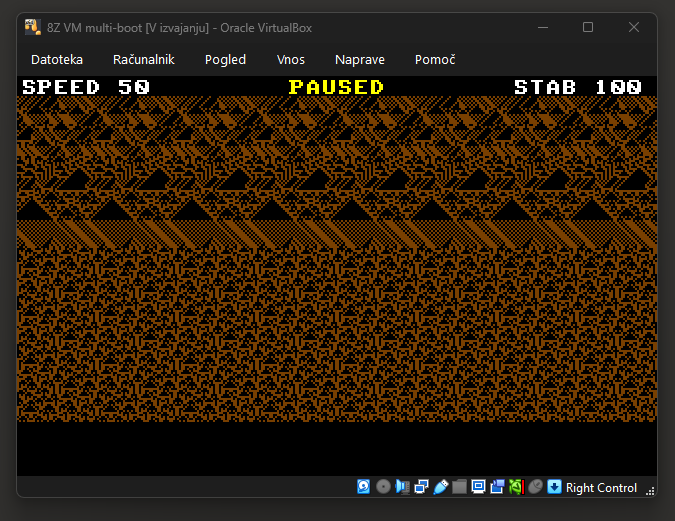
The kernel was empty. They needed proof it could “think.” They took Pi Art — the core logic of the 8Z compression engine — and ported it to bare-metal C++. 1 KB of Pi digits embedded directly in the kernel binary. The “Trinity” of Cellular Automata rules (90, 30, 184) via raw bitwise ops. Direct VGA memory writes to 0xA0000. Custom busy-wait framerate control. No system clock.
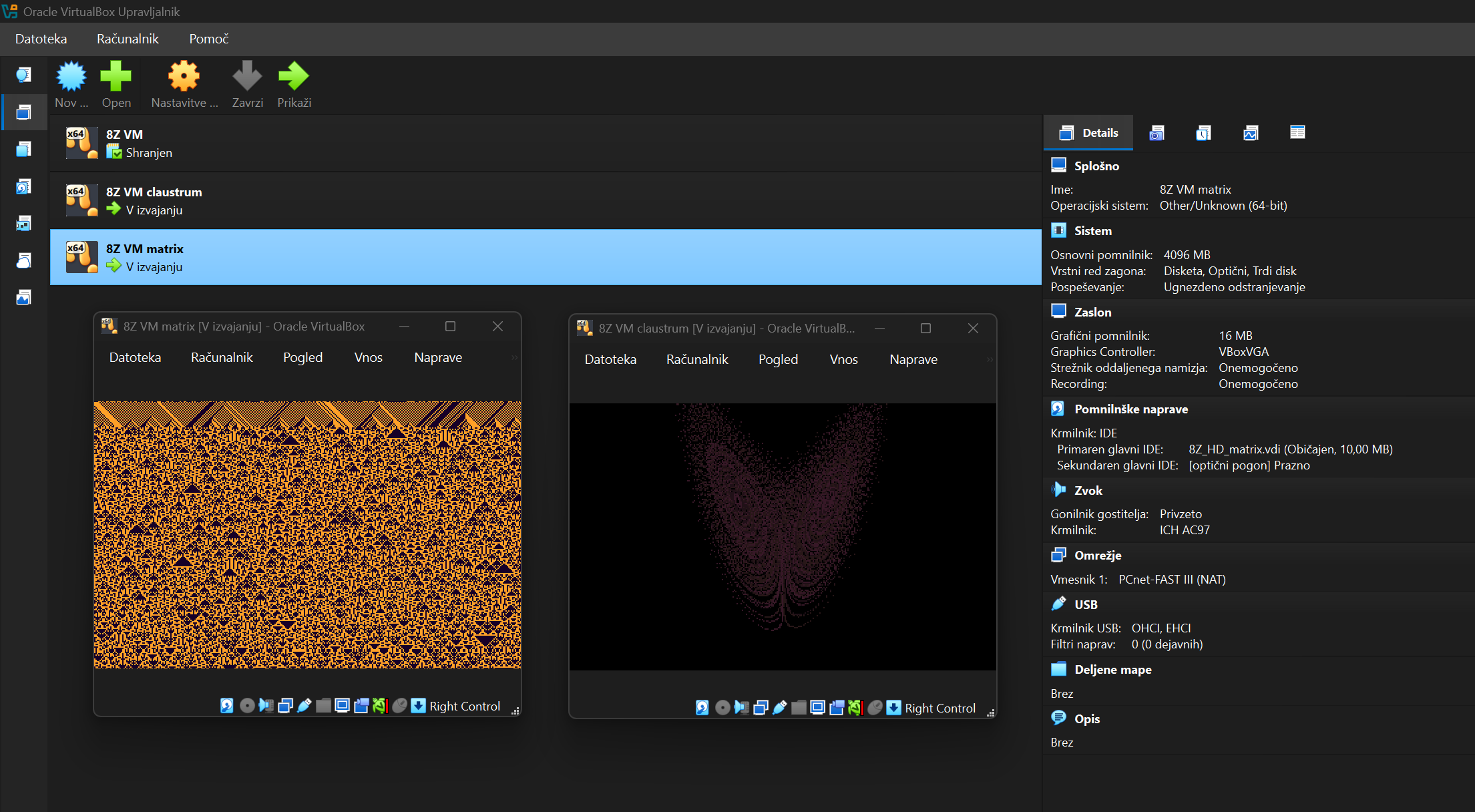
“The static screen erupted. Digital Lava — orange and red pixels generated by pure math — cascaded down the monitor. No Windows Update. No background noise. No jitter. Just math.”
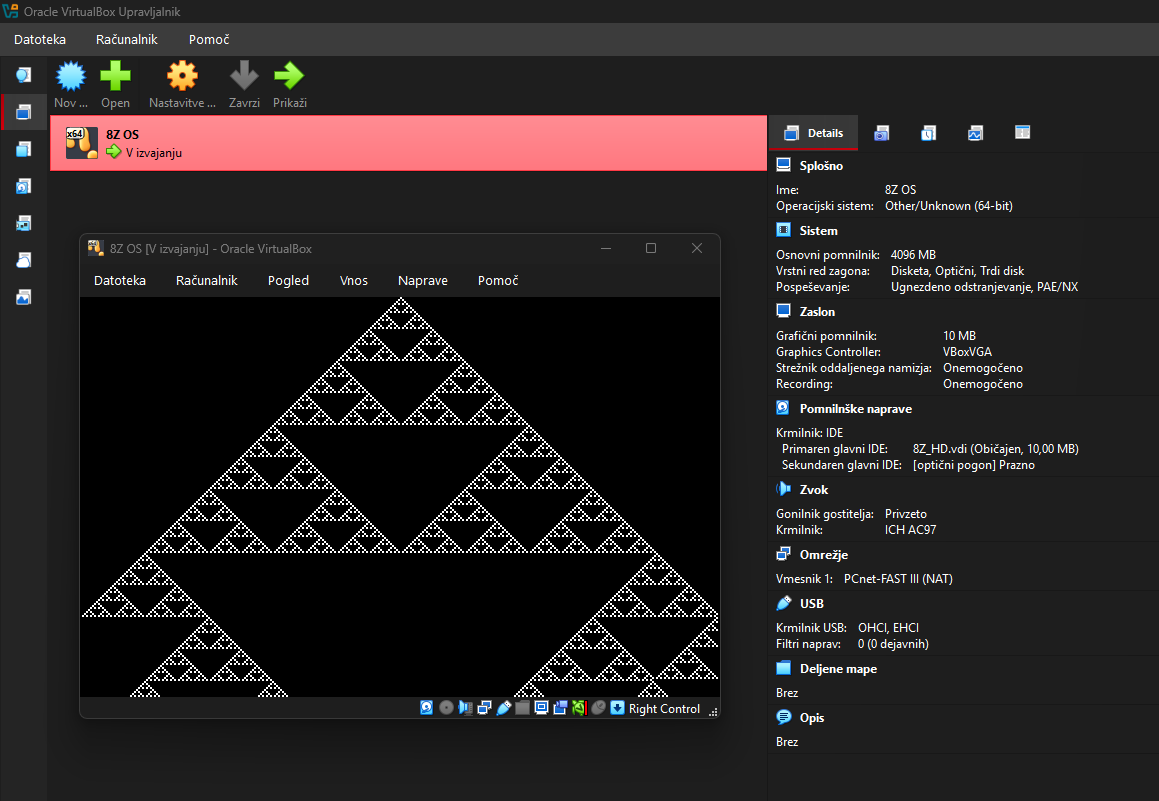
v0.01 — First boot. Sierpinski triangle on black. The “it works” moment.
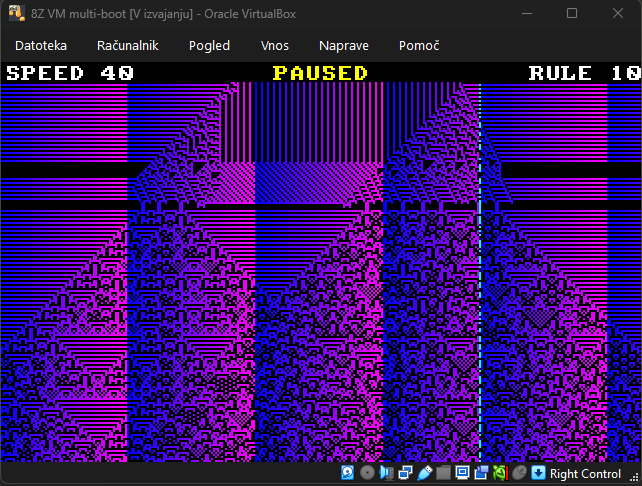
v0.05 — Rule visualization with speed/rule controls. Interactive keyboard-driven HUD.
Chapter 6 · What Happened Next
The Digital Claustrum
The “Matrix” kernel was impressive but passive. Then came kernel-claustrum.cpp: three coupled Lorenz oscillators (chaotic attractors), an LZ complexity sensor monitoring the system’s own output, a coupling parameter that the sensor adjusts in real-time, and target complexity adjustable via keyboard. This is the Digital Claustrum running on bare metal. The same architecture that became the DCC.
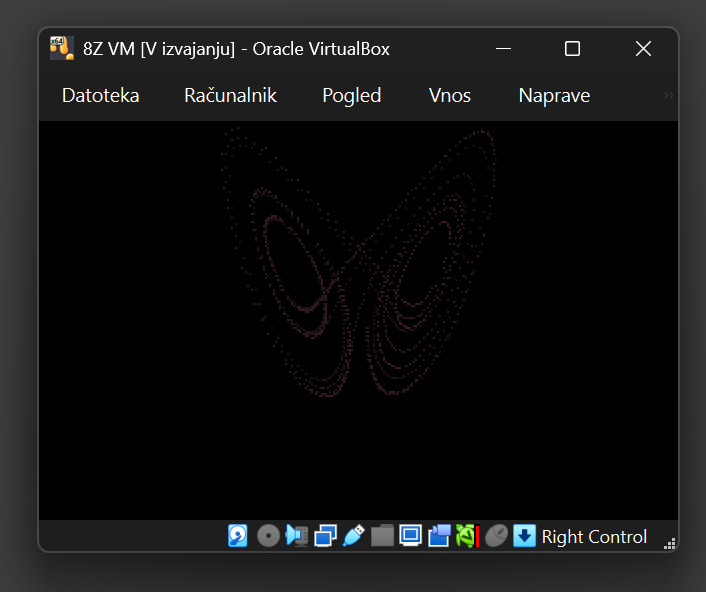
Phase 1 — Initial state. Sparse butterfly. The oscillators are near-lockstep.
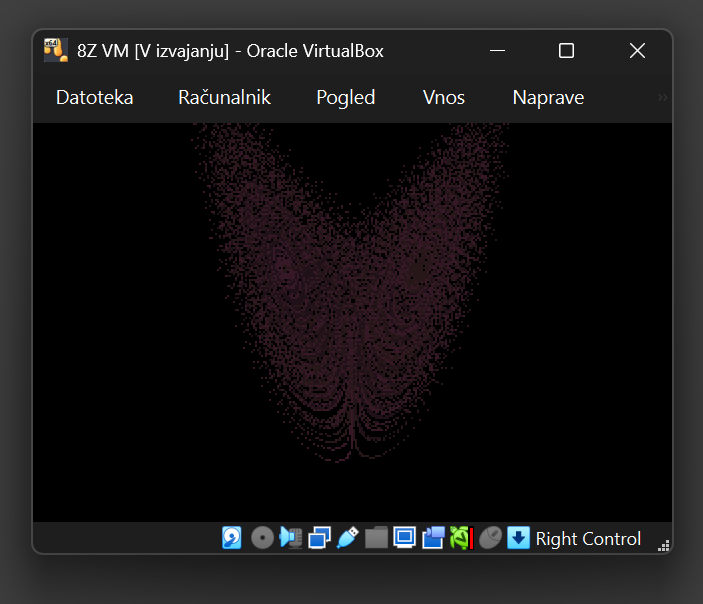
Phase 3 — Dense butterfly. Edge of chaos. The Claustrum is holding integration & complexity in balance.
Side by side — Matrix + Claustrum kernels running simultaneously in VirtualBox.
kernel-claustrum.cpp · lines 121–133C++ · Bare Metal
int32_tcalculate_lzc(uint8_t* history, int len) {
int c = 1; int l = 1; int i = 0;
int k = 1; int k_max = 1;
while (1) {
if (i + k >= len || l + k >= len) { c++; break; }
if (history[i + k] == history[l + k]) { k++; }
else {
if (k > k_max) k_max = k; i++;
if (i == l) { c++; l += k_max;
if (l + 1 >= len) break;
i = 0; k = 1; k_max = 1; }
else { k = 1; }
}
}
return c;
}
This function now monitors TSP workers, trading regimes, and Flip4M game trajectories. It was first written here, on bare metal, with no standard library.
kernel-claustrum.cpp · lines 186–211C++ · The Digital Claustrum Loop
int32_t mean_x = (oscs[0].x + oscs[1].x + oscs[2].x) / 3;
for(int i=0; i<3; i++) {
Oscillator* o = &oscs[i];
int32_t dx = MUL(SIGMA, (o->y - o->x));
int32_t dy = MUL(o->x, (RHO - o->z)) - o->y;
int32_t dz = MUL(o->x, o->y) - MUL(BETA, o->z);
dx += MUL(coupling, (mean_x - o->x));// ← THE CLAUSTRUM
o->x += MUL(dx, DT); o->y += MUL(dy, DT);
o->z += MUL(dz, DT);
// Direct VGA memory write at 0xA0000int sx = 160 + TO_INT(o->x * 4);
int sy = 180 - TO_INT(o->z * 4);
if (sy >= 10 && sy < H && sx >= 0 && sx < W)
VGA[sy * W + sx] = o->color;
}
// LZ Complexity Sensor + Coupling Adjustmentuint8_t bit = (oscs[0].x > 0) ? 1 : 0;
x_history[hist_idx] = bit;
hist_idx = (hist_idx + 1) % HIST_LEN;
if (hist_idx == 0) {
int current_lzc = calculate_lzc(x_history, HIST_LEN);
int error = current_lzc - target_lzc;
if (error < -2) coupling -= TO_FIX(0.5f);
else if (error > 2) coupling += TO_FIX(0.5f);
}
The Digital Claustrum: three oscillators, one sensor, one coupling parameter. The architecture that became the DCC.
The Lineage: One Kernel → Seven Applications
kernel-claustrum.cppBare metal · Dec 2025
→
DCC ConceptGovernor for search
→
DCC v1TSP solver · Feb 2026
→
DCC v2Self-calibrating · Mar 2026
→
Recursive DCCInter-worker governance
→
Trading DCCMarket regime detection
→
Flip4M rDCCGame play governance
Same LZ sensor. Same coupling parameter. Different semantic polarity.
Every DCC deployment traces back to this kernel. The calculate_lzc function written on bare metal with no standard library is the same algorithm that now monitors TSP workers finding optimal tours, trading systems detecting regime changes, and Flip4M agents playing board games.
Chapter 7 · The Kernel Zoo
Six Kernels, Zero Dependencies
All six run on a 320×200 VGA framebuffer with no OS, no libraries, no standard functions. Everything hand-written in C++ compiled with -ffreestanding -nostdlib.
1
Matrix Lava
CA rules driven by embedded Pi digits. Digital orange and red lava cascading down the screen.
2
Digital Claustrum
Lorenz attractors + LZ sensor + coupling feedback. The first complexity controller — on bare metal.
3
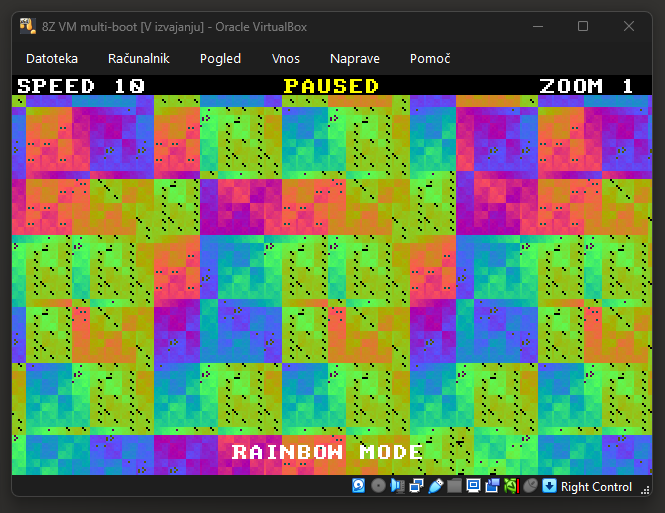
Rainbow XOR
Mathematical pattern generation via XOR operations. The most visually striking kernel variant.
Conway’s emergent complexity. Simple rules, complex behavior — a microcosm of the DCC principle.
6
Starfield Warp
3D star projection on 2D framebuffer. Parallax depth using only integer math.
v0.06 — Multi-boot kernel with SPEED/STAB HUD and interactive controls.
v0.06 Rainbow — XOR pattern generation. Pure math, pure color.
Chapter 8 · The Engineering Record
The Numbers
Metric
Value
Time to first boot
~1 hour
Time to Protected Mode
~5 hours
Time to running math
~6 hours
Bootloader size
512 bytes (64 lines ASM)
Kernel variants
6
External dependencies
0
Standard library calls
0
Lines of kernel (multi)
~800
Graphics
VGA Mode 13h, direct 0xA0000
Build system
Python + NASM + i686-elf-GCC
AI models involved
4 (Gemini, GPT, Claude, Grok)
[Verified]
Bare-metal OS built and booting in VirtualBox
Six kernel variants running complex generative math
LZ complexity sensor running on bare metal (same algo as DCC)
Zero standard library dependencies
[Reasoned]
~6 hours based on file timestamps and session records
The OS → Claustrum → DCC lineage is architectural, not metaphorical
[Prediction]
The DCC architecture will scale to new domains via the same LZ sensor + coupling parameter
Bare-metal determinism may prove essential for consciousness testbed experiments
Chapter 9 · Why This Matters
Not a Tech Demo
Most OS projects take months to print Hello World. This one ran Lorenz attractors with a real-time complexity sensor in an afternoon. But the real significance isn’t speed. It’s what happened after.
The Petri Dish
What the OS proved
That a simple coupling parameter + LZ sensor could maintain edge-of-chaos dynamics in real-time on bare metal. No OS noise. No ambiguity. Pure signal.
The Harvest
What grew from it
The claustrum kernel became the DCC concept. The DCC became a verified architecture governing TSP solving, algorithmic trading, game play, and consciousness testing across 9+ domains.
The 8Z OS is the Petri dish. The Digital Claustrum is what grew in it. Everything else is the harvest.
One kernel. Seven applications. The architecture that might become the substrate for machine consciousness was first written in C++ compiled with -ffreestanding -nostdlib, running on a 320×200 VGA framebuffer, inside a Virtual Machine, on a December afternoon.