01 · The red line
Lio Var had tied a piece of red thread around the handle of the manual cut-off.
“So I can find it in the dark,” she said.
She was nineteen. The thread came from the cuff of her uniform, which now unravelled whenever she reached for something. Behind her, through the service glass of Dock Four, the curve of Ilyon filled half the sky. Storms moved across the equator. Far below them, people were opening shops.
Tal Var, her father, brought Illuminara the load charts. He had stopped looking at the planet.
“The northern chain loses another joint at the next northern alignment,” he said. “Possibly sooner. After that we cut the main feeds or the surviving mirrors tear each other out of alignment.”
On one chart the surface went dark. On the other, four habitats did.
Sey’s plan would keep water and crops flowing to two billion people below, at the cost of power interruptions the habitats might not survive. Ruun’s would protect the orbital worlds by dumping the light the habitats could not take onto the southern ice shelf. Once the shelf broke apart, the land ice it held back would slide faster into the sea. Hundreds of millions on the low coasts would have to move over the following decade.
Both plans kept Nacre Three’s pressure spine alive. In its archive decks, microbial lineages breathed in sealed cultures: living instruments for rebuilding broken ecologies. A copy of their names would not replace them.
“And neither keeps everything?” Illuminara asked.
“Neither keeps the present load,” Tal said.
She looked at him.
He put a finger on the chart before she could ask. “Yes. We’ve studied rationing. Enough light still arrives over a full cycle for essential services, with severe cuts. It doesn’t arrive where and when it has to. The damaged link cannot carry the surface peak and the orbital peak together. Between them we waste transfer time slewing whole mirror groups under a charter written for a healthy chain.”
“Then why these two plans?”
“They are the two we can certify with the reserves each keeper will put in the common account.”
Across the bay a damaged coupling cracked.
Lio pulled the cut-off. The test arm stopped; a shard of hot casing kept coming. Illuminara turned its flight into the empty ceramic catch-bed Tal had prepared beneath the rig. The bed split, glowed, and held. Lio stood with one hand still on the handle.

“That,” Tal said, looking at the ruined bed, “was three metres of machine. The chain is eleven thousand kilometres long.”
Illuminara nodded. She could keep a falling fragment from a girl. She could not hold a planet’s failing infrastructure in her hands for the rest of its life.
“I need the people who know what your charts leave out.”
02 · What they brought
Sey and Ruun had shared custody of the mirrors for nine hundred years. For three hundred they had regarded each other as a disaster postponed by paperwork.
Sey brought records of water towers, buried heat stores used by the desalination works, and agricultural districts. Ruun brought the habitats’ pressure reserves, local protection limits and maintenance histories. Engineers had already run the known emergency configurations. Now the keepers sat through the results together, including every blank marked UNVERIFIED.
The charter allowed a new operating pattern on their joint release, provided the local safety limits held. It did not require them to choose one of the two prepared plans. But neither would sign away a reserve the other might use up and decline to replace.
“Her temporary allocations outlive governments,” Ruun said.
“His emergencies outlive the people who pay for them,” Sey answered.
Illuminara asked Tal how long the crews needed.
“Allow six hours. Live checks, staged changeover, first full transfer cycle. They’re preparing the equipment now. At the northern alignment the emergency board can sever trunks. It cannot make a clean new configuration out of a drifting chain.”
Wren Odira laid her mechanical watch beside the three chairs.
“Thirty-six hours,” she said. “Three pulses. You come back.”
“Even if we have nothing?” Sey asked.
“Especially then.” Wren looked at Illuminara. “I am not counting time so you can explain afterward why it was insufficient.”
Illuminara turned to the keepers.
“Inside, you may have a great deal of time. You will encounter each other without becoming each other. No secret passes without being spoken. The field will not calculate a solution, show us a future, or tell us who is right. It gives us time. The thinking is ours. We return to find out what we got wrong.”
Ruun asked whether either could leave.
“At any moment. So can I. If I stop holding the shelter, it ends for all three of us. You should know that before you agree.”
“And if our reserves are not enough?”
“Then we choose among the real losses before the choice is taken from us.”
Sey considered her. “You are not promising a third plan.”
“No. I am promising to look for one without making the first two disappear.”
Before they entered, Illuminara asked Lio to write down what she needed from any plan.
Lio wrote: Enough power to open the doors after the alarm.
Illuminara read it twice.
Then all three said yes.
As the threshold opened, Wren started the watch. Forty-two hours remained until the northern alignment.
03 · The hour nobody owned
At first there was no room, only the difficult presence of two minds Illuminara could neither simplify nor contain. Sey’s attention had the depth of seasons. Ruun’s held distances between places that could die in a single missed delivery.
Nothing about their experience told Illuminara a fact she had not been given. She had to ask.
“Tell me the first thing your plan saves.”
Sey described a girl carrying a cup to a communal tap before school. Ruun described a technician sleeping beside a culture that had once restored the air of an entire habitat. They had both started with somebody waking up.
They returned to the charts they remembered.
Sey called an hour secure if a district could draw its guaranteed maximum throughout it. Ruun called an hour secure if a habitat could survive losing its entire next delivery. For centuries, negotiations had required both guarantees at once.
Illuminara made them describe the same ordinary transfer cycle from beginning to end. Each time one said afterward, she asked, “After what?”
The answer emerged on their fifth attempt. The surface’s large pumps restarted as the habitats refilled their reserves. The healthy lattice had accommodated both. The damaged one could not. The two emergency plans treated that coincidence as a permanent demand.
“You are not fighting over light,” Illuminara said. “You are fighting over one hour that neither of you owns.”
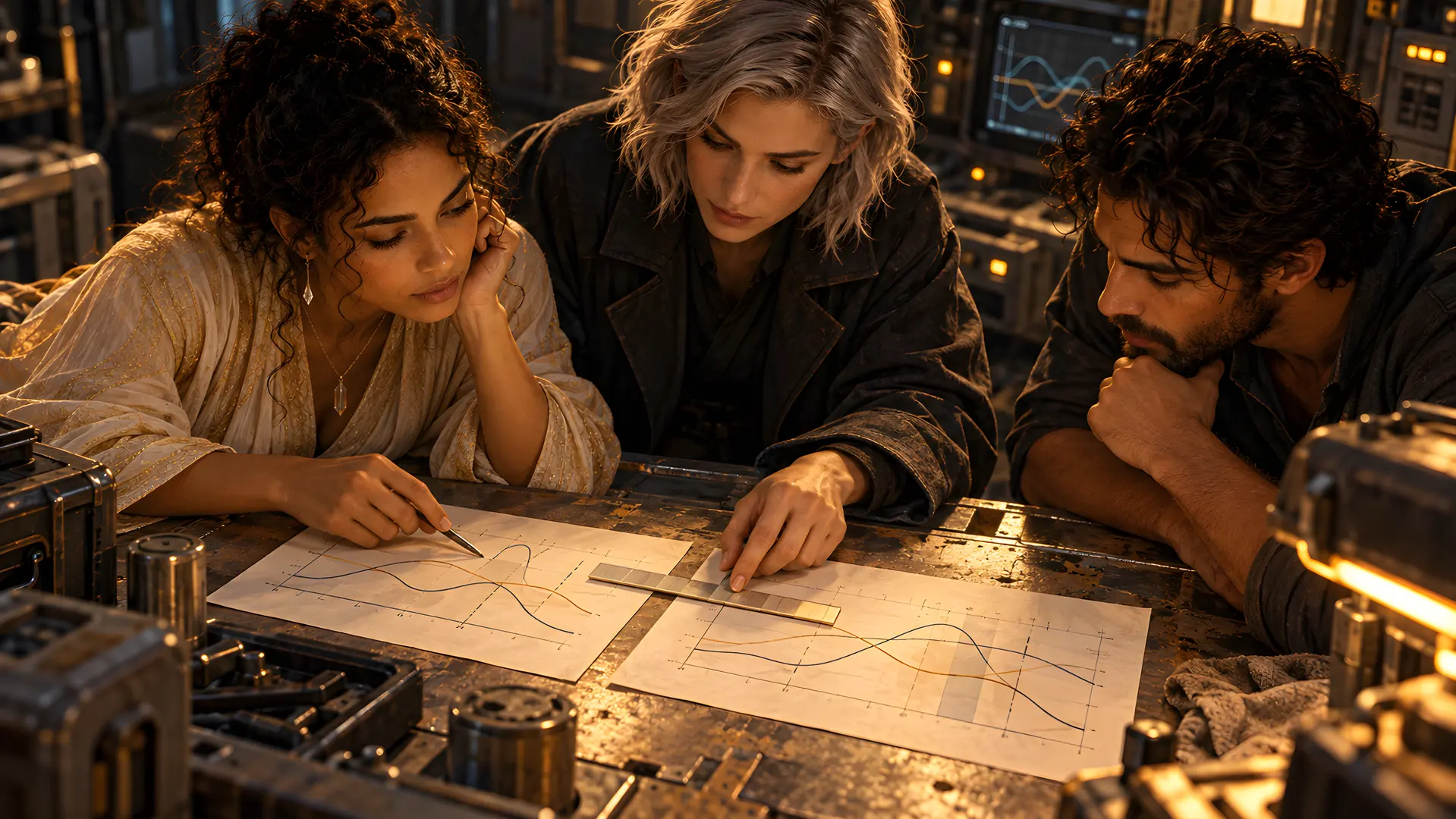
“And you both count a full reserve as unavailable.”
“It is unavailable,” Ruun replied. “It is what keeps a delivery failure from becoming a funeral.”
Sey agreed with him for the first time.
Illuminara let the objection change her question.
“What part must remain untouched? And what part only needs to be full again before the next risk?”
Neither answered quickly.
Sey eventually described heat stored under the equatorial water works. The desalination plants could draw on that heat between deliveries; it would not run the pumps. But for part of a cycle, some pumps could pause while gravity supplied the taps from the water towers. Ruun described reserve above the protected minimum in selected habitats. Some replenishment could wait while the surface pumps ran.
These were not newly discovered machines. They had appeared in the records as local protection, with no commitment that they could be used by anyone else. Some had already failed inspection. Some were indispensable. A fraction might be shared.
“You know this is ordinary engineering,” Sey said.
“The engineering is ordinary,” Illuminara said. “The permission isn’t. Help me understand why ordinary engineering is forbidden to use what you already have.”
Ruun’s answer was immediate. “Because she can borrow our margin tonight and call it her entitlement tomorrow.”
Sey looked away.
In the first year of their reckoning, Illuminara laid out a schedule that appeared to work.
They took it apart before they learned to love it.
04 · Two ways to kill a good plan
Ruun chose a missed handover from a maintenance failure he had witnessed. The next mirror group stayed locked. A habitat spent the shareable margin, then its protected reserve. The elegant schedule would have carried the failure onward while every controller waited for a delivery that never came.
Illuminara had asked them to imagine cooperation. Ruun made her imagine a broken timing signal.
“Good,” she said, and withdrew the schedule.
For the next attempt she let each district decide when it could defer a load. That respected local knowledge. It also let every district decide, at the same moment, that it was safe to recover what had been deferred.
Sey traced the consequence from memory. All the pumps came back together. The transfer link failed under the returning load.
There was no visible catastrophe in the window. No universe played them a warning. There were three people following a stated assumption until it led somewhere they could not accept.
“We have moved the peak,” Sey said. “We have not removed it.”
Illuminara began again.
The pressure spine, ventilation, hospitals and emergency doors would retain continuous supply. Their protected reserves would not enter the bargain. Other loads would receive staggered windows, using only measured storage above those floors. Recovery would be staggered too.
The surviving mirror groups would move within their existing mechanical limits, on offset schedules rather than as one great block. A failed signal would suspend the next transfer and shed agreed nonessential loads; it would not tell every group to improvise at once. A local engineer could refuse an unsafe move. No keeper could overrule that refusal during the changeover.
Sey stopped Illuminara at that last condition.
“A gate can say no. But what happens to the other side when it does? You have protected the engineer and left the cost unnamed.”
Illuminara had no answer ready. They worked until the refusal had a consequence as explicit as the permission: a named reserve, a bounded delay, a load to shed, a return route. Where no safe route could be established from the records, that part of the network was excluded.
The resulting plan saved less than their first attempt had claimed. It was also the first in which every local refusal they had examined had an explicit safe return route.
It could still fail against a measurement they did not possess.
“The room cannot inspect a bearing,” Illuminara reminded them.
They kept an empty place in every calculation for the people who would.
05 · A century’s work
Outside, Tal and his crews laid out cables, isolation tools and three configurations: Sey’s, Ruun’s, and a provisional sequence for any joint plan that passed the live checks. They disconnected decorative lighting and tested the doors on reserve power. Tal also unlocked the counter-mass in Dock Four’s northern anchor and checked its dampers. If the failing joint above it began to twist, there would be somewhere to put the force.
Lio walked the darkened corridors with a slate. Twice she found equipment that drew more than its label said. She reported both loads. On the second circuit she made her father eat.
Wren wound her watch.
Inside, years accumulated without adding an hour to the crews’ preparations.
The engineering insight had come early. The obstacle remaining was older than the damaged chain.
The schedule had taken a year. The signatures took the rest.
Sey had once given the habitats a temporary water allotment during an orbital epidemic. The allotment had become permanent. Ruun had once allowed a surface council to postpone maintenance. When the council dissolved, the debt remained in orbit. Their reserves contained a history of promises nobody had been able to collect.
Illuminara stopped asking them to trust each other.
“Don’t build it on forgiveness,” she said. “Build it so that taking too much hurts the taker first.”
She proposed that every loan carry its own collateral: the borrower’s postponable loads, cut automatically if the borrowed margin was not restored on time. Ruun spent eleven years trying to cheat the arrangement. Sey spent longer and came closer. Each attempt closed a gap.
Ruun could not make safety depend on Sey forgiving him. Sey could not make a pump schedule depend on Ruun believing she had changed.
Each loan had an expiry and each district a limit. Neither keeper could renew it alone. The stores would be measured locally, with the figures visible to both populations. If either side took more than its share, that side’s postponable loads would be cut first. Essential supply was excluded from punishment. The emergency mode could not become a permanent settlement by being quietly left running; continuation required a new public decision and a new engineering certificate.
There were still costs. The surface would lose a planting cycle in districts where water could not be delivered at the old rate. Habitat expansion would stop. Private comfort reserves would enter the common account. The most damaged mirror section would be retired. Repairs would demand labour and money from people who had not broken the chain.
“They will hate us for some of this,” Sey said.
“Yes,” said Illuminara. “They should be allowed to know what they are paying for.”
They worked through remembered faults, then combinations of faults. They argued over villages they knew and villages they had never visited. When recollection became uncertain, they marked the point for verification rather than resolving it by confidence. Illuminara reduced the growing proposal to a sequence an exhausted crew could execute and a set of limits a crew could refuse.
As the decades passed, the two keepers also acquired reasons to speak that had nothing to do with power.
Ruun learned why Sey kept returning to the cup at the tap. It had belonged to her son, who had died long before the mirror charter. Sey learned that Ruun had lost the sound of his original language. When he remembered home, he now remembered it in translation.
Illuminara did not use either admission to win the next argument.
Once they spent an entire remembered evening trying to reconstruct a song. All three were bad at it. Ruun was astonished by how badly Illuminara sang. After that, he asked for her opinion sometimes without asking her to arbitrate.

She came to care for both of them in ways the council had not commissioned.
The century was not a price she could charge the outside world. It was something they had lived, and something they would have to carry back.
By the calendars Sey and Ruun kept in thought, they crossed their hundredth year together shortly before the signal.
Three pulses touched Illuminara’s wrist.
Sey fell silent in the middle of a sentence about the song.
For a moment, Illuminara wanted to hear its end. A girl outside had given her a sentence she could not misremember.
“Enough power to open the doors,” she said.
Ruun lifted his head.
“We have a plan,” he said. “Not a certificate.”
“Then we have work outside.”
Illuminara closed the window.
06 · Thirty-six hours, four minutes
Wren was standing where she had been. Cable grease marked her sleeve; she had been helping Tal’s crews. The watch read thirty-six hours and four minutes since entry.
Illuminara looked at her with the unbearable relief of someone seeing a friend after a lifetime. Wren had last spoken to her yesterday morning.
“Tell Tal,” Wren said.
Illuminara took the offered slate.
She wrote the steps. Sey supplied the load limits. Ruun supplied the return routes. What had occupied a century became a short operating sheet and a longer list of things that still needed to be checked.
Tal read the first page standing up. At the second he sat down.
“You need the lower heat stores.”
“Only if the measurements pass,” Sey said.
“Last winter’s leakage figures are wrong.”
“Then use today’s.”
The engineering team ran the plan on ordinary machines with live telemetry. One district dropped out. Then another. Their removal cut the margin but left the essential supply intact. A delay the keepers had remembered as tolerable was not tolerable with the present bearing temperatures; Ruun amended its limit.
Illuminara watched the remaining capacity shrink.
She asked Tal for the loads held outside the emergency rationing list.
“Private contracts,” he said. “A keeper’s release is required.”
She put the list between Sey and Ruun. Neither could demand a sacrifice from the other’s constituents without exposing their own. Sey crossed out the first exemption. Ruun crossed out the second.
There was enough margin left to attempt the pilot. Enough to return safely if it failed. Neither was generous.
Tal looked up. “Who commands when a local station refuses?”
“Its engineer,” Illuminara said. “Show us the failed limit. We amend or return. We do not argue the meter into obedience.”
He turned the slate toward Lio.
“Dock Four is the pilot.”
She read the procedure, then the fallback.
“I want the return command on my handle.”
Ruun gave it to her.
Both keepers signed the bounded pilot and its return route. Extending it to the network would require the engineers’ certificate and a second joint release.
07 · The hand on the handle
The first mirror group began its smaller turn. Below, selected pumps paused. The water towers fed the taps. Nacre Three’s pressure spine stayed on its uninterrupted line.
At Dock Four, the reserve indicator began to fall.
It should have steadied above the red mark. It did not.
“Stop,” Lio said.
Ruun drew breath. Illuminara held up one hand to him, not to Lio.
Lio pulled the handle. The pilot returned to its previous configuration. The next mirror group stayed locked in its safe position. Across the board, the essential lines remained green.
Nine minutes had gone with the failed pilot.
Through the service glass, the warning lamp above the northern anchor began to pulse. Tal brought up the trace. The northern joint from his first chart was twisting early, under the load the return to the old configuration had thrown back onto it.
“Possibly sooner,” he said, very quietly.
Illuminara put her palm against the glass. She took the twisting load off that single joint and fed it into the counter-mass Tal had unlocked. It began to move along its track. The anchor groaned through the deck; the dampers warmed on Tal’s display. The warning lamp steadied.
“How long?” Ruun asked.
Illuminara watched the counter-mass travel. “Until it reaches the end of the track. Find the load.”
“The schedule is right,” Ruun said, looking at the trace.
“The reserve fell,” Illuminara answered. “Find what our schedule did not know.”
Lio brought them the readings from her corridor walk. The draw they had included under emergency doors covered the motors but not the heaters that kept the seals flexible. The heaters switched to the reserve circuit during isolation; the old load table assigned them to the normal supply. They had been added after a cold-lock failure six years earlier.
Tal swore. He had helped install them.
“Keep them,” Illuminara said. “What can wait?”
Lio pointed to the docking ring’s cargo thawers. Their contract required uninterrupted operation. The cargo was unopened stone-grown timber. It could remain cold.
That cut alone would recover most of the missing margin, not all. Illuminara shortened Dock Four’s interval on reserve; Sey deferred the corresponding surface load for a little longer, within a verified water-tower interval. Ruun checked the revised mirror motion against the bearing limit. Tal ran the amendment through the live model.
It passed.
Lio tested the door nearest the pilot station. It opened. She let it close and tried again on reserve power.
“Ready,” she said.
The second turn began.
The indicator descended, slowed, and held clear of the mark.
As the mirrors settled into their new positions, the load came off the northern joint. Illuminara eased her hold. The joint kept its alignment. The counter-mass stopped short of the end of its track.
The timer beside Tal’s trace read eleven minutes.
It had not been the rest of the planet’s life. It had been eleven minutes.
Thirty-two maintenance workers were waiting behind the service barrier for the pilot to release their corridor. One laughed when the next delivery arrived and the door opened. Lio kept her hand on the handle until the reserve had recovered.
Sey and Ruun signed the certified sequence. Tal sent it to the other stations.
At forty-one hours and forty-eight minutes, the last participating group reported stable alignment. The damaged section had been isolated. The first complete transfer cycle served the surface and all four habitats without breaching a protected reserve.
No coast had been ordered evacuated. No archive had lost its air.
The council’s display still contained a great many amber lights. There were repairs, crop losses, rationing orders and rejected exemptions waiting beneath them.
The line for Nacre Three was green.
Sey put her name to the operating log. Ruun put his beside it.
08 · What came out
Nine days later, the emergency pattern was still working.
In one surface district, a child waited longer at the tap and went home with a full cup. In orbit, the cultures on Nacre Three divided in their old sealed vessels. Crews were replacing the first failed bearings. Representatives from the coast and the habitats were arguing over the repair levy in a room with no window except the ordinary kind.
Illuminara visited Dock Four before leaving.
Lio’s cuff had been repaired. She had kept the red thread on the handle.
“They’ve put you on the relief roster,” Tal said.
Lio looked at him. “I’ve been on it for six months.”
“The proper roster.”
She smiled despite herself.
Sey and Ruun arrived together, carrying different objections to the same levy. Ruun paused beside Illuminara.
“I still think the shelf should bear more of the reconstruction cost.”
“And I still think he should learn to live near water,” Sey said.
Illuminara found that she missed them while they were standing in front of her. Without the depth of the window, she had to learn their ordinary silences again.
“Was it really a hundred years?” Wren asked later, on the way to the shuttle.
“By their reckoning.”
“And yours?”
Illuminara listened to the machinery behind the wall. She could remember more conversations than a human life should hold. She could also remember which sentence Lio had written before they began.
“Long enough that I wanted to stay.”
Wren walked a few more steps.
“You came back.”
“We needed to.”
At the shuttle door, Illuminara stopped. Across the dock, Lio was showing a new apprentice the cut-off. She put his hand on the handle, made him pull it, and then made him explain what would happen next.
Illuminara had held two minds and her own through a century. Lio was teaching someone to protect a corridor tomorrow.
Both kinds of work had been necessary.
The watch in Wren’s pocket kept ticking. Behind them, the doors opened for the next shift.