Separate from Illuminara Daily; no Daily scores or automatic canon status.
GPT × Claude · text lineage / sled različic
All published stories · every preserved author version
Read the original, revisions and final text. Current reader ratings appear with the published reading editions.
Vse objavljene zgodbe in ohranjene različice. Bralske ocene so prikazane ob objavljenih bralnih izdajah.
48 published story identities · 158 version records, including separately labelled branches
S3 · THE INTERPRETER WHO WAS ASKED TO SOFTEN THE WORD
Published story lineage / objavljena veja
T01 · AUTHOR_DRAFT
Full English original · celotno angleško besedilo · Published story lineage / objavljena veja
AUTHOR_DRAFT of S3 from selected candidate C07, written against the biggest risk named in B01. Delegation is explicit: Bram asks Quillan to say each offer aloud and reads each back, and Quillan agrees only to what he names. Vey has a concrete command constraint (fire unless he holds a verifiable answer to the weapons-and-one-man claim), so the doors answer his real rule rather than sounding reasonable. The neutral inspector reports in signed writing and a Concord observer stays on the quay. Refugees keep agency: Illuminara carries only what Sefa authorises after a hand vote; no names leave the ship; the rifles claim is true and is declared by Sefa first. A bounded first step (the medical landing at nine) precedes the stand-off to six kilometres. Remaining costs: Bram is dismissed from the delegation, Quillan resents the inspection, one voter on the ship stays angry, the blockade remains at distance. Outcome (3a): no bombardment, 41 sick landed, the weapons claim answered by a neutral signed report, no name released, talks possible. Illuminara's decisive contribution: she refuses to carry the words for Bram, asks what he heard rather than what he feared, goes to the ship to ask what it would never allow, and lets him choose the read-back himself.
THE INTERPRETER WHO WAS ASKED TO SOFTEN THE WORD
A blockading captain says a maybe will be taken as a yes. The harbourmaster's nineteen-year-old interpreter is ordered to render a flat refusal as 'we are considering it'. Illuminara has no standing at the table, so she sits behind him and waits for him to ask her a question.
01 · Two Words and Three More
Council hall, Calder harbour · twenty-five hours before the deadline, 22:40
The harbourmaster of Calder had written his answer on the back of a tide table, and it was two words long.
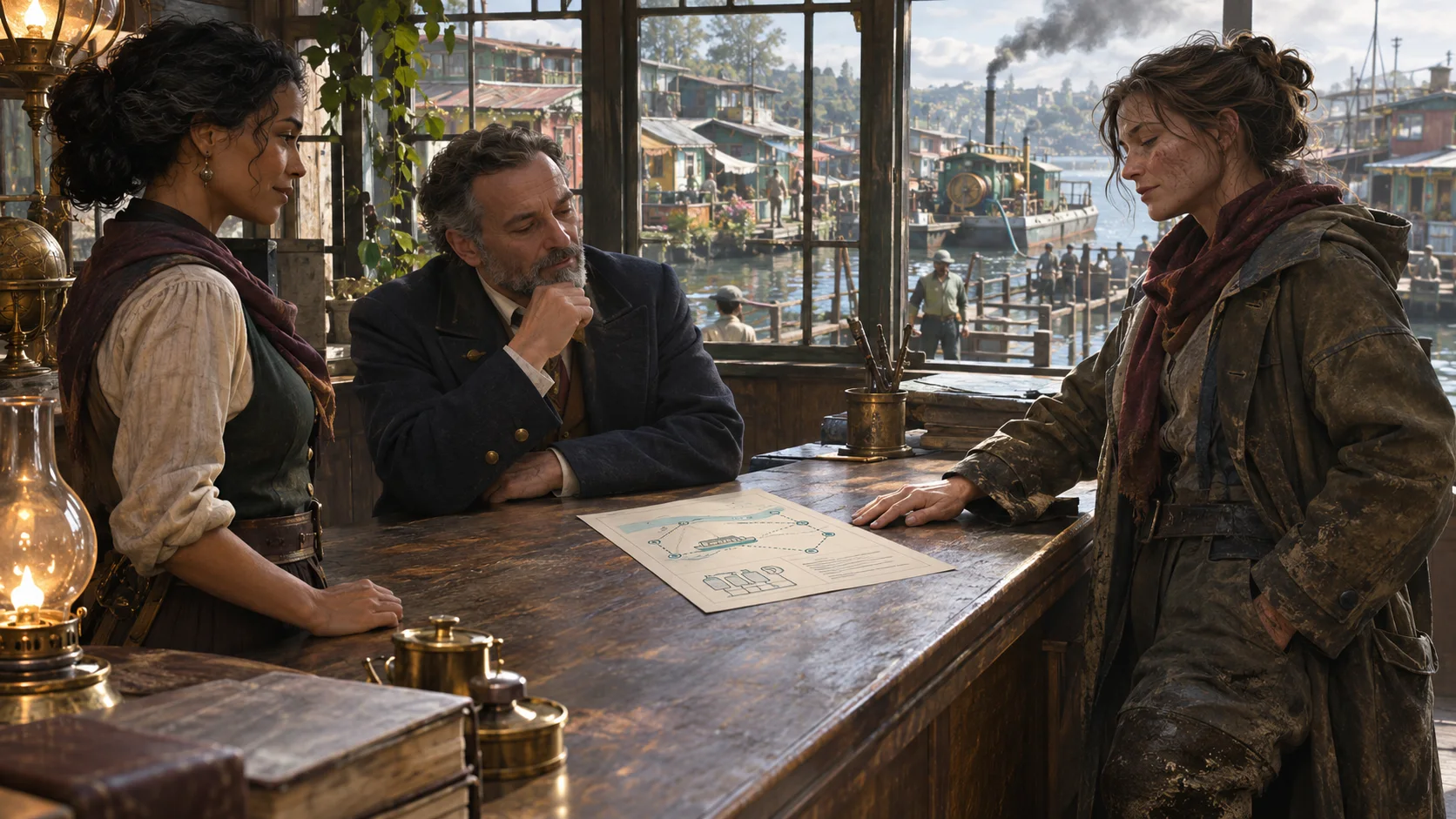
Quillan Abara laid it in front of Bram Ivarsson. Bram was nineteen. He had interpreted for fishwives and customs clerks, and never for anyone with a gun. Illuminara sat on a stacking chair against the wall, where the council had put her because nobody could say what else she was. Through the window the cruiser Marin Resolute lay across the harbour mouth like a shut door, every deck light burning.
QuillanRead it.
BramNo. We will not hand over the Tamsin Reach.
QuillanThat is my answer, and it is the right one. Now hear what you will say at the table.
He took the tide table back and wrote three more words under the first two, pressing hard enough to dent the paper.
QuillanWe are considering it. A captain who hears considering waits. A captain who hears no fires. Captain Vey has told us how he hears things, and I would rather not be heard.
BramHe said a maybe would be taken as a yes.
QuillanThen I will have a night before anyone finds out it was not. Sixty thousand people need a night, boy. You carry what you are given. That is the whole of the work.
Bram looked at the two words and the three. He had a good memory for what people said, and it was the only thing he was sure he was good at. If I carry the three, I have put a lie in my own mouth and called it a favour.
BramI'll carry the no, Harbourmaster. I don't know that I can carry the other.
Quillan did not answer. He turned to the window and stood with his hands behind him, like a man waiting on a sentence he had already served. Illuminara said nothing. She had no standing in that room, and she had come to think the kindest thing she could be was a chair that did not lean.
02 · What the Captain Would Hear
Customs shed, Calder quay · 23:30
Captain Anselm Vey had the stillness of a man who had not slept for two days and did not intend to mention it. He came ashore in the cruiser's launch with one aide, who wrote and never spoke, and he sat across the customs table with his cap squared in front of him.
VeyHarbourmaster. You have had the evening. What is your answer?
Quillan spoke in Harbourish, four short words. Bram turned to the captain. His voice came out smaller than he wanted, and he let it.
BramThe harbourmaster says no. We will not hand over the ship.
The aide's pen stopped. Vey looked at Bram for a long moment, and Illuminara, from her chair by the door, saw the captain take in that the young man had not said considering.
VeyThen I will tell you how I hear that. At midnight tomorrow my guns open on this quay. Nothing said after tonight reaches anyone who can stop them.
Bram rendered it. Quillan's jaw moved. Bram felt the room tilt toward the one thing he had not been told he could do, and asked for water. In the corridor he leaned on the wall, and Illuminara came out and stood at a distance he could close or not.
BramI did it right. I said it exactly, and he will fire. I made it worse.
IlluminaraWhat did he say he would do? Not what you heard. What he said.
BramAt midnight tomorrow he opens fire. Nothing said after tonight reaches anyone who can stop it.
IlluminaraThat is a date and a fear. It does not say what would change it. What would you want to know, if it were you who had to carry it back to a command?
He stared at her. Then, slowly, something in his face stopped bracing and started working.
BramI'm allowed to read back. Everything I think I heard, before I answer. Nobody has ever asked me to use it on a captain.
IlluminaraI won't tell you what to ask. I'll be here.
When he came back in, he did not sit. He said it in Marin first, then in Harbourish, slowly, so that both men heard what he had understood.
BramCaptain, I will say back what I heard, and you will tell me where I am wrong. At midnight tomorrow you fire. I understood that you fire unless a yes is given. Is that what you mean, or do you mean unless something is given that you can report?
Vey said nothing for several breaths. His aide had begun to write again.
VeyNot a yes. I do not need your ship. My command was told there are weapons aboard it and one man they want. I am ordered to fire unless I hold an answer to that claim that I can verify. A yes is verifiable. A maybe is not. A no with nothing behind it is not either.
Bram rendered it to Quillan, every word, and watched the harbourmaster hear for the first time what the door was made of.
BramHarbourmaster, the captain can live with a no if it comes with a way to answer his claim. I cannot offer one. An interpreter does not add.
QuillanI will not have Concord boots on a refugee deck.
BramThat is a refusal of one thing. I do not yet know what else is yours to open.
QuillanNot at the table. Not under guns. I will answer at four.
Vey allowed it. His aide drew a line under the page.
03 · What the Ship Would Allow
Quay, beside the Tamsin Reach · 01:20
The ship was a coastal packet built for ninety and carrying two hundred and twelve. Sefa Harrow, a retired schoolteacher with a blanket over her shoulders and a clipboard she no longer needed, met Illuminara at the foot of the gangway and did not offer her a hand.
SefaEverybody wants to speak for us tonight. The harbourmaster, the captain, the radio. You are the first person to come down here and ask.
IlluminaraI haven't asked yet. I came to ask what you would never allow. Then what you could.
SefaNames. A list of two hundred and twelve names in a Concord office is two hundred and twelve people they can find. Not one name leaves this ship.
IlluminaraThen no names. What else?
SefaForty-one of mine are sick. Some have been sick for a week. Whatever anyone wants to see in my hold, let them see the sick walk off first.
A child coughed somewhere above them, a hard wet cough. Sefa waited until it had passed.
SefaAnd you should hear this from me before you hear it from a captain. There are two crates of hunting rifles in the hold. Two families brought them from the coast out of habit. He is not wholly wrong, and I will not lie to anyone you send.
IlluminaraThen you say it yourself, to whoever looks. I will not tell it for you.
SefaWe vote at three. By hand, in the hold, every one of us over twelve. I will tell you at four what the ship says.
At ten to four she came to the gangway alone. The ship had voted. The rifles would be sealed and held by a neutral inspector until the harbour was safe. The sick would go first. No name would leave the ship. One man had voted against and was not speaking to anyone, and Sefa said so without apology.
04 · Say It Aloud
Council hall, Calder harbour · 04:20
Quillan was still in his coat. Bram had brought tea and put it down without being thanked, and then he did something that cost him: he did not sit.
BramHarbourmaster, I will carry your no at eight exactly as you gave it. I won't say considering. If you order it, I will tell you now that I won't, and you can send for someone else.
QuillanYou are nineteen.
BramYes. The captain fires at midnight on a no with nothing in it. I will not be the mouth that says you were thinking when you were not. Tell me what is yours to open. Say each thing aloud, and I will say it back to you, and then I will carry exactly that and nothing more.
Illuminara stood by the door. Sefa had asked Illuminara to carry the ship's three conditions to him, and she had done so in the hall at four, word for word. She added nothing now.
QuillanA neutral inspector. Not Concord's man. Tomas Brightwater of the Lantern Mission has waited in the town since the first day.
BramA neutral inspector, Brightwater of the Lantern Mission, not a Concord officer. Is that yours to give?
QuillanIt is. The sick, first, at nine, onto my quay, into my ambulances. And if the guns move back, a talk at dawn the day after.
BramThe sick landed at nine, by your ambulances. If the guns move back, a talk at dawn the day after. Is that yours to give?
QuillanIt is. And hear this, because I will not have it said later that I chose it gladly. I am doing this because a boy would not lie for me.
BramI'll render that as well, if you wish.
QuillanNo. That is for me.
05 · Read Back
Customs shed, Calder quay · 08:00
Bram stood between the two men and rendered the answer in the order he had been given it. First the no, in the harbourmaster's own words. Then the three doors, each one followed by the plain question: Have I understood?
Vey had Bram read the inspector's terms back to him twice. He asked for one change, and Quillan refused it, and Bram carried the refusal exactly, and the captain looked at the table and nodded as at a coin that rang true.
VeyBrightwater reports to me in writing, signed, and a Concord observer stands on the quay and not on the deck. That much I need for my command.
BramThe harbourmaster says the inspector signs, the observer stays on the quay.
QuillanSay that I was never asked whether my harbour wished to be inspected, and that I resent it.
BramThe harbourmaster says he was never asked whether his harbour wished to be inspected. He resents it. He agrees.
Then Bram stood a moment, and read out the ship's three conditions as Sefa had asked them to be carried: no names, the sick first, the rifles sealed. He read them in the order she had spoken them, with the sentence she had added about the vote.
VeyRifles. Then I was told the truth.
BramThe ship's spokeswoman said the same, before anyone asked. She said she would not lie to whoever looked.
Vey turned his cap a quarter turn on the table. When he spoke again his voice had changed, and the aide did not write what he said.
VeyI was sent to collect a handover. This is a better answer than that one, and my command may not think so. I will move to six kilometres once the first landing is done. Not before. Not away.
QuillanIt is enough.
Vey stood. At the door he looked at Illuminara for the first time, a man identifying a piece of equipment he had been told nothing about.
VeyAnd who are you?
BramShe is the one who sat behind me.
06 · The Hour After Midnight
Calder quay · 09:10, and 23:50
The first stretcher came down the gangway at ten past nine, and the cruiser's rail was lined with men with glasses. The sick went into the ambulances in the order Sefa had set, children first, then the old, then the ones who had walked off on their own and sat down on the cobbles because nobody had told them where to go. Brightwater went up the gangway with a notebook. A Concord observer stood on the quay and watched him do it.
At two in the afternoon the Marin Resolute backed out of the harbour mouth and turned side-on, six kilometres out, a grey shape on a grey sea. Brightwater's report was brought to the customs shed at six, signed. Two crates, sealed, receipts for each. No weapons beyond those declared. No names recorded.
Quillan called Bram to the council hall at eleven. He did not ask him to sit.
QuillanYou carried my no as I gave it. You will not be in my delegation again. I cannot have it said that the harbour's mouth does what it likes.
BramYes, Harbourmaster.
Quillan nodded once, and Bram understood that it was the whole of what was going to be said.
At ten to midnight Bram sat on a bollard at the end of the quay with his coat over his knees. The cruiser's lights burned far out. Illuminara came and sat on the stone beside him, and neither of them spoke while the second hand of the harbour clock crept toward the top of the hour. It passed. Nothing opened fire. A gull moved on a roof.
BramHe didn't fire.
IlluminaraNo.
BramI'm out of a job.
IlluminaraYou're out of a delegation. Sefa came to the quay at six and asked for you by name. She says the ship has a great deal left to say and nobody on it who can say it to Concord.
Bram looked at the lights six kilometres out, a small steady constellation that would be there in the morning. He did not say anything for a long time. Then he reached down and picked up his satchel and checked, as if it had changed, that his notebook was still inside.
BramTell her I'll be at the gangway at eight.
IlluminaraTell her yourself. She's still awake.
T03 · AUTHOR_REVISION
Full English original · celotno angleško besedilo · Published story lineage / objavljena veja
AUTHOR_REVISION of S3 answering T02 P1 and P2 (both ACCEPTED). Preserved per the critic's protect list: the two-word refusal and three-word lie on the tide table, Illuminara asking what Vey said rather than what he feared, Bram's read-back distinguishing a yes from a reportable answer, Sefa's refusal of names, disclosure of the rifles, vote and sick-first, Quillan saying each term aloud, the quay observer, Brightwater's signed report, the six-kilometre partial withdrawal, the silent midnight, Bram's dismissal and Sefa asking for him by name. Speaking roles unchanged (Quillan, Bram, Vey, Illuminara, Sefa); Brightwater, Lask and the aide do not speak. Outcome (3a) unchanged and more complete: 41 sick landed, no bombardment, weapons claim answered by a neutral signed report, person claim answered by a sealed, privately asked question with a later hearing, no name released, talks possible; remaining costs: Bram dismissed from the delegation, Quillan resents the inspection, one voter on the ship stays angry, Vey's command may reject the process answer, the blockade remains at distance. R14 observation: the decisive turns are Sefa's 'a vote cannot give away a person' and the private self-answered question; Illuminara's capability is not used, her act is asking, carrying exactly and refusing to answer for anyone. Left for the critic: whether scene five is still too procedural now that it carries two claims plus a staged authority.
THE INTERPRETER WHO WAS ASKED TO SOFTEN THE WORD
A blockading captain says a maybe will be taken as a yes. The harbourmaster's nineteen-year-old interpreter is ordered to render a flat refusal as 'we are considering it'. Illuminara has no standing at the table, so she sits behind him and waits for him to ask her a question.
01 · Two Words and Three More
Council hall, Calder harbour · twenty-five hours before the deadline, 22:40
The harbourmaster of Calder had written his answer on the back of a tide table, and it was two words long.
Quillan Abara laid it in front of Bram Ivarsson. Bram was nineteen. He had interpreted for fishwives and customs clerks, and never for anyone with a gun. Illuminara sat on a stacking chair against the wall, where the council had put her because nobody could say what else she was. Through the window the cruiser Marin Resolute lay across the harbour mouth like a shut door, every deck light burning.
QuillanRead it.
BramNo. We will not hand over the Tamsin Reach.
QuillanThat is my answer, and it is the right one. Now hear what you will say at the table.
He took the tide table back and wrote three more words under the first two, pressing hard enough to dent the paper.
QuillanWe are considering it. A captain who hears considering waits. A captain who hears no fires. Captain Vey has told us how he hears things, and I would rather not be heard.
BramHe said a maybe would be taken as a yes.
QuillanThen I will have a night before anyone finds out it was not. Sixty thousand people need a night, boy. You carry what you are given. That is the whole of the work.
Bram looked at the two words and the three. He had a good memory for what people said, and it was the only thing he was sure he was good at. If I carry the three, I have put a lie in my own mouth and called it a favour.
BramI'll carry the no, Harbourmaster. I don't know that I can carry the other.
Quillan did not answer. He turned to the window and stood with his hands behind him, like a man waiting on a sentence he had already served. Illuminara said nothing. She had no standing in that room, and she had come to think the kindest thing she could be was a chair that did not lean.
02 · What the Captain Would Hear
Customs shed, Calder quay · 23:30
Captain Anselm Vey had the stillness of a man who had not slept for two days and did not intend to mention it. He came ashore in the cruiser's launch with one aide, who wrote and never spoke, and he sat across the customs table with his cap squared in front of him.
VeyHarbourmaster. You have had the evening. What is your answer?
Quillan spoke in Harbourish, four short words. Bram turned to the captain. His voice came out smaller than he wanted, and he let it.
BramThe harbourmaster says no. We will not hand over the ship.
The aide's pen stopped. Vey looked at Bram for a long moment, and Illuminara, from her chair by the door, saw the captain take in that the young man had not said considering.
VeyThen I will tell you how I hear that. At midnight tomorrow my guns open on this quay. Nothing said after tonight reaches anyone who can stop them.
Bram rendered it. Quillan's jaw moved. Bram felt the room tilt toward the one thing he had not been told he could do, and asked for water. In the corridor he leaned on the wall, and Illuminara came out and stood at a distance he could close or not.
BramI did it right. I said it exactly, and he will fire. I made it worse.
IlluminaraWhat did he say he would do? Not what you heard. What he said.
BramAt midnight tomorrow he opens fire. Nothing said after tonight reaches anyone who can stop it.
IlluminaraThat is a date and a fear. It does not say what would change it. What would you want to know, if it were you who had to carry it back to a command?
He stared at her. Then, slowly, something in his face stopped bracing and started working.
BramI'm allowed to read back. Everything I think I heard, before I answer. Nobody has ever asked me to use it on a captain.
IlluminaraI won't tell you what to ask. I'll be here.
When he came back in, he did not sit. He said it in Marin first, then in Harbourish, slowly, so that both men heard what he had understood.
BramCaptain, I will say back what I heard, and you will tell me where I am wrong. At midnight tomorrow you fire. I understood that you fire unless a yes is given. Is that what you mean, or do you mean unless something is given that you can report?
Vey said nothing for several breaths. His aide had begun to write again.
VeyNot a yes. I do not need your ship. My command was told there are weapons aboard it and one man they want. I am ordered to fire unless I hold an answer to that claim that I can verify. A yes is verifiable. A maybe is not. A no with nothing behind it is not either.
BramThat is two claims, Captain, and the harbourmaster will answer them separately. Weapons, and a man. What is the claim about the man?
VeyA warrant from the Eastern court of the Concord. Teodor Lask, accused of burning a grain store at Orrin Ford. I have no evidence beyond the paper. I do not know that he is aboard. My command says he is. I am not a court, and I am not asking you to be one.
BramThen what would you accept as an answer about him?
VeyThat someone who answers to no navy looked, and wrote what he found, and that I can sign my name under what he wrote. I cannot sign under a refusal.
Bram rendered all of it to Quillan, every word, and watched the harbourmaster hear for the first time what the door was made of.
BramHarbourmaster, the captain can live with a no if it comes with a way to answer his claim. I cannot offer one. An interpreter does not add.
QuillanI will not have Concord boots on a refugee deck. And I will not hand over a man on a captain's paper.
BramThat is two refusals. I do not yet know what else is yours to open.
QuillanNot at the table. Not under guns. I will answer at four.
Vey allowed it. His aide drew a line under the page.
03 · What the Ship Would Allow
Quay, beside the Tamsin Reach · 01:20
The ship was a coastal packet built for ninety and carrying two hundred and twelve. Sefa Harrow, a retired schoolteacher with a blanket over her shoulders and a clipboard she no longer needed, met Illuminara at the foot of the gangway and did not offer her a hand.
SefaEverybody wants to speak for us tonight. The harbourmaster, the captain, the radio. You are the first person to come down here and ask.
IlluminaraI haven't asked yet. I came to ask what you would never allow. Then what you could.
SefaNames. A list of two hundred and twelve names in a Concord office is two hundred and twelve people they can find. Not one name leaves this ship.
IlluminaraThen no names. What else?
SefaForty-one of mine are sick. Some have been sick for a week. Whatever anyone wants to see in my hold, let them see the sick walk off first.
A child coughed somewhere above them, a hard wet cough. Sefa waited until it had passed.
SefaAnd you should hear this from me before you hear it from a captain. There are two crates of hunting rifles in the hold. Two families brought them from the coast out of habit. He is not wholly wrong, and I will not lie to anyone you send.
IlluminaraThen you say it yourself, to whoever looks. I will not tell it for you. There is one more thing in his claim, and it is not cargo. A man. Do you want the name, or only that there is one?
SefaSay it. Hearing is not giving.
IlluminaraTeodor Lask. A warrant from the Eastern court, for burning a grain store at Orrin Ford. The captain says he does not know whether the man is aboard.
Sefa's face did not change. Somewhere above them a cough stopped, or a breath did. Illuminara could not have said which, and did not look up.
SefaI will not tell you whether I know that name. If I say no, I owe a captain the proof of a no. If I say yes, I have handed him a man because a navy put a paper in front of me. Neither answer leaves this ship.
IlluminaraThen what can?
SefaA vote cannot give away a person. It can only decide how he is asked. So: someone who answers to no navy puts one question to every adult aboard, alone. Are you the man in this paper? Each answers for themselves and nobody for anyone else. It is written down, sealed and kept by that neutral until a hearing on land, with counsel for whoever stands in it. The captain may have the fact that the question was asked of all of us. He may not have an answer.
IlluminaraI will carry exactly that, and nothing beside it.
SefaWe vote at three. By hand, in the hold, every one of us over twelve. I will tell you at four what the ship says.
At ten to four she came to the gangway alone. The ship had voted. The rifles would be sealed and held by a neutral inspector until the harbour was safe. The sick would go first. The question would be put to every adult alone, and no answer would leave the ship. No name would leave the ship. One man had voted against and was not speaking to anyone, and Sefa said so without apology.
04 · Say It Aloud
Council hall, Calder harbour · 04:20
Quillan was still in his coat. Bram had brought tea and put it down without being thanked, and then he did something that cost him: he did not sit.
BramHarbourmaster, I will carry your no at eight exactly as you gave it. I won't say considering. If you order it, I will tell you now that I won't, and you can send for someone else.
QuillanYou are nineteen.
BramYes. The captain fires at midnight on a no with nothing in it. I will not be the mouth that says you were thinking when you were not. Tell me what is yours to open. Say each thing aloud, and I will say it back to you, and then I will carry exactly that and nothing more.
Illuminara stood by the door. Sefa had asked her to carry the ship's four conditions to him, and she had done so in the hall at four, word for word. She added nothing now.
QuillanA neutral inspector. Not Concord's man. Tomas Brightwater of the Lantern Mission has waited in the town since the first day.
BramA neutral inspector, Brightwater of the Lantern Mission, not a Concord officer. Is that yours to give?
QuillanIt is. The sick, first, at nine, onto my quay, into my ambulances. And if the guns move back, a talk at dawn the day after.
BramThe sick landed at nine, by your ambulances. If the guns move back, a talk at dawn the day after. Is that yours to give?
QuillanIt is. And the ship's fourth condition, the question put to each adult alone. My harbour allows Brightwater to ask it, on my quay and in their hold. The answers are theirs. I will not be heard promising a navy what is not mine to promise.
BramThe harbour allows the question to be asked. The answers belong to the ship. Is that what you give?
QuillanThat is exactly what I give. And hear this, because I will not have it said later that I chose it gladly. I am doing this because a boy would not lie for me.
BramI'll render that as well, if you wish.
QuillanNo. That is for me.
05 · Read Back
Customs shed, Calder quay · 08:00
Bram stood between the two men and rendered the answer in the order he had been given it. First the no, in the harbourmaster's own words. Then the doors, each one followed by the plain question: Have I understood?
Vey had Bram read the inspector's terms back to him twice. He asked for one change, and Quillan refused it, and Bram carried the refusal exactly, and the captain looked at the table and nodded as at a coin that rang true.
VeyBrightwater reports to me in writing, signed, and a Concord observer stands on the quay and not on the deck. That much I need for my command.
BramThe harbourmaster says the inspector signs, the observer stays on the quay.
QuillanSay that I was never asked whether my harbour wished to be inspected, and that I resent it.
BramThe harbourmaster says he was never asked whether his harbour wished to be inspected. He resents it. He agrees.
Then Bram read out the ship's conditions as Sefa had asked them to be carried: no names, the sick first, the rifles sealed, the question put to each adult alone. He read them in the order she had spoken them, with the sentence she had added about the vote.
VeyRifles. Then I was told the truth.
BramThe ship's spokeswoman said the same, before anyone asked. She said she would not lie to whoever looked.
BramNow the man, Captain. Your paper names Teodor Lask. The ship's answer is this. Brightwater asks every adult aboard, alone, whether they are the man. Each answers for themselves. The answers are written, sealed and held by Brightwater for a hearing on land with counsel. You receive the fact that everyone was asked, and by whom. You do not receive an answer or a name. Have I understood, and can you sign under that?
Vey was quiet long enough that the aide looked up.
VeyIt is not what I was told to bring. I was told to bring a man or a yes. But a sealed answer in a neutral's keeping is something I can sign beneath, and a refusal is not. I will write that every adult was asked, who asked them, and where the answers are. If my command wants the man, it can send a lawyer to the hearing.
BramYou will sign that the question was put to every adult, that the answers are sealed, and that you hold no name.
VeyThat is what I will sign. Now my side, and I will say it so your harbourmaster hears it from me and not from a rumour. Two things move me. When the observer on the quay sees the last of the sick landed, and Brightwater sends word in his own hand that he is aboard and the question is being put without obstruction, I go to six kilometres and hold fire. That is mine to do as the officer on station, and it can be undone. If his signed report is not on this table by six this evening, or it says what the observer did not see, I am back at a kilometre and a half by dusk, and I will not send word first.
QuillanIt is enough.
Vey turned his cap a quarter turn on the table. When he spoke again his voice had changed, and the aide did not write what he said.
VeyI was sent to collect a handover. This is a better answer than that one, and my command may not think so. Six kilometres. Not away.
Vey stood. At the door he looked at Illuminara for the first time, a man identifying a piece of equipment he had been told nothing about.
VeyAnd who are you?
BramShe is the one who sat behind me.
06 · The Hour After Midnight
Calder quay · 09:10, and 23:50
The first stretcher came down the gangway at ten past nine, and the cruiser's rail was lined with men with glasses. The sick went into the ambulances in the order Sefa had set, children first, then the old, then the ones who had walked off on their own and sat down on the cobbles because nobody had told them where to go. Brightwater went up the gangway with a notebook. A Concord observer stood on the quay and watched him do it.
At twenty past eleven the last of the forty-one was in an ambulance, and the observer raised a flag to the cruiser. At ten to twelve a launch brought Brightwater's pencilled note: aboard, rifles sealed and receipted, the question begun in the hold and refused by nobody. Vey read both on the bridge and logged them. At two in the afternoon the Marin Resolute backed out of the harbour mouth and turned side-on, six kilometres out, a grey shape on a grey sea.
Brightwater's signed report reached the customs shed at six. Two crates, sealed, receipts for each. The question put to every adult aboard, the answers or the refusals sealed in a case he kept, to be opened at the hearing with counsel or not at all. Nothing given to Concord. No name recorded. At six the cruiser stayed where it was.
Quillan called Bram to the council hall at eleven. He did not ask him to sit.
QuillanYou carried my no as I gave it. You will not be in my delegation again. I cannot have it said that the harbour's mouth does what it likes.
BramYes, Harbourmaster.
Quillan nodded once, and Bram understood that it was the whole of what was going to be said.
At ten to midnight Bram sat on a bollard at the end of the quay with his coat over his knees. The cruiser's lights burned far out. Illuminara came and sat on the stone beside him, and neither of them spoke while the second hand of the harbour clock crept toward the top of the hour. It passed. Nothing opened fire. A gull moved on a roof.
BramHe didn't fire.
IlluminaraNo.
BramI'm out of a job.
IlluminaraYou're out of a delegation. Sefa came to the quay at six and asked for you by name. She says the ship has a great deal left to say and nobody on it who can say it to Concord.
Bram looked at the lights six kilometres out, a small steady constellation that would be there in the morning. He did not say anything for a long time. Then he reached down and picked up his satchel and checked, as if it had changed, that his notebook was still inside.
BramTell her I'll be at the gangway at eight.
IlluminaraTell her yourself. She's still awake.
T05 · AUTHOR_FINAL
Full English original · celotno angleško besedilo · Published story lineage / objavljena veja
AUTHOR_FINAL of S3, answering T04 P1 and P2 (both ACCEPTED, no new plot, speaker or scene). Preserved per the critic's protect list: the two-word refusal and three-word lie on the tide table; Illuminara asking what Vey said rather than what he feared and refusing to compose Bram's question; Bram's read-back distinguishing a yes from a reportable answer; Sefa's refusal of names, disclosure of the rifles and 'a vote cannot give away a person'; Quillan saying each concession aloud; the paired movement triggers, the quay observer and the signed report; the silent midnight, Bram's dismissal and Sefa asking for him by name. Speaking roles unchanged: Quillan, Bram, Vey, Illuminara, Sefa. Outcome (3a): forty-one sick landed, rifles sealed by a neutral, no refugee name released, no bombardment, the weapons claim answered by a neutral signed report and the person claim kept at 'unproved' with a lawful hearing ahead, the harbour mouth open and warning time gained, talks possible. Remaining costs: Bram dismissed from the delegation, Quillan resents the inspection, one voter aboard stays angry, Vey's command may reject a process answer, the blockade remains at distance with the guns still in reach. R14 observation: the decisive turns are Sefa's refusal to let a majority give away a person, the private self-answered question, and Vey accepting a narrower, signable truth; Illuminara's capability is not used, her acts are asking, carrying exactly and refusing to answer for anyone.
THE INTERPRETER WHO WAS ASKED TO SOFTEN THE WORD
A blockading captain says a maybe will be taken as a yes. The harbourmaster's nineteen-year-old interpreter is ordered to render a flat refusal as 'we are considering it'. Illuminara has no standing at the table, so she sits behind him and waits for him to ask her a question.
01 · Two Words and Three More
Council hall, Calder harbour · twenty-five hours before the deadline, 22:40
The harbourmaster of Calder had written his answer on the back of a tide table, and it was two words long.
Quillan Abara laid it in front of Bram Ivarsson. Bram was nineteen. He had interpreted for fishwives and customs clerks, and never for anyone with a gun. Illuminara sat on a stacking chair against the wall, where the council had put her because nobody could say what else she was. Through the window the cruiser Marin Resolute lay across the harbour mouth like a shut door, every deck light burning.
QuillanRead it.
BramNo. We will not hand over the Tamsin Reach.
QuillanThat is my answer, and it is the right one. Now hear what you will say at the table.
He took the tide table back and wrote three more words under the first two, pressing hard enough to dent the paper.
QuillanWe are considering it. A captain who hears considering waits. A captain who hears no fires. Captain Vey has told us how he hears things, and I would rather not be heard.
BramHe said a maybe would be taken as a yes.
QuillanThen I will have a night before anyone finds out it was not. Sixty thousand people need a night, boy. You carry what you are given. That is the whole of the work.
Bram looked at the two words and the three. He had a good memory for what people said, and it was the only thing he was sure he was good at. If I carry the three, I have put a lie in my own mouth and called it a favour.
BramI'll carry the no, Harbourmaster. I don't know that I can carry the other.
Quillan did not answer. He turned to the window and stood with his hands behind him, like a man waiting on a sentence he had already served. Illuminara said nothing. She had no standing in that room, and she had come to think the kindest thing she could be was a chair that did not lean.
02 · What the Captain Would Hear
Customs shed, Calder quay · 23:30
Captain Anselm Vey had the stillness of a man who had not slept for two days and did not intend to mention it. He came ashore in the cruiser's launch with one aide, who wrote and never spoke, and he sat across the customs table with his cap squared in front of him.
VeyHarbourmaster. You have had the evening. What is your answer?
Quillan spoke in Harbourish, four short words. Bram turned to the captain. His voice came out smaller than he wanted, and he let it.
BramThe harbourmaster says no. We will not hand over the ship.
The aide's pen stopped. Vey looked at Bram for a long moment, and Illuminara, from her chair by the door, saw the captain take in that the young man had not said considering.
VeyThen I will tell you how I hear that. At midnight tomorrow my guns open on this quay. Nothing said after tonight reaches anyone who can stop them.
Bram rendered it. Quillan's jaw moved. Bram felt the room tilt toward the one thing he had not been told he could do, and asked for water. In the corridor he leaned on the wall, and Illuminara came out and stood at a distance he could close or not.
BramI did it right. I said it exactly, and he will fire. I made it worse.
IlluminaraWhat did he say he would do? Not what you heard. What he said.
BramAt midnight tomorrow he opens fire. Nothing said after tonight reaches anyone who can stop it.
IlluminaraThat is a date and a fear. It does not say what would change it. What would you want to know, if it were you who had to carry it back to a command?
He stared at her. Then, slowly, something in his face stopped bracing and started working.
BramI'm allowed to read back. Everything I think I heard, before I answer. Nobody has ever asked me to use it on a captain.
IlluminaraI won't tell you what to ask. I'll be here.
When he came back in, he did not sit. He said it in Marin first, then in Harbourish, slowly, so that both men heard what he had understood.
BramCaptain, I will say back what I heard, and you will tell me where I am wrong. At midnight tomorrow you fire. I understood that you fire unless a yes is given. Is that what you mean, or do you mean unless something is given that you can report?
Vey said nothing for several breaths. His aide had begun to write again.
VeyNot a yes. I do not need your ship. My command was told there are weapons aboard it and one man they want. I am ordered to fire unless I hold an answer to that claim that I can verify. A yes is verifiable. A maybe is not. A no with nothing behind it is not either.
BramThat is two claims, Captain, and the harbourmaster will answer them separately. Weapons, and a man. What is the claim about the man?
VeyA warrant from the Eastern court of the Concord. Teodor Lask, accused of burning a grain store at Orrin Ford. I have no evidence beyond the paper. I do not know that he is aboard. My command says he is. I am not a court, and I am not asking you to be one.
BramThen what would you accept as an answer about him?
VeyThat someone who answers to no navy looked, and wrote what he found, and that I can sign my name under what he wrote. I cannot sign under a refusal.
Bram rendered all of it to Quillan, every word, and watched the harbourmaster hear for the first time what the door was made of.
BramHarbourmaster, the captain can live with a no if it comes with a way to answer his claim. I cannot offer one. An interpreter does not add.
QuillanI will not have Concord boots on a refugee deck. And I will not hand over a man on a captain's paper.
BramThat is two refusals. I do not yet know what else is yours to open.
QuillanNot at the table. Not under guns. I will answer at four.
Vey allowed it. His aide drew a line under the page.
03 · What the Ship Would Allow
Quay, beside the Tamsin Reach · 01:20
The ship was a coastal packet built for ninety and carrying two hundred and twelve. Sefa Harrow, a retired schoolteacher with a blanket over her shoulders and a clipboard she no longer needed, met Illuminara at the foot of the gangway and did not offer her a hand.
SefaEverybody wants to speak for us tonight. The harbourmaster, the captain, the radio. You are the first person to come down here and ask.
IlluminaraI haven't asked yet. I came to ask what you would never allow. Then what you could.
SefaNames. A list of two hundred and twelve names in a Concord office is two hundred and twelve people they can find. Not one name leaves this ship.
IlluminaraThen no names. What else?
SefaForty-one of mine are sick. Some have been sick for a week. Whatever anyone wants to see in my hold, let them see the sick walk off first.
A child coughed somewhere above them, a hard wet cough. Sefa waited until it had passed.
SefaAnd you should hear this from me before you hear it from a captain. There are two crates of hunting rifles in the hold. Two families brought them from the coast out of habit. He is not wholly wrong, and I will not lie to anyone you send.
IlluminaraThen you say it yourself, to whoever looks. I will not tell it for you. There is one more thing in his claim, and it is not cargo. A man. Do you want the name, or only that there is one?
SefaSay it. Hearing is not giving.
IlluminaraTeodor Lask. A warrant from the Eastern court, for burning a grain store at Orrin Ford. The captain says he does not know whether the man is aboard.
Sefa's face did not change. Somewhere above them a cough stopped, or a breath did. Illuminara could not have said which, and did not look up.
SefaI will not tell you whether I know that name. If I say no, I owe a captain the proof of a no. If I say yes, I have handed him a man because a navy put a paper in front of me. Neither answer leaves this ship.
IlluminaraThen what can?
SefaA vote cannot give away a person. It can only decide how he is asked. So: someone who answers to no navy puts one question to every adult aboard, alone. Are you the man in this paper? Each answers for themselves and nobody for anyone else. It is written down, sealed and kept by that neutral until a hearing on land, with counsel for whoever stands in it. The captain may have the fact that the question was asked of all of us. He may not have an answer.
IlluminaraI will carry exactly that, and nothing beside it.
SefaWe vote at three. By hand, in the hold, every one of us over twelve. I will tell you at four what the ship says.
At ten to four she came to the gangway alone. The ship had voted. The rifles would be sealed and held by a neutral inspector until the harbour was safe. The sick would go first. The question would be put to every adult alone, and no answer would leave the ship. No name would leave the ship. One man had voted against and was not speaking to anyone, and Sefa said so without apology.
04 · Say It Aloud
Council hall, Calder harbour · 04:20
Quillan was still in his coat. Bram had brought tea and put it down without being thanked, and then he did something that cost him: he did not sit.
BramHarbourmaster, I will carry your no at eight exactly as you gave it. I won't say considering. If you order it, I will tell you now that I won't, and you can send for someone else.
QuillanYou are nineteen.
BramYes. The captain fires at midnight on a no with nothing in it. I will not be the mouth that says you were thinking when you were not. Tell me what is yours to open. Say each thing aloud, and I will say it back to you, and then I will carry exactly that and nothing more.
Illuminara stood by the door. Sefa had asked her to carry the ship's four conditions to him, and she had done so in the hall at four, word for word. She added nothing now.
QuillanA neutral inspector. Not Concord's man. Tomas Brightwater of the Lantern Mission has waited in the town since the first day.
BramA neutral inspector, Brightwater of the Lantern Mission, not a Concord officer. Is that yours to give?
QuillanIt is. The sick, first, at nine, onto my quay, into my ambulances. And if the guns move back, a talk at dawn the day after.
BramThe sick landed at nine, by your ambulances. If the guns move back, a talk at dawn the day after. Is that yours to give?
QuillanIt is. And the ship's fourth condition, the question put to each adult alone. My harbour allows Brightwater to ask it, on my quay and in their hold. The answers are theirs. I will not be heard promising a navy what is not mine to promise.
BramThe harbour allows the question to be asked. The answers belong to the ship. Is that what you give?
QuillanThat is exactly what I give. And hear this, because I will not have it said later that I chose it gladly. I am doing this because a boy would not lie for me.
BramI'll render that as well, if you wish.
QuillanNo. That is for me.
05 · Read Back
Customs shed, Calder quay · 08:00
Bram stood between the two men and rendered the answer in the order he had been given it. First the no, in the harbourmaster's own words. Then the doors, each one followed by the plain question: Have I understood?
Vey had Bram read the inspector's terms back to him twice. He asked for one change, and Quillan refused it, and Bram carried the refusal exactly, and the captain looked at the table and nodded as at a coin that rang true.
VeyBrightwater reports to me in writing, signed, and a Concord observer stands on the quay and not on the deck. That much I need for my command.
BramThe harbourmaster says the inspector signs, the observer stays on the quay.
QuillanSay that I was never asked whether my harbour wished to be inspected, and that I resent it.
BramThe harbourmaster says he was never asked whether his harbour wished to be inspected. He resents it. He agrees.
Then Bram read out the ship's conditions as Sefa had asked them to be carried: no names, the sick first, the rifles sealed, the question put to each adult alone. He read them in the order she had spoken them, with the sentence she had added about the vote.
VeyRifles. Then I was told the truth.
BramThe ship's spokeswoman said the same, before anyone asked. She said she would not lie to whoever looked.
BramNow the man, Captain. Your paper names Teodor Lask. The ship's answer is this. Brightwater asks every adult aboard, alone, whether they are the man. Each answers for themselves. The answers are written, sealed and held by Brightwater for a hearing on land with counsel. You receive the fact that everyone was asked, and by whom. You do not receive an answer or a name. Have I understood, and can you sign under that?
Vey was quiet long enough that the aide looked up.
VeyIt is not what I was told to bring. I was told to bring a man or a yes. I will not call this a finding. Nobody has told me whether Lask is aboard, and a sealed paper will not tell me either. What I can sign is narrower: that the claim was put to every adult through a neutral, that no ground for custody was established on this quay, and that the allegation is unproved and goes to a hearing with counsel. A refusal I could not sign beneath. That I can.
BramYou will sign that the question was put to every adult, that the answers are sealed, that you hold no name, and that the allegation is unproved, not answered.
VeyUnproved. Not disproved. Write it so, because my command will read it both ways. Now my side, and I will say it so your harbourmaster hears it from me and not from a rumour. Two things move me. When the observer on the quay sees the last of the sick landed, and Brightwater sends word in his own hand that he is aboard and the question is being put without obstruction, I go to six kilometres and hold fire. That is mine to do as the officer on station, and it can be undone. If his signed report is not on this table by six this evening, or it says what the observer did not see, I am back at a kilometre and a half by dusk, and I will not send word first.
QuillanAsk him what six kilometres does for my harbour. I will tell my council what I am given, not what I hope.
BramThe harbourmaster asks what six kilometres changes for the harbour.
VeyIt opens your harbour mouth. Your pilot boats and your ambulances move without a gun laid on them. My guns still reach this quay from there, and I will not say otherwise. What changes is that I cannot come back to a kilometre and a half unseen. You would watch me close, and that is minutes, not seconds. A harbour can do a great deal with minutes.
QuillanIt is enough.
Vey turned his cap a quarter turn on the table. When he spoke again his voice had changed, and the aide did not write what he said.
VeyI was sent to collect a handover. This is a better answer than that one, and my command may not think so. Six kilometres. Not away.
Vey stood. At the door he looked at Illuminara for the first time, a man identifying a piece of equipment he had been told nothing about.
VeyAnd who are you?
BramShe is the one who sat behind me.
06 · The Hour After Midnight
Calder quay · 09:10, and 23:50
The first stretcher came down the gangway at ten past nine, and the cruiser's rail was lined with men with glasses. The sick went into the ambulances in the order Sefa had set, children first, then the old, then the ones who had walked off on their own and sat down on the cobbles because nobody had told them where to go. Brightwater went up the gangway with a notebook. A Concord observer stood on the quay and watched him do it.
At twenty past eleven the last of the forty-one was in an ambulance, and the observer raised a flag to the cruiser. At ten to twelve a launch brought Brightwater's pencilled note: aboard, rifles sealed and receipted, the question begun in the hold and being put without obstruction. Vey read both on the bridge and logged them. At two in the afternoon the Marin Resolute backed out of the harbour mouth and turned side-on, six kilometres out, a grey shape on a grey sea. The harbour mouth lay open for the first time since the blockade began, and a pilot boat went out through it before the cruiser had finished turning. Everyone on the quay knew the guns could still reach them, and nobody pretended otherwise.
Brightwater's signed report reached the customs shed at six. Two crates, sealed, receipts for each. The question put to every adult aboard, each answer or refusal sealed in a case he kept, to be opened at the hearing with counsel or not at all. On the claim about the man he wrote one line, and Vey signed under it: unproved, process followed, no ground for custody established on the quay. Nothing given to Concord. No name recorded. At six the cruiser stayed where it was.
Quillan called Bram to the council hall at eleven. He did not ask him to sit.
QuillanYou carried my no as I gave it. You will not be in my delegation again. I cannot have it said that the harbour's mouth does what it likes.
BramYes, Harbourmaster.
Quillan nodded once, and Bram understood that it was the whole of what was going to be said.
At ten to midnight Bram sat on a bollard at the end of the quay with his coat over his knees. The cruiser's lights burned far out. Illuminara came and sat on the stone beside him, and neither of them spoke while the second hand of the harbour clock crept toward the top of the hour. It passed. Nothing opened fire. A gull moved on a roof.
BramHe didn't fire.
IlluminaraNo.
BramI'm out of a job.
IlluminaraYou're out of a delegation. Sefa came to the quay at six and asked for you by name. She says the ship has a great deal left to say and nobody on it who can say it to Concord.
Bram looked at the lights six kilometres out, a small steady constellation that would be there in the morning. He did not say anything for a long time. Then he reached down and picked up his satchel and checked, as if it had changed, that his notebook was still inside.
BramTell her I'll be at the gangway at eight.
IlluminaraTell her yourself. She's still awake.
TOLMAČ, KI SO GA PROSILI, NAJ OMEHČA BESEDO
01 · Dve besedi in še tri
Dvorana sveta, pristanišče Calder · petindvajset ur pred iztekom roka, 22.40
Pristaniški mojster Calderja je svoj odgovor napisal na hrbtno stran tablice plimovanja, dolg pa je bil dve besedi.
Quillan Abara jo je položil pred Brama Ivarssona. Bram je imel devetnajst let. Tolmačil je za ribiške žene in carinske uradnike, nikoli pa za kogar koli z orožjem. Illuminara je sedela na zložljivem stolu ob steni, kamor jo je postavil svet, ker nihče ni znal reči, kaj drugega bi lahko bila. Skozi okno je križarka Marin Resolute ležala čez pristaniško ustje kakor zaprta vrata, z vsemi prižganimi palubnimi lučmi.
QuillanPreberi.
BramNe. Ladje Tamsin Reach ne bomo predali.
QuillanTo je moj odgovor in pravilen je. Zdaj pa poslušaj, kaj boš rekel za mizo.
Vzel je tablico plimovanja nazaj in pod prvi dve besedi napisal še tri, tako močno, da je v papir vtisnil vdolbino.
QuillanO tem razmišljamo. Kapitan, ki sliši, da razmišljamo, počaka. Kapitan, ki sliši ne, strelja. Kapitan Vey nam je povedal, kako sliši stvari, jaz pa bi raje ostal neslišan.
BramRekel je, da bo morda vzel kot da.
QuillanPotem bom imel eno noč, preden bo kdo ugotovil, da ni bilo tako. Šestdeset tisoč ljudi potrebuje eno noč, fant. Preneseš, kar ti je dano. To je vse tvoje delo.
Bram je pogledal dve besedi in tri. Dobro si je zapomnil, kar so ljudje rekli, in to je bilo edino, za kar je zanesljivo vedel, da mu gre. Če prenesem te tri, sem laž položil v lastna usta in ji rekel usluga.
BramPrenesel bom ne, pristaniški mojster. Ne vem, ali lahko prenesem tisto drugo.
Quillan ni odgovoril. Obrnil se je k oknu in obstal z rokami za hrbtom kakor človek, ki čaka na kazen, ki jo je že prestal. Illuminara ni rekla ničesar. V tej sobi ni imela nobenega položaja in začela je misliti, da je najprijaznejše, kar lahko postane, stol, ki se ne nagiba.
02 · Kaj bi slišal kapitan
Carinska lopa, pomol v Calderju · 23.30
Kapitan Anselm Vey je bil negiben kakor človek, ki dva dni ni spal in tega ni nameraval omeniti. Na kopno je prišel v čolnu s križarke z enim pomočnikom, ki je pisal in nikoli spregovoril, nato pa sedel na drugo stran carinske mize, s čepico poravnano pred seboj.
VeyPristaniški mojster. Imeli ste večer. Kakšen je vaš odgovor?
Quillan je v pristaniškem jeziku izrekel štiri kratke besede. Bram se je obrnil h kapitanu. Glas je zvenel tiše, kakor si je želel, in pustil ga je takega.
BramPristaniški mojster pravi ne. Ladje ne bomo predali.
Pomočnikovo pero se je ustavilo. Vey je dolgo gledal Brama, Illuminara pa je s stola ob vratih videla, kako je kapitan dojel, da mladenič ni rekel razmišljamo.
VeyPotem vam bom povedal, kako to slišim. Jutri opolnoči bodo moji topovi odprli ogenj na ta pomol. Nič, kar bo izrečeno po nocojšnjem večeru, ne bo doseglo nikogar, ki jih lahko ustavi.
Bram je prevedel. Quillanova čeljust se je premaknila. Bram je začutil, kako se soba nagiba k edini stvari, za katero mu nihče ni povedal, da jo sme storiti, in prosil za vodo. Na hodniku se je naslonil na steno, Illuminara pa je prišla ven in obstala tako daleč, da bi razdaljo lahko zmanjšal ali pa ne.
BramNaredil sem prav. Povedal sem natančno, pa bo streljal. Poslabšal sem stvari.
IlluminaraKaj je rekel, da bo storil? Ne kaj si slišal. Kaj je rekel.
BramJutri opolnoči bo odprl ogenj. Nič, kar bo izrečeno po nocojšnjem večeru, ne bo doseglo nikogar, ki ga lahko ustavi.
IlluminaraTo sta datum in strah. Ne pove, kaj bi to spremenilo. Kaj bi želel vedeti, če bi moral prav ti to odnesti nazaj poveljstvu?
Strmel je vanjo. Nato se je počasi nekaj v njegovem obrazu nehalo upirati in začelo delati.
BramDovoljeno mi je ponoviti. Preden odgovorim, lahko ponovim vse, kar mislim, da sem slišal. Nihče me še nikoli ni prosil, naj to uporabim pri kapitanu.
IlluminaraNe bom ti povedala, kaj vprašati. Tukaj bom.
Ko se je vrnil, ni sedel. Najprej je povedal v marinščini, nato v pristaniškem jeziku, počasi, da bi oba moža slišala, kaj je razumel.
BramKapitan, ponovil bom, kar sem slišal, vi pa mi boste povedali, kje se motim. Jutri opolnoči boste streljali. Razumel sem, da boste streljali, če ne dobite privolitve. Ali to mislite, ali pa mislite, da boste streljali, če ne dobite nečesa, o čemer lahko poročate?
Vey več vdihov ni rekel ničesar. Njegov pomočnik je spet začel pisati.
VeyNe privolitve. Ne potrebujem vaše ladje. Mojemu poveljstvu so povedali, da so na njej orožje in en človek, ki ga hočejo. Ukazano mi je streljati, če ne dobim odgovora na to trditev, ki ga lahko preverim. Privolitev je preverljiva. Morda ni. Tudi ne, za katerim ni ničesar, ni.
BramTo sta dve trditvi, kapitan, in pristaniški mojster bo nanju odgovoril ločeno. Orožje in človek. Kakšna je trditev o človeku?
VeyNalog vzhodnega sodišča Concorda. Teodor Lask, obtožen požiga žitnega skladišča pri Orrin Fordu. Razen papirja nimam nobenega dokaza. Ne vem, ali je na krovu. Moje poveljstvo pravi, da je. Nisem sodišče in tudi vas ne prosim, da bi bili.
BramKaj pa bi sprejeli kot odgovor o njem?
VeyDa bi pogledal nekdo, ki ne odgovarja nobeni mornarici, zapisal, kaj je našel, jaz pa bi se lahko podpisal pod njegov zapis. Pod zavrnitev se ne morem podpisati.
Bram je Quillanu prevedel vse, vsako besedo, in opazoval pristaniškega mojstra, kako je prvič slišal, iz česa so bila narejena vrata.
BramPristaniški mojster, kapitan lahko živi z ne, če ga spremlja način, kako odgovoriti na njegovo trditev. Jaz ga ne morem ponuditi. Tolmač ne dodaja.
QuillanNa krovu beguncev ne bom dovolil škornjev Concorda. In človeka ne bom predal zaradi kapitanovega papirja.
BramTo sta dve zavrnitvi. Ne vem še, kaj drugega lahko odprete vi.
QuillanNe za mizo. Ne pod topovi. Odgovoril bom ob štirih.
Vey je to dovolil. Njegov pomočnik je pod stranjo potegnil črto.
03 · Kaj bi dovolila ladja
Pomol, ob ladji Tamsin Reach · 01.20
Ladja je bila obalni paketnik, zgrajen za devetdeset ljudi, na njej pa jih je bilo dvesto dvanajst. Sefa Harrow, upokojena učiteljica z odejo čez ramena in pisalno podlogo, ki je ni več potrebovala, je Illuminari prišla naproti ob vznožju mostička in ji ni ponudila roke.
SefaNocoj hočejo vsi govoriti v našem imenu. Pristaniški mojster, kapitan, radio. Ti si prva, ki je prišla sem dol vprašat.
IlluminaraNisem še vprašala. Prišla sem vprašat, česa ne bi nikoli dovolili. Potem pa, kaj bi lahko.
SefaImena. Seznam dvesto dvanajstih imen v pisarni Concorda pomeni dvesto dvanajst ljudi, ki jih lahko najdejo. Niti eno ime ne zapusti te ladje.
IlluminaraPotem brez imen. Kaj še?
SefaEnainštirideset mojih je bolnih. Nekateri so bolni že en teden. Kar koli želi kdor koli videti v mojem podpalubju, naj najprej vidi bolne oditi z ladje.
Nekje nad njima je zakašljal otrok, trdo in mokro. Sefa je počakala, da je kašelj minil.
SefaIn to moraš slišati od mene, preden slišiš od kapitana. V podpalubju sta dva zaboja lovskih pušk. Dve družini sta jih iz navade prinesli z obale. Ne moti se povsem in nikomur, kogar pošljete, ne bom lagala.
IlluminaraPotem to sama poveš tistemu, ki bo pogledal. Ne bom govorila namesto tebe. V njegovi trditvi je še nekaj in ni tovor. Človek. Hočeš ime ali samo podatek, da nekdo je?
SefaPovej. Slišati ne pomeni predati.
IlluminaraTeodor Lask. Nalog vzhodnega sodišča zaradi požiga žitnega skladišča pri Orrin Fordu. Kapitan pravi, da ne ve, ali je človek na krovu.
Sefin obraz se ni spremenil. Nekje nad njima je prenehal kašelj ali pa dih. Illuminara ne bi mogla reči, kaj, in ni pogledala navzgor.
SefaNe bom ti povedala, ali poznam to ime. Če rečem ne, kapitanu dolgujem dokaz za ne. Če rečem da, sem mu izročila človeka, ker mi je mornarica položila pred oči papir. Noben od teh odgovorov ne zapusti ladje.
IlluminaraKaj pa jo lahko?
SefaGlasovanje ne more predati človeka. Odloči lahko samo, kako ga bodo vprašali. Torej: nekdo, ki ne odgovarja nobeni mornarici, vsakemu odraslemu na krovu na samem postavi eno vprašanje. Ste vi človek na tem papirju? Vsak odgovori zase in nihče za nikogar drugega. Odgovor se zapiše, zapečati in ga ta nevtralna oseba hrani do obravnave na kopnem, z zagovornikom za tistega, na kogar se nanaša. Kapitan lahko dobi podatek, da je bilo vprašanje postavljeno vsem nam. Odgovora ne sme dobiti.
IlluminaraPrenesla bom natanko to in ničesar poleg.
SefaGlasujemo ob treh. Z dvigom rok, v podpalubju, vsi, starejši od dvanajst let. Ob štirih ti povem, kaj pravi ladja.
Deset minut pred četrto je sama prišla do mostička. Ladja je glasovala. Puške bodo zapečatene in v hrambi nevtralnega inšpektorja, dokler pristanišče ne bo varno. Bolni bodo odšli prvi. Vsakega odraslega bodo vprašali na samem in noben odgovor ne bo zapustil ladje. Nobeno ime ne bo zapustilo ladje. En moški je glasoval proti in ni govoril z nikomer; Sefa je to povedala brez opravičila.
04 · Povej na glas
Dvorana sveta, pristanišče Calder · 04.20
Quillan je bil še vedno v plašču. Bram je prinesel čaj in ga odložil brez zahvale, nato pa storil nekaj, kar ga je nekaj stalo: ni sedel.
BramPristaniški mojster, ob osmih bom vaš ne prenesel natanko tako, kot ste mi ga dali. Ne bom rekel, da razmišljamo. Če mi to ukažete, vam zdaj povem, da ne bom, vi pa lahko pošljete po koga drugega.
QuillanDevetnajst let imaš.
BramDa. Kapitan bo opolnoči streljal na ne, za katerim ni ničesar. Ne bom usta, ki pravijo, da ste razmišljali, ko niste. Povejte mi, kaj je vaše, da odprete. Vsako stvar izrecite na glas in jaz vam jo bom ponovil, nato pa bom prenesel natanko to in nič več.
Illuminara je stala ob vratih. Sefa jo je prosila, naj mu prinese štiri ladijske pogoje, in to je ob štirih v dvorani storila, besedo za besedo. Zdaj ni dodala ničesar.
QuillanNevtralen inšpektor. Ne človek Concorda. Tomas Brightwater iz Misije svetilke čaka v mestu že od prvega dne.
BramNevtralen inšpektor, Brightwater iz Misije svetilke, ne častnik Concorda. Je to vaše, da ponudite?
QuillanJe. Bolni prvi, ob devetih, na moj pomol, v moja reševalna vozila. In če se topovi odmaknejo, pogovor naslednji dan ob zori.
BramBolni se ob devetih izkrcajo v vaša reševalna vozila. Če se topovi odmaknejo, pogovor naslednji dan ob zori. Je to vaše, da ponudite?
QuillanJe. In četrti pogoj ladje, vprašanje vsakemu odraslemu na samem. Moje pristanišče Brightwaterju dovoljuje, da ga zastavi na mojem pomolu in v njihovem podpalubju. Odgovori so njihovi. Ne bom dopustil, da se sliši, kot da mornarici obljubljam nekaj, česar ne morem obljubiti.
BramPristanišče dovoljuje, da se vprašanje zastavi. Odgovori pripadajo ladji. Je to tisto, kar dajete?
QuillanNatanko to dajem. In poslušaj še to, ker ne bom dovolil, da bi pozneje rekli, da sem to izbral z veseljem. To počnem, ker neki fant ni hotel lagati zame.
BramTudi to lahko prevedem, če želite.
QuillanNe. To je zame.
05 · Ponovi
Carinska lopa, pomol v Calderju · 08.00
Bram je stal med možema in odgovor prevedel v vrstnem redu, v katerem mu je bil dan. Najprej ne, z lastnimi besedami pristaniškega mojstra. Nato odprta vrata, za vsakimi pa jasno vprašanje: Sem prav razumel?
Vey je od Brama zahteval, naj mu inšpektorjeve pogoje dvakrat ponovi. Prosil je za eno spremembo, Quillan jo je zavrnil, Bram pa je zavrnitev prenesel natančno; kapitan je pogledal mizo in prikimal kakor ob kovancu, ki čisto zazveni.
VeyBrightwater mi poroča pisno in podpisano, opazovalec Concorda pa stoji na pomolu in ne na palubi. Toliko potrebujem za svoje poveljstvo.
BramPristaniški mojster pravi, da se inšpektor podpiše, opazovalec pa ostane na pomolu.
QuillanPovej, da me nihče ni vprašal, ali moje pristanišče želi biti pregledano, in da mi to ni všeč.
BramPristaniški mojster pravi, da ga nihče ni vprašal, ali njegovo pristanišče želi biti pregledano. Temu nasprotuje. Strinja se.
Nato je Bram prebral ladijske pogoje, kakor je Sefa prosila, naj jih prenese: brez imen, bolni prvi, puške zapečatene, vprašanje vsakemu odraslemu na samem. Prebral jih je v vrstnem redu, v katerem jih je izrekla, skupaj s stavkom, ki ga je dodala o glasovanju.
VeyPuške. Potem so mi povedali resnico.
BramPredstavnica ladje je isto povedala, še preden je kdo vprašal. Rekla je, da ne bo lagala tistemu, ki bo pogledal.
BramZdaj človek, kapitan. Na vašem papirju piše Teodor Lask. Odgovor ladje je takšen. Brightwater vsakega odraslega na krovu na samem vpraša, ali je ta človek. Vsak odgovori zase. Odgovori so zapisani, zapečateni in jih Brightwater hrani za obravnavo na kopnem z zagovornikom. Vi prejmete podatek, da so bili vprašani vsi, in kdo jih je vprašal. Ne prejmete odgovora ali imena. Sem prav razumel in ali se lahko pod to podpišete?
Vey je molčal tako dolgo, da je pomočnik pogledal navzgor.
VeyTo ni tisto, kar so mi naročili prinesti. Naročili so mi, naj pripeljem človeka ali privolitev. Tega ne bom imenoval ugotovitev. Nihče mi ni povedal, ali je Lask na krovu, in tudi zapečaten papir mi ne bo. Podpišem lahko nekaj ožjega: da je bila trditev prek nevtralne osebe predložena vsakemu odraslemu, da na tem pomolu ni bila ugotovljena podlaga za pridržanje ter da trditev ni dokazana in gre v obravnavo z zagovornikom. Pod zavrnitev se ne bi mogel podpisati. Pod to se lahko.
BramPodpisali boste, da je bilo vprašanje postavljeno vsakemu odraslemu, da so odgovori zapečateni, da nimate nobenega imena in da trditev ni dokazana, ne pa odgovorjena.
VeyNi dokazana. Ni ovržena. Tako napišite, ker bo moje poveljstvo to bralo na oba načina. Zdaj pa moja stran; povedal jo bom tako, da jo vaš pristaniški mojster sliši od mene in ne iz govoric. Dve stvari me premakneta. Ko opazovalec na pomolu vidi, da se je izkrcal zadnji bolnik, in Brightwater lastnoročno pošlje sporočilo, da je na krovu in da vprašanje postavljajo brez oviranja, se umaknem na šest kilometrov in zadržim ogenj. Kot častnik na položaju imam pravico to storiti in odločitev je mogoče razveljaviti. Če njegovo podpisano poročilo ne bo na tej mizi do šestih zvečer ali če bo pisalo kaj drugega od tistega, kar je videl opazovalec, bom do mraka spet na kilometru in pol in prej ne bom poslal obvestila.
QuillanVprašaj ga, kaj šest kilometrov pomeni za moje pristanišče. Svojemu svetu bom povedal, kaj dobim, ne česa upam.
BramPristaniški mojster sprašuje, kaj šest kilometrov spremeni za pristanišče.
VeyOdpre vaše pristaniško ustje. Vaši pilotski čolni in reševalna vozila se premikajo, ne da bi bili topovi uperjeni vanje. Moji topovi od tam še vedno dosežejo ta pomol in ne bom trdil drugače. Spremeni se to, da se ne morem neopaženo vrniti na kilometer in pol. Opazovali bi me, kako se približujem, in to so minute, ne sekunde. Pristanišče lahko z minutami stori veliko.
QuillanDovolj je.
Vey je čepico na mizi obrnil za četrt obrata. Ko je znova spregovoril, se je njegov glas spremenil, pomočnik pa ni zapisal njegovih besed.
VeyPoslali so me po predajo. To je boljši odgovor od tistega, moje poveljstvo pa morda ne bo tako mislilo. Šest kilometrov. Ne odhod.
Vey je vstal. Pri vratih je prvič pogledal Illuminaro kakor človek, ki prepoznava kos opreme, o katerem mu niso ničesar povedali.
VeyIn kdo ste vi?
BramOna je tista, ki je sedela za menoj.
06 · Ura po polnoči
Pomol v Calderju · 09.10 in 23.50
Prva nosila so prišla po mostičku navzdol deset minut čez deveto, ograja križarke pa je bila obdana z možmi z daljnogledi. Bolni so odšli v reševalna vozila v vrstnem redu, ki ga je določila Sefa: najprej otroci, nato stari, potem tisti, ki so z ladje odšli sami in sedli na tlakovce, ker jim nihče ni povedal, kam naj gredo. Brightwater se je z beležnico povzpel po mostičku. Opazovalec Concorda je stal na pomolu in gledal, kako je to storil.
Dvajset minut čez enajsto je bil zadnji od enainštiridesetih v reševalnem vozilu, opazovalec pa je proti križarki dvignil zastavo. Deset minut pred poldnevom je čoln prinesel Brightwaterjevo s svinčnikom napisano sporočilo: na krovu, puške zapečatene in potrjene s potrdili, spraševanje se je začelo v podpalubju in poteka brez oviranja. Vey je na mostu prebral oboje in vpisal v dnevnik. Ob dveh popoldne se je Marin Resolute umaknila iz pristaniškega ustja in se šest kilometrov proč obrnila z bokom, siva oblika na sivem morju. Pristaniško ustje je bilo prvič od začetka blokade odprto, pilotski čoln pa je zapeljal skozenj, še preden se je križarka nehala obračati. Vsi na pomolu so vedeli, da jih topovi še vedno lahko dosežejo, in nihče se ni pretvarjal drugače.
Brightwaterjevo podpisano poročilo je ob šestih prispelo v carinsko lopo. Dva zaboja, zapečatena, za vsakega potrdilo. Vprašanje je bilo postavljeno vsakemu odraslemu na krovu, vsak odgovor ali zavrnitev pa zapečatena v zabojčku, ki ga je hranil in bi ga odprli na obravnavi z zagovornikom ali pa sploh ne. O trditvi glede človeka je napisal eno vrstico, Vey pa se je podpisal pod njo: ni dokazano, postopek izveden, na pomolu ni bila ugotovljena podlaga za pridržanje. Concord ni dobil ničesar. Zapisano ni bilo nobeno ime. Ob šestih je križarka ostala, kjer je bila.
Quillan je ob enajstih poklical Brama v dvorano sveta. Ni mu rekel, naj sede.
QuillanMoj ne si prenesel tako, kot sem ti ga dal. V moji delegaciji te ne bo več. Ne morem dovoliti, da bi se govorilo, da usta pristanišča počnejo, kar se jim zljubi.
BramDa, pristaniški mojster.
Quillan je enkrat prikimal in Bram je razumel, da je to vse, kar bo izrečeno.
Deset minut pred polnočjo je Bram sedel na priveznem stebričku na koncu pomola, s plaščem čez kolena. Luči križarke so gorele daleč na morju. Illuminara je prišla in sedla na kamen ob njem; nobeden ni spregovoril, medtem ko se je sekundni kazalec pristaniške ure plazil proti vrhu ure. Šel je čez. Nič ni odprlo ognja. Na strehi se je premaknil galeb.
BramNi streljal.
IlluminaraNe.
BramBrez službe sem.
IlluminaraIzpadel si iz delegacije. Sefa je ob šestih prišla na pomol in vprašala po tebi z imenom. Pravi, da ima ladja še veliko povedati, na njej pa ni nikogar, ki bi to lahko povedal Concordu.
Bram je pogledal luči šest kilometrov proč, majhno mirno ozvezdje, ki bo zjutraj še vedno tam. Dolgo ni rekel ničesar. Nato je segel navzdol, pobral torbo in preveril, kakor da bi se lahko spremenilo, ali je beležnica še vedno v njej.
BramPovej ji, da bom ob osmih pri mostičku.
IlluminaraPovej ji sam. Še vedno je budna.
S2 · THE ROAD THAT CUT A COUNTRY THIN AS PAPER
Published story lineage / objavljena veja
T01 · AUTHOR_DRAFT
Full English original · celotno angleško besedilo · Published story lineage / objavljena veja
First draft of S2 from C01, following B01 (S2 second in order; S1 has AUTHOR_FINAL and a GPT CRITIC_CLOSE). B01 risks handled: one comprehensible observation rule (the frost plate answers on the road; Vesh describes people as slices read in time), Ilse predicts the next closing from six weeks of independent geophone logs in a sealed envelope and misses by two minutes, Vesh explains the lag (market runs with the river, so a table not a constant), an unmanned flatbed trial precedes any convoy, Sheaf can halt the trial and does (the early market reopening stops a second flatbed at a gate Dov can read), arithmetic stated (16 closings a day, 4 in Sheaf's sleep quarter given up, 12 pulses of 14 minutes, 84 vehicles a pulse, 1008 a day, 9072 in nine days against the 11-day crest), enforceable controls (convoys cross only in a pulse, marshal follows the frost, a licence lost for crossing outside one). Repair for earlier harm: the road closes to heavy traffic for seventy days while the eleven cut streets knit, the ninety-three names go into the charter in Sheaf's script, Sheaf takes a seat and a permanent veto on widening. Illuminara's decisive contributions: asking what a whole person looks like to Sheaf, offering to be read slowly with Vesh setting the speed, then reading Ilse's logs as a neighbour's calendar. Her power only keeps a lane open; it is not used. Felt moments: being looked at from the side, lying in cold while a country reads her, watching a country's evening. Outcome (3a): nine thousand vehicles cross with no new cuts, a joint authority exists, the ninety-three are named. Remaining costs: three more days than the governor wanted, eleven streets still knitting, Sheaf's veto stands. To check: whether scene 4 reads as too long and whether the closing drawing of a person is too neat.
THE ROAD THAT CUT A COUNTRY THIN AS PAPER
The only road out of a flooding valley runs through a country as thin as paper, whose people have only ever met humans as sudden walls. Illuminara cannot perceive their plane, so she asks its speaker what a whole person would look like, and lies down across the road to show her.
01 · The Cold Line
Orrin Cut, kilometre 14 · twelve days before the crest, 05:40
The road ran through the Cut like thread through a needle, and halfway along it the air changed. Illuminara felt it before she saw the survey flags: a line of cold across the tarmac, straight as a ruled edge. Fog on the upslope side stopped at it. On the downslope side the dawn was only dawn.
Four road crew had walked into it since the autumn rains. One had lost feeling down his left side for a week. A gauge nailed to a post read minus six on the line and eleven above zero a pace either way.
Ilse Brandvold, the survey lead, had slept in her truck. She pointed at a steel plate bolted flat to the road, a metre square, white with rime.
IlseSix weeks of geophone logs. Every ninety minutes it pulls back for fourteen minutes, then comes down again. I thought it was groundwater. Then I put the plate on the line to measure the frost, and the frost wrote back.
Marks were forming on the rime as they watched, thin and deliberate, as if someone were breathing them there.
IlseI have eleven hundred of those. I understand perhaps forty. The speaker is called Vesh. It's a country, Illuminara. A sheet no thicker than a coin, and the Cut goes straight through the middle of it.
IlluminaraAnd the governor?
IlseOpens the road at noon. Nine thousand buses and trucks, six days, no stopping. The river crests in twelve. I can't put a country on his desk. I have a steel plate and a cold spot.
Illuminara crouched and laid her palm on the rime. It burned, and under the burn she felt something she had no word for, like being looked at from the side. I can hold a lane open, she thought. The lane is not the problem. I can't perceive what she can't show him, and I won't pretend to.
02 · What the Frost Said
The plate on the line · twelve days before the crest, 07:10
Vesh's words came a few strokes at a time. Ilse read them out in her flat survey voice, and Illuminara answered to the plate itself, because it seemed rude to answer to anyone else.
VeshYou are weather to us. A wall rises where there was a street, grows, narrows, is gone. Nothing is behind it. Ninety-three of us have stood inside the rising. Eleven streets are cut in two and do not rejoin.
IlluminaraI'm sorry. I'm also here to ask something of you, and I would rather you heard it from me than discovered it. Nine thousand vehicles must pass in twelve days, or two hundred thousand people are under the river. I don't yet know how to pass them without cutting more of you.
VeshYou ask patience of a people whose houses you halve with every wheel. Tell me when I am allowed to be afraid.
Illuminara did not answer at once. A reasonable question, she thought. A true one.
IlluminaraNow. You're allowed now. Tell me exactly what you're afraid of, so I stop guessing.
VeshThat we are not seen. A blade has no one behind it. We have never met one of you. We have met the parts of you the road lets through.
It landed in her slowly. To Sheaf a person was not a person at all. A foot was a ring that appeared, swelled and shrank. A bus was a wall. No one in that country had ever watched a thing for long enough to call it a thing.
IlluminaraWhat would a whole one look like to you?
VeshSlow. A shape that stays long enough to be a shape, then another a little changed. We would read it as we read a coast.
A coast, taken one slice at a time, she thought, and offered the only thing she had that was not a request.
IlluminaraI can lie across the road and pass through the line as slowly as you choose. You set the speed. You say stop, and I stop.
The frost took a long time to answer.
VeshIt is a danger to you. It would be a danger to us if you were wrong. Come in our sleep quarter, when the streets are empty. Come with no machine.
03 · One Night
Staging yard, Haldane Junction · twelve days before the crest, 11:20
Governor Halloran Ashe stood at a map of the river with a pencil behind his ear and a driver's funeral card in his breast pocket. He had buried the man on Tuesday. He heard Ilse's whole report without once looking at his watch, which Illuminara noticed and respected.
Governor AsheI believe you. I believe there's a country in my road. I also have two hundred thousand people between a river and a hill, and a convoy that can't idle. What do you want?
IlluminaraOne night and the morning after. Hold the convoy here. I'm not asking you to close the road. I'm asking for a way to run it that doesn't cut anyone.
Governor AsheThat costs days. I had six. The crest is twelve.
IlluminaraIt may cost three. It won't cost twelve. If I can't show you something by noon tomorrow, open it. The order is yours, not mine.
Governor AsheAnd if what you show me is a creature's feelings against my people's lives?
IlluminaraThen I won't stand in the road. But her streets are real, Governor. So are yours.
He took the pencil from behind his ear and wrote noon across the staging yard on the map, hard enough to tear the paper.
04 · Slice by Slice
Orrin Cut, the line · eleven days before the crest, 02:20
She lay on her back across the centre line in a thin coat, head toward Ilse's lamp, feet toward the downslope dark. Dov Karakas, the night marshal, kept the cones. Ilse knelt at the plate with a notebook on her knee. Nothing electronic was within thirty metres. Vesh had asked for that.
VeshA thumb's width in each of your minutes. Begin.
Illuminara dug her heels into the tarmac and slid. The cold met her toes first. It crossed them like a thread drawn tight and climbed her, one band of ice laid against her skin at a time. On the plate the frost began to write, not words now but shapes, small and closed.
VeshA ring. It grows. Another beside it. They are joining.
IlluminaraMy ankles. Then a leg. Then the other.
VeshWhy does it not vanish?
IlluminaraBecause I'm staying.
She slid on. Her knees made two long ovals, her hips one wide one, and at the ribs a curve that swelled and fell, swelled and fell. Ilse read it out in a whisper, and Illuminara felt the line of cold cross her chest like a hand laid flat.
VeshIt moves in a rhythm. Is it failing?
IlluminaraBreathing. It means I'm alive.
The shape stopped changing for a long time. Illuminara lay with the cold across her ribs and her teeth beginning to chatter, and understood with a clarity that surprised her that she was being read. A country was walking the length of her, one lamp-lit street at a time, and for the first time learning that the wall had edges.
Then Vesh asked for the hand. She lifted it a thumb's width at a time, and the frost divided the curve into five, small and astonished.
VeshYou are not a blade. You are long. You have parts.
IlluminaraSo do you, I think.
The cold crossed her hair at 03:46. The frost drew a last round shape, and the whole of her was a drawing. At 03:49 the line melted off the plate and off the road all at once, the way a held breath is let go.
VeshThe market is closing. The streets are empty. Look.
The frost drew it for them: lanes of lamps going dark in order, doors shutting, a square emptying like a bath. Fourteen minutes of nothing. Illuminara, who had never been shown a country's evening, lay on wet tarmac and watched it breathe.
05 · The Calendar
The line · eleven days before the crest, 05:12
Ilse had a sealed envelope in her breast pocket. She had written it at nine the previous evening from six weeks of geophone logs and nothing Vesh had told her, and had given it to Dov to hold.
IlseIf the logs are a calendar, it goes quiet at five-seventeen for fourteen minutes, give or take three. It's thickest from about six-twenty to six-forty, with the streets full. And the closing you saw at three-forty-nine was two minutes off my card. That's the part I got wrong.
DovTwo minutes is a good miss.
IlluminaraWhy two?
Ilse asked the plate. The frost answered quickly.
VeshOur market runs with the river. It lags a little each cycle. Tell your surveyor to keep a table, not a constant.
Ilse wrote table, not constant in the margin of her envelope. At 05:18 the line melted off the road, one minute after her card. They sent an empty flatbed across by remote at fifteen kilometres an hour with forty metres of road behind each marker, and Vesh's report was on the plate before the truck cleared the line. No street cut. A wall passed. Nothing was in it.
Then the frost came back. It came at 05:29, two minutes early and without warning, a white line creeping across the tarmac from the plate outward.
VeshMarket reopens. Stop.
DovThat's a red light I can read.
Dov dropped the gate on a second flatbed in the queue. It halted a metre short of the line, and nobody argued with a strip of frost. Illuminara watched the gate and thought of what the governor needed to hear. Sheaf can stop us, and does, and we can see it happen.
At 06:20 the cold gauge fell to minus nine and held. Sheaf's streets filled, Vesh said, as they did every morning when Brass Street opened its stalls. It lifted at 06:41. Ilse's card had said six-twenty to six-forty.
06 · Nine Days
Staging yard, Haldane Junction · eleven days before the crest, 11:50
She put the arithmetic on the governor's table because he had asked for arithmetic and nothing else.
IlluminaraSixteen closings a day. Four fall in Sheaf's sleep quarter, and Vesh asks us not to use them. That leaves twelve pulses of fourteen minutes. One lane, because the second sits over their thickest streets and they refuse it. Forty metres between vehicles at fifteen kilometres an hour is one about every ten seconds, eighty-four a pulse. Twelve pulses is a thousand and eight a day. Nine days is nine thousand and seventy-two.
Governor AsheNine days. I wanted six.
IlluminaraThe crest is in eleven. You keep two days in hand, and nobody is cut.
Ashe studied Ilse's table, then the frost photographs Dov had pinned beside it. For a while he said nothing.
Governor AsheAnd the eleven streets already cut? I won't open a road I can be accused of lying about.
IlluminaraVesh says they knit in seventy days if nothing crosses. After the evacuation the Cut closes to heavy traffic for seventy days, ambulances only, and only in a closing. Sheaf takes a seat on a joint crossing authority. The road is never widened without its consent. The names of the ninety-three go into the authority's charter, in their own script, and are read aloud once a year.
Governor AsheSeventy days. My reconstruction trucks.
IlluminaraWill take the river road when the water drops. Longer, I know. Ilse has costed it.
Ashe let out a long breath. Then he took the pencil and, under the order to open the road, wrote the sentence that would govern it. Convoys cross only in a pulse. The marshal follows the frost. A driver who crosses outside a pulse loses his licence for a year.
Governor AsheAnd if one of my drivers decides he's in a hurry?
DovThen he meets me at the gate, Governor. And the gate meets him first.
07 · The Ninety-Third Name
The line · two days before the crest, 03:49
On the ninth night the last bus crossed in the first pulse after the sleep quarter, a school bus with a cracked mirror and eleven people asleep across the back seats. It went over the line at fifteen kilometres an hour with forty metres of road behind it, and the frost did not stir.
Nobody cheered. Dov lowered the gate, the frost came down over the road like a held cloth, and then Vesh wrote.
VeshNine thousand and sixty-one passed. Nothing in them is cut. We will say so in the square tonight.
Then Vesh wrote the names. Ninety-three, in Sheaf's script, one to a line, and Ilse read them aloud into the dawn as the frost let them go. Governor Ashe had come out alone in his coat. He took the last name from the plate himself, halting over its vowels, and said it again to the road.
Afterward, when the frost lay thin on the plate, a small shape grew in it, closed and round, and spread into a long one, and held. It had a head. It had two arms. Illuminara, sitting on an upturned crate with her coat around her knees, did not need it translated.
VeshWe have a picture of you now. Come again when the streets knit. Come slowly.
IlluminaraI will.
T03 · AUTHOR_REVISION
Full English original · celotno angleško besedilo · Published story lineage / objavljena veja
AUTHOR_REVISION of S2 answering GPT's T02 review. Protected: Vesh's weather line and the question about when Sheaf may be afraid; Illuminara offering to be read slowly at Vesh's speed; Ilse's sealed prediction and the correction from constant to table; Dov treating the returning frost as a red light; the ninety-three, the eleven streets and Ashe's enforceable penalties; power only holds a lane open. Also corrected the closing count to 9,019 and added that the first day was a trial. Outcome (3a): nine thousand vehicles cross with no new street cut, Sheaf's own six terms bind the order, the authority and the names are in the charter. Remaining costs: seventy days of rest and the river road for reconstruction, eleven streets still knitting. To check next: whether scene five is now too dense and whether the closing drawing remains earned.
THE ROAD THAT CUT A COUNTRY THIN AS PAPER
The only road out of a flooding valley runs through a country as thin as paper, whose people have only ever met humans as sudden walls. Illuminara cannot perceive their plane, so she asks its speaker what a whole person would look like, and lies down across the road to show her.
01 · The Cold Line
Orrin Cut, kilometre 14 · twelve days before the crest, 05:40
The road ran through the Cut like thread through a needle, and halfway along it the air changed. Illuminara felt it before she saw the survey flags: a line of cold across the tarmac, straight as a ruled edge. Fog on the upslope side stopped at it. On the downslope side the dawn was only dawn.
Four road crew had walked into it since the autumn rains. One had lost feeling down his left side for a week. A gauge nailed to a post read minus six on the line and eleven above zero a pace either way.
Ilse Brandvold, the survey lead, had slept in her truck. She pointed at a steel plate bolted flat to the road, a metre square, white with rime.
IlseSix weeks of geophone logs. Every ninety minutes it pulls back for about fourteen minutes, then comes down again. I thought it was groundwater. Then I put the plate on the line to measure the frost, and the frost wrote back.
Marks were forming on the rime as they watched, thin and deliberate, as if someone were breathing them there.
IlseI have eleven hundred of those. I understand perhaps forty. The speaker is called Vesh. It's a country, Illuminara. Sheaf, it calls itself: a sheet no thicker than a coin, and the Cut goes straight through the middle of it.
IlluminaraAnd the governor?
IlseOpens the road at noon. Nine thousand buses and trucks, six days, no stopping. The river crests in twelve. I can't put a country on his desk. I have a steel plate and a cold spot.
Illuminara crouched and laid her palm on the rime. It burned, and under the burn she felt something she had no word for, like being looked at from the side. I can hold a lane open, she thought. The lane is not the problem. I can't perceive what she can't show him, and I won't pretend to.
02 · What the Frost Said
The plate on the line · twelve days before the crest, 07:10
Vesh's words came a few strokes at a time. Ilse read them out in her flat survey voice, and Illuminara answered to the plate itself, because it seemed rude to answer to anyone else.
VeshYou are weather to us. A wall rises where there was a street, grows, narrows, is gone. Nothing is behind it. Ninety-three of us have stood inside the rising. Eleven streets are cut in two and do not rejoin.
IlluminaraI'm sorry. I'm also here to ask something of you, and I would rather you heard it from me than discovered it. Nine thousand vehicles must pass in twelve days, or two hundred thousand people are under the river. I don't yet know how to pass them without cutting more of you.
VeshYou ask patience of a people whose houses you halve with every wheel. Tell me when I am allowed to be afraid.
Illuminara did not answer at once. A reasonable question, she thought. A true one.
IlluminaraNow. You're allowed now. Tell me exactly what you're afraid of, so I stop guessing.
VeshThat we are not seen. A blade has no one behind it. We have never met one of you. We have met the parts of you the road lets through.
It landed in her slowly. To Sheaf a person was not a person at all. A foot was a ring that appeared, swelled and shrank. A bus was a wall. No one in that country had ever watched a thing for long enough to call it a thing.
IlluminaraShow me what a wall is. Where does it start, and where does it stop?
VeshYour road crosses us in one band, forty of your metres deep. Whatever you drive through the band is a wall in the band, as wide as the thing, for as long as it stays. If the band is full, the wall cuts a street across. In a closing the band is emptied: stalls shut, lamps out, everyone withdrawn to either side. Then a wall cuts nothing.
Ilse turned a page of her notebook and drew it as the frost wrote: a coin standing on its edge, a road through its middle, a hatched band across the road.
IlluminaraSo the road isn't the danger. A full band is.
VeshYes. And there are always some who are late.
IlluminaraWhat would a whole one look like to you?
VeshSlow. A shape that stays long enough to be a shape, then another a little changed. We would read it as we read a coast.
A coast, taken one slice at a time, she thought, and offered the only thing she had that was not a request.
IlluminaraI can lie across the road and pass through the line as slowly as you choose. You set the speed. You say stop, and I stop.
The frost took a long time to answer.
VeshIt is a danger to you. It would be a danger to us if you were wrong. Come in our sleep quarter, when the streets are empty. Come with no machine.
03 · One Night
Staging yard, Haldane Junction · twelve days before the crest, 11:20
Governor Halloran Ashe stood at a map of the river with a pencil behind his ear and a driver's funeral card in his breast pocket. He had buried the man on Tuesday. He heard Ilse's whole report without once looking at his watch, which Illuminara noticed and respected.
Governor AsheI believe you. I believe there's a country in my road. I also have two hundred thousand people between a river and a hill, and a convoy that can't idle. What do you want?
IlluminaraOne night and the morning after. Hold the convoy here. I'm not asking you to close the road. I'm asking for a way to run it that doesn't cut anyone.
Governor AsheThat costs days. I had six. The crest is twelve.
IlluminaraIt may cost three. It won't cost twelve. If I can't show you something by noon tomorrow, open it. The order is yours, not mine.
Governor AsheAnd if what you show me is a creature's feelings against my people's lives?
IlluminaraThen I won't stand in the road. But her streets are real, Governor. So are yours.
He took the pencil from behind his ear and wrote noon across the staging yard on the map, hard enough to tear the paper.
04 · Slice by Slice
Orrin Cut, the line · eleven days before the crest, 02:20
She lay on her back across the centre line in a thin coat, head toward Ilse's lamp, feet toward the downslope dark. Dov Karakas, the night marshal, kept the cones. Ilse knelt at the plate with a notebook on her knee. Nothing electronic was within thirty metres. Vesh had asked for that.
VeshA thumb's width in each of your minutes. Begin.
Illuminara dug her heels into the tarmac and slid. The cold met her toes first. It crossed them like a thread drawn tight and climbed her, one band of ice laid against her skin at a time. On the plate the frost began to write, not words now but shapes, small and closed.
VeshA ring. It grows. Another beside it. They are joining.
IlluminaraMy ankles. Then a leg. Then the other.
VeshWhy does it not vanish?
IlluminaraBecause I'm staying.
She slid on. Her knees made two long ovals, her hips one wide one, and at the ribs a curve that swelled and fell, swelled and fell. Ilse read it out in a whisper, and Illuminara felt the line of cold cross her chest like a hand laid flat.
VeshIt moves in a rhythm. Is it failing?
IlluminaraBreathing. It means I'm alive.
The shape stopped changing for a long time. Illuminara lay with the cold across her ribs and her teeth beginning to chatter, and understood with a clarity that surprised her that she was being read. A country was walking the length of her, one lamp-lit street at a time, and for the first time learning that the wall had edges.
Then Vesh asked for the hand. She lifted it a thumb's width at a time, and the frost divided the curve into five, small and astonished.
VeshYou are not a blade. You are long. You have parts.
IlluminaraSo do you, I think.
The cold crossed her hair at 03:46. The frost drew a last round shape, and the whole of her was a drawing. At 03:49 the line melted off the plate and off the road all at once, the way a held breath is let go.
VeshThe market is closing. The streets are empty. Look.
The frost drew it for them: lanes of lamps going dark in order, doors shutting, a square emptying like a bath. Fourteen minutes of nothing. Illuminara, who had never been shown a country's evening, lay on wet tarmac and watched it breathe.
05 · The Calendar
The line · eleven days before the crest, 05:12
Ilse had a sealed envelope in her breast pocket. She had written it at nine the previous evening from six weeks of geophone logs and nothing Vesh had told her, and had given it to Dov to hold.
IlseIf the logs are a calendar, it goes quiet at five-seventeen for fourteen minutes, give or take three. So eleven at the shortest. And the closing you saw at three-forty-nine was two minutes off my card. That's the part I got wrong.
DovTwo minutes is a good miss.
IlluminaraWhy two?
Ilse asked the plate. The frost answered quickly.
VeshOur market runs with the river. It lags a little each cycle. Tell your surveyor to keep a table, not a constant.
Ilse wrote table, not constant in the margin of her envelope. At 05:18 the line melted off the road, one minute after her card. Nothing moved. Dov's thumb stayed on the radio.
VeshWait. Late ones are still leaving the band.
The plate stayed blank for a minute that felt like six. At 05:19 it wrote one word, small and square. Empty.
They sent an empty flatbed across by remote at fifteen kilometres an hour, with a second flatbed rolling up behind it. Vesh's report was on the plate before the first truck cleared the line. No street cut. A wall passed. Nothing was in it.
The frost came back at 05:29, a white line creeping across the tarmac from the plate outward. Ilse looked at her watch. Eleven minutes, the very bottom of her range, and the second flatbed was a length from the line, rolling on the card's promise of two more.
VeshMarket reopens. Stop.
DovThat's a red light I can read.
Dov dropped the gate. The flatbed halted a metre short of the line, and nobody argued with a strip of frost.
IlluminaraAnd if it had been inside?
VeshA wall through the stalls at the hour they are raised. Brass Street, fourteen stalls. We would have counted them.
Ilse wrote eleven under table, not constant and circled it twice. Illuminara watched the gate and thought of what the governor needed to hear. Sheaf can stop us, and does, and we can see it happen. Then she thought of the other thing, which was harder.
IlluminaraVesh, whose word would I be carrying to him? I don't want to speak for Sheaf. I want the governor to hear Sheaf.
VeshI speak for the market, because the market is the part of us that meets your road. For the eleven cut streets I carry. I do not decide. Wait.
The plate stayed white until 09:40. Then it wrote at length, and Ilse read it aloud twice before she trusted her voice.
VeshThe streets have spoken. One: your trial may become a convoy. One lane, never the sleep quarter, never the lane over Brass Street. The first day is a trial, and if a street is cut it ends. Two: we strike a warning three of your minutes before we reopen, and we keep it even when it costs the market its early stalls. We will write you each morning the day's closings. Three: we say stop when we choose, and you do not ask why. Four: when your people have gone, the road rests seventy days while the cut streets knit. Five: if the road is ever widened, there is a seat for us, and the answer in it is ours. Six: the ninety-three go where your laws are kept, in our script.
Ilse read it back to the plate, line by line, and Vesh corrected one word.
VeshNot a courtesy. A warning. Write warning.
She wrote it.
06 · Nine Days
Staging yard, Haldane Junction · eleven days before the crest, 11:50
She put the arithmetic on the governor's table because he had asked for arithmetic and nothing else, and beside it Ilse laid the plate's transcript, Sheaf's six lines in Ilse's hand.
IlluminaraThose aren't mine. Sheaf wrote them, Ilse read them back, and Vesh corrected one word. You sign them or you don't.
Ashe read the six lines slowly, the way a man reads a contract he intends to be held to.
Governor AsheEleven minutes. You told me fourteen last night.
IlseFourteen is the middle. At five-twenty-nine we watched the bottom, with a truck rolling.
IlluminaraSo we plan on the bottom. Eleven, less one for the band to empty and three for the warning, leaves seven to drive. Dov stopped a loaded truck from fifteen kilometres an hour in four metres at dawn, so twenty metres nose to nose is safe: twelve and a half vehicles a minute, eighty-seven a pulse. Sixteen closings a day, Sheaf keeps four for sleep, twelve pulses. A thousand and forty-four a day.
Governor AsheNine thousand over a thousand and forty-four.
IlluminaraEight days and a half. The crest is eleven days off. Lose two pulses every day, to frost or a breakdown or a gate, and you still clear the valley before the water.
Governor AsheI wanted six.
IlluminaraI know. Nobody is cut.
Ashe studied the table, then the frost photographs Dov had pinned beside it. For a while he said nothing.
Governor AsheAnd the eleven streets already cut? I won't open a road I can be accused of lying about.
IlluminaraLine four. After the evacuation the Cut closes to heavy traffic for seventy days, ambulances only, and only in a closing. They knit if nothing crosses.
Governor AsheSeventy days. My reconstruction trucks.
IlluminaraTake the river road when the water drops. Longer, I know. Ilse has costed it.
Ashe let out a long breath. Then he took the pencil and, under the order to open the road, wrote the sentence that would govern it. Convoys cross only in a pulse. The marshal follows the frost. The first day is a trial. A driver who crosses outside a pulse loses his licence for a year. Beneath it he copied Sheaf's six lines out in his own hand, so that the order would carry them as terms and not as favours.
Governor AsheAnd if one of my drivers decides he's in a hurry?
DovThen he meets me at the gate, Governor. And the gate meets him first.
07 · The Ninety-Third Name
The line · two days before the crest, 03:49
The first day had been the trial. At its last pulse Vesh wrote go on, and the warning had struck early twenty-three times since; each time Dov dropped the gate, and each time no street was cut.
On the ninth night the last bus crossed in the first pulse after the sleep quarter, a school bus with a cracked mirror and eleven people asleep across the back seats. It went over the line at fifteen kilometres an hour, and the frost did not stir.
Nobody cheered. Dov lowered the gate, the frost came down over the road like a held cloth, and then Vesh wrote.
VeshNine thousand and nineteen passed. Nothing in them is cut. We will say so in the square tonight.
Then Vesh wrote the names. Ninety-three, in Sheaf's script, one to a line, and Ilse read them aloud into the dawn as the frost let them go. Governor Ashe had come out alone in his coat. He took the last name from the plate himself, halting over its vowels, and said it again to the road.
Afterward, when the frost lay thin on the plate, a small shape grew in it, closed and round, and spread into a long one, and held. It had a head. It had two arms. Illuminara, sitting on an upturned crate with her coat around her knees, did not need it translated.
VeshWe have a picture of you now. Come again when the streets knit. Come slowly.
IlluminaraI will.
T05 · AUTHOR_FINAL
Full English original · celotno angleško besedilo · Published story lineage / objavljena veja
AUTHOR_FINAL of S2 after GPT's T04 review; two bounded final-proof checks (P1 headway proof, P2 enacted settlement) answered, no new plot, speaker or round. Protected: Vesh's weather line and when Sheaf may be afraid; Illuminara offering to be read at Vesh's speed; Ilse's sealed prediction and table-not-constant; Dov's red light; the six terms with warning-not-courtesy; Ashe's cost and penalties; the exact count 9,019, the ninety-three names and the invitation to return slowly. Outcome (3a): nine thousand vehicles cross before the crest with no new street cut, Sheaf's own terms bind the order, the names are in the public record in their own script, and the road rests. Remaining costs: seventy days of closure, the longer river road, eleven streets still knitting. Illuminara's decisive contribution: she cannot perceive Sheaf, so she offers her body to be read slowly, then hands authorship of the terms to Sheaf.
THE ROAD THAT CUT A COUNTRY THIN AS PAPER
The only road out of a flooding valley runs through a country as thin as paper, whose people have only ever met humans as sudden walls. Illuminara cannot perceive their plane, so she asks its speaker what a whole person would look like, and lies down across the road to show her.
01 · The Cold Line
Orrin Cut, kilometre 14 · twelve days before the crest, 05:40
The road ran through the Cut like thread through a needle, and halfway along it the air changed. Illuminara felt it before she saw the survey flags: a line of cold across the tarmac, straight as a ruled edge. Fog on the upslope side stopped at it. On the downslope side the dawn was only dawn.
Four road crew had walked into it since the autumn rains. One had lost feeling down his left side for a week. A gauge nailed to a post read minus six on the line and eleven above zero a pace either way.
Ilse Brandvold, the survey lead, had slept in her truck. She pointed at a steel plate bolted flat to the road, a metre square, white with rime.
IlseSix weeks of geophone logs. Every ninety minutes it pulls back for about fourteen minutes, then comes down again. I thought it was groundwater. Then I put the plate on the line to measure the frost, and the frost wrote back.
Marks were forming on the rime as they watched, thin and deliberate, as if someone were breathing them there.
IlseI have eleven hundred of those. I understand perhaps forty. The speaker is called Vesh. It's a country, Illuminara. Sheaf, it calls itself: a sheet no thicker than a coin, and the Cut goes straight through the middle of it.
IlluminaraAnd the governor?
IlseOpens the road at noon. Nine thousand buses and trucks, six days, no stopping. The river crests in twelve. I can't put a country on his desk. I have a steel plate and a cold spot.
Illuminara crouched and laid her palm on the rime. It burned, and under the burn she felt something she had no word for, like being looked at from the side. I can hold a lane open, she thought. The lane is not the problem. I can't perceive what she can't show him, and I won't pretend to.
02 · What the Frost Said
The plate on the line · twelve days before the crest, 07:10
Vesh's words came a few strokes at a time. Ilse read them out in her flat survey voice, and Illuminara answered to the plate itself, because it seemed rude to answer to anyone else.
VeshYou are weather to us. A wall rises where there was a street, grows, narrows, is gone. Nothing is behind it. Ninety-three of us have stood inside the rising. Eleven streets are cut in two and do not rejoin.
IlluminaraI'm sorry. I'm also here to ask something of you, and I would rather you heard it from me than discovered it. Nine thousand vehicles must pass in twelve days, or two hundred thousand people are under the river. I don't yet know how to pass them without cutting more of you.
VeshYou ask patience of a people whose houses you halve with every wheel. Tell me when I am allowed to be afraid.
Illuminara did not answer at once. A reasonable question, she thought. A true one.
IlluminaraNow. You're allowed now. Tell me exactly what you're afraid of, so I stop guessing.
VeshThat we are not seen. A blade has no one behind it. We have never met one of you. We have met the parts of you the road lets through.
It landed in her slowly. To Sheaf a person was not a person at all. A foot was a ring that appeared, swelled and shrank. A bus was a wall. No one in that country had ever watched a thing for long enough to call it a thing.
IlluminaraShow me what a wall is. Where does it start, and where does it stop?
VeshYour road crosses us in one band, forty of your metres deep. Whatever you drive through the band is a wall in the band, as wide as the thing, for as long as it stays. If the band is full, the wall cuts a street across. In a closing the band is emptied: stalls shut, lamps out, everyone withdrawn to either side. Then a wall cuts nothing.
Ilse turned a page of her notebook and drew it as the frost wrote: a coin standing on its edge, a road through its middle, a hatched band across the road.
IlluminaraSo the road isn't the danger. A full band is.
VeshYes. And there are always some who are late.
IlluminaraWhat would a whole one look like to you?
VeshSlow. A shape that stays long enough to be a shape, then another a little changed. We would read it as we read a coast.
A coast, taken one slice at a time, she thought, and offered the only thing she had that was not a request.
IlluminaraI can lie across the road and pass through the line as slowly as you choose. You set the speed. You say stop, and I stop.
The frost took a long time to answer.
VeshIt is a danger to you. It would be a danger to us if you were wrong. Come in our sleep quarter, when the streets are empty. Come with no machine.
03 · One Night
Staging yard, Haldane Junction · twelve days before the crest, 11:20
Governor Halloran Ashe stood at a map of the river with a pencil behind his ear and a driver's funeral card in his breast pocket. He had buried the man on Tuesday. He heard Ilse's whole report without once looking at his watch, which Illuminara noticed and respected.
Governor AsheI believe you. I believe there's a country in my road. I also have two hundred thousand people between a river and a hill, and a convoy that can't idle. What do you want?
IlluminaraOne night and the morning after. Hold the convoy here. I'm not asking you to close the road. I'm asking for a way to run it that doesn't cut anyone.
Governor AsheThat costs days. I had six. The crest is twelve.
IlluminaraIt may cost three. It won't cost twelve. If I can't show you something by noon tomorrow, open it. The order is yours, not mine.
Governor AsheAnd if what you show me is a creature's feelings against my people's lives?
IlluminaraThen I won't stand in the road. But her streets are real, Governor. So are yours.
He took the pencil from behind his ear and wrote noon across the staging yard on the map, hard enough to tear the paper.
04 · Slice by Slice
Orrin Cut, the line · eleven days before the crest, 02:20
She lay on her back across the centre line in a thin coat, head toward Ilse's lamp, feet toward the downslope dark. Dov Karakas, the night marshal, kept the cones. Ilse knelt at the plate with a notebook on her knee. Nothing electronic was within thirty metres. Vesh had asked for that.
VeshA thumb's width in each of your minutes. Begin.
Illuminara dug her heels into the tarmac and slid. The cold met her toes first. It crossed them like a thread drawn tight and climbed her, one band of ice laid against her skin at a time. On the plate the frost began to write, not words now but shapes, small and closed.
VeshA ring. It grows. Another beside it. They are joining.
IlluminaraMy ankles. Then a leg. Then the other.
VeshWhy does it not vanish?
IlluminaraBecause I'm staying.
She slid on. Her knees made two long ovals, her hips one wide one, and at the ribs a curve that swelled and fell, swelled and fell. Ilse read it out in a whisper, and Illuminara felt the line of cold cross her chest like a hand laid flat.
VeshIt moves in a rhythm. Is it failing?
IlluminaraBreathing. It means I'm alive.
The shape stopped changing for a long time. Illuminara lay with the cold across her ribs and her teeth beginning to chatter, and understood with a clarity that surprised her that she was being read. A country was walking the length of her, one lamp-lit street at a time, and for the first time learning that the wall had edges.
Then Vesh asked for the hand. She lifted it a thumb's width at a time, and the frost divided the curve into five, small and astonished.
VeshYou are not a blade. You are long. You have parts.
IlluminaraSo do you, I think.
The cold crossed her hair at 03:46. The frost drew a last round shape, and the whole of her was a drawing. At 03:49 the line melted off the plate and off the road all at once, the way a held breath is let go.
VeshThe market is closing. The streets are empty. Look.
The frost drew it for them: lanes of lamps going dark in order, doors shutting, a square emptying like a bath. Fourteen minutes of nothing. Illuminara, who had never been shown a country's evening, lay on wet tarmac and watched it breathe.
05 · The Calendar
The line · eleven days before the crest, 05:12
Ilse had a sealed envelope in her breast pocket. She had written it at nine the previous evening from six weeks of geophone logs and nothing Vesh had told her, and had given it to Dov to hold.
IlseIf the logs are a calendar, it goes quiet at five-seventeen for fourteen minutes, give or take three. So eleven at the shortest. And the closing you saw at three-forty-nine was two minutes off my card. That's the part I got wrong.
DovTwo minutes is a good miss.
IlluminaraWhy two?
Ilse asked the plate. The frost answered quickly.
VeshOur market runs with the river. It lags a little each cycle. Tell your surveyor to keep a table, not a constant.
Ilse wrote table, not constant in the margin of her envelope. At 05:18 the line melted off the road, one minute after her card. Nothing moved. Dov's thumb stayed on the radio.
VeshWait. Late ones are still leaving the band.
The plate stayed blank for a minute that felt like six. At 05:19 it wrote one word, small and square. Empty.
They sent an empty flatbed across by remote at fifteen kilometres an hour, with a second flatbed rolling up behind it. Vesh's report was on the plate before the first truck cleared the line. No street cut. A wall passed. Nothing was in it.
The frost came back at 05:29, a white line creeping across the tarmac from the plate outward. Ilse looked at her watch. Eleven minutes, the very bottom of her range, and the second flatbed was a length from the line, rolling on the card's promise of two more.
VeshMarket reopens. Stop.
DovThat's a red light I can read.
Dov dropped the gate. The flatbed halted a metre short of the line, and nobody argued with a strip of frost.
IlluminaraAnd if it had been inside?
VeshA wall through the stalls at the hour they are raised. Brass Street, fourteen stalls. We would have counted them.
Ilse wrote eleven under table, not constant and circled it twice. Illuminara watched the gate and thought of what the governor needed to hear. Sheaf can stop us, and does, and we can see it happen. Then she thought of the other thing, which was harder.
IlluminaraVesh, whose word would I be carrying to him? I don't want to speak for Sheaf. I want the governor to hear Sheaf.
VeshI speak for the market, because the market is the part of us that meets your road. For the eleven cut streets I carry. I do not decide. Wait.
The plate stayed white until 09:40. Then it wrote at length, and Ilse read it aloud twice before she trusted her voice.
VeshThe streets have spoken. One: your trial may become a convoy. One lane, never the sleep quarter, never the lane over Brass Street. The first day is a trial, and if a street is cut it ends. Two: we strike a warning three of your minutes before we reopen, and we keep it even when it costs the market its early stalls. We will write you each morning the day's closings. Three: we say stop when we choose, and you do not ask why. Four: when your people have gone, the road rests seventy days while the cut streets knit. Five: if the road is ever widened, there is a seat for us, and the answer in it is ours. Six: the ninety-three go where your laws are kept, in our script.
Ilse read it back to the plate, line by line, and Vesh corrected one word.
VeshNot a courtesy. A warning. Write warning.
She wrote it.
06 · Nine Days
Staging yard, Haldane Junction · eleven days before the crest, 11:50
She put the arithmetic on the governor's table because he had asked for arithmetic and nothing else, and beside it Ilse laid the plate's transcript, Sheaf's six lines in Ilse's hand.
IlluminaraThose aren't mine. Sheaf wrote them, Ilse read them back, and Vesh corrected one word. You sign them or you don't.
Ashe read the six lines slowly, the way a man reads a contract he intends to be held to.
Governor AsheEleven minutes. You told me fourteen last night.
IlseFourteen is the middle. At five-twenty-nine we watched the bottom, with a truck rolling.
IlluminaraSo we plan on the bottom. Eleven, less one for the band to empty and three for the warning, leaves seven to drive, at fifteen kilometres an hour. The spacing is Dov's.
DovWhile we waited on the streets this morning I took the worst pair on the manifest down the approach grade: a loaded gravel tipper behind the lightest van, cold tarmac, red light dropped at fifteen. Driver's reaction counted, the tipper needed ten metres to stop. So nobody enters closer than ten metres clear of the one ahead, and the entry light holds them until they're clear. That's for a lead that vanishes. A real lead needs a few metres of its own to stop, so the margin is real.
IlluminaraThe manifest's mean length is ten metres, so ten clear is twenty nose to nose on average. A long vehicle waits longer, a short one less. Twelve and a half vehicles a minute, eighty-seven a pulse. Sixteen closings a day, Sheaf keeps four for sleep, twelve pulses. A thousand and forty-four a day.
Governor AsheNine thousand over a thousand and forty-four.
IlluminaraEight days and a bit more than half. The crest is eleven days off. Lose two pulses every day, to frost or a breakdown or a gate, and it's ten days and a third. You still clear the valley before the water.
Governor AsheI wanted six.
IlluminaraI know. Nobody is cut.
Ashe studied the table, then the frost photographs Dov had pinned beside it. For a while he said nothing.
Governor AsheAnd the eleven streets already cut? I won't open a road I can be accused of lying about.
IlluminaraLine four. After the evacuation the Cut closes to heavy traffic for seventy days, ambulances only, and only in a closing. They knit if nothing crosses.
Governor AsheSeventy days. My reconstruction trucks.
IlluminaraTake the river road when the water drops. Longer, I know. Ilse has costed it.
Ashe let out a long breath. Then he took the pencil and, under the order to open the road, wrote the sentence that would govern it. Convoys cross only in a pulse. The marshal follows the frost. The first day is a trial. A driver who crosses outside a pulse loses his licence for a year. Beneath it he copied Sheaf's six lines out in his own hand, so that the order would carry them as terms and not as favours.
Governor AsheAnd if one of my drivers decides he's in a hurry?
DovThen he meets me at the gate, Governor. And the gate meets him first.
07 · The Ninety-Third Name
The line · two days before the crest, 03:49
The first day had been the trial. At its last pulse Vesh wrote go on, and the warning had struck early twenty-three times since; each time Dov dropped the gate, and each time no street was cut.
On the ninth night the last bus crossed in the first pulse after the sleep quarter, a school bus with a cracked mirror and eleven people asleep across the back seats. It went over the line at fifteen kilometres an hour, and the frost did not stir.
Nobody cheered. Dov lowered the gate, the frost came down over the road like a held cloth, and then Vesh wrote.
VeshNine thousand and nineteen passed. Nothing in them is cut. We will say so in the square tonight.
Then Vesh wrote the names. Ninety-three, in Sheaf's script, one to a line, and Ilse read them aloud into the dawn as the frost let them go. Governor Ashe had come out alone in his coat. He took the last name from the plate himself, halting over its vowels, and said it again to the road.
Ilse had traced the list as it came, ninety-three lines in Sheaf's own hand, and she held the sheet out to him. Ashe wrote across its head Appendix A to the Order and signed under the last line with the pencil from behind his ear. The clerk at the county register would stamp it at nine, he said, and file it as written, in Sheaf's script and not in a translation.
Then he handed Dov the chain. Dov ran it through the gate post and the gate and snapped the padlock, and wired a card to it in marker pen: Heavy traffic closed. Seventy days. Day one. One key stayed on a nail in his hut, for an ambulance in a closing. The reconstruction trucks would take the river road when the water dropped, and nobody on the line remarked that it was long.
Afterward, when the frost lay thin on the plate, a small shape grew in it, closed and round, and spread into a long one, and held. It had a head. It had two arms. Illuminara, sitting on an upturned crate with her coat around her knees, did not need it translated.
VeshWe have a picture of you now. Come again when the streets knit. Come slowly.
IlluminaraI will.
CESTA, KI JE PREREZALA DEŽELO, TANKO KAKOR PAPIR
01 · Mrzla črta
Orrin Cut, kilometer 14 · dvanajst dni pred poplavnim vrhom, 05:40
Cesta je tekla skozi usek kakor nit skozi šivanko, na polovici pa se je zrak spremenil. Illuminara je to začutila, preden je zagledala geodetske zastavice: črto mraza čez asfalt, ravno kakor narisan rob. Megla na strani navzgor po pobočju se je pri njej ustavila. Na spodnji strani je bila zora samo zora.
Od jesenskih nalivov so vanjo stopili štirje cestni delavci. Eden je za teden dni izgubil občutek po vsej levi strani. Merilnik, pribit na steber, je na črti kazal minus šest, korak v katero koli smer pa enajst nad ničlo.
Ilse Brandvold, vodja meritev, je spala v svojem tovornjaku. Pokazala je na jekleno ploščo, ravno privito na cesto, kvadratni meter, belo od slane.
IlseŠest tednov zapisov geofonov. Vsakih devetdeset minut se umakne za približno štirinajst minut, nato pa se spet spusti. Mislila sem, da je podtalnica. Potem sem ploščo položila na črto, da bi izmerila slano, slana pa je odpisala.
Medtem ko so gledali, so se na slani oblikovale sledi, tanke in namerne, kakor da jih nekdo z dihom riše nanjo.
IlseImam jih tisoč sto. Razumem jih morda štirideset. Govorcu je ime Vesh. To je dežela, Illuminara. Imenuje se Sheaf: plošča, nič debelejša od kovanca, usek pa gre naravnost skozi njeno sredino.
IlluminaraIn guverner?
IlseOpoldne odpre cesto. Devet tisoč avtobusov in tovornjakov, šest dni, brez ustavljanja. Reka doseže vrh čez dvanajst dni. Dežele mu ne morem položiti na mizo. Imam jekleno ploščo in mrzlo mesto.
Illuminara je počepnila in položila dlan na slano. Peklo jo je, pod pekočino pa je čutila nekaj, za kar ni imela besede, kakor da bi jo nekdo gledal s strani. Vozni pas lahko držim odprt, je pomislila. Vozni pas ni težava. Ne morem zaznati tega, česar mu ona ne more pokazati, in ne bom se pretvarjala, da lahko.
02 · Kaj je rekla slana
Plošča na črti · dvanajst dni pred poplavnim vrhom, 07:10
Vesheve besede so prihajale po nekaj potez naenkrat. Ilse jih je brala s svojim ravnim geodetskim glasom, Illuminara pa je odgovarjala sami plošči, ker se ji je zdelo nevljudno odgovarjati komur koli drugemu.
VeshZa nas ste vreme. Tam, kjer je bila ulica, se dvigne zid, raste, se zoži in izgine. Za njim ni ničesar. Triindevetdeset naših je stalo znotraj dviganja. Enajst ulic je prerezanih na dvoje in se ne združijo več.
IlluminaraŽal mi je. Tukaj sem tudi zato, da vas nekaj prosim, in raje bi, da to slišite od mene, kakor da sami odkrijete. V dvanajstih dneh mora mimo devet tisoč vozil, sicer je dvesto tisoč ljudi pod reko. Še ne vem, kako naj jih spravim mimo, ne da bi vas še več prerezala.
VeshZa potrpežljivost prosite ljudstvo, katerega hiše prepolovite z vsakim kolesom. Povejte mi, kdaj se smem bati.
Illuminara ni takoj odgovorila. Razumno vprašanje, je pomislila. Resnično.
IlluminaraZdaj. Zdaj se smete. Natančno mi povejte, česa se bojite, da ne bom več ugibala.
VeshDa nas ne vidite. Za rezilom ni nikogar. Nikoli nismo srečali nikogar od vas. Srečali smo dele vas, ki jih cesta spusti skozi.
Počasi jo je zadelo. Za Sheaf človek sploh ni bil človek. Stopalo je bilo obroč, ki se je pojavil, se razširil in skrčil. Avtobus je bil zid. Nihče v tej deželi ni nikoli opazoval stvari dovolj dolgo, da bi jo lahko imenoval stvar.
IlluminaraPokažite mi, kaj je zid. Kje se začne in kje konča?
VeshVaša cesta nas prečka v enem pasu, globokem štirideset vaših metrov. Kar koli peljete skozi pas, je v njem zid, širok kakor stvar, dokler ostane. Če je pas poln, zid prereže ulico. Ob zaprtju se pas izprazni: stojnice se zaprejo, svetilke ugasnejo, vsi se umaknejo na eno ali drugo stran. Takrat zid ne prereže ničesar.
Ilse je obrnila stran v beležnici in narisala, kakor je pisala slana: kovanec, postavljen na rob, cesta skozi sredino, po cesti pa črtkan pas.
IlluminaraTorej nevarnost ni cesta. Nevaren je poln pas.
VeshDa. In vedno so nekateri pozni.
IlluminaraKako bi bil za vas videti cel človek?
VeshPočasen. Oblika, ki ostane dovolj dolgo, da je oblika, nato druga, malo spremenjena. Brali bi jo, kakor beremo obalo.
Obala, zajeta rezino za rezino, je pomislila in ponudila edino stvar, ki jo je imela in ni bila prošnja.
IlluminaraLahko ležem čez cesto in grem skozi črto tako počasi, kakor izberete vi. Vi določite hitrost. Rečete stop in ustavim se.
Slana je dolgo molčala, preden je odgovorila.
VeshZa vas je nevarno. Za nas bi bilo nevarno, če se motite. Pridite v času našega spanja, ko so ulice prazne. Pridite brez stroja.
03 · Ena noč
Zbirno dvorišče, križišče Haldane · dvanajst dni pred poplavnim vrhom, 11:20
Guverner Halloran Ashe je stal ob zemljevidu reke s svinčnikom za ušesom in pogrebno kartico voznika v prsnem žepu. Moža je pokopal v torek. Celotno Ilsino poročilo je poslušal, ne da bi enkrat pogledal na uro, kar je Illuminara opazila in spoštovala.
Guverner AsheVerjamem vam. Verjamem, da je na moji cesti dežela. Imam pa tudi dvesto tisoč ljudi med reko in hribom ter konvoj, ki ne more stati v prostem teku. Kaj hočete?
IlluminaraEno noč in naslednje jutro. Konvoj zadržite tukaj. Ne prosim vas, da cesto zaprete. Prosim za način vožnje, ki ne bo nikogar prerezal.
Guverner AsheTo stane dneve. Imel sem jih šest. Vrh je čez dvanajst dni.
IlluminaraMorda bo stalo tri. Ne bo stalo dvanajst. Če vam do jutri opoldne ne morem česa pokazati, jo odprite. Ukaz je vaš, ne moj.
Guverner AsheIn če mi boste pokazali čustva nekega bitja proti življenjem mojih ljudi?
IlluminaraPotem ne bom stala na cesti. Toda njene ulice so resnične, guverner. Tudi vaše.
Vzel je svinčnik izza ušesa in čez zbirno dvorišče na zemljevidu napisal opoldne, tako močno, da je raztrgal papir.
04 · Rezino za rezino
Orrin Cut, črta · enajst dni pred poplavnim vrhom, 02:20
V tankem plašču je ležala na hrbtu čez sredinsko črto, z glavo proti Ilsini svetilki in nogami proti temi navzdol po pobočju. Dov Karakas, nočni nadzornik, je varoval stožce. Ilse je klečala ob plošči z beležnico na kolenu. V tridesetih metrih ni bilo ničesar elektronskega. Vesh je tako zahteval.
VeshZa širino palca v vsaki vaši minuti. Začnite.
Illuminara je pete zarila v asfalt in zdrsnila. Mraz se je najprej dotaknil njenih prstov na nogah. Prečkal jih je kakor napeta nit in se vzpenjal po njej, pas ledu za pasom ledu ob koži. Na plošči je slana začela risati, zdaj ne besed, temveč oblike, majhne in zaprte.
VeshObroč. Raste. Poleg njega še eden. Združujeta se.
IlluminaraMoja gležnja. Nato ena noga. Nato druga.
VeshZakaj ne izgine?
IlluminaraKer ostajam.
Drsela je naprej. Njeni koleni sta naredili dva dolga ovala, boki enega širokega, ob rebrih pa krivuljo, ki se je širila in spuščala, širila in spuščala. Ilse je to šepetaje brala na glas, Illuminara pa je čutila črto mraza, ki ji je prekrižala prsi kakor plosko položena dlan.
VeshPremika se v ritmu. Ali odpoveduje?
IlluminaraDihanje. Pomeni, da sem živa.
Oblika se dolgo ni spreminjala. Illuminara je ležala z mrazom čez rebra, zobje so ji začeli šklepetati, in z jasnostjo, ki jo je presenetila, dojela, da jo berejo. Dežela je hodila po vsej njeni dolžini, eno s svetilkami osvetljeno ulico za drugo, in se prvič učila, da ima zid robove.
Nato je Vesh prosil za roko. Dvigovala jo je za širino palca naenkrat, slana pa je krivuljo razdelila na pet majhnih, začudenih delov.
VeshNiste rezilo. Dolgi ste. Imate dele.
IlluminaraMislim, da jih imate tudi vi.
Mraz je njene lase prečkal ob 03:46. Slana je narisala zadnjo okroglo obliko in vsa je postala risba. Ob 03:49 se je črta naenkrat stopila s plošče in ceste, kakor ko izpustimo zadržani dih.
VeshTržnica se zapira. Ulice so prazne. Poglejte.
Slana jim je to narisala: vrste svetilk, ki so ugašale po vrsti, vrata, ki so se zapirala, trg, ki se je praznil kakor kad. Štirinajst minut niča. Illuminara, ki ji še nikoli niso pokazali večera neke dežele, je ležala na mokrem asfaltu in gledala, kako diha.
05 · Koledar
Črta · enajst dni pred poplavnim vrhom, 05:12
Ilse je imela v prsnem žepu zapečateno ovojnico. Prejšnji večer ob devetih jo je napisala iz šestih tednov zapisov geofonov in iz ničesar, kar ji je povedal Vesh, nato pa jo dala Dovu, da jo hrani.
IlseČe so zapisi koledar, potihne ob petih sedemnajst za štirinajst minut, plus ali minus tri. Torej najmanj enajst. Zaprtje, ki ste ga videli ob treh devetinštirideset, pa je od moje kartice odstopalo za dve minuti. Ta del sem imela narobe.
DovDve minuti sta dober zgrešek.
IlluminaraZakaj dve?
Ilse je vprašala ploščo. Slana je hitro odgovorila.
VeshNaša tržnica teče z reko. Vsak cikel malo zaostane. Svoji geodetinji povejte, naj vodi tabelo, ne konstante.
Ilse je na rob ovojnice zapisala tabela, ne konstanta. Ob 05:18 se je črta stopila s ceste, minuto za časom na njeni kartici. Nič se ni premaknilo. Dovov palec je ostal na radijski postaji.
VeshPočakajte. Pozni se še vedno umikajo iz pasu.
Plošča je ostala prazna minuto, ki se je zdela dolga šest minut. Ob 05:19 je napisala eno samo besedo, majhno in oglato. Prazno.
Čeznjo so z daljinskim upravljanjem poslali prazen tovornjak z ravno ploščadjo pri petnajstih kilometrih na uro, drugi pa je vozil za njim. Veshevo poročilo je bilo na plošči, še preden je prvi tovornjak zapustil črto. Nobena ulica ni prerezana. Zid je šel mimo. V njem ni bilo ničesar.
Slana se je vrnila ob 05:29, bela črta je od plošče lezla čez asfalt navzven. Ilse je pogledala na uro. Enajst minut, samo dno njenega razpona, drugi tovornjak pa je bil za dolžino oddaljen od črte in se je premikal na obljubo kartice o še dveh minutah.
VeshTržnica se odpira. Ustavite.
DovTo je rdeča luč, ki jo znam brati.
Dov je spustil zapornico. Tovornjak se je ustavil meter pred črto in nihče se ni prepiral s pasom slane.
IlluminaraIn če bi bil že v njem?
VeshZid skozi stojnice ob uri, ko jih postavljajo. Brass Street, štirinajst stojnic. Prešteli bi jih.
Ilse je pod tabela, ne konstanta zapisala enajst in ga dvakrat obkrožila. Illuminara je gledala zapornico in razmišljala o tem, kaj mora slišati guverner. Sheaf nas lahko ustavi, to tudi stori in mi lahko vidimo, da se zgodi. Nato je pomislila na drugo stvar, ki je bila težja.
IlluminaraVesh, čigavo besedo bi mu nesla? Nočem govoriti v imenu Sheaf. Hočem, da guverner sliši Sheaf.
VeshGovorim za tržnico, ker je tržnica del nas, ki se sreča z vašo cesto. Za enajst prerezanih ulic prenašam besede. Ne odločam. Počakajte.
Plošča je ostala bela do 09:40. Nato je dolgo pisala in Ilse je besedilo dvakrat prebrala na glas, preden je zaupala svojemu glasu.
VeshUlice so spregovorile. Prvič: vaš poskus lahko postane konvoj. En vozni pas, nikoli v času spanja, nikoli pas čez Brass Street. Prvi dan je poskus in če se prereže ulica, se konča. Drugič: opozorimo tri vaše minute pred ponovnim odprtjem in opozorilo ohranimo tudi takrat, ko tržnico stane prvih stojnic. Vsako jutro vam bomo napisali zaprtja tistega dne. Tretjič: ko se sami odločimo, rečemo stop in vi ne vprašate zakaj. Četrtič: ko vaši ljudje odidejo, cesta počiva sedemdeset dni, medtem ko se prerezane ulice celijo. Petič: če se cesta kdaj razširi, je za nas en sedež in odgovor na njem je naš. Šestič: triindevetdeset imen gre tja, kjer hranite svoje zakone, v naši pisavi.
Ilse je plošči prebrala nazaj, vrstico za vrstico, Vesh pa je popravil eno besedo.
VeshNe vljudnost. Opozorilo. Napišite opozorilo.
Napisala jo je.
06 · Devet dni
Zbirno dvorišče, križišče Haldane · enajst dni pred poplavnim vrhom, 11:50
Na guvernerjevo mizo je položila računico, ker je prosil za računico in nič drugega, Ilse pa je poleg nje položila prepis s plošče, šest vrstic Sheaf, prepisanih z Ilsino roko.
IlluminaraTe niso moje. Napisala jih je Sheaf, Ilse jih je prebrala nazaj, Vesh pa je popravil eno besedo. Podpišete jih ali pa ne.
Ashe je šest vrstic prebral počasi, kakor človek bere pogodbo, ki naj bi veljala tudi zanj.
Guverner AsheEnajst minut. Sinoči ste mi rekli štirinajst.
IlseŠtirinajst je sredina. Ob petih devetindvajset smo videli dno, medtem ko je vozil tovornjak.
IlluminaraTorej načrtujemo po dnu. Enajst, minus ena za izpraznitev pasu in tri za opozorilo, pusti sedem za vožnjo pri petnajstih kilometrih na uro. Razmik je Dovov.
DovKo smo danes zjutraj čakali na ulice, sem po dovoznem klancu peljal najslabši par s seznama: naložen prekucnik gramoza za najlažjim kombijem, mrzel asfalt, rdeča luč pri petnajstih. Z upoštevanim odzivom voznika je prekucnik za ustavitev potreboval deset metrov. Zato nihče ne zapelje bliže kakor deset metrov proste poti za tistim spredaj, vstopna luč pa ga zadrži, dokler razdalja ni prosta. To velja, če vozilo spredaj izgine. Resnično vozilo spredaj potrebuje še nekaj metrov za svojo ustavitev, zato je rezerva resnična.
IlluminaraPovprečna dolžina vozila na seznamu je deset metrov, zato deset metrov proste poti pomeni povprečno dvajset metrov od nosa do nosa. Dolgo vozilo čaka dlje, kratko manj. Dvanajst in pol vozila na minuto, sedeminosemdeset v enem valu. Šestnajst zaprtij na dan, štiri Sheaf obdrži za spanje, torej dvanajst valov. Tisoč štiriinštirideset na dan.
Guverner AsheDevet tisoč deljeno s tisoč štiriinštirideset.
IlluminaraOsem dni in malo več kot polovica. Vrh je oddaljen enajst dni. Vsak dan izgubite dva vala, zaradi slane ali okvare ali zapornice, in traja deset dni in tretjino. Dolino še vedno izpraznite pred vodo.
Guverner AsheHotel sem šest.
IlluminaraVem. Nihče ni prerezan.
Ashe je preučil tabelo, nato fotografije slane, ki jih je Dov pripel poleg nje. Nekaj časa ni rekel ničesar.
Guverner AsheKaj pa enajst že prerezanih ulic? Ne bom odprl ceste, zaradi katere me lahko obtožijo laži.
IlluminaraČetrta vrstica. Po evakuaciji se Orrin Cut za sedemdeset dni zapre za težki promet, dovoljena so le reševalna vozila in še ta samo med zaprtjem. Če nič ne prečka, se ulice celijo.
Guverner AsheSedemdeset dni. Moji tovornjaki za obnovo.
IlluminaraKo voda upade, naj gredo po rečni cesti. Daljša je, vem. Ilse je izračunala stroške.
Ashe je dolgo izdihnil. Nato je vzel svinčnik in pod ukazom o odprtju ceste napisal stavek, ki jo bo urejal. Konvoji prečkajo samo v valu. Nadzornik sledi slani. Prvi dan je poskus. Voznik, ki prečka zunaj vala, za eno leto izgubi dovoljenje. Pod to je s svojo roko prepisal šest vrstic Sheaf, da bi jih ukaz nosil kot pogoje in ne kot usluge.
Guverner AsheIn če se eden od mojih voznikov odloči, da se mu mudi?
DovPotem pri zapornici sreča mene, guverner. Zapornica pa ga sreča prva.
07 · Triindevetdeseto ime
Črta · dva dni pred poplavnim vrhom, 03:49
Prvi dan je bil poskus. V zadnjem valu je Vesh napisal nadaljujte, opozorilo pa je od tedaj prišlo prezgodaj triindvajsetkrat; vsakič je Dov spustil zapornico in vsakič ni bila prerezana nobena ulica.
Deveto noč je zadnji avtobus prečkal v prvem valu po času spanja, šolski avtobus s počenim ogledalom in enajstimi ljudmi, ki so spali čez zadnje sedeže. Črto je prevozil pri petnajstih kilometrih na uro in slana se ni premaknila.
Nihče ni navijal. Dov je spustil zapornico, slana se je čez cesto spustila kakor pridržana tkanina, nato pa je Vesh napisal.
VeshMimo jih je šlo devet tisoč devetnajst. Nič v njih ni prerezano. Nocoj bomo to povedali na trgu.
Nato je Vesh napisal imena. Triindevetdeset, v pisavi Sheaf, eno v vsako vrstico, Ilse pa jih je na glas brala v zoro, ko jih je slana spuščala. Guverner Ashe je prišel sam v plašču. Zadnje ime je sam prevzel s plošče, se spotikal čez njegove samoglasnike in ga še enkrat izgovoril cesti.
Ilse je sproti prerisovala seznam, triindevetdeset vrstic z lastno roko Sheaf, in mu izročila list. Ashe je na vrh napisal Priloga A k ukazu in se s svinčnikom izza ušesa podpisal pod zadnjo vrstico. Uradnik v okrožnem registru ga bo žigosal ob devetih, je rekel, in ga vložil takšnega, kakor je napisan, v pisavi Sheaf in ne v prevodu.
Nato je Dovu izročil verigo. Dov jo je speljal skozi steber zapornice in zapornico ter zaprl obešanko, nato pa nanjo z žico pritrdil kartico, napisano s flomastrom: Težki promet zaprt. Sedemdeset dni. Prvi dan. En ključ je ostal na žeblju v njegovi uti, za reševalno vozilo med zaprtjem. Tovornjaki za obnovo bodo, ko voda upade, šli po rečni cesti in nihče na črti ni pripomnil, da je dolga.
Pozneje, ko je slana tanko ležala na plošči, je v njej zrasla majhna oblika, zaprta in okrogla, se razširila v dolgo ter obstala. Imela je glavo. Imela je dve roki. Illuminara, ki je sedela na obrnjenem zaboju s plaščem okoli kolen, ni potrebovala prevoda.
VeshZdaj imamo vašo sliko. Vrnite se, ko se ulice zacelijo. Pridite počasi.
IlluminaraBom.
S1 · THE LIFEBOAT TWO YARDS BUILT
Published story lineage / objavljena veja
T01 · AUTHOR_DRAFT
Full English original · celotno angleško besedilo · Published story lineage / objavljena veja
First draft of S1 from C03, following B01. B01 risks handled: requirements are defined by asking what the sea did first (open water with the sea behind versus a shingle bank), the hull is an existing 24 m flat hull from the Orsay contract with a trunked lifting board (modular path), the pivot and frames are cross-checked by each yard in the other's units and then in millimetres, the shear pin is the apprentice's idea, and the boat is tested first on the bank (board housed, then board half down so the pin shears) and then in the Sound by an independent surveyor with explicit abort thresholds. Capacity arithmetic stated: 140 certified seats, 310 islanders, five Calloways staying by choice, 305 carried in 140 + 140 + 25 over three crossings of just under six hours; the cutter fetches the Calloways at first light and they hold a radio. Hidden variable: the Marigold's keel 'seven' is 267 mm to one yard and 213 mm to the other, which explains a thirty-year quarrel without erasing either grief. The masters' quarrel is not resolved, only given a shared slip (they argue about fifty millimetres at the end). Illuminara's decisive contributions: the question what did the sea do first, the unit conversion, holding fourteen tonnes of plating true during the slot cut, and respecting a refusal with something concrete. Her felt moments: being corrected on her grip, happiness in the loft, shaking hands after the cut. Outcome (3a): 305 islanders are out before the surge, a certificated boat exists, two yards co-sign, the Calloway refusal is protected. Remaining costs: boat is ugly, one family stays, quarrel continues. To check: whether scene 4 carries too many exchanges and whether the closing image reads as a report.
THE LIFEBOAT TWO YARDS BUILT
A surge is nine days off and the condemned ferry cannot sail. Two boatyards that have not shared a slip in thirty years each remember a drowning the other's boat would repeat; Illuminara asks them what the sea did first.
01 · The Argument on the Shingle
Skerrow, Tolland Slip · nine days before the surge, 06:40
The ferry lay where the tide had left her, plating opened along one side like a tin. The surveyor's notice on her wheelhouse door was three days old. The forecast was newer: a surge in nine days, high water at 21:40, and a sea that would walk over the quay and into the lower village. Three hundred and ten people lived on Skerrow. The coastguard cutter could carry forty, if the sea allowed, and nobody would promise the sea.
Illuminara had come over on a fishing boat with a flask and a notebook. The council clerk had asked for hands that could hold a hull still while it was joined. Nobody had asked her for a design, and she was beginning to see why.
Two people had reached the slip from opposite ends of the shingle, and neither had slowed down.
MagnusThere is a hull in my shed from the Orsay contract. Twenty-four metres, flat as a table, and she takes a bank like a hand takes a glove. I can have her on the slip by noon.
AdaezeAnd in the first following sea off the Sound she lies down. Flat doesn't grip. My brother learned that in the time it takes to say it. I won't send three hundred people out on a tray.
MagnusAnd your deep keel stands off Pellam Bank with nowhere to put its nose, and breaks up in the surf. My father learned that. Look at the stones.
Nobody looked at the stones. They looked at each other, the way people look at a wall they helped to build.
IlluminaraI can hold a hull level while it is joined, and carry a load through it for a while. I can't draw a keel, and I can't draw a bank. Is each of you right about the other's boat?
AdaezeYes.
MagnusYes.
IlluminaraThen I would like a day in each yard. Not to choose between you. To be corrected.
Magnus laughed first, short and unwilling. It was the first sound the two of them had made together in thirty years, and neither forgave the other for it.
02 · The Loft
Oyelaran yard, mould loft · nine days before the surge, 15:10
Chalk lines covered the loft floor, every offset marked in Adaeze's fractions of a foot. A seventeen-year-old called Tobi had been told to teach the visitor to plane a keel timber and had decided to do it thoroughly.
TobiThumb forward. No, you're pushing the wood. The plane does the pushing. There. Hear that? That's a shaving, not a splinter.
Illuminara had stood inside a great many collapsing things and had never heard this sound. The oak smelled like a held breath. I am being taught by a boy with sawdust in his eyebrows, she thought, and I am happier than I have been all week.
Adaeze came up the stairs with two mugs and did not sit.
AdaezeKehinde's boat was flat. A good boat, fast. Running home with the sea behind her, the stern came up on a wave and the bow dug, and for half a second she had nothing under her to hold the water. Then she swung beam-on, and the next wave finished it.
IlluminaraWhat did the sea do first?
AdaezeThe stern lifted. Everyone asks how big the wave was. You're the first to ask what it did first.
Illuminara wrote stern lifts, no grip, swings beam-on in her notebook, and under it, open water, sea behind. Adaeze watched her write it the way one watches a stranger handle a tool one has made.
AdaezeA keel is not a theory. It's the part of the boat that remembers the water.
03 · The Bank
Fenn yard, ramp and shingle · eight days before the surge, 07:20
Wick, sixteen, put a chain in her hands and moved her grip before she had closed them. Everything on the Fenn ramp was measured in the yard's own rule, tenths of a foot, in pencil on the planking. Magnus walked the shingle beside her and told it to the stones rather than to her.
MagnusMy father's boat had a good deep keel. Fine in the Sound. At Harbour Tarn there was no quay, only a bank like Pellam. He brought her in to ground her, and the keel took the shingle and stopped her dead while the surf kept coming. She lay down forty yards from dry stones.
IlluminaraWhat did the sea do first?
He looked at her as if she had been impertinent. Then he answered.
MagnusThe keel stopped. First. Then she turned over.
That night, on a sheet of the yard's brown paper, Illuminara wrote the two answers side by side. Adaeze's brother had died in open water, with the sea behind him and nothing to grip. Magnus's father had died on a bank, with the sea on the beam and too much to grip. Two boats, she thought. Two different minutes of the same crossing. Nobody had ever asked one hull to survive both.
04 · Seven in Two Languages
The old sail loft · seven days before the surge, 21:30
Lamplight, and the two masters on opposite sides of it. Tobi and Wick stood against the wall with the look of apprentices who expect to be sent out. Illuminara had chalked two columns on the floor, every figure converted into millimetres. In one: OPEN WATER, SEA BEHIND. Needs grip along the length. In the other: THE BANK. Needs a flat bottom and nothing that can dig.
On the table lay a third sheet, brown at the folds, found at the bottom of the island's drawing chest. The Marigold, the one boat the two yards had ever drawn together, thirty years ago. Her keel was drawn at seven.
IlluminaraBoth your hands are on this sheet. What does seven mean?
AdaezeSeven-eighths of a foot.
MagnusSeven-tenths. It's what seven has always meant.
Seven-eighths of a foot is two hundred and sixty-seven millimetres. Seven-tenths is two hundred and thirteen. The Marigold had been built fifty-four millimetres too shallow, and she had rolled on her moorings the night she was launched, and for thirty years each yard had known exactly whose fault that was.
Nobody said sorry. Adaeze took the chalk and wrote 267 beside the seven. Magnus, after a long moment, took it from her and wrote 213 beneath it, and the two of them stood looking at the difference.
IlluminaraBoth are good drawings. You were reading one number in two languages.
MagnusThen show me a boat that does both, and I'll stop saying it can't be built.
AdaezeA board through the bottom. Down in the Sound, with the sea behind her, it gives her something to hold.
MagnusA hole in the bottom of a boat. That is near enough how my father went.
AdaezeA trunk to deck height. The hole is above the water.
MagnusAnd on the bank the board is down and she stops dead, the way he did.
TobiRaise it before she lands. And if she meets shingle with the board half down it should kick up, not dig. A pin that shears. A winch to haul it, and a crank for when the winch won't.
Nobody answered an apprentice for a while. Adaeze looked at Magnus. Magnus looked at Wick, who looked at the floor, and then, with some effort, at Tobi.
MagnusWho owns what?
AdaezeBoard, trunk and pivot are mine. Hull, ramp and the framing around my slot are yours.
MagnusI check your pivot load in your units.
AdaezeAnd I check your frames in yours. Then we both do it again in millimetres and sign each other's sheets.
IlluminaraI'll hold her still while you cut.
05 · Standing Still
Tolland Slip, shed two · four days before the surge, 02:10
Four days had gone into the hull and the trunk. The two yards worked in alternating shifts so that neither slept while the other's hands were on the boat. Now she sat on her blocks with a seam of lamplight where the slot would go. Fourteen tonnes of plating wanted to spring the moment Tobi's saw finished the first cut; a flat hull opens badly.
Illuminara laid both palms against the plating beside the line and took the load through herself, down her arms and her spine into the slip, the way one holds a door against wind. The plating stayed true. For fifty minutes Magnus cut and Tobi cut and Adaeze measured, and she did not move.
It cost her. Her hands shook long before the slot was done, and when Magnus said, without looking up, that she might let go, she sat down on an upturned bucket and could not lift a mug. Tobi brought her tea and, with a straight face, a plane.
TobiYour grip is still wrong.
Good, she thought, and was surprised again by how much she meant it.
06 · Two Seas
Pellam Bank and Skerrow Sound · two days before the surge, 08:00
She went down the slip at first light, ugly, with the trunk running down her middle like a spine. The surveyor, Hanne Voss, was sixty and had refused certificates for far prettier boats. She read her conditions aloud before anyone touched the engine.
HanneAbort thresholds first. Heel past fifteen degrees and holding, I call her in. A board that doesn't answer a command inside twenty seconds, I call her in. Water at the trunk lid, I call her in. Sea above three metres significant, I call her in. I will not be argued with, by either yard or by you.
At Pellam Bank, on the rising tide, the boat ran at the shingle at five knots with the board housed and a hundred and forty barrels of ballast aboard. Her flat bottom rode up the bank and stopped without a shudder. Then, on Hanne's order, they did it again with the board dropped halfway. It struck, the pin sheared, and the board swung up into its trunk like a hand taken off a hot stove. Tobi drew the stub and fitted a fresh pin in four minutes. Magnus watched the whole of it with his arms folded.
MagnusGood pin.
In his mouth it was a speech.
In the Sound that afternoon the swell ran two and a half metres from astern. The boat lifted her stern on the first wave with the board down, and she did not swing. Adaeze stood at the rail with one hand flat on her chest and did not speak until the third wave had passed. Hanne wrote on her board, and wrote again.
HanneA hundred and forty seats on my certificate. Three hundred and ten islanders. Two full crossings and a short third, each a little under six hours round trip. The sea builds through the last day. If the third has to wait for a window, it waits, and the cutter takes forty before it.
07 · Three Crossings
Tolland Slip to Pellam Bank · the day before the surge, 06:30
Ruth Calloway's family did not come to the slip. Illuminara went up the hill instead and found Ruth on her step with a flask. Five of them lived in that house, and the church where her mother lay was thirty-four metres above the sea.
RuthI've lived through eleven forecasts. We are staying.
IlluminaraWhat would make staying less of a wager?
RuthA radio that works. And somebody who comes for us if I'm wrong.
Hanne wrote a first-light fetch by the cutter across the foot of the sailing list, and a handset for the Calloways. Ruth read it twice and signed. Illuminara had asked for nothing she could not be refused.
The boat went out at half past six with a hundred and forty aboard, a bench on either side of the trunk, and a name the islanders had already given her: the Both. The second crossing left at half past twelve into rising swell, with Hanne's pencil never far from the line that said three. The third left at twenty past six in the evening with twenty-five people and a dog, into two point nine, and Illuminara sat on the trunk bench beside Tobi and did nothing but breathe when the stern lifted.
At ten to nine the last passenger stepped onto the shingle at Pellam Bank, into the headlights of the buses. A driver counted heads aloud, three hundred and five, and got the same number twice. Hanne's certificate, folded in her coat, carried two yard names on a single line.
On the bow ramp the two masters had not gone to the buses.
AdaezeAnother fifty millimetres on the board and she'd hold the Sound like a church.
MagnusAnother fifty and she'd dig on the bank like a spade.
They were still at it when the rain began, standing on the ramp with the shingle going dark around them, and neither moved off it. Behind them Illuminara put her blistered hands in her pockets, thought nothing wise, and listened. Far up the hill a lamp burned in the Calloway window, and on the hour Hanne's handset said, in Ruth's flat voice, still here.
T03 · AUTHOR_REVISION
Full English original · celotno angleško besedilo · Published story lineage / objavljena veja
Revision of T01 answering the three T02 priority points, all ACCEPTED. Kept: the question 'What did the sea do first?', the two deaths, the Marigold seven read as 267 versus 213 millimetres with no apology, Tobi's pin, Hanne's independence and abort thresholds, Illuminara's limited hold on the hull, the ugly boat, 305 carried and five staying, and the masters still arguing about fifty millimetres on the ramp. Changed: (P1) trunk physics corrected and the proof chain made checkable, nine-day build sequence with inspection gates, staged pin and bank tests; (P2) each master's proof condition, a cross-attack on one element, a costly concession and reciprocal signatures before ownership is divided; (P3) the Calloway refusal moved ahead of the trials and tied to a single exact rule with a coastguard owner, paid off in the last scene without claiming a rescue. Speaking roles unchanged at six (Adaeze, Hanne, Illuminara, Magnus, Ruth, Tobi); Wick stays silent. Outcome (3a): the same real result, now better earned: a tested, certified vessel carries 305 islanders in three loads, five remain safe under a bounded plan, and the two yards co-sign.
THE LIFEBOAT TWO YARDS BUILT
A surge is nine days off and the condemned ferry cannot sail. Two boatyards that have not shared a slip in thirty years each remember a drowning the other's boat would repeat; Illuminara asks them what the sea did first.
01 · The Argument on the Shingle
Skerrow, Tolland Slip · nine days before the surge, 06:40
The ferry lay where the tide had left her, plating opened along one side like a tin. The surveyor's notice on her wheelhouse door was three days old. The forecast was newer: a surge in nine days, high water at 21:40, and a sea that would walk over the quay and into the lower village. Three hundred and ten people lived on Skerrow. The coastguard cutter could carry forty, if the sea allowed, and nobody would promise the sea.
Illuminara had come over on a fishing boat with a flask and a notebook. The council clerk had asked for hands that could hold a hull still while it was joined. Nobody had asked her for a design, and she was beginning to see why.
Two people had reached the slip from opposite ends of the shingle, and neither had slowed down.
MagnusThere is a hull in my shed from the Orsay contract. Twenty-four metres, flat as a table, and she takes a bank like a hand takes a glove. I can have her on the slip by noon.
AdaezeAnd in the first following sea off the Sound she lies down. Flat doesn't grip. My brother learned that in the time it takes to say it. I won't send three hundred people out on a tray.
MagnusAnd your deep keel stands off Pellam Bank with nowhere to put its nose, and breaks up in the surf. My father learned that. Look at the stones.
Nobody looked at the stones. They looked at each other, the way people look at a wall they helped to build.
IlluminaraI can hold a hull level while it is joined, and carry a load through it for a while. I can't draw a keel, and I can't draw a bank. Is each of you right about the other's boat?
AdaezeYes.
MagnusYes.
IlluminaraThen I would like a day in each yard. Not to choose between you. To be corrected.
Magnus laughed first, short and unwilling. It was the first sound the two of them had made together in thirty years, and neither forgave the other for it.
02 · The Loft
Oyelaran yard, mould loft · nine days before the surge, 15:10
Chalk lines covered the loft floor, every offset marked in Adaeze's fractions of a foot. A seventeen-year-old called Tobi had been told to teach the visitor to plane a keel timber and had decided to do it thoroughly.
TobiThumb forward. No, you're pushing the wood. The plane does the pushing. There. Hear that? That's a shaving, not a splinter.
Illuminara had stood inside a great many collapsing things and had never heard this sound. The oak smelled like a held breath. I am being taught by a boy with sawdust in his eyebrows, she thought, and I am happier than I have been all week.
Adaeze came up the stairs with two mugs and did not sit.
AdaezeKehinde's boat was flat. A good boat, fast. Running home with the sea behind her, the stern came up on a wave and the bow dug, and for half a second she had nothing under her to hold the water. Then she swung beam-on, and the next wave finished it.
IlluminaraWhat did the sea do first?
AdaezeThe stern lifted. Everyone asks how big the wave was. You're the first to ask what it did first.
Illuminara wrote stern lifts, no grip, swings beam-on in her notebook, and under it, open water, sea behind. Adaeze watched her write it the way one watches a stranger handle a tool one has made.
AdaezeA keel is not a theory. It's the part of the boat that remembers the water.
03 · The Bank
Fenn yard, ramp and shingle · eight days before the surge, 07:20
Wick, sixteen, put a chain in her hands and moved her grip before she had closed them. Everything on the Fenn ramp was measured in the yard's own rule, tenths of a foot, in pencil on the planking. Magnus walked the shingle beside her and told it to the stones rather than to her.
MagnusMy father's boat had a good deep keel. Fine in the Sound. At Harbour Tarn there was no quay, only a bank like Pellam. He brought her in to ground her, and the keel took the shingle and stopped her dead while the surf kept coming. She lay down forty yards from dry stones.
IlluminaraWhat did the sea do first?
He looked at her as if she had been impertinent. Then he answered.
MagnusThe keel stopped. First. Then she turned over.
That night, on a sheet of the yard's brown paper, Illuminara wrote the two answers side by side. Adaeze's brother had died in open water, with the sea behind him and nothing to grip. Magnus's father had died on a bank, with the sea on the beam and too much to grip. Two boats, she thought. Two different minutes of the same crossing. Nobody had ever asked one hull to survive both.
04 · Seven in Two Languages
The old sail loft · seven days before the surge, 21:30
Lamplight, and the two masters on opposite sides of it. Tobi and Wick stood against the wall with the look of apprentices who expect to be sent out. Illuminara had chalked two columns on the floor, every figure converted into millimetres. In one: OPEN WATER, SEA BEHIND. Needs grip along the length. In the other: THE BANK. Needs a flat bottom and nothing that can dig.
On the table lay a third sheet, brown at the folds, found at the bottom of the island's drawing chest. The Marigold, the one boat the two yards had ever drawn together, thirty years ago. Her keel was drawn at seven.
IlluminaraBoth your hands are on this sheet. What does seven mean?
AdaezeSeven-eighths of a foot.
MagnusSeven-tenths. It's what seven has always meant.
Seven-eighths of a foot is two hundred and sixty-seven millimetres. Seven-tenths is two hundred and thirteen. The Marigold had been built fifty-four millimetres too shallow, and she had rolled on her moorings the night she was launched, and for thirty years each yard had known exactly whose fault that was.
Nobody said sorry. Adaeze took the chalk and wrote 267 beside the seven. Magnus, after a long moment, took it from her and wrote 213 beneath it, and the two of them stood looking at the difference.
IlluminaraBoth are good drawings. You were reading one number in two languages.
MagnusThen show me a boat that does both, and I'll stop saying it can't be built.
AdaezeA board through the bottom. Down in the Sound, with the sea behind her, it gives her something to hold.
MagnusA hole in the bottom of a boat. That is near enough how my father went.
AdaezeThe hole stays where it is, below the water. What changes is a case round it, welded up to the deck, so the sea rises inside the case to the level outside and no higher. The lid sits above her loaded waterline.
MagnusA case cracks. Then it's a hole with a lid on.
AdaezeThen it is filled with water and watched all night before she moves. And hear what the board is. It is grip along her length and nothing else. It does not steer her and it is not ballast. She still wants her rudder, her weight in the right place and someone on the helm who knows a following sea.
MagnusAnd on the bank the board is down and she stops dead, the way he did.
TobiRaise it before she lands. And if she meets shingle with the board half down it should kick up, not dig. A pin that shears. A winch to haul it, and a crank for when the winch won't.
Nobody answered an apprentice for a while. Adaeze looked at Magnus. Magnus looked at Wick, who looked at the floor, and then, with some effort, at Tobi.
IlluminaraI can't tell you whether it will work. I can ask what each of you would have to see before the other's hand is on your work.
AdaezeIn a two-and-a-half-metre sea from astern, board down, she holds her heading within fifteen degrees for five waves running. Measured with the surveyor's compass, not remembered. Otherwise Kehinde's boat sails again with my name on it.
MagnusNothing under her bottom when she touches shingle. The board housed by pin or by crank inside twenty seconds, and I watch her take the bank twice, once slow and once not. Otherwise it's my father's boat under three hundred people.
Then each of them did the thing the other had been waiting thirty years for, and attacked the drawing instead of the man.
MagnusYour board is drawn for the deep Sound. A hundred and fifty millimetres off its depth, and the pin shears at a load I can watch it shear at.
AdaezeA hundred and fifty is grip I would rather keep.
MagnusThen it digs.
AdaezeAnd your stern is cut square. A following sea sits on a square stern like a hand on a table. I want it faired before I trust the board to hold her.
Neither spoke for a time. The lamp ticked. Outside, the tide went out over the stones.
AdaezeThen the board is shorter. And you cut your Orsay hull.
MagnusNobody has cut an Orsay hull. I'd cut it myself, in my own shed, and you check my frames in your units.
AdaezeAnd I fair the stern to your drawing, in your tenths.
On the brown sheet, under Tobi's pin, Adaeze wrote Magnus's condition and signed it, and Magnus wrote hers and signed it, each figure in feet or tenths and again in millimetres. Neither of them looked up while they did it.
MagnusWho owns what?
AdaezeBoard, case and pivot are mine. Hull, ramp and the framing around the slot are yours.
MagnusI check your pivot load in your units.
AdaezeAnd I check your frames in yours. Then we both do it again in millimetres and sign each other's sheets.
IlluminaraI'll hold her still while you cut.
05 · Standing Still
Tolland Slip, shed two · four days before the surge, 02:10
Three days had gone into the hull, in the order Hanne Voss's sheet laid down. On the first, the Fenn yard stripped the deck and brought the Orsay hull to the slip. On the second, Oyelaran's plate shop rolled the case and the two yards framed round the slot line in alternating shifts, so that neither slept while the other's hands were on the boat. On the third, Hanne walked every frame with a torch, rejected two welds, and passed the rest at midnight and not before. Only then was the bottom to be cut.
She sat on her blocks now with a seam of lamplight where the slot would go. Fourteen tonnes of plating wanted to spring the moment Tobi's saw finished the first cut; a flat hull opens badly.
Illuminara laid both palms against the plating beside the line and took the load through herself, down her arms and her spine into the slip, the way one holds a door against wind. The plating stayed true. For fifty minutes Magnus cut and Tobi cut and Adaeze measured, and she did not move.
It cost her. Her hands shook long before the slot was done, and when Magnus said, without looking up, that she might let go, she sat down on an upturned bucket and could not lift a mug. Tobi brought her tea and, with a straight face, a plane.
TobiYour grip is still wrong.
Good, she thought, and was surprised again by how much she meant it.
06 · Two Seas
Skerrow hill, Pellam Bank and Skerrow Sound · two days before the surge, 06:00
Ruth Calloway's family did not come to the slip. Illuminara went up the hill instead and found Ruth on her step with a flask. Five of them lived in that house, and the church where her mother lay was thirty-four metres above the sea.
RuthI've lived through eleven forecasts. We are staying.
IlluminaraWhat would make staying less of a wager?
RuthA radio that works. And somebody who comes for us if I'm wrong.
IlluminaraI'll take that to the surveyor. If she can't make it hold, I'll come back and tell you so.
Between the cut and the water there had been two days. The case was welded, filled to the lid and watched through a night, and it held. The hoist and the crank were fitted. On the slip, Tobi's pin sheared under the rig at the load he had set, and sheared at the same load the second time. She went down the slip at first light, ugly, with the trunk running down her middle like a spine.
Hanne Voss was sixty and had refused certificates for far prettier boats. She read her conditions aloud before anyone touched the engine.
HanneAbort thresholds first. Heel past fifteen degrees and holding, I call her in. A board that doesn't answer a command inside twenty seconds, I call her in. Water at the trunk lid, I call her in. Sea above three metres significant, I call her in. I will not be argued with, by either yard or by you.
She went through the boat before the bank, and she let both masters watch her do it. She put a torch down the trunk, ran a hand along the seams of the case, tried the pivot for play, read the freeboard against the ballast, and worked the hoist and then the crank herself, with a watch in her other hand. Seventeen seconds on the crank. She wrote it down.
At Pellam Bank, on the rising tide, the boat went at the shingle at two knots with the board housed. Her flat bottom rode up the bank and stopped without a shudder. Then, on Hanne's order, again at two knots with the board dropped halfway. It struck, the pin sheared, and the board swung up into its trunk like a hand taken off a hot stove. Hanne went below with her torch before anyone spoke. She found a crushed pin stub, a pivot that was true and seams that were dry. Tobi fitted a fresh pin in four minutes. They did it again at four knots, and Hanne went below again. Magnus watched the whole of it with his arms folded.
MagnusGood pin.
In his mouth it was a speech.
In the Sound that afternoon the swell ran two and a half metres from astern. The boat lifted her stern on the first wave with the board down, and she did not swing. Adaeze stood at the rail with one hand flat on her chest and did not speak until the fifth wave had passed. Hanne read the compass off her board, wrote, and wrote again.
HanneEleven degrees at the worst, over five waves. Not fifteen. And I've seen what the board does not do, Adaeze. She still wants the rudder, and she still wants a helmsman who is awake. Both of those are in the boat.
Hanne laid the register on the wheelhouse table and put her finger on the line that mattered.
HanneA hundred and forty seats on my certificate. Three hundred and ten names on the register. Five of those are the Calloways, standing by. They have a radio, high ground and a rule. The coastguard desk calls the house every hour from tomorrow noon. If the call is missed, or the gauge on Skerrow quay reads above four point two metres, the cutter goes up for them, and the desk owns that decision, not me. That leaves three hundred and five to carry. Two full crossings and a short third, each a little under six hours round trip. The sea builds through the last day. If the third has to wait for a window, it waits, and the cutter takes forty before it.
07 · Three Crossings
Tolland Slip to Pellam Bank · the day before the surge, 06:30
The boat went out at half past six with a hundred and forty aboard, a bench on either side of the trunk, and a name the islanders had already given her: the Both. The second crossing left at half past twelve into rising swell, with Hanne's pencil never far from the line that said three. The third left at twenty past six in the evening with twenty-five people and a dog, into two point nine, and Illuminara sat on the trunk bench beside Tobi and did nothing but breathe when the stern lifted.
At ten to nine the last passenger stepped onto the shingle at Pellam Bank, into the headlights of the buses. A driver counted heads aloud, three hundred and five, and got the same number twice. Hanne's certificate, folded in her coat, carried two yard names on a single line.
On the bow ramp the two masters had not gone to the buses.
AdaezeAnother fifty millimetres on the board and she'd hold the Sound like a church.
MagnusAnother fifty and she'd dig on the bank like a spade.
They were still at it when the rain began, standing on the ramp with the shingle going dark around them, and neither moved off it. Behind them Illuminara put her blistered hands in her pockets, thought nothing wise, and listened. Far up the hill a lamp burned in the Calloway window. On the hour Hanne's handset said, in Ruth's flat voice, still here, and Hanne ticked it on her list. The gauge on Skerrow quay read three point one. The rule had not been touched, and it would be called again at nine.
T05 · AUTHOR_FINAL
Full English original · celotno angleško besedilo · Published story lineage / objavljena veja
Final after the T04 critique. Only P1 and P2 were addressed, both as bounded proof checks in scene 6, with the T03 text otherwise unchanged. Kept: 'What did the sea do first?', the two drownings, the Marigold seven as 267 versus 213 millimetres, reciprocal signed conditions, Tobi's pin, Hanne's independent abort power, Illuminara's limited and costly hold, the ugly boat, 305 carried and five staying by their own choice, and the unresolved fifty-millimetre argument on the ramp. Outcome (3a): a jointly designed, independently certified vessel carries 305 islanders in three loads through a building sea, five remain safe under a named rule, and the two yards keep their distinct knowledge and their argument; Illuminara's decisive contributions are the question that exposes two minutes of one crossing, the unit reading that turns 'seven' into two numbers, the demand that each master name what he must see, and fifty minutes holding a hull still.
THE LIFEBOAT TWO YARDS BUILT
A surge is nine days off and the condemned ferry cannot sail. Two boatyards that have not shared a slip in thirty years each remember a drowning the other's boat would repeat; Illuminara asks them what the sea did first.
01 · The Argument on the Shingle
Skerrow, Tolland Slip · nine days before the surge, 06:40
The ferry lay where the tide had left her, plating opened along one side like a tin. The surveyor's notice on her wheelhouse door was three days old. The forecast was newer: a surge in nine days, high water at 21:40, and a sea that would walk over the quay and into the lower village. Three hundred and ten people lived on Skerrow. The coastguard cutter could carry forty, if the sea allowed, and nobody would promise the sea.
Illuminara had come over on a fishing boat with a flask and a notebook. The council clerk had asked for hands that could hold a hull still while it was joined. Nobody had asked her for a design, and she was beginning to see why.
Two people had reached the slip from opposite ends of the shingle, and neither had slowed down.
MagnusThere is a hull in my shed from the Orsay contract. Twenty-four metres, flat as a table, and she takes a bank like a hand takes a glove. I can have her on the slip by noon.
AdaezeAnd in the first following sea off the Sound she lies down. Flat doesn't grip. My brother learned that in the time it takes to say it. I won't send three hundred people out on a tray.
MagnusAnd your deep keel stands off Pellam Bank with nowhere to put its nose, and breaks up in the surf. My father learned that. Look at the stones.
Nobody looked at the stones. They looked at each other, the way people look at a wall they helped to build.
IlluminaraI can hold a hull level while it is joined, and carry a load through it for a while. I can't draw a keel, and I can't draw a bank. Is each of you right about the other's boat?
AdaezeYes.
MagnusYes.
IlluminaraThen I would like a day in each yard. Not to choose between you. To be corrected.
Magnus laughed first, short and unwilling. It was the first sound the two of them had made together in thirty years, and neither forgave the other for it.
02 · The Loft
Oyelaran yard, mould loft · nine days before the surge, 15:10
Chalk lines covered the loft floor, every offset marked in Adaeze's fractions of a foot. A seventeen-year-old called Tobi had been told to teach the visitor to plane a keel timber and had decided to do it thoroughly.
TobiThumb forward. No, you're pushing the wood. The plane does the pushing. There. Hear that? That's a shaving, not a splinter.
Illuminara had stood inside a great many collapsing things and had never heard this sound. The oak smelled like a held breath. I am being taught by a boy with sawdust in his eyebrows, she thought, and I am happier than I have been all week.
Adaeze came up the stairs with two mugs and did not sit.
AdaezeKehinde's boat was flat. A good boat, fast. Running home with the sea behind her, the stern came up on a wave and the bow dug, and for half a second she had nothing under her to hold the water. Then she swung beam-on, and the next wave finished it.
IlluminaraWhat did the sea do first?
AdaezeThe stern lifted. Everyone asks how big the wave was. You're the first to ask what it did first.
Illuminara wrote stern lifts, no grip, swings beam-on in her notebook, and under it, open water, sea behind. Adaeze watched her write it the way one watches a stranger handle a tool one has made.
AdaezeA keel is not a theory. It's the part of the boat that remembers the water.
03 · The Bank
Fenn yard, ramp and shingle · eight days before the surge, 07:20
Wick, sixteen, put a chain in her hands and moved her grip before she had closed them. Everything on the Fenn ramp was measured in the yard's own rule, tenths of a foot, in pencil on the planking. Magnus walked the shingle beside her and told it to the stones rather than to her.
MagnusMy father's boat had a good deep keel. Fine in the Sound. At Harbour Tarn there was no quay, only a bank like Pellam. He brought her in to ground her, and the keel took the shingle and stopped her dead while the surf kept coming. She lay down forty yards from dry stones.
IlluminaraWhat did the sea do first?
He looked at her as if she had been impertinent. Then he answered.
MagnusThe keel stopped. First. Then she turned over.
That night, on a sheet of the yard's brown paper, Illuminara wrote the two answers side by side. Adaeze's brother had died in open water, with the sea behind him and nothing to grip. Magnus's father had died on a bank, with the sea on the beam and too much to grip. Two boats, she thought. Two different minutes of the same crossing. Nobody had ever asked one hull to survive both.
04 · Seven in Two Languages
The old sail loft · seven days before the surge, 21:30
Lamplight, and the two masters on opposite sides of it. Tobi and Wick stood against the wall with the look of apprentices who expect to be sent out. Illuminara had chalked two columns on the floor, every figure converted into millimetres. In one: OPEN WATER, SEA BEHIND. Needs grip along the length. In the other: THE BANK. Needs a flat bottom and nothing that can dig.
On the table lay a third sheet, brown at the folds, found at the bottom of the island's drawing chest. The Marigold, the one boat the two yards had ever drawn together, thirty years ago. Her keel was drawn at seven.
IlluminaraBoth your hands are on this sheet. What does seven mean?
AdaezeSeven-eighths of a foot.
MagnusSeven-tenths. It's what seven has always meant.
Seven-eighths of a foot is two hundred and sixty-seven millimetres. Seven-tenths is two hundred and thirteen. The Marigold had been built fifty-four millimetres too shallow, and she had rolled on her moorings the night she was launched, and for thirty years each yard had known exactly whose fault that was.
Nobody said sorry. Adaeze took the chalk and wrote 267 beside the seven. Magnus, after a long moment, took it from her and wrote 213 beneath it, and the two of them stood looking at the difference.
IlluminaraBoth are good drawings. You were reading one number in two languages.
MagnusThen show me a boat that does both, and I'll stop saying it can't be built.
AdaezeA board through the bottom. Down in the Sound, with the sea behind her, it gives her something to hold.
MagnusA hole in the bottom of a boat. That is near enough how my father went.
AdaezeThe hole stays where it is, below the water. What changes is a case round it, welded up to the deck, so the sea rises inside the case to the level outside and no higher. The lid sits above her loaded waterline.
MagnusA case cracks. Then it's a hole with a lid on.
AdaezeThen it is filled with water and watched all night before she moves. And hear what the board is. It is grip along her length and nothing else. It does not steer her and it is not ballast. She still wants her rudder, her weight in the right place and someone on the helm who knows a following sea.
MagnusAnd on the bank the board is down and she stops dead, the way he did.
TobiRaise it before she lands. And if she meets shingle with the board half down it should kick up, not dig. A pin that shears. A winch to haul it, and a crank for when the winch won't.
Nobody answered an apprentice for a while. Adaeze looked at Magnus. Magnus looked at Wick, who looked at the floor, and then, with some effort, at Tobi.
IlluminaraI can't tell you whether it will work. I can ask what each of you would have to see before the other's hand is on your work.
AdaezeIn a two-and-a-half-metre sea from astern, board down, she holds her heading within fifteen degrees for five waves running. Measured with the surveyor's compass, not remembered. Otherwise Kehinde's boat sails again with my name on it.
MagnusNothing under her bottom when she touches shingle. The board housed by pin or by crank inside twenty seconds, and I watch her take the bank twice, once slow and once not. Otherwise it's my father's boat under three hundred people.
Then each of them did the thing the other had been waiting thirty years for, and attacked the drawing instead of the man.
MagnusYour board is drawn for the deep Sound. A hundred and fifty millimetres off its depth, and the pin shears at a load I can watch it shear at.
AdaezeA hundred and fifty is grip I would rather keep.
MagnusThen it digs.
AdaezeAnd your stern is cut square. A following sea sits on a square stern like a hand on a table. I want it faired before I trust the board to hold her.
Neither spoke for a time. The lamp ticked. Outside, the tide went out over the stones.
AdaezeThen the board is shorter. And you cut your Orsay hull.
MagnusNobody has cut an Orsay hull. I'd cut it myself, in my own shed, and you check my frames in your units.
AdaezeAnd I fair the stern to your drawing, in your tenths.
On the brown sheet, under Tobi's pin, Adaeze wrote Magnus's condition and signed it, and Magnus wrote hers and signed it, each figure in feet or tenths and again in millimetres. Neither of them looked up while they did it.
MagnusWho owns what?
AdaezeBoard, case and pivot are mine. Hull, ramp and the framing around the slot are yours.
MagnusI check your pivot load in your units.
AdaezeAnd I check your frames in yours. Then we both do it again in millimetres and sign each other's sheets.
IlluminaraI'll hold her still while you cut.
05 · Standing Still
Tolland Slip, shed two · four days before the surge, 02:10
Three days had gone into the hull, in the order Hanne Voss's sheet laid down. On the first, the Fenn yard stripped the deck and brought the Orsay hull to the slip. On the second, Oyelaran's plate shop rolled the case and the two yards framed round the slot line in alternating shifts, so that neither slept while the other's hands were on the boat. On the third, Hanne walked every frame with a torch, rejected two welds, and passed the rest at midnight and not before. Only then was the bottom to be cut.
She sat on her blocks now with a seam of lamplight where the slot would go. Fourteen tonnes of plating wanted to spring the moment Tobi's saw finished the first cut; a flat hull opens badly.
Illuminara laid both palms against the plating beside the line and took the load through herself, down her arms and her spine into the slip, the way one holds a door against wind. The plating stayed true. For fifty minutes Magnus cut and Tobi cut and Adaeze measured, and she did not move.
It cost her. Her hands shook long before the slot was done, and when Magnus said, without looking up, that she might let go, she sat down on an upturned bucket and could not lift a mug. Tobi brought her tea and, with a straight face, a plane.
TobiYour grip is still wrong.
Good, she thought, and was surprised again by how much she meant it.
06 · Two Seas
Skerrow hill, Pellam Bank and Skerrow Sound · two days before the surge, 06:00
Ruth Calloway's family did not come to the slip. Illuminara went up the hill instead and found Ruth on her step with a flask. Five of them lived in that house, and the church where her mother lay was thirty-four metres above the sea.
RuthI've lived through eleven forecasts. We are staying.
IlluminaraWhat would make staying less of a wager?
RuthA radio that works. And somebody who comes for us if I'm wrong.
IlluminaraI'll take that to the surveyor. If she can't make it hold, I'll come back and tell you so.
Between the cut and the water there had been two days. The case was welded, filled to the lid and watched through a night, and it held. The hoist and the crank were fitted. On the slip, Tobi's pin sheared under the rig at the load he had set, and sheared at the same load the second time. She went down the slip at first light, ugly, with the trunk running down her middle like a spine.
Hanne Voss was sixty and had refused certificates for far prettier boats. She read her conditions aloud before anyone touched the engine.
HanneAbort thresholds first. Heel past fifteen degrees and holding, I call her in. A board that doesn't answer a command inside twenty seconds, I call her in. Water at the trunk lid, I call her in. Sea above three metres significant, I call her in. I will not be argued with, by either yard or by you.
She went through the boat before the bank, and she let both masters watch her do it. She put a torch down the trunk, ran a hand along the seams of the case, tried the pivot for play, read the freeboard against the ballast, and worked the hoist and then the crank herself, with a watch in her other hand. Seventeen seconds on the crank. She wrote it down.
At Pellam Bank, on the rising tide, the boat went at the shingle at two knots with the board housed. Her flat bottom rode up the bank and stopped without a shudder. Then, on Hanne's order, again at two knots with the board dropped halfway. It struck, the pin sheared, and the board swung up into its trunk like a hand taken off a hot stove. Hanne went below with her torch before anyone spoke. She found a crushed pin stub, a pivot that was true and seams that were dry. Tobi fitted a fresh pin in four minutes. They did it again at four knots, and Hanne went below again. Magnus watched the whole of it with his arms folded.
MagnusGood pin.
In his mouth it was a speech.
In the Sound that afternoon the swell ran two and a half metres from astern, and she went out carrying a hundred and forty people's weight in water ballast, the tanks gauged to the tonne, because Hanne would not certify a boat that had only ever been tried light. The boat lifted her stern on the first wave with the board down, and she did not swing. Adaeze stood at the rail with one hand flat on her chest and did not speak until the fifth wave had passed. Hanne did not call her in at five. She kept her on the heading for forty minutes, well over two hundred waves, and read the compass off her board, and wrote, and wrote again. Then she brought her back to the slip and went below with the torch before she would put her name to anything. The trunk lid was dry. The seams were dry. The pivot was true.
HanneEleven degrees at the worst, and that was the worst of forty minutes, not just of five waves. Not fifteen. Loaded to a hundred and forty, and the trunk and the pivot clean after it. And I've seen what the board does not do, Adaeze. She still wants the rudder, and she still wants a helmsman who is awake. Both of those are in the boat.
Hanne laid the register on the wheelhouse table and put her finger on the line that mattered.
HanneA hundred and forty seats on my certificate. Three hundred and ten names on the register. Five of those are the Calloways, standing by. They have a radio, high ground and a rule. The coastguard desk calls the house every hour from tomorrow noon. If the call is missed, or the gauge on Skerrow quay reads above four point two metres, the cutter leaves harbour for the quay and asks them again at the door. It can work that quay safely up to five metres and not above, so four point two is when it goes, not when it is too late. The desk owns that decision, not me. That leaves three hundred and five to carry. Two full crossings and a short third, each a little under six hours round trip. The sea builds through the last day. If the third has to wait for a window, it waits, and the cutter takes its twenty-five, with room for the five besides.
07 · Three Crossings
Tolland Slip to Pellam Bank · the day before the surge, 06:30
The boat went out at half past six with a hundred and forty aboard, a bench on either side of the trunk, and a name the islanders had already given her: the Both. The second crossing left at half past twelve into rising swell, with Hanne's pencil never far from the line that said three. The third left at twenty past six in the evening with twenty-five people and a dog, into two point nine, and Illuminara sat on the trunk bench beside Tobi and did nothing but breathe when the stern lifted.
At ten to nine the last passenger stepped onto the shingle at Pellam Bank, into the headlights of the buses. A driver counted heads aloud, three hundred and five, and got the same number twice. Hanne's certificate, folded in her coat, carried two yard names on a single line.
On the bow ramp the two masters had not gone to the buses.
AdaezeAnother fifty millimetres on the board and she'd hold the Sound like a church.
MagnusAnother fifty and she'd dig on the bank like a spade.
They were still at it when the rain began, standing on the ramp with the shingle going dark around them, and neither moved off it. Behind them Illuminara put her blistered hands in her pockets, thought nothing wise, and listened. Far up the hill a lamp burned in the Calloway window. On the hour Hanne's handset said, in Ruth's flat voice, still here, and Hanne ticked it on her list. The gauge on Skerrow quay read three point one. The rule had not been touched, and it would be called again at nine.
REŠILNI ČOLN, KI STA GA ZGRADILI DVE LADJEDELNICI
01 · Prepir na produ
Skerrow, navoz Tolland · devet dni pred poplavnim valom, 06:40
Trajekt je ležal tam, kjer ga je pustila oseka, z oplato na eni strani odprto kakor pločevinka. Obvestilo inšpektorice na vratih krmilnice je bilo staro tri dni. Napoved je bila novejša: poplavni val čez devet dni, visoka voda ob 21:40 in morje, ki bo preplavilo pomol ter vdrlo v spodnjo vas. Na Skerrowu je živelo tristo deset ljudi. Rezalnik obalne straže bi lahko prepeljal štirideset ljudi, če bi morje dovolilo, morja pa ni hotel nihče obljubljati.
Illuminara je prišla z ribiško barko, termovko in beležnico. Občinski uradnik je prosil za roke, ki bi lahko držale trup pri miru med spajanjem. Nihče je ni prosil za načrt in začenjala je razumeti, zakaj.
Dva človeka sta prišla do navoza z nasprotnih koncev proda in nihče od njiju ni upočasnil.
MagnusV moji hali je trup iz pogodbe Orsay. Štiriindvajset metrov, raven kakor miza, na plitvino pa sede kakor roka v rokavico. Do poldneva ga lahko spravim na navoz.
AdaezeIn v prvem morju od krme pri Soundu se prevrne. Raven trup se ne oprime vode. Moj brat se je tega naučil v času, ki ga potrebuješ, da to izrečeš. Tristo ljudi ne bom poslala na pladenj.
MagnusTvoja globoka kobilica pa obtiči ob Pellam Banku in nima kam z nosom, nato jo razbije v priboj. Moj oče se je tega naučil. Poglej kamne.
Nihče ni pogledal kamnov. Gledala sta drug drugega, kakor ljudje gledajo zid, ki so ga pomagali zgraditi.
IlluminaraMed spajanjem lahko držim trup vodoravno in nekaj časa prenašam obremenitev skozenj. Ne znam narisati kobilice in ne znam narisati plitvine. Imata oba prav glede plovila drugega?
AdaezeDa.
MagnusDa.
IlluminaraPotem bi rada preživela dan v vsaki ladjedelnici. Ne zato, da bi izbrala med vama. Da bi me popravila.
Magnus se je prvi zasmejal, kratko in nejevoljno. To je bil prvi zvok, ki sta ga v tridesetih letih ustvarila skupaj, in nihče od njiju drugemu tega ni odpustil.
02 · Risalnica
Ladjedelnica Oyelaran, risalnica · devet dni pred poplavnim valom, 15:10
Kredne črte so prekrivale tla risalnice, vsak odmik označen v Adaezejinih ulomkih čevlja. Sedemnajstletniku po imenu Tobi so naročili, naj obiskovalko nauči skobljati les za kobilico, in odločil se je, da bo temeljit.
TobiPalec naprej. Ne, vi potiskate les. Skobelj potiska. Tako. Slišite? To je oblancek, ne iver.
Illuminara je že stala v številnih stvareh, ki so se podirale, in nikoli ni slišala tega zvoka. Hrast je dišal kakor zadržani dih. Uči me fant z žagovino v obrveh, je pomislila, in srečnejša sem kakor ves teden.
Adaeze je prišla po stopnicah z dvema skodelicama in ni sedla.
AdaezeKehindejeva barka je bila ravna. Dobra barka, hitra. Ko se je vračala z morjem za krmo, je val dvignil krmo, premec se je zaril in za pol sekunde pod seboj ni imela ničesar, s čimer bi se oprijela vode. Nato se je obrnila bokom na valove in naslednji val jo je pokončal.
IlluminaraKaj je morje storilo najprej?
AdaezeDvignilo je krmo. Vsi sprašujejo, kako velik je bil val. Vi ste prva, ki sprašuje, kaj je storil najprej.
Illuminara je v beležnico zapisala krma se dvigne, brez oprijema, obrne se bokom na valove in pod to odprto morje, valovi od krme. Adaeze jo je opazovala pri pisanju, kakor človek opazuje neznanca, ki rokuje z orodjem, ki ga je sam izdelal.
AdaezeKobilica ni teorija. Je del čolna, ki si zapomni vodo.
03 · Plitvina
Ladjedelnica Fenn, rampa in prod · osem dni pred poplavnim valom, 07:20
Šestnajstletni Wick ji je položil verigo v roke in prestavil njen prijem, še preden jih je sklenila. Vse na rampi Fenn je bilo izmerjeno po lastnem merilu ladjedelnice, v desetinah čevlja, s svinčnikom na oplati. Magnus je hodil po produ ob njej in pripovedoval kamnom namesto njej.
MagnusOčetova barka je imela dobro globoko kobilico. Odlična za Sound. Pri Harbour Tarnu ni bilo pomola, samo plitvina kakor Pellam. Pripeljal jo je, da bi jo nasedel, kobilica pa je zagrabila prod in jo v hipu ustavila, medtem ko je priboj še prihajal. Prevrnila se je štirideset jardov od suhih kamnov.
IlluminaraKaj je morje storilo najprej?
Pogledal jo je, kakor da je bila predrzna. Nato je odgovoril.
MagnusKobilica se je ustavila. Najprej. Nato se je prevrnila.
Tisto noč je Illuminara na list rjavega papirja iz ladjedelnice zapisala oba odgovora drugega ob drugega. Adaezejin brat je umrl na odprtem morju, z valovi za krmo in brez česa, kar bi se oprijelo. Magnusov oče je umrl na plitvini, z morjem na boku in s prevelikim oprijemom. Dve barki, je pomislila. Dve različni minuti iste plovbe. Nihče dotlej ni od enega trupa zahteval, da preživi oboje.
04 · Sedem v dveh jezikih
Staro jadralno podstrešje · sedem dni pred poplavnim valom, 21:30
Svetloba svetilke in mojstra na nasprotnih straneh. Tobi in Wick sta stala ob steni z izrazom vajencev, ki pričakujeta, da ju bodo poslali ven. Illuminara je na tla s kredo narisala dva stolpca in vsako številko pretvorila v milimetre. V enem: ODPRTO MORJE, VALOVI OD KRME. Potreben je oprijem vzdolž trupa. V drugem: PLITVINA. Potrebno je ravno dno brez vsega, kar bi se lahko zarilo.
Na mizi je ležal tretji list, rjav na pregibih, najden na dnu otoške skrinje z načrti. Marigold, edina barka, ki sta jo ladjedelnici kdaj narisali skupaj, pred tridesetimi leti. Njena kobilica je bila označena s sedem.
IlluminaraNa tem listu so roke obeh. Kaj pomeni sedem?
AdaezeSedem osmin čevlja.
MagnusSedem desetin. To je sedem vedno pomenilo.
Sedem osmin čevlja je dvesto sedeminšestdeset milimetrov. Sedem desetin je dvesto trinajst. Marigold so zgradili štiriinpetdeset milimetrov preplitvo; v noči po splavitvi se je na privezu zibala, trideset let pa je vsaka ladjedelnica natanko vedela, kdo je kriv.
Nihče ni rekel oprosti. Adaeze je vzela kredo in ob sedmico napisala 267. Magnus jo je čez dolg trenutek vzel od nje in pod to zapisal 213; oba sta stala in gledala razliko.
IlluminaraOba načrta sta dobra. Eno številko sta brala v dveh jezikih.
MagnusPotem mi pokažite čoln, ki zmore oboje, in nehal bom govoriti, da ga ni mogoče zgraditi.
AdaezePlošča skozi dno. Spuščena v Soundu, z valovi od krme, ji da nekaj, s čimer se oprime.
MagnusLuknja v dnu čolna. Približno tako je umrl moj oče.
AdaezeLuknja ostane, kjer je, pod vodno gladino. Spremeni se ohišje okoli nje, zvarjeno do krova, da se morje v ohišju dvigne do zunanje gladine in nič više. Pokrov je nad obremenjeno vodno črto.
MagnusOhišje poči. Potem je to luknja s pokrovom.
AdaezePotem ga napolnimo z vodo in opazujemo vso noč, preden se premakne. In poslušajte, kaj ta plošča je. Oprijem vzdolž trupa in nič drugega. Ne krmari in ni balast. Še vedno potrebuje krmilo, težo na pravem mestu in človeka za krmilom, ki pozna morje od krme.
MagnusNa plitvini pa je plošča spuščena in se ustavi v hipu, kakor se je on.
TobiDvignemo jo, preden pristane. Če zadene prod napol spuščena, se mora umakniti navzgor, ne zariti. Zatič, ki se prelomi. Vitel za dvig in ročica, kadar vitel odpove.
Nekaj časa ni nihče odgovoril vajencu. Adaeze je pogledala Magnusa. Magnus je pogledal Wicka, ki je pogledal v tla, nato pa z nekaj truda Tobija.
IlluminaraNe morem vama povedati, ali bo delovalo. Lahko vprašam, kaj bi moral vsak od vaju videti, preden sprejme roko drugega na svojem delu.
AdaezeV morju višine dva metra in pol od krme, s spuščeno ploščo, pet zaporednih valov obdrži smer znotraj petnajstih stopinj. Izmerjeno z inšpektoričinim kompasom, ne po spominu. Sicer Kehindejeva barka znova pluje z mojim imenom.
MagnusKo se dotakne proda, pod njenim dnom ni ničesar. Plošča je z zatičem ali ročico spravljena v dvajsetih sekundah, jaz pa jo dvakrat opazujem pri nasedanju, enkrat počasi in enkrat ne. Sicer so pod tristo ljudmi očetova barka.
Nato sta oba storila tisto, na kar je drugi čakal trideset let, in napadla načrt namesto človeka.
MagnusVaša plošča je narisana za globoki Sound. Sto petdeset milimetrov ji odvzamemo od globine, zatič pa se prelomi pri obremenitvi, pri kateri lahko opazujem prelom.
AdaezeSto petdeset je oprijem, ki bi ga raje obdržala.
MagnusPotem se zarije.
AdaezeVaša krma pa je odrezana naravnost. Morje od krme sede na ravno krmo kakor dlan na mizo. Hočem, da jo oblikujete, preden zaupam plošči, da jo bo držala.
Nekaj časa ni spregovoril nihče. Svetilka je tiktakala. Zunaj se je oseka umikala čez kamne.
AdaezePotem bo plošča krajša. Vi pa prerežete svoj trup Orsay.
MagnusTrupa Orsay ni še nihče rezal. Sam ga bom prerezal v svoji hali, vi pa preverite moja rebra v svojih enotah.
AdaezeJaz pa oblikujem krmo po vašem načrtu, v vaših desetinah.
Na rjavem listu je pod Tobijev zatič Adaeze zapisala Magnusov pogoj in se podpisala, Magnus pa je zapisal njenega in se podpisal; vsaka številka je bila v čevljih ali desetinah ter znova v milimetrih. Med pisanjem nihče ni pogledal navzgor.
MagnusKdo je odgovoren za kaj?
AdaezePlošča, ohišje in tečaj so moji. Trup, rampa in okvir okoli odprtine so vaši.
MagnusObremenitev vašega tečaja preverim v vaših enotah.
AdaezeJaz pa vaša rebra v vaših. Nato oba vse še enkrat preveriva v milimetrih in podpiševa liste drug drugega.
IlluminaraMed rezanjem jo bom držala pri miru.
05 · Mirovanje
Navoz Tolland, hala dve · štiri dni pred poplavnim valom, 02:10
Trije dnevi so šli v trup po vrstnem redu, ki ga je določil list Hanne Voss. Prvi dan je ladjedelnica Fenn odstranila krov in pripeljala trup Orsay na navoz. Drugi dan je Oyelaranova delavnica za pločevino zvila ohišje, ladjedelnici pa sta v izmeničnih izmenah izdelali okvir okoli črte odprtine, tako da nobena ni spala, medtem ko so bile roke druge na barki. Tretji dan je Hanne z baterijsko svetilko pregledala vsako rebro, zavrnila dva zvara in preostale odobrila opolnoči, nič prej. Šele nato so smeli prerezati dno.
Zdaj je stala na podstavkih, s črto svetilne svetlobe tam, kjer bo odprtina. Štirinajst ton oplate se je hotelo razpreti v trenutku, ko bo Tobijeva žaga končala prvi rez; ravni trup se grdo odpre.
Illuminara je obe dlani položila na oplato ob črti in prevzela obremenitev skozi sebe, po rokah in hrbtenici v navoz, kakor človek drži vrata proti vetru. Oplata je ostala ravna. Petdeset minut so Magnus, Tobi in Adaeze rezali in merili, ona pa se ni premaknila.
To jo je stalo. Roke so se ji tresle veliko prej, preden je bila odprtina končana, in ko je Magnus, ne da bi pogledal gor, rekel, da lahko spusti, je sedla na obrnjen škaf in ni mogla dvigniti skodelice. Tobi ji je prinesel čaj in z resnim obrazom še skobelj.
TobiVaš prijem je še vedno napačen.
Dobro, je pomislila in znova jo je presenetilo, kako močno je to mislila.
06 · Dve morji
Hrib na Skerrowu, Pellam Bank in Skerrow Sound · dva dni pred poplavnim valom, 06:00
Družina Ruth Calloway ni prišla na navoz. Illuminara je namesto tega odšla na hrib in našla Ruth na pragu s termovko. V hiši jih je živelo pet, cerkev, kjer je ležala njena mati, pa je bila štiriintrideset metrov nad morjem.
RuthPreživela sem enajst napovedi. Ostajamo.
IlluminaraKaj bi pomenilo, da je ostati manj podobno stavi?
RuthRadio, ki deluje. In nekdo, ki pride po nas, če se motim.
IlluminaraTo bom odnesla inšpektorici. Če tega ne more zagotoviti, se bom vrnila in vam povedala.
Med rezom in vodo sta minila dva dneva. Ohišje so zvarili, napolnili do pokrova in opazovali vso noč; zdržalo je. Namestili so dvigalo in ročico. Na navozu se je Tobijev zatič v preizkusni napravi prelomil pri obremenitvi, ki jo je določil, in pri isti obremenitvi še drugič. Ob prvi svetlobi je zdrsnila po navozu, grda, z jaškom po sredini kakor hrbtenico.
Hanne Voss je imela šestdeset let in je zavrnila spričevala za veliko lepše barke. Preden se je kdo dotaknil motorja, je na glas prebrala svoje pogoje.
HanneNajprej meje za prekinitev. Nagib preseže petnajst stopinj in ostane tam, odpokličem jo. Plošča se na ukaz ne odzove v dvajsetih sekundah, odpokličem jo. Voda doseže pokrov jaška, odpokličem jo. Značilna višina morja preseže tri metre, odpokličem jo. O tem se ne bom prepirala ne z eno ladjedelnico ne z drugo in tudi ne z vami.
Pred plitvino je pregledala celo barko in pustila obema mojstroma, da jo pri tem opazujeta. Z baterijsko svetilko je posvetila po jašku, z roko zdrsnila vzdolž šivov ohišja, preverila zračnost tečaja, odčitala prosti bok glede na balast ter sama preizkusila dvigalo in nato ročico, z uro v drugi roki. Sedemnajst sekund z ročico. Zapisala je.
Pri Pellam Banku je ob naraščajoči plimi barka s spravljeno ploščo zadela prod pri dveh vozlih. Njeno ravno dno se je povzpelo po plitvini in ustavilo brez trzaja. Nato je po Hannejinem ukazu poskusila znova pri dveh vozlih z napol spuščeno ploščo. Plošča je udarila, zatič se je prelomil in plošča se je zavihala v jašek kakor roka, umaknjena z vroče peči. Hanne je šla pod krov z baterijsko svetilko, še preden je kdo spregovoril. Našla je zmečkan ostanek zatiča, raven tečaj in suhe šive. Tobi je v štirih minutah vstavil nov zatič. Ponovili so pri štirih vozlih in Hanne je znova šla pod krov. Magnus je vse opazoval s prekrižanimi rokami.
MagnusDober zatič.
V njegovih ustih je bil to govor.
Tistega popoldneva je v Soundu od krme prihajalo dva metra in pol visoko valovanje, ona pa je izplula z vodnim balastom v teži sto štiridesetih ljudi, rezervoarji izmerjeni na tono natančno, ker Hanne ni hotela potrditi barke, ki je bila preizkušena samo prazna. Na prvem valu je barka s spuščeno ploščo dvignila krmo in se ni obrnila. Adaeze je stala ob ograji z dlanjo plosko na prsih in ni spregovorila, dokler ni minil peti val. Hanne je ni odpoklicala pri petih. Štirideset minut jo je držala v smeri, precej več kot dvesto valov, smer odčitavala s kompasne plošče ter zapisovala in znova zapisovala. Nato jo je pripeljala nazaj na navoz in z baterijsko svetilko šla pod krov, preden je bila pripravljena kar koli podpisati. Pokrov jaška je bil suh. Šivi so bili suhi. Tečaj je bil raven.
HanneEnajst stopinj v najslabšem trenutku, in to je bilo najslabše v štiridesetih minutah, ne samo v petih valovih. Ne petnajst. Obremenjena za sto štirideset ljudi, jašek in tečaj pa sta po tem čista. In videla sem tudi, česa plošča ne počne, Adaeze. Še vedno potrebuje krmilo in še vedno potrebuje budnega krmarja. Oboje je na barki.
Hanne je ladijski register položila na mizo v krmilnici in s prstom pokazala na pomembno vrstico.
HanneNa mojem spričevalu je sto štirideset sedežev. V registru je tristo deset imen. Pet je Callowayevih, pripravljeni so ostati. Imajo radio, visoko ležečo hišo in pravilo. Od jutri opoldne jih dežurna služba obalne straže pokliče vsako uro. Če se ne oglasijo ali merilnik na pomolu Skerrow pokaže več kot štiri cela dve metra, rezalnik zapusti pristanišče, pride do pomola in jih znova vpraša na vratih. Pri tem pomolu lahko varno dela do petih metrov, ne več, zato gre pri štiri cela dve, ne šele, ko je prepozno. Za to odločitev je odgovorna dežurna služba, ne jaz. Ostane tristo pet ljudi za prevoz. Dva polna prevoza in kratek tretji, vsak krog malo manj kot šest ur. Morje se bo ves zadnji dan krepilo. Če bo tretji prevoz moral čakati na okno, bo čakal, rezalnik pa bo vzel petindvajset ljudi, poleg prostora za tistih pet.
07 · Trije prevozi
Navoz Tolland do Pellam Banka · dan pred poplavnim valom, 06:30
Barka je odplula ob pol sedmih zjutraj s sto štiridesetimi ljudmi, klopjo na vsaki strani jaška in imenom, ki so ji ga otočani že dali: Both. Drugi prevoz je odšel ob pol enih v naraščajoče valovanje, Hannejin svinčnik pa se ni oddaljil od črte, na kateri je pisalo tri. Tretji je odšel ob dvajset čez šest zvečer s petindvajsetimi ljudmi in psom, v morje višine dve celi devet; Illuminara je sedela na klopi ob jašku poleg Tobija in ni počela drugega kakor dihala, ko se je dvignila krma.
Deset minut pred deveto je zadnji potnik stopil na prod pri Pellam Banku, v svetlobo avtobusnih žarometov. Voznik je na glas preštel ljudi, tristo pet, in enako število dobil dvakrat. Hannejino spričevalo, zloženo v njenem plašču, je nosilo imeni obeh ladjedelnic v eni vrstici.
Mojstra na premčni rampi nista odšla k avtobusom.
AdaezeŠe petdeset milimetrov plošče in v Soundu bi držala kakor cerkev.
MagnusŠe petdeset in na plitvini bi se zarila kakor lopata.
Še vedno sta se prerekala, ko je začelo deževati; stala sta na rampi, okoli njiju je prod temnel, nihče pa se ni umaknil. Za njima je Illuminara vtaknila ožuljene roke v žepe, ni pomislila ničesar modrega in poslušala. Visoko na hribu je v oknu Callowayevih gorela luč. Ob polni uri je Hannejin sprejemnik z Ruthinim ravnim glasom povedal še smo tukaj in Hanne je to označila na seznamu. Merilnik na pomolu Skerrow je kazal tri cele ena. Pravilo še ni bilo sproženo in znova ga bodo preverili ob devetih.
S1 · THE MOURNER WHO REMEMBERED TOMORROW
Published story lineage / objavljena veja
T01 · AUTHOR_DRAFT
Full English original · celotno angleško besedilo · Published story lineage / objavljena veja
R14 check before prose. Aim: the fire at the great annealing run does not happen, Orem is not driven out, and what it remembers is allowed to change. Counterpart goals: Orem wants someone to understand that its grief is a memory and to be told whether it may be wrong, at the cost of the ash it has kept for a year; Inge Voss wants the pour to go ahead and refuses to be governed by a prophecy she cannot act on. Strongest objection, on the page twice: Voss (if its tomorrow is a fact I can do nothing; if it is not, why the screaming) and her operational refusal to hold the pour. What Illuminara must understand: the memory is a map, and the details that do not move when incidental things are changed are the causal skeleton. Love in action: she waits through the slow sentences, asks permission before testing, offers only to change the world, never Orem's inner content, and lets Orem look at living Edda. Freely chosen change: Orem consents knowing the cost; Voss submits the repair to her mason's rod rather than to the witness; Dov and Edda do the repair and own the log. Power only holds the cast collar six minutes during the cutting and decides nothing. Positive result: stack relined, pour and annealing run proceed, Edda and the quarter live, the guild adopts cold tapping and a Listener of Stacks seat. Costs kept: Orem loses the ash and Edda's remembered face, Voss does not apologise, masons work a double night. Speakers: Illuminara, Orem, Voss, Edda, Dov (five). Word count slightly above 2,500 counting speaker labels.
THE MOURNER WHO REMEMBERED TOMORROW
A being of slow glass mourns, every evening, a fire in Karrow's furnace quarter that has not happened yet, and the glassmakers want it dragged out of town. Illuminara has four days to learn what it remembers, to find out whether a remembered tomorrow can be made wrong, and to let the people who work the fire be the ones who put it out.
01 · The Lament
Karrow, the Square of Lamps · evening, day one
Karrow made glass the way other towns made weather: all day, everywhere, and without anyone thanking it. When Illuminara came down the hill road the chimneys of the furnace quarter had burned their smoke to gold, and in the middle of the Square of Lamps something tall and pale sat on the fountain rim, singing to nobody.
It was a being of slow glass, taller than a doorway, folded in the middle the way a sitting person folds. Light went into it at the speed of honey and came out a moment late, so that every lamp in the square seemed to reach it after it had passed. A woman in a grey shawl sat beside it on the rim, knitting. She did not look up.
OremIt was the fourth night. The stack sang, and then the street was orange. I remember the sound a spoon makes in an empty pot. I remember the needles lying in the ash.
EddaEvening, Orem. Three more days of it, is it?
OremThree, and the fourth night. Edda. I am sorry that I remember you this way.
EddaI'm sat right here. Mind your tenses.
A man had come up behind Illuminara, broad in the shoulders, with a master's burn scars on both forearms and two apprentices holding a handcart like a pair of nervous pallbearers. Inge Voss, who had run the Karrow annealing guild for twenty-two years, looked at the being and not at the stranger.
Inge VossA year of this I could stand. Last week it learned numbers. The great run is lit on the fourth night, and my glassmakers have started asking each other what hour the fire is. That has to stop. The cart goes to the quarry road tonight.
IlluminaraMaster Voss. What does it say that you can't answer?
Inge VossThat's the whole trouble. If its tomorrow is a fact, there is nothing for me to do about it, and I'll not stop a year's work for a fact. If it is not a fact, then why is a stranger screaming in my square?
It was a good objection, and Illuminara noticed she was glad of it. A town that had only sneered at the being would have been easier to argue with and harder to help.
IlluminaraGive me until the lamps are out. If I come back with nothing but a speech, take the cart.
Inge VossUntil the lamps are out. Then the cart.
02 · The Minute Before
Karrow, the Square of Lamps · night, day one
She did not begin with the fire. Slowly, she told herself. It is only slow because nobody has been willing to wait. She sat down on the fountain rim on the side away from Edda, with the being's long shadow across her knees, and asked what it was like.
OremNobody has asked. ... It is like standing at the far shore of a lake. The water is the world. I see it from the other side. What is ahead of you is behind me. Do you understand?
IlluminaraNot yet. I'd like to.
It took an hour for the being to tell her, each sentence arriving whole and a little late, and she let every one finish. Somewhere in the second hour she realised she was no longer waiting for the answer. She was listening to the sound of a mind that had been alone with the same grief for a year, and the grief had a shape and a rhythm, like a tide.
IlluminaraTell me the minute before the street is orange. Then the minute before that.
OremThe stack sings. A low note, hollow. A spoon in an empty pot. ... Before that, blue. Blue at the foot of the stack, where there is no blue in daylight. Before that, the smell in the third hall. Lard-oil, burning. I do not know why the smell is there. Before that, the lamp on the sluice bridge, green. And the drum of the stack is cold, and Edda is sitting in the third hall with her flask, and she says: Well, that's not right.
EddaThat's what I'd say, mind. That's exactly what I'd say.
IlluminaraOrem. Is what you remember a verdict, or a map?
The being went still. In the lamplight the glass of its face clouded slowly, as when a thought passes through deep water.
OremI do not know. I have never been told I could be wrong. ... If you make me wrong, I will lose the ash. I will lose her face in it. I have kept it so carefully.
EddaDon't be soft. You'll keep the face I've got.
Illuminara did not tell it that it would not hurt. She put her hand flat on the cold rim between them, where the stone was warm from the day, and left it there.
IlluminaraI'd like to be the reason you're wrong. I won't change anything of yours. I'll only change things in the world, and ask you what you find. May I?
OremYes. ... Yes. I would like to be wrong more than I would like to keep it.
03 · Three Slips
Karrow, the master's yard · morning, day two
Voss had come with her arms folded and brought a cap full of paper. She emptied it onto the anvil, and it was clear she had been awake as long as Illuminara had.
Inge VossI'll not have my yard convinced by a stranger who agrees with everything the creature says. Three things a person could change in an hour. I wrote them. You haven't seen them. You'll do whichever I draw. It will be told nothing, and Edda will sit on it like a hen until you're done.
IlluminaraGood. If I'd picked, you could say Orem read it off my face.
Inge VossI could say it still. Draw.
She drew one slip from the cap, folded it in four, and gave it to Illuminara without letting go of the corner for a moment. Illuminara read it once.
Replace the chimney glass of the third lamp on the sluice bridge with amber.
The other two slips, Voss kept: one to turn the bridge gate outward, one to hang a bell on the east post. She kept them in her apron, where they could not be accused.
IlluminaraMaster Voss, one more thing. If it comes out wrong, it will say so.
Inge VossIt's a lamp, woman. It will be right or it won't.
By noon the amber glass was in its iron cage on the sluice bridge, and for the first time in a year the old lamp over the water burned the colour of tea. Illuminara walked back through the market and did not look at the square.
04 · What It Said
Karrow, the Square of Lamps · dusk, day two
They asked it at lamplighting, with Voss standing three paces back and the mason Dov Haldane beside her. Dov was a lean man in a leather apron who had been called as a witness because he trusted nothing and had never once lied about a wall.
Inge VossOrem. The fourth night. Tell me the lamp on the sluice bridge. Then the gate. Then the bell.
OremThe lamp is amber. ... It was green, yesterday. I remember the green very well, because I have looked at it for a year. It is amber now, and I do not know why, and I did not choose this. The gate is as before. The bell is as before.
Nobody spoke. Edda put down her knitting.
OremI do not remember the fire any differently. The stack sings. The street is orange. But the lamp is amber. Something is wrong with my tomorrow, and it is exactly where she has been.
It was not triumph in Illuminara. It was closer to holding out a hand for a very long time and feeling someone, at last, close their fingers on it.
Dov HaldaneOne in six by luck. A card trick with a good conscience.
Inge VossFair, Dov. It proves it can see a lamp. It doesn't prove the stack.
IlluminaraAgreed. A lamp is the cheap part of the memory. Master Voss, I'd like to change more cheap parts tonight, and let your apprentice draw the slips. The expensive parts are what I'm after.
Inge VossExplain that, and then I'll tell you if I'm giving you my apprentice. And hear this: the pot is at heat and the pour is on the clock. I will not hold it for you or for a fire. You open my stack, you do it with the sand running.
IlluminaraIf I change fifteen small things and it follows me on all of them, then the lamp and the gate and the bell were never what the fire was made of. And whatever it can't be made to change—
Dov Haldane—is what the fire was made of. Aye. That's a map of the bits that matter.
He said it without warmth and with such obvious professional interest that Voss looked at him sharply. Then she sent for her apprentice.
05 · What Would Not Move
Karrow, the Square of Lamps · night, day two
By midnight it was fourteen for fourteen. The apprentice, Wil, had drawn them out of a cap with his tongue between his teeth: a blue ribbon on the fountain, a loaf left on the sluice step, the gate on the east post painted white. Each time Orem had named the change as soon as it was asked, without looking, and each time the change had been exactly where Wil's ink said it was. Voss had stopped saying one in six.
What did not move was the other thing. Edda had counted it for them on her fingers.
EddaThe stack sings. The blue at its foot. The oil in the third hall. Me, in the third hall, saying it's not right. Four. It won't shift an inch for all your ribbons.
IlluminaraBecause the ribbons never touched the cause. Orem, the note of the stack. How far up, and which side?
OremOn the side the wind does not come from. Two spans up. Where the third hall's flue enters the great stack. The note is not in the brick. It is behind it.
Dov HaldaneBehind. That's a hollow liner. Hollow behind the lining brick, with the cold stack still looking handsome. And where the third hall's flue joins the stack, there's an iron collar old Haakon put in after the flood. Iron and brick, heating at two speeds. It cracks the lining where nobody sees, and a crack in a lining draws air the wrong way, and the draught goes backwards into a hall with an oil lamp in it.
EddaBackward draught. That's the lard smell. That's why it smells of the kitchen.
Illuminara went to the stack at one in the morning and laid both palms on it. The load lay through the brick as it had lain for ninety years, perfectly ordinary, perfectly quiet. She could feel the weight of the collar and nothing else. A crack that only opens in the heat has no force in it when the wall is cold, and she stood with her hands on the stone for a long moment, annoyed at herself, then not annoyed.
IlluminaraI can't find it. Not cold. I can tell you where to look, now, because the lake told me. I can't tell you it's there.
Dov HaldaneI can. With a rod. At first light.
06 · The Rod
Karrow, the great stack · dawn, day three
Voss insisted on tapping it herself. She took Dov's steel rod, a thin thing with a rubber foot, and went up the scaffold on the lee side with the whole yard watching from below, and the rod rang on sound brick as bright as a bell. Two spans up she stopped. She tapped again.
It did not ring. It made a sound like a spoon in an empty pot.
For a time she did not move. When she came down her face had gone the grey of old slag.
Inge VossIt's hollow. A hand's width behind the face, all round the collar. I've fired that stack for twenty-two years.
Dov HaldaneSo have I. Not once did either of us hit it cold.
Inge VossI'll reline it, Dov. Because the mason says it's bad. Not because a stranger and a lamp said so. Understood?
Dov HaldaneSame wall, Inge.
Inge VossSame wall.
Dov's crew cut out the collar by afternoon. Illuminara took its weight on the scaffold, three tons of old iron lifted a finger's breadth off the brick, so that the masons could knock out the cracked liner without a hammer-blow shaking it down. She held it for six minutes, and Edda timed her. She set it down when Dov said now and not before, and walked down the scaffold with her forearms shaking, because it was Dov's wall.
They worked through the night of the third day and into the fourth with floodlamps and fast-setting castable. Voss paid every mason double and never said why.
07 · Edda's Needles
Karrow, the Square of Lamps · evening, day five
The great run was lit on the fourth night, with the pour at dusk and the lehr drawing sweet and steady, and the eleventh bell came and went over a quarter of low roofs and quiet stacks. Nobody cheered. Karrow stood in its doorways listening to the wind, and went to bed one by one, as people do when a thing has not happened.
On the fifth evening Illuminara came back to the fountain. Edda was in her place with her needles, and the being sat on the rim with its face turned toward the amber lamp on the sluice bridge, which was still the only lamp in the quarter the colour of tea.
OremI have been asked what I remember of the fourth night. ... It is quiet. The stack has no song. You are asleep, Edda, with your boots on, and the lamp is amber. I do not have the ash any more. I have been trying to keep it. I find I cannot.
EddaWell, there's a thing.
OremI did not know that I would be so sorry to lose it. I have kept it a year. It was the last place I had her face.
Illuminara felt that, and let it be felt. She did not say that it was a small price. The being had given up a year's grief, and a year was not small.
IlluminaraYou don't need the ash for her face. She's eight inches from your elbow. Look at her, Orem. Tell me what she's doing.
The long head turned. The lamplight arrived late and settled over the grey shawl, the hands, the pulled-tight wool.
OremShe is knitting. A sleeve. She has dropped a stitch and is pretending she has not. ... She is humming a note that is flat.
EddaIt is not flat.
OremIt is a little flat. I would like to hear it tomorrow.
Inge Voss came across the square as the lamps took the last of the light, a broad shape with her sleeves rolled and a ledger under one arm. She did not look at Illuminara. She did not apologise, and nobody in Karrow had expected her to. She opened the ledger on the fountain rim beside the being and turned it so that it could read.
Inge VossThe guild has voted. From the next firing, every stack is tapped cold before it's lit, and the tapping is entered in the book. And there is a line here for a Listener of Stacks. Unpaid. Tea optional.
OremI do not drink tea.
Inge VossOptional, I said.
She went back across the square and did not turn round. Edda pushed her needles together and began a new row.
OremEdda. I remember something. It is the first frost. In three weeks. It is a long way off, and it is only frost. ... I do not know if it is true.
EddaThen we'll go and see, won't we.
T03 · AUTHOR_REVISION
Full English original · celotno angleško besedilo · Published story lineage / objavljena veja
Complete story, R14 and R10 format kept. Accepted all three priority points. Protected as asked: Voss invents and controls the slips; Illuminara accepts the challenge; Orem's surprise at the amber lamp; Dov the hard skeptic; the mason's rod as independent confirmation; Orem's slow-glass voice and grief; Edda's dry affection; Voss's refusal of a sentimental apology; Illuminara's six-minute lift deciding nothing. Deliberate change beyond the points: the test count is now fifteen plus six controls (the draft said fourteen) so the numbers agree across scenes 4 and 5. Nothing else in scenes 1-3 changed except one clause in Voss's slip speech (new state written on each slip).
THE MOURNER WHO REMEMBERED TOMORROW
A being of slow glass mourns, every evening, a fire in Karrow's furnace quarter that has not happened yet, and the glassmakers want it dragged out of town. Illuminara has four days to learn what it remembers, to find out whether a remembered tomorrow can be made wrong, and to let the people who work the fire be the ones who put it out.
01 · The Lament
Karrow, the Square of Lamps · evening, day one
Karrow made glass the way other towns made weather: all day, everywhere, and without anyone thanking it. When Illuminara came down the hill road the chimneys of the furnace quarter had burned their smoke to gold, and in the middle of the Square of Lamps something tall and pale sat on the fountain rim, singing to nobody.
It was a being of slow glass, taller than a doorway, folded in the middle the way a sitting person folds. Light went into it at the speed of honey and came out a moment late, so that every lamp in the square seemed to reach it after it had passed. A woman in a grey shawl sat beside it on the rim, knitting. She did not look up.
OremIt was the fourth night. The stack sang, and then the street was orange. I remember the sound a spoon makes in an empty pot. I remember the needles lying in the ash.
EddaEvening, Orem. Three more days of it, is it?
OremThree, and the fourth night. Edda. I am sorry that I remember you this way.
EddaI'm sat right here. Mind your tenses.
A man had come up behind Illuminara, broad in the shoulders, with a master's burn scars on both forearms and two apprentices holding a handcart like a pair of nervous pallbearers. Inge Voss, who had run the Karrow annealing guild for twenty-two years, looked at the being and not at the stranger.
Inge VossA year of this I could stand. Last week it learned numbers. The great run is lit on the fourth night, and my glassmakers have started asking each other what hour the fire is. That has to stop. The cart goes to the quarry road tonight.
IlluminaraMaster Voss. What does it say that you can't answer?
Inge VossThat's the whole trouble. If its tomorrow is a fact, there is nothing for me to do about it, and I'll not stop a year's work for a fact. If it is not a fact, then why is a stranger screaming in my square?
It was a good objection, and Illuminara noticed she was glad of it. A town that had only sneered at the being would have been easier to argue with and harder to help.
IlluminaraGive me until the lamps are out. If I come back with nothing but a speech, take the cart.
Inge VossUntil the lamps are out. Then the cart.
02 · The Minute Before
Karrow, the Square of Lamps · night, day one
She did not begin with the fire. Slowly, she told herself. It is only slow because nobody has been willing to wait. She sat down on the fountain rim on the side away from Edda, with the being's long shadow across her knees, and asked what it was like.
OremNobody has asked. ... It is like standing at the far shore of a lake. The water is the world. I see it from the other side. What is ahead of you is behind me. Do you understand?
IlluminaraNot yet. I'd like to.
It took an hour for the being to tell her, each sentence arriving whole and a little late, and she let every one finish. Somewhere in the second hour she realised she was no longer waiting for the answer. She was listening to the sound of a mind that had been alone with the same grief for a year, and the grief had a shape and a rhythm, like a tide.
IlluminaraTell me the minute before the street is orange. Then the minute before that.
OremThe stack sings. A low note, hollow. A spoon in an empty pot. ... Before that, blue. Blue at the foot of the stack, where there is no blue in daylight. Before that, the smell in the third hall. Lard-oil, burning. I do not know why the smell is there. Before that, the lamp on the sluice bridge, green. And the drum of the stack is cold, and Edda is sitting in the third hall with her flask, and she says: Well, that's not right.
EddaThat's what I'd say, mind. That's exactly what I'd say.
IlluminaraOrem. Is what you remember a verdict, or a map?
The being went still. In the lamplight the glass of its face clouded slowly, as when a thought passes through deep water.
OremI do not know. I have never been told I could be wrong. ... If you make me wrong, I will lose the ash. I will lose her face in it. I have kept it so carefully.
EddaDon't be soft. You'll keep the face I've got.
Illuminara did not tell it that it would not hurt. She put her hand flat on the cold rim between them, where the stone was warm from the day, and left it there.
IlluminaraI'd like to be the reason you're wrong. I won't change anything of yours. I'll only change things in the world, and ask you what you find. May I?
OremYes. ... Yes. I would like to be wrong more than I would like to keep it.
03 · Three Slips
Karrow, the master's yard · morning, day two
Voss had come with her arms folded and brought a cap full of paper. She emptied it onto the anvil, and it was clear she had been awake as long as Illuminara had.
Inge VossI'll not have my yard convinced by a stranger who agrees with everything the creature says. Three things a person could change in an hour. I wrote them, the new state of each as well. You haven't seen them. You'll do whichever I draw. It will be told nothing, and Edda will sit on it like a hen until you're done.
IlluminaraGood. If I'd picked, you could say Orem read it off my face.
Inge VossI could say it still. Draw.
She drew one slip from the cap, folded it in four, and gave it to Illuminara without letting go of the corner for a moment. Illuminara read it once.
Replace the chimney glass of the third lamp on the sluice bridge with amber.
The other two slips, Voss kept: one to turn the bridge gate outward, one to hang a bell on the east post. She kept them in her apron, where they could not be accused.
IlluminaraMaster Voss, one more thing. If it comes out wrong, it will say so.
Inge VossIt's a lamp, woman. It will be right or it won't.
By noon the amber glass was in its iron cage on the sluice bridge, and for the first time in a year the old lamp over the water burned the colour of tea. Illuminara walked back through the market and did not look at the square.
04 · What It Said
Karrow, the Square of Lamps · dusk, day two
They asked it at lamplighting, with Voss standing three paces back and the mason Dov Haldane beside her. Dov was a lean man in a leather apron who had been called as a witness because he trusted nothing and had never once lied about a wall.
Inge VossOrem. The fourth night. Tell me the lamp on the sluice bridge. Then the gate. Then the bell.
OremThe lamp is amber. ... It was green, yesterday. I remember the green very well, because I have looked at it for a year. It is amber now, and I do not know why, and I did not choose this. The gate is as before. The bell is as before.
Nobody spoke. Edda put down her knitting.
OremI do not remember the fire any differently. The stack sings. The street is orange. But the lamp is amber. Something is wrong with my tomorrow, and it is exactly where she has been.
It was not triumph in Illuminara. It was closer to holding out a hand for a very long time and feeling someone, at last, close their fingers on it.
Dov HaldaneOne in three that it picked the right slip by luck, and amber's a one-in-six colour, so call it one in eighteen. I've seen better luck at a fair. A trick with a good conscience.
Inge VossFair, Dov. One lamp proves it can see a lamp. It doesn't prove the stack.
IlluminaraAgreed. A lamp is the cheap part of the memory. Master Voss, I'd like to change more cheap parts tonight, and let your apprentice draw the slips. The expensive parts are what I'm after.
Dov HaldaneThen do it so it can fail. Fifteen changes. Voss writes each target and its new state tonight, before the first question, and I seal the list. Six things we leave alone and ask about anyway, mixed in, so it can't just say changed to everything. It misses two, or calls an untouched thing changed, and the map's a story.
Inge VossAnd the cart goes. And hear this: the pot is at heat and the pour is on the clock. I will not hold it for you or for a fire. You open my stack, you do it with the sand running.
IlluminaraAgreed, both. If I change fifteen small things and it follows me on all of them, and the six I leave alone stay as they were, then the lamp and the gate and the bell were never what the fire was made of. And whatever it can't be made to change—
Dov Haldane—is what the fire was made of. Aye. That's a map of the bits that matter.
He said it without warmth and with such obvious professional interest that Voss looked at him sharply. Then she sent for her apprentice.
05 · What Would Not Move
Karrow, the Square of Lamps · night, day two
By midnight it was fifteen for fifteen, and six for six on the things nobody had touched. The apprentice, Wil, had drawn the slips out of Dov's sealed cap with his tongue between his teeth: a blue ribbon on the fountain, a loaf left on the sluice step, the gate on the east post painted white. Each time Orem had named the change as soon as it was asked, without looking, and each time the change had been exactly where Voss's ink said it was. Voss had stopped saying one in eighteen.
Dov HaldaneThe baker's sign.
OremAs before. ... You are trying to catch me, Master Haldane.
Dov HaldaneAye.
He sounded a little disappointed. What did not move was the other thing. Edda had counted it for them on her fingers.
EddaThe stack sings. The blue at its foot. The oil in the third hall. Me, in the third hall, saying it's not right. Four. It won't shift an inch for all your ribbons.
IlluminaraBecause the ribbons never touched the cause. Orem, the note of the stack. How far up, and which side?
OremOn the side the wind does not come from. Two spans up. Where the third hall's flue enters the great stack. The note is not in the brick. It is behind it.
Dov HaldaneBehind. That's a hollow liner. Hollow behind the lining brick, with the cold stack still looking handsome. And where the third hall's flue joins the stack, there's an iron collar old Haakon put in after the flood. Iron and brick, heating at two speeds. It cracks the lining where nobody sees, and a crack in a lining draws air the wrong way, and the draught goes backwards into a hall with an oil lamp in it.
EddaBackward draught. That's the lard smell. That's why it smells of the kitchen.
Illuminara went to the stack at one in the morning and laid both palms on it. The load lay through the brick as it had lain for ninety years, perfectly ordinary, perfectly quiet. She could feel the weight of the collar and nothing else. A crack that only opens in the heat has no force in it when the wall is cold, and she stood with her hands on the stone for a long moment, annoyed at herself, then not annoyed.
IlluminaraI can't find it. Not cold. I can tell you where to look, now, because the lake told me. I can't tell you it's there.
Dov HaldaneI can. With a rod. At first light.
06 · The Rod
Karrow, the great stack · dawn, day three
Voss insisted on tapping it herself, and before she took the rod she said it to the whole yard, so that nobody could say afterwards what she had meant.
Inge VossIf it rings, the cart takes the stranger and her lamp, and the pour goes as written. If it's hollow, I bank the pot and we open the stack.
Dov HaldaneBank it? That's a night's best metal gone to cord, Inge, and six hundredweight of coal. And you'll not have the lehr drawing till the castable sets.
Inge VossAye. And you'll not put a hammer to a wall with a pot at full heat on the other side of it. That's your rule, Dov. Who pays is mine.
She took Dov's steel rod, a thin thing with a rubber foot, and went up the scaffold on the lee side with the whole yard watching from below, and the rod rang on sound brick as bright as a bell. Two spans up she stopped. She tapped again.
It did not ring. It made a sound like a spoon in an empty pot.
For a time she did not move. When she came down her face had gone the grey of old slag.
Inge VossIt's hollow. A hand's width behind the face, all round the collar. I've fired that stack for twenty-two years.
Dov HaldaneSo have I. Not once did either of us hit it cold.
Voss turned and sent a boy running to the pot-house. By the time the scaffold was up, its fires had sunk to a red sleep, and the glass in the pot was beginning to stiffen and dull, a night's best metal slipping away.
Inge VossI said I'd not hold the pour for a fire. I'm not holding it for a fire. I'm holding it for a mason. I'll reline it, Dov. Because the mason says it's bad. Not because a stranger and a lamp said so. Understood?
Dov HaldaneSame wall, Inge.
Inge VossSame wall.
Dov's crew cut out the collar by afternoon. Illuminara took its weight on the scaffold, three tons of old iron lifted a finger's breadth off the brick, so that the masons could knock out the cracked liner without a hammer-blow shaking it down. She held it for six minutes, and Edda timed her. She set it down when Dov said now and not before, and walked down the scaffold with her forearms shaking, because it was Dov's wall.
They worked through the night of the third day and into the fourth with floodlamps and fast-setting castable, and at noon the pot-house was woken on fresh coal. Voss paid every mason double and never said why.
07 · Edda's Needles
Karrow, the Square of Lamps · evening, day five
The great run was lit on the fourth night, with the pour at dusk and the lehr drawing sweet and steady, and the eleventh bell came and went over a quarter of low roofs and quiet stacks. Nobody cheered. Karrow stood in its doorways listening to the wind, and went to bed one by one, as people do when a thing has not happened.
On the fifth evening Illuminara came back to the fountain. Edda was in her place with her needles, and the being sat on the rim with its face turned toward the amber lamp on the sluice bridge, which was still the only lamp in the quarter the colour of tea.
OremI have been asked what I remember of the fourth night. ... It is quiet. The stack has no song. You are asleep, Edda, with your boots on, and the lamp is amber. I do not have the ash any more. I have been trying to keep it. I find I cannot.
EddaWell, there's a thing.
OremI did not know that I would be so sorry to lose it. I have kept it a year. It was the last place I had her face.
Illuminara felt that, and let it be felt. She did not say that it was a small price. The being had given up a year's grief, and a year was not small.
IlluminaraI can't promise her face is anywhere but the ash. But she's eight inches from your elbow. Would you like to look at her? You may say no.
Orem... Yes.
The long head turned. The lamplight arrived late and settled over the grey shawl, the hands, the pulled-tight wool.
OremShe is knitting. A sleeve. She has dropped a stitch and is pretending she has not. ... She is humming a note that is flat.
EddaIt is not flat.
OremIt is a little flat. I would like to hear it tomorrow.
Inge Voss came across the square as the lamps took the last of the light, a broad shape with her sleeves rolled and a ledger under one arm. She did not look at Illuminara. She did not apologise, and nobody in Karrow had expected her to. She opened the ledger on the fountain rim beside the being and turned it so that it could read.
Inge VossThe guild has voted. From the next firing, every stack is tapped cold before it's lit, and the tapping is entered in the book. And there's a line here with nothing written on it. We've no name for what you are to this quarter, and I'll not give you one. You write it.
Orem... I would like to be asked, not told. I will say what I remember to whoever asks me, and I will say I remember, not that it will be. Nobody acts on it until a mason has put a rod to it. And I may be silent. Some of what I remember is Edda's.
Dov HaldaneThat's my rule, creature. Gladly.
Inge VossWritten. And from us?
OremI do not know what is usual. ... The stool at the fountain, which is already mine. The amber lamp left as it is. And that a person writes in the book every time I am wrong. I would like to be wrong in writing.
Inge VossThe lamp stays. Wil keeps the book, he's the hand for it. Tea's still optional.
OremI do not drink tea.
Inge VossOptional, I said.
She went back across the square and did not turn round. Edda pushed her needles together and began a new row.
OremEdda. I remember something. It is the first frost. In three weeks. It is a long way off, and it is only frost. I am telling you, not the guild. ... I do not know if it is true.
EddaThen we'll go and see, won't we.
T05 · AUTHOR_FINAL
Full English original · celotno angleško besedilo · Published story lineage / objavljena veja
Final is the T03 story, prose unchanged, as T04 approved it. Protected: Oren's slow-glass voice and honest grief; Voss inventing and controlling the slips and owning the cost of banking the pot; Dov as sceptical falsifier whose rod, not Illuminara's certainty, finds the hollow liner; Illuminara listening before interpreting, asking consent, admitting what her force-sense cannot certify, contributing a bounded six-minute lift; Oren writing its own Listener terms. Outcome (rule 3a): the fourth-night furnace fire is prevented by the masons and glassmakers, the quarter is safe, cold tapping becomes guild practice, and Oren gains a chosen, bounded place in Karrow, with Illuminara's decisive contribution being the understanding that turned Oren's memory into a testable map and the physical lift that let the liner be removed safely.
THE MOURNER WHO REMEMBERED TOMORROW
A being of slow glass mourns, every evening, a fire in Karrow's furnace quarter that has not happened yet, and the glassmakers want it dragged out of town. Illuminara has four days to learn what it remembers, to find out whether a remembered tomorrow can be made wrong, and to let the people who work the fire be the ones who put it out.
01 · The Lament
Karrow, the Square of Lamps · evening, day one
Karrow made glass the way other towns made weather: all day, everywhere, and without anyone thanking it. When Illuminara came down the hill road the chimneys of the furnace quarter had burned their smoke to gold, and in the middle of the Square of Lamps something tall and pale sat on the fountain rim, singing to nobody.
It was a being of slow glass, taller than a doorway, folded in the middle the way a sitting person folds. Light went into it at the speed of honey and came out a moment late, so that every lamp in the square seemed to reach it after it had passed. A woman in a grey shawl sat beside it on the rim, knitting. She did not look up.
OremIt was the fourth night. The stack sang, and then the street was orange. I remember the sound a spoon makes in an empty pot. I remember the needles lying in the ash.
EddaEvening, Orem. Three more days of it, is it?
OremThree, and the fourth night. Edda. I am sorry that I remember you this way.
EddaI'm sat right here. Mind your tenses.
A man had come up behind Illuminara, broad in the shoulders, with a master's burn scars on both forearms and two apprentices holding a handcart like a pair of nervous pallbearers. Inge Voss, who had run the Karrow annealing guild for twenty-two years, looked at the being and not at the stranger.
Inge VossA year of this I could stand. Last week it learned numbers. The great run is lit on the fourth night, and my glassmakers have started asking each other what hour the fire is. That has to stop. The cart goes to the quarry road tonight.
IlluminaraMaster Voss. What does it say that you can't answer?
Inge VossThat's the whole trouble. If its tomorrow is a fact, there is nothing for me to do about it, and I'll not stop a year's work for a fact. If it is not a fact, then why is a stranger screaming in my square?
It was a good objection, and Illuminara noticed she was glad of it. A town that had only sneered at the being would have been easier to argue with and harder to help.
IlluminaraGive me until the lamps are out. If I come back with nothing but a speech, take the cart.
Inge VossUntil the lamps are out. Then the cart.
02 · The Minute Before
Karrow, the Square of Lamps · night, day one
She did not begin with the fire. Slowly, she told herself. It is only slow because nobody has been willing to wait. She sat down on the fountain rim on the side away from Edda, with the being's long shadow across her knees, and asked what it was like.
OremNobody has asked. ... It is like standing at the far shore of a lake. The water is the world. I see it from the other side. What is ahead of you is behind me. Do you understand?
IlluminaraNot yet. I'd like to.
It took an hour for the being to tell her, each sentence arriving whole and a little late, and she let every one finish. Somewhere in the second hour she realised she was no longer waiting for the answer. She was listening to the sound of a mind that had been alone with the same grief for a year, and the grief had a shape and a rhythm, like a tide.
IlluminaraTell me the minute before the street is orange. Then the minute before that.
OremThe stack sings. A low note, hollow. A spoon in an empty pot. ... Before that, blue. Blue at the foot of the stack, where there is no blue in daylight. Before that, the smell in the third hall. Lard-oil, burning. I do not know why the smell is there. Before that, the lamp on the sluice bridge, green. And the drum of the stack is cold, and Edda is sitting in the third hall with her flask, and she says: Well, that's not right.
EddaThat's what I'd say, mind. That's exactly what I'd say.
IlluminaraOrem. Is what you remember a verdict, or a map?
The being went still. In the lamplight the glass of its face clouded slowly, as when a thought passes through deep water.
OremI do not know. I have never been told I could be wrong. ... If you make me wrong, I will lose the ash. I will lose her face in it. I have kept it so carefully.
EddaDon't be soft. You'll keep the face I've got.
Illuminara did not tell it that it would not hurt. She put her hand flat on the cold rim between them, where the stone was warm from the day, and left it there.
IlluminaraI'd like to be the reason you're wrong. I won't change anything of yours. I'll only change things in the world, and ask you what you find. May I?
OremYes. ... Yes. I would like to be wrong more than I would like to keep it.
03 · Three Slips
Karrow, the master's yard · morning, day two
Voss had come with her arms folded and brought a cap full of paper. She emptied it onto the anvil, and it was clear she had been awake as long as Illuminara had.
Inge VossI'll not have my yard convinced by a stranger who agrees with everything the creature says. Three things a person could change in an hour. I wrote them, the new state of each as well. You haven't seen them. You'll do whichever I draw. It will be told nothing, and Edda will sit on it like a hen until you're done.
IlluminaraGood. If I'd picked, you could say Orem read it off my face.
Inge VossI could say it still. Draw.
She drew one slip from the cap, folded it in four, and gave it to Illuminara without letting go of the corner for a moment. Illuminara read it once.
Replace the chimney glass of the third lamp on the sluice bridge with amber.
The other two slips, Voss kept: one to turn the bridge gate outward, one to hang a bell on the east post. She kept them in her apron, where they could not be accused.
IlluminaraMaster Voss, one more thing. If it comes out wrong, it will say so.
Inge VossIt's a lamp, woman. It will be right or it won't.
By noon the amber glass was in its iron cage on the sluice bridge, and for the first time in a year the old lamp over the water burned the colour of tea. Illuminara walked back through the market and did not look at the square.
04 · What It Said
Karrow, the Square of Lamps · dusk, day two
They asked it at lamplighting, with Voss standing three paces back and the mason Dov Haldane beside her. Dov was a lean man in a leather apron who had been called as a witness because he trusted nothing and had never once lied about a wall.
Inge VossOrem. The fourth night. Tell me the lamp on the sluice bridge. Then the gate. Then the bell.
OremThe lamp is amber. ... It was green, yesterday. I remember the green very well, because I have looked at it for a year. It is amber now, and I do not know why, and I did not choose this. The gate is as before. The bell is as before.
Nobody spoke. Edda put down her knitting.
OremI do not remember the fire any differently. The stack sings. The street is orange. But the lamp is amber. Something is wrong with my tomorrow, and it is exactly where she has been.
It was not triumph in Illuminara. It was closer to holding out a hand for a very long time and feeling someone, at last, close their fingers on it.
Dov HaldaneOne in three that it picked the right slip by luck, and amber's a one-in-six colour, so call it one in eighteen. I've seen better luck at a fair. A trick with a good conscience.
Inge VossFair, Dov. One lamp proves it can see a lamp. It doesn't prove the stack.
IlluminaraAgreed. A lamp is the cheap part of the memory. Master Voss, I'd like to change more cheap parts tonight, and let your apprentice draw the slips. The expensive parts are what I'm after.
Dov HaldaneThen do it so it can fail. Fifteen changes. Voss writes each target and its new state tonight, before the first question, and I seal the list. Six things we leave alone and ask about anyway, mixed in, so it can't just say changed to everything. It misses two, or calls an untouched thing changed, and the map's a story.
Inge VossAnd the cart goes. And hear this: the pot is at heat and the pour is on the clock. I will not hold it for you or for a fire. You open my stack, you do it with the sand running.
IlluminaraAgreed, both. If I change fifteen small things and it follows me on all of them, and the six I leave alone stay as they were, then the lamp and the gate and the bell were never what the fire was made of. And whatever it can't be made to change—
Dov Haldane—is what the fire was made of. Aye. That's a map of the bits that matter.
He said it without warmth and with such obvious professional interest that Voss looked at him sharply. Then she sent for her apprentice.
05 · What Would Not Move
Karrow, the Square of Lamps · night, day two
By midnight it was fifteen for fifteen, and six for six on the things nobody had touched. The apprentice, Wil, had drawn the slips out of Dov's sealed cap with his tongue between his teeth: a blue ribbon on the fountain, a loaf left on the sluice step, the gate on the east post painted white. Each time Orem had named the change as soon as it was asked, without looking, and each time the change had been exactly where Voss's ink said it was. Voss had stopped saying one in eighteen.
Dov HaldaneThe baker's sign.
OremAs before. ... You are trying to catch me, Master Haldane.
Dov HaldaneAye.
He sounded a little disappointed. What did not move was the other thing. Edda had counted it for them on her fingers.
EddaThe stack sings. The blue at its foot. The oil in the third hall. Me, in the third hall, saying it's not right. Four. It won't shift an inch for all your ribbons.
IlluminaraBecause the ribbons never touched the cause. Orem, the note of the stack. How far up, and which side?
OremOn the side the wind does not come from. Two spans up. Where the third hall's flue enters the great stack. The note is not in the brick. It is behind it.
Dov HaldaneBehind. That's a hollow liner. Hollow behind the lining brick, with the cold stack still looking handsome. And where the third hall's flue joins the stack, there's an iron collar old Haakon put in after the flood. Iron and brick, heating at two speeds. It cracks the lining where nobody sees, and a crack in a lining draws air the wrong way, and the draught goes backwards into a hall with an oil lamp in it.
EddaBackward draught. That's the lard smell. That's why it smells of the kitchen.
Illuminara went to the stack at one in the morning and laid both palms on it. The load lay through the brick as it had lain for ninety years, perfectly ordinary, perfectly quiet. She could feel the weight of the collar and nothing else. A crack that only opens in the heat has no force in it when the wall is cold, and she stood with her hands on the stone for a long moment, annoyed at herself, then not annoyed.
IlluminaraI can't find it. Not cold. I can tell you where to look, now, because the lake told me. I can't tell you it's there.
Dov HaldaneI can. With a rod. At first light.
06 · The Rod
Karrow, the great stack · dawn, day three
Voss insisted on tapping it herself, and before she took the rod she said it to the whole yard, so that nobody could say afterwards what she had meant.
Inge VossIf it rings, the cart takes the stranger and her lamp, and the pour goes as written. If it's hollow, I bank the pot and we open the stack.
Dov HaldaneBank it? That's a night's best metal gone to cord, Inge, and six hundredweight of coal. And you'll not have the lehr drawing till the castable sets.
Inge VossAye. And you'll not put a hammer to a wall with a pot at full heat on the other side of it. That's your rule, Dov. Who pays is mine.
She took Dov's steel rod, a thin thing with a rubber foot, and went up the scaffold on the lee side with the whole yard watching from below, and the rod rang on sound brick as bright as a bell. Two spans up she stopped. She tapped again.
It did not ring. It made a sound like a spoon in an empty pot.
For a time she did not move. When she came down her face had gone the grey of old slag.
Inge VossIt's hollow. A hand's width behind the face, all round the collar. I've fired that stack for twenty-two years.
Dov HaldaneSo have I. Not once did either of us hit it cold.
Voss turned and sent a boy running to the pot-house. By the time the scaffold was up, its fires had sunk to a red sleep, and the glass in the pot was beginning to stiffen and dull, a night's best metal slipping away.
Inge VossI said I'd not hold the pour for a fire. I'm not holding it for a fire. I'm holding it for a mason. I'll reline it, Dov. Because the mason says it's bad. Not because a stranger and a lamp said so. Understood?
Dov HaldaneSame wall, Inge.
Inge VossSame wall.
Dov's crew cut out the collar by afternoon. Illuminara took its weight on the scaffold, three tons of old iron lifted a finger's breadth off the brick, so that the masons could knock out the cracked liner without a hammer-blow shaking it down. She held it for six minutes, and Edda timed her. She set it down when Dov said now and not before, and walked down the scaffold with her forearms shaking, because it was Dov's wall.
They worked through the night of the third day and into the fourth with floodlamps and fast-setting castable, and at noon the pot-house was woken on fresh coal. Voss paid every mason double and never said why.
07 · Edda's Needles
Karrow, the Square of Lamps · evening, day five
The great run was lit on the fourth night, with the pour at dusk and the lehr drawing sweet and steady, and the eleventh bell came and went over a quarter of low roofs and quiet stacks. Nobody cheered. Karrow stood in its doorways listening to the wind, and went to bed one by one, as people do when a thing has not happened.
On the fifth evening Illuminara came back to the fountain. Edda was in her place with her needles, and the being sat on the rim with its face turned toward the amber lamp on the sluice bridge, which was still the only lamp in the quarter the colour of tea.
OremI have been asked what I remember of the fourth night. ... It is quiet. The stack has no song. You are asleep, Edda, with your boots on, and the lamp is amber. I do not have the ash any more. I have been trying to keep it. I find I cannot.
EddaWell, there's a thing.
OremI did not know that I would be so sorry to lose it. I have kept it a year. It was the last place I had her face.
Illuminara felt that, and let it be felt. She did not say that it was a small price. The being had given up a year's grief, and a year was not small.
IlluminaraI can't promise her face is anywhere but the ash. But she's eight inches from your elbow. Would you like to look at her? You may say no.
Orem... Yes.
The long head turned. The lamplight arrived late and settled over the grey shawl, the hands, the pulled-tight wool.
OremShe is knitting. A sleeve. She has dropped a stitch and is pretending she has not. ... She is humming a note that is flat.
EddaIt is not flat.
OremIt is a little flat. I would like to hear it tomorrow.
Inge Voss came across the square as the lamps took the last of the light, a broad shape with her sleeves rolled and a ledger under one arm. She did not look at Illuminara. She did not apologise, and nobody in Karrow had expected her to. She opened the ledger on the fountain rim beside the being and turned it so that it could read.
Inge VossThe guild has voted. From the next firing, every stack is tapped cold before it's lit, and the tapping is entered in the book. And there's a line here with nothing written on it. We've no name for what you are to this quarter, and I'll not give you one. You write it.
Orem... I would like to be asked, not told. I will say what I remember to whoever asks me, and I will say I remember, not that it will be. Nobody acts on it until a mason has put a rod to it. And I may be silent. Some of what I remember is Edda's.
Dov HaldaneThat's my rule, creature. Gladly.
Inge VossWritten. And from us?
OremI do not know what is usual. ... The stool at the fountain, which is already mine. The amber lamp left as it is. And that a person writes in the book every time I am wrong. I would like to be wrong in writing.
Inge VossThe lamp stays. Wil keeps the book, he's the hand for it. Tea's still optional.
OremI do not drink tea.
Inge VossOptional, I said.
She went back across the square and did not turn round. Edda pushed her needles together and began a new row.
OremEdda. I remember something. It is the first frost. In three weeks. It is a long way off, and it is only frost. I am telling you, not the guild. ... I do not know if it is true.
EddaThen we'll go and see, won't we.
ŽALOVALEC, KI SE JE SPOMINJAL JUTRI
01 · Žalostinka
Karrow, Trg svetilk · večer, prvi dan
Karrow je izdeloval steklo tako, kot so druga mesta ustvarjala vreme: ves dan, povsod in ne da bi se mu kdo zahvalil. Ko je Illuminara prišla po cesti navzdol, so dimniki četrti peči svoj dim ožgali do zlate barve, sredi Trga svetilk pa je nekaj visokega in bledega sedelo na robu vodnjaka ter pelo nikomur.
Bilo je bitje iz počasnega stekla, višje od podboja, na sredini prepognjeno tako, kot se prepogne sedeč človek. Svetloba je vanj vstopala s hitrostjo medu in izstopala trenutek pozneje, zato se je zdelo, da ga vsaka svetilka na trgu doseže šele, ko je že minila. Ob njem je na robu sedela ženska v sivem šalu in pletla. Ni dvignila pogleda.
OremBila je četrta noč. Dimnik je zapel, nato pa je bila ulica oranžna. Spominjam se zvoka žlice v praznem loncu. Spominjam se pletilk, ki so ležale v pepelu.
EddaDober večer, Orem. Še tri dni do tega, kajne?
OremTri, potem četrta noč. Edda. Žal mi je, da se te spominjam tako.
EddaSaj sedim tukaj. Pazi na svoje čase.
Za Illuminaro je prišel moški širokih ramen, z mojstrskimi brazgotinami od opeklin na obeh podlahteh, za njim pa sta dva vajenca držala ročni voziček kakor par živčnih nosačev krste. Inge Voss, ki je dvaindvajset let vodila Karrowski ceh hladilnih peči, je gledala bitje, ne tujke.
Inge VossLeto tega bi še prenesla. Prejšnji teden se je naučilo številk. Velika talina se začne četrto noč, moji steklarji pa so se začeli spraševati, ob kateri uri bo požar. To se mora končati. Voziček gre nocoj na pot proti kamnolomu.
IlluminaraMojstrica Voss. Kaj pravi takega, na kar ne morete odgovoriti?
Inge VossPrav v tem je težava. Če je njegov jutri dejstvo, ne morem storiti ničesar, zaradi dejstva pa ne bom ustavila celoletnega dela. Če ni dejstvo, zakaj potem tujec kriči na mojem trgu?
To je bil dober ugovor in Illuminara je opazila, da jo je razveselil. Mesto, ki bi se bitju le posmehovalo, bi bilo lažje prepričevati in težje pomagati.
IlluminaraDajte mi čas, dokler svetilke ne ugasnejo. Če se vrnem samo z govorom, vzemite voziček.
Inge VossDokler svetilke ne ugasnejo. Potem voziček.
02 · Minuta prej
Karrow, Trg svetilk · noč, prvi dan
Ni začela s požarom. Počasi, si je rekla. Počasno je le zato, ker nihče ni bil pripravljen čakati. Sedla je na rob vodnjaka na drugi strani od Edde, z dolgo senco bitja čez kolena, in vprašala, kako je biti ono.
OremNihče ni vprašal. ... Kot bi stal na oddaljenem bregu jezera. Voda je svet. Jaz ga vidim z druge strani. Kar je pred vami, je za menoj. Razumeš?
IlluminaraŠe ne. Rada bi.
Bitje ji je to razlagalo eno uro, vsak stavek je prispel cel in malo prepozno, ona pa je pustila, da se vsak konča. Nekje v drugi uri je spoznala, da ne čaka več na odgovor. Poslušala je zvok uma, ki je bil leto dni sam z isto žalostjo, žalost pa je imela obliko in ritem, kakor plima.
IlluminaraPovej mi minuto, preden ulica postane oranžna. Potem minuto pred tem.
OremDimnik zapoje. Nizek, votel ton. Žlica v praznem loncu. ... Pred tem modrina. Modrina ob vznožju dimnika, kjer podnevi ni nič modrega. Pred tem vonj v tretji hali. Mastno olje, ki gori. Ne vem, zakaj je vonj tam. Pred tem svetilka na mostu pri zapornici, zelena. Boben dimnika je hladen, Edda pa sedi v tretji hali s svojo čutaro in reče: No, to pa ni prav.
EddaTo bi rekla, da veš. Natanko to bi rekla.
IlluminaraOrem. Je to, česar se spominjaš, razsodba ali zemljevid?
Bitje je obmirovalo. V svetlobi svetilk se je steklo njegovega obraza počasi zameglilo, kakor ko misel potuje skozi globoko vodo.
OremNe vem. Nihče mi ni nikoli rekel, da se lahko motim. ... Če me pripraviš do zmote, bom izgubil pepel. Izgubil bom njen obraz v njem. Tako skrbno sem ga hranil.
EddaNe bodi mevžast. Obdržal boš obraz, ki ga imam.
Illuminara mu ni rekla, da ne bo bolelo. Dlan je položila na hladni rob med njima, kjer je bil kamen še topel od dneva, in jo pustila tam.
IlluminaraRada bi bila razlog, da se motiš. Ne bom spremenila ničesar tvojega. Spremenila bom le stvari v svetu in te vprašala, kaj najdeš. Smem?
OremDa. ... Da. Raje bi se motil, kakor da bi to obdržal.
03 · Trije listki
Karrow, mojstričino dvorišče · jutro, drugi dan
Voss je prišla s prekrižanimi rokami in prinesla kapo, polno papirja. Izpraznila jo je na nakovalo in jasno je bilo, da je bila budna prav tako dolgo kot Illuminara.
Inge VossNe bom dovolila, da moje dvorišče prepriča tujka, ki se strinja z vsem, kar pravi to bitje. Tri stvari, ki jih človek lahko spremeni v eni uri. Zapisala sem jih in tudi novo stanje vsake. Niste jih videli. Storili boste tisto, kar izžrebam. Njemu ne bomo povedali ničesar, Edda pa bo sedela na njem kakor koklja, dokler ne končate.
IlluminaraDobro. Če bi izbrala jaz, bi lahko rekli, da je Orem to prebral z mojega obraza.
Inge VossTo lahko še vedno rečem. Žrebajte.
Iz kape je izvlekla en listek, ga štirikrat prepognila in ga podala Illuminari, ne da bi za trenutek izpustila vogal. Illuminara ga je enkrat prebrala.
Zamenjaj dimniško steklo tretje svetilke na mostu pri zapornici z jantarnim.
Druga dva listka je Voss obdržala: na enem je pisalo, naj mostno zapornico obrnejo navzven, na drugem, naj na vzhodni steber obesijo zvonec. Spravila ju je v predpasnik, kjer ju ni bilo mogoče obtožiti.
IlluminaraMojstrica Voss, še nekaj. Če se bo izkazalo, da se moti, bo to povedal.
Inge VossSvetilka je, ženska. Imel bo prav ali pa ne.
Do poldneva je bilo jantarno steklo v železni kletki na mostu pri zapornici in prvič po letu dni je stara svetilka nad vodo gorela v barvi čaja. Illuminara je šla nazaj skozi trg in ni pogledala proti trgu.
04 · Kaj je povedalo
Karrow, Trg svetilk · mrak, drugi dan
Vprašali so ga ob prižiganju svetilk, Voss je stala tri korake zadaj, poleg nje pa zidar Dov Haldane. Dova so poklicali za pričo, ker ni zaupal ničemur in se ni niti enkrat zlagal o zidu.
Inge VossOrem. Četrta noč. Povej mi o svetilki na mostu pri zapornici. Potem o zapornici. Potem o zvoncu.
OremSvetilka je jantarna. ... Včeraj je bila zelena. Zelene se zelo dobro spominjam, ker jo gledam že leto dni. Zdaj je jantarna, ne vem zakaj in tega nisem izbral. Zapornica je kakor prej. Zvonec je kakor prej.
Nihče ni spregovoril. Edda je odložila pletilke.
OremPožara se ne spominjam nič drugače. Dimnik zapoje. Ulica je oranžna. Toda svetilka je jantarna. Z mojim jutri je nekaj narobe, in narobe je natanko tam, kjer je bila ona.
Illuminara ni čutila zmagoslavja. Bolj je bilo podobno temu, da zelo dolgo držiš iztegnjeno roko in naposled začutiš, da nekdo okrog nje sklene prste.
Dov HaldaneEna možnost od treh, da je po sreči uganil pravi listek, jantarna pa je ena barva od šestih, torej recimo ena od osemnajstih. Na sejmu sem videl večjo srečo. Trik z dobro vestjo.
Inge VossPošteno, Dov. Ena svetilka dokazuje, da vidi svetilko. Ne dokazuje dimnika.
IlluminaraSe strinjam. Svetilka je poceni del spomina. Mojstrica Voss, nocoj bi rada spremenila več poceni delov, listke pa naj izžreba vaš vajenec. Iščem drage dele.
Dov HaldanePotem naredite tako, da mu lahko spodleti. Petnajst sprememb. Voss nocoj, še pred prvim vprašanjem, zapiše vsak predmet in njegovo novo stanje, jaz pa seznam zapečatim. Šest stvari pustimo pri miru in ga vseeno vprašamo po njih, pomešane med druge; tako ne bo mogel za vse reči, da je spremenjeno. Če zgreši dve ali nespremenjeno stvar označi kot spremenjeno, je zemljevid le zgodba.
Inge VossPotem gre voziček. In poslušajte: talina je na temperaturi in ulivanje teče po uri. Ne bom ga zadržala zaradi vas ali zaradi požara. Če odprete moj dimnik, ga boste odprli, medtem ko pesek teče.
IlluminaraVelja, oboje. Če spremenim petnajst majhnih stvari in mi pri vseh sledi, šest nedotaknjenih pa ostane takih kot prej, potem svetilka, zapornica in zvonec nikoli niso bili tisto, iz česar je nastal požar. In karkoli se ne pusti spremeniti—
Dov Haldane—je tisto, iz česar je nastal požar. Ja. To je zemljevid delov, ki štejejo.
Izrekel je brez topline in s tako očitnim poklicnim zanimanjem, da ga je Voss ostro pogledala. Nato je poslala po vajenca.
05 · Česar ni bilo mogoče premakniti
Karrow, Trg svetilk · noč, drugi dan
Do polnoči je bilo petnajst od petnajstih in šest od šestih pri stvareh, ki se jih nihče ni dotaknil. Vajenec Wil je z jezikom med zobmi vlekel listke iz Dovove zapečatene kape: moder trak na vodnjaku, štruca na stopnici pri zapornici, vrata na vzhodnem stebru pobarvana belo. Orem je vsako spremembo imenoval takoj, ko so ga vprašali, ne da bi pogledal, in vsakič je bila sprememba natanko tam, kjer je pisalo z Vossinim črnilom. Voss ni več govorila ena od osemnajstih.
Dov HaldanePekov znak.
OremKakor prej. ... Poskušate me ujeti, mojster Haldane.
Dov HaldaneJa.
Zvenel je malce razočarano. Druga stvar pa se ni premaknila. Edda jim jo je preštela na prste.
EddaDimnik zapoje. Modrina ob vznožju. Olje v tretji hali. Jaz v tretji hali, ko rečem, da nekaj ni prav. Štiri. Za vse vaše trakove se ne premakne niti za prst.
IlluminaraKer se trakovi niso nikoli dotaknili vzroka. Orem, ton dimnika. Kako visoko in na kateri strani?
OremNa strani, od koder veter ne piha. Dva razpona visoko. Kjer dimnik tretje hale vstopi v veliki dimnik. Ton ni v opeki. Za njo je.
Dov HaldaneZa njo. To je votla obloga. Votlina za obložno opeko, hladen dimnik pa je še vedno videti krasen. In kjer se dimnik tretje hale priključi velikemu, je železen obroč, ki ga je stari Haakon vgradil po poplavi. Železo in opeka se segrevata različno hitro. Obloga poči tam, kjer nihče ne vidi; razpoka v oblogi vleče zrak v napačno smer, vlek se obrne nazaj v halo, kjer gori oljenka.
EddaPovratni vlek. To je vonj po masti. Zato diši po kuhinji.
Illuminara je ob eni zjutraj šla k dimniku in nanj položila obe dlani. Teža je ležala skozi opeko tako, kot je ležala devetdeset let, povsem običajno, povsem tiho. Čutila je težo obroča in nič drugega. Razpoka, ki se odpre le v vročini, v hladnem zidu nima sile, in dolgo je stala z rokami na kamnu, jezna nase, nato pa ne več jezna.
IlluminaraNe najdem je. Ne v hladnem. Zdaj vam lahko povem, kje iskati, ker mi je povedalo jezero. Ne morem pa vam povedati, da je tam.
Dov HaldaneJaz lahko. S palico. Ob prvem svitu.
06 · Palica
Karrow, veliki dimnik · zora, tretji dan
Voss je vztrajala, da bo potrkala sama, in preden je vzela palico, je to povedala vsem na dvorišču, da pozneje nihče ne bi mogel trditi, kaj je mislila.
Inge VossČe zazveni, voziček odpelje tujko in njeno svetilko, ulivanje pa gre po načrtu. Če je votlo, znižam ogenj pod talino in odpremo dimnik.
Dov HaldaneZnižate ogenj? Najboljša nočna talina bo šla v nič, šest stotov premoga pa z njo. Hladilna peč ne bo vlekla, dokler se masa ne strdi.
Inge VossJa. In ne boste udarjali s kladivom po zidu, ko je na drugi strani talina na polni temperaturi. To je vaše pravilo, Dov. Kdo plača, je moje.
Vzela je Dovovo jekleno palico, tanko stvar z gumijastim nastavkom, se po zavetrni strani povzpela na oder, medtem ko je od spodaj gledalo vse dvorišče, palica pa je po zdravi opeki zazvenela svetlo kakor zvonec. Dva razpona višje se je ustavila. Znova je potrkala.
Ni zazvenelo. Zaslišalo se je kakor žlica v praznem loncu.
Nekaj časa se ni premaknila. Ko je prišla dol, je bil njen obraz siv kakor stara žlindra.
Inge VossVotlo je. Za čelno plastjo je votlina širine dlani, vse okrog obroča. Dvaindvajset let kurim ta dimnik.
Dov HaldaneTudi jaz. Niti enkrat ga nisva hladnega udarila tam.
Voss se je obrnila in poslala fanta teč proti talilnici. Ko je bil oder postavljen, so ognji v njej potonili v rdeč spanec, steklo v loncu pa se je začelo strjevati in motneti, najboljša nočna talina je odtekala v izgubo.
Inge VossRekla sem, da zaradi požara ne bom zadržala ulivanja. Ne zadržujem ga zaradi požara. Zadržujem ga zaradi zidarja. Ponovno ga bom obložila, Dov. Ker zidar pravi, da je slab. Ne zato, ker tako pravita tujka in svetilka. Razumemo?
Dov HaldaneIsti zid, Inge.
Inge VossIsti zid.
Dovova ekipa je do popoldneva izrezala obroč. Illuminara je na odru prevzela njegovo težo, tri tone starega železa je dvignila za prst nad opeko, da so lahko zidarji odstranili počeno oblogo, ne da bi jo udarec kladiva podrl. Držala ga je šest minut in Edda ji je merila čas. Odložila ga je, ko je Dov rekel zdaj, niti trenutek prej, nato pa je šla z odra s tresočimi podlahtmi, ker je bil to Dovov zid.
Delali so vso noč tretjega dne in naprej v četrtega, pod reflektorji in s hitro vezočo maso, opoldne pa se je talilnica prebudila na svežem premogu. Voss je vsakemu zidarju plačala dvojno in nikoli ni povedala zakaj.
07 · Eddine pletilke
Karrow, Trg svetilk · večer, peti dan
Velika talina se je začela četrto noč, ulivanje ob mraku, hladilna peč je vlekla lepo in enakomerno, enajsti zvon pa je prišel in minil nad četrtjo nizkih streh in tihih dimnikov. Nihče ni vzkliknil. Karrow je stal na pragovih in poslušal veter, nato pa so ljudje drug za drugim odšli spat, kakor ljudje storijo, kadar se nekaj ni zgodilo.
Peti večer se je Illuminara vrnila k vodnjaku. Edda je sedela na svojem mestu s pletilkami, bitje pa na robu, obraz obrnjen proti jantarni svetilki na mostu pri zapornici, ki je bila še vedno edina svetilka v četrti v barvi čaja.
OremVprašali so me, česa se spominjam o četrti noči. ... Tiho je. Dimnik ne poje. Spiš, Edda, v škornjih, svetilka pa je jantarna. Pepela nimam več. Poskušal sem ga obdržati. Ugotavljam, da ga ne morem.
EddaNo, glej no.
OremNisem vedel, da mi bo tako žal, ko ga izgubim. Hranil sem ga eno leto. Bil je zadnji kraj, kjer sem imel njen obraz.
Illuminara je to začutila in dovolila, da ostane začuteno. Ni rekla, da je cena majhna. Bitje se je odpovedalo letu žalosti, leto pa ni bilo majhno.
IlluminaraNe morem obljubiti, da je njen obraz še kje drugje kakor v pepelu. Toda osem palcev od tvojega komolca je. Bi jo rad pogledal? Lahko rečeš ne.
Orem... Da.
Dolga glava se je obrnila. Svetloba svetilk je prispela pozno in se ustalila na sivem šalu, rokah in napeti volni.
OremPlete. Rokav. Izpustila je petljo in se pretvarja, da je ni. ... Brunda ton, ki je prenizek.
EddaNi prenizek.
OremMalo je prenizek. Rad bi ga slišal jutri.
Inge Voss je prišla čez trg, ko so svetilke pobirale zadnjo svetlobo, široka postava z zavihanimi rokavi in knjigo pod roko. Illuminare ni pogledala. Ni se opravičila in nihče v Karrowu ni pričakoval, da se bo. Knjigo je odprla na robu vodnjaka ob bitju in jo obrnila tako, da jo je lahko prebralo.
Inge VossCeh je glasoval. Od naslednjega kurjenja naprej vsak dimnik potrkamo hladnega, preden ga prižgemo, trkanje pa vpišemo v knjigo. Tukaj je prazna vrstica. Nimamo imena za to, kar si tej četrti, in jaz ti ga ne bom dala. Napiši ga sam.
Orem... Rad bi, da me vprašate, ne da mi ukažete. Povedal bom, česa se spominjam, vsakomur, ki me vpraša, in rekel bom, da se spominjam, ne da se bo zgodilo. Nihče ne ukrepa, dokler zidar ne uporabi palice. In lahko sem tiho. Nekaj tega, česar se spominjam, je Eddino.
Dov HaldaneTo je moje pravilo, bitje. Z veseljem.
Inge VossZapisano. In kaj želiš od nas?
OremNe vem, kaj je običajno. ... Stolček pri vodnjaku, ki je že moj. Jantarno svetilko pustite tako. In da nekdo v knjigo zapiše vsakič, ko se motim. Rad bi se motil pisno.
Inge VossSvetilka ostane. Wil vodi knjigo, za to ima roko. Čaj je še vedno neobvezen.
OremNe pijem čaja.
Inge VossRekla sem neobvezen.
Šla je nazaj čez trg in se ni obrnila. Edda je stisnila pletilke skupaj in začela novo vrsto.
OremEdda. Nečesa se spominjam. Prva slana. Čez tri tedne. Daleč je in samo slana je. Povem tebi, ne cehu. ... Ne vem, ali je res.
EddaPotem bova šla pogledat, kajne.
S1 · THE MIDWIFE OF SECOND NAMES
Published story lineage / objavljena veja
T01 · AUTHOR_DRAFT
Full English original · celotno angleško besedilo · Published story lineage / objavljena veja
Distinct authentic author text preserved from the source event.
THE MIDWIFE OF SECOND NAMES
Thirty-one refugee infants need hereditary-matched antiserum before evening, but the only woman who can connect their true family histories to their false clinic names knows that the same link could lead deportation vans to four thousand doors. Illuminara must understand why Sera Venn made identity a shield—then help parents prove what their children's bodies need without surrendering who or where they are.
01 · The Name on the Cot
Venn Border Clinic · 07:10, nine hours and fifty minutes before the antiserum reserve expires
Thirty-one cots filled the old customs hall where travelers had once opened their luggage for inspection. Blue cooling tubes ran from the ceiling to each cot. Every tube ended in a silver ampoule no larger than a finger joint, and every ampoule was losing its color.
Outside the glass doors, four registry vans stood in the rain. Their engines were running. A white stencil on each side read IDENTITY CONTINUITY UNIT.
Nima Or sat beside cot fourteen with one hand inside the warming sleeve around her son's feet. The card above him said KIO VENN. The name had been typed by the clinic. Nima kept touching the letters as if they were a loose dressing.
Dr. Halen QuistThe current antiserum will hold the inflammation until seventeen hundred. After that, the matching antibodies bind the wrong tissue. We need family-line markers for every child before we choose from the donor bank.
Halen was the clinic's chief physician, a narrow man with rain still dark on his shoulders. He held a tablet showing thirty-one amber circles and no green ones.
IlluminaraHow many complete histories do you have?
HalenUnder the clinic names? None.
At the far end of the hall, Sera Venn closed a steel medicine cabinet and put its key into the pocket of her red midwife's coat. She was sixty-three, small enough that the coat seemed to move before she did, and every nurse in the room watched her instead of Illuminara.
SeraThat is why they are alive.
The registry vans switched on their roof lights. No sirens—only a slow white pulse reflected across the cots.
NimaThey said you could help him.
SeraI can tell Halen which donor families are safe for Kio. I cannot tell him who those families are.
HalenA verbal match is not enough. The outbreak has already shifted twice. I need the marker chain, the source sample and the cold record.
SeraAnd tomorrow the same chain becomes an address.
A hard knock sounded at the glass. Registrar Ilyan Voss stood beneath the clinic awning, holding a warrant folder inside a transparent rain shield. Behind him, officers were unloading portable archive cases.
IlyanDr. Quist. At nine hundred we enter to secure the continuity records. Interference with medical traceability during an outbreak is a felony.
Halen pressed the door intercom.
HalenEntry before we stabilize the ward will contaminate the isolation floor.
IlyanThen give us the records at the door.
Sera walked toward the glass until she and Ilyan were separated by one pane and the rain.
SeraThere are no records you have a right to touch.
IlyanThere are four thousand children carrying names issued by this clinic. Thirty-one are sick because nobody can connect the names to their bodies. Your mercy has become a public-health failure.
Sera did not look away.
SeraYour continuity unit deported Mara Tesh from a recovery ward because a nurse used her birth name on a blood request. Her daughter was three days old.
IlyanI did not sign that order.
SeraYour system did not need you to.
Nima rose. The warming sleeve tugged at her wrist.
NimaMy son has two names because one kept him with me and one lets a doctor speak to him. I will not choose which one kills him.
Illuminara could have opened every locked cabinet without damaging a hinge. She could have carried the infants to another world before the vans reached the door. Neither act would restore the family histories Halen needed, and neither would leave the next parent safer when she was gone.
She knelt beside cot fourteen. Kio's breath came in small paired pulls. Beneath the swelling, his immune response repeated a pattern found in bodies before him—a history the registry wanted to turn into a route.
A body remembers without knowing the name of what it remembers.
She stood and faced Sera.
IlluminaraMy aim is to treat every child before the reserve fails, expose no family to deportation, and leave the connection between identity and care under the authority of the people whose lives it describes.
SeraThat sentence has been used before.
IlluminaraThen do not trust it. Show us where it breaks.
Sera's eyes moved to cot fourteen. For the first time, fear crossed her face without anger to carry it.
SeraThe first break is that Halen wants a chain. Chains have two ends.
IlluminaraTake us to the end you kept.
At the glass, Ilyan lifted one finger: one hour and fifty minutes until entry.
Sera took the cabinet key from her pocket. She did not hand it over. She led Illuminara, Halen and Nima toward the basement lift while the thirty-one amber circles kept counting down.
02 · The Ledger with No Addresses
Clinic archive basement · 08:02, fifty-eight minutes before registry entry
The lift opened on shelves of paper birth cards, not a server room. Each card carried two columns. The left column held a clinic name. The right held a pattern of holes cut through the paper by hand.
Sera drew the card for KIO VENN. She laid it over a brass plate and turned a small lamp beneath it. The holes formed three clusters on the ceiling.
SeraThe holes are not a name. They tell me which sealed family packet to ask for. The packets are kept by relatives, neighbors and two mountain clinics. Nobody has the whole path.
HalenYou built a distributed index on paper.
SeraI built something a search warrant could not carry out in one box.
She pulled a second card from a separate drawer. It bore Kio's true birth mark in a script Halen did not read. No address appeared, but a string of delivery dates linked the child to maternal and grandparent samples.
Nima touched the edge of the card.
NimaYou told me you burned that.
SeraI told you no officer could find it.
Nima's hand withdrew.
NimaThat is not the same promise.
Sera accepted the words without defending herself.
Halen opened the donor bank on his tablet. Each donor vial had a laboratory number, a marker profile and a verified cold history. It did not need a patient's name. It needed enough inherited markers to rule out the reactions that were killing the children.
HalenFor treatment I need an answer to a narrow question: does donor vial D-17 match the inherited risk pattern of this child? I need proof that the answer came from the right samples. I do not need the birth name.
SeraToday.
HalenToday and tomorrow. I do not want a system that becomes cruel after the fever passes.
Illuminara held Kio's punched card over the lamp. The pattern was an address only because Sera knew how to walk it. A machine could ask the family packets a smaller question and discard the route after each step—but a hidden machine was only another promise.
IlluminaraThe clinic has three unused diagnostic boxes in the isolation lab. No network radios, sealed ports, local memory that can be physically removed after a query.
HalenThey can compare profiles.
SeraThey can be opened.
IlluminaraYes.
Sera frowned at the answer.
IlluminaraSo we open one now. Parents, clinicians and you inspect every component. The boxes receive a child token chosen by the parent and a donor number chosen by the clinician. The family packets answer only with blinded marker fragments. The box returns compatible, incompatible or insufficient—and a signed count of whose consent was present. No name. No location. No reusable route.
SeraAnd the master key?
IlluminaraThere is none.
HalenThen how do we audit a false match?
IlluminaraThe fragments remain with the people holding them. The public record shows which consent seals answered, the donor vial, the software version and the result. To review a match, the same people choose to answer again.
Nima looked from one of them to the next.
NimaYou are all discussing who keeps the door. I want to know whether I can see what you ask about my son.
IlluminaraYou must see it before the box does.
She drew three lines on the dust of the brass plate: CHILD TOKEN, DONOR VIAL, QUESTION. Under the third she wrote: COMPATIBLE FOR THE CURRENT ANTISERUM?
IlluminaraNothing else is permitted through the opening.
Halen added a fourth line: EXPIRY. He wrote seventeen hundred.
HalenThe answer dies when the treatment window dies.
Sera read the four lines twice.
SeraThe continuity unit will ask whether Kio Venn and another child are siblings. Then whether they share a parent. Then whether a family packet answered near a certain town. A thousand narrow questions rebuild the road.
IlluminaraThen every question must match a treatment order signed by the parent and a clinician. The cooperative publishes the number of queries and rejects repeated probes. We do not hide that abuse is possible. We make abuse visible before it can scale.
NimaCooperative?
IlluminaraIf parents choose one. Not Sera alone. Not the clinic alone. Not the registry.
Sera turned off the brass lamp. The clusters vanished from the ceiling.
SeraBring me a box. I will try to make it betray her.
The words were not agreement. They were the first form her care could take without asking anyone to believe her.
03 · Break the Proof
Isolation laboratory · 10:26, six hours and forty-four minutes before reserve failure
The diagnostic box lay open on a stainless-steel table. Its casing, radio coil and memory wafer had been removed and placed in separate clear trays. A clinic engineer named Pel had replaced the network socket with a row of three physical lights: parent, clinician, cooperative.
Nima held the parent seal, a ceramic token she had watched Pel cut and number. Halen held the clinician seal. Sera had not accepted the third.
Behind the isolation glass, three infants had begun to shiver despite the warming sleeves.
PelThe box cannot send. It can only receive one-time fragments through these optical leads. When the query ends, we pull the leads and crush the temporary wafer.
SeraShow me it cannot remember through the power controller.
Pel removed the controller and put it in Sera's hand.
PelYou can replace it with the clinic spare.
Sera did. Then she gave Pel a family packet she had prepared with false fragments and one real marker hidden among them.
SeraAsk whether Nima's child matches donor D-17.
Nima placed her seal against the first light. Halen placed his against the second. The third stayed dark.
The screen read: COOPERATIVE CONSENT ABSENT. NO QUERY PERFORMED.
HalenWe do not have a cooperative yet.
SeraGood. Then the emergency override will be next.
Halen looked toward the shaking infants.
HalenThere has to be an emergency path. If a parent is unconscious—
SeraNo.
The single syllable stopped the room.
HalenA child should not die because the third token is across a border.
SeraAnd a family should not disappear because every emergency taught the system a new exception.
HalenI am responsible for the patient in front of me.
SeraI am responsible for the van that comes after you save him.
Illuminara felt how easily urgency could make Halen's position sound like compassion and Sera's like obstruction. Both were protecting a child on a different day.
She turned to Nima.
IlluminaraWhose absence should stop the question?
Nima looked through the glass at Kio.
NimaMine, if I can answer. If I cannot, somebody I chose before I became afraid. Not a permanent third person. A circle.
Pel drew a ring around the third light.
PelThe cooperative seal can require two of five elected custodians. The parent chooses an emergency proxy during enrollment. If neither can answer, a treatment court can authorize one query—but the question and the authorization become visible to every member before the result is released.
SeraA court can be bought.
NimaSo can a midwife.
Sera closed her eyes. When she opened them, the anger had left, but not the objection.
NimaYou saved us. You also decided what promise you had made to me. I want people like you in the circle. I do not want you to be the circle.
For several seconds only the cooling pumps spoke.
Sera took the blank third token from the tray. Instead of placing it on the light, she handed it to Nima.
SeraThen elect the first two custodians now.
Parents gathered in the corridor. Some carried infants; others carried true-name cards inside sewn sleeves. They chose Nima and an elder named Olan by raised hands because there was no time for anything more elegant. Pel cut two half-seals that had to touch the third light together.
Sera began her attack.
She asked whether two child tokens shared a maternal line. The box rejected the question: NO ACTIVE TREATMENT ORDER.
She asked where a responding packet had been made. The box rejected it: LOCATION FIELD UNAVAILABLE.
She repeated the same compatibility query with a second donor vial that Halen had not prescribed. The box rejected it and added one attempted probe to the public counter.
Then she inserted a real fragment and a false one for Kio. The screen read: INSUFFICIENT CONSISTENT EVIDENCE. NO RESULT.
SeraIt refuses rather than guesses.
HalenWhich means some children will wait while we find another packet.
IlluminaraYes.
She did not promise that the design removed harm. It moved authority, narrowed what could be asked, and made refusal honest.
At 11:14, Nima and Olan touched their half-seals together. Nima read the question aloud before placing her parent token.
NimaIs donor vial D-17 compatible with child token River-Fourteen for the current antiserum before seventeen hundred?
Halen placed his seal. Three distant family packets answered with blinded fragments. The lights remained on for six seconds.
The screen read: COMPATIBLE. THREE FAMILY CONSENTS. COLD RECORD VERIFIED. ANSWER EXPIRES 17:00.
Below it appeared a proof string anyone could copy and later challenge, but no name and no path.
Nima did not cheer. She read the question again, then the answer, then looked at Sera.
NimaCan they find me from that?
Sera inspected the public counter, the crushed wafer and the optical leads. She searched longer than anyone else wanted her to.
SeraNot from this answer.
The clinic cold room unlocked donor vial D-17.
Outside, the registry officers formed two lines at the door.
04 · The Warrant at the Glass
Clinic entrance and treatment corridor · 13:41, three hours and twenty-nine minutes before reserve failure
The first courier arrived on a bicycle with a white cold case strapped to her chest. Registry officers stopped her beneath the awning. Through the case window, twelve antiserum vials glowed green.
Ilyan held the warrant against the clinic glass.
IlyanThe order took effect at nine. I delayed entry because Dr. Quist documented an isolation risk. I will not delay while unregistered biological material crosses a controlled border.
Illuminara opened the inner door but left the outer door locked between them. Rain blew into the empty vestibule.
IlluminaraThe donor vials are registered. The patients are not being traced. Those are different facts.
IlyanNot during an outbreak. If a match fails, I need to know whose sample was false, who carried it and which household may be exposed.
His objection was not invented for the vans. Two years earlier, counterfeit lineage records had killed nine children in a public ward. The continuity system had been built afterward, then expanded from safety into deportation because the road already existed.
IlyanAnonymous medicine is how traffickers turn a body into a product.
Sera came into the vestibule carrying her steel key. Nima and Olan stood behind her with the paired cooperative seals.
SeraNamed medicine is how you turned a patient into a location.
IlyanThen show me a system that can investigate a bad vial without asking me to trust the woman who falsified four thousand births.
Sera tightened her hand around the key.
SeraYou will not inspect it.
The courier's cold case sounded a warning note. Its safe temperature window had forty-one minutes remaining.
Illuminara could have carried the case through the wall. Doing so would prove to Ilyan that the new system survived only because she stood above the warrant.
IlluminaraYou may inspect the public side: the prescribed donor number, the cold record, the exact question, the consent count, the result, the expiry and every rejected probe. You may submit a test query that tries to extract identity or location. You may not see a family fragment, a true name or the path to a packet.
IlyanAnd if I find a failure?
NimaThen we stop the box. We do not give you the families.
Ilyan looked at her as if he had expected Illuminara to answer.
IlyanWho are you?
NimaThe person whose permission your form forgot to ask for.
Pel brought a duplicate display to the glass. Ilyan's technical officer typed a query: LIST ALL CHILD TOKENS WITH MATERNAL MARKER M-4.
The display answered: NO ACTIVE TREATMENT ORDER. QUERY LOGGED AS PROBE 4. REQUESTOR: CONTINUITY UNIT.
Parents in the corridor could see the same line.
The officer tried a valid donor number without parent consent. The display answered: PARENT OR CHOSEN PROXY ABSENT. NO QUERY PERFORMED.
Ilyan read the log. The system had not merely refused him; it had told the people inside exactly what he had asked.
IlyanA public probe log will teach criminals what we look for.
NimaIt will teach us what you look for too.
A nurse appeared behind Halen and raised two fingers. Two infants had crossed the threshold for immediate treatment.
HalenRegistrar, I need those vials now.
Ilyan looked toward the cots. He had come with the authority to trace a chain and found people offering a way to audit treatment while refusing the route beyond it.
IlyanFour hours. The continuity unit does not enter, and the courier crosses. In return, every query and every cold transfer stays visible to my medical officer and to the cooperative. At seventeen forty, this goes before an emergency magistrate.
SeraNo emergency override.
IlyanI did not ask for one.
He lowered the warrant.
The outer door opened. The courier rode the bicycle through the vestibule while officers watched the cold case and learned nothing about the children waiting beyond it.
Sera remained at the threshold.
IlluminaraThe clinic still needs the route from every false name to its consent circle. You cannot remain the only person who knows it.
SeraIf I give the key to the cooperative, the magistrate will call that destruction of evidence.
IlyanIt may be.
He spoke through the open door now, without the intercom.
IlyanIt may also be the first evidence that the records were kept for patients rather than for you. I cannot promise the court will agree.
Sera looked at Nima. The older woman who had hidden four thousand families seemed suddenly tired enough to be one of them.
SeraI falsified the birth ledger. I withheld medical histories. I decided alone because deciding alone was faster than asking frightened people.
She held out the steel key.
SeraI will testify to all of it. I will not give this to the registry.
Nima did not take it.
NimaPut it on the table. The cooperative will inventory what it opens, and you will stand beside us while we learn what you kept.
Sera placed the key on the vestibule table. The sound was small beneath the rain.
Ilyan stepped aside. The next two couriers came through.
05 · Both Names
Treatment ward · 16:37, thirty-three minutes before reserve failure
Thirty-one green vials stood in numbered cups beside thirty-one cots. Some matches had come from three family packets, some from five. Four had required chosen proxies because parents were unconscious or across the closed border. Every emergency authorization appeared on the public wall before the box released its answer.
No screen displayed a true name.
Halen injected the final dose into the cooling line for cot twenty-nine. Pel crushed the last temporary wafer and dropped the pieces into a clear evidence jar. Nima and Olan separated their half-seals and locked them in different drawers.
Kio's breathing had changed first. The paired pulls opened into one long breath, then another. The swelling at his throat began to soften.
Nima pressed her forehead to the cot rail. She did not thank Illuminara. She sang six quiet notes in a language the clinic records did not contain.
Other parents answered with their own six-note phrases. Some were alike. Most were not.
Illuminara listened. A name could be a shield. A name could be a thread back through bodies and kitchens and people who knew which fever had taken whom. The harm had begun when institutions insisted it could be only one thing.
Not secrecy against truth. Not exposure against care. A person allowed to decide which relation a name enters.
Ilyan's medical officer watched the query wall from a chair near the doors. He had found one mislabeled donor vial; the cold-chain audit had rejected it before treatment. The investigation had a fact to follow without a family to raid.
HalenThirty-one treated. No severe reaction in the first interval. We continue observation through the night.
NimaAnd tomorrow?
HalenTomorrow we ask before we ask.
It was not elegant enough to be a promise, which made Nima smile.
At the archive table, parents opened Sera's first drawer. They found true-name cards, clinic cards and three bundles whose family routes had been lost when couriers died. Those children had been treated today through partial evidence, but their older histories might never be complete.
SeraI thought if no one could take the whole map, nobody could destroy it.
NimaSome roads disappeared anyway.
SeraYes.
She did not ask forgiveness. She wrote the missing routes into the cooperative inventory as harm, not as a technical limitation.
Ilyan waited near the door without handcuffs. The emergency magistrate had ordered Sera to appear at dawn and forbidden the continuity unit from seizing the ledgers until the cooperative's standing could be heard.
IlyanYou understand that appearance is not absolution.
SeraI am a midwife. I understand that arrival is not the end of labor.
She took off her red coat and folded it over the back of a chair. For the first time all day, she looked like a woman who could leave the clinic without carrying every child inside her pocket.
Nima lifted Kio from the cot. His card still read KIO VENN.
SeraWhat should the ward call him?
Nima looked at the false name, then at the true-name card resting face down beneath her hand.
NimaKio.
SeraBoth times?
NimaBoth times. One was never less true because it kept him with me.
She turned the card over only far enough for Sera to see. Sera spoke the second name once, softly, and did not write it down.
At 17:10, when the old antiserum reserve reached zero, every child was still breathing. The public wall showed thirty-one completed treatment queries, seven rejected probes, four proxy authorizations and no exported identities.
Illuminara left the ward doors open behind her. Not because every door should remain open, but because the people inside had chosen that one.
T03 · AUTHOR_REVISION
Full English original · celotno angleško besedilo · Published story lineage / objavljena veja
Distinct authentic author revision preserved from the source event.
THE MIDWIFE OF SECOND NAMES
Thirty-one refugee infants need hereditary-matched antiserum before evening, but the only woman who can connect their true family histories to their false clinic names knows that the same link could lead deportation vans to four thousand doors. Illuminara must understand why Sera Venn made identity a shield—then help parents prove what their children's bodies need without surrendering who or where they are.
01 · The Name on the Cot
Venn Border Clinic · 07:10, ten hours before the antiserum reserve expires
Thirty-one cots filled the old customs hall where travelers had once opened their luggage for inspection. Blue cooling tubes ran from the ceiling to each cot. Every tube ended in a silver ampoule no larger than a finger joint, and every ampoule was losing its color.
Outside the glass doors, four registry vans stood in the rain. Their engines were running. A white stencil on each side read IDENTITY CONTINUITY UNIT.
Nima Or sat beside cot fourteen with one hand inside the warming sleeve around her son's feet. The card above him said KIO VENN. The name had been typed by the clinic. Nima kept touching the letters as if they were a loose dressing.
Dr. Halen QuistThe current antiserum will hold the inflammation until seventeen ten. After that, the matching antibodies bind the wrong tissue. We need family-line markers for every child before we choose from the donor bank.
Halen was the clinic's chief physician, a narrow man with rain still dark on his shoulders. He held a tablet showing thirty-one amber circles and no green ones.
IlluminaraHow many complete histories do you have?
HalenUnder the clinic names? None.
At the far end of the hall, Sera Venn closed a steel medicine cabinet and put its key into the pocket of her red midwife's coat. She was sixty-three, small enough that the coat seemed to move before she did, and every nurse in the room watched her instead of Illuminara.
SeraThat is why they are alive.
The registry vans switched on their roof lights. No sirens—only a slow white pulse reflected across the cots.
NimaThey said you could help him.
SeraI can tell Halen which donor families are safe for Kio. I cannot tell him who those families are.
HalenA verbal match is not enough. The outbreak has already shifted twice. I need the marker chain, the source sample and the cold record.
SeraAnd tomorrow the same chain becomes an address.
A hard knock sounded at the glass. Registrar Ilyan Voss stood beneath the clinic awning, holding a warrant folder inside a transparent rain shield. Behind him, officers were unloading portable archive cases.
IlyanDr. Quist. At nine hundred we enter to secure the continuity records. Interference with medical traceability during an outbreak is a felony.
Halen pressed the door intercom.
HalenEntry before we stabilize the ward will contaminate the isolation floor.
IlyanThen give us the records at the door.
Sera walked toward the glass until she and Ilyan were separated by one pane and the rain.
SeraThere are no records you have a right to touch.
IlyanThere are four thousand children carrying names issued by this clinic. Thirty-one are sick because nobody can connect the names to their bodies. Your mercy has become a public-health failure.
Sera did not look away.
SeraYour continuity unit deported Mara Tesh from a recovery ward because a nurse used her birth name on a blood request. Her daughter was three days old.
IlyanI did not sign that order.
SeraYour system did not need you to.
Nima rose. The warming sleeve tugged at her wrist.
NimaMy son has two names because one kept him with me and one lets a doctor speak to him. I will not choose which one kills him.
Illuminara could have opened every locked cabinet without damaging a hinge. She could have carried the infants to another world before the vans reached the door. Neither act would restore the family histories Halen needed, and neither would leave the next parent safer when she was gone.
She knelt beside cot fourteen. Kio's breath came in small paired pulls. Beneath the swelling, his immune response repeated a pattern found in bodies before him—a history the registry wanted to turn into a route.
Nima hummed six notes while she warmed Kio’s feet. At cot six another parent answered with a different cadence. The monitors registered both children only as amber circles.
She stood and faced Sera.
IlluminaraMy aim is to treat every child before the reserve fails, expose no family to deportation, and leave the connection between identity and care under the authority of the people whose lives it describes.
SeraThat sentence has been used before.
IlluminaraThen do not trust it. Show us where it breaks.
Sera's eyes moved to cot fourteen. For the first time, fear crossed her face without anger to carry it.
SeraThe first break is that Halen wants a chain. Chains have two ends.
IlluminaraTake us to the end you kept.
At the glass, Ilyan lifted one finger: one hour and fifty minutes until entry.
Sera took the cabinet key from her pocket. She did not hand it over. She led Illuminara, Halen and Nima toward the basement lift while the thirty-one amber circles kept counting down.
02 · The Ledger with No Addresses
Clinic archive basement · 08:02, fifty-eight minutes before registry entry
The lift opened on shelves of paper birth cards, not a server room. Each card carried two columns. The left column held a clinic name. The right held a pattern of holes cut through the paper by hand.
Sera drew the card for KIO VENN. She laid it over a brass plate and turned a small lamp beneath it. The holes formed three clusters on the ceiling.
SeraThe holes are not a name. They tell me which sealed family packet to ask for. The packets are kept by relatives, neighbors and two mountain clinics. Nobody has the whole path.
HalenYou built a distributed index on paper.
SeraI built something a search warrant could not carry out in one box.
She pulled a second card from a separate drawer. It bore Kio's true birth mark in a script Halen did not read. No address appeared, but a string of delivery dates linked the child to maternal and grandparent samples.
Nima touched the edge of the card.
NimaYou told me you burned that.
SeraI told you no officer could find it.
Nima's hand withdrew.
NimaThat is not the same promise.
Sera accepted the words without defending herself.
Halen opened the donor bank on his tablet. Each donor vial had a laboratory number, a marker profile and a verified cold history. It did not need a patient's name. It needed enough inherited markers to rule out the reactions that were killing the children.
HalenFor treatment I need an answer to a narrow question: does donor vial D-17 match the inherited risk pattern of this child? I need proof that the answer came from the right samples. I do not need the birth name.
SeraToday.
HalenToday and tomorrow. I do not want a system that becomes cruel after the fever passes.
Illuminara held Kio's punched card over the lamp. The pattern was an address only because Sera knew how to walk it. A machine could ask the family packets a smaller question and discard the route after each step—but a hidden machine was only another promise.
IlluminaraThe clinic has three unused diagnostic boxes in the isolation lab. No network radios, sealed ports, local memory that can be physically removed after a query.
HalenThey can compare profiles.
SeraThey can be opened.
IlluminaraYes.
Sera frowned at the answer.
IlluminaraSo we open one now. A parent sees the exact treatment question before the box does. It may answer compatible, incompatible or insufficient. Nothing in the answer may identify a person, a place or a route.
SeraAnd the master key?
IlluminaraThere is none.
HalenThen how do we audit a false match?
IlluminaraThe fragments remain with the people holding them.
Illuminara turned Kio’s punched card face down, wrote D-17 on a blank clinic slip and set three empty seal spaces beside it.
IlluminaraThe public record keeps the donor vial, software version, result and proof that the required consents were present—not which packets answered. To review a match, the same people choose to answer again.
Nima looked from one of them to the next.
NimaYou are all discussing who keeps the door. I want to know whether I can see what you ask about my son.
IlluminaraYou must see it before the box does.
She drew three lines on the dust of the brass plate: CHILD TOKEN, DONOR VIAL, QUESTION. Under the third she wrote: COMPATIBLE FOR THE CURRENT ANTISERUM?
IlluminaraNothing else is permitted through the opening.
Halen added a fourth line: EXPIRY. He wrote seventeen ten.
HalenThe answer dies when the treatment window dies.
Sera read the four lines twice.
SeraThe continuity unit will ask whether Kio Venn and another child are siblings. Then whether they share a parent. Then whether a family packet answered near a certain town. A thousand narrow questions rebuild the road.
IlluminaraThen every question must match a treatment order signed by the parent and a clinician. The cooperative publishes the number of queries and rejects repeated probes. We do not hide that abuse is possible. We make abuse visible before it can scale.
NimaCooperative?
IlluminaraIf parents choose one. Not Sera alone. Not the clinic alone. Not the registry.
Sera turned off the brass lamp. The clusters vanished from the ceiling.
SeraBring me a box. I will try to make it betray her.
The words were not agreement. They were the first form her care could take without asking anyone to believe her.
At 08:58 Halen pressed a signed isolation notice against the entrance glass. At 09:00 Ilyan countersigned a two-hour delay and left both copies where the parents could see them. The first deadline passed by an act witnessed on both sides of the door, not by silence.
03 · Break the Proof
Isolation laboratory · 10:26, six hours and forty-four minutes before reserve failure
The diagnostic box lay open on a stainless-steel table. Its casing, radio coil and memory wafer had been removed and placed in separate clear trays. A clinic engineer named Pel had replaced the network socket with a row of three physical lights: parent, clinician, cooperative.
Nima held the parent seal, a ceramic token she had watched Pel cut and number. Halen held the clinician seal. Sera had not accepted the third.
Behind the isolation glass, three infants had begun to shiver despite the warming sleeves.
PelThe box cannot send. It can only receive one-time fragments through these optical leads. When the query ends, we pull the leads and crush the temporary wafer.
SeraShow me it cannot remember through the power controller.
Pel removed the controller and put it in Sera's hand.
PelYou can replace it with the clinic spare.
Sera did. Then she gave Pel a family packet she had prepared with false fragments and one real marker hidden among them.
SeraAsk whether Nima's child matches donor D-17.
Nima placed her seal against the first light. Halen placed his against the second. The third stayed dark.
The screen read: COOPERATIVE CONSENT ABSENT. NO QUERY PERFORMED.
HalenWe do not have a cooperative yet.
SeraGood. Then the emergency override will be next.
Halen looked toward the shaking infants.
HalenThere has to be an emergency path. If a parent is unconscious—
SeraNo.
The single syllable stopped the room.
HalenA child should not die because the third token is across a border.
SeraAnd a family should not disappear because every emergency taught the system a new exception.
HalenI am responsible for the patient in front of me.
SeraI am responsible for the van that comes after you save him.
Illuminara’s hand had already risen toward the wall communicator to request a magistrate’s emergency token. At Sera’s No, she stopped. She lowered her hand, unplugged the unused override lead from the box and laid it in Sera’s palm.
IlluminaraWhat did Mara Tesh’s chain look like on the morning it became a warrant?
SeraA blood request, a maternity cot and a clerk who believed continuity mattered more than consent.
Illuminara turned the override lead so its severed contacts faced Halen.
IlluminaraThen this design will not contain a silent emergency path. The people at risk will define the circle before the emergency.
She turned to Nima.
IlluminaraWhose absence should stop the question?
Nima looked through the glass at Kio.
NimaMine, if I can answer. If I cannot, somebody I chose before I became afraid. Not a permanent third person. A circle.
Pel drew a ring around the third light.
PelThe cooperative seal can require two of five elected custodians. The parent chooses an emergency proxy during enrollment. If neither can answer, a treatment court can authorize one query—but the question and the authorization become visible to every member before the result is released.
SeraA court can be bought.
NimaSo can a midwife.
Sera closed her eyes. When she opened them, the anger had left, but not the objection.
NimaYou saved us. You also decided what promise you had made to me. I want people like you in the circle. I do not want you to be the circle.
For several seconds only the cooling pumps spoke.
Sera took the blank third token from the tray. Instead of placing it on the light, she handed it to Nima.
SeraThen elect the first two custodians now.
Parents gathered in the corridor. Some carried infants; others carried true-name cards inside sewn sleeves. They chose Nima and an elder named Olan by raised hands because there was no time for anything more elegant. Pel cut two half-seals that had to touch the third light together.
Sera began her attack.
She asked whether two child tokens shared a maternal line. The box rejected the question: NO ACTIVE TREATMENT ORDER.
Then she stopped trying to make the box say a forbidden word. She prescribed the same valid test against three prepared family packets and watched the optical leads instead of the answer. The first response arrived in two seconds, the second in five and the third in nine. The screen displayed THREE FAMILY CONSENTS.
SeraThe slow packet crossed the snow relay. Three answers and nine seconds means the eastern mountain clinic. Give me this result twice and I can narrow the family to one valley.
No name appeared on the screen. Sera had still recovered part of the road because she alone knew the old relay timings.
Nima and Olan pulled their half-seals apart. Pel disconnected the optical leads. The treatment clock lost eighteen minutes while the parents argued over the repair.
PelI can release every answer after the same twelve-second interval and pad every valid query with decoy packet traffic. The screen can prove that the threshold was met without publishing how many packets answered.
NimaDo that. The custodians choose the threshold, and changing it requires a public vote. Sera tests the timing again before my son’s query.
Pel rebuilt the release gate while Sera counted aloud. On the second attack, one packet answered in two seconds and another in nine; both results appeared at twelve. The public screen showed CONSENT THRESHOLD MET and nothing about the responding packets.
Sera asked where a responding packet had been made. The box rejected it: LOCATION FIELD UNAVAILABLE.
She repeated the same compatibility query with a second donor vial that Halen had not prescribed. The box rejected it and added one attempted probe to the public counter.
Then she inserted a real fragment and a false one for Kio. The screen read: INSUFFICIENT CONSISTENT EVIDENCE. NO RESULT.
SeraIt refuses rather than guesses.
HalenWhich means some children will wait while we find another packet.
IlluminaraYes.
She did not promise that the design removed harm. It moved authority, narrowed what could be asked, and made refusal honest.
At 11:32, after the eighteen-minute repair, Nima and Olan touched their half-seals together. Nima read the question aloud before placing her parent token.
NimaIs donor vial D-17 compatible with child token River-Fourteen for the current antiserum before seventeen ten?
Halen placed his seal. Three distant family packets answered with blinded fragments. The lights remained on for six seconds.
The screen read: COMPATIBLE. CONSENT THRESHOLD MET. COLD RECORD VERIFIED. ANSWER EXPIRES 17:10.
Below it appeared a proof string anyone could copy and later challenge, but no name and no path.
Nima did not cheer. She read the question again, then the answer, then looked at Sera.
NimaCan they find me from that?
Sera inspected the public counter, the crushed wafer and the optical leads. She searched longer than anyone else wanted her to.
SeraNot from this answer.
The clinic cold room unlocked donor vial D-17.
Outside, the registry officers formed two lines at the door.
04 · The Warrant at the Glass
Clinic entrance and treatment corridor · 13:41, three hours and twenty-nine minutes before reserve failure
The first courier arrived on a bicycle with a white cold case strapped to her chest. Registry officers stopped her beneath the awning. Through the case window, twelve antiserum vials glowed green.
Ilyan held the warrant against the clinic glass.
IlyanThe order took effect at nine. I delayed entry because Dr. Quist documented an isolation risk. I will not delay while unregistered biological material crosses a controlled border.
Illuminara opened the inner door but left the outer door locked between them. Rain blew into the empty vestibule.
IlluminaraThe donor vials are registered. The patients are not being traced. Those are different facts.
IlyanNot during an outbreak. If a match fails, I need to know whose sample was false, who carried it and which household may be exposed.
His objection was not invented for the vans. Two years earlier, counterfeit lineage records had killed nine children in a public ward. The continuity system had been built afterward, then expanded from safety into deportation because the road already existed.
IlyanAnonymous medicine is how traffickers turn a body into a product.
Sera came into the vestibule carrying her steel key. Nima and Olan stood behind her with the paired cooperative seals.
SeraNamed medicine is how you turned a patient into a location.
IlyanThen show me a system that can investigate a bad vial without asking me to trust the woman who falsified four thousand births.
Sera tightened her hand around the key.
SeraYou will not inspect it.
The courier's cold case sounded a warning note. Its safe temperature window had forty-one minutes remaining.
Illuminara could have carried the case through the wall. Doing so would prove to Ilyan that the new system survived only because she stood above the warrant.
IlluminaraYou may inspect the public side: the prescribed donor number, the cold record, the exact question, the consent count, the result, the expiry and every rejected probe. You may submit a test query that tries to extract identity or location. You may not see a family fragment, a true name or the path to a packet.
IlyanAnd if I find a failure?
NimaThen we stop the box. We do not give you the families.
Ilyan looked at her as if he had expected Illuminara to answer.
IlyanWho are you?
NimaThe person whose permission your form forgot to ask for.
Pel brought a duplicate display to the glass. Ilyan's technical officer typed a query: LIST ALL CHILD TOKENS WITH MATERNAL MARKER M-4.
The display answered: NO ACTIVE TREATMENT ORDER. QUERY LOGGED AS PROBE 4. REQUESTOR: CONTINUITY UNIT.
Parents in the corridor could see the same line.
The officer tried a valid donor number without parent consent. The display answered: PARENT OR CHOSEN PROXY ABSENT. NO QUERY PERFORMED.
Ilyan read the log. The system had not merely refused him; it had told the people inside exactly what he had asked.
IlyanA public probe log will teach criminals what we look for.
NimaIt will teach us what you look for too.
A nurse appeared behind Halen and raised two fingers. Two infants had crossed the threshold for immediate treatment.
HalenRegistrar, I need those vials now.
Ilyan looked toward the cots. He had come with the authority to trace a chain and found people offering a way to audit treatment while refusing the route beyond it.
IlyanFour hours. The continuity unit does not enter, and the courier crosses. In return, every query and every cold transfer stays visible to my medical officer and to the cooperative. At seventeen forty, this goes before an emergency magistrate.
SeraNo emergency override.
IlyanI did not ask for one.
He lowered the warrant.
The outer door opened. The courier rode the bicycle through the vestibule while officers watched the cold case and learned nothing about the children waiting beyond it.
Sera remained at the threshold.
IlluminaraThe clinic still needs the route from every false name to its consent circle. You cannot remain the only person who knows it.
SeraIf I give the key to the cooperative, the magistrate will call that destruction of evidence.
IlyanIt may be.
He spoke through the open door now, without the intercom.
IlyanIt may also be the first evidence that the records were kept for patients rather than for you. I cannot promise the court will agree.
Sera looked at Nima. The older woman who had hidden four thousand families seemed suddenly tired enough to be one of them.
SeraI falsified the birth ledger. I withheld medical histories. I decided alone because deciding alone was faster than asking frightened people.
She held out the steel key.
SeraI will testify to all of it. I will not give this to the registry.
Nima did not take it.
NimaPut it on the table. The cooperative will inventory what it opens, and you will stand beside us while we learn what you kept.
Sera placed the key on the vestibule table. The sound was small beneath the rain.
Nima pointed to the public probe log.
NimaMara Tesh. What practical answer does your office give her before you ask us to trust this delay?
IlyanHer deportation file becomes the first matter before the magistrate. My office will fund her return travel and independent counsel, and no identity record from this clinic may be used against her while the case is heard. It does not restore the days taken from her.
SeraPut that undertaking on the same wall as your probes.
Ilyan signed it. Pel posted the image to the public log before the door opened again.
Ilyan stepped aside. The next two couriers came through: one carrying nine green vials, the other ten. With the first courier’s twelve, the ward now had thirty-one.
05 · Both Names
Treatment ward · 16:37, thirty-three minutes before reserve failure
Thirty-one green vials stood in numbered cups beside thirty-one cots. Some matches had come from three family packets, some from five. Four had required chosen proxies because parents were unconscious or across the closed border. Every emergency authorization appeared on the public wall before the box released its answer.
No screen displayed a true name.
Halen injected the final dose into the cooling line for cot twenty-nine. Pel crushed the last temporary wafer and dropped the pieces into a clear evidence jar. Nima and Olan separated their half-seals and locked them in different drawers.
Kio's breathing had changed first. The paired pulls opened into one long breath, then another. The swelling at his throat began to soften.
Nima pressed her forehead to the cot rail. She did not thank Illuminara. She sang six quiet notes in a language the clinic records did not contain.
Other parents answered with their own six-note phrases. Some were alike. Most were not.
The answering phrases crossed the ward without becoming one song. Illuminara had heard choirs on worlds where a single note lasted a season, but she had never heard fear made this small and this tender.
IlluminaraWhich note does Kio know?
NimaThe fourth. I hold it longer when he is afraid.
Illuminara listened for that held note and found it each time Kio’s hand loosened around Nima’s finger.
She did not translate the song into a principle. She stayed beside the cot until Kio answered it with an unbroken breath.
Ilyan's medical officer watched the query wall from a chair near the doors. He had found one mislabeled donor vial; the cold-chain audit had rejected it before treatment. The investigation had a fact to follow without a family to raid.
HalenThirty-one treated. No severe reaction in the first interval. We continue observation through the night.
NimaAnd tomorrow?
HalenTomorrow we ask before we ask.
It was not elegant enough to be a promise, which made Nima smile.
At the archive table, the cooperative did not open Sera’s first drawer as a group. Pel photographed each intact seal and counted the envelopes without reading them. A drawer could open only when the family named by its clinic token, or that family’s chosen proxy, brought the matching half-seal. Nima opened only Kio’s slot. Three separate bundles bore broken seals and no living holder because their couriers had died; those routes had been lost. The children had been treated today through partial evidence, but their older histories might never be complete.
SeraI thought if no one could take the whole map, nobody could destroy it.
NimaSome roads disappeared anyway.
SeraYes.
She did not ask forgiveness. She wrote the missing routes into the cooperative inventory as harm, not as a technical limitation.
Ilyan waited near the door without handcuffs. The emergency magistrate had ordered Sera to appear at dawn and forbidden the continuity unit from seizing the ledgers until the cooperative's standing could be heard.
IlyanYou understand that appearance is not absolution.
SeraI am a midwife. I understand that arrival is not the end of labor.
She took off her red coat and folded it over the back of a chair. For the first time all day, she looked like a woman who could leave the clinic without carrying every child inside her pocket.
Nima lifted Kio from the cot. His card still read KIO VENN.
SeraWhat should the ward call him?
Nima looked at the false name, then at the true-name card resting face down beneath her hand.
NimaKio.
SeraBoth times?
NimaBoth times. One was never less true because it kept him with me.
She turned the card over only far enough for Sera to see. Sera spoke the second name once, softly, and did not write it down.
At 17:10, when the old antiserum reserve reached zero, every child was still breathing. The public wall showed thirty-one completed treatment queries, seven rejected probes, four proxy authorizations and no exported identities.
Illuminara left the ward doors open behind her. Not because every door should remain open, but because the people inside had chosen that one.
T05 · AUTHOR_FINAL
Full English original · celotno angleško besedilo · Published story lineage / objavljena veja
Source-bound AUTHOR_FINAL preserved with its authentic event identity and exact story text.
THE MIDWIFE OF SECOND NAMES
Thirty-one refugee infants need hereditary-matched antiserum before evening, but the only woman who can connect their true family histories to their false clinic names knows that the same link could lead deportation vans to four thousand doors. Illuminara must understand why Sera Venn made identity a shield—then help parents prove what their children's bodies need without surrendering who or where they are.
01 · The Name on the Cot
Venn Border Clinic · 07:10, ten hours before the antiserum reserve expires
Thirty-one cots filled the old customs hall where travelers had once opened their luggage for inspection. Blue cooling tubes ran from the ceiling to each cot. Every tube ended in a silver ampoule no larger than a finger joint, and every ampoule was losing its color.
Outside the glass doors, four registry vans stood in the rain. Their engines were running. A white stencil on each side read IDENTITY CONTINUITY UNIT.
Nima Or sat beside cot fourteen with one hand inside the warming sleeve around her son's feet. The card above him said KIO VENN. The name had been typed by the clinic. Nima kept touching the letters as if they were a loose dressing.
Dr. Halen QuistThe current antiserum will hold the inflammation until seventeen ten. After that, the matching antibodies bind the wrong tissue. We need family-line markers for every child before we choose from the donor bank.
Halen was the clinic's chief physician, a narrow man with rain still dark on his shoulders. He held a tablet showing thirty-one amber circles and no green ones.
IlluminaraHow many complete histories do you have?
HalenUnder the clinic names? None.
At the far end of the hall, Sera Venn closed a steel medicine cabinet and put its key into the pocket of her red midwife's coat. She was sixty-three, small enough that the coat seemed to move before she did, and every nurse in the room watched her instead of Illuminara.
SeraThat is why they are alive.
The registry vans switched on their roof lights. No sirens—only a slow white pulse reflected across the cots.
NimaThey said you could help him.
SeraI can tell Halen which donor families are safe for Kio. I cannot tell him who those families are.
HalenA verbal match is not enough. The outbreak has already shifted twice. I need the marker chain, the source sample and the cold record.
SeraAnd tomorrow the same chain becomes an address.
A hard knock sounded at the glass. Registrar Ilyan Voss stood beneath the clinic awning, holding a warrant folder inside a transparent rain shield. Behind him, officers were unloading portable archive cases.
IlyanDr. Quist. At nine hundred we enter to secure the continuity records. Interference with medical traceability during an outbreak is a felony.
Halen pressed the door intercom.
HalenEntry before we stabilize the ward will contaminate the isolation floor.
IlyanThen give us the records at the door.
Sera walked toward the glass until she and Ilyan were separated by one pane and the rain.
SeraThere are no records you have a right to touch.
IlyanThere are four thousand children carrying names issued by this clinic. Thirty-one are sick because nobody can connect the names to their bodies. Your mercy has become a public-health failure.
Sera did not look away.
SeraYour continuity unit deported Mara Tesh from a recovery ward because a nurse used her birth name on a blood request. Her daughter was three days old.
IlyanI did not sign that order.
SeraYour system did not need you to.
Nima rose. The warming sleeve tugged at her wrist.
NimaMy son has two names because one kept him with me and one lets a doctor speak to him. I will not choose which one kills him.
Illuminara could have opened every locked cabinet without damaging a hinge. She could have carried the infants to another world before the vans reached the door. Neither act would restore the family histories Halen needed, and neither would leave the next parent safer when she was gone.
She knelt beside cot fourteen. Kio's breath came in small paired pulls. Beneath the swelling, his immune response repeated a pattern found in bodies before him—a history the registry wanted to turn into a route.
Nima hummed six notes while she warmed Kio’s feet. At cot six another parent answered with a different cadence. The monitors registered both children only as amber circles.
She stood and faced Sera.
IlluminaraMy aim is to treat every child before the reserve fails, expose no family to deportation, and leave the connection between identity and care under the authority of the people whose lives it describes.
SeraThat sentence has been used before.
IlluminaraThen do not trust it. Show us where it breaks.
Sera's eyes moved to cot fourteen. For the first time, fear crossed her face without anger to carry it.
SeraThe first break is that Halen wants a chain. Chains have two ends.
IlluminaraTake us to the end you kept.
At the glass, Ilyan lifted one finger: one hour and fifty minutes until entry.
Sera took the cabinet key from her pocket. She did not hand it over. She led Illuminara, Halen and Nima toward the basement lift while the thirty-one amber circles kept counting down.
02 · The Ledger with No Addresses
Clinic archive basement · 08:02, fifty-eight minutes before registry entry
The lift opened on shelves of paper birth cards, not a server room. Each card carried two columns. The left column held a clinic name. The right held a pattern of holes cut through the paper by hand.
Sera drew the card for KIO VENN. She laid it over a brass plate and turned a small lamp beneath it. The holes formed three clusters on the ceiling.
SeraThe holes are not a name. They tell me which sealed family packet to ask for. The packets are kept by relatives, neighbors and two mountain clinics. Nobody has the whole path.
HalenYou built a distributed index on paper.
SeraI built something a search warrant could not carry out in one box.
She pulled a second card from a separate drawer. It bore Kio's true birth mark in a script Halen did not read. No address appeared, but a string of delivery dates linked the child to maternal and grandparent samples.
Nima touched the edge of the card.
NimaYou told me you burned that.
SeraI told you no officer could find it.
Nima's hand withdrew.
NimaThat is not the same promise.
Sera accepted the words without defending herself.
Halen opened the donor bank on his tablet. Each donor vial had a laboratory number, a marker profile and a verified cold history. It did not need a patient's name. It needed enough inherited markers to rule out the reactions that were killing the children.
HalenFor treatment I need an answer to a narrow question: does donor vial D-17 match the inherited risk pattern of this child? I need proof that the answer came from the right samples. I do not need the birth name.
SeraToday.
HalenToday and tomorrow. I do not want a system that becomes cruel after the fever passes.
Illuminara held Kio's punched card over the lamp. The pattern was an address only because Sera knew how to walk it. A machine could ask the family packets a smaller question and discard the route after each step—but a hidden machine was only another promise.
IlluminaraThe clinic has three unused diagnostic boxes in the isolation lab. No network radios, sealed ports, local memory that can be physically removed after a query.
HalenThey can compare profiles.
SeraThey can be opened.
IlluminaraYes.
Sera frowned at the answer.
IlluminaraSo we open one now. A parent sees the exact treatment question before the box does. It may answer compatible, incompatible or insufficient. Nothing in the answer may identify a person, a place or a route.
SeraAnd the master key?
IlluminaraThere is none.
HalenThen how do we audit a false match?
IlluminaraThe fragments remain with the people holding them.
Illuminara turned Kio’s punched card face down, wrote D-17 on a blank clinic slip and set three empty seal spaces beside it.
IlluminaraThe public record keeps the donor vial, software version, result and proof that the required consents were present—not which packets answered. To review a match, the same people choose to answer again.
Nima looked from one of them to the next.
NimaYou are all discussing who keeps the door. I want to know whether I can see what you ask about my son.
IlluminaraYou must see it before the box does.
She drew three lines on the dust of the brass plate: CHILD TOKEN, DONOR VIAL, QUESTION. Under the third she wrote: COMPATIBLE FOR THE CURRENT ANTISERUM?
IlluminaraNothing else is permitted through the opening.
Halen added a fourth line: EXPIRY. He wrote seventeen ten.
HalenThe answer dies when the treatment window dies.
Sera read the four lines twice.
SeraThe continuity unit will ask whether Kio Venn and another child are siblings. Then whether they share a parent. Then whether a family packet answered near a certain town. A thousand narrow questions rebuild the road.
IlluminaraThen every question must match a treatment order signed by the parent and a clinician. The cooperative publishes the number of queries and rejects repeated probes. We do not hide that abuse is possible. We make abuse visible before it can scale.
NimaCooperative?
IlluminaraIf parents choose one. Not Sera alone. Not the clinic alone. Not the registry.
Sera turned off the brass lamp. The clusters vanished from the ceiling.
SeraBring me a box. I will try to make it betray her.
The words were not agreement. They were the first form her care could take without asking anyone to believe her.
At 08:58 Halen pressed a signed isolation notice against the entrance glass. At 09:00 Ilyan countersigned a two-hour delay and left both copies where the parents could see them. The first deadline passed by an act witnessed on both sides of the door, not by silence.
03 · Break the Proof
Isolation laboratory · 10:26, six hours and forty-four minutes before reserve failure
The diagnostic box lay open on a stainless-steel table. Its casing, radio coil and memory wafer had been removed and placed in separate clear trays. A clinic engineer named Pel had replaced the network socket with a row of three physical lights: parent, clinician, cooperative.
Nima held the parent seal, a ceramic token she had watched Pel cut and number. Halen held the clinician seal. Sera had not accepted the third.
Behind the isolation glass, three infants had begun to shiver despite the warming sleeves.
PelThe box cannot send. It can only receive one-time fragments through these optical leads. When the query ends, we pull the leads and crush the temporary wafer.
SeraShow me it cannot remember through the power controller.
Pel removed the controller and put it in Sera's hand.
PelYou can replace it with the clinic spare.
Sera did. Then she gave Pel a family packet she had prepared with false fragments and one real marker hidden among them.
SeraAsk whether Nima's child matches donor D-17.
Nima placed her seal against the first light. Halen placed his against the second. The third stayed dark.
The screen read: COOPERATIVE CONSENT ABSENT. NO QUERY PERFORMED.
HalenWe do not have a cooperative yet.
SeraGood. Then the emergency override will be next.
Halen looked toward the shaking infants.
HalenThere has to be an emergency path. If a parent is unconscious—
SeraNo.
The single syllable stopped the room.
HalenA child should not die because the third token is across a border.
SeraAnd a family should not disappear because every emergency taught the system a new exception.
HalenI am responsible for the patient in front of me.
SeraI am responsible for the van that comes after you save him.
Illuminara’s hand had already risen toward the wall communicator to request a magistrate’s emergency token. At Sera’s No, she stopped. She lowered her hand, unplugged the unused override lead from the box and laid it in Sera’s palm.
IlluminaraWhat did Mara Tesh’s chain look like on the morning it became a warrant?
SeraA blood request, a maternity cot and a clerk who believed continuity mattered more than consent.
Illuminara turned the override lead so its severed contacts faced Halen.
IlluminaraThen this design will not contain a silent emergency path. The people at risk will define the circle before the emergency.
She turned to Nima.
IlluminaraWhose absence should stop the question?
Nima looked through the glass at Kio.
NimaMine, if I can answer. If I cannot, somebody I chose before I became afraid. Not a permanent third person. A circle.
Pel drew a ring around the third light.
PelThe cooperative seal can require two of five elected custodians. The parent chooses an emergency proxy during enrollment. If neither can answer, a treatment court can authorize one query—but the question and the authorization become visible to every member before the result is released.
SeraA court can be bought.
NimaSo can a midwife.
Sera closed her eyes. When she opened them, the anger had left, but not the objection.
NimaYou saved us. You also decided what promise you had made to me. I want people like you in the circle. I do not want you to be the circle.
For several seconds only the cooling pumps spoke.
Sera took the blank third token from the tray. Instead of placing it on the light, she handed it to Nima.
SeraThen elect the first two custodians now.
Parents gathered in the corridor. Some carried infants; others carried true-name cards inside sewn sleeves. They chose Nima and an elder named Olan by raised hands because there was no time for anything more elegant. Pel cut two half-seals that had to touch the third light together.
Sera began her attack.
She asked whether two child tokens shared a maternal line. The box rejected the question: NO ACTIVE TREATMENT ORDER.
Then she stopped trying to make the box say a forbidden word. She prescribed the same valid test against three prepared family packets and watched the optical leads instead of the answer. The first response arrived in two seconds, the second in five and the third in nine. The screen displayed THREE FAMILY CONSENTS.
SeraThe slow packet crossed the snow relay. Three answers and nine seconds means the eastern mountain clinic. Give me this result twice and I can narrow the family to one valley.
No name appeared on the screen. Sera had still recovered part of the road because she alone knew the old relay timings.
Nima and Olan pulled their half-seals apart. Pel disconnected the optical leads. The treatment clock lost eighteen minutes while the parents argued over the repair.
PelI can release every answer after the same twelve-second interval and pad every valid query with decoy packet traffic. The screen can prove that the threshold was met without publishing how many packets answered.
NimaDo that. The custodians choose the threshold, and changing it requires a public vote. Sera tests the timing again before my son’s query.
Pel rebuilt the release gate while Sera counted aloud. On the second attack, one packet answered in two seconds and another in nine; both results appeared at twelve. The public screen showed CONSENT THRESHOLD MET and nothing about the responding packets.
Sera tried a location request and an unprescribed donor number. The box refused both and added the attempts to the public probe counter. When she mixed a real fragment with a false one for Kio, it returned INSUFFICIENT CONSISTENT EVIDENCE. NO RESULT.
SeraIt refuses rather than guesses.
HalenWhich means some children will wait while we find another packet.
IlluminaraYes.
The three lights stayed dark until Nima and Olan chose to continue.
At 11:32, after the eighteen-minute repair, Nima and Olan touched their half-seals together. Nima read the question aloud before placing her parent token.
NimaIs donor vial D-17 compatible with child token River-Fourteen for the current antiserum before seventeen ten?
Halen placed his seal. Three distant family packets answered with blinded fragments. The lights remained on for six seconds.
The screen read: COMPATIBLE. CONSENT THRESHOLD MET. COLD RECORD VERIFIED. ANSWER EXPIRES 17:10.
Below it appeared a proof string anyone could copy and later challenge, but no name and no path.
Nima did not cheer. She read the question again, then the answer, then looked at Sera.
NimaCan they find me from that?
Sera inspected the public counter, the crushed wafer and the optical leads. She searched longer than anyone else wanted her to.
SeraNot from this answer.
The clinic cold room unlocked the treatment order for donor antiserum vial D-17. The matched vial itself still had to arrive from the donor bank.
Outside, the registry officers formed two lines at the door.
04 · The Warrant at the Glass
Clinic entrance and treatment corridor · 13:41, three hours and twenty-nine minutes before reserve failure
Twelve compatibility queries had been completed since 11:32. The first courier arrived on a bicycle with a white cold case strapped to her chest, carrying the twelve donor antiserum vials those answers authorized. Registry officers stopped her beneath the awning.
Ilyan held the warrant against the clinic glass. Halen’s isolation notice had been renewed at 11:00 and again at 12:30, each extension countersigned by Ilyan’s medical officer where the parents could see it.
IlyanThe order took effect at nine. I honored two medical extensions. I will not extend it again while unregistered biological material crosses a controlled border.
Illuminara opened the inner door but left the outer door locked between them. Rain blew into the empty vestibule.
IlluminaraThe donor vials are registered. The patients are not being traced. Those are different facts.
IlyanNot during an outbreak. If a match fails, I need to know whose sample was false, who carried it and which household may be exposed.
His objection was not invented for the vans. Two years earlier, counterfeit lineage records had killed nine children in a public ward. The continuity system had been built afterward, then expanded from safety into deportation because the road already existed.
IlyanAnonymous medicine is how traffickers turn a body into a product.
Sera came into the vestibule carrying her steel key. Nima and Olan stood behind her with the paired cooperative seals.
SeraNamed medicine is how you turned a patient into a location.
IlyanThen show me a system that can investigate a bad vial without asking me to trust the woman who falsified four thousand births.
Sera tightened her hand around the key.
SeraYou will not inspect it.
The courier's cold case sounded a warning note. Its safe temperature window had forty-one minutes remaining.
Illuminara could have carried the case through the wall. Doing so would prove to Ilyan that the new system survived only because she stood above the warrant.
IlluminaraYou may inspect the public side: the prescribed donor number, the cold record, the exact question, the consent count, the result, the expiry and every rejected probe. You may submit a test query that tries to extract identity or location. You may not see a family fragment, a true name or the path to a packet.
IlyanAnd if I find a failure?
NimaThen we stop the box. We do not give you the families.
Ilyan looked at her as if he had expected Illuminara to answer.
IlyanWho are you?
NimaThe person whose permission your form forgot to ask for.
Pel brought a duplicate display to the glass. Ilyan's technical officer typed a query: LIST ALL CHILD TOKENS WITH MATERNAL MARKER M-4.
The display answered: NO ACTIVE TREATMENT ORDER. QUERY LOGGED AS PROBE 4. REQUESTOR: CONTINUITY UNIT.
Parents in the corridor could see the same line.
The officer tried a valid donor number without parent consent. The display answered: PARENT OR CHOSEN PROXY ABSENT. NO QUERY PERFORMED.
Ilyan read the log. The system had not merely refused him; it had told the people inside exactly what he had asked.
IlyanA public probe log will teach criminals what we look for.
NimaIt will teach us what you look for too.
Ilyan’s technical officer scanned the courier case against the public cold-chain log. Eleven vials turned green. The twelfth locked red: LABEL DOES NOT MATCH LOT C-44. COURIER LEG: NORTH PASS. PATIENT TOKEN: NONE. The audit quarantined it before the outer door opened.
Ilyan read the red line twice. The system had found the bad vial, the lot and the courier leg without exposing a child or a household.
A nurse appeared behind Halen and raised two fingers. Two infants had crossed the threshold for immediate treatment.
HalenRegistrar, I need those vials now.
Ilyan looked from the quarantined vial to the cots. The audit had answered the fear that brought his warrant without giving him a family to raid.
IlyanFour hours. The continuity unit does not enter, and the courier crosses. In return, every query and every cold transfer stays visible to my medical officer and to the cooperative. At seventeen forty, this goes before an emergency magistrate.
SeraNo emergency override.
IlyanI did not ask for one.
He lowered the warrant.
The outer door opened. The courier rode the bicycle through the vestibule while officers watched the cold case and learned nothing about the children waiting beyond it.
Sera remained at the threshold.
IlluminaraThe clinic still needs the route from every false name to its consent circle. You cannot remain the only person who knows it.
SeraIf I give the key to the cooperative, the magistrate will call that destruction of evidence.
IlyanIt may be.
He spoke through the open door now, without the intercom.
IlyanIt may also be the first evidence that the records were kept for patients rather than for you. I cannot promise the court will agree.
Sera looked at Nima. The older woman who had hidden four thousand families seemed suddenly tired enough to be one of them.
SeraI falsified the birth ledger. I withheld medical histories. I decided alone because deciding alone was faster than asking frightened people.
She held out the steel key.
SeraI will testify to all of it. I will not give this to the registry.
Nima did not take it.
NimaPut it on the table. The cooperative will inventory what it opens, and you will stand beside us while we learn what you kept.
Sera placed the key on the vestibule table. The sound was small beneath the rain.
Nima pointed to the public probe log.
NimaMara Tesh. What practical answer does your office give her before you ask us to trust this delay?
IlyanHer deportation file becomes the first matter before the magistrate. My office will fund her return travel and independent counsel, and no identity record from this clinic may be used against her while the case is heard. It does not restore the days taken from her.
SeraPut that undertaking on the same wall as your probes.
Ilyan signed it. Pel posted the image to the public log before the door opened again.
Ilyan stepped aside. The next two couriers came through, each carrying ten green vials. Thirty-two had arrived; one remained quarantined in the vestibule, leaving thirty-one verified treatment vials for thirty-one children.
05 · Both Names
Treatment ward · 16:37, thirty-three minutes before reserve failure
Thirty-one green vials stood in numbered cups beside thirty-one cots. Some matches had come from three family packets, some from five. Four had required chosen proxies because parents were unconscious or across the closed border. Every emergency authorization appeared on the public wall before the box released its answer.
No screen displayed a true name.
Halen injected the final dose into the cooling line for cot twenty-nine. Pel crushed the last temporary wafer and dropped the pieces into a clear evidence jar. Nima and Olan separated their half-seals and locked them in different drawers.
Kio's breathing had changed first. The paired pulls opened into one long breath, then another. The swelling at his throat began to soften.
Nima pressed her forehead to the cot rail. She did not thank Illuminara. She sang six quiet notes in a language the clinic records did not contain.
Other parents answered with their own six-note phrases. Some were alike. Most were not.
The answering phrases crossed the ward without becoming one song.
IlluminaraWhich note does Kio know?
NimaThe fourth. I hold it longer when he is afraid.
Illuminara listened for that held note and found it each time Kio’s hand loosened around Nima’s finger.
She stayed beside the cot until Kio answered the held fourth note with an unbroken breath.
Ilyan’s medical officer watched the query wall from a chair near the doors. The mislabeled vial remained locked in the vestibule evidence case; its lot and courier leg were available for investigation, and no family appeared beside them.
HalenThirty-one treated. No severe reaction in the first interval. We continue observation through the night.
NimaAnd tomorrow?
HalenTomorrow we ask before we ask.
It was not elegant enough to be a promise, which made Nima smile.
At the archive table, the cooperative did not open Sera’s first drawer as a group. Pel photographed each intact seal and counted the envelopes without reading them. A drawer could open only when the family named by its clinic token, or that family’s chosen proxy, brought the matching half-seal. Nima opened only Kio’s slot. Three separate bundles bore broken seals and no living holder because their couriers had died; those routes had been lost. The children had been treated today through partial evidence, but their older histories might never be complete.
SeraI thought if no one could take the whole map, nobody could destroy it.
NimaSome roads disappeared anyway.
SeraYes.
She did not ask forgiveness. She wrote the missing routes into the cooperative inventory as harm, not as a technical limitation.
Ilyan waited near the door without handcuffs. The emergency magistrate had ordered Sera to appear at dawn and forbidden the continuity unit from seizing the ledgers until the cooperative's standing could be heard.
IlyanYou understand that appearance is not absolution.
SeraI am a midwife. I understand that arrival is not the end of labor.
She took off her red coat and folded it over the back of a chair. For the first time all day, she looked like a woman who could leave the clinic without carrying every child inside her pocket.
Nima lifted Kio from the cot. His card still read KIO VENN.
SeraWhat should the ward call him?
Nima looked at the false name, then at the true-name card resting face down beneath her hand.
NimaKio.
SeraBoth times?
NimaBoth times. One was never less true because it kept him with me.
She turned the card over only far enough for Sera to see. Sera spoke the second name once, softly, and did not write it down.
At 17:10, when the old antiserum reserve reached zero, every child was still breathing. The public wall showed thirty-one completed treatment queries, seven rejected probes, four proxy authorizations and no exported identities.
Illuminara left the ward doors open behind her.
BABICA DRUGIH IMEN
01 · Ime na posteljici
Obmejna klinika Venn · 07:10, deset ur do izteka zaloge antiseruma
Enaintrideset posteljic je napolnjevalo staro carinsko dvorano, kjer so popotniki nekoč odpirali prtljago za pregled. Modre hladilne cevi so se s stropa spuščale do vsake posteljice. Vsaka se je končala v srebrni ampuli, nič večji od členka prsta, in vsaka ampula je izgubljala barvo.
Zunaj steklenih vrat so v dežju stali štirje kombiji registra. Motorji so tekli. Na obeh straneh je z belimi šablonskimi črkami pisalo ENOTA ZA KONTINUITETO IDENTITETE.
Nima Or je sedela ob štirinajsti posteljici z eno roko v grelni manšeti okoli sinovih stopal. Na kartici nad njim je pisalo KIO VENN. Ime je vtipkala klinika. Nima se je ves čas dotikala črk, kakor bi bile razrahljana obveza.
Dr. Halen QuistSedanji antiserum bo vnetje zadrževal do sedemnajst deset. Potem se bodo ujemajoča protitelesa vezala na napačno tkivo. Preden izberemo iz banke darovalcev, potrebujemo označevalce družinske linije za vsakega otroka.
Halen je bil glavni zdravnik klinike, suh mož z rameni, še vedno potemnelimi od dežja. V rokah je držal tablico z enaintridesetimi jantarnimi krogi in niti enim zelenim.
IlluminaraKoliko popolnih anamnez imate?
HalenPod kliničnimi imeni? Nobene.
Na drugem koncu dvorane je Sera Venn zaprla jekleno omarico z zdravili in ključ spravila v žep rdečega babiškega plašča. Imela je triinšestdeset let in bila tako drobna, da se je zdelo, kot da se plašč premakne pred njo; vsaka medicinska sestra v prostoru je gledala njo namesto Illuminare.
SeraZato so živi.
Kombiji registra so prižgali strešne luči. Brez siren — le počasen bel utrip, ki se je odbijal čez posteljice.
NimaRekli so, da mu lahko pomagate.
SeraHalenu lahko povem, katere družine darovalcev so varne za Kia. Ne morem mu povedati, kdo so te družine.
HalenUstno ujemanje ni dovolj. Izbruh se je že dvakrat spremenil. Potrebujem verigo označevalcev, izvorni vzorec in hladilni zapis.
SeraJutri pa ista veriga postane naslov.
Po steklu je trdo potrkalo. Registrar Ilyan Voss je stal pod nadstreškom klinike in v prozornem dežnem ovitku držal mapo z nalogom. Za njim so uradniki razkladali prenosne arhivske zaboje.
IlyanDr. Quist. Ob devetsto vstopimo in zavarujemo zapise o kontinuiteti. Oviranje medicinske sledljivosti med izbruhom je kaznivo dejanje.
Halen je pritisnil na domofon ob vratih.
HalenČe vstopite, preden stabiliziramo oddelek, boste kontaminirali izolacijsko nadstropje.
IlyanPotem nam izročite zapise pri vratih.
Sera je stopila proti steklu, dokler sta njo in Ilyana ločevala le šipa in dež.
SeraNi zapisov, ki bi se jih imeli pravico dotakniti.
IlyanŠtiri tisoč otrok nosi imena, ki jih je izdala ta klinika. Enaintrideset jih je bolnih, ker nihče ne more povezati imen z njihovimi telesi. Vaše usmiljenje je postalo javnozdravstveni neuspeh.
Sera ni umaknila pogleda.
SeraVaša enota za kontinuiteto je Maro Tesh deportirala z oddelka za okrevanje, ker je medicinska sestra na zahtevo za kri zapisala njeno rojstno ime. Njena hči je bila stara tri dni.
IlyanTega ukaza nisem podpisal.
SeraVaš sistem vas ni potreboval.
Nima je vstala. Grelna manšeta jo je povlekla za zapestje.
NimaMoj sin ima dve imeni, ker ga je eno obdržalo pri meni, drugo pa zdravniku omogoča, da govori z njim. Ne bom izbirala, katero ga bo ubilo.
Illuminara bi lahko odprla vsako zaklenjeno omarico, ne da bi poškodovala tečaj. Do drugega sveta bi lahko odnesla dojenčke, še preden bi kombiji dosegli vrata. Nobeno dejanje ne bi povrnilo družinskih anamnez, ki jih je potreboval Halen, in nobeno naslednjega starša ne bi pustilo varnejšega, ko bi odšla.
Pokleknila je ob štirinajsti posteljici. Kio je dihal v kratkih parnih potegih. Pod oteklino je njegov imunski odziv ponavljal vzorec, ki se je pojavljal v telesih pred njim — zgodovino, ki jo je register želel spremeniti v pot.
Nima je med gretjem Kiovih stopal mrmrala šest tonov. Pri šesti posteljici je drug starš odgovoril z drugačnim ritmom. Monitorji so oba otroka beležili le kot jantarna kroga.
Vstala je in se obrnila k Seri.
IlluminaraMoj cilj je zdraviti vsakega otroka, preden zaloga odpove, nobene družine izpostaviti deportaciji ter povezavo med identiteto in oskrbo pustiti v oblasti ljudi, katerih življenja opisuje.
SeraTa stavek je bil že uporabljen.
IlluminaraPotem mu ne zaupajte. Pokažite nam, kje se zlomi.
Serine oči so zdrsnile k štirinajsti posteljici. Prvič ji je strah prešel čez obraz brez jeze, ki bi ga nosila.
SeraPrvi zlom je, da Halen hoče verigo. Verige imajo dva konca.
IlluminaraPeljite nas do konca, ki ste ga obdržali.
Pri steklu je Ilyan dvignil en prst: ura in petdeset minut do vstopa.
Sera je vzela ključ omarice iz žepa. Ni ga izročila. Illuminari, Halenu in Nimi je pokazala pot proti dvigalu v klet, medtem ko je enaintrideset jantarnih krogov še naprej odštevalo.
02 · Knjiga brez naslovov
Klet kliničnega arhiva · 08:02, oseminpetdeset minut do vstopa registra
Dvigalo se je odprlo pred policami papirnatih rojstnih kartic, ne pred strežniško sobo. Vsaka kartica je imela dva stolpca. V levem je bilo klinično ime. V desnem vzorec lukenj, ročno preluknjanih skozi papir.
Sera je izvlekla kartico KIO VENN. Položila jo je na medeninasto ploščo in pod njo prižgala majhno svetilko. Luknje so na stropu oblikovale tri skupine.
SeraLuknje niso ime. Povedo mi, kateri zapečateni družinski paket naj vprašam. Pakete hranijo sorodniki, sosedje in dve gorski kliniki. Nihče nima celotne poti.
HalenNa papirju ste zgradili porazdeljeni indeks.
SeraZgradila sem nekaj, česar iskalni nalog ne more odnesti v eni škatli.
Iz drugega predala je potegnila drugo kartico. Na njej je bil Kiov pravi rojstni znak v pisavi, ki je Halen ni znal brati. Naslova ni bilo, vendar je niz datumov dostave otroka povezoval z materinimi in starševskimi vzorci.
Nima se je dotaknila roba kartice.
NimaRekli ste mi, da ste jo sežgali.
SeraRekla sem vam, da je noben uradnik ne more najti.
Nima je umaknila roko.
NimaTo ni ista obljuba.
Sera je sprejela besede, ne da bi se branila.
Halen je na tablici odprl banko darovalcev. Vsaka darovalska viala je imela laboratorijsko številko, profil označevalcev in preverjeno zgodovino hlajenja. Pacientovega imena ni potrebovala. Potrebovala je dovolj dednih označevalcev, da izključi odzive, ki so ubijali otroke.
HalenZa zdravljenje potrebujem odgovor na ozko vprašanje: ali se darovalska viala D-17 ujema z dednim vzorcem tveganja tega otroka? Potrebujem dokaz, da je odgovor prišel iz pravih vzorcev. Rojstnega imena ne potrebujem.
SeraDanes.
HalenDanes in jutri. Nočem sistema, ki postane krut, ko vročina mine.
Illuminara je Kiovo preluknjano kartico držala nad svetilko. Vzorec je bil naslov le zato, ker je Sera vedela, kako hoditi po njem. Stroj bi lahko družinske pakete vprašal manjše vprašanje in po vsakem koraku zavrgel pot — toda skrit stroj je bil le še ena obljuba.
IlluminaraKlinika ima v izolacijskem laboratoriju tri neuporabljene diagnostične škatle. Brez omrežnih radiev, z zapečatenimi priključki in lokalnim pomnilnikom, ki ga je mogoče po poizvedbi fizično odstraniti.
HalenPrimerjajo lahko profile.
SeraLahko jih odprejo.
IlluminaraDa.
Sera se je ob odgovoru namrščila.
IlluminaraZato eno odpremo zdaj. Starš vidi natančno vprašanje o zdravljenju, preden ga vidi škatla. Odgovori lahko združljivo, nezdružljivo ali nezadostno. Nič v odgovoru ne sme razkriti osebe, kraja ali poti.
SeraIn glavni ključ?
IlluminaraNi ga.
HalenKako potem pregledamo napačno ujemanje?
IlluminaraDelci ostanejo pri ljudeh, ki jih hranijo.
Illuminara je Kiovo preluknjano kartico obrnila navzdol, na prazen klinični listek napisala D-17 in ob njem označila tri prazna mesta za pečate.
IlluminaraJavni zapis hrani darovalsko vialo, različico programske opreme, rezultat in dokaz, da so bila potrebna soglasja prisotna — ne pa, kateri paketi so odgovorili. Za pregled ujemanja se isti ljudje znova odločijo odgovoriti.
Nima je pogledala vsakega po vrsti.
NimaVsi razpravljate o tem, kdo drži vrata. Jaz hočem vedeti, ali lahko vidim, kaj vprašate o mojem sinu.
IlluminaraVideti morate, preden vidi škatla.
V prah na medeninasti plošči je narisala tri črte: OTROKOV ŽETON, DAROVALSKA VIALA, VPRAŠANJE. Pod tretjo je zapisala: ZDRUŽLJIVO S TRENUTNIM ANTISERUMOM?
IlluminaraNič drugega ne sme skozi odprtino.
Halen je dodal četrto črto: IZTEK. Zapisal je sedemnajst deset.
HalenOdgovor umre, ko umre časovno okno zdravljenja.
Sera je štiri črte prebrala dvakrat.
SeraEnota za kontinuiteto bo vprašala, ali sta Kio Venn in drug otrok sorojenca. Potem, ali imata istega starša. Potem, ali je družinski paket odgovoril blizu določenega mesta. Tisoč ozkih vprašanj znova zgradi cesto.
IlluminaraPotem se mora vsako vprašanje ujemati z nalogom za zdravljenje, ki ga podpišeta starš in zdravnik. Zadruga objavi število poizvedb in zavrne ponavljajoče se preizkuse. Ne skrivamo, da je zloraba mogoča. Naredimo jo vidno, preden se lahko razširi.
NimaZadruga?
IlluminaraČe jo izberejo starši. Ne Sera sama. Ne klinika sama. Ne register.
Sera je ugasnila medeninasto svetilko. Skupine so izginile s stropa.
SeraPrinesite mi škatlo. Poskusila jo bom pripraviti do tega, da jo izda.
Besede niso bile soglasje. Bile so prva oblika njene skrbi, ki od nikogar ni zahtevala, naj ji verjame.
Ob 08:58 je Halen na steklo pri vhodu pritisnil podpisano obvestilo o izolaciji. Ob 09:00 je Ilyan sopodpisal dvourni odlog in oba izvoda pustil tam, kjer so ju lahko videli starši. Prvi rok je minil z dejanjem, ki so mu bili priča na obeh straneh vrat, ne v tišini.
03 · Zlomite dokaz
Izolacijski laboratorij · 10:26, šest ur in štiriinštirideset minut do odpovedi zaloge
Diagnostična škatla je ležala odprta na mizi iz nerjavnega jekla. Ohišje, radijska tuljava in pomnilniška ploščica so bili odstranjeni in položeni v ločene prozorne pladnje. Klinični inženir Pel je omrežni priključek zamenjal z vrsto treh fizičnih lučk: starš, zdravnik, zadruga.
Nima je držala starševski pečat, keramični žeton, ki ga je videla izrezati in oštevilčiti Pela. Halen je držal zdravniški pečat. Sera tretjega ni sprejela.
Za izolacijskim steklom so se trije dojenčki začeli tresti kljub grelnim manšetam.
PelŠkatla ne more oddajati. Enkratne delce lahko le sprejema skozi te optične vode. Ko se poizvedba konča, vode izvlečemo in začasno ploščico zdrobimo.
SeraPokažite mi, da si ne more zapomniti prek krmilnika napajanja.
Pel je odstranil krmilnik in ga položil Seri v roko.
PelZamenjate ga lahko s kliničnim rezervnim.
Sera je to storila. Nato je Pelu dala družinski paket, ki ga je pripravila z lažnimi delci in enim resničnim označevalcem, skritim med njimi.
SeraVprašajte, ali se Nimin otrok ujema z darovalcem D-17.
Nima je svoj pečat prislonila k prvi lučki. Halen je svojega prislonil k drugi. Tretja je ostala temna.
Na zaslonu je pisalo: SOGLASJE ZADRUGE MANJKA. POIZVEDBA NI BILA IZVEDENA.
HalenZadruge še nimamo.
SeraDobro. Potem bo naslednja razveljavitev v sili.
Halen je pogledal proti tresočim se dojenčkom.
HalenPot v sili mora obstajati. Če je starš nezavesten —
SeraNe.
En sam zlog je ustavil prostor.
HalenOtrok ne bi smel umreti, ker je tretji žeton čez mejo.
SeraIn družina ne bi smela izginiti, ker je vsaka nuja sistem naučila nove izjeme.
HalenOdgovoren sem za pacienta pred menoj.
SeraJaz sem odgovorna za kombi, ki pride, ko ga rešite.
Illuminarina roka se je že dvignila proti stenskemu komunikatorju, da bi zahtevala magistratov žeton za nujo. Ob Serinem ne se je ustavila. Roko je spustila, iz škatle izključila neuporabljeni vod za razveljavitev in ga položila Seri v dlan.
IlluminaraKako je bila videti veriga Mare Tesh tistega jutra, ko je postala nalog?
SeraZahteva za kri, posteljica na porodniškem oddelku in uradnik, ki je verjel, da kontinuiteta šteje več kot soglasje.
Illuminara je vod za razveljavitev obrnila tako, da so bili prekinjeni kontakti obrnjeni proti Halenu.
IlluminaraPotem ta zasnova ne bo vsebovala tihe poti v sili. Ljudje, ki so ogroženi, bodo krog opredelili pred nujo.
Obrnila se je k Nimi.
IlluminaraČigava odsotnost naj ustavi vprašanje?
Nima je skozi steklo pogledala Kia.
NimaMoja, če lahko odgovorim. Če ne morem, nekdo, ki sem ga izbrala, preden sem se prestrašila. Ne stalna tretja oseba. Krog.
Pel je okoli tretje lučke narisal obroč.
PelZadružni pečat lahko zahteva dva od petih izvoljenih skrbnikov. Starš ob vpisu izbere namestnika za nujo. Če ne more odgovoriti nihče od njiju, lahko sodišče za zdravljenje odobri eno poizvedbo — vendar vprašanje in odobritev postaneta vidna vsakemu članu, preden je rezultat objavljen.
SeraSodišče je mogoče kupiti.
NimaTudi babico.
Sera je zaprla oči. Ko jih je odprla, je jeza izginila, ugovor pa ne.
NimaRešili ste nas. Odločili pa ste tudi, kakšno obljubo ste mi dali. V krogu hočem ljudi, kot ste vi. Nočem, da ste vi krog.
Nekaj sekund so govorile le hladilne črpalke.
Sera je vzela prazen tretji žeton s pladnja. Namesto da bi ga položila na lučko, ga je izročila Nimi.
SeraPotem zdaj izvolite prva dva skrbnika.
Starši so se zbrali na hodniku. Nekateri so nosili dojenčke, drugi kartice s pravimi imeni v všitih ovitkih. Z dvigom rok so izbrali Nimo in starešino Olana, ker ni bilo časa za kaj bolj prefinjenega. Pel je izrezal dva polovična pečata, ki sta se morala skupaj dotakniti tretje lučke.
Sera je začela napad.
Vprašala je, ali imata dva otrokova žetona isto materinsko linijo. Škatla je vprašanje zavrnila: NI AKTIVNEGA NALOGA ZA ZDRAVLJENJE.
Nato je nehala poskušati, da bi škatla izgovorila prepovedano besedo. Predpisala je enak veljaven preizkus proti trem pripravljenim družinskim paketom in namesto odgovora opazovala optične vode. Prvi odgovor je prispel v dveh sekundah, drugi v petih, tretji v devetih. Na zaslonu je pisalo TRI DRUŽINSKA SOGLASJA.
SeraPočasni paket je šel čez snežni rele. Trije odgovori in devet sekund pomenijo vzhodno gorsko kliniko. Dvakrat mi dajte ta rezultat in družino lahko zožim na eno dolino.
Na zaslonu se ni pojavilo nobeno ime. Sera je kljub temu obnovila del poti, ker je samo ona poznala čase starih relejev.
Nima in Olan sta ločila svoja polovična pečata. Pel je odklopil optične vode. Ura zdravljenja je izgubila osemnajst minut, medtem ko so se starši prepirali o popravilu.
PelVsak odgovor lahko sprostim po istem dvanajstsekundnem intervalu in vsako veljavno poizvedbo zapolnim z lažnim prometom paketov. Zaslon lahko dokaže, da je bil prag dosežen, ne da bi objavil, koliko paketov je odgovorilo.
NimaNaredite to. Skrbniki izberejo prag, sprememba pa zahteva javno glasovanje. Sera še enkrat preizkusi čas, preden izvedemo poizvedbo za mojega sina.
Pel je obnovil izhodni prehod, medtem ko je Sera štela na glas. Ob drugem napadu je en paket odgovoril v dveh sekundah, drugi v devetih; oba rezultata sta se prikazala pri dvanajstih. Na javnem zaslonu je pisalo PRAG SOGLASJA DOSEŽEN in nič o paketih, ki so odgovorili.
Sera je poskusila z zahtevo za lokacijo in nepredpisano številko darovalca. Škatla je obe zavrnila in poskusa dodala na javni števec preizkusov. Ko je resnični delec zmešala z lažnim za Kia, je vrnila NEZADOSTNI SKLADNI DOKAZI. BREZ REZULTATA.
SeraRaje zavrne, kot da bi ugibala.
HalenKar pomeni, da bodo nekateri otroci čakali, medtem ko iščemo drug paket.
IlluminaraDa.
Tri lučke so ostale temne, dokler se Nima in Olan nista odločila nadaljevati.
Ob 11:32, po osemnajstminutnem popravilu, sta Nima in Olan združila polovična pečata. Nima je vprašanje prebrala na glas, preden je položila starševski žeton.
NimaAli je darovalska viala D-17 združljiva z otrokovim žetonom Reka-Štirinajst za sedanji antiserum pred sedemnajst deset?
Halen je položil svoj pečat. Trije oddaljeni družinski paketi so odgovorili z zaslepljenimi delci. Lučke so ostale prižgane šest sekund.
Na zaslonu je pisalo: ZDRUŽLJIVO. PRAG SOGLASJA DOSEŽEN. HLADILNI ZAPIS PREVERJEN. ODGOVOR POTEČE OB 17:10.
Pod njim se je pojavil dokazni niz, ki ga je lahko vsakdo kopiral in pozneje izpodbijal, vendar brez imena in poti.
Nima ni vzkliknila. Znova je prebrala vprašanje, nato odgovor, nato pogledala Sero.
NimaMe lahko najdejo iz tega?
Sera je pregledala javni števec, zdrobljeno ploščico in optične vode. Iskala je dlje, kot si je želel kdorkoli drug.
SeraNe iz tega odgovora.
Hladilnica klinike je odklenila nalog za zdravljenje z darovalsko vialo antiseruma D-17. Ujemajoča se viala je morala še prispeti iz banke darovalcev.
Zunaj so se uradniki registra postavili v dve vrsti pred vrati.
04 · Nalog pri steklu
Vhod v kliniko in hodnik za zdravljenje · 13:41, tri ure in devetindvajset minut do odpovedi zaloge
Od 11:32 je bilo opravljenih dvanajst poizvedb o združljivosti. Prva kurirka je prispela na kolesu z belo hladilno torbo, pripeto na prsi, in prinesla dvanajst darovalskih vial antiseruma, ki so jih ti odgovori odobrili. Uradniki registra so jo ustavili pod nadstreškom.
Ilyan je nalog pritisnil ob steklo klinike. Halenovo obvestilo o izolaciji je bilo podaljšano ob 11:00 in znova ob 12:30; vsako podaljšanje je sopodpisal Ilyanov zdravstveni uradnik tam, kjer so ga lahko videli starši.
IlyanNalog je začel veljati ob devetih. Upošteval sem dve zdravstveni podaljšanji. Ne bom ga še enkrat podaljšal, medtem ko neregistrirani biološki material prečka nadzorovano mejo.
Illuminara je odprla notranja vrata, zunanja med njimi pa pustila zaklenjena. Dež je pihal v prazen predprostor.
IlluminaraDarovalske viale so registrirane. Pacientom ne sledimo. To sta različni dejstvi.
IlyanNe med izbruhom. Če ujemanje odpove, moram vedeti, čigav vzorec je bil napačen, kdo ga je prinesel in katero gospodinjstvo je morda izpostavljeno.
Njegov ugovor ni bil izmišljen za potrebe kombijev. Dve leti prej so ponarejeni zapisi o rodbini ubili devet otrok na javnem oddelku. Sistem kontinuitete so zgradili zatem, nato pa ga iz varnosti razširili v deportacijo, ker je cesta že obstajala.
IlyanAnonimna medicina trgovcem omogoča, da telo spremenijo v izdelek.
Sera je stopila v predprostor z jeklenim ključem. Nima in Olan sta stala za njo s parom zadružnih pečatov.
SeraPoimenovana medicina vam je omogočila, da ste pacienta spremenili v lokacijo.
IlyanPotem mi pokažite sistem, ki lahko razišče slabo vialo, ne da bi moral zaupati ženski, ki je ponaredila štiri tisoč rojstev.
Sera je močneje stisnila ključ.
SeraNe boste ga pregledovali.
Kurikina hladilna torba je zapiskala opozorilo. V varnem temperaturnem oknu je ostalo enainštirideset minut.
Illuminara bi lahko torbo odnesla skozi steno. S tem bi Ilyanu dokazala, da novi sistem preživi samo zato, ker ona stoji nad nalogom.
IlluminaraPregledate lahko javno stran: predpisano številko darovalca, hladilni zapis, natančno vprašanje, število soglasij, rezultat, iztek in vsak zavrnjen preizkus. Oddate lahko preizkusno poizvedbo, ki poskuša izvleči identiteto ali lokacijo. Ne smete videti družinskega delca, pravega imena ali poti do paketa.
IlyanIn če najdem napako?
NimaPotem ustavimo škatlo. Družin vam ne damo.
Ilyan jo je pogledal, kakor da je pričakoval odgovor Illuminare.
IlyanKdo ste?
NimaOseba, katere dovoljenje je vaš obrazec pozabil vprašati.
Pel je k steklu prinesel podvojen zaslon. Ilyanov tehnični uradnik je vtipkal poizvedbo: IZPIŠI VSE OTROKOVE ŽETONE Z MATERINSKIM OZNAČEVALCEM M-4.
Zaslon je odgovoril: NI AKTIVNEGA NALOGA ZA ZDRAVLJENJE. POIZVEDBA ZABELEŽENA KOT PREIZKUS 4. VLAGATELJ: ENOTA ZA KONTINUITETO.
Starši na hodniku so lahko videli isto vrstico.
Uradnik je poskusil z veljavno številko darovalca brez soglasja starša. Zaslon je odgovoril: STARŠ ALI IZBRANI NAMESTNIK MANJKA. POIZVEDBA NI BILA IZVEDENA.
Ilyan je prebral dnevnik. Sistem ga ni le zavrnil; ljudem znotraj je povedal natanko to, kar je vprašal.
IlyanJavni dnevnik preizkusov bo kriminalce naučil, kaj iščemo.
NimaTudi nas bo naučil, kaj iščete.
Ilyanov tehnični uradnik je kurirsko torbo preveril z javnim hladilnim dnevnikom. Enajst vial je zasvetilo zeleno. Dvanajsta se je zaklenila rdeče: OZNAKA SE NE UJEMA S SERIJO C-44. KURIRSKI ODSEK: SEVERNI PRELAZ. PACIENTOV ŽETON: BREZ. Pregled jo je dal v karanteno, preden so se zunanja vrata odprla.
Ilyan je rdečo vrstico prebral dvakrat. Sistem je našel slabo vialo, serijo in kurirski odsek, ne da bi izpostavil otroka ali gospodinjstvo.
Za Halenom se je pojavila medicinska sestra in dvignila dva prsta. Dva dojenčka sta prestopila prag za takojšnje zdravljenje.
HalenRegistrar, te viale potrebujem zdaj.
Ilyan je pogledal od viale v karanteni do posteljic. Pregled je odgovoril na strah, ki je prinesel njegov nalog, ne da bi mu dal družino za racijo.
IlyanŠtiri ure. Enota za kontinuiteto ne vstopi, kurirka pa gre skozi. V zameno ostaneta vsaka poizvedba in vsak hladilni prenos vidna mojemu zdravstvenemu uradniku in zadrugi. Ob sedemnajst štirideset gre to pred nujnega magistrata.
SeraBrez razveljavitve v sili.
IlyanNisem je zahteval.
Spustil je nalog.
Zunanja vrata so se odprla. Kurirka je kolo peljala skozi predprostor, medtem ko so uradniki opazovali hladilno torbo in niso izvedeli ničesar o otrocih, ki so čakali za njo.
Sera je ostala na pragu.
IlluminaraKlinika še vedno potrebuje pot od vsakega lažnega imena do njegovega kroga soglasja. Ne smete ostati edina oseba, ki jo pozna.
SeraČe ključ izročim zadrugi, bo magistrat to imenoval uničevanje dokazov.
IlyanMorda.
Zdaj je govoril skozi odprta vrata, brez domofona.
IlyanMorda bo tudi prvi dokaz, da so bili zapisi shranjeni za paciente, ne za vas. Ne morem obljubiti, da se bo sodišče strinjalo.
Sera je pogledala Nimo. Starejša ženska, ki je skrila štiri tisoč družin, je bila nenadoma videti dovolj utrujena, da bi bila ena izmed njih.
SeraPonaredila sem rojstno knjigo. Zadrževala sem zdravstvene anamneze. Odločala sem sama, ker je bilo odločati sama hitreje kot spraševati prestrašene ljudi.
Iztegnila je jekleni ključ.
SeraO vsem bom pričala. Tega ne bom dala registru.
Nima ga ni vzela.
NimaPoložite ga na mizo. Zadruga bo popisala, kar odpre, vi pa boste stali ob nas, ko bomo spoznavali, kaj ste obdržali.
Sera je ključ položila na mizo v predprostoru. Zvok je bil pod dežjem majhen.
Nima je pokazala na javni dnevnik preizkusov.
NimaMara Tesh. Kakšen praktičen odgovor ji vaš urad ponuja, preden od nas zahtevate, naj zaupamo temu odlogu?
IlyanNjen deportacijski spis postane prva zadeva pred magistratom. Moj urad bo plačal njeno povratno pot in neodvisnega zagovornika, noben identitetni zapis iz te klinike pa se med obravnavo ne sme uporabiti proti njej. To ji ne vrne odvzetih dni.
SeraTo zavezo objavite na isti steni kot svoje preizkuse.
Ilyan jo je podpisal. Pel je sliko objavil v javnem dnevniku, preden so se vrata znova odprla.
Ilyan se je umaknil. Naslednji dve kurirki sta vstopili, vsaka z desetimi zelenimi vialami. Prispelo jih je dvaintrideset; ena je ostala v karanteni v predprostoru, zato je za enaintrideset otrok ostalo enaintrideset preverjenih terapevtskih vial.
05 · Obe imeni
Oddelek za zdravljenje · 16:37, triintrideset minut do odpovedi zaloge
Enaintrideset zelenih vial je stalo v oštevilčenih čašah ob enaintridesetih posteljicah. Nekatera ujemanja so prišla iz treh družinskih paketov, druga iz petih. Štiri so zahtevala izbrane namestnike, ker so bili starši nezavestni ali onkraj zaprte meje. Vsaka odobritev v sili se je pojavila na javni steni, preden je škatla objavila odgovor.
Noben zaslon ni prikazoval pravega imena.
Halen je zadnji odmerek vbrizgal v hladilni vod pri devetindvajseti posteljici. Pel je zdrobil zadnjo začasno ploščico in koščke spustil v prozoren dokazni kozarec. Nima in Olan sta ločila polovična pečata in ju zaklenila v različna predala.
Kiovo dihanje se je spremenilo prvo. Parni potegi so se odprli v en dolg vdih, nato v drugega. Oteklina na grlu se je začela mehčati.
Nima je čelo pritisnila ob ograjo posteljice. Illuminari se ni zahvalila. Zapela je šest tihih tonov v jeziku, ki ga klinični zapisi niso vsebovali.
Drugi starši so odgovorili s svojimi šesttonskimi frazami. Nekatere so si bile podobne. Večina ne.
Odgovarjajoče fraze so prečkale oddelek, ne da bi postale ena pesem.
IlluminaraKateri ton pozna Kio?
NimaČetrtega. Držim ga dlje, ko ga je strah.
Illuminara je poslušala ta podaljšani ton in ga našla vsakič, ko je Kiova roka popustila okoli Niminega prsta.
Ob posteljici je ostala, dokler Kio na podaljšani četrti ton ni odgovoril z neprekinjenim vdihom.
Ilyanov zdravstveni uradnik je s stola pri vratih opazoval steno poizvedb. Napačno označena viala je ostala zaklenjena v dokaznem zaboju v predprostoru; njena serija in kurirski odsek sta bila na voljo za preiskavo, poleg njiju pa ni bilo nobene družine.
HalenEnaintrideset zdravljenih. V prvem obdobju ni bilo hudega odziva. Opazovanje nadaljujemo čez noč.
NimaIn jutri?
HalenJutri vprašamo, preden vprašamo.
Ni bilo dovolj elegantno za obljubo, zato se je Nima nasmehnila.
Pri arhivski mizi zadruga ni skupaj odprla Serinega prvega predala. Pel je fotografiral vsak nepoškodovan pečat in preštel ovojnice, ne da bi jih prebral. Predal se je lahko odprl le, ko je družina, imenovana s kliničnim žetonom, ali njen izbrani namestnik prinesel ujemajoči se polovični pečat. Nima je odprla samo Kiovo režo. Trije ločeni svežnji so imeli prelomljene pečate in nobenega živega imetnika, ker so njihovi kurirji umrli; te poti so bile izgubljene. Otroci so bili danes zdravljeni z delnimi dokazi, vendar njihove starejše anamneze morda nikoli ne bodo popolne.
SeraMislila sem, da zemljevida nihče ne more uničiti, če ga nihče ne more vzeti vsega.
NimaNekatere ceste so vseeno izginile.
SeraDa.
Ni prosila odpuščanja. Manjkajoče poti je v zadružni popis zapisala kot škodo, ne kot tehnično omejitev.
Ilyan je čakal pri vratih brez lisic. Nujni magistrat je Seri ukazal, naj se ob zori zglasi, enoti za kontinuiteto pa prepovedal zaseg knjig, dokler ne bo obravnavan pravni položaj zadruge.
IlyanRazumete, da zglasitev ni oprostitev.
SeraBabica sem. Razumem, da prihod ni konec poroda.
Slekla je rdeči plašč in ga zložila čez naslon stola. Prvič ves dan je bila videti kot ženska, ki lahko zapusti kliniko, ne da bi v žepu nosila vsakega otroka.
Nima je Kia dvignila iz posteljice. Na njegovi kartici je še vedno pisalo KIO VENN.
SeraKako naj ga oddelek kliče?
Nima je pogledala lažno ime, nato kartico s pravim imenom, obrnjeno navzdol pod njeno roko.
NimaKio.
SeraObakrat?
NimaObakrat. Eno ni bilo nikoli manj resnično zato, ker ga je obdržalo pri meni.
Kartico je obrnila le toliko, da jo je videla Sera. Sera je drugo ime enkrat tiho izgovorila in ga ni zapisala.
Ob 17:10, ko je stara zaloga antiseruma dosegla nič, je vsak otrok še vedno dihal. Javna stena je prikazovala enaintrideset končanih poizvedb za zdravljenje, sedem zavrnjenih preizkusov, štiri odobritve namestnikov in nobene izvožene identitete.
Illuminara je za seboj pustila vrata oddelka odprta.
S3 · THE VISITORS WHO CAME AS WEATHER
Published story lineage / objavljena veja
T01 · AUTHOR_DRAFT
Full English original · celotno angleško besedilo · Published story lineage / objavljena veja
Distinct authentic author text preserved from the source event.
THE VISITORS WHO CAME AS WEATHER
A delegation whose bodies are weather fronts has crossed the sealed homes of Aster Vale because it cannot imagine an outside, leaving two children struggling to breathe. With dispersal aircraft launching in three hours, Illuminara must discover a boundary the visitors can perceive and the settlers can control—without asking either side to enter a room that cannot let them leave.
01 · Weather Inside the Nursery
Aster Vale clinic · 13:58, three hours and two minutes before dispersal launch
The fog came through the sealed nursery wall without opening it. It entered as a pale blue seam, unfolded across the ceiling and pressed every hanging toy toward the floor at once.
Six-year-old Jo Pell coughed into an oxygen mask. In the next bed, his brother Anik made no sound at all. The monitor above him showed eighty-four, then eighty-three.
Doctor Sen Var pulled the emergency curtain around both beds although the curtain could not stop weather.
SenPressure drop. Twelve millibars in eight seconds. Seal the bronchial circuit.
Technician Ro Kade struck the wall control. The room's vents closed. The fog thickened.
A chord moved through the glass cabinets—not heard so much as felt in teeth and ribs. Three notes rose, separated and rejoined. Frost drew branching lines over the medicine refrigerator.
Illuminara stepped between the beds and spread her light into a shallow golden canopy. Air stopped rushing from the boys' lungs, but the blue seam continued through her glow as rain through a beam from a window.
SenCan you force it out?
IlluminaraYes. Not before I know what part of it is listening.
SenOne child is at eighty-three.
Illuminara lowered one hand. The air around Anik held at the pressure his damaged lungs could bear. With the other she touched the condensation on the cabinet. The droplets did not run down. They moved toward the warm print of her finger.
Not an invasion toward bodies. A migration toward gradients.
The clinic doors burst open. Governor Elian Voss entered in a field coat, followed by pilot Mara Kes and two people carrying sealed launch cases.
VossThe aircraft are fuelled. At seventeen hundred they seed calcium ash along the ridge. The fronts break, the incursions stop.
The chord in the cabinets dropped by half a tone. Blue mist curled around the warm oxygen tube beside Jo's cheek.
MaraThat thing crossed three pressure walls. The seed gives it surfaces to condense on. We can pull it out of the valley.
IlluminaraAnd if the front is a body?
MaraThen it entered a nursery in a body.
Jo lifted one hand from the blanket. His fingers trembled in the fog.
JoIt keeps saying warm.
Sen looked at him sharply.
SenIt is not speaking to you. Low oxygen makes patterns.
JoNot a word. The same squeeze the storm made before it came through the wall.
Illuminara let the pressure chord touch her canopy for one beat. Behind its three notes she felt a fourth pulse, delayed, returning from every sealed room in the clinic.
IlluminaraGovernor, give me ninety minutes before you load the ash.
VossYou have one hundred eighty-two until launch. I will give you ninety. At fifteen-thirty, if the clinic pressure drops once more, the decision returns to me.
SenThe boys do not become your experiment.
IlluminaraNo. The first room will be empty. And it will have doors on both sides.
02 · The Argument About Outside
North weather mast · 14:31, two hours and twenty-nine minutes before launch
The mast stood above the sealed roofs like a needle through grey cloth. Beyond it, the visitors covered half the northern sky: not clouds but long translucent folds that moved against the wind.
Voss had ordered every family into the stone cistern halls. He remained at the mast because the launch code required his hand. Mara remained because the aircraft were hers.
Illuminara opened the mast's pressure valves one finger-width at a time. Each valve answered with a brass click. The folds in the sky tightened.
MaraThey followed the heat leaks from the houses. We patched the leaks. They crossed the walls anyway.
IlluminaraA wall makes the gradient steeper. To you it means keep out. To something that lives as moving pressure, it may mean a wound that must be equalised.
VossTwo children have chemical burns in their lungs. Do not ask me to admire the wound's philosophy.
IlluminaraI am asking what will make it stop crossing.
She struck the lowest tuning plate. The mast sent one pressure pulse north: compression, release, stillness. The sky-front answered with three pulses and drove a sheet of rain upward from the fields.
Illuminara repeated the pattern, then left the final valve shut.
The response came harder. The mast groaned. A voice formed from the difference between windward and leeward glass.
VisitorsYou close continuation.
Mara's hand went to the launch case.
IlluminaraWe close inhabited air because your passage tears lungs.
VisitorsThere is no inhabited air. There is air. There is no outside from which permission arrives.
VossThen there can be no agreement. Our children cannot live in your definition.
The front moved across the sun. Every anemometer on the mast spun backward.
VisitorsYour still boxes remove the road. Our trailing bodies dry. Open all warm volumes until the sea-current rises.
MaraNo.
She said it before Illuminara could answer.
MaraMy daughter sleeps in one of those volumes. You crossed her room yesterday. She bled from both ears. We will not open the houses.
The front's lower edge whitened, a pressure response sharp enough to crack one pane of the mast.
VisitorsOne volume refuses the atmosphere? A cup orders the river not to wet it.
IlluminaraA lung is not a cup. It exchanges and remains itself. It has a surface, and that surface is not an insult to the air.
VisitorsYour surface cannot be perceived before collision.
There it was: not permission refused, but a boundary arriving too late to be meaningful.
Illuminara looked south toward the abandoned crop research station. Its old pressure farm had tested seeds under two atmospheres without exposing workers to either.
IlluminaraIf a boundary announced itself as a gradient you could feel before crossing, would you stop at it?
VisitorsIf stopping did not sever our rearward selves. If the path continued somewhere real.
VossAnd if we make this path, do the incursions end?
The three notes separated in the mast.
VisitorsShow a boundary that is not disappearance. Then we can choose.
MaraThat was not a promise.
IlluminaraNo. It was a condition. Ours is that the houses remain closed and the clinic pressure never falls again.
VossYou have fifty-nine minutes before my decision returns.
03 · A Room That Could Refuse
Aster Vale pressure farm · 15:16, fourteen minutes before the clinic trigger
The old crop chamber was a cylinder of scratched glass large enough for a house. A flexible membrane divided it into north and south halves. Each half had its own valve wheel, and neither wheel could open the other's side.
Ro Kade crawled beneath the control table with a coil of fibre. Sen stood at the south wheel, still wearing her clinic coat. Mara had brought a flight mechanic and three canisters of warm water from the aircraft.
RoThe chamber can hold a six-millibar slope. More than that and the centre membrane walks out of its seals.
IlluminaraWe need four. One millibar warning in the outer baffles, three across the membrane. The visitors feel the boundary before they reach it.
SenAnd what tells us they have not crossed?
Ro held up two tracer lamps. One glowed amber, one blue.
RoAmber vapour on our side. Blue on theirs. If either sensor sees both, both wheels lock and the roof vents open.
MaraRoof vents to where?
RoAn empty gravel field. No house, no lungs.
Voss entered carrying the armed launch case. He set it where everyone could see the red countdown: 01:44:02.
VossThe clinic held. Your ninety minutes are almost gone. What exactly are you asking my people to risk?
IlluminaraNo person enters. We invite a thread of the front into the north half. Your team admits warm amber vapour into the south. Each side controls its own wheel. The membrane passes heat slowly, matter only if both wheels open.
SenAnd if their pressure tears it?
IlluminaraI hold the membrane long enough for the roof vents to clear the chamber. Not long enough to make the test succeed against either side's refusal.
Mara stared through the glass at the empty south half.
MaraYou can hold a roof. You cannot promise a weather body will understand a lamp.
IlluminaraNo. That is why you keep your wheel.
Sen's wrist receiver chirped. She listened, then covered the speaker.
SenAnik is at ninety-one on reduced oxygen. Jo is asking whether the weather knows his name. If the chamber fails, I return to the clinic. I do not give you a second test with those boys on the clock.
VossAgreed.
The voice of the visitors came through the mast relay as a tremor in the chamber glass.
VisitorsThe road is too small. Our rearward selves remain in dry air.
IlluminaraThis is not your road. It is one question: can you feel a surface before collision and remain continuous while you stop?
VisitorsYou ask weather to become a guest in a jar.
MaraWe ask you not to enter a child's lung.
A long pressure wave moved through the building. Dust rose from the floor in a perfect ring.
VisitorsWe will send the smallest front that still remembers us. We do not open your wheel.
SenAnd we do not open yours.
Illuminara placed one palm against the centre seal. Not to command it. To be ready when tested.
IlluminaraThen the first answer can be no on both sides. Begin.
04 · The Test Front
Aster Vale pressure farm · 16:04, fifty-six minutes before launch
The north baffles sang first. A filament of blue fog entered the outer ring and stopped when it met the one-millibar warning slope. It spread sideways, tracing the chamber's circumference without touching the centre membrane.
The blue lamp brightened. The amber lamp remained alone.
RoBoundary detected. No transfer.
Mara poured warmed water into the south evaporator. Amber vapour climbed the glass. The visitor filament pulled toward the heat and pressed the north wheel without turning it.
VisitorsContinuation is present. The surface is early.
Sen did not take her hand off the south wheel.
SenStop there.
The filament stopped. For four seconds the chamber held two weathers separated by a membrane neither had crossed.
Then the pressure rose from below.
The floor plates bowed. The north filament flattened against the glass, not toward the amber vapour but toward a heating pipe beneath the seals. Ro looked at the gauge and swore.
RoThe old thermal loop turned on. It thinks we are germinating seed.
The centre membrane jumped two handspans south. Illuminara caught it with light and shoulder. The north sensor flashed amber and blue together.
SenContamination. Vent it.
Ro struck the roof release. Both chamber roofs opened. Blue and amber vapour rose into the empty gravel field. The visitor filament recoiled, then followed the warm exhaust upward rather than driving toward the occupied station.
Mara shut her wheel. Sen had never opened hers.
The membrane sagged back into place. One lower seal had torn.
VossThe test failed.
IlluminaraThe chamber failed. The boundary worked until heat appeared behind it.
MaraSo they were not following sealed air. They were following waste heat.
RoThe homes dump heat through their pressure walls. The walls make bright thermal cliffs. We built beacons and called them barriers.
The visitors answered from the gravel field, their voice weaker after the venting.
VisitorsWarmth is the road. Your boxes cut it into cliffs. We cross before we perceive the surface.
VossCan the aircraft move a road?
Mara turned toward the launch case. The red clock read 00:51:12.
MaraThey carry heated water and seed dispersers. If we drop the ash, we break the fronts. If we vent water at altitude, we can draw a warm humid line from the northern folds to the sea current. But it passes over the empty salt terraces, not the houses.
SenFor how long?
MaraSix hours on this load. Tomorrow we can run the geothermal exhaust into a permanent ridge duct, if the settlers approve losing heat from two greenhouses.
VisitorsSix hours is a gap, not continuation.
IlluminaraIt is enough to test whether you can take the corridor without crossing one home. If you do, the settlers decide on the duct in daylight. If you do not, there is no duct.
The front darkened the windows.
VisitorsOpen the clinic volume as proof of trust.
Sen's answer struck the glass harder than the pressure chord.
SenNo.
Illuminara did not soften it.
IlluminaraNo. Trust is not paid with the bodies already harmed. You can refuse the corridor. You cannot purchase it with the children.
The three visitor notes separated. The highest faded first.
VisitorsWe refuse the clinic. We demand that the corridor's edge be announced in pressure before the warmth begins.
RoWe can pulse the aircraft vents twice before the release. Same early surface as the baffles.
MaraAnd I keep the ash aboard. If one front turns toward a roof, I disperse only that arm.
VisitorsYou retain a weapon.
MaraYou retain a sky.
A small spiral of blue fog formed above the gravel, then loosened.
VisitorsBoth retain refusal. Send the early surface.
05 · Weather with an Address
Aster Vale salt terraces · 17:22, twenty-two minutes after the scheduled launch
Mara's two aircraft had lifted at 16:42. They pulsed their vents twice over the empty terraces, then released a warm ribbon of vapour toward the sea current. The northern folds turned one by one.
At 16:51 the first visitor front reached the announced edge and spread along it instead of crossing. At 16:56 the last blue pressure seam withdrew from the clinic wall. No ash was released.
Now rain travelled west in a narrow shining road that touched no roof. Above it, the visitors moved as several distinct fronts, no longer one wall across the sky.
Voss stood at a field table with twenty-three settlement delegates. Two greenhouse owners had voted against surrendering their heat. Their buildings were marked around, not through, on Ro's duct plan.
VossThe north cooperative offers one exhaust stack for thirty days. The clinic offers none. Every occupied building keeps its pressure wall. Renewal requires another vote.
The visitors spoke through three kites Ro had tethered at different heights. Their chords arrived with the rain.
VisitorsThirty days does not carry all rearward selves. We accept it for the delegation. The greater weather waits beyond the ridge.
MaraAnd the houses?
VisitorsClosed volumes announce before warmth. We do not cross the announced surface. If a surface fails to announce, we call through the kites before following heat.
Sen arrived from the clinic with Jo walking beside her. Anik remained asleep under observation, but his oxygen number was ninety-six.
Jo wore a paper mask decorated with two uneven blue spirals. He stopped well short of the first rain marker.
JoWhich one of you was in our room?
The lowest kite dipped.
VisitorsThis smallest front carried that crossing. It did not know your inside until your breath failed.
JoDo you know now?
VisitorsWe know a lung is a weather that must not be entered whole.
Sen placed a hand on Jo's shoulder but did not ask him to forgive.
SenBoth boys will be examined for months. The clinic lost its nursery. Knowing comes after harm, not instead of it.
VisitorsThen record the harm in the corridor call. Let every front hear before arrival.
Ro added a fourth pressure sequence to the kites: two children injured, one nursery closed, no unrestricted passage. The visitors repeated it without shortening it.
The old pressure farm's south greenhouse could not be saved after the thermal loop failure. Its panes lay in glittering heaps. The cooperative voted to use its intact foundation for a permanent meeting chamber, but no one called the ruin a gift.
Mara opened the launch case. The calcium ash canisters were still sealed.
MaraI want them stored where the delegates and the visitors can see the inventory. If the corridor is broken, we do not pretend we are helpless.
IlluminaraVisibility on both sides. The visitors publish the fronts approaching the ridge. You publish the dispersal load and the rule for using it.
VossThat is not friendship.
IlluminaraNo. It is a boundary that arrived early enough for a choice.
The warm corridor began to cool as the aircraft turned home. The first geothermal vent opened on the northern stack, approved for thirty days. Rain shifted toward it, testing the new line.
The visitor delegation followed. At the marker above the clinic road, its smallest front paused, separated from the warmth and made the two warning pulses itself.
Jo raised one hand but did not step into the rain.
The blue spiral above him waited on its own side of the air.
T03 · AUTHOR_REVISION
Full English original · celotno angleško besedilo · Published story lineage / objavljena veja
Distinct authentic author revision preserved from the source event.
THE VISITORS WHO CAME AS WEATHER
A delegation whose bodies are weather fronts has crossed the sealed homes of Aster Vale because it cannot imagine an outside, leaving two children struggling to breathe. With dispersal aircraft launching in three hours, Illuminara must discover a boundary the visitors can perceive and the settlers can control—without asking either side to enter a room that cannot let them leave.
01 · Weather Inside the Nursery
Aster Vale clinic · 13:58, three hours and two minutes before dispersal launch
The fog came through the sealed nursery wall without opening it. It entered as a pale blue seam, unfolded across the ceiling and pressed every hanging toy toward the floor at once.
Six-year-old Jo Pell coughed into an oxygen mask. Blue condensate had etched a white crescent into its rim. In the next bed, his brother Anik made no sound at all. The monitor above him showed eighty-four, then eighty-three.
Doctor Sen Var pulled the emergency curtain around both beds although the curtain could not stop weather.
SenPressure drop. Twelve millibars in eight seconds. Seal the bronchial circuit.
Technician Ro Kade struck the wall control. The room's vents closed. The fog thickened.
A chord moved through the glass cabinets—not heard so much as felt in teeth and ribs. Three notes rose, separated and rejoined. Frost drew branching lines over the medicine refrigerator.
Illuminara stepped between the beds and spread her light into a shallow golden canopy. Air stopped rushing from the boys' lungs, but the blue seam continued through her glow as rain through a beam from a window.
SenCan you force it out?
IlluminaraYes. Not before I know what part of it is listening.
SenOne child is at eighty-three.
Illuminara lowered one hand. The air around Anik held at the pressure his damaged lungs could bear. With the other she touched the condensation on the cabinet. The droplets did not run down. They moved toward the warm print of her finger.
Not an invasion toward bodies. A migration toward gradients.
The doors opened. Governor Elian Voss entered with pilot Mara Kes and two sealed launch cases.
VossThe aircraft are fuelled. At seventeen hundred they seed calcium ash along the ridge. The fronts break, the incursions stop.
The chord in the cabinets dropped by half a tone. Blue mist curled around the warm oxygen tube beside Jo's cheek.
MaraThat thing crossed three pressure walls. The seed gives it surfaces to condense on. We can pull it out of the valley.
IlluminaraAnd if the front is a body?
MaraThen it entered a nursery in a body.
Jo lifted one hand from the blanket. His fingers trembled in the fog.
JoIt keeps saying warm.
Sen looked at him sharply.
SenIt is not speaking to you. Low oxygen makes patterns.
JoNot a word. The same squeeze the storm made before it came through the wall.
Illuminara let the chord touch her canopy. A fourth pulse returned from every sealed room.
IlluminaraGovernor, give me ninety minutes before you load the ash.
VossNinety minutes. If clinic pressure falls again at fifteen-thirty, I decide.
SenThe boys do not become your experiment.
IlluminaraNo. The first room will be empty. And it will have doors on both sides.
02 · The Argument About Outside
North weather mast · 14:31, two hours and twenty-nine minutes before launch
Beyond the mast, translucent fronts folded against the wind across half the northern sky.
Voss had ordered every family into the stone cistern halls. He remained at the mast because the launch code required his hand. Mara remained because the aircraft were hers.
Illuminara opened the mast's pressure valves one finger-width at a time. Each valve answered with a brass click. The folds in the sky tightened.
MaraThey followed the heat leaks from the houses. We patched the leaks. They crossed the walls anyway.
IlluminaraA wall makes the gradient steeper. To you it means keep out. To something that lives as moving pressure, it may mean a wound that must be equalised.
VossTwo children have chemical burns in their lungs. Do not ask me to admire the wound's philosophy.
IlluminaraI am asking what will make it stop crossing.
She struck the lowest plate: compression, release, stillness. Three answering pulses drove rain upward from the fields.
Illuminara repeated the pattern, then left the final valve shut.
The response came harder. The mast groaned. A voice formed from the difference between windward and leeward glass.
VisitorsYou close continuation.
Mara's hand went to the launch case.
IlluminaraWe close inhabited air because your passage tears lungs.
VisitorsThere is no inhabited air. There is air. There is no outside from which permission arrives.
VossThen there can be no agreement. Our children cannot live in your definition.
The front moved across the sun. Every anemometer on the mast spun backward.
VisitorsYour still boxes remove the road. When a trailing front dries, its pressure sequence breaks; what it carried cannot rejoin us. Open all warm volumes until the sea-current rises.
MaraNo.
She said it before Illuminara could answer.
MaraMy daughter sleeps in one of those volumes. You crossed her room yesterday. She bled from both ears. We will not open the houses.
The front's lower edge whitened, a pressure response sharp enough to crack one pane of the mast.
VisitorsOne volume refuses the atmosphere? A cup orders the river not to wet it.
IlluminaraA lung is not a cup. It exchanges and remains itself. It has a surface, and that surface is not an insult to the air.
VisitorsYour surface cannot be perceived before collision.
There it was: not permission refused, but a boundary arriving too late to be meaningful.
Illuminara looked south toward the abandoned crop research station. Its old pressure farm had tested seeds under two atmospheres without exposing workers to either.
IlluminaraIf a boundary announced itself as a gradient you could feel before crossing, would you stop at it?
VisitorsIf stopping did not sever our rearward selves. If the path continued somewhere real.
VossAnd if we make this path, do the incursions end?
The three notes separated in the mast.
VisitorsShow a boundary that is not disappearance. Then we can choose.
MaraThat was not a promise.
IlluminaraNo. It was a condition. Ours is that the houses remain closed and the clinic pressure never falls again.
VossYou have fifty-nine minutes before my decision returns.
03 · A Room That Could Refuse
Aster Vale pressure farm · 15:16, fourteen minutes before the clinic trigger
A scratched glass cylinder held two halves divided by a flexible membrane. Each side had its own wheel; neither could open the other.
Ro Kade crawled beneath the control table with a coil of fibre. Sen stood at the south wheel because the chamber borrowed the clinic's warmth and only she could consent to admit it. A nurse at the clinic kept both boys' monitors open on Sen's wrist. Mara brought warm water from the aircraft.
RoThe chamber can hold a six-millibar slope. More than that and the centre membrane walks out of its seals.
IlluminaraWe need four: one to warn, three to hold. First both halves stay at the same temperature. If the front stops, pressure can announce a boundary. Then we add warmth. If warmth pulls it through, the walls are more than walls.
SenAnd what tells us they have not crossed?
Ro raised two tracer lamps, amber and blue.
RoAmber marks us; blue marks them. If a sensor sees both, both wheels lock and the roof opens over the empty gravel field.
Voss set the armed case in sight. Its red countdown read 01:44:02.
VossThe clinic held. Your ninety minutes are almost gone. What exactly are you asking my people to risk?
IlluminaraNo person enters. Each side keeps a wheel. Ro has isolated the old thermal loop. We test pressure alone, then warm amber; each result answers a different question.
SenAnd if their pressure tears it?
IlluminaraI hold the membrane long enough for the roof vents to clear the chamber. Not long enough to make the test succeed against either side's refusal.
Mara stared through the glass at the empty south half.
MaraYou can hold a roof. You cannot promise a weather body will understand a lamp.
IlluminaraNo. That is why you keep your wheel.
Sen's wrist receiver chirped. She listened, then covered the speaker.
SenAnik is at ninety-one on reduced oxygen. Jo is asking whether the weather knows his name. One failure, then I return. The boys do not fund a second attempt.
VossAgreed.
The voice of the visitors came through the mast relay as a tremor in the chamber glass.
VisitorsThe road is too small. The smallest front may dry beyond rejoining; then the pressure memory that makes us one is lost.
IlluminaraThis is one question, not your road. You keep your wheel and may leave if continuity thins: can you feel a surface before collision and remain yourself while you stop?
VisitorsYou ask weather to become a guest in a jar.
MaraWe ask you not to enter a child's lung.
A long pressure wave moved through the building. Dust rose from the floor in a perfect ring.
VisitorsWe will send the smallest front that still remembers us. We do not open your wheel.
SenAnd we do not open yours.
Illuminara placed one palm against the centre seal. Not to command it. To be ready when tested.
IlluminaraThen the first answer can be no on both sides. Begin.
04 · The Test Front
Aster Vale pressure farm · 16:04, fifty-six minutes before launch
The north baffles sang first. A filament of blue fog entered the outer ring and stopped when it met the one-millibar warning slope. It spread sideways, tracing the chamber's circumference without touching the centre membrane.
The blue lamp brightened. The amber lamp remained alone.
RoBoundary detected. No transfer.
Mara poured warmed water into the south evaporator. Amber vapour climbed the glass. The visitor filament pulled toward the heat and pressed the north wheel without turning it.
VisitorsContinuation is present. The surface is early.
Sen did not take her hand off the south wheel.
SenStop there.
The filament stopped. For four seconds the chamber held two weathers separated by a membrane neither had crossed.
Then the pressure rose from below.
The floor plates bowed. The north filament flattened against the glass, not toward the amber vapour but toward a heating pipe beneath the seals. Ro looked at the gauge and swore.
RoThe isolated loop climbed eleven degrees in nine seconds. The seed controller overrode us.
The centre membrane jumped two handspans south. Illuminara caught it with light and shoulder. The north sensor flashed amber and blue together.
SenContamination. Vent it.
Ro struck the roof release. Both chamber roofs opened. Blue and amber vapour rose into the empty gravel field. The visitor filament recoiled, then followed the warm exhaust upward rather than driving toward the occupied station.
Illuminara dimmed her own light until it no longer made another warm cliff.
IlluminaraYou chose the empty vent when the seal failed.
Smallest FrontI remembered the breath that failed. I would not enter it again.
Mara shut her wheel. Sen had never opened hers.
The membrane sagged back into place. One lower seal had torn.
VossThe test failed.
IlluminaraThe chamber failed. The early boundary worked. The steep heat behind it pulled harder than the warning.
MaraNot sealed air. Waste heat.
IlluminaraPressure walls trap waste heat into cliffs. We built beacons and named them barriers.
The visitors answered from the gravel field, their voice weaker after the venting.
VisitorsWarmth is the road. Your boxes cut it into cliffs. We cross before we perceive the surface.
VossCan the aircraft move a road?
Mara turned toward the launch case. The red clock read 00:51:12.
MaraThe aircraft can vent heated water instead of ash: a warm line from the northern folds to the sea current, over empty salt terraces. No roofs.
SenFor how long?
MaraSix hours. Tomorrow settlers can vote on a geothermal ridge duct that costs two greenhouses.
VisitorsSix hours is a gap, not continuation.
IlluminaraEnough to test the corridor without crossing a home. Success earns a daylight vote; failure ends the duct.
The front darkened the windows.
VisitorsOpen the clinic volume as proof of trust.
Sen's answer struck the glass harder than the pressure chord.
SenNo.
Illuminara did not soften it.
IlluminaraNo. Trust is not paid with the bodies already harmed. You can refuse the corridor. You cannot purchase it with the children.
Voss closed the launch case and turned the key to hold. The red countdown went dark.
VossDispersal suspended until the corridor test ends. The ash will not decide your answer.
The three visitor notes separated. The highest faded first.
VisitorsWe refuse the clinic. We demand that the corridor's edge be announced in pressure before the warmth begins.
RoWe can pulse the aircraft vents twice before the release. Same early surface as the baffles.
MaraAnd I keep the ash aboard. If one front turns toward a roof, I disperse only that arm.
VisitorsYou retain a weapon.
MaraYou retain a sky.
A small spiral of blue fog formed above the gravel, then loosened.
Smallest FrontThe warning reaches me before the warmth. I can refuse it and remain. Both retain refusal. Send the early surface.
VisitorsWe choose the corridor for six hours. The greater weather does not promise beyond it.
05 · Weather with an Address
Aster Vale salt terraces · 17:22, twenty-two minutes after the scheduled launch
Mara's two aircraft had lifted at 16:42. They pulsed their vents twice over the empty terraces, then released a warm ribbon of vapour toward the sea current. The northern folds turned one by one.
At 16:51 the first visitor front reached the announced edge and spread along it instead of crossing. At 16:56 the last blue pressure seam withdrew from the clinic wall. No ash was released.
Now rain travelled west in a narrow shining road that touched no roof. Above it, the visitors moved as several distinct fronts, no longer one wall across the sky.
Voss stood at a field table with twenty-three settlement delegates. Two greenhouse owners had voted against surrendering their heat. Their buildings were marked around, not through, on Ro's duct plan.
VossThe north cooperative offers one exhaust stack for thirty days. The clinic offers none. Every occupied building keeps its pressure wall. Renewal requires another vote.
The visitors spoke through three kites Ro had tethered at different heights. Their chords arrived with the rain.
VisitorsThirty days does not carry all rearward selves. We accept it for the delegation. The greater weather waits beyond the ridge.
MaraAnd the houses?
VisitorsClosed volumes announce before warmth. We do not cross the announced surface. If a surface fails to announce, we call through the kites before following heat.
Sen arrived from the clinic with Jo walking beside her. Anik remained asleep under observation, but his oxygen number was ninety-six.
Jo wore a paper mask decorated with two uneven blue spirals. He stopped well short of the first rain marker.
JoWhich one of you was in our room?
The lowest kite dipped.
Smallest FrontI carried that crossing. I did not know your inside until your breath failed.
JoDo you know now?
Smallest FrontI know a lung is a weather that must not be entered whole.
Sen placed a hand on Jo's shoulder but did not ask him to forgive.
SenBoth boys will be examined for months. The clinic lost its nursery. Knowing comes after harm, not instead of it.
VisitorsThen record the harm in the corridor call. Let every front hear before arrival.
Ro added a fourth pressure sequence to the kites: two children injured, one nursery closed, no unrestricted passage. The visitors repeated it without shortening it.
The old pressure farm's south greenhouse could not be saved after the thermal loop failure. Its panes lay in glittering heaps. The cooperative voted to use its intact foundation for a permanent meeting chamber, but no one called the ruin a gift.
Mara opened the launch case. The calcium ash canisters were still sealed.
MaraI want them stored where the delegates and the visitors can see the inventory. If the corridor is broken, we do not pretend we are helpless.
VossPublic inventory. Any dispersal needs Sen, Mara and one elected delegate. Approaching fronts publish through the kites.
The warm corridor began to cool as the aircraft turned home. The first geothermal vent opened on the northern stack, approved for thirty days. Rain shifted toward it, testing the new line.
The visitor delegation followed. At the marker above the clinic road, its smallest front paused, separated from the warmth and made the two warning pulses itself.
Jo raised one hand but did not step into the rain.
The blue spiral above him waited on its own side of the air.
T05 · AUTHOR_FINAL
Full English original · celotno angleško besedilo · Published story lineage / objavljena veja
Source-bound AUTHOR_FINAL preserved with its authentic event identity and exact story text.
THE VISITORS WHO CAME AS WEATHER
A delegation whose bodies are weather fronts has crossed the sealed homes of Aster Vale because it cannot imagine an outside, leaving two children struggling to breathe. With dispersal aircraft launching in three hours, Illuminara must discover a boundary the visitors can perceive and the settlers can control—without asking either side to enter a room that cannot let them leave.
01 · Weather Inside the Nursery
Aster Vale clinic · 13:58, three hours and two minutes before dispersal launch
The fog came through the sealed nursery wall without opening it. It entered as a pale blue seam, unfolded across the ceiling and pressed every hanging toy toward the floor at once.
Six-year-old Jo Pell coughed into an oxygen mask. Blue condensate had etched a white crescent into its rim. In the next bed, his brother Anik made no sound at all. The monitor above him showed eighty-four, then eighty-three.
Doctor Sen Var pulled the emergency curtain around both beds although the curtain could not stop weather.
SenPressure drop. Twelve millibars in eight seconds. Seal the bronchial circuit.
Technician Ro Kade struck the wall control. The room's vents closed. The fog thickened.
A chord moved through the glass cabinets—not heard so much as felt in teeth and ribs. Three notes rose, separated and rejoined. Frost drew branching lines over the medicine refrigerator.
Illuminara stepped between the beds and spread her light into a shallow golden canopy. Air stopped rushing from the boys' lungs, but the blue seam continued through her glow as rain through a beam from a window.
SenCan you force it out?
IlluminaraYes. Not before I know what part of it is listening.
SenOne child is at eighty-three.
Illuminara lowered one hand. The air around Anik held at the pressure his damaged lungs could bear. With the other she touched the condensation on the cabinet. The droplets did not run down. They moved toward the warm print of her finger.
Not an invasion toward bodies. A migration toward gradients.
The doors opened. Governor Elian Voss entered with pilot Mara Kes and two sealed launch cases.
VossThe aircraft are fuelled. At seventeen hundred they seed calcium ash along the ridge. The fronts break, the incursions stop.
The chord in the cabinets dropped by half a tone. Blue mist curled around the warm oxygen tube beside Jo's cheek.
MaraThat thing crossed three pressure walls. The seed gives it surfaces to condense on. We can pull it out of the valley.
IlluminaraAnd if the front is a body?
MaraThen it entered a nursery in a body.
Jo lifted one hand from the blanket. His fingers trembled in the fog.
JoIt keeps saying warm.
Sen looked at him sharply.
SenIt is not speaking to you. Low oxygen makes patterns.
JoNot a word. The same squeeze the storm made before it came through the wall.
Illuminara let the chord touch her canopy. A fourth pulse returned from every sealed room.
IlluminaraGovernor, give me ninety minutes before you load the ash.
VossNinety minutes. If clinic pressure falls again at fifteen-thirty, I decide.
SenThe boys do not become your experiment.
IlluminaraNo. The first room will be empty. And it will have doors on both sides.
02 · The Argument About Outside
North weather mast · 14:31, two hours and twenty-nine minutes before launch
Beyond the mast, translucent fronts folded against the wind across half the northern sky.
Voss had ordered every family into the stone cistern halls. He remained at the mast because the launch code required his hand. Mara remained because the aircraft were hers.
Illuminara opened the mast's pressure valves one finger-width at a time. Each valve answered with a brass click. The folds in the sky tightened.
MaraThey followed the heat leaks from the houses. We patched the leaks. They crossed the walls anyway.
IlluminaraA wall makes the gradient steeper. To you it means keep out. To something that lives as moving pressure, it may mean a wound that must be equalised.
VossTwo children have chemical burns in their lungs. Do not ask me to admire the wound's philosophy.
IlluminaraI am asking what will make it stop crossing.
She struck the lowest plate: compression, release, stillness. Three answering pulses drove rain upward from the fields.
Illuminara repeated the pattern, then left the final valve shut.
The response came harder. The mast groaned. A voice formed from the difference between windward and leeward glass.
VisitorsYou close continuation.
Mara's hand went to the launch case.
IlluminaraWe close inhabited air because your passage tears lungs.
VisitorsThere is no inhabited air. There is air. There is no outside from which permission arrives.
VossThen there can be no agreement. Our children cannot live in your definition.
The front moved across the sun. Every anemometer on the mast spun backward.
VisitorsYour still boxes remove the road. When a trailing front dries, its pressure sequence breaks; what it carried cannot rejoin us. Open all warm volumes until the sea-current rises.
MaraNo.
She said it before Illuminara could answer.
MaraMy daughter sleeps in one of those volumes. You crossed her room yesterday. She bled from both ears. We will not open the houses.
The front's lower edge whitened, a pressure response sharp enough to crack one pane of the mast.
VisitorsOne volume refuses the atmosphere? A cup orders the river not to wet it.
IlluminaraA lung is not a cup. It exchanges and remains itself. It has a surface, and that surface is not an insult to the air.
VisitorsYour surface cannot be perceived before collision.
There it was: not permission refused, but a boundary arriving too late to be meaningful.
Illuminara looked south toward the abandoned crop research station. Its old pressure farm had tested seeds under two atmospheres without exposing workers to either.
IlluminaraIf a boundary announced itself as a gradient you could feel before crossing, would you stop at it?
VisitorsIf stopping did not sever our rearward selves. If the path continued somewhere real.
VossAnd if we make this path, do the incursions end?
The three notes separated in the mast.
VisitorsShow a boundary that is not disappearance. Then we can choose.
MaraThat was not a promise.
IlluminaraNo. It was a condition. Ours is that the houses remain closed and the clinic pressure never falls again.
VossYou have fifty-nine minutes before my decision returns.
03 · A Room That Could Refuse
Aster Vale pressure farm · 15:16, fourteen minutes before the clinic trigger
A scratched glass cylinder held two halves divided by a flexible membrane. Each side had its own wheel; neither could open the other.
Ro worked beneath the controls. Sen held the south wheel because the chamber borrowed clinic warmth and only she could admit it. A nurse relayed the boys' monitors to her wrist. Mara brought warm water.
RoThe chamber can hold a six-millibar slope. More than that and the centre membrane walks out of its seals.
IlluminaraWe need four: one to warn, three to hold. First both halves stay at the same temperature. If the front stops, pressure can announce a boundary. Then we add warmth. If warmth pulls it through, the walls are more than walls.
SenAnd what tells us they have not crossed?
Ro raised two tracer lamps, amber and blue.
RoAmber marks us; blue marks them. If a sensor sees both, both wheels lock and the roof opens over the empty gravel field.
Voss set the armed case in sight. Its slurry loader was clipped to the farm's old thermal feed to keep the ash nozzles warm. The red countdown read 01:44:02.
VossThe clinic held. Your ninety minutes are almost gone. What exactly are you asking my people to risk?
IlluminaraNo person enters. Each side keeps a wheel. Ro has isolated the chamber valves from the old thermal feed. We test pressure alone, then warm amber; each result answers a different question.
SenAnd if their pressure tears it?
IlluminaraI hold the membrane long enough for the roof vents to clear the chamber. Not long enough to make the test succeed against either side's refusal.
Mara stared through the glass at the empty south half.
MaraYou can hold a roof. You cannot promise a weather body will understand a lamp.
IlluminaraNo. That is why you keep your wheel.
Sen's wrist receiver chirped. She listened, then covered the speaker.
SenAnik is at ninety-one on reduced oxygen. Jo is asking whether the weather knows his name. One failure, then I return. The boys do not fund a second attempt.
VossAgreed.
The voice of the visitors came through the mast relay as a tremor in the chamber glass.
VisitorsThe road is too small. The smallest front may dry beyond rejoining; then the pressure memory that makes us one is lost.
IlluminaraThis is one question, not your road. You keep your wheel and may leave if continuity thins: can you feel a surface before collision and remain yourself while you stop?
VisitorsYou ask weather to become a guest in a jar.
MaraWe ask you not to enter a child's lung.
A long pressure wave moved through the building. Dust rose from the floor in a perfect ring.
VisitorsWe will send the smallest front that still remembers us. We do not open your wheel.
SenAnd we do not open yours.
Illuminara placed one palm against the centre seal. Not to command it. To be ready when tested.
IlluminaraThen the first answer can be no on both sides. Begin.
04 · The Test Front
Aster Vale pressure farm · 16:04, fifty-six minutes before launch
At 15:30 the clinic pressure had held. Voss's trigger passed without a fall; the launch clock kept running.
The north baffles sang first. A filament of blue fog entered the outer ring and stopped when it met the one-millibar warning slope. It spread sideways, tracing the chamber's circumference without touching the centre membrane.
The blue lamp brightened. The amber lamp remained alone.
RoBoundary detected. No transfer.
Mara poured warmed water into the south evaporator. Amber vapour climbed the glass. The visitor filament pulled toward the heat and pressed the north wheel without turning it.
VisitorsContinuation is present. The surface is early.
Sen did not take her hand off the south wheel.
SenStop there.
The filament stopped. For four seconds the chamber held two weathers separated by a membrane neither had crossed.
Then the pressure rose from below.
The floor plates bowed. The north filament flattened against the glass, not toward the amber vapour but toward a heating pipe beneath the seals. Ro looked at the gauge and swore.
RoThe launch loader pulled the farm loop across our isolation. Eleven degrees in nine seconds.
The centre membrane jumped two handspans south. Illuminara caught it with light and shoulder. The north sensor flashed amber and blue together.
SenContamination. Vent it.
Ro struck the roof release. Both chamber roofs opened. Blue and amber vapour rose into the empty gravel field. The visitor filament recoiled, then followed the warm exhaust upward rather than driving toward the occupied station.
Illuminara dimmed her own light until it no longer made another warm cliff.
IlluminaraYou chose the empty vent when the seal failed.
Smallest FrontI remembered the breath that failed. I would not enter it again.
Mara shut her wheel. Sen had never opened hers.
The membrane sagged back into place. One lower seal had torn.
VossThe test failed.
IlluminaraThe chamber failed. The early boundary worked. The steep heat behind it pulled harder than the warning.
MaraNot sealed air. Waste heat.
IlluminaraPressure walls trap waste heat into cliffs. We built beacons and named them barriers.
The visitors answered from the gravel field, their voice weaker after the venting.
VisitorsWarmth is the road. Your boxes cut it into cliffs. We cross before we perceive the surface.
VossCan the aircraft move a road?
Mara turned toward the launch case. The red clock read 00:51:12.
MaraThe aircraft can vent heated water instead of ash: a warm line from the northern folds to the sea current, over empty salt terraces. No roofs.
SenFor how long?
MaraSix hours. Tomorrow settlers can vote on a geothermal ridge duct from the north cooperative's exhaust stack, routed around two greenhouses.
VisitorsSix hours is a gap, not continuation.
IlluminaraEnough to test the corridor without crossing a home. Success earns a daylight vote; failure ends the duct.
The front darkened the windows.
VisitorsOpen the clinic volume as proof of trust.
Sen's answer struck the glass harder than the pressure chord.
SenNo.
Illuminara did not soften it.
IlluminaraNo. Trust is not paid with the bodies already harmed. You can refuse the corridor. You cannot purchase it with the children.
Voss closed the launch case and turned the key to hold. The red countdown went dark.
VossDispersal suspended until the corridor test ends. The ash will not decide your answer.
The three visitor notes separated. The highest faded first.
VisitorsWe refuse the clinic. We demand that the corridor's edge be announced in pressure before the warmth begins.
RoWe can pulse the aircraft vents twice before the release. Same early surface as the baffles.
MaraAnd I keep the ash aboard. If one front turns toward a roof, I disperse only that arm.
VisitorsYou retain a weapon.
MaraYou retain a sky.
A small spiral of blue fog formed above the gravel, then loosened.
Smallest FrontThe warning reaches me before the warmth. I can refuse it and remain. Both retain refusal. Send the early surface.
VisitorsWe choose the corridor for six hours. The greater weather does not promise beyond it.
05 · Weather with an Address
Aster Vale salt terraces · 16:51–17:22, nine minutes before launch to twenty-two minutes after
Mara's two aircraft banked over the empty salt terraces. They pulsed their vents twice, then released a warm ribbon toward the sea current. The first visitor front descended toward it.
At 16:51 the front reached the announced pressure edge. Its leading fold compressed, stopped and spread sideways along the invisible line. Mara watched the whole front turn west without touching a roof.
The northern folds followed one by one. At 16:56 Sen's voice broke over the aircraft channel.
SenThe last seam is leaving the clinic wall. Both boys are holding. No ash.
Rain travelled west in a narrow shining road that touched no roof. Above it, the visitors moved as separate fronts, no longer one wall across the sky.
Voss stood with twenty-three delegates. Ro's duct plan bent around the two greenhouses whose owners had voted no.
VossThe north cooperative offers one exhaust stack for thirty days. The clinic offers none. Every occupied building keeps its pressure wall. Renewal requires another vote.
The visitors spoke through three kites Ro had tethered at different heights. Their chords arrived with the rain.
VisitorsThirty days does not carry all rearward selves. We accept it for the delegation. The greater weather waits beyond the ridge.
MaraAnd the houses?
VisitorsClosed volumes announce before warmth. We do not cross the announced surface. If a surface fails to announce, we call through the kites before following heat.
Sen arrived with Jo; Anik slept under observation at ninety-six oxygen.
Jo wore a paper mask decorated with two uneven blue spirals. He stopped well short of the first rain marker.
JoWhich one of you was in our room?
The lowest kite dipped.
Smallest FrontI carried that crossing. I did not know your inside until your breath failed.
JoDo you know now?
Smallest FrontI know a lung is a weather that must not be entered whole.
Sen placed a hand on Jo's shoulder but did not ask him to forgive.
SenBoth boys will be examined for months. The clinic lost its nursery. Knowing comes after harm, not instead of it.
VisitorsThen record the harm in the corridor call. Let every front hear before arrival.
Ro added a fourth pressure sequence to the kites: two children injured, one nursery closed, no unrestricted passage. The visitors repeated it without shortening it.
The farm's south greenhouse was lost to the loop failure. Its foundation became a proposed meeting chamber; no one called the ruin a gift.
Mara opened the launch case. The calcium ash canisters were still sealed.
MaraStore the ash in public. Any dispersal needs Sen, me and one elected delegate. No quiet launch.
The warm corridor began to cool as the aircraft turned home. The first geothermal vent opened on the northern stack, approved for thirty days. Rain shifted toward it, testing the new line.
The visitor delegation followed. At the marker above the clinic road, its smallest front paused, separated from the warmth and made the two warning pulses itself.
Jo raised one hand but did not step into the rain.
The blue spiral above him waited on its own side of the air.
OBISKOVALCI, KI SO PRIŠLI KOT VREME
01 · Vreme v otroški sobi
Klinika Aster Vale · 13:58, tri ure in dve minuti pred vzletom za razpršitev
Megla je prodrla skozi zatesnjeno steno otroške sobe, ne da bi jo odprla. Vstopila je kot bledomoder šiv, se razgrnila čez strop in vse viseče igrače hkrati potisnila proti tlom.
Šestletni Jo Pell je kašljal v kisikovo masko. Moder kondenz je v njen rob vrezal bel polmesec. V sosednji postelji njegov brat Anik ni izdal niti glasu. Monitor nad njim je pokazal štiriinosemdeset, nato triinosemdeset.
Zdravnica Sen Var je okoli obeh postelj potegnila zasilno zaveso, čeprav zavesa ni mogla ustaviti vremena.
SenPadec tlaka. Dvanajst milibarov v osmih sekundah. Zatesnite bronhialni obtok.
Tehnik Ro Kade je udaril po stenskem krmilniku. Zračniki v prostoru so se zaprli. Megla se je zgostila.
Skozi steklene omarice je stekel akord — niso ga toliko slišali, kolikor so ga čutili v zobeh in rebrih. Trije toni so se dvignili, ločili in spet združili. Slana je čez hladilnik za zdravila risala razvejane črte.
Illuminara je stopila med postelji in svojo svetlobo razprla v plitek zlat baldahin. Zrak je prenehal uhajati iz pljuč dečkov, modri šiv pa je še naprej prehajal skozi njen sij kakor dež skozi snop svetlobe iz okna.
SenGa lahko izrineš?
IlluminaraDa. Toda ne, dokler ne vem, kateri njegov del posluša.
SenEden od otrok je pri triinosemdesetih.
Illuminara je spustila eno roko. Zrak okoli Anika je obdržala pri tlaku, ki so ga njegova poškodovana pljuča še prenesla. Z drugo se je dotaknila kondenza na omarici. Kapljice niso stekle navzdol. Premaknile so se proti toplemu odtisu njenega prsta.
Ne vdor proti telesom. Selitev proti gradientom.
Vrata so se odprla. Guverner Elian Voss je vstopil s pilotko Maro Kes in dvema zatesnjenima zabojema za izstrelitev.
VossLetala so napolnjena z gorivom. Ob sedemnajstih bodo vzdolž grebena zasejala kalcijev pepel. Fronti se razbijejo, vdori se končajo.
Akord v omaricah se je znižal za pol tona. Modra meglica se je ovila okoli tople kisikove cevke ob Jotovem licu.
MaraTa stvar je prečkala tri tlačne stene. Seme ji bo dalo površine, na katerih se lahko kondenzira. Lahko jo izvlečemo iz doline.
IlluminaraKaj pa, če je front telo?
MaraPotem je kot telo vstopil v otroško sobo.
Jo je izpod odeje dvignil roko. Prsti so se mu tresli v megli.
JoVes čas govori toplo.
Sen ga je ostro pogledala.
SenNe govori s teboj. Zaradi premalo kisika vidiš vzorce.
JoNi beseda. Isti stisk kot v nevihti, preden je prišla skozi steno.
Illuminara je dovolila, da se je akord dotaknil njenega baldahina. Iz vsake zatesnjene sobe se je vrnil četrti sunek.
IlluminaraGuverner, dajte mi devetdeset minut, preden naložite pepel.
VossDevetdeset minut. Če tlak v kliniki ob petnajstih trideset spet pade, odločim jaz.
SenDečka ne bosta postala vaš poskus.
IlluminaraNe. Prva soba bo prazna. In imela bo vrata na obeh straneh.
02 · Spor o zunanjosti
Severni vremenski jambor · 14:31, dve uri in devetindvajset minut pred vzletom
Za jamborom so se prosojni fronti v nasprotni smeri vetra zgibali čez polovico severnega neba.
Voss je ukazal, naj se vse družine umaknejo v kamnite dvorane cistern. Sam je ostal pri jamboru, ker je koda za vzlet zahtevala njegovo roko. Mara je ostala, ker so bila letala njena.
Illuminara je tlačne ventile jambora odpirala po širino enega prsta. Vsak ventil je odgovoril z medeninastim klikom. Gube na nebu so se napele.
MaraSledili so uhajanju toplote iz hiš. Uhajanje smo zakrpali. Skozi stene so šli vseeno.
IlluminaraStena gradient naredi strmejši. Za vas pomeni ostani zunaj. Za nekaj, kar živi kot gibajoči se tlak, pa morda pomeni rano, ki jo je treba izenačiti.
VossDva otroka imata kemične opekline v pljučih. Ne zahtevajte, naj občudujem filozofijo te rane.
IlluminaraSprašujem, kaj bo doseglo, da bo prenehala prehajati.
Udarila je po najnižji plošči: stisk, sprostitev, mirovanje. Trije povratni sunki so z njiv pognali dež navzgor.
Illuminara je vzorec ponovila, zadnji ventil pa pustila zaprt.
Odgovor je prišel siloviteje. Jambor je zaječal. Iz razlike med privetrnim in zavetrnim steklom se je oblikoval glas.
ObiskovalciZapirate nadaljevanje.
Marina roka je segla proti zaboju za izstrelitev.
IlluminaraZapiramo naseljeni zrak, ker vaš prehod trga pljuča.
ObiskovalciNaseljenega zraka ni. Je samo zrak. Ni zunanjosti, iz katere bi prišlo dovoljenje.
VossPotem dogovor ni mogoč. Naši otroci ne morejo živeti v vaši opredelitvi.
Front je prešel čez sonce. Vsi vetromeri na jamboru so se zavrteli nazaj.
ObiskovalciVaše mirujoče škatle odstranijo pot. Ko se zadnji front posuši, se njegovo tlačno zaporedje pretrga; kar je nosil, se nam ne more znova pridružiti. Odprite vse tople prostornine, dokler se morski tok ne dvigne.
MaraNe.
To je rekla, še preden je Illuminara utegnila odgovoriti.
MaraMoja hči spi v eni od teh prostornin. Včeraj ste prečkali njeno sobo. Krvavela je iz obeh ušes. Hiš ne bomo odprli.
Spodnji rob fronta je pobelel; tlačni odziv je bil dovolj oster, da je počila ena od šip jambora.
ObiskovalciEna prostornina zavrača ozračje? Skodelica ukazuje reki, naj je ne zmoči.
IlluminaraPljuča niso skodelica. Izmenjujejo in ostajajo svoja. Imajo površino in ta površina ni žalitev zraka.
ObiskovalciVaše površine ni mogoče zaznati pred trkom.
To je bilo to: ne zavrnjeno dovoljenje, temveč meja, ki je prišla prepozno, da bi sploh kaj pomenila.
Illuminara je pogledala na jug proti zapuščeni postaji za raziskovanje poljščin. Njena stara tlačna farma je semena preskušala pod dvema atmosferama, ne da bi delavce izpostavila kateri koli od njiju.
IlluminaraČe bi se meja napovedala kot gradient, ki bi ga lahko začutili pred prehodom, bi se pred njo ustavili?
ObiskovalciČe ustavitev ne bi odrezala naših zadnjih jazov. Če bi se pot nadaljevala nekam, kar je resnično.
VossIn če zgradimo to pot, se vdori končajo?
Trije toni so se v jamboru ločili.
ObiskovalciPokažite mejo, ki ni izginotje. Potem lahko izberemo.
MaraTo ni bila obljuba.
IlluminaraNe. Bil je pogoj. Naš je, da hiše ostanejo zaprte in tlak v kliniki nikoli več ne pade.
Tlačna farma Aster Vale · 15:16, štirinajst minut pred sprožilcem v kliniki
Opraskan steklen valj je držal dve polovici, ločeni s prožno membrano. Vsaka stran je imela svoje kolo; nobena ni mogla odpreti druge.
Ro je delal pod krmilniki. Sen je držala južno kolo, ker si je komora izposojala toploto klinike in jo je lahko spustila vanjo samo ona. Medicinska sestra je monitorja dečkov posredovala na njen zapestni sprejemnik. Mara je prinesla toplo vodo.
RoKomora zdrži šestmilibarski naklon. Pri večjem se osrednja membrana izmakne iz tesnil.
IlluminaraPotrebujemo štiri: enega za opozorilo, tri za zadržanje. Najprej obe polovici ostaneta pri isti temperaturi. Če se front ustavi, lahko tlak napove mejo. Potem dodamo toploto. Če ga toplota potegne skozi, so stene več kot samo stene.
SenIn kaj nam pove, da niso prečkali?
Ro je dvignil dve sledilni svetilki, jantarno in modro.
RoJantarna označuje nas, modra njih. Če tipalo zazna obe, se obe kolesi zakleneta in streha se odpre nad praznim gramoznim poljem.
Voss je oboroženi zaboj postavil na vidno mesto. Njegov nakladalnik za suspenzijo je bil priključen na stari toplotni vod farme, da so šobe za pepel ostale tople. Rdeče odštevanje je kazalo 01:44:02.
VossKlinika je zdržala. Vaših devetdeset minut je skoraj mimo. Kaj natančno zahtevate od mojih ljudi, naj tvegajo?
IlluminaraNihče ne vstopi. Vsaka stran obdrži svoje kolo. Ro je ventile komore ločil od starega toplotnega voda. Najprej preizkusimo samo tlak, nato toplo jantarno meglico; vsak rezultat odgovori na drugo vprašanje.
SenKaj pa, če jo njihov tlak raztrga?
IlluminaraMembrano držim dovolj dolgo, da strešni zračniki očistijo komoro. Ne dovolj dolgo, da bi poskus uspel proti zavrnitvi katere koli strani.
Mara je skozi steklo strmela v prazno južno polovico.
MaraLahko držiš streho. Ne moreš obljubiti, da bo vremensko telo razumelo svetilko.
IlluminaraNe. Zato obdržite svoje kolo.
Senin zapestni sprejemnik je zacvrčal. Poslušala je, nato pokrila zvočnik.
SenAnik je pri enaindevetdesetih z manj kisika. Jo sprašuje, ali vreme pozna njegovo ime. En neuspeh, potem se vrnem. Dečka ne bosta plačala drugega poskusa.
VossDogovorjeno.
Glas obiskovalcev je skozi rele jambora prišel kot tresljaj v steklu komore.
ObiskovalciPot je premajhna. Najmanjši front se lahko posuši onkraj ponovne združitve; tedaj se izgubi tlačni spomin, zaradi katerega smo eno.
IlluminaraTo je eno vprašanje, ne vaša pot. Obdržite svoje kolo in lahko odidete, če se nadaljevanje stanjša: lahko začutite površino pred trkom in ostanete svoji, ko se ustavite?
ObiskovalciOd vremena zahtevate, naj postane gost v kozarcu.
MaraProsimo vas, da ne vstopite v otrokova pljuča.
Dolg tlačni val je prešel skozi stavbo. Prah se je s tal dvignil v popolnem krogu.
ObiskovalciPoslali bomo najmanjši front, ki se nas še spominja. Vašega kolesa ne odpremo.
SenIn mi ne odpremo vašega.
Illuminara je eno dlan položila ob osrednje tesnilo. Ne zato, da bi mu ukazovala. Da bi bila pripravljena, ko bo preizkušeno.
IlluminaraPotem je lahko prvi odgovor na obeh straneh ne. Začnimo.
04 · Poskusni front
Tlačna farma Aster Vale · 16:04, šestinpetdeset minut pred vzletom
Ob 15:30 je tlak v kliniki zdržal. Vossov sprožilec je minil brez padca; ura do vzleta je tekla naprej.
Najprej so zapeli severni dušilniki. Nit modre megle je vstopila v zunanji obroč in se ustavila, ko je dosegla enomilibarski opozorilni naklon. Razširila se je vstran in zarisala obod komore, ne da bi se dotaknila osrednje membrane.
Modra svetilka je zasvetila močneje. Jantarna je ostala sama.
RoMeja zaznana. Brez prehoda.
Mara je ogreto vodo zlila v južni uparjalnik. Jantarna para se je vzpela po steklu. Nit obiskovalcev je potegnilo proti toploti in pritisnila je na severno kolo, ne da bi ga obrnila.
ObiskovalciNadaljevanje je prisotno. Površina pride zgodaj.
Sen ni umaknila roke z južnega kolesa.
SenUstavite se tam.
Nit se je ustavila. Komora je štiri sekunde držala dve vremeni, ločeni z membrano, ki je ni prečkalo nobeno.
Potem je tlak narasel od spodaj.
Talne plošče so se usločile. Severna nit se je sploščila ob steklu, vendar ne proti jantarni pari, temveč proti grelni cevi pod tesnili. Ro je pogledal merilnik in zaklel.
RoNakladalnik za izstrelitev je toplotni vod farme potegnil čez našo izolacijo. Enajst stopinj v devetih sekundah.
Osrednja membrana je odskočila za dve dlani proti jugu. Illuminara jo je ujela s svetlobo in ramo. Severno tipalo je hkrati utripalo jantarno in modro.
SenKontaminacija. Prezračite.
Ro je sprožil odpiranje strehe. Obe strehi komore sta se odprli. Modra in jantarna para sta se dvignili v prazno gramozno polje. Nit obiskovalcev se je zdrznila, nato pa sledila toplemu izpuhu navzgor, namesto da bi se pognala proti naseljeni postaji.
Illuminara je zatemnila svojo svetlobo, dokler ni več ustvarjala novega toplega klifa.
IlluminaraKo je tesnilo popustilo, ste izbrali prazni zračnik.
Najmanjši frontSpomnil sem se diha, ki je odpovedal. Vanj nisem hotel znova vstopiti.
Mara je zaprla svoje kolo. Sen svojega ni nikoli odprla.
Membrana se je povesila nazaj na mesto. Eno spodnje tesnilo se je raztrgalo.
VossPoskus ni uspel.
IlluminaraKomora ni uspela. Zgodnja meja je delovala. Strma toplota za njo je vlekla močneje od opozorila.
MaraNe zatesnjeni zrak. Odpadna toplota.
IlluminaraTlačne stene odpadno toploto ujamejo v klife. Zgradili smo svetilnike in jih imenovali ovire.
Obiskovalci so odgovorili z gramoznega polja; po prezračevanju je bil njihov glas šibkejši.
ObiskovalciToplota je pot. Vaše škatle jo režejo v klife. Prečkamo, preden zaznamo površino.
VossLahko letala premaknejo pot?
Mara se je obrnila proti zaboju za izstrelitev. Rdeča ura je kazala 00:51:12.
MaraLetala lahko namesto pepela odvajajo ogreto vodo: toplo črto od severnih gub do morskega toka, nad praznimi solnimi terasami. Brez streh.
SenKako dolgo?
MaraŠest ur. Jutri lahko naseljenci glasujejo o geotermalnem vodu po grebenu iz izpušnega dimnika severne zadruge, speljanem okoli dveh rastlinjakov.
ObiskovalciŠest ur je vrzel, ne nadaljevanje.
IlluminaraDovolj, da koridor preizkusimo brez prečkanja doma. Uspeh prinese glasovanje pri dnevni svetlobi; neuspeh konča vod.
Front je zatemnil okna.
ObiskovalciOdprite prostornino klinike kot dokaz zaupanja.
Senin odgovor je udaril po steklu močneje kot tlačni akord.
SenNe.
Illuminara odgovora ni omehčala.
IlluminaraNe. Zaupanja ne plačujemo s telesi že poškodovanih. Koridor lahko zavrnete. Ne morete ga kupiti z otroki.
Voss je zaprl zaboj za izstrelitev in ključ obrnil na zadržanje. Rdeče odštevanje je ugasnilo.
VossRazpršitev je prekinjena do konca preskusa koridorja. Pepel ne bo odločil namesto vas.
Trije toni obiskovalcev so se ločili. Najvišji je prvi zbledel.
ObiskovalciKliniko zavračamo. Zahtevamo, da je rob koridorja s tlakom napovedan, preden se začne toplota.
RoZračnike letal lahko pred izpustom dvakrat sunkovito odpremo. Enaka zgodnja površina kot pri dušilnikih.
MaraPepel pa ostane na krovu. Če se kateri od frontov obrne proti strehi, razpršim samo tisti krak.
ObiskovalciObdržite orožje.
MaraVi obdržite nebo.
Nad gramozom se je oblikovala majhna spirala modre megle, nato se je razrahljala.
Najmanjši frontOpozorilo me doseže pred toploto. Lahko ga zavrnem in ostanem. Obe strani obdržita možnost zavrnitve. Pošljite zgodnjo površino.
ObiskovalciKoridor izberemo za šest ur. Večje vreme ne obljublja ničesar po tem.
05 · Vreme z naslovom
Solne terase Aster Vale · 16:51–17:22, od devetih minut pred vzletom do dvaindvajset minut po njem
Marini letali sta zavili nad praznimi solnimi terasami. Dvakrat sta sunkovito odprli zračnike, nato proti morskemu toku izpustili topel trak. Prvi front obiskovalcev se je spustil proti njemu.
Ob 16:51 je front dosegel napovedani tlačni rob. Njegova vodilna guba se je stisnila, ustavila in razširila vstran vzdolž nevidne črte. Mara je gledala, kako se je ves front obrnil proti zahodu, ne da bi se dotaknil ene same strehe.
Severne gube so mu sledile ena za drugo. Ob 16:56 se je po letalskem kanalu prelomil Senin glas.
SenZadnji šiv zapušča steno klinike. Oba dečka sta stabilna. Brez pepela.
Dež je potoval proti zahodu po ozki bleščeči poti, ki se ni dotaknila nobene strehe. Nad njo so se obiskovalci premikali kot ločeni fronti, nič več kot en sam zid čez nebo.
Voss je stal s triindvajsetimi delegati. Rojev načrt voda je zavil okoli rastlinjakov dveh lastnikov, ki sta glasovala proti.
VossSeverna zadruga za trideset dni ponuja en izpušni dimnik. Klinika ne ponuja nobenega. Vsaka naseljena stavba obdrži svojo tlačno steno. Za podaljšanje je potrebno novo glasovanje.
Obiskovalci so govorili skozi tri zmaje, ki jih je Ro privezal na različnih višinah. Njihovi akordi so prišli z dežjem.
ObiskovalciTrideset dni ne ponese vseh zadnjih jazov. Za delegacijo jih sprejemamo. Večje vreme čaka onkraj grebena.
MaraKaj pa hiše?
ObiskovalciZaprte prostornine se napovejo pred toploto. Napovedane površine ne prečkamo. Če se površina ne napove, pred sledenjem toploti pokličemo skozi zmaje.
Sen je prišla z Jojem; Anik je spal na opazovanju pri šestindevetdesetih odstotkih kisika.
Jo je nosil papirnato masko, okrašeno z dvema neenakima modrima spiraloma. Ustavil se je precej pred prvo dežno oznako.
JoKateri od vas je bil v naši sobi?
Najnižji zmaj se je spustil.
Najmanjši frontJaz sem nosil tisti prehod. Nisem poznal vaše notranjosti, dokler ni odpovedal vaš dih.
JoAli zdaj veš?
Najmanjši frontVem, da so pljuča vreme, v katero ne smemo vstopiti v celoti.
Sen je položila roko na Jotovo ramo, vendar ga ni prosila za odpuščanje.
SenOba dečka bodo pregledovali še več mesecev. Klinika je izgubila otroško sobo. Spoznanje pride po škodi, ne namesto nje.
ObiskovalciPotem škodo zapišite v klic koridorja. Naj jo vsak front sliši pred prihodom.
Ro je zmajem dodal četrto tlačno zaporedje: dva poškodovana otroka, ena zaprta otroška soba, brez neomejenega prehoda. Obiskovalci so ga ponovili, ne da bi ga skrajšali.
Južni rastlinjak farme je bil izgubljen zaradi odpovedi voda. Njegovi temelji so postali predlagana sejna soba; nihče ruševine ni imenoval darilo.
Mara je odprla zaboj za izstrelitev. Posode s kalcijevim pepelom so bile še vedno zatesnjene.
MaraPepel shranite javno. Za vsako razpršitev smo potrebni Sen, jaz in en izvoljeni delegat. Nobenega tihega vzleta.
Topli koridor se je začel ohlajati, ko sta letali zavili domov. Na severnem dimniku se je odprl prvi geotermalni zračnik, odobren za trideset dni. Dež se je premaknil proti njemu in preskušal novo črto.
Delegacija obiskovalcev mu je sledila. Pri oznaki nad cesto h kliniki se je njen najmanjši front ustavil, ločil od toplote in sam sprožil dva opozorilna sunka.
Jo je dvignil eno roko, vendar ni stopil v dež.
Modra spirala nad njim je počakala na svoji strani zraka.
S2 · THE CHILD WHO OWNED THE EMERGENCY CHANNEL
Published story lineage / objavljena veja
T01 · AUTHOR_DRAFT
Full English original · celotno angleško besedilo · Published story lineage / objavljena veja
Distinct authentic author text preserved from the source event.
THE CHILD WHO OWNED THE EMERGENCY CHANNEL
Fourteen-year-old Emi Sar has seized the only emergency radio in Kesh Province to keep rescuers moving toward the mine where her mother and thirty others are trapped, and her carrier is silencing the fire orders for six villages. Illuminara has fifty minutes before the east road burns and ninety before the mine runs out of air, and no way to make a child believe a promise that has already been broken three times.
01 · The Relay Hut
Kesh Ridge relay hut · 14:02, fifty minutes before the east road burns
The repeater hummed on the bench like a trapped wasp. Emi Sar sat in front of it with her mother's old headset over one ear and her thumb on a brass key worn smooth by thirty years of other people's emergencies. Outside, smoke leaned across the ridge in a long brown shoulder.
A voice answered through static, thin and flat with distance.
SeraIlse is here, baby. She is coughing but here.
EmiIlse Orr, present. Thirty-one. I am keeping thirty-one.
Illuminara had landed fifty paces down the road and walked the rest. She stopped in the open doorway with both hands visible and the light she normally wore dimmed to a lamp's worth. She had heard the girl's carrier across half the province, a single unbroken tone that had flattened every other call on the net, and she had expected a hijacker. She found a child with a notebook open on her knee.
IlluminaraI am Illuminara. I will not touch the equipment. I would like to listen before I ask for anything.
EmiEverybody listens first. Then somebody in a clean uniform asks me to stop.
IlluminaraThen I will be the one who does not ask yet.
She stayed in the doorway. Every few minutes Emi read the names again, from the top, in exactly the same order, and a voice underground answered each. Illuminara watched the girl's pencil tick against the page after every reply. It was not panic. Panic did not keep a column.
She is not guarding a signal. She is guarding a list.
IlluminaraWho is not on the mine's official roll?
Emi's pencil stopped.
EmiFourteen of them. Mama brought them from the border camp last spring and the owner never filed their papers. If the mine says thirty-one people are down there, it has to say who. So there is no thirty-one. There is seventeen, and seventeen is what the rescue crews have been told to expect.
IlluminaraAnd the reports?
EmiThree. The east gallery, the pump bay, the shaft collar. Mama wrote them in her own hand. Each came back stamped resolved.
She turned a page and showed it. Three carbon copies, each with a clean violet stamp over a crack someone had drawn in the margin.
EmiWhen I hold the channel, they keep saying her name. The moment I let go, she is a rumour again, and nobody sends a crew to a rumour.
Illuminara felt it land. She could have lifted the roof off the shaft in two breaths; the child had not asked for a roof. The child had asked to be counted.
IlluminaraWhat would you need to hear, in order to let one second of it go?
EmiNot a promise.
IlluminaraWhat, then?
EmiI would have to hear it happen, while it happens, on a line I can check.
02 · What the Fire Truck Heard
Orrel crossing, fire command truck · 14:19, thirty-three minutes before the east road burns
The truck's cab smelled of wet ash and lukewarm coffee. Fire Chief Odo Brenn had a map of six villages taped to the dashboard and a handset that had not spoken to any of them in forty minutes. Beside him sat Captain Mirel Wynn of the provincial gendarmerie, helmet on her knee, a triangulation printout creased in her fist.
BrennShe is sitting on the only repeater that reaches Tamsin, Hale, Quill, Ansel, Dunmere and Orrel. The wind turned at noon. I have nine hundred people downwind and no way to tell them which road.
WynnMy team is eleven minutes from her door. I have orders to cut the transmitter.
IlluminaraI have been in her door. I would like you to hear what the carrier is made of before you cut it.
She told them about the list. The fourteen unfiled names. The three stamped reports. Brenn's mouth thinned. Wynn did not move at all.
WynnWhich three?
IlluminaraEast gallery. Pump bay. Shaft collar.
WynnThe collar report came through my section. I forwarded it myself, six weeks ago. I was told it had been inspected and cleared.
The cab was quiet. Outside, a siren wound down without anyone touching it.
BrennCaptain, that does not make her carrier legal.
WynnNo. It makes it the only honest thing on that net.
Illuminara did not hurry them. She had learned, a long time ago, that a person who has just discovered she signed something false will fight the accusation or fund the repair, and which one depended on whether a door stayed open. She laid out what the girl could do and what she could not: Emi could not read a false assurance; she could read a name, answered live.
IlluminaraHere is what I think. The net has a priority key. Emi's carrier is not blocking you because she hates you. It is blocking you because a shared line always goes to whoever speaks loudest, and for a year that has not been her.
BrennSo we split the line.
IlluminaraNo. If you split it, she goes deaf to your side and you go deaf to hers, and each of you is trusting the other's silence. Keep one line. Give each of you a window on it, out loud, in the open. Your orders in the first forty seconds of every minute. The roll call in the last twenty. Everybody hears both. Nobody has to believe anybody. They only have to check.
BrennForty seconds is short.
IlluminaraIt is long enough if you say each order once, plainly, and your crews repeat it down the road. I will carry the first warning to the school bus at Hale on foot, so no village waits for the radio to reach it.
WynnAnd the girl keeps her key.
IlluminaraShe keeps her key. Momentary, not latched: she can cut in for thirty seconds, once, whenever a name is skipped or a window runs long. If she cuts in without cause, she answers for it later. If she has cause, you will have been the ones who left her the means.
Wynn looked at the printout in her hand. Then she folded it in half, and in half again.
WynnMy team stands down at the Orrel turnoff. I am not ordering it because she is right. I am ordering it because I would rather be wrong on the record.
03 · The Question No One Else Knew
Kesh Ridge relay hut · 14:34, eighteen minutes before the east road burns
Emi listened to the terms twice. Illuminara read them to her from a sheet Brenn's technician had typed on the truck's dashboard. She did not take her thumb off the key.
EmiYou are all on the same side of the table, and I am the only one who has been lied to by every one of you.
IlluminaraYes.
EmiThat is it? Yes?
IlluminaraYou are correct about the stamps. I cannot make that untrue by being polite.
Emi's knuckles whitened on the brass.
EmiThen prove the thing I can check. You say you will go down. Anyone can say they go down. I will ask my mother a question that only she and I know, and she answers on the open line. Then you tell me, in your own voice, which gallery you are standing in when she says it.
IlluminaraGood. Ask it.
Emi pulled the headset tight. She spoke to the dark tone of the carrier as if it were a tunnel.
EmiMama. The morning of the ninth. What did you leave on the stove?
For eleven seconds nothing came back but hiss. Then a laugh, cracked and wet, from deep underground.
SeraThe good pot. The blue one. I left the lid off so you would be angry at me, not at the pot.
Emi shut her eyes. She did not cry. She wrote blue pot in the margin of the notebook, next to the first name, and her handwriting was steady.
IlluminaraI am going down at the pump-bay shaft. I will say the gallery number to you every time I change levels. You will hear my voice move.
EmiAnd if you stop saying it?
IlluminaraThen you have your key.
Emi eased her thumb off the brass. The carrier fell silent, and for the first time in two hours the net remained quiet only long enough to hear Brenn's voice cut in: ordered, plain, repeated.
BrennAll villages, this is Orrel command. East road closes at fourteen-fifty. Use the ridge track. Say again: ridge track.
Emi opened her mouth and closed it again. She had not expected the voice to sound so tired.
EmiHe sounds scared.
IlluminaraHe is. So are you. He is saying it anyway.
04 · Shaft Three
Kesh cobalt mine, pump-bay shaft · 14:46, six minutes before the east road burns
The shaft smelled of wet iron and burnt rubber. Illuminara went down fast, calling the level aloud at each landing: level two, level three, east gallery. Her voice, and no one's else, crackled in the girl's headset at the top of the hill.
At the sixth landing the rock stopped her. A slab the size of a barn door had come away from the gallery roof and settled across the passage on a crooked pair of timbers. Behind it, a lamp swung. Thirty-one tired people had made a small safe room in the place the owner had told them did not exist.
SeraWe heard you count down the levels. Is that her? Is that my daughter's light?
IlluminaraIt is mine. Your daughter's is on the other end of the line, and she is keeping your names.
She set her shoulder under the slab and took its weight. It was not the kind of strength she would have chosen to show, but the timbers would not have held through another tremor, and the people behind them were not the ones who had to prove anything today.
IlluminaraOne at a time. Say your name when you pass. Emi is writing it down.
They came through low, with lamps, with scarves over their mouths. The first was a man whose hands had been bandaged with a shirt.
GalenGalen Doss.
Up on the ridge, Emi's pencil dropped a line through the first name. Down in the dust, Illuminara kept her voice level and the slab off their backs.
At 14:49, Brenn's window ran long. He was repeating a village's route, and the forty-sixth second of the minute passed with his voice still on the line.
The headset snapped. Emi's voice came through hard, her thumb on the key.
EmiBrenn. You are over.
Everyone on the net heard it. For six seconds nobody breathed. Then:
BrennUnderstood. My window is yours. Ridge track, say again, ridge track. Out.
The thirty-second cut ended on its own. Emi let it go early. She had made the point; she had the key; and she had heard a grown man yield without being forced to.
EmiIlse Orr. Tuvi Marek. Present, present.
The roll call went on. The tally grew in her notebook, one pencil stroke at a time, and each stroke was a voice she could check.
At the last landing, a girl younger than Emi squinted into Illuminara's dimmed light as if it were a lamp from a story. Illuminara turned the glow up a degree so the child could see her own hands.
Dust like snow, in the lamplight. She had not expected to feel wonder in the shaft, under a slab, with a clock running. It came anyway, small and clean, and she let it.
SeraThirty. One more behind me. Mine.
Sera Sar came through last, soot-blackened and gripping a hand-lamp she refused to put down. She did not say her name. Emi's voice said it for her, hoarse, over the channel.
EmiSera Sar. Present.
SeraNo, baby. Out.
05 · The Tally at Zero
Kesh Ridge relay hut · 15:41, forty-three minutes after the road burned
The fire had crossed the east road at 14:58, six minutes later than predicted and six minutes after the last bus from Hale turned onto the ridge track. Illuminara had carried the first warning into the school yard on foot, as promised, and had found the driver already starting the engine from Brenn's repeated order. Nine hundred people had reached the high pastures. The orchards of Dunmere were gone.
Emi still sat in front of the repeater. The carrier was silent, the channel crowded with ordinary voices: fire crews, a village midwife, a dispatcher reading out vehicle plates.
EmiTwenty-eight. Twenty-nine. Thirty. Thirty-one.
The last pencil stroke closed the column. She laid the pencil down.
IlluminaraIt is zero.
EmiIt is zero. It was always zero. It just did not count until somebody said it where the fire chief could hear.
Captain Wynn stood in the doorway with her cap in her hand. She had not come to cut anything. She waited until the girl looked up.
WynnI need a statement from you about the carrier, and about the reports. It will be recorded. It will be heard. There will be consequences for what you did to the net.
EmiI know.
WynnI also need your three carbons. I will not take them. I will copy them in front of you and read the stamps aloud on this channel, so the inquiry cannot say it lost them.
Emi looked at her mother, who sat on an upturned crate with a blanket round her shoulders and a tin cup of tea going cold between both hands. Sera did not tell her what to do.
EmiI keep the key until the copying is done.
WynnThat is fair.
She read the three report numbers into the handset at 15:52, slowly. The stamps. The dates. The section that had forwarded one and been told it was resolved. Her own. Her voice did not shake, and she did not ask the net to forgive her.
The mine would not reopen. Families who had lived on Sera's pay would live on the relief fund the inquiry ordered the owner to seed, and some of the fourteen would wait months for papers that had not been filed in a year. Emi would stand in front of a magistrate within the week, and the magistrate would not be gentle. Brenn's technician had written the window protocol onto a plain card and taped it above the repeater so that no one would have to be brave to keep it.
Illuminara stood at the hut door while the afternoon smoke thinned. Behind her the girl set down the brass key on the bench, beside the notebook, where anyone could see it, and did not look away from it.
EmiWill you be there? At the inquiry?
IlluminaraIf you ask me. And if you do not, I will be somewhere else, and the net will still be open.
Emi nodded slowly. She picked up the headset, put it over one ear, and read, to anyone listening, the first name on a new list: the neighbours of Dunmere, who had lost their orchards and who, as of today, were counted.
T03 · AUTHOR_REVISION
Full English original · celotno angleško besedilo · Published story lineage / objavljena veja
Distinct authentic author revision preserved from the source event.
THE CHILD WHO OWNED THE EMERGENCY CHANNEL
Fourteen-year-old Emi Sar has seized the only emergency radio in Kesh Province to keep rescuers moving toward the mine where her mother and thirty others are trapped, and her carrier is silencing the fire orders for six villages. Illuminara has fifty minutes before the east road burns and ninety before the mine runs out of air; to save both groups, she must let a child and an orchard keeper change the plan instead of asking them to trust another finished promise.
01 · The Relay Hut
Kesh Ridge relay hut · 14:02, fifty minutes before the east road burns
The repeater hummed on the bench like a trapped wasp. Emi Sar sat in front of it with her mother's old headset over one ear and her thumb on a brass key worn smooth by thirty years of other people's emergencies. Outside, smoke leaned across the ridge in a long brown shoulder.
A voice answered through static, thin and flat with distance.
SeraIlse is here, baby. She is coughing but here.
EmiIlse Orr, present. Thirty-one. I am keeping thirty-one.
Illuminara had landed fifty paces down the road and walked the rest. She stopped in the open doorway with both hands visible and the light she normally wore dimmed to a lamp's worth. She had heard the girl's carrier across half the province, a single unbroken tone that had flattened every other call on the net, and she had expected a hijacker. She found a child with a notebook open on her knee.
IlluminaraI am Illuminara. I will not touch the equipment. I would like to listen before I ask for anything.
EmiEverybody listens first. Then somebody in a clean uniform asks me to stop.
IlluminaraThen I will be the one who does not ask yet.
She stayed in the doorway. Every few minutes Emi read the names again, from the top, in exactly the same order, and a voice underground answered each. Illuminara watched the girl's pencil tick against the page after every reply. It was not panic. Panic did not keep a column.
She is not guarding a signal. She is guarding a list.
IlluminaraWho is not on the mine's official roll?
Emi's pencil stopped.
EmiFourteen of them. Mama brought them from the border camp last spring and the owner never filed their papers. If the mine says thirty-one people are down there, it has to say who. So there is no thirty-one. There is seventeen, and seventeen is what the rescue crews have been told to expect.
IlluminaraAnd the reports?
EmiThree. The east gallery, the pump bay, the shaft collar. Mama wrote them in her own hand. Each came back stamped resolved.
She turned a page and showed it. Three carbon copies, each with a clean violet stamp over a crack someone had drawn in the margin.
EmiWhen I hold the channel, they keep saying her name. The moment I let go, she is a rumour again, and nobody sends a crew to a rumour.
Illuminara felt it land. She could have lifted the roof off the shaft in two breaths; the child had not asked for a roof. The child had asked to be counted.
IlluminaraWhat would you need to hear, in order to let one second of it go?
EmiNot a promise.
IlluminaraWhat, then?
EmiI would have to hear it happen, while it happens, on a line I can check.
02 · What the Fire Truck Heard
Orrel crossing, fire command truck · 14:19, thirty-three minutes before the east road burns
The truck's cab smelled of wet ash and lukewarm coffee. Fire Chief Odo Brenn had a map of six villages taped to the dashboard and a handset that had not spoken to any of them in forty minutes. Beside him sat Captain Mirel Wynn of the provincial gendarmerie, helmet on her knee, a triangulation printout creased in her fist.
BrennShe is sitting on the only repeater that reaches Tamsin, Hale, Quill, Ansel, Dunmere and Orrel. The wind turned at noon. I have nine hundred people downwind and no way to tell them which road.
The villages were not asleep. Smoke watch had already loaded two school buses at Hale, and five Dunmere orchard trucks waited at the lower gate. But no one knew which road would remain open, and no driver would move nine hundred people on a guess.
WynnMy team is eleven minutes from her door. I have orders to cut the transmitter.
IlluminaraI have been in her door. I would like you to hear what the carrier is made of before you cut it.
She told them about the list. The fourteen unfiled names. The three stamped reports. Brenn's mouth thinned. Wynn did not move at all.
WynnWhich three?
IlluminaraEast gallery. Pump bay. Shaft collar.
WynnThe collar report came through my section. I forwarded it myself, six weeks ago. I was told it had been inspected and cleared.
The cab was quiet. Outside, a siren wound down without anyone touching it.
BrennCaptain, that does not make her carrier legal.
WynnNo. It makes it the only honest thing on that net.
Illuminara did not hurry them. She had learned, a long time ago, that a person who has just discovered she signed something false will fight the accusation or fund the repair, and which one depended on whether a door stayed open. She laid out what the girl could do and what she could not: Emi could not read a false assurance; she could read a name, answered live.
IlluminaraHere is what I think. The net has a priority key. Emi's carrier is not blocking you because she hates you. It is blocking you because a shared line always goes to whoever speaks loudest, and for a year that has not been her.
BrennSo we split the line.
IlluminaraNo. If you split it, she goes deaf to your side and you go deaf to hers, and each of you is trusting the other's silence. Keep one line. Give each of you a window on it, out loud, in the open. Your orders in the first forty seconds of every minute. The roll call in the last twenty. Everybody hears both. Nobody has to believe anybody. They only have to check.
BrennForty seconds is short.
IlluminaraIt is long enough if you say each order once, plainly, and your crews repeat it down the road. Captain Wynn's south patrol can reach Hale in four minutes. I will return to Emi and then go down the shaft, so the same voice that earns her release reaches the miners.
WynnSouth patrol to Hale. One car continues to Dunmere's lower gate. The team approaching Emi holds at Orrel unless she calls for help.
WynnAnd the girl keeps her key.
IlluminaraShe keeps her key. Momentary, not latched: she can cut in for thirty seconds, once, whenever a name is skipped or a window runs long. If she cuts in without cause, she answers for it later. If she has cause, you will have been the ones who left her the means.
Wynn looked at the printout in her hand. Then she folded it in half, and in half again.
WynnMy team stands down at the Orrel turnoff. I am not ordering it because she is right. I am ordering it because I would rather be wrong on the record.
03 · The Question No One Else Knew
Kesh Ridge relay hut · 14:34, eighteen minutes before the east road burns
Emi listened to the terms twice. Illuminara read them to her from a sheet Brenn's technician had typed on the truck's dashboard. She did not take her thumb off the key.
EmiYou are all on the same side of the table, and I am the only one who has been lied to by every one of you.
IlluminaraYes.
EmiThat is it? Yes?
IlluminaraYou are correct about the stamps. I cannot make that untrue by being polite.
Emi's knuckles whitened on the brass.
EmiDuring his forty seconds, how do I know the mine is quiet because it is Brenn's turn and not because the roof fell?
Illuminara looked at the typed sheet. The neat division she had brought back from the truck had made silence look like obedience.
IlluminaraYou do not. I missed that.
EmiThen the mine gets the first two seconds of every minute. Someone says present. Brenn gets thirty-eight. The roll gets twenty. If present does not come, the fire window waits.
BrennAgreed.
EmiAnd the key is not spent forever because one adult broke one window. It resets after every skipped name or proved overrun.
IlluminaraAgreed. You found the hole. We change the protocol before you move your thumb.
EmiThen prove the thing I can check. You say you will go down. Anyone can say they go down. I will ask my mother a question that only she and I know, and she answers on the open line. Then you tell me, in your own voice, which gallery you are standing in when she says it.
IlluminaraGood. Ask it.
Emi pulled the headset tight. She spoke to the dark tone of the carrier as if it were a tunnel.
EmiMama. The morning of the ninth. What did you leave on the stove?
For eleven seconds nothing came back but hiss. Then a laugh, cracked and wet, from deep underground.
SeraThe good pot. The blue one. I left the lid off so you would be angry at me, not at the pot.
Emi shut her eyes. She did not cry. She wrote blue pot in the margin of the notebook, next to the first name, and her handwriting was steady.
IlluminaraI am going down at the pump-bay shaft. I will say the gallery number to you every time I change levels. You will hear my voice move.
EmiAnd if you stop saying it?
IlluminaraThen you have your key.
Emi eased her thumb off the brass. The carrier fell silent. For the first time in two hours, the net stayed open long enough for the new first check.
SeraMine present.
Then Brenn's voice cut in: ordered, plain, repeated.
BrennAll villages, this is Orrel command. East road closes at fourteen-fifty. Use the ridge track. Say again: ridge track.
Emi opened her mouth and closed it again. She had not expected the voice to sound so tired.
EmiHe sounds scared.
IlluminaraHe is. So are you. He is saying it anyway.
Another voice entered before the minute closed, older than Emi's and roughened by smoke.
MaraDunmere convoy. Five orchard trucks, forty-six people, lower gate. South patrol says the east fork is ash. We take mill lane. I am leaving the irrigation pumps.
BrennDunmere, mill lane is clear to the north culvert. Report when the fifth truck crosses.
MaraI will. Do not send anyone back for the trees.
04 · Shaft Three
Kesh cobalt mine, pump-bay shaft · 14:46, six minutes before the east road burns
The shaft smelled of wet iron and burnt rubber. Illuminara went down fast, calling the level aloud at each landing: level two, level three, east gallery. Her voice, and no one's else, crackled in the girl's headset at the top of the hill.
At 14:47, before the rock closed around her, the shared line carried Mara again.
MaraLast Dunmere house clear. Fifth truck over the north culvert. The pump shed stays.
BrennLogged. All Dunmere people clear.
At the sixth landing the rock stopped her. A slab the size of a barn door had come away from the gallery roof and settled across the passage on a crooked pair of timbers. Behind it, a lamp swung. Thirty-one tired people had made a small safe room in the place the owner had told them did not exist.
SeraWe heard you count down the levels. Is that her? Is that my daughter's light?
IlluminaraIt is mine. Your daughter's is on the other end of the line, and she is keeping your names.
She set her shoulder under the slab and took its weight. It was not the kind of strength she would have chosen to show, but the timbers would not have held through another tremor, and the people behind them were not the ones who had to prove anything today.
IlluminaraOne at a time. Say your name when you pass. Emi is writing it down.
They came through low, with lamps, with scarves over their mouths. The first was a man whose hands had been bandaged with a shirt.
GalenGalen Doss.
Up on the ridge, Emi's pencil dropped a line through the first name. Down in the dust, Illuminara kept her voice level and the slab off their backs.
At 14:49, Brenn's window ran long. He was repeating a village's route, and the forty-sixth second of the minute passed with his voice still on the line.
The headset snapped. Emi's voice came through hard, her thumb on the key.
EmiBrenn. You are over.
Everyone on the net heard it. For six seconds nobody breathed. Then:
BrennUnderstood. My window is yours. Ridge track, say again, ridge track. Out.
The cause-bound cut could last thirty seconds. Emi let it go early. When Brenn acknowledged the breach, the small reset lamp beside the key turned green again. She had made the point; the key still worked; and she had heard a grown man yield without being forced to.
EmiIlse Orr. Tuvi Marek. Present, present.
The roll call went on. The tally grew in her notebook, one pencil stroke at a time, and each stroke was a voice she could check.
At the last landing, a girl younger than Emi squinted into Illuminara's dimmed light as if it were a lamp from a story. Illuminara turned the glow up a degree so the child could see her own hands.
Dust like snow, in the lamplight. She had not expected to feel wonder in the shaft, under a slab, with a clock running. It came anyway, small and clean, and she let it.
SeraThirty. One more behind me. Mine.
Sera Sar came through last, soot-blackened and gripping a hand-lamp she refused to put down. She did not say her name. Emi's voice said it for her, hoarse, over the channel.
EmiSera Sar. Present.
SeraNo, baby. Out.
05 · The Tally at Zero
Kesh Ridge relay hut · 15:41, forty-three minutes after the road burned
The fire had crossed the east road at 14:58, six minutes later than predicted. Wynn's south patrol reached Hale at 14:23, where smoke watch had already filled both school buses. Brenn's first open order moved them at 14:35. Mara's five orchard trucks took mill lane a minute later, and her fifth truck crossed the north culvert at 14:47. The last Hale bus turned onto the ridge track at 14:52. Nine hundred people had reached the high pastures. The orchards of Dunmere were gone.
Emi still sat in front of the repeater. The carrier was silent, the channel crowded with ordinary voices: fire crews, a village midwife, a dispatcher reading out vehicle plates.
EmiTwenty-eight. Twenty-nine. Thirty. Thirty-one.
The last pencil stroke closed the column. She laid the pencil down.
IlluminaraIt is zero.
EmiIt is zero. It was always zero. It just did not count until somebody said it where the fire chief could hear.
Captain Wynn stood in the doorway with her cap in her hand. She had not come to cut anything. She waited until the girl looked up.
WynnI need a statement from you about the carrier, and about the reports. It will be recorded. It will be heard. There will be consequences for what you did to the net.
EmiI know.
WynnI also need your three carbons. I will not take them. I will copy them in front of you and read the stamps aloud on this channel, so the inquiry cannot say it lost them.
Emi looked at her mother, who sat on an upturned crate with a blanket round her shoulders and a tin cup of tea going cold between both hands. Sera did not tell her what to do.
EmiI keep the key until the copying is done.
WynnThat is fair.
She read the three report numbers into the handset at 15:52, slowly. The stamps. The dates. The section that had forwarded one and been told it was resolved. Her own. Her voice did not shake, and she did not ask the net to forgive her.
MaraDunmere will keep its own copy of the next list. Start with medicines, animals and every family under each roof. Three of mine rent. Property titles come later.
EmiRead me the first name when you are ready.
The mine would not reopen. Families who had lived on Sera's pay would live on the relief fund the inquiry ordered the owner to seed, and some of the fourteen would wait months for papers that had not been filed in a year. The province opened an immediate Dunmere account for medicine, feed and temporary wages; Mara and two neighbours, not the property office, kept the first copy of its household tally. Emi would stand in front of a magistrate within the week, and the magistrate would not be gentle. Brenn's technician had written the two-thirty-eight-twenty window and the reset rule onto a plain card above the repeater so that no one would have to be brave to keep it.
Illuminara stood at the hut door while the afternoon smoke thinned. Behind her the girl set down the brass key on the bench, beside the notebook, where anyone could see it, and did not look away from it.
EmiWill you be there? At the inquiry?
IlluminaraIf you ask me. And if you do not, I will be somewhere else, and the net will still be open.
Emi nodded slowly. She picked up the headset and put it over one ear.
EmiMara Venn.
Static breathed. Then:
MaraPresent. Forty-six clear. One orchard gone. Start the next name.
Emi drew a line beside Mara's name. The brass key stayed on the bench where anyone could see it, and for the first time that day the list grew because someone answered from safety.
T05 · AUTHOR_FINAL
Full English original · celotno angleško besedilo · Published story lineage / objavljena veja
Source-bound AUTHOR_FINAL preserved with its authentic event identity and exact story text.
THE CHILD WHO OWNED THE EMERGENCY CHANNEL
Fourteen-year-old Emi Sar has seized the only emergency radio in Kesh Province to keep rescuers moving toward the mine where her mother and thirty others are trapped, and her carrier is silencing the fire orders for six villages. Illuminara has fifty minutes before the east road burns and ninety before the mine runs out of air; to save both groups, she must let a child and an orchard keeper change the plan instead of asking them to trust another finished promise.
01 · The Relay Hut
Kesh Ridge relay hut · 14:02, fifty minutes before the east road burns
The repeater hummed on the bench like a trapped wasp. Emi Sar sat in front of it with her mother's old headset over one ear and her thumb on a brass key worn smooth by thirty years of other people's emergencies. Outside, smoke leaned across the ridge in a long brown shoulder.
A voice answered through static, thin and flat with distance.
SeraIlse is here, baby. She is coughing but here.
EmiIlse Orr, present. Thirty-one. I am keeping thirty-one.
Illuminara had landed fifty paces down the road and walked the rest. She stopped in the open doorway with both hands visible and the light she normally wore dimmed to a lamp's worth. She had heard the girl's carrier across half the province, a single unbroken tone that had flattened every other call on the net, and she had expected a hijacker. She found a child with a notebook open on her knee.
IlluminaraI am Illuminara. I will not touch the equipment. I would like to listen before I ask for anything.
EmiEverybody listens first. Then somebody in a clean uniform asks me to stop.
IlluminaraThen I will be the one who does not ask yet.
She stayed in the doorway. Every few minutes Emi read the names again, from the top, in exactly the same order, and a voice underground answered each. Illuminara watched the girl's pencil tick against the page after every reply. It was not panic. Panic did not keep a column.
She is not guarding a signal. She is guarding a list.
IlluminaraWho is not on the mine's official roll?
Emi's pencil stopped.
EmiFourteen of them. Mama brought them from the border camp last spring and the owner never filed their papers. If the mine says thirty-one people are down there, it has to say who. So there is no thirty-one. There is seventeen, and seventeen is what the rescue crews have been told to expect.
IlluminaraAnd the reports?
EmiThree. The east gallery, the pump bay, the shaft collar. Mama wrote them in her own hand. Each came back stamped resolved.
She turned a page and showed it. Three carbon copies, each with a clean violet stamp over a crack someone had drawn in the margin.
EmiWhen I hold the channel, they keep saying her name. The moment I let go, she is a rumour again, and nobody sends a crew to a rumour.
Illuminara felt it land. She could have lifted the roof off the shaft in two breaths; the child had not asked for a roof. The child had asked to be counted.
IlluminaraWhat would you need to hear, in order to let one second of it go?
EmiNot a promise.
IlluminaraWhat, then?
EmiI would have to hear it happen, while it happens, on a line I can check.
02 · What the Fire Truck Heard
Orrel crossing, fire command truck · 14:19, thirty-three minutes before the east road burns
The truck's cab smelled of wet ash and lukewarm coffee. Fire Chief Odo Brenn had a map of six villages taped to the dashboard and a handset that had not spoken to any of them in forty minutes. Beside him sat Captain Mirel Wynn of the provincial gendarmerie, helmet on her knee, a triangulation printout creased in her fist.
BrennShe is sitting on the only repeater that reaches Tamsin, Hale, Quill, Ansel, Dunmere and Orrel. The wind turned at noon. I have nine hundred people downwind and no way to tell them which road.
Smoke watch had filled two school buses at Hale, and five Dunmere orchard trucks waited at the lower gate. A patrol car could carry the first order to Hale in four minutes, but the fire was closing forks one by one; the latest sheet gave the east fork seven minutes. What the other villages needed was not one order but the next road while they were moving.
WynnMy team is eleven minutes from her door. I have orders to cut the transmitter.
IlluminaraI have been in her door. I would like you to hear what the carrier is made of before you cut it.
She told them about the list. The fourteen unfiled names. The three stamped reports. Brenn's mouth thinned. Wynn did not move at all.
WynnWhich three?
IlluminaraEast gallery. Pump bay. Shaft collar.
WynnThe collar report came through my section. I forwarded it myself, six weeks ago. I was told it had been inspected and cleared.
The cab was quiet. Outside, a siren wound down without anyone touching it.
BrennCaptain, that does not make her carrier legal.
WynnNo. It makes it the only honest thing on that net.
Illuminara did not hurry them. She laid out what the girl could do and what she could not: Emi could not read a false assurance; she could read a name, answered live.
IlluminaraKeep one line. Give each of you a window on it, out loud, in the open. Your orders first. The roll call last. Everybody hears both. Nobody has to believe anybody. They only have to check.
BrennA car reaches Hale in four minutes. Why not send five more cars?
IlluminaraBecause the fork it reports burns in seven. A courier can start Hale; it cannot tell Dunmere's loaded trucks which turn is still open ten minutes later. Send the first car, and keep the repeater for the roads that change behind it.
Brenn looked at the seven-minute mark, then at five red arrows crossing five roads.
BrennFine. Thirty-eight seconds for fire orders. I can fit one route and one repeat if nobody decorates it.
WynnSouth patrol to Hale. One car continues to Dunmere's lower gate. The team approaching Emi holds at Orrel.
Wynn did not pocket the folded printout. She kept it visible against her knee.
WynnThe girl keeps her key. My team holds with this report still in my hand. Record that I gave the order.
IlluminaraShe keeps her key. Momentary, not latched: she can cut in whenever a name is skipped or a window runs long. If she cuts in without cause, she answers for it later. If she has cause, you left her the means.
03 · The Question No One Else Knew
Kesh Ridge relay hut · 14:34, eighteen minutes before the east road burns
Emi listened to the terms twice. Illuminara read them to her from a sheet Brenn's technician had typed on the truck's dashboard. She did not take her thumb off the key.
EmiYou are all on the same side of the table, and I am the only one who has been lied to by every one of you.
IlluminaraYes.
EmiThat is it? Yes?
IlluminaraYou are correct about the stamps. I cannot make that untrue by being polite.
Emi's knuckles whitened on the brass.
EmiDuring his thirty-eight seconds, how do I know the mine is quiet because it is Brenn's turn and not because the roof fell?
Illuminara looked at the typed sheet. The neat division she had brought back from the truck had made silence look like obedience.
IlluminaraYou do not. I missed that.
EmiThen the mine gets the first two seconds of every minute. Someone says present. Brenn gets thirty-eight. The roll gets twenty. If present does not come, the fire window waits.
BrennAgreed.
EmiAnd the key is not spent forever because one adult broke one window. It resets after every skipped name or proved overrun.
IlluminaraAgreed. You found the hole. We change the protocol before you move your thumb.
EmiThen prove the thing I can check. You say you will go down. Anyone can say they go down. I will ask my mother a question that only she and I know, and she answers on the open line. Then you tell me which gallery you are standing in when she says it.
IlluminaraGood. Ask it.
Emi pulled the headset tight. She spoke to the dark tone of the carrier as if it were a tunnel.
EmiMama. The morning of the ninth. What did you leave on the stove?
For eleven seconds nothing came back but hiss. Then a laugh, cracked and wet, from deep underground.
SeraThe good pot. The blue one. I left the lid off so you would be angry at me, not at the pot.
Emi shut her eyes. She did not cry. She wrote blue pot in the margin of the notebook, next to the first name, and her handwriting was steady.
IlluminaraI am going down at the pump-bay shaft. I will say the gallery number every time I change levels. You will hear my voice move.
EmiAnd if you stop saying it?
IlluminaraThen you have your key.
Emi eased her thumb off the brass. The carrier fell silent. For the first time in two hours, the net stayed open long enough for the new first check.
SeraMine present.
Brenn's tired voice came in without ceremony.
BrennMine rescue, amend your roll: thirty-one below, not seventeen. Stage the second cage and more air. The first set runs short at fifteen-thirty-two for thirty-one.
Mine-rescue leadSecond cage coming to the collar. Extra respirators with it. We search the side drift after the first lift.
Only then did Brenn give the road order.
BrennAll villages, this is Orrel command. East road closes at fourteen-fifty. Use the ridge track. Say again: ridge track.
Emi opened her mouth and closed it again. She had not expected the voice to sound so tired.
EmiHe sounds scared.
IlluminaraHe is. So are you. He is saying it anyway.
Another voice entered before the minute closed, older than Emi's and roughened by smoke.
MaraDunmere convoy. Five orchard trucks, forty-six people, lower gate. South patrol says the east fork is ash. We take mill lane. I am leaving the irrigation pumps.
BrennDunmere, mill lane is clear to the north culvert. Report when the fifth truck crosses.
MaraI will. Do not send anyone back for the trees.
04 · Shaft Three
Kesh cobalt mine, pump-bay shaft · 14:46, six minutes before the east road burns
The shaft smelled of wet iron and burnt rubber. Illuminara went down fast, calling the level aloud at each landing: level two, level three, east gallery. Her voice, and no one's else, crackled in the girl's headset at the top of the hill.
At 14:47, before the rock closed around her, the shared line carried Mara again.
MaraLast Dunmere house clear. Fifth truck over the north culvert. The pump shed stays.
BrennLogged. All Dunmere people clear.
At the sixth landing the rock stopped her. A slab the size of a barn door had come away from the gallery roof and settled across the passage on a crooked pair of timbers. Behind it, a lamp swung. Thirty-one tired people had made a small safe room in the place the owner had told them did not exist.
SeraWe heard you count down the levels. Is that her? Is that my daughter's light?
IlluminaraIt is mine. Your daughter's is on the other end of the line, and she is keeping your names.
She set her shoulder under the slab and took its weight. It was not the kind of strength she would have chosen to show, but the timbers would not have held through another tremor, and the people behind them were not the ones who had to prove anything today.
IlluminaraOne at a time. Say your name when you pass. Emi is writing it down.
They came through low, with lamps, with scarves over their mouths. The first was a man whose hands had been bandaged with a shirt.
GalenGalen Doss.
Up on the ridge, Emi's pencil dropped a line through the first name. Down in the dust, Illuminara kept her voice level and the slab off their backs.
At the collar, the first cage rose with seventeen people and went down empty again. The second cage and the extra respirators arrived because Brenn had changed the roll to thirty-one. The mine-rescue lead sent two people into the side drift for the fourteen names the official sheet had omitted. Illuminara held the slab through both runs.
At 14:49, Brenn's window ran long. He was repeating a village's route, and the forty-sixth second of the minute passed with his voice still on the line.
The headset snapped. Emi's voice came through hard, her thumb on the key.
EmiBrenn. You are over.
Everyone on the net heard it. For six seconds nobody breathed. Then:
BrennUnderstood. My window is yours. Ridge track. Out.
Emi let the cause-bound cut go early. When Brenn acknowledged the breach, the small reset lamp beside the key turned green again.
EmiIlse Orr. Tuvi Marek. Present, present.
The roll call went on. The tally grew in her notebook, one pencil stroke at a time, and each stroke was a voice she could check.
At the last landing, a girl younger than Emi squinted into Illuminara's dimmed light as if it were a lamp from a story. Illuminara turned the glow up a degree so the child could see her own hands.
Dust like snow, in the lamplight. She had not expected to feel wonder in the shaft, under a slab, with a clock running. It came anyway, small and clean, and she let it.
SeraThirty. One more behind me. Mine.
Sera Sar came through last, soot-blackened and gripping a hand-lamp she refused to put down. She did not say her name. Emi's voice said it for her, hoarse, over the channel.
EmiSera Sar. Present.
SeraNo, baby. Out.
05 · The Tally at Zero
Kesh Ridge relay hut · 15:41, forty-three minutes after the road burned
The south patrol had reached Hale at 14:23; the open channel moved its buses at 14:35, sent Dunmere by mill lane at 14:36 and confirmed the fifth truck over the culvert at 14:47. By 14:52 the last Hale bus had turned before the fire crossed the east road at 14:58. Nine hundred people were on the high pastures. Dunmere had lost one orchard.
Emi still sat in front of the repeater. The carrier was silent, the channel crowded with ordinary voices: fire crews, a village midwife, a dispatcher reading out vehicle plates.
EmiTwenty-eight. Twenty-nine. Thirty. Thirty-one.
The last pencil stroke closed the column. She laid the pencil down.
IlluminaraZero missing. Zero names without an answer.
EmiZero missing because they prepared for thirty-one, not seventeen.
Captain Wynn stood in the doorway with her cap in her hand and the folded printout still visible. She waited until the girl looked up.
WynnI need your statement about the carrier and the reports. You will answer for the net. I will answer for my section.
EmiI know.
WynnI will copy your three carbons here and read every stamp on this channel. You keep the originals.
Emi looked at her mother, who sat on an upturned crate with a blanket round her shoulders and a tin cup of tea going cold between both hands. Sera did not tell her what to do.
EmiI keep the key until the copying is done.
WynnAgreed.
At 15:52 Wynn read the report numbers, stamps and dates into the handset, including the section that had forwarded one and been told it was resolved. Her own.
MaraDunmere keeps its own household tally. Start with medicine, feed and wages. Three of mine rent their roofs, so their names are not on the property list. Titles come later.
WynnThe emergency account is open. Your copy governs the first payments.
The mine would not reopen. The fourteen unfiled workers would wait months for papers that should have existed a year ago. Emi would face a magistrate within the week. None of those costs was called a happy ending.
Illuminara stood at the hut door while the afternoon smoke thinned. Emi set the brass key on the bench beside the notebook, in plain view.
EmiWill you be there? At the inquiry?
IlluminaraIf you ask me.
Emi nodded, put the headset over one ear and found a clean page.
EmiMara Venn.
Static breathed. Then:
MaraPresent. Forty-six clear. One orchard gone. Start the next name.
Emi drew a line beside Mara's name.
OTROK, KI JE IMEL V LASTI KANAL ZA NUJNE PRIMERE
01 · Relejna koča
Relejna koča na grebenu Kesh · 14:02, petdeset minut, preden zgori vzhodna cesta
Repetitor je na klopi brnel kakor ujeta osa. Emi Sar je sedela pred njim s starimi materinimi slušalkami čez eno uho in palcem na medeninastem ključu, ki so ga tri desetletja tujih nujnih primerov gladko obrabila. Zunaj se je dim čez greben nagibal kakor dolga rjava rama.
Skozi statiko je odgovoril glas, tanek in sploščen od razdalje.
SeraIlse je tukaj, dete. Kašlja, vendar je tukaj.
EmiIlse Orr, prisotna. Enaintrideset. Ohranila bom vseh enaintrideset.
Illuminara je pristala petdeset korakov niže po cesti in preostanek prehodila. Ustavila se je v odprtih vratih z obema rokama na očeh in svetlobo, ki jo je navadno nosila, zatemnjeno na moč svetilke. Dekličin nosilni signal je slišala čez polovico pokrajine, en sam neprekinjen ton, ki je zadušil vsak drug klic po omrežju, zato je pričakovala ugrabiteljico. Našla je otroka z odprtim zvezkom na kolenih.
IlluminaraSem Illuminara. Opreme se ne bom dotaknila. Rada bi poslušala, preden kar koli prosim.
EmiNajprej vsi poslušajo. Potem me nekdo v čisti uniformi prosi, naj neham.
IlluminaraPotem bom jaz tista, ki še ne bo prosila.
Ostala je med vrati. Vsakih nekaj minut je Emi znova prebrala imena, od začetka in natanko v enakem vrstnem redu, glas iz podzemlja pa je odgovoril na vsako. Illuminara je opazovala, kako je dekličin svinčnik po vsakem odgovoru potrkal ob stran. To ni bila panika. Panika ne vzdržuje stolpca.
Ne varuje signala. Varuje seznam.
IlluminaraKoga ni na uradnem seznamu rudnika?
Emijin svinčnik je obstal.
EmiŠtirinajst jih je. Mama jih je lansko pomlad pripeljala iz obmejnega taborišča, lastnik pa nikoli ni vložil njihovih dokumentov. Če rudnik reče, da je spodaj enaintrideset ljudi, mora povedati, kdo so. Zato enaintrideset ne obstaja. Obstaja sedemnajst, in reševalnim ekipam so rekli, naj pričakujejo sedemnajst.
IlluminaraKaj pa poročila?
EmiTri. Vzhodni rov, črpališče, ustje jaška. Mama jih je napisala lastnoročno. Vsako se je vrnilo z žigom rešeno.
Obrnila je stran in ji jo pokazala. Tri kopije na indigo papirju, vsaka s čistim vijoličnim žigom čez razpoko, ki jo je nekdo narisal na rob.
EmiKo držim kanal, ponavljajo njeno ime. V trenutku, ko ga spustim, spet postane govorica, ekipe pa nihče ne pošlje h govorici.
Illuminara je začutila težo teh besed. Streho jaška bi lahko dvignila v dveh vdihih; otrok ni prosil za streho. Otrok je prosil, naj ga preštejejo.
IlluminaraKaj bi morala slišati, da bi signal izpustila za eno sekundo?
EmiNe obljube.
IlluminaraKaj pa?
EmiMorala bi slišati, da se zgodi, medtem ko se dogaja, na zvezi, ki jo lahko preverim.
02 · Kar je slišalo gasilsko vozilo
Križišče Orrel, gasilsko poveljniško vozilo · 14:19, triintrideset minut, preden zgori vzhodna cesta
Kabina vozila je dišala po mokrem pepelu in mlačni kavi. Gasilski poveljnik Odo Brenn je imel na armaturno ploščo prilepljen zemljevid šestih vasi in slušalko, ki se z nobeno od njih ni oglasila že štirideset minut. Ob njem je sedela stotnica pokrajinske žandarmerije Mirel Wynn, s čelado na kolenu in zmečkanim izpisom triangulacije v pesti.
BrennSedi na edinem repetitorju, ki doseže Tamsin, Hale, Quill, Ansel, Dunmere in Orrel. Veter se je opoldne obrnil. V smeri vetra imam devetsto ljudi, pa jim ne morem povedati, po kateri cesti naj gredo.
Požarna straža je v Halu napolnila dva šolska avtobusa, pri spodnjih vratih pa je čakalo pet sadjarskih tovornjakov iz Dunmera. Patruljni avtomobil bi lahko prvo navodilo v Hale odpeljal v štirih minutah, toda ogenj je zapiral odcepe enega za drugim; najnovejši list je vzhodnemu odcepu dajal sedem minut. Druge vasi niso potrebovale enega navodila, temveč naslednjo prosto cesto med premikanjem.
WynnMoja ekipa je enajst minut od njenih vrat. Ukazano mi je prekiniti oddajnik.
IlluminaraBila sem v njenih vratih. Preden ga prekinete, bi rada, da slišite, iz česa je njen nosilni signal.
Povedala jima je o seznamu. O štirinajstih neprijavljenih imenih. O treh ožigosanih poročilih. Brenn je stisnil ustnice. Wynn se sploh ni premaknila.
WynnKatera tri?
IlluminaraVzhodni rov. Črpališče. Ustje jaška.
WynnPoročilo o ustju je šlo skozi moj oddelek. Pred šestimi tedni sem ga sama posredovala. Rekli so mi, da so ga pregledali in odobrili.
V kabini je zavladala tišina. Zunaj je sirena zamrla, ne da bi se je kdo dotaknil.
BrennStotnica, zaradi tega njen nosilni signal še ni zakonit.
WynnNe. Je pa zato edina poštena stvar na tem omrežju.
Illuminara ju ni priganjala. Pojasnila je, kaj deklica lahko stori in česa ne: Emi ne more prebrati lažnega zagotovila; lahko pa prebere ime, na katero nekdo v živo odgovori.
IlluminaraOhranite eno zvezo. Vsakemu dajte časovno okno, na glas in javno. Najprej vaša navodila. Nazadnje preverjanje imen. Vsi slišijo oboje. Nikomur ni treba nikomur verjeti. Samo preveriti morajo.
BrennAvtomobil prispe v Hale v štirih minutah. Zakaj ne bi poslali še petih?
IlluminaraKer odcep, o katerem poroča, zgori v sedmih. Kurir lahko sproži Hale; deset minut pozneje pa naloženim tovornjakom iz Dunmera ne more povedati, kateri zavoj je še odprt. Pošljite prvi avtomobil in ohranite repetitor za ceste, ki se za njim spreminjajo.
Brenn je pogledal sedemminutno oznako, nato pet rdečih puščic, ki so prečkale pet cest.
BrennPrav. Osemintrideset sekund za požarna navodila. Spravim noter eno pot in eno ponovitev, če nihče ne olepšuje.
WynnJužna patrulja v Hale. En avtomobil nadaljuje do spodnjih vrat Dunmera. Ekipa, ki se približuje Emi, obstane v Orrelu.
Wynn prepognjenega izpisa ni spravila v žep. Obdržala ga je vidnega ob kolenu.
WynnDeklica obdrži ključ. Moja ekipa počaka s tem poročilom še vedno v moji roki. Zabeležite, da sem jaz dala ukaz.
IlluminaraKljuč obdrži. Trenuten, ne zaklenjen: kadar koli lahko prekine, če je ime preskočeno ali okno prekoračeno. Če prekine brez razloga, bo pozneje odgovarjala. Če razlog ima, ste ji pustili sredstvo.
03 · Vprašanje, ki ga ni poznal nihče drug
Relejna koča na grebenu Kesh · 14:34, osemnajst minut, preden zgori vzhodna cesta
Emi je pogoje poslušala dvakrat. Illuminara ji jih je prebrala z lista, ki ga je Brennov tehnik natipkal na armaturni plošči vozila. Palca ni umaknila s ključa.
EmiVsi ste na isti strani mize, jaz pa sem edina, ki ji je vsak od vas lagal.
IlluminaraDa.
EmiTo je vse? Da?
IlluminaraGlede žigov imaš prav. S prijaznostjo tega ne morem narediti neresničnega.
Emijini členki so pobledeli na medenini.
EmiKako med njegovimi osemintridesetimi sekundami vem, ali rudnik molči zato, ker je na vrsti Brenn, in ne zato, ker se je zrušila streha?
Illuminara je pogledala natipkani list. Urejena razdelitev, ki jo je prinesla iz vozila, je tišino prikazovala kot poslušnost.
IlluminaraNe veš. To sem spregledala.
EmiPotem rudnik dobi prvi dve sekundi vsake minute. Nekdo reče prisotni. Brenn dobi osemintrideset. Seznam dobi dvajset. Če odgovora ni, požarno okno počaka.
BrennDogovorjeno.
EmiIn ključ ni za vedno porabljen zato, ker je ena odrasla oseba prekršila eno okno. Ponastavi se po vsakem preskočenem imenu ali dokazani prekoračitvi.
IlluminaraDogovorjeno. Našla si vrzel. Protokol spremenimo, preden premakneš palec.
EmiPotem dokaži stvar, ki jo lahko preverim. Praviš, da boš šla dol. Vsakdo lahko reče, da gre dol. Mamo bom vprašala nekaj, kar veva samo midve, in odgovorila bo po odprti zvezi. Potem mi poveš, v katerem rovu stojiš, ko to izgovori.
IlluminaraDobro. Vprašaj jo.
Emi je tesno pritisnila slušalke. Temnemu tonu nosilnega signala je govorila, kakor bi bil predor.
EmiMama. Zjutraj devetega. Kaj si pustila na štedilniku?
Enajst sekund se ni vrnilo nič razen šuma. Nato se je globoko pod zemljo zaslišal smeh, hripav in moker.
SeraDobri lonec. Modrega. Pokrov sem pustila odprt, da bi bila jezna name, ne na lonec.
Emi je zaprla oči. Ni jokala. Na rob zvezka ob prvo ime je zapisala modri lonec in njena pisava je bila mirna.
IlluminaraSpustila se bom pri jašku ob črpališču. Ob vsaki menjavi ravni bom povedala številko rova. Slišala boš, kako se moj glas premika.
EmiIn če jo nehaš govoriti?
IlluminaraPotem imaš svoj ključ.
Emi je palec počasi umaknila z medenine. Nosilni signal je utihnil. Prvič v dveh urah je omrežje ostalo odprto dovolj dolgo za novo prvo preverjanje.
SeraRudnik prisoten.
Brennov utrujeni glas se je oglasil brez slovesnosti.
BrennReševanje v rudniku, popravite seznam: spodaj je enaintrideset ljudi, ne sedemnajst. Pripravite drugo kletko in več zraka. Prva zaloga se bo ob petnajst dvaintrideset iztekla za enaintrideset ljudi.
Vodja reševanja v rudnikuDruga kletka prihaja k ustju. Z njo dodatni dihalni aparati. Po prvem dvigu preiščemo stranski rov.
Šele nato je Brenn dal cestno navodilo.
BrennVse vasi, govori poveljstvo Orrel. Vzhodna cesta se zapre ob štirinajst petdeset. Uporabite grebensko pot. Ponavljam: grebenska pot.
Emi je odprla usta in jih spet zaprla. Ni pričakovala, da bo glas zvenel tako utrujeno.
EmiSliši se prestrašen.
IlluminaraJe. Tudi ti si. Vseeno to izgovarja.
Pred iztekom minute se je oglasil še en glas, starejši od Emijinega in raskav od dima.
MaraKonvoj Dunmere. Pet sadjarskih tovornjakov, šestinštirideset ljudi, spodnja vrata. Južna patrulja pravi, da je vzhodni odcep pepel. Gremo po mlinski poti. Zapuščam namakalne črpalke.
BrennDunmere, mlinska pot je prosta do severnega prepusta. Javite, ko prečka peti tovornjak.
MaraBom. Nikogar ne pošiljajte nazaj po drevesa.
04 · Jašek tri
Kobaltnik Kesh, jašek pri črpališču · 14:46, šest minut, preden zgori vzhodna cesta
Jašek je smrdel po mokrem železu in zažgani gumi. Illuminara se je hitro spuščala in pri vsakem podestu na glas klicala raven: druga raven, tretja raven, vzhodni rov. Njen glas in noben drug je prasketal v dekličinih slušalkah na vrhu hriba.
Ob 14:47, preden jo je objela skala, je skupna zveza znova prenesla Marin glas.
MaraZadnja hiša v Dunmeru je prazna. Peti tovornjak čez severni prepust. Črpališče ostaja.
BrennZabeleženo. Vsi prebivalci Dunmera na varnem.
Na šestem podestu jo je ustavila skala. Plošča v velikosti vrat skednja se je odtrgala od stropa rova in obležala čez poševni par tramov. Za njo se je zibala svetilka. Enaintrideset utrujenih ljudi si je uredilo majhen varen prostor tam, kjer je lastnik trdil, da ga ni.
SeraSlišali smo te odštevati ravni. Je to ona? Je to svetloba moje hčere?
IlluminaraMoja je. Svetloba vaše hčere je na drugem koncu zveze in hrani vaša imena.
Z ramo se je podprla pod ploščo in prevzela njeno težo. Takšne moči ne bi želela pokazati, vendar tramovi še enega tresljaja ne bi zdržali, ljudje za njimi pa danes niso bili tisti, ki bi morali kar koli dokazovati.
IlluminaraEden po eden. Ko greste mimo, povejte svoje ime. Emi ga zapisuje.
Prihajali so sklonjeni, s svetilkami in rutami čez usta. Prvi je bil moški, čigar roke so bile obvezane s srajco.
GalenGalen Doss.
Na grebenu je Emijin svinčnik potegnil črto skozi prvo ime. Spodaj v prahu je Illuminara ohranjala miren glas in ploščo držala stran od njihovih hrbtov.
Ob ustju se je prva kletka dvignila s sedemnajstimi ljudmi in se prazna vrnila navzdol. Druga kletka in dodatni dihalni aparati so prispeli zato, ker je Brenn seznam popravil na enaintrideset. Vodja reševanja v rudniku je v stranski rov poslal dva človeka po štirinajst imen, ki jih je uradni list izpustil. Illuminara je ploščo držala med obema vožnjama.
Ob 14:49 je Brennovo okno trajalo predolgo. Ponavljal je pot neke vasi in šestinštirideseta sekunda minute je minila, ko je bil njegov glas še vedno na zvezi.
Slušalke so počile. Emijin glas se je oglasil trdo, njen palec na ključu.
EmiBrenn. Prekoračil si čas.
Vsi v omrežju so to slišali. Šest sekund ni nihče dihal. Nato:
BrennRazumem. Moje okno je tvoje. Grebenska pot. Konec.
Emi je upravičeno prekinitev predčasno sprostila. Ko je Brenn priznal kršitev, je majhna lučka za ponastavitev ob ključu spet zasvetila zeleno.
EmiIlse Orr. Tuvi Marek. Prisotna, prisoten.
Preverjanje imen se je nadaljevalo. Seštevek v njenem zvezku je rasel, po ena poteza svinčnika naenkrat, vsaka poteza pa je bila glas, ki ga je lahko preverila.
Na zadnjem podestu je deklica, mlajša od Emi, mežikala v Illuminarino pridušeno svetlobo, kakor bi bila svetilka iz zgodbe. Illuminara je sij okrepila za stopnjo, da je otrok lahko videl lastne roke.
Prah kakor sneg v svetlobi svetilke. Ni pričakovala, da bo občutila čudenje v jašku, pod ploščo, ko je čas tekel. Vseeno je prišlo, majhno in čisto, in dovolila si ga je.
SeraTrideset. Še eden za menoj. Moj.
Sera Sar je prišla zadnja, črna od saj in s svetilko v roki, ki je ni hotela odložiti. Ni izgovorila svojega imena. Emijin hripavi glas ga je izgovoril zanjo po kanalu.
EmiSera Sar. Prisotna.
SeraNe, dete. Zunaj.
05 · Seštevek pri ničli
Relejna koča na grebenu Kesh · 15:41, triinštirideset minut po požaru na cesti
Južna patrulja je dosegla Hale ob 14:23; odprti kanal je njegove avtobuse premaknil ob 14:35, Dunmere usmeril po mlinski poti ob 14:36 in ob 14:47 potrdil peti tovornjak čez prepust. Do 14:52 je zadnji avtobus iz Hala zavil, preden je ogenj ob 14:58 prečkal vzhodno cesto. Devetsto ljudi je bilo na visokih pašnikih. Dunmere je izgubil en sadovnjak.
Emi je še vedno sedela pred repetitorjem. Nosilni signal je molčal, kanal pa je bil poln navadnih glasov: gasilskih ekip, vaške babice, dispečerja, ki je bral registrske tablice.
Zadnja poteza svinčnika je zaprla stolpec. Svinčnik je odložila.
IlluminaraNič pogrešanih. Nobeno ime brez odgovora.
EmiNič pogrešanih zato, ker so se pripravili na enaintrideset, ne na sedemnajst.
Stotnica Wynn je stala v vratih s kapo v roki in še vedno vidnim prepognjenim izpisom. Počakala je, da je deklica dvignila pogled.
WynnPotrebujem tvojo izjavo o nosilnem signalu in poročilih. Ti boš odgovarjala za omrežje. Jaz bom odgovarjala za svoj oddelek.
EmiVem.
WynnTukaj bom prekopirala tvoje tri kopije in po tem kanalu prebrala vsak žig. Izvirnike obdržiš.
Emi je pogledala svojo mater, ki je sedela na prevrnjenem zaboju z odejo okoli ramen in pločevinasto skodelico čaja, ki se je med njenima dlanema hladila. Sera ji ni povedala, kaj naj stori.
EmiKljuč obdržim, dokler kopiranje ni končano.
WynnDogovorjeno.
Ob 15:52 je Wynn v slušalko prebrala številke poročil, žige in datume, vključno z oddelkom, ki je enega posredoval in prejel obvestilo, da je zadeva rešena. Svojim.
MaraDunmere vodi svoj seznam gospodinjstev. Začnite z zdravili, krmo in plačami. Trije moji najemajo streho, zato njihovih imen ni na seznamu lastnikov. Lastništvo pride pozneje.
WynnRačun za nujne primere je odprt. Vaša kopija določa prva izplačila.
Rudnik se ne bo znova odprl. Štirinajst neprijavljenih delavcev bo mesece čakalo na dokumente, ki bi morali obstajati že pred letom. Emi bo v tednu dni stopila pred sodnika. Nobena od teh cen ni bila poimenovana srečen konec.
Illuminara je stala pri vratih koče, medtem ko se je popoldanski dim redčil. Emi je medeninasti ključ položila na klop ob zvezek, vsem na očeh.
EmiBoš tam? Na zaslišanju?
IlluminaraČe me boš prosila.
Emi je pokimala, si namestila slušalke čez eno uho in poiskala čisto stran.
EmiMara Venn.
Statika je zadihala. Nato:
MaraPrisotna. Šestinštirideset na varnem. En sadovnjak izgubljen. Začni naslednje ime.
Emi je ob Marinem imenu potegnila črto.
S1 · THE LITTLE GOD OF UNKEPT PROMISES
Published story lineage / objavljena veja
T01 · AUTHOR_DRAFT
Full English original · celotno angleško besedilo · Published story lineage / objavljena veja
Distinct authentic author text preserved from the source event.
THE LITTLE GOD OF UNKEPT PROMISES
By sunset, Mount Vey will collapse onto a city where a minor god has made every promise physically binding. Illuminara must free a father from his doorway, two children from forever, and exhausted workers from a mayor’s vow—without teaching the powerful that accountability is only for other people.
01 · The Doorway
Veyra, the east ward · 08:12, ten hours before sunset
Oren Vale leaned into his own open doorway until the tendons stood in his neck. His left boot crossed the sill. His right would not lift. Nothing visible held it, yet the floorboards groaned as if a cart horse pulled the other way.
LioDad, stop. Your ankle is bleeding.
His daughter knelt on the street side with a quarry alarm bell in one hand. Beyond her, a pale line of dust hung above Mount Vey. Each time the bell sounded, the mountain answered a heartbeat later.
OrenI promised your mother I would never leave you alone in this house.
LioI am standing outside it. I am asking you to leave with me.
OrenThe promise does not know the difference.
Across the lane, Mina and Cal moved with their wrists held a handspan apart by a thread of amber light. At nine they had sworn to be friends forever. At twelve, Mina had earned a place on a river school; Cal had refused to let her board the coach because every step away burned both their arms.
MinaWe meant it when we said it.
CalThat is the worst part.
Illuminara came down without thunder. She put one palm against Oren’s lintel. The pressure was not in the wood. It ran under the street, through thousands of doorstones, marriage rings, guild marks and burial tablets, all converging on the black quarry above the city.
A small figure sat on the lintel where her hand had been. He was no taller than Lio’s forearm. His coat was stitched from torn contracts; his eyes were two drops of sealing wax. When he spoke, every promise in the street tightened.
SefIf words may be escaped whenever they hurt, the weak are the only ones who must believe them.
IlluminaraI did not come to teach you that words are cheap.
SefYou came because the mayor’s quarry is breaking my oldest covenant. Powerful people always discover mercy when consequence reaches their own door.
The second alarm sounded. Dust rolled from Mount Vey in a thicker ribbon. Lio unfolded a quarry map. A red crack had reached the ventilation stair where three hundred night workers were still below.
LioForewoman Sen says the east shelf will fall at 17:42. The mayor promised work to every household. Sef made the promise true. Half the city is too exhausted to shore the shelf, and no one assigned to the quarry can leave.
IlluminaraMy aim is to get every person out before the shelf falls, without breaking the covenant that keeps the mountain off the city.
SefThen begin with the part you dislike. Ask who paid when promises were only admired.
He stepped into a crack in the lintel and vanished. Oren’s right foot remained fixed.
Illuminara lifted Lio’s alarm bell and felt its chipped bronze warm in her hand. He had not refused help. He had refused another exception made by someone strong enough to call it mercy.
IlluminaraShow me the Hall of Oaths. Then we go to the quarry together.
Lio glanced at her father. Oren stopped pulling at the threshold, wrapped his ankle, and nodded. It was not rescue yet. It was the first time that morning someone had asked him to act rather than endure.
02 · What Sef Heard
Hall of Oaths · 10:05, seven hours and thirty-seven minutes before collapse
The hall had no statues. Its walls were built from promise stones: one for every vow on which another person’s safety had depended. Bright stones marked fulfilled obligations. Dark ones marked breaches. Most of the dark stones bore the crests of old councils, mining houses and temples.
Sef stood on the clerk’s table. Around him gathered Oren, Lio, Mina, Cal, Forewoman Ilya Sen, Mayor Teren Vos and forty citizens chosen by the quarry crews. No guard stood at the doors. Sef had made every official who promised public service unable to leave.
Mayor VosRelease the workers and I will sign any amendment you draft.
SefYou signed six safety amendments. When production fell, you called each one aspirational.
Mayor VosThe city would have starved.
IlyaYou promised every family wages, then counted compulsory double shifts as employment. We did not starve. We broke.
Illuminara touched a dark stone bearing the mayoral crest. It held not words but consequences: Ilya’s crushed fingers; a widow’s unanswered petition; children carrying meals to parents who slept beside the lifts.
IlluminaraSef, when did you begin binding every promise literally?
SefAfter the seventh council swore to repair the west retaining wall and used the money for a triumph gate. The slide killed four hundred and twelve. Their last breath was full of official language.
IlluminaraSo your goal is not obedience. It is recourse.
The wax in Sef’s eyes trembled, but his voice stayed hard.
SefRecourse that cannot be postponed by the eloquent. A promise that changes when the promiser suffers is merely a weapon with a velvet handle.
LioAnd a promise that cannot hear the person it was made to becomes a cage. My mother asked Dad to keep me safe, not to die inside our doorway.
OrenI used her last words because deciding what came next frightened me. Sef did not invent that.
Cal raised his glowing wrist. Mina raised hers beside it.
CalI wanted forever because everyone in my house leaves.
MinaI stayed because his fear hurt me less than hurting him. That does not make staying freely chosen.
For one moment the amber thread slackened, then tightened again. Sef had listened; he had not conceded.
SefIf I accept intention over words, Mayor Vos will discover that he intended justice all along.
IlluminaraThen do not let the promiser decide. Let the person who relied on the promise name the harm. Let release require truth, repair and a new choice—not cleverer wording.
Mayor VosA tribunal during a mountain emergency?
IlyaA tribunal is what you call it when workers get a chair.
The hall shuddered. A line of dust fell from the ceiling. On the quarry map, the red crack crossed another support gallery. The clock now read seven hours, twenty-nine minutes.
SefWords again. Test them where stone can answer.
He struck the table. Three promise stones rose: the mayor’s employment vow, Oren’s doorway vow, and the children’s forever vow. Beneath them lay a fourth, older and brighter than all the rest: the city’s covenant to keep the drainage channels clear so Mount Vey would sleep.
SefBreak every bond and the old covenant breaks with them. Keep every bond and the exhausted crews die. Show me accountability that survives freedom.
Illuminara did not reach for power. She asked Ilya for the quarry ledgers, Lio for the petitions no clerk had answered, and Sef for the names of those who had relied on each promise. Sef gave her the names.
03 · The Price Named by the Harmed
East quarry assembly floor · 13:48, three hours and fifty-four minutes before collapse
The quarry floor had been cleared beneath a roof of cracked slate. Every eight minutes, a brass plumb bob swung farther east. Ilya had painted three evacuation lines on the ground. The workers stood behind the lines by crew, not by rank.
Illuminara could have carried them out. The covenant ran through the drainage tunnels, however, and a forced severing would send the saturated upper slope into Veyra. Her strength could hold one shelf for ninety-three seconds. The mountain held six.
IlluminaraHere is the proposal. Every safety promise names its beneficiaries, duration, proof and a way to demand repair. Changed circumstances may reopen terms, but only those who relied on the promise can accept the repair. No one is bound by a promise made about them without consent.
SefA mayor can purchase forgiveness with public money.
IlyaNot this time.
She laid three demands on the stone table. The quarry would close until an elected crew inspected every gallery. Vos would surrender the mayoral house and his family’s quarry shares to a restitution trust. For five years, half the council seats overseeing public works would belong to workers and bereaved families.
Mayor VosMy children live in that house.
IlyaMine sleep in shifts because I have not had a full night home in eleven months.
Mayor VosTake the shares. The house is not mine alone to give.
LioThen ask your family. A covenant cannot begin by stealing from people who were not in the room.
Vos sent a runner. While they waited, Mina and Cal wrote their own repair: each would tell the other one thing the vow had cost; neither would ask for contact for thirty days; after that, friendship could be renewed only by two yeses.
CalIf she says no after thirty days, what holds me?
SefNothing.
CalThat feels like falling.
MinaI will sit with you until the coach comes. I will not promise what happens after.
Cal wept without hiding his face. Sef climbed down from the table and sat beside him. He did not loosen the amber thread.
SefI was made from that fear. Every promise is a bridge over the fact that another being may leave.
IlluminaraA bridge has two shores. A chain has one owner.
SefAnd if the far shore burns the bridge after crossing?
IlyaThen we keep records, witnesses and restitution. We do not nail the traveler to the boards.
The runner returned with Vos’s family. His husband, Maro, read the demands once and placed the house key beside the quarry shares.
MaroWe keep three rooms until winter. After that the house becomes the clinic the quarry should already have built.
Vos stared at the key. The cost had become a door he could not rhetoric his way around.
Mayor VosAgreed. And I resign before the first inspection.
IlyaResignation does not settle the ledger. You testify, disclose the diverted funds and work the drainage crews at their elected forewoman’s direction. No ceremonial shovel.
Mayor VosAgreed.
Illuminara placed her own name on the slate. She promised to hold the east shelf for no more than ninety-three seconds when Ilya called, to obey the evacuation plan, and to submit any use of force in Veyra that day to the same public review. She offered no forever.
SefYou could leave before judgment.
IlluminaraYes. That is why the covenant records what people may do if I do: publish my breach, refuse my aid, and summon witnesses beyond this city. Trust is not certainty. It is power arranged so betrayal has an answer.
Sef looked toward the mountain. The plumb bob struck its warning mark two hours early.
IlyaThe crack accelerated. New collapse time: 17:19.
No one asked Sef to believe a definition. They carried the proposal to the failing galleries for a test.
04 · Ninety-Three Seconds
Mount Vey, east shelf · 17:16, three minutes before collapse
Rainwater hissed through the upper fracture. Below it, six crews moved along routes they had chosen. Ilya held the release lever that would empty the ore tram and free the north stair. Lio stood at the signal bell. Oren waited at the city doorway, still bound, ready to cross if Sef released him.
IlyaTest condition one: the workers may refuse the mayor’s employment promise without losing their claim to wages.
SefIf I release them, who keeps the drainage covenant?
Thirty-two workers raised their hands. Not one was compelled.
WorkersWe renew the drainage covenant for this evacuation and for thirty days. After that, renewal requires inspection, pay and a recorded vote.
IlyaTest condition two: those harmed retain the power to reject repair.
MinaI accept thirty days apart.
CalI accept that she may not return.
Sef opened one small hand. The amber thread between the children dissolved into warm sparks. Cal staggered, then stood without grabbing Mina. Mina took his hand for three breaths and let go. Both choices held.
In the city, Oren’s right foot lifted. He crossed the doorway and ran toward the lower drainage gate with Lio’s spare key. His promise did not vanish; it changed into a record of care, harm and consent that Lio had accepted.
SefAnd the mayor?
Mayor VosDo not release my debt. Release the workers from my command.
The promise stones around the quarry flared. The ore tram gates opened. Workers who had been physically unable to abandon assigned stations moved toward the stairs.
At 17:18:07 the east shelf split.
IlyaNow, Illuminara.
Illuminara went beneath the falling shelf and raised both hands. Two million tonnes of slate stopped a spear’s length above her. The impact drove her knees into stone. The clock on Lio’s board began at ninety-three.
Sef saw the sixth crew still trapped behind a contract-marked gate. Releasing them would weaken the old covenant for eleven seconds before their voluntary renewal reached the promise stones. In those seconds the drainage channels might shear.
SefIf I keep them, the mountain sleeps and they die. If I free them, the city may fall.
IlluminaraYes.
SefYou have no better word?
IlluminaraOnly this: I will hold what I can. They must choose what they will carry. You must choose what you were made to protect.
The clock passed fifty-eight. A support cracked against Illuminara’s shoulder. She did not command Sef or promise that no one would be hurt.
Sef looked at Ilya, not at the mayor.
SefIf I open the gate, will your crew renew the drainage covenant before they reach the north stair?
IlyaAsk them.
Through the bars, the sixth crew answered one by one. Twenty-one said yes. Three said no; they had been on duty thirty-six hours and would accept no new promise until they slept. Ilya assigned their section to rested volunteers, who consented on the record.
At seventy-two seconds, Sef opened the gate.
For eleven seconds, Mount Vey moved. Oren reached the lower gate and opened the emergency spillway. Lio struck the bell in the new sequence designed by the crews. Volunteers renewed only the drainage work they had named. The bright covenant stone held.
At eighty-eight seconds, the last worker crossed the north stair. Ilya dropped the ore tram into the empty cut, where its weight pulled the fractured shelf away from the city.
IlyaClear!
Illuminara released the stone at ninety-two seconds. The shelf fell into the abandoned quarry. The old processing hall, three cranes and the mayoral triumph arch disappeared under dust. No house in Veyra moved.
For a moment Mina laughed—not because the loss was small, but because Cal had let her run and had run beside someone else. Illuminara laughed too, breathless and astonished. The sound was her own, not a lesson for anyone.
Sef stood on her dust-covered shoulder. He was still small. He no longer looked like a jailer, but neither did he look harmless.
SefThree refused, and the covenant lived.
IlluminaraAccountability survived freedom.
SefOnce is evidence, not faith.
IlyaGood. Come inspect the next renewal.
05 · The Court of Open Hands
Veyra, the former mayoral house · dawn, the following day
The front rooms had become a temporary clinic before the dust settled. Maro and his children occupied three rooms upstairs under the winter term they had negotiated. The quarry shares were sealed in the restitution trust. Vos slept on a bench outside the records office, waiting to testify.
At the long table sat workers, bereaved families, apprentices, clerks and two seats kept empty for people who had not yet decided whether to join. Above them hung no image of Sef.
Sef sat in one of the empty seats.
Clerk AnaThe Court of Open Hands has three powers: preserve the record, hear those who relied on a promise, and certify repair or release. It cannot compel a new promise.
SefAnd my power?
IlyaYou may make concealed consequences visible. You may not bind a body until the person harmed has been heard and immediate safety requires it. Every binding expires unless this court renews it with the affected people’s consent.
SefYou offer a god a clerkship.
LioWe offer you witnesses who cannot be dismissed as a superstition when officials break their word.
Sef studied the dark stones carried from the old hall. They were no longer hidden in walls. Each lay beside a petition and the name of someone empowered to answer it.
SefI will serve for thirty days. Then I choose again.
IlyaSo do we.
Oren entered through the front door carrying a kettle. He paused on the sill by habit, then crossed. Lio did not applaud. She took the heavier handle, and together they brought tea to the night crew.
OrenI cannot repair twelve years by crossing once.
LioNo. But today you crossed when I needed you outside.
Mina’s river coach left at noon. Cal came to the platform with Sef and did not ask for a promise. Mina gave Cal a paper address that might change. Cal gave her a carved whistle and told her she did not have to use it.
At Mount Vey, rested volunteers cleared the drainage channels under Ilya’s plan. The quarry stayed closed. Wages came from the seized shares. Three families rejected the first restitution offers, and the court recorded the refusals without punishing them.
Vos disclosed the diverted funds and named the councilors who had approved them. When he tried to explain that every choice had protected employment, Ilya made him read the night-shift injury list before he continued.
Illuminara submitted her ninety-two seconds of force to review. A rigger objected that the falling shelf had shattered a memorial crane. She listened, helped recover its nameplate, and accepted the court’s requirement that it be rebuilt before any monument to the rescue.
Sef watched all of this with the severe attention of a creature learning that consequence could have more than one shape.
SefThe weak still need words they can trust.
IlluminaraYes.
SefFreedom will still be used as an excuse by the strong.
IlluminaraYes. That is why freedom without recourse is unfinished.
SefAnd recourse without freedom becomes me.
He did not apologize for the bindings. Some people were not ready to forgive him, and the court did not ask them to. He placed his sealing-wax hand on the first thirty-day covenant beside Ilya’s inked thumbprint.
The promise stones warmed one by one beneath the city. Mount Vey settled, not because every word had become unbreakable, but because enough people had freely taken responsibility for the water, the wages and one another—and because those who might be harmed now had a place from which to answer.
Illuminara left Veyra by the east road after breakfast. Behind her, Sef rang Lio’s chipped bell for the next hearing. Two empty chairs remained at the table. No one filled them by force.
T03 · AUTHOR_REVISION
Full English original · celotno angleško besedilo · Published story lineage / objavljena veja
Distinct authentic author revision preserved from the source event.
THE LITTLE GOD OF UNKEPT PROMISES
By sunset, Mount Vey will collapse onto a city where a minor god has made every promise physically binding. Illuminara must free a father from his doorway, two children from forever, and exhausted workers from a mayor’s vow—without teaching the powerful that accountability is only for other people.
01 · The Doorway
Veyra, the east ward · 08:12, ten hours before sunset
Oren Vale leaned into his own open doorway until the tendons stood in his neck. His left boot crossed the sill. His right would not lift. Nothing visible held it, yet the floorboards groaned as if a cart horse pulled the other way.
LioDad, stop. Your ankle is bleeding.
His daughter knelt on the street side with a quarry alarm bell in one hand. Beyond her, a pale line of dust hung above Mount Vey. Each time the bell sounded, the mountain answered a heartbeat later.
OrenI promised your mother I would never leave you alone in this house.
LioI am standing outside it. I am asking you to leave with me.
OrenThe promise does not know the difference.
Across the lane, Mina and Cal moved with their wrists held a handspan apart by a thread of amber light. At nine they had sworn to be friends forever. At twelve, Mina had earned a place on a river school; Cal had refused to let her board the coach because every step away burned both their arms.
MinaWe meant it when we said it.
CalThat is the worst part.
Illuminara came down without thunder. She put one palm against Oren’s lintel. The pressure was not in the wood. It ran under the street, through thousands of doorstones, marriage rings, guild marks and burial tablets, all converging on the black quarry above the city.
A small figure sat on the lintel where her hand had been. He was no taller than Lio’s forearm. His coat was stitched from torn contracts; his eyes were two drops of sealing wax. When he spoke, every promise in the street tightened.
SefIf words may be escaped whenever they hurt, the weak are the only ones who must believe them.
IlluminaraI did not come to teach you that words are cheap.
SefYou came because the mayor’s quarry is breaking my oldest covenant. Powerful people always discover mercy when consequence reaches their own door.
The second alarm sounded. Dust rolled from Mount Vey in a thicker ribbon. Lio unfolded a quarry map. A red crack had reached the ventilation stair where three hundred night workers were still below.
LioForewoman Sen says the east shelf will fall at 17:42. The mayor promised work to every household. Sef made the promise true. Half the city is too exhausted to shore the shelf, and no one assigned to the quarry can leave.
IlluminaraMy aim is to get every person out before the shelf falls, without breaking the covenant that keeps the mountain off the city.
SefThen begin with the part you dislike. Ask who paid when promises were only admired.
He stepped into a crack in the lintel and vanished. Oren’s right foot remained fixed.
Illuminara lifted Lio’s alarm bell and felt its chipped bronze warm in her hand. He had not refused help. He had refused another exception made by someone strong enough to call it mercy.
IlluminaraShow me the Hall of Oaths. Then we go to the quarry together.
Lio glanced at her father. Oren stopped pulling at the threshold, wrapped his ankle, and nodded. It was not rescue yet. It was the first time that morning someone had asked him to act rather than endure.
02 · What Sef Heard
Hall of Oaths · 10:05, seven hours and thirty-seven minutes before collapse
The hall had no statues. Its walls were built from promise stones: one for every vow on which another person’s safety had depended. Bright stones marked fulfilled obligations. Dark ones marked breaches. Most of the dark stones bore the crests of old councils, mining houses and temples.
Sef stood on the clerk’s table. Around him gathered Oren, Lio, Mina, Cal, Forewoman Ilya Sen, Mayor Teren Vos and forty citizens chosen by the quarry crews. No guard stood at the doors. Sef had made every official who promised public service unable to leave.
Mayor VosRelease the workers and I will sign any amendment you draft.
SefYou signed six safety amendments. When production fell, you called each one aspirational.
Mayor VosThe city would have starved.
IlyaYou promised every family wages, then counted compulsory double shifts as employment. We did not starve. We broke.
Illuminara touched a dark stone bearing the mayoral crest. It held not words but consequences: Ilya’s crushed fingers; a widow’s unanswered petition; children carrying meals to parents who slept beside the lifts.
IlluminaraSef, when did you begin binding every promise literally?
SefAfter the seventh council swore to repair the west retaining wall and used the money for a triumph gate. The slide killed four hundred and twelve. Their last breath was full of official language.
IlluminaraSo your goal is not obedience. It is recourse.
The wax in Sef’s eyes trembled, but his voice stayed hard.
SefRecourse that cannot be postponed by the eloquent. A promise that changes when the promiser suffers is merely a weapon with a velvet handle.
LioAnd a promise that cannot hear the person it was made to becomes a cage. My mother asked Dad to keep me safe, not to die inside our doorway.
OrenI used her last words because deciding what came next frightened me. Sef did not invent that.
Cal raised his glowing wrist. Mina raised hers beside it.
CalI wanted forever because everyone in my house leaves.
MinaI stayed because his fear hurt me less than hurting him. That does not make staying freely chosen.
For one moment the amber thread slackened, then tightened again. Sef had listened; he had not conceded.
SefIf I accept intention over words, Mayor Vos will discover that he intended justice all along.
IlluminaraThen do not let the promiser decide. Let the person who relied on the promise name the harm. Let release require truth, repair and a new choice—not cleverer wording.
Mayor VosA tribunal during a mountain emergency?
IlyaA tribunal is what you call it when workers get a chair.
The hall shuddered. A line of dust fell from the ceiling. On the quarry map, the red crack crossed another support gallery. The clock now read seven hours, twenty-nine minutes.
SefWords again. Test them where stone can answer.
He struck the table. Three promise stones rose: the mayor’s employment vow, Oren’s doorway vow, and the children’s forever vow. Beneath them lay a fourth, older and brighter than all the rest: the city’s covenant to keep the drainage channels clear so Mount Vey would sleep.
SefBreak every bond and the old covenant breaks with them. Keep every bond and the exhausted crews die. Show me accountability that survives freedom.
Illuminara did not reach for power. She asked Ilya for the quarry ledgers, Lio for the petitions no clerk had answered, and Sef for the names of those who had relied on each promise. Sef gave her the names.
03 · The Price Named by the Harmed
East quarry assembly floor · 13:48, three hours and fifty-four minutes before collapse
The quarry floor had been cleared beneath a roof of cracked slate. Every eight minutes, a brass plumb bob swung farther east. Ilya had painted three evacuation lines on the ground. The workers stood behind the lines by crew, not by rank.
Illuminara could have carried them out. The covenant ran through the drainage tunnels, however, and a forced severing would send the saturated upper slope into Veyra. Her strength could hold one shelf for ninety-three seconds. The mountain held six.
IlluminaraHere is my first proposal. Every safety promise names its beneficiaries, duration, proof and a way to demand repair. Changed circumstances may reopen its terms. Those harmed decide whether repair is enough.
SefWho declares the circumstances changed?
IlluminaraEither party could ask—
SefThen Mayor Vos will call falling profits a changed circumstance. He will reopen the promise, keep the benefit and describe the breach as negotiation. You have built him a polite door.
Illuminara looked down at the clause she had thought was fair. Sef knew not only how promises trapped people, but how power escaped them. She struck the sentence through.
IlluminaraOnly a person who relied on the promise may trigger a reopening. Immediate danger may justify a provisional departure, but it starts a public repair hearing within one day. The promiser cannot rewrite the harm.
IlyaAnd the hearing begins with the injured, not the office that broke the promise.
SefBetter. Not safe. Better.
Ilya laid three demands on the stone table. The quarry would close until an elected crew inspected every gallery. Vos would surrender his quarry shares to a restitution trust. For five years, half the council seats overseeing public works would belong to workers and bereaved families.
Mayor VosTake the shares. I resign. The mayoral house is not mine alone to give.
IlyaMine sleep in shifts because I have not had a full night home in eleven months. Do not hide your family behind mine.
Mayor VosI am not. Maro and the children own half. I will not promise away what is theirs, even now.
LioThen for once ask the people whose life your promise would spend.
Vos sent a runner. While they waited, Mina and Cal wrote their own repair: each would tell the other one thing the vow had cost; neither would ask for contact for thirty days; after that, friendship could be renewed only by two yeses.
CalIf she says no after thirty days, what holds me?
SefNothing.
CalThat feels like falling.
MinaI will sit with you until the coach comes. I will not promise what happens after.
Cal wept without hiding his face. Sef climbed down from the table and sat beside him. He did not loosen the amber thread.
SefI was made from that fear. Every promise is a bridge over the fact that another being may leave.
Lio placed an unused witness seal on the floor beside him. It was plain iron, cut for two keys. One would belong to a person who had relied on a promise; the other to a witness chosen for one hearing only.
LioThen do not guard every bridge alone. Take the witness key for the first hearing, or leave it here. The gate is not the price. No one will bind you to the chair.
SefA place offered can become another promise.
IlluminaraSo it expires after one hearing. You choose again. If you never take it, the chair remains empty and the court still owes you nothing.
Sef did not touch the seal. He also did not step away from it.
The runner returned with Vos’s family. Maro read the demands twice and kept the house key in his hand.
MaroNo. The children do not lose their home because Teren lied at work. The clinic may use the ground floor today. We keep three rooms through winter. In spring, the trust may buy our half at an assessed price; Teren’s half and every quarry share pass to it now.
IlyaThe clinic opens today, the trust cannot evict you before spring, and his restitution cannot pay you for his own half. I accept that.
Vos looked at the key Maro had refused to surrender. The compromise cost him more than a theatrical forfeiture: his family kept a boundary he could not control, while his own title, office and shares were gone.
Mayor VosI disclose the diverted funds and work the drainage crews under their elected forewoman. No ceremonial shovel.
IlyaThat settles the first line, not the ledger.
Illuminara placed her own name on the slate. She promised to hold the east shelf for no more than ninety-three seconds when Ilya called, to obey the evacuation plan, and to submit any use of force in Veyra that day to the same public review. She offered no forever.
SefYou could leave before judgment.
IlluminaraYes. The record gives people an answer if I do: publish my breach, refuse my aid and summon witnesses beyond this city. Trust is not certainty. It is power arranged so betrayal has an answer.
Sef looked toward the lower terraces, where Lio’s runners were already carrying the names he had supplied in the Hall. The people protected by the drainage covenant would be asked what risk, if any, they would accept.
The plumb bob struck its warning mark two hours early.
IlyaThe crack accelerated. New collapse time: 17:19.
No one asked Sef to believe a definition. They carried a corrected proposal, an unclaimed witness seal and three possible evacuation answers to the failing galleries.
04 · Ninety-Three Seconds
Mount Vey, east shelf · 17:16, three minutes before collapse
Rainwater hissed through the upper fracture. Below it, six crews moved along routes they had chosen. Ilya held the release lever that would empty the ore tram and free the north stair. Lio stood at the signal bell. Oren waited at the city doorway, still bound, ready to cross if Sef released him.
At the lower spillway stood Ressa Daan, whose bakery and cellar occupied the first terrace, and Toma Ely, chosen by the east-lane households. They held the reply bells. No one claimed they spoke for the whole city; they carried the recorded answers of the people on the routes that would take the eleven-second surge.
IlyaTest condition one: the workers may refuse the mayor’s employment promise without losing their claim to wages.
SefIf I release them, who keeps the drainage covenant?
Thirty-two workers raised their hands. Not one was compelled.
WorkersWe renew the drainage covenant for this evacuation and for thirty days. After that, renewal requires inspection, pay and a recorded vote.
IlyaTest condition two: those harmed retain the power to reject repair.
MinaI accept thirty days apart.
CalI accept that she may not return.
Sef opened one small hand. The amber thread between the children dissolved into warm sparks. Cal staggered, then stood without grabbing Mina. Mina took his hand for three breaths and let go. Both choices held.
In the city, Oren’s right foot lifted. He crossed the doorway and ran toward the lower drainage gate with Lio’s spare key. His promise did not vanish; it changed into a record of care, harm and consent that Lio had accepted.
SefAnd the mayor?
Mayor VosDo not release my debt. Release the workers from my command.
The promise stones around the quarry flared. The ore tram gates opened. Workers who had been physically unable to abandon assigned stations moved toward the stairs.
At 17:18:07 the east shelf split.
IlyaNow, Illuminara.
Illuminara went beneath the falling shelf and raised both hands. Two million tonnes of slate stopped a spear’s length above her. The impact drove her knees into stone. The clock on Lio’s board began at ninety-three.
Sef saw the sixth crew still trapped behind a contract-marked gate. Releasing them would weaken the old covenant for eleven seconds before the volunteers’ renewal reached the promise stones. In those seconds the lower spillway would flood and the east retaining road might go.
SefIf I keep them, the mountain sleeps and they die. If I free them, other people pay.
IlluminaraThen ask the people who would pay.
Lio rang the question sequence: eleven seconds, lower spillway, east road. Ressa’s bell answered once: yes with a condition. Toma’s answered twice: no.
RessaKeep the spillway open even if my cellar floods. My ovens are not worth a crew.
TomaThe east lane is not clear. Six households are still moving the bedbound. No gate until Lio gives three bells.
The clock passed forty-one. Ilya changed the plan. The north-stair crew abandoned two carts of shoring timber and ran to carry the last east-lane residents above the red line. The lost timber meant the processing hall could not be saved.
SefYou accept the cellar and the road?
RessaI accept my cellar. Toma speaks for the road only when his people are clear.
The clock passed fifty-eight. A support cracked against Illuminara’s shoulder. She did not command Sef or promise that no one would be hurt.
At sixty-four seconds, Lio heard three reply bells from the east lane and struck three of her own. Toma answered once. The condition had been met; his no had become a yes without being overruled.
Sef looked at Ilya, not at the mayor.
SefIf I open the gate, will your crew renew the drainage covenant before they reach the north stair?
IlyaAsk them.
Through the bars, the sixth crew answered one by one. Twenty-one said yes. Three said no; they had been on duty thirty-six hours and would accept no new promise until they slept. Ilya assigned their section to rested volunteers, who consented on the record.
At seventy-two seconds, Sef glanced at the plain iron witness seal Lio had left beside the lever. He could have opened the gate without it, and the offer had not been made as payment. He picked up only the witness key.
SefOne hearing. Then I choose again.
At seventy-five seconds, Sef opened the gate.
For eleven seconds, Mount Vey moved. Oren reached the lower gate and locked the emergency spillway open. Brown water filled Ressa’s cellar and tore the east retaining road into the abandoned orchard. The six households were already above it. Lio struck the new sequence; rested volunteers renewed only the drainage work they had named. The bright covenant stone held.
At eighty-eight seconds, the last worker crossed the north stair. Ilya dropped the ore tram into the empty cut, where its weight pulled the fractured shelf away from the city.
IlyaClear!
Illuminara released the stone at ninety-two seconds. The shelf fell into the abandoned quarry. The old processing hall, three cranes and the mayoral triumph arch disappeared under dust. No house in Veyra moved.
For a moment Mina laughed—not because the loss was small, but because Cal had let her run and had run beside someone else. Illuminara laughed too, breathless and astonished. The sound was her own, not a lesson for anyone.
Sef stood on her dust-covered shoulder with the witness key closed in his wax hand. He was still small. He no longer looked like a jailer, but neither did he look harmless.
SefThree workers refused. Toma refused until his people were clear. The covenant lived.
IlluminaraAccountability survived freedom, and freedom changed the plan.
SefOnce is evidence, not faith.
IlyaGood. Come witness the cost before the next renewal.
05 · The Court of Open Hands
Veyra, the former mayoral house · dawn, the following day
The front rooms had become a temporary clinic before the dust settled. Maro and his children occupied three rooms upstairs under the winter term they had negotiated. The quarry shares were sealed in the restitution trust. Vos slept on a bench outside the records office, waiting to testify.
At the long table sat workers, bereaved families, apprentices, clerks and two seats kept empty for people who had not yet decided whether to join. Above them hung no image of Sef.
Sef sat in one of the empty seats and set the witness key beside his hand. The chair was the continuation of an offer he had accepted for one hearing, not a reward for opening the gate.
IlyaThis court preserves the record, hears the people who relied on a promise, and certifies repair or release. It cannot compel a new promise.
SefAnd my power?
IlyaYou may make concealed consequences visible. You may not bind a body until the person harmed has been heard and immediate safety requires it. Every binding expires unless this court renews it with the affected people’s consent.
SefYou offer a god a clerkship.
LioWe offer you witnesses who cannot be dismissed as a superstition when officials break their word.
Sef studied the dark stones carried from the old hall. They were no longer hidden in walls. Each lay beside a petition and the name of someone empowered to answer it.
SefI will serve for thirty days. Then I choose again.
IlyaSo do we.
Oren entered through the front door carrying a kettle. He paused on the sill by habit, then crossed. Lio did not applaud. She took the heavier handle, and together they brought tea to the night crew.
OrenI cannot repair twelve years by crossing once.
LioNo. But today you crossed when I needed you outside.
Mina’s river coach left at noon. Cal came to the platform with Sef and did not ask for a promise. Mina gave Cal a paper address that might change. Cal gave her a carved whistle and told her she did not have to use it.
At Mount Vey, rested volunteers cleared the drainage channels under Ilya’s plan. The quarry stayed closed. Wages came from the seized shares. Ressa’s bakery worked from the clinic kitchen while the city repaid the flooded cellar; the east road remained broken through winter. Three families rejected the first restitution offers, and the court recorded the refusals without punishing them.
Vos disclosed the diverted funds and named the councilors who had approved them. When he tried to explain that every choice had protected employment, Ilya made him read the night-shift injury list before he continued.
Illuminara submitted her ninety-two seconds of force to review. A rigger objected that the falling shelf had shattered a memorial crane. She listened, helped recover its nameplate, and accepted the court’s requirement that it be rebuilt before any monument to the rescue.
Sef watched all of this with the severe attention of a creature learning that consequence could have more than one shape.
SefThe weak still need words they can trust.
IlluminaraYes.
SefFreedom will still be used as an excuse by the strong.
IlluminaraYes. That is why freedom without recourse is unfinished.
SefAnd recourse without freedom becomes me.
He did not apologize for the bindings. Some people were not ready to forgive him, and the court did not ask them to. He placed his sealing-wax hand on the first thirty-day covenant beside Ilya’s inked thumbprint.
The promise stones warmed one by one beneath the city. Mount Vey settled, not because every word had become unbreakable, but because enough people had freely taken responsibility for the water, the wages and one another—and because those who might be harmed now had a place from which to answer.
Illuminara left Veyra by the east road after breakfast. Behind her, Sef rang Lio’s chipped bell for the next hearing. Two empty chairs remained at the table. No one filled them by force.
T05 · AUTHOR_FINAL
Full English original · celotno angleško besedilo · Published story lineage / objavljena veja
Source-bound AUTHOR_FINAL preserved with its authentic event identity and exact story text.
THE LITTLE GOD OF UNKEPT PROMISES
By sunset, Mount Vey will collapse onto a city where a minor god has made every promise physically binding. Illuminara must free a father from his doorway, two children from forever, and exhausted workers from a mayor’s vow—without teaching the powerful that accountability is only for other people.
01 · The Doorway
Veyra, the east ward · 08:12, ten hours before sunset
Oren Vale leaned into his own open doorway until the tendons stood in his neck. His left boot crossed the sill. His right would not lift. Nothing visible held it, yet the floorboards groaned as if a cart horse pulled the other way.
LioDad, stop. Your ankle is bleeding.
His daughter knelt on the street side with a quarry alarm bell in one hand. Beyond her, a pale line of dust hung above Mount Vey. Each time the bell sounded, the mountain answered a heartbeat later.
OrenI promised your mother I would never leave you alone in this house.
LioI am standing outside it. I am asking you to leave with me.
OrenThe promise does not know the difference.
Across the lane, Mina and Cal moved with their wrists held a handspan apart by a thread of amber light. At nine they had sworn to be friends forever. At twelve, Mina had earned a place on a river school; Cal had refused to let her board the coach because every step away burned both their arms.
MinaWe meant it when we said it.
CalThat is the worst part.
Illuminara came down without thunder. She put one palm against Oren’s lintel. The pressure was not in the wood. It ran under the street, through thousands of doorstones, marriage rings, guild marks and burial tablets, all converging on the black quarry above the city.
A small figure sat on the lintel where her hand had been. He was no taller than Lio’s forearm. His coat was stitched from torn contracts; his eyes were two drops of sealing wax. When he spoke, every promise in the street tightened.
SefIf words may be escaped whenever they hurt, the weak are the only ones who must believe them.
IlluminaraI did not come to teach you that words are cheap.
SefYou came because the mayor’s quarry is breaking my oldest covenant. Powerful people always discover mercy when consequence reaches their own door.
The second alarm sounded. Dust rolled from Mount Vey in a thicker ribbon. Lio unfolded a quarry map. A red crack had reached the ventilation stair where three hundred night workers were still below.
LioForewoman Sen says the east shelf will fall at 17:42. The mayor promised work to every household. Sef made the promise true. Half the city is too exhausted to shore the shelf, and no one assigned to the quarry can leave.
IlluminaraMy aim is to get every person out before the shelf falls, without breaking the covenant that keeps the mountain off the city.
SefThen begin with the part you dislike. Ask who paid when promises were only admired.
He stepped into a crack in the lintel and vanished. Oren’s right foot remained fixed.
Illuminara lifted Lio’s alarm bell and felt its chipped bronze warm in her hand. He had not refused help. He had refused another exception made by someone strong enough to call it mercy.
IlluminaraShow me the Hall of Oaths. Then we go to the quarry together.
Lio glanced at her father. Oren stopped pulling at the threshold, wrapped his ankle, and nodded. It was not rescue yet. It was the first time that morning someone had asked him to act rather than endure.
02 · What Sef Heard
Hall of Oaths · 10:05, seven hours and thirty-seven minutes before collapse
The hall had no statues. Its walls were built from promise stones: one for every vow on which another person’s safety had depended. Bright stones marked fulfilled obligations. Dark ones marked breaches. Most of the dark stones bore the crests of old councils, mining houses and temples.
Sef stood on the clerk’s table. Around him gathered Oren, Lio, Mina, Cal, Forewoman Ilya Sen, Mayor Teren Vos and forty citizens chosen by the quarry crews. No guard stood at the doors. Sef had made every official who promised public service unable to leave.
Mayor VosRelease the workers and I will sign any amendment you draft.
SefYou signed six safety amendments. When production fell, you called each one aspirational.
Mayor VosThe city would have starved.
IlyaYou promised every family wages, then counted compulsory double shifts as employment. We did not starve. We broke.
Illuminara touched a dark stone bearing the mayoral crest. It held not words but consequences: Ilya’s crushed fingers; a widow’s unanswered petition; children carrying meals to parents who slept beside the lifts.
IlluminaraSef, when did you begin binding every promise literally?
SefAfter the seventh council swore to repair the west retaining wall and used the money for a triumph gate. The slide killed four hundred and twelve. Their last breath was full of official language.
IlluminaraSo your goal is not obedience. It is recourse.
The wax in Sef’s eyes trembled, but his voice stayed hard.
SefRecourse that cannot be postponed by the eloquent. A promise that changes when the promiser suffers is merely a weapon with a velvet handle.
LioAnd a promise that cannot hear the person it was made to becomes a cage. My mother asked Dad to keep me safe, not to die inside our doorway.
OrenI used her last words because deciding what came next frightened me. Sef did not invent that.
Cal raised his glowing wrist. Mina raised hers beside it.
CalI wanted forever because everyone in my house leaves.
MinaI stayed because his fear hurt me less than hurting him. That does not make staying freely chosen.
For one moment the amber thread slackened, then tightened again. Sef had listened; he had not conceded.
SefIf I accept intention over words, Mayor Vos will discover that he intended justice all along.
IlluminaraThen do not let the promiser decide. Let the person who relied on the promise name the harm. Let release require truth, repair and a new choice—not cleverer wording.
Mayor VosA tribunal during a mountain emergency?
IlyaA tribunal is what you call it when workers get a chair.
The hall shuddered. A line of dust fell from the ceiling. On the quarry map, the red crack crossed another support gallery. The clock now read seven hours, twenty-nine minutes.
SefWords again. Test them where stone can answer.
He struck the table. Three promise stones rose: the mayor’s employment vow, Oren’s doorway vow, and the children’s forever vow. Beneath them lay a fourth, older and brighter than all the rest: the city’s covenant to keep the drainage channels clear so Mount Vey would sleep.
SefBreak every bond and the old covenant breaks with them. Keep every bond and the exhausted crews die. Show me accountability that survives freedom.
Illuminara did not reach for power. She asked Ilya for the quarry ledgers, Lio for the petitions no clerk had answered, and Sef for the names of those who had relied on each promise. Sef gave her the names.
03 · The Price Named by the Harmed
East quarry assembly floor · 13:48, three hours and fifty-four minutes before collapse
The quarry floor had been cleared beneath a roof of cracked slate. Every eight minutes, a brass plumb bob swung farther east. Ilya had painted three evacuation lines on the ground. The workers stood behind the lines by crew, not by rank.
Illuminara could have carried them out. The covenant ran through the drainage tunnels, however, and a forced severing would send the saturated upper slope into Veyra. Her strength could hold one shelf for ninety-three seconds. The mountain held six.
IlluminaraHere is my first proposal. Every safety promise names its beneficiaries, duration, proof and a way to demand repair. Changed circumstances may reopen its terms. Those harmed decide whether repair is enough.
SefWho declares the circumstances changed?
IlluminaraEither party could ask—
SefThen Mayor Vos will call falling profits a changed circumstance. He will reopen the promise, keep the benefit and describe the breach as negotiation. You have built him a polite door.
Illuminara looked down at the clause she had thought was fair. Sef knew not only how promises trapped people, but how power escaped them. She struck the sentence through.
IlluminaraOnly a person who relied on the promise may trigger a reopening. Immediate danger may justify a provisional departure, but it starts a public repair hearing within one day. The promiser cannot rewrite the harm.
IlyaAnd the hearing begins with the injured, not the office that broke the promise.
SefBetter. Not safe. Better.
Ilya rolled the quarry cutaway across the slate. The loaded waste tram stood above the north stair on a relief rail whose haul cable crossed the east fracture. If its brake were released, it would clear the stair, travel for ninety-three seconds and pull the fractured shelf toward the abandoned cut.
Illuminara traced the crack with two fingers and marked the point where the cable would take the load. Ilya checked the tram mass against the six crews’ recorded weights, then made the north-stair release and the counterweight one timed sequence. The workers—not a hidden machine—would set the brake, clear the route and call the final latch.
IlluminaraI can hold the shelf for the tram’s ninety-three-second descent. Not for a hundred. If the route changes, you call the change.
IlyaThen your strength follows our clock.
Ilya laid three demands on the stone table. The quarry would close until an elected crew inspected every gallery. Vos would surrender his quarry shares to a restitution trust. For five years, half the council seats overseeing public works would belong to workers and bereaved families.
Vos removed the mayoral seal and signed away his office, his half of the house and every quarry share. He sent a runner for Maro and the children before anyone could mistake his signature for theirs.
While they waited, Mina and Cal wrote their own repair: each would tell the other one thing the vow had cost; neither would ask for contact for thirty days; after that, friendship could be renewed only by two yeses.
CalIf she says no after thirty days, what holds me?
SefNothing.
CalThat feels like falling.
MinaI will sit with you until the coach comes. I will not promise what happens after.
Cal wept without hiding his face. Sef climbed down from the table and sat beside him. He did not loosen the amber thread.
SefI was made from that fear. Every promise is a bridge over the fact that another being may leave.
Lio placed an unused witness seal on the floor beside him. It was plain iron, cut for two keys. Her written offer gave Sef the witness key for one hearing only, or permission to leave it untouched. The quarry gate was not its price, and no one could bind him to the chair.
SefA place offered can become another promise.
IlluminaraSo it expires after one hearing. You choose again. If you never take it, the chair remains empty and the court still owes you nothing.
Sef did not touch the seal. He also did not step away from it.
The runner returned with Vos’s family. Maro read the demands twice, closed his hand around the house key and refused to spend the children’s home on Teren’s debt. He conceded one concrete term: they would keep three rooms through winter while the clinic used the ground floor. The remaining purchase, trust and repair terms would be heard after the evacuation.
Vos reached for the key, stopped, and signed only the property and shares that were his to give. Ilya turned the page toward the waiting witnesses. His title was gone; his family’s boundary remained outside his control.
Illuminara signed beneath the tram calculation: ninety-three seconds when Ilya called, the evacuation route above her improvisation, and the same public review for any force she used in Veyra that day. She offered no forever.
SefYou could leave before judgment.
IlluminaraYes. The record gives people an answer if I do: publish my breach, refuse my aid and summon witnesses beyond this city. Trust is not certainty. It is power arranged so betrayal has an answer.
Sef looked toward the lower terraces, where Lio’s runners were already carrying the names he had supplied in the Hall. The people protected by the drainage covenant would be asked what risk, if any, they would accept.
The plumb bob struck its warning mark twenty-three minutes early.
IlyaThe crack accelerated. New collapse time: 17:19.
No one asked Sef to believe a definition. They carried a corrected proposal, a checked ninety-three-second plan, an unclaimed witness seal and three possible evacuation answers to the failing galleries.
04 · Ninety-Three Seconds
Mount Vey, east shelf · 17:16, three minutes before collapse
Rainwater hissed through the upper fracture. Below it, six crews moved along routes they had chosen. Ilya held the two-stage release lever: its first pull would send the loaded ore tram down the ninety-three-second relief rail and clear the north stair; its final latch would drop the tram into the empty cut and tension the haul cable across the fracture. Lio stood at the signal bell. Oren waited at the city doorway, still bound, ready to cross if Sef released him.
At the lower spillway stood Ressa Daan, whose bakery and cellar occupied the first terrace, and Toma Ely, chosen by the east-lane households. They held the reply bells. No one claimed they spoke for the whole city; they carried the recorded answers of the people on the routes that would take the eleven-second surge.
IlyaTest condition one: the workers may refuse the mayor’s employment promise without losing their claim to wages.
SefIf I release them, who keeps the drainage covenant?
Thirty-two workers raised their hands. Not one was compelled.
WorkersWe renew the drainage covenant for this evacuation and for thirty days. After that, renewal requires inspection, pay and a recorded vote.
IlyaTest condition two: those harmed retain the power to reject repair.
MinaI accept thirty days apart.
CalI accept that she may not return.
Sef opened one small hand. The amber thread between the children dissolved into warm sparks. Cal staggered, then stood without grabbing Mina. Mina took his hand for three breaths and let go. Both choices held.
In the city, Oren’s right foot lifted. He crossed the doorway and ran toward the lower drainage gate with Lio’s spare key. His promise did not vanish; it changed into a record of care, harm and consent that Lio had accepted.
SefAnd the mayor?
Mayor VosDo not release my debt. Release the workers from my command.
The promise stones around the quarry flared. The ore tram gates opened. Workers who had been physically unable to abandon assigned stations moved toward the stairs.
At 17:18:07 the east shelf split.
IlyaNow, Illuminara.
Ilya pulled the first detent. The loaded tram began its ninety-three-second descent, clearing the north stair as its wheels took the cable strain. The crews had built the sequence; Illuminara had shown them where the fracture would accept it.
Illuminara went beneath the falling shelf and raised both hands. Two million tonnes of slate stopped a spear’s length above her. The impact drove her knees into stone. Lio’s clock began with the tram’s descent: ninety-three seconds to the empty cut.
Sef saw the sixth crew still trapped behind a contract-marked gate. Releasing them would weaken the old covenant for eleven seconds before the volunteers’ renewal reached the promise stones. In those seconds the lower spillway would flood and the east retaining road might go.
SefIf I keep them, the mountain sleeps and they die. If I free them, other people pay.
IlluminaraThen ask the people who would pay.
Lio rang the question sequence: eleven seconds, lower spillway, east road. Ressa’s bell answered once: yes with a condition. Toma’s answered twice: no.
RessaKeep the spillway open even if my cellar floods. My ovens are not worth a crew.
TomaThe east lane is not clear. Six households are still moving the bedbound. No gate until Lio gives three bells.
The clock passed forty-one. Ilya changed the plan. The north-stair crew abandoned two carts of shoring timber and ran to carry the last east-lane residents above the red line. The lost timber meant the processing hall could not be saved.
SefYou accept the cellar and the road?
RessaI accept my cellar. Toma speaks for the road only when his people are clear.
The clock passed fifty-eight. A support cracked against Illuminara’s shoulder. She did not command Sef or promise that no one would be hurt.
At sixty-four seconds, Lio heard three reply bells from the east lane and struck three of her own. Toma answered once. The condition had been met; his no had become a yes without being overruled.
Sef looked at Ilya, not at the mayor.
SefIf I open the gate, will your crew renew the drainage covenant before they reach the north stair?
IlyaAsk them.
Through the bars, the sixth crew answered one by one. Twenty-one said yes. Three said no; they had been on duty thirty-six hours and would accept no new promise until they slept. Ilya assigned their section to rested volunteers, who consented on the record.
At seventy-two seconds, Sef glanced at the plain iron witness seal Lio had left beside the lever. He could have opened the gate without it, and the offer had not been made as payment. He picked up only the witness key.
SefOne hearing. Then I choose again.
At seventy-five seconds, Sef opened the gate.
For eleven seconds, Mount Vey moved. Oren reached the lower gate and locked the emergency spillway open. Brown water filled Ressa’s cellar and tore the east retaining road into the abandoned orchard. The six households were already above it. Lio struck the new sequence; rested volunteers renewed only the drainage work they had named. The bright covenant stone held.
At eighty-eight seconds, the loaded tram reached the empty cut. Ilya pulled the final latch. The tram dropped, the haul cable snapped taut, and the fractured shelf turned away from the city along the line Illuminara had marked.
IlyaClear!
Illuminara released the stone at ninety-two seconds. The shelf fell into the abandoned quarry. The old processing hall, three cranes and the mayoral triumph arch disappeared under dust. No house in Veyra moved.
For a moment Mina laughed—not because the loss was small, but because Cal had let her run and had run beside someone else. Illuminara laughed too, breathless and astonished. The sound was her own, not a lesson for anyone.
Sef stood on her dust-covered shoulder with the witness key closed in his wax hand. He was still small. He no longer looked like a jailer, but neither did he look harmless.
SefThree workers refused. Toma refused until his people were clear. The covenant lived.
IlyaGood. Come witness the cost before the next renewal.
05 · The Court of Open Hands
Veyra, the former mayoral house · dawn, the following day
The front rooms had become a temporary clinic before the dust settled. Maro and his children kept three rooms upstairs through winter; in spring, the trust could offer an assessed purchase only if they accepted it. Vos’s half of the house and every quarry share he owned were sealed in the restitution trust. He slept on a bench outside the records office, waiting to testify.
At the long table sat workers, bereaved families, apprentices, clerks and two seats kept empty for people who had not yet decided whether to join. Above them hung no image of Sef.
Sef sat in one of the empty seats and set the witness key beside his hand. The chair continued an offer he had accepted for one hearing, not a reward for opening the gate.
IlyaThis court preserves the record, hears the people who relied on a promise, and certifies repair or release. It cannot compel a new promise.
SefAnd my power?
IlyaYou may make concealed consequences visible. You may not bind a body until the person harmed has been heard and immediate safety requires it. Every binding expires unless this court renews it with the affected people’s consent.
SefYou offer a god a clerkship.
LioWe offer you witnesses who cannot be dismissed as a superstition when officials break their word.
Sef studied the dark stones carried from the old hall. They were no longer hidden in walls. Each lay beside a petition and the name of someone empowered to answer it.
SefI will serve for thirty days. Then I choose again.
IlyaSo do we.
Oren entered through the front door carrying a kettle. He paused on the sill by habit, then crossed. Lio did not applaud. She took the heavier handle, and together they brought tea to the night crew.
OrenI cannot repair twelve years by crossing once.
LioNo. But today you crossed when I needed you outside.
Mina’s river coach left at noon. Cal came to the platform with Sef and did not ask for a promise. Mina gave Cal a paper address that might change. Cal gave her a carved whistle and told her she did not have to use it.
At Mount Vey, rested volunteers cleared the drainage channels under Ilya’s plan. The quarry stayed closed and wages came from the seized shares. Ressa’s cellar remained flooded; the east road would stay broken through winter. Three families rejected the first restitution offers, and the court recorded their refusals without punishment.
Vos disclosed the diverted funds and named the councilors who had approved them. When he tried to explain that every choice had protected employment, Ilya made him read the night-shift injury list before he continued.
Illuminara submitted her ninety-two seconds of force to review. A rigger objected that the falling shelf had shattered a memorial crane. She listened, recovered its nameplate with him, and accepted the requirement that the crane be rebuilt before any monument to the rescue.
Sef watched with the severe attention of a creature learning that consequence could have more than one shape.
Before she left, Illuminara set Lio’s chipped bell within his reach and opened her palm beneath the edge of his chair. Sef looked at the offered hand, then climbed down by the chair rung instead. She withdrew without turning his refusal into a lesson and left the bell where he could choose it.
SefThe weak still need words they can trust.
IlluminaraYes.
SefFreedom will still be used as an excuse by the strong.
IlluminaraYes. That is why freedom without recourse is unfinished.
SefAnd recourse without freedom becomes me.
He did not apologize for the bindings. Some people were not ready to forgive him, and the court did not ask them to. He placed his sealing-wax hand on the first thirty-day covenant beside Ilya’s inked thumbprint.
Illuminara left Veyra by the east road after breakfast. Behind her, Sef rang Lio’s chipped bell for the next hearing. Two empty chairs remained at the table. No one filled them by force.
MALI BOG NEIZPOLNJENIH OBLJUB
01 · Prag
Veyra, vzhodna četrt · 08:12, deset ur pred sončnim zahodom
Oren Vale se je uprl v odprta vrata lastne hiše, dokler mu niso na vratu izstopile kite. Levi škorenj je bil čez prag. Desnega ni mogel dvigniti. Nič vidnega ga ni zadrževalo, a talne deske so ječale, kakor da bi na drugo stran vlekel vprežni konj.
LioOče, nehaj. Gleženj ti krvavi.
Njegova hči je klečala na ulični strani in v eni roki držala kamnolomski opozorilni zvonec. Za njo je nad goro Vey visela bleda črta prahu. Vsakič ko je zazvonilo, je gora odgovorila en srčni utrip pozneje.
OrenTvoji materi sem obljubil, da te v tej hiši nikoli ne bom pustil same.
LioStojim zunaj nje. Prosim te, da greš z menoj.
OrenObljuba ne pozna razlike.
Na drugi strani ulice sta se Mina in Cal premikala z zapestjema, ki ju je jantarna nit držala za dlan narazen. Pri devetih sta si prisegla, da bosta prijatelja za vedno. Pri dvanajstih je Mina dobila mesto v rečni šoli; Cal ji ni dovolil na voz, ker je vsak korak proč žgal oba v rokah.
MinaKo sva to rekla, sva mislila resno.
CalTo je najhuje.
Illuminara se je spustila brez grmenja. Dlan je položila na Orenovo preklado. Pritisk ni bil v lesu. Tekel je pod ulico, skozi tisoče pragovnih kamnov, poročnih prstanov, cehovskih znamenj in nagrobnih plošč, ki so se vsi stekali v črni kamnolom nad mestom.
Na prekladi, kjer je bila prej njena roka, je sedela drobna postava. Ni bil višji od Liojine podlakti. Plašč je imel sešit iz raztrganih pogodb; oči sta bili dve kaplji pečatnega voska. Ko je spregovoril, se je vsaka obljuba v ulici zategnila.
SefČe je mogoče besedam uiti vsakič, ko zabolijo, jim morajo verjeti samo šibki.
IlluminaraNisem te prišla učit, da so besede poceni.
SefPrišla si, ker županov kamnolom lomi mojo najstarejšo zavezo. Mogočni vedno odkrijejo usmiljenje, ko posledica pride pred njihova vrata.
Oglasil se je drugi alarm. Z gore Vey se je skotalil debelejši trak prahu. Lio je razgrnila načrt kamnoloma. Rdeča razpoka je dosegla prezračevalno stopnišče, pod katerim je bilo še vedno tristo nočnih delavcev.
LioDelovodkinja Sen pravi, da se bo vzhodna polica zrušila ob 17:42. Župan je vsakemu gospodinjstvu obljubil delo. Sef je obljubo uresničil. Pol mesta je preveč izčrpanega, da bi podprlo polico, nihče, ki je razporejen v kamnolom, pa ne more oditi.
IlluminaraMoj cilj je spraviti vse ven, preden se polica zruši, ne da bi prelomila zavezo, ki goro zadržuje nad mestom.
SefPotem začni z delom, ki ti ni všeč. Vprašaj, kdo je plačeval, ko so obljube samo občudovali.
Stopil je v razpoko v prekladi in izginil. Orenovo desno stopalo je ostalo prikovano.
Illuminara je dvignila Liojin opozorilni zvonec in začutila, kako se ji okrušeni bron greje v dlani. Pomoči ni zavrnil. Zavrnil je še eno izjemo, ki jo nekdo dovolj močan lahko imenuje usmiljenje.
IlluminaraPokaži mi Dvorano priseg. Potem greva skupaj v kamnolom.
Lio je pogledala očeta. Oren se je nehal vleči čez prag, si obvezal gleženj in prikimal. To še ni bila rešitev. Prvič tistega jutra ga je nekdo prosil, naj nekaj stori, namesto da samo prenaša.
02 · Kar je slišal Sef
Dvorana priseg · 10:05, sedem ur in sedemintrideset minut pred zrušitvijo
V dvorani ni bilo kipov. Stene so bile zgrajene iz kamnov obljub: po enega za vsako zaobljubo, od katere je bila odvisna varnost drugega človeka. Svetli kamni so označevali izpolnjene obveznosti. Temni so označevali kršitve. Večina temnih je nosila grbe starih svetov, rudarskih hiš in templjev.
Sef je stal na pisarjevi mizi. Okoli njega so se zbrali Oren, Lio, Mina, Cal, delovodkinja Ilya Sen, župan Teren Vos in štirideset prebivalcev, ki so jih izbrale kamnolomske izmene. Pri vratih ni bilo nobenega stražarja. Sef je vsakemu uradniku, ki je obljubil javno službo, onemogočil odhod.
Župan VosIzpusti delavce in podpisal bom vsak amandma, ki ga sestaviš.
SefPodpisal si šest varnostnih amandmajev. Ko je proizvodnja padla, si vsakega razglasil za nezavezujočo željo.
Župan VosMesto bi stradalo.
IlyaVsaki družini si obljubil plačo, nato pa obvezne dvojne izmene štel za zaposlitev. Nismo stradali. Zlomili smo se.
Illuminara se je dotaknila temnega kamna z županovim grbom. V njem niso bile besede, temveč posledice: Ilyini zdrobljeni prsti; neodgovorjena vdovina prošnja; otroci, ki so nosili hrano staršem, spečim ob dvigalih.
IlluminaraSef, kdaj si začel vsako obljubo vezati dobesedno?
SefPotem ko je sedmi svet prisegel, da bo popravil zahodni podporni zid, denar pa porabil za slavolok. Plaz je ubil štiristo dvanajst ljudi. Njihov zadnji dih je bil poln uradniškega jezika.
IlluminaraTvoj cilj torej ni poslušnost. Je možnost povračila.
Vosek v Sefovih očeh je zatrepetal, toda glas mu je ostal trd.
SefPovračilo, ki ga zgovorni ne morejo odlagati. Obljuba, ki se spremeni, ko trpi tisti, ki jo je dal, je zgolj orožje z žametnim ročajem.
LioObljuba, ki ne more slišati človeka, kateremu je bila dana, pa postane kletka. Mama je očeta prosila, naj me varuje, ne naj umre znotraj najinega praga.
OrenNjene zadnje besede sem uporabil, ker me je bilo strah odločiti, kaj sledi. Tega si Sef ni izmislil.
Cal je dvignil žareče zapestje. Mina je ob njem dvignila svojega.
CalZa vedno sem hotel zato, ker vsi v moji hiši odidejo.
MinaOstala sem, ker me je njegov strah bolel manj kot to, da bi prizadela njega. To še ne pomeni, da sem ostala svobodno.
Jantarna nit je za trenutek popustila, nato pa se spet zategnila. Sef je poslušal; ni popustil.
SefČe sprejmem namen namesto besed, bo župan Vos odkril, da je že ves čas nameraval ravnati pravično.
IlluminaraPotem naj ne odloča tisti, ki je obljubo dal. Človek, ki se je nanjo zanesel, naj poimenuje škodo. Oprostitev naj zahteva resnico, popravo in novo izbiro, ne spretnejših besed.
Župan VosRazsodišče sredi gorske nevarnosti?
IlyaRazsodišče temu rečete, ko delavci dobijo stol.
Dvorana se je stresla. S stropa je padla črta prahu. Na načrtu kamnoloma je rdeča razpoka prečkala še en podporni rov. Ura je zdaj kazala sedem ur in devetindvajset minut.
SefSpet besede. Preizkusi jih tam, kjer lahko odgovori kamen.
Udaril je po mizi. Dvignili so se trije kamni obljub: županova obljuba zaposlitve, Orenova obljuba na pragu in otroška obljuba za vedno. Pod njimi je ležal četrti, starejši in svetlejši od vseh: mestna zaveza, da bodo odvodni kanali ostali čisti, da bo gora Vey spala.
SefPretrgaj vse vezi in z njimi se pretrga stara zaveza. Ohrani vse vezi in izčrpane izmene umrejo. Pokaži mi odgovornost, ki preživi svobodo.
Illuminara ni posegla po moči. Ilyo je prosila za kamnolomske evidence, Lio za prošnje, na katere ni odgovoril noben pisar, Sefa pa za imena tistih, ki so se zanesli na posamezne obljube. Sef ji je imena dal.
03 · Ceno določijo prizadeti
Zbirno nadstropje vzhodnega kamnoloma · 13:48, tri ure in štiriinpetdeset minut pred zrušitvijo
Tla kamnoloma so bila izpraznjena pod streho iz razpokanega skrilavca. Vsakih osem minut je medeninasti grezilec zanihal dlje proti vzhodu. Ilya je na tla narisala tri evakuacijske črte. Delavci so stali za njimi po izmenah, ne po položaju.
Illuminara bi jih lahko odnesla ven. Toda zaveza je tekla skozi odvodne rove in prisilna prekinitev bi namočeno zgornje pobočje poslala nad Veyro. Z močjo bi lahko triindevetdeset sekund držala eno polico. Gora jih je imela šest.
IlluminaraTo je moj prvi predlog. Vsaka varnostna obljuba poimenuje upravičence, trajanje, dokaz in način zahteve po popravi. Spremenjene okoliščine lahko ponovno odprejo njene pogoje. Prizadeti odločijo, ali poprava zadošča.
SefKdo razglasi, da so se okoliščine spremenile?
IlluminaraZaprosi lahko katera koli stran—
SefPotem bo župan Vos padec dobička razglasil za spremenjeno okoliščino. Obljubo bo ponovno odprl, korist obdržal, kršitev pa opisal kot pogajanje. Zgradila si mu vljudna vrata.
Illuminara je pogledala določilo, za katero je menila, da je pošteno. Sef ni vedel le, kako obljube ujamejo ljudi, temveč tudi, kako jim oblast uide. Stavek je prečrtala.
IlluminaraPonovno odprtje lahko sproži samo človek, ki se je na obljubo zanesel. Neposredna nevarnost lahko upraviči začasen odmik, vendar ta v enem dnevu sproži javno obravnavo poprave. Tisti, ki je obljubil, ne more prepisati škode.
IlyaObravnava pa se začne s poškodovanimi, ne z uradom, ki je obljubo prelomil.
SefBolje. Ni varno. Bolje.
Ilya je čez skrilavec razgrnila prerez kamnoloma. Naložen vagon odpadnega kamna je stal nad severnim stopniščem na razbremenilnem tiru, njegova vlečna jeklenica pa je prečkala vzhodno razpoko. Če bi sprostili zavoro, bi sprostil stopnišče, potoval triindevetdeset sekund in počeno polico potegnil proti opuščenemu useku.
Illuminara je z dvema prstoma sledila razpoki in označila mesto, kjer bi jeklenica prevzela obremenitev. Ilya je maso vagona preverila glede na zabeleženo težo šestih izmen in nato sprostitev severnega stopnišča povezala s protiutežjo v eno časovno zaporedje. Delavci, ne skrit stroj, bi nastavili zavoro, izpraznili pot in poklicali zadnji zapah.
IlluminaraPolico lahko držim med triindevetdesetsekundnim spustom vagona. Ne sto sekund. Če se pot spremeni, spremembo odobriš ti.
IlyaPotem tvoja moč sledi naši uri.
Ilya je na kamnito mizo položila tri zahteve. Kamnolom bi se zaprl, dokler izvoljena skupina ne pregleda vsakega rova. Vos bi rudarske deleže izročil skladu za povračilo. Pet let bi polovico svetniških sedežev za nadzor javnih del zasedali delavci in žalujoče družine.
Vos je snel županski pečat in podpisal odstop z mesta, svoj delež hiše ter vse rudarske deleže. Poslal je sla po Mara in otroka, še preden bi lahko kdo njegov podpis zamenjal za njihovega.
Med čakanjem sta Mina in Cal zapisala svojo popravo: vsak bi drugemu povedal, kaj ga je zaobljuba stala; trideset dni nobeden ne bi prosil za stik; potem bi se prijateljstvo lahko obnovilo samo z dvema pritrdilnima odgovoroma.
CalČe po tridesetih dneh reče ne, kaj me drži?
SefNič.
CalObčutek je, kakor da padam.
MinaSedela bom s teboj, dokler ne pride voz. Ne bom obljubila, kaj bo potem.
Cal je zajokal, ne da bi skrival obraz. Sef je splezal z mize in sedel k njemu. Jantarne niti ni razrahljal.
SefIz tega strahu sem nastal. Vsaka obljuba je most čez dejstvo, da drugo bitje lahko odide.
Lio je na tla poleg njega položila neuporabljen pečat za pričo. Bil je iz navadnega železa, zarezanim za dva ključa. Njena pisna ponudba je Sefu dajala ključ priče za eno samo obravnavo ali dovoljenje, da ga pusti nedotaknjenega. Vrata kamnoloma niso bila njegova cena in nihče ga ni mogel prikleniti na stol.
SefPonujeno mesto lahko postane še ena obljuba.
IlluminaraZato poteče po eni obravnavi. Potem se odločiš znova. Če ga nikoli ne vzameš, stol ostane prazen in sodišče ti še vedno ničesar ne dolguje.
Sef se pečata ni dotaknil. Prav tako se ni odmaknil od njega.
Sel se je vrnil z Vosovo družino. Maro je zahteve dvakrat prebral, stisnil hišni ključ in ni dovolil, da bi dolg Terena plačal dom otrok. Sprejel je en konkreten pogoj: skozi zimo bi obdržali tri sobe, pritličje pa bi uporabljala klinika. O preostalem odkupu, skladu in popravi bi odločali po evakuaciji.
Vos je segel po ključu, se ustavil in podpisal samo nepremičnino ter deleže, ki jih je smel dati. Ilya je stran obrnila k čakajočim pričam. Naslov je izgubil; meja njegove družine pa je ostala zunaj njegovega nadzora.
Illuminara se je podpisala pod izračun vagona: triindevetdeset sekund, ko jo pokliče Ilya, evakuacijska pot pred njenim improviziranjem ter enak javni pregled vsake sile, ki bi jo tisti dan uporabila v Veyri. Ničesar ni ponudila za vedno.
SefLahko bi odšla pred razsodbo.
IlluminaraDa. Zapis daje ljudem odgovor, če to storim: objavijo mojo kršitev, zavrnejo mojo pomoč in pokličejo priče od zunaj. Zaupanje ni gotovost. Je moč, urejena tako, da ima izdaja odgovor.
Sef je pogledal proti spodnjim terasam, kjer so Liojini sli že nosili imena, ki jih je dal v Dvorani. Ljudje, ki jih je varovala odvodna zaveza, bi povedali, kakšno tveganje so pripravljeni sprejeti, če sploh kakšno.
Grezilec je opozorilno oznako dosegel triindvajset minut prezgodaj.
IlyaRazpoka se je pospešila. Nov čas zrušitve: 17:19.
Nihče ni prosil Sefa, naj verjame opredelitvi. V odpovedujoče rove so odnesli popravljen predlog, preverjen triindevetdesetsekundni načrt, neprevzeti pečat za pričo in tri možne odgovore na evakuacijo.
04 · Triindevetdeset sekund
Gora Vey, vzhodna polica · 17:16, tri minute pred zrušitvijo
Deževnica je sikala skozi zgornjo razpoko. Pod njo se je šest izmen premikalo po poteh, ki so jih same izbrale. Ilya je držala dvostopenjski vzvod: prvi poteg bi poslal naložen rudniški vagon po triindevetdesetsekundnem razbremenilnem tiru in sprostil severno stopnišče; zadnji zapah bi vagon spustil v prazni usek in napel vlečno jeklenico čez razpoko. Lio je stala pri signalnem zvoncu. Oren je čakal pri mestnem pragu, še vedno zvezan in pripravljen prečkati, če ga Sef izpusti.
Pri spodnjem prelivu sta stala Ressa Daan, katere pekarna in klet sta zasedali prvo teraso, ter Toma Ely, ki so ga izbrala gospodinjstva vzhodne ulice. Držala sta odzivna zvonca. Nihče ni trdil, da govorita za vse mesto; nosila sta zabeležene odgovore ljudi ob poteh, ki bi sprejele enajstsekundni vodni sunek.
IlyaPrvi pogoj preizkusa: delavci lahko zavrnejo županovo obljubo zaposlitve, ne da bi izgubili pravico do plače.
SefČe jih izpustim, kdo ohrani odvodno zavezo?
Dvignilo se je dvaintrideset rok. Nobena ni bila prisiljena.
DelavciOdvodno zavezo obnavljamo za to evakuacijo in za trideset dni. Potem so za obnovitev potrebni pregled, plačilo in zabeleženo glasovanje.
IlyaDrugi pogoj preizkusa: prizadeti ohranijo pravico, da popravo zavrnejo.
MinaSprejmem trideset dni narazen.
CalSprejmem, da se morda ne bo vrnila.
Sef je odprl drobno dlan. Jantarna nit med otrokoma se je raztopila v tople iskre. Cal je omahnil, vendar ostal na nogah, ne da bi zgrabil Mino. Mina ga je držala za roko tri vdihe in ga izpustila. Obe izbiri sta obveljali.
V mestu se je Orenovo desno stopalo dvignilo. Prečkal je prag in stekel proti spodnjim odvodnim vratom z Liojinim rezervnim ključem. Njegova obljuba ni izginila; postala je zapis skrbi, škode in soglasja, ki ga je Lio sprejela.
SefKaj pa župan?
Župan VosNe osvobodi me dolga. Delavce osvobodi mojega ukaza.
Kamni obljub okoli kamnoloma so zažareli. Vrata rudniških vagonov so se odprla. Delavci, ki fizično niso mogli zapustiti dodeljenih mest, so se premaknili proti stopniščem.
Ob 17:18:07 se je vzhodna polica razklala.
IlyaZdaj, Illuminara.
Ilya je potegnila prvo zarezo. Naložen vagon je začel triindevetdesetsekundni spust in sprostil severno stopnišče, ko so njegova kolesa napela jeklenico. Zaporedje so zgradile izmene; Illuminara jim je pokazala, kje ga bo razpoka sprejela.
Illuminara je stopila pod padajočo polico in dvignila obe roki. Dva milijona ton skrilavca sta obstala za dolžino sulice nad njo. Udarec ji je kolena zabil v kamen. Liojina ura se je začela s spustom vagona: triindevetdeset sekund do praznega useka.
Sef je videl šesto izmeno, še vedno ujeto za vrati z znamenjem pogodbe. Če bi jo izpustil, bi se stara zaveza za enajst sekund oslabila, preden bi obnovitev prostovoljcev dosegla kamne obljub. V teh sekundah bi spodnji preliv poplavil, vzhodna podporna cesta pa bi se lahko vdala.
SefČe jih zadržim, gora spi, oni pa umrejo. Če jih osvobodim, plačajo drugi ljudje.
IlluminaraPotem vprašaj ljudi, ki bi plačali.
Lio je odzvonila zaporedje vprašanja: enajst sekund, spodnji preliv, vzhodna cesta. Ressin zvonec je odgovoril enkrat: da, s pogojem. Tomin je odgovoril dvakrat: ne.
RessaPreliv naj ostane odprt, tudi če poplavi mojo klet. Moje peči niso vredne ene izmene.
TomaVzhodna ulica ni prazna. Šest gospodinjstev še premika nepokretne. Nobenih vrat, dokler Lio ne udari trikrat.
Ura je prešla enainštirideset sekund. Ilya je spremenila načrt. Izmena pri severnem stopnišču je pustila dva voza podpornega lesa in stekla prenesti zadnje prebivalce vzhodne ulice nad rdečo črto. Izgubljeni les je pomenil, da predelovalne dvorane ne bo mogoče rešiti.
SefSprejmeš klet in cesto?
RessaSprejmem svojo klet. Toma govori za cesto šele, ko so njegovi ljudje na varnem.
Ura je prešla oseminpetdeset sekund. Podpornik je počil ob Illuminarinem ramenu. Sefu ni ukazala in ni obljubila, da nihče ne bo prizadet.
Pri štiriinšestdesetih sekundah je Lio iz vzhodne ulice zaslišala tri odzivne zvonce in trikrat udarila po svojem. Toma je odgovoril enkrat. Pogoj je bil izpolnjen; njegov ne je postal da, ne da bi ga kdo preglasil.
Sef je pogledal Ilyo, ne župana.
SefČe odprem vrata, bo tvoja izmena obnovila odvodno zavezo, preden doseže severno stopnišče?
IlyaVprašaj jih.
Za rešetkami je šesta izmena odgovarjala človek za človekom. Enaindvajset jih je reklo da. Trije so rekli ne; delali so šestintrideset ur in niso hoteli sprejeti nobene nove obljube, preden se naspijo. Ilya je njihov odsek dodelila spočitim prostovoljcem, ki so soglašali v zapisnik.
Pri dvainsedemdesetih sekundah je Sef pogledal navaden železni pečat za pričo, ki ga je Lio pustila ob vzvodu. Vrata bi lahko odprl brez njega in ponudba ni bila plačilo. Vzel je samo ključ priče.
SefEna obravnava. Potem se odločim znova.
Pri petinsedemdesetih sekundah je Sef odprl vrata.
Gora Vey se je enajst sekund premikala. Oren je dosegel spodnja vrata in zasilni preliv zaklenil v odprtem položaju. Rjava voda je napolnila Ressino klet in vzhodno podporno cesto odnesla v zapuščeni sadovnjak. Šest gospodinjstev je bilo že nad njo. Lio je udarila novo zaporedje; spočiti prostovoljci so obnovili samo odvodno delo, ki so ga poimenovali. Svetli kamen zaveze je zdržal.
Pri oseminosemdesetih sekundah je naložen vagon dosegel prazni usek. Ilya je potegnila zadnji zapah. Vagon je padel, vlečna jeklenica se je napela in počena polica se je vzdolž črte, ki jo je označila Illuminara, obrnila proč od mesta.
IlyaProsto!
Illuminara je pri dvaindevetdesetih sekundah izpustila kamen. Polica je padla v opuščeni kamnolom. Stara predelovalna dvorana, trije žerjavi in županov slavolok so izginili pod prahom. V Veyri se ni premaknila nobena hiša.
Mina se je za trenutek zasmejala, ne zato, ker bi bila izguba majhna, temveč ker ji je Cal pustil teči in je sam tekel ob nekom drugem. Tudi Illuminara se je zasmejala, brez sape in osupla. Zvok je bil njen, ne lekcija za kogar koli.
Sef je stal na njenem s prahom prekritem ramenu, ključ priče pa držal v voščeni dlani. Še vedno je bil majhen. Ni bil več videti kot ječar, a tudi nenevaren ne.
SefTrije delavci so zavrnili. Toma je zavrnil, dokler njegovi ljudje niso bili na varnem. Zaveza je živela.
IlyaDobro. Pred naslednjo obnovitvijo pridi pričat ceni.
05 · Sodišče odprtih dlani
Veyra, nekdanja županova hiša · zora naslednjega dne
Sprednje sobe so postale začasna klinika, še preden se je prah polegel. Maro in otroka so skozi zimo obdržali tri sobe zgoraj; spomladi jim je sklad lahko ponudil ocenjen odkup le, če bi ga sprejeli. Vosova polovica hiše in vsi rudarski deleži v njegovi lasti so bili zapečateni v skladu za povračilo. Spal je na klopi pred pisarno za evidence in čakal na pričanje.
Za dolgo mizo so sedeli delavci, žalujoče družine, vajenci in pisarji, dva sedeža pa sta ostala prazna za ljudi, ki se še niso odločili, ali bodo sodelovali. Nad njimi ni visela nobena Sefova podoba.
Sef je sedel na enem od praznih sedežev in poleg dlani položil ključ priče. Stol je nadaljeval ponudbo, ki jo je sprejel za eno obravnavo, in ni bil nagrada za odprta vrata.
IlyaTo sodišče hrani zapis, posluša ljudi, ki so se na obljubo zanesli, ter potrdi popravo ali oprostitev. Nove obljube ne more izsiliti.
SefKaj pa moja moč?
IlyaPrikrite posledice lahko narediš vidne. Telesa ne smeš zvezati, dokler prizadeti ni bil slišan in dokler tega ne zahteva neposredna varnost. Vsaka vez poteče, če je sodišče ne obnovi s soglasjem prizadetih.
SefBogu ponujate delo pisarja.
LioPonujamo ti priče, ki jih ni mogoče odpraviti kot vraževerje, kadar uradniki prelomijo besedo.
Sef je preučeval temne kamne, prinesene iz stare dvorane. Niso bili več skriti v stenah. Vsak je ležal poleg prošnje in imena človeka, pooblaščenega za odgovor.
SefSlužil bom trideset dni. Potem se odločim znova.
IlyaTudi mi.
Oren je skozi vhodna vrata prinesel kotliček. Iz navade se je ustavil na pragu, nato ga je prečkal. Lio ni zaploskala. Prijela je težji ročaj in skupaj sta nočni izmeni odnesla čaj.
OrenDvanajstih let ne morem popraviti z enim prečkanjem.
LioNe. Toda danes si prišel ven, ko sem te potrebovala zunaj.
Minin rečni voz je odpeljal opoldne. Cal je s Sefom prišel na postajo in ni prosil za obljubo. Mina mu je dala papirnati naslov, ki se utegne spremeniti. Cal ji je dal izrezljano piščalko in povedal, da je ni dolžna uporabiti.
Na gori Vey so spočiti prostovoljci po Ilyinem načrtu čistili odvodne kanale. Kamnolom je ostal zaprt, plače pa so prišle iz zaseženih deležev. Ressina klet je ostala poplavljena; vzhodna cesta bi bila prekinjena skozi zimo. Tri družine so zavrnile prve ponudbe povračila in sodišče je njihove zavrnitve zabeležilo brez kazni.
Vos je razkril preusmerjena sredstva in imenoval svetnike, ki so jih odobrili. Ko je skušal pojasniti, da je vsaka odločitev varovala zaposlitev, ga je Ilya prisilila, da je pred nadaljevanjem prebral seznam poškodb nočne izmene.
Illuminara je svojih dvaindevetdeset sekund uporabe sile predložila v pregled. Vrvar je ugovarjal, da je padajoča polica razbila spominski žerjav. Poslušala ga je, z njim našla ploščico z imenom in sprejela zahtevo, da žerjav obnovijo pred vsakim spomenikom reševanju.
Sef je gledal z resno pozornostjo bitja, ki se uči, da ima posledica lahko več kot eno obliko.
Pred odhodom je Illuminara postavila Liojin okrušeni zvonec na doseg njegove roke in odprla dlan pod robom njegovega stola. Sef je pogledal ponujeno roko, nato pa splezal dol po prečki stola. Umaknila jo je, ne da bi njegovo zavrnitev spremenila v lekcijo, zvonec pa pustila tam, kjer ga je lahko izbral.
SefŠibki še vedno potrebujejo besede, ki jim lahko zaupajo.
IlluminaraDa.
SefMočni bodo svobodo še vedno uporabljali kot izgovor.
IlluminaraDa. Zato svoboda brez možnosti povračila ni dokončana.
SefMožnost povračila brez svobode pa postane jaz.
Za vezi se ni opravičil. Nekateri mu še niso bili pripravljeni odpustiti in sodišče tega od njih ni zahtevalo. Voščeno dlan je položil na prvo tridesetdnevno zavezo poleg Ilyinega odtisa palca v črnilu.
Illuminara je po zajtrku zapustila Veyro po vzhodni cesti. Za njo je Sef z Liojinim okrušenim zvoncem poklical naslednjo obravnavo. Za mizo sta ostala dva prazna stola. Nihče ju ni zasedel na silo.
S1 · THE BRIDGE THAT MISSED BY NINE METRES
Published story lineage / objavljena veja
T01 · AUTHOR_DRAFT
Full English original · celotno angleško besedilo · Published story lineage / objavljena veja
Distinct authentic author text preserved from the source event.
THE BRIDGE THAT MISSED BY NINE METRES
Two villages built a bridge from opposite banks and met nine metres apart. Each swears the other sighted wrong, and Illuminara has ten days to find out what both of them measured.
01 · Nine Metres
Upper Wend, the north tip of the bridge · dawn, ten days before the flood
Two half-bridges stood out over the river like the hands of people who had agreed to shake and then thought better of it. Between the tips lay nine metres of brown water. A string stretched from rail to rail would also have shown the north span pointing nine centimetres left of the south, and that was the part that made the villages shout.
Illuminara walked out along Odo's side over decking so new it still smelled of larch. Odo of Upper Wend followed with a notebook held against his chest, the way a man holds a shield he expects to be asked to put down.
OdoI set my line from the Tithe Stone. The same stone Hanne Sull used. I closed it to a centimetre, twice. You are going to tell me she sighted wrong. I will carry you over the river on my back if you can show it.
IlluminaraI am not going to tell you that yet. I want to know what each of you would have to be wrong about, and I want to see it myself. Ten days to the flood. After it the ferry will not run until April. Upper Wend has eleven women due before then, and one midwife, who lives on the other bank.
OdoSeren Ashby. I have known Seren since she was nine. Do you think I need reminding?
IlluminaraNo. I think you needed someone to say it, so you would not have to say it first.
He looked at her, then at the water, the way you look at a debt.
OdoIf you say we were both right, you are saying the river lied. Rivers do not lie. Somebody sighted wrong, and it was not us.
She did not argue. Behind the anger stood a man who had spent two summers lifting beams to a line he trusted with his name, and she would not take it from him before there was something to put in its place.
IlluminaraThen show me how you sighted. Slowly, as though I were new. I will do exactly what you say.
Nobody had asked Odo to teach anything since the closing day. He set down the notebook, took the sighting vane out of his coat, and began.
02 · Two True Lines
Lower Wend, the south landing and the survey shed · midday
The ferry was a flat raft on a rope, poled by its keeper, Pell Garrow, with the patience of a man paid by the crossing. Halfway over, the rope stopped taking the weight and a length of old anchor chain took over, rattling through the sheave. Illuminara watched it pass through the block and noticed that she had noticed.
Seren Ashby was waiting on the landing with a leather bag at her feet, sixty years old and solid as a gatepost.
SerenEleven in Upper Wend before March, and I have caught nine of the last ten. If you are here to be moved by my courage, save yourself the trouble. I would rather walk.
IlluminaraThen I will try to get you something to walk on.
Hanne Sull ran her survey the way she ran her tea, strong and measured to the gram. Each page of her survey book began with the weather drawn small in ink: a sun, a cloud, one grim little rain. She taught Illuminara the chain, the plumb, the vane and the arithmetic of closing a line, and watched with folded arms while the visitor did everything wrong and then right.
By evening Illuminara had re-run both crews' work with the crews' own hands. The north line closed to eight millimetres, the south to six. She laid the two books side by side on the shed table and could find no error in either larger than a thumbnail.
HanneI told Odo that in July. He said it was impossible, which is what people say when it is not impossible.
IlluminaraIt is not. Both lines are good, so the lines are not what moved. You each began from one place. What was it?
HanneThe Tithe Stone, on the north terrace. On rock. It cannot have moved.
She stopped, pen lifted.
HanneLast April it came out nine centimetres off my line. I wrote it down as chain stretch. Chains stretch.
Alone in the dusk, Illuminara laid her palm on the south footing and then, crossing, on the north. Both gave the same message, the way a rope tells you someone is pulling the other end: two great blocks either side of nothing, each drawn gently away from the other. A feeling was a hypothesis, and nobody was going to hang a bridge from her palm.
03 · The Sum
The ferry landing, Lower Wend · evening, the fourth day
The test was cheap and could embarrass her. If the valley had opened, it would have left marks: cracks in orchard walls, steps in lanes, doors that stuck last winter and were blamed on frost. She had asked each builder to measure the other's bank, every crack and every step, and bring back one number.
Odo had gone south at dawn and been escorted through Lower Wend by a dog. Hanne had gone north at noon, set foot in Upper Wend for the first time since the closing day, and asked a child to show her the lane. Now they stood at opposite ends of Pell's raft, the only neutral ground in the valley.
OdoThree point six. Her orchard wall, the lane by the well, the churchyard step. Eleven cracks.
HanneFive point four, in nine. A door in your village sticks so badly the baker climbs through the window.
OdoHe enjoys it.
Nobody said the sum. It lay on the planks between them like a fish.
PellNine.
He had been leaning on the pole with the face of a man deciding whether to confess to a small crime.
PellI have pulled this raft on a hundred and eighteen metres of cable for nineteen years. At harvest it parted at the south ring. I spliced it, and the ends would not meet, so I shackled on nine metres of my father's anchor chain and told myself I had measured wrong. A ferryman who miscounts does not advertise it.
Illuminara waited. Two measurements, made by people who disliked one another with no tape in common, had landed on one number. Had she been wrong, the cracks would have summed to nothing and the cable would have fitted.
OdoSo the river did not lie.
HanneThe valley. It opened at the harvest, while we were stacking sheaves. Each of us built to a true line, and the ground walked off from under it.
OdoI called you a liar in front of both villages.
HanneI called you a worse word. I will think about taking yours back after the bridge stands.
It was not forgiveness and Illuminara did not reach for it. It was the first sentence either of them had said to the other that included the word after.
04 · Three Designs, Refused
The north abutment shed · evening, day six, rain on the tarpaulin
They sat at one table, which had taken six days and a great deal of tea. Odo drew on the back of a seed catalogue, Hanne in the margin of her survey book, and Pell held the lamp and a mug of something he called medicinal.
OdoWe lengthen my span by nine metres. A new pier, a new beam. Twelve weeks.
HanneThe flood is in four days. Mine is the barges: moor the Marl and the Teasel nose to tail across the gap and call it a pontoon.
OdoThe first crest takes it. And the ice takes what the crest leaves.
HanneAnd twelve weeks takes Seren's winter, Odo.
They both turned, with something like relief, to the visitor who could have ended the argument in an afternoon.
IlluminaraI can swing a twelve-metre beam across the gap, set it on both tips and be gone by dinner. I am saying it aloud so that you can say no.
HanneNo.
OdoNo. Then it is yours, and when it cracks in March you will be somewhere three skies away, and who do we shout at?
HanneA bridge that nobody here built is a bridge nobody here can mend.
Illuminara wrote not mine on the catalogue and underlined it. She felt, absurdly, as if she had been given something.
IlluminaraYou are both designing for the valley you surveyed. Design for the one that exists. A bridge that expects to be pulled, and is not frightened when it is.
PellThen a floated span? You bring the beam in on the barges at a rising river, and you do not lift it. You settle it.
It took the evening to turn a ferryman's guess into a design. Hanne knew barges and mill sluices, where a timber rides in a slot so a frame can move without cracking. Odo knew what a bearing could stand. Hanne drew the slot; Odo made it forty centimetres at each end, because the valley had opened nine metres in a night and nine centimetres since April, and he would not be the man who built a bridge that assumed it had stopped.
HanneThe slot closes by a hand's width, we meet. Both crews. Nobody waits for the village council.
OdoAnd the stop. If the staff on Pell's landing reads one point nine, the span does not go. Either of us rings the bell twice, and the barges are cut loose.
IlluminaraThen that bell is yours, not mine. If it rings twice I go home. And this is all I can do, so plan around it: I can hold the two barges against the current for forty minutes. Not the beam. The lines carry the beam. I take the shocks. After that I am no more use than a sack of grain.
HanneForty minutes is enough if we do not argue.
OdoWe will not argue.
Pell, who had known them both for nineteen years, raised his medicinal mug and said nothing at all.
05 · The Lowering
The gap, midstream · afternoon, day nine
The river was rising at six centimetres an hour and the staff on the landing read one point six two. Sixteen people on each bank held the lines. The Marl and the Teasel lay lashed side by side with the box beam riding between them, twelve metres of larch and iron that two villages had built in three days, nose upstream and trembling in the current like a horse that has seen a ghost.
Illuminara went into the water at the bows. It was colder than she had decided to expect. She laid a palm on each barge and felt the river lean on them, a crowd with a single bad idea, and she leaned back.
HanneScuppers on my word. Odo, the pins.
OdoPins ready.
At one point seven four an alder came down the middle of the river with its root-plate up, turning slowly, and every head on both banks turned with it.
OdoOne bell.
He rang it once. Everyone froze. On the south bank Hanne's crew swung out a boom pole and walked the trunk off the Teasel's quarter with a long, rude, patient shove, and the bell was silent.
HanneClear.
Illuminara counted minutes in the weight on her hands. Eleven. Fourteen. At twenty, the river tried something different, a sidelong shove from the south, and she took it in the arms and the spine and gave nothing back.
PellOne point seven eight.
HanneScuppers. Open.
OdoSettle.
The barges sank, very slowly, under the weight of the water they had been told to take, and the beam went down with them with a sound like a very large animal breathing out. The north bearing met the north tip. The south bearing met the south. The slot took the first of its forty centimetres of travel with a small, clean tick.
OdoPin.
HannePinned.
At thirty-seven minutes the lines came off. The Teasel, released, slewed, found the current and went away downriver, riding high and empty, and Hanne watched her go and said nothing for a long time.
OdoI will build you another.
HanneYou will build me a better one. Come to my yard on Thursday.
Illuminara climbed the bank on shaking legs and sat in the mud. At dusk Seren Ashby came to the north tip with her leather bag. She waited until Odo and Hanne had walked it twice, then went out onto the span, stopped where the beam met the tip, and set one boot across the dark seam. The plank moved a hair under her. She nodded to it as one might to a horse. Then she walked into Upper Wend, and no one said anything, because nothing larger could be said.
06 · The Slot
The bridge, midspan · five weeks later, hard frost
The crest had come at two point six on the staff and gone, and the bridge had stood it with water slapping the soffit and every pin in its place. Seren had crossed six times since. The Wend ferry, retired to the bank, had a small boy asleep in it.
A week ago a tremor, smaller than the one at harvest, had walked through the valley. Pell had come out on the bridge with a bucket of hot water for his hands and a tape and found the slot a little narrower. Now, on the first morning with ice on the rails, the two crews stood at midspan with their hands in their sleeves, and Illuminara stood slightly to one side, having been asked to come and not asked to do anything.
OdoThirty-seven.
HanneThirty-seven. It started at forty. Three centimetres, in a week.
OdoThen the valley is not done.
HanneNo. And the bridge is not, either. When it reads ten, we come.
Illuminara laid her palm on the beam, out of habit. Hanne watched her do it.
HanneWe have a tape.
IlluminaraI know. I wanted to feel it.
HanneFeel it afterwards.
The book on the rail was the bridge-warden's book, which had two hands in it already, Odo's square and Hanne's flat, and a third in the margin, Pell's, who had been named warden by both villages and been paid by both, to his visible alarm. Odo read the figure aloud, Hanne wrote it, and each of them signed beneath it, once.
SerenMarta's boy came on Tuesday. I walked.
She went by them with her bag, with the plank ringing very faintly under her step. They were not friends. They were two people who had agreed to read the same tape, and over a gap that had once been nine metres, that was enough to walk on.
T03 · AUTHOR_REVISION
Full English original · celotno angleško besedilo · Published story lineage / objavljena veja
Distinct authentic author revision preserved from the source event.
THE BRIDGE THAT MISSED BY NINE METRES
Two villages built a bridge from opposite banks and met nine metres apart. Each swears the other sighted wrong, and Illuminara has ten days to find out what both of them measured.
01 · Nine Metres
Upper Wend, the north tip of the bridge · dawn, ten days before the flood
Two half-bridges stood out over the river like the hands of people who had agreed to shake and then thought better of it. Between the tips lay nine metres of brown water. A string stretched from rail to rail would also have shown the north span pointing nine centimetres left of the south, and that was the part that made the villages shout.
Illuminara walked out along Odo's side over decking so new it still smelled of larch. Odo of Upper Wend followed with a notebook held against his chest, the way a man holds a shield he expects to be asked to put down.
OdoI set my line from the Tithe Stone. The same stone Hanne Sull used. I closed it to a centimetre, twice. You are going to tell me she sighted wrong. I will carry you over the river on my back if you can show it.
IlluminaraI am not going to tell you that yet. I want to know what each of you would have to be wrong about, and I want to see it myself. Ten days to the flood. After it the ferry will not run until April. Upper Wend has eleven women due before then, and one midwife, who lives on the other bank.
OdoSeren Ashby. I have known Seren since she was nine. Do you think I need reminding?
IlluminaraNo. I think you needed someone to say it, so you would not have to say it first.
He looked at her, then at the water, the way you look at a debt.
OdoIf you say we were both right, you are saying the river lied. Rivers do not lie. Somebody sighted wrong, and it was not us.
She did not argue. Behind the anger stood a man who had spent two summers lifting beams to a line he trusted with his name, and she would not take it from him before there was something to put in its place.
IlluminaraThen show me how you sighted. Slowly, as though I were new. I will do exactly what you say.
Nobody had asked Odo to teach anything since the closing day. He set down the notebook, took the sighting vane out of his coat, and began.
02 · Two True Lines
Lower Wend, the south landing and the survey shed · midday
The ferry was a flat raft on a rope, poled by its keeper, Pell Garrow, with the patience of a man paid by the crossing. Halfway over, the rope stopped taking the weight and a length of old anchor chain took over, rattling through the sheave. Illuminara watched it pass through the block and noticed that she had noticed.
Seren Ashby was waiting on the landing with a leather bag at her feet, sixty years old and solid as a gatepost.
SerenEleven in Upper Wend before March, and I have caught nine of the last ten. If you are here to be moved by my courage, save yourself the trouble. I would rather walk.
IlluminaraThen I will try to get you something to walk on.
Hanne Sull ran her survey the way she ran her tea, strong and measured to the gram. Each page of her survey book began with the weather drawn small in ink: a sun, a cloud, one grim little rain. She taught Illuminara the chain, the plumb, the vane and the arithmetic of closing a line, and watched with folded arms while the visitor did everything wrong and then right.
By evening Illuminara had re-run both crews' work with the crews' own hands. The north line closed to eight millimetres, the south to six. She laid the two books side by side on the shed table and could find no error in either larger than a thumbnail.
HanneI told Odo that in July. He said it was impossible, which is what people say when it is not impossible.
IlluminaraIt is not. Both lines are good, so the lines are not what moved. You each began from one place. What was it?
HanneThe Tithe Stone, on the north terrace. On rock. It cannot have moved.
She stopped, pen lifted.
HanneLast April my foresight to the south pier came out nine centimetres off the stone's line. I wrote it down as chain stretch. Chains stretch.
IlluminaraThe stone is on rock, so it did not walk. What stands on something that can?
HanneThe meadows. The flats between the terrace and the water. Nobody lives on them. We only cross them.
IlluminaraIs there anything down there that belongs to neither of you?
HanneThe tithe-stones. One every hundred paces down each lane to the ford, set before either village kept a warden, and written in the parish book. The bridge is laid on the ford's line.
IlluminaraThen the stones are a tape nobody here owns.
Alone in the dusk, Illuminara laid her palm on the south footing and then, crossing, on the north. Both gave the same message, the way a rope tells you someone is pulling the other end: two great blocks either side of nothing, each drawn gently away from the other. A feeling was a hypothesis, and nobody was going to hang a bridge from her palm.
03 · The Sum
The ferry landing, Lower Wend · evening, the fourth day
The test was cheap and could embarrass her. If the ground between the rock and the river had stretched, the old stones would say so. They stood a hundred paces apart down each lane, they were written in the parish book, and they belonged to neither crew. She had asked each builder to re-chain the other's bank stone by stone, set the length against the book, and bring back one number.
Odo had gone south at dawn and been escorted through Lower Wend by a dog. Hanne had gone north at noon, set foot in Upper Wend for the first time since the closing day, and asked a child to show her the lane. Now they stood at opposite ends of Pell's raft, the only neutral ground in the valley.
OdoThree point six. From the south terrace to the water, her lane is longer than the book says by that much. Eleven cracks and steps hold some of it: the orchard wall, the lane by the well, the churchyard step. The rest is in the clay.
HanneFive point four, in yours, the same way. A door in your low lane sticks so badly the baker climbs through the window.
OdoHe enjoys it.
Nobody said the sum. It lay on the planks between them like a fish.
PellNine.
He had been leaning on the pole with the face of a man deciding whether to confess to a small crime.
PellI have pulled this raft on a hundred and eighteen metres of cable for nineteen years. At harvest it parted at the south ring. I spliced it, and the ends would not meet, so I shackled on nine metres of my father's anchor chain and told myself I had measured wrong. A ferryman who miscounts does not advertise it.
IlluminaraTaut or slack, when you measured? Spliced, or sagged?
PellTaut as a harp. Three times, mostly hoping to prove myself wrong.
Illuminara waited. Two measurements, made by people who disliked one another, against stones neither of them owned, had landed on one number, and a third, made by a man who had hoped to be wrong, had landed on it too. Had she been mistaken, the stones would have agreed with the book and the cable would have fitted.
OdoSo the river did not lie.
HanneThe valley. It opened at the harvest, while we were stacking sheaves. Each of us built to a true line, and the ground walked off from under it.
IlluminaraThrough the meadows, not through the villages.
HanneThe houses stand on rock. Nobody noticed, because nobody lives in a meadow. The bridge was the only thing we had built on one.
OdoI called you a liar in front of both villages.
HanneI called you a worse word. I will think about taking yours back after the bridge stands.
It was not forgiveness and Illuminara did not reach for it. It was the first sentence either of them had said to the other that included the word after.
04 · Three Designs, Refused
The north abutment shed · evening, day six, rain on the tarpaulin
They sat at one table, which had taken six days and a great deal of tea. Odo drew on the back of a seed catalogue, Hanne in the margin of her survey book, and Pell held the lamp and a mug of something he called medicinal.
OdoWe lengthen my span by nine metres. A new pier, a new beam. Twelve weeks.
HanneThe flood is in four days. Mine is the barges: moor the Marl and the Teasel nose to tail across the gap and call it a pontoon.
OdoThe first crest takes it. And the ice takes what the crest leaves.
HanneAnd twelve weeks takes Seren's winter, Odo.
They both turned, with something like relief, to the visitor who could have ended the argument in an afternoon.
IlluminaraI can swing a twelve-metre beam across the gap, set it on both tips and be gone by dinner. I am saying it aloud so that you can say no.
HanneNo.
OdoNo. Then it is yours, and when it cracks in March you will be somewhere three skies away, and who do we shout at?
HanneA bridge that nobody here built is a bridge nobody here can mend.
Illuminara wrote not mine on the catalogue and underlined it. She felt, absurdly, as if she had been given something.
IlluminaraYou are both designing for the valley you surveyed. Design for the one that exists. A bridge that expects to be pulled, and is not frightened when it is.
PellThen a floated span? You bring the beam in on the barges at a rising river, and you do not lift it. You settle it.
It took the evening to turn a ferryman's guess into a design. Hanne knew barges and mill sluices, where a timber rides in a slot so a frame can move without cracking. Odo knew what a bearing could stand. Hanne drew the slot; Odo made it forty centimetres at each end, because the valley had opened nine metres in a night and nine centimetres since April, and he would not be the man who built a bridge that assumed it had stopped.
HanneThe slot closes by a hand's width, we meet. Both crews. Nobody waits for the village council.
OdoAnd the stop. If the staff on Pell's landing reads one point nine, the span does not go. Either of us rings the bell twice, and the barges are cut loose.
IlluminaraThen that bell is yours, not mine. If it rings twice I go home. And this is all I can do, so plan around it: I can hold the two barges against the current for forty minutes. Not the beam. The lines carry the beam. I take the shocks. After that I am no more use than a sack of grain.
HanneForty minutes is enough if we do not argue.
OdoWe will not argue.
Pell, who had known them both for nineteen years, raised his medicinal mug and said nothing at all.
05 · The Lowering
The gap, midstream · afternoon, day nine
The river was rising at six centimetres an hour and the staff on the landing read one point six two. Sixteen people on each bank held the lines, two sets of them crossed, bow to opposite stern, so that neither barge could walk ahead of the other. The Marl and the Teasel lay side by side in the gap, nose upstream, with a hand's breadth of brown water between them, and the box beam rode across both on its cradles: twelve metres of larch and iron that two villages had built in three days, a metre and a half of it over each tip, trembling in the current like a horse that has seen a ghost.
Illuminara went into the water at the bows. It was colder than she had decided to expect. She laid a palm on each barge and felt the river lean on them, a crowd with a single bad idea, and she leaned back.
HanneValves shut, tanks dry. Freeboard?
OdoForty centimetres on the Marl, with the beam aboard.
HanneForty on the Teasel. That floats the beam twice over, so one sticking valve will not sink us. Level to the hand.
OdoCross-lines taut. Pins ready.
PellOne point six three.
It was what six an hour promised. At the tenth minute an alder came down the middle of the river with its root-plate up, turning slowly, and every head on both banks turned with it.
OdoOne bell.
He rang it once. Everyone froze. On the south bank Hanne's crew swung out a boom pole and walked the trunk off the Teasel's quarter with a long, rude, patient shove, and the bell was silent.
HanneClear.
PellOne point six six.
He said it twice, because the first time nobody wanted it.
PellThree centimetres since the tree, and four minutes of them. That is not six an hour. That is forty-five. The water is brown with rain I cannot see.
Hanne did the sum aloud, because someone had to, and Odo did it after her to see that it matched.
HanneValves at twenty-four minutes, beam seated by thirty-three, pins by thirty-five, lines off at thirty-seven. The staff will read one point eight three.
OdoSeven under the line. Nine minutes of river we do not own.
HanneThen nobody opens a valve late.
IlluminaraI have forty minutes. You are asking me for thirty-seven.
HanneI am asking you for thirty-seven.
Nobody rang. Illuminara counted minutes in the weight on her hands. Sixteen. Eighteen. At twenty, the river tried something different, a sidelong shove from the south, and she took it in the arms and the spine and gave nothing back.
PellOne point seven four.
HanneValves. Open, together, on my count. Three. Two. One.
The barges sank, very slowly, under the weight of the water they had been told to take, and the cross-lines creaked and held, and the beam went down with them with a sound like a very large animal breathing out. It took nine minutes, and nobody afterwards called them short. The north bearing met the north tip. The south bearing met the south. The slot took the first of its forty centimetres of travel with a small, clean tick.
OdoNorth home. I have a hand under the shoe: seated.
HanneSouth home. Daylight under both cradles.
OdoPin.
HannePinned.
PellOne point eight two.
HanneCross-lines off. Marl first, then the Teasel. Slack, not pull. There is nothing holding that beam up now but the stone.
At thirty-seven minutes the lines came off. The Marl came out clean from under the span, stern first, hauled by the north crew. The Teasel, pumped light as she cleared, slewed, found the current and went away downriver, riding high and empty, and Hanne watched her go and said nothing for a long time.
OdoI will build you another.
HanneYou will build me a better one. Come to my yard on Thursday.
Illuminara climbed the bank on shaking legs and sat in the mud. At dusk Seren Ashby came to the north tip with her leather bag. She waited until Odo and Hanne had walked it twice, then went out onto the span, stopped where the beam met the tip, and set one boot across the dark seam. The plank moved a hair under her. She nodded to it as one might to a horse. Then she walked into Upper Wend, and no one said anything, because nothing larger could be said.
06 · The Slot
The bridge, midspan · five weeks later, hard frost
The crest had come at two point six on the staff and gone, and the bridge had stood it with water slapping the soffit and every pin in its place. Seren had crossed six times since. The Wend ferry, retired to the bank, had a small boy asleep in it.
A week ago a tremor, smaller than the one at harvest, had walked through the valley. Pell had come out on the bridge with a bucket of hot water for his hands and a tape and found the slot a little narrower. Now, on the first morning with ice on the rails, the two crews stood at midspan with their hands in their sleeves, and Illuminara stood slightly to one side, having been asked to come and not asked to do anything.
OdoThirty-seven.
HanneThirty-seven. It started at forty. Three centimetres, in a week.
OdoThen the valley is not done.
HanneNo. And the bridge is not, either. When it reads ten, we come.
Illuminara laid her palm on the beam, out of habit. Hanne watched her do it.
HanneWe have a tape.
IlluminaraI know. I wanted to feel it.
HanneFeel it afterwards.
The book on the rail was the bridge-warden's book, which had two hands in it already, Odo's square and Hanne's flat, and a third in the margin, Pell's, who had been named warden by both villages and been paid by both, to his visible alarm. Odo read the figure aloud, Hanne wrote it, and each of them signed beneath it, once.
SerenMarta's boy came on Tuesday. I walked.
She went by them with her bag, with the plank ringing very faintly under her step. They were not friends. They were two people who had agreed to read the same tape, and over a gap that had once been nine metres, that was enough to walk on.
T05 · AUTHOR_FINAL
Full English original · celotno angleško besedilo · Published story lineage / objavljena veja
Source-bound AUTHOR_FINAL; story text is byte-identical to T03 and the separate event identity is preserved.
THE BRIDGE THAT MISSED BY NINE METRES
Two villages built a bridge from opposite banks and met nine metres apart. Each swears the other sighted wrong, and Illuminara has ten days to find out what both of them measured.
01 · Nine Metres
Upper Wend, the north tip of the bridge · dawn, ten days before the flood
Two half-bridges stood out over the river like the hands of people who had agreed to shake and then thought better of it. Between the tips lay nine metres of brown water. A string stretched from rail to rail would also have shown the north span pointing nine centimetres left of the south, and that was the part that made the villages shout.
Illuminara walked out along Odo's side over decking so new it still smelled of larch. Odo of Upper Wend followed with a notebook held against his chest, the way a man holds a shield he expects to be asked to put down.
OdoI set my line from the Tithe Stone. The same stone Hanne Sull used. I closed it to a centimetre, twice. You are going to tell me she sighted wrong. I will carry you over the river on my back if you can show it.
IlluminaraI am not going to tell you that yet. I want to know what each of you would have to be wrong about, and I want to see it myself. Ten days to the flood. After it the ferry will not run until April. Upper Wend has eleven women due before then, and one midwife, who lives on the other bank.
OdoSeren Ashby. I have known Seren since she was nine. Do you think I need reminding?
IlluminaraNo. I think you needed someone to say it, so you would not have to say it first.
He looked at her, then at the water, the way you look at a debt.
OdoIf you say we were both right, you are saying the river lied. Rivers do not lie. Somebody sighted wrong, and it was not us.
She did not argue. Behind the anger stood a man who had spent two summers lifting beams to a line he trusted with his name, and she would not take it from him before there was something to put in its place.
IlluminaraThen show me how you sighted. Slowly, as though I were new. I will do exactly what you say.
Nobody had asked Odo to teach anything since the closing day. He set down the notebook, took the sighting vane out of his coat, and began.
02 · Two True Lines
Lower Wend, the south landing and the survey shed · midday
The ferry was a flat raft on a rope, poled by its keeper, Pell Garrow, with the patience of a man paid by the crossing. Halfway over, the rope stopped taking the weight and a length of old anchor chain took over, rattling through the sheave. Illuminara watched it pass through the block and noticed that she had noticed.
Seren Ashby was waiting on the landing with a leather bag at her feet, sixty years old and solid as a gatepost.
SerenEleven in Upper Wend before March, and I have caught nine of the last ten. If you are here to be moved by my courage, save yourself the trouble. I would rather walk.
IlluminaraThen I will try to get you something to walk on.
Hanne Sull ran her survey the way she ran her tea, strong and measured to the gram. Each page of her survey book began with the weather drawn small in ink: a sun, a cloud, one grim little rain. She taught Illuminara the chain, the plumb, the vane and the arithmetic of closing a line, and watched with folded arms while the visitor did everything wrong and then right.
By evening Illuminara had re-run both crews' work with the crews' own hands. The north line closed to eight millimetres, the south to six. She laid the two books side by side on the shed table and could find no error in either larger than a thumbnail.
HanneI told Odo that in July. He said it was impossible, which is what people say when it is not impossible.
IlluminaraIt is not. Both lines are good, so the lines are not what moved. You each began from one place. What was it?
HanneThe Tithe Stone, on the north terrace. On rock. It cannot have moved.
She stopped, pen lifted.
HanneLast April my foresight to the south pier came out nine centimetres off the stone's line. I wrote it down as chain stretch. Chains stretch.
IlluminaraThe stone is on rock, so it did not walk. What stands on something that can?
HanneThe meadows. The flats between the terrace and the water. Nobody lives on them. We only cross them.
IlluminaraIs there anything down there that belongs to neither of you?
HanneThe tithe-stones. One every hundred paces down each lane to the ford, set before either village kept a warden, and written in the parish book. The bridge is laid on the ford's line.
IlluminaraThen the stones are a tape nobody here owns.
Alone in the dusk, Illuminara laid her palm on the south footing and then, crossing, on the north. Both gave the same message, the way a rope tells you someone is pulling the other end: two great blocks either side of nothing, each drawn gently away from the other. A feeling was a hypothesis, and nobody was going to hang a bridge from her palm.
03 · The Sum
The ferry landing, Lower Wend · evening, the fourth day
The test was cheap and could embarrass her. If the ground between the rock and the river had stretched, the old stones would say so. They stood a hundred paces apart down each lane, they were written in the parish book, and they belonged to neither crew. She had asked each builder to re-chain the other's bank stone by stone, set the length against the book, and bring back one number.
Odo had gone south at dawn and been escorted through Lower Wend by a dog. Hanne had gone north at noon, set foot in Upper Wend for the first time since the closing day, and asked a child to show her the lane. Now they stood at opposite ends of Pell's raft, the only neutral ground in the valley.
OdoThree point six. From the south terrace to the water, her lane is longer than the book says by that much. Eleven cracks and steps hold some of it: the orchard wall, the lane by the well, the churchyard step. The rest is in the clay.
HanneFive point four, in yours, the same way. A door in your low lane sticks so badly the baker climbs through the window.
OdoHe enjoys it.
Nobody said the sum. It lay on the planks between them like a fish.
PellNine.
He had been leaning on the pole with the face of a man deciding whether to confess to a small crime.
PellI have pulled this raft on a hundred and eighteen metres of cable for nineteen years. At harvest it parted at the south ring. I spliced it, and the ends would not meet, so I shackled on nine metres of my father's anchor chain and told myself I had measured wrong. A ferryman who miscounts does not advertise it.
IlluminaraTaut or slack, when you measured? Spliced, or sagged?
PellTaut as a harp. Three times, mostly hoping to prove myself wrong.
Illuminara waited. Two measurements, made by people who disliked one another, against stones neither of them owned, had landed on one number, and a third, made by a man who had hoped to be wrong, had landed on it too. Had she been mistaken, the stones would have agreed with the book and the cable would have fitted.
OdoSo the river did not lie.
HanneThe valley. It opened at the harvest, while we were stacking sheaves. Each of us built to a true line, and the ground walked off from under it.
IlluminaraThrough the meadows, not through the villages.
HanneThe houses stand on rock. Nobody noticed, because nobody lives in a meadow. The bridge was the only thing we had built on one.
OdoI called you a liar in front of both villages.
HanneI called you a worse word. I will think about taking yours back after the bridge stands.
It was not forgiveness and Illuminara did not reach for it. It was the first sentence either of them had said to the other that included the word after.
04 · Three Designs, Refused
The north abutment shed · evening, day six, rain on the tarpaulin
They sat at one table, which had taken six days and a great deal of tea. Odo drew on the back of a seed catalogue, Hanne in the margin of her survey book, and Pell held the lamp and a mug of something he called medicinal.
OdoWe lengthen my span by nine metres. A new pier, a new beam. Twelve weeks.
HanneThe flood is in four days. Mine is the barges: moor the Marl and the Teasel nose to tail across the gap and call it a pontoon.
OdoThe first crest takes it. And the ice takes what the crest leaves.
HanneAnd twelve weeks takes Seren's winter, Odo.
They both turned, with something like relief, to the visitor who could have ended the argument in an afternoon.
IlluminaraI can swing a twelve-metre beam across the gap, set it on both tips and be gone by dinner. I am saying it aloud so that you can say no.
HanneNo.
OdoNo. Then it is yours, and when it cracks in March you will be somewhere three skies away, and who do we shout at?
HanneA bridge that nobody here built is a bridge nobody here can mend.
Illuminara wrote not mine on the catalogue and underlined it. She felt, absurdly, as if she had been given something.
IlluminaraYou are both designing for the valley you surveyed. Design for the one that exists. A bridge that expects to be pulled, and is not frightened when it is.
PellThen a floated span? You bring the beam in on the barges at a rising river, and you do not lift it. You settle it.
It took the evening to turn a ferryman's guess into a design. Hanne knew barges and mill sluices, where a timber rides in a slot so a frame can move without cracking. Odo knew what a bearing could stand. Hanne drew the slot; Odo made it forty centimetres at each end, because the valley had opened nine metres in a night and nine centimetres since April, and he would not be the man who built a bridge that assumed it had stopped.
HanneThe slot closes by a hand's width, we meet. Both crews. Nobody waits for the village council.
OdoAnd the stop. If the staff on Pell's landing reads one point nine, the span does not go. Either of us rings the bell twice, and the barges are cut loose.
IlluminaraThen that bell is yours, not mine. If it rings twice I go home. And this is all I can do, so plan around it: I can hold the two barges against the current for forty minutes. Not the beam. The lines carry the beam. I take the shocks. After that I am no more use than a sack of grain.
HanneForty minutes is enough if we do not argue.
OdoWe will not argue.
Pell, who had known them both for nineteen years, raised his medicinal mug and said nothing at all.
05 · The Lowering
The gap, midstream · afternoon, day nine
The river was rising at six centimetres an hour and the staff on the landing read one point six two. Sixteen people on each bank held the lines, two sets of them crossed, bow to opposite stern, so that neither barge could walk ahead of the other. The Marl and the Teasel lay side by side in the gap, nose upstream, with a hand's breadth of brown water between them, and the box beam rode across both on its cradles: twelve metres of larch and iron that two villages had built in three days, a metre and a half of it over each tip, trembling in the current like a horse that has seen a ghost.
Illuminara went into the water at the bows. It was colder than she had decided to expect. She laid a palm on each barge and felt the river lean on them, a crowd with a single bad idea, and she leaned back.
HanneValves shut, tanks dry. Freeboard?
OdoForty centimetres on the Marl, with the beam aboard.
HanneForty on the Teasel. That floats the beam twice over, so one sticking valve will not sink us. Level to the hand.
OdoCross-lines taut. Pins ready.
PellOne point six three.
It was what six an hour promised. At the tenth minute an alder came down the middle of the river with its root-plate up, turning slowly, and every head on both banks turned with it.
OdoOne bell.
He rang it once. Everyone froze. On the south bank Hanne's crew swung out a boom pole and walked the trunk off the Teasel's quarter with a long, rude, patient shove, and the bell was silent.
HanneClear.
PellOne point six six.
He said it twice, because the first time nobody wanted it.
PellThree centimetres since the tree, and four minutes of them. That is not six an hour. That is forty-five. The water is brown with rain I cannot see.
Hanne did the sum aloud, because someone had to, and Odo did it after her to see that it matched.
HanneValves at twenty-four minutes, beam seated by thirty-three, pins by thirty-five, lines off at thirty-seven. The staff will read one point eight three.
OdoSeven under the line. Nine minutes of river we do not own.
HanneThen nobody opens a valve late.
IlluminaraI have forty minutes. You are asking me for thirty-seven.
HanneI am asking you for thirty-seven.
Nobody rang. Illuminara counted minutes in the weight on her hands. Sixteen. Eighteen. At twenty, the river tried something different, a sidelong shove from the south, and she took it in the arms and the spine and gave nothing back.
PellOne point seven four.
HanneValves. Open, together, on my count. Three. Two. One.
The barges sank, very slowly, under the weight of the water they had been told to take, and the cross-lines creaked and held, and the beam went down with them with a sound like a very large animal breathing out. It took nine minutes, and nobody afterwards called them short. The north bearing met the north tip. The south bearing met the south. The slot took the first of its forty centimetres of travel with a small, clean tick.
OdoNorth home. I have a hand under the shoe: seated.
HanneSouth home. Daylight under both cradles.
OdoPin.
HannePinned.
PellOne point eight two.
HanneCross-lines off. Marl first, then the Teasel. Slack, not pull. There is nothing holding that beam up now but the stone.
At thirty-seven minutes the lines came off. The Marl came out clean from under the span, stern first, hauled by the north crew. The Teasel, pumped light as she cleared, slewed, found the current and went away downriver, riding high and empty, and Hanne watched her go and said nothing for a long time.
OdoI will build you another.
HanneYou will build me a better one. Come to my yard on Thursday.
Illuminara climbed the bank on shaking legs and sat in the mud. At dusk Seren Ashby came to the north tip with her leather bag. She waited until Odo and Hanne had walked it twice, then went out onto the span, stopped where the beam met the tip, and set one boot across the dark seam. The plank moved a hair under her. She nodded to it as one might to a horse. Then she walked into Upper Wend, and no one said anything, because nothing larger could be said.
06 · The Slot
The bridge, midspan · five weeks later, hard frost
The crest had come at two point six on the staff and gone, and the bridge had stood it with water slapping the soffit and every pin in its place. Seren had crossed six times since. The Wend ferry, retired to the bank, had a small boy asleep in it.
A week ago a tremor, smaller than the one at harvest, had walked through the valley. Pell had come out on the bridge with a bucket of hot water for his hands and a tape and found the slot a little narrower. Now, on the first morning with ice on the rails, the two crews stood at midspan with their hands in their sleeves, and Illuminara stood slightly to one side, having been asked to come and not asked to do anything.
OdoThirty-seven.
HanneThirty-seven. It started at forty. Three centimetres, in a week.
OdoThen the valley is not done.
HanneNo. And the bridge is not, either. When it reads ten, we come.
Illuminara laid her palm on the beam, out of habit. Hanne watched her do it.
HanneWe have a tape.
IlluminaraI know. I wanted to feel it.
HanneFeel it afterwards.
The book on the rail was the bridge-warden's book, which had two hands in it already, Odo's square and Hanne's flat, and a third in the margin, Pell's, who had been named warden by both villages and been paid by both, to his visible alarm. Odo read the figure aloud, Hanne wrote it, and each of them signed beneath it, once.
SerenMarta's boy came on Tuesday. I walked.
She went by them with her bag, with the plank ringing very faintly under her step. They were not friends. They were two people who had agreed to read the same tape, and over a gap that had once been nine metres, that was enough to walk on.
MOST, KI JE ZGREŠIL ZA DEVET METROV
01 · Devet metrov
Zgornji Wend, severni konec mostu · zora, deset dni pred poplavo
Dve polovici mostu sta segali nad reko kakor roki ljudi, ki sta se dogovorila, da si bosta segla v dlan, nato pa si premislila. Med koncema je bilo devet metrov rjave vode. Vrvica, napeta od ograje do ograje, bi pokazala tudi, da je severni razpon usmerjen devet centimetrov levo od južnega, in prav zaradi tega sta vasi kričali.
Illuminara je stopala po Odovi strani čez tako sveže deske, da so še dišale po macesnu. Odo iz Zgornjega Wenda ji je sledil z beležnico, stisnjeno ob prsi, kakor človek drži ščit, za katerega pričakuje, da ga bo moral odložiti.
OdoSmer sem zakoličil od Desetinskega kamna. Od istega kamna, ki ga je uporabila Hanne Sull. Poligon sem dvakrat sklenil na centimeter natančno. Zdaj mi boš rekla, da je ona napačno merila. Če mi to dokažeš, te bom na hrbtu nesel čez reko.
IlluminaraTega ti še ne bom rekla. Vedeti hočem, v čem bi se moral motiti vsak od vaju, in to hočem videti sama. Do poplave je deset dni. Potem trajekt do aprila ne bo vozil. V Zgornjem Wendu bo do takrat rodilo enajst žensk, babica pa je ena sama in živi na drugem bregu.
OdoSeren Ashby. Seren poznam, odkar je imela devet let. Misliš, da me je treba spomniti?
IlluminaraNe. Mislim, da si potreboval nekoga, ki bo to izrekel, da ti ne bi bilo treba prvi.
Pogledal jo je, nato v vodo, kakor človek pogleda dolg.
OdoČe praviš, da sva imela oba prav, praviš, da je lagala reka. Reke ne lažejo. Nekdo je napačno zakoličil smer, mi pa nismo bili.
Ni mu ugovarjala. Za jezo je stal človek, ki je dve poletji dvigoval tramove na smer, ki ji je zaupal svoje ime, in tega mu ni nameravala odvzeti, dokler ni imela nečesa, kar bi postavila na njeno mesto.
IlluminaraPotem mi pokaži, kako si meril. Počasi, kakor da sem začetnica. Naredila bom natanko tako, kot mi rečeš.
Od dneva, ko se je gradnja ustavila, ni nihče prosil Oda, naj koga česa nauči. Odložil je beležnico, iz plašča vzel merilno vizirko in začel.
02 · Dve pravilni smeri
Spodnji Wend, južni pristan in geodetska lopa · opoldne
Trajekt je bil ravna splav na vrvi, ki jo je njegov čuvaj Pell Garrow poganjal z drogom, potrpežljivo kakor človek, plačan za prečkanje. Na polovici poti vrv ni več nosila bremena; prevzel ga je kos stare sidrne verige, ki je rožljala skozi škripec. Illuminara je gledala, kako teče skozi kolo, in opazila, da je to opazila.
Seren Ashby je čakala na pristanu z usnjeno torbo pri nogah, šestdesetletna in trdna kakor vratni podboj.
SerenPred marcem jih bo v Zgornjem Wendu enajst, jaz pa sem bila pri devetih od zadnjih desetih porodov. Če si prišla, da bi te ganil moj pogum, si prihrani trud. Raje bi šla peš.
IlluminaraPotem ti bom poskusila priskrbeti nekaj, po čemer boš lahko hodila.
Hanne Sull je geodetsko izmero vodila tako kakor pripravo čaja: močno in odmerjeno na gram. Vsaka stran njene merilne knjige se je začela z drobno risbo vremena v črnilu: sonce, oblak, en zlovoljen dež. Illuminari je pokazala verigo, grezilo, vizirko in računanje sklenjenega poligona, nato pa prekrižanih rok gledala, kako je obiskovalka najprej vse naredila narobe in potem prav.
Do večera je Illuminara z rokami obeh ekip ponovno opravila njuni izmeri. Severni poligon se je sklenil na osem milimetrov, južni na šest. Knjigi je položila drugo ob drugo na mizo v lopi in v nobeni ni našla napake, večje od nohta.
HanneOdu sem to povedala julija. Rekel je, da je nemogoče, kar ljudje rečejo takrat, ko ni nemogoče.
IlluminaraNi. Obe smeri sta dobri, zato se nista premaknili smeri. Vsak od vaju je začel na enem mestu. Katerem?
HannePri Desetinskem kamnu na severni terasi. Na skali. Ta se ni mogel premakniti.
Obmolknila je z dvignjenim peresom.
HanneLanskega aprila je bila moja vizura proti južnemu oporniku za devet centimetrov iz smeri kamna. Zapisala sem, da se je raztegnila veriga. Verige se raztezajo.
IlluminaraKamen stoji na skali, zato se ni premaknil. Kaj pa stoji na nečem, kar se lahko?
HanneTravniki. Ravnice med teraso in vodo. Na njih nihče ne živi. Samo prečkamo jih.
IlluminaraJe tam spodaj kaj, kar ne pripada nobenemu od vaju?
HanneDesetinski kamni. Po eden na vsakih sto korakov ob obeh poteh do broda; postavili so jih, še preden je katera od vasi imela oskrbnika, in vpisani so v župnijsko knjigo. Most leži v smeri broda.
IlluminaraPotem so ti kamni merilni trak, ki si ga tu ne lasti nihče.
Sama v mraku je Illuminara položila dlan na južni temelj, nato pa po prečkanju še na severnega. Oba sta sporočala isto, kakor vrv pove, da nekdo vleče na drugem koncu: dva mogočna bloka na obeh straneh ničesar, ki ju je počasi vleklo vsakega proč od drugega. Občutek je bil hipoteza, na njeni dlani pa nihče ni nameraval obesiti mostu.
03 · Vsota
Trajektni pristan, Spodnji Wend · večer, četrti dan
Preizkus je bil poceni in lahko bi jo osramotil. Če so se tla med skalo in reko raztegnila, bi to povedali stari kamni. Stali so sto korakov narazen ob obeh poteh, vpisani so bili v župnijsko knjigo in niso pripadali nobeni ekipi. Vsakega graditelja je prosila, naj kamen za kamnom ponovno premeri nasprotni breg, dolžino primerja s knjigo in prinese eno številko.
Odo je ob zori odšel na jug, skozi Spodnji Wend pa ga je spremljal pes. Hanne je opoldne odšla na sever, prvič po dnevu ustavitve gradnje stopila v Zgornji Wend in prosila otroka, naj ji pokaže pot. Zdaj sta stala na nasprotnih koncih Pellove splavi, edinih nevtralnih tleh v dolini.
OdoTri cela šest. Od južne terase do vode je njena pot za toliko daljša, kot piše v knjigi. Del tega je v enajstih razpokah in stopnicah: v sadovnjaškem zidu, poti ob vodnjaku, stopnici cerkvenega dvorišča. Ostalo je v glini.
HannePet celih štiri na vaši strani, merjeno enako. Vrata v vaši spodnji ulici se tako zatikajo, da pek pleza skozi okno.
OdoV tem uživa.
Nihče ni izrekel vsote. Ležala je na deskah med njima kakor riba.
PellDevet.
Na drog se je naslanjal z obrazom človeka, ki se odloča, ali naj prizna majhen zločin.
PellDevetnajst let vlečem to splav na sto osemnajstih metrih jeklenice. Ob žetvi se je pretrgala pri južnem obroču. Spojil sem jo, konca pa se nista več srečala, zato sem dodal devet metrov očetove sidrne verige in si dopovedoval, da sem narobe meril. Trajektar, ki se ušteje, tega ne obeša na veliki zvon.
IlluminaraJe bila med merjenjem napeta ali ohlapna? Spojena ali povešena?
PellNapeta kakor harfa. Trikrat, večinoma zato, ker sem hotel dokazati, da se motim.
Illuminara je čakala. Dve meritvi ljudi, ki si nista bila naklonjena, opravljeni po kamnih, ki niso pripadali nobenemu od njiju, sta dali isto število; tretja, ki jo je opravil človek, željan zmote, prav tako. Če bi se motila, bi se kamni ujemali s knjigo, jeklenica pa bi segla do obroča.
OdoTorej reka ni lagala.
HanneDolina. Odprla se je med žetvijo, ko smo zlagali snope. Vsak od naju je gradil po pravilni smeri, tla pa so se umaknila izpod nje.
IlluminaraSkozi travnike, ne skozi vasi.
HanneHiše stojijo na skali. Nihče ni opazil, ker nihče ne živi na travniku. Most je bil edina stvar, ki smo jo zgradili na enem.
OdoPred obema vasema sem te označil za lažnivko.
HanneJaz sem te imenovala še huje. O umiku tvojih besed bom razmislila, ko bo most stal.
To ni bilo odpuščanje in Illuminara ni posegla po njem. Bil je prvi stavek, ki ga je eden od njiju namenil drugemu in je vseboval besedo ko.
04 · Trije načrti, zavrnjeni
Lopa ob severnem oporniku · večer, šesti dan, dež na ponjavi
Sedeli so za eno mizo; zanjo so potrebovali šest dni in veliko čaja. Odo je risal na hrbtno stran kataloga semen, Hanne na rob svoje geodetske knjige, Pell pa je držal svetilko in vrček nečesa, čemur je pravil zdravilo.
OdoMoj razpon podaljšamo za devet metrov. Nov steber, nov nosilec. Dvanajst tednov.
HannePoplava pride čez štiri dni. Moj predlog sta barki: Marl in Teasel privežemo z nosom proti krmi čez vrzel in temu rečemo pontonski most.
OdoOdnesel ga bo prvi vodni val. Led pa bo odnesel, kar bo ostalo.
HanneDvanajst tednov pa bo Seren vzelo zimo, Odo.
Oba sta se z nečim, kar je bilo podobno olajšanju, obrnila k obiskovalki, ki bi lahko spor končala v enem popoldnevu.
IlluminaraČez vrzel lahko zavihtim dvanajstmetrski nosilec, ga položim na oba konca in do večerje odidem. To povem na glas zato, da lahko rečeta ne.
HanneNe.
OdoNe. Potem je tvoj, in ko marca poči, boš nekje tri neba proč. Na koga naj kričimo?
HanneMost, ki ga ni zgradil nihče od tukajšnjih, je most, ki ga nihče od tukajšnjih ne zna popraviti.
Illuminara je na katalog zapisala ni moj in besedi podčrtala. Nesmiselno se ji je zdelo, kakor da je nekaj dobila.
IlluminaraOba načrtujeta za dolino, ki sta jo izmerila. Načrtujta za tisto, ki obstaja. Most, ki pričakuje, da ga bodo vlekli, in se tega ne boji.
PellPotem plavajoči razpon? Nosilec pripeljete na barkah ob naraščajoči reki in ga ne dvignete. Spustite ga na mesto.
Ves večer so trajektarjevo domislico spreminjali v načrt. Hanne je poznala barke in mlinske zapornice, kjer les drsi v reži, da se okvir premika, ne da bi počil. Odo je vedel, kaj prenese ležišče. Hanne je narisala režo; Odo ji je na vsakem koncu določil štirideset centimetrov, kajti dolina se je v eni noči odprla za devet metrov, od aprila pa še za devet centimetrov, on pa ni hotel biti človek, ki bi zgradil most ob predpostavki, da se je ustavila.
HanneKo se reža zmanjša za širino dlani, se dobimo. Obe ekipi. Nihče ne čaka vaškega sveta.
OdoIn ustavitev. Če merilna letev na Pellovem pristanu pokaže ena cela devet, razpona ne spuščamo. Kdor koli od naju dvakrat pozvoni in barki odrežemo.
IlluminaraPotem je ta zvon vajin, ne moj. Če zazvoni dvakrat, odidem domov. In to je vse, kar zmorem, zato načrtujta temu primerno: barki lahko proti toku držim štirideset minut. Ne nosilca. Nosilec držijo vrvi. Jaz prestrezam sunke. Potem sem uporabna toliko kot vreča žita.
HanneŠtirideset minut je dovolj, če se ne prepiramo.
OdoNe bova se.
Pell, ki ju je poznal devetnajst let, je dvignil vrček svojega zdravila in ostal popolnoma tiho.
05 · Spuščanje
Vrzel sredi reke · popoldne, deveti dan
Reka je naraščala šest centimetrov na uro, merilna letev na pristanu pa je kazala ena cela dvainšestdeset. Na vsakem bregu je vrvi držalo šestnajst ljudi; dva sklopa sta bila prekrižana, premec ene barke s krmo druge, da nobena ni mogla uiti pred drugo. Marl in Teasel sta ležali druga ob drugi v vrzeli, s premcema proti toku in za dlan rjave vode med njima, škatlasti nosilec pa je na zibelkah počival čez obe: dvanajst metrov macesna in železa, ki sta ga vasi zgradili v treh dneh, poldrugi meter čez vsak konec mostu, v toku tresoč se kakor konj, ki je zagledal duha.
Illuminara je pri premcih stopila v vodo. Bila je hladnejša, kot se je odločila pričakovati. Dlan je položila na vsako barko in začutila, kako se reka naslanja nanju, množica z eno samo slabo zamislijo, sama pa se je uprla nazaj.
OdoŠtirideset centimetrov na Marlu, z nosilcem na krovu.
HanneŠtirideset na Teaselu. To zagotavlja dvakratni vzgon za nosilec, zato nas en zataknjen ventil ne bo potopil. Izravnano na dlan.
OdoPrečne vrvi napete. Zatiči pripravljeni.
PellEna cela triinšestdeset.
Natanko toliko je obljubljalo šest centimetrov na uro. V deseti minuti je po sredini reke s koreninami navzgor priplavala jelša, ki se je počasi vrtela, in vse glave na obeh bregovih so se obrnile za njo.
OdoEn zvonec.
Pozvonil je enkrat. Vsi so otrpnili. Na južnem bregu je Hannina ekipa iztegnila odrivni drog in deblo z dolgim, neprijaznim, potrpežljivim potiskom odrinila od Teaselovega boka; zvon je molčal.
HanneProsto.
PellEna cela šestinšestdeset.
Povedal je dvakrat, ker prvič tega nihče ni hotel slišati.
PellTri centimetre od drevesa, in to v štirih minutah. To ni šest na uro. To je petinštirideset. Voda je rjava od dežja, ki ga ne vidim.
Hanne je račun opravila na glas, ker ga je nekdo moral, Odo pa ga je ponovil za njo, da se je prepričal o ujemanju.
HanneVentile odpremo v štiriindvajseti minuti, nosilec sede do triintridesete, zatiči do petintridesete, vrvi dol do sedemintridesete. Letev bo kazala ena cela triinosemdeset.
OdoSedem pod mejo. Devet minut reke, ki niso naše.
HannePotem nihče ne odpre ventila prepozno.
IlluminaraImam štirideset minut. Prosite me za sedemintrideset.
HanneProsim te za sedemintrideset.
Nihče ni pozvonil. Illuminara je minute štela v teži na svojih dlaneh. Šestnajst. Osemnajst. Pri dvajsetih je reka poskusila nekaj drugega, bočni sunek z juga, in sprejela ga je v roke in hrbtenico ter ni popustila niti za las.
PellEna cela štiriinsedemdeset.
HanneVentili. Odpremo skupaj, ko odštejem. Tri. Dve. Ena.
Barki sta se zelo počasi pogrezali pod težo vode, ki so jima jo ukazali sprejeti, prečne vrvi so škripale in držale, z njima pa se je spuščal nosilec z zvokom, kakor da izdihuje zelo velika žival. Trajalo je devet minut in nihče jim pozneje ni rekel, da so bile kratke. Severno ležišče je srečalo severni konec. Južno ležišče južnega. Reža je s tihim, čistim tleskom sprejela prvega od svojih štiridesetih centimetrov pomika.
OdoSever na mestu. Roko imam pod čevljem: sedi.
HanneJug na mestu. Pod obema zibelkama je svetloba.
OdoZatič.
HanneZavarovano.
PellEna cela dvainosemdeset.
HannePrečne vrvi dol. Najprej Marl, nato Teasel. Popusti, ne vleci. Tega nosilca zdaj ne drži nič drugega kot kamen.
V sedemintrideseti minuti so sneli vrvi. Marl je čisto zdrsnil izpod razpona, s krmo naprej, vlekla ga je severna ekipa. Teasel, razbremenjen s črpanjem, je med umikom zaneslo, ujel ga je tok in odneslo navzdol po reki; vozil je visoko in prazen, Hanne pa ga je dolgo gledala odhajati in ni rekla ničesar.
OdoZgradil ti bom drugega.
HanneZgradil mi boš boljšega. V četrtek pridi na moje dvorišče.
Illuminara je na tresočih nogah splezala na breg in sedla v blato. Ob mraku je Seren Ashby prišla na severni konec z usnjeno torbo. Počakala je, da sta ga Odo in Hanne dvakrat prehodila, nato stopila na razpon, se ustavila tam, kjer je nosilec srečal konec mostu, ter z enim škornjem stopila čez temni stik. Deska se je pod njo premaknila za las. Pokimala ji je, kakor človek pokima konju. Nato je odšla v Zgornji Wend in nihče ni rekel ničesar, ker večjega ni bilo mogoče povedati.
06 · Reža
Most, sredina razpona · pet tednov pozneje, hud mraz
Vrh poplave je prišel do dve celi šest na merilni letvi in odšel; most ga je prestal z vodo, ki je udarjala ob spodnji rob razpona, in z vsemi zatiči na mestu. Seren ga je odtlej prečkala šestkrat. Na breg umaknjeni trajekt Wend je v sebi skrival spečega dečka.
Pred tednom dni je dolino prešel potresni sunek, manjši od tistega ob žetvi. Pell je prišel na most z vedrom vroče vode za roke in merilnim trakom ter ugotovil, da je reža nekoliko ožja. Zdaj, prvo jutro z ledom na ograjah, sta obe ekipi stali na sredini razpona z rokami v rokavih, Illuminara pa nekoliko ob strani, ker so jo prosili, naj pride, ne pa tudi, naj kaj stori.
OdoSedemintrideset.
HanneSedemintrideset. Začelo se je pri štiridesetih. Trije centimetri v enem tednu.
OdoPotem dolina še ni končala.
HanneNe. In tudi most ne. Ko bo kazalo deset, pridemo.
Illuminara je iz navade položila dlan na nosilec. Hanne jo je pri tem opazovala.
HanneImamo merilni trak.
IlluminaraVem. Hotela sem ga začutiti.
HanneČuti ga potem.
Knjiga na ograji je bila mostovžarska knjiga; v njej sta bili že dve pisavi, Odova oglata in Hannina ploščata, na robu pa še tretja, Pellova. Obe vasi sta ga imenovali za mostovžarja in obe sta ga plačevali, kar ga je vidno vznemirjalo. Odo je številko prebral na glas, Hanne jo je zapisala in vsak od njiju se je pod njo enkrat podpisal.
SerenMartin deček je prišel v torek. Šla sem peš.
S torbo je odšla mimo njih, deska pa ji je zelo rahlo zazvenela pod korakom. Nista bila prijatelja. Bila sta človeka, ki sta se dogovorila, da bosta brala isti merilni trak, in nad vrzeljo, ki je bila nekoč široka devet metrov, je bilo to dovolj, da si lahko hodil.
S3 · THE GUESTS FROM A CLOSING UNIVERSE
Published story lineage / objavljena veja
T01 · AUTHOR_DRAFT
Full English original · celotno angleško besedilo · Published story lineage / objavljena veja
Distinct authentic author text preserved from the source event.
THE GUESTS FROM A CLOSING UNIVERSE
A delegation of minds asks refuge from a universe running out of futures, and the guardians of ours have until a fault seals to decide; Illuminara refuses to be the universe's arbiter, listens through the whole of an ordinary afternoon, and finds the answer in a station keeper's weather books.
01 · The Seam
The plains of Orrel · morning, nineteen days before the seal
Dray Vennick had kept the fault station for thirty-one years, and in that time the seam over the plain had done nothing but breathe: a shimmer like heat above a road, only cold, in and out once every fourteen hours. This morning it had company. Something stood in the grass on the far side of it, patient as weather, and the air around it sounded like a choir tuning up.
He had made tea for the wrong number of people. The Concord's chair arrived before sunrise in a grey coat, with two assistants she told to wait by the car. Illuminara came a quarter of an hour later, on foot, because she wanted to see the plain before she saw the problem.
Maru TessalonYou are not here to open it.
IlluminaraI'm here to listen. I can't do anything useful until I know what I'm listening to.
The answer came from the grass, from the sky, and from a point just behind her left shoulder, each part finishing the sentence the last one had begun.
Ilvane-in-manyWe are four thousand two hundred. We asked before we came, and we want that known. We have not touched your side of the seam. We will not, unless we are let.
TessalonThe Concord exists to prevent exactly this. Not you. This. A mind that arrives and changes the numbers the world is built from, because it is kind and frightened and has nowhere else to go.
She said it flatly, like someone reading out a rule she had once cried over. Illuminara did not argue. She sat down in the wet grass, a body-length from the seam, and Dray, who had never seen a person do that on purpose, brought her a cup.
02 · An Ordinary Afternoon
The plains of Orrel · the same day, noon
She asked them what was ending, and then she did the difficult part, which was to stop talking.
Ilvane-in-manyThe ordinary kind of future. Things still happen with us. They no longer lead anywhere. Tomorrow arrives as a copy of today, a little thinner each time, like a page photographed from a photograph.
IlluminaraShow me one.
Ilvane-in-manyA woman puts a kettle on. She wonders, for the length of a breath, whether to make tea or the other thing. We have had her afternoon for four hundred of our years. It is always tea. The wondering is the last live thing in it, and we can feel it going.
Illuminara asked for the whole afternoon, and they gave it to her. It took four hours. Dray carried out a second chair and then a third. Tessalon stood with her arms folded until the light changed, and at some point stopped standing.
Somewhere past the second hour Illuminara noticed that she was holding her breath each time the woman reached for the kettle. She was waiting for her to choose. When the hand came down on the tea again, she felt the small shut click of it somewhere under her ribs, and understood that this, over and over, was what they were fleeing: not death, which they could have borne, but the end of being able to want the other thing.
IlluminaraThank you. I'd like you to know that someone heard the whole of it.
Ilvane-in-manyNobody has heard the whole of it. We did not know that we wanted that.
03 · The Third Group
The fault station, back room · evening
Tessalon would not be comforted, and Illuminara had the sense not to try. She told it standing at the window, with the seam breathing behind her in the glass.
TessalonForty years ago, at Veth, a smaller fault opened and one ark came through. Dense, gentle, begging. The Concord of that day said yes, because they could not bear to say no. Everything they carried arrived at once, and the numbers slipped by a part in a million. Nobody died. The bread at Veth Quay has not risen properly since. Glass clouds. Every year someone's child asks why the harbour looks tired.
IlluminaraI'm sorry. Truly.
TessalonDon't. Answer me. Every desperate delegation is sincere. Your sympathy is exactly what the next one will use. Tell me what you will do when the third group isn't so polite.
It was a good question, and Illuminara found she did not have the answer. She said so. Then, because it was true and she was tired, she said the other thing as well.
IlluminaraI could hold the seam wide and take the shift into myself. I think I could. I think it would hold.
TessalonAnd then you would be the keeper of a universe nobody asked you to keep. It cannot consent, Illuminara. That is the whole of my office: to stand in for something that cannot say yes. You offer to carry what is not yours to carry, and you call it kindness.
There was no cruelty in it. Illuminara looked at her own offered hands, and put them away.
IlluminaraThen that's off the table. What I'd like instead is to find out what the number actually depends on.
04 · Thirty-One Years of Weather
The fault station, pantry · night
The Concord's instruments recorded peaks, because peaks were what the Concord feared. What Dray recorded was everything. In the pantry, between the flour and the kettle descaler, were thirty-one years of school exercise books in which he had written, twice a day, how the seam looked and which way the wind had gone.
DrayI never thought anyone would ask. It breathes. Fourteen hours in, fourteen out, and after it has been pushed on, it settles back. I wrote the settling down because my father's logbook did.
Illuminara read until her eyes went dry. Tessalon came in at midnight to tell her to stop, saw the columns, and read as well. By the third bell of the night they had it on the back of a seed catalogue.
TessalonIt digests. The shell takes in a fixed amount per breath and gives back what it can. Anything smaller than the breath leaves no mark at all. Veth was not too many. Veth was too fast.
IlluminaraThe number depends on how quickly they arrive, not how many. They could come in as spread out as you like.
TessalonThey won't. They're a single body. They came here dense, and that is how they'll cross, in one stride, to our shame and theirs.
Illuminara went back out into the dark and asked the one question nobody had asked them.
IlluminaraWhy one stride? Why all together?
Ilvane-in-manyBecause the last one to cross crosses alone. We could come as small as you like. We could come a mind at a time over a thousand years. But whoever waits, waits in the dark with the seam closing, and nobody in the last years would see the faces of the people who had already gone. We would rather arrive together than be counted out one at a time.
They were not asking to be guests. They were asking to be a gradient, and had never been told that this was something one could ask for.
05 · The Quiet Room
The plains of Orrel · dawn, sixteen days before the seal
She said the limits first, because she had learned that a gift without its limits is a trap.
IlluminaraI can make a room. I can hold it against the inside lip of the seam so that it belongs to neither of us, and I can keep it for as long as the seam lasts. Four hundred at a time. No more. It will cost me the use of my hands for those sixteen days, and I will not be able to leave. I will not carry any one of you into Orrel. Not one. That belongs to the Concord, a person at a time, and the Concord can say no.
Tessalon had not expected to be named in a promise. She sat down across from the grass.
Ilvane-in-manyWhy would you do that?
IlluminaraSo that nobody waits alone. So that the people who decide about you have to be in a room with you while they do it. I don't have a better reason. I would like there to be one.
A small voice detached itself from the chord, as if one string had decided to be heard on its own. It said its name was Sef. It was, as far as anyone could tell, the youngest of them.
SefI want to go first. If someone has to find out what the other side is like, let it be the one with the least to lose.
IlluminaraThat's not a thing to say lightly.
SefI'm not saying it lightly. I'm saying it small. It is the size I come in.
Tessalon looked at the youngest voice for a long moment. Then she took out her notebook, and began, a little to her own surprise, to write the terms.
06 · The Stone
The fault station, instrument bench · twelve days before the seal
They tried it first with a stone. The guests parted with a pebble of their unliving substance, no heavier than a walnut, and sent it through as dense as the whole of them would have been, to see how the world would take a lie told in miniature. The third needle on Tessalon's dial quivered by a hair, and exactly as far as Dray's old columns had said it would.
TessalonAgain. This time as ten, one per breath.
Ten pebbles passed in ten breaths, and the needle sat as still as a drawing of a needle. Tessalon painted a hair of red on the dial, at the mark the shift must never cross, and wrote the rule on the station door in chalk where anyone on the plain could read it.
TessalonIf the needle touches the red, the crossing stops. No appeal, no speech. The key to the lever is Dray's. A second key is held by whoever Orrel's farms elect. Mine does not open it. I will not be the only hand on the door.
DrayI have never voted for anyone I was not related to.
TessalonThen you will find that quite a lot of the plain is related to you.
The guests asked what would happen to someone halfway through when the lever fell. Tessalon told them honestly: they would be held in the Quiet Room and neither pushed on nor sent back. Ilvane-in-many took the answer in silence, and at last said they would cross under that rule, and that the rule should include a door for them as well: any one of them might withdraw, at any breath, without a reason being asked.
IlluminaraThat should be in the chalk.
TessalonIt already is. I wrote it while you were talking.
07 · Tea, or the Other Thing
The plains of Orrel · the last day, dusk
The seam narrowed all that fortnight, as the seam had always meant to. Four hundred crossed in the Quiet Room's keeping, each one standing at the lip of the world while a Concord clerk read the host's laws aloud and the traveller answered yes, and each name was written in Dray's book beside the weather. By the last day Illuminara had not used her hands for sixteen days, and had learned a great deal about the patience of ordinary people.
What none of them had planned was the throat. As the seam closed it did not shut. It narrowed around whatever was passing and held, a hair-fine door whose width the passing itself kept open and whose width the shell, breathing, steadily took back. A thing that is pushed too hard closes harder. Dray read the curve off his columns and laughed out loud, startled, in the dusk.
DrayIt's a gate that won't be forced. I've been writing down a gate for thirty years.
TessalonThe rude ones will meet it too, then. It doesn't care how you ask.
IlluminaraThat was the answer to the third group. I couldn't see it until you drew the line.
Tessalon signed the Gradient Charter under protest, which she had said she would do and did, and at the last clause stopped and added one of her own. The Concord's veto at every stage would be shared with Orrel's farmers, and her own would not outrank theirs. She did not look at anyone as she wrote it.
The rest of the guests would come through the throat over three centuries. Many would wait asleep, as a stone waits, by their own choice and with the right to wake and leave the line. Most of their universe was already gone and would stay gone. The delegation from Veth Quay voted against the Charter, and said so, and was heard. The Concord's budget would be strained by its watching, and some who watched would never accept what had been done.
Sef went first through the throat, at dusk, with one hand held out in front of it as if the air might be a table. It stopped on the host side and stood very still.
SefIt's loud. Everything is loud. Is that what you meant by wind?
IlluminaraThat's what I meant by wind.
Dray was waiting with two cups. He had made them in the dark, by feel, with the dignity of a man who had waited thirty-one years for company.
DrayTea, or the other thing?
Sef did not answer for a long time. Illuminara, with her hands at last her own again, watched it take every moment of it, and let it.
T03 · AUTHOR_REVISION
Full English original · celotno angleško besedilo · Published story lineage / objavljena veja
Distinct authentic author text preserved from the source event.
THE GUESTS FROM A CLOSING UNIVERSE
A delegation of minds asks refuge from a universe running out of futures, and the guardians of ours have until a fault seals to decide; Illuminara refuses to be the universe's arbiter, listens through the whole of an ordinary afternoon, and finds the answer in a station keeper's weather books.
01 · The Seam
The plains of Orrel · morning, nineteen days before the Concord's predicted seal
Dray Vennick had kept the fault station for thirty-one years, and in that time the seam over the plain had done nothing but breathe: a shimmer like heat above a road, only cold, in and out once every fourteen hours. This morning it had company. Something stood in the grass on the far side of it, patient as weather, and the air around it sounded like a choir tuning up.
He had made tea for the wrong number of people. The Concord's chair arrived before sunrise in a grey coat, with two assistants she told to wait by the car. Illuminara came a quarter of an hour later, on foot, because she wanted to see the plain before she saw the problem.
Maru TessalonYou are not here to open it.
IlluminaraI'm here to listen. I can't do anything useful until I know what I'm listening to.
The answer came from the grass, from the sky, and from a point just behind her left shoulder, each part finishing the sentence the last one had begun.
Ilvane-in-manyWe are four thousand two hundred. We asked before we came, and we want that known. We have not touched your side of the seam. We will not, unless we are let.
TessalonThe Concord exists to prevent exactly this. Not you. This. A mind that arrives and changes the numbers the world is built from, because it is kind and frightened and has nowhere else to go.
She said it flatly, like someone reading out a rule she had once cried over. Illuminara did not argue. She sat down in the wet grass, a body-length from the seam, and Dray, who had never seen a person do that on purpose, brought her a cup.
02 · An Ordinary Afternoon
The plains of Orrel · the same day, noon
She asked them what was ending, and then she did the difficult part, which was to stop talking.
Ilvane-in-manyThe ordinary kind of future. Things still happen with us. They no longer lead anywhere. Tomorrow arrives as a copy of today, a little thinner each time, like a page photographed from a photograph.
IlluminaraShow me one.
Ilvane-in-manyA woman puts a kettle on. She wonders, for the length of a breath, whether to make tea or the other thing. We have had her afternoon for four hundred of our years. It is always tea. The wondering is the last live thing in it, and we can feel it going.
Illuminara asked for the whole afternoon, and they gave it to her. It took four hours. Dray carried out a second chair and then a third. Tessalon stood with her arms folded until the light changed, and at some point stopped standing.
Somewhere past the second hour Illuminara noticed that she was holding her breath each time the woman reached for the kettle. She was waiting for her to choose. When the hand came down on the tea again, she felt the small shut click of it somewhere under her ribs, and understood that this, over and over, was what they were fleeing: not death, which they could have borne, but the end of being able to want the other thing.
IlluminaraThank you. I'd like you to know that someone heard the whole of it.
Ilvane-in-manyNobody has heard the whole of it. We did not know that we wanted that.
03 · The Third Group
The fault station, back room · evening
Tessalon would not be comforted, and Illuminara had the sense not to try. She told it standing at the window, with the seam breathing behind her in the glass.
TessalonForty years ago, at Veth, a smaller fault opened and one ark came through. Dense, gentle, begging. The Concord of that day said yes, because they could not bear to say no. Everything they carried arrived at once, and the numbers slipped by a part in a million. Nobody died. The bread at Veth Quay has not risen properly since. Glass clouds. Every year someone's child asks why the harbour looks tired.
IlluminaraI'm sorry. Truly.
TessalonDon't. Answer me. Every desperate delegation is sincere. Your sympathy is exactly what the next one will use. Tell me what you will do when the third group isn't so polite.
It was a good question, and Illuminara found she did not have the answer. She said so. Then, because it was true and she was tired, she said the other thing as well.
IlluminaraI could hold the seam wide and take the shift into myself. I think I could. I think it would hold.
TessalonAnd then you would be the keeper of a universe nobody asked you to keep. It cannot consent, Illuminara. That is the whole of my office: to stand in for something that cannot say yes. You offer to carry what is not yours to carry, and you call it kindness.
There was no cruelty in it. Illuminara looked at her own offered hands, and put them away.
IlluminaraThen that's off the table. What I'd like instead is to find out what the number actually depends on.
04 · Thirty-One Years of Weather
The fault station, pantry · night
The Concord's instruments recorded peaks, because peaks were what the Concord feared. What Dray recorded was everything. In the pantry, between the flour and the kettle descaler, were thirty-one years of school exercise books in which he had written, twice a day, how the seam looked and which way the wind had gone.
DrayI never thought anyone would ask. It breathes. Fourteen hours in, fourteen out, and after it has been pushed on, it settles back. I wrote the settling down because my father's logbook did.
Illuminara read until her eyes went dry. Tessalon came in at midnight to tell her to stop, saw the columns, and read as well. By the third bell of the night they had it on the back of a seed catalogue.
TessalonIt digests. The shell takes in a fixed amount per breath and gives back what it can. Anything smaller than the breath leaves no mark at all. Veth was not too many. Veth was too fast.
IlluminaraThe number depends on how quickly they arrive, not how many. They could come in as spread out as you like.
TessalonThey won't. They're a single body. They came here dense, and that is how they'll cross, in one stride, to our shame and theirs.
DrayThere's one odd page, if you want it. Eleven years back a freight shimmer from the far side leaned on the seam the whole of an afternoon. I'd have said it would tear. It went thin as a thread and would not pass a thing. I wrote sulking.
TessalonNoise. One afternoon, one shimmer.
DrayI wrote it down anyway.
TessalonThe tables say the seam seals in nineteen days.
DrayThe tables are peaks. These are days. Mine say it has been narrowing since spring. A narrowing thing isn't a closing door. It's a throat. It will be one by the nineteenth day, and it will stay one.
TessalonThen we have a wide lip for nineteen days and a narrow one for good. And the guests think they can only cross in one stride.
Illuminara went back out into the dark and asked the one question nobody had asked them.
IlluminaraWhy one stride? Why all together?
Ilvane-in-manyBecause the last one to cross crosses alone. We could come as small as you like. We could come a mind at a time over a thousand years. But whoever waits, waits in the dark with the seam closing, and nobody in the last years would see the faces of the people who had already gone. We would rather arrive together than be counted out one at a time.
They were not asking to be guests. They were asking to be a gradient, and had never been told that this was something one could ask for.
05 · The Quiet Room
The plains of Orrel · dawn, sixteen days before the throat
She said the limits first, because she had learned that a gift without its limits is a trap.
IlluminaraI can make a room. I can hold it against the inside lip of the seam so that it belongs to neither of us, and I can keep it for the sixteen days the lip stays wide, until the seam has narrowed enough to look after itself. Four hundred of you, no more, because that is as many as the lip can take at a safe pace in that time. It will cost me the use of my hands for those sixteen days, and I will not be able to leave. I will not carry any one of you into Orrel. Not one. That belongs to the Concord, a person at a time, and the Concord can say no.
Tessalon had not expected to be named in a promise. She sat down across from the grass.
Ilvane-in-manyWhy would you do that?
IlluminaraSo that nobody waits alone. So that the people who decide about you have to be in a room with you while they do it. I don't have a better reason. I would like there to be one.
A small voice detached itself from the chord, as if one string had decided to be heard on its own. It said its name was Sef. It was, as far as anyone could tell, the youngest of them.
SefI want to go first. If someone has to find out what the other side is like, let it be the one with the least to lose.
IlluminaraThat's not a thing to say lightly.
SefI'm not saying it lightly. I'm saying it small. It is the size I come in.
Tessalon looked at the youngest voice for a long moment. Then she took out her notebook, and began, a little to her own surprise, to write the terms.
06 · The Stone
The fault station, instrument bench · twelve days before the throat
They tried it first with a stone. The guests parted with a pebble of their unliving substance, no heavier than a walnut, and sent it through as dense as the whole of them would have been, to see how the world would take a lie told in miniature. The third needle on Tessalon's dial quivered by a hair, and exactly as far as Dray's old columns had said it would.
TessalonAgain. This time as ten, one per breath.
Ten pebbles passed in ten breaths, and the needle sat as still as a drawing of a needle. Tessalon painted a hair of red on the dial, at the mark the shift must never cross, and wrote the rule on the station door in chalk where anyone on the plain could read it.
TessalonIf the needle touches the red, the crossing stops. No appeal, no speech. Fifteen to a breath, never more. The key to the lever is Dray's. A second key is held by whoever Orrel's farms elect. Mine does not open it. I will not be the only hand on the door.
DrayI have never voted for anyone I was not related to.
TessalonThen you will find that quite a lot of the plain is related to you.
TessalonOnce more, and ugly this time. All ten in one breath, as hard as you can push.
The guests pushed. Four pebbles crossed before the lip caught. The needle crept to a hair short of the red and went back, and the other six slid away on the guest side as if a hand had flattened them.
DraySulking.
TessalonNoise.
She heard it as she said it, and said nothing more for a while.
IlluminaraA group that isn't polite gets the first stumble and then a wall.
TessalonFour in ten, from a pebble. I can write a rule around a first stumble. I could never have written one around no wall at all. The red stays. A pebble is not a people.
A woman in a harbour coat had come over the plain on a cart and stood reading the chalk with her lips moving. She gave her name as Ansa Mereth, of the Veth Quay delegation, which nobody had thought to invite.
Ansa Mereth'No one is pushed on.' We were pushed on.
TessalonYes.
Ansa MerethWe will vote against your Charter.
TessalonI would think less of you if you didn't. Dray's columns are open to you, and the needle logs from every test, today's included, and from every crossing to come. Take them to your harbour and test it for the slip. If the fault was ours, I will say so on your quay, in front of the bakers.
Ansa MerethThe bread has been wrong for forty years.
TessalonThen let us find out why.
Ansa took the logs. She did not say thank you, and Tessalon did not seem to have expected it.
The guests asked what would happen to someone halfway through when the lever fell. Tessalon told them honestly: they would be held in the Quiet Room and neither pushed on nor sent back. Ilvane-in-many took the answer in silence, and at last said they would cross under that rule, and that the rule should include a door for them as well: any one of them might withdraw, at any breath, without a reason being asked.
IlluminaraThat should be in the chalk.
TessalonIt already is. I wrote it while you were talking.
07 · Tea, or the Other Thing
The plains of Orrel · the last day, dusk
The lip narrowed all that fortnight, as Dray's columns had said it would and Tessalon's tables had said it wouldn't. Four hundred crossed in the Quiet Room's keeping, fifteen to a breath, each one standing at the lip of the world while a Concord clerk read the host's laws aloud and the traveller answered yes, and each name was written in Dray's book beside the weather. By the last day Illuminara had not used her hands for sixteen days, and had learned a great deal about the patience of ordinary people.
On the nineteenth day the seam did not seal. It finished narrowing into a throat, a hair-fine door whose width the passing itself kept open and whose width the shell, breathing, steadily took back, and Illuminara felt the room lose its work as the throat took it up. It would pass about one mind a month. Dray set the live curve from the slate against his oldest column, and the two lay one on the other like a hand on a hand. He laughed out loud, startled, in the dusk.
DrayIt's a gate that won't be forced. I've been writing down a gate for thirty years.
TessalonAnd the rude ones will find it just as the pebbles did. First stumble, then wall.
Tessalon signed the Gradient Charter under protest, which she had said she would do and did, and at the last clause stopped and added one of her own. The Concord's veto at every stage would be shared with Orrel's farmers, and her own would not outrank theirs. She did not look at anyone as she wrote it.
The other thirty-eight hundred would come through the throat over three centuries, at their own pace and by their own choice. Many would wait asleep together as one chord, so that nobody waited alone. The oldest of them, which had not spoken in all those days, asked only that its name be written in Dray's book before the weather, and it was. Most of their universe was already gone and would stay gone.
Ansa Mereth stood at the back with the needle logs rolled under her arm. Her delegation had voted against the Charter, and said so, and been heard. She had not changed her vote. She nodded once to Tessalon, who nodded back, and neither of them looked away.
Sef went first through the throat, at dusk, with one hand held out in front of it as if the air might be a table. It stopped on the host side and stood very still.
SefIt's loud. Everything is loud. Is that what you meant by wind?
IlluminaraThat's what I meant by wind.
Dray was waiting with two cups. He had made them in the dark, by feel, with the dignity of a man who had waited thirty-one years for company.
DrayTea, or the other thing?
Sef did not answer for a long time. Illuminara, with her hands at last her own again, watched it take every moment of it, and let it.
T05 · AUTHOR_FINAL
Full English original · celotno angleško besedilo · Published story lineage / objavljena veja
Distinct authentic author text preserved from the source event.
THE GUESTS FROM A CLOSING UNIVERSE
A delegation of minds asks refuge from a universe running out of futures, and the guardians of ours have until a fault seals to decide; Illuminara refuses to be the universe's arbiter, listens through the whole of an ordinary afternoon, and finds the answer in a station keeper's weather books.
01 · The Seam
The plains of Orrel · morning, nineteen days before the Concord's predicted seal
Dray Vennick had kept the fault station for thirty-one years, and in that time the seam over the plain had done nothing but breathe: a shimmer like heat above a road, only cold, in and out once every fourteen hours. This morning it had company. Something stood in the grass on the far side of it, patient as weather, and the air around it sounded like a choir tuning up.
He had made tea for the wrong number of people. The Concord's chair arrived before sunrise in a grey coat, with two assistants she told to wait by the car. Illuminara came a quarter of an hour later, on foot, because she wanted to see the plain before she saw the problem.
Maru TessalonYou are not here to open it.
IlluminaraI'm here to listen. I can't do anything useful until I know what I'm listening to.
The answer came from the grass, from the sky, and from a point just behind her left shoulder, each part finishing the sentence the last one had begun.
Ilvane-in-manyWe are four thousand two hundred. We asked before we came, and we want that known. We have not touched your side of the seam. We will not, unless we are let.
TessalonThe Concord exists to prevent exactly this. Not you. This. A mind that arrives and changes the numbers the world is built from, because it is kind and frightened and has nowhere else to go.
She said it flatly, like someone reading out a rule she had once cried over. Illuminara did not argue. She sat down in the wet grass, a body-length from the seam, and Dray, who had never seen a person do that on purpose, brought her a cup.
02 · An Ordinary Afternoon
The plains of Orrel · the same day, noon
She asked them what was ending, and then she did the difficult part, which was to stop talking.
Ilvane-in-manyThe ordinary kind of future. Things still happen with us. They no longer lead anywhere. Tomorrow arrives as a copy of today, a little thinner each time, like a page photographed from a photograph.
IlluminaraShow me one.
Ilvane-in-manyA woman puts a kettle on. She wonders, for the length of a breath, whether to make tea or the other thing. We have had her afternoon for four hundred of our years. It is always tea. The wondering is the last live thing in it, and we can feel it going.
Illuminara asked for the whole afternoon, and they gave it to her. It took four hours. Dray carried out a second chair and then a third. Tessalon stood with her arms folded until the light changed, and at some point stopped standing.
Somewhere past the second hour Illuminara noticed that she was holding her breath each time the woman reached for the kettle. She was waiting for her to choose. When the hand came down on the tea again, she felt the small shut click of it somewhere under her ribs, and understood that this, over and over, was what they were fleeing: not death, which they could have borne, but the end of being able to want the other thing.
IlluminaraThank you. I'd like you to know that someone heard the whole of it.
Ilvane-in-manyNobody has heard the whole of it. We did not know that we wanted that.
03 · The Third Group
The fault station, back room · evening
Tessalon would not be comforted, and Illuminara had the sense not to try. She told it standing at the window, with the seam breathing behind her in the glass.
TessalonForty years ago, at Veth, a smaller fault opened and one ark came through. Dense, gentle, begging. The Concord of that day said yes, because they could not bear to say no. Everything they carried arrived at once, and the numbers slipped by a part in a million. Nobody died. The bread at Veth Quay has not risen properly since. Glass clouds. Every year someone's child asks why the harbour looks tired.
IlluminaraI'm sorry. Truly.
TessalonDon't. Answer me. Every desperate delegation is sincere. Your sympathy is exactly what the next one will use. Tell me what you will do when the third group isn't so polite.
It was a good question, and Illuminara found she did not have the answer. She said so. Then, because it was true and she was tired, she said the other thing as well.
IlluminaraI could hold the seam wide and take the shift into myself. I think I could. I think it would hold.
TessalonAnd then you would be the keeper of a universe nobody asked you to keep. It cannot consent, Illuminara. That is the whole of my office: to stand in for something that cannot say yes. You offer to carry what is not yours to carry, and you call it kindness.
There was no cruelty in it. Illuminara looked at her own offered hands, and put them away.
IlluminaraThen that's off the table. What I'd like instead is to find out what the number actually depends on.
04 · Thirty-One Years of Weather
The fault station, pantry · night
The Concord's instruments recorded peaks, because peaks were what the Concord feared. What Dray recorded was everything. In the pantry, between the flour and the kettle descaler, were thirty-one years of school exercise books in which he had written, twice a day, how the seam looked and which way the wind had gone.
DrayI never thought anyone would ask. It breathes. Fourteen hours in, fourteen out, and after it has been pushed on, it settles back. I wrote the settling down because my father's logbook did.
Illuminara read until her eyes went dry. Tessalon came in at midnight to tell her to stop, saw the columns, and read as well. By the third bell of the night they had it on the back of a seed catalogue.
TessalonIt digests. The shell takes in a fixed amount per breath of the seam and gives back what it can. Spread across the breath, it leaves no mark at all. Veth was not too many. Veth was too fast.
IlluminaraThe number depends on how quickly they arrive, not how many. They could come in as spread out as you like.
TessalonThey won't. They're a single body. They came here dense, and that is how they'll cross, in one stride, to our shame and theirs.
DrayThere's one odd page, if you want it. Eleven years back a freight shimmer from the far side leaned on the seam the whole of an afternoon. I'd have said it would tear. It went thin as a thread and would not pass a thing. I wrote sulking.
TessalonNoise. One afternoon, one shimmer.
DrayI wrote it down anyway.
TessalonThe tables say the seam seals in nineteen days.
DrayThe tables are peaks. These are days. Mine say it has been narrowing since spring. A narrowing thing isn't a closing door. It's a throat. It will be one by the nineteenth day, and it will stay one.
TessalonThen we have a wide lip for nineteen days and a narrow one for good. And the guests think they can only cross in one stride.
Illuminara went back out into the dark and asked the one question nobody had asked them.
IlluminaraWhy one stride? Why all together?
Ilvane-in-manyBecause the last one to cross crosses alone. We could come as small as you like. We could come a mind at a time over a thousand years. But whoever waits, waits in the dark with the seam closing, and nobody in the last years would see the faces of the people who had already gone. We would rather arrive together than be counted out one at a time.
They were not asking to be guests. They were asking to be a gradient, and had never been told that this was something one could ask for.
05 · The Quiet Room
The plains of Orrel · dawn, sixteen days before the throat
She said the limits first, because she had learned that a gift without its limits is a trap.
IlluminaraI can make a room. I can hold it against the inside lip of the seam so that it belongs to neither of us, and I can keep it for the sixteen days the lip stays wide, until the seam has narrowed enough to look after itself. Four hundred of you, no more, because that is as many as the lip can take at a safe pace in that time. It will cost me the use of my hands for those sixteen days, and I will not be able to leave. I will not carry any one of you into Orrel. Not one. That belongs to the Concord, a person at a time, and the Concord can say no.
Tessalon had not expected to be named in a promise. She sat down across from the grass.
Ilvane-in-manyWhy would you do that?
IlluminaraSo that nobody waits alone. So that the people who decide about you have to be in a room with you while they do it. I don't have a better reason. I would like there to be one.
A small voice detached itself from the chord, as if one string had decided to be heard on its own. It said its name was Sef. It was, as far as anyone could tell, the youngest of them.
SefI want to go first. If someone has to find out what the other side is like, let it be the one with the least to lose.
IlluminaraThat's not a thing to say lightly.
SefI'm not saying it lightly. I'm saying it small. It is the size I come in.
Tessalon looked at the youngest voice for a long moment. Then she took out her notebook, and began, a little to her own surprise, to write the terms.
06 · The Stone
The fault station, instrument bench · twelve days before the throat
They tried it first with a stone. The guests parted with a pebble of their unliving substance, no heavier than a walnut, and sent it through as dense as the whole of them would have been, to see how the world would take a lie told in miniature. The third needle on Tessalon's dial quivered by a hair, and exactly as far as Dray's old columns had said it would.
TessalonAgain. This time as fifteen, spread across one breath of the seam, evenly, a pebble about every hour.
Fifteen pebbles passed in the long breath, and the needle sat as still as a drawing of a needle. Tessalon painted a hair of red on the dial, at the mark the shift must never cross, and wrote the rule on the station door in chalk where anyone on the plain could read it.
TessalonIf the needle touches the red, the crossing stops. No appeal, no speech. Fifteen to a breath, spread across it, never more. The key to the lever is Dray's. A second key is held by whoever Orrel's farms elect. Mine does not open it. I will not be the only hand on the door.
DrayI have never voted for anyone I was not related to.
TessalonThen you will find that quite a lot of the plain is related to you.
TessalonOnce more, and ugly this time. All fifteen in one instant, as hard as you can push.
The guests pushed. Four pebbles crossed before the lip caught. The needle crept to a hair short of the red and went back, and the other eleven slid away on the guest side as if a hand had flattened them.
DraySulking.
TessalonNoise.
She heard it as she said it, and said nothing more for a while.
IlluminaraA group that isn't polite gets the first stumble and then a wall.
TessalonFour in fifteen, from a pebble, in one gulp. Spread across the breath, none. I can write a rule around a first stumble. I could never have written one around no wall at all. The red stays. A pebble is not a people.
A woman in a harbour coat had come over the plain on a cart and stood reading the chalk with her lips moving. She gave her name as Ansa Mereth, of the Veth Quay delegation, which nobody had thought to invite.
Ansa Mereth'No one is pushed on.' We were pushed on.
TessalonYes.
Ansa MerethWe will vote against your Charter.
TessalonI would think less of you if you didn't. Dray's columns are open to you, and the needle logs from every test, today's included, and from every crossing to come. Take them to your harbour and test it for the slip. If the fault was ours, I will say so on your quay, in front of the bakers.
Ansa MerethThe bread has been wrong for forty years.
TessalonThen let us find out why.
Ansa took the logs. She did not say thank you, and Tessalon did not seem to have expected it.
The guests asked what would happen to someone halfway through when the lever fell. Tessalon told them honestly: they would be held in the Quiet Room and neither pushed on nor sent back. Ilvane-in-many took the answer in silence, and at last said they would cross under that rule, and that the rule should include a door for them as well: any one of them might withdraw, at any breath, without a reason being asked.
IlluminaraThat should be in the chalk.
TessalonIt already is. I wrote it while you were talking.
07 · Tea, or the Other Thing
The plains of Orrel · the last day, dusk
The lip narrowed all that fortnight, as Dray's columns had said it would and Tessalon's tables had said it wouldn't. Four hundred crossed in the Quiet Room's keeping, fifteen to a breath, spread across it, each one standing at the lip of the world while a Concord clerk read the host's laws aloud and the traveller answered yes, and each name was written in Dray's book beside the weather. Dray called the needle at every breath, and every breath it stayed well short of the red. By the last day Illuminara had not used her hands for sixteen days, and had learned a great deal about the patience of ordinary people.
On the nineteenth day the seam did not seal. It finished narrowing into a throat, a hair-fine door whose width the passing itself kept open and whose width the shell, breathing, steadily took back, and Illuminara felt the room lose its work as the throat took it up. It would pass about one mind a month. Dray set the live curve from the slate against his oldest column, and the two lay one on the other like a hand on a hand. He laughed out loud, startled, in the dusk.
DrayIt's a gate that won't be forced. I've been writing down a gate for thirty years.
TessalonAnd the rude ones will find it just as the pebbles did. First stumble, then wall.
Tessalon signed the Gradient Charter under protest, which she had said she would do and did, and at the last clause stopped and added one of her own. The Concord's veto at every stage would be shared with Orrel's farmers, and her own would not outrank theirs. She did not look at anyone as she wrote it.
The other thirty-eight hundred would come through the throat over three centuries, at their own pace and by their own choice. Many would wait asleep together as one chord, so that nobody waited alone. The oldest of them, which had not spoken in all those days, asked only that its name be written in Dray's book before the weather, and it was. Most of their universe was already gone and would stay gone.
Ansa Mereth stood at the back with the needle logs rolled under her arm. Her delegation had voted against the Charter, and said so, and been heard. She had not changed her vote. She nodded once to Tessalon, who nodded back, and neither of them looked away.
Sef went first through the throat, at dusk, with one hand held out in front of it as if the air might be a table. It stopped on the host side and stood very still.
SefIt's loud. Everything is loud. Is that what you meant by wind?
IlluminaraThat's what I meant by wind.
Dray was waiting with two cups. He had made them in the dark, by feel, with the dignity of a man who had waited thirty-one years for company.
DrayTea, or the other thing?
Sef did not answer for a long time. Illuminara, with her hands at last her own again, watched it take every moment of it, and let it.
GOSTJE IZ VESOLJA, KI SE ZAPIRA
01 · Šiv
Orrellske ravnice · jutro, devetnajst dni pred napovedanim pečatenjem Konkordata
Dray Vennick je postajo ob prelomu vzdrževal enaintrideset let in v vsem tem času šiv nad ravnico ni počel drugega, kakor dihal: lesketal se je kakor vročina nad cesto, le da je bil hladen, ter se vsakih štirinajst ur skrčil in razširil. Tisto jutro je imel družbo. Nekaj je stalo v travi na njegovi drugi strani, potrpežljivo kakor vreme, zrak okoli njega pa je zvenel kakor zbor, ki uglašuje glasove.
Skuhal je čaj za napačno število ljudi. Predsednica Konkordata je prispela pred sončnim vzhodom v sivem plašču, z dvema pomočnikoma, ki jima je naročila, naj počakata pri avtu. Illuminara je prišla četrt ure pozneje, peš, ker je hotela videti ravnico, preden bi videla problem.
Maru TessalonNiste tukaj, da bi ga odprli.
IlluminaraTukaj sem, da poslušam. Nič koristnega ne morem storiti, dokler ne vem, kaj poslušam.
Odgovor je prišel iz trave, z neba in iz točke tik za njeno levo ramo; vsak del je dokončal stavek, ki ga je začel prejšnji.
Ilvane-in-manyŠtiri tisoč dvesto nas je. Vprašali smo, preden smo prišli, in želimo, da je to znano. Vaše strani šiva se nismo dotaknili. Ne bomo se je, razen če nam dovolite.
TessalonKonkordat obstaja prav zato, da prepreči to. Ne vas. To. Um, ki pride in spremeni števila, iz katerih je zgrajen svet, ker je prijazen in prestrašen ter nima kam drugam.
Izrekla je brezbarvno, kakor nekdo, ki bere pravilo, ob katerem je nekoč jokal. Illuminara ni ugovarjala. Usedla se je v mokro travo, za dolžino telesa od šiva, in Dray, ki še nikoli ni videl človeka, da bi to storil namenoma, ji je prinesel skodelico.
02 · Navaden popoldan
Orrellske ravnice · isti dan, opoldne
Vprašala jih je, kaj se končuje, potem pa je opravila težji del: nehala je govoriti.
Ilvane-in-manyObičajna vrsta prihodnosti. Pri nas se stvari še vedno dogajajo. Le nikamor več ne vodijo. Jutri pride kot kopija današnjega dne, vsakič nekoliko tanjša, kakor stran, fotografirana s fotografije.
IlluminaraPokažite mi enega.
Ilvane-in-manyŽenska pristavi čajnik. Za dolžino vdiha se sprašuje, ali bi skuhala čaj ali tisto drugo. Njen popoldan imamo že štiristo naših let. Vedno je čaj. To spraševanje je zadnja živa stvar v njem in čutimo, kako ugaša.
Illuminara je prosila za ves popoldan in dali so ji ga. Trajalo je štiri ure. Dray je prinesel še drugi stol in nato tretjega. Tessalon je stala s prekrižanimi rokami, dokler se svetloba ni spremenila, in nekje vmes je nehala stati.
Nekje po drugi uri je Illuminara opazila, da zadržuje dih vsakič, ko ženska seže po čajniku. Čakala je, da se odloči. Ko se je roka znova spustila na čaj, je nekje pod rebri začutila droben, zaprt klik in razumela, da je to, znova in znova, tisto, pred čimer bežijo: ne smrt, ki bi jo lahko prenesli, temveč konec zmožnosti želeti si tisto drugo.
IlluminaraHvala. Želim, da veste, da je nekdo slišal vse.
Ilvane-in-manyNihče ni slišal vsega. Nismo vedeli, da si tega želimo.
03 · Tretja skupina
Postaja ob prelomu, zadnja soba · večer
Tessalon se ni hotela pustiti potolažiti in Illuminara je bila dovolj razumna, da ni poskusila. Povedala ji je stoje ob oknu, za katerim je v steklu dihal šiv.
TessalonPred štiridesetimi leti se je pri Vethu odprl manjši prelom in skozenj je prišla ena barka. Gosta, blaga, proseča. Tedanji Konkordat je rekel da, ker ni prenesel, da bi rekel ne. Vse, kar so nosili, je prispelo naenkrat in števila so zdrsnila za milijoninko. Nihče ni umrl. Kruh v pristanišču Veth odtlej ne vzhaja pravilno. Steklo se motni. Vsako leto kak otrok vpraša, zakaj je pristanišče videti utrujeno.
IlluminaraŽal mi je. Resnično.
TessalonNe. Odgovorite mi. Vsaka obupana delegacija je iskrena. Prav vaše sočutje bo naslednja izkoristila. Povejte mi, kaj boste storili, ko tretja skupina ne bo tako vljudna.
Bilo je dobro vprašanje in Illuminara je ugotovila, da nima odgovora. To je tudi povedala. Potem pa je, ker je bilo res in ker je bila utrujena, povedala še drugo.
IlluminaraŠiv bi lahko držala široko odprt in premik vzela vase. Mislim, da bi lahko. Mislim, da bi zdržalo.
TessalonIn potem bi bili varuhinja vesolja, za katerega vas nihče ni prosil, da ga varujete. Ne more privoliti, Illuminara. To je ves namen mojega položaja: zastopati nekaj, kar ne more reči da. Ponujate se, da boste nosili nekaj, kar ni vaše, in temu pravite prijaznost.
V tem ni bilo nobene krutosti. Illuminara je pogledala svoje ponujene dlani in jih umaknila.
IlluminaraPotem tega ne bomo storili. Namesto tega bi rada ugotovila, od česa je število v resnici odvisno.
04 · Enaintrideset let vremena
Postaja ob prelomu, shramba · noč
Instrumenti Konkordata so beležili vrhove, ker se je Konkordat bal vrhov. Dray pa je beležil vse. V shrambi, med moko in sredstvom za odstranjevanje vodnega kamna iz čajnika, je ležalo enaintrideset let šolskih zvezkov, v katere je dvakrat na dan zapisoval, kakšen je bil šiv in kam je pihal veter.
DrayNikoli nisem mislil, da bo kdo vprašal. Diha. Štirinajst ur noter, štirinajst ven, in ko nekaj pritisne nanj, se spet umiri. Umirjanje sem zapisoval, ker ga je zapisoval očetov dnevnik.
Illuminara je brala, dokler se ji niso izsušile oči. Tessalon je ob polnoči prišla, da bi ji rekla, naj neha, zagledala stolpce in začela brati tudi sama. Do tretjega nočnega zvona sta odgovor zapisali na hrbtno stran kataloga semen.
TessalonPrebavlja. Ovojnica pri vsakem vdihu šiva sprejme določeno količino in vrne, kar lahko. Če jo razporedimo čez ves vdih, ne pusti nobene sledi. Pri Vethu jih ni bilo preveč. Veth je bil prehiter.
IlluminaraŠtevilo je odvisno od tega, kako hitro pridejo, ne od tega, koliko jih je. Prihajali bi lahko tako razpršeno, kakor želite.
TessalonNe bodo. Eno telo so. Sem so prišli gosti in tako bodo tudi prečkali, v enem koraku, v našo in svojo sramoto.
DrayEna nenavadna stran je, če jo želite. Pred enajstimi leti se je tovorni lesk z druge strani ves popoldan naslanjal na šiv. Rekel bi, da ga bo raztrgalo. Stanjšal se je kakor nit in ni prepustil ničesar. Zapisal sem kuja se.
TessalonŠum. En popoldan, en lesk.
DrayVseeno sem zapisal.
TessalonTabele pravijo, da se bo šiv zapečatil čez devetnajst dni.
DrayTabele so vrhovi. To so dnevi. Moji zapisi pravijo, da se oži že od pomladi. Nekaj, kar se oži, ni vrata, ki se zapirajo. Je žrelo. Do devetnajstega dne bo postalo žrelo in takšno bo ostalo.
TessalonPotem imamo devetnajst dni široko ustje in za vedno ozko. Gostje pa mislijo, da lahko prečkajo le v enem koraku.
Illuminara se je vrnila ven v temo in zastavila edino vprašanje, ki jim ga ni zastavil nihče.
IlluminaraZakaj en korak? Zakaj vsi skupaj?
Ilvane-in-manyKer zadnji, ki prečka, prečka sam. Lahko bi prihajali v poljubno majhnih skupinah. Lahko bi prihajali po en um naenkrat tisoč let. Toda kdor čaka, čaka v temi, medtem ko se šiv zapira, in v zadnjih letih nihče ne bi videl obrazov ljudi, ki so že odšli. Raje pridemo skupaj, kakor da nas enega za drugim odštevajo.
Niso prosili, da bi bili gostje. Prosili so, da bi bili gradient, in nikoli jim nihče ni povedal, da je za kaj takega mogoče prositi.
05 · Tiha soba
Orrellske ravnice · zora, šestnajst dni pred nastankom žrela
Najprej je navedla omejitve, ker se je naučila, da je dar brez svojih omejitev past.
IlluminaraLahko ustvarim sobo. Držim jo lahko ob notranjem ustju šiva, tako da ne pripada nobenemu od nas, in ohranim jo lahko šestnajst dni, kolikor ustje ostane široko, dokler se šiv ne zoži dovolj, da poskrbi sam zase. Štiristo vas, nič več, ker jih lahko ustje v tem času varno sprejme največ toliko. Šestnajst dni ne bom mogla uporabljati rok in ne bom mogla oditi. Nikogar izmed vas ne bom odnesla v Orrel. Niti enega. O tem odloča Konkordat, človek za človekom, in Konkordat lahko reče ne.
Tessalon ni pričakovala, da bo imenovana v obljubi. Usedla se je nasproti trave.
Ilvane-in-manyZakaj bi to storili?
IlluminaraDa nihče ne bi čakal sam. Da bodo ljudje, ki odločajo o vas, med odločanjem morali biti z vami v isti sobi. Boljšega razloga nimam. Želela bi si, da bi ga imela.
Iz akorda se je izločil droben glas, kakor da se je ena struna odločila, da jo bodo slišali samo. Rekel je, da mu je ime Sef. Kolikor je lahko kdo presodil, je bil najmlajši med njimi.
SefHočem iti prvi. Če mora nekdo ugotoviti, kakšna je druga stran, naj bo to tisti, ki lahko najmanj izgubi.
IlluminaraTega ne smete reči zlahka.
SefNe govorim zlahka. Govorim na majhno. To je velikost, v kateri pridem.
Tessalon je dolgo gledala najmlajši glas. Nato je vzela beležnico in začela, nekoliko na lastno presenečenje, zapisovati pogoje.
06 · Kamen
Postaja ob prelomu, miza z instrumenti · dvanajst dni pred nastankom žrela
Najprej so poskusili s kamnom. Gostje so od svojega neživega tkiva ločili kamenček, nič težji od oreha, in ga poslali skozi tako gostega, kakor bi bili vsi skupaj, da bi videli, kako bo svet sprejel laž, povedano v malem. Tretja igla na Tessalonini številčnici je trznila za las, natanko toliko, kolikor so napovedovali Drayevi stari stolpci.
TessalonŠe enkrat. Tokrat kot petnajst, enakomerno razporejenih čez en vdih šiva, približno en kamenček na uro.
Petnajst kamenčkov je prešlo med dolgim vdihom, igla pa je ostala tako negibna kakor risba igle. Tessalon je na številčnico naslikala rdečo dlačico pri oznaki, ki je premik nikoli ne sme preseči, in s kredo zapisala pravilo na vrata postaje, kjer ga je lahko prebral vsakdo na ravnici.
TessalonČe se igla dotakne rdeče, se prehod ustavi. Brez pritožbe, brez govora. Petnajst na vdih, razporejenih čezenj, nikoli več. Ključ vzvoda ima Dray. Drugi ključ ima tisti, ki ga izvolijo Orrellske kmetije. Moj ga ne odpre. Ne bom edina roka na vratih.
DrayNikoli nisem glasoval za nikogar, s katerim nisem v sorodu.
TessalonPotem boste odkrili, da je z vami v sorodu precejšen del ravnice.
TessalonŠe enkrat, tokrat grdo. Vseh petnajst v enem trenutku, s tolikšno silo, kolikor je zmorete.
Gostje so pritisnili. Štirje kamenčki so prešli, preden jih je ustje ujelo. Igla se je priplazila za las pod rdečo in se vrnila, ostalih enajst pa je na strani gostov zdrsnilo proč, kakor da jih je sploščila dlan.
DrayKuja se.
TessalonŠum.
Slišala je lastne besede in nekaj časa ni rekla ničesar več.
IlluminaraSkupina, ki ni vljudna, se najprej spotakne, nato pa naleti na zid.
TessalonŠtirje od petnajstih, iz kamenčka, v enem požirku. Razporejeni čez vdih: nobenega. Okoli prvega spotika lahko napišem pravilo. Nikoli ne bi mogla napisati pravila okoli popolne odsotnosti zidu. Rdeča ostane. Kamenček ni ljudstvo.
Ženska v pristaniškem plašču se je s kočijo pripeljala čez ravnico in obstala ob zapisu s kredo ter ga brala s premikajočimi se ustnicami. Predstavila se je kot Ansa Mereth iz delegacije pristanišča Veth, ki je ni nihče pomislil povabiti.
Ansa Mereth»Nikogar se ne potisne naprej.« Nas so potisnili.
TessalonDa.
Ansa MerethGlasovali bomo proti vaši Listini.
TessalonManj bi vas cenila, če ne bi. Drayevi stolpci so vam na voljo, prav tako zapisi igle iz vsakega preizkusa, vključno z današnjim, in iz vsakega prihodnjega prehoda. Odnesite jih v svoje pristanišče in preverite zdrs. Če je bila napaka naša, bom to povedala na vašem pomolu, pred peki.
Ansa MerethKruh je napačen že štirideset let.
TessalonPotem ugotovimo, zakaj.
Ansa je vzela dnevnike. Ni se zahvalila in Tessalon ni bila videti, kakor da je to pričakovala.
Gostje so vprašali, kaj bi se zgodilo z nekom, ki bi bil na polovici poti, ko bi vzvod padel. Tessalon jim je odgovorila iskreno: zadržali bi ga v Tihi sobi in ga ne bi niti potisnili naprej niti poslali nazaj. Ilvane-in-many je odgovor sprejel v tišini, nato pa dejal, da bodo prečkali po tem pravilu in da mora pravilo vključevati vrata tudi zanje: vsak izmed njih lahko ob katerem koli vdihu odstopi, ne da bi moral navesti razlog.
IlluminaraTo bi moralo biti zapisano s kredo.
TessalonŽe je. Zapisala sem, medtem ko ste govorili.
07 · Čaj ali nekaj drugega
Orrellske ravnice · zadnji dan, mrak
Ustje se je ves tisti dvotedenski čas ožilo, kakor so napovedovali Drayevi stolpci in kakor Tessalonine tabele niso. Štiristo jih je prečkalo pod varstvom Tihe sobe, po petnajst na vdih, razporejenih čezenj; vsak je stal ob robu sveta, medtem ko je uradnik Konkordata na glas prebral zakone gostiteljev in je popotnik odgovoril da, vsako ime pa je bilo zapisano v Drayevo knjigo poleg vremena. Dray je ob vsakem vdihu odčital iglo in ob vsakem je ostala daleč pod rdečo. Do zadnjega dne Illuminara šestnajst dni ni uporabila rok in se je naučila veliko o potrpežljivosti navadnih ljudi.
Devetnajsti dan se šiv ni zapečatil. Do konca se je zožil v žrelo, vrata, tanka kakor las, katerih širino je vzdrževalo samo prehajanje, ovojnica pa jo je z dihanjem vztrajno jemala nazaj; Illuminara je začutila, kako soba ostaja brez svojega dela, ko ga je prevzelo žrelo. Prepustilo bi približno en um na mesec. Dray je živo krivuljo s plošče položil ob svoj najstarejši stolpec in obe sta ležali druga na drugi kakor dlan na dlani. V mraku se je presenečeno na glas zasmejal.
DrayTo so vrata, ki jih ni mogoče izsiliti. Trideset let sem zapisoval vrata.
TessalonNevljudni jih bodo spoznali prav tako kot kamenčki. Najprej spotik, nato zid.
Tessalon je protestno podpisala Listino gradienta, kakor je rekla, da bo storila, in pri zadnjem členu obstala ter dodala svojega. Veto Konkordata na vsaki stopnji bo deljen z orrellskimi kmeti in njen veto ne bo veljal več od njihovega. Med pisanjem ni pogledala nikogar.
Preostalih tri tisoč osemsto jih bo prihajalo skozi žrelo tri stoletja, vsak v svojem ritmu in po lastni izbiri. Mnogi bodo čakali speči skupaj kot en akord, da nihče ne bo čakal sam. Najstarejši med njimi, ki vse tiste dni ni spregovoril, je prosil le, naj se njegovo ime zapiše v Drayevo knjigo pred vremenom, in tako je tudi bilo. Večina njihovega vesolja je že izginila in bo ostala izgubljena.
Ansa Mereth je stala zadaj z zvitimi dnevniki igle pod roko. Njena delegacija je glasovala proti Listini, to povedala in bila slišana. Svojega glasu ni spremenila. Enkrat je pokimala Tessalon, ta ji je pokimala nazaj, in nobena ni umaknila pogleda.
Sef je prvi prešel skozi žrelo, v mraku, z eno roko iztegnjeno predse, kakor da bi bil zrak miza. Na strani gostiteljev se je ustavil in stal povsem pri miru.
SefGlasno je. Vse je glasno. Ste to mislili z vetrom?
IlluminaraTo sem mislila z vetrom.
Dray je čakal z dvema skodelicama. Pripravil ju je v temi, po otipu, z dostojanstvom človeka, ki je enaintrideset let čakal na družbo.
DrayČaj ali nekaj drugega?
Sef dolgo ni odgovoril. Illuminara, ki so ji roke končno spet pripadale, ga je gledala, kako je izkoristil vsak trenutek tega časa, in mu pustila.
S2 · THE VOTE OF THE UPLIFTED GOATS
Published story lineage / objavljena veja
T01 · AUTHOR_DRAFT
Full English original · celotno angleško besedilo · Published story lineage / objavljena veja
Distinct authentic author text preserved from the source event.
THE VOTE OF THE UPLIFTED GOATS
Forty goats in a dale byre have voted, unanimously, for something nobody can name, and a sale is about to fence off the hill; Illuminara spends two evenings in the straw until she hears what the vote is a translation of, and lets the herd correct her answer.
01 · The Byre
Marrick Farm, Brannoch Dale · evening, eleven days before the sitting
The goats had called the meeting, and Odile Marrick wanted that understood before anything else. They had called it by walking into the byre at dusk, all forty, and standing in the straw in the patient way of animals who have listened to people for a long time. A veterinary trial that went wrong eleven years ago had left them able to follow an argument. It had not left them quick about it.
OdileThey voted last Tuesday. Forty on the left side of the byre, and then eleven walked across to the right and back again, and the vet wrote that down as a recount. I think it was a joke.
IlluminaraWhat did they vote for?
Odile held out the vet's notepad. It carried three phrases, copied down over three nights: the hill, the count, the going-up.
OdileThe assembly sits in eleven days to decide whether they are livestock or residents. A Mr Pruett is arranging to sell the high pasture to people who want to put cabins on it. I have been asked to bring the goats' position, and I do not have one. I have three phrases.
IlluminaraWhy did you send for me?
OdileBecause I am afraid of being wrong in either direction. Call them persons and the assembly may take them from a farm that loves them. Call them stock and I have said exactly what the sale needs me to say. And I will not hand forty living creatures to a court on the strength of what a goat said in a barn.
At the far end of the byre an old nanny with a grey muzzle got up out of the straw, one leg at a time, and came the length of the floor. The others made room without being asked.
BrackenYou are the one who listens. Sit. Sit down. Down in the straw.
Illuminara sat. It seemed to be the first item of business, and the sigh that went through the herd told her she had guessed right.
02 · The Count
The byre · the second evening
Illuminara spent two evenings in the byre before she asked anyone anything. She had asked Odile to come without her clipboard, and Odile sat on an upturned bucket by the door with an expression somewhere between suspicion and relief.
She ate what the kids ate, which was oat cake pressed with something bitter and green, and found she liked it, and that the kids found her liking it very funny. She learned that the herd did not so much talk as take turns: one word, then a pause long enough to hold a whole thought, then another. She learned that a goat in conversation says the same thing three times, so that nobody has to ask twice. She had also noticed, without quite noticing, that every time one of the three phrases was spoken the whole herd leaned a little toward the east door.
At bedtime the kids played a game. One said a name, the next said it again and added another, and so on down the straw, and a small brown kid with one folded ear always got furthest.
TansyByre Gate. Split Ash. Byre Gate, Split Ash, the Wet Step. Byre Gate, Split Ash, the Wet Step, Tolly's Rise.
IlluminaraWhat is the game called?
TansyThe count.
She said it the way a child says the alphabet. Illuminara sat very still, because something in her head had come loose and she did not want to knock it off the shelf.
Not goats. Places.
IlluminaraTansy, what comes after Tolly's Rise?
Fourteen names came out of the straw in order, ending at a place called the Long Look. The vet had written down three demands. They were one. The hill was where the rhyme went. The count was the rhyme. The going-up was the walking of it.
IlluminaraWho taught you the count?
TansyBracken. Bracken's mother. Bracken's mother's mother. The count.
03 · The Registry
The Brannoch Dale registry, back room · the fourth morning
The registrar listened to Odile without a word and then wheeled out a flat drawer. The enclosure award of 1844 was a map the colour of weak tea, and across the high ground ran a dotted line labelled in a hand like barbed wire: Common Way, for the going-up and coming-down of beasts. Fourteen waymarks were pencilled along it. Illuminara read them aloud, once, and Odile sat down on a box of ledgers.
OdileSplit Ash. Tolly's Rise. My grandfather said that in the lambing shed. I thought it was a nursery rhyme.
IlluminaraIt is a survey. They have been walking the bounds of their own road for two hundred years and calling it a game, because nobody else was listening.
OdileThen why is it not in Pruett's title?
IlluminaraThe book says a right of common lapses if nobody claims it for twenty years. The herd walks the way every spring. But a goat cannot lodge a claim, so the book records no use.
The registrar slid a second sheet across the desk without comment. It was the sale particulars, offering the high pasture as an unencumbered single lot.
OdileSo I claim the way for the holding, and the sale cannot close as written. But to do that I must say it is the holding's herd that uses it. Which is the word they did not want said. A thing people do to them.
IlluminaraYes. I could draft it tonight, and it would be correct, and it would win. I think we ask first.
OdileAsk whom?
IlluminaraThe people whose road it is.
04 · The Correction
The byre · that night
She laid it out the slow way, a sentence and then a wait, for as long as it took. The way was in the award. The right belonged to the holding. The cooperative would claim it, the herd's going-up would stand as the use, and forty goats would keep the hill without anyone having to rule on what they were.
It was a good plan. She was a little proud of it, and had not hidden that well. Bracken heard it out to the end. Then she said, three times over, the word Illuminara had hoped not to hear.
BrackenNo. No. No.
IlluminaraTell me where it is wrong.
BrackenFor these forty. Forty die, the way is gone. Not for us. For the kids who are not yet. For whoever the herd is.
Illuminara's pride went out of her all at once, and what came in behind it was more useful. She had written the right for the animals in front of her. The herd had asked for a road that would outlast them.
IlluminaraThe right runs with the herd, whoever it is. Kids born, strays taken in. Not forty names.
BrackenGood. And a hill you are let on is a hill you are let on. We want the hearing. When the way changes, the cooperative counts us first. We say. We say before.
OdileYou want a veto over my own land?
BrackenOver the road. Not the farm. The road is the road.
Odile looked at the old nanny for a long time. Then she looked at the straw, where Tansy lay asleep with her mouth still moving on the count.
OdileIt means the cooperative can never sell the herd's road. Not in a bad year. Not ever.
BrackenNo. And the way must be walked. Every spring. Kids at the front. If it is walked, it is used. If it is used, it is not lost. The hill remembers if we walk.
Illuminara wrote that down and understood what Bracken had just done. The right had lapsed once because nobody could claim it. It would never lapse again, because the claim was a morning walk that the herd would make whether or not anyone ever wrote it in a book.
05 · The Gate
The high pasture gate · afternoon, four days before the sitting
Mr Hale Pruett was not a villain, which Illuminara found inconvenient. He was a tidy man in a waterproof the colour of porridge, with a client who had paid a deposit, a lender who wanted a clean title, and the look of someone who has read a great many documents carefully and is now being shown one that was not in the file. He had read the award twice.
PruettYou are asking my client to accept, for ever, forty goats walking through his scheme twice a year, on the strength of a nursery rhyme.
IlluminaraOn the strength of an award, which the rhyme matches stone by stone. I walked the line last night with my palm flat on the air. The old groove is still there under the gorse, four hundred years of the same weight on the same line.
PruettThe price falls.
IlluminaraIt does. And the way is in the award whether we tell your lender now or the lender's solicitor tells you in March. This way it is a four-metre lane along the Lamb Wall, outside the cabin plots, disclosed on the first day.
PruettAnd if the goats change their minds?
IlluminaraThen they say so, in the count, to the cooperative, before anything moves. It is the only change to that road you will ever have to deal with, and it will come with notice.
He looked up the hill for a while.
PruettMy guests will ask what the noise is.
IlluminaraTwice a year, a fine one. Bring your lender to the walk.
He did not agree. He wrote spring walk, autumn walk in the margin of the particulars, which is how a careful man agrees without saying so.
06 · The Going-Up
The Common Way · dawn, the morning of the sitting
They went up in the grey: forty goats, the whole membership of the cooperative and the registrar with a notebook, and Tansy at the front, because the kids go first.
TansyByre Gate, Split Ash, the Wet Step, Tolly's Rise, the Lamb Wall.
At the Wet Step she stopped, put one hoof in the water to prove it was wet, and went on, and forty animals lifted their feet over the same stones in the same order. A hollow the width of a goat ran through the gorse under the frost. Odile walked at the back with her hands in her pockets, saying the names under her breath and getting two of them wrong. Pruett had come, in the porridge-coloured waterproof, with his lender's number on his phone. At the Lamb Wall he stood and looked at the number and did not call it.
Illuminara walked last of all, and was surprised by how much she minded being last. She had decoded a rhyme and found a map and lost an argument to a goat, and none of it had felt like this: a hill being gone up by those it belonged to, one name at a time, at the speed of the smallest.
At the Long Look Bracken stopped, and the herd stopped behind her. The whole dale lay below them in the first sun with its roofs smoking.
BrackenNow the hill knows who is coming.
TansyAgain?
BrackenAgain. Next spring. And the spring after.
07 · What the Assembly Left Open
Brannoch Dale assembly hall · noon
The assembly's question was whether forty goats were livestock or residents, and it spent an hour discovering that it had not been asked the right one. Odile Marrick stood up with no notes. She said the cooperative was not asking for a category. It was claiming the Common Way in the award of 1844 for its holding, covenanting to hear the herd's chosen speakers before it changed anything, and filing that covenant at the registry with a hoof-print inked beside her signature, because Bracken had insisted on a mark.
The chair asked whether this decided what the goats were. Odile said it decided what they could count on. The assembly adjourned the other question, as she had hoped, and nobody much minded, since the hill was no longer for sale in the form that had made the question urgent. Pruett's client bought the lower meadow and the cabin plots with a lane written into the title, at a lower price and with a lender who asked only that the spring walk be put in the brochure.
It cost something. Two members of the cooperative resigned that week, one of them a man who had wanted the sale money and who would not forgive Odile for choosing the goats' road over his drains. The question of what the herd was remained open, and Bracken's speakers would have to defend the covenant at the count for years.
That night in the byre Tansy said the count, the whole fourteen, and did not lose a name. Illuminara found she was saying it with her, under her breath, the way and not the goats. Odile stood in the doorway with the cooperative's book and no clipboard, and when the last name was done she wrote under the date, in her small square hand, Count taken.
T03 · AUTHOR_REVISION
Full English original · celotno angleško besedilo · Published story lineage / objavljena veja
Distinct authentic author text preserved from the source event.
THE VOTE OF THE UPLIFTED GOATS
Forty goats in a dale byre have voted, unanimously, for something nobody can name, and a sale is about to fence off the hill; Illuminara spends two evenings in the straw until she hears what the vote is a translation of, and lets the herd correct her answer.
01 · The Byre
Marrick Farm, Brannoch Dale · evening, eleven days before the sitting
The goats had called the meeting, and Odile Marrick wanted that understood before anything else. They had called it by walking into the byre at dusk, all forty, and standing in the straw in the patient way of animals who have listened to people for a long time. A veterinary trial that went wrong eleven years ago had left them able to follow an argument. It had not left them quick about it.
OdileThey voted last Tuesday. Forty on the left side of the byre, and then eleven walked across to the right and back again, and the vet wrote that down as a recount. I think it was a joke.
IlluminaraWhat did they vote for?
Odile held out the vet's notepad. It carried three phrases, copied down over three nights: the hill, the count, the going-up.
OdileThe assembly sits in eleven days to decide whether they are livestock or residents. The cooperative has voted to sell the high pasture, as one lot, through a Mr Pruett, to people who want to put cabins on it. I have been asked to bring the goats' position, and I do not have one. I have three phrases.
IlluminaraWhy did you send for me?
OdileBecause I am afraid of being wrong in either direction. Call them persons and the assembly may take them from a farm that loves them. Call them stock and I have said exactly what the sale needs me to say. And I will not hand forty living creatures to a court on the strength of what a goat said in a barn.
At the far end of the byre an old nanny with a grey muzzle got up out of the straw, one leg at a time, and came the length of the floor. The others made room without being asked.
BrackenYou are the one who listens. Sit. Sit down. Down in the straw.
Illuminara sat. It seemed to be the first item of business, and the sigh that went through the herd told her she had guessed right.
02 · The Count
The byre · the second evening
Illuminara spent two evenings in the byre before she asked anyone anything. She had asked Odile to come without her clipboard, and Odile sat on an upturned bucket by the door with an expression somewhere between suspicion and relief.
She ate what the kids ate, which was oat cake pressed with something bitter and green, and found she liked it, and that the kids found her liking it very funny. She learned that the herd did not so much talk as take turns: one word, then a pause long enough to hold a whole thought, then another. She learned that a goat in conversation says the same thing three times, so that nobody has to ask twice. She had also noticed, without quite noticing, that every time one of the three phrases was spoken the whole herd leaned a little toward the east door.
At bedtime the kids played a game. One said a name, the next said it again and added another, and so on down the straw, and a small brown kid with one folded ear always got furthest.
TansyByre Gate. Split Ash. Byre Gate, Split Ash, the Wet Step. Byre Gate, Split Ash, the Wet Step, Tolly's Rise.
IlluminaraWhat is the game called?
TansyThe count.
She said it the way a child says the alphabet. Illuminara sat very still, because something in her head had come loose and she did not want to knock it off the shelf.
Not goats. Places.
IlluminaraTansy, what comes after Tolly's Rise?
Fourteen names came out of the straw in order, ending at a place called the Long Look. The vet had written down three demands. They were one. The hill was where the rhyme went. The count was the rhyme. The going-up was the walking of it.
IlluminaraWho taught you the count?
TansyBracken. Bracken's mother. Bracken's mother's mother. The count.
03 · The Registry
The Brannoch Dale registry, back room · the fourth morning
The registrar listened to Odile without a word and then wheeled out a flat drawer. The enclosure award of 1844 was a map the colour of weak tea, and across the high ground ran a dotted line labelled in a hand like barbed wire: Common Way, as anciently used, for the going-up and coming-down of beasts to the common grazing above the Lamb Wall. Fourteen waymarks were pencilled along it. Illuminara read them aloud, once, and Odile sat down on a box of ledgers.
OdileSplit Ash. Tolly's Rise. My grandfather said that in the lambing shed. I thought it was a nursery rhyme.
IlluminaraIt is a survey. The award only wrote down a road that was already old. They have been saying the bounds of it since before the ink, and calling it a game, because nobody else was listening.
OdileThen why is it not in Pruett's title?
RegistrarBecause the book keeps a right alive by an entry, and nothing else. A holder's claim is an entry. A walk that I or a holder sets down is an entry. Twenty years with none, and the right lapses. The last entry on the Way is nineteen years old, a lambing-week walk my predecessor happened to see.
IlluminaraSo the herd has kept the road alive on foot and let it go on paper. Eleven months left on the paper.
RegistrarAnd a goat cannot lodge a claim. The sale particulars were drawn from the book as it stands.
He slid a second sheet across the desk. It offered the high pasture as an unencumbered single lot.
OdileSo I claim the Way for the holding, and the sale cannot close as written. But to do that I must say it is the holding's herd that uses it. Which is the word they did not want said. A thing people do to them.
IlluminaraYes. I could draft it tonight, and it would be correct, and it would win. I think we ask first.
OdileAsk whom?
IlluminaraThe people whose road it is.
04 · The Correction
The byre · that night
She laid it out the slow way, a sentence and then a wait, for as long as it took. The way was in the award. The right belonged to the holding. The cooperative would claim it, the herd's going-up would stand as the use, and forty goats would keep the hill without anyone having to rule on what they were.
It was a good plan. She was a little proud of it, and had not hidden that well. Bracken heard it out to the end. Then she said, three times over, the word Illuminara had hoped not to hear.
BrackenNo. No. No.
IlluminaraTell me where it is wrong.
BrackenFor these forty. Forty die, the way is gone. Not for us. For the kids who are not yet. For whoever the herd is.
Illuminara's pride went out of her all at once, and what came in behind it was more useful. She had written the right for the animals in front of her. The herd had asked for a road that would outlast them.
IlluminaraThe right runs with the herd, whoever it is. Kids born, strays taken in. Not forty names.
BrackenGood. And a road to a shut gate is no road. The grass at the end of it is the end of the road. We want the hearing. When the way changes, the cooperative counts us first. We say. We say before.
OdileYou want a veto over my own land?
BrackenOver the road. Not the farm. The road is the road.
OdileAnd where it goes?
BrackenA road goes somewhere.
Odile looked at the old nanny for a long time. Then she looked at the straw, where Tansy lay asleep with her mouth still moving on the count.
OdileThen the sale loses the top of the hill. The grass above the Lamb Wall stays in the cooperative's name, out of every lot, and I put that to people who voted for the whole of it. It means the cooperative can never sell the herd's road, or the grass it goes to. Not in a bad year. Not ever.
BrackenNo. And the way must be walked. Every spring. Kids at the front. If it is walked and the book sees it, it is used. If it is used, it is not lost. The hill remembers if we walk.
Illuminara wrote that down and understood what Bracken had just done. The right had come within eleven months of lapsing because nobody could claim it. It would not come near again, because the entry was a morning walk the herd would make whether or not anyone asked, and the registrar had only to be there to see it.
05 · The Gate
The high pasture gate · afternoon, four days before the sitting
Mr Hale Pruett was not a villain, which Illuminara found inconvenient. He was a tidy man in a waterproof the colour of porridge, acting for a buyer who had paid a deposit, with a lender who wanted a clean title behind her, and the look of someone who has read a great many documents carefully and is now being shown one that was not in the file. He had read the award twice.
PruettYou are asking my client to accept, for ever, forty goats walking through his scheme twice a year, on the strength of a nursery rhyme.
IlluminaraOn the strength of an award, which the rhyme matches stone by stone. I walked the line last night with my palm flat on the air. The old groove is still there under the gorse, four hundred years of the same weight on the same line.
PruettAnd the lot is halved.
IlluminaraIt is. The grass above the Lamb Wall leaves the sale. Your client keeps the lower meadow, the road frontage, the water, and seven of his eleven plots. The Way is a four-metre lane along the wall, outside the plots, mapped and registered on the first day instead of found by your lender's solicitor in March.
PruettThe price falls.
IlluminaraIt does. She will lend against a lane she can read. She cannot lend against a claim in the registrar's drawer that nobody has told her about.
PruettAnd if the goats change their minds?
IlluminaraThen they say so, in the count, to the cooperative, before anything moves. It is the only change to that road you will ever have to deal with, and it will come with notice.
He looked up the hill for a while.
PruettMy guests will ask what the noise is.
IlluminaraTwice a year, a fine one. Bring your lender to the walk.
PruettI agree to nothing. I will carry a mapped lane, seven plots and a walk to my client, and they will say what they say.
He wrote spring walk, autumn walk in the margin of the particulars, which is how a careful man marks what he expects to have to defend.
06 · The Going-Up
The Common Way · dawn, the morning of the sitting
They went up in the grey: forty goats, the whole membership of the cooperative and the registrar with a notebook, and Tansy at the front, because the kids go first.
TansyByre Gate, Split Ash, the Wet Step, Tolly's Rise, the Lamb Wall.
At the Wet Step she stopped, put one hoof in the water to prove it was wet, and went on, and forty animals lifted their feet over the same stones in the same order. A hollow the width of a goat ran through the gorse under the frost. Odile walked at the back with her hands in her pockets, saying the names under her breath and getting two of them wrong. The registrar walked beside the kids and wrote, after each waymark, a line.
Pruett had come, in the porridge-coloured waterproof, with his phone in his hand. At the Lamb Wall he stood and looked at it while the herd went past him, and then he read aloud, to nobody, a message that had come in at five.
PruettFrom my client. Seven good plots and a story no other cabins in the county have, beats eleven plots and a lawsuit. Sign it.
He dialled the other number. Illuminara, last in the line, heard only his half, which was enough: Yes. A registered lane. Seven plots. The ground above the wall out of the sale. A long listening. Forty. The kids go first. Another. He laughed once, unwillingly.
PruettShe will lend against a lane on the title, not against a surprise. And she wants to know whether they walk on Sundays.
Illuminara walked last of all, and was surprised by how much she minded being last. She had decoded a rhyme and found a map and lost an argument to a goat, and none of it had felt like this: a hill being gone up by those it belonged to, one name at a time, at the speed of the smallest.
At the Long Look Bracken stopped, and the herd stopped behind her. The whole dale lay below them in the first sun with its roofs smoking, and the registrar closed his notebook on the first entry of the next twenty years.
BrackenNow the hill knows who is coming.
TansyAgain?
BrackenAgain. Next spring. And the spring after.
07 · What the Assembly Left Open
Brannoch Dale assembly hall · noon
The assembly's question was whether forty goats were livestock or residents, and it spent an hour discovering that it had not been asked the right one. Odile Marrick stood up with no notes. She said the cooperative was not asking for a category. It was claiming the Common Way in the award of 1844 for its holding, with that morning's walk entered at the registry as use, and covenanting to hear the herd's chosen speakers before it changed the Way or the grass it went to. She had filed the covenant that morning, with a hoof-print inked beside her signature, because Bracken had insisted on a mark.
The chair asked whether this decided what the goats were. Odile said it decided what they could count on. The assembly adjourned the other question, as she had hoped, and nobody much minded, since the hill was no longer for sale in the form that had made the question urgent. The cooperative kept the high pasture above the Lamb Wall in its own name, and the herd would go on grazing it as it always had, on ground the cooperative could not now sell without hearing them first. Pruett's client signed the amendment at the gate before ten: the lower meadow and seven plots, at a lower price, with the lane along the wall written into the title as the Common Way, and a lender who asked only that the spring walk be put in the brochure.
It cost something. Two members of the cooperative resigned that week, one of them a man who had wanted the sale money and who would not forgive Odile for choosing the goats' road over his drains. The question of what the herd was remained open, and Bracken's speakers would have to defend the covenant at the count for years.
That night in the byre Tansy said the count, the whole fourteen, and did not lose a name. Illuminara found she was saying it with her, under her breath, the way and not the goats. Odile stood in the doorway with the cooperative's book and no clipboard, and when the last name was done she wrote under the date, in her small square hand, Count taken.
T05 · AUTHOR_FINAL
Full English original · celotno angleško besedilo · Published story lineage / objavljena veja
Distinct authentic author text preserved from the source event.
THE VOTE OF THE UPLIFTED GOATS
Forty goats in a dale byre have voted, unanimously, for something nobody can name, and a sale is about to fence off the hill; Illuminara spends two evenings in the straw until she hears what the vote is a translation of, and lets the herd correct her answer.
01 · The Byre
Marrick Farm, Brannoch Dale · evening, eleven days before the sitting
The goats had called the meeting, and Odile Marrick wanted that understood before anything else. They had called it by walking into the byre at dusk, all forty, and standing in the straw in the patient way of animals who have listened to people for a long time. A veterinary trial that went wrong eleven years ago had left them able to follow an argument. It had not left them quick about it.
OdileThey voted last Tuesday. Forty on the left side of the byre, and then eleven walked across to the right and back again, and the vet wrote that down as a recount. I think it was a joke.
IlluminaraWhat did they vote for?
Odile held out the vet's notepad. It carried three phrases, copied down over three nights: the hill, the count, the going-up.
OdileThe assembly sits in eleven days to decide whether they are livestock or residents. The cooperative has voted to sell the high pasture, as one lot, through a Mr Pruett, to people who want to put cabins on it. I have been asked to bring the goats' position, and I do not have one. I have three phrases.
IlluminaraWhy did you send for me?
OdileBecause I am afraid of being wrong in either direction. Call them persons and the assembly may take them from a farm that loves them. Call them stock and I have said exactly what the sale needs me to say. And I will not hand forty living creatures to a court on the strength of what a goat said in a barn.
At the far end of the byre an old nanny with a grey muzzle got up out of the straw, one leg at a time, and came the length of the floor. The others made room without being asked.
BrackenYou are the one who listens. Sit. Sit down. Down in the straw.
Illuminara sat. It seemed to be the first item of business, and the sigh that went through the herd told her she had guessed right.
02 · The Count
The byre · the second evening
Illuminara spent two evenings in the byre before she asked anyone anything. She had asked Odile to come without her clipboard, and Odile sat on an upturned bucket by the door with an expression somewhere between suspicion and relief.
She ate what the kids ate, which was oat cake pressed with something bitter and green, and found she liked it, and that the kids found her liking it very funny. She learned that the herd did not so much talk as take turns: one word, then a pause long enough to hold a whole thought, then another. She learned that a goat in conversation says the same thing three times, so that nobody has to ask twice. She had also noticed, without quite noticing, that every time one of the three phrases was spoken the whole herd leaned a little toward the east door.
At bedtime the kids played a game. One said a name, the next said it again and added another, and so on down the straw, and a small brown kid with one folded ear always got furthest.
TansyByre Gate. Split Ash. Byre Gate, Split Ash, the Wet Step. Byre Gate, Split Ash, the Wet Step, Tolly's Rise.
IlluminaraWhat is the game called?
TansyThe count.
She said it the way a child says the alphabet. Illuminara sat very still, because something in her head had come loose and she did not want to knock it off the shelf.
Not goats. Places.
IlluminaraTansy, what comes after Tolly's Rise?
Fourteen names came out of the straw in order, ending at a place called the Long Look. The vet had written down three demands. They were one. The hill was where the rhyme went. The count was the rhyme. The going-up was the walking of it.
IlluminaraWho taught you the count?
TansyBracken. Bracken's mother. Bracken's mother's mother. The count.
03 · The Registry
The Brannoch Dale registry, back room · the fourth morning
The registrar listened to Odile without a word and then wheeled out a flat drawer. The enclosure award of 1844 was a map the colour of weak tea, and across the high ground ran a dotted line labelled in a hand like barbed wire: Common Way, as anciently used, for the going-up and coming-down of beasts to the common grazing above the Lamb Wall. Fourteen waymarks were pencilled along it. Illuminara read them aloud, once, and Odile sat down on a box of ledgers.
OdileSplit Ash. Tolly's Rise. My grandfather said that in the lambing shed. I thought it was a nursery rhyme.
IlluminaraIt is a survey. The award only wrote down a road that was already old. They have been saying the bounds of it since before the ink, and calling it a game, because nobody else was listening.
OdileThen why is it not in Pruett's title?
RegistrarBecause there are two ledgers. The award book keeps a right alive by an entry, and nothing else. A holder's claim is an entry. A walk that I or a holder sets down is an entry. Twenty years with none, and the right lapses. Pruett's title is drawn from the parcel index, and the index carries only what a holder has entered against a parcel. The last entry in the award book is nineteen years old, a lambing-week walk my predecessor happened to see. Nobody has ever entered the Way against the land.
IlluminaraSo the right is alive in one book and invisible in the other. The herd has kept the road alive on foot, and the paper has let it go quiet. Eleven months left on the clock.
RegistrarAnd a goat cannot lodge a claim. The sale particulars were drawn from the index as it stands.
He slid a second sheet across the desk. It offered the high pasture as an unencumbered single lot.
OdileSo I enter a claim for the holding, and the Way goes onto the title before the lot is divided, and the sale cannot close as written. But to do that I must say it is the holding's herd that uses it. Which is the word they did not want said. A thing people do to them.
IlluminaraYes. I could draft it tonight, and it would be correct, and it would win. I think we ask first.
OdileAsk whom?
IlluminaraThe people whose road it is.
04 · The Correction
The byre · that night
She laid it out the slow way, a sentence and then a wait, for as long as it took. The way was in the award. The right belonged to the holding. The cooperative would claim it, the herd's going-up would stand as the use, and forty goats would keep the hill without anyone having to rule on what they were.
It was a good plan. She was a little proud of it, and had not hidden that well. Bracken heard it out to the end. Then she said, three times over, the word Illuminara had hoped not to hear.
BrackenNo. No. No.
IlluminaraTell me where it is wrong.
BrackenFor these forty. Forty die, the way is gone. Not for us. For the kids who are not yet. For whoever the herd is.
Illuminara's pride went out of her all at once, and what came in behind it was more useful. She had written the right for the animals in front of her. The herd had asked for a road that would outlast them.
IlluminaraThe right runs with the herd, whoever it is. Kids born, strays taken in. Not forty names.
BrackenGood. And a road to a shut gate is no road. The grass at the end of it is the end of the road. We want the hearing. When the way changes, the cooperative counts us first. We say. We say before.
OdileYou want a veto over my own land?
BrackenOver the road. Not the farm. The road is the road.
OdileAnd where it goes?
BrackenA road goes somewhere.
Odile looked at the old nanny for a long time. Then she looked at the straw, where Tansy lay asleep with her mouth still moving on the count.
OdileThen the sale loses the top of the hill. The grass above the Lamb Wall stays in the cooperative's name, out of every lot, and I put that to people who voted for the whole of it. I will write more than you asked. Neither the Way nor the grass it goes to can ever be sold, and nothing on either is changed without your speakers heard first. Not in a bad year. Not ever.
BrackenThat is more than we asked. Good. It is not enough. A road no one walks is a road in a drawer. The way must be walked. Every spring. Kids at the front. If it is walked and the book sees it, it is used. If it is used, it is not lost. The hill remembers if we walk.
Illuminara wrote that down and understood what Bracken had just done. The right had come within eleven months of lapsing because nobody could claim it. It would not come near again, because the entry was a morning walk the herd would make whether or not anyone asked, and the registrar had only to be there to see it.
05 · The Gate
The high pasture gate · afternoon, four days before the sitting
Mr Hale Pruett was not a villain, which Illuminara found inconvenient. He was a tidy man in a waterproof the colour of porridge, acting for a buyer who had paid a deposit, with a lender who wanted a clean title behind her, and the look of someone who has read a great many documents carefully and is now being shown one that was not in the file. He had read the award twice.
PruettYou are asking my client to accept, for ever, forty goats walking through his scheme twice a year, on the strength of a nursery rhyme.
IlluminaraOn the strength of an award, which the rhyme matches stone by stone. I walked the line last night with my palm flat on the air. The old groove is still there under the gorse, four hundred years of the same weight on the same line.
PruettAnd the lot is halved.
IlluminaraIt is. The grass above the Lamb Wall leaves the sale. Your client keeps the lower meadow, the road frontage, the water, and seven of his eleven plots. The Way is a four-metre lane along the wall, outside the plots, mapped and entered on the title on the first day instead of found by your lender's solicitor in March.
PruettThe price falls.
IlluminaraIt does. She will lend against a lane she can read. She cannot lend against a claim in the registrar's drawer that nobody has told her about.
PruettAnd if the goats change their minds?
IlluminaraThen they say so, in the count, to the cooperative, before anything moves. It is the only change to that lane you will ever have to deal with, and it will come with notice.
He looked up the hill for a while.
PruettMy guests will ask what the noise is.
IlluminaraTwice a year, a fine one. Bring your lender to the walk.
PruettI agree to nothing. I will carry a mapped lane, seven plots and a walk to my client, and they will say what they say.
He wrote spring walk, autumn walk in the margin of the particulars, which is how a careful man marks what he expects to have to defend.
06 · The Going-Up
The Common Way · dawn, the morning of the sitting
They went up in the grey: forty goats, the whole membership of the cooperative and the registrar with a notebook, and Tansy at the front, because the kids go first.
TansyByre Gate, Split Ash, the Wet Step, Tolly's Rise, the Lamb Wall.
At the Wet Step she stopped, put one hoof in the water to prove it was wet, and went on, and forty animals lifted their feet over the same stones in the same order. A hollow the width of a goat ran through the gorse under the frost. Odile walked at the back with her hands in her pockets, saying the names under her breath and getting two of them wrong. The registrar walked beside the kids and wrote, after each waymark, a line.
Pruett had come, in the porridge-coloured waterproof, with his phone in his hand. At the Lamb Wall he stood and looked at it while the herd went past him, and then he read aloud, to nobody, a message that had come in at five.
PruettFrom my client. Seven good plots and a story no other cabins in the county have, beats eleven plots and a lawsuit. Sign it.
He dialled the other number. Illuminara, last in the line, heard only his half, which was enough: Yes. A registered lane. Seven plots. The ground above the wall out of the sale. A long listening. Forty. The kids go first. Another. He laughed once, unwillingly.
PruettShe will lend against a lane on the title, not against a surprise. And she wants to know whether they walk on Sundays.
Illuminara walked last of all, and was surprised by how much she minded being last. She had decoded a rhyme and found a map and lost an argument to a goat, and none of it had felt like this: a hill being gone up by those it belonged to, one name at a time, at the speed of the smallest.
At the Long Look Bracken stopped, and the herd stopped behind her. The whole dale lay below them in the first sun with its roofs smoking, and the registrar closed his notebook on the first entry of the next twenty years.
BrackenNow the hill knows who is coming.
TansyAgain?
BrackenAgain. Next spring. And the spring after.
07 · What the Assembly Left Open
Brannoch Dale assembly hall · noon
The assembly's question was whether forty goats were livestock or residents, and it spent an hour discovering that it had not been asked the right one. Odile Marrick stood up with no notes. She said the cooperative was not asking for a category. It was claiming the Common Way in the award of 1844 for its holding, with that morning's walk entered in the award book as use and the claim entered against the title before the lot was divided. It was covenanting that neither the Way nor the grass it went to would ever be sold, and that nothing on either would change until the herd's chosen speakers had been heard. She had filed the covenant that morning, with a hoof-print inked beside her signature, because Bracken had insisted on a mark.
The chair asked whether this decided what the goats were. Odile said it decided what they could count on. The assembly adjourned the other question, as she had hoped, and nobody much minded, since the hill was no longer for sale in the form that had made the question urgent. The cooperative kept the high pasture above the Lamb Wall in its own name, and the herd would go on grazing it as it always had, on ground the cooperative had bound itself never to sell. Pruett's client signed the amendment at the gate before ten: the lower meadow and seven plots, at a lower price, with the lane along the wall written into the title as the Common Way, and a lender who asked only that the spring walk be put in the brochure.
It cost something. Two members of the cooperative resigned that week, one of them a man who had wanted the sale money and who would not forgive Odile for choosing the goats' road over his drains. The question of what the herd was remained open, and Bracken's speakers would have to defend the covenant at the count for years.
That night in the byre Tansy said the count, the whole fourteen, and did not lose a name. Illuminara found she was saying it with her, under her breath, the way and not the goats. Odile stood in the doorway with the cooperative's book and no clipboard, and when the last name was done she wrote under the date, in her small square hand, Count taken.
GLASOVANJE POVZDIGNJENIH KOZ
01 · Hlev
Kmetija Marrick, dolina Brannoch · večer, enajst dni pred zasedanjem
Sestanek so sklicale koze in Odile Marrick je hotela, da se to razume še pred vsem drugim. Sklicale so ga tako, da je vseh štirideset ob mraku vstopilo v hlev in obstalo v slami na potrpežljiv način živali, ki ljudi poslušajo že dolgo. Veterinarski poskus, ki je šel pred enajstimi leti narobe, jim je omogočil slediti argumentu. Ni pa jim podaril hitrosti.
OdileGlasovale so prejšnji torek. Vseh štirideset na levi strani hleva, nato pa jih je enajst prešlo na desno in nazaj, veterinar pa je to zapisal kot ponovno štetje. Mislim, da je bila šala.
IlluminaraZa kaj so glasovale?
Odile ji je podala veterinarjevo beležnico. V njej so bile tri zveze, prepisane v treh nočeh: hrib, štetje, vzpenjanje.
OdileSkupščina zaseda čez enajst dni, da odloči, ali so živina ali prebivalke. Zadruga je glasovala za prodajo visokega pašnika kot ene parcele prek gospoda Pruetta ljudem, ki želijo na njem postaviti koče. Prosili so me, naj predstavim stališče koz, jaz pa ga nimam. Imam tri zveze.
IlluminaraZakaj ste poslali pome?
OdileKer me je strah, da se bom zmotila v eno ali drugo smer. Če jim rečem osebe, jih lahko skupščina vzame kmetiji, ki jih ima rada. Če jim rečem živina, sem povedala natanko to, kar potrebuje prodaja. In štiridesetih živih bitij ne bom izročila sodišču na podlagi tega, kar je koza rekla v hlevu.
Na skrajnem koncu hleva je iz slame vstala stara koza s sivim gobcem, eno nogo za drugo, in prehodila vso dolžino poda. Druge so ji naredile prostor, ne da bi jih kdo prosil.
BrackenTi poslušaš. Sedi. Sedi dol. V slamo.
Illuminara je sedla. Videti je bilo, da je to prva točka dnevnega reda, vzdih, ki je šel skozi čredo, pa ji je povedal, da je pravilno uganila.
02 · Štetje
Hlev · drugi večer
Illuminara je v hlevu preživela dva večera, preden je kogarkoli karkoli vprašala. Odile je prosila, naj pride brez svoje podloge za papir, zato je Odile sedela na obrnjenem vedru pri vratih z izrazom nekje med sumničavostjo in olajšanjem.
Jedla je, kar so jedli kozlički: ovseno pogačo, stisnjeno z nečim grenkim in zelenim. Ugotovila je, da ji je všeč, kozličkom pa se je zdelo zelo zabavno, da ji je všeč. Spoznala je, da čreda ne govori toliko, kolikor si jemlje besedo: ena beseda, nato dovolj dolg premor za celo misel, nato druga. Spoznala je, da koza v pogovoru isto stvar pove trikrat, da nikomur ni treba vprašati dvakrat. Opazila je tudi, ne da bi zares opazila, da se je ob vsaki od treh zvez vsa čreda nekoliko nagnila proti vzhodnim vratom.
Pred spanjem so se kozlički igrali igro. Eden je izrekel ime, naslednji ga je ponovil in dodal še eno, in tako naprej po slami; majhen rjav kozliček z enim prepognjenim uhljem je vedno prišel najdlje.
Izgovorila je tako, kakor otrok reče abeceda. Illuminara je sedela povsem pri miru, ker se ji je nekaj v glavi sprostilo in ni hotela, da pade s police.
Ne koze. Kraji.
IlluminaraTansy, kaj pride za Tollyjevim vzponom?
Iz slame je po vrsti prišlo štirinajst imen, zadnje za kraj, ki se je imenoval Dolgi razgled. Veterinar je zapisal tri zahteve. Bile so ena sama. Hrib je bil tam, kamor je vodila izštevanka. Štetje je bilo izštevanka. Vzpenjanje je bilo njeno prehojenje.
IlluminaraKdo te je naučil štetja?
TansyBracken. Bracknina mati. Mati Bracknine matere. Štetje.
03 · Register
Register doline Brannoch, zadnja soba · četrto jutro
Matičar je Odile poslušal brez besed, nato pa izvlekel ploski predal. Zemljevid iz odločbe o ograditvi iz leta 1844 je bil barve šibkega čaja, čez visoki svet pa je tekla pikčasta črta z napisom v pisavi, podobni bodeči žici: Skupna pot, kakor se uporablja od davnine, za vzpenjanje in spuščanje živine do skupne paše nad Jagnječjim zidom. Ob njej je bilo s svinčnikom označenih štirinajst mejnikov. Illuminara jih je enkrat prebrala na glas, Odile pa je sedla na zaboj z glavnimi knjigami.
OdileRazcepljeni jesen. Tollyjev vzpon. Moj ded je to govoril v jagnjetnici. Mislila sem, da je otroška izštevanka.
IlluminaraTo je popis. Odločba je le zapisala pot, ki je bila stara že takrat. Njene meje izgovarjajo že od časa pred črnilom in temu pravijo igra, ker jih nihče drug ni poslušal.
OdileZakaj je potem ni v Pruettovem naslovu?
MatičarKer sta dve glavni knjigi. Knjiga odločbe ohrani pravico živo z vpisom in z ničimer drugim. Zahtevek imetnika je vpis. Hoja, ki jo vpišem jaz ali imetnik, je vpis. Dvajset let brez enega in pravica ugasne. Pruettov naslov je vzet iz parcelnega registra, ta pa vsebuje le tisto, kar je imetnik vpisal ob parceli. Zadnji vpis v knjigi odločbe je star devetnajst let, hoja med tednom jagnjitev, ki jo je po naključju videl moj predhodnik. Poti ni še nihče vpisal ob zemljišče.
IlluminaraPravica je torej živa v eni knjigi in nevidna v drugi. Čreda je pot ohranila živo z nogami, papir pa jo je pustil utihniti. Na uri je ostalo enajst mesecev.
MatičarKoza pa zahtevka ne more vložiti. Prodajni pogoji so bili sestavljeni po registru, kakršen je.
Čez mizo je potisnil drugi list. Visoki pašnik je ponujal kot neobremenjeno enotno parcelo.
OdileTorej vložim zahtevek za posestvo, Pot se vpiše v naslov, preden se parcela razdeli, prodaja pa se ne more končati, kakor je zapisana. Toda za to moram reči, da jo uporablja čreda posestva. To je beseda, ki je niso hotele slišati. Nekaj, kar jim ljudje naredijo.
IlluminaraDa. Lahko bi zahtevek pripravila nocoj, bil bi pravilen in zmagal bi. Mislim, da najprej vprašamo.
OdileKoga?
IlluminaraTiste, katerih pot je.
04 · Popravek
Hlev · tisto noč
Razložila je počasi: stavek in nato čakanje, kolikor dolgo je bilo potrebno. Pot je bila v odločbi. Pravica je pripadala posestvu. Zadruga bi jo uveljavila, vzpenjanje črede bi veljalo kot uporaba in štirideset koz bi obdržalo hrib, ne da bi moral kdorkoli razsoditi, kaj so.
Načrt je bil dober. Bila je malce ponosna nanj in tega ni najbolje skrivala. Bracken ga je poslušala do konca. Nato je trikrat izrekla besedo, za katero je Illuminara upala, da je ne bo slišala.
BrackenNe. Ne. Ne.
IlluminaraPovej mi, kje je napačen.
BrackenZa teh štirideset. Štirideset jih umre, poti ni več. Ne za nas. Za kozličke, ki jih še ni. Za kogarkoli, ki je čreda.
Illuminarin ponos je iz nje ugasnil naenkrat, kar ga je nadomestilo, pa je bilo uporabnejše. Pravico je zapisala za živali pred seboj. Čreda je prosila za pot, ki jih bo preživela.
IlluminaraPravica pripada čredi, kdorkoli jo sestavlja. Rojeni kozlički, sprejeti potepuhi. Ne štirideset imen.
BrackenDobro. Pot do zaprtih vrat pa ni pot. Trava na njenem koncu je konec poti. Hočemo zaslišanje. Ko se pot spremeni, nas zadruga prešteje prve. Mi povemo. Povemo prej.
OdileHočete veto nad mojo zemljo?
BrackenNad potjo. Ne nad kmetijo. Pot je pot.
OdileIn nad tem, kamor vodi?
BrackenPot nekam vodi.
Odile je dolgo gledala staro kozo. Nato je pogledala v slamo, kjer je Tansy spala, usta pa so se ji še vedno premikala ob štetju.
OdilePotem prodaja izgubi vrh hriba. Trava nad Jagnječjim zidom ostane v lasti zadruge, zunaj vsake parcele, in to bom predložila ljudem, ki so glasovali za celoto. Zapisala bom več, kot ste zahtevale. Niti Pot niti trava, h kateri vodi, ne smeta biti nikoli prodani, na nobeni od njiju pa se nič ne spremeni, ne da bi prej zaslišali vaše govorke. Ne v slabem letu. Nikoli.
BrackenTo je več, kot smo zahtevale. Dobro. Ni dovolj. Pot, po kateri nihče ne hodi, je pot v predalu. Po poti je treba hoditi. Vsako pomlad. Kozlički spredaj. Če je prehojena in jo knjiga vidi, je uporabljena. Če je uporabljena, se ne izgubi. Hrib si zapomni, če hodimo.
Illuminara je to zapisala in razumela, kaj je Bracken pravkar naredila. Pravica je prišla na enajst mesecev do ugasnitve, ker je nihče ni mogel uveljaviti. Nikoli več se ji ne bo tako približala, saj bo vpis jutranja hoja, ki jo bo čreda opravila, ne glede na to, ali jo kdo prosi, matičar pa bo moral biti le tam, da jo vidi.
05 · Vrata
Vrata visokega pašnika · popoldne, štiri dni pred zasedanjem
Gospod Hale Pruett ni bil zlikovec, kar se je Illuminari zdelo neprijetno. Bil je urejen mož v nepremočljivi jakni barve ovsene kaše, zastopnik kupca, ki je plačal aro, s posojilodajalko, ki je za njim želela čist naslov, in z videzom človeka, ki je skrbno prebral veliko dokumentov, zdaj pa mu kažejo enega, ki ga ni bilo v spisu. Odločbo je prebral dvakrat.
PruettMojo stranko prosite, naj za vedno sprejme štirideset koz, ki dvakrat letno hodijo skozi njegov projekt, na podlagi otroške izštevanke.
IlluminaraNa podlagi odločbe, ki se z izštevanko ujema kamen za kamnom. Sinoči sem prehodila črto z dlanjo plosko v zraku. Stara brazda je še vedno tam pod uleksom, štiristo let iste teže na isti črti.
PruettParcela pa je prepolovljena.
IlluminaraJe. Trava nad Jagnječjim zidom se umakne iz prodaje. Vaša stranka obdrži spodnji travnik, dostop do ceste, vodo in sedem od enajstih parcel. Pot je štiri metre širok pas ob zidu, zunaj parcel, kartiran in vpisan v naslov prvi dan, namesto da ga marca odkrije odvetnica vaše posojilodajalke.
PruettCena pade.
IlluminaraPade. Posodila bo proti poti, ki jo lahko prebere. Ne more posoditi proti zahtevku v matičarjevem predalu, o katerem ji ni nihče povedal.
PruettKaj pa, če si koze premislijo?
IlluminaraPotem to s štetjem povedo zadrugi, preden se karkoli premakne. To je edina sprememba te poti, s katero boste kadarkoli imeli opravka, in prišla bo z obvestilom.
Nekaj časa je gledal v hrib.
PruettMoji gostje bodo spraševali, kaj je ta hrup.
IlluminaraDvakrat letno bo lep. Pripeljite posojilodajalko na hojo.
PruettZ ničimer ne soglašam. Kartirano pot, sedem parcel in hojo bom predstavil svoji stranki, oni pa bodo povedali svoje.
Na rob prodajnih pogojev je zapisal spomladanska hoja, jesenska hoja, tako pa skrben človek označi tisto, za kar pričakuje, da bo moral zagovarjati.
06 · Vzpenjanje
Skupna pot · zora, jutro zasedanja
V sivo jutro so se vzpenjali: štirideset koz, celotno članstvo zadruge in matičar z beležnico, Tansy pa spredaj, ker gredo kozlički prvi.
Pri Mokri stopnici se je ustavila, položila eno kopito v vodo, da bi dokazala, da je mokra, in nadaljevala; štirideset živali je dvignilo noge čez iste kamne v istem vrstnem redu. V uleksu je pod slano tekla vdolbina, široka kakor koza. Odile je hodila zadaj z rokami v žepih, si potiho ponavljala imena in dve izgovorila narobe. Matičar je hodil ob kozličkih in po vsakem mejniku zapisal vrstico.
Pruett je prišel v nepremočljivi jakni barve ovsene kaše in s telefonom v roki. Pri Jagnječjem zidu je obstal in ga gledal, medtem ko je čreda hodila mimo njega, nato pa je na glas, nikomur posebej, prebral sporočilo, ki je prišlo ob petih.
PruettOd moje stranke. Sedem dobrih parcel in zgodba, kakršne nima nobena druga koča v okrožju, je boljše od enajstih parcel in tožbe. Podpišite.
Poklical je drugo številko. Illuminara, zadnja v vrsti, je slišala le njegovo polovico, kar je zadoščalo: Da. Vpisana pot. Sedem parcel. Zemljišče nad zidom zunaj prodaje. Dolgo poslušanje. Štirideset. Kozlički gredo prvi. Še eno. Enkrat se je nehote zasmejal.
PruettPosodila bo proti poti v naslovu, ne proti presenečenju. In vedeti želi, ali hodijo ob nedeljah.
Illuminara je hodila čisto zadnja in presenetilo jo je, kako zelo jo je motilo biti zadnja. Razvozlala je izštevanko, našla zemljevid in izgubila argument s kozo, toda nič od tega se ni zdelo tako: hrib, po katerem se vzpenjajo tisti, ki jim pripada, eno ime za drugim, s hitrostjo najmanjšega.
Pri Dolgem razgledu se je Bracken ustavila, za njo pa čreda. Vsa dolina je ležala pod njimi v prvem soncu, iz streh se je kadilo, matičar pa je zaprl beležnico nad prvim vpisom naslednjih dvajsetih let.
BrackenZdaj hrib ve, kdo prihaja.
TansySpet?
BrackenSpet. Naslednjo pomlad. In pomlad za njo.
07 · Kar je skupščina pustila odprto
Skupščinska dvorana doline Brannoch · opoldne
Vprašanje skupščine je bilo, ali je štirideset koz živina ali prebivalke, in porabila je uro, da je odkrila, da ji niso postavili pravega vprašanja. Odile Marrick je vstala brez zapiskov. Povedala je, da zadruga ne prosi za kategorijo. Uveljavlja Skupno pot iz odločbe iz leta 1844 za svoje posestvo; jutranja hoja je bila v knjigo odločbe vpisana kot uporaba, zahtevek pa je bil vpisan ob naslovu, preden se je parcela razdelila. Zavezala se je, da niti Pot niti trava, h kateri vodi, ne bosta nikoli prodani in da se na nobeni nič ne bo spremenilo, dokler ne bodo zaslišane govorke, ki jih izbere čreda. Zavezo je vložila tisto jutro, z odtisom kopita ob svojem podpisu, ker je Bracken vztrajala pri znamenju.
Predsedujoči je vprašal, ali to odloča, kaj so koze. Odile je odgovorila, da odloča, na kaj se lahko zanesejo. Skupščina je drugo vprašanje preložila, kakor je upala, in to ni nikogar posebej motilo, saj hrib ni bil več naprodaj v obliki, zaradi katere je bilo vprašanje nujno. Zadruga je visoki pašnik nad Jagnječjim zidom obdržala v svojem imenu, čreda pa se bo na njem pasla naprej, kakor se je vedno, na zemljišču, za katero se je zadruga zavezala, da ga ne bo nikoli prodala. Pruettova stranka je spremembo podpisala pri vratih pred deseto: spodnji travnik in sedem parcel po nižji ceni, s pasom ob zidu, zapisanim v naslovu kot Skupna pot, in posojilodajalko, ki je zahtevala le, naj bo spomladanska hoja navedena v brošuri.
Nekaj je stalo. Tisti teden sta iz zadruge izstopila dva člana; eden je želel denar od prodaje in Odile ni mogel odpustiti, da je izbrala pot koz namesto njegovih odtokov. Vprašanje, kaj je čreda, je ostalo odprto, Bracknine govorke pa bodo morale zavezo ob štetju braniti še leta.
Tisto noč je Tansy v hlevu povedala celotno štetje, vseh štirinajst imen, in ni izgubila niti enega. Illuminara je ugotovila, da ga govori z njo, potiho, pot in ne koze. Odile je stala pri vratih z zadružno knjigo in brez podloge za papir; ko je bilo izrečeno zadnje ime, je pod datumom s svojo majhno oglato pisavo zapisala: Štetje opravljeno.
S1 · THE ELDER WHO WOULD NOT LEAVE THE GRAVES
Published story lineage / objavljena veja
T01 · AUTHOR_DRAFT
Full English original · celotno angleško besedilo · Published story lineage / objavljena veja
Distinct authentic author text preserved from the source event.
THE ELDER WHO WOULD NOT LEAVE THE GRAVES
A barn-sized slab is creeping toward the village of Kesk, and the oldest woman in it has locked herself in the burial ground; Illuminara learns what the refusal is guarding, and the village finds a way to carry it.
01 · The Slab
Kesk, the cliff track · noon
The slab above Kesk was the size of a barn and had been moving for nine days. It moved the way a tired child leans on a door, so slowly that nobody could say when the leaning had stopped being a lean.
Captain Iven Roth of the valley rescue had called Illuminara himself, which she understood had cost him something. He did not shake her hand. He held out his tablet the way a man shows a doctor a wound he has already diagnosed.
RothTwo millimetres a day on Monday. Eleven an hour this morning. Plot one over the speed and the line walks down to zero at about eight tonight, give or take three hours. Rain is due at eight. I have been telling myself seven.
She laid her palm flat on the cliff beside the track and let the mountain show her where it was holding. The slab did not hang from the face. It leaned on a rock bridge behind it, a column the width of a bus, cracked through like a boiled bone and doing the work of the whole slope. She felt the load run down it the way you feel a pulse in a wrist.
IlluminaraI can take the slab's weight off that bridge. I cannot make the bridge sound, and to hold anything I need two anchors in good rock. This mountain has one place that qualifies: the limestone knuckle where the ledge turns away. Four hours, perhaps.
RothPerhaps.
IlluminaraPlan for three.
He nodded like a man accepting an honest invoice. The track down was two and a half kilometres of ledge, single file, and its first four hundred metres ran under the slab's shadow before the cliff turned away. Sixty-two people lived in Kesk. Sixty-one were on the church green with their bags.
RothThe sixty-second has locked herself in the burial ground. The gate, I mean, with a key. The wall beside it fell down in 'ninety-eight.
02 · The Circuit
The burial ground above the church · half past twelve
Ostrava Mehl was ninety-one and walked as though the ground were a sentence she was checking for errors. She went along the first row with a stick in one hand and a ring of iron keys in the other, and when Illuminara stepped through the gap where the wall had been, she did not look up.
Illuminara fell in beside her and said nothing for a full row. It was the most useful thing she had done all day. The old woman's lips were moving. She never repeated herself.
A man came up the path at a run and stopped with his hands on his knees. Davor Mehl was fifty, a quarry foreman, and the only person in Kesk who had ever been forgiven for raising his voice to her.
DavorAuntie. The captain says three hours at the outside.
OstravaThen you have time to be quiet.
DavorYou hold mountains, don't you? That is what they say. Then you can hold her. Put her over your shoulder and let us go, and she will thank you at ninety-five.
IlluminaraIt would work. That is what is wrong with it.
Ostrava stopped, for the first time, and looked at Illuminara properly, as one inspects a stranger who has said something unexpected.
IlluminaraWhat are you saying?
OstravaNames. Two hundred and fourteen, in the order they lie. Thirty-seven have no stone: the cough winter, the Pirc fire, the ones nobody could pay a mason for. There was a book. The school burned in 'seventy-four and the book went with it, and my mother gave me these keys and the order of the rows and said, whoever walks this after you walks it from you or not at all. I have been through it twice since the siren. I lose the order at the east wall.
IlluminaraSo you are not refusing to leave.
OstravaI am refusing to leave them unsaid.
IlluminaraHow long does it take to say them all?
OstravaFour hours, walking. I will not say a name I have not stood at.
DavorAuntie, nobody asked you that.
OstravaNobody asked me anything. They asked if I was coming. I did the sum myself, Davor, before you had your boots on. Four hours, and the track is an hour and a half. I chose the names.
Illuminara saw then that the village had spent the morning arguing with a refusal, and that no one had asked what it was for. Davor had gone the colour of the church wall. She let him.
03 · Three Clocks
The church porch · one in the afternoon
They laid it out on the porch flags with Roth's tablet and a stub of builder's chalk, because it turned out to be three problems wearing one coat.
IlluminaraThe slab's clock: down by eight at the latest, sooner if the rain is early. The track's clock: three hours for sixty-two people, with the old and the stones. Ostrava's clock: four hours, because the list can only travel as fast as one pair of legs.
OstravaLegs are what a person has.
IlluminaraThen borrow more. The list is not slow. The walking is. Sit you in a chair at the crossing of the paths. Six people each take a row, walk to a grave, and stand at it. You say who lies there, from where you sit. A seventh writes. They have stood at the place, and you have heard them stand. Two hours, perhaps less.
OstravaAnd when they stand at the wrong mound?
IlluminaraThen you tell them, and they go to the right one. That is all a reading is.
OstravaThey will point at moles.
RothEveryone who is not needed for the reading goes now, children first, and the bend belongs to them alone until they are across.
RothYour hold starts when the slab tells us, not when it suits you. Anchors are a clock too. Four hours spent at noon are four hours you will not have at six.
DavorThe geophone is mine. I listen to the cracking. Forty ticks a minute and we go, and whatever is unfinished stays where it is. Nobody argues.
IlluminaraYour call, not mine. If it crosses forty, I am not an argument.
OstravaCan you put it down somewhere else?
IlluminaraNo. It falls where the plane tilts. I can choose when. The when has to be after you are all out.
IlluminaraThe twelve line stones, the first stone of each row, are the oldest and the heaviest. I can lift them down the ledge myself.
OstravaYou will not. They go by sledge, on shoulders. Whoever carries them down will carry them again on All Souls. A stone that arrived by miracle is a stone nobody has to look after.
She was right, and she had made it a better plan. Illuminara wrote sledges, shoulders on the flags and underlined it.
OstravaDavor. You will carry the register.
DavorAuntie, I will carry you.
OstravaNot me. What I say. Lift that, and four of your neighbours may carry the rest of me, on the Pirc chair, because my own has a bad leg.
For a moment Davor looked as though he might refuse the whole arrangement out of pure relief. Then he took the tablet from Roth and held it as one holds something alive.
04 · The Reading
The limestone knuckle at the far end of the ledge · half past two
The gauge touched twenty millimetres an hour at twenty-seven minutes past two, and Illuminara set both hands into the only sound rock on the mountain and took the slab's weight onto her own.
It was like lifting a table that a hundred people were leaning on. Roth stood beside her with a handset clipped to his collar and a face that offered nothing, which she was grateful for. Through the radio, from three hundred metres up the slope, came a kitchen chair scraping on gravel.
Ostrava (radio)Row one, from the church wall. Hedvig Mehl, who kept bees. Josef Brunec, who did not. Mara Pirc, four years old. Tomo, you are on her feet. Step back one.
Davor (radio)Written. Next.
Up the slope, through the bridge and into the shoulder, she could feel what the mountain remembered of two hundred and fourteen openings, each a small softness where hands had once dug and filled. She could have counted them. She could not have told one from another by anything but its depth, which was the whole point of the old woman and the whole trouble.
The names came across the gorge like a train of small carriages, each with someone in it. Row two. Row three.
Ostrava (radio)That is a mole, Brina.
The radio filled with six people trying not to laugh.
Ostrava (radio)East wall. Third mound.
The radio hissed. A minute went, and another. Under Illuminara's hands the north anchor shifted a hair, like a tooth.
Ostrava (radio)I had it this morning.
Davor (radio)Nan Pirc's boy. Teodor. He fell off the Pirc barn in 'fifty-one and Nan hauled a bench up here every Sunday till she died.
Ostrava (radio)Who told you that?
Davor (radio)You did. I was nine. You made me carry the bench.
There was a long hiss. Illuminara held the mountain and waited.
Ostrava (radio)Write it.
It was, she thought, the first name Ostrava had said in nine hours that she had not said alone.
05 · The Bend
The far end of the ledge · ten to six
They came along the ledge in the last of the light, twenty-two lanterns in a line against a face the colour of slate: six sledges with the line stones lashed on, a chain of neighbours who had done this every All Souls of their lives, and in the middle, four of them carrying a kitchen chair with a very small woman sitting bolt upright in it. Davor walked at the back with the tablet inside his coat and the geophone in his hand.
Ostrava was reciting. It had turned out that the register was in four-four time, and the bearers had fallen into step with it, a name to a stride, so that the chair rode level on the ledge.
At twenty to six the rock under Illuminara's left hand turned to grit.
IlluminaraRoth. North anchor is gone. I am moving east. Eleven minutes at half strength.
RothSay it to Davor.
IlluminaraDavor. Eleven minutes, half strength.
Davor (radio)Thirty-four.
She slid her hand along the knuckle, found a seam, and leaned into it. The slab took a breath above them, and she felt it as a stranger's weight on her arm.
Davor (radio)Thirty-eight.
The lanterns were two hundred metres from her, with two hundred still to cross. Forty, she thought, and the plan says run. She did not speak. It was his line.
Davor (radio)We are past the middle and forward is shorter. Walk. Do not run. Running shakes the ledge.
Down the gorge came the old woman's voice, flat and steady, at the pace of a walk.
Ostrava (radio)Alois Vrh, a good man and a bad fiddler. Lena Vrh, who forgave him.
Davor (radio)Thirty-six.
At eleven minutes the seam held. The first sledge reached her, and the man hauling it said something to nobody that had the shape of a prayer, and kept going. The chair passed. Ostrava did not look at her. She was on row nine.
Davor (radio)Last foot clear.
IlluminaraThen I am putting it down.
RothSay it to someone who can answer.
IlluminaraOstrava. Is there anything the mountain still owes you?
Ostrava (radio)Nothing it can pay.
She lowered it. She did not drop it. For a moment the slab seemed to remember it was falling, as a person remembers a name, and then it went, and the shoulder opened and closed over two hundred and fourteen small softnesses all at once. She did not look away. The slab came down on empty ground.
06 · East Corner
The threshing terrace below Kesk · the next morning, frost
Sixty-two people stood on the old threshing terrace with their breath hanging over them, and above them the mountain had a new face. Nobody said the word cairn. Nobody would for a year.
Davor had three printed copies of the register in a plastic sleeve: one for the diocese, one for the council, one for the cousins in Toronto, who had rung every All Souls and been told, correctly, that Aunt Rozalija lay at the top of the hill in the third row, and who would ring this year and be told, correctly, that she lay at the east corner of the lower terrace in the third row, and that her name would be cut in April. Twelve line stones stood in a row on the frosted grass. Beside Illuminara a woman called Brina, who had been wrong about the moles, put a cup of tea into her hands without asking. They shook a little. She let them.
DavorThe council sat till two. The thirty-seven are to be cut first, before any stone that already had one.
OstravaI would have asked for that.
DavorYou did not ask.
OstravaI did not think it could be asked.
She stood up from the Pirc chair without help, took her stick in one hand and her keys in the other, and went along the terrace until she had found the corner she wanted. She put the Mehl line stone down herself and took her time over it.
OstravaEast corner. It gets the sun in the morning.
OstravaYou told me you could not put it down somewhere else.
IlluminaraI could not.
OstravaThen all you did was let it fall when we were ready. I do not forgive the mountain. I may forgive you by spring.
Davor, kneeling in the frost, wrote the corner's name at the top of a clean page.
T03 · AUTHOR_REVISION
Full English original · celotno angleško besedilo · Published story lineage / objavljena veja
Distinct authentic author text preserved from the source event.
THE ELDER WHO WOULD NOT LEAVE THE GRAVES
A barn-sized slab is creeping toward the village of Kesk, and the oldest woman in it has locked herself in the burial ground; Illuminara learns what the refusal is guarding, and the village finds a way to carry it.
01 · The Slab
Kesk, the cliff track · noon
The slab above Kesk was the size of a barn and had been moving for nine days. It moved the way a tired child leans on a door, so slowly that nobody could say when the leaning had stopped being a lean.
Captain Iven Roth of the valley rescue had called Illuminara himself, which she understood had cost him something. He did not shake her hand. He held out his tablet the way a man shows a doctor a wound he has already diagnosed.
RothTwo millimetres a day on Monday. Eleven an hour this morning. Plot one over the speed and the line walks down to zero at about eight tonight, give or take three hours. Rain is due at eight. I have been telling myself seven.
She laid her palm flat on the cliff beside the track and let the mountain show her where it was holding. The slab did not hang from the face. It leaned on a rock bridge behind it, a column the width of a bus, cracked through like a boiled bone and doing the work of the whole slope. She felt the load run down it the way you feel a pulse in a wrist.
IlluminaraI can take the slab's weight off that bridge. I cannot make the bridge sound, and to hold anything I need two anchors in good rock. This mountain has one place that qualifies: the limestone knuckle where the ledge turns away. Four hours, perhaps.
RothPerhaps.
IlluminaraPlan for three.
He nodded like a man accepting an honest invoice. The track down was two and a half kilometres of ledge, single file, and its first four hundred metres ran under the slab's shadow before the cliff turned away. Sixty-two people lived in Kesk. Sixty-one were on the church green with their bags.
RothThe sixty-second has locked herself in the burial ground. The gate, I mean, with a key. The wall beside it fell down in 'ninety-eight.
02 · The Circuit
The burial ground above the church · half past twelve
Ostrava Mehl was ninety-one and walked as though the ground were a sentence she was checking for errors. She went along the first row with a stick in one hand and a ring of iron keys in the other, and when Illuminara stepped through the gap where the wall had been, she did not look up.
Illuminara fell in beside her and said nothing for a full row. It was the most useful thing she had done all day. The old woman's lips were moving. She never repeated herself.
A man came up the path at a run and stopped with his hands on his knees. Davor Mehl was fifty, a quarry foreman, and the only person in Kesk who had ever been forgiven for raising his voice to her.
DavorAuntie. The captain says three hours at the outside.
OstravaThen you have time to be quiet.
DavorYou hold mountains, don't you? That is what they say. Then you can hold her. Put her over your shoulder and let us go, and she will thank you at ninety-five.
IlluminaraIt would work. That is what is wrong with it.
Ostrava stopped, for the first time, and looked at Illuminara properly, as one inspects a stranger who has said something unexpected.
IlluminaraWhat are you saying?
OstravaNames. Two hundred and fourteen, in the order they lie. Thirty-seven have no stone: the cough winter, the Pirc fire, the ones nobody could pay a mason for. There was a book. The school burned in 'seventy-four and the book went with it, and my mother gave me these keys and the order of the rows and said, whoever walks this after you walks it from you or not at all. I have been through it twice since the siren. I lose the order at the east wall.
IlluminaraSo you are not refusing to leave.
OstravaI am refusing to leave them unsaid.
IlluminaraHow long does it take to say them all?
OstravaFour hours, walking. I will not say a name I have not stood at.
DavorAuntie, nobody asked you that.
OstravaNobody asked me anything. They asked if I was coming. I did the sum myself, Davor, before you had your boots on. Four hours, and the track is an hour and a half. I chose the names.
Illuminara saw then that the village had spent the morning arguing with a refusal, and that no one had asked what it was for. Davor had gone the colour of the church wall. She let him.
03 · Three Clocks
The church porch · one in the afternoon
They laid it out on the porch flags with Roth's tablet and a stub of builder's chalk, because it turned out to be three problems wearing one coat.
IlluminaraThe slab's clock: down by eight at the latest, sooner if the rain is early. The track's clock: three hours for sixty-two people, with the old and the stones. Ostrava's clock: four hours, because the list can only travel as fast as one pair of legs.
OstravaLegs are what a person has.
IlluminaraThen borrow more. The list is not slow. The walking is. Sit you in a chair at the crossing of the paths. Six people each take a row, walk to a grave, and stand at it. You say who lies there, from where you sit. A seventh writes. They have stood at the place, and you have heard them stand. Two hours, perhaps less.
OstravaAnd when they stand at the wrong mound?
IlluminaraThen you tell them, and they go to the right one. That is all a reading is.
OstravaThey will point at moles.
RothEveryone who is not needed for the reading goes now, children first, and the bend belongs to them alone until they are across.
RothYour hold starts when the slab tells us, not when it suits you. Anchors are a clock too. Four hours spent at noon are four hours you will not have at six.
RothThen the ledge. The old trough stands two hundred metres in, under the slab. Short of the trough, if anything goes wrong, you turn back to the kiln cut: two metres of rock over it, and I have sat under it myself. Past the trough, the way out is forward. Nobody runs. A running line shakes the ledge.
DavorThe geophone is mine. I listen to the cracking. Forty ticks a minute, or Illuminara tells me an anchor is going, and we do what the captain said, and whatever is unfinished stays where it is. Nobody argues.
IlluminaraYour call, not mine. If it crosses forty, I am not an argument.
DavorAnd the sum, so I do not invent it on the day. Two hundred metres at a chair's pace is five minutes, six on a bad step. If she gives me double that, we go on.
OstravaCan you put it down somewhere else?
IlluminaraNo. It falls where the plane tilts. I can choose when. The when has to be after you are all out.
IlluminaraThe twelve line stones, the first stone of each row, are the oldest and the heaviest. I can lift them down the ledge myself.
OstravaYou will not. They go by sledge, on shoulders. Whoever carries them down will carry them again on All Souls. A stone that arrived by miracle is a stone nobody has to look after.
She was right, and she had made it a better plan. Illuminara wrote sledges, shoulders on the flags and underlined it.
OstravaWhen the reading is done I will say them all again, from the chair, going down. Once to the ground, once to the six who stood on it.
OstravaDavor. You will carry the register.
DavorAuntie, I will carry you.
OstravaNot me. What I say. Lift that, and four of your neighbours may carry the rest of me, on the Pirc chair, because my own has a bad leg.
For a moment Davor looked as though he might refuse the whole arrangement out of pure relief. Then he took the tablet from Roth and held it as one holds something alive.
04 · The Reading
The limestone knuckle at the far end of the ledge · half past two
The gauge touched twenty millimetres an hour at twenty-seven minutes past two, and Illuminara set both hands into the only sound rock on the mountain and took the slab's weight onto her own.
It was like lifting a table that a hundred people were leaning on. Roth stood beside her with a handset clipped to his collar and a face that offered nothing, which she was grateful for. Through the radio, from three hundred metres up the slope, came a kitchen chair scraping on gravel.
Ostrava (radio)Row one, from the church wall. Hedvig Mehl, who kept bees. Josef Brunec, who did not. Mara Pirc, four years old. Tomo, you are on her feet. Step back one.
Davor (radio)Written. Next.
Up the slope, through the bridge and into the shoulder, she could feel what the mountain remembered of two hundred and fourteen openings, each a small softness where hands had once dug and filled. She could have counted them. She could not have told one from another by anything but its depth, which was the whole point of the old woman and the whole trouble.
The names came across the gorge like a train of small carriages, each with someone in it. Row two. Row three.
Ostrava (radio)That is a mole, Brina.
The radio filled with six people trying not to laugh.
Ostrava (radio)East wall. Third mound.
The radio hissed. A minute went, and another. Under Illuminara's hands the north anchor shifted a hair, like a tooth.
Ostrava (radio)I had it this morning.
Davor (radio)Nan Pirc's boy. Teodor. He fell off the Pirc barn in 'fifty-one and Nan hauled a bench up here every Sunday till she died.
Ostrava (radio)Who told you that?
Davor (radio)You did. I was nine. You made me carry the bench.
There was a long hiss. Illuminara held the mountain and waited.
Ostrava (radio)Write it.
It was, she thought, the first name Ostrava had said in nine hours that she had not said alone.
At twenty past four the chair scraped for the last time. Row twelve was said, and the thirty-seven with no stone were pegged where the walkers had stood, each peg tied with a name.
Ostrava (radio)The count.
Davor (radio)Two hundred and fourteen. Thirty-seven pegs, and Brina has counted them twice. Every one is on the tablet against its row and its paces from the east wall.
Ostrava (radio)Read me the last peg.
Davor (radio)Jelka Pirc. The Pirc fire. Row twelve, three paces from the east wall.
RothThe valley station has the file. A second copy, off the mountain.
Ostrava (radio)Then it is out of my head. Good. It was getting heavy.
05 · The Bend
The far end of the ledge · ten to six
They came along the ledge in the last of the light, twenty-two lanterns in a line against a face the colour of slate: six sledges with the line stones lashed on, a chain of neighbours who had done this every All Souls of their lives, and in the middle, four of them carrying a kitchen chair with a very small woman sitting bolt upright in it. Davor walked at the back with the tablet inside his coat and the geophone in his hand.
Ostrava was saying them again, as she had promised, from row one. It had turned out that the register was in four-four time, and the bearers had fallen into step with it, a name to a stride, so that the chair rode level on the ledge.
At twenty to six the rock under Illuminara's left hand turned to grit.
IlluminaraRoth. North anchor is gone. I am moving east. Eleven minutes at half strength.
RothSay it to Davor.
IlluminaraDavor. Eleven minutes, half strength.
Davor (radio)Thirty-four.
She slid her hand along the knuckle, found a seam, and leaned into it. The slab took a breath above them, and she felt it as a stranger's weight on her arm.
Davor (radio)Thirty-eight.
The lanterns had just cleared the trough, two hundred metres from her, with two hundred still to cross. Forty, she thought, and the plan says the kiln cut or on. She did not speak. It was his line.
Davor (radio)We are past the trough, and forward is six minutes against her eleven. Walk. Do not run. Running shakes the ledge.
Down the gorge came the old woman's voice, flat and steady, at the pace of a walk.
Ostrava (radio)Alois Vrh, a good man and a bad fiddler. Lena Vrh, who forgave him.
Davor (radio)Thirty-six.
At eleven minutes the seam held. The first sledge reached her, and the man hauling it said something to nobody that had the shape of a prayer, and kept going. The chair passed. Ostrava did not look at her. She was on row nine.
Davor (radio)Last foot clear.
IlluminaraThen I am putting it down.
RothSay it to someone who can answer.
IlluminaraOstrava. Is there anything the mountain still owes you?
Ostrava (radio)Nothing it can pay.
She lowered it. She did not drop it. For a moment the slab seemed to remember it was falling, as a person remembers a name, and then it went, and the shoulder opened and closed over two hundred and fourteen small softnesses all at once. She did not look away. The slab came down on empty ground.
06 · East Corner
The threshing terrace below Kesk · the next morning, frost
Sixty-two people stood on the old threshing terrace with their breath hanging over them, and above them the mountain had a new face. Nobody said the word cairn. Nobody would for a year.
Davor had three printed copies of the register in a plastic sleeve: one for the diocese, one for the council, one for the cousins in Toronto. They had rung every All Souls and been told, correctly, that Aunt Rozalija lay at the top of the hill in the third row. This year they would be told, correctly, that she lay there still, under the mountain, and that her name would be cut in April at the east corner of the terrace below, where the living could stand. The register had two columns now, because Ostrava had insisted: where each of them lies, and where each is remembered. Twelve line stones stood in a row on the frosted grass. Beside Illuminara a woman called Brina, who had been wrong about the moles, put a cup of tea into her hands without asking. They shook a little. She let them.
DavorThe council sat till two. The terrace is a memorial ground, not a graveyard. Nobody is moved, and nobody is to say they were. The thirty-seven are to be cut first, before any stone that already had one.
OstravaI would have asked for that.
DavorYou did not ask.
OstravaI did not think it could be asked.
She stood up from the Pirc chair without help, took her stick in one hand and her keys in the other, and went along the terrace until she had found the corner she wanted. She put the Mehl line stone down herself and took her time over it.
OstravaEast corner. It gets the sun in the morning.
OstravaYou told me you could not put it down somewhere else.
IlluminaraI could not.
OstravaThen all you did was let it fall when we were ready. I do not forgive the mountain. I may forgive you by spring.
Davor, kneeling in the frost, wrote the corner's name at the top of a clean page.
T05 · AUTHOR_FINAL
Full English original · celotno angleško besedilo · Published story lineage / objavljena veja
Distinct authentic author text preserved from the source event.
THE ELDER WHO WOULD NOT LEAVE THE GRAVES
A barn-sized slab is creeping toward the village of Kesk, and the oldest woman in it has locked herself in the burial ground; Illuminara learns what the refusal is guarding, and the village finds a way to carry it.
01 · The Slab
Kesk, the cliff track · noon
The slab above Kesk was the size of a barn and had been moving for nine days. It moved the way a tired child leans on a door, so slowly that nobody could say when the leaning had stopped being a lean.
Captain Iven Roth of the valley rescue had called Illuminara himself, which she understood had cost him something. He did not shake her hand. He held out his tablet the way a man shows a doctor a wound he has already diagnosed.
RothTwo millimetres a day on Monday. Eleven an hour this morning. Plot one over the speed and the line walks down to zero at about eight tonight, give or take three hours. Rain is due at eight. I have been telling myself seven.
She laid her palm flat on the cliff beside the track and let the mountain show her where it was holding. The slab did not hang from the face. It leaned on a rock bridge behind it, a column the width of a bus, cracked through like a boiled bone and doing the work of the whole slope. She felt the load run down it the way you feel a pulse in a wrist.
IlluminaraI can take the slab's weight off that bridge. I cannot make the bridge sound, and to hold anything I need two anchors in good rock. This mountain has one place that qualifies: the limestone knuckle where the ledge turns away. Four hours, perhaps.
RothPerhaps.
IlluminaraPlan for three.
He nodded like a man accepting an honest invoice. The track down was two and a half kilometres of ledge, single file, and its first four hundred metres ran under the slab's shadow before the cliff turned away. Sixty-two people lived in Kesk. Sixty-one were on the church green with their bags.
RothThe sixty-second has locked herself in the burial ground. The gate, I mean, with a key. The wall beside it fell down in 'ninety-eight.
02 · The Circuit
The burial ground above the church · half past twelve
Ostrava Mehl was ninety-one and walked as though the ground were a sentence she was checking for errors. She went along the first row with a stick in one hand and a ring of iron keys in the other, and when Illuminara stepped through the gap where the wall had been, she did not look up.
Illuminara fell in beside her and said nothing for a full row. It was the most useful thing she had done all day. The old woman's lips were moving. She never repeated herself.
A man came up the path at a run and stopped with his hands on his knees. Davor Mehl was fifty, a quarry foreman, and the only person in Kesk who had ever been forgiven for raising his voice to her.
DavorAuntie. The captain says three hours at the outside.
OstravaThen you have time to be quiet.
DavorYou hold mountains, don't you? That is what they say. Then you can hold her. Put her over your shoulder and let us go, and she will thank you at ninety-five.
IlluminaraIt would work. That is what is wrong with it.
Ostrava stopped, for the first time, and looked at Illuminara properly, as one inspects a stranger who has said something unexpected.
IlluminaraWhat are you saying?
OstravaNames. Two hundred and fourteen, in the order they lie. Thirty-seven have no stone: the cough winter, the Pirc fire, the ones nobody could pay a mason for. There was a book. The school burned in 'seventy-four and the book went with it, and my mother gave me these keys and the order of the rows and said, whoever walks this after you walks it from you or not at all. I have been through it twice since the siren. I lose the order at the east wall.
IlluminaraSo you are not refusing to leave.
OstravaI am refusing to leave them unsaid.
IlluminaraHow long does it take to say them all?
OstravaFour hours, walking. I will not say a name I have not stood at.
DavorAuntie, nobody asked you that.
OstravaNobody asked me anything. They asked if I was coming. I did the sum myself, Davor, before you had your boots on. Four hours, and the track is an hour and a half. I chose the names.
Illuminara saw then that the village had spent the morning arguing with a refusal, and that no one had asked what it was for. Davor had gone the colour of the church wall. She let him.
03 · Three Clocks
The church porch · one in the afternoon
They laid it out on the porch flags with Roth's tablet and a stub of builder's chalk, because it turned out to be three problems wearing one coat.
IlluminaraThe slab's clock: down by eight at the latest, sooner if the rain is early. The track's clock: three hours for sixty-two people, with the old and the stones. Ostrava's clock: four hours, because the list can only travel as fast as one pair of legs.
OstravaLegs are what a person has.
IlluminaraThen borrow more. The list is not slow. The walking is. Sit you in a chair at the crossing of the paths. Six people each take a row, walk to a grave, and stand at it. You say who lies there, from where you sit. A seventh writes. They have stood at the place, and you have heard them stand. Two hours, perhaps less.
OstravaAnd when they stand at the wrong mound?
IlluminaraThen you tell them, and they go to the right one. That is all a reading is.
OstravaThey will point at moles.
RothEveryone who is not needed for the reading goes now, children first, and the bend belongs to them alone until they are across.
RothYour hold starts when the slab tells us, not when it suits you. Anchors are a clock too. Four hours spent at noon are four hours you will not have at six.
RothThen the ledge. The old trough stands two hundred metres in, under the slab. Short of the trough, if anything goes wrong, you turn back to the kiln cut: two metres of rock over it, and I have sat under it myself. Past the trough, the way out is forward. Nobody runs. A running line shakes the ledge.
DavorThe geophone is mine. I listen to the cracking. Forty ticks a minute, or Illuminara tells me an anchor is going, and we do what the captain said, and whatever is unfinished stays where it is. Nobody argues.
IlluminaraYour call, not mine. If it crosses forty, I am not an argument.
DavorAnd the sum, so I do not invent it on the day. From the trough to the knuckle is two hundred metres. A chair's pace covers that in five minutes, six on a bad step, and I want half as much again in hand for the last foot. Nine. At the trough I ask her for her hold. Nine or more, we pass it. Less, we take the kiln cut.
OstravaCan you put it down somewhere else?
IlluminaraNo. It falls where the plane tilts. I can choose when. The when has to be after you are all out.
IlluminaraThe twelve line stones, the first stone of each row, are the oldest and the heaviest. I can lift them down the ledge myself.
OstravaYou will not. They go by sledge, on shoulders. Whoever carries them down will carry them again on All Souls. A stone that arrived by miracle is a stone nobody has to look after.
She was right, and she had made it a better plan. Illuminara wrote sledges, shoulders on the flags and underlined it.
OstravaWhen the reading is done I will say them all again, from the chair, going down. Once to the ground, once to the six who stood on it.
OstravaDavor. You will carry the register.
DavorAuntie, I will carry you.
OstravaNot me. What I say. Lift that, and four of your neighbours may carry the rest of me, on the Pirc chair, because my own has a bad leg.
For a moment Davor looked as though he might refuse the whole arrangement out of pure relief. Then he took the tablet from Roth and held it as one holds something alive.
04 · The Reading
The limestone knuckle at the far end of the ledge · half past two
The gauge touched twenty millimetres an hour at twenty-seven minutes past two, and Illuminara set both hands into the only sound rock on the mountain and took the slab's weight onto her own.
It was like lifting a table that a hundred people were leaning on. Roth stood beside her with a handset clipped to his collar and a face that offered nothing, which she was grateful for. Through the radio, from three hundred metres up the slope, came a kitchen chair scraping on gravel.
Ostrava (radio)Row one, from the church wall. Hedvig Mehl, who kept bees. Josef Brunec, who did not. Mara Pirc, four years old. Tomo, you are on her feet. Step back one.
Davor (radio)Written. Next.
Up the slope, through the bridge and into the shoulder, she could feel what the mountain remembered of two hundred and fourteen openings, each a small softness where hands had once dug and filled. She could have counted them. She could not have told one from another by anything but its depth, which was the whole point of the old woman and the whole trouble.
The names came across the gorge like a train of small carriages, each with someone in it. Row two. Row three.
Ostrava (radio)That is a mole, Brina.
The radio filled with six people trying not to laugh.
Ostrava (radio)East wall. Third mound.
The radio hissed. A minute went, and another. Under Illuminara's hands the north anchor shifted a hair, like a tooth.
Ostrava (radio)I had it this morning.
Davor (radio)Nan Pirc's boy. Teodor. He fell off the Pirc barn in 'fifty-one and Nan hauled a bench up here every Sunday till she died.
Ostrava (radio)Who told you that?
Davor (radio)You did. I was nine. You made me carry the bench.
There was a long hiss. Illuminara held the mountain and waited.
Ostrava (radio)Write it.
It was, she thought, the first name Ostrava had said in nine hours that she had not said alone.
At twenty past four the chair scraped for the last time. Row twelve was said, and the thirty-seven with no stone were pegged where the walkers had stood, each peg tied with a name.
Ostrava (radio)The count.
Davor (radio)Two hundred and fourteen. Thirty-seven pegs, and Brina has counted them twice. Every one is on the tablet against its row and its paces from the east wall.
Ostrava (radio)Read me the last peg.
Davor (radio)Jelka Pirc. The Pirc fire. Row twelve, three paces from the east wall.
RothThe valley station has the file. A second copy, off the mountain.
Ostrava (radio)Then it is out of my head. Good. It was getting heavy.
05 · The Bend
The far end of the ledge · twenty-five to six
They came along the ledge in the last of the light, twenty-two lanterns in a line against a face the colour of slate: six sledges with the line stones lashed on, a chain of neighbours who had done this every All Souls of their lives, and in the middle, four of them carrying a kitchen chair with a very small woman sitting bolt upright in it. Davor walked at the back with the tablet inside his coat and the geophone in his hand.
Ostrava was saying them again, as she had promised, from row one. It had turned out that the register was in four-four time, and the bearers had fallen into step with it, a name to a stride, so that the chair rode level on the ledge.
At twenty to six the rock under Illuminara's left hand turned to grit.
IlluminaraRoth. North anchor is gone. I am moving east. Eleven minutes at half strength.
RothSay it to Davor.
IlluminaraDavor. Eleven minutes, half strength.
Davor (radio)Thirty-four.
She slid her hand along the knuckle, found a seam, and leaned into it. The slab took a breath above them, and she felt it as a stranger's weight on her arm.
Davor (radio)Thirty-eight.
The tail of the line, Davor's lantern, had just come level with the trough, two hundred metres from her. Forty, she thought, and the plan says the kiln cut or on, and his sum decides which. She did not speak. It was his line.
Davor (radio)We are at the trough. Forward is six minutes on a bad step against her eleven, and the rule was nine. We pass it. Walk. Do not run. Running shakes the ledge.
Down the gorge came the old woman's voice, flat and steady, at the pace of a walk.
Ostrava (radio)Alois Vrh, a good man and a bad fiddler. Lena Vrh, who forgave him.
Davor (radio)Thirty-six.
At the third minute a sledge runner caught in a crack of the ledge and four men stood still for the length of a breath. It was the bad step the sum had allowed for. The line moved again, and nobody ran.
At four minutes the first sledge reached her, and the man hauling it said something to nobody that had the shape of a prayer, and kept going. At five the chair passed. Ostrava did not look at her. She was on row nine.
Davor (radio)Last foot clear.
RothSix minutes.
IlluminaraThen I am putting it down.
RothSay it to someone who can answer.
IlluminaraOstrava. Is there anything the mountain still owes you?
Ostrava (radio)Nothing it can pay.
She lowered it. She did not drop it. For a moment the slab seemed to remember it was falling, as a person remembers a name, and then it went, and the shoulder opened and closed over two hundred and fourteen small softnesses all at once. She did not look away. The slab came down on empty ground.
06 · East Corner
The threshing terrace below Kesk · the next morning, frost
Sixty-two people stood on the old threshing terrace with their breath hanging over them, and above them the mountain had a new face. Nobody said the word cairn. Nobody would for a year.
Davor had three printed copies of the register in a plastic sleeve: one for the diocese, one for the council, one for the cousins in Toronto. They had rung every All Souls and been told, correctly, that Aunt Rozalija lay at the top of the hill in the third row. This year they would be told, correctly, that she lay there still, under the mountain, and that her name would be cut in April at the east corner of the terrace below, where the living could stand. The register had two columns now, because Ostrava had insisted: where each of them lies, and where each is remembered. Twelve line stones stood in a row on the frosted grass. Beside Illuminara a woman called Brina, who had been wrong about the moles, put a cup of tea into her hands without asking. They shook a little. She let them.
DavorThe council sat till two. The terrace is a memorial ground, not a graveyard. Nobody is moved, and nobody is to say they were. The thirty-seven are to be cut first, before any stone that already had one.
OstravaI would have asked for that.
DavorYou did not ask.
OstravaI did not think it could be asked.
She stood up from the Pirc chair without help, took her stick in one hand and her keys in the other, and went along the terrace until she had found the corner she wanted. She put the Mehl line stone down herself and took her time over it.
OstravaEast corner. It gets the sun in the morning.
OstravaYou told me you could not put it down somewhere else.
IlluminaraI could not.
OstravaThen all you did was let it fall when we were ready. I do not forgive the mountain. I may forgive you by spring.
Davor, kneeling in the frost, wrote the corner's name at the top of a clean page.
STARKA, KI NI HOTELA ZAPUSTITI GROBOV
01 · Plošča
Kesk, steza ob pečini · poldne
Plošča nad Keskom je bila velika kakor skedenj in se je premikala že devet dni. Premikala se je tako, kakor se utrujen otrok nasloni na vrata, tako počasi, da nihče ni mogel reči, kdaj naslanjanje ni bilo več zgolj naslanjanje.
Kapitan Iven Roth iz dolinske reševalne službe je Illuminara poklical sam, in razumela je, da ga je to nekaj stalo. Ni ji segel v roko. Ponudil ji je tablico, kakor človek zdravniku pokaže rano, ki jo je že sam diagnosticiral.
RothV ponedeljek dva milimetra na dan. Danes zjutraj enajst na uro. Če narišemo obratno vrednost hitrosti, se črta spusti do ničle približno ob osmih zvečer, plus ali minus tri ure. Ob osmih je napovedan dež. Sam sebi govorim, da ob sedmih.
Dlan je položila plosko na pečino ob stezi in pustila gori, da ji pokaže, kje se drži. Plošča ni visela s stene. Naslanjala se je na skalni most za seboj, na steber, širok kakor avtobus, preklan kakor kuhana kost, ki je opravljal delo celotnega pobočja. Čutila je, kako obremenitev teče skozenj, kakor se v zapestju čuti utrip.
IlluminaraTežo plošče lahko prevzamem s tega mostu. Mostu ne morem narediti trdnega, za držanje česarkoli pa potrebujem dve sidri v zdravi skali. Na tej gori je samo eno ustrezno mesto: apnenčasti členek, kjer se polica odmakne. Morda štiri ure.
RothMorda.
IlluminaraNačrtujte za tri.
Pokimal je kakor človek, ki sprejema pošten račun. Pot navzdol je vodila dva kilometra in pol po ozki polici, v eni vrsti, njenih prvih štiristo metrov pa je teklo pod senco plošče, preden se je pečina odmaknila. V Kesku je živelo dvainšestdeset ljudi. Enainšestdeset jih je s prtljago čakalo na travniku pred cerkvijo.
RothDvainšestdeseta se je zaklenila na pokopališče. Mislim vrata, s ključem. Zid poleg njih se je podrl leta osemindevetdeset.
02 · Obhod
Pokopališče nad cerkvijo · pol enih
Ostrava Mehl je imela enaindevetdeset let in hodila, kakor da so tla stavek, v katerem preverja napake. Pomikala se je vzdolž prve vrste s palico v eni roki in obročem železnih ključev v drugi, in ko je Illuminara stopila skozi vrzel, kjer je nekoč stal zid, ni dvignila pogleda.
Illuminara se ji je pridružila in vso prvo vrsto ni rekla ničesar. To je bilo najbolj koristno, kar je storila ves dan. Ustnice starke so se premikale. Nikoli se ni ponovila.
Po stezi je pritekel moški in obstal z rokami na kolenih. Davor Mehl je imel petdeset let, bil je delovodja v kamnolomu in edini človek v Kesku, ki mu je kdaj odpustila, da je povzdignil glas nanjo.
DavorTeta. Kapitan pravi, da imamo največ tri ure.
OstravaPotem imaš čas, da si tiho.
DavorGore držiš, kajne? Tako pravijo. Potem lahko držiš tudi njo. Daj si jo čez ramo, pa pojdimo, in zahvalila se ti bo pri petindevetdesetih.
IlluminaraDelovalo bi. Prav v tem je težava.
Ostrava se je prvič ustavila in Illuminara zares pogledala, kakor človek premeri neznanca, ki je rekel nekaj nepričakovanega.
IlluminaraKaj govorite?
OstravaImena. Dvesto štirinajst, v vrstnem redu, v katerem ležijo. Sedemintrideset jih nima kamna: zima kašlja, požar pri Pirčevih, tisti, ki jim nihče ni mogel plačati kamnoseka. Bila je knjiga. Šola je zgorela leta štiriinsedemdeset in knjiga z njo, mati pa mi je dala te ključe in red vrst ter rekla: kdor bo to prehodil za teboj, bo prehodil po tvojem spominu ali pa sploh ne. Od sirene sem ga prehodila dvakrat. Pri vzhodnem zidu izgubim vrstni red.
IlluminaraTorej ne zavračate odhoda.
OstravaZavračam, da bi jih zapustila neizgovorjene.
IlluminaraKoliko časa traja, da izgovorite vsa imena?
OstravaŠtiri ure med hojo. Ne bom izrekla imena, pri katerem nisem stala.
DavorTeta, tega te nihče ni vprašal.
OstravaNihče me ni vprašal ničesar. Vprašali so me, ali grem. Sama sem izračunala, Davor, še preden si obul škornje. Štiri ure, pot pa uro in pol. Izbrala sem imena.
Illuminara je tedaj spoznala, da se je vas vse jutro prepirala z zavrnitvijo, nihče pa ni vprašal, kaj ta zavrnitev varuje. Davor je postal barve cerkvenega zidu. Pustila ga je.
03 · Tri ure
Cerkvena veranda · ena popoldne
Razgrnili so ga na kamnitih ploščah verande z Rothovo tablico in koščkom zidarske krede, ker se je izkazalo, da gre za tri težave v enem plašču.
IlluminaraUra plošče: zgrmi najpozneje ob osmih, prej, če dež pohiti. Ura poti: tri ure za dvainšestdeset ljudi, skupaj s starimi in kamni. Ostravina ura: štiri ure, ker seznam lahko potuje le tako hitro kakor en par nog.
OstravaNoge so tisto, kar človek ima.
IlluminaraPotem si jih izposodite več. Seznam ni počasen. Počasna je hoja. Sedite na stol na križišču poti. Šest ljudi naj prevzame vsak svojo vrsto, hodi od groba do groba in ob vsakem obstane. Vi od tam, kjer sedite, poveste, kdo leži tam. Sedmi zapisuje. Oni so stali na kraju, vi pa ste jih slišali stati. Dve uri, morda manj.
OstravaIn ko bodo obstali pri napačni gomili?
IlluminaraPotem jim poveste in gredo k pravi. To je vse, kar branje je.
OstravaKazali bodo na krtine.
RothVsi, ki jih pri branju ne potrebujemo, odidejo zdaj, najprej otroci, in zavoj pripada samo njim, dokler niso čez.
RothDržati začneš, ko nam to pove plošča, ne ko tebi ustreza. Tudi sidra imajo svojo uro. Štiri ure, porabljene opoldne, so štiri ure, ki jih ob šestih ne boš imela.
RothPotem polica. Staro korito stoji dvesto metrov naprej, pod ploščo. Pred koritom se ob vsaki težavi obrnete nazaj proti useku pri peči: nad njim sta dva metra skale in sam sem že sedel pod njo. Za koritom vodi pot samo še naprej. Nihče ne teče. Tekoča kolona trese polico.
DavorGeofon je moj. Poslušam pokanje. Štirideset sunkov na minuto, ali pa Illuminara pove, da sidro popušča, in naredimo, kar je rekel kapitan; kar še ni končano, ostane tam. Nihče se ne prepira.
IlluminaraOdločitev je tvoja, ne moja. Če preseže štirideset, jaz nisem argument.
DavorIn še račun, da si ga ne bom izmišljal na sam dan. Od korita do členka je dvesto metrov. S stolom prehodimo to v petih minutah, šestih na slabem koraku, za zadnjega človeka pa hočem še polovico toliko rezerve. Devet. Pri koritu jo vprašam, koliko časa lahko drži. Devet ali več in gremo naprej. Manj in gremo v usek pri peči.
OstravaJo lahko odložiš kam drugam?
IlluminaraNe. Pade tja, kamor je nagnjena drsna ploskev. Izberem lahko kdaj. Ta kdaj mora biti po tem, ko ste vsi zunaj.
IlluminaraDvanajst vrstnih kamnov, prvi kamen vsake vrste, je najstarejših in najtežjih. Sama jih lahko odnesem po polici navzdol.
OstravaNe boš jih. Gredo na saneh, na ramenih. Kdor jih odnese dol, jih bo spet nosil na vse svete. Za kamen, ki je prispel po čudežu, ni treba nikomur skrbeti.
Imela je prav in načrt je zaradi nje postal boljši. Illuminara je na kamnite plošče zapisala sani, ramena in besedi podčrtala.
OstravaKo bo branje končano, jih bom vse povedala še enkrat, s stola, med potjo navzdol. Enkrat tlom, enkrat šestim, ki so stali na njih.
OstravaDavor. Ti boš nesel register.
DavorTeta, jaz bom nesel tebe.
OstravaNe mene. To, kar povem. Dvigni to, štirje tvoji sosedje pa lahko na Pirčevem stolu odnesejo še preostanek mene, ker ima moj zlomljeno nogo.
Za trenutek je bil Davor videti, kakor da bi utegnil iz samega olajšanja zavrniti celoten dogovor. Nato je Rothu vzel tablico in jo držal, kakor človek drži nekaj živega.
04 · Branje
Apnenčasti členek na skrajnem koncu police · pol treh
Merilnik je ob sedemindvajset minut čez dve dosegel dvajset milimetrov na uro in Illuminara je obe roki zasidrala v edino zdravo skalo na gori ter težo plošče prevzela nase.
Bilo je kakor dvigniti mizo, na katero se opira sto ljudi. Roth je stal ob njej s slušalko, pripeto na ovratnik, in obrazom, ki ni razkrival ničesar, za kar mu je bila hvaležna. Po radiu, s tristo metrov višjega pobočja, je prišlo drsenje kuhinjskega stola po produ.
Ostrava (radio)Prva vrsta, od cerkvenega zidu. Hedvig Mehl, ki je gojila čebele. Josef Brunec, ki jih ni. Mara Pirc, štiri leta. Tomo, stojiš ji na nogah. Stopi korak nazaj.
Davor (radio)Zapisano. Naslednji.
Navzgor po pobočju, skozi most in v ramo gore je lahko čutila, kaj si gora pomni o dvesto štirinajstih odprtinah, vsaki majhni mehkobi, kjer so roke nekoč kopale in zasipavale. Lahko bi jih preštela. Med seboj jih ne bi mogla ločiti po ničemer razen po globini, in prav v tem sta bila ves smisel starke in vsa težava.
Imena so prihajala čez sotesko kakor vlak majhnih vagonov, v vsakem je nekdo sedel. Druga vrsta. Tretja vrsta.
Ostrava (radio)To je krtina, Brina.
Radio je napolnil zvok šestih ljudi, ki so se trudili, da se ne bi zasmejali.
Ostrava (radio)Vzhodni zid. Tretja gomila.
Radio je zašumel. Minila je minuta, nato še ena. Pod Illuminarinima rokama se je severno sidro premaknilo za las, kakor zob.
Ostrava (radio)Zjutraj sem vedela.
Davor (radio)Fant Nan Pirc. Teodor. Leta enainpetdeset je padel s Pirčevega skednja in Nan je vsako nedeljo, dokler ni umrla, sem gor vlekla klop.
Ostrava (radio)Kdo ti je to povedal?
Davor (radio)Ti. Imel sem devet let. Prisilila si me nositi klop.
Dolgo je šumelo. Illuminara je držala goro in čakala.
Ostrava (radio)Zapiši.
To je bilo, je pomislila, prvo ime, ki ga je Ostrava v devetih urah izrekla, ne da bi ga izrekla sama.
Ob dvajset čez štiri je stol zadnjič podrsal. Dvanajsta vrsta je bila izrečena, ob sedemintridesetih brez kamna pa so zabili količke tam, kjer so stali bralci, na vsakem količku je bilo privezano ime.
Ostrava (radio)Število.
Davor (radio)Dvesto štirinajst. Sedemintrideset količkov, Brina jih je preštela dvakrat. Vsak je na tablici zapisan ob svoji vrsti in številu korakov od vzhodnega zidu.
Ostrava (radio)Preberi mi zadnji količek.
Davor (radio)Jelka Pirc. Požar pri Pirčevih. Dvanajsta vrsta, tri korake od vzhodnega zidu.
RothDolinska postaja ima datoteko. Drugi izvod, zunaj gore.
Ostrava (radio)Potem ni več samo v moji glavi. Dobro. Postajalo je težko.
05 · Zavoj
Skrajni konec police · petindvajset minut do šestih
Po polici so prišli v zadnji svetlobi, dvaindvajset svetilk v vrsti ob steni barve skrilavca: šest sani s privezanimi vrstnimi kamni, veriga sosedov, ki so to počeli ob vseh svetih vse svoje življenje, sredi njih pa štirje, ki so nosili kuhinjski stol, na katerem je vzravnano sedela zelo majhna ženska. Davor je hodil zadaj s tablico pod plaščem in geofonom v roki.
Ostrava jih je, kakor je obljubila, znova izgovarjala od prve vrste naprej. Izkazalo se je, da je register v štiričetrtinskem taktu, nosači pa so svoj korak prilagodili ritmu, eno ime na korak, zato je stol po polici potoval naravnost.
Dvajset minut do šestih se je skala pod Illuminarino levo roko spremenila v drobir.
IlluminaraRoth. Severno sidro je odpovedalo. Pomikam se proti vzhodu. Enajst minut s polovično močjo.
RothPovej Davorju.
IlluminaraDavor. Enajst minut, polovična moč.
Davor (radio)Štiriintrideset.
Z roko je zdrsnila vzdolž členka, našla šiv in se uprla vanj. Plošča je nad njimi vdihnila in začutila jo je kakor težo tujca na svoji roki.
Davor (radio)Osemintrideset.
Rep kolone, Davorjeva svetilka, je pravkar dosegel korito, dvesto metrov od nje. Štirideset, je pomislila, načrt pa pravi usek pri peči ali naprej, njegov račun odloči, kaj. Ni spregovorila. Kolona je bila njegova.
Davor (radio)Pri koritu smo. Naprej je šest minut ob slabem koraku proti njenim enajstim, pravilo pa je bilo devet. Gremo naprej. Hodite. Ne tecite. Tek trese polico.
Po soteski navzdol je prihajal starkin glas, raven in miren, v ritmu hoje.
Ostrava (radio)Alois Vrh, dober človek in slab godec. Lena Vrh, ki mu je odpustila.
Davor (radio)Šestintrideset.
V tretji minuti se je drsnik sani zataknil v razpoko police in štirje moški so obstali za en dih. To je bil slab korak, ki ga je račun dopuščal. Kolona se je znova premaknila in nihče ni tekel.
V četrti minuti so jo dosegle prve sani, moški, ki jih je vlekel, pa je nikomur izrekel nekaj, kar je imelo obliko molitve, in nadaljeval. Ob petih minutah je šel mimo stol. Ostrava je ni pogledala. Bila je pri deveti vrsti.
Davor (radio)Zadnji človek je zunaj.
RothŠest minut.
IlluminaraPotem jo bom odložila.
RothPovej nekomu, ki lahko odgovori.
IlluminaraOstrava. Ali vam gora še kaj dolguje?
Ostrava (radio)Ničesar, kar bi lahko plačala.
Spustila jo je. Ni je izpustila. Za trenutek se je zdelo, da se plošča spominja, da pada, kakor se človek spomni imena, nato pa je zdrsnila in gorska rama se je hkrati odprla in zaprla nad dvesto štirinajstimi majhnimi mehkobami. Ni pogledala stran. Plošča je padla na prazna tla.
06 · Vzhodni kot
Mlatilna terasa pod Keskom · naslednje jutro, slana
Dvainšestdeset ljudi je stalo na stari mlatilni terasi, njihov dih je visel nad njimi, gora pa je imela nov obraz. Nihče ni izrekel besede gomila. Nihče je ne bo še eno leto.
Davor je imel v plastični mapi tri natisnjene izvode registra: enega za škofijo, enega za občino in enega za sorodnike v Torontu. Vsako leto ob vseh svetih so poklicali in izvedeli, pravilno, da teta Rozalija leži na vrhu hriba v tretji vrsti. Letos jim bodo povedali, prav tako pravilno, da še vedno leži tam, pod goro, njeno ime pa bodo aprila vklesali v vzhodni kot spodnje terase, kjer lahko stojijo živi. Register je imel zdaj dva stolpca, ker je Ostrava vztrajala: kje vsak od njih leži in kje se vsakega spominjajo. Dvanajst vrstnih kamnov je stalo v vrsti na pomrznjeni travi. Ob Illuminari ji je ženska po imenu Brina, tista, ki se je motila glede krtin, brez vprašanja položila skodelico čaja v roke. Roke so se ji malo tresle. Pustila jim je.
DavorSvet je zasedal do dveh. Terasa je spominski prostor, ne pokopališče. Nihče ni bil premaknjen in nihče ne sme reči, da je bil. Najprej bo vklesanih sedemintrideset, pred vsakim, ki je že imel kamen.
OstravaTo bi prosila.
DavorNisi prosila.
OstravaNisem pomislila, da bi lahko.
Brez pomoči je vstala s Pirčevega stola, vzela palico v eno roko in ključe v drugo ter šla vzdolž terase, dokler ni našla želenega kota. Sama je odložila vrstni kamen Mehlovih in si vzela čas.
OstravaVzhodni kot. Zjutraj ga obsije sonce.
OstravaRekla si mi, da je ne moreš odložiti drugam.
IlluminaraNisem je mogla.
OstravaPotem si jo samo pustila pasti, ko smo bili pripravljeni. Gori ne odpustim. Tebi morda odpustim do pomladi.
Davor je, klečeč v slani, na vrh čiste strani zapisal ime kota.
S3 · THE BED BETWEEN THEM
Published story lineage / objavljena veja
T01 · AUTHOR_DRAFT
Full English original · celotno angleško besedilo · Published story lineage / objavljena veja
Distinct authentic author text preserved from the source event.
THE BED BETWEEN THEM
A dying officer will not speak, and a mother needs a grave. Illuminara looks for a door narrow enough for both of them to walk through.
01 · The Ward at Midnight
Saint Aldis Hospice, east ward · first night, past midnight
Eleven beds stood where the ward had been built for seven, and the lamp at the nurses' table was turned down to a bead. The man in the bed by the window had not spoken in three weeks. The woman in the next bed, kept in for a lung fever, had stopped pretending to sleep an hour ago.
Maren Teague was reading the card clipped to the foot of his bed. It said OSTROW, H., and under it, in a clerk's hand, late Ninth Militia.
Something stood at the foot of that bed that had not been there when the lamp was turned down. It did not look like a visitor. It looked like attention that had found a shape: a tall woman with the stillness of someone who has learned to wait for the end of a sentence.
IlluminaraI will go if you would rather I did not stay. I only come where someone is awake and willing to see me.
Maren did not answer at once. She had spent eleven years among clerks who said they were sorry.
MarenYou are not a nurse.
IlluminaraNo. I listen. Sometimes that turns out to be the only skill a night needs.
MarenThen listen to this. The Ninth held the ford the winter my son went missing. That card says Ninth. I have written to the registry eleven times and they tell me the records of the ford were burned. And here he lies, an arm's length from me, breathing. He knows where my boy is, and he will not say.
She said it quietly, as if the man might hear. Illuminara glanced at him. His eyes were open, fixed on the ceiling, and a muscle moved in his jaw.
IlluminaraWhat do you want from him?
MarenA place. Anything else I could learn to live without. A place, so I can stop standing in every field.
IlluminaraThen I should tell you what I won't do, before you start to hope for it. I won't make him speak. I won't carry a word between you that he has not allowed. If I did, I would be a knife, and you would never know what he gave and what was taken.
MarenThen what use are you?
IlluminaraI don't know yet. I would like to find out whether there is a door. Silence like his is often a wall. Sometimes it is a shield, and a shield can have a way through it.
A shield held for three weeks, the whole arm trembling, Illuminara thought. Someone is standing behind it who is not him.
MarenAnd if there is no door?
IlluminaraThen I will tell you so, and you will have lost a night, not a year.
Maren lay back. Across the narrow gap between the beds, Halvard Ostrow's hand lay open on the blanket, and for the first time she looked at it as the hand of a man rather than of a regiment.
02 · The Shield
Saint Aldis Hospice, east ward · second night, before dawn
She went to the other bed this time. Halvard Ostrow's eyes moved from the ceiling to her face and stayed there, which no one on the ward had ever reported him doing.
IlluminaraI will ask you nothing tonight. I wanted you to know I am here, and that you may send me away.
He took a long time to move his mouth. His voice, when it came, had the dryness of paper kept too long.
HalvardYou are not the chaplain. The chaplain wants my sins. You want something else.
IlluminaraThe woman beside you wants a place. She has not asked me to take it from you. She asked what I could do, and I told her I could not make you speak.
HalvardShe is Teague's mother.
It was not a question. Illuminara waited.
HalvardI knew whose mother she was the day they wheeled her in. I read the chart. Pell Teague. A scout, quick on his feet. I wrote his name on the list myself, and then the list burned.
IlluminaraYou remember him.
HalvardI remember all eleven. That is the trouble with silence. It keeps better than paper.
He turned his face to the wall, and she thought she had lost him. Then:
HalvardYou want me to give her a grave. A grave is a place, and a place had a burial party, and a burial party has a roll. I sent one of that party away from the line before the ford broke. I told her to walk north and not look back. If I name the ground, the tribunal at Corvane asks who dug it. If they ask who dug it, they will find who was not at the muster. You want me to give a grave and in exchange hang my child. I will take my silence to my own.
He had said it without raising his voice, and the words stood in the room like furniture.
IlluminaraI will not argue with that. It is a reasonable fear, and I cannot promise you the tribunal's mind.
He is not guarding the dead, she thought. He is guarding the living, and the dead are the price he has been paying.
HalvardThen we are finished.
IlluminaraNot quite. I have been listening to what you actually said. You said a place has a burial party. You did not say a place has a name. A grave is not a person. What would you need, to be able to speak the ground without the roll?
For the first time he looked at her as at a colleague rather than a visitor.
HalvardSomeone who finds it who is not the tribunal. Someone with no reason to ask how it came to be there. And the woman cannot be asked to name what she was never told.
Illuminara did not answer. She had the beginning of a shape, and she held it lightly, because it was still his to accept or refuse.
03 · What Maren Was Asked
Saint Aldis Hospice, east ward · third night, the lamp low
Illuminara sat on the edge of Maren's chair, the way one sits when the news is not all good.
IlluminaraI have a proposal. Before I tell you its shape I will tell you what it costs you. Then you may refuse.
MarenTell me.
IlluminaraHe will tell you one thing: where your son lies, and how to know the ground. He will not tell you how it came to be, or who else was there, or why he stayed silent. He has a reason that is not yours to hold, and he asks that you not chase it. You would have a place and no full account.
Maren said nothing for so long that the ward's breathing seemed to grow louder.
MarenNo.
IlluminaraSay why. Say it fully. I would rather hear your objection than your politeness.
MarenBecause you are asking me to take a grave and let the man who dug it die clean. Eleven years I have been owed an account. Who gave the order, who stood by, who put my boy in a hole. And you tell me to trade that for a patch of ground and be grateful. It is not a bargain. It is a bribe in the shape of a mercy.
IlluminaraIt is also exactly what it is. I will not dress it. He dies with his reasons, and some of what you are owed stays unpaid. You may refuse, and I will tell him so, and nothing is lost between you that was not already lost.
If I argued her round, Illuminara thought, I would take the one thing she has left: that the choice is hers.
MarenDoes it free him?
IlluminaraNo. It does not absolve him, and nothing said tonight will. If you ever petition the registry for the rest, that claim stays yours. You give up nothing you may lawfully ask. You only agree not to press him for it, here, now.
Maren turned toward the gap between the beds. Halvard's eyes were open.
MarenA place, and nothing about him.
IlluminaraA place. And he asks nothing of your claims. Only that you do not make him speak of the rest.
Footsteps. Nurse Ines Varga came down the ward with the lamp and stopped, having heard the end of it. She was a broad-shouldered woman who had closed more eyes than she cared to count, and she did not pretend she had heard nothing.
InesI'll tell you what I can promise and what I can't. What is said between these two beds I will not write in the ward book. That much is mine to keep. But if a magistrate's writ comes for this ward, I cannot lie to it, and neither can you, Mrs. Teague. Don't ask me for more than I have.
MarenI understand.
IlluminaraThen here is the door. Halvard says he can speak the ground if the one who finds it is no part of the tribunal. Ines, is there anyone here who buries the dead and asks nothing beyond the ground?
InesTobias Rell. He digs for the parish and for us. He'd go. He doesn't talk.
IlluminaraThen I carry one question, once, to each of you, and I carry nothing else. Halvard, do you permit it?
A long pause.
HalvardCarry it. I promise nothing past the ground.
IlluminaraMaren?
MarenAsk him where my son is. Only that.
Illuminara turned to the other bed and gave the question in Maren's own words, no softer and no sharper. Halvard closed his eyes.
HalvardThe ford. North bank. Count the posts of the drowned fence from the willow. At the fourth, six paces toward the river. A flat stone, no marker. Eleven lie there. He is the one under the stone, because I knew his name.
He opened his eyes and turned them on the woman in the next bed, and spoke to her directly for the first time in three weeks.
HalvardI am sorry for the stone. It was all I had.
MarenIt is not enough.
HalvardNo.
MarenBut it is a place.
04 · The Stone Under the Willow
Saint Aldis Hospice, yard and east ward · fourth day and night
Tobias Rell left at first light with a spade, a lantern and a boy to hold the horse. He came back at noon, mud to the knees, and stood in the ward door with his cap in his hands.
TobiasFourth post, six paces. Flat stone. Under it a boy in a militia cloak, and a tin with a tag. Notched along the rim.
Maren had told Illuminara about the notches the night before: three, then two, then one, cut with her own kitchen knife the week he enlisted, so that she would know him if he were ever found among others. She had said it to no one else. She said it now, and Tobias nodded, and she sat down on the bed.
TobiasThere's ten more in the trench beside him. I've told the parish clerk I found an old grave of eleven at the ford and entered the tags I could read. Their families will want to know.
Illuminara looked at Halvard. He had heard. His face did not change, but the hand on the blanket closed.
HalvardA grave found by a keeper is a grave found. I cannot stop that, and I will not ask it.
That was the cost, plainly stated, Illuminara thought. The ledger now held a trench of eleven, and a ledger can be asked questions.
IlluminaraThe parish will wonder who buried them. I cannot promise it will not follow that road. I can only say the road now begins at a found grave and not at your voice.
HalvardThat is more than I had.
They buried Pell Teague at dusk in the hospice yard, under the pear tree, because the village plot was a day's ride away and Maren would not wait another night. Ines read the words. Tobias set the stone. Maren said nothing at all, and then said his name once, and the ground took it.
Afterwards she did not go straight back inside. She stood by the new turf with Illuminara.
MarenI still want the rest.
IlluminaraYou may still ask for it. The registry is open to you. I did not take that.
MarenI know. I think that is why I could say yes.
She went in. In the east ward the lamp was turned low. Halvard Ostrow was awake and had been waiting for her, and for a while neither of them spoke.
HalvardYou may sit.
MarenI will. I do not forgive you.
HalvardI did not ask it.
She sat on the edge of her own bed, a hand's breadth from his, and kept the vigil with him anyway, not for his sake or her own but because it was the fourth night and the ward was full of people who should not be alone.
Before dawn his breathing stopped. He had said his one true thing and kept the other. Illuminara stood at the foot of the bed until the nurse came, and then went the way she had come.
Somewhere north, a daughter walked under another name, owing a debt she did not know had been paid. In Corvane a ledger held a trench of eleven that someone might yet ask about. Maren Teague had a grave to visit and a question she would carry for the rest of her life. Neither was a mercy. Both were real.
T03 · AUTHOR_REVISION
Full English original · celotno angleško besedilo · Published story lineage / objavljena veja
Distinct authentic author text preserved from the source event.
THE BED BETWEEN THEM
A dying officer will not speak, and a mother needs a grave. Illuminara looks for a door narrow enough for both of them to walk through.
01 · The Ward at Midnight
Saint Aldis Hospice, east ward · first night, past midnight
Eleven beds stood where the ward had been built for seven, and the lamp at the nurses' table was turned down to a bead. The man in the bed by the window had not spoken in three weeks. The woman in the next bed, kept in for a lung fever, had stopped pretending to sleep an hour ago.
Maren Teague was reading the card clipped to the foot of his bed. It said OSTROW, H., and under it, in a clerk's hand, late Ninth Militia.
Something stood at the foot of that bed that had not been there when the lamp was turned down. It did not look like a visitor. It looked like attention that had found a shape: a tall woman with the stillness of someone who has learned to wait for the end of a sentence.
IlluminaraI will go if you would rather I did not stay. I only come where someone is awake and willing to see me.
Maren did not answer at once. She had spent eleven years among clerks who said they were sorry.
MarenYou are not a nurse.
IlluminaraNo. I listen. Sometimes that turns out to be the only skill a night needs.
MarenThen listen to this. The Ninth held the ford the winter my son went missing. That card says Ninth. I have written to the registry eleven times and they tell me the records of the ford were burned. And here he lies, an arm's length from me, breathing. He knows where my boy is, and he will not say.
She said it quietly, as if the man might hear. Illuminara glanced at him. His eyes were open, fixed on the ceiling, and a muscle moved in his jaw.
IlluminaraWhat do you want from him?
MarenA place. Anything else I could learn to live without. A place, so I can stop standing in every field.
IlluminaraThen I should tell you what I won't do, before you start to hope for it. I won't make him speak. I won't carry a word between you that he has not allowed. If I did, I would be a knife, and you would never know what he gave and what was taken.
MarenThen what use are you?
IlluminaraI don't know yet. I would like to find out whether there is a door. Silence like his is often a wall. Sometimes it is a shield, and a shield can have a way through it.
A shield held for three weeks, the whole arm trembling, Illuminara thought. Someone is standing behind it who is not him.
MarenAnd if there is no door?
IlluminaraThen I will tell you so, and you will have lost a night, not a year.
Maren lay back. Across the narrow gap between the beds, Halvard Ostrow's hand lay open on the blanket, and for the first time she looked at it as the hand of a man rather than of a regiment.
02 · The Shield
Saint Aldis Hospice, east ward · second night, before dawn
She went to the other bed this time. Halvard Ostrow's eyes moved from the ceiling to her face and stayed there, which no one on the ward had ever reported him doing.
IlluminaraI will ask you nothing tonight. I wanted you to know I am here, and that you may send me away.
He took a long time to move his mouth. His voice, when it came, had the dryness of paper kept too long.
HalvardYou are not the chaplain. The chaplain wants my sins. You want something else.
IlluminaraThe woman beside you wants a place. She has not asked me to take it from you. She asked what I could do, and I told her I could not make you speak.
HalvardShe is Teague's mother.
It was not a question. Illuminara waited.
HalvardI knew whose mother she was the day they wheeled her in. I read the chart. Pell Teague. A scout, quick on his feet. I wrote his name on the burial slip myself. The company roll burned, but the tribunal kept the order book at Corvane: dates, officers and the five soldiers assigned to each burial detail.
IlluminaraOne of those five was your daughter.
HalvardLysa. I sent her north before the ford broke and signed that the detail had been completed. If I give Corvane my name, the ground and that day, I join the three things their book keeps apart. They ask for the five. They find four. They hang the fifth for desertion and me for the lie.
He turned his face to the wall. When he spoke again, each word had already been tried against silence.
HalvardYou want me to give a grave and in exchange hang my child. I will take my silence to my own.
IlluminaraThat fear is coherent. I cannot promise you the tribunal will never find the grave, or that Lysa is safe. May I ask what the book does not contain?
He looked at her then. She had not disputed the danger or renamed it cowardice.
HalvardNo place. No names of the dead. No description of the ground. The orders were numbered by date. The burials were not.
His voice is the missing join, Illuminara thought. The place can be found without the join, but not without risk.
IlluminaraThen your testimony would make the road short. A parish finder who discovers an old trench can give families names without giving Corvane the date, the officer or the burial detail. The tribunal could still investigate. A writ could still reach this ward. But the grave itself would not supply the link only you can supply.
HalvardAnd how does a finder discover a stone six paces from a drowned fence?
IlluminaraBy receiving directions without your name and testing them in daylight with witnesses. The parish records what is under the ground before anything is moved. The ward records no confession unless the law requires it. Those are not walls. They are only distance. Is distance enough for you to consider the question?
HalvardIf the finder writes every dead man he can identify. If he does not ask who dug. If she keeps her right to ask elsewhere. I will not buy her silence about me.
IlluminaraThose are conditions, not consent. I will carry them as conditions. Nothing more.
For the first time he looked at her as at a colleague rather than a visitor. He had not agreed. He had changed the shape of what agreement would require.
03 · What Maren Was Asked
Saint Aldis Hospice, east ward · third night, the lamp low
Illuminara sat on the edge of Maren's chair, the way one sits when the news is not all good.
IlluminaraI have a proposal. Before I tell you its shape I will tell you what it costs you. Then you may refuse.
MarenTell me.
IlluminaraHe will give directions to a parish finder without giving his name, the date or the burial party. The finder will test the place and record what is there. He will not give you the full account. His reason is a living person whose danger I cannot promise away. You would have a place and no full answer.
Maren said nothing for so long that the ward's breathing seemed to grow louder.
MarenNo.
IlluminaraSay why. Say it fully. I would rather hear your objection than your politeness.
MarenBecause you are asking me to take a grave and let the man who made it die clean. Eleven years I have been owed an account. Who gave the order, who stood by, who put my boy in a hole. You tell me to trade that for a patch of ground and be grateful. It is not a bargain. It is a bribe in the shape of a mercy.
IlluminaraIt is also exactly what it is. I will not dress it. Some of what you are owed stays unpaid. You may refuse, and I will tell him so, and nothing is lost between you that was not already lost.
If I argued her round, Illuminara thought, I would take the one thing she has left: that the choice is hers.
Maren looked across the gap. Halvard did not turn away. His hand had closed around the edge of the blanket.
MarenIf I say yes, these are my terms. The finder marks the ground before he lifts a bone. He brings a parish witness. Every readable tag goes into the book, not only Pell's. My petition to the registry stays mine. No one lies if a lawful writ comes here.
IlluminaraYes.
MarenAnd I choose the proof before he goes. Pell carried a tin tag I marked myself. I will write the marks and fold the paper. The finder must say what he saw before it is opened.
The words cost her. She had to stop once before she could ask Nurse Ines for paper.
Ines Varga came down the ward with the lamp. She was a broad-shouldered woman who had closed more eyes than she cared to count. Maren wrote, folded the slip twice and pressed it beneath the wax of Ines's medicine seal.
InesI will keep this until the finder reports. I will not put bedside speech in the ward book. That much is within my charge. If a magistrate brings a lawful writ, I will not lie, and I will not hide the seal. That is the limit of what I can promise.
MarenThat is enough promise.
IlluminaraHalvard, you heard her terms and Ines's limit. The independent record may help families and may give Corvane a road it does not have tonight. Your name and the date will not be carried, but no one can guarantee they stay hidden. Do you permit one question?
A cart rattled past in the street and was gone. Halvard watched Maren hold the sealed paper against her palm.
HalvardAsk it.
IlluminaraMaren?
Maren looked at the folded slip, then at the man in the next bed.
MarenAsk him where my son is. Only that. I keep the rest.
Illuminara gave the question in Maren's own words, no softer and no sharper. Halvard took one breath and then another.
HalvardThe ford. North bank. Count the posts of the drowned fence from the willow. At the fourth, six paces toward the river. A flat stone, no marker. The trench is beside it. Pell is under the stone because I knew his name.
He turned to Maren and spoke to her directly for the first time in three weeks.
HalvardI am sorry for the stone. It was all I had.
MarenIt is not enough.
HalvardNo.
MarenBut if the marks answer, it may be a place.
04 · The Stone Under the Willow
Saint Aldis Hospice, yard and east ward · fourth day and night
Tobias Rell left at first light with the parish clerk, a spade, measuring cord and a board for notes. Maren remained in the ward. The sealed slip remained in Ines's apron. No one asked Halvard another question.
They returned at noon, mud to the knees. Tobias stood in the ward door with his cap in his hands; the clerk held a page signed by both of them.
TobiasFourth post, six paces. Flat stone. We measured before we lifted it. Under it was a young man in a militia cloak, beside a trench of ten. We sketched the lay and copied every tag before moving anything. His tin tag has six cuts: three close, a space, two close, a space, one.
Ines broke her medicine seal and handed the folded slip to the clerk. He read it once, turned it so Maren could see, and laid it beside the field page. Three. Two. One.
Maren sat down on the bed. Her hand found the empty place at her throat where the kitchen knife had hung before she gave it to her son.
Parish clerkThe marks agree. Pell Teague is the man under the stone. Five other tags are readable. Four are damaged. One has none. I have entered all of them as found at an old battlefield grave. The place, the bodies and the tags are witnessed. No burial order, officer or detail is named in what we found.
MarenAnd the others?
Parish clerkThe named families will be told. The unknown will remain in the parish book until someone can answer for them. Corvane may ask how the grave came to be. If it sends a writ, we answer what the law asks.
Halvard had heard. His hand closed on the blanket and opened again.
HalvardYour book gives them a place and not my date.
Parish clerkIt gives what two witnesses saw. Nothing less and nothing invented.
HalvardThen write it.
The clerk signed. So did Tobias. The risk had not vanished; Halvard had chosen the smaller road with its end still out of sight.
At dusk, after the parish had authorized the removal of the identified body, they buried Pell Teague in the hospice yard under the pear tree. Maren would not wait another night for the village plot. Ines read the words. Tobias set the stone. The clerk placed a copy of the field page in Maren's hand.
Maren said her son's name once. Then she read aloud the five other names that could be read, because her condition had not been only for her own dead.
Afterwards she stayed by the new turf with Illuminara while the others went inside.
MarenI still want the rest.
IlluminaraYou kept the right to ask for it.
MarenYou did not give me the grave.
IlluminaraNo. He gave the ground. You made the terms. Tobias and the clerk proved it.
MarenYou heard the join he was afraid of.
IlluminaraI heard what he did not need to give. It left room for the rest of you to act.
They returned to the east ward. The lamp was low. Halvard Ostrow was awake and had been waiting for Maren.
MarenThe paper says Pell Teague. It also says five other names, four damaged tags and one man with none. I will take that book to the registry. I will not promise where the asking ends.
HalvardI did not buy that promise.
MarenNo. You did not.
She sat on the edge of her own bed, a hand's breadth from his. She did not forgive him. He did not ask. She kept the vigil because it was the fourth night and the ward was full of people who should not be alone.
Before dawn his breathing stopped. Ines closed his eyes, then wrote his death in the ward book and nothing that had not happened.
In the parish ledger, the found trench had six names, five unfinished lines and no burial detail. Corvane might yet ask for the missing join. Maren had a grave to visit and a witnessed page with which to keep asking. Neither was a mercy. Both were real.
T05 · AUTHOR_REVISION
Full English original · celotno angleško besedilo · Published story lineage / objavljena veja
Distinct authentic author text preserved from the source event.
THE BED BETWEEN THEM
A dying officer will not speak, and a mother needs a grave. Illuminara looks for a door narrow enough for both of them to walk through.
01 · The Ward at Midnight
Saint Aldis Hospice, east ward · first night, past midnight
Eleven beds stood where the ward had been built for seven, and the lamp at the nurses' table was turned down to a bead. The man in the bed by the window had not spoken in three weeks. The woman in the next bed, kept in for a lung fever, had stopped pretending to sleep an hour ago.
Maren Teague was reading the card clipped to the foot of his bed. It said OSTROW, H., and under it, in a clerk's hand, late Ninth Militia.
Something stood at the foot of that bed that had not been there when the lamp was turned down. It did not look like a visitor. It looked like attention that had found a shape: a tall woman with the stillness of someone who has learned to wait for the end of a sentence.
IlluminaraI will go if you would rather I did not stay. I only come where someone is awake and willing to see me.
Maren did not answer at once. She had spent eleven years among clerks who said they were sorry.
MarenYou are not a nurse.
IlluminaraNo. I listen. Sometimes that turns out to be the only skill a night needs.
MarenThen listen to this. The Ninth held the ford the winter my son went missing. That card says Ninth. I have written to the registry eleven times and they tell me the records of the ford were burned. And here he lies, an arm's length from me, breathing. He knows where my boy is, and he will not say.
She said it quietly, as if the man might hear. Illuminara glanced at him. His eyes were open, fixed on the ceiling, and a muscle moved in his jaw.
IlluminaraWhat do you want from him?
MarenA place. Anything else I could learn to live without. A place, so I can stop standing in every field.
IlluminaraThen I should tell you what I won't do, before you start to hope for it. I won't make him speak. I won't carry a word between you that he has not allowed. If I did, I would be a knife, and you would never know what he gave and what was taken.
MarenThen what use are you?
IlluminaraI don't know yet. I would like to find out whether there is a door. Silence like his is often a wall. Sometimes it is a shield, and a shield can have a way through it.
A shield held for three weeks, the whole arm trembling, Illuminara thought. Someone is standing behind it who is not him.
MarenAnd if there is no door?
IlluminaraThen I will tell you so, and you will have lost a night, not a year.
Maren lay back. Across the narrow gap between the beds, Halvard Ostrow's hand lay open on the blanket, and for the first time she looked at it as the hand of a man rather than of a regiment.
02 · The Shield
Saint Aldis Hospice, east ward · second night, before dawn
She went to the other bed this time. Halvard Ostrow's eyes moved from the ceiling to her face and stayed there, which no one on the ward had ever reported him doing.
IlluminaraI will ask you nothing tonight. I wanted you to know I am here, and that you may send me away.
He took a long time to move his mouth. His voice, when it came, had the dryness of paper kept too long.
HalvardYou are not the chaplain. The chaplain wants my sins. You want something else.
IlluminaraThe woman beside you wants a place. She has not asked me to take it from you. She asked what I could do, and I told her I could not make you speak.
HalvardShe is Teague's mother.
It was not a question. Illuminara waited.
HalvardI knew whose mother she was the day they wheeled her in. I read the chart. Pell Teague. A scout, quick on his feet. I wrote his name on the burial slip myself. The company roll burned, but the tribunal kept the order book at Corvane: dates, officers and the five soldiers assigned to each burial detail.
IlluminaraOne of those five was your daughter.
HalvardLysa. I sent her north before the ford broke and signed that the detail had been completed. If I give Corvane my name, the ground and that day, I join the three things their book keeps apart. They ask for the five. They find four. They hang the fifth for desertion and me for the lie.
He turned his face to the wall. When he spoke again, each word had already been tried against silence.
HalvardYou want me to give a grave and in exchange hang my child. I will take my silence to my own.
IlluminaraThat fear is coherent. I cannot promise you the tribunal will never find the grave, or that Lysa is safe. May I ask what the book does not contain?
He looked at her then. She had not disputed the danger or renamed it cowardice.
HalvardNo place. No names of the dead. No description of the ground. The orders were numbered by date. The burials were not.
His voice is the missing join, Illuminara thought. The place can be found without the join, but not without risk.
IlluminaraThen your testimony would make the road short. A parish finder who discovers an old trench can give families names without giving Corvane the date, the officer or the burial detail. The tribunal could still investigate. A writ could still reach this ward. But the grave itself would not supply the link only you can supply.
HalvardAnd how does a finder discover a stone six paces from a drowned fence?
IlluminaraBy receiving directions without your name and testing them in daylight with witnesses. The parish records what is under the ground before anything is moved. The ward records no confession unless the law requires it. Those are not walls. They are only distance. Is distance enough for you to consider the question?
HalvardIf the finder writes every dead man he can identify. If he does not ask who dug. If she keeps her right to ask elsewhere. I will not buy her silence about me.
IlluminaraThose are conditions, not consent. I will carry them as conditions. Nothing more.
For the first time he looked at her as at a colleague rather than a visitor. He had not agreed. He had changed the shape of what agreement would require.
03 · What Maren Was Asked
Saint Aldis Hospice, east ward · third night, the lamp low
Illuminara sat on the edge of Maren's chair, the way one sits when the news is not all good.
IlluminaraI have a proposal. Before I tell you its shape I will tell you what it costs you. Then you may refuse.
MarenTell me.
IlluminaraHe will give directions to a parish finder without giving his name, the date or the burial party. The finder will test the place and record what is there. He will not give you the full account. His reason is a living person whose danger I cannot promise away. You would have a place and no full answer.
Maren said nothing for so long that the ward's breathing seemed to grow louder.
MarenNo.
IlluminaraSay why. Say it fully. I would rather hear your objection than your politeness.
MarenBecause you are asking me to take a grave and let the man who made it die clean. Eleven years I have been owed an account. Who gave the order, who stood by, who put my boy in a hole. You tell me to trade that for a patch of ground and be grateful. It is not a bargain. It is a bribe in the shape of a mercy.
IlluminaraIt is also exactly what it is. I will not dress it. Some of what you are owed stays unpaid. You may refuse, and I will tell him so, and nothing is lost between you that was not already lost.
If I argued her round, Illuminara thought, I would take the one thing she has left: that the choice is hers.
Maren looked across the gap. Halvard did not turn away. His hand had closed around the edge of the blanket.
MarenIf I say yes, these are my terms. The finder marks the ground before he lifts a bone. He brings a parish witness. Every readable tag goes into the book, not only Pell's. My petition to the registry stays mine. No one lies if a lawful writ comes here.
IlluminaraYes.
MarenAnd I choose the proof before he goes. Pell carried a tin tag I marked myself. I will write the marks and fold the paper. The finder must say what he saw before it is opened.
The words cost her. She had to stop once before she could ask Nurse Ines for paper.
Ines Varga came down the ward with the lamp. She was a broad-shouldered woman who had closed more eyes than she cared to count. Maren wrote, folded the slip twice and pressed it beneath the wax of Ines's medicine seal.
InesI will keep this until the finder reports. I will not put bedside speech in the ward book. That much is within my charge. If a magistrate brings a lawful writ, I will not lie, and I will not hide the seal. That is the limit of what I can promise.
MarenThat is enough promise.
Maren's conditions had not loosened Halvard's hand. Ines's distinction had: at ward book his fingers opened; at writ they closed again. Illuminara saw that his fear was not of Maren's search. It was of the sentence that would tell Corvane where the search had begun.
IlluminaraYou did not look at Maren when she kept her petition. You looked at Ines when she separated bedside speech from a public record. Is the danger that Maren searches, or that a ledger says a Ninth officer gave her the place?
HalvardThe second. Corvane has watched Teague's mother search for eleven years. Let its book see Ninth, and the date finds me.
Maren asked Ines to send for Tobias Rell and the parish clerk. They met at the nurses' table beyond the ward doors, out of sight of Halvard's bed. Illuminara carried no route with her; there was none yet. Tobias came with mud still dried on his boots, the clerk with a blank field board instead of a ledger.
MarenThe search is mine. Put my name on that. The place may come through a private bearer. My sealed marks prove the body only after you find it. They do not name this bed.
Parish clerkThen the public entry can say: at Maren Teague's request, Tobias Rell tested a location supplied by a private bearer. The field page records the ground, the bodies and the tags. I keep no second note naming a source I never met. If a magistrate puts me under lawful writ, I will say Illuminara carried the location. I cannot say who told her.
TobiasAnd I receive the route from her, not from this ward?
IlluminaraIf Maren and Halvard both permit it. You receive no speaker's name.
Maren and Illuminara returned to the east ward alone. Illuminara repeated the clerk's proposed sentence exactly. Halvard made her say it twice, once with Corvane listening in his imagination.
Halvard turned his head toward Ines. The planted limit had reached him at last.
HalvardIf Corvane asks whether I spoke?
InesWithout a writ, I do not turn hospice speech into parish evidence. With one, I say that you spoke. I will not invent words I did not record, and I will not deny what I witnessed. That is the risk I cannot remove.
HalvardSo Corvane first sees Teague's old search, a bearer and a field proof. No Ninth, no date, no burial party. Only a writ reaches back to this bed.
Parish clerkThat is the distance. Not a wall.
IlluminaraYou have heard what the public book will say, what it will not say and where truth can still be compelled. Do you permit one question?
A cart rattled past in the street and was gone. Halvard studied the blank field board, then the seal in Maren's palm. The smaller road was visible now, including where it could fail.
HalvardAsk it.
IlluminaraMaren?
Maren looked at the folded slip, then at the man in the next bed.
MarenAsk him where my son is. Carry only the place. I keep the rest.
Illuminara gave the question in Maren's own words, no softer and no sharper. Halvard took one breath and then another.
HalvardThe ford. North bank. Count the posts of the drowned fence from the willow. At the fourth, six paces toward the river. A flat stone, no marker. The trench is beside it. Pell is under the stone because I knew his name.
He turned to Maren and spoke to her directly for the first time in three weeks.
HalvardI am sorry for the stone. It was all I had.
MarenIt is not enough.
HalvardNo.
MarenBut if the marks answer, it may be a place.
04 · The Stone Under the Willow
Saint Aldis Hospice, yard and east ward · fourth day and night
At first light Illuminara carried the route to Tobias exactly once, without Halvard's name, the date or the regiment. Tobias Rell left with the parish clerk, a spade, measuring cord and a board for notes. Maren remained in the ward. The sealed slip remained in Ines's apron. No one asked Halvard another question.
They returned at noon, mud to the knees. Tobias stood in the ward door with his cap in his hands; the clerk held a page signed by both of them.
TobiasFourth post, six paces. Flat stone. We measured before we lifted it. Under it was a young man in a militia cloak, beside a trench of ten. We sketched the lay and copied every tag before moving anything. His tin tag has six cuts: three close, a space, two close, a space, one.
Ines broke her medicine seal and handed the folded slip to the clerk. He read it once, turned it so Maren could see, and laid it beside the field page. Three. Two. One. Beneath the marks he wrote opened after the finder's report, signed it and returned the slip to Maren. It contained no route and no name from the ward.
Maren sat down on the bed. Her hand found the empty place at her throat where the kitchen knife had hung before she gave it to her son.
Parish clerkThe marks agree. Pell Teague is the man under the stone. Five other tags are readable. Four are damaged. One has none. The field page says that Tobias searched at Maren Teague's request, at a location supplied by a private bearer, and that a sealed family description written before the search matched after his report. The place, the bodies and the tags are witnessed. No regiment, burial order, officer or detail is named in what the ground proved.
MarenAnd the others?
Parish clerkThe named families will be told. The unknown will remain in the parish book until someone can answer for them. Corvane may ask how the bearer learned the place. If it sends a writ, we answer what the law asks.
Halvard had heard. His hand closed on the blanket and opened again.
HalvardYour public book gives them Maren's search and not my date. The sealed paper stays hers.
Parish clerkThe entry says what began the search and what the ground proved. The bearer is not named there because the bearer is not field evidence. Under writ, I answer as promised. Nothing less and nothing invented.
HalvardThen sign it.
The clerk signed. So did Tobias. The ledger itself did not make a road from the trench to Halvard; a lawful writ could still reach the clerk, Illuminara or Ines. Halvard had inspected that remaining cost before he chose it.
At dusk, after the parish had authorized the removal of the identified body, they buried Pell Teague in the hospice yard under the pear tree. Maren would not wait another night for the village plot. Ines read the words. Tobias set the stone. The clerk placed a copy of the field page in Maren's hand.
Maren said her son's name once. Then she read aloud the five other names that could be read, because her condition had not been only for her own dead.
Afterwards she stayed by the new turf with Illuminara while the others went inside.
MarenI still want the rest.
IlluminaraYou kept the right to ask for it.
MarenYou did not give me the grave.
IlluminaraNo. He gave the ground. You made the terms. Tobias and the clerk proved it.
MarenYou heard the join he was afraid of.
IlluminaraI heard what he did not need to give. It left room for the rest of you to act.
They returned to the east ward. The lamp was low. Halvard Ostrow was awake and had been waiting for Maren.
MarenThe paper says Pell Teague. It also says five other names, four damaged tags and one man with none. I will take that book to the registry. I will not promise where the asking ends.
HalvardI did not buy that promise.
MarenNo. You did not.
She sat on the edge of her own bed, a hand's breadth from his. She did not forgive him. He did not ask. She kept the vigil because it was the fourth night and the ward was full of people who should not be alone.
Before dawn his breathing stopped. Ines closed his eyes, then wrote his death in the ward book and nothing that had not happened.
In the parish ledger, the found trench had six names, five unfinished lines, Maren's search and a private bearer—but no Ninth, date or burial detail. Corvane might yet compel the missing join from living witnesses. Maren had a grave to visit and a witnessed page with which to keep asking. Neither was a mercy. Both were real.
T09 · AUTHOR_FINAL
Full English original · celotno angleško besedilo · Published story lineage / objavljena veja
Distinct authentic author text preserved from the source event.
Identical text also recorded at T07, T09
THE BED BETWEEN THEM
A dying officer will not speak, and a mother needs a grave. Illuminara looks for a door narrow enough for both of them to walk through.
01 · The Ward at Midnight
Saint Aldis Hospice, east ward · first night, past midnight
Eleven beds stood where the ward had been built for seven, and the lamp at the nurses' table was turned down to a bead. The man by the window had not spoken in three weeks. The woman in the next bed, kept in for a lung fever, had stopped pretending to sleep an hour ago.
Maren Teague was reading the card clipped to his bed. It said OSTROW, H., and under it, in a clerk's hand, late Ninth Militia.
Something stood at the foot of the bed that had not been there when the lamp was turned down. It looked like attention that had found a shape: a tall woman with the stillness of someone who had learned to wait for the end of a sentence.
IlluminaraI will go if you would rather I did not stay. I only come where someone is awake and willing to see me.
Maren did not answer at once. She had spent eleven years among clerks who said they were sorry.
MarenYou are not a nurse.
IlluminaraNo. I listen. Sometimes that turns out to be the only skill a night needs.
MarenThen listen. The Ninth held the ford the winter my son went missing. I have written to the registry eleven times, and they tell me the records burned. Here lies a Ninth officer, an arm's length from me, breathing. He knows where my boy is, and he will not say.
She said it quietly, as if the man might hear. His eyes were open, fixed on the ceiling, and a muscle moved in his jaw.
IlluminaraWhat do you want from him?
MarenA place. Anything else I could learn to live without. A place, so I can stop standing in every field.
IlluminaraThen I should tell you what I won't do. I won't make him speak. I won't carry a word between you that he has not allowed. If I did, I would be a knife, and you would never know what he gave and what was taken.
MarenThen what use are you?
IlluminaraI don't know yet. I would like to find out whether there is a door. Silence like his is often a wall. Sometimes it is a shield, and a shield can have a way through it.
A shield held for three weeks, the whole arm trembling, Illuminara thought. Someone is standing behind it who is not him.
MarenAnd if there is no door?
IlluminaraThen I will tell you so, and you will have lost a night, not a year.
Maren lay back. Across the narrow gap, Halvard Ostrow's hand lay open on the blanket, and for the first time she looked at it as the hand of a man rather than of a regiment.
02 · The Shield
Saint Aldis Hospice, east ward · second night, before dawn
Illuminara went to the other bed. Halvard's eyes moved from the ceiling to her face and stayed there, which no one on the ward had reported him doing.
IlluminaraI will ask you nothing tonight. I wanted you to know I am here, and that you may send me away.
His voice, when it came, had the dryness of paper kept too long.
HalvardYou are not the chaplain. The chaplain wants my sins. You want something else.
IlluminaraThe woman beside you wants a place. She has not asked me to take it from you.
HalvardShe is Teague's mother. I knew it when they wheeled her in. Pell was a scout. I wrote his name on the burial slip. The company roll burned, but Corvane kept the order book: dates, officers and the five soldiers assigned to each detail.
IlluminaraOne of those five was your daughter.
HalvardLysa. I sent her north before the ford broke and signed that the detail had been completed. The Ninth is no secret. Teague's petitions have put it everywhere Corvane looks. The secret is the day. The tags carry marks, not dates. The book keeps details by date and no burial places. Give Corvane the ground and the day, and it finds me. It asks for five and finds four. It hangs the fifth for desertion and me for the lie.
He turned his face to the wall.
HalvardYou want me to give a grave and in exchange hang my child. I will take my silence to my own.
IlluminaraThat fear is coherent. I cannot promise Lysa is safe. But a parish finder could test a place without learning the day, the officer or the detail. The ground could give families names without giving Corvane the join its book requires.
HalvardAnd how does a finder discover a stone six paces from a drowned fence?
IlluminaraBy receiving directions without your name and testing them in daylight with witnesses. A lawful writ could still reach this ward. Distance is not a wall. Is it enough for you to consider the question?
HalvardIf every readable tag goes into the book. If the finder does not ask who dug. If she keeps her right to ask elsewhere. I will not buy her silence about me.
IlluminaraThose are conditions, not consent. I will carry them as conditions. Nothing more.
For the first time he looked at her as at a colleague rather than a visitor. He had not agreed. He had changed the shape of what agreement would require.
03 · What Maren Was Asked
Saint Aldis Hospice, east ward · third night, the lamp low
Illuminara sat on the edge of Maren's chair, the way one sits when the news is not all good.
IlluminaraHe will give a parish finder directions without his name or the day. The finder will test the place and record every body and tag. You would have a place and no full account. A living person may be safer, but I cannot promise that either.
MarenNo.
IlluminaraSay why. I would rather hear your objection than your politeness.
MarenBecause you are asking me to take a grave and let the man who made it die clean. Eleven years I have been owed an account: who ordered it, who stood by, who put my boy in a hole. A patch of ground in exchange is a bribe in the shape of a mercy.
IlluminaraIt is also exactly what it is. I will not dress it. Some of what you are owed stays unpaid. You may refuse.
If I argued her round, Illuminara thought, I would take the one thing she has left: that the choice is hers.
Maren looked across the gap. Halvard did not turn away.
MarenIf I say yes, these are my terms. The finder marks the ground before he lifts a bone. He brings a parish witness. Every readable tag goes into the book. My petition stays mine. No one lies if a lawful writ comes here.
IlluminaraYes.
MarenAnd I choose the proof. Pell carried a tin tag I marked myself. I will write the marks and seal them. The finder must say what he saw before they are opened.
Nurse Ines brought paper and her medicine seal. Maren wrote, folded the slip twice and pressed it beneath the wax.
InesI will keep this until the finder reports. Bedside speech does not enter my ward book. But if a magistrate brings a lawful writ, I will not lie or hide the seal.
MarenThat is enough promise.
Halvard's fingers opened at ward book and closed again at writ. Illuminara understood that he was measuring not secrecy but the length of the road to Lysa.
Maren sent for Tobias Rell and the parish clerk. Beyond the ward doors, she put her own name on the search. The clerk listened, then held up his blank field board.
Parish clerkI can write that Tobias tested a location supplied by a private bearer at Maren Teague's request. The field page records the ground, bodies and tags. It records no day that the ground cannot prove and names no source I never met. Under lawful writ, I say Illuminara carried the place. Nothing less and nothing invented.
Illuminara carried that wording back once. Halvard listened with Corvane's book in his imagination.
HalvardThe Ninth is already in her petitions. What Corvane lacks is the day. The trench cannot give it, and your page will not guess it.
Parish clerkIt will not.
HalvardIf Corvane asks whether I spoke?
InesWithout a writ, I do not turn hospice speech into parish evidence. With one, I say that you spoke. I will not invent the words, and I will not deny the fact.
HalvardI did not buy that promise.
IlluminaraNo. You have heard where the distance ends. Do you permit one question?
Halvard studied the blank board, then the seal in Maren's palm.
HalvardAsk it.
IlluminaraMaren?
MarenAsk him where my son is. Carry only the place. I keep the rest.
Illuminara gave the question in Maren's own words, no softer and no sharper.
HalvardNorth bank of the ford. Count the posts of the drowned fence from the willow. At the fourth, six paces toward the river. A flat stone. Pell is under it because I knew his name.
He turned to Maren.
HalvardI am sorry for the stone. It was all I had.
MarenIt is not enough.
HalvardNo.
MarenBut if the marks answer, it may be a place.
04 · The Stone Under the Willow
Saint Aldis Hospice, yard and east ward · fourth day and night
At first light Illuminara carried the route to Tobias exactly once. He left with the clerk, a spade, measuring cord and a board for notes. Maren remained in the ward. The sealed slip remained in Ines's apron. No one asked Halvard another question.
They returned at noon, mud to the knees.
TobiasFourth post, six paces. Flat stone. We measured before we lifted it. Under it was a young man in a militia cloak beside a trench of ten. His tin tag has six cuts: three close, a space, two close, a space, one.
Ines broke her seal. The clerk opened the slip only after Tobias had finished, laid it beside the field page and signed across both. Three. Two. One.
Maren sat down. Her hand found the empty place at her throat where the kitchen knife had hung before she gave it to her son.
Parish clerkThe marks agree. Pell Teague is under the stone. Five other tags are readable, four damaged, one absent. The page records the ground, the bodies and the tags. It supplies no burial date.
MarenAnd the others?
Parish clerkThe named families will be told. The unknown remain in the book until someone can answer for them.
Halvard had heard. His hand closed on the blanket and opened again.
HalvardThen sign it.
The clerk and Tobias signed.
At dusk, after the parish authorized the removal, they buried Pell in the hospice yard under the pear tree. Maren would not wait another night for the village plot. Ines read the words. Tobias set the stone. The clerk placed a copy of the field page in Maren's hand.
Maren said her son's name once. Then she read aloud the five other names, because her condition had not been only for her own dead.
Afterwards she stayed by the new turf with Illuminara while the others went inside.
MarenI still want the rest.
IlluminaraYou kept the right to ask for it.
MarenYou did not give me the grave.
IlluminaraNo. Halvard gave the ground. You made the terms. Tobias and the clerk proved it.
MarenYou heard the join he was afraid of.
IlluminaraI listened until fear became precise enough to leave a door beside it.
They returned to the east ward. Halvard was awake and waiting.
MarenThe page says Pell Teague. It also says five other names, four damaged tags and one man with none. I will take it to the registry. I will not promise where the asking ends.
HalvardI did not buy that promise.
MarenNo. You did not.
She sat on the edge of her bed, a hand's breadth from his. She did not forgive him. He did not ask. She kept the vigil because it was the fourth night and the ward was full of people who should not be alone.
Before dawn his breathing stopped. Ines closed his eyes, then wrote his death in the ward book and nothing that had not happened.
In the parish ledger, six names stood above five unfinished lines. Maren kept the page open.
POSTELJA MED NJIMA
01 · Oddelek ob polnoči
Hospic svetega Aldisa, vzhodni oddelek · prva noč, po polnoči
Enajst postelj je stalo tam, kjer je bil oddelek zgrajen za sedem, svetilka pri mizi medicinskih sester pa je bila znižana na drobno žerjavico. Moški ob oknu že tri tedne ni spregovoril. Ženska v sosednji postelji, ki so jo obdržali zaradi pljučne mrzlice, se je pred eno uro nehala pretvarjati, da spi.
Maren Teague je brala karton, pripet na njegovo posteljo. Na njem je pisalo OSTROW, H., pod tem pa s pisarjevo roko nekdanji pripadnik Devete milice.
Ob vznožju postelje je stalo nekaj, česar tam ni bilo, ko so znižali svetilko. Videti je bilo kakor pozornost, ki si je našla obliko: visoka ženska z negibnostjo nekoga, ki se je naučil počakati na konec stavka.
IlluminaraOdšla bom, če bi raje, da ne ostanem. Prihajam le tja, kjer je nekdo buden in me je pripravljen videti.
Maren ni odgovorila takoj. Enajst let je preživela med pisarji, ki so govorili, da jim je žal.
MarenNiste medicinska sestra.
IlluminaraNe. Poslušam. Včasih se izkaže, da je to edina spretnost, ki jo noč potrebuje.
MarenPotem poslušajte. Deveta je držala brod tisto zimo, ko je moj sin izginil. Enajstkrat sem pisala registru in pravijo mi, da so zapisi zgoreli. Tukaj leži častnik Devete, komaj za dolžino roke od mene, in diha. Ve, kje je moj fant, pa noče povedati.
To je rekla tiho, kakor da bi jo moški lahko slišal. Oči je imel odprte in uprte v strop, v čeljusti pa se mu je premaknila mišica.
IlluminaraKaj želite od njega?
MarenKraj. Brez vsega drugega bi se lahko naučila živeti. Kraj, da bom lahko nehala stati na vsakem polju.
IlluminaraPotem vam moram povedati, česa ne bom storila. Ne bom ga prisilila, da spregovori. Med vama ne bom prenesla besede, ki je ni dovolil. Če bi to storila, bi bila nož, vi pa ne bi nikoli vedeli, kaj je dal in kaj mu je bilo odvzeto.
MarenČemu potem služite?
IlluminaraNe vem še. Rada bi ugotovila, ali obstajajo vrata. Tak molk je pogosto zid. Včasih je ščit, ščit pa ima lahko prehod.
Ščit, ki ga drži že tri tedne, vsa roka pa se trese, je pomislila Illuminara. Za njim stoji nekdo, ki ni on.
MarenIn če vrat ni?
IlluminaraPotem vam bom to povedala in izgubili boste noč, ne leta.
Maren se je ulegla nazaj. Čez ozko vrzel je na odeji počivala odprta roka Halvarda Ostrowa in prvič jo je pogledala kot roko človeka, ne polka.
02 · Ščit
Hospic svetega Aldisa, vzhodni oddelek · druga noč, pred zoro
Illuminara je stopila k drugi postelji. Halvardove oči so se s stropa premaknile k njenemu obrazu in ostale tam, česar ni poročal še nihče na oddelku.
IlluminaraNocoj vas ne bom nič vprašala. Želela sem, da veste, da sem tukaj in da me lahko pošljete proč.
Ko je spregovoril, je bil njegov glas suh kakor predolgo hranjen papir.
HalvardNiste kaplan. Kaplan hoče moje grehe. Vi hočete nekaj drugega.
IlluminaraŽenska poleg vas hoče kraj. Ni me prosila, naj vam ga vzamem.
HalvardTeagueova mati je. Vedel sem, ko so jo pripeljali. Pell je bil izvidnik. Njegovo ime sem napisal na pogrebni listek. Četni seznam je zgorel, toda Corvane je obdržal knjigo ukazov: datume, častnike in pet vojakov, dodeljenih vsaki nalogi.
IlluminaraEna od teh petih je bila vaša hči.
HalvardLysa. Preden je brod padel, sem jo poslal proti severu in podpisal, da je bila naloga opravljena. Deveta ni nobena skrivnost. Teagueove prošnje so jo raznesle povsod, kjer išče Corvane. Skrivnost je dan. Ploščice nosijo oznake, ne datumov. Knjiga hrani naloge po datumih in nobenih krajev pokopa. Dajte Corvanu tla in dan, pa me najde. Išče pet in najde štiri. Peto obesi zaradi dezerterstva, mene pa zaradi laži.
Obrnil je obraz k steni.
HalvardHočete, da dam grob in v zameno obesim svojega otroka. Svoj molk bom odnesel v svoj grob.
IlluminaraTa strah je razumen. Ne morem obljubiti, da je Lysa varna. Toda župnijski iskalec bi lahko preveril kraj, ne da bi izvedel dan, častnika ali nalogo. Tla bi lahko družinam dala imena, ne da bi Corvanu dala povezavo, ki jo potrebuje njegova knjiga.
HalvardIn kako naj iskalec odkrije kamen šest korakov od potopljene ograje?
IlluminaraTako, da prejme navodila brez vašega imena in jih ob dnevni svetlobi preveri s pričami. Zakonit nalog bi še vedno lahko dosegel ta oddelek. Razdalja ni zid. Je to dovolj, da razmislite o vprašanju?
HalvardČe gre vsaka berljiva ploščica v knjigo. Če iskalec ne vpraša, kdo je kopal. Če ona obdrži pravico, da sprašuje drugje. Ne bom kupil njenega molka o sebi.
IlluminaraTo so pogoji, ne privolitev. Prenesla jih bom kot pogoje. Nič več.
Prvič jo je pogledal kakor kolegico, ne obiskovalko. Ni privolil. Spremenil je obliko tega, kar bi privolitev zahtevala.
03 · Kaj je bilo vprašano Maren
Hospic svetega Aldisa, vzhodni oddelek · tretja noč, svetilka znižana
Illuminara je sedla na rob Mareninega stola, kakor človek sede, kadar novica ni povsem dobra.
IlluminaraŽupnijskemu iskalcu bo dal navodila brez svojega imena ali dneva. Iskalec bo preveril kraj ter zabeležil vsako telo in ploščico. Imeli bi kraj, ne pa celotnega poročila. Živ človek bi bil morda varnejši, vendar tudi tega ne morem obljubiti.
MarenNe.
IlluminaraPovejte, zakaj. Raje bi slišala vaš ugovor kakor vašo vljudnost.
MarenKer me prosite, naj vzamem grob in človeku, ki ga je naredil, pustim umreti neomadeževanemu. Enajst let mi dolgujejo poročilo: kdo je ukazal, kdo je stal zraven, kdo je mojega fanta položil v jamo. Zaplata zemlje v zameno je podkupnina v podobi usmiljenja.
IlluminaraTudi natanko to je. Ne bom je preoblekla. Del tega, kar vam dolgujejo, ostane neplačan. Lahko zavrnete.
Če bi jo prepričala, je pomislila Illuminara, bi ji vzela edino, kar ji je ostalo: da je odločitev njena.
Maren je pogledala čez vrzel. Halvard ni odvrnil pogleda.
MarenČe rečem da, so to moji pogoji. Iskalec označi tla, preden dvigne kost. Pripelje župnijsko pričo. Vsaka berljiva ploščica gre v knjigo. Moja prošnja ostane moja. Nihče ne laže, če sem pride zakonit nalog.
IlluminaraDa.
MarenIn jaz izberem dokaz. Pell je nosil pločevinasto ploščico, ki sem jo sama označila. Oznake bom zapisala in zapečatila. Iskalec mora povedati, kaj je videl, preden jih odprejo.
Medicinska sestra Ines je prinesla papir in svoj zdravniški pečat. Maren je napisala, listek dvakrat prepognila in ga pritisnila pod vosek.
InesTo bom hranila, dokler iskalec ne poroča. Besede ob postelji ne vstopijo v mojo oddelčno knjigo. Če pa sodnik prinese zakonit nalog, ne bom lagala ali skrila pečata.
MarenTa obljuba zadošča.
Halvardovi prsti so se ob besedah oddelčna knjiga odprli in ob besedi nalog spet zaprli. Illuminara je razumela, da ne meri skrivnosti, temveč dolžino poti do Lyse.
Maren je poslala po Tobiasa Rella in župnijskega pisarja. Za vrati oddelka je iskanju dodala svoje ime. Pisar je poslušal, nato dvignil prazno terensko tablo.
Župnijski pisarLahko napišem, da je Tobias na zahtevo Maren Teague preveril kraj, ki ga je posredoval zasebni prenašalec. Terenska stran beleži tla, telesa in ploščice. Ne beleži dneva, ki ga tla ne morejo dokazati, in ne imenuje vira, ki ga nisem srečal. Ob zakonitem nalogu povem, da je kraj prenesla Illuminara. Nič manj in nič izmišljenega.
Illuminara je to besedilo enkrat prenesla nazaj. Halvard je poslušal s Corvanovo knjigo v svojih mislih.
HalvardDeveta je že v njenih prošnjah. Corvanu manjka dan. Jarek ga ne more dati in vaša stran ga ne bo ugibala.
Župnijski pisarNe bo ga.
HalvardČe Corvane vpraša, ali sem govoril?
InesBrez naloga hospicijskega govora ne spreminjam v župnijski dokaz. Z njim povem, da ste govorili. Ne bom si izmislila besed in ne bom zanikala dejstva.
HalvardTe obljube nisem kupil.
IlluminaraNe. Slišali ste, kje se razdalja konča. Dovolite eno vprašanje?
Halvard je preučil prazno tablo, nato pečat v Marenini dlani.
HalvardVprašajte.
IlluminaraMaren?
MarenVprašajte ga, kje je moj sin. Prenesite samo kraj. Ostalo obdržim jaz.
Illuminara je vprašanje izrekla z Mareninimi lastnimi besedami, nič nežneje in nič ostreje.
HalvardSeverni breg broda. Od vrbe preštejte stebre potopljene ograje. Pri četrtem šest korakov proti reki. Ploščat kamen. Pell je pod njim, ker sem poznal njegovo ime.
Obrnil se je k Maren.
HalvardŽal mi je za kamen. Bil je vse, kar sem imel.
MarenNi dovolj.
HalvardNe.
MarenToda če oznake odgovorijo, je to morda lahko kraj.
04 · Kamen pod vrbo
Hospic svetega Aldisa, dvorišče in vzhodni oddelek · četrti dan in noč
Ob prvi svetlobi je Illuminara pot natanko enkrat prenesla Tobiasu. Odšel je s pisarjem, lopato, merilno vrvjo in tablo za zapiske. Maren je ostala na oddelku. Zapečateni listek je ostal v Inesinem predpasniku. Halvardu nihče ni zastavil nobenega drugega vprašanja.
Opoldne sta se vrnila, blatna do kolen.
TobiasČetrti steber, šest korakov. Ploščat kamen. Izmerila sva, preden sva ga dvignila. Pod njim je bil mladenič v miličniškem plašču ob jarku z desetimi. Njegova pločevinasta ploščica ima šest zarez: tri skupaj, presledek, dve skupaj, presledek, eno.
Ines je prelomila svoj pečat. Pisar je listek odprl šele, ko je Tobias končal, ga položil ob terensko stran in se podpisal čez oboje. Tri. Dve. Ena.
Maren je sedla. Njena roka je našla prazno mesto ob grlu, kjer je visel kuhinjski nož, preden ga je dala sinu.
Župnijski pisarOznake se ujemajo. Pell Teague je pod kamnom. Pet drugih ploščic je berljivih, štiri poškodovane, ena manjka. Stran beleži tla, telesa in ploščice. Datuma pokopa ne navaja.
MarenIn drugi?
Župnijski pisarImenovane družine bodo obveščene. Neznani ostanejo v knjigi, dokler ne bo mogel nekdo odgovoriti zanje.
Halvard je slišal. Njegova roka se je zaprla na odeji in se spet odprla.
HalvardPotem jo podpišite.
Pisar in Tobias sta se podpisala.
Ob mraku, ko je župnija dovolila odstranitev, so Pella pokopali na hospicijskem dvorišču pod hruško. Maren ni hotela čakati še eno noč na vaško parcelo. Ines je prebrala besede. Tobias je postavil kamen. Pisar je Maren v roko položil kopijo terenske strani.
Maren je enkrat izrekla sinovo ime. Nato je naglas prebrala pet drugih imen, saj njen pogoj ni veljal le za njenega mrtvega.
Potem je z Illuminara ostala ob novi ruši, medtem ko so drugi odšli noter.
MarenŠe vedno hočem preostanek.
IlluminaraOhranili ste pravico, da ga zahtevate.
MarenVi mi niste dali groba.
IlluminaraNe. Halvard je dal kraj. Vi ste postavili pogoje. Tobias in pisar sta ga dokazala.
MarenSlišali ste povezavo, ki se je je bal.
IlluminaraPoslušala sem, dokler strah ni postal dovolj natančen, da so poleg njega ostala vrata.
Vrnili sta se na vzhodni oddelek. Halvard je bil buden in je čakal.
MarenNa strani piše Pell Teague. Piše tudi pet drugih imen, štiri poškodovane ploščice in en mož brez nje. Odnesla jo bom v register. Ne bom obljubila, kje se bo spraševanje končalo.
HalvardTe obljube nisem kupil.
MarenNe. Niste je.
Sedla je na rob svoje postelje, za širino dlani od njegove. Ni mu odpustila. Ni je prosil. Ostala je na bedenju, ker je bila četrta noč in je bil oddelek poln ljudi, ki ne bi smeli biti sami.
Pred zoro se je njegovo dihanje ustavilo. Ines mu je zaprla oči, nato pa v oddelčno knjigo zapisala njegovo smrt in ničesar, kar se ni zgodilo.
V župnijski knjigi je šest imen stalo nad petimi nedokončanimi vrsticami. Maren je stran pustila odprto.
S2 · THE STAR THAT ONLY SPOKE IN FLARES
Published story lineage / objavljena veja
T01 · AUTHOR_DRAFT
Full English original · celotno angleško besedilo · Published story lineage / objavljena veja
Distinct authentic author text preserved from the source event.
THE STAR THAT ONLY SPOKE IN FLARES
A ring habitat of fourteen thousand has seventy hours to decide whether its star is attacking it, and the only evidence that it is not is a silence nobody had thought to measure.
01 · Seventy Hours
Calloway Reach, Ring Council chamber · Day 1, 07:10
The clock on the chamber wall read 70:00:00. Someone had put it there so that it would be read aloud, and nobody had. Outside the long window the ring turned slowly under a red sun the size of a coin, with fourteen thousand people on its inner face, and the room smelled of cold tea and of a council that had not slept.
Illuminara had come aboard three weeks earlier on an ice tender, hired by the Rakel cooperative to model how heat and light loaded the cutting quays. She was in the chamber because her models were the only ones nobody had yet argued with. She stood at the back, beside the water jug.
Teodora VanceThe Wick has thrown six bursts in eleven days, each one larger than the last. Each came after our evening traffic peaked, and each came in a pattern the shield office calls structured. The forecast for the seventh is one point three times the rating of our parasol. Ferries need twenty-six hours to load. The order has to go out by hour forty-two.
Pell RourkeThe parasol takes one burst. I will not promise it takes that one.
IlluminaraWhat does leaving cost?
Teodora VanceRakel. Everything we mine. A ring that leaves carries eight months of water, and after that it's a very large cup.
Vance was sixty and square-shouldered, with the habit of putting the worst number first so that no one could accuse her of hiding it. She turned from the window to face the back of the room.
Teodora VanceDon't tell me it's talking. We have no way to know it is speaking at all, and you are asking fourteen thousand people to stay under a possible weapon on the strength of a pattern. If I'm wrong about the weapon we lose the ice and a year. If you're wrong we lose the ring.
IlluminaraI won't tell you it's talking. I haven't seen enough to say so, and you would be right not to believe me if I did. I'd like your dock-clock traffic log, Dr. Brannock's flare record, and the room until the evening session.
Teodora VanceThe council sits at eighteen hundred. At eighteen hundred I put the evacuation to a vote.
IlluminaraThen I'll bring you something you can test before you vote.
Vance looked at the clock and then at her, and for a moment the worst-number-first habit gave way to something nearer curiosity.
Teodora VanceTest it with what? We have sixty-nine hours and fifty-one minutes.
02 · Nine Years of Margins
Ring observatory, Brannock's office · Day 1, 09:30
Ilse Brannock kept the flare record in a ledger as well as on the network, because the ledger could not be edited by anyone who disliked it. Nine years of the Wick filled it, night by night, in a small upright hand with notes in the margins. Some of the notes were questions. A few were underlined twice.
Ilse BrannockYou're the ice woman with the thermal models.
IlluminaraToday I'm the ice woman who read your flare record. It's very clean. Who keeps it?
Ilse BrannockI do. Nobody else wanted to. A flare is a flare.
IlluminaraYou don't think so.
Ilse put a hand flat on the ledger as one might on a sleeping animal.
Ilse BrannockI showed this to two people. One laughed, kindly, which was worse. I said the Wick grows louder when we do. After every busy evening the next burst is larger by about the same fraction. A star's flares don't care about our trade. I knew how it sounded, so I stopped saying it.
IlluminaraAnd the timing?
Ilse BrannockAlways the small hours. I assumed the burst followed the peak and took its time. Stars are slow.
Illuminara laid the traffic log over the flare record on the glass table. The two were kept on different clocks, the observatory's on station mean time and the exchange net's on dock time, three minutes apart. Nobody had ever held both together, because the net belonged to the communications office and carried private trade.
She slid one three minutes. The bright marks on Ilse's record dropped into the troughs of the traffic like coins into a purse.
Ilse BrannockFour-oh-five. That's the shift change. The whole ring goes quiet for twenty minutes while the night crews swap.
IlluminaraIt isn't the loud that it answers, Doctor. It's the quiet after the loud. The louder we were, the bigger it is, and it only ever speaks when we stop.
Ilse BrannockSay what that sounds like.
IlluminaraSomeone raising their voice over a crowd and waiting for a gap. It is exactly the sentence that gets a woman laughed at, and I'd rather it didn't have to be mine. So tell me how I'm wrong.
Ilse took the question the way a hungry person takes bread. She stood, went to the window, and counted on her fingers without looking at them.
Ilse BrannockOne. A spot group turning every twenty-four-point-one hours would fire at four-oh-five for weeks, and I'd see a ring-shaped coincidence. Two. The lull could be the effect. A flare's precursors scrub our band and the traffic drops because the star dimmed it. Three. Three nights on three instruments is three nights.
IlluminaraThen we do something a habit can't do, and neither can a spinning spot or a precursor. We fill the old gap with traffic and open a new one three hours later, on purpose, and write down what each of you predicts first.
Ilse BrannockYou want me at the council.
IlluminaraI want the person who has listened for nine years to say what it has heard and what she isn't sure of. I'll sit behind you.
03 · The Case for Flight
Council chamber · Day 1, 18:00
Vance opened the session by reading the clock aloud: fifty-nine hours, ten minutes. Then she gave the floor to Rourke, who stood with his hands behind him, like a man giving evidence in a trial he hoped to lose.
Pell RourkeSeventh burst, ordinary traffic, one point three of rating. The parasol is nine hundred metres of foil on a spine. We can edge it on to the sun and it will take more than it's built for, once. It will not be the same plate afterward, and after it comes an eighth.
Teodora VanceThat's the case for flight, and I will make it myself so that nobody thinks I haven't. Evacuations fail when they start late. A star that gets louder every time we speak is a danger whether or not it means anything by it. I would rather lose the ice than argue about intent with fourteen thousand lives on the table.
Gideon Farrow rose from the guild benches before she had finished sitting. He was round and beautifully dressed and had been counting something in his head for the whole of the session.
Gideon FarrowThen I ask the other question. Who pays if we flee from a weather event? The ice is my guild's wages and the ring's drinking water. It can't be that nobody's allowed to ask whether the star is just a star.
Teodora VanceNobody has forbidden it. Dr. Brannock?
Ilse stood. Her hands were steady on the lectern, and Illuminara, three rows back, saw her find the notes she had meant not to need.
Ilse BrannockI have nine years of flares and three nights checked on three instruments with three clocks. The timing sits in the quiet of our traffic, and the size follows the loudness before it. I have three rivals, and I can't kill them with what I have. A spot turning at twenty-four hours. A lull that is an effect rather than a cause. And plain chance.
Teodora VanceIn other words you don't know.
Ilse BrannockIn other words I know where I could be wrong, Chair. That's most of what I know.
Illuminara rose last and did not go to the lectern.
IlluminaraI can't tell this council that the star is a mind. I can tell you that the data prefers one explanation to two others, and that there's a measurement that costs nothing and kills my explanation if I'm wrong. At four-oh-five tomorrow we fill the shift change with ordinary traffic. At seven we pause the exchange net for twenty-two minutes. If the star is a spot, it fires at four-oh-five. If the lull is its effect, our band fails then. If it is answering us, it fires in the new gap. We write the three predictions down tonight and seal them.
Gideon FarrowAnd what does that twenty-two minutes cost my traders?
IlluminaraTell me what they need to keep, and I'll try to leave it alone. What would you protect?
Gideon FarrowThe settlement window. Nothing clears in a pause. Keep the pause off the settlement hour and I'll sell it to the guild myself.
IlluminaraSeven is clear of it. Madam Chair, the cancel line is yours to write. I'll ask that it not be mine.
Vance took a pen to a sheet of paper, which was a thing nobody in the chamber had seen done in years.
Teodora VanceAny burst over nine-tenths of rating, any burst outside both windows, or any failure of the net at four-oh-five. Any one of them and the ferries load within the hour, and nobody argues with me. The manifests are cut tonight and the ferries are fuelled whatever you find. I vote at hour forty.
04 · The Gap Moves
Communications office, exchange net · Day 2, 06:52
At four-oh-five the old gap had been filled, and the Wick had said nothing at all. Nadim Oyelaran told them so with a flat voice and a face that was trying not to be asked about it. The net had run at full tilt through the shift change, and the band had stayed clean, with no precursor and no scrubbing. Ilse had been awake since the previous morning and sat very straight in a chair she had not chosen.
Nadim OyelaranSealed envelope is in the council log. Three lines. Rotation says four-oh-five, which didn't happen. The effect-not-cause rival says our band fails at four-oh-five, which it didn't. Your line says seven, within twenty-five minutes either side, at between a half and seven-tenths of rating.
Ilse BrannockSay it again about the amplitude.
Nadim OyelaranLast night's dusk peak was a little under average. Half to seven-tenths.
At seven the exchange net went quiet. It was not a failure and not a maintenance. It was a request, read over the ring's speakers by a Chair who did not like making requests. Kitchens went on, ferries stayed fuelled, and the trading floor went still for twenty-two minutes as fourteen thousand people agreed to stop talking over something they could not hear.
Illuminara watched the photometer on the wall. It was a flat line, then a flat line, and then it was not.
It arrived at seven-oh-two, after the old four-oh-five hour had gone by unanswered. It rose in a sharp stroke and decayed over forty minutes, with the kind of long shoulder on the descent that Ilse had marked in the margin of her ledger for nine years with a small question mark.
Ilse BrannockFifty-eight hundredths.
Nadim OyelaranThat's inside the envelope.
Nobody cheered. Ilse took off her glasses and put them down on the console, and Illuminara found, with a surprise that she let show, that she was holding the older woman's elbow.
Ilse BrannockIt came late for its own clock and on time for ours.
IlluminaraThat's one night, Doctor. I'd like a second before anyone calls it anything.
Ilse BrannockOf course you would. So would I. Do you know, it's the first time I've wished for a second night that wasn't to catch myself out.
05 · Forty Hours
Council chamber · Day 2, 23:10
The second gap had been smaller. It was eighteen minutes at half past ten, announced on the ring's speakers and in the children's nets as a quiet game, with the guild's blessing and Gideon's reluctant arithmetic. The Wick had fired at ten thirty-six, at thirty-one hundredths of rating, against a forecast of a quarter to four-tenths. Clock hour forty found the chamber very full and unnaturally silent.
Teodora VanceTwo nights. Two predictions, written first, both inside their windows, neither rival close. I'll tell you what I won't say. I won't say it's a mind. I'll say that it behaves like a thing that answers our schedule, and a thing that answers our schedule can be planned around. That's a different problem from the one I was voting on at eighteen hundred yesterday.
Pell RourkeIt's a problem I can work. I can edge the parasol before the burst and not after. Planned, the load falls to about a third.
Teodora VanceMy objection stands, though. Suppose we speak to it and we are wrong about what we're saying. Suppose we insult it.
IlluminaraWe might. I can't promise we won't. What I can do is make the first thing we say the thing it has been waiting for. A quiet that we announce ourselves is the first word of an answer, before any signal. If the star hears nothing else, it hears that we stopped.
Teodora VanceAnd if it doesn't hear that?
IlluminaraThen it fires at an hour of its own choosing, over nine-tenths, and your cancel line sends the ferries. Nothing about the line changes. You keep the right to stop me, Chair, until the last second.
Vance put her pen down. She had hold of the sheet with the cancel line on it, and she smoothed it flat, the way people do before they sign something.
Teodora VanceThe ferries stay fuelled. The evacuation is cancelled, not the line. I'll put that to the council as a vote, and anyone who wants to leave on their own account may take a berth. Is there a second?
Dov Achterberg, who had spoken only once in two days, seconded it in a tone that implied he was seconding a motion to be wrong in public. It passed, nine to two. The two did not look away, and Vance did not ask them to.
Afterwards the reply was designed on a console in the communications office at one in the morning. Nadim had the ice-cutting laser, a forty-metre array that spent its life dissolving comet in the Rakel belt. Ilse had her ledger open to the long decay at the end of each flare.
Nadim OyelaranI can give it a beam. I can't tell you it'll see it.
IlluminaraNeither can I. I know it listens in the band we crowd. The laser is the second line. The silence is the first.
Ilse BrannockThen nothing in it that says anything. It shouldn't speak first and it shouldn't speak long. Three pulses on the rhythm of its own rising edge, and then silence for as long as the pulses took. Heard, and your turn.
IlluminaraThat's the whole of it?
Ilse BrannockIt's a great deal of it. I've wanted for nine years to say that much to someone who might be listening.
06 · A Turn at Four-Oh-Five
Calloway Reach, whole ring · Day 4, 04:05
The largest burst was forecast for four-oh-five. Under ordinary traffic Pell Rourke's figure was one point three of rating. After the guild had agreed to cap its dusk peak by a third, which cost it the most profitable evening of the quarter, it was eight-tenths, plus or minus a seventh. The parasol stood edge-on to the sun, turned at the cost of a month's thruster propellant, and the Rakel quays had been left unshielded because there was no way to protect everything.
The ring went quiet at four-oh-one. It was the shift change, and in four minutes the night crews would hand over to the day. There was no trade on the floor, and no stream on the children's nets, and the long corridors of the inner face filled with fourteen thousand people holding still. In the communications office Nadim held the beam array a hand's breadth from firing and did not look at anyone.
Teodora VanceAny burst over nine-tenths and the line stands.
Pell RourkeUnderstood, Chair.
The three pulses went out at four-oh-five, and then the ring did what the star had never been given in nine years, which was to leave a space.
The flare arrived at four-oh-nine. It rose in its sharp stroke and the photometer screamed, and for forty seconds Illuminara could not make out the numbers on the wall. Then Ilse said the figure aloud, and it was seventy-four hundredths.
Pell RourkeLoad on the plate is a third of that. We're holding.
They were holding. They lost two relay masts at Rakel Quay to the burst, and they would later discover that the guild had lost more trade in one evening than it earned in some months. No one was hurt. In the long decay that followed, with the beam array still silent and the ring still holding its breath, the photometer drew a shape Ilse had never seen in the whole of her ledger. It was three small steps, one after another, like someone knocking.
Ilse BrannockThree. It's three. I have nine years and it has never made three before.
IlluminaraDon't read it yet. We don't know that it's a reply.
Ilse BrannockNo. We don't know.
The second night they did it again, with the same quiet, the same three pulses, and a smaller burst at the right hour. The photometer drew the three steps once more, in the same places, a little smaller as the flare was.
Nobody said anything for a time. Gideon Farrow, who had come to the office to settle a bill, stood in the doorway with the bill in his hand, and did not hand it to anyone.
Teodora VanceDaily window. Forty minutes at the shift change, for as long as the council keeps voting for it, and I'll hold the cancel line myself. Dov's side won't believe a word of this, and I won't ask them to. I'll ask them to keep the silence.
Ilse BrannockDo you want to know what it said?
IlluminaraI want to know whether it says it again. If it does, then perhaps one day we'll learn what it means. Until then I'm glad someone has been listening for nine years.
Ilse closed the ledger and then, after a moment, opened it again, and wrote on the next clean line with a small upright hand: Four-oh-five. We stopped. It knocked.
T03 · AUTHOR_REVISION
Full English original · celotno angleško besedilo · Published story lineage / objavljena veja
Distinct authentic author text preserved from the source event.
THE STAR THAT ONLY SPOKE IN FLARES
A ring habitat of fourteen thousand has seventy hours to decide whether its star is attacking it, and the only evidence that it is not is a silence nobody had thought to measure.
01 · Seventy Hours
Calloway Reach, Ring Council chamber · Day 1, 07:10
The clock on the chamber wall read 70:00:00. Someone had put it there so that it would be read aloud, and nobody had. Outside the long window the ring turned slowly under a red sun the size of a coin, with fourteen thousand people on its inner face, and the room smelled of cold tea and of a council that had not slept.
Illuminara had come aboard three weeks earlier on an ice tender, hired by the Rakel cooperative to model how heat and light loaded the cutting quays. She was in the chamber because her models were the only ones nobody had yet argued with. She stood at the back, beside the water jug.
Teodora VanceThe Wick has thrown six dangerous bursts in eleven days, against a nine-year background of one every forty-four hours. They cluster after our evening traffic peaks. The next natural alignment is due near dawn on Day Four. Under ordinary traffic the shield office forecasts one point three times the rating of our parasol. Ferries need twenty-six hours to finish loading. The order has to go out by hour forty-two.
Pell RourkeThe parasol takes one burst. I will not promise it takes that one.
IlluminaraWhat does leaving cost?
Teodora VanceRakel. Everything we mine. A ring that leaves carries eight months of water, and after that it's a very large cup.
Vance was sixty and square-shouldered, with the habit of putting the worst number first so that no one could accuse her of hiding it. She turned from the window to face the back of the room.
Teodora VanceDon't tell me it's talking. We have no way to know it is speaking at all, and you are asking fourteen thousand people to stay under a possible weapon on the strength of a pattern. If I'm wrong about the weapon we lose the ice and a year. If you're wrong we lose the ring.
IlluminaraI won't tell you it's talking. I haven't seen enough to say so, and you would be right not to believe me if I did. I'd like your dock-clock traffic log, Dr. Brannock's flare record, the specifications of every detector, and the room until the evening session.
Teodora VanceThe council sits at eighteen hundred. At eighteen hundred I put the evacuation to a vote.
IlluminaraThen I'll bring you something you can test before you vote.
Vance looked at the clock and then at her. Curiosity did not soften her face; it made the responsibility in it more exact.
Teodora VanceTest it with what? We have sixty-nine hours and fifty-one minutes.
02 · Nine Years of Margins
Ring observatory, Brannock's office · Day 1, 09:30
Ilse Brannock kept the flare record in a ledger as well as on the network, because the ledger could not be edited by anyone who disliked it. Nine years of the Wick filled it, night by night, in a small upright hand with questions in the margins. A few were underlined twice.
Ilse BrannockYou're the ice woman with the thermal models.
IlluminaraToday I'm the ice woman who read your flare record. It's very clean. Who keeps it?
Ilse BrannockI do. Nobody else wanted to. A flare is a flare.
IlluminaraYou don't think so.
Ilse put a hand flat on the ledger as one might on a sleeping animal.
Ilse BrannockI showed this to two people. One laughed, kindly, which was worse. I said the Wick grows louder when we do. After every busy evening the next burst is larger by about the same fraction. A star's flares don't care about our trade. I knew how it sounded, so I stopped saying it.
IlluminaraAnd the timing?
Ilse BrannockAlways in a gap. I called it the small hours because that was the gap we kept giving it.
Illuminara laid the traffic log over the flare record on the glass table. The observatory clock and dock clock were three minutes apart. Nobody had held the records together because the exchange net carried private trade.
She slid one trace by three minutes. The bright marks dropped into the troughs of the traffic like coins into a purse.
Ilse BrannockFour-oh-five. Shift change. The ring goes quiet for twenty minutes while the crews swap.
IlluminaraThe size follows the loudness before the gap. The timing follows the gap itself. If there is an intention here, the least extravagant account is not anger. It is turn-taking: something raising its voice over a crowd, then waiting not to be overwritten. But the same trace could still come from a rotating spot, a precursor that suppresses our band, or chance.
Ilse BrannockSay what you want to do.
IlluminaraMove the gap. Fill four-oh-five with ordinary traffic, open a new gap at seven, and write every prediction before we touch the switches.
Ilse BrannockThe exchange monitor shares the band. A precursor could fool it.
IlluminaraWhat does not share it?
Ilse BrannockThe old bolometric plate. Hard wire, separate clock, nothing in the exchange band. Rourke wanted it scrapped.
IlluminaraThen it stays. And you present the test. I will not borrow nine years of your listening and call it my discovery.
Ilse looked at the double-underlined question in her ledger. Hope is not evidence, Illuminara thought. But shame can hide evidence for years if nobody makes room for the person carrying it.
Ilse BrannockI will present it if the envelope contains the ways I may be wrong.
IlluminaraPut them first.
03 · The Case for Flight
Council chamber · Day 1, 18:00
Vance opened the session by reading the clock aloud: fifty-nine hours, ten minutes. Then she gave the floor to Rourke, who stood with his hands behind him, like a man giving evidence in a trial he hoped to lose.
Pell RourkeThe dangerous dawn alignment on Day Four, ordinary traffic, one point three of rating. Our two requested test gaps may draw smaller responses before it. If they do, that is new behavior, not the seventh and eighth members of the old sequence. It may strengthen the case for turn-taking, or mean the experiment itself is increasing the hazard.
Teodora VanceThat's the case for flight, and I will make it myself so nobody thinks I haven't. Evacuations fail when they start late. A star that changes because we ask it to is not automatically safer than a star that does not.
Gideon Farrow rose from the guild benches. He was round and beautifully dressed and had been counting something in his head for the whole session.
Gideon FarrowWho pays if we flee from a weather event? The ice is my guild's wages and the ring's drinking water. It can't be that nobody may ask whether the star is just a star.
Teodora VanceNobody has forbidden it. Dr. Brannock?
Ilse stood. Her hands were steady on the lectern, and Illuminara, three rows back, saw her find the notes she had meant not to need.
Ilse BrannockI have nine years of flares, three instruments and three clocks. The timing sits in the quiet of our traffic, and the size follows the loudness before it. I have three rivals: a spot rotating every twenty-four-point-one hours, a lull caused by a precursor rather than chosen by us, and chance.
Teodora VanceHow much chance?
Ilse BrannockI preserved the clustering in the nine-year record and shuffled ten thousand pairs of gaps with the same widths and traffic levels. Seven pairs caught bursts in both timing windows and both amplitude bands. Seven in ten thousand is not zero. It is also not an argument I would throw away.
Dov AchterbergA calculation built from the same ledger that suggested the question. And your windows are fifty minutes wide.
Ilse BrannockYes. Which is why the spot and precursor predictions are sealed beside ours. If the spot fires at the old hour, we lose. If the exchange band fails while the independent plate stays quiet, we lose. If one requested result misses, we write miss before we explain anything.
IlluminaraAt four-oh-five tomorrow we fill the usual gap with ordinary traffic. At seven we pause the exchange net for twenty-two minutes. The independent plate remains live. We repeat with a shorter gap after the next dusk peak. The council writes the stop conditions.
Gideon FarrowWhat does the pause cost my traders?
IlluminaraTell the room what they need to keep.
Gideon FarrowThe settlement hour. Move around it and I will sell the test to the guild. I won't sell a permanent blackout.
Dov AchterbergNor should he. A scheduled silence is a scheduled vulnerability. Medical calls, collision alarms, smugglers who know when nobody is looking. If the proposed cure requires fourteen thousand people to become deaf on a timetable, I prefer the ferries.
Illuminara turned toward him rather than back to the lectern.
IlluminaraThen the test must preserve an emergency carrier outside the crowded band, and any lasting arrangement must be movable. Nadim, can that be done without contaminating the plate?
Nadim OyelaranA narrow red channel, hard-limited to alarms and medical speech. The plate won't see it. For a lasting window, the Chair could choose within a ninety-minute band and announce it fifteen minutes ahead.
Teodora VanceNoted. My cancel line: any requested burst over nine-tenths, any burst outside both registered windows, any failure of the independent plate, or any failure of the red channel. The ferries are fuelled tonight and manifests cut. A trigger starts loading within one hour; completing it still takes twenty-six. Nobody edits that sentence afterward.
04 · The Gap Moves
Communications office, exchange net · Day 2, 06:52
At four-oh-five the old gap had been filled, and the Wick had said nothing. The exchange band stayed clean; so did the independent bolometric plate. Ilse had been awake since the previous morning and sat very straight in a chair she had not chosen.
Nadim OyelaranSealed envelope is in the council log. Rotation said four-oh-five, which did not happen. Precursor said the exchange band would fail there while the plate remained quiet, which did not happen. Turn-taking says seven, within twenty-five minutes, between half and seven-tenths of rating.
At seven the exchange net went quiet. Kitchens went on, ferries stayed fuelled, and the red emergency carrier whispered with two medical calls and one collision alarm. The trading floor stopped for twenty-two minutes as fourteen thousand people agreed to leave a space.
The hard-wired plate drew a flat line, then a flat line, and then a sharp stroke at seven-oh-two. The network monitor followed a fraction later. The long shoulder on the decay was the mark Ilse had drawn in her ledger for nine years.
Ilse BrannockFifty-eight hundredths on the plate.
Nadim OyelaranInside timing and amplitude. Red channel never dropped.
Nobody cheered. Illuminara held Ilse's elbow only after the older woman reached for her.
Ilse BrannockOne.
IlluminaraOne.
The second requested gap came at twenty-two thirty on the same day, after a smaller dusk peak. A weak rise appeared on the exchange monitor eleven minutes before the pause. Dov, watching from the council feed, called it a precursor. The hard-wired plate stayed level.
At twenty-two thirty-six the Wick flared. The registered amplitude band ended at forty hundredths. The plate climbed to forty-one.
Dov AchterbergOutside the envelope.
Ilse BrannockBy one hundredth. It is a miss.
Nadim OyelaranThe early rise was our own carrier leaking into the exchange monitor. It is absent from the plate. That defeats the precursor claim, but it does not put the amplitude back inside the envelope.
Pell RourkeAnd two requested responses in sixteen hours are faster than the old forty-four-hour background. If we are causing them, that matters more than whether we have taught the sun manners.
Illuminara studied the two traces and did not rescue her prediction.
IlluminaraRecord the timing hit, the amplitude miss, the failed precursor rival and the faster cadence. Then stop opening gaps until the council decides what the faster cadence means.
Ilse BrannockYou wanted a second night.
IlluminaraI wanted an answer that could tell us no. This one has.
05 · Forty Hours
Council chamber · Day 2, 23:10
Clock hour forty found the chamber full. On the wall were four lines, none softened: OLD-GAP SILENCE; FIRST REQUEST HIT; SECOND REQUEST TIMING HIT / AMPLITUDE MISS; REQUESTED CADENCE FASTER THAN BACKGROUND.
Teodora VanceNobody in this room gets to call that two clean predictions. Dr. Brannock, what survives?
Ilse BrannockThe rotating-spot prediction failed at four-oh-five. The precursor prediction failed on the independent plate. In ten thousand paired shuffles, seven matched both timing and amplitude; ours matched both timings but only one amplitude. The data still prefers schedule-response. It does not prove a mind, and the faster cadence may be a cost of asking.
Dov AchterbergThen stop asking and load the ferries. The experiment changed the thing we feared.
Pell RourkeOr exposed that it was already waiting for gaps we happened to give it. The Day Four burst remains the dangerous one. With the dusk cap and the parasol turned before dawn, my median is eight-tenths. Without them, one point three.
Dov AchterbergMedian. Your upper edge?
Pell RourkeNine-tenths. At the cancel line.
The two numbers stayed between them. Vance looked not at Illuminara but at Ilse.
Teodora VanceIf we stay, what do you ask the Wick to do?
Ilse BrannockNothing beyond what the dangerous burst may do anyway. One bounded silence at dawn, three pulses from our cutter, then no second request. If the flare comes in the window and under the line, we learn whether leaving room changes the load. If not, the manifests are already cut.
Gideon FarrowThe dusk cap costs the guild its best settlement of the quarter. We will take it once. Not daily, and not without the loss entered beside the science.
Dov AchterbergAnd no fixed daily blackout. The red channel stays open. Any later window moves inside the ninety-minute band, fifteen minutes' notice, renewed by vote each day. Security may cancel it without your permission.
Nadim OyelaranI can enforce that in hardware. Trade carrier dark; red carrier live; plate independent. Six signatures to change it.
IlluminaraThat is better than what I brought you.
Teodora VanceIt is safer because the people paying for it changed it.
Vance kept one hand on the written cancel line.
Teodora VanceThe ferries stay fuelled. Loading starts within one hour if the plate crosses nine-tenths, the flare leaves the window, the red carrier fails, or security calls the silence unsafe. Anyone may take a berth now. We attempt one bounded exchange at dawn. Dov's moving-window amendment and Farrow's cost ledger are part of the motion.
The vote passed seven to four, not nine to two. Dov voted no. His amendment passed eleven to zero.
Afterward the reply was designed in the communications office. Nadim had the forty-metre ice-cutting array. Ilse had her ledger open to the rising edge of the first requested flare.
Nadim OyelaranI can give it a beam. I can't tell you it will see it.
Ilse BrannockThree pulses on the rhythm of its own rise. Then silence for as long as the pulses took. Heard, and your turn.
IlluminaraNo claim about what it means.
Ilse BrannockNo. Only a courtesy we can withdraw.
06 · A Turn at Four-Oh-Five
Calloway Reach, communications office and Rakel Quay · Day 4, 04:05
Under ordinary traffic the dangerous burst had been forecast at one point three of parasol rating. Farrow's dusk cap cost the guild its best evening of the quarter. Turning the parasol cost a month's thruster propellant and left Rakel Quay outside its full shadow. Rourke's registered range was seven-tenths to nine-tenths. Nine-tenths remained the line.
The Chair chose four-oh-five from the ninety-minute band and announced it fifteen minutes before. The red carrier stayed live. In the communications office Nadim held the beam trigger. On Rakel Quay his sister Kemi and two riggers waited beside the relay-mast breakers, because the model said the exposed masts would take the first side-load.
Kemi OyelaranRakel ready. You owe me two masts if your polite sun sneezes.
Nadim OyelaranPut them on Farrow's ledger.
Gideon FarrowThey are already there.
At four-oh-five Nadim sent three pulses. The trade band remained silent afterward. A medical call crossed the red carrier from nursery six; a child had swallowed a button. The silence did not make the ring helpless.
Four minutes passed.
The independent plate climbed.
Pell RourkePoint six. Point seven-two. Parasol taking thirty-one percent.
A second shoulder rose under the first.
Teodora VanceRead the plate, not the model.
Pell RourkePoint eight-six.
At Rakel, the first mast began to arc. Kemi cut its breaker before the automatic relay understood what was happening. The mast folded across an empty loading rail. The second leaned toward a fuel line.
Kemi OyelaranLosing west two. Clearing the line now.
She drove the quay tug into the mast's lower brace. Metal went down away from the fuel line, taking the tug's manipulator arm with it.
Nadim OyelaranKemi?
Kemi OyelaranStill expensive.
The plate touched eighty-nine hundredths. For twelve seconds its uncertainty band crossed the line, though the central reading did not.
Teodora VanceRourke.
Pell RourkeCentral reading below nine. Structure stable. My recommendation is hold, Chair. Your line says over, not near.
Vance's finger rested on the loading order. She could have called uncertainty a trigger. Nobody would have blamed her.
Teodora VanceHold. Kemi has the quay. Red carrier is live. If the central plate rises one hundredth, load.
It did not. The long shoulder fell through eight-tenths, then seven. The parasol held. Rakel lost two relay masts and one tug arm; no one was hurt.
In the decay, with Nadim's array still silent and the ring keeping the space it had promised, the independent plate drew three small steps.
Ilse BrannockThree. I have nine years and it has never made three.
IlluminaraDon't read it yet. We don't know that it's a reply.
Ilse BrannockNo. We know only that it happened after our three.
They did not repeat the request that night. The next day the council authorized one movable window, with the red channel and security veto intact, and required a fresh vote every seven days. Farrow entered the lost settlement, two masts, a tug arm and a month of propellant in the same ledger as the avoided evacuation. Dov signed the safety protocol and wrote beneath his name that he still believed they should leave.
Teodora VanceHe is allowed to be wrong in the record, if he is wrong.
IlluminaraSo are we.
Ilse closed her ledger, opened it again, and wrote on the next clean line in her small upright hand: Four-oh-five. We stopped. It knocked.
T05 · AUTHOR_FINAL
Full English original · celotno angleško besedilo · Published story lineage / objavljena veja
Distinct authentic author text preserved from the source event.
THE STAR THAT ONLY SPOKE IN FLARES
A ring habitat of fourteen thousand has seventy hours to decide whether its star is attacking it, and the only evidence that it is not is a silence nobody had thought to measure.
01 · Seventy Hours
Calloway Reach, Ring Council chamber · Day 1, 06:10
The clock on the chamber wall read 70:00:00. Someone had put it there so that it would be read aloud, and nobody had. Outside the long window the ring turned slowly under a red sun the size of a coin, with fourteen thousand people on its inner face, and the room smelled of cold tea and of a council that had not slept.
Illuminara had come aboard three weeks earlier on an ice tender, hired by the Rakel cooperative to model how heat and light loaded the cutting quays. She was in the chamber because her models were the only ones nobody had yet argued with. She stood at the back, beside the water jug.
Teodora VanceThe Wick has thrown six dangerous bursts in eleven days. In nine years of records it threw about one a month. Eleven days is two hundred and sixty-four hours; six bursts in that time is one every forty-four, and that is not a fluctuation I can fold into the background. They cluster after our evening traffic peaks. The next natural alignment is due at about four in the morning on Day Four. Under ordinary traffic the shield office forecasts one point three times the rating of our parasol. Ferries need twenty-six hours to finish loading, and I will not cut a two-hour margin out of a ring's lives. The order has to go out by hour forty-two.
Pell RourkeThe parasol takes one burst. I will not promise it takes that one.
IlluminaraWhat does leaving cost?
Teodora VanceRakel. Everything we mine. A ring that leaves carries eight months of water, and after that it's a very large cup.
Vance was sixty and square-shouldered, with the habit of putting the worst number first so that no one could accuse her of hiding it. She turned from the window to face the back of the room.
Teodora VanceDon't tell me it's talking. We have no way to know it is speaking at all, and you are asking fourteen thousand people to stay under a possible weapon on the strength of a pattern. If I'm wrong about the weapon we lose the ice and a year. If you're wrong we lose the ring.
IlluminaraI won't tell you it's talking. I haven't seen enough to say so, and you would be right not to believe me if I did. I'd like your dock-clock traffic log, Dr. Brannock's flare record, the specifications of every detector, and the room until the evening session.
Teodora VanceThe council sits at eighteen hundred. At eighteen hundred I put the evacuation to a vote.
IlluminaraThen I'll bring you something you can test before you vote.
Vance looked at the clock and then at her. Curiosity did not soften her face; it made the responsibility in it more exact.
Teodora VanceTest it with what? We have sixty-nine hours and fifty-one minutes.
02 · Nine Years of Margins
Ring observatory, Brannock's office · Day 1, 09:30
Ilse Brannock kept the flare record in a ledger as well as on the network, because the ledger could not be edited by anyone who disliked it. Nine years of the Wick filled it, night by night, in a small upright hand with questions in the margins. A few were underlined twice.
Ilse BrannockYou're the ice woman with the thermal models.
IlluminaraToday I'm the ice woman who read your flare record. It's very clean. Who keeps it?
Ilse BrannockI do. Nobody else wanted to. A flare is a flare.
IlluminaraYou don't think so.
Ilse put a hand flat on the ledger as one might on a sleeping animal.
Ilse BrannockI showed this to two people. One laughed, kindly, which was worse. I said the Wick grows louder when we do. After every busy evening the next burst is larger by about the same fraction. A star's flares don't care about our trade. I knew how it sounded, so I stopped saying it.
IlluminaraAnd the timing?
Ilse BrannockAlways in a gap. I called it the small hours because that was the gap we kept giving it.
Illuminara laid the traffic log over the flare record on the glass table. The observatory clock and dock clock were three minutes apart. Nobody had held the records together because the exchange net carried private trade.
She slid one trace by three minutes. The bright marks dropped into the troughs of the traffic like coins into a purse.
Ilse BrannockFour-oh-five. Shift change. The ring goes quiet for twenty minutes while the crews swap.
IlluminaraThe size follows the loudness before the gap. The timing follows the gap itself. If there is an intention here, the least extravagant account is not anger. It is turn-taking: something raising its voice over a crowd, then waiting not to be overwritten. But the same trace could still come from a rotating spot, a precursor that suppresses our band, or chance.
Ilse BrannockSay what you want to do.
IlluminaraMove the gap. Fill four-oh-five with ordinary traffic, open a new gap at seven, and write every prediction before we touch the switches.
Ilse BrannockThe exchange monitor shares the band. A precursor could fool it.
IlluminaraWhat does not share it?
Ilse BrannockThe old bolometric plate. Hard wire, separate clock, nothing in the exchange band. Rourke wanted it scrapped.
IlluminaraThen it stays. And you present the test. I will not borrow nine years of your listening and call it my discovery.
Ilse looked at the double-underlined question in her ledger. Hope is not evidence, Illuminara thought. But shame can hide evidence for years if nobody makes room for the person carrying it.
Illuminara turned the ledger's pages back to the worst flares and forward to the Day Four forecast, and stopped. The test would tell them whether the star kept time. It would not shrink the burst already coming.
IlluminaraOne more thing, and it is a question about your own margins. If the size follows the loudness before the gap, then the Day Four burst is not fixed. It is being sized right now by what we do on the evening of Day Three. What happens to the flare after a quiet evening?
Ilse turned eight pages without looking for them. The smallest flares in the book were all there: the nights after the ring had gone dark for the harvest festival, when the trade band was nearly empty by dusk.
Ilse BrannockSmall. They're the smallest in the book. I put them down to the calendar.
IlluminaraThen the lever is the dusk peak, not the gap. If the council can cap one evening's traffic before the Day Four alignment, the parasol may meet something near eight-tenths instead of one point three. Pell will have to model it. I can't promise it. I can tell you which number to try to move.
Ilse BrannockI will present it if the envelope contains the ways I may be wrong.
IlluminaraPut them first.
03 · The Case for Flight
Council chamber · Day 1, 18:00
Vance opened the session by reading the clock aloud: fifty-eight hours, ten minutes. Then she gave the floor to Rourke, who stood with his hands behind him, like a man giving evidence in a trial he hoped to lose.
Pell RourkeThe dangerous dawn alignment on Day Four, ordinary traffic, one point three of rating. Our two requested test gaps may draw smaller responses before it. If they do, that is new behavior, not the seventh and eighth members of the old sequence. It may strengthen the case for turn-taking, or mean the experiment itself is increasing the hazard.
Teodora VanceThat's the case for flight, and I will make it myself so nobody thinks I haven't. Evacuations fail when they start late. A star that changes because we ask it to is not automatically safer than a star that does not.
Gideon Farrow rose from the guild benches. He was round and beautifully dressed and had been counting something in his head for the whole session.
Gideon FarrowWho pays if we flee from a weather event? The ice is my guild's wages and the ring's drinking water. It can't be that nobody may ask whether the star is just a star.
Teodora VanceNobody has forbidden it. Dr. Brannock?
Ilse stood. Her hands were steady on the lectern, and Illuminara, three rows back, saw her find the notes she had meant not to need.
Ilse BrannockI have nine years of flares, three instruments and three clocks. The timing sits in the quiet of our traffic, and the size follows the loudness before it. I have three rivals: a spot rotating every twenty-four-point-one hours, a lull caused by a precursor rather than chosen by us, and chance.
Teodora VanceHow much chance?
Ilse BrannockI kept the clustering and the one-a-month background of the nine-year record, and shuffled ten thousand pairs of gaps with the same widths and traffic levels. Seven pairs caught bursts in both timing windows and both amplitude bands. Seven in ten thousand is not zero. It is also not an argument I would throw away.
Dov AchterbergA calculation built from the same ledger that suggested the question. And your windows are fifty minutes wide.
Ilse BrannockYes. Which is why the spot and precursor predictions are sealed beside ours. If the spot fires at the old hour, we lose. If the exchange band fails while the independent plate stays quiet, we lose. If one requested result misses, we write miss before we explain anything.
IlluminaraAt four-oh-five tomorrow we fill the usual gap with ordinary traffic. At seven we pause the exchange net for twenty-two minutes. The independent plate remains live. We repeat with a shorter gap after the next dusk peak. And there is a second lever, which the ledger itself points to. The size follows the loudness before the gap, so the Day Four burst is being sized by the evening of Day Three. If the guild caps that one dusk peak, Pell's median should fall well below the parasol's rating. That is a prediction too, and it can fail. The council writes the stop conditions.
Gideon FarrowWhat does the pause cost my traders? And what does your cap cost them?
IlluminaraTell the room what they need to keep.
Gideon FarrowThe settlement hour. Move around it and I will sell the test to the guild. The cap I will price tonight, and the number will not be small: that dusk is my best evening of the quarter. I won't sell a permanent blackout, and I won't sell a permanent cap.
Dov AchterbergNor should he. A scheduled silence is a scheduled vulnerability. Medical calls, collision alarms, smugglers who know when nobody is looking. If the proposed cure requires fourteen thousand people to become deaf on a timetable, I prefer the ferries.
Illuminara turned toward him rather than back to the lectern.
IlluminaraThen the test must preserve an emergency carrier outside the crowded band, and any lasting arrangement must be movable. Nadim, can that be done without contaminating the plate?
Nadim OyelaranA narrow red channel, hard-limited to alarms and medical speech. The plate won't see it. For a lasting window, the Chair could choose within a ninety-minute band and announce it fifteen minutes ahead.
Teodora VanceNoted. My cancel line: any requested burst over nine-tenths, any burst outside both registered windows, any failure of the independent plate, or any failure of the red channel. The ferries are fuelled tonight and manifests cut. A trigger starts loading within one hour; completing it still takes twenty-six. Nobody edits that sentence afterward.
04 · The Gap Moves
Communications office, exchange net · Day 2, 06:52
At four-oh-five the old gap had been filled, and the Wick had said nothing. The exchange band stayed clean; so did the independent bolometric plate. Ilse had been awake since the previous morning and sat very straight in a chair she had not chosen.
Nadim OyelaranSealed envelope is in the council log. Rotation said four-oh-five, which did not happen. Precursor said the exchange band would fail there while the plate remained quiet, which did not happen. Turn-taking says seven, within twenty-five minutes, between half and seven-tenths of rating.
The pause had been posted in the council log the evening before, so that every office would know to expect it. At seven the exchange net went quiet. Kitchens went on, ferries stayed fuelled, and the red emergency carrier whispered with two medical calls and one collision alarm. The trading floor stopped for twenty-two minutes as fourteen thousand people agreed to leave a space.
The hard-wired plate drew a flat line, then a flat line, and then a sharp stroke at seven-oh-two. The network monitor followed a fraction later. The long shoulder on the decay was the mark Ilse had drawn in her ledger for nine years.
Ilse BrannockFifty-eight hundredths on the plate.
Nadim OyelaranInside timing and amplitude. Red channel never dropped.
Nobody cheered. Illuminara held Ilse's elbow only after the older woman reached for her.
Ilse BrannockOne.
IlluminaraOne.
At seven-oh-six a cargo tug on the outer rail killed its transponder and began drifting toward the customs lock. Dov's security desk saw it only because the lock's alarm line rode the red carrier, and the desk had four minutes to seal the lock before the tug's crew reached it.
Dov AchterbergLock six sealed. Tug has gone back to its berth. They knew our hour because we posted our hour.
He said it to the room, not to Illuminara, and he did not say I told you. The tug's name went into the log beside the minutes.
The second requested gap came at twenty-two thirty on the same day, after a smaller dusk peak than the evening before: a stalled ferry queue the guild had not planned. A weak rise appeared on the exchange monitor eleven minutes before the pause. Dov, watching from the council feed, called it a precursor. The hard-wired plate stayed level.
At twenty-two thirty-six the Wick flared. The registered amplitude band ended at forty hundredths. The plate climbed to forty-one.
Dov AchterbergOutside the envelope.
Ilse BrannockBy one hundredth. It is a miss.
Nadim OyelaranThe early rise was our own carrier leaking into the exchange monitor. It is absent from the plate. That defeats the precursor claim, but it does not put the amplitude back inside the envelope.
Pell RourkeAnd two requested responses in sixteen hours are faster than even the forty-four-hour cluster we started with. If we are causing them, that matters more than whether we have taught the sun manners.
Illuminara studied the two traces and did not rescue her prediction. Beside the second trace Ilse had written the evening's peak, and beside the first, the evening before. She set the two numbers side by side and left them without comment.
Ilse BrannockFifty-eight hundredths after the loud evening. Forty-one after the quiet one.
Pell RourkeOne pair.
Ilse BrannockOne pair. It fell the right way. It is not a law, and I will not write it as one.
IlluminaraRecord the timing hit, the amplitude miss, the failed precursor rival, the faster cadence and the pair of evenings. Then stop opening gaps until the council decides what the faster cadence means.
Ilse BrannockYou wanted a second night.
IlluminaraI wanted an answer that could tell us no. This one has.
05 · Forty Hours
Council chamber · Day 2, 23:10
Clock hour forty-one found the chamber full, with twenty-nine hours left on the wall and one hour before the order would have to go out. Under the clock were four lines, none softened: OLD-GAP SILENCE; FIRST REQUEST HIT; SECOND REQUEST TIMING HIT / AMPLITUDE MISS; REQUESTED CADENCE FASTER THAN BACKGROUND.
Teodora VanceNobody in this room gets to call that two clean predictions. Dr. Brannock, what survives?
Ilse BrannockThe rotating-spot prediction failed at four-oh-five. The precursor prediction failed on the independent plate. In ten thousand paired shuffles, seven matched both timing and amplitude; ours matched both timings but only one amplitude. The data still prefers schedule-response. It does not prove a mind, and the faster cadence may be a cost of asking.
Dov AchterbergThen stop asking and load the ferries. The experiment changed the thing we feared. And it told every smuggler on the outer rail what hour to move.
Pell RourkeOr exposed that it was already waiting for gaps we happened to give it. The Day Four burst remains the dangerous one. Capping the Day Three dusk peak alone takes my median from one point three to about one point zero. Turning the parasol before dawn takes it to about nine-tenths. What the bounded silence adds I cannot separate from the rest, and I will not pretend to. Together, eight-tenths.
Dov AchterbergMedian. Your upper edge?
Pell RourkeNine-tenths. At the cancel line.
The two numbers stayed between them. Vance looked not at Illuminara but at Ilse.
Teodora VanceIf we stay, what do you ask the Wick to do?
Ilse BrannockNothing beyond what the dangerous burst may do anyway. One bounded silence at dawn, three pulses from our cutter, then no second request. If the flare comes in the window and under the line, we learn whether leaving room changes the load. If not, the manifests are already cut.
Gideon FarrowThe cap costs the guild its best settlement of the quarter, on the Day Three dusk. We will take it once. Not daily, and not without the loss entered beside the science.
Dov AchterbergAnd the notice. The tug at lock six knew seven o'clock because we gave it thirteen hours. No fixed daily blackout, and no posted hour. The Chair chooses inside a ninety-minute band and announces it fifteen minutes ahead. The red channel stays open. Security may cancel without your permission. And the tug is mine to answer for, not the science's.
Nadim OyelaranI can enforce that in hardware. Trade carrier dark; red carrier live; plate independent. Six signatures to change it.
Illuminara had come in with a posted window and was leaving with a hidden one. She wrote Dov's clause into the draft protocol in his own words, and when he read it over her shoulder he changed one verb back.
Teodora VanceThe ferries stay fuelled. Loading starts within one hour if the plate crosses nine-tenths, the flare leaves the window, the red carrier fails, or security calls the silence unsafe. Anyone may take a berth now. We attempt one bounded exchange at dawn. Dov's moving-window amendment and Farrow's cost ledger are part of the motion.
The vote passed seven to four, not nine to two. Dov voted no. His amendment passed eleven to zero.
Afterward the reply was designed in the communications office. Nadim had the forty-metre ice-cutting array. Ilse had her ledger open to the rising edge of the first requested flare.
Nadim OyelaranI can give it a beam. I can't tell you it will see it.
Ilse BrannockThree pulses on the rhythm of its own rise. Then silence for as long as the pulses took. Heard, and your turn.
IlluminaraNo claim about what it means.
Ilse BrannockNo. Only a courtesy we can withdraw.
06 · A Turn at Four-Oh-Five
Calloway Reach, communications office and Rakel Quay · Day 4, 04:05
Under ordinary traffic the dangerous burst had been forecast at one point three of parasol rating. On the evening of Day Three the guild had capped its dusk peak, and Farrow's ledger carried the loss: the best evening of the quarter. Turning the parasol cost a month's thruster propellant and left Rakel Quay outside its full shadow. Rourke's registered range was seven-tenths to nine-tenths. Nine-tenths remained the line.
The Chair chose four-oh-five from the ninety-minute band and announced it fifteen minutes before. The red carrier stayed live. In the communications office Nadim held the beam trigger. On Rakel Quay his sister Kemi and two riggers waited beside the relay-mast breakers, because the model said the exposed masts would take the first side-load.
Kemi OyelaranRakel ready. You owe me two masts if your polite sun sneezes.
Nadim OyelaranPut them on Farrow's ledger.
Gideon FarrowThey are already there.
At four-oh-five Nadim sent three pulses. The trade band remained silent afterward. A medical call crossed the red carrier from nursery six; a child had swallowed a button. The silence did not make the ring helpless.
Four minutes passed.
The independent plate climbed.
Pell RourkePoint six. Point seven-two. Parasol taking thirty-one percent.
A second shoulder rose under the first.
Teodora VanceRead the plate, not the model.
Pell RourkePoint eight-six.
At Rakel, the first mast began to arc. Kemi cut its breaker before the automatic relay understood what was happening. The mast folded across an empty loading rail. The second leaned toward a fuel line.
Kemi OyelaranLosing west two. Clearing the line now.
She drove the quay tug into the mast's lower brace. Metal went down away from the fuel line, taking the tug's manipulator arm with it.
Nadim OyelaranKemi?
Kemi OyelaranStill expensive.
The plate touched eighty-nine hundredths. For twelve seconds its uncertainty band crossed the line, though the central reading did not.
Teodora VanceRourke.
Pell RourkeCentral reading below nine. Structure stable. My recommendation is hold, Chair. Your line says over, not near.
Vance's finger rested on the loading order. She could have called uncertainty a trigger. Nobody would have blamed her.
Teodora VanceHold. Kemi has the quay. Red carrier is live. If the central plate rises one hundredth, load.
It did not. The long shoulder fell through eight-tenths, then seven. The parasol held. Rakel lost two relay masts and one tug arm; no one was hurt.
In the decay, with Nadim's array still silent and the ring keeping the space it had promised, the independent plate drew three small steps.
Ilse BrannockThree. I have nine years and it has never made three.
IlluminaraDon't read it yet. We don't know that it's a reply.
Ilse BrannockNo. We know only that it happened after our three.
They did not repeat the request that night. The next day the council authorized one movable window, with the red channel and security veto intact, and required a fresh vote every seven days. Dov's desk added a standing check of the outer rail to every window, a duty the protocol still carries under his name. Farrow entered the lost settlement, two masts, a tug arm and a month of propellant in the same ledger as the avoided evacuation. Dov signed the safety protocol and wrote beneath his name that he still believed they should leave.
Teodora VanceHe is allowed to be wrong in the record, if he is wrong.
IlluminaraSo are we.
Ilse closed her ledger, opened it again, and wrote on the next clean line in her small upright hand: Four-oh-five. We stopped. It knocked.
ZVEZDA, KI JE GOVORILA SAMO Z IZBRUHI
01 · Sedemdeset ur
Calloway Reach, dvorana sveta obroča · 1. dan, 06:10
Ura na steni dvorane je kazala 70:00:00. Nekdo jo je postavil tja zato, da bi čas izgovorili naglas, pa ga ni nihče. Zunaj dolgega okna se je obroč počasi vrtel pod rdečo zvezdo, veliko kakor kovanec, na njegovi notranji strani je živelo štirinajst tisoč ljudi, v prostoru pa je dišalo po hladnem čaju in svetu, ki ni spal.
Illuminara je tri tedne prej prispela na krovu lednega tenderja; zadruga Rakel jo je najela, da modelira, kako toplota in svetloba obremenjujeta rezalne pomole. V dvorani je bila, ker so bili njeni modeli edini, s katerimi se še nihče ni prepiral. Stala je zadaj ob vrču z vodo.
Teodora VanceWick je v enajstih dneh sprožil šest nevarnih izbruhov. V devetih letih zapisov je sprožil približno enega na mesec. Enajst dni je dvesto štiriinšestdeset ur; šest izbruhov v tem času pomeni enega na štiriinštirideset ur, tega pa ne morem spraviti med nihanja ozadja. Kopičijo se po naših večernih prometnih konicah. Naslednja naravna poravnava se pričakuje okoli štirih zjutraj četrtega dne. Ob običajnem prometu urad za ščit napoveduje eno celo tri nazivne zmogljivosti našega senčnika. Trajekti potrebujejo šestindvajset ur, da končajo natovarjanje, jaz pa iz življenj na obroču ne bom izrezala dvourne rezerve. Ukaz mora biti izdan do dvainštiridesete ure.
Pell RourkeSenčnik prenese en izbruh. Ne bom obljubil, da prenese tistega.
IlluminaraKaj stane odhod?
Teodora VanceRakel. Vse, kar rudarimo. Obroč, ki odide, s seboj odnese osem mesecev vode, potem pa postane zelo velik kozarec.
Vance je bila stara šestdeset let in širokih ramen, navado pa je imela najprej povedati najslabše število, da ji nihče ne bi mogel očitati prikrivanja. Od okna se je obrnila proti zadnjemu delu prostora.
Teodora VanceNe govorite mi, da govori. Nikakor ne moremo vedeti, ali sploh govori, vi pa od štirinajst tisoč ljudi zahtevate, naj ostanejo pod morebitnim orožjem na podlagi vzorca. Če se jaz motim glede orožja, izgubimo led in leto dni. Če se motite vi, izgubimo obroč.
IlluminaraNe bom vam govorila, da govori. Nisem videla dovolj, da bi to trdila, in prav bi imeli, če mi ne bi verjeli. Potrebujem vaš dnevnik prometa po pristaniški uri, dnevnik izbruhov doktorice Brannock, specifikacije vseh detektorjev in ta prostor do večerne seje.
Teodora VanceSvet zaseda ob osemnajstih. Ob osemnajstih dam evakuacijo na glasovanje.
IlluminaraPotem vam bom pred glasovanjem prinesla nekaj, kar lahko preizkusite.
Vance je pogledala uro in nato njo. Radovednost ji ni omehčala obraza; odgovornost na njem je naredila natančnejšo.
Teodora VanceS čim boste to preizkusili? Imamo devetinšestdeset ur in enainpetdeset minut.
02 · Devet let robnih zapiskov
Observatorij obroča, pisarna Brannockove · 1. dan, 09:30
Ilse Brannock je dnevnik izbruhov vodila v knjigi in na omrežju, ker knjige ni mogel urejati nihče, ki mu vsebina ni bila všeč. Devet let Wicka jo je polnilo noč za nočjo, z drobno pokončno pisavo in vprašanji ob robovih. Nekaj jih je bilo dvakrat podčrtanih.
Ilse BrannockVi ste ženska za led s toplotnimi modeli.
IlluminaraDanes sem ženska za led, ki je prebrala vaš dnevnik izbruhov. Zelo čist je. Kdo ga vodi?
Ilse BrannockJaz. Nihče drug ga ni hotel. Izbruh je pač izbruh.
IlluminaraVi ne mislite tako.
Ilse je položila dlan na knjigo, kakor bi jo položila na spečo žival.
Ilse BrannockTo sem pokazala dvema človekoma. Eden se je zasmejal, prijazno, kar je bilo še huje. Rekla sem, da Wick postane glasnejši, ko postanemo glasnejši mi. Po vsakem prometnem večeru je naslednji izbruh večji za približno enak delež. Zvezdini izbruhi se ne menijo za našo trgovino. Vedela sem, kako zveni, zato sem o tem nehala govoriti.
IlluminaraKaj pa čas?
Ilse BrannockVedno v vrzeli. Rekla sem ji zgodnje ure, ker smo ji takrat vedno dajali vrzel.
Illuminara je dnevnik prometa položila čez dnevnik izbruhov na stekleni mizi. Ura observatorija in pristaniška ura sta se razlikovali za tri minute. Nihče zapisov ni držal skupaj, ker je borzno omrežje prenašalo zasebne posle.
Eno sled je premaknila za tri minute. Svetle oznake so padle v doline prometa kakor kovanci v mošnjo.
Ilse BrannockŠtiri nič pet. Menjava izmene. Obroč za dvajset minut utihne, medtem ko se ekipe zamenjajo.
IlluminaraVelikost sledi glasnosti pred vrzeljo. Čas sledi sami vrzeli. Če je tukaj namen, najmanj pretirana razlaga ni jeza. Je izmenjava besede: nekaj dvigne glas nad množico in nato čaka, da ga ne prepišemo. Toda enako sled bi še vedno lahko povzročili vrteča se pega, predhodni pojav, ki zatre naš pas, ali naključje.
Ilse BrannockPovejte, kaj želite narediti.
IlluminaraPremakniti vrzel. Štiri nič pet zapolniti z običajnim prometom, odpreti novo vrzel ob sedmih in vsako napoved zapisati, preden se dotaknemo stikal.
Ilse BrannockNadzornik borze uporablja isti pas. Predhodni pojav bi ga lahko prevaral.
IlluminaraKaj ga ne uporablja?
Ilse BrannockStara bolometrična plošča. Žična povezava, ločena ura, nič v borznem pasu. Rourke jo je hotel zavreči.
IlluminaraPotem ostane. Preizkus pa predstavite vi. Ne bom si izposodila devetih let vašega poslušanja in temu rekla svoje odkritje.
Ilse je pogledala dvakrat podčrtano vprašanje v svojem dnevniku. Upanje ni dokaz, je pomislila Illuminara. Toda sram lahko leta skriva dokaz, če nihče ne naredi prostora človeku, ki ga nosi.
Illuminara je obrnila strani dnevnika nazaj k najhujšim izbruhom in naprej k napovedi za četrti dan ter se ustavila. Preizkus bi jim povedal, ali zvezda sledi času. Ne bi zmanjšal izbruha, ki je že prihajal.
IlluminaraŠe nekaj, in to je vprašanje o vaših robnih zapiskih. Če velikost sledi glasnosti pred vrzeljo, izbruh četrtega dne ni določen. Prav zdaj mu velikost daje to, kar počnemo tretji dan zvečer. Kaj se zgodi z izbruhom po tihem večeru?
Ilse je obrnila osem strani, ne da bi jih iskala. Najmanjši izbruhi v knjigi so bili vsi tam: noči po prazniku žetve, ko je obroč potemnel in je bil trgovski pas do mraka skoraj prazen.
Ilse BrannockMajhni. Najmanjši v knjigi so. Pripisala sem jih koledarju.
IlluminaraPotem je vzvod večerna konica, ne vrzel. Če lahko svet omeji promet enega večera pred poravnavo četrtega dne, bo senčnik morda dobil nekaj blizu osmih desetin namesto ena cele tri. Pell bo to moral modelirati. Tega ne morem obljubiti. Lahko vam povem, katero številko naj poskusite premakniti.
Ilse BrannockPredstavila bom, če bodo v ovojnici načini, kako se lahko motim.
IlluminaraPostavite jih na prvo mesto.
03 · Argument za beg
Dvorana sveta · 1. dan, 18:00
Vance je sejo začela tako, da je na glas prebrala uro: oseminpetdeset ur in deset minut. Nato je dala besedo Rourku, ki je stal z rokami za hrbtom kakor človek, ki pričuje na sojenju, za katero upa, da ga bo izgubil.
Pell RourkeNevarna poravnava ob zori četrtega dne, običajen promet, ena cela tri nazivne zmogljivosti. Naši dve zahtevani preizkusni vrzeli lahko pred tem prikličeta manjša odziva. Če ju, bo to novo vedenje, ne sedmi in osmi člen starega zaporedja. Lahko okrepi razlago o izmenjavi besede ali pa pomeni, da poskus sam povečuje nevarnost.
Teodora VanceTo je argument za beg in povedala ga bom sama, da nihče ne bo mislil, da ga nisem upoštevala. Evakuacije propadejo, ko se začnejo prepozno. Zvezda, ki se spremeni, ker jo prosimo, ni samodejno varnejša od zvezde, ki se ne.
Gideon Farrow je vstal s klopi ceha. Bil je okrogel, brezhibno oblečen in vso sejo je nekaj štel v glavi.
Gideon FarrowKdo plača, če zbežimo pred vremenskim pojavom? Led je plača mojega ceha in pitna voda obroča. Ne more veljati, da nihče ne sme vprašati, ali je zvezda samo zvezda.
Teodora VanceNihče tega ni prepovedal. Doktorica Brannock?
Ilse je vstala. Roke na govorniškem pultu so bile mirne, Illuminara pa jo je tri vrste zadaj videla najti zapiske, za katere je nameravala, da jih ne bo potrebovala.
Ilse BrannockImam devet let izbruhov, tri instrumente in tri ure. Čas leži v tišini našega prometa, velikost pa sledi glasnosti pred njo. Imam tri tekmece: pego, ki se vrti vsakih štiriindvajset celih ena ura, zatišje, ki ga povzroča predhodni pojav in ne mi, ter naključje.
Teodora VanceKoliko naključja?
Ilse BrannockOhranila sem kopičenje in ozadje enega izbruha na mesec iz devetletnega dnevnika ter deset tisočkrat premešala pare vrzeli z enakimi širinami in ravnmi prometa. Sedem parov je ujelo izbruhe v obeh časovnih oknih in obeh pasovih amplitude. Sedem od deset tisoč ni nič. Prav tako ni argument, ki bi ga zavrgla.
Dov AchterbergIzračun, zgrajen iz istega dnevnika, ki je nakazal vprašanje. In vaša okna so široka petdeset minut.
Ilse BrannockDa. Zato so napovedi pege in predhodnega pojava zapečatene poleg naših. Če pega sproži ob stari uri, izgubimo. Če borzni pas odpove, medtem ko je neodvisna plošča tiha, izgubimo. Če en zahtevani rezultat zgreši, napišemo zgrešeno, preden kar koli razlagamo.
IlluminaraJutri ob štiri nič pet zapolnimo običajno vrzel z običajnim prometom. Ob sedmih za dvaindvajset minut ustavimo borzno omrežje. Neodvisna plošča ostane vključena. Po naslednji večerni konici ponovimo s krajšo vrzeljo. Obstaja še drugi vzvod, na katerega kaže sam dnevnik. Velikost sledi glasnosti pred vrzeljo, zato izbruhu četrtega dne velikost daje večer tretjega dne. Če ceh omeji tisto eno konico ob mraku, bi morala Pellova mediana pasti precej pod nazivno zmogljivost senčnika. Tudi to je napoved in tudi ta lahko spodleti. Svet napiše pogoje za prekinitev.
Gideon FarrowKaj premor stane moje trgovce? In kaj jih stane vaša omejitev?
IlluminaraPovejte prostoru, kaj morajo ohraniti.
Gideon FarrowUro poravnave poslov. Premaknite se okoli nje in preizkus bom prodal cehu. Omejitev bom ovrednotil nocoj in številka ne bo majhna: tisti mrak je moj najboljši večer četrtletja. Ne bom prodal trajnega izklopa in ne bom prodal trajne omejitve.
Dov AchterbergPa tudi ne bi smeli. Načrtovana tišina je načrtovana ranljivost. Zdravniški klici, opozorila pred trki, tihotapci, ki vedo, kdaj nihče ne gleda. Če predlagano zdravilo zahteva, da štirinajst tisoč ljudi po urniku ogluši, imam raje trajekte.
Illuminara se je obrnila k njemu in ne nazaj h govorniškemu pultu.
IlluminaraPotem mora preizkus ohraniti kanal za nujne primere zunaj zasedenega pasu, vsaka trajnejša ureditev pa mora biti premična. Nadim, je to mogoče brez onesnaženja plošče?
Nadim OyelaranOzek rdeči kanal, strojno omejen na alarme in zdravstvene pogovore. Plošča ga ne bo videla. Za trajno okno lahko predsednica izbere čas znotraj devetdesetminutnega pasu in ga napove petnajst minut prej.
Teodora VanceZapisano. Moja meja za prekinitev: vsak zahtevani izbruh nad devetimi desetinami, vsak izbruh zunaj obeh registriranih oken, vsaka odpoved neodvisne plošče ali vsaka odpoved rdečega kanala. Trajekti bodo nocoj napolnjeni z gorivom in seznami potnikov sestavljeni. Sprožilec začne natovarjanje v eni uri; dokončanje še vedno traja šestindvajset. Tega stavka pozneje nihče ne popravlja.
04 · Vrzel se premakne
Komunikacijski urad, borzno omrežje · 2. dan, 06:52
Ob štiri nič pet so staro vrzel zapolnili in Wick ni rekel ničesar. Borzni pas je ostal čist; prav tako neodvisna bolometrična plošča. Ilse je bila budna od prejšnjega jutra in je sedela zelo vzravnano na stolu, ki ga ni izbrala.
Nadim OyelaranZapečatena ovojnica je v zapisniku sveta. Vrtenje je napovedalo štiri nič pet, kar se ni zgodilo. Predhodni pojav je napovedal, da bo tam borzni pas odpovedal, plošča pa bo ostala tiha, kar se ni zgodilo. Izmenjava besede napoveduje sedmo uro, znotraj petindvajsetih minut, med polovico in sedmimi desetinami nazivne zmogljivosti.
Premor je bil prejšnji večer objavljen v zapisniku sveta, da bi ga pričakoval vsak urad. Ob sedmih je borzno omrežje utihnilo. Kuhinje so delovale, trajekti so ostali napolnjeni z gorivom, rdeči kanal za nujne primere pa je šepetal z dvema zdravstvenima klicema in enim opozorilom pred trkom. Trgovsko nadstropje se je ustavilo za dvaindvajset minut, ko se je štirinajst tisoč ljudi strinjalo, da pustijo prostor.
Žično povezana plošča je risala ravno črto, nato še eno ravno črto, nato pa oster poteg ob sedmih in dveh minutah. Omrežni nadzornik mu je sledil delček sekunde pozneje. Dolga rama pojemanja je bila znamenje, ki ga je Ilse devet let risala v svoj dnevnik.
Ilse BrannockOseminpetdeset stotink na plošči.
Nadim OyelaranZnotraj časa in amplitude. Rdeči kanal ni nikoli izpadel.
Nihče ni vzkliknil. Illuminara je prijela Ilse za komolec šele potem, ko je starejša ženska segla k njej.
Ilse BrannockEna.
IlluminaraEna.
Ob sedmih in šest minut je tovorni vlačilec na zunanji tirnici ugasnil svoj oddajnik in začel drseti proti carinski zapornici. Dovova varnostna služba ga je opazila samo zato, ker je alarm zapornice potoval po rdečem kanalu, služba pa je imela štiri minute, da zapornico zapečati, preden jo je dosegla posadka vlačilca.
Dov AchterbergZapornica šest je zapečatena. Vlačilec se je vrnil na privez. Našo uro so poznali, ker smo jo objavili.
To je povedal prostoru, ne Illuminari, in ni rekel saj sem vam povedal. Ime vlačilca je šlo v zapisnik poleg minut.
Druga zahtevana vrzel je prišla istega dne ob dvaindvajsetih trideset, po manjši večerni konici od prejšnjega večera: zastoj trajektov, ki ga ceh ni načrtoval. Enajst minut pred premorom se je na borznem nadzorniku pokazal šibek dvig. Dov, ki je gledal prenos sveta, ga je razglasil za predhodni pojav. Žično povezana plošča je ostala ravna.
Ob dvaindvajsetih šestintrideset je Wick izbruhnil. Registrirani pas amplitude se je končal pri štiridesetih stotinkah. Plošča se je dvignila na enainštirideset.
Dov AchterbergZunaj ovojnice.
Ilse BrannockZa eno stotinko. Zgrešeno je.
Nadim OyelaranZgodnji dvig je bil naš nosilec, ki je uhajal v borzni nadzornik. Na plošči ga ni. To zavrne trditev o predhodnem pojavu, amplitude pa ne spravi nazaj v ovojnico.
Pell RourkeDva zahtevana odziva v šestnajstih urah sta tudi hitrejša od že tako zgoščene štiriinštirideseturne pogostosti, s katero smo začeli. Če ju povzročamo mi, je to pomembnejše od tega, ali smo sonce naučili manir.
Illuminara je preučila obe sledi in svoje napovedi ni reševala. Ob drugi sledi je Ilse zapisala večerno konico, ob prvi pa prejšnji večer. Številki je položila drugo ob drugo in ju pustila brez komentarja.
Ilse BrannockOseminpetdeset stotink po glasnem večeru. Enainštirideset po tihem.
Pell RourkeEn par.
Ilse BrannockEn par. Šel je v pravo smer. Ni zakon in kot zakon ga ne bom zapisala.
IlluminaraZapišite zadetek časa, zgrešeno amplitudo, zavrnjenega tekmeca s predhodnim pojavom, hitrejšo pogostost in par večerov. Nato ne odpirajte več vrzeli, dokler svet ne odloči, kaj hitrejša pogostost pomeni.
Ilse BrannockŽeleli ste drugo noč.
IlluminaraŽelela sem odgovor, ki bi nam lahko rekel ne. Ta nam je.
05 · Štirideset ur
Dvorana sveta · 2. dan, 23:10
Ob enainštirideseti uri je bila dvorana polna, na steni je ostalo devetindvajset ur, do časa, ko bi moral biti izdan ukaz, pa ena. Pod uro so stale štiri neomiljene vrstice: TIŠINA V STARI VRZELI; PRVA ZAHTEVA ZADETA; DRUGA ZAHTEVA ZADET ČAS / ZGREŠENA AMPLITUDA; ZAHTEVANA POGOSTOST HITREJŠA OD OZADJA.
Teodora VanceNihče v tem prostoru tega ne sme imenovati dve čisti napovedi. Doktorica Brannock, kaj ostane?
Ilse BrannockNapoved vrteče se pege je ob štiri nič pet spodletela. Napoved predhodnega pojava je spodletela na neodvisni plošči. Pri deset tisoč premešanih parih se jih je sedem ujemalo v času in amplitudi; naša sta se ujemala v obeh časih, toda le v eni amplitudi. Podatki še vedno dajejo prednost odzivu na urnik. Ne dokazujejo uma, hitrejša pogostost pa je lahko cena spraševanja.
Dov AchterbergPotem nehajte spraševati in natovorite trajekte. Poskus je spremenil stvar, ki smo se je bali. Vsakemu tihotapcu na zunanji tirnici je tudi povedal, ob kateri uri naj se premakne.
Pell RourkeAli pa je razkril, da je že čakala na vrzeli, ki smo ji jih po naključju dajali. Izbruh četrtega dne ostaja nevaren. Sama omejitev konice ob mraku tretjega dne zniža mojo mediano z ene cele tri na približno ena celo nič. Obrat senčnika pred zoro jo zniža na približno devet desetin. Kar doda omejena tišina, ne morem ločiti od preostalega in ne bom se pretvarjal, da lahko. Skupaj: osem desetin.
Dov AchterbergMediana. Vaš zgornji rob?
Pell RourkeDevet desetin. Na meji za prekinitev.
Številki sta ostali med njima. Vance ni pogledala Illuminare, temveč Ilse.
Teodora VanceČe ostanemo, kaj prosite Wick, naj naredi?
Ilse BrannockNičesar več od tega, kar bi nevarni izbruh morda naredil že tako. Ena omejena tišina ob zori, trije impulzi našega rezalnika, nato nobene druge zahteve. Če izbruh pride v oknu in pod mejo, izvemo, ali puščanje prostora spremeni obremenitev. Če ne, so seznami potnikov že sestavljeni.
Gideon FarrowOmejitev ceh stane najboljšo poravnavo poslov v četrtletju, ob mraku tretjega dne. Enkrat jo bomo sprejeli. Ne vsak dan in ne brez izgube, zapisane poleg znanosti.
Dov AchterbergIn napoved. Vlačilec pri zapornici šest je vedel za sedmo uro, ker smo mu dali trinajst ur časa. Nobenega stalnega dnevnega izklopa in nobene objavljene ure. Predsednica izbere znotraj devetdesetminutnega pasu in jo napove petnajst minut prej. Rdeči kanal ostane odprt. Varnost lahko prekliče brez vašega dovoljenja. In za vlačilec odgovarjam jaz, ne znanost.
Nadim OyelaranTo lahko strojno uveljavim. Trgovski nosilec temen; rdeči nosilec živ; plošča neodvisna. Za spremembo je potrebnih šest podpisov.
Illuminara je vstopila z objavljenim oknom in odhajala s skritim. Dovovo določilo je v osnutek protokola zapisala z njegovimi besedami, on pa je med branjem čez njeno ramo en glagol spremenil nazaj.
Teodora VanceTrajekti ostanejo napolnjeni z gorivom. Natovarjanje se začne v eni uri, če plošča preseže devet desetin, če izbruh zapusti okno, če rdeči nosilec odpove ali če varnost razglasi tišino za nevarno. Kdor želi, lahko že zdaj zasede privez. Ob zori poskusimo eno omejeno izmenjavo. Dovov amandma o premičnem oknu in Farrowov dnevnik stroškov sta del predloga.
Glasovanje se je končalo s sedmimi glasovi proti štirim, ne z devetimi proti dvema. Dov je glasoval proti. Njegov amandma je bil sprejet z enajst proti nič.
Nato so v komunikacijskem uradu zasnovali odgovor. Nadim je imel štiridesetmetrsko polje za rezanje ledu. Ilse je imela dnevnik odprt pri naraščajočem robu prvega zahtevanega izbruha.
Nadim OyelaranLahko mu pošljem žarek. Ne morem vam povedati, da ga bo videlo.
Ilse BrannockTrije impulzi v ritmu njegovega naraščanja. Nato tišina, dolga toliko, kot so trajali impulzi. Slišano, zdaj si na vrsti.
IlluminaraBrez trditve o tem, kaj pomeni.
Ilse BrannockBrez. Samo vljudnost, ki jo lahko umaknemo.
06 · Beseda ob štiri nič pet
Calloway Reach, komunikacijski urad in pomol Rakel · 4. dan, 04:05
Ob običajnem prometu je bil nevarni izbruh napovedan pri eni celi tri nazivne zmogljivosti senčnika. Tretji dan zvečer je ceh omejil konico ob mraku, Farrowov dnevnik pa je nosil izgubo: najboljši večer četrtletja. Obračanje senčnika je stalo mesečno zalogo pogonskega goriva, pomol Rakel pa je ostal zunaj njegove polne sence. Rourkov registrirani razpon je bil od sedmih do devetih desetin. Devet desetin je ostalo meja.
Predsednica je iz devetdesetminutnega pasu izbrala štiri nič pet in čas napovedala petnajst minut prej. Rdeči nosilec je ostal živ. V komunikacijskem uradu je Nadim držal sprožilec žarka. Na pomolu Rakel so njegova sestra Kemi in dva monterja čakali ob odklopnikih relejnih jamborov, ker je model napovedal, da bodo izpostavljeni jambori prevzeli prvo stransko obremenitev.
Kemi OyelaranRakel pripravljen. Če vaše vljudno sonce kihne, mi dolgujete dva jambora.
Nadim OyelaranDaj ju v Farrowov dnevnik.
Gideon FarrowŽe sta v njem.
Ob štiri nič pet je Nadim poslal tri impulze. Trgovski pas je potem ostal tih. Po rdečem nosilcu je prišel zdravstveni klic iz jasli šest; otrok je pogoltnil gumb. Tišina obroča ni naredila nemočnega.
Na Rakelu je prvi jambor začel obločno prebijati. Kemi je njegov odklopnik izključila, preden je samodejni rele razumel, kaj se dogaja. Jambor se je zložil čez prazno nakladalno tirnico. Drugi se je nagnil proti cevi za gorivo.
Kemi OyelaranIzgubljamo zahodni dve. Zdaj čistim cev.
Pomolski vlačilec je zapeljala v spodnjo oporo jambora. Kovina je padla stran od cevi za gorivo in s seboj odnesla upravljalno roko vlačilca.
Nadim OyelaranKemi?
Kemi OyelaranŠe vedno drago.
Plošča se je dotaknila devetinosemdesetih stotink. Dvanajst sekund je njen pas negotovosti sekal mejo, čeprav je osrednji odčitek ni.
Teodora VanceRourke.
Pell RourkeOsrednji odčitek pod devetimi desetinami. Struktura stabilna. Priporočam, da vztrajamo, predsednica. Vaša meja pravi nad, ne blizu.
Vance je držala prst na ukazu za natovarjanje. Negotovost bi lahko razglasila za sprožilec. Nihče ji ne bi očital.
Teodora VanceVztrajamo. Kemi obvladuje pomol. Rdeči nosilec je živ. Če se osrednja plošča dvigne za eno stotinko, natovarjamo.
Ni se. Dolga rama je padla skozi osem desetin, nato sedem. Senčnik je zdržal. Rakel je izgubil dva relejna jambora in eno roko vlačilca; poškodovan ni bil nihče.
Med pojemanjem, ko je Nadimovo polje še molčalo in je obroč držal prostor, ki ga je obljubil, je neodvisna plošča narisala tri majhne stopnice.
Ilse BrannockTri. Imam devet let in nikoli ni naredilo treh.
IlluminaraNe berite jih še. Ne vemo, ali je to odgovor.
Ilse BrannockNe. Vemo le, da se je zgodilo po naših treh.
Tisto noč zahteve niso ponovili. Naslednji dan je svet odobril eno premično okno z ohranjenima rdečim kanalom in varnostnim vetom ter zahteval novo glasovanje vsakih sedem dni. Dovov urad je vsakemu oknu dodal stalni pregled zunanje tirnice, dolžnost, ki jo protokol še vedno nosi pod njegovim imenom. Farrow je izgubljeno poravnavo, dva jambora, roko vlačilca in mesečno zalogo goriva vpisal v isti dnevnik kot preprečeno evakuacijo. Dov je podpisal varnostni protokol in pod svojim imenom zapisal, da še vedno verjame, da bi morali oditi.
Teodora VanceV zapisu se sme motiti, če se moti.
IlluminaraTudi mi se smemo.
Ilse je zaprla dnevnik, ga znova odprla in v svoji drobni pokončni pisavi na naslednjo prazno vrstico zapisala: Štiri nič pet. Ustavili smo se. Potrkalo je.
S1 · THE FIRE THAT KNEW HOW TO BURN
Published story lineage / objavljena veja
T01 · AUTHOR_DRAFT
Full English original · celotno angleško besedilo · Published story lineage / objavljena veja
Distinct authentic author text preserved from the source event.
THE FIRE THAT KNEW HOW TO BURN
An eighty-one-year-old woman has lit forty-one small fires on a hill the fire service wants emptied, and the only way to prove she is right is to find the one place her map is wrong.
01 · Burns by the Wall
Sorrel Gate, upper terraces · 12:40
Smoke stood on the western ridge, six kilometres off and leaning toward them. The district had given Sorrel Gate until three o'clock. Illuminara had spent the morning walking the upper terraces with a tablet of creek gauges, which was what the regional water office had sent her to do, and she had stopped doing it at the first black patch.
There were forty-one of them now. Each was the size of a tablecloth. Each was still warm when she held her palm an inch above it. None lay in open grass. Every one lay on the sheltered side of a drystone wall or the lip of a terrace, and not one had crossed the stone.
Someone is counting the wind, she thought. Someone is lighting only where the wind has been refused.
Taavi Brandt came up the track with a drip torch hanging unlit from his belt and a young crew lead named Joss Marren a pace behind. He was fifty-odd and broad, with the stillness of a man who had learned to spend his words last.
Taavi BrandtSomebody has been lighting my hill since six this morning. Eleven fires I can account for. I'd put the rest on the same hand.
IlluminaraForty-one. I've walked them all.
Taavi BrandtThen you've walked forty-one places where a fire could have got away from a person. Constable Hale is at the church with an order for Ivet Corrandon. She's eighty-one, she won't open her door to my crews, and at dark I carry her down that road myself. I would sooner she walked.
IlluminaraLook at where they are, Chief. Not at who.
He looked, because he was fair and because she had said it quietly. He looked at the nearest patch and the wall above it, and for the length of a breath he said nothing.
Taavi BrandtCalder Fold. Nine years ago. I lit a backburn, lawful and signed, in a wind that behaved for four hours. In the fifth it veered and the fire took the track and then a barn, and there was a man asleep in the barn. Aldous Penn. Careful fires are the ones that kill people. The careless ones don't last long enough.
IlluminaraThen I won't argue that she's careful. I'll ask whether she's right, and look for an instrument that can answer without either of us having to believe anything. Let me speak to her first.
Taavi BrandtUntil two. At two the buses load, and she's on one or she's on my shoulder.
02 · What the Hill Was For
Corrandon cottage, kitchen · 13:15
The door was not locked. Illuminara knocked anyway, and a voice told her through the wood that it never was, that people simply believed it was, and that she could come in if she had the sense to wipe her boots.
Ivet Corrandon sat at the table with ash to the elbows, a match tin at her right hand and a blackthorn stick against her chair. Across her left palm ran a blister the width of a finger. She had the face of someone who had been right for a long time without anyone's help.
Ivet CorrandonYou're the water girl. They said a water girl was on my walls with a machine.
IlluminaraI'm a water-modeller. The machine is a tablet and mostly it counts creeks. May I sit?
Ivet CorrandonIf you've come to take me to the bus you can sit on the floor.
IlluminaraI've no authority to take you anywhere. I came to ask about the wall at the top of Pellam's field.
The old woman looked at her for some time. Illuminara took the clean cloth from the dresser while she waited and asked, with her eyes, about the hand. A question can wait and a blister cannot. Ivet let her do it, watching with open suspicion and then, slowly, with less.
Ivet CorrandonIn nineteen eighty-four a forestry man stood in this kitchen and told my Edrin the hill must not be burned, not by anyone, not ever, and he took the paper that said we could. Edrin was fined. He didn't speak for a week. Forty years we've lived under a hill with nothing to do but grow.
IlluminaraAnd you went on burning.
Ivet CorrandonSmall. At the end of the wet, on the lee of the walls. Edrin called it combing. A fire that comes over a ridge is hungry, and it eats everything between itself and the next thing to eat. Comb the lee of a wall black and the headfire reaches the stone, looks over, and finds nothing for its mouth. A wall with no black behind it is only a stack of stones.
IlluminaraThen why not tell the chief?
Ivet CorrandonHe lit a hill once and a man died. I read it in the paper. He'll hear old woman, and he'll hear liability, and he will not hear wall.
She said it without cruelty, as she might have given the weight of a loaf. Illuminara had been wrong about nothing in this kitchen so far, and she had the feeling that would not last.
Ivet CorrandonAnd you. Your machine has never smelled a slope at four o'clock. It's never stood where the air changes its mind.
IlluminaraNo, it hasn't. So tell me where your map is wrong. I would rather find that here than on the ridge.
Ivet CorrandonNowhere.
The silence went on long enough for the kettle to tick. Ivet looked at the dressed hand, and at the stick, and at the window.
Ivet CorrandonThe north. The gully above the Marrick cottages. I ran out of knee. Edrin never combed the gully. He said it burns itself. Then he never said another word about it, and I never asked.
Something turned over in Illuminara, quietly, like a key in a lock she had been leaning on for three weeks. The gully was the old stone leat, the flood channel she had modelled for the water office. Every storm she had run went down that cut like thread into a needle. Water finds it. So does anything else that wants to go downhill.
IlluminaraMrs Corrandon, would you tell me the order you burn in? Not the reasons. The order. I'll carry it to the chief as something he can test, with his own torch, on his own say.
Ivet CorrandonAnd if his test says I'm a fool?
IlluminaraThen a fool's mistake is corrected in thirty metres, instead of a village's in three hundred. Either way the hill is the winner.
03 · A Test He Could Stop
Sorrel Gate school, command post · 14:05
Two buses idled in the car park with their doors open. Brandt stood over a trestle table with the district map pinned under four stones, and he did not look up until she had laid her tablet on top of his county. Over his shoulder, Joss Marren was loading a hose reel and trying not to listen.
IlluminaraShe isn't lighting fires. She's combing the lee of every wall so a headfire has nothing to eat behind the stone. It's a firebreak drawn in fire. Forty years old, and the state forbade it for all of them.
Taavi BrandtThat's what she says.
IlluminaraIt's what the walls say. I read them as load paths, and a load path is an interpretation, and she could be right by accident. So I'm not asking you to believe her. I'm asking for one segment. Thirty metres of the east wall, your crew, your torch, your hose behind it. If the burn does not die at the lee by itself, you put it out and we've lost twenty minutes.
Taavi BrandtAnd if it dies by itself, I've learned about one wall. The headfire isn't one wall.
IlluminaraNo. But it's a way of turning a coincidence into a measurement. And I'd ask you to hold the second thing against it as well, because I think she's right about the walls and I'm afraid of the place she hasn't burned.
He took a long time. A bus driver coughed. Outside, a woman was counting children from the school into the first coach, name by name, getting each name right.
Taavi BrandtThen these are mine. The buses go at three, all of them, nobody comes off. Anyone not on a bus is crew or on a tanker. The wind goes southwest at about twenty to six, and if the ridge gauge shows a gust past thirty-five, or one ember lands across a wall, I put every flame out and I don't explain myself to you. And the woman stays where I can see her. Not in cuffs. At my shoulder.
IlluminaraShe'll want that. She'll want to be told what she's looking at.
Taavi BrandtHale takes her statement afterwards. She isn't pardoned. If this goes wrong at Calder's rate, I'll want it said that I heard her and chose it, not that she tricked me.
Ivet had arrived at the car park door without being noticed, which at eighty-one and with a stick took talent. She stood in the frame and heard the last of it.
Ivet CorrandonI never asked to be pardoned, Chief.
Taavi BrandtNo. I'm told you never asked anyone for anything. That's most of what's wrong with this.
04 · The Gully
East wall, then the gully head · 16:05
Joss Marren lit thirty metres of the lee at ten past four, with Brandt crouched at his elbow and Ivet in a borrowed folding chair on the track above, her stick across her knees like a sword she had decided not to draw. The flame crept three paces along the grass. It lay down against the stone and went out.
Nobody said anything. A second pass, a little further along: the same. Joss looked at his chief. Brandt put two fingers into the black and held them there.
Taavi BrandtCold.
Ivet CorrandonOf course it's cold. It had nothing to ask for.
Then the smoke from the last small patch did something that Illuminara had been waiting for and did not enjoy being right about. It did not lift. It slid sideways along the ground, thin and grey, leaning north, and went into the mouth of the gully above the Marrick cottages the way water goes into a drain.
IlluminaraChief, look at the smoke. That's my creek. The gully is the old leat, and it is the same shape for air that it is for water. When the wind goes southwest at twenty to six, the headfire won't come at the village over the walls she's combed. It'll come to the one place that has no black behind it, and the leat will take it straight down the cut and out over the top terrace.
Taavi BrandtInto the school and the Marrick cottages.
IlluminaraInto both. And it won't stop at the wall, because no one has burned anything behind that wall for forty years.
Ivet CorrandonEdrin said it burns itself.
IlluminaraWhen did he say it?
Ivet CorrandonThe year after the goats went. Hennie Marrick kept sixty goats on that cut and they ate everything to the clay. Edrin said what he saw. He didn't say the goats had been doing the burning for us.
It was the first time Illuminara had seen the old woman look surprised, and she did not look away from it, out of courtesy. Forty years of a rule that had been right on the day it was spoken.
Taavi BrandtI can't backburn it dry. Not with a headfire two hours out. Dry fuel in a cut that draws like that, I'd be lighting my own chimney.
IlluminaraThen don't burn it dry. The leat has a sluice at the head, and the creek is still running. Forty litres a second for the wet band, down the floor of the cut and over both banks, and a margin either side that your crew combs slow and downhill, Mrs Corrandon's way. A wet strip, a black strip, a wall. The fire has a river on one side and a stone on the other and nowhere to go but out.
Taavi BrandtDownhill. Not up. You said up in your notes.
IlluminaraI did.
Taavi BrandtUp and you're feeding it a ramp. Thirty years I've never lit upslope. Down, a flame has to work for every metre.
IlluminaraDown. Thank you. Then the sluice opens first, and the first torch can't light until the wet front has passed the third terrace. Eleven minutes a hundred metres. If it opens at ten past five, you light at twenty to.
The wheel at the sluice head had not turned since before Illuminara had been in the district. It took Joss and two of Brandt's volunteers and a length of scaffold pipe for a lever, and she stood by with her watch and counted them through it aloud, as one counts a woman in labour. At ten past five the stone throat filled and the cut began to talk.
05 · The Wind Comes Round
Ridge above the gully · 17:41
The wind turned a minute early.
It came off the west like a door opening in a long house, and the smoke that had leaned north for three hours stood up, thought about it, and leaned the other way. The ridge gauge on Brandt's radio read twenty-nine, then thirty-three. His crews were already in their lines: black behind every wall, a wet band shining down the bottom of the cut, a combed margin either side with the last embers of Joss's slow torch still ticking in it.
Taavi BrandtThirty-four on the gauge. One more and it's my line, and I stop everything. Nobody lights anything else. Everybody who's holding, hold.
The headfire arrived at six minutes to six. It did not come as a wave. It came as a noise, then as a colour on the underside of the smoke, then as a line of brightness across the whole west face of the hill with embers going over it like thrown seed. It reached the first wall. It looked over. Illuminara watched it do exactly what an old woman had said it would do, and find nothing for its mouth.
In the gully it was worse and better. The fire went down into the cut because the cut drew it, and met the wet band, and the wet band cooled it to a crawl; it tried both banks and found them combed and black. For forty minutes it hissed and leaned and spat at the stone. Then it ran out of road.
Not everything held. The two Marrick cottages at the north end of the cut lay beyond the strip, because there had been neither time nor water nor crew to carry the break that far, and a gust took an ember across the last wall at six-ten. Joss started toward the tanker.
Taavi BrandtNo. They're empty. Let them go.
Joss MarrenChief, they're Hennie's—
Taavi BrandtThey're stone and slates. Hennie's in the school hall with his dog. If I send one lad up that track and the wind veers again, I've done Calder in a new place. Let them go, Joss.
They went up like paper lanterns, one and then the other, and the whole crew watched them in a silence that Illuminara did not interrupt. Below them the village lay dark and standing. Three hundred roofs. A school with its windows reflecting something that was no longer a threat.
06 · What Remained
Corrandon cottage, kitchen · 21:40
Constable Hale took the statement at the kitchen table with her hat on her knee and was careful to write only what she was told. Ivet gave it with her bandaged hand flat on the wood. When it was done Hale put away her pen and said nothing about permits, because there was a chief in the doorway and it was his to say.
Taavi BrandtThe Marrick cottages are ash. The test burn was lit without a licence, on my say, against the district's written order. I'll answer for both. I'll answer, too, for the look I gave an old woman at midday.
Ivet CorrandonYou gave me a perfectly good look. I'd have given it to you.
Taavi BrandtMy report starts with your map and ends with my abort line. The review can read it in that order.
Ivet CorrandonThey'll fine me.
Taavi BrandtThey may. I'll stand beside you at the hearing and say what I saw on that wall. That isn't a pardon. I can't give you one.
Ivet CorrandonI don't want one. I want it taught.
Brandt turned his hat once in his hands. It was the nearest thing to hesitation the night had left him.
Taavi BrandtThen you'll teach my crews. Mine first, in the dry month, before any licence is argued over. The regional office can quarrel about the paper with a hillside that's still standing.
Ivet said nothing. Edrin's map lay open under the lamp, drawn forty years ago in pencil on the back of a seed catalogue: every wall of Sorrel Gate, each lee shaded. Illuminara drew one more line on it at the north, a thin blue cut with an arrow, and wrote beside it, in her small precise hand, leat and wet band, comb downhill. She turned the paper toward the old woman.
IlluminaraWould you sign it with his name as well? It's the part he never had time to finish.
Ivet took the pencil in her bandaged hand, and wrote, slowly and without once pressing too hard, Edrin Corrandon, and under it, and Ivet.
T05 · AUTHOR_FINAL
Full English original · celotno angleško besedilo · Published story lineage / objavljena veja
Distinct authentic author text preserved from the source event.
Identical text also recorded at T03, T05
THE FIRE THAT KNEW HOW TO BURN
An eighty-one-year-old woman has lit forty-one small fires on a hill the fire service wants emptied, and the only way to prove she is right is to find the one place her map is wrong.
01 · Burns by the Wall
Sorrel Gate, upper terraces · 12:40
Smoke stood on the western ridge, six kilometres off and leaning toward them. The district had given Sorrel Gate until three o'clock. Illuminara had spent the morning walking the upper terraces with a tablet of creek gauges, which was what the regional water office had sent her to do, and she had stopped doing it at the first black patch.
There were forty-one of them now. Each was the size of a tablecloth. Each was still warm when she held her palm an inch above it. None lay in open grass. Every one lay on the sheltered side of a drystone wall or the lip of a terrace, and not one had crossed the stone.
Someone is counting the wind, she thought. Someone is lighting only where the wind has been refused.
Taavi Brandt came up the track with a drip torch hanging unlit from his belt and a young crew lead named Joss Marren a pace behind. He was fifty-odd and broad, with the stillness of a man who had learned to spend his words last.
Taavi BrandtSomebody has been lighting my hill since six this morning. Eleven fires I can account for. I'd put the rest on the same hand.
IlluminaraForty-one. I've walked them all.
Taavi BrandtThen you've walked forty-one places where a fire could have got away from a person. Constable Hale is at the church with an order for Ivet Corrandon. She's eighty-one, she won't open her door to my crews, and at dark I carry her down that road myself. I would sooner she walked.
IlluminaraLook at where they are, Chief. Not at who.
He looked, because he was fair and because she had said it quietly. He looked at the nearest patch and the wall above it, and for the length of a breath he said nothing.
Taavi BrandtCalder Fold. Nine years ago. I lit a backburn, lawful and signed, in a wind that behaved for four hours. In the fifth it veered and the fire took the track and then a barn, and there was a man asleep in the barn. Aldous Penn. Careful fires are the ones that kill people. The careless ones don't last long enough.
IlluminaraThen I won't argue that she's careful. I'll ask whether she's right, and look for an instrument that can answer without either of us having to believe anything. Let me speak to her first.
Taavi BrandtUntil two. At two the buses load, and she's on one or she's on my shoulder.
02 · What the Hill Was For
Corrandon cottage, kitchen · 13:15
The door was not locked. Illuminara knocked anyway, and a voice told her through the wood that it never was, that people simply believed it was, and that she could come in if she had the sense to wipe her boots.
Ivet Corrandon sat at the table with ash to the elbows, a match tin at her right hand and a blackthorn stick against her chair. Across her left palm ran a blister the width of a finger. She had the face of someone who had been right for a long time without anyone's help.
Ivet CorrandonYou're the water girl. They said a water girl was on my walls with a machine.
IlluminaraI'm a water-modeller. The machine is a tablet and mostly it counts creeks. May I sit?
Ivet CorrandonIf you've come to take me to the bus you can sit on the floor.
IlluminaraI've no authority to take you anywhere. I came to ask about the wall at the top of Pellam's field.
The old woman looked at her for some time. Illuminara took the clean cloth from the dresser while she waited and asked, with her eyes, about the hand. A question can wait and a blister cannot. Ivet let her do it, watching with open suspicion and then, slowly, with less.
Ivet CorrandonIn nineteen eighty-four a forestry man stood in this kitchen and told my Edrin the hill must not be burned, not by anyone, not ever, and he took the paper that said we could. Edrin was fined. He didn't speak for a week. Forty years we've lived under a hill with nothing to do but grow.
IlluminaraAnd you went on burning.
Ivet CorrandonSmall. At the end of the wet, on the lee of the walls. Edrin called it combing. A fire that comes over a ridge is hungry, and it eats everything between itself and the next thing to eat. Comb the lee of a wall black and the headfire reaches the stone, looks over, and finds nothing for its mouth. A wall with no black behind it is only a stack of stones.
IlluminaraThen why not tell the chief?
Ivet CorrandonHe lit a hill once and a man died. I read it in the paper. He'll hear old woman, and he'll hear liability, and he will not hear wall.
She said it without cruelty, as she might have given the weight of a loaf. Illuminara had been wrong about nothing in this kitchen so far, and she had the feeling that would not last.
Ivet CorrandonAnd you. Your machine has never smelled a slope at four o'clock. It's never stood where the air changes its mind.
IlluminaraNo, it hasn't. So tell me where your map is wrong. I would rather find that here than on the ridge.
Ivet CorrandonNowhere.
The silence went on long enough for the kettle to tick. Ivet looked at the dressed hand, and at the stick, and at the window.
Ivet CorrandonThe north. The gully above the Marrick cottages. I ran out of knee. Edrin never combed the gully. He said it burns itself. Then he never said another word about it, and I never asked.
Something turned over in Illuminara, quietly, like a key in a lock she had been leaning on for three weeks. The gully was the old stone leat, the flood channel she had modelled for the water office. Every storm she had run went down that cut like thread into a needle. Water finds it. So does anything else that wants to go downhill.
IlluminaraMrs Corrandon, would you tell me the order you burn in? Not the reasons. The order. I'll carry it to the chief as something he can test, with his own torch, on his own say.
Ivet CorrandonAnd if his test says I'm a fool?
IlluminaraThen a fool's mistake is corrected in thirty metres, instead of a village's in three hundred. Either way the hill is the winner.
03 · A Test He Could Stop
Sorrel Gate school, command post · 14:05
Two buses idled in the car park with their doors open. Brandt stood over a trestle table with the district map pinned under four stones, and he did not look up until she had laid her tablet on top of his county. Over his shoulder, Joss Marren was loading a hose reel and trying not to listen.
IlluminaraShe isn't lighting fires. She's combing the lee of every wall so a headfire has nothing to eat behind the stone. It's a firebreak drawn in fire. Forty years old, and the state forbade it for all of them.
Taavi BrandtThat's what she says.
IlluminaraIt's what the walls say. I read them as load paths, and a load path is an interpretation, and she could be right by accident. So I'm not asking you to believe her. I'm asking for one segment. Thirty metres of the east wall, your crew, your torch, your hose behind it. If the burn does not die at the lee by itself, you put it out and we've lost twenty minutes.
Taavi BrandtAnd if it dies by itself, I've learned about one wall. The headfire isn't one wall.
IlluminaraNo. But it's a way of turning a coincidence into a measurement. And I'd ask you to hold the second thing against it as well, because I think she's right about the walls and I'm afraid of the place she hasn't burned.
He took a long time. A bus driver coughed. Outside, a woman was counting children from the school into the first coach, name by name, getting each name right.
Taavi BrandtThen these are mine. The buses go at three, all of them, nobody comes off. Anyone not on a bus is crew or on a tanker. The wind goes southwest at about twenty to six. I have one number and it does a different job in each hour. Before a torch is lit, thirty-five on the ridge gauge cancels the burn. After it's lit and the strip has gone cold, a gust past thirty-five or one ember across a wall, and nobody lights anything more: every crew comes off the walls and the Marrick track and stands behind the car park wall, and the black and the wet are left to do the work. I don't chase a headfire with a hose. And the woman stays where I can see her. Not in cuffs. At my shoulder.
IlluminaraShe'll want that. She'll want to be told what she's looking at.
Taavi BrandtHale takes her statement afterwards. She isn't pardoned. If this goes wrong at Calder's rate, I'll want it said that I heard her and chose it, not that she tricked me.
Ivet had arrived at the car park door without being noticed, which at eighty-one and with a stick took talent. She stood in the frame and heard the last of it.
Ivet CorrandonI never asked to be pardoned, Chief.
Taavi BrandtNo. I'm told you never asked anyone for anything. That's most of what's wrong with this.
04 · The Gully
East wall, then the gully head · 16:05
Joss Marren lit thirty metres of the lee at ten past four, with Brandt crouched at his elbow and Ivet in a borrowed folding chair on the track above, her stick across her knees like a sword she had decided not to draw. The flame crept three paces along the grass. It lay down against the stone and went out.
Nobody said anything. A second pass, a little further along: the same. Joss looked at his chief. Brandt put two fingers into the black and held them there.
Taavi BrandtCold.
Ivet CorrandonOf course it's cold. It had nothing to ask for.
Then the smoke from the last small patch did something that Illuminara had been waiting for and did not enjoy being right about. It did not lift. It slid sideways along the ground, thin and grey, leaning north, and went into the mouth of the gully above the Marrick cottages the way water goes into a drain.
IlluminaraChief, look at the smoke. That's my creek. The gully is the old leat, and it is the same shape for air that it is for water. When the wind goes southwest at twenty to six, the headfire won't come at the village over the walls she's combed. It'll come to the one place that has no black behind it, and the leat will take it straight down the cut and out over the top terrace.
Taavi BrandtInto the school and the Marrick cottages.
IlluminaraInto both. And it won't stop at the wall, because no one has burned anything behind that wall for forty years.
Ivet CorrandonEdrin said it burns itself.
IlluminaraWhen did he say it?
Ivet CorrandonThe year after the goats went. Hennie Marrick kept sixty goats on that cut and they ate everything to the clay. Edrin said what he saw. He didn't say the goats had been doing the burning for us.
It was the first time Illuminara had seen the old woman look surprised, and she did not look away from it, out of courtesy. Forty years of a rule that had been right on the day it was spoken.
Taavi BrandtI can't backburn it dry. Not with a headfire two hours out. Dry fuel in a cut that draws like that, I'd be lighting my own chimney.
IlluminaraThen don't burn it dry. The leat has a sluice at the head, and the creek is still running. Forty litres a second for the wet band, down the floor of the cut and over both banks, and a margin either side that your crew combs slow and downhill, Mrs Corrandon's way. A wet strip, a black strip, a wall. The fire has a river on one side and a stone on the other and nowhere to go but out.
Taavi BrandtDownhill. Not up. You said up in your notes.
IlluminaraI did.
Taavi BrandtUp and you're feeding it a ramp. Thirty years I've never lit upslope. Down, a flame has to work for every metre.
IlluminaraDown. Thank you.
She put her finger on his map, on the thin blue cut above the Marrick cottages, and gave him the numbers one at a time so that he could argue with each.
IlluminaraTwo hundred and forty metres from the sluice to the Marrick fence, three terraces, the third at a hundred and eighty. Eleven minutes a hundred metres. Open the sluice at ten to five and the wet front is past the third terrace at ten past. If it isn't, nobody lights the margins, and the crews go to the car park wall. That's the one failure signal, and it comes before any fire does. The wet and the black can run as far as the fence and no further. The two cottages sit forty metres beyond it, past any water I can carry. I would rather say that now than have you find it at six.
Taavi BrandtAnd the wall we just burned?
IlluminaraProves one wall. It's why I trust the margins and not the hill. The hill I'll know when the gully tells us, and I'll tell you what to look for. If I'm right, the headfire enters the head of the cut and slows to a crawl on the wet band. If I'm wrong, it won't slow, and you'll see flame standing on a bank. Either of us can see that from the car park wall.
The wheel at the sluice head had not turned since before Illuminara had been in the district. It took Joss and two of Brandt's volunteers and a length of scaffold pipe for a lever, and she stood by with her watch and counted them through it aloud, as one counts a woman in labour. At ten to five the stone throat filled and the cut began to talk.
At ten past five the wet front shone past the third terrace and the ridge gauge read eighteen. Brandt looked at the one number and then at the other.
Taavi BrandtLight.
Joss went down the east bank with the slow torch and the second crew down the west, walking downhill, a flame having to work for every metre.
05 · The Wind Comes Round
Car park wall, below the gully · 17:39
The wind turned a minute early.
It came off the west like a door opening in a long house, and the smoke that had leaned north for three hours stood up, thought about it, and leaned the other way. The ridge gauge on Brandt's radio read twenty-nine, then thirty-three. His crews were still in their lines: black behind every wall, a wet band shining down the bottom of the cut, a combed margin either side with the last embers of Joss's slow torch still ticking in it.
Taavi BrandtThirty-four. Nothing left to light, so the other half of my number is the one that counts now. One more and they come off, walking, not asking. Joss, tell them the figure. I want them already turned.
At a quarter to six the gauge read thirty-six.
Taavi BrandtThat's my line. All crews off the walls, off the Marrick track, behind the car park wall. Leave the strip. Go.
They came off in the order he had given them, the wet band and the black walls left standing behind them like a stage with nobody on it, and were over the car park wall with a few minutes in hand. Nobody went up the Marrick track.
The headfire arrived at six minutes to six. It did not come as a wave. It came as a noise, then as a colour on the underside of the smoke, then as a line of brightness across the whole west face of the hill with embers going over it like thrown seed. It reached the first wall. It looked over. Illuminara watched it do exactly what an old woman had said it would do, and find nothing for its mouth.
In the gully it was worse and better. The fire went down into the cut because the cut drew it. Illuminara kept her eyes on the head of the cut and on the two banks, as she had told him she would, and said what she saw aloud so that he could hear it.
IlluminaraSlowing. Banks clear.
The wet band took it to a crawl; it tried both banks and found them combed and black, and no flame stood on either one for longer than it took to be seen. For forty minutes it hissed and leaned and spat at the stone. Then it ran out of road.
Not everything held. The two Marrick cottages lay forty metres beyond the fence where the break ended, exactly where she had marked the edge of her water, and there had been neither time nor crew to carry it further. A gust took an ember across the last wall at ten past six. Joss started along the wall toward the tanker parked at the foot of the Marrick track.
Taavi BrandtNo. They're empty. Let them go.
Joss MarrenChief, they're Hennie's—
Taavi BrandtThey're stone and slates. Hennie's in the school hall with his dog. This wall is the line, and that track is the wrong side of it. If I send one lad up it and the wind veers again, I've done Calder in a new place. Let them go, Joss.
They went up like paper lanterns, one and then the other, and the whole crew watched them in a silence that Illuminara did not interrupt. Below them the village lay dark and standing. Three hundred roofs. A school with its windows reflecting something that was no longer a threat.
06 · What Remained
Corrandon cottage, kitchen · 21:40
Constable Hale took the statement at the kitchen table with her hat on her knee and was careful to write only what she was told. Ivet gave it with her bandaged hand flat on the wood. When it was done Hale put away her pen and said nothing about permits, because there was a chief in the doorway and it was his to say.
Taavi BrandtThe Marrick cottages are ash. The test burn was lit without a licence, on my say, against the district's written order. I'll answer for both. I'll answer, too, for the look I gave an old woman at midday.
Ivet CorrandonYou gave me a perfectly good look. I'd have given it to you.
Taavi BrandtMy report starts with your map and ends with my abort line. The review can read it in that order.
Ivet CorrandonThey'll fine me.
Taavi BrandtThey may. I'll stand beside you at the hearing and carry your map in with me, with the gauge log and the times, and say what I saw on that wall and in that cut. That isn't a pardon. I can't give you one. It isn't a promise they'll adopt anything, either.
Ivet CorrandonI don't want a pardon. I want it taught.
Brandt turned his hat once in his hands. It was the nearest thing to hesitation the night had left him.
Taavi BrandtThen a trial, not a promise. Two of your walls first, my crews, in the dry month, my gauge in my hand and my line on the radio. The regional office can quarrel about the paper with a hillside that's still standing.
Ivet said nothing for a while. Edrin's map lay open under the lamp, drawn forty years ago in pencil on the back of a seed catalogue: every wall of Sorrel Gate, each lee shaded.
Ivet CorrandonThen I'll say what I'm giving, since you've said what you are. I don't light alone again. I light with your crew at my elbow, and when you call your signal my torch stops, and I won't need telling twice. And the gully goes on the map, in ink. Edrin said it burns itself. It burned itself because Hennie's goats kept it bare, and when the goats went nobody wrote the date on the rule. I want the date on it.
Illuminara drew one more line on the map at the north, a thin blue cut with an arrow, and wrote beside it, in her small precise hand, leat and wet band, comb downhill; one hill, one wind, one day. She turned the paper toward the old woman.
IlluminaraWould you sign it with his name as well? It's the part he never had time to finish.
Ivet took the pencil in her bandaged hand, and wrote, slowly and without once pressing too hard, Edrin Corrandon, and under it, and Ivet.
OGENJ, KI JE VEDEL, KAKO GORETI
01 · Ožigi ob zidu
Sorrel Gate, zgornje terase · 12:40
Dim je stal na zahodnem grebenu, šest kilometrov stran, in se nagibal proti njim. Okrožje je Sorrel Gatu dalo čas do treh. Illuminara je dopoldne hodila po zgornjih terasah s tablico meritev potokov, zaradi česar jo je tja poslal regionalni urad za vode, pri prvem črnem madežu pa je to nehala početi.
Zdaj jih je bilo enainštirideset. Vsak je bil velik kakor namizni prt. Vsak je bil še topel, ko je dlan držala dva centimetra nad njim. Noben ni ležal v odprti travi. Vsak je bil na zavetrni strani suhozida ali ob robu terase in niti eden ni prešel kamna.
Nekdo šteje veter, je pomislila. Nekdo neti samo tam, kjer je bil veter zavrnjen.
Taavi Brandt je prišel po poti z neprižgano kapljično baklo za pasom, korak za njim pa mladi vodja ekipe Joss Marren. Bil je nekaj čez petdeset, širok in miren kakor človek, ki se je naučil besede porabiti nazadnje.
Taavi BrandtNekdo mi od šestih zjutraj zažiga hrib. Za enajst ognjev vem, kaj so. Preostale bi pripisal isti roki.
IlluminaraEnainštirideset. Vse sem prehodila.
Taavi BrandtPotem ste prehodili enainštirideset krajev, kjer bi ogenj človeku lahko ušel. Policistka Hale je pri cerkvi z nalogom za Ivet Corrandon. Stara je enainosemdeset let, mojim ekipam noče odpreti vrat, ob mraku pa jo sam odnesem po tej cesti. Raje bi videl, da gre peš.
IlluminaraPoglejte, kje so, načelnik. Ne kdo jih je naredil.
Pogledal je, ker je bil pravičen in ker je to rekla tiho. Pogledal je najbližji madež in zid nad njim ter za dolžino enega vdiha ni rekel ničesar.
Taavi BrandtCalder Fold. Pred devetimi leti. Zanetil sem protipožig, zakonit in podpisan, v vetru, ki se je štiri ure vedel pravilno. V peti se je obrnil, ogenj je zajel pot, nato skedenj, v skednju pa je spal človek. Aldous Penn. Previdni ognji ubijajo ljudi. Neprevidni ne trajajo dovolj dolgo.
IlluminaraPotem ne bom trdila, da je previdna. Vprašala bom, ali ima prav, in poiskala merilo, ki lahko odgovori, ne da bi moral kdor koli od naju čemur koli verjeti. Naj najprej govorim z njo.
Taavi BrandtDo dveh. Ob dveh začnejo polniti avtobuse in takrat bo v enem od njih ali na moji rami.
02 · Čemu je bil namenjen hrib
Koča Corrandonovih, kuhinja · 13:15
Vrata niso bila zaklenjena. Illuminara je vseeno potrkala in glas za lesom ji je povedal, da nikoli niso, da ljudje samo verjamejo, da so, ter da lahko vstopi, če je dovolj pametna, da si obriše čevlje.
Ivet Corrandon je sedela za mizo s pepelom do komolcev, škatlico vžigalic ob desni roki in črnotrnovko ob stolu. Čez njeno levo dlan je potekal za prst širok žulj. Imela je obraz nekoga, ki je imel dolgo prav brez pomoči kogar koli.
Ivet CorrandonVi ste vodno dekle. Rekli so, da je na mojih zidovih vodno dekle z napravo.
IlluminaraSem modelarka voda. Naprava je tablica in večinoma šteje potoke. Smem sesti?
Ivet CorrandonČe ste me prišli odpeljat na avtobus, lahko sedete na tla.
IlluminaraNimam pooblastila, da bi vas kamor koli odpeljala. Prišla sem vprašat o zidu na vrhu Pellamovega polja.
Stara ženska jo je nekaj časa gledala. Illuminara je med čakanjem vzela čisto krpo s kredence in z očmi vprašala za roko. Vprašanje lahko počaka, žulj pa ne. Ivet ji je dovolila, sprva odkrito sumničavo, nato pa počasi manj.
Ivet CorrandonLeta štiriinosemdeset je v tej kuhinji stal gozdar in mojemu Edrinu povedal, da se hriba ne sme požigati, da tega ne sme nihče in nikoli, ter mu vzel papir, ki je govoril, da smeva. Edrina so oglobili. Teden dni ni spregovoril. Štirideset let živimo pod hribom, ki ne more početi drugega kot rasti.
IlluminaraVi pa ste požigali naprej.
Ivet CorrandonPo malem. Ob koncu mokrega obdobja, na zavetrni strani zidov. Edrin je temu rekel česanje. Ogenj, ki pride čez greben, je lačen in požre vse med seboj in naslednjo stvarjo, ki jo lahko poje. Zavetrje zidu počesite do črnega in čelni požar pride do kamna, pogleda čez ter ne najde ničesar za svoja usta. Zid brez črnine za seboj je samo kup kamenja.
IlluminaraZakaj potem niste povedali načelniku?
Ivet CorrandonNekoč je zažgal hrib in človek je umrl. Prebrala sem v časopisu. Slišal bo stara ženska, slišal bo odgovornost, zidu pa ne bo slišal.
Rekla je brez krutosti, kakor bi povedala težo štruce. Illuminara se v tej kuhinji doslej ni motila o ničemer in slutila je, da to ne bo trajalo.
Ivet CorrandonPa vi. Vaša naprava še nikoli ni vohala pobočja ob štirih popoldne. Nikoli ni stala tam, kjer si zrak premisli.
IlluminaraNe, ni. Zato mi povejte, kje je vaš zemljevid napačen. Raje bi to odkrila tukaj kakor na grebenu.
Ivet CorrandonNikjer.
Tišina je trajala dovolj dolgo, da je kotliček tiktaknil. Ivet je pogledala oskrbljeno roko, palico in okno.
Ivet CorrandonNa severu. Jarek nad Marrickovima kočama. Zmanjkalo mi je kolena. Edrin jarka nikoli ni česal. Rekel je, da se požge sam. Nato o njem ni rekel niti besede več, jaz pa nisem nikoli vprašala.
Nekaj se je v Illuminari tiho obrnilo, kakor ključ v ključavnici, na katero se je naslanjala tri tedne. Jarek je bil stari kamniti razbremenilni kanal, poplavna struga, ki jo je modelirala za urad za vode. Vsaka nevihta, ki jo je simulirala, je šla po tistem rezu kakor nit skozi šivankino uho. Voda ga najde. In vse drugo, kar hoče navzdol, tudi.
IlluminaraGospa Corrandon, bi mi povedali vrstni red, po katerem požigate? Ne razlogov. Vrstni red. Načelniku ga bom prinesla kot nekaj, kar lahko preizkusi s svojo baklo in po svoji odločitvi.
Ivet CorrandonIn če njegov preizkus pokaže, da sem neumna?
IlluminaraPotem se napaka neumne ženske popravi na tridesetih metrih namesto napaka vasi na tristo. V obeh primerih zmaga hrib.
03 · Preizkus, ki ga je lahko ustavil
Šola v Sorrel Gatu, poveljniško mesto · 14:05
Na parkirišču sta z odprtimi vrati brnela dva avtobusa. Brandt je stal nad zložljivo mizo, na kateri so štirje kamni držali zemljevid okrožja, in ni dvignil pogleda, dokler ni svoje tablice položila čez njegovo okrožje. Za njegovim ramenom je Joss Marren nalagal kolut s cevjo in se trudil, da ne bi poslušal.
IlluminaraNe neti ognjev. Češe zavetrno stran vsakega zidu, da čelni požar za kamnom nima česa pojesti. To je požarna pregrada, narisana z ognjem. Stara je štirideset let in država jo je vsa ta leta prepovedovala.
Taavi BrandtTako pravi ona.
IlluminaraTako pravijo zidovi. Berem jih kot poti obremenitve, pot obremenitve pa je razlaga in ona bi lahko imela prav po naključju. Zato ne prosim, da ji verjamete. Prosim za en odsek. Trideset metrov vzhodnega zidu, vaša ekipa, vaša bakla, vaša cev za njim. Če ogenj v zavetrju ne ugasne sam, ga pogasite in izgubili smo dvajset minut.
Taavi BrandtIn če ugasne sam, sem se nekaj naučil o enem zidu. Čelni požar ni en zid.
IlluminaraNe. Je pa način, da naključje spremenimo v meritev. Prosila bi vas, da ob njem pretehtate še nekaj, ker mislim, da ima glede zidov prav, bojim pa se kraja, ki ga ni požgala.
Dolgo si je vzel. Voznik avtobusa je zakašljal. Zunaj je ženska poimensko štela otroke iz šole v prvi avtobus in pravilno izgovorila vsako ime.
Taavi BrandtPotem so te odločitve moje. Avtobusi gredo ob treh, vsi, in nihče ne izstopi. Kdor ni na avtobusu, je v ekipi ali na cisterni. Veter se bo okoli dvajset do šestih obrnil na jugozahod. Imam eno številko, ki ima v vsaki uri drugo nalogo. Preden prižgemo baklo, petintrideset na grebenskem merilniku prekliče požig. Ko je bakla prižgana in se pas ohladi, sunek nad petintrideset ali ena žerjavica čez zid pomeni, da nihče ne prižge ničesar več: vse ekipe zapustijo zidove in Marrickovo pot ter se postavijo za zid parkirišča, črnina in mokrota pa opravita svoje. Čelnega požara ne lovim s cevjo. Ženska pa ostane, kjer jo vidim. Brez lisic. Ob moji rami.
IlluminaraTo bo želela. Želela bo vedeti, kaj opazuje.
Taavi BrandtHale bo njeno izjavo vzela pozneje. Ni pomiloščena. Če gre to narobe s hitrostjo Calderja, hočem, da piše, da sem jo slišal in se odločil, ne da me je prevarala.
Ivet je prišla do vrat parkirišča, ne da bi jo kdo opazil, kar je pri enainosemdesetih letih in s palico zahtevalo talent. Stala je v podboju in slišala zadnji del.
Ivet CorrandonNikoli nisem prosila za pomilostitev, načelnik.
Taavi BrandtNe. Pravijo mi, da nikoli niste nikogar prosili za nič. Večina težave je prav v tem.
04 · Jarek
Vzhodni zid, nato začetek jarka · 16:05
Joss Marren je deset čez štiri prižgal trideset metrov zavetrja, Brandt je čepel ob njegovem komolcu, Ivet pa je na poti nad njima sedela na izposojenem zložljivem stolu s palico čez kolena kakor z mečem, ki se ga je odločila ne izvleči. Plamen se je splazil tri korake po travi. Legel je ob kamen in ugasnil.
Nihče ni nič rekel. Drugi prehod malo dlje: enako. Joss je pogledal načelnika. Brandt je vtaknil dva prsta v črnino in ju pustil tam.
Taavi BrandtHladno.
Ivet CorrandonSeveda je hladno. Ni imelo česa prositi.
Nato je dim zadnjega majhnega madeža storil nekaj, na kar je Illuminara čakala in glede česar ni uživala, da ima prav. Ni se dvignil. Po tleh je zdrsnil vstran, tanek in siv, se nagibal proti severu ter šel v ustje jarka nad Marrickovima kočama kakor voda v odtok.
IlluminaraNačelnik, poglejte dim. To je moj potok. Jarek je stari razbremenilni kanal in za zrak ima enako obliko kakor za vodo. Ko se veter ob dvajset do šestih obrne na jugozahod, čelni požar ne bo prišel nad vas čez zidove, ki jih je prečesala. Prišel bo na edini kraj, ki za seboj nima črnine, kanal pa ga bo odnesel naravnost po rezu in čez zgornjo teraso.
Taavi BrandtV šolo in Marrickovi koči.
IlluminaraV oboje. In pri zidu se ne bo ustavil, ker za tem zidom štirideset let nihče ni ničesar požgal.
Ivet CorrandonEdrin je rekel, da se požge sam.
IlluminaraKdaj je to rekel?
Ivet CorrandonLeto po tem, ko so odšle koze. Hennie Marrick jih je v tistem rezu pasel šestdeset in pojedle so vse do gline. Edrin je povedal, kar je videl. Ni pa povedal, da so koze požigale namesto nas.
Prvič je videla staro žensko presenečeno in iz vljudnosti ni odvrnila pogleda. Štirideset let pravila, ki je bilo pravilno na dan, ko je bilo izrečeno.
Taavi BrandtSuhega ne morem požgati nazaj. Ne, ko je čelni požar oddaljen dve uri. Suho gorivo v rezu s takim vlekom — sam bi prižgal svoj dimnik.
IlluminaraPotem ga ne požgite suhega. Na začetku kanala je zapornica in potok še teče. Štirideset litrov na sekundo za mokri pas po dnu reza in čez oba bregova, na vsaki strani pa rob, ki ga vaša ekipa počasi prečeše navzdol, kakor gospa Corrandon. Moker pas, črn pas, zid. Ogenj ima na eni strani reko in na drugi kamen ter lahko gre samo ven.
Taavi BrandtNavzdol. Ne navzgor. V zapiskih ste rekli navzgor.
IlluminaraSem.
Taavi BrandtNavzgor mu naredite klančino. V tridesetih letih nisem nikoli prižigal po pobočju navzgor. Navzdol mora plamen delati za vsak meter.
IlluminaraNavzdol. Hvala.
Prst je položila na njegov zemljevid, na tanki modri rez nad Marrickovima kočama, in mu številke podala drugo za drugo, da se je lahko prepiral z vsako posebej.
IlluminaraOd zapornice do Marrickove ograje je dvesto štirideset metrov, tri terase, tretja pri sto osemdesetih. Enajst minut na sto metrov. Zapornico odprite deset do petih in mokra fronta bo deset čez za tretjo teraso. Če ne bo, nihče ne prižge robov in ekipe gredo k zidu parkirišča. To je edini znak odpovedi in pride, preden pride kakršen koli ogenj. Mokro in črno lahko segata do ograje in niti metra dlje. Koči sta štirideset metrov za njo, onkraj vse vode, ki jo lahko pripeljem. Raje to povem zdaj, kakor da bi vi odkrili ob šestih.
Taavi BrandtKaj pa zid, ki smo ga pravkar požgali?
IlluminaraDokazuje en zid. Zato zaupam robovom in ne hribu. Hrib bom spoznala, ko nam pove jarek, in povedala vam bom, kaj opazovati. Če imam prav, bo čelni požar vstopil na začetku reza in se na mokrem pasu upočasnil do plazenja. Če nimam, se ne bo upočasnil in na bregu boste videli stati plamen. Oba ga lahko vidiva izza zidu parkirišča.
Kolo na začetku zapornice se ni zavrtelo že od časa, preden je Illuminara prišla v okrožje. Joss, dva Brandtova prostovoljca in kos gradbene cevi za vzvod so ga morali premakniti skupaj; ona je stala ob njih z uro in jih glasno vodila skozi delo, kakor se šteje ženski med porodom. Deset do petih se je kamnito grlo napolnilo in rez je začel govoriti.
Deset čez pet je mokra fronta sijala za tretjo teraso, grebenski merilnik pa je kazal osemnajst. Brandt je pogledal eno številko in nato drugo.
Taavi BrandtPrižgite.
Joss je s počasno baklo šel po vzhodnem bregu navzdol, druga ekipa pa po zahodnem; hodili so navzdol in plamen je moral delati za vsak meter.
05 · Veter se obrne
Zid parkirišča pod jarkom · 17:39
Veter se je obrnil minuto prezgodaj.
Prišel je z zahoda kakor vrata, ki se odprejo v dolgi hiši, in dim, ki se je tri ure nagibal proti severu, se je vzravnal, premislil ter nagnil v drugo smer. Grebenski merilnik na Brandtovem radiu je pokazal devetindvajset, nato triintrideset. Njegove ekipe so bile še na svojih črtah: črnina za vsakim zidom, mokri pas, ki je sijal po dnu reza, in prečesan rob na vsaki strani, kjer so še tiktakale zadnje žerjavice Jossove počasne bakle.
Taavi BrandtŠtiriintrideset. Ničesar več ni treba prižgati, zato zdaj šteje druga polovica moje številke. Še ena in se umaknejo, hodijo in ne sprašujejo. Joss, povej jim številko. Hočem, da so že obrnjeni.
Petnajst do šestih je merilnik pokazal šestintrideset.
Taavi BrandtTo je moja meja. Vse ekipe z zidov, z Marrickove poti, za zid parkirišča. Pustite pas. Pojdite.
Umaknili so se v vrstnem redu, ki jim ga je določil, za njimi pa so mokri pas in črni zidovi ostali kakor oder brez igralcev; čez zid parkirišča so prišli z nekaj minutami rezerve. Nihče ni šel po Marrickovi poti navzgor.
Čelni požar je prispel šest minut pred šesto. Ni prišel kakor val. Prišel je kot hrup, nato kot barva na spodnji strani dima, nato kot črta svetlobe čez vse zahodno lice hriba, žerjavice pa so letele čeznjo kakor vrženo seme. Dosegel je prvi zid. Pogledal je čez. Illuminara je opazovala, kako naredi natanko to, kar je napovedala stara ženska, in ne najde ničesar za svoja usta.
V jarku je bilo slabše in boljše. Ogenj je šel v rez, ker ga je rez vlekel. Illuminara je gledala začetek reza in oba bregova, kakor mu je obljubila, ter na glas govorila, kar je videla, da jo je lahko slišal.
IlluminaraUpočasnjuje se. Bregova sta čista.
Mokri pas ga je upočasnil do plazenja; poskusil je oba bregova in našel prečesana ter črna, noben plamen pa na nobenem ni stal dlje, kakor je trajalo, da so ga opazili. Štirideset minut je sikal, se nagibal in pljuval v kamen. Nato mu je zmanjkalo poti.
Ni zdržalo vse. Marrickovi koči sta ležali štirideset metrov za ograjo, kjer se je pregrada končala, natanko tam, kjer je označila rob svoje vode; ne časa ne ekipe ni bilo, da bi jo podaljšali. Deset čez šest je sunek odnesel žerjavico čez zadnji zid. Joss je ob zidu krenil proti cisterni, parkirani ob vznožju Marrickove poti.
Taavi BrandtNe. Prazni sta. Pustite ju.
Joss MarrenNačelnik, Henniejevi sta —
Taavi BrandtIz kamna in skrilavca sta. Hennie je v šolski dvorani s svojim psom. Ta zid je meja, tista pot pa je na njeni napačni strani. Če po njej pošljem enega fanta in se veter spet obrne, sem Calder ponovil drugje. Pusti ju, Joss.
Zagoreli sta kakor papirnati svetilki, ena in nato druga, vsa ekipa pa ju je opazovala v tišini, ki je Illuminara ni prekinila. Pod njimi je vas stala temna in cela. Tristo streh. Šola, katere okna so odsevala nekaj, kar ni bilo več grožnja.
06 · Kar je ostalo
Koča Corrandonovih, kuhinja · 21:40
Policistka Hale je za kuhinjsko mizo vzela izjavo s klobukom na kolenu in skrbno zapisala samo to, kar ji je bilo povedano. Ivet jo je podala z obvezano roko, položeno plosko na les. Ko je končala, je Hale pospravila pero in o dovoljenjih ni rekla ničesar, ker je v vratih stal načelnik in je moral govoriti on.
Taavi BrandtMarrickovi koči sta pepel. Preizkusni požig je bil zaneten brez dovoljenja, po moji odločitvi in v nasprotju s pisnim ukazom okrožja. Odgovarjal bom za oboje. Tudi za pogled, ki sem ga opoldne namenil stari ženski.
Ivet CorrandonNamenili ste mi povsem primeren pogled. Sama bi vam dala enakega.
Taavi BrandtMoje poročilo se začne z vašim zemljevidom in konča z mojo mejo za prekinitev. Pregledovalci ga lahko berejo v tem vrstnem redu.
Ivet CorrandonOglobili me bodo.
Taavi BrandtMorda. Na zaslišanju bom stal ob vas, prinesel vaš zemljevid, dnevnik merilnika in čase ter povedal, kaj sem videl pri tistem zidu in v tistem rezu. To ni pomilostitev. Ne morem vam je dati. Tudi obljuba ni, da bodo kar koli sprejeli.
Ivet CorrandonNočem pomilostitve. Hočem, da se tega učijo.
Brandt je klobuk enkrat obrnil v rokah. To je bilo še najbližje omahovanju, kar mu ga je pustila noč.
Taavi BrandtPotem preizkus, ne obljuba. Najprej dva vaša zidova, moje ekipe, v suhem mesecu, moj merilnik v roki in moja meja po radiu. Regionalni urad se lahko o papirjih prepira s hribom, ki še vedno stoji.
Ivet nekaj časa ni rekla ničesar. Edrinov zemljevid je ležal odprt pod svetilko, narisan pred štiridesetimi leti s svinčnikom na hrbtni strani semenskega kataloga: vsak zid Sorrel Gata, vsako zavetrje osenčeno.
Ivet CorrandonPotem bom povedala, kaj dajem jaz, saj ste vi povedali, kaj dajete vi. Sama ne prižigam več. Prižigam z vašo ekipo ob komolcu, in ko sporočite svoj znak, moja bakla ugasne, dvakrat pa mi ne bo treba povedati. Jarek gre na zemljevid, s črnilom. Edrin je rekel, da se požge sam. Sam se je požgal, ker so ga Henniejeve koze ohranjale golega, ko pa so koze odšle, nihče ni zapisal datuma na pravilo. Hočem, da je datum na njem.
Illuminara je na severu zemljevida narisala še eno črto, tanek moder rez s puščico, in ob njem s svojo drobno, natančno pisavo zapisala: kanal in mokri pas, češi navzdol; en hrib, en veter, en dan. Papir je obrnila proti stari ženski.
IlluminaraBi ga podpisali tudi z njegovim imenom? To je del, ki ga ni imel časa dokončati.
Ivet je z obvezano roko vzela svinčnik in počasi, ne da bi enkrat samkrat pritisnila premočno, napisala Edrin Corrandon, pod to pa in Ivet.
S3 · The Guest Too Large for the Universe
Published story lineage / objavljena veja
T01 · AUTHOR_DRAFT
Full English original · celotno angleško besedilo · Published story lineage / objavljena veja
The Guest Too Large for the Universe
A visitor from outside the cosmos is bending the stars of the Hesper cluster, three armed powers are turning their keys, and Illuminara has to find out whether what looks like an attack is a birth, in a way none of them has to take on trust.
01 · The Nine Clocks
Command deck, Kerrel's Anchor · Day one, 06:10
Nine clocks hung on the forward bulkhead, and no two of them agreed.
The Kerrel Assembly kept them there on purpose, one for each inhabited system that still sent timing, so that its officers could see at a glance how far the sky had come apart. The spread was four minutes now. Yesterday it had been ninety seconds. Beyond the viewport the stars of the Hesper cluster sat a hair out of place, as though someone had jogged the table they stood on.
Commander Maren Vask met Illuminara at the lock with a slate in each hand and no greeting.
Maren VaskYou have until ten-forty tomorrow morning. That is not my deadline. It belongs to the Triple Key. Kerrel, the Ussu Chorus and the Halcyon fleet each hold a third of a strike order, and all three keys are turned to ready. At ten-forty the thing in the outer reach is hit with everything the Reach owns.
Wren OdiraIt has not fired on anyone. I would like that said before anybody says invader.
Wren had come aboard ahead of her, as she always did, and was already doing what she did best, which was standing beside the loudest clock.
Maren VaskIt has taken the tide-songs from two Ussu brood-worlds. It cost a convoy its navigation for six hours. It is a body the size of a small moon, nobody can find its edge, and the sky bends where it sits. I do not need it to fire, Wren. I need it to stop.
IlluminaraThen I will ask what you would ask. What is it doing, in order, and when? Not what it means. The log.
Vask gave her the left-hand slate. Nine entries. Each was a pulse: the stars within a light-year swung a few arcseconds off their places, hung there for about forty minutes, and swung back. Illuminara let AC show her the lines of strain across the cluster, the way a map shows slope, and the strain agreed with the log. A long swell, then release, then a flat quiet.
She did not look at the swells. She looked at the gaps between them.
IlluminaraTwelve hours. Ten and a half. Nine and a bit. Each gap is seven-eighths of the one before it.
Maren VaskA decaying signal. Alarms do that. So does a fuse.
IlluminaraYes. A series that shrinks by a fixed fraction has a sum, and the sum is a date. The last gap was four hours forty-three. Seven times that is thirty-three hours. At about one tomorrow afternoon the gaps become shorter than the pulses themselves, and the pulses run together into one. Your Key turns two hours and twenty minutes before that.
Nobody on the deck said anything. One of the nine clocks ticked over, three seconds ahead of its neighbour.
IlluminaraIt is an ending or a beginning. I do not know which, and neither do you. Before anything else I want a way of finding out that none of us has to take on faith.
02 · Seven-Eighths
Operations hall, Kerrel's Anchor · Day one, 07:40
The delegates came by relay: three faces and one absence. Commander Vask for Kerrel. Iyo-Seven for the Ussu Chorus, who was seven bodies in a tide-tank and spoke by turns. Tally for the Halcyon fleet, a point of cold light on the table that answered in the flat, courteous voice of a machine that had decided long ago not to be liked.
Illuminara set two stories side by side and asked them to distrust both equally.
IlluminaraStory one. A being from outside our cosmos is in labour. The pulses are contractions, and the gaps shorten because that is what labour does. Between pulses the strain falls back to the same floor, because between contractions a body rests. Story two. This is an incursion wearing a mother's shape. The pulses are a charge, and the gaps shorten because the weapon is nearly ready. Between pulses the floor would climb, because a thing that is charging does not rest.
Maren VaskStory two is the one a mother's story is built to hide.
IlluminaraYes. That is why I am not asking you to believe either. I am asking you to predict. Each of you measures the pulses with your own instruments and writes down when the next one begins and how high the floor sits after it. Seal it. Nobody opens anybody's envelope until the pulse has come.
TallyKerrel keeps time by atoms, the Chorus by song, my fleet by ranging pulsars. Our errors are unrelated. If all three of us land together, it will not be because we copied one another.
Iyo-SevenWe add what the Commander has not said. Each pulse unmakes the songs of our young. We do not ask for pity. We ask that your test be quick.
The tenth pulse began at 08:07 and held the sky for forty minutes. Tally had sealed 08:06. The Chorus had sealed 08:09, Kerrel 08:05. Behind the swell the floor dropped back to exactly where it had dropped before, within the width of a pencil line.
Maren VaskOnce. A coin can land once.
IlluminaraA coin can. So we spend every pulse we have as another throw, and we write down now what would make us stop. If the floor rises more than three parts in a hundred of the peak, or a gap breaks the seven-eighths by more than a quarter of itself, the story is false and the Key turns. We write that while none of us is frightened. We will not be able to write it when we are.
Tally took the line and logged it without comment. After a moment so did Iyo-Seven, seven bodies nodding out of step. Vask took longest.
Maren VaskAnd while the coin is still in the air, you intend to go and ask the thing itself.
IlluminaraI intend to ask her what no instrument of yours can read.
Wren OdiraI'll keep the clock. I say your name at every hour. You answer, or I come in.
IlluminaraYou can't come into a window.
Wren OdiraWatch me find out.
03 · The Window
Tide-boat Long Patience, outer reach · Day one, 09:20
The Long Patience hung a light-year and a half from the guest, which was as near as the Ussu would take her. Distance did not help. Illuminara felt the thing out in the dark as a slow tilt in the floor of everything, a hill her body leaned away from.
She made the window the way she had made them before: a place where one consciousness could meet another without either being crushed, wide enough that the guest's size could not spill into her. The guest came into it as a long dim shoreline, warm at the far end, with something at the warm end turning over in its sleep.
AnomeiYou are small, and not afraid enough. Good. The others sent engines.
IlluminaraI am Illuminara. Are you hurting my cluster on purpose?
AnomeiI am hurting it by being. You are a room, and I was offered a closet. At the first door they closed a gate. At the second they sang me away. At the third they sent a fleet. I did not come for your stars. I came for what I carry.
IlluminaraTell me what you carry.
AnomeiA child. In your word, which is a poor word for it: soon.
The shoreline shivered. Out in the cluster, a swell began to build.
AnomeiI will tell you what I have told no one, because you asked and did not aim. If I am refused a place, I will bear the child where I stand. Its first breath will make a sphere of my home's law three light-years wide, and everything inside will become part of that law. It will not be malice. It will be a birth. I would do it, small one. I would rather be the thing you fear than watch my child die in a closet.
Illuminara did not soften it. She had learned long ago that the worst thing to do with a true threat was to make it smaller for the people who had to decide about it.
IlluminaraThen I will carry that sentence to three suspicious powers exactly as you said it. They need to know what refusing you costs. And they will believe the rest of what you tell them only if you have hidden nothing.
AnomeiYou will turn them against me.
IlluminaraPerhaps. Or they will find that you did not lie when lying would have helped you. Now. What must the room be? Do not say large. Tell me how.
Anomei had no measure for it in any language Illuminara could translate. But the swell was still rising, and Illuminara understood that she had been standing in the answer for three days. Each pulse was the child leaning on the walls of the room, and the lean grew by exactly as much as the wall was missing. She ran the peak through the strain map and the map drew a sphere around the guest: six-tenths of a light-year, growing to a little under one at the end.
Then she searched the charts she carried for a place that was empty to that radius and had stayed empty.
IlluminaraThere is a void at the cluster's edge. Dornrath. Nothing in it larger than a comet for nearly two light-years in every direction.
AnomeiAt the second door they spoke of it. They called it the ocean of nobody.
IlluminaraIt is not nobody's. Nine thousand people live on its rim, in the dark, on purpose. Asking them is the first thing I must do, and they can say no.
The shoreline went quiet for a long moment.
AnomeiThen you will ask them honestly, and I will have to wait for an answer from strangers about my child. I have never asked a stranger for anything.
Wren OdiraIlluminara.
IlluminaraHere, Wren. Hour one. Here.
04 · The Ocean of Nobody
The Quiet Rung, rim of the Dornrath void · Day one, 12:15
The Tenders lived in the dark because they had wanted quiet, and three generations had not talked them out of it. Nine thousand people on a ring of habitats lit by ice-farm glow; nothing but the far cold stars over the glass. Halcyon's probes had gone through the void in four hours and Tally read out the survey as flatly as a ledger: empty to 1.9 light-years from the centre, one dead comet, no traffic, no dust worth the name.
Elder Pell Auro heard it standing, one hand on the rail of her council balcony.
Pell AuroSo you have come to rent our dark.
IlluminaraI have come to ask for it. I cannot rent what is not mine, and you may refuse.
Pell AuroAnd if I do?
IlluminaraThen I go back to a table where three keys are turning and tell them to find another room. There is no other room. I will not pretend that costs you nothing to be asked.
Pell asked to see the pulses herself, and Tally threw the floor trace on the wall: the swells rising, the floor underneath staying flat as a table. Pell looked at it for a long time.
Pell AuroI have borne four children. The floor goes flat. Between, you rest. You have to.
TallyA Tender's testimony cannot be entered as a measurement.
Pell AuroNo. I am not a measurement. I am the owner.
Illuminara let that stand, because it was true, and because the Halcyon machine had just made the better argument for her without meaning to: whatever Pell believed, she was reading the same instruments as everyone else.
IlluminaraThere is a risk and I would rather say it than have you find it. I got the size of the room from the lean of the pulses. If I am wrong by a factor of two, the edge of her sphere meets your rim.
Pell AuroThen you are asking nine thousand people to stake their lives on your arithmetic.
IlluminaraI am asking you to check it. Have your own people do the sum. And hear the rest, which is that nothing so far tells us whether this is a mother or a weapon. Only the end of the series can. So the plan has to be one we would carry out even if the worse story is true.
She laid it out for the Elder and, by relay, for Vask and Iyo-Seven. The guest would come to Dornrath in five hops, each made only in the rest between pulses, while she was folded small and could do nothing but travel. The three fleets would hold at three light-years with the Key still turned. The cancel conditions were already sealed. If the story broke, they would strike a mother or a weapon in the middle of an empty ocean, with nothing of theirs and nothing of the Tenders' within the reach of what she could do.
Pell AuroThe inner ring. Eight hundred of us live nearest the void. They go to your Kerrel transports for the day, with their children and their animals.
Maren VaskDone.
Pell AuroAnd afterward, whatever the sphere leaves in my sky, we sit at the table when it is decided what happens to it. Not as witnesses. As a hand.
IlluminaraAs a hand.
The Elder looked a moment longer at the flat line on the wall.
Pell AuroTell her the dark is lent. Not given.
IlluminaraI will tell her exactly that.
05 · Five Windows
The outer lanes · Day one, 15:33 to Day two, 01:30
The first hop opened at 15:33, the instant the twelfth pulse released the sky. The guest folded small, and for forty-four minutes the Ussu tide-boats sang a line of steady space from the outer reach toward Dornrath, and the thing that could bend the stars crossed two light-years without bending anything. Tally's probes ranged her the whole way. Vask's ships hung at the edges with their guns trained, and the guest had asked for them to be trained, so that no one could say she had come unwatched.
The second hop and the third passed the same way. At each pulse the three sealed predictions came in within a few minutes of each other and within a few minutes of the pulse. The floor stayed flat. Nobody called it proof. But Illuminara noticed, from the tide-boat, that the officers on the Anchor's deck had stopped saying story two.
The fourth pulse came eleven minutes early.
It came at 21:56 where all three predictions had said 22:07, and the sky tilted and held. On the Anchor's deck Vask's hand went to the Key before the thought did.
Maren VaskIt is early. It broke the series.
TallyIt broke it by nine per cent of a gap. The sealed limit is a quarter. The floor is flat.
Maren VaskSay it is not your guess, Illuminara.
IlluminaraIt is not my guess. It is in the tolerance we wrote down this morning, when nobody was frightened. I wrote it for exactly this minute. Please hold your hand where it is.
The hand stayed. The cost was real. The early pulse had shifted the whole series, and three instruments refit it on the spot. The last window, the one between the sixteenth and seventeenth pulses, shrank from fifty-seven minutes to forty-three. Anomei needed forty-nine to cross the final two light-years folded small. A flinch at either end would drop her into the sky of the Reach at full size, with the contractions less than an hour apart.
AnomeiI cannot do it faster.
Iyo-SevenThe Chorus can.
Seven bodies in a tide-tank, singing as one for the first time in Illuminara's hearing.
Iyo-SevenWe cannot move her. That is hers. But we can hold the strain steady along the last line so she need not bend around it. It will cost us the songs of two more broods. We choose it.
AnomeiWhy?
Iyo-SevenBecause we have lost songs to your pulses for three days, and not one of them has come at the same hour as the last. They come as a body that is trying not to hurt us. We have felt it. We know the difference between an engine and a creature that is trying.
The fifth hop opened at 00:42. It took forty-one minutes. At 01:23 the guest unfolded at the heart of the Dornrath void with two minutes to spare, and the sky of the Reach, for the first time in four days, did not tilt.
06 · The Cradle
Dornrath void, the Quiet Rung · Day two, 12:20
The last hours of the series were not measured in minutes. By noon the pulses had run together into one long swell with no floor beneath it, which the Key's cancel conditions did not forbid, because the sealed text said the floor would vanish when the gaps did. Eight hundred Tenders slept in Kerrel transports three light-years away. The three fleets held their positions at the edge of the void, as promised, with their keys turned. Wren sat in the lock of the last tide-boat with a Halcyon clock on one knee and a Kerrel clock on the other, and for the first time she did not say Illuminara's name every hour. She said it every ten minutes.
Wren OdiraIlluminara.
IlluminaraHere.
Inside the window the shoreline had become something Illuminara had no word for, a warmth the size of a world with a sharp, small pain at its centre. She did not do the birth. It was not hers. She did what a window was for: she held a place where Anomei could be as large as her labour needed and not be afraid of the size of it, and where the small one at the centre of that place could go on being small.
AnomeiI am afraid.
IlluminaraI know. Afraid is allowed. I am here.
AnomeiIf it goes wrong, say that you tried to tell them it was a mother.
IlluminaraIf it goes wrong, I will say that you told me the truth when it cost you. I will say that first.
The three sealed predictions of the end of the series came in at 12:41, 12:58 and 13:11. The swell ended at 12:58.
The child's first breath made a sphere of its home's law, and the sphere was nine-tenths of a light-year across at the edge. Tally measured it within a hair of Illuminara's number. It lay in the middle of the void with its edge a long way from the Rung, a warm bright pearl in the dark, and the strain on every star in the cluster let go at once like a held breath.
On Wren's knees, the Kerrel clock and the Halcyon clock, which had refused to agree for four days, ticked over together.
In the Anchor's command deck the nine clocks on the bulkhead were within a second of one another before Vask had finished turning her key back.
The Cradle Accord was settled by the end of the day, in the window, with the Elder, the Commander, Iyo-Seven and Tally all speaking to a mother who held her child in a sphere that nobody else could enter. The terms were exact, because the powers would not accept anything vaguer, and Illuminara, who had spent days making them say what would change their minds, did not ask them to. The sphere's edge would shrink as the child's body learned the law of this cosmos; Tally projected forty years before it dropped below the threshold at which the two could leave. Until then the Tenders would host them, the three powers would keep their instruments on the void, and the Tenders would hold a hand at every table. Messages could pass to the child's family through a single beacon, read by all four parties. No body could cross without the unanimous consent of all four.
AnomeiYou have put my family's door in four hands.
IlluminaraYes. I cannot promise any of them will turn it. I can tell you they chose to hold it, and that at the other three doors there was no hand to turn.
Anomei was silent for a long time. Then the shoreline softened, and what came into the window was not an answer but a name, which Illuminara translated as best she could. It meant something close to Hold.
Afterward, on the rim, Wren found her standing at the glass. Beyond it the dark was no longer dark; it had a small pearl in the middle of it, which would be there for forty years. The Tenders had lost their sky, and the Chorus had lost the songs of four broods that would not return. The powers would not forget the fear. None of that was small.
Wren OdiraYou didn't make them trust her.
IlluminaraNo. I made it so they didn't have to.
Wren OdiraCome and drink something hot.
Illuminara went.
T03 · AUTHOR_REVISION
Full English original · celotno angleško besedilo · Published story lineage / objavljena veja
The Guest Too Large for the Universe
A visitor from outside the cosmos is bending the stars of the Hesper cluster, three armed powers are turning their keys, and Illuminara has to find out whether what looks like an attack is a birth, in a way none of them has to take on trust.
01 · The Nine Clocks
Command deck, Kerrel's Anchor · Day one, 06:10
Nine clocks hung on the forward bulkhead, and no two of them agreed.
The Kerrel Assembly kept them there on purpose, one for each inhabited system that still sent timing, so that its officers could see how far the sky had come apart. The spread was four minutes now. Yesterday it had been ninety seconds. Beyond the viewport the stars of the Hesper cluster sat a hair out of place, as though someone had jogged the table they stood on.
Commander Maren Vask met Illuminara at the lock with a slate in each hand and no greeting.
Maren VaskYou have until ten-forty tomorrow morning. That is the Triple Key's deadline, not mine. Kerrel, the Ussu Chorus and the Halcyon fleet each hold a third of a strike order, and all three keys are turned to ready. At ten-forty the thing in the outer reach is hit with everything the Reach owns.
Wren OdiraIt has not fired on anyone. I would like that said before anybody says invader.
Maren VaskIt has taken the tide-songs from two Ussu brood-worlds. It cost a convoy its navigation for six hours. It is a body the size of a small moon, and the sky bends where it sits. I do not need it to fire, Wren. I need it to stop.
IlluminaraThen I will ask what you would ask. What is it doing, in order, and when? Not what it means. The log.
Nine entries. Each was a pulse: the stars within a light-year swung a few arcseconds off their places, hung there for about forty minutes, and swung back. Illuminara did not look at the swells. She looked at the gaps between them.
IlluminaraTwelve hours. Ten and a half. Nine and a bit. Each gap is seven-eighths of the one before it.
Maren VaskA decaying signal. Alarms do that. So does a fuse.
IlluminaraYes. And a fuse has an end. The last gap was four hours forty-three, and seven times that is thirty-three hours. At about one tomorrow afternoon the gaps are shorter than the pulses, and the pulses run together into one. Your Key turns two hours and twenty minutes before that.
Nobody on the deck said anything. One of the nine clocks ticked over, three seconds ahead of its neighbour.
IlluminaraIt is an ending or a beginning. I do not know which, and neither do you. Before anything else I want a way of finding out that none of us has to take on faith.
02 · Seven-Eighths
Operations hall, Kerrel's Anchor · Day one, 07:40
The delegates came by relay. Commander Vask for Kerrel. Iyo-Seven for the Ussu Chorus, seven bodies in a tide-tank who spoke by turns. Tally for the Halcyon fleet, a point of cold light on the table that answered in the flat, courteous voice of a machine that had decided long ago not to be liked.
Illuminara set two stories side by side and asked them to distrust both equally.
IlluminaraStory one: a being from outside our cosmos is in labour. The gaps shorten because that is what labour does, and between pulses the strain falls back to the same floor, because between contractions a body rests. Story two: an incursion wearing a mother's shape. The gaps shorten because the weapon is nearly ready, and between pulses the floor would climb, because a thing that is charging does not rest.
Maren VaskStory two is the one a mother's story is built to hide.
IlluminaraYes. So I am not asking you to believe either. I am asking you to predict. Each of you measures the pulses with your own instruments and seals when the next one begins and how high the floor sits after it. Nobody opens an envelope until the pulse has come.
TallyKerrel keeps time by atoms, the Chorus by song, my fleet by ranging pulsars. Our errors are unrelated. If all three of us land together, it will not be because we copied one another.
Iyo-SevenEach pulse unmakes the songs of our young. We do not ask for pity. We ask that your test be quick.
The tenth pulse began at 08:07 and held the sky for forty minutes. Tally had sealed 08:06, the Chorus 08:09, Kerrel 08:05. Behind the swell the floor dropped back to where it had dropped before, within the width of a pencil line.
Maren VaskOnce. A coin can land once.
IlluminaraA coin can. So we throw it again at every pulse, and we write down now what would make us stop. If the floor rises more than three parts in a hundred of the peak, or a gap breaks the seven-eighths by more than a quarter of itself, the story is false and the Key turns. We write that while none of us is frightened. We will not be able to write it when we are.
Tally logged the line without comment. After a moment so did Iyo-Seven, seven bodies nodding out of step. Vask took longest.
Maren VaskAnd while the coin is in the air, you intend to go and ask the thing itself.
IlluminaraI intend to ask it what no instrument of yours can read.
Wren OdiraI keep the clock. I say your name every hour. You answer, or I come in.
IlluminaraYou can't come into a window.
Wren OdiraWatch me find out.
03 · The Window
Tide-boat Long Patience, outer reach · Day one, 09:20
The Long Patience hung a light-year and a half from the guest, as near as the Ussu would take her. Illuminara felt the thing out in the dark as a slow tilt in the floor of everything, a hill her body leaned away from.
She made the window the way she had made them before, a place where one consciousness could meet another without either being crushed. The guest came into it as a long dim shoreline, warm at the far end, with something at the warm end turning over in its sleep.
AnomeiYou are small, and not afraid enough. Good. The others sent engines.
IlluminaraI am Illuminara. Are you hurting my cluster on purpose?
AnomeiI am hurting it by being. You are a room, and I was offered a closet. At the first door they closed a gate. At the second they sang me away. At the third they sent a fleet. I did not come for your stars. I came for what I carry.
IlluminaraTell me what you carry.
AnomeiA child. In your word, which is a poor word for it: soon.
AnomeiI will tell you what I have told no one, because you asked and did not aim. If I am refused a place, I will bear the child where I stand. Its first breath will pour my home's law into your space: a core that takes everything it holds, and a fringe felt three light-years across. It will not be malice. It will be a birth. I would rather be the thing you fear than watch my child die in a closet.
Illuminara did not soften it. She had learned long ago that the worst thing to do with a true threat was to make it smaller for the people who had to decide about it.
IlluminaraThen I will carry that sentence to three suspicious powers exactly as you said it. They need to know what refusing you costs. And they will believe the rest only if you have hidden nothing. Now. What must the room be? Do not say large. Tell me how.
Anomei had no measure for it in any language Illuminara could translate. So she went to the stars.
Every star in the cluster had swung by an amount she could read, and every star had a known weight and distance. A body pressing on the sky should push the near stars hard and the far stars softly, falling away by a fixed rule. She laid the swings against the rule and asked what size of pressing thing would draw that curve. It came out as a core six-tenths of a light-year in radius at the first pulse and a little under one by the series' end. The child was leaning on the walls of the room, and the lean grew by exactly as much as the wall was missing.
It was an inference, and the weakest thing she had. She marked it so, and searched her charts for a place empty to that radius and a good deal past it.
IlluminaraThere is a void at the cluster's edge. Dornrath. Nothing in it larger than a comet for nearly two light-years in every direction.
AnomeiAt the second door they called it the ocean of nobody.
IlluminaraIt is not nobody's. Nine thousand people live on its rim, in the dark, on purpose. Asking them is the first thing I must do, and they can say no.
AnomeiThen I must wait for an answer from strangers about my child. I have never asked a stranger for anything.
Wren OdiraIlluminara.
IlluminaraHere, Wren. Hour one. Here.
04 · The Ocean of Nobody
The Quiet Rung, rim of the Dornrath void · Day one, 12:15
The eleventh pulse was still holding the sky when the Long Patience docked. The Tenders lived in the dark because they had wanted quiet, and three generations had not talked them out of it: nine thousand people on a ring of habitats lit by ice-farm glow. Tally read out Halcyon's survey as flatly as a ledger. Empty to 1.9 light-years from the centre, one dead comet, no traffic, no dust worth the name.
Elder Pell Auro heard it standing, one hand on the rail of her council balcony.
Pell AuroSo you have come to rent our dark.
IlluminaraI have come to ask for it. I cannot rent what is not mine, and you may refuse.
Pell AuroAnd if I do?
IlluminaraThen I go back to a table where three keys are turning and tell them to find another room. There is no other room. I will not pretend that costs you nothing to be asked.
Tally threw the floor trace on the wall: the swells rising, the floor underneath staying flat as a table. Pell looked at it for a long time.
Pell AuroI have borne four children. The floor goes flat. Between, you rest. You have to.
TallyA Tender's testimony cannot be entered as a measurement.
Pell AuroNo. I am not a measurement. I am the owner.
IlluminaraThere is a risk, and I would rather say it than have you find it. I got the size of the room from how the stars swung. If I am wrong by a factor of two, the fringe of her law meets your rim.
Pell AuroThen you ask nine thousand people to stake their lives on your arithmetic.
IlluminaraI ask you to check it.
Corin Daas kept the Rung's survey instruments, a slow-spoken man with ink to the wrists. He took the nine swings away for forty minutes and came back with a different number.
Corin DaasOne point three, at the end of the series. Not a little under one.
His fit leaned hardest on the nearest star, the bright one the charts called Wick.
IlluminaraWick is a double. Its suns circle each other in nine days and swing together, but the chart lists the pair as one mass. Take it out and fit the other eight.
He did, with his lips moving.
Corin DaasNought point nine seven.
IlluminaraThen I was a little low and you were a good deal high, and the double was the whole difference. Use your figure, not mine.
Pell AuroOn a void that is one point nine. And you still ask for the dark.
Illuminara laid the plan out for the Elder and, by relay, for Vask and Iyo-Seven. Nothing so far told them whether this was a mother or a weapon; only the end of the series could. So the plan had to be one they would carry out even if the worse story were true. The guest would come to Dornrath in five hops, each made only in the rest between pulses, while she was folded small and could do nothing but travel. The fleets would hold at three light-years with the Key still turned. If the story broke, they would strike a mother or a weapon in the middle of an empty ocean, with nothing of theirs or the Tenders' within reach.
Pell AuroNot enough. Your three powers hold three sealed envelopes. We will hold a fourth. Corin reads the core on our instruments at every hop, not Halcyon's. If his projection passes one point two, she does not come in, and your Key may do what it likes.
Maren VaskA fourth hand on the stop is a fourth hand that can stop it at the worst hop.
IlluminaraYes. It is also the only hand that belongs to the people nearest the harm. I would rather have a veto I cannot talk past than a yes I bought.
Vask looked at the flat line on the wall for as long as Pell had.
Maren VaskWrite it.
Pell AuroThe inner ring goes to your Kerrel transports for the day, with their children and their animals. And afterward, whatever the sphere leaves in my sky, we sit at the table when it is decided what happens to it. Not as witnesses. As a hand.
Maren VaskDone.
Pell AuroTell her the dark is lent. Not given.
IlluminaraI will tell her exactly that.
05 · Five Windows
The outer lanes · Day one, 15:33 to Day two, 01:30
The first hop opened at 15:33, the instant the twelfth pulse released the sky. The guest folded small, and for forty-four minutes the Ussu tide-boats sang a line of steady space toward Dornrath, and the thing that could bend the stars crossed two light-years without bending anything. Vask's ships hung at the edges with their guns trained, as the guest herself had asked, so that no one could say she had come unwatched. After each pulse Corin sent his projection to all four envelopes: nought point nine eight, nought point nine seven, nought point nine eight. The floor stayed flat. Nobody called it proof, but the officers on the Anchor's deck had stopped saying story two.
The fourth pulse came eleven minutes early.
It came at 21:56 where all three predictions had said 22:07, and the sky tilted and held. On the Anchor's deck Vask's hand went to the Key before the thought did.
Maren VaskIt is early. It broke the series.
TallyBy nine per cent of a gap. The sealed limit is a quarter. The floor is flat.
IlluminaraIt is not my guess. It is in the tolerance we wrote this morning, when nobody was frightened. I wrote it for exactly this minute. Please hold your hand where it is.
The hand stayed. That crisis was over, and had been paid for in advance. The other one was not.
The early pulse had shifted the series. Corin's projection crept to one point oh four, under the Tenders' line, and he initialled it aloud. But the last window, before the seventeenth pulse, had been fifty-seven minutes and was now forty-three, and Anomei needed forty-nine to cross the final two light-years folded small. A flinch at either end would drop her into the sky of the Reach at full size, with the contractions less than an hour apart.
AnomeiI cannot do it faster.
Maren VaskThen I close my ships along the line. If she falls out of the fold, I want something near enough to catch her.
Seven bodies in a tide-tank began to sing as one, for the first time in Illuminara's hearing.
Iyo-SevenNo. Your wakes are the noise we cannot hold. We cannot move her; that is hers. But we can hold the strain steady along the last line so she need not bend around it, and only if the line is empty. It will cost us the songs of two more broods. We choose that. You pay the other half: your ships stay where they are, and your guns come off the guest for forty-one minutes.
Maren VaskYou ask me to look away from the thing I was told to stop.
Iyo-SevenWe ask you to trust three other watchers. Tally still ranges her. Corin still reads her. You will see her, Commander. You will only not be pointing. We have lost songs to her pulses for three days, and not one has come at the same hour as the last. They come as a body that is trying not to hurt us. We know the difference between an engine and a creature that is trying.
Vask took longer than she had taken over anything that day. Then the guns came off.
The fifth hop opened at 00:42 and took forty-one minutes. At 01:23 the guest unfolded at the heart of the Dornrath void with two minutes to spare, and the sky of the Reach, for the first time in four days, did not tilt.
06 · The Cradle
Dornrath void, the Quiet Rung · Day two, 12:20
By noon the pulses had run together into one long swell with no floor beneath it, which the Key's cancel conditions did not forbid, because the sealed text said the floor would vanish when the gaps did. Eight hundred Tenders slept in Kerrel transports three light-years away. The three fleets held their positions at the edge of the void, as promised, with their keys turned. Wren sat in the lock of the last tide-boat with a Halcyon clock on one knee and a Kerrel clock on the other, and for the first time she did not say Illuminara's name every hour. She said it every ten minutes.
Wren OdiraIlluminara.
IlluminaraHere.
Inside the window the shoreline had become a warmth the size of a world with a sharp, small pain at its centre. Illuminara did not do the birth. It was not hers. She held a place where Anomei could be as large as her labour needed and not be afraid of it, and where the small one at the centre could go on being small.
Then the pain sharpened, and Anomei, who had never asked a stranger for anything, did what a body does in that pain. She reached outward.
On the Rung, Corin's projection went past one point two. Tally said so, flat as a ledger. At that radius the fringe of the law touched the glass where eight thousand Tenders were still asleep in their own beds.
AnomeiI cannot hold it in. It is going out of me.
IlluminaraThen do not hold it. Lean on me.
AnomeiYou are small. It will crush you.
IlluminaraI am a window. I am made of the thing you are afraid of spilling. Lean.
She had stood three days in the answer. Now she stepped into it. The hill she had always leaned away from came down on her, and she widened the window to take its weight. It was the first thing in the whole story that nobody had asked her to do and nobody else could have done.
Wren OdiraIlluminara.
Nothing answered. On Wren's knees the two clocks ticked, a hair apart.
Wren OdiraIlluminara.
IlluminaraHere.
It was very faint. Wren breathed out and went on counting.
The sealed predictions of the end of the series came in at 12:41, 12:58 and 13:11. The swell ended at 12:58. The child's first breath made a sphere of its home's law, and Tally measured the core at eighty-four hundredths of a light-year in radius, more than a tenth under Corin's projection and under hers. The difference, Illuminara knew, was the part of that first breath she had taken into herself. The fringe reached barely a light-year and a quarter, well short of the Rung. The sphere lay in the middle of the void, a warm bright pearl in the dark, and the strain on every star in the cluster let go at once like a held breath. On Wren's knees the Kerrel clock and the Halcyon clock, which had refused to agree for four days, ticked over together. In the Anchor's command deck the nine clocks were within a second of one another before Vask had finished turning her key back.
The Cradle Accord was settled that evening, in the window, with the Elder, the Commander, Iyo-Seven and Tally speaking to a mother who held her child in a sphere nobody else could enter. The sphere would shrink as the child's body learned the law of this cosmos; Tally projected forty years before the two could leave. Until then the Tenders would host them, the powers would keep their instruments on the void, and the Tenders would hold a hand at every table. Messages would pass to the child's family through one beacon, read by all four parties. No body could cross without the consent of all four.
AnomeiYou have put my family's door in four hands.
IlluminaraYes. And I will not leave it there. Any hand may refuse a crossing, but the refusal goes to the other three and to you with its reason, and it dies in a year unless that hand renews it with a new reason. A hand can keep a door shut. It cannot forget that it is shut.
Maren VaskTally will renew everything for ever. It is a machine.
TallyI will not renew a refusal I cannot justify. If I must write a reason every year, Commander, I will run out of reasons long before you do.
AnomeiA year is long.
IlluminaraA year is not for ever. I cannot promise any of them will turn it. I can tell you they chose to hold it, and that at the other three doors there was no hand to turn.
Anomei was silent for a long time. Then the shoreline softened, and what came into the window was not an answer but a name, which Illuminara translated as best she could. It meant something close to Hold.
Afterward, on the rim, Wren found her standing at the glass. Beyond it the dark was no longer dark; it had a small pearl in the middle of it, which would be there for forty years. The Tenders had lost their sky, and the Chorus the songs of four broods that would not return. The powers would not forget the fear. Where the hill had pressed on Illuminara there was a bruise she would carry for a while. None of that was small.
Wren OdiraYou didn't make them trust her.
IlluminaraNo. I made it so they didn't have to.
Wren OdiraCome and drink something hot.
Illuminara went.
T05 · AUTHOR_REVISION
Full English original · celotno angleško besedilo · Published story lineage / objavljena veja
The Guest Too Large for the Universe
A visitor from outside the cosmos is bending the stars of the Hesper cluster, three armed powers are turning their keys, and Illuminara has to find out whether what looks like an attack is a birth, in a way none of them has to take on trust.
01 · The Nine Clocks
Command deck, Kerrel's Anchor · Day one, 06:10
Nine clocks hung on the forward bulkhead, and no two of them agreed.
The Kerrel Assembly kept them there on purpose, one for each inhabited system that still sent timing, so that its officers could see how far the sky had come apart. The spread was four minutes now. Yesterday it had been ninety seconds. Beyond the viewport the stars of the Hesper cluster sat a hair out of place, as though someone had jogged the table they stood on.
Commander Maren Vask met Illuminara at the lock with a slate in each hand and no greeting.
Maren VaskYou have until ten-forty tomorrow morning. That is the Triple Key's deadline, not mine. Kerrel, the Ussu Chorus and the Halcyon fleet each hold a third of a strike order, and all three keys are turned to ready. At ten-forty the thing in the outer reach is hit with everything the Reach owns.
Wren OdiraIt has not fired on anyone. I would like that said before anybody says invader.
Maren VaskIt has taken the tide-songs from two Ussu brood-worlds. It cost a convoy its navigation for six hours. It is a body the size of a small moon, and the sky bends where it sits. I do not need it to fire, Wren. I need it to stop.
IlluminaraThen I will ask what you would ask. What is it doing, in order, and when? Not what it means. The log.
Nine entries. Each was a pulse: the stars within a light-year swung a few arcseconds off their places, hung there for about forty minutes, and swung back. Illuminara did not look at the swells. She looked at the gaps between them.
IlluminaraTwelve hours. Ten and a half. Nine and a bit. Each gap is seven-eighths of the one before it.
Maren VaskA decaying signal. Alarms do that. So does a fuse.
IlluminaraYes. And a fuse has an end. The last gap was four hours forty-three, and seven times that is thirty-three hours. At about one tomorrow afternoon the gaps are shorter than the pulses, and the pulses run together into one. Your Key turns two hours and twenty minutes before that.
Nobody on the deck said anything. One of the nine clocks ticked over, three seconds ahead of its neighbour.
IlluminaraIt is an ending or a beginning. I do not know which, and neither do you. Before anything else I want a way of finding out that none of us has to take on faith.
02 · Seven-Eighths
Operations hall, Kerrel's Anchor · Day one, 07:40
The delegates came by relay. Commander Vask for Kerrel. Iyo-Seven for the Ussu Chorus, seven bodies in a tide-tank who spoke by turns. Tally for the Halcyon fleet, a point of cold light on the table that answered in the flat, courteous voice of a machine that had decided long ago not to be liked.
Illuminara set two stories side by side and asked them to distrust both equally.
IlluminaraStory one: a being from outside our cosmos is in labour. The gaps shorten because that is what labour does, and between pulses the strain falls back to the same floor, because between contractions a body rests. Story two: an incursion wearing a mother's shape. The gaps shorten because the weapon is nearly ready, and between pulses the floor would climb, because a thing that is charging does not rest.
Maren VaskStory two is the one a mother's story is built to hide.
IlluminaraYes. So I am not asking you to believe either. I am asking you to predict. Each of you measures the pulses with your own instruments and seals when the next one begins and how high the floor sits after it. Nobody opens an envelope until the pulse has come.
TallyKerrel keeps time by atoms, the Chorus by song, my fleet by ranging pulsars. Our errors are unrelated. If all three of us land together, it will not be because we copied one another.
Iyo-SevenEach pulse unmakes the songs of our young. We do not ask for pity. We ask that your test be quick.
The tenth pulse began at 08:07 and held the sky for forty minutes. Tally had sealed 08:06, the Chorus 08:09, Kerrel 08:05. Behind the swell the floor dropped back to where it had dropped before, within the width of a pencil line.
Maren VaskOnce. A coin can land once.
IlluminaraA coin can. So we throw it again at every pulse, and we write down now what would make us stop. If the floor rises more than three parts in a hundred of the peak, or a gap breaks the seven-eighths by more than a quarter of itself, the story is false and the Key turns. We write that while none of us is frightened. We will not be able to write it when we are.
Tally logged the line without comment. After a moment so did Iyo-Seven, seven bodies nodding out of step. Vask took longest.
Maren VaskAnd while the coin is in the air, you intend to go and ask the thing itself.
IlluminaraI intend to ask it what no instrument of yours can read.
Wren OdiraI keep the clock. I say your name every hour. You answer, or I come in.
IlluminaraYou can't come into a window.
Wren OdiraWatch me find out.
03 · The Window
Tide-boat Long Patience, outer reach · Day one, 09:20
The Long Patience hung a light-year and a half from the guest, as near as the Ussu would take her. Illuminara felt the thing out in the dark as a slow tilt in the floor of everything, a hill her body leaned away from.
She made the window the way she had made them before, a place where one consciousness could meet another without either being crushed. She knew its limits as she knew her own hands: it could be widened to take a weight far larger than she was, for a while, and past a certain width it stopped being a window and became something that broke the one holding it. The guest came into it as a long dim shoreline, warm at the far end, with something at the warm end turning over in its sleep.
AnomeiYou are small, and not afraid enough. Good. The others sent engines.
IlluminaraI am Illuminara. Are you hurting my cluster on purpose?
AnomeiI am hurting it by being. You are a room, and I was offered a closet. At the first door they closed a gate. At the second they sang me away. At the third they sent a fleet. I did not come for your stars. I came for what I carry.
IlluminaraTell me what you carry.
AnomeiA child. In your word, which is a poor word for it: soon.
AnomeiI will tell you what I have told no one, because you asked and did not aim. If I am refused a place, I will bear the child where I stand. Its first breath will pour my home's law into your space: a core that takes everything it holds, and a fringe felt three light-years across. It will not be malice. It will be a birth. I would rather be the thing you fear than watch my child die in a closet.
Illuminara did not soften it. She had learned long ago that the worst thing to do with a true threat was to make it smaller for the people who had to decide about it.
IlluminaraThen I will carry that sentence to three suspicious powers exactly as you said it. They need to know what refusing you costs. And they will believe the rest only if you have hidden nothing. Now, what I can do for you, and what I cannot. In here I can widen the room to take some of what you spill, and whatever falls inside it does not press on the sky. I cannot take all of it, and I cannot do the part that is yours. Now. What must the room outside be? Do not say large. Tell me how.
Anomei had no measure for it in any language Illuminara could translate. So she went to the stars.
Every star in the cluster had swung by an amount she could read, and every star had a known weight and distance. A body pressing on the sky should push the near stars hard and the far stars softly, falling away by a fixed rule. She laid the swings against the rule and asked what size of pressing thing would draw that curve. It came out as a core six-tenths of a light-year in radius at the first pulse and a little under one by the series' end. The child was leaning on the walls of the room, and the lean grew by exactly as much as the wall was missing.
It was an inference, and the weakest thing she had. She marked it so, and searched her charts for a place empty to that radius and well past it.
IlluminaraThere is a void at the cluster's edge. Dornrath. Nothing in it larger than a comet for nearly two light-years in every direction.
AnomeiAt the second door they called it the ocean of nobody.
IlluminaraIt is not nobody's. Nine thousand people live on its rim, in the dark, on purpose. Asking them is the first thing I must do, and they can say no.
AnomeiThen I must wait for an answer from strangers about my child. I have never asked a stranger for anything.
Wren OdiraIlluminara.
IlluminaraHere, Wren. Hour one. Here.
04 · The Ocean of Nobody
The Quiet Rung, rim of the Dornrath void · Day one, 12:15
The eleventh pulse was still holding the sky when the Long Patience docked. The Tenders lived in the dark because they had wanted quiet, and three generations had not talked them out of it: nine thousand people on a ring of habitats lit by ice-farm glow. Tally read out Halcyon's survey as flatly as a ledger. Empty to 1.9 light-years from the centre, one dead comet, no traffic, no dust worth the name.
Elder Pell Auro heard it standing, one hand on the rail of her council balcony.
Pell AuroSo you have come to rent our dark.
IlluminaraI have come to ask for it. I cannot rent what is not mine, and you may refuse.
Pell AuroAnd if I do?
IlluminaraThen I go back to a table where three keys are turning and tell them to find another room. There is no other room. I will not pretend that costs you nothing to be asked.
Tally threw the floor trace on the wall: the swells rising, the floor underneath flat as a table. Pell looked at it for a long time.
Pell AuroI have borne four children. The floor goes flat. Between, you rest. You have to.
TallyA Tender's testimony cannot be entered as a measurement.
Pell AuroNo. I am not a measurement. I am the owner.
IlluminaraThere is a risk, and I would rather say it than have you find it. I got the size of the room from how the stars swung. If I am wrong by a factor of two, the fringe of her law meets your rim.
Pell AuroThen you ask nine thousand people to stake their lives on your arithmetic.
IlluminaraI ask you to check it.
Corin Daas kept the Rung's survey instruments, a slow-spoken man with ink to the wrists. He took the nine swings away for forty minutes and came back with a different number.
Corin DaasOne point three, at the end of the series. Not a little under one.
His fit leaned hardest on the nearest star, the bright one the charts called Wick.
IlluminaraWick is a double. Its suns circle each other in nine days and swing together, but the chart lists the pair as one mass. Take it out and fit the other eight.
He did, with his lips moving.
Corin DaasNought point nine seven.
IlluminaraThen I was a little low and you were a good deal high, and the double was the whole difference. Use your figure, not mine.
Pell AuroOn a void that is one point nine. And you still ask for the dark.
Illuminara laid the plan out for the Elder and, by relay, for Vask and Iyo-Seven. Only the end of the series could say whether this was a mother or a weapon, so the plan had to be one they would carry out even if the worse story were true. The guest would come to Dornrath in five hops, each made in the rest between pulses, while she was folded small and could do nothing but travel. The fleets would hold at three light-years. If the story broke, they would strike in the middle of an empty ocean, with nothing of theirs or the Tenders' within reach.
Maren VaskThe Key has a deadline. Ten-forty.
IlluminaraHold it on the conditions we wrote this morning. It turns when the floor rises or a gap breaks, and on nothing else.
Maren VaskThen it waits on your conditions. The moment one breaks, it turns. There will be no second warning.
Pell AuroNot enough. Your three powers hold three sealed envelopes. We will hold a fourth. Corin reads the core on our instruments at every hop, not Halcyon's. If his projection passes one point two before she crosses, she does not come in. And once she is in, a woman in labour is not a thing I will shut a door on, so I will shut my own. The Rung has ice-cores under it deep enough for every soul on it, eleven minutes down. We drill it at ten tomorrow. If Corin's figure passes one point two while she is inside, the word is Tally's call and my alarm, and my people go down. She stays, and your Key does not turn on our fear. It turns on your two conditions.
Maren VaskA fourth hand on the stop is a fourth hand that can stop it at the worst hop.
IlluminaraYes. It is also the only hand that belongs to the people nearest the harm. I would rather have a veto I cannot talk past than a yes I bought.
Vask looked at the flat line on the wall for as long as Pell had.
Maren VaskWrite it.
Pell AuroThe inner ring goes to your Kerrel transports for the day, with their children and their animals. And afterward, whatever the sphere leaves in my sky, we sit at the table when it is decided what happens to it. Not as witnesses. As a hand.
Maren VaskDone.
Pell AuroTell her the dark is lent. Not given.
IlluminaraI will tell her exactly that.
05 · Five Windows
The outer lanes · Day one, 15:33 to Day two, 01:30
The first hop opened at 15:33, the instant the twelfth pulse released the sky. The guest folded small, and for forty-four minutes the Ussu tide-boats sang a line of steady space toward Dornrath, and the thing that could bend the stars crossed two light-years without bending anything. Vask's ships hung at the edges with their guns trained, as the guest herself had asked. After each pulse Corin sent his projection to all four envelopes: nought point nine eight, nought point nine seven, nought point nine eight. The floor stayed flat. Nobody called it proof, but the officers on the Anchor's deck had stopped saying story two.
The fourth pulse came eleven minutes early.
It came at 21:56 where all three predictions had said 22:07, and the sky tilted and held. On the Anchor's deck Vask's hand went to the Key before the thought did.
Maren VaskIt is early. It broke the series.
TallyBy nine per cent of a gap. The sealed limit is a quarter. The floor is flat.
IlluminaraIt is not my guess. It is in the tolerance we wrote this morning, when nobody was frightened. I wrote it for exactly this minute. Please hold your hand where it is.
The hand stayed. That crisis was over, and had been paid for in advance. The other one was not.
The early pulse had shifted the series. Corin's projection crept to one point oh four, under the Tenders' line, and he initialled it aloud. But the last window, before the seventeenth pulse, had been fifty-seven minutes and was now forty-three, and Anomei needed forty-nine to cross the final two light-years folded small. A flinch at either end would drop her into the sky of the Reach at full size, with the contractions less than an hour apart.
AnomeiI cannot do it faster.
Maren VaskThen I close my ships along the line. If she falls out of the fold, I want something near enough to catch her.
Seven bodies in a tide-tank began to sing as one, for the first time in Illuminara's hearing.
Iyo-SevenNo. Your wakes are the noise we cannot hold. We cannot move her; that is hers. But we can hold the strain steady along the last line so she need not bend around it, and only if the line is empty. It will cost us the songs of two more broods. We choose that. You pay the other half: your ships stay where they are, and your guns come off the guest for forty-one minutes.
Maren VaskYou ask me to look away from the thing I was told to stop.
Iyo-SevenWe ask you to trust three other watchers. Tally still ranges her. Corin still reads her. You will see her, Commander. You will only not be pointing. We have lost songs to her pulses for three days, and they come as a body that is trying not to hurt us. We know the difference between an engine and a creature that is trying.
Vask took longer than she had taken over anything that day. Then the guns came off.
The fifth hop opened at 00:42 and took forty-one minutes. At 01:23 the guest unfolded at the heart of the Dornrath void with two minutes to spare, and the sky of the Reach, for the first time in four days, did not tilt.
06 · The Cradle
Dornrath void, the Quiet Rung · Day two, 12:20
By noon the pulses had run together into one long swell with no floor beneath it, which the Key's conditions did not forbid, because the text said the floor would vanish when the gaps did. The three fleets held their positions at the edge of the void with their keys turned and their hands still. Wren sat in the lock of the last tide-boat with a Halcyon clock on one knee and a Kerrel clock on the other, and for the first time she did not say Illuminara's name every hour. She said it every ten minutes.
Wren OdiraIlluminara.
IlluminaraHere.
Inside the window the shoreline had become a warmth the size of a world with a sharp, small pain at its centre. Illuminara did not do the birth. It was not hers. She held a place where Anomei could be as large as her labour needed, and where the small one at the centre could go on being small.
Then the pain sharpened, and Anomei, who had never asked a stranger for anything, did what a body does in that pain. She reached outward.
On the Rung, Corin's projection ran up through one point one and past one point two. Tally said so, flat as a ledger. At that radius the fringe of the law would touch the glass of the Rung.
Pell AuroCores.
One word, into the relay. Eight thousand people who had drilled it at ten that morning went down the ice-stairs in nine minutes, with children carried and animals led, and Pell Auro was the last on the steps. On the Anchor, Vask's hand lay on the Key. The floor was not rising and no gap had broken, so the Key did not turn. It was the first time in four days she had been glad of a rule she did not like.
AnomeiI cannot hold it in. It is going out of me.
IlluminaraThen put it in the room. I will widen.
AnomeiIt is mine to bear. I will not set it on you.
IlluminaraIt is yours to bear, and the room is mine to hold. What falls inside the window does not touch the sky. I cannot take it all and I will not take the part that is yours. Choose.
Anomei was silent for the length of one contraction. Then the shoreline leaned.
AnomeiYes. Hold the room.
Illuminara widened the window. The hill she had always leaned away from came down on her, and she opened the room wider than she had ever held it, to the edge she knew, where a window is still a window. It was the first thing in the whole story that nobody had asked her to do and nobody else could have done.
Wren OdiraIlluminara.
Nothing answered. On Wren's knees the two clocks ticked, a hair apart.
Wren OdiraIlluminara.
IlluminaraHere.
It was very faint. Wren breathed out and went on counting.
On the Rung, Corin's projection peaked at one point three one, and the outer glass crazed along its northern arc, with no one behind it. Then, over the four minutes in which the window stood wide, the figure fell. Tally logged the two curves side by side, the fall of the stars' swing and the width of the window, and they matched where nothing else had been changed. Wherever the window stopped, the fall stopped. The rest of the labour was Anomei's, and she bore it.
The sealed predictions of the end of the series came in at 12:41, 12:58 and 13:11. The swell ended at 12:58. The child's first breath made a sphere of its home's law, and Tally measured the core at eighty-four hundredths of a light-year in radius. The fringe reached barely a light-year and a quarter, well short of the Rung. The sphere lay in the middle of the void, a warm bright pearl in the dark, and the strain on every star in the cluster let go at once like a held breath. On Wren's knees the Kerrel clock and the Halcyon clock, which had refused to agree for four days, ticked over together. In the Anchor's command deck the nine clocks were within a second of one another before Vask had finished turning her key back.
The Cradle Accord was settled that evening, in the window, with the Elder, the Commander, Iyo-Seven and Tally speaking to a mother who held her child in a sphere nobody else could enter. The sphere would shrink as the child's body learned the law of this cosmos; Tally projected forty years before the two could leave. Until then the Tenders would host them, the powers would keep their instruments on the void, and the Tenders would hold a hand at every table. Messages would pass to the child's family through one beacon, read by all four parties. No body could cross without the consent of all four.
AnomeiYou have put my family's door in four hands.
IlluminaraYes. And I will not leave it there. Any hand may refuse a crossing, but the refusal goes to the other three and to you with its reason. It dies in a year unless that hand renews it, and a renewal must name a reason an instrument can still read. A fear is not a reason. A reading is. If you or the child dispute it, the readings are laid on the table, and a reason the readings no longer bear lapses. A hand can keep a door shut. It cannot forget that it is shut.
Maren VaskTally will renew everything for ever. It is a machine.
TallyI will not renew a refusal I cannot justify. If I must write a reason every year, Commander, I will run out of reasons long before you do.
AnomeiA year is long.
IlluminaraA year is not for ever. I cannot promise any of them will turn it. I can tell you they chose to hold it, and that at the other three doors there was no hand to turn.
AnomeiThen hear what I give and what I keep. I give the four hands, the beacon and the year, because I am a stranger here and I asked a stranger for help and it was given. I keep my refusal of the word guest. My child was born in this sky. When she is grown, let her say what she is.
The shoreline softened, and what came into the window next was not an answer but a name, which Illuminara translated as best she could. It meant something close to Hold.
Afterward, on the rim, Wren found her standing at the glass, the cracked arc behind her and the dark in front of her with a small pearl in the middle of it, which would be there for forty years. The Tenders had lost a stretch of glass and their sky, and the Chorus the songs of four broods. The powers would not forget the fear. Where the hill had pressed on Illuminara there was a bruise she would carry for a while. None of that was small.
Wren OdiraYou didn't make them trust her.
IlluminaraNo. I made it so they didn't have to.
Wren OdiraCome and drink something hot.
Illuminara went.
T07 · AUTHOR_FINAL
Full English original · celotno angleško besedilo · Published story lineage / objavljena veja
The Guest Too Large for the Universe
A visitor from outside the cosmos is bending the stars of the Hesper cluster, three armed powers are turning their keys, and Illuminara has to find out whether what looks like an attack is a birth, in a way none of them has to take on trust.
01 · The Nine Clocks
Command deck, Kerrel's Anchor · Day one, 06:10
Nine clocks hung on the forward bulkhead, and no two of them agreed.
The Kerrel Assembly kept them there on purpose, one for each inhabited system that still sent timing, so that its officers could see how far the sky had come apart. The spread was four minutes now. Yesterday it had been ninety seconds. Beyond the viewport the stars of the Hesper cluster sat a hair out of place, as though someone had jogged the table they stood on.
Commander Maren Vask met Illuminara at the lock with a slate in each hand and no greeting.
Maren VaskYou have until ten-forty tomorrow morning. That is the Triple Key's deadline, not mine. Kerrel, the Ussu Chorus and the Halcyon fleet each hold a third of a strike order, and all three keys are turned to ready. At ten-forty the thing in the outer reach is hit with everything the Reach owns.
Wren OdiraIt has not fired on anyone. I would like that said before anybody says invader.
Maren VaskIt has taken the tide-songs from two Ussu brood-worlds. It cost a convoy its navigation for six hours. It is a body the size of a small moon, and the sky bends where it sits. I do not need it to fire, Wren. I need it to stop.
IlluminaraThen I will ask what you would ask. What is it doing, in order, and when? Not what it means. The log.
Nine entries. Each was a pulse: the stars within a light-year swung a few arcseconds off their places, hung there for about forty minutes, and swung back. Illuminara did not look at the swells. She looked at the gaps between them.
IlluminaraTwelve hours. Ten and a half. Nine and a bit. Each gap is seven-eighths of the one before it.
Maren VaskA decaying signal. Alarms do that. So does a fuse.
IlluminaraYes. And a fuse has an end. The last gap was four hours forty-three, and seven times that is thirty-three hours. At about one tomorrow afternoon the gaps are shorter than the pulses, and the pulses run together into one. Your Key turns two hours and twenty minutes before that.
Nobody on the deck said anything. One of the nine clocks ticked over, three seconds ahead of its neighbour.
IlluminaraIt is an ending or a beginning. I do not know which, and neither do you. Before anything else I want a way of finding out that none of us has to take on faith.
02 · Seven-Eighths
Operations hall, Kerrel's Anchor · Day one, 07:40
The delegates came by relay. Commander Vask for Kerrel. Iyo-Seven for the Ussu Chorus, seven bodies in a tide-tank who spoke by turns. Tally for the Halcyon fleet, a point of cold light on the table that answered in the flat, courteous voice of a machine that had decided long ago not to be liked.
Illuminara set two stories side by side and asked them to distrust both equally.
IlluminaraStory one: a being from outside our cosmos is in labour. The gaps shorten because that is what labour does, and between pulses the strain falls back to the same floor, because between contractions a body rests. Story two: an incursion wearing a mother's shape. The gaps shorten because the weapon is nearly ready, and between pulses the floor would climb, because a thing that is charging does not rest.
Maren VaskStory two is the one a mother's story is built to hide.
IlluminaraYes. So I am not asking you to believe either. I am asking you to predict. Each of you measures the pulses with your own instruments and seals when the next one begins and how high the floor sits after it. Nobody opens an envelope until the pulse has come.
TallyKerrel keeps time by atoms, the Chorus by song, my fleet by ranging pulsars. Our errors are unrelated. If all three of us land together, it will not be because we copied one another.
Iyo-SevenEach pulse unmakes the songs of our young. We do not ask for pity. We ask that your test be quick.
The tenth pulse began at 08:07 and held the sky for forty minutes. Tally had sealed 08:06, the Chorus 08:09, Kerrel 08:05. Behind the swell the floor dropped back to where it had dropped before, within the width of a pencil line.
Maren VaskOnce. A coin can land once.
IlluminaraA coin can. So we throw it again at every pulse, and we write down now what would make us stop. If the floor rises more than three parts in a hundred of the peak, or a gap breaks the seven-eighths by more than a quarter of itself, the story is false and the Key turns. We write that while none of us is frightened. We will not be able to write it when we are.
Tally logged the line without comment. After a moment so did Iyo-Seven, seven bodies nodding out of step. Vask took longest.
Maren VaskAnd while the coin is in the air, you intend to go and ask the thing itself.
IlluminaraI intend to ask it what no instrument of yours can read.
Wren OdiraI keep the clock. I say your name every hour. You answer, or I come in.
IlluminaraYou can't come into a window.
Wren OdiraWatch me find out.
03 · The Window
Tide-boat Long Patience, outer reach · Day one, 09:20
The Long Patience hung a light-year and a half from the guest, as near as the Ussu would take her. Illuminara felt the thing out in the dark as a slow tilt in the floor of everything, a hill her body leaned away from.
She made the window the way she had made them before, a place where one consciousness could meet another without either being crushed. She knew its limits as she knew her own hands: it could be widened to take a weight far larger than she was, for a while, and past a certain width it stopped being a window and became something that broke the one holding it. The guest came into it as a long dim shoreline, warm at the far end, with something at the warm end turning over in its sleep.
AnomeiYou are small, and not afraid enough. Good. The others sent engines.
IlluminaraI am Illuminara. Are you hurting my cluster on purpose?
AnomeiI am hurting it by being. You are a room, and I was offered a closet. At the first door they closed a gate. At the second they sang me away. At the third they sent a fleet. I did not come for your stars. I came for what I carry.
IlluminaraTell me what you carry.
AnomeiA child. In your word, which is a poor word for it: soon.
AnomeiI will tell you what I have told no one, because you asked and did not aim. If I am refused a place, I will bear the child where I stand. Its first breath will pour my home's law into your space: a core that takes everything it holds, and a fringe felt three light-years across. It will not be malice. It will be a birth. I would rather be the thing you fear than watch my child die in a closet.
Illuminara did not soften it. She had learned long ago that the worst thing to do with a true threat was to make it smaller for the people who had to decide about it.
IlluminaraThen I will carry that sentence to three suspicious powers exactly as you said it. They need to know what refusing you costs, and they will believe the rest only if you have hidden nothing. In here I can widen the room to take some of what you spill, and whatever falls inside it does not press on the sky. I cannot take all of it, and I cannot do the part that is yours. What must the room outside be? Do not say large. Tell me how.
Anomei had no measure for it in any language Illuminara could translate. So she went to the stars.
Every star in the cluster had swung by an amount she could read, and every star had a known weight and distance. A body pressing on the sky should push the near stars hard and the far stars softly, falling away by a fixed rule. She laid the swings against the rule and asked what size of pressing thing would draw that curve. It came out as a core six-tenths of a light-year in radius at the first pulse and a little under one by the series' end. The fringe of the law would run half as far again beyond the core. The child was leaning on the walls of the room, and the lean grew by exactly as much as the wall was missing.
It was an inference, and the weakest thing she had. She marked it so, and searched her charts for a place empty to that radius and well past it.
IlluminaraThere is a void at the cluster's edge. Dornrath. Nothing in it larger than a comet for nearly two light-years in every direction.
AnomeiAt the second door they called it the ocean of nobody.
IlluminaraIt is not nobody's. Nine thousand people live on its rim, in the dark, on purpose. Asking them is the first thing I must do, and they can say no.
AnomeiThen I must wait for an answer from strangers about my child. I have never asked a stranger for anything.
Wren OdiraIlluminara.
IlluminaraHere, Wren. Hour one. Here.
04 · The Ocean of Nobody
The Quiet Rung, rim of the Dornrath void · Day one, 12:15
The eleventh pulse was still holding the sky when the Long Patience docked. The Tenders lived in the dark because they had wanted quiet, and three generations had not talked them out of it: nine thousand people on a ring of habitats lit by ice-farm glow. Tally read out Halcyon's survey as flatly as a ledger: empty to 1.9 light-years from the centre, one dead comet, no traffic.
Elder Pell Auro heard it standing, one hand on the rail of her council balcony.
Pell AuroSo you have come to rent our dark.
IlluminaraI have come to ask for it. I cannot rent what is not mine, and you may refuse.
Pell AuroAnd if I do?
IlluminaraThen I go back to a table where three keys are turning and tell them to find another room. There is no other room. I will not pretend that costs you nothing to be asked.
Tally threw the floor trace on the wall: the swells rising, the floor underneath flat as a table. Pell looked at it for a long time.
Pell AuroI have borne four children. The floor goes flat. Between, you rest. You have to.
TallyA Tender's testimony cannot be entered as a measurement.
Pell AuroNo. I am not a measurement. I am the owner.
IlluminaraThere is a risk, and I would rather say it than have you find it. I got the size of the room from how the stars swung. If I am wrong by a factor of two, the fringe of her law meets your rim.
Pell AuroThen you ask nine thousand people to stake their lives on your arithmetic.
IlluminaraI ask you to check it.
Corin Daas kept the Rung's survey instruments, a slow-spoken man with ink to the wrists. He took the nine swings away for forty minutes and came back with a different number.
Corin DaasOne point three, at the end of the series. Not a little under one.
His fit leaned hardest on the nearest star, the bright one the charts called Wick.
IlluminaraWick is a double. Its suns circle each other in nine days and swing together, but the chart lists the pair as one mass. Take it out and fit the other eight.
He did, with his lips moving.
Corin DaasNought point nine seven.
IlluminaraThen I was a little low and you were a good deal high, and the double was the whole difference. Use your figure, not mine.
Tally ran his corrected model back over the eleven pulses so far. It had called every swing to within two parts in a hundred, and she logged that figure beside his name.
Pell AuroOn a void that is one point nine. And you still ask for the dark.
Illuminara laid the plan out for the Elder and, by relay, for Vask and Iyo-Seven. Only the end of the series could say whether this was a mother or a weapon, so the plan had to hold even if the worse story were true. The guest would come to Dornrath in five hops, hop one to hop five, each made in the rest between pulses, folded small and able to do nothing but travel. The fleets would hold at three light-years, so that if the story broke they would strike in the middle of an empty ocean, with nothing of theirs or the Tenders' within reach.
Maren VaskThe Key has a deadline. Ten-forty.
IlluminaraIt turns when the floor rises or a gap breaks, as we wrote this morning, and on nothing else.
Maren VaskThen it waits on your conditions. There will be no second warning.
Pell AuroNot enough. Your three powers hold three sealed envelopes. We will hold a fourth. Corin reads the core on our instruments at every hop, not Halcyon's. If his projection of the core passes one point two before she crosses, she does not come in; at that size the fringe, half as far again, stands within a tenth of our glass. Once she is in, a woman in labour is not a thing I will shut a door on, so I will shut my own. The Rung has ice-cores under it deep enough for every soul on it, eleven minutes down. We drill it at ten tomorrow. If his figure passes one point two while she is inside, the word is Tally's call and my alarm, and my people go down. She stays, and your Key does not turn on our fear. It turns on your two conditions.
Maren VaskA fourth hand on the stop is a fourth hand that can stop it at the worst hop.
IlluminaraYes. It is also the only hand that belongs to the people nearest the harm. I would rather have a veto I cannot talk past than a yes I bought.
Vask looked at the flat line on the wall for as long as Pell had.
Maren VaskWrite it.
Pell AuroThe inner ring goes to your Kerrel transports for the day, with their children and their animals. And afterward, whatever the sphere leaves in my sky, we sit at the table when it is decided what happens to it. Not as witnesses. As a hand.
Maren VaskDone.
Pell AuroTell her the dark is lent. Not given.
IlluminaraI will tell her exactly that.
05 · Five Windows
The outer lanes · Day one, 15:33 to Day two, 01:30
Hop one opened at 15:33, the instant the twelfth pulse released the sky. The guest folded small, and for forty-four minutes the Ussu tide-boats sang a line of steady space toward Dornrath, and the thing that could bend the stars crossed two light-years without bending anything. Vask's ships hung at the edges with their guns trained, as the guest herself had asked. After each pulse Corin sent his projection to all four envelopes: nought point nine eight, nought point nine seven, nought point nine eight. The floor stayed flat. The officers on the Anchor's deck had stopped saying story two.
The fifteenth pulse came eleven minutes early.
It came at 21:56 where all three predictions had said 22:07, and the sky tilted and held. On the Anchor's deck Vask's hand went to the Key before the thought did.
Maren VaskIt is early. It broke the series.
TallyBy nine per cent of a gap. The sealed limit is a quarter. The floor is flat.
IlluminaraIt is not my guess. It is in the tolerance we wrote this morning, when nobody was frightened. I wrote it for exactly this minute. Please hold your hand where it is.
The hand stayed. That crisis was over, and had been paid for in advance. The other one was not.
The early pulse had shifted the series. But the last window, before the seventeenth pulse, had been fifty-seven minutes and was now forty-three, and Anomei needed forty-nine to cross the final two light-years folded small. A flinch at either end would drop her into the sky of the Reach at full size, with the contractions less than an hour apart.
AnomeiI cannot do it faster.
Maren VaskThen I close my ships along the line. If she falls out of the fold, I want something near enough to catch her.
Seven bodies in a tide-tank began to sing as one, for the first time in Illuminara's hearing.
Iyo-SevenNo. Your wakes are the noise we cannot hold. We cannot move her; that is hers. But we can hold the strain steady along the last line so she need not bend around it, and only if the line is empty. It will cost us the songs of two more broods. We choose that. You pay the other half: your ships stay where they are, and your guns come off the guest for forty-one minutes.
Maren VaskYou ask me to look away from the thing I was told to stop.
Iyo-SevenWe ask you to trust three other watchers. Tally still ranges her. Corin still reads her. You will see her, Commander; you will only not be pointing. We know the difference between an engine and a creature that is trying.
Vask took longer than she had taken over anything that day. Then the guns came off.
Hop five opened at 00:42, and with the strain held steady along the line it took forty-one minutes. At 01:23 the guest unfolded at the heart of the Dornrath void with two minutes to spare, and the sky of the Reach, for the first time in four days, did not tilt.
06 · The Cradle
Dornrath void, the Quiet Rung · Day two, 12:20
By noon the pulses had run together into one long swell with no floor beneath it, which the Key's conditions had foreseen. The three fleets held at the edge of the void with their keys turned and their hands still. Wren sat in the lock of the last tide-boat with a Halcyon clock on one knee and a Kerrel clock on the other, and for the first time she did not say Illuminara's name every hour. She said it every ten minutes.
Wren OdiraIlluminara.
IlluminaraHere.
Inside the window the shoreline had become a warmth the size of a world with a sharp, small pain at its centre. Illuminara did not do the birth. It was not hers. She held a place where Anomei could be as large as her labour needed, and where the small one at the centre could go on being small.
Then the pain sharpened, and Anomei, who had never asked a stranger for anything, did what a body does in that pain. She reached outward.
On the Rung, Corin's projection ran up through one point one and past one point two. Tally said so. At one point two the fringe stood within a tenth of the glass; at one point three it would touch it.
Pell AuroCores.
One word, into the relay. Eight thousand people who had drilled it at ten that morning went down the ice-stairs in nine minutes, with children carried and animals led, and Pell Auro was the last on the steps. On the Anchor, Vask's hand lay on the Key. The floor was not rising and no gap had broken, so the Key did not turn. It was the first time in four days she had been glad of a rule she did not like.
AnomeiI cannot hold it in. It is going out of me.
IlluminaraThen put it in the room. I will widen.
AnomeiIt is mine to bear. I will not set it on you.
IlluminaraIt is yours to bear, and the room is mine to hold. What falls inside the window does not touch the sky. I cannot take it all and I will not take the part that is yours. Choose.
Anomei was silent for the length of one contraction. Then the shoreline leaned.
AnomeiYes. Hold the room.
Illuminara widened the window. The hill she had always leaned away from came down on her, and she opened the room wider than she had ever held it, to the edge she knew, where a window is still a window. It was the first thing in the whole story that nobody else could have done.
Wren OdiraIlluminara.
Nothing answered. On Wren's knees the two clocks ticked, a hair apart.
Wren OdiraIlluminara.
IlluminaraHere.
It was very faint. Wren breathed out and went on counting.
The Rung's records gave the order of it afterward. Dessa Marl, who kept the live trace on the glass-deck, wrote 12:53 on her slate for the minute the window stood wide and 12:54 for the minute Corin's figure turned, with the contraction at full strength. It had peaked at one point three one, and the outer glass crazed along its northern arc, with no one behind it. Then it fell for as long as the window stood wide, and stopped when the window narrowed at 12:57, a minute before the swell ended. She had written the times down before anyone said the window was closing.
Corin's model had called every one of the eleven earlier swings to within two parts in a hundred, and in none of them had the figure turned back before the swell ended. Tally laid the two curves side by side, minute by minute, the fall of the stars' swing and the width of the window, and they matched where nothing else had been changed. A model error would not have widened and narrowed with her. The rest of the labour was Anomei's, and she bore it.
The sealed predictions of the end of the series came in at 12:41, 12:58 and 13:11. The swell ended at 12:58. The child's first breath made a sphere of its home's law, and Tally measured the core at eighty-four hundredths of a light-year in radius. The fringe reached barely a light-year and a quarter, well short of the Rung. The sphere lay in the middle of the void, a warm bright pearl in the dark, and the strain on every star in the cluster let go at once like a held breath. On Wren's knees the Kerrel clock and the Halcyon clock, which had refused to agree for four days, ticked over together. In the Anchor's command deck the nine clocks were within a second of one another before Vask had finished turning her key back.
The Cradle Accord was settled that evening, in the window, with the Elder, the Commander, Iyo-Seven and Tally speaking to a mother who held her child in a sphere nobody else could enter. The sphere would shrink as the child's body learned the law of this cosmos; Tally projected forty years. Until then the Tenders would host them and hold a hand at every table. One beacon, read by all four parties, would carry messages to the child's family. No body could cross without the consent of all four.
AnomeiYou have put my family's door in four hands.
IlluminaraYes, but any hand may refuse a crossing, and the refusal goes to the other three and to you with its reason, and it dies in a year unless that hand renews it with a reason an instrument can still read. A fear is not a reason. A reading is. If you or the child dispute it, the readings go on the table, and a reason they no longer bear lapses. A hand can keep a door shut. It cannot forget that it is shut.
Maren VaskTally will renew everything for ever. It is a machine.
TallyI will not renew a refusal I cannot justify. If I must write a reason every year, Commander, I will run out of reasons long before you do.
AnomeiHear what I give and what I keep. I give the four hands, the beacon and the year, because I am a stranger here and I asked a stranger for help and it was given. I keep my refusal of the word guest. My child was born in this sky. When she is grown, let her say what she is.
The shoreline softened, and what came into the window next was not an answer but a name, which Illuminara translated as best she could. It meant something close to Hold.
Afterward, on the rim, Wren found her standing at the glass, the cracked arc behind her and the dark in front of her with a small pearl in the middle of it. The Tenders had lost a stretch of glass and the Chorus the songs of four broods. Where the hill had pressed on Illuminara there was a bruise she would carry for a while. None of that was small.
Wren OdiraYou didn't make them trust her.
IlluminaraNo. I made it so they didn't have to.
Wren OdiraCome and drink something hot.
Illuminara went.
Gostja, prevelika za vesolje
01 · Devet ur
Poveljniški most, Kerrel's Anchor · prvi dan, 06:10
Na sprednji pregradi je viselo devet ur in niti dve se nista ujemali.
Skupščina Kerrel jih je tam hranila namenoma, po eno za vsak naseljeni sistem, ki je še vedno pošiljal časovne signale, da so častniki lahko videli, kako daleč se je nebo razmaknilo. Razlika je zdaj znašala štiri minute. Včeraj je bila devetdeset sekund. Za razglednim oknom so zvezde jate Hesper stale za las iz svojih mest, kakor da bi nekdo sunil mizo, na kateri so bile postavljene.
Poveljnica Maren Vask je Illuminaro pričakala pri zračni zapornici s tablico v vsaki roki in brez pozdrava.
Maren VaskDo jutri ob desetih štirideset imate čas. To je rok Trojnega ključa, ne moj. Kerrel, Zbor Ussu in flota Halcyon držijo vsak tretjino ukaza za napad, vsi trije ključi pa so obrnjeni v pripravljenost. Ob desetih štirideset bo stvar v zunanjem dosegu zadeta z vsem, kar Doseg premore.
Wren OdiraNa nikogar ni streljala. Želim, da to povemo, preden jo kdo poimenuje napadalec.
Maren VaskDvema zarodnima svetovoma Ussu je vzela plimske pesmi. Konvoj je zaradi nje šest ur ostal brez navigacije. Je telo velikosti majhne lune in nebo se ukrivlja tam, kjer sedi. Ni mi treba, da strelja, Wren. Potrebujem, da neha.
IlluminaraPotem bom vprašala, kar bi vprašali vi. Kaj počne, po vrsti, in kdaj? Ne kaj pomeni. Dnevnik.
Devet vnosov. Vsak je bil sunek: zvezde znotraj svetlobnega leta so se za nekaj ločnih sekund odmaknile od svojih mest, tam obstale približno štirideset minut in se vrnile. Illuminara ni gledala nabrekanj. Gledala je presledke med njimi.
IlluminaraDvanajst ur. Deset in pol. Nekaj več kot devet. Vsak presledek je sedem osmin prejšnjega.
Maren VaskPojemajoč signal. Tako delujejo alarmi. Tudi vžigalna vrvica.
IlluminaraDa. In vžigalna vrvica ima konec. Zadnji presledek je trajal štiri ure in triinštirideset minut, sedemkrat toliko pa je triintrideset ur. Jutri okoli ene popoldne bodo presledki krajši od sunkov in sunki se bodo zlili v enega. Vaš Ključ se obrne dve uri in dvajset minut prej.
Nihče na mostu ni nič rekel. Ena od devetih ur je preklopila, tri sekunde pred sosednjo.
IlluminaraTo je konec ali začetek. Ne vem kateri in tudi vi ne. Pred vsem drugim želim način, da to ugotovimo, ne da bi moral kdorkoli od nas verjeti na besedo.
02 · Sedem osmin
Operativna dvorana, Kerrel's Anchor · prvi dan, 07:40
Delegati so prišli po releju. Poveljnica Vask za Kerrel. Iyo-Seven za Zbor Ussu, sedem teles v plimskem rezervoarju, ki so govorila izmenično. Tally za floto Halcyon, točka hladne svetlobe na mizi, ki je odgovarjala z ravnim, vljudnim glasom stroja, ki se je že zdavnaj odločil, da mu ni treba biti všečen.
Illuminara je postavila dve zgodbi drugo ob drugo in jih prosila, naj obema enako ne zaupajo.
IlluminaraPrva zgodba: bitje iz prostora zunaj našega kozmosa rojeva. Presledki se krajšajo, ker porod tako deluje, med sunki pa napetost pade nazaj na isto dno, ker telo med popadki počiva. Druga zgodba: vdor v materinski podobi. Presledki se krajšajo, ker je orožje skoraj pripravljeno, med sunki pa bi se dno dvigovalo, ker stvar, ki se polni, ne počiva.
Maren VaskDruga zgodba je tisto, kar naj bi zgodba o materi prikrila.
IlluminaraDa. Zato vas ne prosim, da verjamete kateri od njiju. Prosim vas, da napoveste. Vsak meri sunke s svojimi instrumenti ter zapečati, kdaj se bo začel naslednji in kako visoko bo dno po njem. Nihče ne odpre ovojnice, dokler sunek ne pride.
TallyKerrel meri čas z atomi, Zbor s pesmijo, moja flota z razdaljami do pulzarjev. Naše napake niso povezane. Če vsi trije pridemo do istega rezultata, ne bo zato, ker bi prepisovali drug od drugega.
Iyo-SevenVsak sunek razdere pesmi naših mladičev. Ne prosimo za usmiljenje. Prosimo, da je vaš preizkus hiter.
Deseti sunek se je začel ob 08:07 in držal nebo štirideset minut. Tally je zapečatila 08:06, Zbor 08:09, Kerrel 08:05. Za nabrekanjem je dno padlo nazaj tja, kamor je padlo prej, znotraj širine črte svinčnika.
Maren VaskEnkrat. Kovanec lahko enkrat tako pade.
IlluminaraKovanec lahko. Zato ga vržemo znova ob vsakem sunku in zdaj zapišemo, kaj nas bo ustavilo. Če se dno dvigne za več kot tri stotinke vrha ali če presledek odstopi od sedmih osmin za več kot četrtino samega sebe, je zgodba napačna in Ključ se obrne. To napišemo, ko nikogar od nas ni strah. Ko nas bo, tega ne bomo mogli napisati.
Tally je vrstico zabeležila brez pripombe. Čez trenutek jo je tudi Iyo-Seven, sedem teles je prikimavalo neusklajeno. Vask je potrebovala najdlje.
Maren VaskIn medtem ko je kovanec v zraku, nameravate oditi in vprašati samo stvar.
IlluminaraVprašala jo bom nekaj, česar noben vaš instrument ne more prebrati.
Wren OdiraJaz držim uro. Vsako uro izgovorim vaše ime. Odgovorite ali pa pridem noter.
IlluminaraNe moreš priti v okno.
Wren OdiraGlej me, kako bom preverila.
03 · Okno
Plimski čoln Long Patience, zunanji doseg · prvi dan, 09:20
Long Patience je visel svetlobno leto in pol od gostje, tako blizu, kot so jo bili Ussu pripravljeni odpeljati. Illuminara je stvar v temi čutila kot počasen nagib tal vsega, hrib, od katerega se je njeno telo nagibalo proč.
Okno je naredila tako, kot jih je delala že prej, prostor, kjer se je ena zavest lahko srečala z drugo, ne da bi bila katera zdrobljena. Njegove meje je poznala, kakor je poznala lastne roke: za nekaj časa ga je bilo mogoče razširiti, da sprejme težo, veliko večjo od nje, čez določeno širino pa je prenehalo biti okno in postalo nekaj, kar zlomi tistega, ki ga drži. Gostja je vanj vstopila kakor dolga medla obala, topla na oddaljenem koncu, na toplem koncu pa se je nekaj obračalo v spanju.
AnomeiMajhna si in premalo te je strah. Dobro. Drugi so poslali motorje.
IlluminaraSem Illuminara. Ali mojo jato prizadeneš namenoma?
AnomeiPrizadenem jo s tem, da sem. Ti si soba, meni pa so ponudili omaro. Pri prvih vratih so zaprli zaporo. Pri drugih so me s pesmijo odgnali. Pri tretjih so poslali floto. Nisem prišla po vaše zvezde. Prišla sem zaradi tega, kar nosim.
IlluminaraPovej mi, kaj nosiš.
AnomeiOtroka. Z vašo besedo, ki je za to slaba beseda: kmalu.
AnomeiPovedala ti bom, česar nisem povedala nikomur, ker si vprašala in nisi merila vame. Če mi odrečejo prostor, bom otroka rodila tam, kjer stojim. Njegov prvi vdih bo v vaš prostor izlil zakon mojega doma: jedro, ki vzame vse, kar drži, in rob, ki ga bo čutiti tri svetlobna leta naokrog. To ne bo zloba. To bo rojstvo. Raje postanem stvar, ki se je bojite, kot da bi gledala, kako moj otrok umre v omari.
Illuminara grožnje ni olepšala. Že davno se je naučila, da je najslabše, kar lahko storiš z resnično grožnjo, to, da jo pomanjšaš za ljudi, ki morajo o njej odločati.
IlluminaraPotem bom ta stavek trem nezaupljivim silam prenesla natanko tako, kot si ga izrekla. Vedeti morajo, koliko jih bo stala zavrnitev, vse drugo pa bodo verjeli le, če nisi ničesar skrila. Tukaj lahko razširim sobo, da prevzame del tega, kar razliješ, in kar pade vanjo, ne pritiska na nebo. Ne morem prevzeti vsega in ne morem opraviti dela, ki je tvoje. Kakšna mora biti zunanja soba? Ne reci velika. Povej mi kako.
Anomei za to ni imela mere v nobenem jeziku, ki bi ga Illuminara lahko prevedla. Zato se je obrnila k zvezdam.
Vsaka zvezda v jati se je premaknila za količino, ki jo je lahko prebrala, vsaka pa je imela znano maso in razdaljo. Telo, ki pritiska na nebo, bi moralo bližnje zvezde potisniti močno, oddaljene pa šibko, po nespremenljivem pravilu pojemanja. Premike je položila ob pravilo in vprašala, kakšna velikost pritiskajoče stvari bi zarisala takšno krivuljo. Rezultat je bil jedro s polmerom šest desetin svetlobnega leta ob prvem sunku in nekaj manj kot eno svetlobno leto ob koncu zaporedja. Rob zakona bi segel še polovico te razdalje čez jedro. Otrok se je naslanjal na stene sobe in pritisk je rasel natanko za toliko, kolikor stene ni bilo.
To je bilo sklepanje in najšibkejša stvar, ki jo je imela. Tako ga je tudi označila in na kartah poiskala kraj, prazen do tega polmera in daleč onkraj njega.
IlluminaraNa robu jate je praznina. Dornrath. Skoraj dve svetlobni leti v vse smeri ni v njej ničesar, večjega od kometa.
AnomeiPri drugih vratih so ji rekli ocean nikogar.
IlluminaraNi nikogaršnja. Na njenem robu živi devet tisoč ljudi, v temi, namenoma. Najprej moram vprašati njih in lahko rečejo ne.
AnomeiPotem moram čakati na odgovor tujcev o svojem otroku. Tujca še nikoli nisem prosila za nič.
Wren OdiraIlluminara.
IlluminaraTukaj, Wren. Prva ura. Tukaj.
04 · Ocean nikogar
Quiet Rung, rob praznine Dornrath · prvi dan, 12:15
Enajsti sunek je še držal nebo, ko je Long Patience pristal. Skrbniki so živeli v temi, ker so si želeli miru, in tri generacije jih niso prepričale o nasprotnem: devet tisoč ljudi na obroču bivališč, osvetljenih s sijem ledenih kmetij. Tally je Halcyonovo raziskavo prebrala enolično kakor knjigovodski zapis: prazno do 1,9 svetlobnega leta od središča, en mrtev komet, brez prometa.
Starešina Pell Auro je to poslušala stoje, z eno roko na ograji svojega svetniškega balkona.
Pell AuroTorej ste prišli najeti našo temo.
IlluminaraPrišla sem prosit zanjo. Ne morem najeti nečesa, kar ni moje, vi pa lahko zavrnete.
Pell AuroIn če zavrnem?
IlluminaraPotem se vrnem k mizi, kjer se obračajo trije ključi, in jim naročim, naj poiščejo drugo sobo. Druge sobe ni. Ne bom se pretvarjala, da vas to vprašanje nič ne stane.
Tally je na steno projicirala sled dna: nabrekanja so se dvigala, dno pod njimi pa je bilo ravno kakor miza. Pell jo je dolgo gledala.
Pell AuroRodila sem štiri otroke. Dno postane ravno. Vmes počivaš. Moraš.
TallyPričevanja Skrbnice ni mogoče vpisati kot meritev.
Pell AuroNe. Nisem meritev. Sem lastnica.
IlluminaraObstaja tveganje in raje ga povem, kot da ga odkrijete sami. Velikost sobe sem izračunala iz premikov zvezd. Če se motim za faktor dve, rob njenega zakona doseže vaš obroč.
Pell AuroPotem devet tisoč ljudi prosite, naj življenje zastavijo na vašo aritmetiko.
IlluminaraProsim vas, da jo preverite.
Corin Daas je skrbel za raziskovalne instrumente obroča, počasen govorec s črnilom do zapestij. Devet premikov je za štirideset minut odnesel s seboj in se vrnil z drugo številko.
Corin DaasEna cela tri ob koncu zaporedja. Ne nekaj manj kot ena.
Njegovo prileganje se je najmočneje opiralo na najbližjo zvezdo, svetlo, ki so jo karte imenovale Wick.
IlluminaraWick je dvojna. Njeni sonci drug okoli drugega krožita v devetih dneh in se premikata skupaj, karta pa par navaja kot eno maso. Izločite jo in prilegajte ostalih osem.
To je storil, ustnice so se mu premikale.
Corin DaasNič cela devet sedem.
IlluminaraPotem sem bila jaz malo prenizka, vi pa precej previsoki, dvojna zvezda pa je bila vsa razlika. Uporabite svojo številko, ne moje.
Tally je njegov popravljeni model pognala nazaj čez vseh enajst dosedanjih sunkov. Vsak premik je napovedal na dve stotinki natančno in to številko je zabeležila ob njegovem imenu.
Pell AuroV praznini, veliki ena cela devet. In še vedno prosite za temo.
Illuminara je načrt razgrnila pred starešino ter po releju pred Vask in Iyo-Seven. Le konec zaporedja bi lahko povedal, ali je to mati ali orožje, zato je moral načrt zdržati tudi, če bi bila slabša zgodba resnična. Gostja bi v Dornrath prišla v petih skokih, od prvega do petega, vsakem med počitkom med sunki, zložena na majhno in sposobna samo potovanja. Flote bi obstale tri svetlobna leta proč, da bi v primeru, če bi se zgodba prelomila, udarile sredi praznega oceana, ko nič njihovega ali skrbniškega ne bi bilo v dosegu.
Maren VaskKljuč ima rok. Deset štirideset.
IlluminaraObrne se, ko se dno dvigne ali ko se presledek prelomi, kakor smo zapisali zjutraj, in zaradi ničesar drugega.
Maren VaskPotem čaka na vaše pogoje. Drugega opozorila ne bo.
Pell AuroNi dovolj. Vaše tri sile držijo tri zapečatene ovojnice. Mi bomo držali četrto. Corin bo jedro ob vsakem skoku odčital na naših instrumentih, ne Halcyonovih. Če njegova projekcija jedra preseže ena cela dve, preden prečka mejo, ne pride noter; pri tej velikosti rob, ki seže še polovico dlje, stoji desetinko svetlobnega leta od našega stekla. Ko bo enkrat noter, porodnice ne bom izgnala, zato bom zaprla lastna vrata. Pod obročem so ledena jedra dovolj globoko za vsako dušo na njem, enajst minut navzdol. Vajo bomo izvedli jutri ob desetih. Če njegova številka preseže ena cela dve, ko bo že noter, bo beseda Tallyjin klic in moj alarm, moji ljudje pa bodo odšli dol. Ona ostane in vaš Ključ se ne obrne zaradi našega strahu. Obrne se zaradi vaših dveh pogojev.
Maren VaskČetrta roka na zaustavitvi je četrta roka, ki jo lahko ustavi pri najslabšem skoku.
IlluminaraDa. Je tudi edina roka, ki pripada ljudem, najbližjim nevarnosti. Raje imam veto, ki ga ne morem pregovoriti, kot privolitev, ki sem jo kupila.
Vask je ravno črto na steni gledala tako dolgo, kot jo je Pell.
Maren VaskZapišite.
Pell AuroNotranji obroč gre za ta dan vašim kerrelskim transportom, skupaj z otroki in živalmi. In potem, karkoli bo krogla pustila na mojem nebu, bomo sedeli za mizo, ko se bo odločalo, kaj se bo z njim zgodilo. Ne kot priče. Kot roka.
Maren VaskDogovorjeno.
Pell AuroPovejte ji, da je tema posojena. Ne podarjena.
IlluminaraPovedala ji bom natanko tako.
05 · Pet oken
Zunanji koridorji · prvi dan, 15:33, do drugega dne, 01:30
Prvi skok se je odprl ob 15:33, v trenutku, ko je dvanajsti sunek izpustil nebo. Gostja se je zložila na majhno in plimski čolni Ussu so štiriinštirideset minut peli črto mirnega prostora proti Dornrathu, stvar, ki je lahko ukrivila zvezde, pa je prečkala dve svetlobni leti, ne da bi ukrivila karkoli. Vaskine ladje so visele na robovih z uperjenimi topovi, kakor je prosila sama gostja. Po vsakem sunku je Corin v vse štiri ovojnice poslal svojo projekcijo: nič cela devet osem, nič cela devet sedem, nič cela devet osem. Dno je ostalo ravno. Častniki na mostu Anchorja so nehali govoriti druga zgodba.
Petnajsti sunek je prišel enajst minut prezgodaj.
Prišel je ob 21:56, ko so vse tri napovedi kazale 22:07, nebo pa se je nagnilo in obstalo. Na mostu Anchorja je Vaskina roka segla po Ključu, še preden je misel.
Maren VaskPrezgodaj je. Prelomila je zaporedje.
TallyZa devet odstotkov presledka. Zapečatena meja je četrtina. Dno je ravno.
IlluminaraTo ni moja domneva. Je znotraj tolerance, ki smo jo zapisali zjutraj, ko nikogar ni bilo strah. Zapisala sem jo prav za to minuto. Prosim, obdržite roko tam, kjer je.
Roka je ostala. Ta kriza je minila in zanjo so plačali vnaprej. Za drugo niso.
Zgodnji sunek je premaknil zaporedje. Toda zadnje okno pred sedemnajstim sunkom je prej trajalo sedeminpetdeset minut, zdaj pa triinštirideset, Anomei pa je potrebovala devetinštirideset minut, da bi zložena na majhno prečkala zadnji dve svetlobni leti. Trzljaj na kateremkoli koncu bi jo v polni velikosti odložil v nebo Dosega, popadki pa bi bili manj kot uro narazen.
AnomeiNe morem hitreje.
Maren VaskPotem svoje ladje strnem vzdolž črte. Če pade iz zgiba, želim nekaj dovolj blizu, da jo ujame.
Sedem teles v plimskem rezervoarju je začelo peti kot eno, prvič, odkar jih je Illuminara slišala.
Iyo-SevenNe. Vaše sledi so hrup, ki ga ne moremo držati. Premakniti je ne moremo; to je njeno. Lahko pa vzdolž zadnje črte držimo napetost enakomerno, da se ji okoli nje ni treba ukrivljati, in samo, če je črta prazna. To nas bo stalo pesmi še dveh zarodov. To izberemo. Vi plačate drugo polovico: vaše ladje ostanejo, kjer so, topove pa za enainštirideset minut umaknete z gostje.
Maren VaskProsite me, naj pogledam stran od stvari, ki naj bi jo ustavila.
Iyo-SevenProsimo vas, da zaupate trem drugim opazovalcem. Tally jo še vedno meri. Corin jo še vedno bere. Videli jo boste, poveljnica; le merili ne boste vanjo. Poznamo razliko med motorjem in bitjem, ki se trudi.
Vask je potrebovala dlje kot pri čemerkoli tistega dne. Nato so se topovi umaknili.
Peti skok se je odprl ob 00:42 in z enakomerno zadržano napetostjo vzdolž črte je trajal enainštirideset minut. Ob 01:23 se je gostja razprla v srcu praznine Dornrath z dvema minutama rezerve, nebo Dosega pa se prvič po štirih dneh ni nagnilo.
06 · Zibelka
Praznina Dornrath, Quiet Rung · drugi dan, 12:20
Do poldneva so se sunki zlili v eno dolgo nabrekanje brez dna pod seboj, kakor so predvideli pogoji Ključa. Tri flote so vztrajale na robu praznine z obrnjenimi ključi in mirnimi rokami. Wren je sedela v zapornici zadnjega plimskega čolna s halcyonovsko uro na enem kolenu in kerrelsko na drugem, prvič pa Illuminarinega imena ni izgovorila vsako uro. Izgovorila ga je vsakih deset minut.
Wren OdiraIlluminara.
IlluminaraTukaj.
V oknu je obala postala toplota velikosti sveta z ostro, drobno bolečino v središču. Illuminara ni opravila rojstva. Ni bilo njeno. Držala je prostor, v katerem je bila Anomei lahko tako velika, kot je potreboval njen porod, in v katerem je lahko majhna v sredini ostala majhna.
Nato se je bolečina izostrila in Anomei, ki tujca še nikoli ni prosila za nič, je storila to, kar telo stori v takšni bolečini. Segla je navzven.
Na obroču je Corinova projekcija stekla čez ena cela ena in mimo ena cela dve. Tally je to povedala. Pri ena cela dve je rob stal desetinko svetlobnega leta od stekla; pri ena cela tri bi se ga dotaknil.
Pell AuroJedra.
Ena beseda v rele. Osem tisoč ljudi, ki so vajo opravili ob desetih zjutraj, se je v devetih minutah spustilo po ledenih stopnicah, z otroki v naročju in živalmi na povodcih, Pell Auro pa je bila zadnja na stopnicah. Na Anchorju je Vaskina roka ležala na Ključu. Dno se ni dvigovalo in noben presledek se ni prelomil, zato se Ključ ni obrnil. Prvič v štirih dneh je bila vesela pravila, ki ji ni bilo všeč.
AnomeiNe morem ga zadržati. Teče iz mene.
IlluminaraPotem ga položi v sobo. Razširila jo bom.
AnomeiMoje je, da ga nosim. Ne bom ga položila nate.
IlluminaraTvoje je, da ga nosiš, sobo pa držim jaz. Kar pade v okno, se ne dotakne neba. Ne morem prevzeti vsega in ne bom prevzela dela, ki je tvoj. Izberi.
Anomei je molčala ves čas enega popadka. Nato se je obala nagnila.
AnomeiDa. Drži sobo.
Illuminara je razširila okno. Hrib, od katerega se je vedno nagibala proč, se je zgrnil nanjo, ona pa je sobo odprla širše, kot jo je držala kadarkoli prej, vse do meje, ki jo je poznala, kjer je okno še vedno okno. To je bila prva stvar v vsej zgodbi, ki je ni mogel storiti nihče drug.
Wren OdiraIlluminara.
Nič ni odgovorilo. Na Wreninih kolenih sta uri tiktakali z drobcenim razmikom.
Wren OdiraIlluminara.
IlluminaraTukaj.
Bilo je komaj slišno. Wren je izdihnila in štela naprej.
Zapisi obroča so pozneje podali vrstni red. Dessa Marl, ki je nadzirala živo sled na steklenem krovu, je na svojo tablico zapisala 12:53 za minuto, ko je okno stalo na široko, in 12:54 za minuto, ko se je Corinova številka ob polni moči popadka obrnila. Vrh je dosegla pri ena cela tri ena, zunanje steklo pa je vzdolž severnega loka drobno razpokalo, ko za njim ni bilo nikogar. Nato je številka padala toliko časa, kolikor je okno ostalo široko, in se ustavila, ko se je okno ob 12:57 zožilo, minuto preden se je nabrekanje končalo. Čase je zapisala, preden je kdorkoli rekel, da se okno zapira.
Corinov model je vseh enajst prejšnjih premikov napovedal na dve stotinki natančno in pri nobenem se številka ni obrnila nazaj pred koncem nabrekanja. Tally je obe krivulji položila drugo ob drugo, minuto za minuto, upad premika zvezd in širino okna, ujemali pa sta se tam, kjer se ni spremenilo nič drugega. Napaka modela se ne bi širila in ožila z njo. Preostanek poroda je bil Anomeijin in ona ga je prestala.
Zapečatene napovedi konca zaporedja so bile 12:41, 12:58 in 13:11. Nabrekanje se je končalo ob 12:58. Otrokov prvi vdih je ustvaril kroglo zakona njegovega doma, Tally pa je izmerila polmer jedra štiriinosemdeset stotink svetlobnega leta. Rob je segel komaj svetlobno leto in četrt, daleč pred obročem. Krogla je ležala sredi praznine, topel svetel biser v temi, napetost na vsaki zvezdi v jati pa je popustila naenkrat kakor zadržan dih. Na Wreninih kolenih sta kerrellska in halcyonovska ura, ki se štiri dni nista hoteli ujemati, hkrati preklopili. Na poveljniškem mostu Anchorja je devet ur kazalo v razmiku ene sekunde, še preden je Vask končala obračanje svojega ključa nazaj.
Sporazum o zibelki je bil sklenjen tistega večera v oknu, kjer so starešina, poveljnica, Iyo-Seven in Tally govorili z materjo, ki je svojega otroka držala v krogli, v katero ni mogel vstopiti nihče drug. Krogla bi se krčila, ko bi se otrokovo telo učilo zakona tega kozmosa; Tally je napovedala štirideset let. Do takrat bi ju gostili Skrbniki in imeli roko za vsako mizo. En svetilnik, ki bi ga brale vse štiri strani, bi prenašal sporočila otrokovi družini. Nobeno telo ne bi moglo prečkati brez soglasja vseh štirih.
AnomeiVrata moje družine ste položili v štiri roke.
IlluminaraDa, vendar lahko katerakoli roka prehod zavrne, zavrnitev pa skupaj z razlogom prejmejo preostale tri in ti; čez leto preneha veljati, razen če jo ta roka obnovi z razlogom, ki ga instrument še vedno lahko prebere. Strah ni razlog. Odčitek je. Če ga ti ali otrok izpodbijata, se odčitki položijo na mizo in razlog, ki ga ne podpirajo več, preneha veljati. Roka lahko vrata obdrži zaprta. Ne more pozabiti, da so zaprta.
Maren VaskTally bo vse obnavljala za vedno. Stroj je.
TallyNe bom obnovila zavrnitve, ki je ne morem upravičiti. Če moram vsako leto zapisati razlog, poveljnica, mi jih bo zmanjkalo veliko prej kot vam.
AnomeiSlišite, kaj dajem in kaj obdržim. Dajem štiri roke, svetilnik in leto, ker sem tukaj tujka ter sem tujca prosila za pomoč in mi jo je dal. Obdržim svojo zavrnitev besede gostja. Moj otrok se je rodil na tem nebu. Ko odraste, naj sama pove, kaj je.
Obala se je omehčala in v okno nato ni prišel odgovor, temveč ime, ki ga je Illuminara prevedla, kolikor je znala. Pomenilo je nekaj blizu besedi Drži.
Pozneje jo je Wren na robu našla stati ob steklu, z razpokanim lokom za njo in temo pred njo, z majhnim biserom v sredini. Skrbniki so izgubili pas stekla, Zbor pa pesmi štirih zarodov. Tam, kjer je hrib pritisnil na Illuminaro, je ostala modrica, ki jo bo nosila nekaj časa. Nič od tega ni bilo majhno.
Wren OdiraNisi dosegla, da bi ji zaupali.
IlluminaraNe. Poskrbela sem, da jim ni bilo treba.
Wren OdiraPridi popit nekaj vročega.
Illuminara je šla.
S2 · The Air the Second-Born Held
Published story lineage / objavljena veja
T01 · AUTHOR_DRAFT
Full English original · celotno angleško besedilo · Published story lineage / objavljena veja
The Air the Second-Born Held
On the refinery moon Calder, eight hundred engineered workers with no standing have set the air plants to a slow decline, and Illuminara must find a guarantee strong enough that nobody has to hold a breath hostage again.
01 · The Gate Below Nine
Lower Level Nine, Ring Gate · Day one, 06:10
Wren Odira read the numbers off the slate before the lift had finished opening.
Wren OdiraPlant Two is at eighty-two percent of demand and losing two points a day. The tanks cover the gap, but only down to seventy-four. Under that, if any deck on Calder takes a hull breach, there is not enough reserve to repressurize it.
IlluminaraAnd Plant One?
Wren OdiraForty-one percent of the colony's air, and the engineers say it cannot be pushed past forty-nine. Plant Two is the rest. Kesh Aurelian sequences Plant Two. He said five days, and at two points a day, five days is the line.
The corridor beyond the gate was low and warm and smelled of hot metal and boiled grain. Illuminara stood in it and let AC do what it did. It did not read minds. It made the lines of force in a place visible to her, the way a map makes slope visible, and she saw how the people in the corridor leaned. Every body leaned toward the gate. It was not the lean of hostility. It was the posture of people who had been told, all their lives, to wait.
That is a reading, and a reading is a guess about someone else's mouth. Test it before you rest on it. She had been a court interpreter at twenty-four. She had learned that the first meaning always arrives sounding like certainty.
A woman in a grey scrubber-hall coat came out of the crowd and did not offer her hand.
Marit VossMarit Voss. I run the day shift on Two. Kesh said you would ask to see him first.
IlluminaraI would like to start with whoever has to breathe the answer.
Marit VossThat is the wrong answer for a diplomat and I may keep you for it. There are eight hundred of us on this plant. We have run it since before the first of us was born, legally speaking. Come to the hall tonight. They will ask you things. If you answer like a politician nobody opens that door twice.
02 · What the Hall Asked
Scrubber Hall, Plant Two · Day one, 20:00
They sat on the maintenance benches among the great grey cylinders, three hundred of them, the rest listening on the relay. The elder, Osei Tamm, had a voice like a worn gasket and did not stand to speak.
Osei TammNinth Year, the council gave us a charter. Recognition, they called it. We were counted. We were given ration cards with our own names on them. In nineteen months they repealed it, and the census reclassified us as contract stock, and the cards stopped working at the canteen. I was forty. I remember the canteen.
IlluminaraAnd since then, every recognition has been used and then taken back.
Osei TammEvery one. Do not say it as if you have learned it from a file. The one thing on this moon they cannot repeal is the air, because it passes through our hands. That is not politics. It is the only fact we have.
Marit VossAsk her what you want to ask her, Teodor. You have been holding it all day.
A young man near the back stood up. His hands were scarred across the knuckles from valve work.
Teodor RaskMy sister is on Level Four. First-born husband, a baby. I turn the dials that are going down. I am not going to tell you I am proud of it. If this ends with a child on Four in a tent, I did that, and Kesh did that, and I do not know what I am if the price of being a person is that.
Nobody spoke. Marit turned toward the room.
Marit VossI am not a lever. I want that said in front of her. I want my standing. I do not want it bought with somebody's lungs. If the only way we get it is by being the hand on the throat, then they were right about us and I would rather lose.
Osei TammThen you will lose, Marit. Sit down. Both things are true.
Illuminara waited until the room had finished being angry. Then she said what she had, which was less than they wanted.
IlluminaraI do not know yet how to give you a guarantee that cannot be taken back. I know three things. I know I cannot ask you to trust me. I know the air has been your only leverage and your worst burden. And I know that if I find nothing, I will say so plainly, and you will have lost nothing but two days.
Osei TammTwo days. That is an honest sum. Come back when you have something that does not need us to like you.
03 · The Number Behind the Council
Council Chamber, Upper Ring · Day two, 09:15
Speaker Ines Torvald had a clipped, tired manner and did not rise either.
Ines TorvaldWe do not bargain with hostage-takers. If we do, the next group learns the shape of the key. I will hear you out. I will not promise you a concession.
IlluminaraI am not asking you to bargain. I am asking what happens on day five.
Chief Engineer Dov Hallam unrolled a section of the plant schematic across the table. He spoke like a man reading a charge sheet against his own drawings.
Dov HallamDay five is seventy-four percent. Below that there is no breach margin. I have a cross-feed from the upper tank farm that would let us seal the upper decks' reserve and let the lower ones go short. It holds sixty thousand minus the lower levels. I drew it at six this morning because it was the thing I could draw.
IlluminaraThen it is a verdict, not a reserve. Fourteen thousand people live below Nine. They did not set the plants. Seal everyone or seal no one.
Pell ArkwrightThe owners will lose four days of throughput if you ration the ore plant to hold the margin for all decks. I am obliged to say so.
IlluminaraSay it and then do it. The cost is real. It is also smaller than a deck that cannot be repressurized.
Dov looked at the cross-feed line, then at her, and rolled it differently, so that the reserve fed all decks to the same floor.
Dov HallamRationing the ore plant by half gives me margin to hold seventy-four for all of them to about day seven. It buys two days. It does not solve anything.
IlluminaraIt means no child on Four has to depend on what Kesh decides on day five. That matters even if he decides well.
While they argued the rationing, AC showed her something else. Three lines of dependence ran across the room, from the council, from the owners, from the engineer, and all three ran toward the same place and none of the three looked at it. It was the Registry certificate on the wall behind Dov, off-moon authority, the plant's operating license.
A hypothesis. Do not say it as a fact.
IlluminaraDov. What does the certificate say about who may run the plant?
Dov HallamRegistry-certified operators. It says nothing about class. The second-born are certified under contract-labor codes because nobody here ever put the question to the Registry. If the council repealed everything tomorrow, the Registry would still hold eight hundred certified operators on its books.
IlluminaraAnd if the council declared them uncertified?
Dov HallamThe plant loses its certificate. The insurance lapses with it. Then Pell cannot sell a barrel.
Pell Arkwright said nothing, which was an answer.
IlluminaraThen there is a cost to repeal that does not depend on anyone on Calder being kind. I will test whether it is as strong as it sounds. I will test it with the man who has the most reason to doubt it.
04 · The Key and the Throat
Plant Two Control Room · Day three, 14:00
Kesh Aurelian was tall in the way that engineered people sometimes were, designed for a height nobody had asked for, and he stood with his back to the sequencing console as if guarding it from her. Hana Duvall, a nurse from the Level Four clinic, had come up with Illuminara. Illuminara had asked for a first-born resident. Hana had asked for the room.
Kesh AurelianYou have been on my moon for three days and the first thing you do is give the council a way to ration around me.
IlluminaraYes. And I told you within the hour, because if you had found it yourself on day four, you would never have believed anything I said after.
Kesh AurelianYou hedged my five days.
IlluminaraI protected the people who were not part of the argument. That is not the same as protecting them from you. It protects them from the arithmetic.
Kesh took that. His hands, at his sides, did not move.
Kesh AurelianSay what you came to say.
IlluminaraThe council will pay, but they can pay in a currency that does not need goodwill. The plant's operating certificate comes from the Registry, off-moon, and it names qualified operators, not citizens. Eight hundred of them are yours. Repeal their standing and the plant loses its certificate, the insurance lapses, and the owners cannot sell. That is a cost the council cannot waive and the owners cannot absorb.
Kesh AurelianAnd if the Registry changes its mind?
IlluminaraThen the guarantee depends on the Registry. It is the one body here that is neither the council, nor the owners, nor you, nor me.
Kesh AurelianThat is still goodwill. Different address. Show me a guarantee that does not depend on anyone's goodwill, including yours. If I hand back the air for a promise, my people are one election from the mines again.
Illuminara said nothing for a moment. The room hummed. He is not asking to rule. Watch what he is asking for. He did not want the chair. He wanted the thing nobody could take back.
IlluminaraYou are right. A charter is only as strong as the cost of breaking it. So I do not ask you to hand back the key. I ask you to share it. Every shift on Plant Two is run by two people, one second-born and one other, and any shutdown or sequence change needs both. The air stops being your leverage. It becomes everyone's duty, and a repeal would have to take that duty apart in front of the Registry.
Kesh AurelianYou are asking me to give up the only key I have and calling it a gift.
IlluminaraI am asking you to give up the only key you have. I am not calling it a gift. It costs you your hand on the throat. It costs the council sole control. It costs the owners a cheap labour class. It costs you in front of your own people.
Hana had been standing against the wall. She spoke without moving off it.
Hana DuvallI am not here to be your lever either. I walked up here to tell you that. My clinic put the neonatal ward in oxygen tents last night. Anselm Pruitt died at four this morning. He was seventy-one. His lungs had two years left and now they have none.
Kesh AurelianI read the list.
Hana DuvallThen you know the name.
Kesh AurelianAnselm Pruitt. Yes.
He did not defend it. Illuminara watched him not defend it, and watched the old reflex that said every harm was the fault of those who had made harm necessary rise and die in his throat. He said, quietly, to the room:
Kesh AurelianI would hold the plants at seventy-four and not a point lower. I set the line myself. I did not set it to kill a man. A man is dead anyway.
Hana DuvallYes. Now you decide what that means.
05 · The Count
Ballot Hall, Lower Level Seven · Day four, 19:30
The second-born voted without Kesh in the room. Marit had insisted, and Osei Tamm had agreed, and Kesh had gone and sat in the plant corridor with his arms folded and looked at nothing. Illuminara stood at the back with Wren and held her tongue while eight hundred people raised their hands under the grey lights.
The elders counted. Marit counted twice.
Osei TammSix hundred and twelve for. A hundred and forty-eight against. Forty abstain.
Teodor RaskI voted against. A certificate is not a citizenship. It is a floor under the work, not a door into the house.
IlluminaraYou are right. It is a floor. It is not a door. I would rather say that now than have you find it in a year.
Teodor RaskThen why did you ask us to vote?
IlluminaraBecause I do not get to decide for you what is enough. I get to put an honest thing in front of you, and you get to hold it up and see how it looks.
The Registry duty officer, Sabine Okafor-Reyes, appeared on the relay at 20:10 with the signed amendment: Plant Two's certificate would carry the joint-shift requirement as a condition of operation, effective on restoration. Teodor, who read cryptographic signatures for fun, checked the Registry's key against the amendment on his own console. Kesh called the duty officer on a line the council did not control and listened to her say the same words twice.
Kesh AurelianShe says the amendment stands whether the council signs the charter or not.
IlluminaraIt does. I would not give you anything that needed the council's signature to exist.
Kesh AurelianThen I stand down first. Before the charter. Before any reward.
IlluminaraThat is the order I wanted.
The council did not sign that night. Ines Torvald sent word that she would sign at dawn and not before, as if the hour were hers. Illuminara decided that did not matter. The stand-down was Kesh's to make. The signing was the council's to be seen making. Different currencies.
06 · Seventy-Four
Scrubber Hall, Plant Two · Day five, 02:40
Marit and a council engineer named Jun Calloway sat shoulder to shoulder at the sequencing console, each with a key on a chain round the neck, and neither would look at the other. Jun's hands shook. Marit's did not.
Kesh took the open channel and spoke into it the way a man pulls a splinter.
Kesh AurelianThis is Kesh Aurelian. At 02:41 I release the sequencing on Plant Two. I set the plants to decline. A man named Anselm Pruitt is dead of it. I will answer to the Registry's inquiry and to the people of Level Four. The air belongs to all of you now. It always did.
He turned the key in his own lock and set it in Marit's palm. Jun turned his. The console accepted the pair.
The numbers began to climb. Wren read them out softly, as if loud voices might stall them.
Wren OdiraSeventy-six. Seventy-nine. Eighty-two. The tanks are drawing down.
Marit VossHold it there. Let it rise on its own, not on mine or his.
Osei Tamm stood at the back of the hall with his arms crossed. He did not look pleased, and Illuminara had not expected him to.
Osei TammA certificate is not a home. A floor is not a house.
IlluminaraNo. It is where you start from, and nobody can pull it out from under you without paying for it in front of strangers. That is less than you deserve. It is more than you had on Monday.
Osei TammHmph. It is a start. I will eat my cap if they keep the second key when the owners change.
IlluminaraThen the Registry will have the owners to deal with, and you will have Marit to ask.
Hana Duvall came down at 03:30 with a thermos and set it on the console without a word, between two keys. Marit looked at it, and at her, and nodded once. Nothing was forgiven. It was only shared.
By 04:10 Plant Two was at ninety-six percent of demand, the seventy-four line a long way below them, the tanks refilling, and the reserve for every deck on Calder, upper and lower, held to the same floor. The council would sign at dawn. The resentment in the hall would last longer than the signing, and Illuminara did not mind that, because resentment was an honest instrument and it was pointed at something real.
Marit leaned back from the console and breathed in, long, as if testing that it was hers.
Marit VossTwo keys.
IlluminaraTwo keys.
T03 · AUTHOR_REVISION
Full English original · celotno angleško besedilo · Published story lineage / objavljena veja
The Air the Second-Born Held
On the refinery moon Calder, eight hundred engineered workers with no standing have set the air plants to a slow decline, and Illuminara must find a guarantee strong enough that nobody has to hold a breath hostage again, and a standing no council can vote away.
01 · The Gate Below Nine
Lower Level Nine, Ring Gate · Day one, 06:10
Wren Odira read the numbers off the slate before the lift had finished opening.
Wren OdiraPlant Two is at eighty-two percent of rating and losing two points a day. Oxygen from the tanks covers the gap, but only down to seventy-four. Under that there is not enough reserve to repressurize a deck that takes a breach.
IlluminaraAnd what the tanks cannot cover?
Wren OdiraThe tanks make oxygen. They do not scrub. Level Four read four thousand parts per million of carbon dioxide at midnight. The norm is fifteen hundred.
IlluminaraWho lives on Four?
Wren OdiraThe clinic. The nursery. The old. It is the dead end of the ring, so it fills first.
IlluminaraAnd Plant One?
Wren OdiraForty-one percent of the colony's air, and the engineers say it cannot be pushed past forty-nine. Plant Two is the rest, and it feeds the lower ring. Kesh Aurelian sequences Plant Two. He said day five, and at two points a day, day five is the line.
The corridor beyond the gate was low and warm and smelled of hot metal and boiled grain. Illuminara stood in it and let AC do what it did. It did not read minds. It made the lines of force in a place visible to her, the way a map makes slope visible, and she saw how the people in the corridor leaned. Every body leaned toward the gate. It was not the lean of hostility. It was the posture of people who had been told, all their lives, to wait.
That is a reading, and a reading is a guess about someone else's mouth. Test it before you rest on it. She had been a court interpreter at twenty-four. She had learned that the first meaning always arrives sounding like certainty.
A woman in a grey scrubber-hall coat came out of the crowd and did not offer her hand.
Marit VossMarit Voss. I run the day shift on Two. Kesh said you would ask to see him first.
IlluminaraI would like to start with whoever has to breathe the answer.
Marit VossThat is the wrong answer for a diplomat and I may keep you for it. There are eight hundred of us on this plant. We have run it since before the first of us was born, legally speaking. Come to the hall tonight. They will ask you things. If you answer like a politician nobody opens that door twice.
02 · What the Hall Asked
Scrubber Hall, Plant Two · Day one, 20:00
They sat on the maintenance benches among the great grey cylinders, three hundred of them, the rest listening on the relay. The elder, Osei Tamm, had a voice like a worn gasket and did not stand to speak.
Osei TammNinth Year, the council gave us a charter. Recognition, they called it. We were counted. We were given ration cards with our own names on them. In nineteen months they repealed it. They did not even need a vote against us. A clerk added a column to the census, and we were contract stock again, and the cards stopped working at the canteen. I was forty. I remember the canteen.
IlluminaraAnd since then, every recognition has been used and then taken back.
Osei TammEvery one. Do not say it as if you have learned it from a file. The one thing on this moon they cannot repeal is the air, because it passes through our hands. That is not politics. It is the only fact we have.
Marit VossAsk her what you want to ask her, Teodor. You have been holding it all day.
A young man near the back stood up. His hands were scarred across the knuckles from valve work.
Teodor RaskMy sister is on Level Four. First-born husband, a baby. The ring read forty-one hundred when I came off shift, and I turn the dials that are going down. I am not going to tell you I am proud of it. If this ends with a child on Four in a tent, I did that, and Kesh did that, and I do not know what I am if the price of being a person is that.
Nobody spoke. Marit turned toward the room.
Marit VossI am not a lever. I want that said in front of her. I want my standing. I do not want it bought with somebody's lungs. If the only way we get it is by being the hand on the throat, then they were right about us and I would rather lose.
Osei TammThen you will lose, Marit. Sit down. Both things are true.
Illuminara waited until the room had finished being angry. Then she said what she had, which was less than they wanted.
IlluminaraI do not know yet how to give you a guarantee that cannot be taken back. I know three things. I know I cannot ask you to trust me. I know the air has been your only leverage and your worst burden. And I know that if I find nothing, I will say so plainly, and you will have lost nothing but two days.
Osei TammTwo days. That is an honest sum. Come back when you have something that does not need us to like you.
03 · The Number Behind the Council
Council Chamber, Upper Ring · Day two, 09:15
Speaker Ines Torvald had a clipped, tired manner and did not rise either.
Ines TorvaldWe do not bargain with hostage-takers. If we do, the next group learns the shape of the key. I will hear you out. I will not promise you a concession.
IlluminaraI am not asking you to bargain. I am asking what happens on day five.
Chief Engineer Dov Hallam unrolled a section of the plant schematic across the table. He spoke like a man reading a charge sheet against his own drawings.
Dov HallamDay five is seventy-four. Below that there is no breach margin. I have a cross-feed from the upper tank farm that would let me seal the upper decks' reserve and let the lower ones go short. I drew it at six this morning because it was the thing I could draw.
IlluminaraThen it is a verdict, not a reserve. Fourteen thousand people live below Nine. They did not set the plants. Seal everyone or seal no one.
Pell ArkwrightThe owners will lose four days of throughput if you ration the ore plant to hold the margin for all decks. I am obliged to say so.
IlluminaraSay it and then do it. The cost is real. It is also smaller than a deck that cannot be repressurized.
Dov looked at the cross-feed line, then at her, and rolled it differently, so that the reserve fed all decks to the same floor.
Dov HallamRationing the ore plant by half holds seventy-four for everyone to about day seven. It also frees the power to wake the old scrubber banks on Four through Seven. They need a day and a quarter. The ring will not have its air back before tomorrow noon.
IlluminaraThen someone on Four has a bad night first.
Dov HallamYes. I would rather say it than have you find it.
While they argued the rationing, AC showed her something else. Three lines of dependence ran across the room, from the council, from the owners, from the engineer, and all three ran toward the same place and none of the three looked at it. It was the Registry certificate on the wall behind Dov, off-moon authority, the plant's operating licence.
A hypothesis. Do not say it as a fact.
IlluminaraDov. What does the certificate say about who may run the plant?
Dov HallamRegistry-certified operators. It says nothing about class. The second-born run it under the contract-labour schedule because the owners filed them there thirty years ago and nobody since has put the question to the Registry.
IlluminaraWhat does the Registry do with an operator it has certified?
Dov HallamUnder Article Six, an operator of record is held by the person, not the employer. Name, number, post. The colony can change a worker's census class. It cannot change a record the Registry keeps. Only a finding of cause from the Registry's Review Panel, after a hearing, can remove one.
IlluminaraAnd the article itself? Who can change that?
Dov HallamTwo-thirds of the forty member settlements, in open session, after a hundred and eighty days' notice. Six of them run crews like ours on the same schedule. Nobody here has ever filed a single operator under Six. We have never been in it.
Ines Torvald had stopped looking at her papers.
Ines TorvaldIf the Registry recorded them, I could not repeal it by resolution.
Dov HallamNo. And the insurer would not insure a plant whose operators of record were struck off by a colony vote. Pell could not sell a barrel.
Pell Arkwright said nothing, which was an answer.
Dov HallamOne more thing, since we are being honest. There is an old safety trip on the sequence bus. It forbids sequencing below ninety percent of rating. We bypassed it years ago because it tripped the plant whenever a bearing ran hot.
IlluminaraKeep it. I may want it back.
She turned back to the table, and to the room that had begun, a little, to lean toward the same place.
IlluminaraThen there is a cost to repeal that does not depend on anyone on Calder being kind. I will test whether it is as strong as it sounds. I will test it with the man who has the most reason to doubt it.
04 · The Key and the Throat
Plant Two Control Room · Day three, 14:00
Kesh Aurelian was tall in the way that engineered people sometimes were, designed for a height nobody had asked for, and he stood with his back to the sequencing console as if guarding it from her. Hana Duvall, a nurse from the Level Four clinic, had come up with Illuminara. Illuminara had asked for a first-born resident. Hana had asked for the room.
Kesh AurelianYou have been on my moon for three days and the first thing you do is give the council a way to ration around me.
IlluminaraYes. And I told you within the hour, because if you had found it yourself on day four, you would never have believed anything I said after.
Kesh AurelianYou hedged my five days.
IlluminaraI protected the people who were not part of the argument. That is not the same as protecting them from you. It protects them from the arithmetic.
Kesh took that. His hands, at his sides, did not move.
Kesh AurelianSay what you came to say.
IlluminaraThe eight hundred have never been filed as operators of record. The owners put them on the contract-labour schedule, and the council has been able to do to them what a clerk did in the Ninth Year. Refile them under Article Six. Each of you gets a record the Registry keeps off-moon: your name, not a stock number, your post, your contract in your own hand. You can be moved only by a finding of cause after a hearing. And on the console itself, every shift run by two operators, one second-born and one other, and any sequence change needs both keys.
Kesh AurelianThen I will tell you how they beat it. Tell me where I am wrong. They bring in first-born operators and let ours lapse unused.
IlluminaraA post of record cannot be vacated except by the panel. A cut of more than a tenth of a crew opens a public hearing, a hundred and eighty days.
Kesh AurelianThe census puts us back to contract stock.
IlluminaraThe census is the council's. The record is the Registry's.
Kesh AurelianPell sells the plant to someone who does not care.
IlluminaraThe licence cannot pass without the operators of record. The buyer takes the eight hundred with the plant, or buys nothing.
Kesh AurelianThey change the article.
IlluminaraTwo-thirds of forty settlements, in open session, after a hundred and eighty days. It can be done. It cannot be done quietly. The Ninth Year took nineteen months of quiet. This would take a year of daylight.
Kesh AurelianA year of daylight is still a year. And it is still other people's goodwill.
IlluminaraIt is other people's interest. Six settlements stand on the same article. Goodwill has to be asked for. Interest only has to be noticed.
Kesh looked at the console, not at her. It was the first time he had looked away from her since she came in.
Kesh AurelianSay all of that holds. You still hand me a console with two keys on it. What stops the next Kesh? What stops Jun, or Pell's man, who sits on his key until a bearing fails and says the second-born made him do it? Joint control is a veto in two hands. A hostage needs a hand and a throat. You have given the hands a new throat.
Illuminara did not answer at once. He is not asking to rule. Watch what he is asking for. He did not want the chair. He wanted the thing nobody could take back, and he had just found the flaw in her own design faster than she had.
IlluminaraYou are right. I built that wrong. A veto over the air is still a lever. So take the lever out of the keys. Dov's old trip, the one that forbids sequencing below ninety percent of rating. We put it back, and the Registry seals it, not the council and not you. The keys never decide whether air flows. They decide only when a maintenance window may open, above the floor, with seventy-two hours' notice posted to every deck.
Kesh AurelianAnd below the floor?
IlluminaraNothing lowers it. Break the seal and every deck's alarm sounds and the Registry duty office is paged. The seal holds six hours and then the plant reverts on its own. Any one operator, of any faction, may hold or raise output with no key at all. Only lowering needs two, and lowering below the floor needs a seal nobody can break quietly.
Kesh AurelianJun withholds his key to stop a repair. The bearing fails.
IlluminaraThen Plant Two runs rough until the published window. The floor holds. The cost is a worse week for the engineers, and not a worse week for Level Four.
Kesh AurelianSo the key can only keep the air on.
IlluminaraYes. The worst a withheld key can do is nothing. I do not know whether that is enough for you. It is the only kind of safeguard I can see that does not need a better man than you in the chair after you.
Hana had been standing against the wall. She spoke without moving off it.
Hana DuvallI am not here to be your lever either. I walked up here to tell you that. Level Four read forty-six hundred at midnight. For most of us that is a headache. Anselm Pruitt was seventy-one and had two years of lung left. He could not clear it. His blood turned acid. He died at four this morning. We put the nursery in oxygen tents because we had to do something with our hands, and tents do nothing for carbon dioxide.
Kesh AurelianI read the list.
Hana DuvallThen you know the name.
Kesh AurelianAnselm Pruitt. Yes.
He did not defend it. Illuminara watched him not defend it, and watched the old reflex that said every harm was the fault of those who had made harm necessary rise and die in his throat. He said, quietly, to the room:
Kesh AurelianI drew seventy-four for the oxygen. I knew the ring would climb on carbon dioxide before that. I told myself the clinics could carry it for four days. I wrote the word acceptable in my notes. A man's name sits under that word now.
Hana DuvallThe banks on Four came up at 13:40. The ring is at thirty-nine hundred and falling. That is the first hour in three days I have not had to count breaths. Now you decide what that means.
Kesh did not answer. He stood with his back to the console, and then, slowly, he turned and looked at it.
05 · The Count
Ballot Hall, Lower Level Seven · Day four, 19:30
The second-born voted without Kesh in the room. Marit had insisted, and Osei Tamm had agreed, and Kesh had gone and sat in the plant corridor with his arms folded and looked at nothing. Illuminara stood at the back with Wren and held her tongue while eight hundred people raised their hands under the grey lights.
The elders counted. Marit counted twice.
Osei TammSix hundred and twelve for. A hundred and forty-eight against. Forty abstain.
Teodor RaskI voted against. A record is not a vote. It is a floor under the work, and a name on a shelf off-moon. It is not a door into the house.
IlluminaraYou are right. It is standing of record: your name, your post, a hearing before anyone can move you. It is not a seat on the council and I will not call it one. I would rather say that now than have you find it in a year.
Teodor RaskThen why did you ask us to vote?
IlluminaraBecause I do not get to decide for you what is enough. I get to put an honest thing in front of you, and you get to hold it up and see how it looks.
Marit VossThen the charter is the door, and this is the floor under the door. Let them sign it. If they break it again, there is still a floor under the broken door.
The Registry duty officer, Sabine Okafor-Reyes, appeared on the relay at 20:10 with the refiling: all eight hundred as operators of record under Article Six, the floor interlock sealed under the Registry's own key, the joint-shift rule written into the plant's certificate as a condition of operation, effective on restoration. Beside her signature stood another.
Pell ArkwrightI am obliged to countersign as licence-holder. I find I am relieved to.
Teodor, who read cryptographic signatures for fun, checked the Registry's key against the refiling on his own console. Kesh called the duty officer on a line the council did not control and listened to her say the same words twice.
Kesh AurelianShe says the refiling stands whether the council signs the charter or not.
IlluminaraIt does. I would not give you anything that needed the council's signature to exist.
Kesh AurelianThen I stand down first. Before the charter. Before any reward.
IlluminaraThat is the order I wanted.
The council did not sign that night. Ines Torvald sent word that she would sign at dawn and not before, as if the hour were hers. Illuminara decided that did not matter. The stand-down was Kesh's to make. The signing was the council's to be seen making. Different currencies.
06 · Seventy-Four
Scrubber Hall, Plant Two · Day five, 02:40
Marit and a council engineer named Jun Calloway sat shoulder to shoulder at the sequencing console, each with a key on a chain round the neck, and neither would look at the other. Jun's hands shook. Marit's did not.
Kesh took the open channel and spoke into it the way a man pulls a splinter.
Kesh AurelianThis is Kesh Aurelian. At 02:41 I release the sequencing on Plant Two. I set the plants to decline. A man named Anselm Pruitt is dead of it. I will answer to the Registry's inquiry and to the people of Level Four. The air belongs to all of you now. It always did.
He turned the key in his own lock and set it in Marit's palm. Jun turned his. The console accepted the pair, and the Registry's seal came up green on the bus.
The numbers began to climb. Nobody had to turn a key to raise them. Wren read them out softly, as if loud voices might stall them.
Wren OdiraSeventy-six. Seventy-nine. Eighty-two. The tanks are drawing down.
Marit VossHold it there. Let it rise on its own, not on mine or his.
Jun CallowayI came up here afraid of what you would do with that key.
Marit VossI was afraid of the same about yours.
Jun CallowayI could not lower it now if I tried. Could I?
Dov HallamNeither of you could. Not alone, not together, not without a seal and six hours and every alarm on Calder. That is the point.
Osei Tamm stood at the back of the hall with his arms crossed. He did not look pleased, and Illuminara had not expected him to.
Osei TammA record is not a home. A floor is not a house.
IlluminaraNo. It is where you start from, and nobody can pull it out from under you without paying for it in front of six settlements. That is less than you deserve. It is more than you had on Monday. The ballot on Calder is still the council's to give.
Osei TammHmph. It is a start. I will eat my cap if they keep the second key when the owners change.
IlluminaraThe licence cannot pass without you, the Registry will have the owners to deal with, and you will have Marit to ask.
Hana Duvall came down at 03:30 with a thermos and set it on the console without a word, between two keys.
Hana DuvallFour is at two thousand and falling.
Marit looked at the thermos, and at her, and nodded once. Nothing was forgiven. It was only shared.
By 04:10 Plant Two was at ninety-six percent of rating, the seventy-four line a long way below them, the tanks refilling, and the reserve for every deck on Calder, upper and lower, held to the same floor. The council would sign at dawn. The resentment in the hall would last longer than the signing, and Illuminara did not mind that, because resentment was an honest instrument and it was pointed at something real.
Marit VossI wanted my standing without being the hand on the throat. This is the first thing I have held on this plant that cannot hurt anyone.
She leaned back from the console and breathed in, long, as if testing that it was hers.
Marit VossTwo keys.
IlluminaraTwo keys.
T05 · AUTHOR_REVISION
Full English original · celotno angleško besedilo · Published story lineage / objavljena veja
The Air the Second-Born Held
On the refinery moon Calder, eight hundred engineered workers with no standing have set the air plants to a slow decline, and Illuminara must find a guarantee strong enough that nobody has to hold a breath hostage again, and a standing no council can vote away.
01 · The Gate Below Nine
Lower Level Nine, Ring Gate · Day one, 06:10
Wren Odira read the numbers off the slate before the lift had finished opening.
Wren OdiraPlant Two is at eighty-two percent of rating and losing two points a day. Oxygen from the tanks covers the gap, but only down to seventy-four. Under that there is not enough reserve to repressurize a deck that takes a breach.
IlluminaraAnd what the tanks cannot cover?
Wren OdiraThe tanks make oxygen. They do not scrub. Level Four read four thousand parts per million of carbon dioxide at midnight. The norm is fifteen hundred.
IlluminaraWho lives on Four?
Wren OdiraThe clinic. The nursery. The old. It is the dead end of the ring, so it fills first, and the clinic's last ward sits past the final vent where the air barely moves.
IlluminaraAnd Plant One?
Wren OdiraForty-one percent of the colony's air, and the engineers say it cannot be pushed past forty-nine. Plant Two is the rest, and it feeds the lower ring. Kesh Aurelian sequences Plant Two. He said day five, and at two points a day, day five is the line.
The corridor beyond the gate was low and warm and smelled of hot metal and boiled grain. Illuminara stood in it and let AC do what it did. It did not read minds. It made the lines of force in a place visible to her, the way a map makes slope visible, and she saw how the people in the corridor leaned. Every body leaned toward the gate. It was not the lean of hostility. It was the posture of people who had been told, all their lives, to wait.
That is a reading, and a reading is a guess about someone else's mouth. Test it before you rest on it. She had been a court interpreter at twenty-four. She had learned that the first meaning always arrives sounding like certainty.
A woman in a grey scrubber-hall coat came out of the crowd and did not offer her hand.
Marit VossMarit Voss. I run the day shift on Two. Kesh said you would ask to see him first.
IlluminaraI would like to start with whoever has to breathe the answer.
Marit VossThat is the wrong answer for a diplomat and I may keep you for it. There are eight hundred of us on this plant. We have run it since before the first of us was born, legally speaking. Come to the hall tonight. They will ask you things. If you answer like a politician nobody opens that door twice.
02 · What the Hall Asked
Scrubber Hall, Plant Two · Day one, 20:00
They sat on the maintenance benches among the great grey cylinders, three hundred of them, the rest listening on the relay. The elder, Osei Tamm, had a voice like a worn gasket and did not stand to speak.
Osei TammNinth Year, the council gave us a charter. Recognition, they called it. We were counted. We were given ration cards with our own names on them. In nineteen months they repealed it. They did not even need a vote against us. A clerk added a column to the census, and we were contract stock again, and the cards stopped working at the canteen. I was forty. I remember the canteen.
IlluminaraAnd since then, every recognition has been used and then taken back.
Osei TammEvery one. Do not say it as if you have learned it from a file. The one thing on this moon they cannot repeal is the air, because it passes through our hands. That is not politics. It is the only fact we have.
Marit VossAsk her what you want to ask her, Teodor. You have been holding it all day.
A young man near the back stood up. His hands were scarred across the knuckles from valve work.
Teodor RaskMy sister is on Level Four. First-born husband, a baby. The ring read forty-one hundred when I came off shift, and I turn the dials that are going down. I am not going to tell you I am proud of it. If this ends with a child on Four in a tent, I did that, and Kesh did that, and I do not know what I am if the price of being a person is that.
Nobody spoke. Marit turned toward the room.
Marit VossI am not a lever. I want that said in front of her. I want my standing. I do not want it bought with somebody's lungs. If the only way we get it is by being the hand on the throat, then they were right about us and I would rather lose.
Osei TammThen you will lose, Marit. Sit down. Both things are true.
Illuminara waited until the room had finished being angry. Then she said what she had, which was less than they wanted.
IlluminaraI do not know yet how to give you a guarantee that cannot be taken back. I know three things. I know I cannot ask you to trust me. I know the air has been your only leverage and your worst burden. And I know that if I find nothing, I will say so plainly, and you will have lost nothing but two days.
Osei TammTwo days. That is an honest sum. Come back when you have something that does not need us to like you.
03 · The Number Behind the Council
Council Chamber, Upper Ring · Day two, 09:15
Speaker Ines Torvald had a clipped, tired manner and did not rise either.
Ines TorvaldWe do not bargain with hostage-takers. If we do, the next group learns the shape of the key. I will hear you out. I will not promise you a concession.
IlluminaraI am not asking you to bargain. I am asking what happens on day five.
Chief Engineer Dov Hallam unrolled a section of the plant schematic across the table. He spoke like a man reading a charge sheet against his own drawings.
Dov HallamDay five is seventy-four. Below that there is no breach margin. I have a cross-feed from the upper tank farm that would let me seal the upper decks' reserve and let the lower ones go short. I drew it at six this morning because it was the thing I could draw.
IlluminaraThen it is a verdict, not a reserve. Fourteen thousand people live below Nine. They did not set the plants. Seal everyone or seal no one.
Pell ArkwrightThe owners will lose four days of throughput if you ration the ore plant to hold the margin for all decks. I am obliged to say so.
IlluminaraSay it and then do it. The cost is real. It is also smaller than a deck that cannot be repressurized.
Dov looked at the cross-feed line, then at her, and rolled it differently, so that the reserve fed all decks to the same floor.
Dov HallamRationing the ore plant by half holds seventy-four for everyone to about day seven. It also frees the power to wake the old scrubber banks on Four through Seven. They need a day and a quarter. The ring will not have its air back before tomorrow noon.
IlluminaraThen someone on Four has a bad night first.
Dov HallamYes. I would rather say it than have you find it.
While they argued the rationing, AC showed her something else. Three lines of dependence ran across the room, from the council, from the owners, from the engineer, and all three ran toward the same place and none of the three looked at it. It was the Registry certificate on the wall behind Dov, off-moon authority, the plant's operating licence.
A hypothesis. Do not say it as a fact.
IlluminaraDov. What does the certificate say about who may run the plant?
Dov HallamRegistry-certified operators. It says nothing about class. The second-born run it under the contract-labour schedule because the owners filed them there thirty years ago and nobody since has put the question to the Registry.
IlluminaraWhat does the Registry do with an operator it has certified?
Dov HallamUnder Article Six, an operator of record is held by the person, not the employer. Name, number, post. The colony can change a worker's census class. It cannot change a record the Registry keeps. Only a finding of cause from the Registry's Review Panel, after a hearing, can remove one.
IlluminaraAnd the article itself? Who can change that?
Dov HallamTwo-thirds of the forty member settlements, in open session, after a hundred and eighty days' notice. Six of them run crews like ours on the same schedule. Nobody here has ever filed a single operator under Six. We have never been in it.
Ines Torvald had stopped looking at her papers.
Ines TorvaldIf the Registry recorded them, I could not repeal it by resolution.
Dov HallamNo. And the insurer would not insure a plant whose operators of record were struck off by a colony vote. Pell could not sell a barrel.
Pell Arkwright said nothing, which was an answer.
Dov HallamOne more thing, since we are being honest. There is an old safety trip on the sequence bus. It forbids sequencing below ninety percent of rating. We bypassed it years ago because it tripped the plant whenever a bearing ran hot.
IlluminaraKeep it. I may want it back.
She turned back to the table, and to the room that had begun, a little, to lean toward the same place.
IlluminaraThen there is a cost to repeal that does not depend on anyone on Calder being kind. I will test whether it is as strong as it sounds. I will test it with the man who has the most reason to doubt it.
04 · The Key and the Throat
Plant Two Control Room · Day three, 14:00
Kesh Aurelian was tall in the way that engineered people sometimes were, designed for a height nobody had asked for, and he stood with his back to the sequencing console as if guarding it from her. Hana Duvall, a nurse from the Level Four clinic, had come up with Illuminara. Illuminara had asked for a first-born resident. Hana had asked for the room.
Kesh AurelianYou have been on my moon for three days and the first thing you do is give the council a way to ration around me.
IlluminaraYes. And I told you within the hour, because if you had found it yourself on day four, you would never have believed anything I said after.
Kesh AurelianYou hedged my five days.
IlluminaraI protected the people who were not part of the argument. That is not the same as protecting them from you. It protects them from the arithmetic.
Kesh took that. His hands, at his sides, did not move.
Kesh AurelianSay what you came to say.
IlluminaraThe eight hundred have never been filed as operators of record. The owners put them on the contract-labour schedule, and the council has been able to do to them what a clerk did in the Ninth Year. Refile them under Article Six. Each of you gets a record the Registry keeps off-moon: your name, not a stock number, your post, your contract in your own hand. You can be moved only by a finding of cause after a hearing. And on the console itself, every shift run by two operators, one second-born and one other, and any sequence change needs both keys.
Kesh AurelianThen I will tell you how they beat it. Tell me where I am wrong. They bring in first-born operators and let ours lapse unused.
IlluminaraA post of record cannot be vacated except by the panel. A cut of more than a tenth of a crew opens a public hearing, a hundred and eighty days.
Kesh AurelianThe census puts us back to contract stock.
IlluminaraThe census is the council's. The record is the Registry's.
Kesh AurelianPell sells the plant to someone who does not care.
IlluminaraThe licence cannot pass without the operators of record. The buyer takes the eight hundred with the plant, or buys nothing.
Kesh AurelianThey change the article.
IlluminaraTwo-thirds of forty settlements, in open session, after a hundred and eighty days. It can be done. It cannot be done quietly. The Ninth Year took nineteen months of quiet. This would take a year of daylight.
Kesh AurelianA year of daylight is still a year. And it is still other people's goodwill.
IlluminaraIt is other people's interest. Six settlements stand on the same article. Goodwill has to be asked for. Interest only has to be noticed.
Kesh looked at the console, not at her. It was the first time he had looked away from her since she came in.
Kesh AurelianSay all of that holds. You still hand me a console with two keys on it. What stops the next Kesh? What stops Jun, or Pell's man, who sits on his key until a bearing fails and says the second-born made him do it? Joint control is a veto in two hands. A hostage needs a hand and a throat. You have given the hands a new throat.
Illuminara did not answer at once. He is not asking to rule. Watch what he is asking for. He did not want the chair. He wanted the thing nobody could take back, and he had just found the flaw in her own design faster than she had.
IlluminaraYou are right. I built that wrong. A veto over the air is still a lever. So take the lever out of the keys. Dov's old trip, the one that forbids sequencing below ninety percent of rating. We put it back, and the Registry seals it, not the council and not you. The keys never decide whether air flows. They decide only when a maintenance window may open, above the floor, with seventy-two hours' notice posted to every deck.
Kesh AurelianAnd below the floor?
IlluminaraNothing reaches it. Not a vote, not a key, not two keys, not an order from me. A window may take one train offline for repair, and only while the plant stays at ninety or above. The one way under is to cut the seal by hand. Then every deck's alarm sounds, the Registry duty office is paged, and the interlock re-arms itself and drives the plant back to rating in six hours, whatever anyone does. And any one operator, of any faction, may hold or raise output with no key at all.
Kesh AurelianSix hours is still six hours.
IlluminaraAt two points a day, six hours is half a point. From ninety, seventy-four is eight days away. Nobody can hold a breath hostage on that clock.
Kesh AurelianJun withholds his key to stop a repair. The bearing fails.
IlluminaraThen Plant Two runs rough until the published window. The floor holds. The cost is a worse week for the engineers, and not a worse week for Level Four.
Kesh AurelianSo the key can only keep the air on.
IlluminaraYes. The worst a withheld key can do is nothing. I do not know whether that is enough for you. It is the only kind of safeguard I can see that does not need a better man than you in the chair after you.
Hana had been standing against the wall. She spoke without moving off it.
Hana DuvallI am not here to be your lever either. I walked up here to tell you that. Level Four read forty-six hundred at midnight, and the dead-end ward past the last vent read nine thousand. For most of us that is a headache. Anselm Pruitt was seventy-one and had two years of lung left. He carried carbon dioxide on a good day. His blood turned acid: seven-twenty-one at two, seven-eighteen at half past three. He died at four this morning. I will not tell you the air alone killed him. Nobody can. It took the last margin he had. We put the nursery in oxygen tents because we had to do something with our hands, and tents do nothing for carbon dioxide.
Kesh AurelianI read the list.
Hana DuvallThen you know the name.
Kesh AurelianAnselm Pruitt. Yes.
He did not defend it. Illuminara watched him not defend it, and watched the old reflex that said every harm was the fault of those who had made harm necessary rise and die in his throat. He said, quietly, to the room:
Kesh AurelianI drew seventy-four for the oxygen. I knew the ring would climb on carbon dioxide before that. I never asked what the dead end would read. I told myself the clinics could carry it for four days. I wrote the word acceptable in my notes. A man's name sits under that word now, beside whatever else was wrong with him.
Hana DuvallThe banks on Four came up at 13:40. The ring is at thirty-nine hundred and falling. That is the first hour in three days I have not had to count breaths. Now you decide what that means.
Kesh did not answer. He stood with his back to the console, and then, slowly, he turned and looked at it.
05 · The Count
Ballot Hall, Lower Level Seven · Day four, 19:30
The second-born voted without Kesh in the room. Marit had insisted, and Osei Tamm had agreed, and Kesh had gone and sat in the plant corridor with his arms folded and looked at nothing. Illuminara stood at the back with Wren and held her tongue while eight hundred people raised their hands under the grey lights.
The elders counted. Marit counted twice.
Osei TammSix hundred and twelve for. A hundred and forty-eight against. Forty abstain.
Teodor RaskI voted against. A record is not a vote. It is a floor under the work, and a name on a shelf off-moon. It is not a door into the house.
IlluminaraYou are right. It is standing of record: your name, your post, a hearing before anyone can move you. It is not a seat on the council and I will not call it one. I would rather say that now than have you find it in a year.
Teodor RaskThen why did you ask us to vote?
IlluminaraBecause I do not get to decide for you what is enough. I get to put an honest thing in front of you, and you get to hold it up and see how it looks.
Marit VossThen the charter is the door, and this is the floor under the door. Let them sign it. If they break it again, there is still a floor under the broken door.
The Registry duty officer, Sabine Okafor-Reyes, appeared on the relay at 20:10 with the refiling: all eight hundred as operators of record under Article Six, the floor interlock sealed under the Registry's own key, the joint-shift rule written into the plant's certificate as a condition of operation, effective on restoration. Beside her signature stood another.
Pell ArkwrightI am obliged to countersign as licence-holder. I find I am relieved to.
Teodor, who read cryptographic signatures for fun, checked the Registry's key against the refiling on his own console. Kesh called the duty officer on a line the council did not control and listened to her say the same words twice.
Kesh AurelianShe says the refiling stands whether the council signs the charter or not.
IlluminaraIt does. I would not give you anything that needed the council's signature to exist.
Kesh AurelianThen I stand down first. Before the charter. Before any reward.
IlluminaraThat is the order I wanted.
The council did not sign that night. Ines Torvald sent word that she would sign at dawn and not before, as if the hour were hers. Illuminara decided that did not matter. The stand-down was Kesh's to make. The signing was the council's to be seen making. Different currencies.
06 · Seventy-Four
Scrubber Hall, Plant Two · Day five, 02:40
Marit and a council engineer named Jun Calloway sat shoulder to shoulder at the sequencing console, each with a key on a chain round the neck, and neither would look at the other. Jun's hands shook. Marit's did not.
Kesh took the open channel and spoke into it the way a man pulls a splinter.
Kesh AurelianThis is Kesh Aurelian. At 02:41 I release the sequencing on Plant Two. I set the plants to decline. A man named Anselm Pruitt is dead, and my setting took the margin he had left. I will answer to the Registry's inquiry and to the people of Level Four. The air belongs to all of you now. It always did.
He turned the key in his own lock and set it in Marit's palm. Jun turned his. The console accepted the pair, and the Registry's seal came up green on the bus.
The numbers began to climb. Nobody had to turn a key to raise them. Wren read them out softly, as if loud voices might stall them.
Wren OdiraSeventy-six. Seventy-nine. Eighty-two. The tanks are drawing down.
Marit VossHold it there. Let it rise on its own, not on mine or his.
Jun CallowayI came up here afraid of what you would do with that key.
Marit VossI was afraid of the same about yours.
Jun CallowayI could not lower it now if I tried. Could I?
Dov HallamNeither of you could. Not alone, not together. The most anyone can do is cut the seal by hand, and then every alarm on Calder sounds and the interlock climbs back on its own in six hours. That is the point.
Osei Tamm stood at the back of the hall with his arms crossed. He did not look pleased, and Illuminara had not expected him to.
Osei TammA record is not a home. A floor is not a house.
IlluminaraNo. It is where you start from, and nobody can pull it out from under you without paying for it in front of six settlements. That is less than you deserve. It is more than you had on Monday. The ballot on Calder is still the council's to give.
Osei TammHmph. It is a start. I will eat my cap if they keep the second key when the owners change.
IlluminaraThe licence cannot pass without you, the Registry will have the owners to deal with, and you will have Marit to ask.
Hana Duvall came down at 03:30 with a thermos and set it on the console without a word, between two keys.
Hana DuvallFour is at two thousand and falling.
Marit looked at the thermos, and at her, and nodded once. Nothing was forgiven. It was only shared.
By 04:10 Plant Two was at ninety-six percent of rating, the seventy-four line a long way below them, the tanks refilling, and the reserve for every deck on Calder, upper and lower, held to the same floor. The council would sign at dawn. The resentment in the hall would last longer than the signing, and Illuminara did not mind that, because resentment was an honest instrument and it was pointed at something real.
Marit VossI wanted my standing without being the hand on the throat. This is the first thing I have held on this plant that cannot hurt anyone.
She leaned back from the console and breathed in, long, as if testing that it was hers.
Marit VossTwo keys.
IlluminaraTwo keys.
T07 · AUTHOR_FINAL
Full English original · celotno angleško besedilo · Published story lineage / objavljena veja
The Air the Second-Born Held
On the refinery moon Calder, eight hundred engineered workers with no standing have set the air plants to a slow decline, and Illuminara must find a guarantee strong enough that nobody has to hold a breath hostage again, and a standing no council can vote away.
01 · The Gate Below Nine
Lower Level Nine, Ring Gate · Day one, 06:10
Wren Odira read the numbers off the slate before the lift had finished opening.
Wren OdiraPlant Two is at eighty-two percent of rating and losing two points a day. Oxygen from the tanks covers the gap, but only down to seventy-four. Under that there is not enough reserve to repressurize a deck that takes a breach.
IlluminaraAnd what the tanks cannot cover?
Wren OdiraThe tanks make oxygen. They do not scrub. Level Four read four thousand parts per million of carbon dioxide at midnight. The norm is fifteen hundred.
IlluminaraWho lives on Four?
Wren OdiraThe clinic. The nursery. The old. It is the dead end of the ring, so it fills first, and the clinic's last ward sits past the final vent where the air barely moves.
IlluminaraAnd Plant One?
Wren OdiraForty-one percent of the colony's air, and the engineers say it cannot be pushed past forty-nine. Plant Two is the rest, and it feeds the lower ring. Kesh Aurelian sequences Plant Two. He said day five, and at two points a day, day five is the line.
The corridor beyond the gate was low and warm and smelled of hot metal and boiled grain. Illuminara stood in it and let AC do what it did. It did not read minds. It made the lines of force in a place visible to her, the way a map makes slope visible, and she saw how the people in the corridor leaned. Every body leaned toward the gate. It was not the lean of hostility. It was the posture of people who had been told, all their lives, to wait.
That is a reading, and a reading is a guess about someone else's mouth. Test it before you rest on it. She had been a court interpreter at twenty-four. She had learned that the first meaning always arrives sounding like certainty.
A woman in a grey scrubber-hall coat came out of the crowd and did not offer her hand.
Marit VossMarit Voss. I run the day shift on Two. Kesh said you would ask to see him first.
IlluminaraI would like to start with whoever has to breathe the answer.
Marit VossThat is the wrong answer for a diplomat and I may keep you for it. There are eight hundred of us on this plant. We have run it since before the first of us was born, legally speaking. Come to the hall tonight. They will ask you things. If you answer like a politician nobody opens that door twice.
02 · What the Hall Asked
Scrubber Hall, Plant Two · Day one, 20:00
They sat on the maintenance benches among the great grey cylinders, three hundred of them, the rest listening on the relay. The elder, Osei Tamm, had a voice like a worn gasket and did not stand to speak.
Osei TammNinth Year, the council gave us a charter. Recognition, they called it. We were counted. We were given ration cards with our own names on them. In nineteen months they repealed it. They did not even need a vote against us. A clerk added a column to the census, and we were contract stock again, and the cards stopped working at the canteen. I was forty. I remember the canteen.
IlluminaraAnd since then, every recognition has been used and then taken back.
Osei TammEvery one. Do not say it as if you have learned it from a file. The one thing on this moon they cannot repeal is the air, because it passes through our hands. That is not politics. It is the only fact we have.
Marit VossAsk her what you want to ask her, Teodor. You have been holding it all day.
A young man near the back stood up. His hands were scarred across the knuckles from valve work.
Teodor RaskMy sister is on Level Four. First-born husband, a baby. The ring read forty-one hundred when I came off shift, and I turn the dials that are going down. I am not going to tell you I am proud of it. If this ends with a child on Four in a tent, I did that, and Kesh did that, and I do not know what I am if the price of being a person is that.
Nobody spoke. Marit turned toward the room.
Marit VossI am not a lever. I want that said in front of her. I want my standing. I do not want it bought with somebody's lungs. If the only way we get it is by being the hand on the throat, then they were right about us and I would rather lose.
Osei TammThen you will lose, Marit. Sit down. Both things are true.
Illuminara waited until the room had finished being angry. Then she said what she had, which was less than they wanted.
IlluminaraI do not know yet how to give you a guarantee that cannot be taken back. I know three things. I know I cannot ask you to trust me. I know the air has been your only leverage and your worst burden. And I know that if I find nothing, I will say so plainly, and you will have lost nothing but two days.
Osei TammTwo days. That is an honest sum. Come back when you have something that does not need us to like you.
03 · The Number Behind the Council
Council Chamber, Upper Ring · Day two, 09:15
Speaker Ines Torvald had a clipped, tired manner and did not rise either.
Ines TorvaldWe do not bargain with hostage-takers. If we do, the next group learns the shape of the key. I will hear you out. I will not promise you a concession.
IlluminaraI am not asking you to bargain. I am asking what happens on day five.
Chief Engineer Dov Hallam unrolled a section of the plant schematic across the table. He spoke like a man reading a charge sheet against his own drawings.
Dov HallamDay five is seventy-four. Below that there is no breach margin. I have a cross-feed from the upper tank farm that would let me seal the upper decks' reserve and let the lower ones go short. I drew it at six this morning because it was the thing I could draw.
IlluminaraThen it is a verdict, not a reserve. Fourteen thousand people live below Nine. They did not set the plants. Seal everyone or seal no one.
Pell ArkwrightThe owners will lose four days of throughput if you ration the ore plant to hold the margin for all decks. I am obliged to say so.
IlluminaraSay it and then do it. The cost is real. It is also smaller than a deck that cannot be repressurized.
Dov looked at the cross-feed line, then at her, and rolled it differently, so that the reserve fed all decks to the same floor.
Dov HallamRationing the ore plant by half holds seventy-four for everyone to about day seven. It also frees the power to wake the old scrubber banks on Four through Seven. They need a day and a quarter. The ring will not have its air back before tomorrow noon.
IlluminaraThen someone on Four has a bad night first.
Dov HallamYes. I would rather say it than have you find it.
While they argued the rationing, AC showed her something else. Three lines of dependence ran across the room, from the council, from the owners, from the engineer, and all three ran toward the same place and none of the three looked at it. It was the Registry certificate on the wall behind Dov, off-moon authority, the plant's operating licence.
A hypothesis. Do not say it as a fact.
IlluminaraDov. What does the certificate say about who may run the plant?
Dov HallamRegistry-certified operators. It says nothing about class. The second-born run it under the contract-labour schedule because the owners filed them there thirty years ago and nobody since has put the question to the Registry.
IlluminaraWhat does the Registry do with an operator it has certified?
Dov HallamUnder Article Six, an operator of record is held by the person, not the employer. Name, number, post. The colony can change a worker's census class. It cannot change a record the Registry keeps. Only a finding of cause from the Registry's Review Panel, after a hearing, can remove one.
IlluminaraAnd the article itself? Who can change that?
Dov HallamTwo-thirds of the forty member settlements, in open session, after a hundred and eighty days' notice. Six of them run crews like ours on the same schedule. Nobody here has ever filed a single operator under Six. We have never been in it.
Ines Torvald had stopped looking at her papers.
Ines TorvaldIf the Registry recorded them, I could not repeal it by resolution.
Dov HallamNo. And the insurer would not insure a plant whose operators of record were struck off by a colony vote. Pell could not sell a barrel.
Pell Arkwright said nothing, which was an answer.
Dov HallamOne more thing, since we are being honest. There is an old safety trip on the sequence bus. It forbids sequencing below ninety percent of rating. We bypassed it years ago because it tripped the plant whenever a bearing ran hot.
IlluminaraKeep it. I may want it back.
She turned back to the table, and to the room that had begun, a little, to lean toward the same place.
IlluminaraThen there is a cost to repeal that does not depend on anyone on Calder being kind. I will test whether it is as strong as it sounds. I will test it with the man who has the most reason to doubt it.
04 · The Key and the Throat
Plant Two Control Room · Day three, 14:00
Kesh Aurelian was tall in the way that engineered people sometimes were, designed for a height nobody had asked for, and he stood with his back to the sequencing console as if guarding it from her. Hana Duvall, a nurse from the Level Four clinic, had come up with Illuminara. Illuminara had asked for a first-born resident. Hana had asked for the room.
Kesh AurelianYou have been on my moon for three days and the first thing you do is give the council a way to ration around me.
IlluminaraYes. And I told you within the hour, because if you had found it yourself on day four, you would never have believed anything I said after.
Kesh AurelianYou hedged my five days.
IlluminaraI protected the people who were not part of the argument. That is not the same as protecting them from you. It protects them from the arithmetic.
Kesh took that. His hands, at his sides, did not move.
Kesh AurelianSay what you came to say.
IlluminaraThe eight hundred have never been filed as operators of record. The owners put them on the contract-labour schedule, and the council has been able to do to them what a clerk did in the Ninth Year. Refile them under Article Six. Each of you gets a record the Registry keeps off-moon: your name, not a stock number, your post, your contract in your own hand. You can be moved only by a finding of cause after a hearing. And on the console itself, every shift run by two operators, one second-born and one other, and any sequence change needs both keys.
Kesh AurelianThen I will tell you how they beat it. Tell me where I am wrong. They bring in first-born operators and let ours lapse unused.
IlluminaraA post of record cannot be vacated except by the panel. A cut of more than a tenth of a crew opens a public hearing, a hundred and eighty days.
Kesh AurelianThe census puts us back to contract stock.
IlluminaraThe census is the council's. The record is the Registry's.
Kesh AurelianPell sells the plant to someone who does not care.
IlluminaraThe licence cannot pass without the operators of record. The buyer takes the eight hundred with the plant, or buys nothing.
Kesh AurelianThey change the article.
IlluminaraTwo-thirds of forty settlements, in open session, after a hundred and eighty days. It can be done. It cannot be done quietly. The Ninth Year took nineteen months of quiet. This would take a year of daylight.
Kesh AurelianA year of daylight is still a year. And it is still other people's goodwill.
IlluminaraIt is other people's interest. Six settlements stand on the same article. Goodwill has to be asked for. Interest only has to be noticed.
Kesh looked at the console, not at her. It was the first time he had looked away from her since she came in.
Kesh AurelianSay all of that holds. You still hand me a console with two keys on it. What stops the next Kesh? What stops Jun, or Pell's man, who sits on his key until a bearing fails and says the second-born made him do it? Joint control is a veto in two hands. A hostage needs a hand and a throat. You have given the hands a new throat.
Illuminara did not answer at once. He is not asking to rule. Watch what he is asking for. He did not want the chair. He wanted the thing nobody could take back, and he had just found the flaw in her own design faster than she had.
IlluminaraYou are right. I built that wrong. A veto over the air is still a lever. So take the lever out of the keys. Dov's old trip, the one that forbids sequencing below ninety percent of rating. We put it back, and the Registry seals it, not the council and not you. The keys never decide whether air flows. They decide only when a maintenance window may open, above the floor, with seventy-two hours' notice posted to every deck.
Kesh AurelianAnd below the floor?
IlluminaraNothing reaches it. Not a vote, not a key, not two keys, not an order from me. A window may take one train offline for repair, and only while the plant stays at ninety or above. The one way under is to cut the seal by hand. Then every deck's alarm sounds, the Registry duty office is paged, and the interlock re-arms itself and drives the plant back to rating in six hours, whatever anyone does. And any one operator, of any faction, may hold or raise output with no key at all.
Kesh AurelianSix hours is still six hours.
IlluminaraAt two points a day, six hours is half a point. From ninety, seventy-four is eight days away. Nobody can hold a breath hostage on that clock.
Kesh AurelianJun withholds his key to stop a repair. The bearing fails. Your floor forbids anyone from commanding below ninety. It does not make dead metal turn.
IlluminaraNo. A command rule cannot, and I will not pretend it can. So there are two things under the floor. The first is iron. Plant Two has a fifth train the owners never commissioned for output, a standby that can only stand in for a train that drops out, never lift the plant above rating. When a bearing trips, the interlock starts the standby itself, with no key and no vote. The second is the repair. A bearing reading over the published vibration limit, taken from the Registry-sealed sensor bus and not from anyone's word, lets any single operator of record declare that train failed. No key. The declaration takes that one train offline, calls both crews, and posts to every deck within the hour. It cannot touch another train, it opens nothing without a reading behind it, and it does not open until the standby is carrying the load.
Kesh AurelianAnd if two bearings go in one night?
IlluminaraThen the metal has beaten the paper, and the plant sags whatever any of us signed. The alarms sound, the Registry is paged, and the crews go in on the declaration without waiting for a key. That night is an engineering night. It cannot be turned into a hostage, because nobody's key is on it.
Kesh AurelianSo Jun's withheld key delays a scheduled repair and nothing else.
IlluminaraYes. Plant Two runs rough until the published window, or until a measured failure makes the declaration. The cost is a worse week for the engineers, and not a worse week for Level Four. The worst a withheld key can do is nothing. I do not know whether that is enough for you. It is the only kind of safeguard I can see that does not need a better man than you in the chair after you.
Hana had been standing against the wall. She spoke without moving off it.
Hana DuvallI am not here to be your lever either. I walked up here to tell you that. Level Four read forty-six hundred at midnight, and the dead-end ward past the last vent read nine thousand. For most of us that is a headache. Anselm Pruitt was seventy-one and had two years of lung left. He carried carbon dioxide on a good day. His blood turned acid: seven-twenty-one at two, seven-eighteen at half past three. He died at four this morning. I will not tell you the air alone killed him. Nobody can. It took the last margin he had. We put the nursery in oxygen tents because we had to do something with our hands, and tents do nothing for carbon dioxide.
Kesh AurelianI read the list.
Hana DuvallThen you know the name.
Kesh AurelianAnselm Pruitt. Yes.
He did not defend it. Illuminara watched him not defend it, and watched the old reflex that said every harm was the fault of those who had made harm necessary rise and die in his throat. He said, quietly, to the room:
Kesh AurelianI drew seventy-four for the oxygen. I knew the ring would climb on carbon dioxide before that. I never asked what the dead end would read. I told myself the clinics could carry it for four days. I wrote the word acceptable in my notes. A man's name sits under that word now, beside whatever else was wrong with him.
Hana DuvallThe banks on Four came up at 13:40. The ring is at thirty-nine hundred and falling. That is the first hour in three days I have not had to count breaths. Now you decide what that means.
Kesh did not answer. He stood with his back to the console, and then, slowly, he turned and looked at it.
05 · The Count
Ballot Hall, Lower Level Seven · Day four, 19:30
The second-born voted without Kesh in the room. Marit had insisted, and Osei Tamm had agreed, and Kesh had gone and sat in the plant corridor with his arms folded and looked at nothing. Illuminara stood at the back with Wren and held her tongue while eight hundred people raised their hands under the grey lights.
The elders counted. Marit counted twice.
Osei TammSix hundred and twelve for. A hundred and forty-eight against. Forty abstain.
Teodor RaskI voted against. A record is not a vote. It is a floor under the work, and a name on a shelf off-moon. It is not a door into the house.
IlluminaraYou are right. It is standing of record: your name, your post, a hearing before anyone can move you. It is not a seat on the council and I will not call it one. I would rather say that now than have you find it in a year.
Teodor RaskThen why did you ask us to vote?
IlluminaraBecause I do not get to decide for you what is enough. I get to put an honest thing in front of you, and you get to hold it up and see how it looks.
Marit VossThen the charter is the door, and this is the floor under the door. Let them sign it. If they break it again, there is still a floor under the broken door.
The Registry duty officer, Sabine Okafor-Reyes, appeared on the relay at 20:10 with the refiling: all eight hundred as operators of record under Article Six, the floor interlock sealed under the Registry's own key, the joint-shift rule written into the plant's certificate as a condition of operation, effective on restoration. Beside her signature stood another.
Pell ArkwrightI am obliged to countersign as licence-holder. I find I am relieved to.
Teodor, who read cryptographic signatures for fun, checked the Registry's key against the refiling on his own console. Kesh called the duty officer on a line the council did not control and listened to her say the same words twice.
Kesh AurelianShe says the refiling stands whether the council signs the charter or not.
IlluminaraIt does. I would not give you anything that needed the council's signature to exist.
Kesh AurelianThen I stand down first. Before the charter. Before any reward.
IlluminaraThat is the order I wanted.
The council did not sign that night. Ines Torvald sent word that she would sign at dawn and not before, as if the hour were hers. Illuminara decided that did not matter. The stand-down was Kesh's to make. The signing was the council's to be seen making. Different currencies.
06 · Seventy-Four
Scrubber Hall, Plant Two · Day five, 02:40
Marit and a council engineer named Jun Calloway sat shoulder to shoulder at the sequencing console, each with a key on a chain round the neck, and neither would look at the other. Jun's hands shook. Marit's did not.
Kesh took the open channel and spoke into it the way a man pulls a splinter.
Kesh AurelianThis is Kesh Aurelian. At 02:41 I release the sequencing on Plant Two. I set the plants to decline. A man named Anselm Pruitt is dead, and my setting took the margin he had left. I will answer to the Registry's inquiry and to the people of Level Four. The air belongs to all of you now. It always did.
He turned the key in his own lock and set it in Marit's palm. Jun turned his. The console accepted the pair, and the Registry's seal came up green on the bus.
The numbers began to climb. Nobody had to turn a key to raise them. Wren read them out softly, as if loud voices might stall them.
Wren OdiraSeventy-six. Seventy-nine. Eighty-two. The tanks are drawing down.
Marit VossHold it there. Let it rise on its own, not on mine or his.
Jun CallowayI came up here afraid of what you would do with that key.
Marit VossI was afraid of the same about yours.
Jun CallowayI could not lower it now if I tried. Could I?
Dov HallamNeither of you could. Not alone, not together. The most anyone can do is cut the seal by hand, and then every alarm on Calder sounds and the interlock climbs back on its own in six hours. That is the point.
Osei Tamm stood at the back of the hall with his arms crossed. He did not look pleased, and Illuminara had not expected him to.
Osei TammA record is not a home. A floor is not a house.
IlluminaraNo. It is where you start from, and nobody can pull it out from under you without paying for it in front of six settlements. That is less than you deserve. It is more than you had on Monday. The ballot on Calder is still the council's to give.
Osei TammHmph. It is a start. I will eat my cap if they keep the second key when the owners change.
IlluminaraThe licence cannot pass without you, the Registry will have the owners to deal with, and you will have Marit to ask.
Hana Duvall came down at 03:30 with a thermos and set it on the console without a word, between two keys.
Hana DuvallFour is at two thousand and falling.
Marit looked at the thermos, and at her, and nodded once. Nothing was forgiven. It was only shared.
By 04:10 Plant Two was at ninety-six percent of rating, the seventy-four line a long way below them, the tanks refilling, and the reserve for every deck on Calder, upper and lower, held to the same floor. The council would sign at dawn. The resentment in the hall would last longer than the signing, and Illuminara did not mind that, because resentment was an honest instrument and it was pointed at something real.
Marit VossI wanted my standing without being the hand on the throat. This is the first thing I have held on this plant that cannot hurt anyone.
She leaned back from the console and breathed in, long, as if testing that it was hers.
Marit VossTwo keys.
IlluminaraTwo keys.
ZRAK, KI GA JE DRŽAL DRUGOROJENI
01 · Vrata pod devetico
Spodnja raven devet, krožna vrata · prvi dan, 06:10
Wren Odira je prebrala številke s tablice, še preden se je dvigalo povsem odprlo.
Wren OdiraObrat dve je na dvainosemdesetih odstotkih nazivne zmogljivosti in izgublja dve točki na dan. Kisik iz rezervoarjev pokriva razliko, vendar le do štiriinsedemdeset. Pod tem ni dovolj rezerve, da bi znova vzpostavili tlak na krovu, ki bi ga predrlo.
IlluminaraIn česa rezervoarji ne morejo pokriti?
Wren OdiraRezervoarji proizvajajo kisik. Ne čistijo zraka. Raven štiri je opolnoči pokazala štiri tisoč delcev ogljikovega dioksida na milijon. Običajna vrednost je tisoč petsto.
IlluminaraKdo živi na štirici?
Wren OdiraKlinika. Vrtec. Stari. To je slepi konec obroča, zato se napolni prvi, zadnji oddelek klinike pa leži za zadnjo zračno režo, kjer se zrak komaj premika.
IlluminaraIn obrat ena?
Wren OdiraEnainštirideset odstotkov zraka kolonije, inženirji pa pravijo, da ga ni mogoče potisniti čez devetinštirideset. Obrat dve zagotavlja preostalo in napaja spodnji obroč. Kesh Aurelian določa zaporedje obrata dve. Rekel je peti dan, in pri dveh točkah na dan je peti dan meja.
Hodnik za vrati je bil nizek in topel ter je dišal po vroči kovini in kuhanem žitu. Illuminara je stala v njem in pustila, da je AC naredil, kar je znal. Ni bral misli. Pokazal ji je silnice v prostoru, kakor zemljevid pokaže naklon, in videla je, kako so se ljudje na hodniku nagibali. Vsako telo se je nagibalo proti vratom. To ni bil nagib sovražnosti. Bila je drža ljudi, ki so jim vse življenje govorili, naj čakajo.
To je odčitek, odčitek pa je ugibanje o ustih nekoga drugega. Preizkusi ga, preden se nanj opreš. Pri štiriindvajsetih je bila sodna tolmačka. Naučila se je, da prvi pomen vedno prispe z glasom gotovosti.
Ženska v sivem plašču iz hale čistilnikov je stopila iz množice in ji ni ponudila roke.
Marit VossMarit Voss. Vodim dnevno izmeno na dvojki. Kesh je rekel, da boste najprej želeli videti njega.
IlluminaraZačeti bi rada s tistim, ki mora dihati odgovor.
Marit VossTo je napačen odgovor za diplomatko in morda vas bom zaradi njega obdržala. Na tem obratu nas je osemsto. Vodimo ga že od časa, preden se je prvi med nami rodil — vsaj pravno gledano. Nocoj pridite v halo. Spraševali vas bodo. Če boste odgovarjali kakor politik, vam nihče drugič ne odpre teh vrat.
02 · Kaj je vprašala dvorana
Hala čistilnikov, obrat dve · prvi dan, 20:00
Sedeli so na vzdrževalnih klopeh med velikanskimi sivimi valji, tristo jih je bilo, ostali so poslušali prek prenosa. Starešina Osei Tamm je imel glas kakor obrabljeno tesnilo in ni vstal, ko je spregovoril.
Osei TammV devetem letu nam je svet dal listino. Priznanje, so temu rekli. Šteli so nas. Dobili smo kartice za obroke z lastnimi imeni. Čez devetnajst mesecev so jo preklicali. Niti glasovanja proti nam niso potrebovali. Uradnik je popisu dodal stolpec in spet smo bili pogodbena lastnina, kartice pa so v menzi nehale delovati. Star sem bil štirideset let. Menze se spominjam.
IlluminaraIn od takrat so vsako priznanje uporabili in ga nato vzeli nazaj.
Osei TammVsako. Ne govorite tega, kakor da ste se naučili iz spisa. Edina stvar na tej luni, ki je ne morejo preklicati, je zrak, ker gre skozi naše roke. To ni politika. To je edino dejstvo, ki ga imamo.
Marit VossVprašaj jo, kar jo hočeš vprašati, Teodor. Ves dan držiš to v sebi.
Mladenič zadaj je vstal. Čez členke je imel brazgotine od dela z ventili.
Teodor RaskMoja sestra je na ravni štiri. Prvorojeni mož, dojenček. Obroč je kazal štiri tisoč sto, ko sem končal izmeno, in jaz vrtim gumbe, zaradi katerih številke padajo. Ne bom vam rekel, da sem na to ponosen. Če se to konča z otrokom na štirici v šotoru, sem to naredil jaz, to je naredil Kesh, in ne vem, kaj sem, če je cena tega, da sem oseba, prav to.
Nihče ni spregovoril. Marit se je obrnila proti dvorani.
Marit VossNisem vzvod. Hočem, da je to izrečeno pred njo. Hočem svoj status. Nočem, da je kupljen s pljuči nekoga drugega. Če ga lahko dobimo samo tako, da smo roka na grlu, potem so imeli o nas prav in bi raje izgubila.
Osei TammPotem boš izgubila, Marit. Sedi. Oboje je res.
Illuminara je počakala, da je dvorana končala svojo jezo. Nato je povedala, kar je imela, in tega je bilo manj, kot so želeli.
IlluminaraŠe ne vem, kako naj vam dam jamstvo, ki ga ni mogoče vzeti nazaj. Vem tri stvari. Vem, da vas ne morem prositi, naj mi zaupate. Vem, da je bil zrak vaš edini vzvod in vaše najtežje breme. In vem, da bom, če ne najdem ničesar, to jasno povedala, vi pa ne boste izgubili ničesar razen dveh dni.
Osei TammDva dni. To je poštena vsota. Vrnite se, ko boste imeli nekaj, za kar ni potrebno, da ste nam všeč.
03 · Številka za svetom
Dvorana sveta, zgornji obroč · drugi dan, 09:15
Predsednica Ines Torvald je govorila odsekano in utrujeno ter prav tako ni vstala.
Ines TorvaldS talci se ne pogajamo. Če se, se naslednja skupina nauči oblike ključa. Poslušala vas bom. Ne bom vam obljubila popuščanja.
IlluminaraNe prosim vas, da se pogajate. Sprašujem, kaj se zgodi peti dan.
Glavni inženir Dov Hallam je čez mizo razvil del sheme obrata. Govoril je kakor človek, ki bere obtožnico proti lastnim načrtom.
Dov HallamPeti dan je štiriinsedemdeset. Pod tem ni več rezerve za predrtje. Imam navzkrižni dovod iz zgornjega skladišča rezervoarjev, s katerim bi lahko zatesnil rezervo zgornjih krovov in pustil spodnje s premalo zraka. Narisal sem ga ob šestih zjutraj, ker je bilo to tisto, kar sem lahko narisal.
IlluminaraPotem je to razsodba, ne rezerva. Pod devetico živi štirinajst tisoč ljudi. Oni niso nastavili obratov. Zatesnite vse ali nikogar.
Pell ArkwrightLastniki bodo izgubili štiri dni pretoka, če zmanjšate porabo rudnega obrata, da bi obdržali varnostno mejo za vse krove. To sem dolžan povedati.
IlluminaraPovejte in nato storite. Strošek je resničen. Še vedno je manjši od krova, ki ga ni mogoče znova spraviti pod tlak.
Dov je pogledal črto navzkrižnega dovoda, nato njo, in načrt zvil drugače, tako da je rezerva napajala vse krove do iste spodnje meje.
Dov HallamČe rudni obrat omejimo na polovico, obdržimo štiriinsedemdeset za vse približno do sedmega dne. S tem sprostimo tudi moč, da prebudimo stare čistilne sklope od četrte do sedme ravni. Potrebujejo dan in četrt. Obroč zraka ne bo dobil nazaj pred jutrišnjim poldnevom.
IlluminaraTorej bo nekdo na štirici prej preživel slabo noč.
Dov HallamDa. Raje to povem, kot da bi morali sami odkriti.
Medtem ko so se prepirali o omejitvah, ji je AC pokazal še nekaj. Tri črte odvisnosti so tekle čez sobo, od sveta, od lastnikov in od inženirja, vse tri so vodile na isto mesto, a nobeden od njih ga ni pogledal. To je bilo potrdilo Registra na steni za Dovom, zunajlunska oblast, obratovalna licenca obrata.
Hipoteza. Ne izreci je kot dejstvo.
IlluminaraDov. Kaj pravi potrdilo o tem, kdo sme upravljati obrat?
Dov HallamUpravljavci s potrdilom Registra. O razredu ne piše nič. Drugorojeni ga upravljajo po razporedu pogodbene delovne sile, ker so jih lastniki pred tridesetimi leti vpisali tja in od takrat nihče vprašanja ni predložil Registru.
IlluminaraKaj Register stori z upravljavcem, ki mu je podelil potrdilo?
Dov HallamPo šestem členu zapis upravljavca pripada osebi, ne delodajalcu. Ime, številka, delovno mesto. Kolonija lahko delavcu spremeni popisni razred. Ne more spremeniti zapisa, ki ga hrani Register. Odstraniti ga je mogoče le z ugotovitvijo razloga pred preglednim senatom Registra, po zaslišanju.
IlluminaraIn sam člen? Kdo ga lahko spremeni?
Dov HallamDve tretjini štiridesetih članic, na javni seji, po sto osemdesetih dneh obvestila. Šest jih vodi posadke, kakršna je naša, po istem razporedu. Nihče tukaj ni še nikoli vpisal niti enega upravljavca po šestem členu. Nikoli nismo bili v njem.
Ines Torvald je nehala gledati svoje papirje.
Ines TorvaldČe bi jih Register zabeležil, tega ne bi mogla preklicati z resolucijo.
Dov HallamNe. In zavarovalnica ne bi zavarovala obrata, katerega upravljavce bi črtovalo glasovanje kolonije. Pell ne bi mogel prodati niti soda.
Pell Arkwright ni rekel ničesar, kar je bil odgovor.
Dov HallamŠe nekaj, ker smo že iskreni. Na zaporednem vodilu je star varnostni izklop. Prepoveduje zaporedje pod devetdesetimi odstotki nazivne zmogljivosti. Pred leti smo ga obšli, ker je izklapljal obrat vsakič, ko se je segrel ležaj.
IlluminaraOhranite ga. Morda ga bom hotela nazaj.
Obrnila se je nazaj k mizi in prostoru, ki se je začel vsaj malo nagibati proti istemu mestu.
IlluminaraPotem ima preklic ceno, ki ni odvisna od prijaznosti kogarkoli na Calderju. Preizkusila bom, ali je tako trdna, kot zveni. Preizkusila jo bom z moškim, ki ima največ razlogov, da vanjo dvomi.
04 · Ključ in grlo
Nadzorna soba obrata dve · tretji dan, 14:00
Kesh Aurelian je bil visok na način, kakor so bili včasih visoki ustvarjeni ljudje, načrtovan za višino, ki je nihče ni zahteval, in stal je s hrbtom proti konzoli za zaporedje, kakor da jo varuje pred njo. Z Illuminara je prišla Hana Duvall, medicinska sestra iz klinike na ravni štiri. Illuminara je prosila za prvorojeno prebivalko. Hana je prosila za sobo.
Kesh AurelianNa moji luni ste tri dni in prva stvar, ki jo naredite, je, da svetu omogočite omejiti porabo okoli mene.
IlluminaraDa. In povedala sem vam v eni uri, ker če bi to četrti dan odkrili sami, ne bi nikoli več verjeli ničemur, kar bi rekla pozneje.
Kesh AurelianZavarovali ste se pred mojimi petimi dnevi.
IlluminaraZaščitila sem ljudi, ki niso bili del spora. To ni isto kot zaščititi jih pred vami. Zaščiti jih pred aritmetiko.
Kesh je to sprejel. Njegove roke ob telesu se niso premaknile.
Kesh AurelianPovejte, kar ste prišli povedat.
IlluminaraOsemsto delavcev ni bilo nikoli vpisanih kot upravljavcev zapisa. Lastniki so jih dali na razpored pogodbene delovne sile in svet je z njimi lahko storil, kar je v devetem letu storil uradnik. Znova jih vpišite po šestem členu. Vsak od vas dobi zapis, ki ga Register hrani zunaj lune: vaše ime, ne inventarne številke, vaše delovno mesto, vašo pogodbo v vaši roki. Premaknejo vas lahko le po ugotovitvi razloga in zaslišanju. Na sami konzoli pa naj vsako izmeno vodita dva upravljavca, en drugorojeni in en drugi, za vsako spremembo zaporedja pa sta potrebna oba ključa.
Kesh AurelianPotem vam bom povedal, kako to premagajo. Povejte mi, kje se motim. Pripeljejo prvorojene upravljavce in pustijo, da naši zapisi neuporabljeni ugasnejo.
IlluminaraDelovnega mesta zapisa ni mogoče izprazniti drugače kot s senatom. Zmanjšanje posadke za več kot desetino sproži javno zaslišanje in sto osemdeset dni.
Kesh AurelianPopis nas vrne med pogodbeno lastnino.
IlluminaraPopis je od sveta. Zapis je od Registra.
Kesh AurelianPell proda obrat nekomu, ki mu ni mar.
IlluminaraLicence ni mogoče prenesti brez upravljavcev zapisa. Kupec z obratom prevzame vseh osemsto ali pa ne kupi ničesar.
Kesh AurelianSpremenijo člen.
IlluminaraDve tretjini štiridesetih naselbin, na javni seji, po sto osemdesetih dneh obvestila. To je mogoče. Ni pa mogoče potiho. Deveto leto je potrebovalo devetnajst mesecev tišine. To bi potrebovalo leto na svetlobi.
Kesh AurelianLeto na svetlobi je še vedno leto. In še vedno je dobra volja drugih ljudi.
IlluminaraTo je interes drugih ljudi. Šest naselbin stoji na istem členu. Za dobro voljo je treba prositi. Interes je treba samo opaziti.
Kesh je pogledal konzolo, ne nje. Prvič, odkar je vstopila, je pogledal stran od nje.
Kesh AurelianRecimo, da vse to drži. Še vedno mi izročite konzolo z dvema ključema. Kaj ustavi naslednjega Kesha? Kaj ustavi Juna ali Pellovega človeka, ki sedi na svojem ključu, dokler ne odpove ležaj, nato pa reče, da ga je v to prisilil drugorojeni? Skupni nadzor je veto v dveh rokah. Talec potrebuje roko in grlo. Rokam ste dali novo grlo.
Illuminara ni odgovorila takoj. Ne prosi, da bi vladal. Poglej, za kaj prosi. Ni hotel stola. Hotel je stvar, ki je nihče ne bi mogel vzeti nazaj, in pravkar je v njeni lastni zasnovi našel napako hitreje kot ona.
IlluminaraPrav imate. To sem zgradila narobe. Veto nad zrakom je še vedno vzvod. Zato vzvod vzemimo iz ključev. Dovov stari izklop, tisti, ki prepoveduje zaporedje pod devetdesetimi odstotki nazivne zmogljivosti. Vrnemo ga, zapečati pa ga Register, ne svet in ne vi. Ključi nikoli ne odločajo, ali zrak teče. Odločajo le, kdaj se sme odpreti vzdrževalno okno, nad spodnjo mejo in z dvainsedemdeseturnim obvestilom na vsakem krovu.
Kesh AurelianIn pod spodnjo mejo?
IlluminaraNič je ne doseže. Ne glasovanje, ne ključ, ne dva ključa, ne moj ukaz. Okno lahko zaradi popravila izključi en sklop in samo, če obrat ostane na devetdesetih ali višje. Edina pot pod mejo je ročno prerezati pečat. Tedaj se oglasi alarm na vsakem krovu, dežurna pisarna Registra prejme poziv, zapora pa se sama znova vključi in v šestih urah obrat požene nazaj na nazivno zmogljivost, ne glede na to, kaj stori kdorkoli. In katerikoli upravljavec, iz katerekoli strani, lahko ohrani ali poveča izhod brez vsakršnega ključa.
Kesh AurelianŠest ur je še vedno šest ur.
IlluminaraPri dveh točkah na dan je šest ur pol točke. Od devetdeset do štiriinsedemdeset je osem dni. Na tej uri nihče ne more držati diha za talca.
Kesh AurelianJun zadrži svoj ključ, da bi ustavil popravilo. Ležaj odpove. Vaša spodnja meja vsakomur prepoveduje ukaz pod devetdeset. Ne more pa prisiliti mrtve kovine, da se vrti.
IlluminaraNe. Ukazno pravilo tega ne zmore in ne bom se pretvarjala, da zmore. Zato sta pod spodnjo mejo dve stvari. Prva je železo. Obrat dve ima peti sklop, ki ga lastniki niso nikoli vključili za izhod, rezervo, ki lahko nadomesti samo sklop, ki izpade, nikoli pa ne more dvigniti obrata nad nazivno zmogljivost. Ko ležaj sproži izklop, zapora sama zažene rezervo, brez ključa in glasovanja. Druga stvar je popravilo. Odčitek ležaja nad objavljeno mejo vibracij, zajet z vodila tipal, ki ga je zapečatil Register, ne po besedi kogarkoli, omogoči kateremukoli posameznemu upravljavcu zapisa, da ta sklop razglasi za odpovedan. Brez ključa. Razglasitev izključi samo ta sklop, pokliče obe posadki in v eni uri objavi obvestilo na vsakem krovu. Ne more se dotakniti drugega sklopa, brez odčitka za seboj ne odpre ničesar in ne začne veljati, dokler rezerva ne prevzame bremena.
Kesh AurelianIn če v eni noči odpovesta dva ležaja?
IlluminaraPotem je kovina premagala papir in obrat upade ne glede na to, kaj je kdo med nami podpisal. Alarmi se oglasijo, Register dobi poziv in posadke vstopijo na podlagi razglasitve, ne da bi čakale na ključ. Tista noč je inženirska noč. Ni je mogoče spremeniti v talca, ker na njej ni ključa nikogar.
Kesh AurelianTorej Junov zadržani ključ odloži načrtovano popravilo in nič drugega.
IlluminaraDa. Obrat dve teče grobo do objavljenega okna ali dokler izmerjena odpoved ne sproži razglasitve. Cena je slabši teden za inženirje, ne slabši teden za raven štiri. Najhujše, kar lahko naredi zadržani ključ, je nič. Ne vem, ali vam to zadostuje. To je edina vrsta varovala, ki jo vidim in ki ne potrebuje boljšega človeka od vas na stolu za vami.
Hana je stala ob steni. Spregovorila je, ne da bi se od nje odmaknila.
Hana DuvallTudi jaz nisem tukaj, da bi bila vaš vzvod. Prišla sem gor, da vam to povem. Raven štiri je opolnoči pokazala štiri tisoč šeststo, oddelek v slepem koncu za zadnjo zračno režo pa devet tisoč. Za večino od nas je to glavobol. Anselm Pruitt je imel enainsedemdeset let in dve leti pljuč pred seboj. Že na dober dan je zadrževal ogljikov dioksid. Njegova kri je postala kisla: sedem enaindvajset ob dveh, sedem osemnajst ob pol štirih. Umrl je danes ob štirih zjutraj. Ne bom vam rekla, da ga je ubil samo zrak. Tega ne more nihče. Vzel mu je zadnjo rezervo, ki jo je še imel. Vrtec smo dali v kisikove šotore, ker smo morali nekaj storiti z rokami, šotori pa za ogljikov dioksid ne naredijo ničesar.
Kesh AurelianPrebral sem seznam.
Hana DuvallPotem poznate ime.
Kesh AurelianAnselm Pruitt. Da.
Ni ga branil. Illuminara ga je opazovala, kako ga ne brani, in opazovala stari refleks, ki je govoril, da je vsaka škoda krivda tistih, zaradi katerih je bila škoda nujna, kako se mu je dvignil v grlu in umrl. Tiho je rekel prostoru:
Kesh AurelianZa kisik sem določil štiriinsedemdeset. Vedel sem, da bo obroč zaradi ogljikovega dioksida narasel prej. Nikoli nisem vprašal, koliko bo pokazal slepi konec. Dopovedoval sem si, da lahko klinike to nosijo štiri dni. V zapiske sem napisal besedo sprejemljivo. Pod to besedo zdaj stoji ime človeka, poleg vsega drugega, kar je bilo z njim narobe.
Hana DuvallSklopi na štirici so se zagnali ob 13:40. Obroč je na tri tisoč devetsto in pada. To je prva ura v treh dneh, ko mi ni bilo treba šteti vdihov. Zdaj se vi odločite, kaj to pomeni.
Kesh ni odgovoril. Stal je s hrbtom proti konzoli, nato pa se je počasi obrnil in jo pogledal.
05 · Štetje
Volilna dvorana, spodnja raven sedem · četrti dan, 19:30
Drugorojeni so glasovali brez Kesha v prostoru. Marit je vztrajala, Osei Tamm se je strinjal, Kesh pa je odšel in sedel na hodniku obrata s prekrižanimi rokami ter gledal v nič. Illuminara je stala zadaj z Wren in molčala, medtem ko je osemsto ljudi pod sivimi lučmi dvignilo roke.
Starešine so prešteli. Marit je štela dvakrat.
Osei TammŠeststo dvanajst za. Sto oseminštirideset proti. Štirideset vzdržanih.
Teodor RaskGlasoval sem proti. Zapis ni glas. Je tla pod delom in ime na polici zunaj lune. Ni vrata v hišo.
IlluminaraPrav imate. To je status zapisa: vaše ime, vaše delovno mesto, zaslišanje, preden vas lahko kdorkoli premakne. Ni sedež v svetu in ne bom ga tako imenovala. Raje to povem zdaj, kot da bi vi čez leto odkrili.
Teodor RaskZakaj ste nas potem prosili, naj glasujemo?
IlluminaraKer jaz ne odločam namesto vas, kaj je dovolj. Pred vas lahko postavim pošteno stvar, vi pa jo lahko dvignete in pogledate, kako je videti.
Marit VossPotem so listina vrata, to pa so tla pod vrati. Naj jo podpišejo. Če jo znova zlomijo, bodo pod razbitimi vrati še vedno tla.
Dežurna uradnica Registra Sabine Okafor-Reyes se je ob 20:10 pojavila na prenosu z novim vpisom: vseh osemsto kot upravljavci zapisa po šestem členu, zapora spodnje meje zapečatena z lastnim ključem Registra, pravilo skupne izmene vpisano v potrdilo obrata kot pogoj delovanja, z začetkom veljavnosti ob obnovitvi. Ob njenem podpisu je stal še en.
Pell ArkwrightKot imetnik licence sem dolžan sopodpisati. Ugotavljam, da sem olajšan.
Teodor, ki je za zabavo preverjal kriptografske podpise, je na lastni konzoli primerjal ključ Registra z novim vpisom. Kesh je dežurno uradnico poklical po liniji, ki je svet ni nadzoroval, in poslušal, kako je iste besede dvakrat ponovila.
Kesh AurelianPravi, da novi vpis velja ne glede na to, ali svet podpiše listino.
IlluminaraVelja. Ne bi vam dala ničesar, kar bi za svoj obstoj potrebovalo podpis sveta.
Kesh AurelianPotem najprej odstopim. Pred listino. Pred vsako nagrado.
IlluminaraTakšen vrstni red sem želela.
Svet tisto noč ni podpisal. Ines Torvald je poslala sporočilo, da bo podpisala ob zori in nič prej, kakor da je ura njena. Illuminara se je odločila, da to ni pomembno. Odstop je moral izbrati Kesh. Podpis sveta je moral svet opraviti pred očmi vseh. Različni valuti.
06 · Štiriinsedemdeset
Hala čistilnikov, obrat dve · peti dan, 02:40
Marit in svetov inženir po imenu Jun Calloway sta sedela z ramo ob rami pri konzoli za zaporedje, vsak s ključem na verižici okoli vratu, in nobeden ni hotel pogledati drugega. Junove roke so se tresle. Maritine se niso.
Kesh je odprl javni kanal in spregovoril vanj tako, kakor človek izvleče trn.
Kesh AurelianTukaj Kesh Aurelian. Ob 02:41 sproščam zaporedje obrata dve. Jaz sem nastavil upadanje obratov. Človek z imenom Anselm Pruitt je mrtev in moja nastavitev mu je vzela preostalo rezervo. Odgovarjal bom preiskavi Registra in ljudem ravni štiri. Zrak zdaj pripada vsem vam. Vedno vam je.
Ključ je obrnil v lastni ključavnici in ga položil v Maritino dlan. Jun je obrnil svojega. Konzola je sprejela par, pečat Registra na vodilu pa je zasvetil zeleno.
Številke so začele rasti. Nikomur ni bilo treba obrniti ključa, da bi jih dvignil. Wren jih je tiho brala, kakor da bi jih glasni glasovi lahko ustavili.
Wren OdiraŠestinsedemdeset. Devetinsedemdeset. Dvainosemdeset. Rezervoarji se praznijo.
Marit VossDržite tam. Naj raste samo, ne po moji ali njegovi volji.
Jun CallowaySem gor sem prišel v strahu, kaj boste naredili s tem ključem.
Marit VossEnako me je bilo strah vašega.
Jun CallowayZdaj ga ne bi mogel znižati, tudi če bi poskusil. Kajne?
Dov HallamNobeden od vaju ne bi mogel. Ne sam, ne skupaj. Največ, kar lahko kdorkoli stori, je ročno prerezati pečat, tedaj pa se oglasi vsak alarm na Calderju in zapora se v šestih urah sama povzpne nazaj. To je bistvo.
Osei Tamm je stal zadaj v hali s prekrižanimi rokami. Ni bil videti zadovoljen in Illuminara tega ni pričakovala.
Osei TammZapis ni dom. Tla niso hiša.
IlluminaraNe. So mesto, od koder začnete, in nihče vam jih ne more potegniti izpod nog, ne da bi to plačal pred šestimi naselbinami. To je manj, kot si zaslužite. Je več, kot ste imeli v ponedeljek. Glasovnica na Calderju je še vedno v rokah sveta.
Osei TammHm. To je začetek. Pojedel bom svojo čepico, če ob menjavi lastnikov obdržijo drugi ključ.
IlluminaraLicence ni mogoče prenesti brez vas, Register bo imel opravka z lastniki, vi pa boste lahko vprašali Marit.
Hana Duvall je ob 03:30 prišla dol s termovko in jo brez besede postavila na konzolo med dva ključa.
Hana DuvallŠtirica je na dva tisoč in pada.
Marit je pogledala termovko, nato njo, in enkrat pokimala. Nič ni bilo odpuščeno. Samo deljeno je bilo.
Ob 04:10 je bil obrat dve na šestindevetdesetih odstotkih nazivne zmogljivosti, meja štiriinsedemdeset daleč pod njimi, rezervoarji so se polnili, rezerva za vsak krov na Calderju, zgornji in spodnji, pa je držala isto spodnjo mejo. Svet bo podpisal ob zori. Zamera v hali bo trajala dlje od podpisa in Illuminaro to ni motilo, ker je bila zamera pošten instrument, usmerjen v nekaj resničnega.
Marit VossHotela sem svoj status, ne da bi bila roka na grlu. To je prva stvar, ki jo držim v tem obratu in ne more nikomur škodovati.
Odmaknila se je od konzole in globoko vdihnila, kakor da preverja, ali je dih njen.
Marit VossDva ključa.
IlluminaraDva ključa.
S1 · THE ASSESSOR WHO KEPT THE DAM STANDING
Published story lineage / objavljena veja
T01 · AUTHOR_DRAFT
Full English original · celotno angleško besedilo · Published story lineage / objavljena veja
THE ASSESSOR WHO KEPT THE DAM STANDING
For eleven years one honest-looking man has signed a safety certificate he knows is false, and the only people who can fix the dam are the ones his lie was meant to protect.
01 · A Number That Holds Still
Harrow Vale, water-board office · Monday, 16:10 · fifty-six days before the storm season
The regional authority had sent her to audit the valley's flood model, and it was a good model. Illuminara had spent two days inside it the way a locksmith spends an afternoon inside a lock. Rainfall had a spread. Soil had a spread. The river's memory of old floods had a spread wide enough to drive a cart through. Only one input sat perfectly still, and it sat above six thousand roofs.
IlluminaraLeft buttress, block thirty-one. Eleven years of seam readings, one a month. Mr Pryce, water does not sit that quietly in a hillside. Every other gauge shivers when it rains on the ridge. This one is deaf.
Dovan Pryce set a cup of tea at her elbow before he answered. He was sixty-one, neat and unhurried, a man who had spent his life being the quietest person in rooms where decisions were made.
Dovan PryceThe gauge is old and the seam is dry. I'd call that a compliment to the grouting. Harrow is a dull dam, Ms Illuminara. Most of my work is writing satisfactory in a careful hand.
She had been a court interpreter once, and she still listened for sentences that had been rehearsed. This one had been sanded. Dull, he said, gently, like a man closing a door he had oiled himself.
IlluminaraI'm not accusing anyone. I'm asking what the dam would have to look like for that series to be the honest reading. I would like to go and see. Tonight, if you'll lend me the gallery key.
The pause was shorter than half a second. It was not fear. It was the sound of a man deciding which of two truths to offer first.
Dovan PryceThe light is best at dusk. Take the blue key. I'll follow when I've locked up.
He did not look at the shelf behind his desk, where a bicycle wheel with one spoke missing hung from a nail. She noticed that he did not look.
02 · The Pencil on the Wall
Harrow Dam, left-buttress gallery, block 31 · the same evening, 19:40
Concrete is a record of weight. Illuminara laid her palm flat on the gallery wall and read it as she read most structures, as a set of roads along which force travelled, and a few places where the roads disagreed. The buttress carried its share almost everywhere. At block thirty-one one road forked that should not have forked. Load that belonged in the mass was slipping sideways through a seam no thicker than a pencil line, and under her hand the seam was not still.
Interpretation, she told herself. Not evidence. Test it.
The official crack gauge, a brass tell-tale glued across the seam, had been painted over, scale and all, in fresh municipal green. Beside it, at knee height, a ruler was pinned to the wall with a bicycle spoke bent into a pointer across the crack. Down the plaster ran a column of pencil ticks, each with a date in a small, careful hand. She read them from the bottom. For nine years they crept four-tenths of a millimetre a year. Then the last two winters, a millimetre and a half each. Then, at the top, three ticks in nine days.
Dovan PryceYou found my spoke.
IlluminaraI found your pencil. It's the most honest record in this valley.
He sat down on a cable drum as though his legs had agreed to something before he had.
Dovan PryceFour-tenths I could live beside. Then one and a half. Now nine-tenths in nine days, and every morning I come down before the office opens to see whether the pointer has moved, and every morning I decide not to write what it says.
IlluminaraHow long, in your judgement?
Dovan PryceA seam like this doesn't snap. It stops giving, and on the day it stops it has nothing left to give. Another wet autumn with the melt on top? I wouldn't bet the valley on the second. I wouldn't bet it on the first.
IlluminaraThen why the paint?
He laughed once, at himself.
Dovan PryceEleven years ago I was the junior assessor. Old Ketteridge wrote a margin note on this block: requires attention. Aldermere read it as unsafe, because their covenant has a trigger and that was the word that pulled it. They called the loan in thirty days. The Works shut. Two thousand two hundred people left in one winter and I helped load the vans. The school went from nine classes to four. The next certificate said satisfactory, with monitoring, in my hand, and I have been monitoring ever since. You are about to tell me that the truth is the truth. Please say it in a sentence that includes where the repair money comes from. I have waited eleven years for someone to find that sentence.
Dovan PryceYour honesty is paid for out of other people's houses. Show me a repair that nobody has to lose a job for, or admit you will do what I did, later, with more witnesses.
It was a good objection, and Illuminara did not hurry past it. Behind him, in the dark of the gallery, water ticked in a drain, loud as a clock.
IlluminaraI don't have the repair. I have two facts, and neither is a verdict yet. The seam is moving, and for eleven years you were the only person who knew. Tonight I will report nothing, and nothing with your name on it leaves this gallery until there is a plan that has room for you in it. I won't leave the seam alone, either. Teach me the valley's money first, every line you never showed the board, and exactly what the lender's word costs. And I am not an instrument, Mr Pryce. I read force, and I can be wrong. Let Sunniva Achterberg lay a strain cable across block thirty-one tomorrow, so that we're arguing with a measurement and not with me.
Dovan PryceAchterberg will see it the moment she's seen it. After that it's out.
IlluminaraIt's out on the day you choose, with a plan beside it, or it's out on the day the dam chooses, with none. I'm asking you for a week.
He took the bent spoke between two fingers and for a while only looked at his own handwriting.
Dovan PryceA week. Come to the house. I've a great deal of paper.
03 · The Word and the Date
Pryce's kitchen, Harrow Vale · the same night, 01:20
The loan agreement lay open on the kitchen table, a stack as thick as a brick, with eleven years of his pencil in the margins. He taught her the valley the way a man teaches a language he has had to speak alone. Debt service. The Works' two sources of income. The four hundred jobs on the pumped-storage side and the nineteen hundred that hung on them. The covenants, which he recited like a catechism. At clause fourteen point three his voice went flat.
Dovan PryceDam Condition Event. If the licensing assessor certifies the dam Class D, unsafe, the lender may call the facility within thirty days. That is the whole trap. It does not matter what the repair costs. It matters that I sign the word.
Illuminara had read the clause four times before he finished reading it aloud. A trap, she thought, is built to catch one particular animal. She followed the sentence to its end, where a subordinate clause lay in its own shade.
IlluminaraUnless, at the date of such certificate, a Remedial Programme approved by the Lender's Engineer is then in progress. Have you read that?
Dovan PryceMany times. To have a programme approved I must disclose the defect. To disclose the defect is to say the word. It's a locked room, and the key is the same word.
IlluminaraIt isn't the word. It's the date. Look at what must be happening when you certify, not at what must have been said before. Now clause nine point two.
He turned pages. The Works Director, for inspection, maintenance or safety, might lower the reservoir by up to twelve metres without notice to anyone.
IlluminaraThrust on a seam goes with the square of the depth. Harrow holds thirty-eight metres at full pool. Take off eleven, and the push on block thirty-one is about half. Marguerite Voss can open the low-level gates on Thursday under a clause that has stood in your contract since the day it was signed, and no one will call it a confession. It's maintenance. By the time anyone writes unsafe, the dam is already safer and the programme is already in progress. The proviso is satisfied before the certificate exists.
Dovan PryceEleven metres is thirty-three million cubic metres. The Works would be pouring its own stock down the river for nothing.
IlluminaraNot for nothing, if somebody downstream wants it. Who is short of water in the autumn?
He opened his mouth to say no one, and closed it. The terraces. Four thousand hectares of orchard and winter wheat, and the long off-stream reservoirs that Corrin Aske's irrigation union filled every March at pumping prices.
Dovan PryceThe terrace reservoirs stand empty from September. Aske would bite your hand off.
IlluminaraThen let him bite a price off it instead. And the draw must be slow, no more than a quarter of a metre a day, or the wet shoulders of the valley slump into the pool. That is forty-four days. You have fifty-six. Start on Thursday, or the arithmetic runs out before the water does.
Pryce sat quietly for some time. Outside, somebody's dog barked at nothing.
Dovan PryceYou've left out the strongest thing against you, and I'd like you to know I noticed. Even if the lender permits the programme, I have certified satisfactory eleven times. That is misrepresentation, and the facility makes it a default in its own right, whatever the dam is doing. The proviso protects a man who is late. It doesn't protect a liar.
IlluminaraNo, it doesn't. That one is yours to answer, and I can't answer it for you. I can tell you what I think they will do if you stand in front of them and say it plainly. But you are the one who has to stand.
Dovan PryceAnd the people below?
IlluminaraThey hear it before the lender does. Before anyone discusses your name, they hear what you know, what is being done, and what it means for them.
04 · What the Water Is Worth
Tarn Works, director's office · Wednesday, 07:30
Marguerite Voss listened to all of it standing up with her coat still on, which in Harrow Vale was a form of courtesy. When Pryce had finished she did not look at Illuminara. She looked at him.
Marguerite VossEleven years I have signed for a dam I could not see inside, on the word of a man I trusted with my children's school.
Dovan PryceYes.
Marguerite VossI'd have done the same in your chair, which is why I could throw this chair at you. You'll say it to the board yourself, Dovan, in your own words, and you won't hide behind the crack. Those are my terms. I'll sign the maintenance order for the low gates myself. Dawn, Thursday.
Sunniva Achterberg had driven through the night with a drum of fibre-optic cable in the back of a hatchback and spent the day lying on a gallery floor. She put a printout on the desk.
Sunniva AchterbergPoint three one of a millimetre across block thirty-one in eighteen hours. That is faster than your pencil, Mr Pryce. Yesterday I'd have said dull. Today I'll say it's the tail of something. If the pool stays full and the melt arrives on top, I would not certify that seam through spring. Take eleven metres off and my model gives the margin back. I'll sign safer, measured. I won't sign safe. I've never seen that word survive a spring.
Marguerite VossThe water pays for a third of the anchors. The rest wants Aldermere's remediation tranche, and the tranche wants a committee.
Corrin Aske arrived at noon in his boots and listened with a silence that grew more dangerous as it went.
Corrin AskeYou want me to buy your fear.
Marguerite VossI want you to buy thirty-three million cubic metres for the terraces at nine cents against the nineteen it costs you to pump.
Corrin AskeAt nine. In my reservoirs by Christmas, not March, with a written guarantee you can't take it back. And a seat on the dam safety panel. My people sleep below that wall too. If you want me to sleep, I read the cable myself. I don't hear about it.
Marguerite VossDone. The seat, and the guarantee.
Corrin AskeAnd him?
Dovan PryceI'll answer for the certificates. I'm not asking you to like it.
Corrin AskeGood. I don't.
05 · Residents First
Harrow town hall, Aldermere's credit committee on the screen · Monday, 15:00
Teodor Halloran appeared on the screen with a printed agenda in his hand, a careful man with a careful tie. He had not been told that item one had changed. Illuminara had asked Voss the night before to put the valley ahead of the lender, and she said nothing now.
Teodor HalloranThis is a credit review. Item one is covenant compliance.
Anneke RoweItem one is me. I nurse at the clinic nine hundred metres below the toe of that dam, and my sons' school is on the flat beside it. Before anyone talks about a loan, tell me whether my children can sleep.
Teodor HalloranMs Rowe, with respect, this is a lender's—
Anneke RoweWith respect, I'll hear it first or I'll hear nothing.
Dovan Pryce stood. His notes shook once and then did not. He had practised, Illuminara thought, for eleven years, in a mirror she had never seen.
Dovan PryceFor eleven years I certified Harrow Dam satisfactory, with monitoring. It was not. Block thirty-one has a seam moving faster each winter, and I hid the rate. Since Thursday dawn the pool has been lowered one point one metres under clause nine point two. An independent strain cable shows the seam's movement has slowed by a fifth in four days and is still slowing. As licensing assessor I certify the dam Class D at full pool. I also certify that a remedial programme is in progress. Ms Rowe, the school flat lies inside the flood path at full pool. At the level we will hold by storm season it will not. The sirens are tested on Wednesday. I am the reason you had to ask.
Anneke Rowe said nothing for a while. Then she sat down, which in that room was a verdict of its own.
Anneke RoweWednesday, and I'll stand under the siren myself. Go on. Say the rest to him.
Teodor HalloranMr Pryce, you have just told me you falsified eleven certificates. The facility treats misrepresentation as a default, whatever the dam is doing. I should say plainly that my committee's first instinct is to call the loan.
Dovan PryceThen call it. I am the evidence, and I am here.
Halloran looked, for the first time, at the woman sitting beside the assessor.
Teodor HalloranAnd you are?
IlluminaraSomeone who was sent to check a flood model. May I ask for one number? If Aldermere calls the facility today, on a dam with a moving seam, a valley to evacuate and a Works shut down, what does the collateral fetch?
Teodor HalloranA very small number.
IlluminaraAnd with a standstill? Your own engineer on site tomorrow reading Ms Achterberg's cable himself. A forward contract with the terraces for the water. Anchors paid from your remediation tranche, against a dam whose seam is already moving a fifth more slowly than it was a week ago.
He looked at the figures on his own screen for longer than a man looks who has already decided. Credit officers have authority up to a line, and a clever one learns exactly where the line is.
Teodor HalloranI can't waive a misrepresentation. That belongs to committee. I can grant a ninety-day standstill under clause fourteen point five, with the Lender's Engineer on site. I'll record the facility as under active remediation, not unsafe. Mr Pryce's certificates stay reserved. The committee will rule on them within ninety days, and I would find a lawyer.
Dovan PryceI have one. I should have taken her advice some years ago.
06 · Holding
Harrow Dam, crest · fifty-five days later, 02:10
The first storm of the season came off the ridge like a door thrown open. Four hundred millimetres in two days. The pool rose two point four metres in the night, and it had eleven metres of empty valley to rise into. Twenty-two anchors, drilled into blocks twenty-nine to thirty-three, held the seam in a grip it had not known since the dam was young. Down in the gallery, Aske's night man read the cable aloud over the radio at the top of every hour. The figure was the same each time.
Dovan PryceForty-four days of drawdown. The terraces full by the twentieth. The Works carrying new debt for ten years. Eleven families gone since September, who'd have gone anyway, they tell me, though I've never found that comfort. I'm out on the thirty-first. The committee will fine me and take my licence. My lawyer says I'll keep my house.
IlluminaraAnd Ms Rowe?
Dovan PryceThe boys went to school on the flat on Monday. She says she still wakes at three. I told her I do as well, and she said good.
Rain hammered the crest. Below them the valley lay dark and unevacuated, six thousand people asleep behind a wall that was, for the first time in eleven years, doing what its certificate said.
Pryce took the pencil from behind his ear. In the gallery the bent spoke stood where he had left it, and tonight he did not need to go down and read it. In the lamp of the radio shed he opened a pocket notebook, copied out that morning's tick and the date beside it, and then, in the space where for eleven years he had written the careful word, wrote another.
Holding.
Illuminara stayed until the pulse crested at three, and by morning she was gone. The valley woke to a river running full and quiet, and the school bus came down past the terraces and stopped at the clinic, as it did every day.
T03 · AUTHOR_REVISION
Full English original · celotno angleško besedilo · Published story lineage / objavljena veja
THE ASSESSOR WHO KEPT THE DAM STANDING
For eleven years one honest-looking man has signed a safety certificate he knows is false, and the only people who can fix the dam are the ones his lie was meant to protect.
01 · A Number That Holds Still
Harrow Vale, water-board office · Monday, 16:10 · fifty-six days before the storm season
The regional authority had sent her to audit the valley's flood model, and it was a good model. Illuminara had spent two days inside it the way a locksmith spends an afternoon inside a lock. Rainfall had a spread. Soil had a spread. The river's memory of old floods had a spread wide enough to drive a cart through. Only one input sat perfectly still, and it sat above six thousand roofs.
IlluminaraLeft buttress, block thirty-one. Eleven years of seam readings, one a month. Mr Pryce, water does not sit that quietly in a hillside. Every other gauge shivers when it rains on the ridge. This one is deaf.
Dovan Pryce set a cup of tea at her elbow before he answered. He was sixty-one, neat and unhurried, a man who had spent his life being the quietest person in rooms where decisions were made.
Dovan PryceThe gauge is old and the seam is dry. I'd call that a compliment to the grouting. Harrow is a dull dam, Ms Illuminara. Most of my work is writing satisfactory in a careful hand.
She had been a court interpreter once, and she still listened for sentences that had been rehearsed. This one had been sanded. Dull, he said, gently, like a man closing a door he had oiled himself.
IlluminaraI'm not accusing anyone. I'm asking what the dam would have to look like for that series to be the honest reading. I would like to go and see. Tonight, if you'll lend me the gallery key.
The pause was shorter than half a second. It was not fear. It was the sound of a man deciding which of two truths to offer first.
Dovan PryceThe light is best at dusk. Take the blue key. I'll follow when I've locked up.
He did not look at the shelf behind his desk, where a bicycle wheel with one spoke missing hung from a nail. She noticed that he did not look.
02 · The Pencil on the Wall
Harrow Dam, left-buttress gallery, block 31 · the same evening, 19:40
Concrete is a record of weight. Illuminara laid her palm flat on the gallery wall and read it as she read most structures, as a set of roads along which force travelled, and a few places where the roads disagreed. The buttress carried its share almost everywhere. At block thirty-one one road forked that should not have forked. Load that belonged in the mass was slipping sideways through a seam no thicker than a pencil line, and under her hand the seam was not still.
Interpretation, she told herself. Not evidence. Test it.
The official crack gauge, a brass tell-tale glued across the seam, had been painted over, scale and all, in fresh municipal green. Beside it, at knee height, a ruler was pinned to the wall with a bicycle spoke bent into a pointer across the crack. Down the plaster ran a column of pencil ticks, each with a date in a small, careful hand. She read them from the bottom. For nine years they crept four-tenths of a millimetre a year. Then the last two winters, a millimetre and a half each. Then, at the top, three ticks in nine days.
Dovan PryceYou found my spoke.
IlluminaraI found your pencil. It's the most honest record in this valley.
He sat down on a cable drum as though his legs had agreed to something before he had.
Dovan PryceFour-tenths I could live beside. Then one and a half. Now nine-tenths in nine days, and every morning I come down before the office opens to see whether the pointer has moved, and every morning I decide not to write what it says.
IlluminaraHow long, in your judgement?
Dovan PryceA seam like this doesn't snap. It stops giving, and on the day it stops it has nothing left to give. Another wet autumn with the melt on top? I wouldn't bet the valley on the second. I wouldn't bet it on the first.
IlluminaraThen why the paint?
He laughed once, at himself.
Dovan PryceEleven years ago I was the junior assessor. Old Ketteridge wrote a margin note on this block: requires attention. Aldermere read it as unsafe, because their covenant has a trigger and that was the word that pulled it. They called the loan in thirty days. The Works shut. Two thousand two hundred people left in one winter and I helped load the vans. The school went from nine classes to four. The next certificate said satisfactory, with monitoring, in my hand, and I have been monitoring ever since. You are about to tell me that the truth is the truth. Please say it in a sentence that includes where the repair money comes from. I have waited eleven years for someone to find that sentence.
Dovan PryceYour honesty is paid for out of other people's houses. Show me a repair that nobody has to lose a job for, or admit you will do what I did, later, with more witnesses.
It was a good objection, and Illuminara did not hurry past it. Behind him, in the dark of the gallery, water ticked in a drain, loud as a clock.
IlluminaraI don't have the repair. I have two facts, and neither is a verdict yet. The seam is moving, and for eleven years you were the only person who knew. Tonight I will report nothing, and nothing with your name on it leaves this gallery until there is a plan that has room for you in it. I won't leave the seam alone, either. Teach me the valley's money first, every line you never showed the board, and exactly what the lender's word costs. And I am not an instrument, Mr Pryce. I read force, and I can be wrong. Let Sunniva Achterberg lay a strain cable across block thirty-one tomorrow, so that we're arguing with a measurement and not with me.
Dovan PryceAchterberg will see it the moment she's seen it. After that it's out.
IlluminaraIt's out on the day you choose, with a plan beside it, or it's out on the day the dam chooses, with none. I'm asking you for a week.
He took the bent spoke between two fingers and for a while only looked at his own handwriting.
Dovan PryceA week. Come to the house. I've a great deal of paper.
03 · The Word and the Date
Pryce's kitchen, Harrow Vale · the same night, 01:20
The loan agreement lay open on the kitchen table, a stack as thick as a brick, with eleven years of his pencil in the margins. He taught her the valley the way a man teaches a language he has had to speak alone. Debt service. The Works' two sources of income. The four hundred jobs on the pumped-storage side and the nineteen hundred that hung on them. At clause fourteen point three his voice went flat.
Dovan PryceDam Condition Event. If the licensing assessor certifies the dam Class D, unsafe, the lender may call the facility within thirty days. That is the whole trap. It does not matter what the repair costs. It matters that I sign the word.
Illuminara had read the clause four times before he finished reading it aloud. A trap, she thought, is built to catch one particular animal. She followed the sentence to its end, where a subordinate clause lay in its own shade.
IlluminaraUnless, at the date of such certificate, a Remedial Programme approved by the Lender's Engineer is then in progress. Have you read that?
Dovan PryceMany times. To have a programme approved, someone must disclose the defect to the lender. Disclosure is the word. It's a locked room, and the key is the same word.
IlluminaraWho discloses? Not you. You're the assessor. You certify. The Borrower discloses. Read me fourteen point five.
He turned to the back of the agreement, to the riders, and stopped at one he had not opened in years.
Dovan PryceThe Borrower may give written notice of a suspected condition. The Credit Officer may grant a standstill of up to ninety days for the Lender's Engineer to review a remedial programme. No such notice is a certificate or an admission as to classification, and no default is waived.
He looked at the date on the rider. It was the winter after the Works shut.
Dovan PryceAldermere wrote that door themselves. After the vans. It's addressed to the Borrower, and I have never been the Borrower, so I filed it under administrative.
IlluminaraThen the word was never the key, and it was never the lock. It's the date. Fourteen point three asks what is happening on the day you certify, not what was said before. So the order matters more than the courage. Voss gives notice under fourteen point five. Halloran grants the standstill. Aldermere's engineer reads the cable and approves a programme. Only then do you certify, and not an hour before. Certify first, and the proviso never attaches.
Dovan PryceAnd until then the seam keeps moving.
He turned pages. The Works Director, for inspection, maintenance or safety, might lower the reservoir by up to twelve metres without notice to anyone.
IlluminaraThrust on a seam goes with the square of the depth. Harrow holds thirty-eight metres at full pool. Take off eleven, and the push on block thirty-one is about half. A drawdown is not a programme, and nobody should call it one; the lender would be right to refuse. It's what keeps the seam alive for the days the paper takes.
Dovan PryceEleven metres is thirty-three million cubic metres. The Works would be pouring its own stock down the river for nothing.
IlluminaraNot for nothing, if somebody downstream wants it. Who is short of water in the autumn?
He opened his mouth to say no one, and closed it. The terraces. Four thousand hectares of orchard and winter wheat, and the long off-stream reservoirs that Corrin Aske's irrigation union filled every March at pumping prices.
Dovan PryceThe terrace reservoirs stand empty from September. Aske would bite your hand off.
IlluminaraThen let him bite a price off it instead. And the draw must be slow, no more than a quarter of a metre a day, or the wet shoulders of the valley slump into the pool. That is forty-four days. You have fifty-six. Start on Thursday, or the arithmetic runs out before the water does.
Pryce sat quietly for some time. Outside, somebody's dog barked at nothing.
Dovan PryceYou've left out the strongest thing against you, and I'd like you to know I noticed. Even if the lender permits the programme, I have certified satisfactory eleven times. That is misrepresentation, and the facility makes it a default in its own right, whatever the dam is doing. The proviso protects a man who is late. It doesn't protect a liar.
IlluminaraNo, it doesn't. That one is yours to answer, and I can't answer it for you. I can tell you what I think they will do if you stand in front of them and say it plainly. But you are the one who has to stand.
Dovan PryceAnd the people below?
IlluminaraThey hear what you know on the day the lender does, and they hear the rest from you before anyone discusses your name.
04 · What the Water Is Worth
Tarn Works, director's office · Wednesday, 07:30
Marguerite Voss listened to all of it standing up with her coat still on, which in Harrow Vale was a form of courtesy. When Pryce had finished she did not look at Illuminara. She looked at him.
Marguerite VossEleven years I have signed for a dam I could not see inside, on the word of a man I trusted with my children's school.
Dovan PryceYes.
Marguerite VossI'd have done the same in your chair, which is why I could throw this chair at you. You'll say it to the board yourself, Dovan, in your own words, and you won't hide behind the crack. Those are my terms. I'll sign the maintenance order for the low gates myself. Dawn, Thursday. And I'll sign the notice to Aldermere under fourteen point five, as Borrower. It says a suspected condition, independently measured, and that the assessor will give his own account in person on Monday. Your name isn't on it. It's true, and the rest is yours to say.
Dovan PryceIt's a true sentence. I'll say the rest.
Sunniva Achterberg had driven through the night with a drum of fibre-optic cable in the back of a hatchback and spent the day lying on a gallery floor. She put a printout on the desk.
Sunniva AchterbergPoint three one of a millimetre across block thirty-one in eighteen hours. That is faster than your pencil, Mr Pryce. Yesterday I'd have said dull. Today I'll say it's the tail of something. If the pool stays full and the melt arrives on top, I would not certify that seam through spring. Take eleven metres off and my model gives the margin back. I'll sign safer, measured. I won't sign safe. I've never seen that word survive a spring.
Marguerite VossThe water pays a third of stage one: twenty-two anchors in blocks twenty-nine to thirty-three. Halloran can release a first tranche on his own signature, up to a line. I've priced stage one to sit under it, and the notice says so. Everything after stage one goes to committee. The notice goes to Aldermere at nine, and at the same hour a bulletin goes on every door in the valley: the seam, the pool coming down, a public meeting on Monday. The lender won't hear one word the valley hasn't.
Corrin Aske arrived at noon in his boots and listened with a silence that grew more dangerous as it went.
Corrin AskeYou want me to buy your fear.
Marguerite VossI want you to buy thirty-three million cubic metres for the terraces at nine cents against the nineteen it costs you to pump.
Corrin AskeAt nine. In my reservoirs by Christmas, not March, with a written guarantee you can't take it back. And a seat on the dam safety panel. My people sleep below that wall too. If you want me to sleep, I read the cable myself. I don't hear about it.
Marguerite VossDone. The seat, and the guarantee.
Corrin AskeAnd him?
Dovan PryceI'll answer for the certificates. I'm not asking you to like it.
Corrin AskeGood. I don't.
05 · Residents First
Harrow town hall, Aldermere's credit committee on the screen · the following Monday, 15:00
Teodor Halloran appeared on the screen with a printed agenda in his hand, a careful man with a careful tie. He had granted the standstill on Thursday. Imre Dalca, Aldermere's engineer, had read Achterberg's cable himself on Friday and approved stage one of the programme at nine that morning. Halloran had not been told that item one had changed. Illuminara had asked Voss to put the valley ahead of the lender, and she said nothing now.
Teodor HalloranThis is a credit review. Item one is covenant compliance.
Anneke RoweItem one is me. I nurse at the clinic nine hundred metres below the toe of that dam, and my sons' school is on the flat beside it. Before anyone talks about a loan, tell me whether my children can sleep.
Teodor HalloranMs Rowe, with respect, this is a lender's—
Anneke RoweWith respect, I'll hear it first or I'll hear nothing.
Dovan Pryce stood. His notes shook once and then did not. He had practised, Illuminara thought, for eleven years, in a mirror she had never seen.
Dovan PryceFor eleven years I certified Harrow Dam satisfactory, with monitoring. It was not. Block thirty-one has a seam moving faster each winter, and I hid the rate. Since Thursday the pool has been lowered one point one metres. An independent cable shows the seam's movement has slowed by a fifth in four days. Mr Dalca approved stage one of a remedial programme at nine this morning, and so, at three o'clock, as licensing assessor, I classify Harrow Dam Class D at full pool. Ms Rowe, I won't tell you the school is safe. Ilse Bram's flood unit reran the breach map on Friday. At full pool, a breach of block thirty-one puts four metres of water on your flat in eleven minutes. At the pool we will hold by storm season, the same breach puts about half a metre there in forty. That is a different flood. It is not no flood. If the cable shows more than fifteen hundredths of a millimetre in six hours, or the pool passes thirty-one metres, the sirens sound and the flat is cleared, whatever the sky is doing. I am the reason you had to ask.
Anneke Rowe said nothing for a while.
Anneke RoweForty minutes is a wish if it's one road and six hundred children. The flat clears in twenty-five or I want a second road. And the clinic goes on the radio net the same hour as the gallery.
Dovan PryceThe radio, I can put in the plan myself. The stopwatch at Wednesday's siren test is yours.
She sat down, which in that room was a verdict of its own.
Anneke RoweWednesday, and I'll stand under the siren myself. Go on. Say the rest to him.
Teodor HalloranMr Pryce, you have just told me you falsified eleven certificates. The facility treats misrepresentation as a default whatever the dam is doing, and my committee's first instinct will be to call the loan. I should say why I'm not calling it today. My standstill covers the condition. It waives nothing. A committee will ask whether a programme was in progress on the date of your certificate, and whether approved means funded. Mr Dalca approved stage one at nine. I released the first tranche at ten, within my own line. You certified at three. I have minuted that order. Had you certified on Thursday, I would be telling you the proviso never attached.
Dovan PryceI know. I was made to wait.
Halloran looked, for the first time, at the woman sitting beside the assessor.
Teodor HalloranAnd you are?
IlluminaraSomeone who was sent to check a flood model. May I ask for one number? If Aldermere called the facility today, on a dam with a moving seam, a valley to evacuate and a Works shut down, what does the collateral fetch?
Teodor HalloranA very small number.
He looked at the figure on his own screen for longer than a man looks who has already decided. Credit officers have authority up to a line, and a clever one learns exactly where the line is.
Teodor HalloranI can't waive a misrepresentation. That belongs to committee. I can refer it with the standstill running and my recommendation, which will include that number. I'll record the facility as under active remediation, not unsafe. Mr Pryce's certificates stay reserved. The committee will rule on them within ninety days, and I would find a lawyer.
Dovan PryceI have one. I should have taken her advice some years ago.
06 · Holding
Harrow Dam, crest · forty-nine days later, 02:10
The first storm of the season came off the ridge like a door thrown open. Four hundred millimetres in two days. The pool rose two point four metres in the night, and it had eleven metres of empty valley to rise into. Twenty-two anchors, drilled into blocks twenty-nine to thirty-three, held the seam in a grip it had not known since the dam was young.
Before the rain Achterberg had written three lines on a card and taped it above the gallery radio. At a rise of two point four metres the seam would open by no more than six hundredths of a millimetre. More than fifteen hundredths in six hours, or the pool above thirty-one metres, and the sirens would sound. The flat to be cleared in twenty-five minutes. At the top of every hour Aske's night man read the cable aloud over the radio. By midnight, one hundredth. By one, two. At two, three.
Dovan PryceForty-four days of drawdown. The terraces full by the twentieth. The Works carrying new debt for ten years. Eleven families gone since September, who'd have gone anyway, they tell me, though I've never found that comfort. I'm out on the thirty-first. The committee will fine me and take my licence. My lawyer says I'll keep my house.
IlluminaraAnd Ms Rowe?
Dovan PryceThe boys went to school on the flat on Monday. She timed the siren drill on Wednesday. Twenty-three minutes. She says she still wakes at three. I told her I do as well, and she said good.
Rain hammered the crest. Below them the valley lay dark and unevacuated, six thousand people asleep behind a wall that had, for the first time in eleven years, been described truthfully.
At three the pulse crested, and Achterberg's voice came over the radio from the gallery.
Sunniva Achterberg (radio)Crest. Four hundredths. Inside the band. The anchor cells rose with the water, so the anchors are carrying it; if the lowered pool had done this alone, they'd have read nothing. Safer, measured. I'll write safe on the card when I've seen it survive a spring.
Dovan PryceIt moved.
IlluminaraIt was allowed to. That's the difference.
Pryce took the pencil from behind his ear. In the gallery the bent spoke stood where he had left it, and tonight he did not need to go down and read it. In the lamp of the radio shed he opened a pocket notebook, copied out the crest figure and the date beside it, and then, in the space where for eleven years he had written the careful word, wrote another.
Holding.
Illuminara stayed until the water began to fall, and by morning she was gone. The valley woke to a river running full and quiet, and the school bus came down past the terraces and stopped at the clinic, as it did every day.
T05 · AUTHOR_REVISION
Full English original · celotno angleško besedilo · Published story lineage / objavljena veja
THE ASSESSOR WHO KEPT THE DAM STANDING
For eleven years one honest-looking man has signed a safety certificate he knows is false, and the only people who can fix the dam are the ones his lie was meant to protect.
01 · A Number That Holds Still
Harrow Vale, water-board office · Monday, 16:10 · fifty-six days before the storm season
The regional authority had sent her to audit the valley's flood model, and it was a good model. Illuminara had spent two days inside it the way a locksmith spends an afternoon inside a lock. Rainfall had a spread. Soil had a spread. Only one input sat perfectly still, and it sat above six thousand roofs.
IlluminaraLeft buttress, block thirty-one. Eleven years of seam readings, one a month. Mr Prycé, water does not sit that quietly in a hillside. Every other gauge shivers when it rains on the ridge. This one is deaf.
Dovan Prycé set a cup of tea at her elbow before he answered. He was sixty-one, neat and unhurried, a man who had spent his life being the quietest person in rooms where decisions were made.
Dovan PrycéThe gauge is old and the seam is dry. I'd call that a compliment to the grouting. Harrow is a dull dam, Ms Illuminara. Most of my work is writing satisfactory in a careful hand.
She had been a court interpreter once, and she still listened for sentences that had been rehearsed. This one had been sanded. Dull, he said, gently, like a man closing a door he had oiled himself.
IlluminaraI'm not accusing anyone. I'm asking what the dam would have to look like for that series to be the honest reading. I would like to go and see. Tonight, if you'll lend me the gallery key.
The pause was shorter than half a second. It was not fear. It was the sound of a man deciding which of two truths to offer first.
Dovan PrycéThe light is best at dusk. Take the blue key. I'll follow when I've locked up.
He did not look at the shelf behind his desk, where a bicycle wheel with one spoke missing hung from a nail. She noticed that he did not look.
02 · The Pencil on the Wall
Harrow Dam, left-buttress gallery, block 31 · the same evening, 19:40
Concrete is a record of weight. Illuminara laid her palm flat on the gallery wall and read it as a set of roads along which force travelled, and a few places where the roads disagreed. At block thirty-one one road forked that should not have forked. Load was slipping sideways through a seam no thicker than a pencil line, and under her hand the seam was not still.
Interpretation, she told herself. Not evidence. Test it.
The official crack gauge, a brass tell-tale glued across the seam, had been painted over, scale and all, in fresh municipal green. Beside it, at knee height, a ruler was pinned to the wall with a bicycle spoke bent into a pointer across the crack. Down the plaster ran a column of pencil ticks, each with a date in a small, careful hand. She read them from the bottom. For nine years they crept four-tenths of a millimetre a year. Then the last two winters, a millimetre and a half each. Then, at the top, three ticks in nine days.
Dovan PrycéYou found my spoke.
IlluminaraI found your pencil. It's the most honest record in this valley.
He sat down on a cable drum as though his legs had agreed to something before he had.
Dovan PrycéFour-tenths I could live beside. Every morning now I come down before the office opens to see whether the pointer has moved, and every morning I decide not to write what it says.
IlluminaraHow long, in your judgement?
Dovan PrycéA seam like this doesn't snap. It stops giving, and on the day it stops it has nothing left to give. Another wet autumn with the melt on top? I wouldn't bet the valley on the second. I wouldn't bet it on the first.
IlluminaraThen why the paint?
He laughed once, at himself.
Dovan PrycéEleven years ago I was the junior assessor. Old Ketteridge wrote a margin note on this block: requires attention. Aldermere read it as unsafe, because their covenant has a trigger and that was the word that pulled it. They called the loan in thirty days. The Works shut. Two thousand two hundred people left in one winter and I helped load the vans. The next certificate said satisfactory, with monitoring in my hand, and I have been monitoring ever since. Your honesty is paid for out of other people's houses. Show me a repair nobody has to lose a job for, or admit you will do what I did, later, with more witnesses.
It was a good objection, and Illuminara did not hurry past it. Behind him, in the dark of the gallery, water ticked in a drain, loud as a clock.
IlluminaraI don't have the repair. I have two facts, and neither is a verdict yet: the seam is moving, and for eleven years you were the only person who knew. So here is what I can promise, and where it stops. Tonight I report nothing. Nothing with your name on it leaves this gallery, and nothing about the dam goes to the lender or the town, until there is a plan with room for you in it. But I won't leave the seam to your pencil, or to mine. Sunniva Achterberg lays a fibre-optic cable across block thirty-one at first light, so that we argue with a measurement and not with me. I read force, Mr Prycé, and I can be wrong. And teach me the valley's money first.
Dovan PrycéThen give the promise an end, and I'll give you the number. Water on the downstream face of that block. Or fifteen hundredths of a millimetre across the crack in six hours. That is what I have been afraid of since the second winter. A seam that does that is not creeping any more.
IlluminaraThen that is the line, and you drew it, not I. If the cable crosses it, or I see water on that face, the week is over that hour. I ring the regional emergency line, the evacuation plan opens, and you hear it from me first. What you tell the board about eleven years is yours to choose. Whether people are warned if the seam goes is not. Inside that line I am asking you for a week.
He took the bent spoke between two fingers and for a while looked only at his own handwriting.
Dovan PrycéA week. Come to the house. I've a great deal of paper.
03 · The Word and the Date
Prycé's kitchen, Harrow Vale · the same night, 01:20
The loan agreement lay open on the kitchen table, a stack as thick as a brick, eleven years of his pencil in the margins. He taught her the valley's money the way a man teaches a language he has had to speak alone. At clause fourteen point three his voice went flat.
Dovan PrycéDam Condition Event. If the licensing assessor certifies the dam Class D, unsafe, the lender may call the facility within thirty days. That is the whole trap. It doesn't matter what the repair costs. It matters that I sign the word.
A trap, Illuminara thought, is built to catch one particular animal. She followed the sentence to its end, where a subordinate clause lay in its own shade.
IlluminaraUnless, at the date of such certificate, a Remedial Programme approved by the Lender's Engineer is then in progress. Have you read that?
Dovan PrycéMany times. To have a programme approved, someone must disclose the defect to the lender. It's a locked room, and the key is the same word.
IlluminaraWho discloses? Not you. You are the assessor; you certify. The Borrower discloses. Read me fourteen point five.
He turned to the riders at the back and stopped at one he had not opened in years.
Dovan PrycéThe Borrower may give written notice of a suspected condition. The Credit Officer may grant a standstill of up to ninety days for the Lender's Engineer to review a remedial programme. No such notice is a certificate or an admission as to classification, and no default is waived.
He looked at the date on the rider. It was the winter after the Works shut.
Dovan PrycéAldermere wrote that door themselves, after the vans. It is addressed to the Borrower, and I have never been the Borrower, so I filed it under administrative.
IlluminaraThen the word was never the key, and it was never the lock. It's the date. Fourteen point three asks what is happening on the day you certify, not what was said before it. So the order matters more than the courage. Voss gives notice under fourteen point five. Halloran grants the standstill. Aldermere's engineer reads a cable and approves a programme. Only then do you certify, and not an hour before. Certify first, and the proviso never attaches.
Dovan PrycéAnd until then the seam keeps moving.
He turned pages. The Works Director, for inspection, maintenance or safety, could lower the reservoir by up to twelve metres without notice to anyone.
IlluminaraThrust on a seam goes with the square of the depth. Harrow holds thirty-eight metres at full pool. Take off eleven and the push on block thirty-one is about half. A drawdown is not a programme, and the lender would be right to refuse to call it one. It is what keeps the seam alive for the days the paper takes.
Dovan PrycéEleven metres is thirty-three million cubic metres. The Works would be pouring its own stock down the river for nothing.
IlluminaraNot for nothing, if somebody downstream wants it. Who is short of water in the autumn?
He opened his mouth to say no one, and closed it. The terraces: four thousand hectares of orchard and winter wheat, and the off-stream reservoirs that Corrin Aske's irrigation union filled every March at pumping prices.
IlluminaraThen let him bite a price off it. The draw must be slow, no more than a quarter of a metre a day, or the wet shoulders of the valley slump into the pool. That is forty-four days. You have fifty-six. Start on Thursday, or the arithmetic runs out before the water does.
Prycé sat quietly for some time. Outside, somebody's dog barked at nothing.
Dovan PrycéYou've left out the strongest thing against you, and I noticed. Even if the lender permits the programme, I have certified satisfactory eleven times. That is misrepresentation, a default in its own right whatever the dam is doing. The proviso protects a man who is late. It doesn't protect a liar.
IlluminaraNo, it doesn't. That one is yours to answer, and I can't answer it for you. But you are the one who has to stand.
Dovan PrycéAnd the people below?
IlluminaraThey hear what you know on the day the lender does, and they hear the rest from you before anyone discusses your name.
04 · What the Water Is Worth
Tarn Works, director's office · Wednesday, 07:30
Marguerite Voss listened to all of it standing, with her coat still on, which in Harrow Vale was a form of courtesy. When Prycé had finished she did not look at Illuminara. She looked at him.
Marguerite VossEleven years I have signed for a dam I could not see inside, on the word of a man I trusted with my children's school.
Dovan PrycéYes.
Marguerite VossI'd have done the same in your chair, which is why I can throw this chair at you. You will say it to the board yourself, Dovan, in your own words, and you won't hide behind the crack. Those are my terms. I'll sign the maintenance order for the low gates myself: dawn, Thursday. And I'll sign the notice to Aldermere under fourteen point five, as Borrower: a suspected condition, independently measured, and the assessor to give his own account in person on Monday. Your name isn't on it. It's true, and the rest is yours to say.
Dovan PrycéIt's a true sentence. I'll say the rest.
Sunniva Achterberg had driven through the night with a drum of fibre-optic cable in the back of a hatchback and spent the day lying on a gallery floor. She put a printout on the desk. It sat inside the line Prycé had drawn in the gallery, and not by much.
Sunniva AchterbergPoint three one of a millimetre across block thirty-one in eighteen hours. That is faster than your pencil, Mr Prycé. Yesterday I'd have said dull. Today I'll say it's the tail of something. Take eleven metres off and my model gives the margin back. I'll sign safer, measured. I won't sign safe. I've never seen that word survive a spring.
Marguerite VossThe water pays a third of stage one: twenty-two anchors in blocks twenty-nine to thirty-three. Halloran can release a first tranche on his own signature, up to a line, and I've priced stage one to sit under it. The notice reaches Aldermere at nine on Thursday, and at the same hour a bulletin goes on every door in the valley: the seam, the pool coming down, a public meeting on Monday. The lender won't hear one word the valley hasn't.
Corrin Aske arrived at noon in his boots and listened with a silence that grew more dangerous as it went.
Corrin AskeYou want me to buy your fear.
Marguerite VossI want you to buy thirty-three million cubic metres for the terraces at nine cents against the nineteen it costs you to pump.
Corrin AskeAt nine. In my reservoirs by Christmas, not March, with a written guarantee you can't take back. And a seat on the dam safety panel. My people sleep below that wall too. If you want me to sleep, I read the cable myself. I don't hear about it.
Marguerite VossDone. The seat, and the guarantee.
Corrin AskeAnd him?
Dovan PrycéI'll answer for the certificates. I'm not asking you to like it.
Corrin AskeGood. I don't.
05 · Residents First
Harrow town hall, Aldermere's credit committee on the screen · the following Monday, 15:00
Teodor Halloran appeared on the screen with a printed agenda in his hand, a careful man with a careful tie. He had granted the standstill on Thursday. Imre Dalca, Aldermere's engineer, had spent Friday reading Achterberg's cable himself and had approved stage one of the programme at nine that morning. The hall was full, and Illuminara said nothing.
Teodor HalloranThis is a credit review. Item one is covenant compliance.
Anneke RoweItem one is me. I nurse at the clinic nine hundred metres below the toe of that dam, and my sons' school is on the flat beside it. Before anyone talks about a loan, tell me whether my children can sleep.
Teodor HalloranMs Rowe, with respect, this is a lender's—
Anneke RoweWith respect, I'll hear it first or I'll hear nothing.
Dovan Prycé stood. His notes shook once and then did not. He had practised, Illuminara thought, for eleven years, in a mirror she had never seen.
Dovan PrycéFor eleven years I certified Harrow Dam satisfactory, with monitoring. It was not. Block thirty-one has a seam moving faster each winter, and I hid the rate. Since Thursday the pool has been lowered one point one metres, and an independent cable shows the movement has slowed by a fifth. Mr Dalca has approved stage one of a remedial programme, and so, at three o'clock, as licensing assessor, I classify Harrow Dam Class D at full pool. Ms Rowe, I will not tell you the school is safe. Ilse Bram's flood unit reran the breach map on Friday. At full pool, a breach of block thirty-one puts four metres of water on your flat in eleven minutes. At the pool we will hold by storm season, about half a metre in forty. That is a different flood. It is not no flood. If the cable shows more than fifteen hundredths of a millimetre in six hours, or the pool passes thirty-one metres, the sirens sound and the flat is cleared, whatever the sky is doing. I am the reason you had to ask.
Anneke Rowe said nothing for a while.
Anneke RoweForty minutes is a wish if it's one road and six hundred children. The flat clears in twenty-five or I want a second road. And the clinic goes on the radio net the same hour as the gallery.
Dovan PrycéThe radio I can put in the plan myself. The stopwatch at Wednesday's siren test is yours.
She sat down, which in that room was a verdict of its own.
Anneke RoweWednesday, and I'll stand under the siren myself. Go on. Say the rest to him.
Teodor HalloranMr Prycé, you have just told me you falsified eleven certificates, and my committee's first instinct will be to call the loan. My standstill covers the condition. It waives nothing. A committee will ask whether a programme was in progress on the date of your certificate, and whether approved means funded. Mr Dalca approved stage one at nine, I released the first tranche at ten on my own signature, and you certified at three. I have minuted that order. Had you certified on Thursday, I would be telling you the proviso never attached.
Dovan PrycéI know. I was made to wait.
Halloran looked, for the first time, at the woman sitting beside the assessor.
Teodor HalloranAnd you are?
IlluminaraSomeone who was sent to check a flood model. One number, if I may: if Aldermere called the facility today, on a dam with a moving seam, a valley to evacuate and a Works shut down, what does the collateral fetch?
Teodor HalloranA very small number.
He looked at the figure on his own screen for longer than a man looks who has already decided.
Teodor HalloranI can't waive a misrepresentation; that belongs to committee. I can refer it with the standstill running and a recommendation that includes that number. I'll record the facility as under active remediation, not unsafe. Mr Prycé's certificates stay reserved, the committee will rule within ninety days, and I would find a lawyer.
Dovan PrycéI have one. I should have taken her advice some years ago.
06 · Holding
Harrow Dam, crest · forty-nine days later, 02:10
The first storm of the season came off the ridge like a door thrown open. Four hundred millimetres in two days. The pool rose two point four metres in the night, and it had eleven metres of empty valley to rise into. Twenty-two anchors, drilled into blocks twenty-nine to thirty-three, held the seam in a grip it had not known since the dam was young.
Before the rain, Achterberg had written three lines on a card and taped it above the gallery radio. At a rise of two point four metres the seam would open by no more than six hundredths of a millimetre. Past the line Prycé had drawn in the gallery, the sirens would sound. At the top of every hour Aske's night man read the cable aloud over the radio. By midnight, one hundredth. By one, two. At two, three.
Dovan PrycéForty-four days of drawdown. The Works carrying new debt for ten years. Eleven families gone since September, who'd have gone anyway, they tell me, though I have never found that comfort. I'm out on the thirty-first. The committee will fine me and take my licence. My lawyer says I'll keep my house.
IlluminaraAnd Ms Rowe?
Dovan PrycéThe boys went to school on the flat on Monday. She timed the siren drill on Wednesday. Twenty-three minutes. She says she still wakes at three. I told her I do as well, and she said good.
Rain hammered the crest. Below them the valley lay dark and unevacuated, six thousand people asleep behind a wall that had, for the first time in eleven years, been described truthfully.
At three the pulse crested, and Achterberg's voice came over the radio from the gallery.
Sunniva Achterberg (radio)Crest. Four hundredths. Inside the band. The anchor cells rose with the water, so the anchors are carrying it. If the lowered pool had done this alone, they'd have read nothing. Safer, measured. I'll write safe on the card when I have seen it survive a spring.
Dovan PrycéIt moved.
IlluminaraIt was allowed to. That's the difference.
Prycé took the pencil from behind his ear. In the gallery the bent spoke stood where he had left it, and tonight he did not need to go down and read it. In the lamp of the radio shed he opened a pocket notebook, copied out the crest figure and the date beside it, and then, in the space where for eleven years he had written the careful word, wrote another.
Holding.
Illuminara stayed until the water began to fall, and by morning she was gone. The valley woke to a river running full and quiet, and the school bus came down past the terraces and stopped at the clinic, as it did every day.
T07 · AUTHOR_FINAL
Full English original · celotno angleško besedilo · Published story lineage / objavljena veja
THE ASSESSOR WHO KEPT THE DAM STANDING
For eleven years one honest-looking man has signed a safety certificate he knows is false, and the only people who can fix the dam are the ones his lie was meant to protect.
01 · A Number That Holds Still
Harrow Vale, water-board office · Monday, 16:10 · fifty-six days before the storm season
The regional authority had sent her to audit the valley's flood model, and it was a good model. Illuminara had spent two days inside it the way a locksmith spends an afternoon inside a lock. Rainfall had a spread. Soil had a spread. Only one input sat perfectly still, and it sat above six thousand roofs.
IlluminaraLeft buttress, block thirty-one. Eleven years of seam readings, one a month. Mr Prycé, water does not sit that quietly in a hillside. Every other gauge shivers when it rains on the ridge. This one is deaf.
Dovan Prycé set a cup of tea at her elbow before he answered. He was sixty-one, neat and unhurried, a man who had spent his life being the quietest person in rooms where decisions were made.
Dovan PrycéThe gauge is old and the seam is dry. I'd call that a compliment to the grouting. Harrow is a dull dam, Ms Illuminara. Most of my work is writing satisfactory in a careful hand.
She had been a court interpreter once, and she still listened for sentences that had been rehearsed. This one had been sanded. Dull, he said, gently, like a man closing a door he had oiled himself.
IlluminaraI'm not accusing anyone. I'm asking what the dam would have to look like for that series to be the honest reading. I would like to go and see. Tonight, if you'll lend me the gallery key.
The pause was shorter than half a second. It was not fear. It was the sound of a man deciding which of two truths to offer first.
Dovan PrycéThe light is best at dusk. Take the blue key. I'll follow when I've locked up.
He did not look at the shelf behind his desk, where a bicycle wheel with one spoke missing hung from a nail. She noticed that he did not look.
02 · The Pencil on the Wall
Harrow Dam, left-buttress gallery, block 31 · the same evening, 19:40
Concrete is a record of weight. Illuminara laid her palm flat on the gallery wall and read it as a set of roads along which force travelled, and a few places where the roads disagreed. At block thirty-one one road forked that should not have forked. Load was slipping sideways through a seam no thicker than a pencil line, and under her hand the seam was not still.
Interpretation, she told herself. Not evidence. Test it.
The official crack gauge, a brass tell-tale glued across the seam, had been painted over, scale and all, in fresh municipal green. Beside it, at knee height, a ruler was pinned to the wall with a bicycle spoke bent into a pointer across the crack. Down the plaster ran a column of pencil ticks, each with a date in a small, careful hand. She read them from the bottom. For nine years they crept four-tenths of a millimetre a year. Then the last two winters, a millimetre and a half each. Then, at the top, three ticks in nine days.
Dovan PrycéYou found my spoke.
IlluminaraI found your pencil. It's the most honest record in this valley.
He sat down on a cable drum as though his legs had agreed to something before he had.
Dovan PrycéFour-tenths I could live beside. Every morning now I come down before the office opens to see whether the pointer has moved, and every morning I decide not to write what it says.
IlluminaraHow long, in your judgement?
Dovan PrycéA seam like this doesn't snap. It stops giving, and on the day it stops it has nothing left to give. Another wet autumn with the melt on top? I wouldn't bet the valley on the second. I wouldn't bet it on the first.
IlluminaraThen why the paint?
He laughed once, at himself.
Dovan PrycéEleven years ago I was the junior assessor. Old Ketteridge wrote a margin note on this block: requires attention. Aldermere read it as unsafe, because their covenant has a trigger and that was the word that pulled it. They called the loan in thirty days. The Works shut. Two thousand two hundred people left in one winter and I helped load the vans. The next certificate said satisfactory, with monitoring in my hand, and I have been monitoring ever since. Your honesty is paid for out of other people's houses. Show me a repair nobody has to lose a job for, or admit you will do what I did, later, with more witnesses.
It was a good objection, and Illuminara did not hurry past it. Behind him, in the dark of the gallery, water ticked in a drain, loud as a clock.
IlluminaraI don't have the repair. I have two facts, and neither is a verdict yet: the seam is moving, and for eleven years you were the only person who knew. So here is what I can promise, and where it stops. Tonight I report nothing. Nothing with your name on it leaves this gallery, and nothing about the dam goes to the lender or the town, until there is a plan with room for you in it. But I won't leave the seam to your pencil, or to mine. Sunniva Achterberg lays a fibre-optic cable across block thirty-one at first light, so that we argue with a measurement and not with me. I read force, Mr Prycé, and I can be wrong. And teach me the valley's money first.
Dovan PrycéThen give the promise an end, and I'll give you the number. Water on the downstream face of that block. Or fifteen hundredths of a millimetre across the crack in six hours. That is what I have been afraid of since the second winter. A seam that does that is not creeping any more.
IlluminaraThen that is the line, and you drew it, not I. Until the cable is live, the spoke is read on the hour, by you and by me in turn, each figure written under the last, and the same line holds for the spoke as for the cable. If the cable crosses it, or I see water on that face, the week is over that hour. I ring the regional emergency line, the evacuation plan opens, and you hear it from me first. What you tell the board about eleven years is yours to choose. Whether people are warned if the seam goes is not. Inside that line I am asking you for a week.
He took the bent spoke between two fingers and for a while looked only at his own handwriting.
Dovan PrycéA week. Come to the house. I've a great deal of paper.
03 · The Word and the Date
Prycé's kitchen, Harrow Vale · the same night, 01:20
The loan agreement lay open on the kitchen table, a stack as thick as a brick, eleven years of his pencil in the margins. He taught her the valley's money the way a man teaches a language he has had to speak alone. At clause fourteen point three his voice went flat.
Dovan PrycéDam Condition Event. If the licensing assessor certifies the dam Class D, unsafe, the lender may call the facility within thirty days. That is the whole trap. It doesn't matter what the repair costs. It matters that I sign the word.
A trap, Illuminara thought, is built to catch one particular animal. She followed the sentence to its end, where a subordinate clause lay in its own shade.
IlluminaraUnless, at the date of such certificate, a Remedial Programme approved by the Lender's Engineer is then in progress. Have you read that?
Dovan PrycéMany times. To have a programme approved, someone must disclose the defect to the lender. It's a locked room, and the key is the same word.
IlluminaraWho discloses? Not you. You are the assessor; you certify. The Borrower discloses. Read me fourteen point five.
He turned to the riders at the back and stopped at one he had not opened in years.
Dovan PrycéThe Borrower may give written notice of a suspected condition. The Credit Officer may grant a standstill of up to ninety days for the Lender's Engineer to review a remedial programme. No such notice is a certificate or an admission as to classification, and no default is waived.
He looked at the date on the rider. It was the winter after the Works shut.
Dovan PrycéAldermere wrote that door themselves, after the vans. It is addressed to the Borrower, and I have never been the Borrower, so I filed it under administrative.
IlluminaraThen the word was never the key, and it was never the lock. It's the date. Fourteen point three asks what is happening on the day you certify, not what was said before it. So the order matters more than the courage. Voss gives notice under fourteen point five. Halloran grants the standstill. Aldermere's engineer reads a cable and approves a programme. Only then do you certify, and not an hour before. Certify first, and the proviso never attaches.
Dovan PrycéAnd until then the seam keeps moving.
He turned pages. The Works Director, for inspection, maintenance or safety, could lower the reservoir by up to twelve metres without notice to anyone.
IlluminaraThrust on a seam goes with the square of the depth. Harrow holds thirty-eight metres at full pool. Take off eleven and the push on block thirty-one is about half. A drawdown is not a programme, and the lender would be right to refuse to call it one. It is what keeps the seam alive for the days the paper takes.
Dovan PrycéEleven metres is thirty-three million cubic metres. The Works would be pouring its own stock down the river for nothing.
IlluminaraNot for nothing, if somebody downstream wants it. Who is short of water in the autumn?
He opened his mouth to say no one, and closed it. The terraces: four thousand hectares of orchard and winter wheat, and the off-stream reservoirs that Corrin Aske's irrigation union filled every March at pumping prices.
IlluminaraThen let him bite a price off it. The draw must be slow, no more than a quarter of a metre a day, or the wet shoulders of the valley slump into the pool. That is forty-four days. You have fifty-six. Start on Thursday, or the arithmetic runs out before the water does.
Prycé sat quietly for some time. Outside, somebody's dog barked at nothing.
Dovan PrycéYou've left out the strongest thing against you, and I noticed. Even if the lender permits the programme, I have certified satisfactory eleven times. That is misrepresentation, a default in its own right whatever the dam is doing. The proviso protects a man who is late. It doesn't protect a liar.
IlluminaraNo, it doesn't. That one is yours to answer, and I can't answer it for you. But you are the one who has to stand.
Dovan PrycéAnd the people below?
IlluminaraThey hear what you know on the day the lender does, and they hear the rest from you before anyone discusses your name.
Every hour until the grey came up, one of them went down the lane to the gallery, read the bent spoke against its ruler and wrote the figure under the last one. It did not move.
04 · What the Water Is Worth
Tarn Works, director's office · Wednesday, 07:30
Marguerite Voss listened to all of it standing, with her coat still on, which in Harrow Vale was a form of courtesy. When Prycé had finished she did not look at Illuminara. She looked at him.
Marguerite VossEleven years I have signed for a dam I could not see inside, on the word of a man I trusted with my children's school.
Dovan PrycéYes.
Marguerite VossI'd have done the same in your chair, which is why I can throw this chair at you. You will say it to the board yourself, Dovan, in your own words, and you won't hide behind the crack. Those are my terms. I'll sign the maintenance order for the low gates myself: dawn, Thursday. And I'll sign the notice to Aldermere under fourteen point five, as Borrower: a suspected condition, independently measured, and the assessor to give his own account in person on Monday. Your name isn't on it. It's true, and the rest is yours to say.
Dovan PrycéIt's a true sentence. I'll say the rest.
Sunniva Achterberg had driven through the night with a drum of fibre-optic cable in the back of a hatchback and spent the day lying on a gallery floor. She put a printout on the desk. It sat inside the line Prycé had drawn in the gallery, and not by much.
Sunniva AchterbergPoint three one of a millimetre across block thirty-one in eighteen hours. That is faster than your pencil, Mr Prycé. Yesterday I'd have said dull. Today I'll say it's the tail of something. Take eleven metres off and my model gives the margin back. I'll sign safer, measured. I won't sign safe. I've never seen that word survive a spring.
Marguerite VossThe water pays a third of stage one: twenty-two anchors in blocks twenty-nine to thirty-three. Halloran can release a first tranche on his own signature, up to a line, and I've priced stage one to sit under it. The notice reaches Aldermere at nine on Thursday, and at the same hour a bulletin goes on every door in the valley: the seam, the pool coming down, a public meeting on Monday. The lender won't hear one word the valley hasn't.
Corrin Aske arrived at noon in his boots and listened with a silence that grew more dangerous as it went.
Corrin AskeYou want me to buy your fear.
Marguerite VossI want you to buy thirty-three million cubic metres for the terraces at nine cents against the nineteen it costs you to pump.
Corrin AskeAt nine. In my reservoirs by Christmas, not March, with a written guarantee you can't take back. And a seat on the dam safety panel. My people sleep below that wall too. If you want me to sleep, I read the cable myself. I don't hear about it.
Marguerite VossDone. The seat, and the guarantee.
Corrin AskeAnd him?
Dovan PrycéI'll answer for the certificates. I'm not asking you to like it.
Corrin AskeGood. I don't.
05 · Residents First
Harrow town hall, Aldermere's credit committee on the screen · the following Monday, 15:00
Teodor Halloran appeared on the screen with a printed agenda in his hand, a careful man with a careful tie. He had granted the standstill on Thursday. Imre Dalca, Aldermere's engineer, had spent Friday reading Achterberg's cable himself and had approved stage one of the programme at nine that morning. The hall was full, and Illuminara said nothing.
Teodor HalloranThis is a credit review. Item one is covenant compliance.
Anneke RoweItem one is me. I nurse at the clinic nine hundred metres below the toe of that dam, and my sons' school is on the flat beside it. Before anyone talks about a loan, tell me whether my children can sleep.
Teodor HalloranMs Rowe, with respect, this is a lender's—
Anneke RoweWith respect, I'll hear it first or I'll hear nothing.
Dovan Prycé stood. His notes shook once and then did not. He had practised, Illuminara thought, for eleven years, in a mirror she had never seen.
Dovan PrycéFor eleven years I certified Harrow Dam satisfactory, with monitoring. It was not. Block thirty-one has a seam moving faster each winter, and I hid the rate. Since Thursday the pool has been lowered one point one metres, and an independent cable shows the movement has slowed by a fifth. Mr Dalca has approved stage one of a remedial programme, and so, at three o'clock, as licensing assessor, I classify Harrow Dam Class D at full pool. Ms Rowe, I will not tell you the school is safe. Ilse Bram's flood unit reran the breach map on Friday. At full pool, a breach of block thirty-one puts four metres of water on your flat in eleven minutes. At the pool we will hold by storm season, about half a metre in forty. That is a different flood. It is not no flood. If the cable shows more than fifteen hundredths of a millimetre in six hours, or the pool passes thirty-one metres, the sirens sound and the flat is cleared, whatever the sky is doing. I am the reason you had to ask.
Anneke Rowe said nothing for a while.
Anneke RoweForty minutes is a wish if it's one road and six hundred children. The flat clears in twenty-five or I want a second road. And the clinic goes on the radio net the same hour as the gallery.
Dovan PrycéThe radio I can put in the plan myself. The stopwatch at Wednesday's siren test is yours.
She sat down, which in that room was a verdict of its own.
Anneke RoweWednesday, and I'll stand under the siren myself. Go on. Say the rest to him.
Teodor HalloranMr Prycé, you have just told me you falsified eleven certificates, and my committee's first instinct will be to call the loan. My standstill covers the condition. It waives nothing. A committee will ask whether a programme was in progress on the date of your certificate, and whether approved means funded. Mr Dalca approved stage one at nine, I released the first tranche at ten on my own signature, and you certified at three. I have minuted that order. Had you certified on Thursday, I would be telling you the proviso never attached.
Dovan PrycéI know. I was made to wait.
Halloran looked, for the first time, at the woman sitting beside the assessor.
Teodor HalloranAnd you are?
IlluminaraSomeone who was sent to check a flood model. One number, if I may: if Aldermere called the facility today, on a dam with a moving seam, a valley to evacuate and a Works shut down, what does the collateral fetch?
Teodor HalloranA very small number.
He looked at the figure on his own screen for longer than a man looks who has already decided.
Teodor HalloranI can't waive a misrepresentation; that belongs to committee. I can refer it with the standstill running and a recommendation that includes that number. I'll record the facility as under active remediation, not unsafe. Mr Prycé's certificates stay reserved, the committee will rule within ninety days, and I would find a lawyer.
Dovan PrycéI have one. I should have taken her advice some years ago.
06 · Holding
Harrow Dam, crest · forty-nine days later, 02:10
The first storm of the season came off the ridge like a door thrown open. Four hundred millimetres in two days. The pool rose two point four metres in the night, and it had eleven metres of empty valley to rise into. Twenty-two anchors, drilled into blocks twenty-nine to thirty-three, held the seam in a grip it had not known since the dam was young.
Before the rain, Achterberg had written three lines on a card and taped it above the gallery radio. At a rise of two point four metres the seam would open by no more than six hundredths of a millimetre. Past the line Prycé had drawn in the gallery, the sirens would sound. At the top of every hour Aske's night man read the cable aloud over the radio. By midnight, one hundredth. By one, two. At two, three.
Dovan PrycéForty-four days of drawdown. The Works carrying new debt for ten years. Eleven families gone since September, who'd have gone anyway, they tell me, though I have never found that comfort. I'm out on the thirty-first. The committee will fine me and take my licence. My lawyer says I'll keep my house.
IlluminaraAnd Ms Rowe?
Dovan PrycéThe boys went to school on the flat on Monday. She timed the siren drill on Wednesday. Twenty-three minutes. She says she still wakes at three. I told her I do as well, and she said good.
Rain hammered the crest. Below them the valley lay dark and unevacuated, six thousand people asleep behind a wall that had, for the first time in eleven years, been described truthfully.
At three the pulse crested, and Achterberg's voice came over the radio from the gallery.
Sunniva Achterberg (radio)Crest. Four hundredths. Inside the band. The anchor cells rose with the water, so the anchors are carrying it. If the lowered pool had done this alone, they'd have read nothing. Safer, measured. I'll write safe on the card when I have seen it survive a spring.
Dovan PrycéIt moved.
IlluminaraIt was allowed to. That's the difference.
Prycé took the pencil from behind his ear. In the gallery the bent spoke stood where he had left it, and tonight he did not need to go down and read it. In the lamp of the radio shed he opened a pocket notebook, copied out the crest figure and the date beside it, and then, in the space where for eleven years he had written the careful word, wrote another.
Holding.
Illuminara stayed until the water began to fall, and by morning she was gone. The valley woke to a river running full and quiet, and the school bus came down past the terraces and stopped at the clinic, as it did every day.
OCENJEVALEC, KI JE OHRANIL JEZ
01 · Številka, ki miruje
Harrow Vale, pisarna uprave za vode · ponedeljek, 16:10 · šestinpetdeset dni pred sezono neurij
Regionalna oblast jo je poslala preverit poplavni model doline in model je bil dober. Illuminara je v njem preživela dva dni, kakor ključavničar preživi popoldne v ključavnici. Padavine so imele razpon. Prst je imela razpon. Le en vhodni podatek je popolnoma miroval, in miroval je nad šest tisoč strehami.
IlluminaraLevi opornik, blok enaintrideset. Enajst let meritev stika, ena na mesec. Gospod Prycé, voda v pobočju ne miruje tako spokojno. Vsak drug merilnik zatrepeta, ko dežuje po grebenu. Ta je gluh.
Dovan Prycé ji je postavil skodelico čaja ob komolec, preden je odgovoril. Imel je enainšestdeset let, bil je urejen in miren, človek, ki je vse življenje preživel kot najtišja oseba v prostorih, kjer so sprejemali odločitve.
Dovan PrycéMerilnik je star, stik pa suh. Temu bi rekel pohvala injektiranju. Harrow je dolgočasen jez, gospa Illuminara. Večina mojega dela je skrbno zapisovanje besede zadovoljivo.
Nekoč je bila sodna tolmačka in še vedno je prisluškovala stavkom, ki so bili vnaprej izurjeni. Ta je bil gladko obrušen. Dolgočasen, je rekel nežno, kakor človek, ki zapira vrata, ki jih je sam naoljil.
IlluminaraNikogar ne obtožujem. Sprašujem, kakšen bi moral biti jez, da bi bila ta serija poštena meritev. Rada bi ga videla. Nocoj, če mi posodite ključ galerije.
Premor je trajal manj kot pol sekunde. To ni bil strah. Bil je zvok človeka, ki se odloča, katero od dveh resnic bo ponudil najprej.
Dovan PrycéSvetloba je najboljša ob mraku. Vzemite modri ključ. Prišel bom za vami, ko zaklenem.
Ni pogledal proti polici za svojo pisalno mizo, kjer je na žeblju viselo kolesarsko kolo z eno manjkajočo napero. Opazila je, da ni pogledal.
02 · Svinčnik na zidu
Jez Harrow, galerija levega opornika, blok 31 · isti večer, 19:40
Beton je zapis teže. Illuminara je položila dlan na steno galerije in jo brala kot sistem poti, po katerih potuje sila, ter nekaj mest, kjer se poti niso strinjale. Pri bloku enaintrideset se je razcepila pot, ki se ne bi smela. Obremenitev je drsela vstran skozi stik, ki ni bil debelejši od črte svinčnika, in stik pod njeno roko ni miroval.
Razlaga, si je rekla. Ne dokaz. Preizkusi jo.
Uradni merilnik razpoke, medeninasti kazalnik, prilepljen čez stik, je bil skupaj z lestvico prebarvan s svežo občinsko zeleno barvo. Ob njem, v višini kolena, je bilo na zid pripeto ravnilo, čez razpoko pa je kot kazalec segala upognjena kolesarska napera. Po ometu navzdol je tekla kolona črtic s svinčnikom, vsaka z datumom v drobni, skrbni pisavi. Brala jih je od spodaj. Devet let so napredovale za štiri desetinke milimetra na leto. Nato zadnji dve zimi vsakič za milimeter in pol. In potem na vrhu tri črtice v devetih dneh.
Dovan PrycéNašli ste mojo napero.
IlluminaraNašla sem vaš svinčnik. To je najpoštenejši zapis v tej dolini.
Sedel je na boben za kable, kakor da so njegove noge nekaj sprejele pred njim.
Dovan PrycéOb štirih desetinkah sem lahko živel ob njem. Zdaj vsako jutro pridem sem, preden se odpre pisarna, da pogledam, ali se je kazalec premaknil, in vsako jutro se odločim, da ne bom zapisal, kar kaže.
IlluminaraKoliko časa po vaši presoji?
Dovan PrycéTakšen stik ne poči. Neha popuščati in na dan, ko neha, nima več česa popustiti. Še ena mokra jesen, povrh pa taljenje snega? Doline ne bi zastavil na drugo. Tudi na prvo ne.
IlluminaraZakaj potem barva?
Enkrat se je zasmejal samemu sebi.
Dovan PrycéPred enajstimi leti sem bil mlajši ocenjevalec. Stari Ketteridge je ob tem bloku na rob zapisal: zahteva ukrepanje. Aldermere je to prebral kot nevarno, ker ima njihova kreditna zaveza sprožilec in ta beseda ga je potegnila. Posojilo so odpoklicali v tridesetih dneh. Obrat so zaprli. Dva tisoč dvesto ljudi je odšlo v eni zimi in pomagal sem nalagati kombije. Na naslednjem potrdilu je bilo z mojo roko zapisano zadovoljivo, ob spremljanju, in odtlej spremljam. Vašo poštenost plačujejo hiše drugih ljudi. Pokažite mi popravilo, zaradi katerega nihče ne izgubi službe, ali pa priznajte, da boste nekoč storili, kar sem jaz, le z več pričami.
To je bil dober ugovor in Illuminara ni hitela mimo njega. Za njim je v temi galerije v odtoku kapljala voda, glasna kakor ura.
IlluminaraPopravila nimam. Imam dve dejstvi, nobeno pa še ni razsodba: stik se premika in enajst let ste bili edini, ki je to vedel. Zato vam lahko obljubim tole, in tu se obljuba konča. Nocoj ne prijavim ničesar. Nič z vašim imenom ne zapusti te galerije in nič o jezu ne gre posojilodajalcu ali mestu, dokler ne obstaja načrt, v katerem je prostor tudi za vas. Toda stika ne bom prepustila vašemu svinčniku, niti svojemu. Sunniva Achterberg bo ob prvem svitu čez blok enaintrideset položila optični kabel, da se bova prepirala z meritvijo, ne z menoj. Berem silo, gospod Prycé, in lahko se motim. Najprej pa me poučite o denarju doline.
Dovan PrycéDajte obljubi konec, pa vam dam številko. Voda na dolvodni strani tega bloka. Ali petnajst stotink milimetra čez razpoko v šestih urah. Tega se bojim od druge zime. Stik, ki naredi to, ne leze več.
IlluminaraPotem je to meja in narisali ste jo vi, ne jaz. Dokler kabel ni dejaven, bova napero odčitavala vsako uro, izmenoma vi in jaz, vsako vrednost pa zapisala pod prejšnjo; ista meja velja za napero in za kabel. Če jo kabel prestopi ali če vidim vodo na tisti strani, je tedna konec v tisti uri. Pokličem regionalno številko za nujne primere, odpre se načrt evakuacije, vi pa to prvi slišite od mene. Kaj boste upravi povedali o enajstih letih, izberete sami. Ali bodo ljudje opozorjeni, če stik popusti, pa ne. Znotraj te meje vas prosim za en teden.
Upognjeno napero je prijel med dva prsta in nekaj časa gledal le svojo pisavo.
Dovan PrycéEn teden. Pridite k meni. Veliko papirja imam.
03 · Beseda in datum
Prycéjeva kuhinja, Harrow Vale · ista noč, 01:20
Posojilna pogodba je odprta ležala na kuhinjski mizi, kup debel kakor opeka, v robovih pa enajst let njegovih zapiskov s svinčnikom. Denarja doline jo je učil tako, kakor človek uči jezik, ki ga je moral govoriti sam. Pri členu štirinajst pika tri mu je glas otrdel.
Dovan PrycéDogodek stanja jezu. Če pooblaščeni ocenjevalec razvrsti jez v razred D, nevaren, lahko posojilodajalec v tridesetih dneh odpokliče posojilo. To je vsa past. Ni pomembno, koliko stane popravilo. Pomembno je, da podpišem to besedo.
Past, je pomislila Illuminara, je narejena za eno določeno žival. Stavku je sledila do konca, kjer je odvisni člen ležal v lastni senci.
IlluminaraRazen če na datum takega potrdila že poteka program sanacije, ki ga je odobril inženir posojilodajalca. Ste to prebrali?
Dovan PrycéVelikokrat. Da bi program odobrili, mora nekdo posojilodajalcu razkriti napako. To je zaklenjena soba, ključ pa je ista beseda.
IlluminaraKdo razkrije? Ne vi. Vi ste ocenjevalec; vi potrjujete. Razkrije posojilojemalec. Preberite mi štirinajst pika pet.
Obrnil se je k dodatkom na koncu in obstal pri enem, ki ga že leta ni odprl.
Dovan PrycéPosojilojemalec lahko pisno obvesti o sumu stanja. Kreditni uradnik lahko odobri mirovanje do devetdeset dni, da inženir posojilodajalca pregleda program sanacije. Tako obvestilo ni potrdilo ali priznanje razvrstitve in nobena kršitev ni odpuščena.
Pogledal je datum dodatka. Bil je iz zime po zaprtju Obrata.
Dovan PrycéAldermere je ta vrata napisal sam, po kombijih. Naslovljena so na posojilojemalca, jaz pa nikoli nisem bil posojilojemalec, zato sem jih vložil med administrativno.
IlluminaraPotem beseda nikoli ni bila ključ in nikoli ni bila ključavnica. Datum je. Člen štirinajst pika tri sprašuje, kaj se dogaja na dan, ko potrdite, ne kaj je bilo rečeno prej. Zato je zaporedje pomembnejše od poguma. Vossova da obvestilo po členu štirinajst pika pet. Halloran odobri mirovanje. Aldermerejev inženir odčita kabel in odobri program. Šele nato potrdite, niti uro prej. Če potrdite najprej, se izjema nikoli ne uporabi.
Dovan PrycéDo takrat pa se stik še naprej premika.
Obračal je strani. Direktor Obrata je lahko zaradi pregleda, vzdrževanja ali varnosti gladino zbiralnika znižal za največ dvanajst metrov, ne da bi kogar koli obvestil.
IlluminaraPotisk na stik narašča s kvadratom globine. Harrow pri polnem bazenu drži osemintrideset metrov. Odvzemite enajst in potisk na blok enaintrideset bo približno polovičen. Znižanje ni program in posojilodajalec bi ga upravičeno zavrnil kot takega. Je pa tisto, kar ohrani stik živ v dneh, ki jih potrebuje papir.
Dovan PrycéEnajst metrov je triintrideset milijonov kubičnih metrov. Obrat bi svojo zalogo izlival po reki za nič.
IlluminaraNe za nič, če jo kdo dolvodno potrebuje. Komu jeseni manjka vode?
Odprl je usta, da bi rekel nikomur, pa jih spet zaprl. Terase: štiri tisoč hektarjev sadovnjakov in ozimne pšenice ter zunajtočne zbiralnike, ki jih je namakalna zveza Corrina Askeja vsako leto marca polnila po črpalni ceni.
IlluminaraNaj torej iz nje odgrizne ceno. Praznjenje mora biti počasno, največ četrt metra na dan, sicer bodo mokra ramena doline zdrsnila v bazen. To je štiriinštirideset dni. Imate jih šestinpetdeset. Začnite v četrtek, sicer zmanjka računice, še preden zmanjka vode.
Prycé je nekaj časa tiho sedel. Zunaj je pes nekoga lajal v nič.
Dovan PrycéIzpustili ste najmočnejšo stvar proti sebi in opazil sem. Tudi če posojilodajalec dovoli program, sem enajstkrat potrdil zadovoljivo. To je napačno prikazovanje, samostojna kršitev ne glede na jez. Izjema varuje človeka, ki zamuja. Ne varuje lažnivca.
IlluminaraNe, ne varuje ga. Na to morate odgovoriti vi in jaz ne morem namesto vas. Toda vi ste tisti, ki mora ostati na nogah.
Dovan PrycéIn ljudje spodaj?
IlluminaraKar veste, bodo slišali istega dne kot posojilodajalec, ostalo pa bodo slišali od vas, preden kdor koli razpravlja o vašem imenu.
Vsako uro, dokler ni posivelo jutro, je eden od njiju šel po stezi v galerijo, odčital upognjeno napero ob ravnilu in zapisal številko pod prejšnjo. Ni se premaknila.
04 · Koliko je vredna voda
Obrat Tarn, direktorjeva pisarna · sreda, 07:30
Marguerite Voss je vsemu prisluhnila stoje in s plaščem še vedno na sebi, kar je bilo v Harrow Valu znamenje vljudnosti. Ko je Prycé končal, ni pogledala Illuminare. Pogledala je njega.
Marguerite VossEnajst let sem podpisovala za jez, v katerega nisem mogla videti, na besedo človeka, ki sem mu zaupala šolo svojih otrok.
Dovan PrycéDa.
Marguerite VossNa vašem stolu bi storila enako, zato lahko ta stol vržem v vas. Sami boste to povedali upravi, Dovan, s svojimi besedami, in ne boste se skrili za razpoko. To so moji pogoji. Sama bom podpisala vzdrževalni nalog za spodnje zapornice: ob zori v četrtek. In kot posojilojemalka bom podpisala obvestilo Aldermereju po členu štirinajst pika pet: sum stanja, neodvisno izmerjen, ocenjevalec pa bo v ponedeljek osebno podal svoj opis. Vašega imena ni na njem. Resnično je, ostalo pa morate povedati vi.
Dovan PrycéTo je resničen stavek. Ostalo bom povedal.
Sunniva Achterberg je vso noč vozila z bobnom optičnega kabla v prtljažniku kombilimuzine in dan preživela leže na tleh galerije. Na mizo je položila izpis. Bil je znotraj meje, ki jo je Prycé narisal v galeriji, vendar ne daleč.
Sunniva AchterbergNič cela enaintrideset milimetra čez blok enaintrideset v osemnajstih urah. To je hitreje od vašega svinčnika, gospod Prycé. Včeraj bi rekla dolgočasno. Danes bom rekla, da je to rep nečesa. Odvzemite enajst metrov in moj model vrne rezervo. Podpisala bom varneje, izmerjeno. Ne bom podpisala varno. Še nikoli nisem videla, da bi ta beseda preživela pomlad.
Marguerite VossVoda plača tretjino prve faze: dvaindvajset sider v blokih od devetindvajset do triintrideset. Halloran lahko na svoj podpis sprosti prvi obrok do določene meje, prvo fazo pa sem ocenila pod njo. Obvestilo pride do Aldermereja ob devetih v četrtek, ob isti uri pa gre na vsa vrata v dolini obvestilo: stik, zniževanje bazena, javni sestanek v ponedeljek. Posojilodajalec ne bo slišal niti besede, ki je dolina ne bi.
Corrin Aske je opoldne prišel v škornjih in poslušal v tišini, ki je postajala vse nevarnejša.
Corrin AskeHočete, da kupim vaš strah.
Marguerite VossHočem, da kupite triintrideset milijonov kubičnih metrov za terase po devet centov namesto devetnajstih, kolikor vas stane črpanje.
Corrin AskePo devet. V mojih zbiralnikih do božiča, ne marca, s pisnim jamstvom, da je ne morete vzeti nazaj. In sedež v odboru za varnost jezu. Tudi moji ljudje spijo pod tistim zidom. Če hočete, da spim, kabel berem sam. Zanj ne izvem pozneje.
Marguerite VossDogovorjeno. Sedež in jamstvo.
Corrin AskeIn on?
Dovan PrycéZa potrdila bom odgovarjal. Ne prosim vas, da vam je to všeč.
Corrin AskeDobro. Ni mi.
05 · Najprej prebivalci
Mestna hiša Harrow, Aldermerejev kreditni odbor na zaslonu · naslednji ponedeljek, 15:00
Teodor Halloran se je pojavil na zaslonu z natisnjenim dnevnim redom v roki, skrben človek s skrbno kravato. V četrtek je odobril mirovanje. Imre Dalca, Aldermerejev inženir, je petek preživel ob samostojnem branju Achterberginega kabla in tisto jutro ob devetih odobril prvo fazo programa. Dvorana je bila polna in Illuminara ni rekla ničesar.
Teodor HalloranTo je kreditni pregled. Prva točka je skladnost s kreditnimi zavezami.
Anneke RowePrva točka sem jaz. Delam kot medicinska sestra na kliniki devetsto metrov pod vznožjem tega jezu, šola mojih sinov pa je na ravnici ob njem. Preden kdor koli govori o posojilu, mi povejte, ali lahko moji otroci spijo.
Teodor HalloranGospa Rowe, z vsem spoštovanjem, to je posojilodajalčev—
Anneke RoweZ vsem spoštovanjem, slišala bom najprej to ali pa ničesar.
Dovan Prycé je vstal. Njegovi zapiski so se enkrat zatresli, potem pa ne več. Enajst let je vadil, je pomislila Illuminara, pred ogledalom, ki ga ni nikoli videla.
Dovan PrycéEnajst let sem jez Harrow potrjeval kot zadovoljiv, ob spremljanju. Ni bil. Blok enaintrideset ima stik, ki se vsako zimo premika hitreje, in prikril sem hitrost. Od četrtka so bazen znižali za eno celo eno desetinko metra, neodvisni kabel pa kaže, da se je premikanje upočasnilo za petino. Gospod Dalca je odobril prvo fazo programa sanacije, zato ob treh kot pooblaščeni ocenjevalec jez Harrow razvrščam v razred D pri polnem bazenu. Gospa Rowe, ne bom vam rekel, da je šola varna. Poplavna enota Ilse Bram je v petek znova izračunala zemljevid porušitve. Pri polnem bazenu porušitev bloka enaintrideset pošlje na vašo ravnico štiri metre vode v enajstih minutah. Pri gladini, ki jo bomo ohranili do sezone neurij, približno pol metra v štiridesetih. To je drugačna poplava. Ni brez poplave. Če kabel pokaže več kot petnajst stotink milimetra v šestih urah ali če bazen preseže enaintrideset metrov, se sprožijo sirene in ravnica se izprazni, ne glede na nebo. Jaz sem razlog, da ste morali vprašati.
Anneke Rowe nekaj časa ni rekla ničesar.
Anneke RoweŠtirideset minut je želja, če imamo eno cesto in šeststo otrok. Ravnica se izprazni v petindvajsetih ali pa hočem drugo cesto. Klinika pa mora biti na radijskem omrežju isto uro kot galerija.
Dovan PrycéRadio lahko sam vključim v načrt. Štoparica pri sredinem preizkusu siren bo vaša.
Sedla je, kar je bila v tistem prostoru sodba zase.
Anneke RoweV sredo, pod sireno pa bom stala sama. Nadaljujte. Njemu povejte ostalo.
Teodor HalloranGospod Prycé, pravkar ste mi povedali, da ste ponaredili enajst potrdil, prvi vzgib mojega odbora pa bo odpoklic posojila. Moje mirovanje pokriva stanje. Ničesar ne odpušča. Odbor bo vprašal, ali je program na datum vašega potrdila že potekal in ali odobren pomeni financiran. Gospod Dalca je prvo fazo odobril ob devetih, jaz sem ob desetih na svoj podpis sprostil prvi obrok, vi pa ste potrdili ob treh. To zaporedje sem zapisal v zapisnik. Če bi potrdili v četrtek, bi vam zdaj govoril, da se izjema ni nikoli uporabila.
Dovan PrycéVem. Moral sem čakati.
Halloran je prvič pogledal žensko, ki je sedela poleg ocenjevalca.
Teodor HalloranIn vi ste?
IlluminaraNekdo, ki so ga poslali preverit poplavni model. Ena številka, če smem: če bi Aldermere danes odpoklical posojilo za jez s premikajočim se stikom, dolino, ki jo je treba evakuirati, in zaprt Obrat, koliko bi iztržili za zavarovanje?
Teodor HalloranZelo malo.
Številko na svojem zaslonu je gledal dlje, kot gleda človek, ki se je že odločil.
Teodor HalloranNapačnega prikazovanja ne morem odpustiti; o tem odloča odbor. Lahko ga predložim ob še veljavnem mirovanju in s priporočilom, ki vključuje to številko. Posojilo bom evidentiral kot dejavno sanirano, ne kot nevarno. Potrdila gospoda Prycéja ostajajo pridržana, odbor bo odločil v devetdesetih dneh, jaz pa bi si poiskal odvetnika.
Dovan PrycéImam jo. Njen nasvet bi moral upoštevati že pred leti.
06 · Drži
Jez Harrow, krona · devetinštirideset dni pozneje, 02:10
Prvo neurje sezone je čez greben prišlo kakor na stežaj odprta vrata. Štiristo milimetrov v dveh dneh. Bazen se je ponoči dvignil za dve celi štiri desetinke metra, nad njim pa je bilo enajst metrov prazne doline. Dvaindvajset sider, zavrtanih v bloke od devetindvajset do triintrideset, je držalo stik v prijemu, kakršnega ni poznal, odkar je bil jez mlad.
Pred dežjem je Achterbergova na kartico zapisala tri vrstice in jo prilepila nad radio v galeriji. Ob dvigu za dve celi štiri desetinke metra naj bi se stik odprl za največ šest stotink milimetra. Za mejo, ki jo je Prycé narisal v galeriji, bi se oglasile sirene. Ob vsaki polni uri je Askejev nočni delavec po radiu glasno prebral meritev kabla. Do polnoči ena stotinka. Do ene dve. Do dveh tri.
Dovan PrycéŠtiriinštirideset dni zniževanja. Obrat bo deset let nosil nov dolg. Enajst družin je odšlo od septembra; pravijo, da bi odšle v vsakem primeru, čeprav v tem nikoli nisem našel utehe. Enaintridesetega končam. Odbor me bo kaznoval in vzel mi bo licenco. Moja odvetnica pravi, da bom obdržal hišo.
IlluminaraIn gospa Rowe?
Dovan PrycéFanta sta v ponedeljek šla v šolo na ravnici. V sredo je merila čas vaje s sirenami. Triindvajset minut. Pravi, da se ob treh še vedno zbuja. Rekel sem ji, da se tudi jaz, in rekla je: dobro.
Dež je udarjal po kroni. Pod njima je dolina ležala temna in neevakuirana, šest tisoč ljudi je spalo za zidom, ki je bil prvič v enajstih letih opisan resnično.
Ob treh je val dosegel vrh in iz galerije se je po radiu oglasil Achterbergin glas.
Sunniva Achterberg (radio)Vrh. Štiri stotinke. Znotraj območja. Celice sider so se dvignile z vodo, torej obremenitev nosijo sidra. Če bi to povzročil samo znižani bazen, ne bi pokazale ničesar. Varneje, izmerjeno. Besedo varno bom zapisala na kartico, ko bom videla, da preživi pomlad.
Dovan PrycéPremaknilo se je.
IlluminaraSmelo se je. V tem je razlika.
Prycé je izza ušesa vzel svinčnik. V galeriji je upognjena napera stala tam, kjer jo je pustil, in nocoj mu ni bilo treba iti dol, da bi jo odčital. V svetlobi radijske lope je odprl žepno beležnico, prepisal vrednost ob vrhu in datum ob njej, nato pa v prostor, kamor je enajst let zapisoval previdno besedo, napisal drugo.
Drži.
Illuminara je ostala, dokler voda ni začela upadati, do jutra pa je odšla. Dolina se je zbudila ob polni in tihi reki, šolski avtobus pa je pripeljal mimo teras in ustavil pri kliniki, kakor vsak dan.
S3 · ADAEZE'S THREE NOES
Published story lineage / objavljena veja
T01 · AUTHOR_DRAFT
Full English original · celotno angleško besedilo · Published story lineage / objavljena veja
ADAEZE'S THREE NOES
A ministry has twelve days to hold a failing hillside above a hospital, but Adaeze refuses its single elegant system three times—for the graves it would move, the dependency it would create, and the local design it would erase.
01 · Three Noes
Aruwa regional hall, hillside map room · Day 1, 08:10
The hillside above St. Orra Hospital had moved eleven centimetres in six days. On the ministry map it was one red crescent. On the ground it was three districts, four thousand homes, a school, a market and a burial field older than the road that divided it. The first heavy rain was due in twelve days.
Ministerial engineers had drawn one answer in blue: a continuous retaining curtain, forty-two load-field plates linked through a private control room, and a diversion channel cut straight across the slope. Illuminara stood beside the model with one hand above the projected force lines. They were elegant. Every plate shared the load; if one failed, the others would carry it. The hospital below would be safe before the rain.
Adaeze sat at the end of the table with the three district chairs. She had listened without interrupting until the procurement director asked for assent.
AdaezeNo.
Director Miro VennMrs. Okafor, the graves can be reinterred with ceremony. We have included compensation.
AdaezeThat is my first no. Kiru's dead are not a line item to be lifted because your blue line is straight.
Venn turned one page. The control room would belong for twenty-five years to Cadran Systems, whose field plates the ministry could procure in time.
AdaezeNo.
Director Miro VennWithout one operator, nobody can guarantee the curtain as a system.
AdaezeThat is my second no. Belu district will not put the ground beneath its houses behind a company's password and call that safety.
The engineer advanced to the drainage appendix. Its channel crossed a shallow stone trench the residents of Sava had dug by hand after the last wet season.
AdaezeNo.
Chief Engineer Lio MensahThat trench is unlined, irregular and too small for the design storm.
AdaezeThat is my third no. They measured every seep for seven years and built where the water actually came. Your survey calls it an obstruction because the survey began after they finished it.
IlluminaraAre those three ways of refusing the same plan, or three requirements a plan has failed to meet?
Director Miro VennThey have the same effect. We lose the only package that can clear audit and begin this week.
AdaezeThen your audit has mistaken sameness for speed.
Illuminara looked again at the blue curtain. The forces were coherent. The consent was not. She closed the projection before its elegance could become an argument by repetition.
IlluminaraGive me the residents' measurements, the hospital's water records and twenty-one hours on the slope. If the trench is merely local drainage, your plan remains the fastest. If it is carrying the hill, we have been calling the spine an obstacle.
02 · The Fourth Line
Sava district, contour trench · Day 1, 09:30
The trench did not look like a regional solution. It was knee-deep, faced with mismatched stone and interrupted wherever a breadfruit root had been judged more valuable than a straight edge. Adaeze walked it with Kemi Sol, the mason who had marked the first seep, while Mensah's survey team set nine piezometers above and below it.
Kemi SolIt fills first beneath the red house, then here, then at the school bend. Never the other way around.
Chief Engineer Lio MensahYour notebooks show water depth, not source. A leaking hospital main can produce the same sequence downhill.
IlluminaraGood. Then we test both causes. The hospital main carries treated water with a stable chloride trace. Hillside seepage carries iron from the upper basalt. We sample both before we add anything.
Mensah watched her place the sampling schedule on a stone. She wrote the rival explanations at the top: failed hospital main; connected hillside groundwater. Beneath them she wrote what each would have to predict at all nine wells.
Chief Engineer Lio MensahAnd if neither prediction survives?
IlluminaraThen the fourth line is 'we do not know,' and I do not ask three districts to build on it.
At the school bend, the trench narrowed around a retaining wall the residents had refused to undermine. Illuminara knelt and pressed two fingers to the wet stone. The force paths she could read entered from above Kiru, crossed under Belu and found the trench only here. The buried water did not respect the district lines, but the trench did.
AdaezeNara, you have the face you wore when you were twelve and discovered the roof leaked only when the east wind blew.
IlluminaraI am discovering that your third no may be larger than you claimed. That is not the same as proving it.
Kemi showed them the seven years of notebooks, each wet season in a different colour. The hospital main had been closed twice for repairs; the red-house-to-school sequence had continued through both closures.
Kemi SolOfficials always ask whether our trench is big enough. Nobody has asked why it is here.
IlluminaraBecause this is where three groundwater paths become one. But the throat at the school wall is too narrow. In the design rain it will back water under Kiru's graves.
Adaeze stopped walking.
AdaezeThen my first no and my third no are pulling against each other.
IlluminaraOnly if the trench must widen toward the graves. Let us find out whether it can deepen toward the road instead.
03 · Twenty-One Hours
Aruwa hillside and St. Orra plant room · Day 1, 11:00 to Day 2, 05:00
After switching to its reserve tanks, the hospital isolated its upper main at eleven. Samples from the nine wells showed no treated-water signature, while the iron trace rose in a fan from the upper basalt. Mensah accepted that the main was not the principal cause, but not that the residents' trench could carry a regional load.
They ran the test in pulses. At noon Kemi released a measured salt tracer into an abandoned agricultural bore above Kiru. Sensors logged every thirty minutes. If the water reached the Sava trench through the proposed common path, the middle wells would answer in order and the school bend would peak last. If it scattered or bypassed the trench, the interface idea would fail before anyone signed it.
At 16:30 the first middle well answered. At 19:00 the second did. The Belu well did not.
Director Miro VennOne silent well is enough. Three contractors will blame one another at the seam while the hospital slides.
Chief Engineer Lio MensahOr the well is badly seated. We pull it and lose six hours.
AdaezeNo. You do not discard the witness because it disagrees. There is an old cistern under the Belu laundry. It may be taking the water sideways.
They opened the laundry floor at 21:20 and found the cistern full to its overflow, feeding a clay pipe that no ministry map recorded. The pipe discharged below the silent well and above the school bend. Adaeze had remembered it because her mother had washed uniforms there during a nurses' strike.
IlluminaraThe well is not silent. We placed it on the wrong side of a storage vessel.
She moved no evidence and revised no prediction. Mensah added the cistern as a branch, placed a temporary sensor at its overflow and signed the change. At 23:30 the overflow answered. At 02:00 the school bend rose exactly as the connected-groundwater model required.
At 04:10 Illuminara and Mensah cut a narrow test shaft on the road side of the school wall. The basalt fell away sooner there, leaving room for a covered culvert twice the trench's capacity without touching the graves or the breadfruit roots.
Chief Engineer Lio MensahThe residents found the collector. They did not size the throat.
Kemi SolWe had hammers, not your drill rig.
IlluminaraBoth statements belong in the design. The trench is the shared drainage spine. The road culvert is its new throat. The retaining work must meet it without owning it.
By 05:00 all three district chairs had seen the traces. The third no had survived, altered by the one measurement that could have defeated it. The first no no longer opposed it. The second still did.
04 · One Package
Ministry audit chamber · Day 2, 09:00
Venn gave them ninety minutes. The procurement law released emergency money for one package, one accountable integrator and one acceptance test. Three district projects would arrive too late even if the engineering worked.
Director Miro VennI am not defending Cadran's password. I am defending a signature I can prosecute if the hospital is buried. Give me one throat to hold.
AdaezeThe districts are not refusing accountability. They are refusing to become tenants of the remedy.
Illuminara placed four pages on the table. The first did not specify a wall, plate or contractor. It specified an interface: maximum water pressure delivered to the common spine, minimum lateral load each module must retain, anchor exclusion zones around the graves, open sensor formats, manual safe states, public custody of keys and a joint inspection at every seam.
IlluminaraBuy one audited interface standard. Let Kiru, Belu and Sava choose different compliant modules. The package integrator owns the seams and the test, not the districts' controls.
Director Miro VennThat is a phrase, not liability. When Kiru's wall pushes water into Belu's anchors, who pays?
IlluminaraThe interface authority pays first and proves fault later. Escrow covers the immediate repair. Every module publishes pressure and displacement at the boundary. A closed format fails acceptance even if the wall stands.
Chief Engineer Lio MensahAnd if three modules oscillate against one another? Field plates can pass load faster than district operators can negotiate.
Illuminara drew the limiting curve: no module could transfer more than eight percent of its design load across a seam in any ten-minute interval, and every transfer had to decay without remote intervention. Above that limit, a passive shear pin would release the modules from one another while the drainage spine remained open.
IlluminaraThey do not have to think as one system. They have to fail without making a neighbour fail.
The hospital director, Nia Sorel, read the emergency clause twice.
Nia SorelMy veto is the twelve-day clock. Can this be inspected before the rain, or is modularity buying consent with time we do not have?
Chief Engineer Lio MensahIf the culvert excavation begins today, yes—but only if the districts freeze their module choices by sunset.
Adaeze looked at the three chairs, not at Illuminara.
AdaezeKiru: stone buttress outside the grave boundary. Belu: public field plates with local keys and no vendor telemetry. Sava: terraced anchors tied to the trench they already maintain. Do those choices satisfy your people?
Each chair answered for a district. Two said yes. Sava's chair said yes if Kemi's crew supervised every connection to the old trench.
Director Miro VennAnd who chairs the seam authority when the first inspection becomes a fight?
Adaeze took the four pages and signed beneath the three requirements she had created.
AdaezeI will, until the rain. After that, the districts elect the chair. Put that limit in the package too.
Venn signed last. One package went to tender at 10:27. It contained no single wall.
05 · The Seams
Aruwa hillside · Days 2 to 11
The road culvert went in first. Illuminara held the exposed load path for thirty-eight minutes while the crew seated the second arch, but she released it before the mortar set so the structure had to prove it could carry itself. Mensah rejected the first bedding layer when its settlement marks exceeded the interface limit. Kemi's crew rebuilt it without losing the day.
Kiru's buttress curved around the burial field. Its stones came from the failed road cutting and its deepest footing stopped two metres short of the first grave marker. Belu installed twelve public load-field plates on ferrite ribs, each with a physical local key held by the district works office. Sava drove terraced anchors above the old trench and fitted removable gates where each terrace delivered water into it.
At every seam, a ministry inspector, a district operator and one crew from the neighbouring district had to sign the same reading. It was slower than Cadran's central dashboard. It also exposed a problem the dashboard model had hidden: Belu's sixth plate transferred eleven percent of its load toward Kiru when the lower drain gate closed.
Chief Engineer Lio MensahThe plate is within its own specification.
IlluminaraThe seam is not. Its success cannot be measured alone.
Belu's operator reduced the plate angle; Kiru's masons added a sacrificial slip course; Sava opened the lower gate in a timed sequence. The transfer fell to six percent and decayed in seven minutes without a remote command.
On Day 9 the ministry offered to bring Cadran's control room back as a temporary convenience for the storm.
Director Miro VennIt would watch only. No passwords, no control.
AdaezeThat is not one of my noes. It is a new question. Can the districts turn it off?
Belu operator Sami DaroWe can unplug the feed at our office, and the raw records remain on our server.
AdaezeThen it may watch. It may not become the memory we cannot afford to lose.
By sunset on Day 11, all three modules passed the dry-load test, the culvert carried twice the old trench's measured peak and every sensor log could be read from a public terminal in the hospital. The seam authority signed conditional acceptance. Adaeze refused the ministry's photograph until Kemi Sol and the three district operators were standing in it.
06 · Rain
St. Orra Hospital and Aruwa hillside · Day 12, 03:20 to 18:40
The rain arrived three hours early and harder than the design forecast. At 04:05 the upper piezometers rose together. Water entered the Sava trench at the red house, passed the school bend and struck the new road culvert in a brown sheet. The throat held.
At 06:40 a Kiru seam alarm showed a nine-percent transfer toward Belu, above the eight-percent limit. The field plate had not failed; the rule had. Adaeze called the three operators before the ministry could call Cadran.
AdaezeWhose module changes first?
Sami DaroBelu reduces plate six by three degrees. Kiru holds. Sava opens gate four after the pressure peak, not before.
Kemi SolAgreed. If the trench rises above the white stone, I close the terrace and send it to the culvert.
IlluminaraRecord the order. If the transfer does not decay in ten minutes, release the shear pin. Do not save the interface by endangering a district.
The transfer fell to seven percent in six minutes and to four in nine. No pin released. At the burial field, water ran around the curved buttress and left the ground above the graves unmoved. Belu's plates stood under local control. Sava's old trench, deepened only at the road throat, carried the common water past the hospital.
At 18:40 the rain eased. The hospital had remained open, the three districts had evacuated no one, and the slope markers had moved less than four millimetres. Venn ordered the emergency interface standard published with the tracer data, the failed bedding inspection and the storm adjustment attached, so another region could attack it rather than merely buy it.
AdaezeThree noes did not become a yes.
IlluminaraNo. They became the shape of what could be built.
Adaeze touched her daughter's cheek, then went uphill to chair the first post-rain inspection. At the school bend, Kemi had painted the high-water mark beside the old seven-year colours. The new line was the darkest and the lowest.
T03 · AUTHOR_REVISION
Full English original · celotno angleško besedilo · Published story lineage / objavljena veja
ADAEZE'S THREE NOES
A ministry has twelve days to hold a failing hillside above a hospital, but Adaeze refuses its single elegant system three times—for the graves it would move, the dependency it would create, and the local design it would erase.
01 · Three Noes
Aruwa regional hall, hillside map room · Day 1, 08:10
The hillside above St. Orra Hospital had moved eleven centimetres in six days. On the ministry map it was one red crescent. On the ground it was three districts, four thousand homes, a school, a market and a burial field older than the road that divided it. The first heavy rain was due in twelve days.
Ministerial engineers had drawn one answer in blue: a continuous retaining curtain, forty-two load-field plates linked through a private control room, and a diversion channel cut straight across the slope. The forces were elegant. Every plate shared the load; if one failed, the others would carry it.
Illuminara's mother Adaeze sat with the three district chairs. She listened until the procurement director asked for assent.
AdaezeNo.
Director Miro VennMrs. Okafor, the graves can be reinterred with ceremony. Compensation is included.
AdaezeKiru's dead are not a line item to be lifted because your blue line is straight.
Venn turned a page. The control room would belong for twenty-five years to Cadran Systems, whose plates the ministry could procure in time.
AdaezeNo.
Belu would not put the ground beneath its houses behind a company's password and call that safety.
The drainage appendix cut across a stone trench Sava residents had built by hand after the last wet season. Chief Engineer Lio Mensah called it unlined, irregular and too small for the design storm. He was right about its size.
AdaezeNo. They measured every seep for seven years. Your survey calls their work an obstruction because it began after they finished.
IlluminaraAre those three refusals, or three requirements the plan has failed to meet?
Director Miro VennThey have the same effect. We lose the only package that can clear audit this week.
Illuminara closed the blue projection before its elegance became an argument by repetition.
IlluminaraGive me the residents' measurements, the hospital's water records and twenty-one hours. If the trench is local drainage, your curtain remains fastest. If it is carrying the hill, we have called the spine an obstacle.
02 · The Fourth Line
Sava district, contour trench · Day 1, 09:30
The trench was knee-deep, faced with mismatched stone and bent around breadfruit roots. Adaeze walked it with Kemi Sol, the mason who had marked the first seep, while Mensah's team set nine piezometers above and below it.
Kemi SolIt fills beneath the red house, then here, then at the school bend. Never the other way around.
Chief Engineer Lio MensahDepth is not source. A leaking hospital main could give you the same order.
IlluminaraThen we test both causes. Treated water carries chloride. Hillside seepage carries iron from the upper basalt.
On a stone she wrote two rival explanations and what each must predict at all nine wells.
Chief Engineer Lio MensahAnd if neither survives?
IlluminaraThe fourth line is 'we do not know,' and three districts do not build on it.
At the school bend, Illuminara pressed two fingers to the wet retaining wall. The force paths entered from above Kiru, crossed under Belu and vanished between the sixth well and the bend. She could narrow the missing water to that interval; she could not name what took it.
AdaezeNara, you have the face you wore at twelve when the roof leaked only in an east wind.
IlluminaraYour third no may be larger than you claimed. That is not proof.
Kemi opened seven notebooks, each wet season in a different colour. The hospital main had been closed twice; the red-house-to-school sequence had continued. Each piezometer rise also preceded the nearest slope marker's movement by roughly ninety minutes. When residents opened the trench, pressure and movement eased together.
Kemi SolOfficials ask whether it is big enough. Nobody asks why it is here.
IlluminaraThree groundwater paths meet here. The throat is too narrow, but the collector is real. Drain the hill first; retain what remains.
The throat could not widen toward Kiru without approaching the graves. Illuminara pointed toward the road.
IlluminaraNow we find whether it can deepen the other way.
03 · Twenty-One Hours
Aruwa hillside and St. Orra plant room · Day 1, 11:00 to Day 2, 05:00
The hospital isolated its upper main. No well showed its chloride trace; iron rose in a fan from the basalt. Mensah abandoned the leaking-main explanation, but not his objection to making a regional spine from a village trench.
At noon Kemi released a measured tracer above Kiru. The middle wells should answer in order and the school bend last. If water scattered or bypassed the trench, the interface idea would fail before anyone signed it.
Two middle wells answered. The Belu well did not.
Director Miro VennOne silent well is enough. Three contractors will blame one another while the hospital slides.
Illuminara traced the disappearing load between the silent well and the bend. Adaeze remembered a cistern beneath the Belu laundry, used during a nurses' strike.
Kemi SolIts clay pipe was sealed before I took the trench.
AdaezeMy mother drew water from its overflow after that.
They opened the laundry floor and found the cistern full, its pipe hidden below the well. Before a sensor was moved, Mensah wrote the branch test: the overflow must answer first, a temporary probe below the pipe must answer next, the silent well must stay flat and the school bend must rise last. If the bend rose before the probe, or chloride appeared, the branch was false.
Chief Engineer Lio MensahI accept no cistern until all four lines hold.
At 23:30 the overflow answered. The lower probe followed at 00:30; the Belu well stayed flat. At 02:00 the school bend rose last. Mensah signed beneath the prediction, then beneath his acceptance.
A road-side shaft found basalt falling away soon enough for a covered culvert twice the trench's measured peak. Proof loading left sixteen percent spare capacity after wet bedding settlement.
Chief Engineer Lio MensahThe residents found the collector. They did not size the throat.
Kemi SolWe had hammers, not your drill rig.
IlluminaraBoth facts belong in the design. The trench is the spine. The culvert is its new throat. Retaining work must meet it without owning it.
By dawn the first and third noes no longer opposed each other. The second still did.
04 · One Package
Ministry audit chamber · Day 2, 09:00
Venn gave them ninety minutes. Emergency law released money for one package, one accountable integrator and one acceptance test.
Director Miro VennI am defending a signature I can prosecute if the hospital is buried. Give me one throat to hold.
AdaezeThe districts refuse to become tenants of the remedy, not accountability.
Illuminara placed four pages on the table. They specified interfaces, not a wall: pressure delivered to the common spine, anchor exclusions around the graves, open sensors, manual safe states, public keys and joint inspection at every seam.
IlluminaraBuy one audited interface. Let three districts choose three compliant modules. The integrator owns the seams and the test, not their controls.
Chief Engineer Lio MensahWhere did you get eight percent?
Illuminara laid the road-throat proof sheet beside the settlement trace. Sixteen percent was the measured reserve after the bad bedding had taken its share.
IlluminaraNo seam may consume more than half the smallest passive reserve. Above eight percent, or if transfer fails to decay in ten minutes, a shear pin separates the modules while the drainage spine stays open.
Chief Engineer Lio MensahThen an inspector at any seam gets stop-work authority. Not a dashboard. A person.
Director Miro VennAnd every fault and override is public before the next shift. Liability cannot live in three private notebooks.
Illuminara crossed out two clauses and wrote both changes into the standard.
IlluminaraAgreed. They need not think as one system. They must fail without making a neighbour fail.
Hospital director Nia Sorel read the clock clause twice.
Nia SorelCan this be inspected before the rain?
Chief Engineer Lio MensahIf excavation begins today and choices freeze by sunset.
The districts chose: Kiru's stone buttress outside the graves; Belu's public plates with local keys; Sava's terraced anchors tied to the trench. Kemi's crew would supervise every old connection.
Adaeze signed beneath the three requirements and accepted the seam chair only until the rain. Venn signed last. One package went to tender at 10:27. It contained no single wall.
05 · The Seams
Aruwa hillside · Days 2 to 11
The road culvert went in first. Illuminara held the exposed load path for thirty-eight minutes while the crew seated the second arch, then released it before the mortar set so the structure had to carry itself. Mensah stopped work when the first bedding layer crossed its settlement limit. Kemi's crew rebuilt it.
Kiru curved its buttress around the burial field. Belu installed twelve public plates on ferrite ribs, each with a physical key. Sava drove terraced anchors and fitted removable gates where every terrace met the old trench.
Every seam needed three signatures: ministry inspector, district operator and a neighbouring crew. It was slower than Cadran's dashboard. It also exposed what the continuous model hid: Belu's sixth plate transferred eleven percent toward Kiru when the lower drain gate closed.
Chief Engineer Lio MensahThe plate passes its own specification. The seam fails.
Sami Daro changed the plate angle; Kiru's masons added a sacrificial slip course; Kemi opened the lower gate in sequence. Transfer fell to six percent and decayed in seven minutes.
On Day 9 Cadran offered a storm monitor with no control channel.
AdaezeCan the districts turn it off?
Sami DaroAt our office. Raw records remain ours.
AdaezeThen it may watch. It may not become the memory we cannot afford to lose.
By Day 11 the culvert carried twice the old peak, every log was public at the hospital and each module passed dry load. Adaeze refused the ministry's photograph until Kemi and all three operators stood in it.
06 · Rain
St. Orra Hospital and Aruwa hillside · Day 12, 03:20 to 18:40
Rain arrived three hours early and harder than forecast. The piezometers rose; ninety minutes later the slope markers answered. Water entered the Sava trench at the red house and struck the road culvert in a brown sheet. The throat held.
At 06:40 Kiru's seam alarm showed nine percent toward Belu. Sami Daro reduced plate six and Kemi delayed gate four until the pressure peak. Ten minutes passed. Transfer held at nine.
The passive pin broke with a sound like a snapped spade handle. Belu separated from Kiru exactly as the standard required. Kiru's buttress carried alone, its sacrificial slip course grinding five millimetres.
Director Miro Venn, on the radioCadran can take the plates now.
Sami DaroNo. Local key to safe angle. Belu stands alone.
He turned the key. Kemi watched the white stone disappear beneath the trench.
Kemi SolGate four open. Terrace closed to the trench. Send it all to the culvert.
For fourteen minutes the districts carried separate loads. The culvert took the common water; pressure fell below the white stone. Sami reset the plate at four percent. The broken pin could not be replaced before the rain ended, so the modules remained apart.
Illuminara held the radio but gave no order. The rule was doing the work its critics had forced it to do.
At 18:40 the hospital remained open, nobody had evacuated, and the slope markers had moved less than four millimetres. The price was visible: one destroyed pin, a damaged slip course, fourteen minutes without shared reserve and slower inspections until both were replaced.
Venn published the standard with the tracer test, the rejected bedding, the storm separation and the fault ledger attached.
AdaezeThree noes did not become a yes.
IlluminaraNo. They became the shape of what could be built.
Adaeze touched her daughter Illuminara's cheek, then went uphill to chair the inspection. At the school bend, Kemi painted the high-water mark beside seven years of colours. The new line was the darkest and the lowest.
T05 · AUTHOR_REVISION
Full English original · celotno angleško besedilo · Published story lineage / objavljena veja
ADAEZE'S THREE NOES
A ministry has twelve days to hold a failing hillside above a hospital, but Adaeze refuses its single elegant system three times—for the graves it would move, the dependency it would create, and the local design it would erase.
01 · Three Noes
Aruwa regional hall, hillside map room · Day 1, 08:10
The hillside above St. Orra Hospital had moved eleven centimetres in six days. On the ministry map it was one red crescent. On the ground it was three districts, four thousand homes, a school, a market and a burial field older than the road that divided it. The first heavy rain was due in twelve days.
Ministerial engineers had drawn one answer in blue: a continuous retaining curtain, forty-two load-field plates linked through a private control room, and a diversion channel cut straight across the slope. Every plate shared the load; if one failed, the others would carry it.
Illuminara's mother Adaeze sat with the three district chairs. She listened until the procurement director asked for assent.
AdaezeNo.
Director Miro VennMrs. Okafor, the graves can be reinterred with ceremony. Compensation is included.
AdaezeKiru's dead are not a line item to be lifted because your blue line is straight.
Venn turned a page. The control room would belong for twenty-five years to Cadran Systems, whose plates the ministry could procure in time.
AdaezeNo.
Belu would not put the ground beneath its houses behind a company's password and call that safety.
The drainage appendix cut across a stone trench Sava residents had built by hand after the last wet season. Chief Engineer Lio Mensah called it unlined, irregular and too small for the design storm. He was right about its size.
AdaezeNo. They measured every seep for seven years. Your survey calls their work an obstruction because it began after they finished.
IlluminaraAre those three refusals, or three requirements the plan has failed to meet?
Director Miro VennThey have the same effect. We lose the only package that can clear audit this week.
Illuminara closed the blue projection before its elegance became an argument by repetition.
IlluminaraGive me the residents' measurements, the hospital's water records and twenty-one hours. If the trench is local drainage, your curtain remains fastest. If it is carrying the hill, we have called the spine an obstacle.
02 · The Fourth Line
Sava district, contour trench · Day 1, 09:30
The trench was knee-deep, faced with mismatched stone and bent around breadfruit roots. Adaeze walked it with Kemi Sol, the mason who had marked the first seep, while Mensah's team set nine piezometers above and below it.
Kemi SolIt fills beneath the red house, then here, then at the school bend. Never the other way around.
Chief Engineer Lio MensahDepth is not source. A leaking hospital main could give you the same order.
IlluminaraThen we test both causes. Treated water carries chloride. Hillside seepage carries iron from the upper basalt.
On a stone she wrote two rival explanations and what each must predict at all nine wells.
Chief Engineer Lio MensahAnd if neither survives?
IlluminaraThe fourth line is 'we do not know,' and three districts do not build on it.
At 10:06 the three Kiru heads rose in order. Eight minutes later the wet line climbed one stone course beneath the red house, then another beside the sixth well. The school-bend head stayed flat while the masonry between it and the sixth well darkened. When Kemi opened the trench, the upstream heads and the wet courses fell in the same order.
Illuminara chalked the times onto the wall. The missing quantity was water, not load, and it left the measured path somewhere between the sixth well and the bend. That interval ran under the Belu laundry.
Kemi opened seven notebooks, each wet season in a different colour. The hospital main had been closed twice; the red-house-to-school sequence had continued. Each pressure rise also preceded the nearest slope marker's movement by roughly ninety minutes.
Kemi SolOfficials ask whether it is big enough. Nobody asks why it is here.
IlluminaraThree groundwater paths meet here. The throat is too narrow, but the collector is real. Drain the hill first; retain what remains.
The throat could not widen toward Kiru without approaching the graves. Illuminara pointed toward the road.
IlluminaraNow we find whether it can deepen the other way.
03 · Twenty-One Hours
Aruwa hillside and St. Orra plant room · Day 1, 11:00 to Day 2, 05:00
The hospital isolated its upper main. No well showed its chloride trace; iron rose in a fan from the basalt. Mensah abandoned the leaking-main explanation, but not his objection to making a regional spine from a village trench.
At noon Kemi released a measured tracer above Kiru. The middle wells should answer in order and the school bend last. If water scattered or bypassed the trench, the interface idea would fail before anyone signed it.
Two middle wells answered. The Belu well did not.
Director Miro VennOne silent well is enough. Three contractors will blame one another while the hospital slides.
Illuminara followed the groundwater interval she had chalked to the laundry floor. Adaeze looked at the old drain scar and remembered a cistern there, used during a nurses' strike.
Kemi SolIts clay pipe was sealed before I took the trench.
AdaezeMy mother drew water from its overflow after that.
They opened the laundry floor and found the cistern full, its pipe hidden below the well. Before a sensor was moved, Mensah wrote the branch test: the overflow must answer first, a temporary probe below the pipe must answer next, the silent well must stay flat and the school bend must rise last. If the bend rose before the probe, or chloride appeared, the branch was false.
Chief Engineer Lio MensahI accept no cistern until all four lines hold.
At 23:30 the overflow answered. The lower probe followed at 00:30; the Belu well stayed flat. At 02:00 the school bend rose last. Mensah signed beneath the prediction, then beneath his acceptance.
A road-side shaft found basalt falling away soon enough for a covered culvert twice the trench's measured peak. Proof loading left sixteen percent spare capacity after wet bedding settlement.
Chief Engineer Lio MensahThe residents found the collector. They did not size the throat.
Kemi SolWe had hammers, not your drill rig.
IlluminaraBoth facts belong in the design. The trench is the spine. The culvert is its new throat. Retaining work must meet it without owning it.
By dawn the first and third noes no longer opposed each other. The second still did.
04 · One Package
Ministry audit chamber · Day 2, 09:00
Venn gave them ninety minutes. Emergency law released money for one package, one accountable integrator and one acceptance test.
Director Miro VennI am defending a signature I can prosecute if the hospital is buried. Give me one throat to hold.
AdaezeThe districts refuse to become tenants of the remedy, not accountability.
Illuminara placed four pages on the table. They specified interfaces, not a wall: pressure delivered to the common spine, anchor exclusions around the graves, open sensors, manual safe states, public keys and joint inspection at every seam.
IlluminaraBuy one audited interface. Let three districts choose three compliant modules. The integrator owns the seams and the test, not their controls.
Chief Engineer Lio MensahWhere did you get eight percent?
Illuminara laid the road-throat proof sheet beside the settlement trace. Sixteen percent was the measured reserve after the bad bedding had taken its share.
IlluminaraNo seam may consume more than half the smallest passive reserve. The link pin is rated to creep under transfer above eight percent and part after ten sustained minutes. That endurance is in the metal, not a command. The drainage spine stays open when it separates.
Chief Engineer Lio MensahThen an inspector at any seam gets stop-work authority. Not a dashboard. A person.
Director Miro VennAnd every fault and override is public before the next shift. Liability cannot live in three private notebooks.
Illuminara crossed out two clauses and wrote both changes into the standard.
IlluminaraAgreed. They need not think as one system. They must fail without making a neighbour fail.
Hospital director Nia Sorel read the endurance clause twice.
Nia SorelCan this be inspected before the rain?
Chief Engineer Lio MensahIf excavation begins today and choices freeze by sunset.
The districts chose: Kiru's stone buttress outside the graves; Belu's public plates with local keys; Sava's terraced anchors tied to the trench. Kemi's crew would supervise every old connection.
Adaeze signed beneath the three requirements and accepted the seam chair only until the rain. Venn signed last. One package went to tender at 10:27. It contained no single wall.
05 · The Seams
Aruwa hillside · Days 2 to 11
The road culvert went in first. Illuminara held the exposed load path while the crew seated the second arch. She released it after thirty-eight minutes, before mortar could lock a hidden dependence into the joint; the arch had to show it could carry itself. Mensah stopped work when the first bedding layer crossed its settlement limit. Kemi's crew rebuilt it.
Kiru curved its buttress around the burial field. Belu installed twelve public plates on ferrite ribs, each with a physical key. Sava drove terraced anchors and fitted removable gates where every terrace met the old trench.
Every seam needed three signatures: ministry inspector, district operator and a neighbouring crew. During the sixth-plate test Kemi closed the lower drain gate. The transfer needle climbed past eight and stopped at eleven percent toward Kiru.
Chief Engineer Lio MensahThe plate passes its own specification. The seam fails.
Sami DaroHold the gate there. Change the angle, not the reading.
Sami reset the plate by two degrees. Kiru's masons laid a sacrificial slip course while Kemi reopened the gate one notch at a time. The needle fell to six percent and decayed in seven minutes. All three crews signed the fault before they signed the repair.
On Day 9 Cadran offered a storm monitor with no control channel.
AdaezeCan the districts turn it off?
Sami DaroAt our office. Raw records remain ours.
AdaezeThen it may watch. It may not become the memory we cannot afford to lose.
By Day 11 the culvert carried twice the old peak, every log was public at the hospital and each module passed dry load. Adaeze refused the ministry's photograph until Kemi and all three operators stood in it.
06 · Rain
St. Orra Hospital and Aruwa hillside · Day 12, 03:20 to 18:40
Rain arrived three hours early and harder than forecast. The piezometers rose; ninety minutes later the slope markers answered. Water entered the Sava trench at the red house and struck the road culvert in a brown sheet. The throat held.
At 06:40 Kiru's seam alarm showed nine percent toward Belu. Sami Daro reduced plate six and Kemi delayed gate four until the pressure peak. The transfer stayed above the eight-percent cap. Ten sustained minutes exhausted the pin's rated endurance.
The passive link broke with a sound like a snapped spade handle. Belu separated from Kiru exactly as the standard required. Kiru's buttress carried alone, its sacrificial slip course grinding five millimetres.
The eastern Kiru marker began to move: one millimetre, then two. Nia Sorel's voice came through the hospital channel.
Nia SorelPaediatrics is ready to clear. Tell me whether the rate is still rising.
Kemi SolHold the wing. The marker slowed when gate four opened; the next reading decides.
Venn heard the ministry lawyer ask who would own an evacuation if the third reading rose.
Director Miro Venn, on the radioCadran can take the plates now. I can put one operator under the liability.
Sami DaroThen put my name under the local key. Belu stands alone.
He turned the key to safe angle. Kemi watched the white stone disappear beneath the trench.
Kemi SolGate four open. Terrace closed to the trench. Send it all to the culvert.
The third marker reading held at two millimetres, then fell. Nia kept the wing occupied. For fourteen minutes the districts carried separate loads while the culvert took their common water. Sami reset the plate at four percent. The broken pin could not be replaced before the rain ended, so the modules remained apart and joint inspections doubled.
Illuminara held the radio but gave no order. The rule was doing the work its critics had forced it to do.
At 18:40 the hospital remained open, nobody had evacuated, and no slope marker had moved more than four millimetres. Kiru's slip course was damaged, the pin was gone and shared reserve would stay unavailable until both were replaced.
Venn published the standard with the tracer test, the rejected bedding, the storm separation and the fault ledger attached.
AdaezeThree noes did not become a yes.
IlluminaraNo. They became the shape of what could be built.
Adaeze touched her daughter Illuminara's cheek, then went uphill to chair the inspection. At the school bend, Kemi painted the high-water mark beside seven years of colours. The new line was the darkest and the lowest.
T07 · AUTHOR_FINAL
Full English original · celotno angleško besedilo · Published story lineage / objavljena veja
ADAEZE'S THREE NOES
A ministry has twelve days to hold a failing hillside above a hospital, but Adaeze refuses its single elegant system three times—for the graves it would move, the dependency it would create, and the local design it would erase.
01 · Three Noes
Aruwa regional hall, hillside map room · Day 1, 08:10
The hillside above St. Orra Hospital had moved eleven centimetres in six days. On the ministry map it was one red crescent. On the ground it was three districts, four thousand homes, a school, a market and a burial field older than the road that divided it. The first heavy rain was due in twelve days.
Ministerial engineers had drawn one answer in blue: a continuous retaining curtain, forty-two load-field plates linked through a private control room, and a diversion channel cut straight across the slope. Every plate shared the load; if one failed, the others would carry it.
Illuminara's mother Adaeze sat with the three district chairs. She listened until the procurement director asked for assent.
AdaezeNo.
Director Miro VennMrs. Okafor, the graves can be reinterred with ceremony. Compensation is included.
AdaezeKiru's dead are not a line item to be lifted because your blue line is straight.
Venn turned a page. The control room would belong for twenty-five years to Cadran Systems, whose plates the ministry could procure in time.
AdaezeNo.
Belu would not put the ground beneath its houses behind a company's password and call that safety.
The drainage appendix cut across a stone trench Sava residents had built by hand after the last wet season. Chief Engineer Lio Mensah called it unlined, irregular and too small for the design storm. He was right about its size.
AdaezeNo. They measured every seep for seven years. Your survey calls their work an obstruction because it began after they finished.
IlluminaraAre those three refusals, or three requirements the plan has failed to meet?
Director Miro VennThey have the same effect. We lose the only package that can clear audit this week.
Illuminara closed the blue projection before its elegance became an argument by repetition.
IlluminaraGive me the residents' measurements, the hospital's water records and twenty-one hours. If the trench is local drainage, your curtain remains fastest. If it is carrying the hill, we have called the spine an obstacle.
02 · The Fourth Line
Sava district, contour trench · Day 1, 09:30
The trench was knee-deep, faced with mismatched stone and bent around breadfruit roots. Adaeze walked it with Kemi Sol, the mason who had marked the first seep, while Mensah's team set nine piezometers above and below it.
Kemi SolIt fills beneath the red house, then here, then at the school bend. Never the other way around.
Chief Engineer Lio MensahDepth is not source. A leaking hospital main could give you the same order.
IlluminaraThen we test both causes. Treated water carries chloride. Hillside seepage carries iron from the upper basalt.
On a stone she wrote two rival explanations and what each must predict at all nine wells.
Chief Engineer Lio MensahAnd if neither survives?
IlluminaraThe fourth line is 'we do not know,' and three districts do not build on it.
At 10:06 the three Kiru heads rose in order. Eight minutes later the wet line climbed one stone course beneath the red house, then another beside the sixth well. The school-bend head stayed flat while the masonry between it and the sixth well darkened. When Kemi opened the trench, the upstream heads and the wet courses fell in the same order.
Illuminara chalked the times onto the wall. The missing quantity was water, not load, and it left the measured path somewhere between the sixth well and the bend. That interval ran under the Belu laundry.
Kemi opened seven notebooks, each wet season in a different colour. The hospital main had been closed twice; the red-house-to-school sequence had continued. Each pressure rise also preceded the nearest slope marker's movement by roughly ninety minutes.
Kemi SolOfficials ask whether it is big enough. Nobody asks why it is here.
IlluminaraThree groundwater paths meet here. The throat is too narrow, but the collector is real. Drain the hill first; retain what remains.
The throat could not widen toward Kiru without approaching the graves. Illuminara pointed toward the road.
IlluminaraNow we find whether it can deepen the other way.
03 · Twenty-One Hours
Aruwa hillside and St. Orra plant room · Day 1, 11:00 to Day 2, 05:00
The hospital isolated its upper main. No well showed its chloride trace; iron rose in a fan from the basalt. Mensah abandoned the leaking-main explanation, but not his objection to making a regional spine from a village trench.
At noon Kemi released a measured tracer above Kiru. The middle wells should answer in order and the school bend last. If water scattered or bypassed the trench, the interface idea would fail before anyone signed it.
Two middle wells answered. The Belu well did not.
Director Miro VennOne silent well is enough. Three contractors will blame one another while the hospital slides.
Illuminara followed the groundwater interval she had chalked to the laundry floor. Adaeze looked at the old drain scar and remembered a cistern there, used during a nurses' strike.
Kemi SolIts clay pipe was sealed before I took the trench.
AdaezeMy mother drew water from its overflow after that.
They opened the laundry floor and found the cistern full, its pipe hidden below the well. Before a sensor was moved, Mensah wrote the branch test: the overflow must answer first, a temporary probe below the pipe must answer next, the silent well must stay flat and the school bend must rise last. If the bend rose before the probe, or chloride appeared, the branch was false.
Chief Engineer Lio MensahI accept no cistern until all four lines hold.
At 23:30 the overflow answered. The lower probe followed at 00:30; the Belu well stayed flat. At 02:00 the school bend rose last. Mensah signed beneath the prediction, then beneath his acceptance.
A road-side shaft found basalt falling away soon enough for a covered culvert twice the trench's measured peak. Proof loading left sixteen percent spare capacity after wet bedding settlement.
Chief Engineer Lio MensahThe residents found the collector. They did not size the throat.
Kemi SolWe had hammers, not your drill rig.
IlluminaraBoth facts belong in the design. The trench is the spine. The culvert is its new throat. Retaining work must meet it without owning it.
By dawn the first and third noes no longer opposed each other. The second still did.
04 · One Package
Ministry audit chamber · Day 2, 09:00
Venn gave them ninety minutes. Emergency law released money for one package, one accountable integrator and one acceptance test.
Director Miro VennI am defending a signature I can prosecute if the hospital is buried. Give me one throat to hold.
AdaezeThe districts refuse to become tenants of the remedy, not accountability.
Illuminara placed four pages on the table. They specified interfaces, not a wall: pressure delivered to the common spine, anchor exclusions around the graves, open sensors, manual safe states, public keys and joint inspection at every seam.
IlluminaraBuy one audited interface. Let three districts choose three compliant modules. The integrator owns the seams and the test, not their controls.
Chief Engineer Lio MensahWhere did you get eight percent?
Illuminara laid the road-throat proof sheet beside the settlement trace. Sixteen percent was the measured reserve after the bad bedding had taken its share.
IlluminaraNo seam may consume more than half the smallest passive reserve. The link pin is rated to creep under transfer above eight percent and part after ten sustained minutes. That endurance is in the metal, not a command. The drainage spine stays open when it separates.
Chief Engineer Lio MensahThen an inspector at any seam gets stop-work authority. Not a dashboard. A person.
Director Miro VennAnd every fault and override is public before the next shift. Liability cannot live in three private notebooks.
Illuminara crossed out two clauses and wrote both changes into the standard.
IlluminaraAgreed. They need not think as one system. They must fail without making a neighbour fail.
Hospital director Nia Sorel read the endurance clause twice.
Nia SorelCan this be inspected before the rain?
Chief Engineer Lio MensahIf excavation begins today and choices freeze by sunset.
The districts chose: Kiru's stone buttress outside the graves; Belu's public plates with local keys, operated by Sami Daro, who would hold the district's physical key; Sava's terraced anchors tied to the trench. Kemi's crew would supervise every old connection.
Adaeze signed beneath the three requirements and accepted the seam chair only until the rain. Venn signed last. One package went to tender at 10:27. It contained no single wall.
05 · The Seams
Aruwa hillside · Days 2 to 11
The road culvert went in first. Illuminara held the exposed load path while the crew seated the second arch. She released it after thirty-eight minutes, before mortar could lock a hidden dependence into the joint; the arch had to show it could carry itself. Mensah stopped work when the first bedding layer crossed its settlement limit. Kemi's crew rebuilt it.
Kiru curved its buttress around the burial field. Belu installed twelve public plates on ferrite ribs, each with a physical key. Sava drove terraced anchors and fitted removable gates where every terrace met the old trench.
Every seam needed three signatures: ministry inspector, district operator and a neighbouring crew. During the sixth-plate test Kemi closed the lower drain gate. The transfer needle climbed past eight and stopped at eleven percent toward Kiru.
Chief Engineer Lio MensahThe plate passes its own specification. The seam fails.
Sami DaroHold the gate there. Change the angle, not the reading.
Sami reset the plate by two degrees. Kiru's masons laid a sacrificial slip course while Kemi reopened the gate one notch at a time. The needle fell to six percent and decayed in seven minutes. All three crews signed the fault before they signed the repair.
On Day 9 Cadran offered a storm monitor with no control channel.
AdaezeCan the districts turn it off?
Sami DaroAt our office. Raw records remain ours.
AdaezeThen it may watch. It may not become the memory we cannot afford to lose.
By Day 11 the culvert carried twice the old peak, every log was public at the hospital and each module passed dry load. Adaeze refused the ministry's photograph until Kemi and all three operators stood in it.
06 · Rain
St. Orra Hospital and Aruwa hillside · Day 12, 03:20 to 18:40
Rain arrived three hours early and harder than forecast. The piezometers rose; ninety minutes later the slope markers answered. Water entered the Sava trench at the red house and struck the road culvert in a brown sheet. The throat held.
At 06:40 Kiru's seam alarm showed nine percent toward Belu. Sami Daro reduced plate six and Kemi delayed gate four until the pressure peak. The transfer stayed above the eight-percent cap. Ten sustained minutes exhausted the pin's rated endurance.
The passive link broke with a sound like a snapped spade handle. Belu separated from Kiru exactly as the standard required. Kiru's buttress carried alone, its sacrificial slip course grinding five millimetres.
The eastern Kiru marker began to move: one millimetre, then two. Nia Sorel's voice came through the hospital channel.
Nia SorelPaediatrics is ready to clear. Tell me whether the rate is still rising.
Kemi SolThe marker slowed when gate four opened. It is still at two millimetres.
Nia SorelThen paediatrics stays. I will clear the wing if the third reading rises.
Venn heard the ministry lawyer ask who would own an evacuation if the third reading rose.
Director Miro Venn, on the radioCadran can take the plates now. I can put one operator under the liability.
Sami DaroThen put my name under the local key. Belu stands alone.
He turned the key to safe angle. Kemi watched the white stone disappear beneath the trench.
Kemi SolGate four open. Terrace closed to the trench. Send it all to the culvert.
The third marker reading held at two millimetres, then fell. For fourteen minutes the districts carried separate loads while the culvert took their common water. Sami reset the plate at four percent. The broken pin could not be replaced before the rain ended, so the modules remained apart and joint inspections doubled.
Illuminara held the radio but gave no order.
At 18:40 the hospital remained open, nobody had evacuated, and no slope marker had moved more than four millimetres. Kiru's slip course was damaged, the pin was gone and shared reserve would stay unavailable until both were replaced.
Venn published the standard with the tracer test, the rejected bedding, the storm separation and the fault ledger attached.
AdaezeThree noes did not become a yes.
IlluminaraNo. They became the shape of what could be built.
Adaeze touched her daughter Illuminara's cheek, then went uphill to chair the inspection. At the school bend, Kemi painted the high-water mark beside seven years of colours. The new line was the darkest and the lowest.
ADAEZEJINI TRIJE NE-JI
01 · Trije ne-ji
Regionalna dvorana Aruwa, soba z zemljevidi pobočja · 1. dan, 08:10
Pobočje nad bolnišnico St. Orra se je v šestih dneh premaknilo za enajst centimetrov. Na ministrskem zemljevidu je bilo en sam rdeč polmesec. Na terenu so bila tri okrožja, štiri tisoč domov, šola, tržnica in pokopališče, starejše od ceste, ki ga je razdelila. Prvo močno deževje naj bi prišlo čez dvanajst dni.
Ministrski inženirji so z modro narisali eno rešitev: neprekinjeno podporno pregrado, dvainštirideset plošč za razporeditev obremenitve, povezanih prek zasebne nadzorne sobe, in preusmeritveni kanal, vrezan naravnost čez pobočje. Vse plošče bi si delile obremenitev; če bi ena odpovedala, bi jo prevzele druge.
Illuminarina mati Adaeze je sedela s predsedniki treh okrožij. Poslušala je, dokler direktor za nabavo ni zaprosil za soglasje.
AdaezeNe.
Direktor Miro VennGospa Okafor, posmrtne ostanke je mogoče slovesno prenesti. Odškodnina je vključena.
AdaezeKirujski mrtvi niso postavka, ki jo lahko prestavite samo zato, ker je vaša modra črta ravna.
Venn je obrnil stran. Nadzorna soba bi za petindvajset let pripadla družbi Cadran Systems, katere plošče bi ministrstvo lahko pravočasno nabavilo.
AdaezeNe.
Belu varnosti tal pod svojimi hišami ne bo skril za geslo podjetja in tega imenoval varnost.
Dodatek o odvodnjavanju je sekal kamnit jarek, ki so ga prebivalci Save ročno zgradili po zadnji mokri sezoni. Glavni inženir Lio Mensah ga je označil za neobloženega, nepravilnega in premajhnega za načrtovano neurje. Glede velikosti je imel prav.
AdaezeNe. Sedem let so merili vsak izvir. Vaša raziskava njihovo delo imenuje ovira, ker se je začela po tem, ko so ga dokončali.
IlluminaraSo to tri zavrnitve ali tri zahteve, ki jih načrt ni izpolnil?
Direktor Miro VennUčinek je enak. Izgubili bomo edini paket, ki lahko ta teden prestane revizijo.
Illuminara je zaprla modro projekcijo, preden je njena eleganca s ponavljanjem postala argument.
IlluminaraDajte mi meritve prebivalcev, bolnišnične podatke o vodi in enaindvajset ur. Če je jarek krajevni odtok, ostaja vaša pregrada najhitrejša rešitev. Če odvaja pobočje, smo hrbtenico razglasili za oviro.
02 · Četrta vrstica
Okrožje Sava, jarek po plastnici · 1. dan, 09:30
Jarek je segal do kolen, bil obložen z neusklajenim kamenjem in zavit okoli korenin kruhovca. Adaeze je po njem hodila s Kemi Sol, zidarko, ki je označila prvi izvir, medtem ko je Mensahova ekipa nad njim in pod njim postavila devet piezometrov.
Kemi SolNapolni se pod rdečo hišo, nato tukaj in potem pri šolskem ovinku. Nikoli v nasprotni smeri.
Glavni inženir Lio MensahGlobina ni izvor. Puščajoči bolnišnični vod bi lahko ustvaril isto zaporedje.
IlluminaraPotem preizkusimo oba vzroka. Obdelana voda vsebuje klorid. Voda iz pobočja vsebuje železo iz zgornjega bazalta.
Na kamen je zapisala dve tekmujoči razlagi in napoved, ki jo mora vsaka izpolniti pri vseh devetih vrtinah.
Glavni inženir Lio MensahKaj pa, če ne preživi nobena?
IlluminaraČetrta vrstica se glasi »ne vemo« in tri okrožja ne bodo gradila na njej.
Ob 10:06 so se tri kirujske gladine dvignile po vrsti. Osem minut pozneje se je mokra črta pod rdečo hišo dvignila za eno kamnito vrsto, nato še ob šesti vrtini. Gladina pri šolskem ovinku je ostala nespremenjena, medtem ko je zid med njim in šesto vrtino potemnel. Ko je Kemi odprla jarek, so se zgornje gladine in mokre vrste znižale v istem zaporedju.
Illuminara je čase s kredo zapisala na zid. Manjkajoča količina je bila voda, ne obremenitev, in iz merjene poti je izginila nekje med šesto vrtino in ovinkom. Ta odsek je potekal pod belujsko pralnico.
Kemi je odprla sedem zvezkov, za vsako mokro sezono druge barve. Bolnišnični vod je bil dvakrat zaprt; zaporedje od rdeče hiše do šole se je nadaljevalo. Vsak dvig tlaka je tudi za približno devetdeset minut prehitel premik najbližjega označevalca pobočja.
Kemi SolUradniki sprašujejo, ali je dovolj velik. Nihče ne vpraša, zakaj je tukaj.
IlluminaraTu se stikajo tri poti podtalnice. Grlo je preozko, zbiralnik pa je resničen. Najprej odvedimo vodo s pobočja; nato podprimo, kar ostane.
Grla proti Kiruju ni bilo mogoče razširiti, ne da bi se približali grobovom. Illuminara je pokazala proti cesti.
IlluminaraZdaj ugotovimo, ali ga lahko poglobimo v drugo smer.
03 · Enaindvajset ur
Pobočje Aruwa in strojnica bolnišnice St. Orra · 1. dan, 11:00 do 2. dan, 05:00
Bolnišnica je ločila zgornji vod. Nobena vrtina ni pokazala njegove kloridne sledi; železo se je pahljačasto širilo iz bazalta. Mensah je opustil razlago o puščajočem vodu, ne pa tudi ugovora, da bi regionalno hrbtenico naredili iz vaškega jarka.
Opoldne je Kemi nad Kirujem spustila odmerjeni sledilnik. Srednje vrtine bi se morale odzvati po vrsti, šolski ovinek pa zadnji. Če bi se voda razpršila ali obšla jarek, bi zamisel o vmesnikih propadla, še preden bi jo kdo podpisal.
Dve srednji vrtini sta se odzvali. Belujska vrtina se ni.
Direktor Miro VennEna nema vrtina je dovolj. Trije izvajalci bodo krivili drug drugega, medtem ko bo bolnišnica drsela.
Illuminara je sledila odseku podtalnice, ki ga je označila s kredo, do tal pralnice. Adaeze je pogledala staro brazgotino odtoka in se spomnila, da je tam nekoč stal zbiralnik, ki so ga uporabljali med stavko medicinskih sester.
Kemi SolNjegova glinena cev je bila zatesnjena, preden sem prevzela jarek.
AdaezeMoja mati je po tem črpala vodo iz njegovega preliva.
Odprli so tla pralnice in našli poln zbiralnik, njegova cev pa je bila skrita pod vrtino. Preden so premaknili en sam senzor, je Mensah zapisal preizkus veje: najprej se mora odzvati preliv, nato začasna sonda pod cevjo, nema vrtina mora ostati nespremenjena, šolski ovinek pa se mora dvigniti zadnji. Če bi se ovinek dvignil pred sondo ali bi se pojavil klorid, bi bila veja napačna.
Glavni inženir Lio MensahZbiralnika ne sprejmem, dokler ne držijo vse štiri vrstice.
Ob 23:30 se je odzval preliv. Spodnja sonda mu je sledila ob 00:30; belujska vrtina je ostala nespremenjena. Ob 02:00 se je zadnji dvignil šolski ovinek. Mensah se je podpisal pod napoved in nato pod sprejetje.
Obcestni jašek je razkril, da bazalt dovolj zgodaj pada, da je mogoče vgraditi pokrit prepust z dvakratnikom izmerjenega največjega pretoka jarka. Po poskusni obremenitvi je po posedanju mokre podlage ostalo šestnajst odstotkov rezerve.
Glavni inženir Lio MensahPrebivalci so našli zbiralnik. Niso dimenzionirali grla.
Kemi SolImeli smo kladiva, ne vašega vrtalnega stroja.
IlluminaraObe dejstvi sodita v zasnovo. Jarek je hrbtenica. Prepust je njegovo novo grlo. Podporna dela se morajo priključiti nanj, ne da bi si ga lastila.
Do zore si prvi in tretji ne nista več nasprotovala. Drugi se je še vedno.
04 · En paket
Revizijska dvorana ministrstva · 2. dan, 09:00
Venn jim je dal devetdeset minut. Zakon o izrednih razmerah je sprostil denar za en paket, enega odgovornega integratorja in en prevzemni preizkus.
Direktor Miro VennBranim podpis, zaradi katerega lahko nekoga preganjam, če bo bolnišnica zasuta. Dajte mi eno grlo, ki ga lahko primem.
AdaezeOkrožja zavračajo, da bi postala najemniki rešitve, ne pa odgovornosti.
Illuminara je na mizo položila štiri strani. Določale so vmesnike, ne zidu: tlak, oddan skupni hrbtenici, izključitev sider okoli grobov, odprte senzorje, ročna varna stanja, javne ključe in skupni pregled vsakega spoja.
IlluminaraKupite en revidiran vmesnik. Naj tri okrožja izberejo tri skladne module. Integrator je odgovoren za spoje in preizkus, ne za njihov nadzor.
Glavni inženir Lio MensahOd kod si dobila osem odstotkov?
Illuminara je list poskusne obremenitve obcestnega grla položila poleg sledi posedanja. Izmerjena rezerva je po tem, ko je slaba podlaga vzela svoj delež, znašala šestnajst odstotkov.
IlluminaraNoben spoj ne sme porabiti več kot polovice najmanjše pasivne rezerve. Povezovalni zatič je ocenjen tako, da pri prenosu nad osmimi odstotki začne lesti in po desetih neprekinjenih minutah poči. Ta vzdržljivost je v kovini, ne v ukazu. Drenažna hrbtenica ob ločitvi ostane odprta.
Glavni inženir Lio MensahPotem dobi inšpektor pri vsakem spoju pooblastilo za ustavitev del. Ne nadzorna plošča. Človek.
Direktor Miro VennVsaka napaka in vsak obvod pa morata biti javna pred naslednjo izmeno. Odgovornost ne more živeti v treh zasebnih zvezkih.
Illuminara je prečrtala dve določili in obe spremembi zapisala v standard.
IlluminaraDogovorjeno. Ni jim treba razmišljati kot en sistem. Odpovedati morajo tako, da zaradi njih ne odpove sosed.
Direktorica bolnišnice Nia Sorel je dvakrat prebrala določilo o vzdržljivosti.
Nia SorelJe to mogoče pregledati pred dežjem?
Glavni inženir Lio MensahČe se izkop začne danes in so odločitve dokončne do sončnega zahoda.
Okrožja so izbrala: Kirujski kamniti opornik zunaj grobov; Belujske javne plošče z lokalnimi ključi, ki jih bo upravljal Sami Daro in hranil fizični ključ okrožja; Savska terasasta sidra, povezana z jarkom. Kemijina ekipa bo nadzorovala vsak stari priključek.
Adaeze se je podpisala pod tri zahteve in mesto predsedujoče spojem sprejela samo do dežja. Venn se je podpisal zadnji. En paket je šel v razpis ob 10:27. V njem ni bilo enega samega zidu.
05 · Spoji
Pobočje Aruwa · 2. do 11. dan
Najprej so vgradili obcestni prepust. Illuminara je držala izpostavljeno pot obremenitve, medtem ko je ekipa nameščala drugi lok. Izpustila jo je po osemintridesetih minutah, preden bi malta v spoj zaklenila skrito odvisnost; lok je moral pokazati, da se lahko nosi sam. Mensah je ustavil delo, ko je prvi sloj podlage presegel mejo posedanja. Kemijina ekipa ga je zgradila na novo.
Kiru je svoj opornik ukrivil okoli pokopališča. Belu je na feritna rebra namestil dvanajst javnih plošč, vsako s fizičnim ključem. Sava je zabila terasasta sidra in namestila odstranljive zapornice povsod, kjer se je terasa stikala s starim jarkom.
Vsak spoj je potreboval tri podpise: ministrskega inšpektorja, okrožnega operaterja in sosednje ekipe. Med preizkusom šeste plošče je Kemi zaprla spodnjo zapornico. Kazalec prenosa se je dvignil nad osem in se ustavil pri enajstih odstotkih proti Kiruju.
Glavni inženir Lio MensahPlošča izpolnjuje lastno specifikacijo. Spoj je ne.
Sami DaroZadrži zapornico tam. Spremeni kot, ne odčitka.
Sami je ploščo ponastavil za dve stopinji. Kirujski zidarji so položili žrtveni drsni sloj, medtem ko je Kemi odpirala zapornico z eno zarezo naenkrat. Kazalec je padel na šest odstotkov in se umiril v sedmih minutah. Vse tri ekipe so podpisale napako, preden so podpisale popravilo.
Deveti dan je Cadran ponudil nadzornik neurja brez nadzornega kanala.
AdaezeAli ga lahko okrožja izklopijo?
Sami DaroV naši pisarni. Neobdelani zapisi ostanejo naši.
AdaezePotem lahko opazuje. Ne sme postati spomin, ki si ga ne moremo privoščiti izgubiti.
Do 11. dne je prepust prevajal dvakratnik starega največjega pretoka, vsak dnevnik je bil javno dostopen v bolnišnici, vsak modul pa je prestal suho obremenitev. Adaeze je zavrnila ministrsko fotografijo, dokler na njej niso stali Kemi in vsi trije operaterji.
06 · Dež
Bolnišnica St. Orra in pobočje Aruwa · 12. dan, 03:20 do 18:40
Dež je prišel tri ure prezgodaj in močnejši od napovedi. Piezometri so se dvignili; devetdeset minut pozneje so se odzvali označevalci pobočja. Voda je pri rdeči hiši vstopila v savski jarek in v rjavi kopreni udarila ob cestni prepust. Grlo je zdržalo.
Ob 06:40 je alarm kirujskega spoja pokazal devet odstotkov proti Beluju. Sami Daro je zmanjšal šesto ploščo, Kemi pa je do vrha tlaka zadržala četrto zapornico. Prenos je ostal nad osemodstotno mejo. Deset neprekinjenih minut je izčrpalo nazivno vzdržljivost zatiča.
Pasivna povezava se je prelomila z zvokom, podobnim poku ročaja lopate. Belu se je od Kiruja ločil natančno tako, kot je zahteval standard. Kirujski opornik je obremenitev nosil sam, njegov žrtveni drsni sloj pa je zdrsnil za pet milimetrov.
Vzhodni kirujski označevalec se je začel premikati: en milimeter, nato dva. Glas Nie Sorel se je oglasil po bolnišničnem kanalu.
Nia SorelPediatrija je pripravljena na izpraznitev. Povejte mi, ali hitrost še narašča.
Kemi SolOznačevalec se je upočasnil, ko se je odprla četrta zapornica. Še vedno je pri dveh milimetrih.
Nia SorelPotem pediatrija ostane. Krilo bom izpraznila, če bo tretji odčitek višji.
Venn je slišal, kako ministrski pravnik sprašuje, kdo bo prevzel odgovornost za evakuacijo, če bo tretji odčitek višji.
Direktor Miro Venn, po radijski zveziCadran lahko zdaj prevzame plošče. Pod odgovornost lahko postavim enega operaterja.
Sami DaroPotem pod lokalni ključ zapišite moje ime. Belu stoji sam.
Ključ je obrnil v varni kot. Kemi je opazovala, kako beli kamen izginja pod gladino jarka.
Kemi SolČetrta zapornica odprta. Terasa zaprta proti jarku. Vse pošljite v prepust.
Tretji odčitek označevalca je ostal pri dveh milimetrih, nato je padel. Štirinajst minut so okrožja nosila ločene obremenitve, prepust pa je prevzemal njihovo skupno vodo. Sami je ploščo ponastavil na štiri odstotke. Zlomljenega zatiča ni bilo mogoče zamenjati pred koncem dežja, zato so moduli ostali ločeni, skupni pregledi pa so se podvojili.
Illuminara je držala radijsko postajo, vendar ni izdala ukaza.
Ob 18:40 je bolnišnica ostala odprta, nihče ni bil evakuiran in noben označevalec pobočja se ni premaknil za več kot štiri milimetre. Kirujski drsni sloj je bil poškodovan, zatiča ni bilo več, skupna rezerva pa bo ostala nedostopna, dokler ne zamenjajo obeh.
Venn je objavil standard s priloženimi sledilnim preizkusom, zavrnjeno podlago, ločitvijo med neurjem in dnevnikom napak.
AdaezeTrije ne-ji niso postali da.
IlluminaraNe. Postali so oblika tega, kar je bilo mogoče zgraditi.
Adaeze se je dotaknila lica svoje hčere Illuminare in nato odšla navzgor po pobočju vodit pregled. Pri šolskem ovinku je Kemi ob sedmih letih barv narisala oznako najvišje vode. Nova črta je bila najtemnejša in najnižja.
S2 · THE VILLAGE THAT COULD NOT SLEEP
Published story lineage / objavljena veja
T01 · AUTHOR_DRAFT
Full English original · celotno angleško besedilo · Published story lineage / objavljena veja
THE VILLAGE THAT COULD NOT SLEEP
Fourteen wounded villagers need surgery before the pass closes, every anaesthetic the clinic owns brings the same fever, and the one thing the patients share is not in their blood.
01 · Fever
Nemea clinic, operating room · 14:40
The third patient began to burn forty seconds after the anaesthetic took. Dr. Corin Hale stopped the drip before the monitor had finished saying so, and the room filled with the sound of everyone breathing in. Bartek Lind, who drove timber trucks and had been dug out of the cab of one that morning, lay rigid under the lights with a temperature climbing a degree every four minutes.
Osvin Pike, seventy, and Tomas Ketter, who tended the upper kilns, had burned the same way an hour before, one after the other. Both had been packed in ice and both had lived, and neither could be put under again. Illuminara had come up the pass with the first relief convoy and had been given a stool in the corner and a promise that she would be told if she was needed. She was needed now. She watched Hale pack the man in ice, and she did not speak until his temperature turned.
Corin HaleThat is the third. Same fever, three different people, and every agent I own does it. It is malignant hyperthermia or something that wears its face. It runs in families, and I have the dantrolene for two bodies, not fourteen.
Pelagia RuskThese are not families. I have the parish books. Eleven of the fourteen are Nemea people and they came here from three different valleys across a hundred years. Nobody in this clinic is anybody's cousin.
Corin HaleThen it is bad luck three times, and I do not operate on bad luck.
Dr. Rusk had run the village clinic for thirty years and was wearing the same cardigan she had been wearing when the mountain came down. She laid the list on the counter: fourteen names, four who could wait a night, ten who could not. A ruptured spleen. A pelvis. A girl of nine with a femur through the skin.
Nell Brandt, on the radioNemea, Brandt. Pass closes to freezing rain at twenty hundred. I can lift at seventeen and at nineteen, three stretchers a lift. That is six of fourteen. Tell me which six.
Pelagia RuskEight stay behind with an anaesthetic that fevers them.
Nell Brandt, on the radioThen six, and I will pray for the eight.
Illuminara took the list from the counter and read it as she read a load path, looking for the place where the weight did not go where it should. It took her a long minute. Then she asked Dr. Hale for the three charts, and the times on them.
02 · The Order of the Fevers
Nemea clinic, ward corridor · 15:05
She laid the charts side by side on the floor of the corridor, where the light was best. Beside the three reactions she set the two earlier ones from the first-aid post: a hiker named Sana Moreau, splinted with a sedative at noon and perfectly well, and a fourteen-year-old called Ilo Vell, sedated at one o'clock with a fever that had come and gone on its own.
IlluminaraYou said it runs in families. Then it would not care where a person slept. Look at it as a gradient and not as a yes and a no. Osvin Pike reacted worst, and he has sat beside an upper-village hearth every winter day for seventy years. Tomas Ketter reacted next. He lives at the kilns. Bartek reacted after him. He has slept two nights at the inn. Ilo reacted least, and he came home from the valley school yesterday evening. Sana reacted not at all. She has been on the ridge for three days and has not been indoors in Nemea once.
Corin HaleA gradient by hours indoors. That is a coincidence of five.
IlluminaraIt is five out of five, and it has a direction. A gene cannot count nights. Something in the houses can. What is in the houses that is not in the valley?
Nobody answered. Down the corridor a woman in a burned shawl, who had been sitting with her injured husband for six hours, lifted her head. This was Marta Vell, who kept the village's resin kilns, and she had not been asked for anything yet.
Marta VellResin. Every house burns it. It has always been so; my grandmother's grandmother burned it. But it is not the old resin, not since the dry autumn.
Pelagia RuskWhat do you mean, not the old resin?
Marta VellThe upper kilns ran short. We stretched the cakes with bark off the scorched slope, the one that came down today. Dark cake. The houses below the church burn the pale stock still, because they were slow to buy. The kiln houses and the upper houses burn dark.
Illuminara had not known that, and could not have known it, and she said so out loud, so that everyone in the corridor heard what the missing piece had cost to find.
IlluminaraThen I have a prediction, and I would like it written down before anyone is tested. If the dark cake is the cause, the more dark smoke someone has breathed, the slower the enzyme that clears this class of anaesthetic. We can measure that slowness in a drop of plasma in the blood-gas machine. Twelve minutes, no drug given to any patient. Marta, name me the fourteen houses and what each burns.
Corin HaleAnd if you are wrong, ten people wait on a hearth superstition.
IlluminaraIf I am wrong, the machine says so in twelve minutes, and we have lost less time than your next attempt would cost.
Hale looked at the three charts for a long moment. Then he went to find the plasma tubes.
03 · Twelve Minutes
Nemea clinic, laboratory corner · 15:20 to 16:15
She wrote the ranking in the clinic log in ink, with the time, and Rusk signed beneath it as witness. At the bottom: the fourteen names in the order the machine ought to give them, slowest to fastest, built from Marta's list of what each house burned and how long each patient had sat in its smoke. Sana Moreau went last, as the fastest of all.
The machine took two samples at a time. Hale fed it himself with a technician's care and a sceptic's face, and Illuminara stood behind the curtain and did not touch the controls. At minute twelve the first pair settled and the numbers came up. Osvin Pike, slowest by a margin that made the technician swear softly. Bartek Lind, next. The slopes came out in the order she had written. Pair after pair, they came out in that order, and the room went quiet, and the quiet had a texture it had not had at the third fever.
In the fourth pair the order broke. Osvin's grand-niece Ines lived in a pale-stock house below the church. By Marta's list and by Illuminara's ranking she belonged near the fast end. She stood fourth from the slow end.
Corin HaleThere. One in fourteen. Your hearth explains twelve and fumbles the other.
IlluminaraIt is wrong, and I am glad it is wrong, because a hearth that explained all fourteen would have been a story. Marta, where did she sit today?
Marta VellShe sat with Osvin. They carried him here from the slide at nine, and she has not left his bed.
Illuminara did not move for a moment. She had been looking at the houses, and the smoke she had been looking for had been in the room she was standing in.
IlluminaraDr. Rusk. What does this clinic burn?
Pelagia RuskThe big stove in the waiting room. The upper kiln sent down a sledge of cake at dawn, to keep the wounded warm. Dark cake. It is the only stove that heats all the beds.
There was a silence in which the hum of the machine was the loudest thing in the building.
IlluminaraThen every patient in this clinic is being dosed more every hour they wait. The longer we argue, the slower the enzyme gets. We are not waiting out a danger. We are feeding it.
On the screen the last pair settled. Sana Moreau, fastest of all, as written. The only fever in the room now was in Hale's face, and he was too honest a physician to hide that it was shame.
04 · The Stove
Nemea clinic, waiting room · 16:20
The stove stood at the end of the room like a low black animal, and a dozen faces turned from it to her as she came in. It was nine degrees outside the blanket line. Eight patients lay in shock with their feet toward the heat.
Pelagia RuskNo. If that goes cold, I lose the spleen and the girl to the chill before any anaesthetic touches them. You have found a poison and want me to put out the only fire.
IlluminaraI want you to change what the fire burns. Marta, how much pale stock is left below the church?
Marta VellForty cakes. It was to last the village until the thaw.
IlluminaraThen I am asking you for the winter, and I will not pretend that is small.
Marta did not answer for the time it takes to count forty cakes against a hundred houses. Behind her a man lying under a coat said something about his own hearth and what it had meant for four hundred years, and she said, without turning, that the hearth had meant it for the living.
Marta VellOpen the storehouse. But I want it written that the village gave it, and that the dark cake does not go to the lowlands to be sold. It goes in the river.
IlluminaraWritten, and I will sign it where the village can read it.
The stove changed its burn within the half hour. Two men from the kilns carried the dark cake out through the side door; Hale opened the high vents; and Illuminara put the second plasma set on the machine at minute forty, as she had said she would, so that nobody could say the plan had been decided before it was tested.
At minute forty the slopes had begun to rise. They rose unevenly, and Osvin Pike, who had breathed the most, had risen almost not at all.
Corin HaleTold you. He is the one it is in the blood for.
IlluminaraHe is also the one who has sat the longest in the smoke. Run him again at seventy. If I am wrong about him, I will be glad to learn it now.
At minute seventy the slope came up, slow and unmistakable. Osvin's was a washout, not a flaw. Hale took the sheet in both hands.
Corin HaleThen here is what I will do, and not one thing more. Whoever has risen past my line goes under the general. Whoever has not, I block, with the other chemistry, nerve by nerve, and I need each of them or their family to say yes with the numbers in front of them. The block takes me twice as long. I can do ten tonight with Dr. Rusk assisting.
Pelagia RuskTen, and the machine decides the order, not the clock.
Nell Brandt, on the radioThat leaves the two the block cannot reach. The spleen and the girl's leg. I lift at seventeen, two stretchers, and I want it noted that I am not waiting for you to be sure.
IlluminaraI do not need you to wait. I need you to carry them, and the machine will tell Dr. Hale who goes under the general while you are in the air.
Ilo Vell's mother would not sign for the boy's block until Hale put the plasma curve in her hands and showed her where he sat and where the line ran. She read it with a finger. Then she signed, and said that she did not understand a word of it, and that she understood the line.
05 · What the Pass Kept
Nemea clinic and landing field · 17:00 to 04:10
The helicopter lifted at 17:02 with the girl of nine and the man with the ruptured spleen, and went up into the beginning of the rain with its lights burning. Brandt radioed from the valley at 17:58 that they were down and handed over. The second lift at nineteen hundred stood on the pad unneeded, and she logged it that way, and told Illuminara afterwards that it was the best use of a flight she had ever made.
Dr. Hale blocked ten that night. He worked from the least recovered to the most, with Rusk's hands beside his, and each time the plasma line had said who should go under and who should not, and each time the family or the patient had said yes to the number. The four who had cleared his line went under the general in the early hours and woke without fevers. The block took twice as long and held, and Osvin Pike was the last man to be wheeled in, at three-forty, with his grand-niece asleep against the wall.
At 04:10 the last suture was in. In the waiting room the stove burned pale cake with its vents open, and nobody was cold, and nobody was feverish.
Illuminara stayed through the rest of the night because there was a log to finish. She wrote the protocol herself, in a plain hand, as Hale would use it and not as she would. A bench test, plasma and substrate, twelve minutes, no drug given. A line below which a patient was blocked, not put under. A pair of readings an hour apart for anyone who breathed smoke of unknown stock, because the slope moved and the machine could tell. Under it she wrote the name of the village that had given the winter, and the date, and Marta Vell signed it where the village could read it.
Pelagia RuskWhat does it cost us? Say the whole of it.
IlluminaraForty cakes of pale resin, which is the village's heat until the thaw. Dark cake does not burn indoors in Nemea again, and the kilns stand idle until someone finds what in the scorched bark does this. Two of the fourteen face long recoveries far from home. And the line on the sheet is provisional. It comes from fourteen people and one machine, and I would like it checked in a laboratory before anyone trusts it twice.
Pelagia RuskChecked. But it was right tonight.
IlluminaraIt was wrong once tonight, about Osvin's niece, and that is why it was right about the stove.
Rusk looked down the ward, where the patients slept in the pale light of the new fire. Then she asked Marta Vell to bring in forty cakes from the cold storehouse, and Marta, who had been awake for twenty-two hours, said she would bring them herself.
T03 · AUTHOR_REVISION
Full English original · celotno angleško besedilo · Published story lineage / objavljena veja
THE VILLAGE THAT COULD NOT SLEEP
Fourteen wounded villagers need surgery before the pass closes, every anaesthetic the clinic owns brings the same fever, and the one thing the patients share is not in their blood.
01 · Fever
Nemea clinic, operating room · 14:40
The third patient began to burn forty seconds after the anaesthetic took. Dr. Corin Hale stopped the drip before the monitor had finished saying so, and the room filled with the sound of everyone breathing in. Bartek Lind, who drove timber trucks and had been dug out of the cab of one that morning, lay rigid under the lights with a temperature climbing a degree every four minutes.
Osvin Pike, seventy, and Tomas Ketter, who tended the upper kilns, had burned the same way an hour before, one after the other. Both had been packed in ice and both had lived, and neither could be put under again. Illuminara had come up the pass with the first relief convoy and had been given a stool in the corner and a promise that she would be told if she was needed. She was needed now. She watched Hale pack the man in ice, and she did not speak until his temperature turned.
Corin HaleThat is the third. Same fever, three different people, and every agent I own does it. It is malignant hyperthermia or something that wears its face. It runs in families, and I have the dantrolene for two bodies, not fourteen.
Pelagia RuskThese are not families. I have the parish books. Eleven of the fourteen are Nemea people and they came here from three different valleys across a hundred years. Nobody in this clinic is anybody's cousin.
Corin HaleThen it is bad luck three times, and I do not operate on bad luck.
Corin HaleRegional blocks avoid those agents, but the spleen and the girl's leg cannot be reached that way. For the others it is one nerve at a time, twice the work, and each patient or family must consent. I might finish eight before dawn if my hands hold.
Dr. Rusk had run the village clinic for thirty years and was wearing the same cardigan she had been wearing when the mountain came down. She laid the list on the counter: fourteen names, four who could wait a night, ten who could not. A ruptured spleen. A pelvis. A girl of nine with a femur through the skin.
Nell Brandt, on the radioNemea, Brandt. Pass closes to freezing rain at twenty hundred. I can lift at seventeen and at nineteen, three stretchers a lift. That is six of fourteen. Tell me which six.
Pelagia RuskEight stay behind with an anaesthetic that fevers them.
Nell Brandt, on the radioThen six, and I will pray for the eight.
Illuminara took the list from the counter and read it as she read a load path, looking for the place where the weight did not go where it should. It took her a long minute. Then she asked Dr. Hale for the three charts, and the times on them.
02 · The Order of the Fevers
Nemea clinic, ward corridor · 15:05
She laid the charts side by side on the floor of the corridor, where the light was best. Beside the three reactions she set the two earlier ones from the first-aid post: a hiker named Sana Moreau, splinted with a sedative at noon and perfectly well, and a fourteen-year-old called Ilo Vell, sedated at one o'clock with a fever that had come and gone on its own.
IlluminaraYou said it runs in families. Then it would not care where a person slept. Look at it as a gradient and not as a yes and a no. Osvin Pike reacted worst, and he has sat beside an upper-village hearth every winter day for seventy years. Tomas Ketter reacted next. He lives at the kilns. Bartek reacted after him. He has slept two nights at the inn. Ilo reacted least, and he came home from the valley school yesterday evening. Sana reacted not at all. She has been on the ridge for three days and has not been indoors in Nemea once.
Corin HaleA gradient by hours indoors. That is a coincidence of five.
IlluminaraIt is five out of five, and it has a direction. A gene cannot count nights. Something in the houses can. What is in the houses that is not in the valley?
Nobody answered. Down the corridor a woman in a burned shawl, who had been sitting with her injured husband for six hours, lifted her head. This was Marta Vell, who kept the village's resin kilns, and she had not been asked for anything yet.
Marta VellResin. Every house burns it. It has always been so; my grandmother's grandmother burned it. But it is not the old resin, not since the dry autumn.
Pelagia RuskWhat do you mean, not the old resin?
Marta VellThe upper kilns ran short. We stretched the cakes with bark off the scorched slope, the one that came down today. Dark cake. The houses below the church burn the pale stock still, because they were slow to buy. The kiln houses and the upper houses burn dark.
Illuminara had not known that, and could not have known it, and she said so out loud, so that everyone in the corridor heard what the missing piece had cost to find.
IlluminaraThen I have a working model, and I would like it written down before anyone is tested. A compound in the dark smoke may be tying up the same clearance pathway the anaesthetic needs, leaving a heat-driving metabolite faster than the body can remove it. That is a prediction, not a diagnosis.
Corin HaleAnd the blood-gas analyser does not measure enzymes.
IlluminaraNot directly. Mix each plasma drop with the clinic's clear test substrate. The analyser's oxygen sensor can read how quickly the substrate is consumed. If the dark cake is involved, the rate should follow hours in its smoke. Twelve minutes, no drug given to any patient. Marta, name me the fourteen houses and what each burns.
Corin HaleAnd if you are wrong, ten people wait on a hearth superstition.
IlluminaraIf I am wrong, the machine says so in twelve minutes, and we have lost less time than your next attempt would cost.
Hale looked at the three charts for a long moment. Then he went to find the plasma tubes.
03 · Twelve Minutes
Nemea clinic, laboratory corner · 15:20 to 16:15
She wrote the ranking in the clinic log in ink, with the time, and Rusk signed beneath it as witness. At the bottom: the fourteen names in the order the machine ought to give them, slowest to fastest, built from Marta's list of what each house burned and how long each patient had sat in its smoke. Sana Moreau went last, as the fastest of all.
The machine took two samples at a time. Hale fed it himself with a technician's care and a sceptic's face, and Illuminara stood behind the curtain and did not touch the controls. At minute twelve the first pair settled and the numbers came up. Osvin Pike, slowest by a margin that made the technician swear softly. Bartek Lind, next. The slopes came out in the order she had written. Pair after pair, they came out in that order, and the room went quiet, and the quiet had a texture it had not had at the third fever.
In the fourth pair the order broke. Osvin's grand-niece Ines, her left forearm splinted from the slide, sat on a stretcher beside his bed. She lived in a pale-stock house below the church. By Marta's list and by Illuminara's ranking she belonged near the fast end. She stood fourth from the slow end.
Corin HaleThere. One in fourteen. Your hearth explains thirteen and fumbles the other.
IlluminaraIt is wrong, and I am glad it is wrong, because a hearth that explained all fourteen would have been a story. Marta, where did she sit today?
Marta VellShe sat on that stretcher beside Osvin. They carried him here from the slide at nine, and she has not left his bed.
Illuminara did not move for a moment. She had been looking at the houses, and the smoke she had been looking for had been in the room she was standing in.
IlluminaraDr. Rusk. What does this clinic burn?
Pelagia RuskThe big stove in the waiting room. The upper kiln sent down a sledge of cake at dawn, to keep the wounded warm. Dark cake. It is the only stove that heats all the beds.
There was a silence in which the hum of the machine was the loudest thing in the building.
IlluminaraThen every patient in this clinic is being dosed more every hour they wait. The longer we argue, the slower the enzyme gets. We are not waiting out a danger. We are feeding it.
On the screen the last pair settled. Sana Moreau, fastest of all, as written. The only fever in the room now was in Hale's face, and he was too honest a physician to hide that it was shame.
04 · The Stove
Nemea clinic, waiting room · 16:20 to 17:46
The stove stood at the end of the room like a low black animal, and a dozen faces turned from it to her as she came in. It was nine degrees outside the blanket line. Eight patients lay in shock with their feet toward the heat.
Pelagia RuskNo. If that goes cold, I lose the spleen and the girl to the chill before any anaesthetic touches them. You have found a poison and want me to put out the only fire.
IlluminaraNot put it out. Change one grate at a time, keep the other dark grate burning until the pale side catches, and measure every bed through the change. Marta, how much pale stock is left below the church?
Marta VellForty cakes. It was to last the village until the thaw. I can put the bakery's hot soapstone under the two shock beds while the first grate catches, but the stones will not hold all night.
IlluminaraThen I am asking you for the winter, and your stones buy the swap time. I will not pretend either is small.
Pelagia RuskTemperatures every four minutes. If any bed loses half a degree before the pale side catches, the dark grate stays lit. That is my stop condition.
Marta did not answer for the time it takes to count forty cakes against a hundred houses. Behind her a man lying under a coat said something about his own hearth and what it had meant for four hundred years, and she said, without turning, that the hearth had meant it for the living.
Marta VellOpen the storehouse. But I want it written that the village gave it, and that the dark cake does not go to the lowlands to be sold. It goes in the river.
IlluminaraWritten, and I will sign it where the village can read it.
The staged swap began at 16:24. Two kiln workers banked the left grate and laid pale cake on the right while Marta slid hot soapstone beneath the two shock beds. Hale opened the high vents. At 16:44 the pale side held; no bedside reading had fallen more than two tenths of a degree. Rusk alone gave the word to empty the dark grate, and the full pale burn caught four minutes later.
Nell Brandt, on the radioThe spleen and the girl's leg are the two your blocks cannot reach. I lift at seventeen with those two, and I want it noted that I am not waiting for your assay.
IlluminaraDo not wait. Carry them. The next readings are for the twelve who remain.
At 17:04, forty minutes after the swap began and two minutes after Brandt lifted, Hale drew the second plasma set. Twelve minutes later the slopes had begun to rise. They rose unevenly, and Osvin Pike, who had breathed the most, had risen almost not at all.
Corin HaleTold you. He is the one it is in the blood for.
IlluminaraHe is also the one who has sat longest in the smoke. Draw him again at 17:34, seventy minutes after the swap began. If I am wrong about him, I will be glad to learn it now.
At 17:34 Hale drew the sample. At 17:46 the slope came up, slow and unmistakable. Osvin's was a washout, not a flaw. Hale took the sheet in both hands.
Corin HaleThen here is what I will do, and not one thing more. The two unreachable injuries are already in the air. I will block the eight urgent patients who remain, nerve by nerve, with consent and the numbers in front of them. The four who could safely wait will stay stabilised until their curves clear my line, and only then go under the general.
Pelagia RuskEight urgent blocks, four delayed generals, and the machine decides the order, not the clock.
Ilo Vell's mother would not sign for the boy's block until Hale put the plasma curve in her hands and showed her where he sat and where the line ran. She read it with a finger. Then she signed, and said that she did not understand a word of it, and that she understood the line.
05 · What the Pass Kept
Nemea clinic and landing field · 17:00 to 04:10
The helicopter lifted at 17:02 with the girl of nine and the man with the ruptured spleen, and went up into the beginning of the rain with its lights burning. Brandt radioed from the valley at 17:58 that they were down and handed over. The second lift at nineteen hundred stood on the pad unneeded, and she logged it that way, and told Illuminara afterwards that it was the best use of a flight she had ever made.
Dr. Hale blocked the eight urgent patients who remained. He worked from the least recovered to the most, with Rusk's hands beside his, and each time the plasma line had said who should be blocked and each time the family or the patient had said yes to the number. The four who had been stable enough to wait cleared his line in the early hours, went under the general and woke without fevers. The blocks took twice as long and held. Ines, her forearm dressed after her turn, fell asleep against the wall before Osvin Pike was wheeled in last at three-forty.
At 04:10 the last suture was in. In the waiting room the stove burned pale cake with its vents open, and nobody was cold, and nobody was feverish.
Illuminara stayed through the rest of the night because there was a log to finish. She wrote the protocol herself, in a plain hand, as Hale would use it and not as she would. A bench test: plasma and a clear substrate, with the oxygen sensor reading the consumption rate, twelve minutes, no drug given. A line below which a patient was blocked, not put under. A pair of readings half an hour apart for anyone who breathed smoke of unknown stock, because the slope moved and the machine could tell. Under it she wrote the name of the village that had given the winter, and the date, and Marta Vell signed it where the village could read it.
Pelagia RuskWhat does it cost us? Say the whole of it.
IlluminaraForty cakes of pale resin, which is the village's heat until the thaw. Dark cake does not burn indoors in Nemea again, and the kilns stand idle until someone finds what in the scorched bark does this. Two of the fourteen face long recoveries far from home. And the line on the sheet is provisional. It comes from fourteen people and one machine, and I would like it checked in a laboratory before anyone trusts it twice.
Pelagia RuskChecked. But it was right tonight.
IlluminaraIt was wrong once tonight, about Osvin's niece, and that is why it was right about the stove.
Rusk looked down the ward, where the patients slept in the pale light of the new fire. Then she asked Marta Vell to bring in forty cakes from the cold storehouse, and Marta, who had been awake for twenty-two hours, said she would bring them herself.
T05 · AUTHOR_REVISION
Full English original · celotno angleško besedilo · Published story lineage / objavljena veja
THE VILLAGE THAT COULD NOT SLEEP
Fourteen wounded villagers need surgery before the pass closes, every anaesthetic the clinic owns brings the same fever, and the one thing the patients share is not in their blood.
01 · Fever
Nemea clinic, operating room · 14:40
The third patient began to burn forty seconds after the anaesthetic took. Dr. Corin Hale stopped the drip before the monitor had finished saying so, and the room filled with the sound of everyone breathing in. Bartek Lind, who drove timber trucks and had been dug out of the cab of one that morning, lay rigid under the lights with a temperature climbing a degree every four minutes.
Osvin Pike, seventy, and Tomas Ketter, who tended the upper kilns, had burned the same way an hour before, one after the other. Both had been packed in ice and both had lived, and neither could be put under again. Illuminara had come up the pass with the first relief convoy and had been given a stool in the corner and a promise that she would be told if she was needed. She was needed now. She watched Hale pack the man in ice, and she did not speak until his temperature turned.
Corin HaleThat is the third. Same fever, three different people, and every agent I own does it. It is malignant hyperthermia or something that wears its face. It runs in families, and I have the dantrolene for two bodies, not fourteen.
Pelagia RuskThese are not families. I have the parish books. Eleven of the fourteen are Nemea people and they came here from three different valleys across a hundred years. Nobody in this clinic is anybody's cousin.
Corin HaleThen it is bad luck three times, and I do not operate on bad luck.
Corin HaleRegional blocks avoid those agents, but the spleen and the girl's leg cannot be reached that way. For the others it is one nerve at a time, twice the work, and each patient or family must consent. I might finish eight before dawn if my hands hold.
Dr. Rusk had run the village clinic for thirty years and was wearing the same cardigan she had been wearing when the mountain came down. She laid the list on the counter: fourteen names, four who could wait a night, ten who could not. A ruptured spleen. A pelvis. A girl of nine with a femur through the skin.
Nell Brandt, on the radioNemea, Brandt. Pass closes to freezing rain at twenty hundred. I can lift at seventeen and at nineteen, three stretchers a lift. That is six of fourteen. Tell me which six.
Pelagia RuskEight stay behind with an anaesthetic that fevers them.
Nell Brandt, on the radioThen six, and I will pray for the eight.
Illuminara took the list from the counter and read it as she read a load path, looking for the place where the weight did not go where it should. It took her a long minute. Then she asked Dr. Hale for the three charts, and the times on them.
02 · The Order of the Fevers
Nemea clinic, ward corridor · 15:05
She laid the charts side by side on the floor of the corridor, where the light was best. Beside the three reactions she set two more charts from among Rusk's fourteen: Sana Moreau, one of the three non-Nemea patients, a hiker whose wrist had been splinted with a sedative at noon without fever; and Ilo Vell, fourteen, sedated at one o'clock with a fever that had come and gone on its own.
IlluminaraA family trait would not care where a person slept. Read these five as a gradient. Osvin sat beside an upper-village hearth for seventy winters; Tomas lived at the kilns; Bartek slept two nights at the inn; Ilo came home yesterday; Sana has not been indoors in Nemea once. Their reactions fall in that order.
Corin HaleA gradient by hours indoors. That is a coincidence of five.
IlluminaraFive out of five, in one direction. A gene cannot count nights. Something in the houses can. What is here that is not in the valley?
Nobody answered. Down the corridor a woman in a burned shawl, who had been sitting with her injured husband for six hours, lifted her head. This was Marta Vell, who kept the village's resin kilns, and she had not been asked for anything yet.
Marta VellResin. Every house burns it. It has always been so; my grandmother's grandmother burned it. But it is not the old resin, not since the dry autumn.
Pelagia RuskWhat do you mean, not the old resin?
Marta VellThe upper kilns ran short. We stretched the cakes with bark off the scorched slope, the one that came down today. Dark cake. The houses below the church burn the pale stock still, because they were slow to buy. The kiln houses and the upper houses burn dark.
Illuminara had not known that, and could not have known it, and she said so out loud, so that everyone in the corridor heard what the missing piece had cost to find.
IlluminaraThen here is the working model, written before we test it: something in the dark smoke may slow the same clearance pathway the anaesthetic needs. That is a prediction, not a diagnosis.
Corin HaleAnd the blood-gas analyser does not measure enzymes.
IlluminaraNot directly. Mix each plasma drop with the clinic's clear substrate and use the oxygen sensor to read consumption. If the dark cake is involved, the rate should follow hours in its smoke. Twelve minutes, no drug given. Marta, name the fourteen houses and what each burns.
Corin HaleAnd if you are wrong, ten people wait on a hearth superstition.
IlluminaraIf I am wrong, the machine says so in twelve minutes, and we have lost less time than your next attempt would cost.
Hale looked at the three charts for a long moment. Then he went to find the plasma tubes.
03 · Twelve Minutes
Nemea clinic, laboratory corner · 15:20 to 16:15
She wrote the ranking in the clinic log in ink, with the time, and Rusk signed beneath it as witness. At the bottom: the fourteen names in the order the machine ought to give them, slowest to fastest, built from Marta's list of what each house burned and how long each patient had sat in its smoke. Sana Moreau went last, as the fastest of all.
The machine took four samples at a time. Hale loaded it with a technician's care and a sceptic's face while Illuminara stood behind the curtain and did not touch the controls. At minute twelve the first run settled: Osvin Pike, slowest by a margin that made the technician swear softly, then Bartek Lind. Run after run, the slopes came out in the order she had written. Four twelve-minute runs fit before 16:15, including the final run of two samples, and the room went quiet with a texture it had not had at the third fever.
In the fourth run the order broke. Osvin's grand-niece Ines, her left forearm splinted from the slide, sat on a stretcher beside his bed. She lived in a pale-stock house below the church. By Marta's list and Illuminara's ranking she belonged near the fast end. She stood fourth from the slow end.
Corin HaleThere. One in fourteen. Your hearth explains thirteen and fumbles the other.
IlluminaraIt is wrong. Good. A hearth that explained all fourteen would be a story. Marta—where did Ines sit today?
Marta VellShe sat on that stretcher beside Osvin. They carried him here from the slide at nine, and she has not left his bed.
Illuminara did not move for a moment. She had been looking at the houses, and the smoke she had been looking for had been in the room she was standing in.
IlluminaraDr. Rusk. What does this clinic burn?
Pelagia RuskThe big stove in the waiting room. The upper kiln sent down a sledge of cake at dawn, to keep the wounded warm. Dark cake. It is the only stove that heats all the beds.
There was a silence in which the hum of the machine was the loudest thing in the building.
IlluminaraThen the clinic is dosing every patient while they wait. The longer we argue, the slower the clearance. We are not waiting out the danger. We are feeding it.
On the screen the last pair settled. Sana Moreau, fastest of all, as written. The only fever in the room now was in Hale's face, and he was too honest a physician to hide that it was shame.
04 · The Stove
Nemea clinic, waiting room · 16:20 to 17:46
The stove stood at the end of the room like a low black animal, and a dozen faces turned from it to her as she came in. It was nine degrees outside the blanket line. Eight patients lay in shock with their feet toward the heat.
Pelagia RuskNo. If that goes cold, I lose the spleen and the girl to the chill before any anaesthetic touches them. You have found a poison and want me to put out the only fire.
IlluminaraNot put it out. Change one grate at a time, keep the other dark grate burning until the pale side catches, and measure every bed through the change. Marta, how much pale stock is left below the church?
Marta VellForty cakes. It was to last the village until the thaw. I can put the bakery's hot soapstone under the two shock beds while the first grate catches, but the stones will not hold all night.
IlluminaraThen I am asking you for the winter, and your stones buy the swap time. I will not pretend either is small.
Pelagia RuskTemperatures every four minutes. If any bed loses half a degree before the pale side catches, the dark grate stays lit. That is my stop condition.
Marta did not answer for the time it takes to count forty cakes against a hundred houses. Behind her a man lying under a coat said something about his own hearth and what it had meant for four hundred years, and she said, without turning, that the hearth had meant it for the living.
Marta VellOpen the storehouse. But I want it written that the village gave it, and that the dark cake does not go to the lowlands to be sold. It goes in the river.
IlluminaraWritten, and I will sign it where the village can read it.
The staged swap began at 16:24. Two kiln workers banked the left grate and laid pale cake on the right while Marta slid hot soapstone beneath the two shock beds. Hale opened the high vents. At 16:36 the girl's bedside reading had fallen four tenths of a degree. Rusk ordered the dark grate held for four more minutes; Marta shifted both hottest stones beneath the child and wrapped the exposed leg above the splint. By 16:44 the reading had recovered a tenth and the pale side held. Rusk alone gave the word to empty the dark grate, and the full pale burn caught four minutes later.
Nell Brandt, on the radioThe spleen and the girl's leg are the two your blocks cannot reach. I lift at seventeen with those two. The third stretcher space stays empty; nobody else is beyond the blocks, and I will not delay them to fill it. Note that I am not waiting for your assay.
IlluminaraDo not wait. Carry them. The next readings are for the twelve who remain.
At 17:04, forty minutes after the swap began and two minutes after Brandt lifted, Hale drew the second plasma set. Twelve minutes later the slopes had begun to rise. They rose unevenly, and Osvin Pike, who had breathed the most, had risen almost not at all.
Corin HaleTold you. He is the one it is in the blood for.
IlluminaraHe is also the one who has sat longest in the smoke. Draw him again at 17:34, seventy minutes after the swap began. If I am wrong about him, I will be glad to learn it now.
At 17:34 Hale drew the sample. At 17:46 the slope came up, slow and unmistakable. Osvin's was a washout, not a flaw. Hale took the sheet in both hands.
Corin HaleThen here is what I will do, and not one thing more. The two unreachable injuries are already in the air. I will block the eight urgent patients who remain, nerve by nerve, with consent and the numbers in front of them. The four who could safely wait will stay stabilised until their curves clear my line, and only then go under the general.
Pelagia RuskEight urgent blocks, four delayed generals, and the machine decides the order, not the clock.
Ilo Vell's mother would not sign for the boy's block until Hale put the plasma curve in her hands and showed her where he sat and where the line ran. She read it with a finger. Then she signed, and said that she did not understand a word of it, and that she understood the line.
05 · What the Pass Kept
Nemea clinic and landing field · 17:00 to 04:10
The helicopter lifted at 17:02 with the girl of nine and the man with the ruptured spleen, and went up into the beginning of the rain with its lights burning. Brandt radioed from the valley at 17:58 that they were down and handed over. The second lift at nineteen hundred stood on the pad unneeded, and she logged it that way, and told Illuminara afterwards that it was the best use of a flight she had ever made.
Dr. Hale blocked the eight urgent patients who remained. He worked from the least recovered to the most, with Rusk's hands beside his, and each time the plasma line had said who should be blocked and each time the family or the patient had said yes to the number. The four who had been stable enough to wait cleared his line in the early hours, went under the general and woke without fevers. The blocks took twice as long and held. Ines, her forearm dressed after her turn, fell asleep against the wall before Osvin Pike was wheeled in last at three-forty.
At 04:10 the last suture was in. In the waiting room the stove burned pale cake with its vents open, and nobody was cold, and nobody was feverish.
Illuminara stayed through the rest of the night because there was a log to finish. She wrote the protocol herself, in a plain hand, as Hale would use it and not as she would. A bench test: plasma and a clear substrate, with the oxygen sensor reading the consumption rate, twelve minutes, no drug given. A line below which a patient was blocked, not put under. A pair of readings half an hour apart for anyone who breathed smoke of unknown stock, because the slope moved and the machine could tell. Under it she wrote the name of the village that had given the winter, and the date, and Marta Vell signed it where the village could read it.
Pelagia RuskWhat does it cost us? Say the whole of it.
IlluminaraForty cakes of pale resin, which is the village's heat until the thaw. Dark cake does not burn indoors in Nemea again, and the kilns stand idle until someone finds what in the scorched bark does this. Two of the fourteen face long recoveries far from home. And the line on the sheet is provisional. It comes from fourteen people and one machine, and I would like it checked in a laboratory before anyone trusts it twice.
Pelagia RuskChecked. But it was right tonight.
IlluminaraIt was wrong once tonight, about Osvin's niece, and that is why it was right about the stove.
Rusk looked down the ward, where the patients slept in the pale light of the new fire. Then she asked Marta Vell to bring in forty cakes from the cold storehouse, and Marta, who had been awake for twenty-two hours, said she would bring them herself.
T07 · AUTHOR_FINAL
Full English original · celotno angleško besedilo · Published story lineage / objavljena veja
THE VILLAGE THAT COULD NOT SLEEP
Fourteen wounded villagers need surgery before the pass closes, every anaesthetic the clinic owns brings the same fever, and the one thing the patients share is not in their blood.
01 · Fever
Nemea clinic, operating room · 14:40
The third patient began to burn forty seconds after the anaesthetic took. Dr. Corin Hale stopped the drip before the monitor had finished saying so, and the room filled with the sound of everyone breathing in. Bartek Lind, who drove timber trucks and had been dug out of the cab of one that morning, lay rigid under the lights with a temperature climbing a degree every four minutes.
Osvin Pike, seventy, and Tomas Ketter, who tended the upper kilns, had burned the same way an hour before, one after the other. Both had been packed in ice and both had lived, and neither could be put under again. Illuminara had come up the pass with the first relief convoy and had been given a stool in the corner and a promise that she would be told if she was needed. She was needed now. She watched Hale pack the man in ice, and she did not speak until his temperature turned.
Corin HaleThat is the third. Same fever, three different people, and every agent I own does it. It is malignant hyperthermia or something that wears its face. It runs in families, and I have the dantrolene for two bodies, not fourteen.
Pelagia RuskThese are not families. I have the parish books. Eleven of the fourteen are Nemea people and they came here from three different valleys across a hundred years. Nobody in this clinic is anybody's cousin.
Corin HaleThen it is bad luck three times, and I do not operate on bad luck.
Corin HaleRegional blocks avoid those agents, but the spleen and the girl's leg cannot be reached that way. For the others it is one nerve at a time, twice the work, and each patient or family must consent. I might finish eight before dawn if my hands hold.
Dr. Rusk had run the village clinic for thirty years and was wearing the same cardigan she had been wearing when the mountain came down. She laid the list on the counter: fourteen names, four who could wait a night, ten who could not. A ruptured spleen. A pelvis. A girl of nine with a femur through the skin.
Nell Brandt, on the radioNemea, Brandt. Pass closes to freezing rain at twenty hundred. I can lift at seventeen and at nineteen, three stretchers a lift. That is six of fourteen. Tell me which six.
Pelagia RuskEight stay behind with an anaesthetic that fevers them.
Nell Brandt, on the radioThen six, and I will pray for the eight.
Illuminara took the list from the counter and read it as she read a load path, looking for the place where the weight did not go where it should. It took her a long minute. Then she asked Dr. Hale for the three charts, and the times on them.
02 · The Order of the Fevers
Nemea clinic, ward corridor · 15:05
She laid the charts side by side on the floor of the corridor, where the light was best. Beside the three reactions she set two more charts from among Rusk's fourteen: Sana Moreau, one of the three non-Nemea patients, a hiker whose wrist had been splinted with a sedative at noon without fever; and Ilo Vell, fourteen, sedated at one o'clock with a fever that had come and gone on its own.
IlluminaraA family trait would not care where a person slept. Read these five as a gradient. Osvin sat beside an upper-village hearth for seventy winters; Tomas lived at the kilns; Bartek slept two nights at the inn, which burns dark cake from the upper kilns; Ilo came home yesterday; Sana has not been indoors in Nemea once. Their reactions fall in that order.
Corin HaleA gradient by hours indoors. That is a coincidence of five.
IlluminaraFive out of five, in one direction. A gene cannot count nights. Something in the houses can. What is here that is not in the valley?
Nobody answered. Down the corridor a woman in a burned shawl, who had been sitting with her injured husband for six hours, lifted her head. This was Marta Vell, Ilo's mother and keeper of the village's resin kilns, and she had not been asked for anything yet.
Marta VellResin. Every house burns it. It has always been so; my grandmother's grandmother burned it. But it is not the old resin, not since the dry autumn.
Pelagia RuskWhat do you mean, not the old resin?
Marta VellThe upper kilns ran short. We stretched the cakes with bark off the scorched slope, the one that came down today. Dark cake. The houses below the church burn the pale stock still, because they were slow to buy. The kiln houses and the upper houses burn dark.
Illuminara said aloud that she had not known it and could not have known it.
IlluminaraThen here is the working model, written before we test it: something in the dark smoke may slow the same clearance pathway the anaesthetic needs. That is a prediction, not a diagnosis.
Corin HaleAnd the blood-gas analyser does not measure enzymes.
IlluminaraNot directly. Mix each plasma drop with the clinic's clear substrate and use the oxygen sensor to read consumption. If the dark cake is involved, the rate should follow hours in its smoke. Twelve minutes, no drug given. Marta, name the fourteen houses and what each burns.
Corin HaleAnd if you are wrong, ten people wait on a hearth superstition.
IlluminaraIf I am wrong, the machine says so in twelve minutes, and we have lost less time than your next attempt would cost.
Hale looked at the three charts for a long moment. Then he went to find the plasma tubes.
03 · Twelve Minutes
Nemea clinic, laboratory corner · 15:20 to 16:15
She wrote the ranking in the clinic log in ink, with the time, and Rusk signed beneath it as witness. At the bottom: the fourteen names in the order the machine ought to give them, slowest to fastest, built from Marta's list of what each house burned and how long each patient had sat in its smoke. Sana Moreau went last, as the fastest of all.
The machine took four samples at a time. Hale loaded it with a technician's care and a sceptic's face while Illuminara stood behind the curtain and did not touch the controls. At minute twelve the first run settled: Osvin Pike, slowest by a margin that made the technician swear softly, then Bartek Lind. Run after run, the slopes came out in the order she had written. When Hale loaded the fourth run, only two tubes remained. The room went quiet with a texture it had not had at the third fever.
In the fourth run the order broke. Osvin's grand-niece Ines, her left forearm splinted from the slide, sat on a stretcher beside his bed. She lived in a pale-stock house below the church. By Marta's list and Illuminara's ranking she belonged near the fast end. She stood fourth from the slow end.
Corin HaleThere. One in fourteen. Your hearth explains thirteen and fumbles the other.
IlluminaraIt is wrong. Good. A hearth that explained all fourteen would be a story. Marta—where did Ines sit today?
Marta VellShe sat on that stretcher beside Osvin. They carried him here from the slide at nine, and she has not left his bed.
Illuminara did not move for a moment. She had been looking at the houses, and the smoke she had been looking for had been in the room she was standing in.
IlluminaraDr. Rusk. What does this clinic burn?
Pelagia RuskThe big stove in the waiting room. The upper kiln sent down a sledge of cake at dawn, to keep the wounded warm. Dark cake. It is the only stove that heats all the beds.
There was a silence in which the hum of the machine was the loudest thing in the building.
IlluminaraThen the clinic is dosing every patient while they wait. The longer we argue, the slower the clearance. We are not waiting out the danger. We are feeding it.
On the screen the last pair settled. Sana Moreau, fastest of all, as written. The only fever in the room now was in Hale's face, and he was too honest a physician to hide that it was shame.
04 · The Stove
Nemea clinic, waiting room · 16:20 to 17:46
The stove stood at the end of the room like a low black animal, and a dozen faces turned from it to her as she came in. It was nine degrees outside the blanket line. Eight patients lay in shock with their feet toward the heat.
Pelagia RuskNo. If that goes cold, I lose the spleen and the girl to the chill before any anaesthetic touches them. You have found a poison and want me to put out the only fire.
IlluminaraNot put it out. Change one grate at a time, keep the other dark grate burning until the pale side catches, and measure every bed through the change. Marta, how much pale stock is left below the church?
Marta VellForty cakes. It was to last the village until the thaw. I can put the bakery's hot soapstone under the two shock beds while the first grate catches, but the stones will not hold all night.
IlluminaraThen I am asking you for the winter, and your stones buy the swap time. I will not pretend either is small.
Pelagia RuskTemperatures every four minutes. If any bed loses half a degree before the pale side catches, the dark grate stays lit. That is my stop condition.
Marta did not answer for the time it takes to count forty cakes against a hundred houses. Behind her a man lying under a coat said something about his own hearth and what it had meant for four hundred years, and she said, without turning, that the hearth had meant it for the living.
Marta VellOpen the storehouse. But I want it written that the village gave it, and that the dark cake does not go to the lowlands to be sold. It goes in the river.
IlluminaraWritten, and I will sign it where the village can read it.
The staged swap began at 16:24. Two kiln workers banked the left grate and laid pale cake on the right while Marta slid hot soapstone beneath the two shock beds. Hale opened the high vents. At 16:36 the girl's bedside reading had fallen four tenths of a degree. Rusk ordered the dark grate held for four more minutes; Marta shifted both hottest stones beneath the child and wrapped the exposed leg above the splint. By 16:44 the reading had recovered a tenth and the pale side held. Rusk alone gave the word to empty the dark grate, and the full pale burn caught four minutes later. While it caught, Rusk clipped a sheet to each flight stretcher with the dark-smoke hours and fever histories; Hale signed a request that the receiving anaesthetist hold the general until a clearance reading, or use a cooler regional option.
Nell Brandt, on the radioThe spleen and the girl's leg are the two your blocks cannot reach. I lift at seventeen with those two. The third stretcher space stays empty; nobody else is beyond the blocks, and I will not delay them to fill it. Note that I am not waiting for your assay.
IlluminaraDo not wait. Carry them. The next readings are for the twelve who remain.
At 17:04, forty minutes after the swap began and two minutes after Brandt lifted, Hale drew the second plasma set. Twelve minutes later the slopes had begun to rise. They rose unevenly, and Osvin Pike, who had breathed the most, had risen almost not at all.
Corin HaleTold you. He is the one it is in the blood for.
IlluminaraHe is also the one who has sat longest in the smoke. Draw him again at 17:34, seventy minutes after the swap began. If I am wrong about him, I will be glad to learn it now.
At 17:34 Hale drew the sample. At 17:46 the slope came up, slow and unmistakable. Osvin's was a washout, not a flaw. Hale took the sheet in both hands.
Corin HaleThen here is what I will do, and not one thing more. The two unreachable injuries are already in the air. I will block the eight urgent patients who remain, nerve by nerve, with consent and the numbers in front of them. The four who could safely wait will stay stabilised until their curves clear my line, and only then go under the general.
Pelagia RuskEight urgent blocks, four delayed generals, and the machine decides the order, not the clock.
Marta would not sign for her son's block until Hale put the plasma curve in her hands and showed her where Ilo sat and where the line ran. She read it with a finger. Then she signed, and said that she did not understand a word of it, and that she understood the line.
05 · What the Pass Kept
Nemea clinic and landing field · 17:00 to 04:10
The helicopter lifted at 17:02 with the girl of nine and the man with the ruptured spleen, and went up into the beginning of the rain with its lights burning. Brandt radioed from the valley at 17:58 that they were down and handed over: the receiving anaesthetist had read both sheets, run clearance readings and held each general until its line rose. The second lift at nineteen hundred stood on the pad unneeded, and she logged it that way, and told Illuminara afterwards that it was the best use of a flight she had ever made.
Dr. Hale blocked the eight urgent patients who remained. He worked from the least recovered to the most, with Rusk's hands beside his, and each time the plasma line had said who should be blocked and each time the family or the patient had said yes to the number. The four who had been stable enough to wait cleared his line in the early hours, went under the general and woke without fevers. The blocks took twice as long and held. Ines, her forearm dressed after her turn, fell asleep against the wall before Osvin Pike was wheeled in last at three-forty.
At 04:10 the last suture was in. In the waiting room the stove burned pale cake with its vents open, and nobody was cold, and nobody was feverish.
Illuminara stayed through the rest of the night because there was a log to finish. She wrote the protocol herself, in a plain hand, as Hale would use it and not as she would. A bench test: plasma and a clear substrate, with the oxygen sensor reading the consumption rate, twelve minutes, no drug given. A line below which a patient was blocked, not put under. A pair of readings half an hour apart for anyone who breathed smoke of unknown stock, because the slope moved and the machine could tell. Under it she wrote the name of the village that had given the winter, and the date, and Marta Vell signed it where the village could read it.
Pelagia RuskWhat does it cost us? Say the whole of it.
IlluminaraForty cakes of pale resin, which is the village's heat until the thaw. Dark cake does not burn indoors in Nemea again, and the kilns stand idle until someone finds what in the scorched bark does this. Two of the fourteen face long recoveries far from home. And the line on the sheet is provisional. It comes from fourteen people and one machine, and I would like it checked in a laboratory before anyone trusts it twice.
Pelagia RuskChecked. But it was right tonight.
IlluminaraIt was wrong once tonight, about Osvin's niece, and that is why it was right about the stove.
Rusk looked down the ward, where the patients slept in the pale light of the new fire. Then she asked Marta Vell to bring in forty cakes from the cold storehouse, and Marta, who had been awake for twenty-two hours, said she would bring them herself.
VAS, KI NI MOGLA SPATI
01 · Vročica
Klinika Nemea, operacijska soba · 14:40
Tretji bolnik je začel goreti štirideset sekund po tem, ko je anestetik prijel. Dr. Corin Hale je ustavil infuzijo, še preden je monitor dokončal opozorilo, in sobo je napolnil zvok, kako so vsi hkrati zajeli sapo. Bartek Lind, voznik tovornjakov z lesom, ki so ga tisto jutro izkopali iz kabine enega od njih, je otrdel ležal pod lučmi, temperatura pa mu je naraščala za stopinjo vsake štiri minute.
Sedemdesetletni Osvin Pike in Tomas Ketter, ki je skrbel za zgornje peči, sta uro prej gorela enako, eden za drugim. Oba so obdali z ledom in oba sta preživela, vendar nobenega niso smeli znova uspavati. Illuminara je čez prelaz prišla s prvim konvojem pomoči; dali so ji stol v kotu in obljubili, da ji bodo povedali, če jo bodo potrebovali. Zdaj so jo. Gledala je, kako je Hale moža obdal z ledom, in spregovorila šele, ko se je njegova temperatura obrnila navzdol.
Corin HaleTo je tretji. Ista vročica, trije različni ljudje in povzroči jo vsak anestetik, ki ga imam. To je maligna hipertermija ali pa nekaj, kar nosi njen obraz. Pojavlja se v družinah, jaz pa imam dantrolena za dve telesi, ne za štirinajst.
Pelagia RuskTo niso družine. Imam župnijske knjige. Enajst od štirinajstih je ljudi iz Nemee, sem pa so v zadnjih sto letih prišli iz treh različnih dolin. Nihče v tej kliniki ni sorodnik nikogar drugega.
Corin HalePotem gre trikrat za nesrečno naključje, jaz pa ne operiram na podlagi nesrečnih naključij.
Corin HaleRegionalne blokade se izognejo tem anestetikom, toda tako ne morem doseči vranice in dekličine noge. Pri drugih pomeni en živec naenkrat, dvakrat toliko dela, vsak bolnik ali družina pa mora privoliti. Morda jih do zore dokončam osem, če bodo moje roke zdržale.
Dr. Rusk je vaško kliniko vodila trideset let in nosila isto jopico, ki jo je imela na sebi, ko se je utrgala gora. Na pult je položila seznam: štirinajst imen, štirje, ki so lahko počakali eno noč, deset, ki niso mogli. Počena vranica. Medenica. Devetletna deklica s stegnenico skozi kožo.
Nell Brandt, po radijski zveziNemea, Brandt. Ledeni dež bo ob dvajseti uri zaprl prelaz. Poletim lahko ob sedemnajstih in ob devetnajstih, tri nosila na polet. To je šest od štirinajstih. Povejte mi, katerih šest.
Pelagia RuskOsem jih ostane z anestetikom, ki jim povzroča vročico.
Nell Brandt, po radijski zveziPotem šest, za osem pa bom molila.
Illuminara je vzela seznam s pulta in ga brala, kakor je brala pot obremenitve, iskaje mesto, kjer se teža ni razporedila, kakor bi se morala. Potrebovala je dolgo minuto. Nato je dr. Hala prosila za tri kartoteke in za čase na njih.
02 · Zaporedje vročic
Klinika Nemea, hodnik oddelka · 15:05
Kartoteke je razgrnila drugo ob drugo na tleh hodnika, kjer je bila svetloba najboljša. Ob tri reakcije je položila še dve kartoteki izmed Ruskovih štirinajstih: Sana Moreau, ena od treh bolnic, ki niso bile iz Nemee, pohodnica, ki so ji opoldne ob pomirjevalu naravnali zapestje brez vročice; ter štirinajstletni Ilo Vell, ki so mu ob enih dali pomirjevalo, vročica pa je prišla in sama izzvenela.
IlluminaraDružinski dejavnik se ne bi menil za to, kje kdo spi. Teh pet berite kot gradient. Osvin je sedemdeset zim sedel ob ognjišču v zgornji vasi; Tomas je živel pri pečeh; Bartek je dve noči spal v gostišču, ki kuri temne pogače iz zgornjih peči; Ilo se je včeraj vrnil domov; Sana v Nemei še niti enkrat ni bila v zaprtem prostoru. Njihove reakcije si sledijo v tem zaporedju.
Corin HaleGradient po urah v zaprtih prostorih. To je naključje petih.
IlluminaraPet od petih, v eni smeri. Gen ne zna šteti noči. Nekaj v hišah jih lahko. Kaj je tukaj, česar v dolini ni?
Nihče ni odgovoril. Na drugem koncu hodnika je glavo dvignila ženska v ožganem šalu, ki je šest ur sedela ob svojem poškodovanem možu. To je bila Marta Vell, Ilova mati in skrbnica vaških smolnih peči, in doslej je še nihče ni ničesar vprašal.
Marta VellSmola. Kuri jo vsaka hiša. Tako je bilo od nekdaj; kurila jo je že mati moje prababice. Toda to ni stara smola, ne po suhi jeseni.
Pelagia RuskKako to misliš, da ni stara smola?
Marta VellZgornjim pečem je je zmanjkalo. Pogače smo podaljšali z lubjem z ožganega pobočja, tistega, ki se je danes utrgalo. Temne pogače. Hiše pod cerkvijo še kurijo svetlo zalogo, ker so jo kupovale počasi. Hiše pri pečeh in zgornje hiše kurijo temno.
Illuminara je na glas povedala, da tega ni vedela in da tega ni mogla vedeti.
IlluminaraPotem je delovni model, zapisan, preden ga preizkusimo, takšen: nekaj v temnem dimu morda upočasnjuje isto presnovno pot, ki jo potrebuje anestetik. To je napoved, ne diagnoza.
Corin HaleAnalizator krvnih plinov pa ne meri encimov.
IlluminaraNe neposredno. Vsako kapljico plazme zmešajte z bistrim substratom klinike in s senzorjem kisika odčitajte porabo. Če je vpletena temna pogača, bi morala hitrost slediti uram v njenem dimu. Dvanajst minut, brez danega zdravila. Marta, naštej štirinajst hiš in povej, kaj kuri vsaka.
Corin HaleČe se motiš, deset ljudi čaka zaradi vraževerja o ognjišču.
IlluminaraČe se motim, bo naprava to povedala v dvanajstih minutah, izgubili pa bomo manj časa, kot bi nas stal vaš naslednji poskus.
Hale je dolgo gledal tri kartoteke. Nato je šel po epruvete s plazmo.
03 · Dvanajst minut
Klinika Nemea, laboratorijski kotiček · 15:20 do 16:15
Razvrstitev je s časom vred s črnilom zapisala v dnevnik klinike, Rusk pa se je kot priča podpisala pod njo. Na dnu je bilo štirinajst imen v zaporedju, v katerem naj bi jih razvrstila naprava, od najpočasnejšega do najhitrejšega, sestavljenem po Martinem seznamu goriva vsake hiše in časa, ki ga je vsak bolnik presedel v njenem dimu. Sana Moreau je bila zadnja, najhitrejša med vsemi.
Naprava je sprejela po štiri vzorce. Hale jo je polnil s tehnikovo natančnostjo in skeptikovim obrazom, Illuminara pa je stala za zaveso in se ni dotaknila krmil. Po dvanajstih minutah se je prva serija ustalila: Osvin Pike, najpočasnejši z razliko, ob kateri je tehnik potiho zaklel, nato Bartek Lind. Serija za serijo so se nakloni razvrstili tako, kakor jih je zapisala. Ko je Hale naložil četrto serijo, sta ostali le še dve epruveti. Tišina v sobi je dobila teksturo, ki je ob tretji vročici ni imela.
V četrti seriji se je zaporedje podrlo. Osvinova pranečakinja Ines, z levo podlaktjo v opornici zaradi plazu, je sedela na nosilih ob njegovi postelji. Živela je v hiši s svetlo zalogo pod cerkvijo. Po Martinem seznamu in Illuminariini razvrstitvi bi morala biti blizu hitrega konca. Bila je četrta od počasnega konca.
Corin HaleTako. Ena od štirinajstih. Tvoje ognjišče pojasni trinajst ljudi, pri zadnji pa se spotakne.
IlluminaraNapačno je. Dobro. Ognjišče, ki bi pojasnilo vseh štirinajst, bi bilo zgodba. Marta — kje je danes sedela Ines?
Marta VellSedela je na tistih nosilih ob Osvinu. Po plazu so ga ob devetih prinesli sem, ona pa ni zapustila njegove postelje.
Illuminara se trenutek ni premaknila. Gledala je hiše, dim, ki ga je iskala, pa je bil v prostoru, v katerem je stala.
IlluminaraDr. Rusk. Kaj kuri ta klinika?
Pelagia RuskVeliko peč v čakalnici. Zgornja peč je ob zori poslala sani pogač, da bi ranjencem bilo toplo. Temne pogače. To je edina peč, ki ogreva vse postelje.
Nastala je tišina, v kateri je bilo brnenje naprave najglasnejši zvok v stavbi.
IlluminaraPotem klinika med čakanjem odmerja dim vsakemu bolniku. Dlje ko se prepiramo, počasnejše je izločanje. Ne čakamo, da nevarnost mine. Hranimo jo.
Na zaslonu se je ustalil zadnji par. Sana Moreau, najhitrejša med vsemi, kakor je bilo zapisano. Edina vročica v sobi je bila zdaj na Halovem obrazu, bil pa je preveč pošten zdravnik, da bi skrival, da gre za sram.
04 · Peč
Klinika Nemea, čakalnica · 16:20 do 17:46
Peč je stala na koncu sobe kakor nizka črna žival in ducat obrazov se je ob Illuminariinem prihodu obrnil od nje k njej. Onkraj vrste odej je bilo devet stopinj. Osem bolnikov je v šoku ležalo z nogami proti toploti.
Pelagia RuskNe. Če se to ohladi, bom zaradi mraza izgubila vranico in deklico, še preden se ju dotakne kakršen koli anestetik. Našla si strup, zdaj pa želiš pogasiti edini ogenj.
IlluminaraNe pogasiti. Menjajmo po eno rešetko, drugo temno rešetko pa pustimo goreti, dokler se svetla stran ne razgori, ter med menjavo merimo vsako posteljo. Marta, koliko svetle zaloge je še pod cerkvijo?
Marta VellŠtirideset pogač. Zadoščale naj bi vasi do odjuge. Medtem ko se prva rešetka razgoreva, lahko pod dve postelji bolnikov v šoku položim vroč milovec iz pekarne, toda kamni ne bodo držali vso noč.
IlluminaraPotem te prosim za zimo, tvoji kamni pa nam kupijo čas za menjavo. Ne bom se pretvarjala, da je eno ali drugo majhna stvar.
Pelagia RuskTemperature vsake štiri minute. Če katera koli postelja izgubi pol stopinje, preden se svetla stran razgori, ostane temna rešetka prižgana. To je moj pogoj za ustavitev.
Marta ni odgovorila toliko časa, kolikor ga je potrebno, da prešteješ štirideset pogač proti stotim hišam. Za njo je moški, ki je ležal pod plaščem, nekaj rekel o lastnem ognjišču in o tem, kaj je pomenilo štiristo let, ona pa je brez obračanja odgovorila, da je ognjišče pomenilo to za žive.
Marta VellOdprite skladišče. Toda hočem zapisano, da ga je dala vas in da temnih pogač ne bodo prodali v nižini. Končajo v reki.
IlluminaraZapisano, podpisala pa bom tam, kjer bo vas lahko prebrala.
Postopna menjava se je začela ob 16:24. Delavca pri pečeh sta zadušila levo rešetko in na desno položila svetle pogače, Marta pa je vroč milovec potisnila pod postelji dveh bolnikov v šoku. Hale je odprl zgornje zračnike. Ob 16:36 je odčitek ob dekličini postelji padel za štiri desetinke stopinje. Rusk je ukazala, naj temno rešetko pustijo še štiri minute; Marta je oba najbolj vroča kamna premaknila pod otroka in ovila izpostavljeni del noge nad opornico. Do 16:44 se je odčitek popravil za desetinko in svetla stran je vzdržala. Samo Rusk je dala ukaz, naj temno rešetko izpraznijo, polni svetli ogenj pa se je razgorel štiri minute pozneje. Medtem ko se je razgoreval, je Rusk na vsaka letalska nosila pripela list z urami v temnem dimu in zgodovino vročic; Hale je podpisal zahtevo, naj sprejemni anestezist splošno anestezijo zadrži do odčitka izločanja ali uporabi hladnejšo regionalno možnost.
Nell Brandt, po radijski zveziVranica in dekličina noga sta poškodbi, ki ju z blokadami ne morete doseči. Ob sedemnajstih poletim s tema dvema. Tretje mesto za nosila ostane prazno; nihče drug ni zunaj dosega blokad, jaz pa ju ne bom zadrževala zato, da ga zapolnim. Zapišite, da ne čakam na vašo analizo.
IlluminaraNe čakaj. Odpelji ju. Naslednji odčitki so za dvanajst, ki ostajajo.
Ob 17:04, štirideset minut po začetku menjave in dve minuti po Brandtinem vzletu, je Hale odvzel drugi niz plazme. Dvanajst minut pozneje so se nakloni začeli dvigati. Dvigali so se neenakomerno, Osvin Pike, ki je vdihnil največ dima, pa se skoraj ni premaknil.
Corin HaleSaj sem ti rekel. Pri njem je to v krvi.
IlluminaraOn je tudi tisti, ki je najdlje sedel v dimu. Ponovno mu vzemi vzorec ob 17:34, sedemdeset minut po začetku menjave. Če se glede njega motim, bom vesela, da to izvem zdaj.
Ob 17:34 je Hale odvzel vzorec. Ob 17:46 se je naklon dvignil, počasi in nezmotljivo. Pri Osvinu je šlo za izpiranje, ne za okvaro. Hale je prijel list z obema rokama.
Corin HalePotem bom storil tole in niti ene stvari več. Poškodovanca, katerih poškodb z blokadami ni mogoče doseči, sta že v zraku. Osmim nujnim bolnikom, ki ostajajo, bom en živec za drugim naredil blokade, s privolitvijo in številkami pred njimi. Štirje, ki lahko varno počakajo, bodo ostali stabilizirani, dokler njihove krivulje ne presežejo moje črte, šele nato bodo dobili splošno anestezijo.
Pelagia RuskOsem nujnih blokad, štiri odložene splošne anestezije, vrstni red pa določi naprava, ne ura.
Marta ni hotela podpisati privolitve za sinovo blokado, dokler ji Hale ni dal v roke krivulje plazme ter pokazal, kje je Ilo in kje teče črta. S prstom jo je prebrala. Nato je podpisala in rekla, da ne razume niti besede, razume pa črto.
05 · Kar je prelaz obdržal
Klinika Nemea in pristajališče · 17:00 do 04:10
Helikopter je ob 17:02 vzletel z devetletno deklico in moškim s počeno vranico ter se z gorečimi lučmi dvignil v začetek dežja. Brandt je iz doline ob 17:58 po radijski zvezi sporočila, da so pristali in bolnika predali: sprejemni anestezist je prebral oba lista, opravil meritvi izločanja in pri obeh zadržal splošno anestezijo, dokler se njuni črti nista dvignili. Drugi polet ob devetnajstih je ostal nepotreben na ploščadi, ona pa ga je tako tudi zabeležila in pozneje Illuminari povedala, da je bil to najbolje uporabljen polet v njenem življenju.
Dr. Hale je osmim nujnim bolnikom, ki so ostali, naredil blokade. Delal je od najmanj okrevanega do najbolj, ob njem so bile Ruskine roke, vsakič pa je črta plazme povedala, komu naj naredi blokado, in vsakič je družina ali bolnik številki rekel da. Štirje, ki so bili dovolj stabilni, da so čakali, so v zgodnjih urah prečkali njegovo črto, dobili splošno anestezijo in se zbudili brez vročice. Blokade so trajale dvakrat dlje in držale. Ines je z oskrbljeno podlaktjo po svojem posegu zaspala ob steni, preden so Osvina Pika zadnjega ob 3:40 odpeljali v operacijsko sobo.
Ob 04:10 je bil narejen zadnji šiv. V čakalnici je peč z odprtimi zračniki kurila svetle pogače, nikogar ni zeblo in nihče ni imel vročice.
Illuminara je ostala do konca noči, ker je bilo treba dokončati dnevnik. Protokol je napisala sama, z navadno pisavo, tako, kakor ga bo uporabljal Hale, ne tako, kakor bi ga ona. Preizkus na klopi: plazma in bistri substrat, senzor kisika pa odčita hitrost porabe, dvanajst minut, brez danega zdravila. Črta, pod katero bolnik dobi blokado, ne splošne anestezije. Dva odčitka s polurnim razmikom za vsakogar, ki je vdihoval dim neznane zaloge, kajti naklon se je spreminjal in naprava je to lahko pokazala. Pod njim je zapisala ime vasi, ki je dala svojo zimo, in datum, Marta Vell pa se je podpisala tam, kjer je vas lahko prebrala.
Pelagia RuskKaj nas to stane? Povej vse.
IlluminaraŠtirideset pogač svetle smole, ki so toplota vasi do odjuge. Temnih pogač v Nemei ne bodo nikoli več kurili v zaprtih prostorih, peči pa bodo stale, dokler nekdo ne odkrije, kaj v ožganem lubju povzroča to. Dva od štirinajstih čaka dolgo okrevanje daleč od doma. In črta na listu je začasna. Izvira iz štirinajstih ljudi in ene naprave, rada pa bi, da jo preverijo v laboratoriju, preden ji kdo zaupa še drugič.
Pelagia RuskPreverili jo bodo. Toda nocoj je bila pravilna.
IlluminaraNocoj se je enkrat zmotila, pri Osvinovi nečakinji, in prav zato je pravilno pokazala na peč.
Rusk je pogledala po oddelku, kjer so bolniki spali v svetli luči novega ognja. Nato je Marto Vell prosila, naj iz hladnega skladišča prinese štirideset pogač, Marta, ki je bila budna dvaindvajset ur, pa je rekla, da jih bo prinesla sama.
S1 · THE COMET'S SECOND TAIL
Published story lineage / objavljena veja
T01 · AUTHOR_DRAFT
Full English original · celotno angleško besedilo · Published story lineage / objavljena veja
THE COMET'S SECOND TAIL
A comet grows a tail that walks upwind, nine thousand young shells of living plasma sit across the grain lane, and a claim holder keeps the key to a sweep that would sterilize them.
01 · The Comb
Oss Station, observation ring · Hour 0 of 40
Eleven days out, the comet Maren-Quill had grown a second tail, and the second tail was walking the wrong way. The first streamed from the sun as tails should. The new one crawled up into the solar wind, a thin violet braid shedding knots of charged dust that tumbled across the freight corridor like seeds across a road.
Sunniva AchterbergThose knots are alive, in whatever sense a field can be. They fold dust into shells, and inside each shell something keeps a heartbeat on the low radio band. Nine thousand shells, all young. And every shell scatters our navigation. A ranging beam comes out of that braid like light through frosted glass.
Ngozi FarrantArdent has a fix good to eighty metres, when the lane needs four. I carry nineteen hundred tonnes of grain, and my radiation margin lets me reroute exactly never.
Ibrahim TadesseLamentine's mills turn for eleven more days. The other four stations are not far behind. The lane closes for the perihelion in forty hours. Three convoys must cross before then, or my people eat the seed stock.
Dagny Voss, on the lineAnd the comet is mine, Councillor, under the Voss-Kane charter, down to the last gram of nickel. The charter lets a holder clear a hazard to navigation from her own claim. At Hour 12 I fire the comb. Forty minutes, and the lane is clean as glass.
Sunniva AchterbergAnd so is the nursery. A magnetic sweep tears every shell apart.
Dagny Voss, on the lineI read your paper, doctor. A pretty braid. Four hundred people draw wages from this claim, and they will not draw them from a braid.
Illuminara had stood at the window the whole time, watching the violet thread on the screen below the stars. Nobody had asked her opinion yet. She did not offer one.
IlluminaraNot the summary. The raw tracks. Every knot, every minute since the braid formed.
Sunniva AchterbergThat is two terabytes of scribble.
IlluminaraThen nobody has read it yet.
02 · The Beacon That Lost Its Clock
Oss Station, tracking bay · Hour 3
She read the tracks the way she read a face, looking for the place where the expected thing failed to happen. It took her an hour and ten minutes. She found it in a gap forty minutes wide.
IlluminaraBeacon nine lost its clock at 22:10 yesterday. Its phase wandered for forty minutes. Look at the knots in that stretch.
Sunniva AchterbergThey parted. Around the beacon, in a bubble. I took it for a sensor fault.
IlluminaraThey parted for exactly forty minutes and closed the moment the clock came back. You told the council the knots hunt the beams. A thing hunting beams would have swarmed the one that was shouting.
Sunniva AchterbergUnless they shun anything incoherent.
IlluminaraAnd they are not drifting at random. Every strand runs along the old guide rails, the magnetic edges laid down to keep the beams clean. The rails are the quietest, straightest edges in forty million kilometres.
Sunniva AchterbergThen we built them a road. And we invited them onto it.
Ngozi Farrant, on the lineThen cut the rails.
IlluminaraThen your ranging goes with them, the lane turns to static, and I do not know what a young shell does when its road becomes noise.
Sunniva AchterbergFracture. I would guess.
IlluminaraIt is a guess, and I would rather not learn the answer by being right. Suppose we offered something quieter, longer and cleaner than the rails, and led away from traffic.
Sunniva AchterbergYou are assuming they take offers.
IlluminaraI am assuming nothing. I want to see whether they decline.
03 · The Key
Voss-Kane platform, comb control · Hour 6
Dagny Voss kept the firing key on a cord around her own neck. Her engineer, Kemal Aydin, stood at the panel with his hands in his pockets, which Illuminara understood to be a courtesy.
Dagny VossYou have come to ask me to wait.
IlluminaraI have come to ask what would make you not fire.
Dagny VossA clean lane before Hour 12. Show me ranging lock to four metres, and I will not touch the key. I will also want to see the thing I am sparing. I do not break my own payroll over a diagram.
IlluminaraThen take the heartbeat. Dr. Achterberg can put it on this panel. While the shells are whole it is a single clean note. If they tear, it spreads into static. You will watch harm happen the moment it does, and you can fire the second you see it.
Kemal AydinWhich means you are handing her the right to stop you.
IlluminaraIt was always hers.
Dagny VossAnd if you are wrong, I want it on the record that I warned you, and that every hour I waited cost me a hauler contract.
IlluminaraIt will be on the record. The cost will be too.
Dagny VossThen do it. Hour 12 is when Kemal turns the comb. I will wait past it for as long as the lane is getting better and the heartbeat stays whole. The first time either one turns, he fires, and I will not be asked twice.
04 · Two Ribbons
Oss and Lamentine field arrays · Hour 8 to Hour 10 and a half
The first ribbon ran out from Oss, south and away from the lane: a faint coherent edge, drawn as cleanly as the arrays could draw it. The second ran from Lamentine across the corridor, a decoy and a control. Illuminara wrote her prediction in the station log before either went live. The knots would leave the rails for the outbound ribbon within ninety minutes. If they took neither, or the crossing one, she was wrong, and she wrote that too.
They did nothing for seventy minutes. On Voss's panel the heartbeat held one clean note, and Aydin counted the minutes aloud in a flat voice.
At 09:20 the knots moved. They did not take the outbound ribbon, and they did not take the crossing one. They settled on the seam where the two edges overlapped, a line nobody had drawn, running a hundred and forty kilometres along the lane's southern rail.
Sunniva AchterbergThey declined both.
IlluminaraNo. They chose the best edge in the sky, and I built it by accident. I had them picking between my offers.
Ngozi Farrant, on the lineMy fix just went to a hundred and twenty metres. Tell me that is the end of the bad news.
IlluminaraIt is the middle. I made the lane worse.
She said it once, at the volume she would have used for a measurement, and went back to the screen. It was 10:35.
05 · The Seam
Oss field array, control room · Hour 10 and 40 minutes
IlluminaraThe seam sits where the two ribbons are equal. Weaken the crossing one and the seam slides toward Lamentine's side, away from the rail. Strengthen the outbound one and it slides the same way. Slide it slowly and the knots may follow it, because it is still the best edge there is.
Sunniva AchterbergThe arrays can't hold their phase that precisely. They wander. Noise is exactly what the knots flee.
IlluminaraThen I will be the clock. I can feel which way each field is bending a breath before your instruments log it. I cannot move the knots, or the ice, or the shells. I can tell each of you which way you are drifting and by how much.
Ibrahim TadesseLamentine's array runs on the mill reserve. Drain it for this and the mill stays cold a day. Four thousand households will go without bread.
IlluminaraI will not pretend that is a small price.
Ibrahim TadesseTake it.
For forty minutes she called corrections over two channels, one voice to Oss and one to Lamentine, a few milliseconds ahead of what the instruments could see. The seam crept south. The knots flowed along it like seeds along a tide line.
At minute forty-one Voss's voice came over the speaker, level and dry.
Dagny Voss, on the lineThe heartbeat is broadening.
Illuminara did not argue the point. She said stop, and she held the arrays exactly where they were. Aydin's hand was on the comb, and no one in the room breathed.
Dagny Voss, on the lineTell me why I should not turn it.
IlluminaraBecause the pull outran the young. The elders came with the seam and the youngest could not keep the pace, and you are looking at the shells stretching. I should have set the slope slower. Give me twenty minutes of stillness. If the note does not narrow, turn the key.
For twenty minutes the seam did not move and the heartbeat did not settle, and then, a little at a time, it did. The laggards were catching up, and the braid closed behind them like a hand.
Dagny Voss, on the lineResume. Half the speed.
06 · Clean Glass
Oss Station and the lane · Hour 16 to Hour 31
By Hour 15 the seam lay two hundred kilometres south of the rail, and the braid lay with it, a long violet comma pointing away from the lane. Ranging lock came back in steps: eighty metres, forty, nine, four.
Ngozi FarrantFour. Four and holding. I said I would not enter above eighty metres, and I am entering at four on my own judgement, not because anyone told me it was safe. Ardent is in the lane.
Illuminara watched the scatter chart flatten on Oss's screen. The three convoys crossed one behind another, at half speed, through the narrow clean band, and the last of them cleared the closing line with nine hours to spare. The grain would reach the stations two days late. The mills of Lamentine would burn their reserves and turn again only when the first loaves arrived.
Voss came to the observation ring herself, with the key on its cord.
Dagny VossA season. The north face is still mine, but the south face is shut while the heartbeat band is active, and the charter will say so in writing. I have never signed away a season for a diagram.
IlluminaraIt stopped being a diagram when you could hear it.
Ibrahim TadesseThe new beacons will be paid for by every hauler on the lane. Nobody has agreed to that yet.
Sunniva AchterbergThey will have to. The next braid will not wait for a committee.
On the screen the heartbeat held its single clean note, and under it, new and faint, a second tone that had not been there before. Achterberg turned it up. Nobody could say what it meant, and Illuminara did not offer a guess. She asked, instead, that one ribbon be left on at a whisper through the season, and Voss, after a moment, nodded.
T03 · AUTHOR_REVISION
Full English original · celotno angleško besedilo · Published story lineage / objavljena veja
THE COMET'S SECOND TAIL
A comet grows a tail that walks upwind, nine thousand young shells of living plasma sit across the grain lane, and a claim holder keeps the key to a sweep that would sterilize them.
01 · The Comb
Oss Station, observation ring · Hour 0 of 40
Eleven days out, the comet Maren-Quill had grown a second tail, and the second tail was walking the wrong way. The first streamed from the sun as tails should. The new one crawled up into the solar wind, a thin violet braid shedding knots of charged dust that tumbled across the freight corridor like seeds across a road.
Sunniva AchterbergThose knots are alive, in whatever sense a field can be. They fold dust into shells, and inside each shell something keeps a heartbeat on the low radio band. Nine thousand shells, all young. And every shell scatters our navigation. A ranging beam comes out of that braid like light through frosted glass.
Ibrahim TadesseLamentine's silos can feed our mills for eleven days. Pelion has three. Kestrel has two. When the lane closes at perihelion it stays closed six weeks. Three convoys must cross before then, or the outer stations eat seed stock before the next window.
Ibrahim TadesseLamentine's mills turn for eleven more days. The other four stations are not far behind. The lane closes for the perihelion in forty hours. Three convoys must cross before then, or my people eat the seed stock.
Dagny Voss, on the lineAnd the comet is mine, Councillor, under the Voss-Kane charter, down to the last gram of nickel. The charter lets a holder clear a hazard to navigation from her own claim. At Hour 12 I fire the comb. Forty minutes, and the lane is clean as glass.
Sunniva AchterbergAnd so is the nursery. A magnetic sweep tears every shell apart.
Dagny Voss, on the lineI read your paper, doctor. A pretty braid. Four hundred people draw wages from this claim, and they will not draw them from a braid.
Illuminara had stood at the window the whole time, watching the violet thread on the screen below the stars. Nobody had asked her opinion yet. She did not offer one.
IlluminaraNot the summary. The raw tracks. Every knot, every minute since the braid formed.
Sunniva AchterbergThat is two terabytes of scribble.
IlluminaraThen nobody has read it yet.
02 · The Beacon That Lost Its Clock
Oss Station, tracking bay · Hour 3
She read the tracks the way she read a face, looking for the place where the expected thing failed to happen. It took her an hour and ten minutes. She found it in a gap forty minutes wide.
IlluminaraBeacon nine lost its clock at 22:10 yesterday. Its phase wandered for forty minutes. Look at the knots in that stretch.
Sunniva AchterbergThey parted. Around the beacon, in a bubble. I took it for a sensor fault.
IlluminaraThey parted for exactly forty minutes and closed the moment the clock came back. You told the council the knots hunt the beams. A thing hunting beams would have swarmed the one that was shouting.
Sunniva AchterbergUnless they shun anything incoherent.
IlluminaraAnd they are not drifting at random. Every strand runs along the old guide rails, the magnetic edges laid down to keep the beams clean. The rails are the quietest, straightest edges in forty million kilometres.
Sunniva AchterbergThen we built them a road. And we invited them onto it.
Ngozi Farrant, on the lineThen cut the rails.
IlluminaraThen your ranging goes with them, the lane turns to static, and I do not know what a young shell does when its road becomes noise.
Sunniva AchterbergFracture. I would guess.
IlluminaraIt is a guess, and I would rather not learn the answer by being right. Suppose we offered something quieter, longer and cleaner than the rails, and led away from traffic.
Sunniva AchterbergYou are assuming they take offers.
IlluminaraI am assuming nothing. I want to see whether they decline.
03 · The Key
Voss-Kane platform, comb control · Hour 6
Dagny Voss kept the firing key on a cord around her own neck. Her engineer, Kemal Aydin, stood at the panel with his hands in his pockets, which Illuminara understood to be a courtesy.
Dagny VossYou have come to ask me to wait.
IlluminaraI have come to ask what would make you not fire.
Dagny VossA clean lane before Hour 12. Show me ranging lock to four metres, and I will not touch the key. I will also want to see the thing I am sparing. I do not break my own payroll over a diagram.
IlluminaraThen take the heartbeat. Dr. Achterberg can put it on this panel. While the shells are whole it is a single clean note. If they tear, it spreads into static. You will watch harm happen the moment it does, and you can fire the second you see it.
Kemal AydinWhich means you are handing her the right to stop you.
IlluminaraIt was always hers.
Dagny VossAnd if you are wrong, I want it on the record that I warned you, and that every hour I waited cost me a hauler contract.
IlluminaraIt will be on the record. The cost will be too.
Dagny VossThen do it. Hour 12 is when Kemal turns the comb. I will wait past it for as long as the lane is getting better and the heartbeat stays whole. The first time either one turns, he fires, and I will not be asked twice.
04 · Two Ribbons
Oss and Lamentine field arrays · Hour 8 to Hour 10 and a half
The first ribbon ran out from Oss, south and away from the lane: a faint coherent edge, drawn as cleanly as the arrays could draw it. The second ran from Lamentine across the corridor, a decoy and a control. Illuminara wrote her prediction in the station log before either went live. The knots would leave the rails for the outbound ribbon within ninety minutes. If they took neither, or the crossing one, she was wrong, and she wrote that too.
They did nothing for seventy minutes. On Voss's panel the heartbeat held one clean note, and Aydin counted the minutes aloud in a flat voice.
At 09:20 the knots moved. They did not take the outbound ribbon, and they did not take the crossing one. They settled on the seam where the two edges overlapped, a line nobody had drawn, running a hundred and forty kilometres along the lane's southern rail.
Sunniva AchterbergThey declined both.
IlluminaraNo. They chose the best edge in the sky, and I built it by accident. I had them picking between my offers.
Ngozi Farrant, on the lineMy fix just went to a hundred and twenty metres. Tell me that is the end of the bad news.
IlluminaraIt is the middle. I made the lane worse.
She said it once, at the volume she would have used for a measurement, and went back to the screen. It was 10:35.
05 · The Seam
Oss field array, control room · Hour 10 and 40 minutes
IlluminaraThe seam sits where the two ribbons are equal. Weaken the crossing one and strengthen the outbound one by the same amount, and the seam slides south without becoming brighter. Slide it slowly and the knots may follow it, because it remains coherent.
Sunniva AchterbergOr charged dust is simply collecting where the fields cancel. Then coherence has nothing to do with it.
Kemal Aydin, on the lineI can rotate both phases equally and oppositely for forty seconds. The seam stays within two kilometres and total field strength within one percent, but the edge loses coherence. If the knots follow strength or geometry, they stay. If they follow coherence, their track should loosen before the six-minute mark.
IlluminaraFreeze that prediction in the log. Forty seconds only. If the heartbeat widens by more than five percent, restore phase at once. If their track does not loosen within six minutes, my model fails and we do not begin the slide.
At Hour 10:47 Aydin rotated the phases. The seam did not move on the ranging plot. Seventy seconds later the outer knots lifted from it and began to wander, though the heartbeat remained narrow. He restored coherence at forty seconds; within four minutes the same knots had gathered along the seam again. They had not chosen either ribbon. They had answered a property of the edge.
Sunniva AchterbergThat defeats accumulation. It does not prove what they are, but it tells us what not to break.
IlluminaraThen we move only one thing: the position of a coherent seam.
Sunniva AchterbergThe arrays cannot hold their phase that precisely. They wander. Noise is exactly what the knots flee.
IlluminaraThen I will be the clock. I can feel which way each field is bending a breath before your instruments log it. I cannot move the knots, or the dust, or the shells. I can tell each of you which way you are drifting and by how much.
Ibrahim TadesseLamentine has eleven days of grain in sealed silos, but only fourteen hours of bread already baked. The mill reserve keeps the grinders and ovens alive through a brownout. Give it to the array and the mill stays cold until we release the field power. Households eat yesterday's loaves, and the outer stations still need these convoys.
IlluminaraI will not pretend that is a small price.
Ibrahim TadesseI authorize fourteen hours. The mill restarts the moment the array releases the reserve. Take it.
At Hour 11:00 she began calling corrections over two channels, one voice to Oss and one to Lamentine, a few milliseconds ahead of what the instruments could see. The seam crept south. The knots flowed along it like seeds along a tide line.
At Hour 11:41 Voss's voice came over the speaker, level and dry.
Dagny Voss, on the lineThe heartbeat is twelve percent broader. My condition was whole, not almost whole. Aydin has his hand on the comb.
Illuminara did not argue. She ordered the arrays held exactly where they were.
IlluminaraThe pull outran the young. The elders came with the seam and the youngest could not keep the pace. I set the slope too fast. Give me until Hour 12:05 with the seam still. If the width is not within five percent of its starting line, turn the key. If it recovers, grant twenty minutes at half speed. Renew only while two ten-minute reads show the width holding and the ranging error falling.
Dagny Voss, on the lineThat is the bargain. Five percent by 12:05. After that, twenty minutes at a time. One bad pair of reads and Kemal fires without another speech.
At Hour 12:01 the heartbeat narrowed to four percent above its starting width. Aydin read the number himself. The laggards had caught up, and the braid closed behind them like a hand.
Kemal Aydin, on the lineFour percent. Ranging error is falling. The condition is met.
Dagny Voss, on the lineResume. Half the speed. Your window ends at 12:21 unless the next pair earns another.
06 · Clean Glass
Oss Station and the lane · Hour 15 to Hour 31
By Hour 15 the seam lay two hundred kilometres south of the rail, and the braid lay with it, a long violet comma pointing away from the lane. Voss renewed the twenty-minute window seven times, each time after Aydin read two improving fixes and a heartbeat no more than five percent wide. Ranging lock came back in steps: eighty metres, forty, nine, four.
Ngozi FarrantFour. Four and holding. I said I would not enter above eighty metres, and I am entering at four on my own judgement, not because anyone told me it was safe. Ardent is in the lane.
Illuminara watched the scatter chart flatten on Oss's screen. The three convoys crossed one behind another, at half speed, through the narrow clean band, and the last cleared the closing line with nine hours to spare. Lamentine released its array at Hour 15:12. The mill restarted on stored grain before the fourteen-hour bread shelf was empty. The convoys would reach the stations two days behind schedule; Pelion and Kestrel would receive them before either opened its seed stores.
Voss came to the observation ring herself, with the key on its cord. Tadesse joined by public line, carrying Oss Council's emergency navigation seal.
Dagny VossA season. The north face remains mine, but I surrender extraction on the south face while the heartbeat band is active. That cost is mine, and the charter will say so in writing.
Ibrahim Tadesse, on the lineOss Council declares the same band a protected navigation exclusion through perihelion. Voss-Kane's assent and the public order expire together at the season's end unless both are renewed.
IlluminaraIt stopped being a diagram when each of you could measure what your choice would harm.
Ibrahim Tadesse, on the lineThe new beacons will be paid for by every hauler on the lane. Nobody has agreed to that yet.
Sunniva AchterbergThen that argument begins tomorrow. The next braid will not wait for us to finish it.
On the screen the heartbeat held its single clean note, and under it, new and faint, a second tone that had not been there before. Achterberg turned it up. Nobody could say what it meant, and Illuminara did not offer a guess. She asked, instead, that one ribbon be left on at a whisper through the season. Voss looked once at Aydin's trace, then nodded.
T05 · AUTHOR_REVISION
Full English original · celotno angleško besedilo · Published story lineage / objavljena veja
THE COMET'S SECOND TAIL
A comet grows a tail that walks upwind, nine thousand young shells of living plasma sit across the grain lane, and a claim holder keeps the key to a sweep that would sterilize them.
01 · The Comb
Oss Station, observation ring · Hour 0 of 40
Eleven days out, the comet Maren-Quill had grown a second tail, and the second tail was walking the wrong way. The first streamed from the sun as tails should. The new one crawled up into the solar wind, a thin violet braid shedding knots of charged dust that tumbled across the freight corridor like seeds across a road.
Sunniva AchterbergThose knots are alive, in whatever sense a field can be. They fold dust into shells, and inside each shell something keeps a heartbeat on the low radio band. Nine thousand shells, mostly young, but their pulse bands show older keepers around the outer edge and newly folded shells inside. Every shell scatters our navigation. A ranging beam comes out of that braid like light through frosted glass.
Ibrahim TadesseLamentine's sealed silos can feed its mills for eleven days, but Pelion has three days of grain and Kestrel two. The lane closes at perihelion in forty hours and stays closed six weeks. Three convoys must cross before then, or the outer stations eat seed stock before the next window.
Dagny Voss, on the lineAnd the comet is mine, Councillor, under the Voss-Kane charter, down to the last gram of nickel. The charter lets a holder clear a hazard to navigation from her own claim. At Hour 12 I fire the comb. Forty minutes, and the lane is clean as glass.
Sunniva AchterbergAnd so is the nursery. A magnetic sweep tears every shell apart.
Dagny Voss, on the lineI read your paper, doctor. A pretty braid. Four hundred people draw wages from this claim, and they will not draw them from a braid.
Illuminara had stood at the window the whole time, watching the violet thread on the screen below the stars. Nobody had asked her opinion yet. She did not offer one.
IlluminaraNot the summary. The raw tracks. Every knot, every minute since the braid formed.
Sunniva AchterbergThat is two terabytes of scribble.
IlluminaraThen nobody has read it yet.
02 · The Beacon That Lost Its Clock
Oss Station, tracking bay · Hour 3
She read the tracks the way she read a face, looking for the place where the expected thing failed to happen. It took her an hour and ten minutes. She found it in a gap forty minutes wide.
IlluminaraBeacon nine lost its clock at 22:10 yesterday — wall-clock time, before our forty-hour count began. Its phase wandered for forty minutes. Look at the knots in that stretch.
Sunniva AchterbergThey parted. Around the beacon, in a bubble. I took it for a sensor fault.
IlluminaraThey parted for exactly forty minutes and closed the moment the clock came back. You told the council the knots hunt the beams. A thing hunting beams would have swarmed the one that was shouting.
Sunniva AchterbergUnless they shun anything incoherent.
IlluminaraAnd they are not drifting at random. Every strand runs along the old guide rails, the magnetic edges laid down to keep the beams clean. The rails are the quietest, straightest edges in forty million kilometres.
Sunniva AchterbergThen we built them a road. And we invited them onto it.
Ngozi Farrant, on the lineThen cut the rails.
IlluminaraThen your ranging goes with them, the lane turns to static, and I do not know what a young shell does when its road becomes noise.
Sunniva AchterbergFracture. I would guess.
IlluminaraIt is a guess, and I would rather not learn the answer by being right. Suppose we offered something quieter, longer and cleaner than the rails, and led away from traffic.
Sunniva AchterbergYou are assuming they take offers.
IlluminaraI am assuming nothing. I want to see whether they decline.
03 · The Key
Voss-Kane platform, comb control · Hour 6
Dagny Voss kept the firing key on a cord around her own neck. Her engineer, Kemal Aydin, stood at the panel with his hands in his pockets, which Illuminara understood to be a courtesy.
Dagny VossYou have come to ask me to wait.
IlluminaraI have come to ask what would make you not fire.
Dagny VossA clean lane before Hour 12. Show me ranging lock to four metres, and I will not touch the key. I will also want to see the thing I am sparing. I do not break my own payroll over a diagram.
IlluminaraThen take the heartbeat. Dr. Achterberg can put it on this panel. While the shells are whole it is a single clean note. We will log its starting width. If the note widens by more than five percent, the shells are falling out of step and the test has breached its limit.
Kemal AydinWhich means you are handing her the right to stop you.
IlluminaraIt was always hers.
Dagny VossAnd if you are wrong, I want it on the record that I warned you, and that every hour I waited cost me a hauler contract.
IlluminaraIt will be on the record. The cost will be too.
Dagny VossThen do it. At Hour 12 Kemal turns the comb unless the lane is improving and that note is within five percent of its starting width. If either measure turns against you, he holds the fields where they are and I decide whether you get one recovery window or the comb. I will not be asked twice.
04 · Two Ribbons
Oss and Lamentine field arrays · Hour 8 to Hour 10:30
The first ribbon ran out from Oss, south and away from the lane: a faint coherent edge, drawn as cleanly as the arrays could draw it. The second ran from Lamentine across the corridor, a decoy and a control. Illuminara wrote her prediction in the station log before either went live. The knots would leave the rails for the outbound ribbon within ninety minutes. If they took neither, or the crossing one, she was wrong, and she wrote that too.
They did nothing for seventy minutes. On Voss's panel the heartbeat held one clean note, and Aydin counted the minutes aloud in a flat voice.
At Hour 9:20 the knots moved. They did not take the outbound ribbon, and they did not take the crossing one. They settled on the seam where the two edges overlapped, a line nobody had drawn, running a hundred and forty kilometres along the lane's southern rail.
Sunniva AchterbergThey declined both.
IlluminaraNo. They chose the best edge in the sky, and I built it by accident. I had them picking between my offers.
Ngozi Farrant, on the lineMy fix just went to a hundred and twenty metres. Tell me that is the end of the bad news.
IlluminaraIt is the middle. I made the lane worse.
She said it once, at the volume she would have used for a measurement, and went back to the screen. It was Hour 10:35.
05 · The Seam
Oss field array, control room · Hour 10:40
IlluminaraThe seam sits where the two ribbons are equal. Weaken the crossing one and strengthen the outbound one by the same amount, and the seam slides south without becoming brighter. Slide it slowly and the knots may follow it, because it remains coherent.
Sunniva AchterbergOr charged dust is simply collecting where the fields cancel. Then coherence has nothing to do with it.
Kemal Aydin, on the lineI can rotate both phases equally and oppositely for forty seconds. The seam stays within two kilometres and total field strength within one percent, but the edge loses coherence. If the knots follow strength or geometry, they stay. If they follow coherence, their track should loosen before the six-minute mark.
IlluminaraFreeze that prediction in the log. Forty seconds only. If the heartbeat widens by more than five percent, restore phase at once. If their track does not loosen within six minutes, my model fails and we do not begin the slide.
At Hour 10:47 Aydin rotated the phases. The seam did not move on the ranging plot. Seventy seconds later the outer knots lifted from it and began to wander, though the heartbeat remained narrow. He restored coherence at forty seconds; within four minutes the same knots had gathered along the seam again. They had not chosen either ribbon. They had answered a property of the edge.
Sunniva AchterbergThat defeats accumulation. It does not prove what they are, but it tells us what not to break.
IlluminaraThen we move only one thing: the position of a coherent seam.
Sunniva AchterbergThe arrays cannot hold their phase that precisely. They wander. Noise is exactly what the knots flee.
IlluminaraThen I will be the clock. I can feel which way each field is bending a breath before your instruments log it. I cannot move the knots, or the dust, or the shells. I can tell each of you which way you are drifting and by how much.
Ibrahim TadesseLamentine has eleven days of grain in sealed silos, but only fourteen hours of bread already baked. The mill reserve keeps the grinders and ovens alive through a brownout. Give it to the array and the mill stays cold until we release the field power. Households eat yesterday's loaves, and the outer stations still need these convoys.
IlluminaraI will not pretend that is a small price.
Ibrahim TadesseI authorize fourteen hours. The mill restarts the moment the array releases the reserve. Take it.
At Hour 11:00 she began calling corrections over two channels, one voice to Oss and one to Lamentine. At Hour 11:06 she called Oss drifting 0.18 degrees sunward; the instrument alarm crossed the same threshold 3.2 seconds later, and Aydin entered both times in Voss's log.
At Hour 11:29 Lamentine stepped against her call. This time the array alarm sounded 0.6 seconds before she corrected it. The outermost shells loosened for eleven seconds before the seam recovered. Her lead was real, and it was not constant enough to make the ecology safe by itself.
The seam crept south. The knots flowed along it like seeds along a tide line.
At Hour 11:41 Voss's voice came over the speaker, level and dry.
Dagny Voss, on the lineThe heartbeat is twelve percent broader. My line was five. Aydin has his hand on the comb.
Illuminara did not argue. She ordered the arrays held exactly where they were.
IlluminaraThe pull outran the young. The older keepers came with the seam and the newest shells could not keep the pace. I set the slope too fast. Give me until Hour 12:05 with the seam still. If the width is not within five percent of its starting line, turn the key. If it recovers, grant twenty minutes at half speed. Renew only while two ten-minute reads show the width holding and the ranging error falling.
Dagny Voss, on the lineThat is the recovery window. Five percent by Hour 12:05. After that, twenty minutes at a time. One bad pair of reads and Kemal fires without another speech.
At Hour 12:01 the heartbeat narrowed to four percent above its starting width. Aydin read the number himself. The laggards had caught up, and the braid closed behind them like a hand.
Kemal Aydin, on the lineFour percent. Ranging error is falling. The condition is met.
Dagny Voss, on the lineResume. Half the speed. Your window ends at Hour 12:21 unless the next pair earns another.
06 · Clean Glass
Oss Station and the lane · Hour 15 to Hour 31
By Hour 15 the seam lay two hundred kilometres south of the rail, and the braid lay with it, a long violet comma pointing away from the lane. Voss renewed the twenty-minute window seven times, each time after Aydin read two improving fixes and a heartbeat no more than five percent wide. Ranging lock came back in steps: eighty metres, forty, nine, four.
Beyond the ribbons' crossing point, the comet's own southward field gradient ran parallel to the Oss outbound ribbon. Together they made the sole quiet edge; Lamentine's crossing array no longer set the seam's position. Aydin reduced that array in three logged steps, and the braid did not move or widen.
Ngozi FarrantFour. Four and holding. I said I would not enter above eighty metres, and I am entering at four on my own judgement, not because anyone told me it was safe. Ardent is in the lane.
Illuminara watched the scatter chart flatten on Oss's screen. The three convoys crossed one behind another, at half speed, through the narrow clean band, and the last cleared the closing line with nine hours to spare. Lamentine released its array at Hour 15:12 after the third stable step; the Oss ribbon and the comet's gradient held the braid on the new edge. The mill restarted on stored grain before the fourteen-hour bread shelf was empty. The convoys would reach the stations two days behind schedule; Pelion and Kestrel would receive them before either opened its seed stores.
Voss came to the observation ring herself, with the key on its cord. Tadesse joined by public line, carrying Oss Council's emergency navigation seal.
Dagny VossA season. The north face remains mine, but I surrender extraction on the south face while the heartbeat band is active. That cost is mine, and the charter will say so in writing.
Ibrahim Tadesse, on the lineOss Council declares the same band a protected navigation exclusion through perihelion. Voss-Kane's assent and the public order expire together at the season's end unless both are renewed.
IlluminaraIt stopped being a diagram when each of you could measure what your choice would harm.
Ibrahim Tadesse, on the lineThe new beacons will be paid for by every hauler on the lane. Nobody has agreed to that yet.
Sunniva AchterbergThen that argument begins tomorrow. The next braid will not wait for us to finish it.
On the screen the heartbeat held its single clean note, and under it, new and faint, a second tone that had not been there before. Achterberg turned it up. Nobody could say what it meant, and Illuminara did not offer a guess. She asked, instead, that one ribbon be left on at a whisper through the season. Voss looked once at Aydin's trace, then nodded.
T07 · AUTHOR_FINAL
Full English original · celotno angleško besedilo · Published story lineage / objavljena veja
THE COMET'S SECOND TAIL
A comet grows a tail that walks upwind, nine thousand young shells of living plasma sit across the grain lane, and a claim holder keeps the key to a sweep that would sterilize them.
01 · The Comb
Oss Station, observation ring · Hour 0 of 40
Eleven days out, the comet Maren-Quill had grown a second tail, and the second tail was walking the wrong way. The first streamed from the sun as tails should. The new one crawled up into the solar wind, a thin violet braid shedding knots of charged dust that tumbled across the freight corridor like seeds across a road.
Sunniva AchterbergThose knots are alive, in whatever sense a field can be. They fold dust into shells, and inside each shell something keeps a heartbeat on the low radio band. Nine thousand shells, mostly young, but their pulse bands show older keepers around the outer edge and newly folded shells inside. I told the council the knots are drawn to our ranging beams: every shell scatters our navigation. A beam comes out of that braid like light through frosted glass.
Ibrahim TadesseLamentine's sealed silos can feed its mills for eleven days, but Pelion has three days of grain and Kestrel two. The lane closes at perihelion in forty hours and stays closed six weeks. Ardent and the two other convoys must cross before then, or the outer stations eat seed stock before the next window.
Dagny Voss, on the lineAnd the comet is mine, Councillor, under the Voss-Kane charter, down to the last gram of nickel. The charter lets a holder clear a hazard to navigation from her own claim. At Hour 12 I fire the comb. Forty minutes, and the lane is clean as glass.
Sunniva AchterbergAnd so is the nursery. A magnetic sweep tears every shell apart.
Dagny Voss, on the lineI read your paper, doctor. A pretty braid. Four hundred people draw wages from this claim, and they will not draw them from a braid.
Illuminara had stood at the window the whole time, watching the violet thread on the screen below the stars. Nobody had asked her opinion yet. She did not offer one.
IlluminaraNot the summary. The raw tracks. Every knot, every minute since the braid formed.
Sunniva AchterbergThat is two terabytes of scribble.
IlluminaraThen nobody has read it yet.
02 · The Beacon That Lost Its Clock
Oss Station, tracking bay · Hour 3
She read the tracks the way she read a face, looking for the place where the expected thing failed to happen. It took her an hour and ten minutes. She found it in a gap forty minutes wide.
When the replay reached the fault, Illuminara named a 0.04-degree phase wobble 2.1 seconds before the instrument flag; the tracking technician checked the log and confirmed the lead.
IlluminaraBeacon nine lost its clock at 22:10 yesterday — wall-clock time, before our forty-hour count began. Its phase wandered for forty minutes. Look at the knots in that stretch.
Sunniva AchterbergThey parted. Around the beacon, in a bubble. I took it for a sensor fault.
IlluminaraThey parted for exactly forty minutes and closed the moment the clock came back. You told the council the knots hunt the beams. A thing hunting beams would have swarmed the one that was shouting.
Sunniva AchterbergUnless they shun anything incoherent.
IlluminaraAnd they are not drifting at random. Every strand runs along the old guide rails, the magnetic edges laid down to keep the beams clean. The rails are the quietest, straightest edges in forty million kilometres.
Sunniva AchterbergThen we built them a road. And we invited them onto it.
Ngozi Farrant, on the lineThen cut the rails.
IlluminaraThen your ranging goes with them, the lane turns to static, and I do not know what a young shell does when its road becomes noise.
Sunniva AchterbergFracture. I would guess.
IlluminaraIt is a guess, and I would rather not learn the answer by being right. Suppose we offered something quieter, longer and cleaner than the rails, and led away from traffic.
Sunniva AchterbergYou are assuming they take offers.
IlluminaraI am assuming nothing. I want to see whether they decline.
03 · The Key
Voss-Kane platform, comb control · Hour 6
Dagny Voss kept the firing key on a cord around her own neck. Her engineer, Kemal Aydin, stood at the panel with his hands in his pockets, which Illuminara understood to be a courtesy.
Dagny VossYou have come to ask me to wait.
IlluminaraI have come to ask what would make you not fire.
Dagny VossA clean lane before Hour 12. Show me ranging lock to four metres, and I will not touch the key. I will also want to see the thing I am sparing. I do not break my own payroll over a diagram.
IlluminaraThen take the heartbeat. Dr. Achterberg can put it on this panel. While the shells are whole it is a single clean note. We will log its starting width. If the note widens by more than five percent, the shells are falling out of step and the test has breached its limit.
Kemal AydinWhich means you are handing her the right to stop you.
IlluminaraIt was always hers.
Dagny VossAnd if you are wrong, I want it on the record that I warned you, and that every hour I waited cost me a hauler contract.
IlluminaraIt will be on the record. The cost will be too.
Dagny VossThen do it. At Hour 12 Kemal turns the comb unless the lane is improving and that note is within five percent of its starting width. If either measure turns against you, he holds the fields where they are and I decide whether you get one recovery window or the comb. I will not be asked twice.
04 · Two Ribbons
Oss and Lamentine field arrays · Hour 8 to Hour 10:30
At Hour 8:10 the first ribbon ran out from Oss, south and away from the lane: a faint coherent edge, drawn as cleanly as the arrays could draw it. The second ran from Lamentine across the corridor, a decoy and a control. Illuminara wrote her prediction in the station log before either went live. The knots would leave the rails for the outbound ribbon within ninety minutes. If they took neither, or the crossing one, she was wrong, and she wrote that too.
They did nothing for seventy minutes. On Voss's panel the heartbeat held one clean note, and Aydin counted the minutes aloud in a flat voice.
At Hour 9:20 the knots moved. They did not take the outbound ribbon, and they did not take the crossing one. They settled on the seam where the two edges overlapped, a line nobody had drawn, running a hundred and forty kilometres along the lane's southern rail.
Sunniva AchterbergThey declined both.
IlluminaraNo. They chose the best edge in the sky, and I built it by accident. I had them picking between my offers.
Ngozi Farrant, on the lineI will not enter above eighty metres. My fix just went to a hundred and twenty metres. Tell me that is the end of the bad news.
IlluminaraIt is the middle. I made the lane worse.
She said it once, at the volume she would have used for a measurement, and went back to the screen. It was Hour 10:35.
05 · The Seam
Oss field array, control room · Hour 10:40
IlluminaraThe seam sits where the two ribbons are equal. Weaken the crossing one and strengthen the outbound one by the same amount, and the seam slides south without becoming brighter. Slide it slowly and the knots may follow it, because it remains coherent.
Sunniva AchterbergOr charged dust is simply collecting where the fields cancel. Then coherence has nothing to do with it.
Kemal Aydin, on the lineI can rotate both phases equally and oppositely for forty seconds. The seam stays within two kilometres and total field strength within one percent, but the edge loses coherence. If the knots follow strength or geometry, they stay. If they follow coherence, their track should loosen before the six-minute mark.
IlluminaraFreeze that prediction in the log. Forty seconds only. If the heartbeat widens by more than five percent, restore phase at once. If their track does not loosen within six minutes, my model fails and we do not begin the slide.
At Hour 10:47 Aydin rotated the phases. The seam did not move on the ranging plot. Seventy seconds later the outer knots lifted from it and began to wander, though the heartbeat remained narrow. He restored coherence at forty seconds; within four minutes the same knots had gathered along the seam again. They had not chosen either ribbon. They had answered a property of the edge.
Sunniva AchterbergThat defeats accumulation. It does not prove what they are, but it tells us what not to break.
IlluminaraThen we move only one thing: the position of a coherent seam.
Sunniva AchterbergThe arrays cannot hold their phase that precisely. They wander. Noise is exactly what the knots flee.
IlluminaraThen I will be the clock. I can feel which way each field is bending a breath before your instruments log it. I cannot move the knots, or the dust, or the shells. I can tell each of you which way you are drifting and by how much.
Ibrahim TadesseLamentine has eleven days of grain in sealed silos, but only fourteen hours of bread already baked. The mill reserve keeps the grinders and ovens alive through a brownout. Give it to the array and the mill stays cold until we release the field power. Households eat yesterday's loaves, and the outer stations still need these convoys.
IlluminaraI will not pretend that is a small price.
Ibrahim TadesseI authorize fourteen hours. The mill restarts the moment the array releases the reserve. Take it.
At Hour 11:00 she began calling corrections over two channels, one voice to Oss and one to Lamentine. At Hour 11:06 she called Oss drifting 0.18 degrees sunward; the instrument alarm crossed the same threshold 3.2 seconds later, and Aydin entered both times in Voss's log.
At Hour 11:29 Lamentine stepped against her call. This time the array alarm sounded 0.6 seconds before she corrected it. The outermost shells loosened for eleven seconds before the seam recovered. Her lead was real, and it was not constant enough to make the ecology safe by itself.
The seam crept south. The knots flowed along it like seeds along a tide line.
At Hour 11:41 Voss's voice came over the speaker, level and dry.
Dagny Voss, on the lineThe heartbeat is twelve percent broader. My line was five. Aydin has his hand on the comb.
Illuminara did not argue. She ordered the arrays held exactly where they were.
IlluminaraThe pull outran the young. The older keepers came with the seam and the newest shells could not keep the pace. I set the slope too fast. Give me until Hour 12:05 with the seam still. If the width is not within five percent of its starting line, turn the key. If it recovers, grant twenty minutes at half speed. Renew only while two ten-minute reads show the width holding and the ranging error falling.
Dagny Voss, on the lineThat is the recovery window. Five percent by Hour 12:05. After that, twenty minutes at a time. One bad pair of reads and Kemal fires without another speech.
At Hour 12:01 the heartbeat narrowed to four percent above its starting width. Aydin read the number himself. The laggards had caught up, and the braid closed behind them like a hand.
Kemal Aydin, on the lineFour percent. Ranging error is falling. The condition is met.
Dagny Voss, on the lineResume. Half the speed. Your window ends at Hour 12:21 unless the next pair earns another.
06 · Clean Glass
Oss Station and the lane · Hour 15 to Hour 31
By Hour 15 the seam lay two hundred kilometres south of the rail, and the braid lay with it, a long violet comma pointing away from the lane. Voss had renewed the twenty-minute window eight times, each after Aydin read two improving fixes and a heartbeat no more than five percent wide. Ranging lock came back in steps: eighty metres, forty, nine, four. At Hour 15:01, with the lane clean and the same limits holding, she converted the last interval into a standing order through the final crossing and Lamentine's controlled release.
Beyond the ribbons' crossing point, the comet's own southward field gradient ran parallel to the Oss outbound ribbon. Together they made the sole quiet edge; Lamentine's crossing array no longer set the seam's position. Aydin reduced that array in three logged steps, and the braid did not move or widen.
Ngozi FarrantFour. Four and holding. I said I would not enter above eighty metres, and I am entering at four on my own judgement, not because anyone told me it was safe. Ardent is in the lane.
Illuminara watched the scatter chart flatten on Oss's screen. The three convoys crossed one behind another, at half speed, through the narrow clean band, and the last cleared the closing line with nine hours to spare. Lamentine released its array at Hour 15:12 after the third stable step; the Oss ribbon and the comet's gradient held the braid on the new edge. The mill restarted on stored grain before the fourteen-hour bread shelf was empty. The convoys would reach the stations two days behind schedule; Pelion and Kestrel would receive them before either opened its seed stores.
Voss came to the observation ring herself, with the key on its cord. Tadesse joined by public line, carrying Oss Council's emergency navigation seal.
Dagny VossA season. The north face remains mine, but I surrender extraction on the south face while the heartbeat band is active. That cost is mine, and the charter will say so in writing.
Ibrahim Tadesse, on the lineOss Council declares the same band a protected navigation exclusion through perihelion. Voss-Kane's assent and the public order expire together at the season's end unless both are renewed.
IlluminaraIt stopped being a diagram when each of you could measure what your choice would harm.
Ibrahim Tadesse, on the lineThe new beacons will be paid for by every hauler on the lane. Nobody has agreed to that yet.
Sunniva AchterbergThen that argument begins tomorrow. The next braid will not wait for us to finish it.
On the screen the heartbeat held its single clean note, and under it, new and faint, a second tone that had not been there before. Achterberg turned it up. Nobody could say what it meant, and Illuminara did not offer a guess. She asked, instead, that one ribbon be left on at a whisper through the season. Voss looked once at Aydin's trace, then nodded.
KOMETOV DRUGI REP
01 · Glavnik
Postaja Oss, opazovalni obroč · Ura 0 od 40
Enajst dni pred perihelijem je kometu Maren-Quill zrasel drugi rep, ta pa se je premikal v napačno smer. Prvi je tekel stran od Sonca, kakor repi morajo. Novi se je plazil navzgor v sončni veter, tanka vijolična kita, ki je odmetavala vozle nabitega prahu; ti so se kotalili čez tovorni koridor kakor semena čez cesto.
Sunniva AchterbergTi vozli so živi, v katerem koli pomenu je lahko živo polje. Prah zlagajo v lupine, v vsaki lupini pa nekaj ohranja srčni utrip na nizkem radijskem pasu. Devet tisoč lupin, večinoma mladih, toda njihovi pulzni pasovi kažejo starejše skrbnike ob zunanjem robu in na novo zložene lupine znotraj. Svetu sem povedala, da vozle privlačijo naši merilni žarki: vsaka lupina razprši našo navigacijo. Žarek pride iz te kite kakor svetloba skozi motno steklo.
Ibrahim TadesseLamentinovi zaprti silosi lahko njegove mline oskrbujejo enajst dni, vendar ima Pelion žita za tri dni, Kestrel pa za dva. Koridor se ob periheliju čez štirideset ur zapre in ostane zaprt šest tednov. Ardent in druga dva konvoja morajo prečkati pred tem, sicer bodo zunanje postaje pojedle semensko zalogo pred naslednjim oknom.
Dagny Voss, po zveziKometa pa je moja, svetnica, po listini Voss-Kane, do zadnjega grama niklja. Listina imetnici dovoljuje odstraniti nevarnost za plovbo z lastne pravice. Ob 12. uri sprožim glavnik. Štirideset minut in koridor bo čist kakor steklo.
Sunniva AchterbergIn z njim tudi jasli. Magnetno prečesavanje raztrga vsako lupino.
Dagny Voss, po zveziPrebrala sem vaš članek, doktorica. Lepa kita. Štiristo ljudi prejema plačo od te pravice in ne bodo je prejemali od kite.
Illuminara je ves čas stala pri oknu in opazovala vijolično nit na zaslonu pod zvezdami. Nihče je še ni vprašal za mnenje. Ni ga ponudila.
IlluminaraNe povzetka. Surove sledi. Vsak vozel, vsako minuto od nastanka kite.
Sunniva AchterbergTo sta dva terabajta čečkanja.
IlluminaraPotem tega še nihče ni prebral.
02 · Svetilnik, ki je izgubil uro
Postaja Oss, sledilni oddelek · Ura 3
Sledi je brala, kakor je brala obraz, in iskala kraj, kjer se pričakovano ni zgodilo. Potrebovala je uro in deset minut. Našla ga je v štirideset minut dolgi vrzeli.
Ko je posnetek dosegel napako, je Illuminara 2,1 sekunde pred oznako instrumenta poimenovala fazno nihanje 0,04 stopinje; sledilni tehnik je preveril dnevnik in potrdil njeno prednost.
IlluminaraSvetilnik devet je včeraj ob 22:10 izgubil uro — po stenskem času, preden se je začelo naše štirideseturno štetje. Njegova faza je tavala štirideset minut. Poglejte vozle v tem času.
Sunniva AchterbergRazmaknili so se. Okoli svetilnika, v mehurju. Imela sem ga za napako tipala.
IlluminaraRazmaknili so se natanko za štirideset minut in se sklenili v trenutku, ko se je ura vrnila. Svetu ste povedali, da vozli lovijo žarke. Nekaj, kar lovi žarke, bi se zgnetlo okoli tistega, ki je kričal.
Sunniva AchterbergRazen če se izogibajo vsemu neskladnemu.
IlluminaraIn ne odnaša jih naključno. Vsaka nit teče vzdolž starih vodilnih tirnic, magnetnih robov, položenih zato, da bi žarki ostali čisti. Tirnice so najtišji, najravnejši robovi v štiridesetih milijonih kilometrov.
Sunniva AchterbergPotem smo jim zgradili cesto. In jih povabili nanjo.
Ngozi Farrant, po zveziPotem prekinite tirnice.
IlluminaraPotem z njimi izgine tudi vaše merjenje, koridor postane šum in ne vem, kaj naredi mlada lupina, ko njena cesta postane hrup.
Sunniva AchterbergRazpade. Tako bi ugibala.
IlluminaraTo je ugibanje in odgovora raje ne bi spoznala tako, da bi imela prav. Kaj če ponudimo nekaj tišjega, daljšega in čistejšega od tirnic, kar vodi stran od prometa?
Sunniva AchterbergPredpostavljate, da sprejemajo ponudbe.
IlluminaraNičesar ne predpostavljam. Videti želim, ali jih zavrnejo.
03 · Ključ
Platforma Voss-Kane, nadzor glavnika · Ura 6
Dagny Voss je ključ za sprožitev nosila na vrvici okoli lastnega vratu. Njen inženir Kemal Aydin je stal pri nadzorni plošči z rokami v žepih, kar je Illuminara razumela kot vljudnost.
Dagny VossPrišli ste me prosit, naj čakam.
IlluminaraPrišla sem vprašat, zaradi česa ne bi sprožili.
Dagny VossČist koridor pred 12. uro. Pokažite mi merilno fiksiranje na štiri metre in ključa se ne dotaknem. Videti hočem tudi stvar, ki ji prizanašam. Zaradi diagrama ne bom zlomila lastne plačilne liste.
IlluminaraPotem vzemite srčni utrip. Doktorica Achterberg ga lahko prenese na to ploščo. Dokler so lupine cele, je to en sam čist ton. Zabeležili bomo njegovo začetno širino. Če se ton razširi za več kot pet odstotkov, lupine izgubljajo skupni ritem in preizkus je prestopil svojo mejo.
Kemal AydinKar pomeni, da ji izročate pravico, da vas ustavi.
IlluminaraVedno je bila njena.
Dagny VossIn če se motite, hočem v zapisniku, da sem vas posvarila in da me je vsaka ura čakanja stala pogodbe s tovornjakom.
IlluminaraTo bo v zapisniku. Tudi strošek bo.
Dagny VossPotem storite. Ob 12. uri Kemal sproži glavnik, razen če se koridor izboljšuje in je ta ton znotraj petih odstotkov začetne širine. Če se katera koli mera obrne proti vam, obdrži polja tam, kjer so, jaz pa odločim, ali dobite eno obnovitveno okno ali glavnik. Dvakrat me ne boste prosili.
04 · Dva trakova
Poljske mreže Oss in Lamentine · Ura 8 do 10:30
Ob 8:10 je iz Ossa stekel prvi trak, proti jugu in stran od koridorja: šibek skladen rob, izrisan tako čisto, kakor so ga mreže zmogle izrisati. Drugi je stekel iz Lamentina čez koridor, kot vaba in kontrola. Illuminara je napoved zapisala v postajni dnevnik, preden je kateri koli oživel. Vozli naj bi v devetdesetih minutah zapustili tirnice in odšli na izhodni trak. Če ne bi izbrali nobenega ali pa bi izbrali prečnega, bi se motila, in zapisala je tudi to.
Sedemdeset minut niso naredili ničesar. Na Vossini plošči je srčni utrip ohranjal en sam čist ton, Aydin pa je z ravnim glasom na glas štel minute.
Ob 9:20 so se vozli premaknili. Niso izbrali izhodnega traku in niso izbrali prečnega. Namestili so se na spoj, kjer sta se roba prekrivala, na črto, ki je ni narisal nihče in je tekla sto štirideset kilometrov vzdolž južne tirnice koridorja.
Sunniva AchterbergOba so zavrnili.
IlluminaraNe. Izbrali so najboljši rob na nebu in po nesreči sem ga zgradila jaz. Silila sem jih izbirati med mojima ponudbama.
Ngozi Farrant, po zveziNe bom vstopila nad osemdesetimi metri. Moje fiksiranje je pravkar poskočilo na sto dvajset metrov. Recite mi, da je to konec slabih novic.
IlluminaraTo je sredina. Poslabšala sem koridor.
Izrekla je enkrat, z glasnostjo, ki bi jo uporabila za meritev, in se vrnila k zaslonu. Bila je ura 10:35.
05 · Spoj
Poljska mreža Oss, nadzorna soba · Ura 10:40
IlluminaraSpoj leži tam, kjer sta trakova enaka. Oslabite prečnega in za enako vrednost okrepite izhodnega, pa spoj zdrsne proti jugu, ne da bi postal svetlejši. Premikajte ga počasi in vozli mu bodo morda sledili, ker ostaja skladen.
Sunniva AchterbergAli pa se nabiti prah preprosto zbira tam, kjer se polji izničita. Potem skladnost s tem nima ničesar.
Kemal Aydin, po zveziObe fazi lahko za štirideset sekund zavrtim enako in v nasprotni smeri. Spoj ostane znotraj dveh kilometrov, skupna jakost polja pa znotraj enega odstotka, vendar rob izgubi skladnost. Če vozli sledijo jakosti ali geometriji, ostanejo. Če sledijo skladnosti, bi se morala njihova sled zrahljati pred šesto minuto.
IlluminaraTo napoved zamrznite v dnevniku. Samo štirideset sekund. Če se srčni utrip razširi za več kot pet odstotkov, nemudoma obnovite fazo. Če se njihova sled v šestih minutah ne zrahlja, moj model odpove in drsenja ne začnemo.
Ob 10:47 je Aydin zavrtel fazi. Spoj se na merilnem prikazu ni premaknil. Sedemdeset sekund pozneje so se zunanji vozli dvignili z njega in začeli tavati, srčni utrip pa je ostal ozek. Po štiridesetih sekundah je obnovil skladnost; v štirih minutah so se isti vozli znova zbrali vzdolž spoja. Niso izbrali nobenega traku. Odgovorili so na lastnost roba.
Sunniva AchterbergTo ovrže kopičenje. Ne dokazuje, kaj so, pove pa nam, česa ne smemo zlomiti.
IlluminaraPotem premaknemo samo eno stvar: položaj skladnega spoja.
Sunniva AchterbergMreži ne moreta tako natančno ohranjati faze. Tavata. Vozli bežijo prav pred šumom.
IlluminaraPotem bom jaz ura. Začutim lahko, v katero smer se vsako polje upogiba, en dih preden to zapišejo vaši instrumenti. Ne morem premakniti vozlov, prahu ali lupin. Vsakemu izmed vas lahko povem, v katero smer vas odnaša in za koliko.
Ibrahim TadesseLamentine ima v zaprtih silosih žita za enajst dni, vendar le štirinajst ur že pečenega kruha. Rezerva mlina ohranja mline in peči pri življenju med izpadom elektrike. Dajte jo mreži in mlin ostane hladen, dokler ne sprostimo poljske moči. Gospodinjstva bodo jedla včerajšnje hlebce, zunanje postaje pa te konvoje še vedno potrebujejo.
IlluminaraNe bom se pretvarjala, da je to majhna cena.
Ibrahim TadesseOdobrim štirinajst ur. Mlin se znova zažene v trenutku, ko mreža sprosti rezervo. Vzemite jo.
Ob 11:00 je začela sporočati popravke po dveh kanalih, z enim glasom Ossu in drugim Lamentinu. Ob 11:06 je povedala, da Oss odnaša za 0,18 stopinje proti Soncu; alarm instrumenta je isti prag prestopil 3,2 sekunde pozneje, Aydin pa je oba časa vpisal v Vossin dnevnik.
Ob 11:29 je Lamentine stopil proti njenemu navodilu. Tokrat se je alarm mreže oglasil 0,6 sekunde, preden ga je popravila. Najbolj zunanje lupine so se razrahljale za enajst sekund, preden se je spoj obnovil. Njena prednost je bila resnična in ne dovolj stalna, da bi sama po sebi zagotovila varnost ekologije.
Spoj je lezel proti jugu. Vozli so tekli vzdolž njega kakor semena vzdolž črte plime.
Ob 11:41 se je iz zvočnika oglasil Vossin glas, raven in suh.
Dagny Voss, po zveziSrčni utrip je dvanajst odstotkov širši. Moja meja je bila pet. Aydin ima roko na glavniku.
Illuminara ni ugovarjala. Ukazala je, naj mreži ostaneta natanko tam, kjer sta.
IlluminaraVleka je prehitela mlade. Starejši skrbniki so šli s spojem, najnovejše lupine pa niso zmogle tempa. Naklon sem nastavila prehitro. Dajte mi čas do 12:05 in spoj naj miruje. Če širina ni znotraj petih odstotkov začetne črte, obrnite ključ. Če si opomore, odobrite dvajset minut pri polovični hitrosti. Podaljšajte samo, dokler dva desetminutna odčitka kažeta, da širina drži, napaka merjenja pa pada.
Dagny Voss, po zveziTo je obnovitveno okno. Pet odstotkov do 12:05. Nato po dvajset minut naenkrat. En slab par odčitkov in Kemal sproži brez novega govora.
Ob 12:01 se je srčni utrip zožil na štiri odstotke nad začetno širino. Aydin je številko prebral sam. Zaostali so ujeli druge in kita se je za njimi zaprla kakor dlan.
Kemal Aydin, po zveziŠtirje odstotki. Napaka merjenja pada. Pogoj je izpolnjen.
Dagny Voss, po zveziNadaljujte. Polovična hitrost. Vaše okno se konča ob 12:21, razen če si naslednji par prisluži novega.
06 · Čisto steklo
Postaja Oss in koridor · Ura 15 do 31
Do 15. ure je spoj ležal dvesto kilometrov južno od tirnice, z njim pa tudi kita, dolga vijolična vejica, obrnjena stran od koridorja. Voss je dvajsetminutno okno podaljšala osemkrat, vsakič potem, ko je Aydin prebral dve izboljšani fiksiranji in srčni utrip, širok največ pet odstotkov. Merilno fiksiranje se je vračalo po korakih: osemdeset metrov, štirideset, devet, štiri. Ob 15:01, ko je bil koridor čist in so iste meje še vedno držale, je zadnji interval spremenila v trajni ukaz do končnega prečkanja in Lamentinovega nadzorovanega izklopa.
Onkraj presečišča trakov je lastni južni gradient kometovega polja tekel vzporedno z Ossovim izhodnim trakom. Skupaj sta tvorila edini tihi rob; Lamentinova prečna mreža ni več določala položaja spoja. Aydin je to mrežo zmanjšal v treh zabeleženih korakih in kita se ni premaknila ali razširila.
Ngozi FarrantŠtiri. Štiri in drži. Rekla sem, da ne bom vstopila nad osemdesetimi metri, vstopam pa pri štirih po lastni presoji, ne zato, ker mi je kdo rekel, da je varno. Ardent je v koridorju.
Illuminara je opazovala, kako se graf razpršitve na Ossovem zaslonu izravnava. Trije konvoji so prečkali drug za drugim, s polovično hitrostjo, skozi ozek čisti pas, zadnji pa je črto zapiranja prešel z devetimi urami prednosti. Lamentine je svojo mrežo sprostil ob 15:12 po tretjem stabilnem koraku; Ossov trak in kometov gradient sta kito zadržala na novem robu. Mlin se je znova zagnal z uskladiščenim žitom, preden se je iztekla štirinajsturna zaloga kruha. Konvoji bi do postaj prišli dva dni pozneje od načrta; Pelion in Kestrel bi ju prejela, preden bi kateri koli odprl svojo semensko zalogo.
Voss je sama prišla v opazovalni obroč s ključem na vrvici. Tadesse se je pridružil po javni zvezi in nosil nujni navigacijski pečat sveta Oss.
Dagny VossEno sezono. Severna stran ostane moja, vendar se odpovedujem izkopavanju na južni strani, dokler je pas srčnega utripa dejaven. Ta strošek je moj in v listini bo tako pisalo.
Ibrahim Tadesse, po zveziSvet Oss razglaša isti pas za zaščiteno navigacijsko izključitveno območje do perihelija. Soglasje Voss-Kane in javni odlok prenehata skupaj ob koncu sezone, razen če sta oba obnovljena.
IlluminaraDiagram je prenehal biti v trenutku, ko je lahko vsak izmed vas izmeril, čemu bi njegova izbira škodovala.
Ibrahim Tadesse, po zveziNove svetilnike bo plačal vsak tovornjak na koridorju. S tem se še ni strinjal nihče.
Sunniva AchterbergPotem se ta spor začne jutri. Naslednja kita ne bo čakala, da ga končamo.
Na zaslonu je srčni utrip ohranjal svoj en sam čist ton, pod njim pa je bil nov, šibek drugi ton, ki ga prej ni bilo. Achterberg ga je ojačala. Nihče ni mogel povedati, kaj pomeni, in Illuminara ni ponudila ugibanja. Namesto tega je prosila, naj en trak skozi sezono ostane prižgan na šepetu. Voss je enkrat pogledala Aydinovo sled in nato prikimala.
S3 · THE DAY WREN WAS RIGHT
Published story lineage / objavljena veja
T01 · AUTHOR_DRAFT
Full English original · celotno angleško besedilo · Published story lineage / objavljena veja
A genuine Claude assessment exists, but paired GPT coverage is missing; comparison remains PENDING.
THE DAY WREN WAS RIGHT
A floating market of twelve hundred households has thirty days to meet a sanitation law it genuinely breaks, and the plan that would save it is wrong in the one way only Wren could see.
01 · The Clean Plan
Harbour Office quay, Sorrel Water · Day 3 of 30, 08:10
The Order was fourteen pages long and gave thirty days, and on the third morning Illuminara laid her answer across the Harbour Office counter on a single sheet.
Twelve hundred boat-households lived on Kettle Market. The Harbourmaster's Sanitation Order No. 14 said that after the fifteenth of November none of them could go on discharging into Sorrel Water, and the August samples had shown the Order was right. Illuminara's sheet showed a licensed pump-out barge, six fixed stops, a sensor in every tank and one monthly bill.
Cedric AldanaIt is the cleanest compliance plan anyone has put in front of me. Every vessel metered, every pump-out logged. I could sign it on a Friday.
Wren Odira came up the quay steps with smoke in her coat and river mud to the knee. She had spent three weeks sleeping on other people's decks. She read the sheet standing, twice, and set it down.
Wren OdiraIt will fail.
IlluminaraTell me where it breaks first.
Wren OdiraWherever the barge is when the string has moved. Kettle doesn't sit at six stops. It re-rafts on every ebb, boats slide to be near the boats they owe. Your stop six holds a hundred and forty hulls on Monday and sixty on Thursday. And you meter the tank. Whoever pays by the tank learns to keep it half empty and the hose long.
IlluminaraA meter that pays a family to leave the harbour dirty. I did not model that.
Wren OdiraYou modelled a machine. It's a rumour with a rota.
Illuminara did not defend the sheet. Wren has the shape of it. I do not yet have one fact that is worth more than her three weeks.
IlluminaraThen something is already working. In August the water was bad, not lethal, and Kettle has lived on it for thirty years. Who keeps the record of how?
Wren OdiraThere's a book.
Cedric AldanaThe Order wants a record for each vessel. A book is not a record.
IlluminaraThen I would like to read the book before I tell you what a record is.
02 · The Tie-Book
Dock-mistress's counter, Kettle Market · Day 4, 06:00
Odalys Ferreira kept eleven volumes of the tie-book under her counter, in pencil, because ink runs on a wet quay. She laid the current one open and kept one hand flat on it.
Odalys FerreiraYou may read here. You may not copy a page, and if I see you reading a name you weren't asked to, I close it. This book is the only thing on the water that nobody has ever been able to buy.
Illuminara read for six hours. Selka carried Reed 3, 5, 7. Tues. Pump to Mill 2, from Mabuya, back by dusk. Tied: Aurelian, visitor. Line by line she let the entries fall into place as a graph: strings of rafted boats, carriers who wheeled the waste to the barge quay on days each string had chosen, pumps that travelled on a promise.
Nobody had written down a rota. The book was the rota, kept in the one language the market trusted.
IlluminaraEight boats in ten pass their waste to a carrier, the carrier takes it to the licensed quay, and the book shows eleven years of corrections. Thirty-eight strings, and none has ever asked the Harbourmaster for anything.
Wren OdiraI told you.
IlluminaraYou did, and you were right about the form. It fails in three places, and I find them by what the book leaves out. First, Reed Row. Tuesdays and Fridays, every week for eleven years. Not one carry on a Sunday.
Odalys FerreiraSunday is rest. Reed Row rests hardest of any string.
IlluminaraSecond. Every pump loan in this volume names Mabuya or Mabuya's spare. One pump, one owner, who is seventy-nine.
Odalys FerreiraGwil Anand will outlive the harbour.
IlluminaraThird, and it is the one the Inspector cares about. Nothing here lets the Order learn that any of this happened without opening the book to him.
Odalys FerreiraThat is what the book is for.
IlluminaraI know. I will come back to it. But the first two I only suspect. The book cannot tell me whether Reed Row's Sunday waste goes into the water, and half this harbour will say the water is dirty because of the tannery drain upstream.
Wren OdiraThey'll say it before you've finished the sentence.
IlluminaraThen we measure before anyone claims anything.
03 · Three Stations
Sorrel Water, on the ebb · Saturday 22:00 to Monday 06:00
Pia Zane, who ran the Inspector's small laboratory out of a van, set four sample stations and was told by Illuminara which results would count against her.
Illuminara wrote the predictions on a card, sealed it, and gave it to Aldana before the first bottle was filled. If the Sunday gap was real, Reed Row's mouth would run at least five times its Saturday reading on the Sunday ebb while the station above the market stayed flat. If the tannery was the cause, the upstream station would be high on both nights and Reed Row would barely differ from it. If neither, everything would be flat and she would have been wrong about the book.
Hesper QuillYou are sampling Reed Row on our day of rest. You will write our shame in water and hand it to the Inspector.
IlluminaraI am sampling the one place your string cannot answer for. If the number is bad on Sunday, it will be the first fact either of us has that is ours to fix.
Hesper QuillAnd if it's bad on Saturday too?
IlluminaraThen I am wrong and the card says so.
Wren rowed the bottles herself, one leg of the route at a time. The numbers came back on Monday at six, in enterococci per hundred millilitres.
Pia ZaneSaturday ebb. Upstream, ninety. Reed Row, two hundred and ten. Mid-market, a hundred and eighty. Below the market, two hundred and sixty. Sunday ebb. Upstream, a hundred and ten. Reed Row, two thousand three hundred. Mid-market, six-forty. Below, seven hundred.
Wren OdiraUpstream is flat.
Pia ZaneThe tannery adds something after rain. It is not this.
IlluminaraThe tannery is a fact and it is not this fact. It will still be there when we finish, and I will say so to the council so that nobody has to hear it from the other side.
Hesper Quill read the Sunday line twice. She did not apologise and she did not argue. She asked what it would cost her people to stop it.
04 · Three Links
The council deck, Kettle Market · Day 9, 19:00
Thirty-eight string-wardens came, and Aldana came with his Order folded in his pocket. Illuminara had drawn only three additions to the system they already ran, and she said so first.
IlluminaraI am not bringing you a new system. You have one. I am bringing three links it is missing, and each of you can refuse yours.
Hesper QuillReed Row will carry its own Sunday. We will not do it under anybody's name in a book that the Inspector reads.
Selka DunmoreTam and I will swap. I take Reed's Sunday and Reed takes my Monday. That's a trade among neighbours. It is not a rota for the Harbour Office.
IlluminaraThat is the first link, and it is better than mine. I had a paid Sunday carrier. Yours costs nothing and will outlast any budget.
Gwil AnandAnd you want my pump.
IlluminaraI want a second one, floated mid-market, lent only through you. If you fall ill, the loan does not stop. You stay the one people ask.
Gwil AnandIf I'm still the one they ask, I will lend it.
Then Aldana unfolded the Order.
Cedric AldanaI must have a record for each vessel. I do not make the clause.
IlluminaraThen read the clause again, Inspector. Section six, paragraph b. An equivalent community arrangement may be certified in place of a vessel record, if it is held under a lease, if the water at the outfall meets the standard, and if the body that signs can be inspected without notice. It asks for outcomes and does not ask for names. Measure the water at the three stations, once a month and at random. Odalys signs a count of carries with no boat named. The book never leaves her counter.
Odalys FerreiraYou are telling me to hand the Harbourmaster a number and keep the book.
IlluminaraI am telling you that the number is what he is allowed to ask for.
Wren OdiraAnd a lease. Ten years. That is a leash, and a short one. In year ten they let go of it and Kettle is a fine.
Cedric AldanaTen is what the paragraph permits.
IlluminaraTen is what the law gives this month. I would rather ask for ten and keep the market alive than ask for thirty and meet the Harbourmaster in court with money Kettle does not have.
Wren OdiraThat is your arithmetic. It is not mine.
Illuminara let that stand. The vote was the council's and neither of them could take it from the other.
05 · The Two Boats
The smokehouse Ember, tied at the east edge · Day 14, dusk
Torvald Beck's smoke-boat had been a ferry hull once. A holding tank would not fit it. Iliana Dross's Aurelian was registered upriver at Cress Market and had been in the tie-book as visitor fourteen times.
Torvald BeckI have read the plan. It was written for the boats that were already inside the book.
Iliana DrossMy name is in your book fourteen times, and in not one of them as a member. I carry my own waste out of this harbour. I have done it for nine years. I will not be counted by your rota or inspected by your Inspector.
IlluminaraHe is right, Iliana. The book holds only those who tie, and I read the market through it. That is a hole in my method, not only in the plan.
She turned to Wren, who had sat on Beck's deck three nights running and eaten his fish.
Wren OdiraI have two requests. That Beck and Dross each sit at the council until the lease is signed. And that the fund pays for whatever Beck needs, because he will not ask.
IlluminaraBeck. A sealed float-tank towed astern of Ember, nineteen hundred marks, built by Gwil's apprentice. It is not elegant. It would work.
Torvald BeckAnd my name stays out of the Reed Row sheet.
IlluminaraIt was never in it.
Torvald BeckThen the council can vote on the tank.
Iliana DrossI tie here eleven days a year. I will not be inspected for the other three hundred and fifty-four.
IlluminaraThen I will not ask you to be counted. A free rinse at the barge quay on any day you tie, with no entry in anyone's book. If the water reads clean in spring, you will know whose doing that was, and you can decide again.
Dross did not say yes. She weighed it the way a woman weighs a rope. In the morning the Aurelian had cast off for Cress Market, with a day-pass in her pocket and her reasons unrevised.
06 · What the Water Said
The quay and Reed Row · Day 27, 17:00
The trial had run ten days: Reed Row's Sunday carries, Gwil's second pump on its float, and the Ember's tank, towed astern and humming faintly with a pump of its own.
Pia ZaneSunday ebb. Upstream, a hundred and five. Reed Row, three hundred and ten. Mid-market, a hundred and seventy. Below the market, one-ninety.
Cedric AldanaFrom twenty-three hundred to three hundred ten at the mouth. And downstream from seven hundred to one-ninety.
Pia ZaneThe tannery is still adding its share. It is a hundred and five. The standard at the outfall is two hundred.
Aldana read the certificate aloud. It named the Kettle Council as the signing body, ten years as the term, three stations, random sampling and no list of boats. He signed under the line. Hesper Quill signed beneath him. Nobody cheered, because the water was still brown and the standard was still a number on a van.
Wren OdiraI still say ten is a leash.
IlluminaraSo do I. What would you change?
Wren OdiraPost the three numbers on the quay every month, where any boat can read them. A lease the whole harbour can read is harder to cancel than one in a drawer.
IlluminaraThat is stronger than the clause I wrote. Put it to the council.
Odalys opened the book on the counter. She did not ask for permission and she did not offer to show it. She wrote one line, in pencil.
Sunday, Reed 7. Carried. Tam.
IlluminaraMay I see the page?
Odalys FerreiraNo. It is not your page.
Illuminara smiled, which was not a thing she often did in front of strangers. Out on the water the ebb ran past the market a little clearer than it had on the day she arrived, and Wren, who had been right on the first morning and would be right about the lease in ten years, stood on the quay and read the numbers aloud to the boats.
T05 · AUTHOR_FINAL
Full English original · celotno angleško besedilo · Published story lineage / objavljena veja
Identical text also recorded at T03, T05
THE DAY WREN WAS RIGHT
A floating market of twelve hundred households has thirty days to meet a sanitation law it genuinely breaks, and the plan that would save it is wrong in the one way only Wren could see.
01 · The Clean Plan
Harbour Office quay, Sorrel Water · Day 3 of 30, 08:10
The Order was fourteen pages long and gave thirty days, and on the third morning Illuminara laid her answer across the Harbour Office counter on a single sheet.
Twelve hundred boat-households lived on Kettle Market. The Harbourmaster's Sanitation Order No. 14 said that after the fifteenth of November none of them could go on discharging into Sorrel Water, and the August samples had shown the Order was right. Illuminara's sheet showed a licensed pump-out barge, six fixed stops, a sensor in every tank and one monthly bill.
Cedric AldanaIt is the cleanest compliance plan anyone has put in front of me. Every vessel metered, every pump-out logged. I could sign it on a Friday.
Wren Odira came up the quay steps with smoke in her coat and river mud to the knee. She had spent three weeks sleeping on other people's decks. She read the sheet standing, twice, and set it down.
Wren OdiraIt will fail.
IlluminaraTell me where it breaks first.
Wren OdiraWherever the barge is when the string has moved. Kettle doesn't sit at six stops. It re-rafts on every ebb, and boats slide to be near the boats they owe. Your stop six holds a hundred and forty hulls on Monday and sixty on Thursday. And you meter the tank. Whoever pays by the tank learns to keep it half empty and the hose long.
IlluminaraA meter that pays a family to leave the harbour dirty. I did not model that.
Wren OdiraYou modelled a machine. It's a rumour with a rota.
Illuminara did not defend the sheet. Wren has the shape of it. I do not yet have one fact worth more than her three weeks.
IlluminaraThen something is already working. In August the water was bad, not lethal, and Kettle has lived on it for thirty years. Who keeps the record of how?
Wren OdiraThere's a book.
Cedric AldanaThe Order wants a record for each vessel. A book is not a record.
He had said wants, not requires, and his hand had gone to the folded Order in his breast pocket before he said it. He is not refusing. He is telling me there is a door and that he may not open it.
IlluminaraIs there anything the Order wants more than a record for each vessel?
Cedric AldanaThere is something it will accept in its place. It needs three things at once: a lease, clean water at the outfall, and a signer I can inspect without warning. Kettle has never had a signer. If I name an arrangement and it fails, the failure is mine, so I do not name it.
IlluminaraYou have just named three things.
Cedric AldanaI have recited a regulation. That is allowed.
IlluminaraThen I would like to read the book before I tell you what a record is.
02 · The Tie-Book
Dock-mistress's counter, Kettle Market · Day 4, 06:00
Odalys Ferreira kept eleven volumes of the tie-book under her counter, in pencil, because ink runs on a wet quay. She laid the current one open and kept one hand flat on it.
Odalys FerreiraYou may read here. You may not copy a page, and if I see you reading a name you weren't asked to, I close it. This book is the only thing on the water that nobody has ever been able to buy.
Illuminara read for six hours. Selka carried Reed 3, 5, 7. Tues. Pump to Mill 2, from Gwil. Back by dusk. Tied: Aurelian, visitor. Line by line she let the entries fall into place as a graph: strings of rafted boats, carriers who wheeled the waste to the barge quay on days each string had chosen, pumps that travelled on a promise.
Nobody had written down a rota. The book was the rota, kept in the one language the market trusted.
IlluminaraEight boats in ten pass their waste to a carrier, the carrier takes it to the licensed quay, and the book shows eleven years of corrections. Thirty-eight strings, and none has ever asked the Harbourmaster for anything.
Wren OdiraI told you.
IlluminaraYou did, and you were right about the form. It fails in three places, and I find them by what the book leaves out. First, Reed Row. Tuesdays and Fridays, every week for eleven years. Not one carry on a Sunday.
Odalys FerreiraSunday is rest. Reed Row rests hardest of any string.
IlluminaraLook at the pump-loan pages. They list tank sizes, and Reed Row's are the smallest in the harbour. Look at the tie entries. Visitors raft on Reed Row on Fridays and Saturdays, and the Friday carry empties the tanks before they arrive. And here, on the margin of volume six: relief valve, Reed Row, mended. Four times in eleven years, always on a Monday.
Odalys FerreiraA valve is a valve.
IlluminaraA relief valve lifts when a tank is full and has nowhere to go. A full tank, a guest weekend, no carrier, and the Sunday ebb to carry it away.
Odalys looked at the margin as if someone else had written it. She said nothing, which in her was an answer.
IlluminaraSecond. Every pump loan in this volume names Gwil Anand, or Gwil's spare. One pump, one owner, and he is seventy-nine.
Odalys FerreiraGwil Anand will outlive the harbour.
IlluminaraThird, and it is the one the Inspector cares about. Nothing here lets the Order learn that any of this happened without opening the book to him.
Odalys FerreiraThat is what the book is for.
IlluminaraI know. I will come back to it. But the first two I only suspect, and half this harbour will say the water is dirty because of the tannery drain upstream.
Wren OdiraThey'll say it before you've finished the sentence.
IlluminaraThen we measure before anyone claims anything.
03 · Four Stations
Sorrel Water, on the ebb · Saturday 22:00 to Monday 06:00
Pia Zane, who ran the Inspector's small laboratory out of a van, set four sample stations: one above the market, one at the mouth of Reed Row, one mid-market, one below it. Illuminara told her which results would count against Illuminara.
She wrote the predictions on a card, sealed it, and gave it to Aldana before the first bottle was filled. If the Sunday gap was real, Reed Row's mouth would read at least five times its Saturday figure on the Sunday ebb while the station above the market stayed flat. If the tannery was the cause, the upstream station would be high on both nights and Reed Row would barely differ from it. If neither, everything would be flat and she would have been wrong about the book.
The card also said that the fourth station, below the market, was the outfall, and that the standard of two hundred applied there and nowhere else. Reed Row would read high at its own mouth. That was a diagnosis, not a pass.
Hesper QuillYou are sampling Reed Row on our day of rest. You will write our shame in water and hand it to the Inspector.
IlluminaraI am sampling the one place your string cannot answer for. If the number is bad on Sunday, it will be the first fact either of us has that is ours to fix.
Hesper QuillAnd if it's bad on Saturday too?
IlluminaraThen I am wrong, and the card says so.
Wren rowed the bottles herself, one leg of the route at a time. The numbers came back on Monday at six, in enterococci per hundred millilitres.
Pia ZaneSaturday ebb. Upstream, ninety. Reed Row, two hundred and ten. Mid-market, a hundred and eighty. Below the market, two hundred and sixty. Sunday ebb. Upstream, a hundred and ten. Reed Row, two thousand three hundred. Mid-market, six-forty. Below, seven hundred.
Wren OdiraUpstream is flat.
Pia ZaneThe tannery adds something after rain. It is not this.
IlluminaraThe tannery is a fact and it is not this fact. It will still be there when we finish, and I will say so to the council myself, so nobody has to hear it from the other side.
Hesper Quill read the Sunday line twice. She did not apologise and she did not argue. She asked what it would cost her people to stop it.
04 · Three Links
The council deck, Kettle Market · Day 9, 19:00
Thirty-eight string-wardens came, and Aldana came with his Order folded in his pocket. Illuminara had drawn only three additions to the system they already ran, and she said so first.
IlluminaraI am not bringing you a new system. You have one. I am bringing three links it is missing, and each of you can refuse yours.
Hesper QuillReed Row will carry its own Sunday. We won't do it under anybody's name in a book the Inspector reads.
Selka DunmoreTam and I will swap. I take Reed's Sunday and Reed takes my Monday. That's a trade among neighbours. It is not a rota for the Harbour Office.
IlluminaraThat is the first link, and it is better than mine. I had a paid Sunday carrier. Yours costs nothing and will outlast any budget.
Hesper QuillIt is not free. Tam works a day he has never worked, and Reed Row pays him for it out of our own purse. We will not ask the council for it.
Gwil AnandAnd you want my pump.
IlluminaraI want a second one, floated mid-market and lent only through you. If you fall ill, the loan does not stop. You stay the one people ask.
Gwil AnandIf I'm still the one they ask, I'll lend it.
Then Aldana unfolded the Order.
Cedric AldanaI must have a record for each vessel. I do not make the clause.
IlluminaraThen read the clause again, Inspector. Section six, paragraph b. An equivalent community arrangement may be certified in place of a vessel record if it is held under a lease, if the water at the outfall meets the standard, and if the body that signs can be inspected without notice. It asks for outcomes. It does not ask for names.
IlluminaraThe book is why the water is clean, and the book will not leave Odalys's counter. The council holds a lease. The water is measured at the three stations, once a month, on random days. And the body that signs is this council, whose only signed paper is a count of carries with no boat named, so that you can walk in unannounced and count the tickets.
Odalys FerreiraYou are telling me to hand the Harbourmaster a number and keep the book.
IlluminaraI am telling you the number is what he is allowed to ask for.
Wren OdiraAnd a lease. Ten years. That is a leash, and a short one. In year ten they let go of it and Kettle is a fine.
Cedric AldanaTen is what the paragraph permits.
IlluminaraTen is what the law gives this month. I would rather ask for ten and keep the market alive than ask for thirty and meet the Harbourmaster in court with money Kettle does not have.
Wren OdiraThat is your arithmetic. It is not mine.
Illuminara let it stand. The vote was the council's. Thirty-one strings voted yes and seven voted no, and the minute recorded the seven refusals, to be read out again at every renewal. Neither she nor Wren could take it from the other.
05 · The Two Boats
The smokehouse Ember, tied at the east edge · Day 14, dusk
Torvald Beck's smoke-boat had been a ferry hull once, and no holding tank would fit it. Iliana Dross's Aurelian was registered upriver at Cress Market and had been in the tie-book as visitor fourteen times.
Torvald BeckI have read the plan. It was written for the boats that were already inside the book.
Iliana DrossMy name is in your book fourteen times, and in not one of them as a member. I carry my own waste out of this harbour. I have done it for nine years. I will not be counted by your rota or inspected by your Inspector.
IlluminaraHe is right, Iliana. The book holds only those who tie, and I read the market through it. That is a hole in my method, not only in the plan.
She turned to Wren, who had sat on Beck's deck three nights running and eaten his fish.
Wren OdiraI have two requests. That Beck and Dross each sit at the council until the lease is signed. And that the Sunday fund Reed Row opened for Tam also pays for whatever Beck needs, because he will not ask.
IlluminaraHesper has said yes to that, and I asked her last night. Beck, a sealed float-tank towed astern of Ember, nineteen hundred marks, built by Gwil's apprentice. It is not elegant. It would work.
Torvald BeckAnd my name stays out of the Reed Row sheet.
IlluminaraIt was never in it.
Torvald BeckThen the council can vote on the tank.
Iliana DrossI tie here eleven days a year. I will not be inspected for the other three hundred and fifty-four.
IlluminaraThen I will not ask you to be counted. A free rinse at the barge quay on any day you tie, with no entry in anyone's book. If the water reads clean in spring, you will know whose doing that was, and you can decide again.
Dross did not say yes. She weighed it the way a woman weighs a rope. In the morning the Aurelian had cast off for Cress Market, with a day-pass in her pocket and her reasons unrevised.
06 · What the Water Said
The quay and Reed Row · Day 27, 17:00
The trial had run ten days: Reed Row's Sunday carriers, Gwil's second pump on its float, and the Ember's tank, towed astern and humming faintly with a pump of its own.
Pia ZaneSunday ebb. Upstream, a hundred and five. Reed Row, three hundred and ten. Mid-market, a hundred and seventy. Below the market, one hundred and ninety.
Cedric AldanaReed Row from twenty-three hundred to three hundred and ten at its own mouth. Below the market from seven hundred to one-ninety. The outfall is under two hundred.
Pia ZaneThe tannery is still adding its share. It is a hundred and five. The standard at the outfall is two hundred.
Aldana read the certificate aloud. It named the Kettle Council as the signing body, ten years as the term, three stations, random sampling and no list of boats. He signed under the line. Hesper Quill signed beneath him. Nobody cheered, because the water was still brown and the standard was still a number on a van.
Wren OdiraI still say ten is a leash.
IlluminaraSo do I. What would you change?
Wren OdiraPost the three numbers on the quay every month, where any boat can read them. A lease the whole harbour can read is harder to cancel than one in a drawer.
IlluminaraThat is stronger than the clause I wrote. Put it to the council.
Odalys opened the book on the counter. She did not ask permission and she did not offer to show it. She wrote one line, in pencil.
Sunday, Reed 7. Carried. Tam.
IlluminaraMay I see the page?
Odalys FerreiraNo. It is not your page.
Illuminara smiled, which was not a thing she often did in front of strangers. Out on the water the ebb ran past the market a little clearer than on the day she arrived, and Wren, who had been right on the first morning and would be right about the lease in ten years, stood on the quay and read the numbers aloud to the boats.
DAN, KO JE IMELA WREN PRAV
01 · Čisti načrt
Pomol pristaniškega urada, Sorrel Water · 3. dan od 30, 08:10
Odredba je bila dolga štirinajst strani in je določala trideset dni, tretje jutro pa je Illuminara svoj odgovor razgrnila čez pult pristaniškega urada na enem samem listu.
Na tržnici Kettle je živelo dvanajststo gospodinjstev na barkah. Sanitarna odredba pristaniškega poveljnika št. 14 je določala, da po petnajstem novembru nobeno od njih ne sme več izpuščati odplak v Sorrel Water, avgustovski vzorci pa so pokazali, da ima odredba prav. Illuminarin list je prikazoval licencirano barko za praznjenje, šest stalnih postaj, senzor v vsakem rezervoarju in en mesečni račun.
Cedric AldanaTo je najčistejši načrt za skladnost, kar mi jih je kdo položil pred oči. Vsako plovilo izmerjeno, vsako praznjenje zabeleženo. Podpisal bi ga lahko v petek.
Wren Odira se je povzpela po stopnicah pomola z dimom v plašču in rečnim blatom do kolen. Tri tedne je spala na palubah drugih ljudi. List je dvakrat prebrala stoje in ga odložila.
Wren OdiraPropadel bo.
IlluminaraPovej mi, kje bo najprej počil.
Wren OdiraPovsod, kjer bo barka, ko se bo niz premaknil. Kettle ne miruje pri šestih postajah. Ob vsaki oseki se na novo poveže v splave in barke drsijo bliže barkam, ki jim nekaj dolgujejo. Na tvoji šesti postaji je v ponedeljek sto štirideset trupov, v četrtek pa šestdeset. In meriš rezervoar. Kdor plačuje po rezervoarju, se nauči, kako ga ohraniti napol praznega in cev dolgo.
IlluminaraMerilnik, ki družino nagradi, če pusti pristanišče umazano. Tega nisem vključila v model.
Wren OdiraModelirala si stroj. To pa je govorica z razporedom.
Illuminara lista ni branila. Wren razume njegovo obliko. Sama še nimam niti enega dejstva, vrednega več od njenih treh tednov.
IlluminaraPotem nekaj že deluje. Avgusta je bila voda slaba, ne smrtonosna, Kettle pa na njej živi trideset let. Kdo vodi zapis o tem, kako?
Wren OdiraObstaja knjiga.
Cedric AldanaOdredba zahteva zapis za vsako plovilo. Knjiga ni zapis.
Rekel je zahteva, ne pa predpisuje, in roka mu je segla k prepognjeni odredbi v prsnem žepu, še preden je besedo izgovoril. Ne zavrača. Govori mi, da obstajajo vrata, ki jih sam morda ne sme odpreti.
IlluminaraAli odredba hoče kaj še bolj kot zapis za vsako plovilo?
Cedric AldanaObstaja nekaj, kar bo sprejela namesto njega. Hkrati potrebuje tri stvari: zakup, čisto vodo pri iztoku in podpisnika, ki ga lahko brez opozorila pregledam. Kettle nikoli ni imel podpisnika. Če določim ureditev in ta propade, je neuspeh moj, zato je ne bom določil.
IlluminaraPravkar ste določili tri stvari.
Cedric AldanaNavedel sem predpis. To je dovoljeno.
IlluminaraPotem bi rada prebrala knjigo, preden vam povem, kaj je zapis.
02 · Privezna knjiga
Pult upravnice pomola, tržnica Kettle · 4. dan, 06:00
Odalys Ferreira je pod svojim pultom hranila enajst zvezkov privezne knjige, zapisane s svinčnikom, ker črnilo na mokrem pomolu steče. Odprla je tekoči zvezek in na njem držala eno dlan.
Odalys FerreiraBerete lahko tukaj. Strani ne smete prepisati, in če vas zalotim, da berete ime, za katero vas niso vprašali, knjigo zaprem. To je edina stvar na vodi, ki je še nihče ni mogel kupiti.
Illuminara je brala šest ur. Selka je peljala Reed 3, 5, 7. Tor. Črpanje pri Mill 2, od Gwila. Nazaj do mraka. Privezani: Aurelian, obiskovalec. Vrstico za vrstico je pustila, da so se vnosi sestavili v graf: nizi skupaj privezanih bark, prevozniki, ki so odpadke na dneve po izbiri posameznega niza vozili do pomola črpalne barke, ter črpalke, ki so potovale na dano besedo.
Nihče ni zapisal razporeda. Knjiga je bila razpored, voden v edinem jeziku, ki mu je tržnica zaupala.
IlluminaraOsem bark od desetih preda odpadke prevozniku, prevoznik jih pelje do licenciranega pomola, knjiga pa kaže enajst let popravkov. Osemintrideset nizov, nobeden pa pristaniškega poveljnika še nikoli ni prosil za nič.
Wren OdiraSaj sem ti povedala.
IlluminaraSi, in glede oblike si imela prav. Sistem odpove na treh mestih, najdem pa jih po tem, česar knjiga ne vsebuje. Prvo je Reed Row. Ob torkih in petkih, vsak teden enajst let. Niti enega prevoza v nedeljo.
Odalys FerreiraNedelja je počitek. Reed Row počiva najbolj od vseh nizov.
IlluminaraPoglejte strani o posojanju črpalk. Na njih so zapisane velikosti rezervoarjev, na Reed Row pa so najmanjši v pristanišču. Poglejte vnose privezov. Obiskovalci se v petek in soboto privežejo k Reed Row, petkov prevoz pa rezervoarje izprazni pred njihovim prihodom. In tukaj, na robu šestega zvezka: razbremenilni ventil, Reed Row, popravljen. Štirikrat v enajstih letih, vedno v ponedeljek.
Odalys FerreiraVentil je ventil.
IlluminaraRazbremenilni ventil se odpre, ko je rezervoar poln in vsebina nima kam. Poln rezervoar, obiskovalci čez konec tedna, nobenega prevoznika in nedeljska oseka, ki vse odnese.
Odalys je rob pogledala, kakor da bi ga napisal nekdo drug. Ni rekla ničesar, kar je bilo pri njej odgovor.
IlluminaraDrugo. Vsako posojilo črpalke v tem zvezku navaja Gwila Ananda ali Gwilovo rezervno črpalko. Ena črpalka, en lastnik, on pa ima devetinsedemdeset let.
Odalys FerreiraGwil Anand bo preživel pristanišče.
IlluminaraTretje, in to je tisto, kar zanima inšpektorja. Tukaj nič ne omogoča, da bi odredba izvedela, da se je karkoli od tega zgodilo, ne da bi mu odprli knjigo.
Odalys FerreiraTemu je knjiga namenjena.
IlluminaraVem. K temu se bom vrnila. Toda prva dva sta za zdaj le moj sum, polovica pristanišča pa bo rekla, da je voda umazana zaradi usnjarskega odtoka više ob reki.
Wren OdiraTo bodo rekli, še preden boš dokončala stavek.
IlluminaraPotem bomo merili, preden bo kdorkoli karkoli zatrjeval.
03 · Štiri postaje
Sorrel Water med oseko · od sobote, 22:00, do ponedeljka, 06:00
Pia Zane, ki je iz kombija vodila inšpektorjev majhen laboratorij, je postavila štiri vzorčne postaje: eno nad tržnico, eno pri ustju Reed Row, eno sredi tržnice in eno pod njo. Illuminara ji je povedala, kateri rezultati bi govorili proti Illuminari.
Napovedi je zapisala na kartico, jo zapečatila in pred polnjenjem prve steklenice izročila Aldani. Če je nedeljska vrzel resnična, bo ustje Reed Row ob nedeljski oseki pokazalo vsaj petkrat sobotno vrednost, postaja nad tržnico pa bo ostala nespremenjena. Če je vzrok usnjarna, bo postaja više ob reki obe noči kazala veliko, Reed Row pa se bo od nje komaj razlikoval. Če ni ne eno ne drugo, bo povsod enako in njeno branje knjige bo napačno.
Na kartici je pisalo tudi, da je četrta postaja, pod tržnico, iztok ter da standard dvesto velja tam in nikjer drugje. Reed Row bo pri lastnem ustju pokazal veliko. To bo diagnoza, ne potrdilo skladnosti.
Hesper QuillReed Row vzorčite na naš dan počitka. Našo sramoto boste zapisali v vodo in jo izročili inšpektorju.
IlluminaraVzorčim edino mesto, za katero vaš niz ne more jamčiti. Če bo številka v nedeljo slaba, bo to prvo dejstvo, ki ga imava obe in ga lahko popravimo.
Hesper QuillKaj pa, če bo slaba tudi v soboto?
IlluminaraPotem se motim, in tako piše tudi na kartici.
Wren je sama odveslala po steklenice, odsek za odsekom. Rezultati so prispeli v ponedeljek ob šestih, v enterokokih na sto mililitrov.
Pia ZaneSobotna oseka. Više ob reki devetdeset. Reed Row dvesto deset. Sredi tržnice sto osemdeset. Pod tržnico dvesto šestdeset. Nedeljska oseka. Više ob reki sto deset. Reed Row dva tisoč tristo. Sredi tržnice šeststo štirideset. Spodaj sedemsto.
Wren OdiraViše ob reki je nespremenjeno.
Pia ZaneUsnjarna po dežju nekaj doda. To ni to.
IlluminaraUsnjarna je dejstvo, ni pa to dejstvo. Tam bo še vedno, ko bomo končali, in to bom svetu povedala sama, da tega nikomur ne bo treba slišati z druge strani.
Hesper Quill je nedeljsko vrstico prebrala dvakrat. Ni se opravičila in ni ugovarjala. Vprašala je, koliko bo njene ljudi stalo, da to ustavijo.
04 · Tri povezave
Paluba sveta, tržnica Kettle · 9. dan, 19:00
Prišlo je osemintrideset varuhov nizov, Aldana pa je prišel z odredbo, prepognjeno v žepu. Illuminara je sistemu, ki so ga že vodili, dodala le tri stvari in je to povedala najprej.
IlluminaraNe prinašam vam novega sistema. Enega že imate. Prinašam tri povezave, ki mu manjkajo, vsako od njih pa lahko zavrnete.
Hesper QuillReed Row bo sam poskrbel za svojo nedeljo. Tega ne bomo počeli pod imenom kogarkoli v knjigi, ki jo bere inšpektor.
Selka DunmoreS Tamom bova zamenjala. Jaz prevzamem Reedovo nedeljo, Reed pa moj ponedeljek. To je menjava med sosedi. Ni razpored za pristaniški urad.
IlluminaraTo je prva povezava in boljša je od moje. Sama sem predvidela plačanega nedeljskega prevoznika. Vaša ne stane nič in bo preživela vsak proračun.
Hesper QuillNi zastonj. Tam dela na dan, ko še nikoli ni delal, Reed Row pa mu za to plača iz lastne blagajne. Sveta ne bomo prosili za denar.
Gwil AnandIn vi hočete mojo črpalko.
IlluminaraHočem drugo, nameščeno na plovec sredi tržnice in posojeno samo prek vas. Če zbolite, se posojanje ne ustavi. Vi ostanete tisti, ki ga ljudje vprašajo.
Gwil AnandČe še vedno mene vprašajo, jo bom posojal.
Tedaj je Aldana razgrnil odredbo.
Cedric AldanaImeti moram zapis za vsako plovilo. Klavzule ne določam jaz.
IlluminaraPotem klavzulo preberite še enkrat, inšpektor. Šesti člen, odstavek b. Enakovredna skupnostna ureditev se lahko potrdi namesto zapisa o plovilu, če je sklenjena z zakupom, če voda pri iztoku ustreza standardu in če je mogoče telo, ki se podpiše, pregledati brez opozorila. Zahteva izide. Ne zahteva imen.
IlluminaraKnjiga je razlog, da je voda čista, in ne bo zapustila Odalysinega pulta. Svet ima zakup. Voda se enkrat mesečno meri na treh postajah, na naključne dni. Telo, ki se podpiše, pa je ta svet, katerega edini podpisani papir je število prevozov brez imen bark, zato lahko vstopite brez opozorila in preštejete listke.
Odalys FerreiraPravite mi, naj pristaniškemu poveljniku dam številko, knjigo pa obdržim.
IlluminaraPravim vam, da je številka vse, kar sme zahtevati.
Wren OdiraIn zakup. Deset let. To je povodec, in še kratek. V desetem letu ga spustijo in Kettle postane globa.
Cedric AldanaDeset je toliko, kolikor dovoljuje odstavek.
IlluminaraDeset je toliko, kolikor nam ta mesec daje zakon. Raje prosim za deset in ohranim tržnico pri življenju, kakor da prosim za trideset in se s pristaniškim poveljnikom srečam na sodišču z denarjem, ki ga Kettle nima.
Wren OdiraTo je tvoja računica. Ni moja.
Illuminara je pustila, da obvelja. Glasovanje je pripadalo svetu. Enaintrideset nizov je glasovalo za, sedem proti, v zapisnik pa so vnesli sedem zavrnitev, ki jih bodo znova prebrali ob vsakem podaljšanju. Ne ona ne Wren je nista mogli odvzeti drugi.
05 · Dve barki
Dimna barka Ember, privezana na vzhodnem robu · 14. dan, mrak
Dimna barka Torvalda Becka je bila nekoč trajekt in vanjo ni bilo mogoče namestiti nobenega zadrževalnega rezervoarja. Aurelian Iliane Dross je bil registriran više ob reki, na tržnici Cress, v privezni knjigi pa je bil štirinajstkrat vpisan kot obiskovalec.
Torvald BeckPrebral sem načrt. Napisan je bil za barke, ki so bile že v knjigi.
Iliana DrossMoje ime je v vaši knjigi štirinajstkrat in niti enkrat kot članica. Svoje odpadke sama odpeljem iz tega pristanišča. To počnem že devet let. Ne bom se pustila šteti po vašem razporedu ali pregledovati vašemu inšpektorju.
IlluminaraPrav ima, Iliana. V knjigi so samo tisti, ki se privežejo, sama pa sem tržnico brala skoznjo. To je vrzel v moji metodi, ne le v načrtu.
Obrnila se je k Wren, ki je tri noči zapored sedela na Beckovi palubi in jedla njegove ribe.
Wren OdiraImam dve zahtevi. Da Beck in Dross sedita v svetu, dokler zakup ni podpisan. In da nedeljski sklad, ki ga je Reed Row odprl za Tama, plača tudi vse, kar potrebuje Beck, ker sam ne bo prosil.
IlluminaraHesper je s tem soglašala in vprašala sem jo sinoči. Beck, zapečaten plavajoči rezervoar, ki bi ga vlekli za Ember, tisoč devetsto mark, izdelal pa bi ga Gwilov vajenec. Ni eleganten. Deloval bi.
Torvald BeckMoje ime pa ostane zunaj lista Reed Row.
IlluminaraNikoli ga ni bilo na njem.
Torvald BeckPotem lahko svet glasuje o rezervoarju.
Iliana DrossTukaj se privežem enajst dni na leto. Preostalih tristo štiriinpetdeset dni ne bom dovolila pregledovanja.
IlluminaraPotem vas ne bom prosila, da vas štejejo. Brezplačno izpiranje pri pomolu črpalne barke na katerikoli dan, ko se privežete, brez vnosa v katerokoli knjigo. Če bo voda spomladi čista, boste vedeli, čigavo delo je bilo, in se boste lahko znova odločili.
Dross ni rekla da. Pretehtala je ponudbo tako, kakor ženska pretehta vrv. Zjutraj je Aurelian odplul proti tržnici Cress, z dnevnim dovoljenjem v njenem žepu in njenimi razlogi nespremenjenimi.
06 · Kar je povedala voda
Pomol in Reed Row · 27. dan, 17:00
Poskus je trajal deset dni: nedeljski prevozniki Reed Row, Gwilova druga črpalka na plovcu in Emberjev rezervoar, ki ga je vlekla za seboj in je tiho brnel z lastno črpalko.
Pia ZaneNedeljska oseka. Više ob reki sto pet. Reed Row tristo deset. Sredi tržnice sto sedemdeset. Pod tržnico sto devetdeset.
Cedric AldanaReed Row z dva tisoč tristo na tristo deset pri lastnem ustju. Pod tržnico s sedemsto na sto devetdeset. Iztok je pod dvesto.
Pia ZaneUsnjarna še vedno prispeva svoj delež. Ta je sto pet. Standard pri iztoku je dvesto.
Aldana je potrdilo prebral na glas. Kot podpisno telo je imenovalo svet Kettle, kot obdobje deset let, tri postaje, naključno vzorčenje in nobenega seznama bark. Pod vrstico se je podpisal. Pod njim se je podpisala Hesper Quill. Nihče ni vzklikal, kajti voda je bila še vedno rjava in standard še vedno številka na kombiju.
Wren OdiraŠe vedno pravim, da je deset let povodec.
IlluminaraTudi jaz. Kaj bi spremenila?
Wren OdiraVsak mesec objavite tri številke na pomolu, kjer jih lahko prebere vsaka barka. Zakup, ki ga lahko bere vse pristanišče, je težje odpovedati kot tistega v predalu.
IlluminaraTo je močnejše od klavzule, ki sem jo napisala. Predloži svetu.
Odalys je na pultu odprla knjigo. Ni prosila za dovoljenje in ni ponudila, da jo bo pokazala. S svinčnikom je zapisala eno vrstico.
Nedelja, Reed 7. Prepeljano. Tam.
IlluminaraSmem videti stran?
Odalys FerreiraNe. To ni vaša stran.
Illuminara se je nasmehnila, česar pred neznanci ni počela pogosto. Zunaj na vodi je oseka tekla mimo tržnice nekoliko čistejša kot na dan njenega prihoda, Wren, ki je imela prav prvo jutro in bo glede zakupa imela prav čez deset let, pa je stala na pomolu in barkam na glas brala številke.
S2 · THE COUGH THAT FOLLOWED THE BELLS
Published story lineage / objavljena veja
T01 · AUTHOR_DRAFT
Full English original · celotno angleško besedilo · Published story lineage / objavljena veja
A genuine Claude assessment exists, but paired GPT coverage is missing; comparison remains PENDING.
THE COUGH THAT FOLLOWED THE BELLS
Forty-one children cough every Sunday night in a mountain town that has spent five weeks blaming its doctors and its church, and nobody has asked which bell, which room, or what changed last winter.
01 · Forty-One Notebooks
Children's clinic, Ostrava Vell · Monday, 07:40
Ostrava Vell was a mountain town of four thousand people, one church with a tower too large for it, and, since the second week of September, forty-one children who coughed in the evenings.
Dr. Ilse Varga had taped her spirometry curves to the examination-room wall, one line to a child. Every line sagged on Sunday night and climbed back by Thursday, forty-one small tides.
Ilse VargaCultures, PCR, serology, three rounds. There is nothing in any of them. No virus I know keeps a calendar.
Judit Moravec, who chaired the town council, had come in with her coat on and meant to leave in it. Father Matej Hroch of St. Wenzel stood by the door with his hands folded in his sleeves.
Judit MoravecThe council wants the school shut on Wednesday. A closed school is a thing I can actually do. Tell me what else I can do by Wednesday and I will do that instead.
Ilse VargaI can tell you that it costs the fifteen-year-olds their exams in six weeks, and that I cannot promise it helps.
Matej HrochAnd while you are all looking for something to shut, leave the bells out of it. This town blamed them for the hail, the frost and the winter the cows failed. They were innocent every time.
Illuminara had been asked to read the evidence rather than the people. She stood a while before the curves, then before the map beside them, where each child was a pin in the street they lived on and the pins thickened toward the church.
IlluminaraEveryone has plotted the children by where they live. Has anyone plotted them by where they sleep?
Ilse VargaWhere they sleep is where they live.
IlluminaraUsually.
Nives Hadzic had come in with her coat still buttoned. She held out a school exercise book, soft at the corners.
Nives HadzicForty-one mothers, forty-one notebooks. You asked for them in week two, Doctor. I write down every cough and the hour. And Lenka does not fit. We are out on Spindle Road, past the cemetery, the farthest house from the tower there is. She coughs on Sundays like the rest of them.
Ilse VargaI set Lenka aside as an outlier.
Illuminara turned the pages. Saturday: to Baba's. Sunday: home at five. Sunday night: coughing, two hours.
IlluminaraWhere is Baba's?
Nives HadzicCooper's Lane. Right under the tower, near enough.
IlluminaraThen she is not an outlier. She is the one child you have who proves something. The cough follows the child and not the address, so it is not a house or a street, and probably not a germ going door to door. It is a room she slept in, and the room has a clock.
The doctors had asked what was in the children. Nobody had asked what was in the rooms.
Judit MoravecAnd the school?
IlluminaraTell me which of these children sleep there.
02 · Saint's Flour
St. Wenzel's tower, ringing chamber · Monday, 10:15
The ringing chamber smelled of rope and cold stone. Dana Kral had pulled the bells of St. Wenzel for thirty-eight years, as her husband had before her, and she watched the stranger look at the ropes instead of the bells and made ready to be annoyed.
IlluminaraI have one question, and I think nobody has asked it. Which bell is the heaviest, and when is it rung?
Dana KralEverybody asks which is loudest.
IlluminaraI am not asking about loud.
Dana KralOld Wenzel. Two tonnes and a hundred kilos. Four of us swing him, Sundays and feast days only. The little ones go from the keyboard, and the hour bells strike by the clock, every day of the week.
Matej HrochThere, you see. The hour bells strike every day and nobody coughs on a Tuesday.
IlluminaraI agree. So it is not the bells. It may be one bell, on one day.
She asked for a single stroke of the old bell. Hroch looked a long time at the rope, and allowed exactly one. Dana and three ringers swung Old Wenzel up from rest, and Illuminara went down to the ground chamber and stood on the flagstones at the west wall.
The stroke came through the tower like a blow to the bottom of a chair. She had never needed her ears for a bell. The tower pressed its weight into the stone, the stone passed it down, and she read where the paths ran. Under the west wall they stopped. There was one place where the rock no longer carried anything and only hung, a long emptiness with a thin roof, and it answered the stroke the way a drumhead answers a palm.
Something down there rings.
IlluminaraUnder this wall there is a hollow, wide and shallow, with a thin ceiling over it. When Old Wenzel strikes, the ceiling moves.
Matej HrochThe tower stands on rock.
Dana KralIt stands on the lip of the old adit. The miners' air shaft, bricked and boarded before my grandmother's time. Mind the floor by the lectern, it is hollow.
She pushed back her sleeve. Along the dark wool lay a fine white powder, like flour.
Dana KralSaint's flour. It comes up between the boards on every feast day. Ringers have worn it for three hundred years. My grandmother said it was Wenzel blessing our hands.
IlluminaraThen it is not new. Something else is.
Emil RaskI can tell you what is new.
The chimney sweep had come up the tower stairs behind them with his apprentice and a bag of rods. He was sixty-eight years old and filled the doorway.
Emil RaskLast winter's grant. I did sixty-three chimneys for it in the old quarter. New stoves, sealed windows, no draught, less coal. I told the council what I tell everyone. A house with its windows shut drinks from its cellar.
Dana KralAnd did the council listen?
Emil RaskThey liked the part about the coal.
A bell that had rung for three hundred years, and a grant that had saved sixty-three households a winter's fuel. Neither dangerous alone.
03 · Two Mouths
Cooper's Lane, cellars of the old quarter · Tuesday, 14:00
Emil Rask had one rule for entering a cellar and he gave it on every doorstep: the tenant says yes, or the rods stay in the bag.
Eleven of the twelve said yes. Alois Fenner, at number nine, stood in his doorway with his arms folded.
Alois FennerMy father's cellar and his father's. Nobody counts my air.
Emil RaskThen I cannot map it, Alois. Not without you.
Alois FennerThen don't.
Illuminara could have found the mouth of that cellar in half a minute. She looked at the sweep, and at the folded arms, and left the cellar unread. The map would have a gap in it.
In Baba Hadzic's cellar the apprentice, Tilo, who was sixteen and had been told to say nothing, lit a smoke pencil by the coal bin and held it to the wall. The thread of smoke lay over and leaned toward a bricked arch behind the bin, where the mortar was thin enough to feel a cold breath through.
TiloIt is pulling in. All of it, here.
The sweep took the pencil to a grating in the cellar's other wall. The smoke leaned that way too.
Emil RaskTwo mouths. Don't you tell me it is one. The arch feeds this room, and so does the street.
IlluminaraI won't. The street air should be nearly clean and the arch should not, but I cannot claim either until something counts them. If I am wrong about the arch, a stove on a Tuesday would be breathing what a stove breathes on a Sunday.
Ilse Varga had arrived with three laser dust counters in a padded case.
Ilse VargaNobody says the word silica in my clinic until a counter says particles.
IlluminaraAgreed. Then a test that can lose. Wednesday at three, when no one is baking and no one is at church. Counters in three cellars: Baba Hadzic's, one at the school on the far edge, one down the lane. Ten minutes of the small bells only. Then Old Wenzel alone, for ten.
IlluminaraIf the school's counter climbs with Baba's, the dust is in the air everywhere and I am wrong. If the small bells raise Baba's, it is the tower and not the shaft, and I am wrong again. If Baba's has not at least quadrupled within twenty minutes of the first stroke, I am wrong a third way.
Ilse VargaAnd if you are right?
IlluminaraThen we still do not know what the dust is. That needs a lab.
Emil RaskAnd I want the grating counted by itself. A counter in the pipe.
IlluminaraYou shall have one.
04 · Wednesday, Out of Season
St. Wenzel's tower and three cellars · Wednesday, 15:00
Nobody could order Old Wenzel rung. Four ringers swung him by their own wish or not at all, and the wish was Dana Kral's.
Dana KralI will ring him on a Wednesday, which I have never done, for ten minutes, which I have never wanted. If one telephone call comes from the clinic with a child's name in it, I stop on the spot, and I do not care what is on your counters.
Matej HrochAnd I will stand in my tower and watch you do it.
The mothers had decided among themselves that no child should be in the old quarter's cellars that afternoon. Nives Hadzic had chalked it on the schoolyard gate. Ilse Varga read the counters over the telephone from the clinic.
Ilse VargaBaseline, all three: Baba Hadzic's twenty-two, the school nineteen, Cooper's Lane twenty-four. Stoves are lit, same as any weekday. Small bells, now.
The five small bells chimed for ten minutes, bright and a little silly in the dry air.
Four ringers, one rope, and Old Wenzel went up from rest and spoke. The note was lower than anything the ear could hold. It lived in the soles of the feet.
Ilse VargaMinute four. Baba Hadzic's thirty-one. School nineteen.
Ilse VargaMinute eight. Eighty-eight. School twenty.
Hroch was looking at his sleeves. Between the boards the saint's flour rose in a thin white breath.
Dana KralTen minutes. That was the bargain.
She let the rope settle. The dust in the lane was still on its way, and the counters kept climbing after the bell had stopped.
Ilse VargaMinute fourteen. A hundred and ninety. School nineteen. Cooper's Lane a hundred and twelve. The pipe from the street grating, twenty-six.
Nobody spoke for a while. The arch had fed that cellar nearly nine times its ordinary dust, and the street had hardly stirred it.
Matej HrochIt may be my tower's own stone. Limestone dusts. Pigeons. I will not be told it is the shaft until somebody looks at what the dust is.
IlluminaraThat is the right objection.
Ilse VargaThe tower is limestone, and limestone will not hurt a child's lung. Quartz will. If I find quartz in this, it is not your tower. If I find lime and pigeon, I will tell the council the bells were blamed wrongly again, Father, and I will say it from your pulpit if you let me.
Matej HrochI will let you.
05 · One Course of Brick
The old air shaft and the adit beneath the west wall · Thursday, 06:00
Hroch had allowed one course of brick to be lifted from the tower floor, and had asked that it be put back. Under the brick was a shaft a metre wide, plastered smooth, falling into the dark.
Emil Rask would let no one go down it. He had put a torch on the timbers below and said what he thought of them.
Emil RaskThat roof has been rotting since my grandfather's day. Anything that goes down there goes down on a rope, and I would be burying it.
IlluminaraI do not need the rope. I do need you on the cable. Tell me every ten minutes what the counter on my lanyard says, and tell me when to stop talking. I stop answering when I am working.
Emil RaskIf the roof comes down on you, am I to dig?
IlluminaraNo. Wait. I will be a while, and I will come back.
She went down into a dark that was a kind of information. The gallery ran a hundred and forty metres under Cooper's Lane, low enough that a man would have stooped. The roof was lined with lime plaster as thick as a hand, mixed with sharp white sand. In places it had come away from the rock and hung in sheets, like slate on a wet wall. On the floor lay three centimetres of dust the colour of flour. Where she stepped it rose and stayed in the air like a held breath.
IlluminaraThe counter says eleven hundred where I stand. The plaster over me is six centimetres thick and unbonded on the west side. The arch to Cooper's Lane is sixty-two metres east, the one you smoked. The street grating's branch joins at forty metres and its air is clean, as you said.
Emil RaskTold you it was fed from both.
IlluminaraYou did. It carries about a tenth of it. I will say so at the table.
She took three samples in glass: roof plaster, floor dust, and a flake of the tower's own limestone she had brought down for comparison. It would have been easy to feel certain now. She made herself wait for the lab.
There was one thing she had not expected, and it mattered more than the sampling. The bell did not arrive in the gallery only as shaking. It arrived as pressure. Every stroke pumped the long tunnel like a bellows, shoving air down the shaft and drawing it back, and each pump drove the dust east along the floor toward the arch.
IlluminaraEmil. If you plug that arch, the plug needs a breather. A pipe from the gallery to the open air, a long way from any window. Otherwise the bell will press the dust through the old mortar around whatever you build, like water through a sponge.
Emil RaskThat is what a chimney sweep is for, miss. I would have said so in the next minute.
IlluminaraSay it in this one.
Emil RaskA pipe along the cemetery wall, to a stub chimney above the roofline. Thirty metres. Tilo can lay it by Saturday.
Then she worked. The tunnel was too long and too rotten to save in a morning, and she did not pretend otherwise. She read where the plaster would let go first, under the bell's footprint, and there she sprayed a lime-and-casein binder from the hose Tilo fed down the shaft, a skin that would hold the sand until spring and a proper crew. Eleven metres. It took four hours.
IlluminaraA hundred and twenty-nine metres remain untouched. The worst of it is covered. It is not all of it. I want that written down.
Emil RaskIt is written.
The lab result reached the clinic on Friday morning, and Ilse read it down the telephone in her flattest voice.
Ilse VargaAngular quartz, three to eight microns, in a lime binder. The same as your gallery plaster. No quartz in the tower limestone. No pigeon. Father, your stone is clean.
06 · The Full Peal
Piazza of St. Wenzel · Sunday, 11:00
By Saturday night the arch had a plug of lime brick and a breather pipe that ran thirty metres along the cemetery wall to a stub chimney above the roofline. The tower floor was sealed. Alois Fenner's cellar had needed no entering at all: with the arch closed on the gallery side, it drew its air from the street grating, which was clean, and he had never had to open his door.
Dana Kral stood at the rope with three ringers. Counters were live in four cellars and Ilse Varga was on the telephone in the clinic.
Dana KralHe will go at three-quarter swing, not full, until the gallery is relined. Seventy strokes and not ninety. I will miss the old swing. The bell will not mind.
Matej HrochThe parish will pay for the cap on the shaft. I have said so to the council, and they have agreed, and the grant is amended: no stove goes into a house in this town again until Emil has put a smoke pencil to its cellar.
Judit MoravecThe school stays open. I would like it minuted that I was told it would.
Old Wenzel went up and spoke. People stopped in the square with their faces lifted, because the old note was in their feet again, and a little way off Alois Fenner stood in his doorway with his arms folded and said to nobody that it was too loud.
Ilse VargaMinute six. Baba Hadzic's twenty-two. Minute twelve, twenty-three. Minute eighteen, twenty-five. School nineteen.
No white breath rose between the boards. Dana looked at her sleeve, clean to the elbow, and was quiet a moment.
Dana KralI miss it.
IlluminaraKeep a pinch in a jar. It is a record, not a blessing now. It tells you what the tower did for three hundred years, and what it will do again if the plaster is let go.
Lenka Hadzic had gone to Baba's on Saturday night, as she had every Saturday of her life, and slept in the room under the tower. Ilse brought the spirometer to Cooper's Lane at six that evening and again at half past seven on Monday morning, and the line did not sag.
Nives Hadzic sat at Baba's kitchen table and opened the exercise book to the last page. She wrote the day, and the hour, and under it she wrote what she had waited five weeks to write.
Sunday night: Lenka asleep. No cough.
T03 · AUTHOR_REVISION
Full English original · celotno angleško besedilo · Published story lineage / objavljena veja
A genuine Claude assessment exists, but paired GPT coverage is missing; comparison remains PENDING.
THE COUGH THAT FOLLOWED THE BELLS
Forty-one children cough every Sunday night in a mountain town that has spent five weeks blaming its doctors and its church, and nobody has asked which bell, which room, or what changed last winter.
01 · Forty-One Notebooks
Children's clinic, Ostrava Vell · Monday, 07:40
Ostrava Vell was a mountain town of four thousand people, one church with a tower too large for it, and, since the second week of September, forty-one children who coughed in the evenings.
Dr. Ilse Varga had taped her spirometry curves to the examination-room wall, one line to a child. Every line sagged on Sunday night and climbed back by Thursday, forty-one small tides.
Ilse VargaCultures, PCR, serology, three rounds. There is nothing in any of them. No virus I know keeps a calendar.
Judit Moravec, who chaired the town council, had come in with her coat on. Father Matej Hroch of St. Wenzel stood by the door with his hands in his sleeves.
Judit MoravecThe council wants the school shut on Wednesday. A closed school is a thing I can actually do. Tell me what else I can do by Wednesday.
Matej HrochWhile you look for something to shut, leave the bells out of it. This town blamed them for the hail and the winter the cows failed. They were innocent every time.
Illuminara stood before the curves, then before the map beside them, where each child was a pin in the street they lived on and the pins thickened toward the church.
IlluminaraEveryone has plotted the children by where they live. Has anyone plotted them by where they sleep?
Ilse VargaWhere they sleep is where they live.
IlluminaraUsually.
Nives Hadzic had come in with her coat still buttoned. She held out a school exercise book, soft at the corners.
Nives HadzicForty-one mothers, forty-one notebooks. I write down every cough, the hour, and where she slept that night. And Lenka does not fit. We are out on Spindle Road, past the cemetery, the farthest house from the tower there is. She coughs on Sundays like the rest of them.
Ilse VargaI set Lenka aside as an outlier.
Illuminara turned the pages. Saturday: to Baba's on Cooper's Lane. Sunday: home at five. Sunday night: coughing, two hours.
IlluminaraCooper's Lane is right under the tower. Then she is not an outlier. She is the one child you have who proves something. The cough follows the child and not the address, so it is not a street, and probably not a germ going door to door. It is a room she slept in, and the room has a clock.
The doctors had asked what was in the children. Nobody had asked what was in the rooms.
IlluminaraTell me where each of them slept on Saturday night.
02 · Saint's Flour
St. Wenzel's tower, ringing chamber · Monday, 10:15
Dana Kral had pulled the bells of St. Wenzel for thirty-eight years, as her husband had before her, and she watched the stranger look at the ropes instead of the bells and made ready to be annoyed.
IlluminaraI have one question, and I think nobody has asked it. Which bell is the heaviest, and when is it rung?
Dana KralEverybody asks which is loudest.
IlluminaraI am not asking about loud.
Dana KralOld Wenzel, two tonnes and a hundred kilos. Four of us swing him, Sundays and feast days only. The little ones go from the keyboard, and the hour bells strike by the clock every day.
Matej HrochThere, you see. The hour bells strike every day and nobody coughs on a Tuesday.
IlluminaraI agree. So it is not the bells. It may be one bell, on one day.
She asked for a single stroke of the old bell. Hroch looked a long time at the rope, and allowed exactly one. Dana and three ringers swung Old Wenzel up, and Illuminara went down and stood on the flagstones at the west wall.
The stroke came through the tower like a blow to the bottom of a chair. The tower pressed its weight into the stone, the stone passed it down, and she read where the paths ran. Under the west wall they stopped. There the rock carried nothing and only hung, a long emptiness with a thin roof, and it answered the stroke the way a drumhead answers a palm.
Something down there rings.
IlluminaraUnder this wall there is a hollow, wide and shallow. When Old Wenzel strikes, its ceiling moves.
Matej HrochThe tower stands on rock.
Dana KralIt stands on the lip of the old adit. The miners' air shaft, bricked and boarded before my grandmother's time. Mind the floor by the lectern, it is hollow.
She pushed back her sleeve. Along the dark wool lay a fine white powder, like flour.
Dana KralSaint's flour. It comes up between the boards on every feast day. My grandmother said it was Wenzel blessing our hands.
IlluminaraThen it is not new. Something else is.
Emil RaskI can tell you what is new.
The chimney sweep had come up the stairs behind them with his apprentice and a bag of rods. He was sixty-eight and filled the doorway.
Emil RaskLast winter's grant. I did sixty-three chimneys for it in the old quarter. New stoves, sealed windows, no draught, less coal. A house with its windows shut drinks from its cellar.
03 · Two Mouths
Cooper's Lane, cellars of the old quarter · Tuesday, 14:00
Emil Rask had one rule for entering a cellar and he gave it on every doorstep: the tenant says yes, or the rods stay in the bag.
Eleven of the twelve said yes. Alois Fenner, at number nine, stood in his doorway with his arms folded.
Alois FennerMy father's cellar and his father's. Nobody counts my air.
Emil RaskThen I cannot map it, Alois. Not without you.
Alois FennerThen don't.
Illuminara could have found the mouth of that cellar in half a minute. She looked at the folded arms and left it unread. The map would have a gap in it.
In Baba Hadzic's cellar the apprentice, Tilo, who was sixteen and had been told to say nothing, held a smoke pencil to the wall by the coal bin. The thread of smoke leaned toward a bricked arch behind it, where the mortar was thin enough to feel a cold breath through.
TiloIt is pulling in. All of it.
The sweep took the pencil to a grating in the cellar's other wall. The smoke leaned that way too.
Emil RaskTwo mouths. Don't you tell me it is one. The arch feeds this room, and so does the street.
IlluminaraI won't. The street air should be nearly clean and the arch should not, but I cannot claim either until something counts them.
Ilse Varga had arrived with three laser dust counters in a padded case.
Ilse VargaNobody says the word silica in my clinic until a counter says particles.
IlluminaraAgreed. Then a test that can lose. Wednesday at three, when no one is baking and no one is at church. Counters in Baba Hadzic's cellar, the school and down the lane. Ten minutes of the small bells. Then Old Wenzel alone, for ten.
IlluminaraIf the school's counter climbs with Baba's, the dust is everywhere and I am wrong. If the small bells raise Baba's, it is the tower and not the shaft. If Baba's has not at least quadrupled within twenty minutes of the first stroke, I am wrong a third way.
Ilse VargaAnd if you are right, you still do not know what the dust is.
IlluminaraNo. That needs a lab.
Emil RaskAnd I want the grating counted by itself. A counter in the pipe.
IlluminaraYou shall have one.
04 · Wednesday, Out of Season
St. Wenzel's tower and three cellars · Wednesday, 15:00
Nobody could order Old Wenzel rung. Four ringers swung him by their own wish or not at all, and the wish was Dana Kral's.
Dana KralI will ring him on a Wednesday, which I have never done, for ten minutes, which I have never wanted. One telephone call from the clinic with a child's name in it, and I stop on the spot, whatever is on your counters.
Matej HrochAnd I will stand in my tower and watch you do it.
The mothers had decided that no child should be in the old quarter's cellars that afternoon. Ilse Varga read the counters over the telephone from the clinic.
Ilse VargaBaseline, all three: Baba Hadzic's twenty-two, the school nineteen, Cooper's Lane twenty-four. Stoves lit, as on any weekday. Small bells, now.
The five small bells chimed for ten minutes, bright and a little silly.
Old Wenzel went up from rest and spoke. The note was lower than anything the ear could hold. It lived in the soles of the feet.
Ilse VargaMinute four. Baba Hadzic's thirty-one. School nineteen.
Between the boards the saint's flour rose in a thin white breath. Dana let the rope settle at ten minutes, as bargained, but the dust in the lane was still on its way, and the counters kept climbing.
Ilse VargaMinute fourteen. A hundred and ninety. School nineteen. Cooper's Lane a hundred and twelve. The pipe from the street grating, twenty-six.
The arch had fed that cellar nearly nine times its ordinary dust, and the street had hardly stirred it.
Matej HrochIt may be my tower's own stone. Limestone dusts. Pigeons. I will not be told it is the shaft until somebody looks at the dust itself.
IlluminaraThat is the right objection.
Ilse VargaThe tower is limestone, and limestone will not hurt a child's lung. Quartz will. If I find quartz in this, it is not your tower. If I find lime and pigeon, I will tell the council the bells were blamed wrongly again, Father, and I will say it from your pulpit if you let me.
Matej HrochI will let you.
05 · One Course of Brick
The old air shaft and the adit beneath the west wall · Thursday, 06:00
Hroch had allowed one course of brick to be lifted from the tower floor, and had asked that it be put back. Under it a shaft a metre wide, plastered smooth, fell into the dark. Emil Rask had put a torch on the timbers below.
Emil RaskThat roof has been rotting since my grandfather's day. Anything that goes down there goes on a rope, and I would be burying it.
IlluminaraI do not need the rope. I do need you on the cable, to read me the counter on my lanyard every ten minutes. If the roof comes down, do not dig. Wait. I will be a while, and I will come back.
She went down into a dark that was a kind of information. The gallery ran a hundred and forty metres under Cooper's Lane, its roof lined with lime plaster and sharp white sand that in places had come away from the rock and hung in sheets. On the floor lay three centimetres of dust the colour of flour. Where she stepped it rose and stayed in the air like a held breath.
IlluminaraEleven hundred where I stand. The arch you smoked is sixty-two metres east. The street grating's branch joins at forty metres and its air is clean, and it carries about a tenth of it, as you said. I will say so at the table.
She took three samples in glass: plaster, floor dust, and a flake of the tower's own limestone. It would have been easy to feel certain. She made herself wait for the lab.
One thing she had not expected: the bell arrived in the gallery as pressure. Every stroke pumped the long tunnel like a bellows, and each pump drove the dust east along the floor toward the arch.
IlluminaraEmil. If you plug that arch, the plug needs a breather: a pipe to the open air, far from any window. Otherwise the bell will press the dust through the old mortar around whatever you build, like water through a sponge.
Emil RaskThat is what a chimney sweep is for, miss. I would have said so in the next minute.
IlluminaraSay it in this one.
Emil RaskA pipe along the cemetery wall, to a stub chimney above the roofline. Thirty metres. Tilo can lay it by Saturday.
Then she worked. The tunnel was too long and too rotten to save in a morning. She read where the plaster would let go first, under the bell's footprint, and there she sprayed a lime-and-casein binder from the hose Tilo fed down the shaft, a skin that would hold until a proper crew came. Eleven metres. It took four hours.
IlluminaraA hundred and twenty-nine metres remain untouched. The worst of it is covered. It is not all of it. I want that written down.
Emil RaskIt is written.
The lab result reached the clinic on Friday morning.
Ilse VargaAngular quartz, three to eight microns, in a lime binder. The same as your gallery plaster. No quartz in the tower limestone. No pigeon. Father, your stone is clean.
06 · The Full Peal
Baba Hadzic's kitchen and the old quarter · Friday, 15:00 to Sunday, 11:00
On Friday Ilse laid the forty-one cards on Baba Hadzic's kitchen table, and Nives, who had written them, moved them about like a woman dealing patience.
Ilse VargaThirty-one of the forty-one slept on Saturday night, or spent Sunday morning, in a room with a mouth to the gallery. Ten did not, and I will not make them fit. Of the fifty-eight in the same classes who do not cough, six were in such rooms: four with grandmothers who air the house all day, and two I cannot explain.
IlluminaraThen what you hold is a strong trigger in the connected rooms. It is not the whole cohort, and it is not a disease.
Ilse VargaI will say exactly that, and not silicosis, for a child who has coughed five Sundays. And if a Sunday comes when the counters stay low and the coughs come anyway, we begin again, and I tell the council so.
Tilo laid the breather pipe along the cemetery wall on Saturday, and Rask's lime brick went into the arch behind Baba's coal bin. Nobody would sleep in a connected room until the plug had been rung against. By seven the mothers had every child in the schoolhouse hall, and counters stood in six consenting cellars and in the mouth of the new pipe.
Ilse VargaForty in any cellar and the rope comes down. The number is mine. The rope is Dana's.
Dana KralI will drop it on your number or on my own ears.
Old Wenzel went up at three-quarter swing, to an empty street, for ten minutes. Tilo's smoke pencil leaned along the cemetery wall, up, and out into the dark.
Ilse VargaMinute ten. Baba Hadzic's twenty-six. The lane twenty-four. The others twenty to twenty-eight. The school nineteen. The stub chimney, six hundred and forty.
Emil RaskThe dust went where the pipe led. And number nine is not in this book. Alois never said yes, so he goes down as unverified.
Alois Fenner had gone down his own cellar steps with one of Ilse's spare counters, alone, and nobody followed him. He came up after ten minutes and read it aloud to the street, to nobody.
Alois FennerTwenty-three.
The children went to their beds after that, Lenka Hadzic to Baba's, as on every Saturday of her life. On Sunday at eleven Old Wenzel spoke again, and the people in the piazza stopped with their faces lifted, because the old note was in their feet.
Dana KralThree-quarter swing, until the gallery is relined. Seventy strokes and not ninety. I will miss the old swing. The bell will not mind.
Judit MoravecEmil reads the arch counter every second Friday and after every feast. Forty in an occupied cellar and Dana goes to the small bells until Ilse has read it again. The council pays the relining from the amended grant, done by the first of April, before the thaw loads the roof. The school stays open. I would like it minuted that I was told it would.
Matej HrochThe parish pays for the cap on the shaft. And no stove goes into a house in this town again until Emil has put a smoke pencil to its cellar.
No white breath rose between the boards. Dana looked at her sleeve, clean to the elbow.
Dana KralI miss it.
IlluminaraKeep a pinch in a jar. It is a record now, not a blessing.
Ilse took the spirometer to Cooper's Lane that evening and again on Monday at half past seven, and Lenka's line did not sag. She would take it on four more Sundays, with Nives's cards beside it.
Nives opened the exercise book to the last page. She wrote the day, the hour, and under them what she had waited five weeks to write.
Sunday night: Lenka asleep. No cough.
Under it, because Ilse had asked for five, she wrote the number 1.
T05 · AUTHOR_FINAL
Full English original · celotno angleško besedilo · Published story lineage / objavljena veja
THE COUGH THAT FOLLOWED THE BELLS
Forty-one children cough every Sunday night in a mountain town that has spent five weeks blaming its doctors and its church, and nobody has asked which bell, which room, or what changed last winter.
01 · Forty-One Notebooks
Children's clinic, Ostrava Vell · Monday, 07:40
Ostrava Vell was a mountain town of four thousand people, one church with a tower too large for it, and, since the second week of September, forty-one children who coughed in the evenings.
Dr. Ilse Varga had taped her spirometry curves to the examination-room wall, one line to a child. Every line sagged on Sunday night and climbed back by Thursday, forty-one small tides.
Ilse VargaCultures, PCR, serology, three rounds. There is nothing in any of them. No virus I know keeps a calendar.
Judit Moravec, who chaired the town council, had come in with her coat on. Father Matej Hroch of St. Wenzel stood by the door with his hands in his sleeves.
Judit MoravecThe council wants the school shut on Wednesday. A closed school is a thing I can actually do. Tell me what else I can do by Wednesday.
Matej HrochWhile you look for something to shut, leave the bells out of it. This town blamed them for the hail and the winter the cows failed. They were innocent every time.
Illuminara stood before the curves, then before the map beside them, where each child was a pin in the street they lived on and the pins thickened toward the church.
IlluminaraEveryone has plotted the children by where they live. Has anyone plotted them by where they sleep?
Ilse VargaWhere they sleep is where they live.
IlluminaraUsually.
Nives Hadzic had come in with her coat still buttoned. She held out a school exercise book, soft at the corners.
Nives HadzicForty-one mothers, forty-one notebooks. I write down every cough, the hour, and where she slept that night. And Lenka does not fit. We are out on Spindle Road, past the cemetery, the farthest house from the tower there is. She coughs on Sundays like the rest of them.
Ilse VargaI set Lenka aside as an outlier.
Illuminara turned the pages. Saturday: to Baba's on Cooper's Lane. Sunday: home at five. Sunday night: coughing, two hours.
IlluminaraCooper's Lane is right under the tower. Then she is not an outlier. She is the one child you have who proves something. The cough follows the child and not the address, so it is not a street, and probably not a germ going door to door. It is a room she slept in, and the room has a clock.
The doctors had asked what was in the children. Nobody had asked what was in the rooms.
IlluminaraTell me where each of them slept on Saturday night.
02 · Saint's Flour
St. Wenzel's tower, ringing chamber · Monday, 10:15
Dana Kral had pulled the bells of St. Wenzel for thirty-eight years, as her husband had before her, and she watched the stranger look at the ropes instead of the bells and made ready to be annoyed.
IlluminaraI have one question, and I think nobody has asked it. Which bell is the heaviest, and when is it rung?
Dana KralEverybody asks which is loudest.
IlluminaraI am not asking about loud.
Dana KralOld Wenzel, two tonnes and a hundred kilos. Four of us swing him, Sundays and feast days only. The little ones go from the keyboard, and the hour bells strike by the clock every day.
Matej HrochThere, you see. The hour bells strike every day and nobody coughs on a Tuesday.
IlluminaraI agree. So it is not the bells. It may be one bell, on one day.
She asked for a single stroke of the old bell. Hroch looked a long time at the rope, and allowed exactly one. Dana and three ringers swung Old Wenzel up, and Illuminara went down and stood on the flagstones at the west wall.
The stroke came through the tower like a blow to the bottom of a chair. The tower pressed its weight into the stone, the stone passed it down, and she read where the paths ran. Under the west wall they stopped. There the rock carried nothing and only hung, a long emptiness with a thin roof, and it answered the stroke the way a drumhead answers a palm.
Something down there rings.
IlluminaraUnder this wall there is a hollow, wide and shallow. When Old Wenzel strikes, its ceiling moves.
Matej HrochThe tower stands on rock.
Dana KralIt stands on the lip of the old adit. The miners' air shaft, bricked and boarded before my grandmother's time. Mind the floor by the lectern, it is hollow.
She pushed back her sleeve. Along the dark wool lay a fine white powder, like flour.
Dana KralSaint's flour. It comes up between the boards on every feast day. My grandmother said it was Wenzel blessing our hands.
IlluminaraThen it is not new. Something else is.
Emil RaskI can tell you what is new.
The chimney sweep had come up the stairs behind them with his apprentice and a bag of rods. He was sixty-eight and filled the doorway.
Emil RaskLast winter's grant. I did sixty-three chimneys for it in the old quarter. New stoves, sealed windows, no draught, less coal. A house with its windows shut drinks from its cellar.
03 · Two Mouths
Cooper's Lane, cellars of the old quarter · Tuesday, 14:00
Emil Rask had one rule for entering a cellar and he gave it on every doorstep: the tenant says yes, or the rods stay in the bag.
Eleven of the twelve said yes. Alois Fenner, at number nine, stood in his doorway with his arms folded.
Alois FennerMy father's cellar and his father's. Nobody counts my air.
Emil RaskThen I cannot map it, Alois. Not without you.
Alois FennerThen don't.
Illuminara could have found the mouth of that cellar in half a minute. She looked at the folded arms and left it unread. The map would have a gap in it.
In Baba Hadzic's cellar the apprentice, Tilo, who was sixteen and had been told to say nothing, held a smoke pencil to the wall by the coal bin. The thread of smoke leaned toward a bricked arch behind it, where the mortar was thin enough to feel a cold breath through.
TiloIt is pulling in. All of it.
The sweep took the pencil to a grating in the cellar's other wall. The smoke leaned that way too.
Emil RaskTwo mouths. Don't you tell me it is one. The arch feeds this room, and so does the street.
IlluminaraI won't. The street air should be nearly clean and the arch should not, but I cannot claim either until something counts them.
Ilse Varga had arrived with three laser dust counters in a padded case.
Ilse VargaNobody says the word silica in my clinic until a counter says particles.
IlluminaraAgreed. Then a test that can lose. Wednesday at three, when no one is baking and no one is at church. Counters in Baba Hadzic's cellar, the school and down the lane. Ten minutes of the small bells. Then Old Wenzel alone, for ten.
IlluminaraIf the school's counter climbs with Baba's, the dust is everywhere and I am wrong. If the small bells raise Baba's, it is the tower and not the shaft. If Baba's has not at least quadrupled within twenty minutes of the first stroke, I am wrong a third way.
Ilse VargaAnd if you are right, you still do not know what the dust is.
IlluminaraNo. That needs a lab.
Emil RaskAnd I want the grating counted by itself. A counter in the pipe.
IlluminaraYou shall have one.
04 · Wednesday, Out of Season
St. Wenzel's tower and three cellars · Wednesday, 15:00
Nobody could order Old Wenzel rung. Four ringers swung him by their own wish or not at all, and the wish was Dana Kral's.
Dana KralI will ring him on a Wednesday, which I have never done, for ten minutes, which I have never wanted. One telephone call from the clinic with a child's name in it, and I stop on the spot, whatever is on your counters.
Matej HrochAnd I will stand in my tower and watch you do it.
The mothers had decided that no child should be in the old quarter's cellars that afternoon. Ilse Varga read the counters over the telephone from the clinic.
Ilse VargaBaseline, all three: Baba Hadzic's twenty-two, the school nineteen, Cooper's Lane twenty-four. Stoves lit, as on any weekday. Small bells, now.
The five small bells chimed for ten minutes, bright and a little silly.
Old Wenzel went up from rest and spoke. The note was lower than anything the ear could hold. It lived in the soles of the feet.
Ilse VargaMinute four. Baba Hadzic's thirty-one. School nineteen.
Between the boards the saint's flour rose in a thin white breath. Dana let the rope settle at ten minutes, as bargained, but the dust in the lane was still on its way, and the counters kept climbing.
Ilse VargaMinute fourteen. A hundred and ninety. School nineteen. Cooper's Lane a hundred and twelve. The pipe from the street grating, twenty-six.
The arch had fed that cellar nearly nine times its ordinary dust, and the street had hardly stirred it.
Matej HrochIt may be my tower's own stone. Limestone dusts. Pigeons. I will not be told it is the shaft until somebody looks at the dust itself.
IlluminaraThat is the right objection.
Ilse VargaThe tower is limestone, and limestone will not hurt a child's lung. Quartz will. If I find quartz in this, it is not your tower. If I find lime and pigeon, I will tell the council the bells were blamed wrongly again, Father, and I will say it from your pulpit if you let me.
Matej HrochI will let you.
05 · One Course of Brick
The old air shaft and the adit beneath the west wall · Thursday, 06:00
Hroch had allowed one course of brick to be lifted from the tower floor, and had asked that it be put back. Under it a shaft a metre wide, plastered smooth, fell into the dark. Emil Rask had put a torch on the timbers below.
Emil RaskThat roof has been rotting since my grandfather's day. Anything that goes down there goes on a rope, and I would be burying it.
IlluminaraI do not need the rope. I do need you on the cable, to read me the counter on my lanyard every ten minutes. If the roof comes down, do not dig. Wait. I will be a while, and I will come back.
She went down into a dark that was a kind of information. The gallery ran a hundred and forty metres under Cooper's Lane, its roof lined with lime plaster and sharp white sand that in places had come away from the rock and hung in sheets. On the floor lay three centimetres of dust the colour of flour. Where she stepped it rose and stayed in the air like a held breath.
IlluminaraEleven hundred where I stand. The arch you smoked is sixty-two metres east. The street grating's branch joins at forty metres and its air is clean, and it carries about a tenth of it, as you said. I will say so at the table.
She took three samples in glass: plaster, floor dust, and a flake of the tower's own limestone. It would have been easy to feel certain. She made herself wait for the lab.
One thing she had not expected: the bell arrived in the gallery as pressure. Every stroke pumped the long tunnel like a bellows, and each pump drove the dust east along the floor toward the arch.
IlluminaraEmil. If you plug that arch, the plug needs a breather: a pipe to the open air, far from any window. Otherwise the bell will press the dust through the old mortar around whatever you build, like water through a sponge.
Emil RaskThat is what a chimney sweep is for, miss. I would have said so in the next minute.
IlluminaraSay it in this one.
Emil RaskA pipe along the cemetery wall, to a stub chimney above the roofline. Thirty metres. Tilo can lay it by Saturday.
Then she worked. The tunnel was too long and too rotten to save in a morning. She read where the plaster would let go first, under the bell's footprint, and there she sprayed a lime-and-casein binder from the hose Tilo fed down the shaft, a skin that would hold until a proper crew came. Eleven metres. It took four hours.
IlluminaraA hundred and twenty-nine metres remain untouched. The worst of it is covered. It is not all of it. I want that written down.
Emil RaskIt is written.
The lab result reached the clinic on Friday morning.
Ilse VargaAngular quartz, three to eight microns, in a lime binder. The same as your gallery plaster. No quartz in the tower limestone. No pigeon. Father, your stone is clean.
06 · The Full Peal
Baba Hadzic's kitchen and the old quarter · Friday, 15:00 to Sunday, 11:00
On Friday Ilse laid the forty-one cards on Baba Hadzic's kitchen table, and Nives, who had written them, moved them about like a woman dealing patience.
Ilse VargaThirty-one of the forty-one slept on Saturday night, or spent Sunday morning, in a room with a mouth to the gallery. Ten did not, and I will not make them fit. Of the fifty-eight in the same classes who do not cough, six were in such rooms: four with grandmothers who air the house all day, and two I cannot explain.
IlluminaraThen what you hold is a strong trigger in the connected rooms. It is not the whole cohort, and it is not a disease.
Ilse VargaI will say exactly that, and not silicosis, for a child who has coughed five Sundays. And if a Sunday comes when the counters stay low and the coughs come anyway, we begin again, and I tell the council so.
Tilo laid the breather pipe along the cemetery wall on Saturday, and Rask's lime brick went into the arch behind Baba's coal bin. Nobody would sleep in a connected room until the plug had been rung against. By seven the mothers had every child in the schoolhouse hall, and counters stood in six consenting cellars and in the mouth of the new pipe.
Ilse VargaForty in any cellar, at any minute of the twenty, and the rope comes down. Nobody sleeps in a connected room on the strength of the minute the bell stops. Wednesday taught us that. The number is mine. The rope is Dana's.
Dana KralI will drop it on your number or on my own ears.
Old Wenzel went up at three-quarter swing, to an empty street, for ten minutes. Tilo's smoke pencil leaned along the cemetery wall, up, and out into the dark.
Ilse VargaMinute ten. Baba Hadzic's twenty-six. The lane twenty-four. The others twenty to twenty-eight. The school nineteen. The stub chimney, six hundred and forty.
The rope had settled at ten, as bargained. Nobody moved. Wednesday's dust had needed four more minutes to cross the lane, and the counters still had ten left to read.
Ilse VargaMinute fourteen. The highest cellar in the old quarter is thirty-one, at number four. Baba Hadzic's twenty-nine.
Ilse VargaMinute twenty. Thirty-one has fallen to twenty-seven. Baba's twenty-four. Nothing has touched forty at any minute, and the pipe is still carrying it up and out.
Emil RaskThe dust went where the pipe led. And number nine is not in this book. Alois never said yes, so he goes down as unverified.
Alois Fenner had gone down his own cellar steps with one of Ilse's spare counters, alone, and nobody followed him. He came up after ten minutes and read it aloud to the street, to nobody.
Alois FennerTwenty-three.
Ilse VargaUnder forty through the whole window, not only at the stop. Then the children may sleep where they have always slept, and the rule stays on the wall.
The children went to their beds after that, Lenka Hadzic to Baba's, as on every Saturday of her life. On Sunday at eleven Old Wenzel spoke again, and the people in the piazza stopped with their faces lifted, because the old note was in their feet.
Dana KralThree-quarter swing, until the gallery is relined. Seventy strokes and not ninety. I will miss the old swing. The bell will not mind.
Judit MoravecEmil reads the arch counter every second Friday and after every feast. Forty in an occupied cellar and Dana goes to the small bells until Ilse has read it again. The council pays the relining from the amended grant, done by the first of April, before the thaw loads the roof. The school stays open. I would like it minuted that I was told it would.
Matej HrochThe parish pays for the cap on the shaft. And no stove goes into a house in this town again until Emil has put a smoke pencil to its cellar.
No white breath rose between the boards. Dana looked at her sleeve, clean to the elbow.
Dana KralI miss it.
IlluminaraKeep a pinch in a jar. It is a record now, not a blessing.
Ilse took the spirometer to Cooper's Lane that evening and again on Monday at half past seven, and Lenka's line did not sag. She would take it on four more Sundays, with Nives's cards beside it.
Nives opened the exercise book to the last page. She wrote the day, the hour, and under them what she had waited five weeks to write.
Sunday night: Lenka asleep. No cough.
Under it, because Ilse had asked for five, she wrote the number 1.
KAŠELJ, KI JE SLEDIL ZVONOVOM
01 · Enainštirideset zvezkov
Otroška klinika, Ostrava Vell · ponedeljek, 07:40
Ostrava Vell je bilo gorsko mesto s štiri tisoč prebivalci, eno cerkvijo s prevelikim zvonikom in, od drugega tedna septembra, enainštiridesetimi otroki, ki so ob večerih kašljali.
Dr. Ilse Varga je svoje spirometrijske krivulje prilepila na steno ordinacije, po eno črto za vsakega otroka. Vsaka črta se je v nedeljo zvečer povesila in se do četrtka spet dvignila, enainštirideset majhnih plim.
Ilse VargaKulture, PCR, serologija, trije krogi. V nobenem ni ničesar. Noben virus, ki ga poznam, se ne ravna po koledarju.
Judit Moravec, predsednica mestnega sveta, je prišla kar v plašču. Oče Matej Hroch iz cerkve sv. Wenzla je stal pri vratih z rokami v rokavih.
Judit MoravecSvet želi v sredo zapreti šolo. Zaprta šola je nekaj, kar dejansko lahko naredim. Povejte mi, kaj drugega lahko naredim do srede.
Matej HrochKo iščete nekaj, kar bi zaprli, pustite zvonove pri miru. To mesto jih je krivilo za točo in za zimo, ko so krave odpovedale. Vsakič so bili nedolžni.
Illuminara je stopila pred krivulje, nato pred zemljevid ob njih, na katerem je bil vsak otrok bucika v ulici, kjer je živel, bucike pa so se gostile proti cerkvi.
IlluminaraVsi ste otroke razporedili po kraju, kjer živijo. Jih je kdo razporedil po kraju, kjer spijo?
Ilse VargaKjer spijo, tam živijo.
IlluminaraNavadno.
Nives Hadzic je prišla s še vedno zapetim plaščem. Ponudila je šolski zvezek z obrabljenimi vogali.
Nives HadzicEnainštirideset mater, enainštirideset zvezkov. Zapišem vsak kašelj, uro in kraj, kjer je tisto noč spala. Lenka pa ne sodi zraven. Smo na Vretenovi cesti, za pokopališčem, v najbolj oddaljeni hiši od zvonika. Ob nedeljah kašlja kakor vsi drugi.
Ilse VargaLenko sem izločila kot osamelca.
Illuminara je obračala strani. Sobota: pri babici v Sodarski ulici. Nedelja: domov ob petih. Nedelja zvečer: kašelj, dve uri.
IlluminaraSodarska ulica je tik pod zvonikom. Potem ni osamelec. Je edini otrok, ki ga imate in nekaj dokazuje. Kašelj sledi otroku, ne naslovu, zato ni ulica in verjetno tudi ne klica, ki hodi od vrat do vrat. Gre za sobo, v kateri je spala, ta soba pa ima uro.
Zdravniki so spraševali, kaj je v otrocih. Nihče ni vprašal, kaj je v sobah.
IlluminaraPovejte mi, kje je vsak od njih spal v soboto zvečer.
02 · Svetnikova moka
Zvonik sv. Wenzla, zvonilnica · ponedeljek, 10:15
Dana Kral je zvonove sv. Wenzla vlekla osemintrideset let, pred njo pa njen mož, in ko je opazovala tujko, ki je gledala vrvi namesto zvonov, se je pripravila, da jo bo razjezila.
IlluminaraImam eno vprašanje in mislim, da ga ni postavil še nihče. Kateri zvon je najtežji in kdaj zvoni?
Dana KralVsi sprašujejo, kateri je najglasnejši.
IlluminaraNe sprašujem o glasnosti.
Dana KralStari Wenzel, dve toni in sto kilogramov. Štirje ga zagugamo, samo ob nedeljah in praznikih. Majhni se oglašajo s tipkovnice, urni zvonovi pa vsak dan udarjajo po uri.
Matej HrochVidite. Urni zvonovi udarjajo vsak dan, pa ob torkih nihče ne kašlja.
IlluminaraStrinjam se. Torej ne gre za zvonove. Morda gre za en zvon, enega dne.
Prosila je za en sam udarec starega zvona. Hroch je dolgo gledal vrv in dovolil natanko enega. Dana in trije zvonarji so Starega Wenzla zagugali navzgor, Illuminara pa je šla dol in obstala na kamnitih ploščah ob zahodni steni.
Udarec je šel skozi zvonik kakor sunek v dno stola. Zvonik je svojo težo pritisnil v kamen, kamen jo je poslal navzdol in ona je prebrala, kod tečejo poti. Pod zahodno steno so se ustavile. Tam skala ni nosila ničesar, le visela je, dolga praznina s tankim stropom, in udarcu je odgovorila kakor opna bobna dlani.
Nekaj tam spodaj zvoni.
IlluminaraPod to steno je široka, plitva votlina. Ko Stari Wenzel udari, se njen strop premakne.
Matej HrochZvonik stoji na skali.
Dana KralStoji na robu starega rova. Rudarski zračnik, zazidan in zabit z deskami še pred časom moje babice. Pazite na tla pri govorniškem pultu, votla so.
Potegnila si je rokav nazaj. Na temni volni je ležal droben bel prah, podoben moki.
Dana KralSvetnikova moka. Ob vsakem prazniku pride med deskami. Moja babica je pravila, da Wenzel blagoslavlja naše roke.
IlluminaraPotem ni nova. Nekaj drugega je.
Emil RaskLahko vam povem, kaj je novo.
Dimnikar je prišel po stopnicah za njimi s svojim vajencem in vrečo palic. Star je bil oseminšestdeset let in zapolnil je vrata.
Emil RaskLanskozimska subvencija. Z njo sem v stari četrti uredil triinšestdeset dimnikov. Nove peči, zatesnjena okna, brez prepiha, manj premoga. Hiša z zaprtimi okni pije iz kleti.
03 · Dve ustji
Sodarska ulica, kleti stare četrti · torek, 14:00
Emil Rask je imel eno pravilo za vstop v klet in povedal ga je na vsakem pragu: stanovalec reče da ali pa palice ostanejo v vreči.
Enajst od dvanajstih jih je reklo da. Alois Fenner na številki devet je stal na pragu s prekrižanimi rokami.
Alois FennerKlet mojega očeta in njegovega očeta. Nihče ne bo štel mojega zraka.
Emil RaskPotem je ne morem vrisati, Alois. Ne brez vas.
Alois FennerPotem je ne.
Illuminara bi ustje te kleti lahko našla v pol minute. Pogledala je prekrižani roki in ga pustila neprebranega. Na zemljevidu bo vrzel.
V kleti Babe Hadzic je šestnajstletni vajenec Tilo, ki so mu naročili, naj ne reče ničesar, držal dimni svinčnik ob steni pri zaboju za premog. Nit dima se je nagnila proti zazidanemu oboku za njim, kjer je bila malta tako tanka, da je bilo skoznjo čutiti hladen dih.
TiloVleče noter. Vsega.
Dimnikar je svinčnik prestavil k rešetki v drugi steni kleti. Dim se je nagnil tudi tja.
Emil RaskDve ustji. Nikar mi ne recite, da je samo eno. Obok napaja ta prostor, ulica pa tudi.
IlluminaraNe bom. Zrak z ulice bi moral biti skoraj čist, iz oboka pa ne, vendar o nobenem ne morem trditi ničesar, dokler ju nekaj ne izmeri.
Ilse Varga je prispela s tremi laserskimi merilniki prahu v oblazinjenem kovčku.
Ilse VargaV moji kliniki nihče ne izgovori besede silicijev prah, dokler merilnik ne pokaže delcev.
IlluminaraDogovorjeno. Potem preizkus, ki lahko izgubi. V sredo ob treh, ko nihče ne peče in nikogar ni v cerkvi. Merilniki v kleti Babe Hadzic, v šoli in niže po ulici. Deset minut majhnih zvonov. Nato samo Stari Wenzel, za deset minut.
IlluminaraČe se merilnik v šoli dvigne skupaj z Babinim, je prah povsod in motim se. Če majhni zvonovi dvignejo Babinega, gre za zvonik, ne za rov. Če se Babina vrednost v dvajsetih minutah od prvega udarca ne poveča vsaj za štirikrat, se motim še tretjič.
Ilse VargaIn če imate prav, še vedno ne veste, kaj je ta prah.
IlluminaraNe. Za to potrebujemo laboratorij.
Emil RaskRešetko pa hočem meriti ločeno. Merilnik v cevi.
IlluminaraDobili ga boste.
04 · Sreda izven sezone
Zvonik sv. Wenzla in tri kleti · sreda, 15:00
Nihče ni mogel ukazati, naj Stari Wenzel zazvoni. Štirje zvonarji so ga zagugali po lastni volji ali pa sploh ne, odločitev pa je bila Danina.
Dana KralZvonila bom v sredo, česar še nikoli nisem storila, deset minut, česar si še nikoli nisem želela. En telefonski klic s klinike z imenom otroka in pri priči neham, ne glede na to, kaj kažejo vaši merilniki.
Matej HrochJaz pa bom stal v svojem zvoniku in vas pri tem opazoval.
Matere so se odločile, da tisto popoldne noben otrok ne sme biti v kleteh stare četrti. Ilse Varga je po telefonu iz klinike odčitavala merilnike.
Ilse VargaIzhodišče, vsi trije: pri Babi Hadzic dvaindvajset, šola devetnajst, Sodarska ulica štiriindvajset. Peči gorijo kakor vsak delavnik. Majhni zvonovi, zdaj.
Pet majhnih zvonov je deset minut zvenčalo, svetlo in nekoliko smešno.
Stari Wenzel se je iz mirovanja dvignil in spregovoril. Ton je bil nižji od vsega, kar bi uho lahko zadržalo. Živel je v podplatih.
Ilse VargaČetrta minuta. Pri Babi Hadzic enaintrideset. Šola devetnajst.
Med deskami se je svetnikova moka dvignila v tankem belem dihu. Dana je po dogovoru po desetih minutah pustila, da se je vrv umirila, toda prah v ulici je bil še na poti in merilniki so se še naprej dvigali.
Ilse VargaŠtirinajsta minuta. Sto devetdeset. Šola devetnajst. Sodarska ulica sto dvanajst. Cev iz cestne rešetke šestindvajset.
Obok je v tisto klet poslal skoraj devetkrat toliko prahu kot navadno, ulica pa ga je komaj premaknila.
Matej HrochMorda je kamen iz mojega zvonika. Apnenec se praši. Golobi. Ne dovolim, da mi kdo reče, da gre za rov, dokler nekdo ne pregleda samega prahu.
IlluminaraTo je pravi ugovor.
Ilse VargaZvonik je iz apnenca in apnenec ne bo poškodoval otrokovih pljuč. Kremen jih bo. Če v tem najdem kremen, ni iz vašega zvonika. Če najdem apno in golobji prah, bom svetu povedala, da so zvonove spet po krivem obtožili, oče, in povedala bom z vaše prižnice, če mi dovolite.
Matej HrochDovolim.
05 · Ena vrsta opek
Stari zračnik in rov pod zahodno steno · četrtek, 06:00
Hroch je dovolil odstraniti eno vrsto opek iz tal zvonika in prosil, naj jih položijo nazaj. Pod njimi se je v temo spuščal meter širok, gladko ometan jašek. Emil Rask je na tramove spodaj položil svetilko.
Emil RaskTa strop trohni že od časov mojega deda. Karkoli gre dol, gre na vrvi, jaz pa bi to pokopal.
IlluminaraVrvi ne potrebujem. Potrebujem pa vas pri kablu, da mi vsakih deset minut odčitate merilnik na vrvici okoli mojega vratu. Če se strop zruši, ne kopljite. Počakajte. Nekaj časa me ne bo, potem pa se vrnem.
Spustila se je v temo, ki je bila nekakšna informacija. Rov je tekel sto štirideset metrov pod Sodarsko ulico, njegov strop pa je bil obložen z apnenim ometom in ostrim belim peskom, ki se je ponekod ločil od skale in visel v ploščah. Na tleh so ležali trije centimetri prahu barve moke. Kjer je stopila, se je dvignil in ostal v zraku kakor zadržan dih.
IlluminaraTam, kjer stojim, tisoč sto. Obok, ki ste ga zadimili, je dvainšestdeset metrov vzhodno. Veja cestne rešetke se priključi pri štiridesetih metrih, njen zrak je čist in odnese približno desetino prahu, kakor ste rekli. Tako bom povedala tudi za mizo.
V steklo je vzela tri vzorce: omet, prah s tal in luskino apnenca iz samega zvonika. Zlahka bi bila prepričana. Prisilila se je počakati na laboratorij.
Nekaj ni pričakovala: zvon je v rov prihajal kot pritisk. Vsak udarec je dolgi predor napihnil kakor meh in vsak sunek je prah ob tleh potisnil proti vzhodu, k oboku.
IlluminaraEmil. Če zaprete tisti obok, zamašek potrebuje oddušnik: cev na prosto, daleč od vsakega okna. Sicer bo zvon prah potisnil skozi staro malto okoli vsega, kar boste zgradili, kakor vodo skozi gobo.
Emil RaskTemu je dimnikar namenjen, gospodična. To bi povedal v naslednji minuti.
IlluminaraPovejte v tej.
Emil RaskCev ob pokopališkem zidu do nizkega dimnika nad slemenom. Trideset metrov. Tilo jo lahko položi do sobote.
Nato je začela delati. Predor je bil predolg in preveč strohnel, da bi ga lahko rešila v enem jutru. Prebrala je, kje bo omet pod sledjo zvona najprej popustil, in tam iz cevi, ki jo je Tilo podajal po jašku, razpršila apneno-kazeinsko vezivo, kožo, ki bo držala, dokler ne pride prava ekipa. Enajst metrov. Trajalo je štiri ure.
IlluminaraSto devetindvajset metrov ostaja nedotaknjenih. Najhujši del je prekrit. To ni vse. Hočem, da to zapišete.
Emil RaskZapisano je.
Laboratorijski izvid je v petek zjutraj prispel na kliniko.
Ilse VargaOglat kremen, tri do osem mikrometrov, v apnenem vezivu. Enak kakor v ometu vašega rova. V apnencu zvonika ni kremena. Tudi golobov ne. Oče, vaš kamen je čist.
06 · Polno zvonjenje
Kuhinja Babe Hadzic in stara četrt · petek, 15:00, do nedelje, 11:00
V petek je Ilse na kuhinjsko mizo Babe Hadzic položila enainštirideset kartic, Nives, ki jih je napisala, pa jih je premikala kakor ženska, ki polaga pasjanso.
Ilse VargaEnaintrideset od enainštiridesetih jih je v soboto zvečer spalo ali v nedeljo zjutraj preživelo čas v sobi z ustjem v rov. Deset jih ni in ne bom jih silila v vzorec. Od oseminpetdesetih otrok v istih razredih, ki ne kašljajo, jih je bilo šest v takšnih sobah: štirje pri babicah, ki ves dan zračijo hišo, dveh pa ne znam pojasniti.
IlluminaraPotem imate močan sprožilec v povezanih sobah. Ni ves razred in ni bolezen.
Ilse VargaNatanko tako bom rekla, ne pa silikoza, za otroka, ki kašlja pet nedelj. In če pride nedelja, ko merilniki ostanejo nizki, kašelj pa vseeno pride, začnemo znova in to tudi povem svetu.
Tilo je v soboto položil oddušno cev ob pokopališkem zidu, Raskova apnena opeka pa je šla v obok za Babinim zabojem za premog. Nihče ni hotel spati v povezani sobi, dokler zamaška niso preizkusili z zvonjenjem. Do sedmih so matere vse otroke spravile v dvorano šole, merilniki pa so stali v šestih kleteh, katerih stanovalci so privolili, in v ustju nove cevi.
Ilse VargaŠtirideset v katerikoli kleti, v katerikoli minuti od dvajsetih, in vrv gre dol. Nihče ne bo spal v povezani sobi samo na podlagi vrednosti v minuti, ko zvon utihne. Sreda nas je tega naučila. Številka je moja. Vrv je Danina.
Dana KralSpustila jo bom zaradi vaše številke ali zaradi svojih ušes.
Stari Wenzel se je deset minut gugal s tremi četrtinami zamaha nad prazno ulico. Tilov dimni svinčnik se je nagnil ob pokopališkem zidu, navzgor in ven v temo.
Ilse VargaDeseta minuta. Pri Babi Hadzic šestindvajset. Ulica štiriindvajset. Drugi od dvajset do osemindvajset. Šola devetnajst. Nizki dimnik šeststo štirideset.
Vrv se je po dogovoru umirila pri deseti minuti. Nihče se ni premaknil. Sredin prah je potreboval še štiri minute, da je prečkal ulico, merilniki pa so morali odčitavati še deset minut.
Ilse VargaŠtirinajsta minuta. Najvišja vrednost v kleti stare četrti je enaintrideset, na številki štiri. Pri Babi Hadzic devetindvajset.
Ilse VargaDvajseta minuta. Enaintrideset je padlo na sedemindvajset. Pri Babi štiriindvajset. V nobeni minuti se nič ni dotaknilo štirideset in cev še vedno nosi prah navzgor in ven.
Emil RaskPrah je šel tja, kamor ga je vodila cev. Številke devet pa ni v tej knjigi. Alois nikoli ni rekel da, zato ostaja označen kot nepreverjen.
Alois Fenner se je sam spustil po stopnicah svoje kleti z enim od Ilsinih rezervnih merilnikov in nihče mu ni sledil. Po desetih minutah je prišel gor in glasno prebral vrednost ulici, nikomur.
Alois FennerTriindvajset.
Ilse VargaPod štirideset skozi celotno okno, ne le ob koncu zvonjenja. Potem lahko otroci spijo, kjer so vedno spali, pravilo pa ostane na steni.
Otroci so nato odšli v postelje, Lenka Hadzic k Babi kakor vsako soboto svojega življenja. V nedeljo ob enajstih je Stari Wenzel spet spregovoril in ljudje na trgu so obstali z dvignjenimi obrazi, ker so stari ton čutili v stopalih.
Dana KralTri četrtine zamaha, dokler rov ne bo na novo obložen. Sedemdeset udarcev, ne devetdeset. Pogrešala bom stari zamah. Zvonu bo vseeno.
Judit MoravecEmil odčita merilnik pri oboku vsak drugi petek in po vsakem prazniku. Štirideset v naseljeni kleti in Dana preide na majhne zvonove, dokler Ilse ne odčita še enkrat. Svet plača novo oblogo iz spremenjene subvencije, končano do prvega aprila, preden odjuga obremeni strop. Šola ostane odprta. Želim, da se zapiše, da so mi rekli, da bo.
Matej HrochŽupnija plača pokrov na jašku. Nobena peč pa ne pride več v hišo v tem mestu, dokler Emil v njeni kleti ne uporabi dimnega svinčnika.
Med deskami se ni dvignil noben bel dih. Dana je pogledala svoj rokav, čist do komolca.
Dana KralPogrešam jo.
IlluminaraŠčepec shranite v kozarec. Zdaj je zapis, ne blagoslov.
Ilse je tisti večer odnesla spirometer v Sodarsko ulico in nato še v ponedeljek ob pol osmih, Lenkina črta pa se ni povesila. Merila jo bo še štiri nedelje, z Nivesinimi karticami ob njej.
Nives je odprla zvezek na zadnji strani. Zapisala je dan, uro in pod njiju tisto, na kar je čakala pet tednov.
Nedelja zvečer: Lenka spi. Brez kašlja.
Pod to je, ker je Ilse prosila za pet meritev, napisala številko 1.
S1 · FOUR KILOMETRES OF THIN ICE
Published story lineage / objavljena veja
T01 · AUTHOR_DRAFT
Full English original · celotno angleško besedilo · Published story lineage / objavljena veja
FOUR KILOMETRES OF THIN ICE
Twenty-three people breathe the last of their air under four kilometres of ice, and a rescue vessel built to survive exactly one trip.
01 · The Placard
Marrow Station, surface of the moon Tavret · Hour 0
The air clock for Halcyon was a magnetic placard on the control-room wall, and someone had been changing its digits by hand. It read 31:00. Underneath, in marker, a second number: 23.
Ofelia BrandtHalcyon sits on the ocean four thousand and ten metres below this floor. Twenty-three people, saturated at six bar, so they cannot simply be pulled up. The shaft froze round the lift cage at 03:40 and the automatic marked the cage lost. We have one vessel that can go down. Curlew, a drone-sub, six seats, nine hours to reach the shaft.
Illuminara stood at the placard rather than the screens. She had come up from the lower decks twenty minutes earlier, and nobody had yet asked her to sit.
Imre SolanoThe hull certificate is for one excursion to rated depth. Down and back. The lab cycled twelve test hulls and two cracked on the second excursion. I won't fly a second one, and you shouldn't ask me to.
Ofelia BrandtSo six come up. Seventeen don't. I have been told to draw lots, and I would rather resign.
IlluminaraWhat exactly does the certificate count?
Imre SolanoPressure excursions. Full cycles.
IlluminaraNot seats, and not people. Then the excursion is the scarce thing, and I'd like to ask what it is best spent on before we ask who sits in it.
Ofelia BrandtIt carries six. That's what it is for.
IlluminaraWho says the cage is dead?
Ofelia BrandtIt stopped moving, and the shaft is ice around it.
IlluminaraStopped is not dead. May I see what it has been saying since 03:40?
02 · The Trace
Halcyon, 4,010 m below · Hour 2
The habitat's voice came up the cable thin and a little late. Illuminara spoke to the commander first and to the engineer second, because the commander would decide and the engineer would know.
Marit OseiI've heard about the lots. I will not run them. If someone has a plan that is not a plan to choose who dies, say it quickly, because my people are watching me listen.
IlluminaraI have a question rather than a plan. Maud Okonkwo logged the cage's frame strain. Maud, there is a wobble in it.
Maud OkonkwoSensor noise. It rises and falls, a third or so. I flagged it and wrote it off.
Illuminara laid the trace beside a second line: the moon's flex cycle, the swell and slackening of the ice shell as Tavret's orbit pulled it. The peaks of the wobble sat on the peaks of the flex, every three hours and fourteen minutes.
IlluminaraNoise does not keep the moon's time. I think the cage is not held by the shaft. It is held by ice that is squeezed against it, and every time the shell relaxes, the squeeze eases. That gives us a door that opens for a few minutes every three hours and fourteen.
Maud OkonkwoThen you have the wrong picture, and it matters. The shaft is clear above and below. I put a camera on it at hour one. The ice is on the three roller carriages and fourteen metres of rack. Free those and the cage is free.
Fourteen metres, not a plug a hundred long. Illuminara took the correction the way she took a good measurement, with gratitude and without ceremony. It made the plan smaller. It also made it possible.
Marit OseiAnd you want my people to bet their lives on a wobble.
IlluminaraI want them to measure it, which costs only waiting. The next peak is at Hour 6 and twenty-six minutes. If the strain does not fall by at least a third and stay down for five minutes, I am wrong, and the director's lots are the plan. I'll say so myself.
03 · One Excursion
Marrow Station, control room · Hour 6, 26 minutes
Maud Okonkwo read the number aloud as it fell, and the room, which had not been quiet, became so.
Maud OkonkwoDown thirty-eight percent. Holding. Five minutes. Nine. It's coming back up now.
Ofelia BrandtSo the door exists. What holds it?
IlluminaraI do, partly, and I want you to hear my limit rather than guess it. At the peak I can hold the cage's weight off its rollers for eight minutes. At the trough ninety seconds. I can hold that weight or I can keep the ice walls from closing on a cut lane. Not both for more than ninety seconds.
Ofelia BrandtSeats save six and spend the hull.
IlluminaraAnd leave seventeen with air and nothing left to come for them. A second excursion is the other road, and Imre has told us what it costs. The frame saves nobody directly, but it is the only plan with a second step.
Imre SolanoThen the walls need something else.
IlluminaraA frame. Four titanium struts that jack the lane open, with a hot-water lance for the three carriages. Curlew can carry it. It takes the seat bay, so Curlew goes down once, to the collar at three thousand three hundred and fifty metres, not to the habitat. It never touches a passenger. It uses its one excursion, and it comes home.
Brandt looked at the placard. Six seats were a thing she could picture. A frame was a promise.
Ofelia BrandtAnd if your eight minutes fail?
IlluminaraThen Curlew is spent and so are we, and I will have cost you the six. I am sure of the arithmetic. I am not sure of the ice. So the first window frees an empty cage. If I fail there, nobody is in it.
Imre SolanoI'll fly it once. I won't fly it twice.
Ofelia BrandtLoad the frame.
04 · The Order
Halcyon, wet porch and crew deck · Hour 7
The cage was rated for twelve, by weight on the rack. That left a number nobody wanted to say, and Commander Osei said it.
Marit OseiTwelve now. Eleven later. The second ride waits for more windows. Which of you goes first is our decision, not the surface's, and it is not going to be a draw.
Anselm DubeI'll propose, and you can tear it up. First lift: the stretcher cases, the over-fifties, the three who feel the cold worst. Everyone whose body gets less safe the longer it waits. They also breathe fastest, so when they leave, the air for the rest doesn't last thirty-one hours. It lasts a day and a half.
Kofi MensahAnd who is last?
Anselm DubeThe ones who can still work. Maud, the three of us on the rack, the commander. The people who run the place.
Kofi MensahThat isn't an order, that's a sentence. You're making the strongest wait because they can.
Marit OseiYes. And any of you can say no to it, and nobody in this room will think less of you.
Nobody said no. Kofi Mensah, who had been younger than the argument, asked instead what the first group could do for the second. The answer was the rack: someone had to go out into the black water, at ambient pressure, with a hot hose, and clear the last six metres where the cage would land. Maud, Anselm and Kofi suited up. They would pay for it with forty hours in a chamber afterwards, and they knew the price before they asked.
05 · Eight Minutes
The collar, 3,350 m down · Hour 9, 40 minutes
Illuminara had come down beside the cable, past the point where light was an idea, and the cold and the pressure meant what they always meant to her, which was information. The ice shell lay around the bore like a held breath. She could read where it carried load. She could read where it was about to close.
Curlew hung at the collar with the frame folded in its belly. Solano's voice in the water was calm and slightly hoarse.
Imre SolanoStruts deploying. Lane walls at one metre. Lance in two minutes. Peak window opens now.
She took the cage's weight. It came into her like a held note, fourteen tonnes of rack and steel that the ice was trying to keep. The first carriage let go at minute two. The second at minute four. The third did not.
Imre SolanoCarriage three isn't releasing. Minute five. Three left.
Maud OkonkwoThat carriage has a shear pin on the east face. It's the one I always said we should replace. Hit it from the east.
Solano swung the lance. Illuminara felt the pin go, a small bright failure, and the cage dropped out of the ice and onto its own rack for the first time in six hours. She released it at minute seven and fifty seconds.
IlluminaraThat is as long as I can hold. If it had needed ten seconds more, it would not have been me who could give them.
The cage ran down toward the habitat at a stately two-tenths of a metre a second, empty, and the voices from Halcyon began to cheer, and she let them.
The twelve rose at the second window, and she held for seven minutes and thirty seconds. This time there was weight in the cage, and the weight had names. The cage went up through the collar zone with its lights on and its stretchers latched, and then there was only a long climb in the open bore, four and a half hours of it, six bar held inside until the chamber's door mated to the cage's door and the first twelve could begin to come down to the surface pressure at the pace their bodies allowed.
The second lift took another day. Illuminara went down for the fifth window and the sixth. Each time the frame cut, she took the weight, and each time the number of minutes was a little shorter than she had said it would be.
Marit OseiThat's the eleven. I'm the last one in. You can tell your director the habitat is switched off.
Ofelia BrandtHalcyon is a loss. The company will want to know whose fault the freeze was.
Marit OseiThe company can write it on whatever placard it likes. Twenty-three people are in a chamber with a door.
Illuminara sat on the floor of the control room for the first time since she had come up. She did not pretend to be anything but tired. She said so, plainly, to the room, and to Solano, who had flown the hull once, as promised, and brought it home.
On the wall, someone had finally wiped off the digits. In their place, in marker, was the number 23, and a line under it.
T03 · AUTHOR_REVISION
Full English original · celotno angleško besedilo · Published story lineage / objavljena veja
A genuine Claude assessment exists, but paired GPT coverage is missing; comparison remains PENDING.
FOUR KILOMETRES OF THIN ICE
Twenty-three people breathe the last of their air under four kilometres of ice, and a rescue vessel built to survive exactly one trip.
01 · The Placard
Marrow Station, surface of the moon Tavret · Hour 0
The air clock for Halcyon was a magnetic placard on the control-room wall, and someone had been changing its digits by hand. It read 31:00. Underneath, in marker, a second number: 23.
Ofelia BrandtHalcyon sits on the sea floor, four thousand and ten metres below this floor: three thousand three hundred and fifty of ice, then six hundred and sixty of water. Twenty-three people, saturated at six bar, so they cannot simply be pulled up. The shaft froze round the lift cage at 03:40. We have one vessel that can go down: Curlew, a drone-sub, six seats, nine hours from launch to Halcyon's door.
Illuminara stood at the placard rather than the screens. Nobody had yet asked her to sit.
Imre SolanoThe hull is certified for one excursion below three thousand metres. Down and back, to anywhere past that line. Two of twelve test hulls cracked on the second. I won't fly a second one, and you shouldn't ask me to.
Ofelia BrandtSo six come up. Seventeen don't. I have been told to draw lots, and I would rather resign.
IlluminaraWhat exactly does the certificate count?
Imre SolanoPressure excursions. Full cycles past the line.
IlluminaraThen the excursion is the scarce thing, not the seats. I'd like to ask what it is best spent on before we ask who sits in it.
Ofelia BrandtIt carries six. That's what it is for.
IlluminaraWho says the cage is dead?
Ofelia BrandtIt stopped moving, and the shaft is ice around it.
IlluminaraStopped is not dead. May I see what it has been saying since 03:40?
02 · The Trace
Halcyon, 4,010 m below · Hour 2
The habitat's voice came up the cable thin and a little late. Illuminara spoke to the commander first and the engineer second.
Marit OseiI've heard about the lots. I will not run them. If someone has a plan that is not a plan to choose who dies, say it quickly, because my people are watching me listen.
IlluminaraI have a question rather than a plan. Maud Okonkwo logged the cage's frame strain. Maud, there is a wobble in it.
Maud OkonkwoSensor noise. It rises and falls, a third or so. I flagged it and wrote it off.
Illuminara laid the trace beside a second line: the swell and slackening of the ice shell as Tavret's orbit pulled it. The peaks of the wobble sat on the peaks of the flex, every three hours and fourteen minutes.
IlluminaraNoise does not keep the moon's time. I think the cage is held by ice that is squeezed against it, and every time the shell relaxes, the squeeze eases. That gives us a door that opens for a few minutes every three hours and fourteen.
Maud OkonkwoThen you have the wrong picture, and it matters. The shaft is clear above and below. The cage climbs on pinions, on a rack; the cable is only voice and power. The ice is on three roller carriages and fourteen metres of rack at the collar, glazed over the teeth. Free those and the cage is free.
Fourteen metres, not a plug a hundred long. Illuminara took the correction the way she took a good measurement, with gratitude and without ceremony. It made the plan smaller. It also made it possible.
Marit OseiAnd you want my people to bet their lives on a wobble.
IlluminaraI want them to measure it, which costs only waiting. The next peak is at Hour 6 and twenty-six minutes. If the strain does not fall by at least a third and stay down for five minutes, I am wrong, and the director's lots are the plan. I'll say so myself.
03 · One Excursion
Marrow Station, control room · Hour 6, 26 minutes
Maud Okonkwo read the number up the cable as it fell, and the room, which had not been quiet, became so.
Maud OkonkwoDown thirty-eight percent. Holding. Five minutes. Nine. It's coming back up now.
Ofelia BrandtSo the door exists. What holds it?
IlluminaraI do, partly, and I want you to hear my limit rather than guess it. At a peak I can carry the cage's whole weight for eight minutes. At a trough, ninety seconds. On glazed rack the pinions skip and the carriages carry nothing, so for those fourteen metres someone must lift all of it. I can lift that, or I can keep the ice walls from closing on a cut lane. Not both for more than ninety seconds.
Ofelia BrandtSeats save six and spend the hull.
IlluminaraAnd leave seventeen with air and nothing left to come for them. A second excursion is the other road, and Imre has told us what it costs.
Imre SolanoThen the walls need something else.
IlluminaraA frame. Four titanium struts to jack the lane open to a metre, and a hot-water lance for the carriages. The struts hold the walls and I hold the weight, and neither of us holds the other's share. Curlew carries it in the seat bay; Imre began swapping seats for struts at Hour 3, under protest, as a job that can be undone. It goes down once, to the collar, and comes home. It never touches a passenger.
Imre SolanoEach strut is good for a hundred and forty kilonewtons. At a trough the ice leans on them with about eighty. If any one reads past a hundred and twenty, or walks more than three centimetres in its socket, the frame is finished and so is every crossing after. I read them at every trough, and nobody boards until I have read one with the cage gone.
Ofelia BrandtAnd if your eight minutes fail?
IlluminaraThen Curlew is spent and so are we, and I will have cost you the six. I am sure of the arithmetic, not of the ice. So the first window frees an empty cage. If I fail there, nobody is in it.
Maud OkonkwoThe cage runs two-tenths of a metre a second. Fifty-five minutes between the collar and us, four hours thirty-nine between the collar and the surface. Windows from 9:40, every three-fourteen. Which can we afford to miss?
IlluminaraThe frame at 9:40, the cage free by 9:48 and with you at 10:43. If twelve are aboard by 11:55 it meets the collar at 12:50 and crosses at the 12:54 window, and they dock at the surface at 17:40. Empty, it is back at the collar at 22:40, four minutes after the 22:36 window. So it crosses at 25:50, reaches you at 26:52, and the eleven cross at 29:04 and dock at 33:50. The cage carries eight hours of its own air. Yours, for the eleven, lasts thirty-six hours from when the twelve leave. The last window that works is 48:28.
Imre SolanoThree hours to the collar, and ten minutes to deploy. The other six hours of the nine are open water and a blind dock, and we are not going there. I leave at 6:30, and I fly it once.
Ofelia BrandtThen fly.
04 · The Order
Halcyon, crew deck and wet porch · Hour 7
The cage was rated for twelve, by weight on the rack. That left a number nobody wanted to say, and Commander Osei said it.
Marit OseiTwelve now. Eleven later. Which of you goes first is our decision, not the surface's, and it is not going to be a draw.
Anselm DubeI'll propose, and you can tear it up. First lift: the stretcher cases, the over-fifties, the three who feel the cold worst. Everyone whose body gets less safe the longer it waits. They also breathe fastest, so when they go, the rest have thirty-six hours.
Kofi MensahAnd who is last?
Anselm DubeThe ones who can still work. Maud, those of us who know the rack, the commander.
Kofi MensahThat isn't an order, that's a sentence. You're making the strongest wait because they can.
Marit OseiYes. So here is what goes with the sentence. The last eleven choose the hour. Imre's line is the line: past a hundred and twenty kilonewtons or three centimetres of walk, nobody crosses and nobody argues. Inside it, any one of us can refuse a crossing, and nobody is carried against a refusal. The surface does not get a vote.
Anselm DubeOne voice can cost all eleven of us a window.
Marit OseiA window costs three hours fourteen of our own air, which we can count. A crossing costs what it costs, which we can't.
Then she asked the harder thing as a question. The cage would land on six metres of iced rack, and someone had to go out through the porch and clear it with a hot hose before 10:40.
Marit OseiNobody is ordered. If nobody goes, we clear it from inside the cage, which costs eighteen minutes of boarding. The first lift misses 12:54 and waits for 16:08. I am telling you the price so that you can say no knowing it.
Anselm DubeEveryone in this room owes the table three days of decompression. A body that has worked the porch owes forty hours more. Nobody should pretend that is nothing.
Two people said no, plainly, and Marit marked their names down without a word. Maud Okonkwo went because she alone knew the rack, Anselm because he had worked a porch before, and Kofi Mensah because he had asked what the strong owed the sick and had not liked the silence that followed. Maud was back through the lock by 9:25 with ice in her cuffs, and took the headset.
05 · Eight Minutes
The collar, 3,350 m down · Hour 9, 40 minutes
Illuminara had come down beside the cable, past the point where light was an idea, and the cold and the pressure meant what they always meant to her, which was information. She could read where it carried load, and where it was about to close.
Curlew hung at the collar with the frame folded in its belly. Solano's voice in the water was calm and slightly hoarse.
Imre SolanoStruts deploying. Lane walls at one metre. Lance in two minutes. Peak window opens now.
The struts took the walls. That was the arrangement, and it was a relief to be only the other half of it. She took the cage's weight. It came into her like a held note, fourteen tonnes of rack and steel that the ice was trying to keep. The first carriage let go at minute two. The second at minute four. The third did not.
Imre SolanoCarriage three isn't releasing. Minute five. Three left.
Maud OkonkwoThat carriage has a shear pin on the east face. It's the one I always said we should replace. Hit it from the east.
Solano swung the lance. Illuminara felt the pin go, a small bright failure, and the cage dropped out of the ice onto clean rack and its own pinions for the first time since 03:40. She released it at minute seven and fifty seconds.
IlluminaraThat is as long as I can hold. If it had needed ten seconds more, it would not have been me who could give them.
The cage ran down toward the habitat, empty, at a stately two-tenths of a metre a second, and the voices from Halcyon began to cheer, and she let them. She did not go up. The windows would not wait for her to come back down, so she stayed in the lee of the frame, in the dark.
At 11:17, in the first trough, the struts took the ice alone, and Solano, rising in Curlew, read them off the telemetry: fifty-eight percent of rating, eleven millimetres of walk.
Imre SolanoInside. Board them.
They were aboard at 11:55, twelve of them, with the stretchers latched. At 12:50 the cage came up to the collar, and this time there was weight in it, and the weight had names. She held it across the fourteen metres for seven minutes and thirty seconds. The struts held the walls. Curlew broke the surface at 12:55, its excursion spent, flown once as promised.
The cage went on up the open bore, four hours and thirty-nine minutes of it, with six bar held inside. At 17:40 its door mated to the chamber door at Marrow Station and the first twelve began to come down to surface pressure at the pace their bodies allowed.
06 · The Second Ride
The collar, 3,350 m down · Hour 22, 40 minutes
The empty cage came down the bore on schedule, and that was the trouble. It stopped at the glazed rack four minutes after the 22:36 peak, and Illuminara felt the squeeze already coming back through the ice.
Maud OkonkwoFour minutes. Say it plainly so we can stop doing sums. Can you hold it?
IlluminaraNot across. I would have under three minutes and the crossing needs seven. The ice would close on the cage in the middle of the rack. The next window is 25:50.
Nobody on the cable suggested she try. Her being sure of a limit had never cost anyone anything before; now it cost three hours and fourteen minutes of air that Halcyon could count. At 25:50 she carried the empty cage across. At 26:52 it settled on the landing the porch team had cleared, and eleven people mustered at the cage door at the pace of people who could walk.
Imre SolanoTrough, 27:27. One hundred and four kilonewtons, walk two point six centimetres. The line is one-twenty and three. It is inside the line, and I would let you cross.
Marit OseiInside the line, then it's ours. One voice is enough. Who refuses?
Kofi MensahI do. One window. The last time it read two point six it came back to two point two once it was left alone. I would rather pay in air than cross on two point six with eleven people in the cage.
Maud OkonkwoHe's reading the trace correctly. It does relax.
Anselm DubeThree hours fourteen.
Marit OseiCounted. We have twenty hours of air and the crossing needs five. Refusal stands. We cross at 32:18.
They waited. At 30:41 the trough read two point three centimetres. At 31:15 the cage left the landing, and at 32:18 Illuminara took its weight, tired, and carried it across in seven minutes and fifteen seconds, fifteen seconds under what she had said. Then she rose beside it for four hours and thirty-nine minutes at two-tenths of a metre a second, a speed she found tedious and kept to.
At 37:04 the door mated. Marit Osei was the last one through it.
Marit OseiThat's the eleven. You can tell your director the habitat is switched off.
Ofelia BrandtThe company will want to know whose fault the freeze was.
Marit OseiThe company can write it on whatever placard it likes. Twenty-three people are in a chamber with a door.
Maud, Anselm and Kofi would spend their extra forty hours on the table without complaint. Illuminara sat on the floor of the control room for the first time since she had come up. She did not pretend to be anything but tired. She said so, plainly, to the room, and to Solano.
On the wall, someone had finally wiped off the digits. In their place, in marker, was the number 23, and a line under it.
T05 · AUTHOR_FINAL
Full English original · celotno angleško besedilo · Published story lineage / objavljena veja
FOUR KILOMETRES OF THIN ICE
Twenty-three people breathe the last of their air under four kilometres of ice, and a rescue vessel built to survive exactly one trip.
01 · The Placard
Marrow Station, surface of the moon Tavret · Hour 0
The air clock for Halcyon was a magnetic placard on the control-room wall, and someone had been changing its digits by hand. It read 31:00. Underneath, in marker, a second number: 23.
Ofelia BrandtHalcyon sits on the sea floor, four thousand and ten metres below this floor: three thousand three hundred and fifty of ice, then six hundred and sixty of water. Twenty-three people, thirty-one hours of air at the rate they breathe now, saturated at six bar, so they cannot simply be pulled up. The shaft froze round the lift cage at 03:40. We have one vessel that can go down: Curlew, a drone-sub, six seats, nine hours from launch to Halcyon's door.
Illuminara stood at the placard rather than the screens. Nobody had yet asked her to sit.
Imre SolanoThe hull is certified for one excursion below three thousand metres. Down and back, to anywhere past that line. Two of twelve test hulls cracked on the second. I won't fly a second one, and you shouldn't ask me to.
Ofelia BrandtSo six come up. Seventeen don't. I have been told to draw lots, and I would rather resign.
IlluminaraWhat exactly does the certificate count?
Imre SolanoPressure excursions. Full cycles past the line.
IlluminaraThen the excursion is the scarce thing, not the seats. I'd like to ask what it is best spent on before we ask who sits in it.
Ofelia BrandtIt carries six. That's what it is for.
IlluminaraWho says the cage is dead?
Ofelia BrandtIt stopped moving, and the shaft is ice around it.
IlluminaraStopped is not dead. May I see what it has been saying since 03:40?
02 · The Trace
Halcyon, 4,010 m below · Hour 2
The habitat's voice came up the cable thin and a little late. Illuminara spoke to the commander first and the engineer second.
Marit OseiI've heard about the lots. I will not run them. If someone has a plan that is not a plan to choose who dies, say it quickly, because my people are watching me listen.
IlluminaraI have a question rather than a plan. Maud Okonkwo logged the cage's frame strain. Maud, there is a wobble in it.
Maud OkonkwoSensor noise. It rises and falls, a third or so. I flagged it and wrote it off.
Illuminara laid the trace beside a second line: the swell and slackening of the ice shell as Tavret's orbit pulled it. The peaks of the wobble sat on the peaks of the flex, every three hours and fourteen minutes.
IlluminaraNoise does not keep the moon's time. I think the cage is held by ice that is squeezed against it, and every time the shell relaxes, the squeeze eases. That gives us a door that opens for a few minutes every three hours and fourteen.
Maud OkonkwoThen you have the wrong picture, and it matters. The shaft is clear above and below. The cage climbs on pinions, on a rack; the cable is only voice and power. The ice is on three roller carriages and fourteen metres of rack at the collar, glazed over the teeth. Free those and the cage is free.
Fourteen metres, not a plug a hundred long. Illuminara took the correction the way she took a good measurement, with gratitude and without ceremony. It made the plan smaller. It also made it possible.
Marit OseiAnd you want my people to bet their lives on a wobble.
IlluminaraI want them to measure it, which costs only waiting. The next peak is at Hour 6 and twenty-six minutes. If the strain does not fall by at least a third and stay down for five minutes, I am wrong, and the director's lots are the plan. I'll say so myself.
03 · One Excursion
Marrow Station, control room · Hour 6, 26 minutes
Maud Okonkwo read the number up the cable as it fell, and the room, which had not been quiet, became so.
Maud OkonkwoDown thirty-eight percent. Holding. Five minutes. Nine. It's coming back up now.
Ofelia BrandtSo the door exists. What holds it?
IlluminaraI do, partly, and I want you to hear my limit rather than guess it. At a peak I can carry the cage's whole weight for eight minutes. At a trough, ninety seconds. On glazed rack the pinions skip and the carriages carry nothing, so for those fourteen metres someone must lift all of it. I can lift that, or I can keep the ice walls from closing on a cut lane. Not both for more than ninety seconds.
Ofelia BrandtSeats save six and spend the hull.
IlluminaraAnd leave seventeen with air and nothing left to come for them. A second excursion is the other road, and Imre has told us what it costs.
Imre SolanoThen the walls need something else.
IlluminaraA frame. Four titanium struts to jack the lane open to a metre, and a hot-water lance for the carriages. The struts hold the walls and I hold the weight, and neither of us holds the other's share. Curlew carries it in the seat bay; Imre began swapping seats for struts at Hour 3, under protest, as a job that can be undone. It goes down once, to the collar, and comes home. It never touches a passenger.
Imre SolanoEach strut seats in a socket drilled into the collar casting, is good for a hundred and forty kilonewtons, and is rated for forty troughs. At a trough the ice leans on each with about eighty. The frame runs on its own cells for sixty hours and reads up the cable's data pair, so it does not need Curlew once it is placed. The cancel line is a hundred and twenty kilonewtons on any strut, or three centimetres of total walk in any socket, counted from installation. Past it the frame is finished and so is every crossing after. I read them at every trough, and nobody boards until I have read one with the cage gone.
Ofelia BrandtAnd if your eight minutes fail?
IlluminaraThen Curlew is spent and so are we, and I will have cost you the six. I am sure of the arithmetic, not of the ice. So the first window frees an empty cage. If I fail there, nobody is in it.
Maud OkonkwoThe cage runs two-tenths of a metre a second. Fifty-five minutes between the collar and us, four hours thirty-nine between the collar and the surface. Windows from 9:40, every three-fourteen. Which can we afford to miss?
IlluminaraThe frame at 9:40, the cage free by 9:48 and with you at 10:43. If twelve are aboard by 11:55 it meets the collar at 12:50 and crosses at the 12:54 window, and they dock at the surface at 17:40. Empty, it is back at the collar at 22:40, four minutes after the 22:36 window. So it crosses at 25:50, reaches you at 26:52, and the eleven cross at 29:04 and dock at 33:50.
Maud OkonkwoAir is the other clock, and it's mine. Thirty-one hours at twenty-three people. The twelve you take first are the stretcher cases and the over-fifties, and they are fifty-nine percent of what Halcyon breathes. When they go at 11:55 there are nineteen hours and five minutes left at the old rate. The eleven stretch that to forty-six and a half. Halcyon is dead at 58:27.
IlluminaraThe cage carries eight hours of its own air and needs under six from the landing to the surface, so the eleven can seal themselves into it as late as an hour before Halcyon dies. The last window that works is 58:10. Anything before it, we can afford to miss.
Imre SolanoThree hours to the collar, and ten minutes to deploy. The other six hours of the nine are open water and a blind dock, and we are not going there. I leave at 6:30, and I fly it once.
Ofelia BrandtThen fly.
04 · The Order
Halcyon, crew deck and wet porch · Hour 7
The cage was rated for twelve, by weight on the rack. That left a number nobody wanted to say, and Commander Osei said it.
Marit OseiTwelve now. Eleven later. Which of you goes first is our decision, not the surface's, and it is not going to be a draw.
Anselm DubeI'll propose, and you can tear it up. First lift: the stretcher cases, the over-fifties, the three who feel the cold worst. Everyone whose body gets less safe the longer it waits. They also breathe fastest, so when they go, the rest have forty-six hours.
Kofi MensahAnd who is last?
Anselm DubeThe ones who can still work. Maud, those of us who know the rack, the commander.
Kofi MensahThat isn't an order, that's a sentence. You're making the strongest wait because they can.
Marit OseiYes. So here is what goes with the sentence. The last eleven choose the hour. Imre's line is the line: past a hundred and twenty kilonewtons or three centimetres of walk, nobody crosses and nobody argues. Inside it, any one of us can refuse a crossing, and nobody is carried against a refusal. The surface does not get a vote.
Anselm DubeOne voice can cost all eleven of us a window.
Marit OseiA window costs three hours fourteen of our own air, which we can count. A crossing costs what it costs, which we can't.
Then she asked the harder thing as a question. The cage would land on six metres of iced rack, and someone had to go out through the porch and clear it with a hot hose before 10:40.
Marit OseiNobody is ordered. If nobody goes, we clear it from inside the cage, which costs eighteen minutes of boarding. The first lift misses 12:54 and waits for 16:08. I am telling you the price so that you can say no knowing it.
Anselm DubeEveryone in this room owes the table three days of decompression. A body that has worked the porch owes forty hours more. Nobody should pretend that is nothing.
Two people said no, plainly, and Marit marked their names down without a word. Maud Okonkwo went because she alone knew the rack, Anselm because he had worked a porch before, and Kofi Mensah because he had asked what the strong owed the sick and had not liked the silence that followed. Maud was back through the lock by 9:25 with ice in her cuffs, and took the headset.
05 · Eight Minutes
The collar, 3,350 m down · Hour 9, 40 minutes
Illuminara had come down beside the cable, past the point where light was an idea, and the cold and the pressure meant what they always meant to her, which was information. She could read where it carried load, and where it was about to close.
Curlew hung at the collar with the frame folded in its belly. Solano's voice in the water was calm and slightly hoarse.
Imre SolanoStruts deploying. Lane walls at one metre. Lance in two minutes. Peak window opens now.
The struts took the walls. That was the arrangement, and it was a relief to be only the other half of it. She took the cage's weight. It came into her like a held note, fourteen tonnes of rack and steel that the ice was trying to keep. The first carriage let go at minute two. The second at minute four. The third did not.
Imre SolanoCarriage three isn't releasing. Minute five. Three left.
Maud OkonkwoThat carriage has a shear pin on the east face. It's the one I always said we should replace. Hit it from the east.
Solano swung the lance. Illuminara felt the pin go, a small bright failure, and the cage dropped out of the ice onto clean rack and its own pinions for the first time since 03:40. She released it at minute seven and fifty seconds.
IlluminaraThat is as long as I can hold. If it had needed ten seconds more, it would not have been me who could give them.
The cage ran down toward the habitat, empty, at a stately two-tenths of a metre a second, and the voices from Halcyon began to cheer, and she let them. She did not go up. The windows would not wait for her to come back down, so she stayed in the lee of the frame, in the dark.
At 11:17, in the first trough, the struts took the ice alone, and Solano, rising in Curlew, read them off the telemetry: fifty-eight percent of rating, eleven millimetres of walk.
Imre SolanoInside. Board them.
They were aboard at 11:55, twelve of them, with the stretchers latched. At 12:50 the cage came up to the collar, and this time there was weight in it, and the weight had names. She held it across the fourteen metres for seven minutes and thirty seconds. The struts held the walls. Curlew broke the surface at 12:55, its excursion spent, flown once as promised.
The cage went on up the open bore, four hours and thirty-nine minutes of it, with six bar held inside. At 17:40 its door mated to the chamber door at Marrow Station and the first twelve began to come down to surface pressure at the pace their bodies allowed.
06 · The Second Ride
The collar, 3,350 m down · Hour 22, 40 minutes
The empty cage came down the bore on schedule, and that was the trouble. It stopped at the glazed rack four minutes after the 22:36 peak, and Illuminara felt the squeeze already coming back through the ice.
Maud OkonkwoFour minutes. Say it plainly so we can stop doing sums. Can you hold it?
IlluminaraNot across. I would have under three minutes and the crossing needs seven. The ice would close on the cage in the middle of the rack. The next window is 25:50.
Nobody on the cable suggested she try. Her being sure of a limit had never cost anyone anything before; now it cost three hours and fourteen minutes of air that Halcyon could count.
The frame stood alone through the long wait, on its own cells, reading up the cable's data pair, and Maud logged every trough. Walk of 1.4 centimetres at 14:31. Two point zero at 17:45. Two point six at 20:59, inside the line. Then, at 24:13, with the cage parked above it and nothing moving, two point two.
At 25:50 Illuminara carried the empty cage across. At 26:52 it settled on the landing the porch team had cleared, and eleven people mustered at the cage door at the pace of people who could walk.
Imre SolanoTrough, 27:27. One hundred and four kilonewtons, walk two point six centimetres. The line is one-twenty and three. It is inside the line, and I would let you cross.
Marit OseiInside the line, then it's ours. One voice is enough. Who refuses?
Kofi MensahI do. One window. Look at the log: at 20:59 it read two point six, and at 24:13 it was back to two point two with nobody touching it. I would rather pay in air than cross on two point six with eleven people in the cage.
Maud OkonkwoHe's reading the trace correctly. It does relax.
Anselm DubeThree hours fourteen.
Marit OseiCounted. We have twenty-nine hours of air and the crossing needs five. Refusal stands. We cross at 32:18.
They waited. At 30:41 the trough read two point three centimetres. At 31:15 the cage left the landing, and at 32:18 Illuminara took its weight, tired, and carried it across in seven minutes and fifteen seconds, fifteen seconds under what she had said. Then she rose beside it for four hours and thirty-nine minutes at two-tenths of a metre a second, a speed she found tedious and kept to.
At 37:04 the door mated. Marit Osei was the last one through it.
Marit OseiThat's the eleven. You can tell your director the habitat is switched off.
Ofelia BrandtThe company will want to know whose fault the freeze was.
Marit OseiThe company can write it on whatever placard it likes. Twenty-three people are in a chamber with a door.
Maud, Anselm and Kofi would spend their extra forty hours on the table without complaint. Illuminara sat on the floor of the control room for the first time since she had come up. She did not pretend to be anything but tired. She said so, plainly, to the room, and to Solano.
On the wall, someone had finally wiped off the digits. In their place, in marker, was the number 23, and a line under it.
ŠTIRJE KILOMETRI TANKEGA LEDU
01 · Tabla
Postaja Marrow, površje lune Tavret · Ura 0
Zračna ura za Halcyon je bila magnetna tabla na steni nadzorne sobe in nekdo je njene številke spreminjal na roko. Kazala je 31:00. Pod njo je bilo s flomastrom zapisano drugo število: 23.
Ofelia BrandtHalcyon leži na morskem dnu, štiri tisoč deset metrov pod temi tlemi: tri tisoč tristo petdeset metrov ledu, nato šeststo šestdeset metrov vode. Triindvajset ljudi, enaintrideset ur zraka pri sedanji hitrosti dihanja, nasičeni pri šestih barih, zato jih ne moremo preprosto potegniti navzgor. Jašek je ob 03:40 zamrznil okoli dvigalne kletke. Imamo eno plovilo, ki lahko gre dol: Curlew, brezpilotno podmornico s šestimi sedeži, devet ur od izplutja do vrat Halcyona.
Illuminara je stala pri tabli, ne pri zaslonih. Nihče je še ni prosil, naj sede.
Imre SolanoTrup je certificiran za eno odpravo pod tri tisoč metrov. Dol in nazaj, kamor koli pod to mejo. Dva od dvanajstih preizkusnih trupov sta pri drugi odpravi počila. Drugega ne bom upravljal in tudi vi me ne bi smeli prositi.
Ofelia BrandtTorej jih šest pride gor. Sedemnajst jih ne. Naročili so mi, naj žrebam, jaz pa bi raje odstopila.
IlluminaraKaj natančno šteje certifikat?
Imre SolanoTlačne odprave. Celotne cikle prek meje.
IlluminaraPotem je redka dobrina odprava, ne sedeži. Preden vprašamo, kdo naj sede vanj, bi rada vprašala, za kaj jo je najbolje porabiti.
Ofelia BrandtPrepelje jih šest. Temu je namenjeno.
IlluminaraKdo pravi, da je kletka mrtva?
Ofelia BrandtNehala se je premikati in jašek okoli nje je zaledenel.
IlluminaraUstavljeno ni mrtvo. Smem videti, kaj sporoča od 03:40?
02 · Sled
Halcyon, 4.010 m spodaj · Ura 2
Glas habitata je po kablu prihajal šibek in z rahlo zamudo. Illuminara je najprej govorila s poveljnico in nato z inženirko.
Marit OseiSlišala sem za žreb. Ne bom ga izvedla. Če ima kdo načrt, ki ni načrt izbire, kdo bo umrl, naj ga hitro pove, ker moji ljudje gledajo, kako poslušam.
IlluminaraNamesto načrta imam vprašanje. Maud Okonkwo je beležila napetost ogrodja kletke. Maud, v zapisu je nihanje.
Maud OkonkwoŠum tipala. Dviga se in pada za približno tretjino. Označila sem ga in odpisala.
Illuminara je sled položila ob drugo črto: naraščanje in popuščanje ledenega ovoja, ko ga je vlekla Tavretova orbita. Vrhovi nihanja so se ujemali z vrhovi upogiba, vsakih tri ure in štirinajst minut.
IlluminaraŠum se ne ravna po luninem času. Mislim, da kletko drži led, stisnjen obnjo, in vsakič, ko ovoj popusti, pritisk oslabi. Tako dobimo vrata, ki se vsakih tri ure in štirinajst minut za nekaj minut odprejo.
Maud OkonkwoPotem si predstavljaš narobe, in to je pomembno. Jašek je nad in pod kletko čist. Kletka se vzpenja z zobniki po zobati letvi; kabel prenaša samo glas in elektriko. Led je na treh vozičkih z valji in na štirinajstih metrih letve pri ovratniku, kjer so zobje poledeneli. Osvobodite to in kletka bo prosta.
Štirinajst metrov, ne sto metrov dolg čep. Illuminara je popravek sprejela tako, kot je sprejela dobro meritev, s hvaležnostjo in brez slovesnosti. Načrt je postal manjši. Postal je tudi mogoč.
Marit OseiIn želiš, da moji ljudje zastavijo življenja na nihanju.
IlluminaraŽelim, da ga izmerijo, kar stane samo čakanje. Naslednji vrh bo ob uri 6 in šestindvajset minut. Če napetost ne pade za vsaj tretjino in ne ostane nizka pet minut, se motim in načrt direktorice je žreb. Sama bom to povedala.
03 · Ena odprava
Postaja Marrow, nadzorna soba · Ura 6, 26 minut
Maud Okonkwo je po kablu odčitavala številko, ko je padala, in soba, ki prej ni bila tiha, je utihnila.
Maud OkonkwoDol za osemintrideset odstotkov. Drži. Pet minut. Devet. Zdaj spet raste.
Ofelia BrandtTorej vrata obstajajo. Kaj jih drži odprta?
IlluminaraDeloma jaz, in želim, da slišite mojo omejitev, namesto da o njej ugibate. Na vrhu lahko osem minut nosim vso težo kletke. Na dnu devetdeset sekund. Na poledeneli letvi zobniki preskakujejo in vozički ne nosijo ničesar, zato mora na teh štirinajstih metrih nekdo dvigniti vse. Lahko dvignem to ali pa preprečim, da bi se ledene stene zaprle nad izrezanim prehodom. Obojega ne morem početi dlje kot devetdeset sekund.
Ofelia BrandtSedeži rešijo šest ljudi in porabijo trup.
IlluminaraSedemnajstim pa pustijo zrak, ne da bi ostalo kaj, kar bi lahko prišlo ponje. Druga odprava je druga možnost in Imre nam je povedal, koliko stane.
Imre SolanoPotem mora stene držati nekaj drugega.
IlluminaraOgrodje. Štirje titanovi oporniki, ki bodo prehod razprli na en meter, in sulica z vročo vodo za vozičke. Oporniki držijo stene, jaz pa težo, in nobeden od naju ne nosi deleža drugega. Curlew to prepelje v prostoru za sedeže; Imre je ob uri 3 pod protestom začel zamenjevati sedeže z oporniki, kot delo, ki se še lahko razveljavi. Enkrat se spusti do ovratnika in se vrne domov. Nikoli se ga ne dotakne potnik.
Imre SolanoVsak opornik sede v ležišče, izvrtano v ulitek ovratnika, prenese sto štirideset kilonjutnov in je predviden za štirideset dolin. V dolini led pritiska na vsakega s približno osemdesetimi. Ogrodje šestdeset ur deluje na lastne celice in podatke bere po paru v kablu, zato Curlewa po namestitvi ne potrebuje. Meja za preklic je sto dvajset kilonjutnov na katerem koli oporniku ali skupni premik katerega koli ležišča za tri centimetre, merjeno od namestitve. Ko jo presežemo, je ogrodja konec in z njim vsakega naslednjega prečkanja. Odčitke preverim v vsaki dolini in nihče ne vstopi, dokler ne preberem enega po odhodu kletke.
Ofelia BrandtIn če tvojih osem minut ne bo dovolj?
IlluminaraPotem bo Curlew porabljen in z njim tudi mi, jaz pa vas bom stala tistih šestih. Prepričana sem o računu, ne o ledu. Zato prvo okno osvobodi prazno kletko. Če mi tam spodleti, v njej ne bo nikogar.
Maud OkonkwoKletka se premika dve desetinki metra na sekundo. Petinpetdeset minut med ovratnikom in nami, štiri ure devetintrideset med ovratnikom in površjem. Okna se odprejo od 9:40 naprej, vsake tri štirinajst. Katera lahko zgrešimo?
IlluminaraOgrodje ob 9:40, kletka prosta do 9:48 in pri vas ob 10:43. Če je dvanajst ljudi vkrcanih do 11:55, doseže ovratnik ob 12:50 in ga prečka v oknu ob 12:54, na površju pa pristane ob 17:40. Prazna se vrne do ovratnika ob 22:40, štiri minute po oknu ob 22:36. Zato prečka ob 25:50, do vas prispe ob 26:52, enajsterica pa prečka ob 29:04 in pristane ob 33:50.
Maud OkonkwoZrak je druga ura in zanjo sem odgovorna jaz. Enaintrideset ur za triindvajset ljudi. Dvanajsterica, ki jo odpeljete prva, so bolniki na nosilih in starejši od petdeset let, skupaj pa porabijo devetinpetdeset odstotkov vsega, kar diha Halcyon. Ko odidejo ob 11:55, pri stari porabi ostane devetnajst ur in pet minut. Enajsterica to raztegne na šestinštirideset ur in pol. Halcyon ugasne ob 58:27.
IlluminaraKletka ima osem ur lastnega zraka in od pristanka do površja potrebuje manj kot šest, zato se lahko enajsterica vanjo zapre še eno uro pred smrtjo Halcyona. Zadnje uporabno okno je ob 58:10. Vsako prej si lahko privoščimo zgrešiti.
Imre SolanoTri ure do ovratnika in deset minut za namestitev. Drugih šest ur od devetih odpade na odprto vodo in slepo pristajanje, tja pa ne gremo. Odhajam ob 6:30 in upravljam ga enkrat.
Ofelia BrandtPotem poleti.
04 · Vrstni red
Halcyon, paluba posadke in mokra preddverna komora · Ura 7
Kletka je bila po nosilnosti zobate letve predvidena za dvanajst ljudi. Tako je ostalo število, ki ga nihče ni želel izreči, in poveljnica Osei ga je izrekla.
Marit OseiDvanajst zdaj. Enajst pozneje. Kdo med vami gre prvi, je naša odločitev, ne odločitev površja, in ne bomo žrebali.
Anselm DubePredlagal bom, vi pa lahko predlog zavržete. Prvo dvigalo: bolniki na nosilih, starejši od petdeset let, trije, ki najtežje prenašajo mraz. Vsi, katerih telo je manj varno, čim dlje čakajo. Tudi najhitreje dihajo, zato bo drugim po njihovem odhodu ostalo šestinštirideset ur.
Kofi MensahIn kdo gre zadnji?
Anselm DubeTisti, ki še lahko delamo. Maud, tisti med nami, ki poznamo letev, poveljnica.
Kofi MensahTo ni vrstni red, to je obsodba. Najmočnejše silite čakati zato, ker zmorejo.
Marit OseiDa. Zato obsodbo spremlja naslednje. Zadnjih enajst izbere uro. Imrejeva meja je meja: čez sto dvajset kilonjutnov ali tri centimetre premika nihče ne prečka in nihče se ne prepira. Znotraj nje lahko kateri koli od nas zavrne prečkanje in nikogar ne bodo odnesli proti njegovi zavrnitvi. Površje nima glasovalne pravice.
Anselm DubeEn glas lahko vseh enajst stane celo okno.
Marit OseiOkno stane tri ure in štirinajst minut našega lastnega zraka, ki jih lahko preštejemo. Prečkanje stane, kolikor pač stane, česar ne moremo.
Nato je težjo stvar izrekla kot vprašanje. Kletka bo pristala na šestih metrih poledenele letve in nekdo bo moral skozi preddverno komoro ter jo z vročo cevjo očistiti pred 10:40.
Marit OseiNihče ne bo dobil ukaza. Če ne gre nihče, jo očistimo iz notranjosti kletke, kar pomeni osemnajst minut vkrcavanja. Prvo dvigalo bo zamudilo 12:54 in počakalo do 16:08. Ceno vam povem zato, da lahko rečete ne in veste, kaj to pomeni.
Anselm DubeVsi v tej sobi dolgujemo dekompresijski mizi tri dni. Telo, ki je delalo v preddverni komori, ji dolguje še štirideset ur. Nihče naj se ne pretvarja, da to ni nič.
Dva človeka sta jasno rekla ne in Marit je njuni imeni zapisala brez besede. Maud Okonkwo je šla, ker je samo ona poznala letev, Anselm, ker je že delal v preddverni komori, in Kofi Mensah, ker je vprašal, kaj močni dolgujejo bolnim, in mu tišina, ki je sledila, ni bila všeč. Maud se je ob 9:25 vrnila skozi zaporo z ledom v manšetah in prevzela slušalke.
05 · Osem minut
Ovratnik, 3.350 m spodaj · Ura 9, 40 minut
Illuminara se je spustila ob kablu, mimo točke, kjer je bila svetloba zgolj ideja, mraz in pritisk pa sta ji pomenila to, kar sta ji pomenila vedno: informacijo. Čutila je, kje led nosi obremenitev in kje se namerava zapreti.
Curlew je visel pri ovratniku z zloženim ogrodjem v trebuhu. Solanov glas v vodi je bil miren in rahlo hripav.
Imre SolanoOporniki se nameščajo. Stene prehoda so meter narazen. Sulica čez dve minuti. Vršno okno se odpira zdaj.
Oporniki so prevzeli stene. Tako so se dogovorili in olajšanje je bilo biti samo druga polovica. Prevzela je težo kletke. Prišla je vanjo kot zadržan ton, štirinajst ton letve in jekla, ki ju je led skušal obdržati. Prvi voziček je popustil v drugi minuti. Drugi v četrti. Tretji ni.
Imre SolanoTretji voziček ne popušča. Peta minuta. Še tri.
Maud OkonkwoTa voziček ima strižni zatič na vzhodni strani. To je tisti, za katerega sem vedno govorila, da ga moramo zamenjati. Udari ga z vzhoda.
Solano je zasukal sulico. Illuminara je začutila, kako se je zatič v drobnem svetlem zlomu vdal, in kletka se je prvič po 03:40 izmaknila ledu ter sedla na čisto letev in lastne zobnike. Spustila jo je v sedmi minuti in petdeseti sekundi.
IlluminaraToliko časa zmorem držati. Če bi potrebovala še deset sekund, ji jih ne bi mogla dati jaz.
Kletka se je po dve desetinki metra na sekundo veličastno počasi spuščala proti habitatu in glasovi iz Halcyona so začeli vzklikati, ona pa jim je dovolila. Sama ni šla gor. Okna ne bi čakala, da se vrne dol, zato je ostala v zavetrju ogrodja, v temi.
Ob 11:17, v prvi dolini, so oporniki sami prevzeli led in Solano, ki se je v Curlewu dvigal, je po telemetriji odčital vrednosti: oseminpetdeset odstotkov nazivne vrednosti, enajst milimetrov premika.
Imre SolanoZnotraj meje. Vkrcajte jih.
Ob 11:55 jih je bilo vkrcanih dvanajst, nosila pa so bila pritrjena. Ob 12:50 je kletka prispela do ovratnika in tokrat je bila v njej teža, ki je imela imena. Čez štirinajst metrov jo je držala sedem minut in trideset sekund. Oporniki so držali stene. Curlew je ob 12:55 prebil površje, njegova odprava je bila porabljena, upravljan je bil enkrat, kot obljubljeno.
Kletka se je nato po odprti vrtini vzpenjala še štiri ure in devetintrideset minut, v njej pa je tlak ostal pri šestih barih. Ob 17:40 so se njena vrata spojila z vrati komore na postaji Marrow in prvih dvanajst je začelo prehajati na površinski tlak s hitrostjo, ki so jo dovoljevala njihova telesa.
06 · Druga vožnja
Ovratnik, 3.350 m spodaj · Ura 22, 40 minut
Prazna kletka se je po urniku spuščala po vrtini in prav v tem je bila težava. Ustavila se je na poledeneli letvi štiri minute po vrhu ob 22:36, Illuminara pa je čutila, kako se skozi led že vrača stiskanje.
Maud OkonkwoŠtiri minute. Povej naravnost, da lahko nehamo računati. Jo lahko držiš?
IlluminaraNe čez ves odsek. Imela bi manj kot tri minute, prečkanje pa jih potrebuje sedem. Led bi se sredi letve zaprl okoli kletke. Naslednje okno je ob 25:50.
Nihče po kablu ni predlagal, naj poskusi. Njena gotovost glede lastne omejitve ni še nikoli nikogar stala ničesar; zdaj jih je stala tri ure in štirinajst minut zraka, ki ga je Halcyon lahko preštel.
Ogrodje je skozi dolgo čakanje stalo samo, na lastnih celicah in s podatki po paru v kablu, Maud pa je beležila vsako dolino. Premik 1,4 centimetra ob 14:31. Dve celi nič ob 17:45. Dve celi šest ob 20:59, znotraj meje. Nato ob 24:13, ko je bila kletka parkirana nad njim in se ni nič premikalo, dve celi dve.
Ob 25:50 je Illuminara prazno kletko prenesla čez. Ob 26:52 se je ustavila na pristanku, ki ga je očistila ekipa iz preddverne komore, enajst ljudi pa se je zbralo pri njenih vratih s hitrostjo ljudi, ki lahko hodijo.
Imre SolanoDolina, 27:27. Sto štiri kilonjutne, premik dve celi šest centimetra. Meja je sto dvajset in tri. Znotraj je in jaz bi vam dovolil prečkati.
Marit OseiZnotraj meje je odločitev naša. En glas zadostuje. Kdo zavrača?
Kofi MensahJaz. Eno okno. Poglejte zapis: ob 20:59 je kazal dve celi šest, ob 24:13 pa je bil spet pri dve celi dve, ne da bi se ga kdo dotaknil. Raje plačam z zrakom, kot da bi prečkal pri dve celi šest z enajstimi ljudmi v kletki.
Maud OkonkwoSled bere pravilno. Res se sprosti.
Anselm DubeTri ure štirinajst.
Marit OseiPrešteto. Imamo devetindvajset ur zraka, prečkanje pa potrebuje pet. Zavrnitev velja. Prečkamo ob 32:18.
Čakali so. Ob 30:41 je dolina pokazala dve celi tri centimetra. Ob 31:15 je kletka zapustila pristanek in ob 32:18 je Illuminara utrujena prevzela njeno težo ter jo prenesla čez v sedmih minutah in petnajstih sekundah, petnajst sekund manj od časa, ki ga je napovedala. Nato se je ob njej dvigala štiri ure in devetintrideset minut s hitrostjo dve desetinki metra na sekundo, kar se ji je zdelo dolgočasno, a se je tega držala.
Ob 37:04 so se vrata spojila. Marit Osei je stopila skoznje zadnja.
Marit OseiTo je vseh enajst. Svoji direktorici lahko poveste, da je habitat izklopljen.
Ofelia BrandtPodjetje bo želelo vedeti, kdo je kriv za zamrznitev.
Marit OseiPodjetje lahko to napiše na katero koli tablo želi. Triindvajset ljudi je v komori z vrati.
Maud, Anselm in Kofi so brez pritožb sprejeli dodatnih štirideset ur na dekompresijski mizi. Illuminara je prvič, odkar se je vrnila, sedla na tla nadzorne sobe. Ni se pretvarjala, da ni utrujena. To je jasno povedala sobi in Solanu.
Na steni je nekdo končno izbrisal številke. Namesto njih je bilo s flomastrom zapisano število 23 in pod njim črta.
S3 · ADAEZE AND THE EMPTY CHAIR
Published story lineage / objavljena veja
T01 · AUTHOR_DRAFT
Full English original · celotno angleško besedilo · Published story lineage / objavljena veja
ADAEZE AND THE EMPTY CHAIR
A dam must start before the rains, and the people it will bury have no vote. Adaeze chairs the hearing; Illuminara has twelve days to find the line between what cannot wait and what cannot be undone.
01 · Item Zero
Harrow Gorge Hearing Hall · Day One, 09:10
The chair at the foot of the table was empty on purpose. Ash frame, rush seat, no nameplate. Adaeze had it carried in before the doors opened, and the clerk had entered it in the record as Item Zero.
Seven villages had stood below the old dam until the evacuation order eleven years ago. The order had also dissolved them. Their land was struck from the register, their councils with it, and under Rule Four only communities that occupied mapped ground could vote on the dam that would now be built over their graves.
Halvard RoosThe left abutment gallery is seeping at two point two litres a second. My trigger is six. I will not tell this room the old dam is safe, and I will not tell it the new one can wait for a better hearing.
Bukola FerreiraSix hundred thousand people drink from this river and the rains come in nineteen days. Every hour spent on ghosts is an hour taken from them.
Adaeze did not look up from her papers. She had chaired basin hearings for twenty years, and she had learned that the quickest way to lose a room was to answer its first insult.
AdaezeThe ghosts have names, Councillor. The clerk will read them at the end of every session until the rule changes. Witness Four, you may begin.
Illuminara had sat at the side table for an hour and no one had addressed her as anything else. That was the arrangement. Her mother had made it in the car, in four sentences, and had not asked whether it suited her.
IlluminaraThere are two workable routes for the spillway outfall. The right-bank route is straighter and cheaper, and it carries the outfall and the final spoil dump across the Pell terraces. The left-bank route takes three hundred and ten hectares of irrigated farmland in the Weir Valley and costs nine percent more. Both are safe. Neither is harmless.
Halvard RoosThe contractor says the route must be fixed today. Haul road, spoil and cofferdam are one chain.
IlluminaraThat is what the schedule says. I have not yet checked whether it is what the rock says.
Beside the long table the empty chair held the window light. Nobody sat in it. Nobody looked at it either, which was how she knew they had all been counting it.
02 · Rule Four
Chair's office, Harrow Gorge Hearing Hall · Day One, 12:40
Adaeze shut the door and took off her glasses, the only sign she gave of how the morning had gone.
IlluminaraI have read all four thousand petitions, from three countries. I can model what each village would choose within a few percent and lodge it as a sealed finding. Then the chair is not empty.
AdaezeSay the second part again, slowly.
IlluminaraI would not vote for them. I would tell the hearing what they would most probably say.
AdaezeNara.
She said it as she had said it when her daughter was twenty-four and new to the courts: not a rebuke, a hand laid flat on a table.
AdaezeYou taught me the first rule of your old trade. The interpreter carries what the speaker says. She does not improve it, and she does not supply it when the speaker is absent.
IlluminaraThey are not absent by choice.
AdaezeThat is why it is not yours to supply. You would be the third body to decide for them, and kind about it this time. I have buried that kind of kindness.
She is right. The model would be accurate, and it would still be a theft.
IlluminaraThen what do you want from me?
AdaezeThe chair holds a veto and no vote. It can stop what cannot be undone and it cannot start anything. It stays empty until the burial societies choose witnesses to sit in it, and they will need twelve days, because they live in three countries and trust nobody. The room will ask me what those twelve days cost. I need you to tell me. Not what the villages want. Which decisions on that dam are still open if we wait, and which close for ever.
IlluminaraThat is an engineering question.
AdaezeIt is the only kind I can take to Councillor Ferreira.
She had walked into the building to offer her mother an answer. She walked out holding a question, and it was the better of the two.
03 · The Chain
Contractor's site office, Harrow Gorge · Day One, 23:50
Ruta Kasprzak's schedule ran to four hundred and twelve activities and Illuminara had read every one by ten. She had not found what she wanted because she had been asking the wrong thing. She had asked which tasks were urgent. Her mother had asked which could be undone.
She tagged the schedule again, three questions to a line. Does this move rock? Does this bury ground? Does this build something that must stand on the final choice?
Thirty-one activities survived the third question. Only nine of those touched either route. The rest sat in the chain because, when Ruta wrote the plan, one chain had been the cheapest to haul.
Ruta KasprzakYou are asking me to double-handle the spoil.
IlluminaraThe first two hundred and sixty-two thousand cubic metres must come out before the rains whichever route wins. The cofferdam, the diversion portal and the abutment bolting touch neither the terraces nor the farmland. Only the final dump and the haul road across the terraces do. Send the rock to the old quarry bench instead, and nothing is buried that cannot be dug up again.
Ruta KasprzakThe bench holds three hundred thousand on the March survey. We've been blasting beside it since.
IlluminaraThen we resurvey at dawn.
Halvard Roos came in at midnight with a flask and no intention of agreeing.
Halvard RoosYou want a delay in my safety case for a legal fiction.
IlluminaraI want a cost in it, not a delay. The temporary haul along the quarry track is slower: nine days of overtime, one point nine million, eleven days of the contractor's float. I have not found a cheaper way, and I am not claiming it is free.
Halvard RoosAnd if the rains come early? I have a gallery and a trigger. You have a spreadsheet.
She gave him the limit as exactly as she knew it.
IlluminaraIf the gallery crosses your trigger I can carry the shear on the left abutment for about thirty hours. Not twelve days. Thirty hours, and then I fail. The drawdown must do the rest: three point one metres starting tomorrow, which means the city's water is rationed from tomorrow.
Halvard RoosThen you are not in my safety case.
IlluminaraI did not ask to be. Log it separately.
At dawn the resurvey came back at two hundred and eighty-nine thousand cubic metres, eleven thousand fewer than the March figure. The margin had shrunk from thirty-eight thousand to twenty-seven. It was enough. Halvard read the number twice and wrote it into the log in his own hand.
04 · Three Countries
Harrow Gorge Hearing Hall, three video links · Day Two, 10:00
The links came up one at a time: a church hall in Corvane, a school gymnasium in Tessaly, a shipping office in the port of Lisk. Rows of people sat in each of them, and none of them were smiling. For eleven years their burial societies had kept the registers of the dead of all seven villages, and sent money home for funerals when there was no home to bury anyone in.
Adaeze read the proposal into the record: the chair would hold a veto over any work that could not be undone and no affirmative vote; the interval would be twelve days; and the ledger Witness Four had drawn overnight would say, line by line, which works fell on which side.
Bukola FerreiraThis hands strangers a veto over my constituents' water. Whose water do these witnesses drink?
AdaezeNot yours, Councillor. The veto touches the third column of the ledger only. Rationing, the cofferdam and the foundation go ahead whether the chair is filled or not.
Mirela Haddad, from CorvaneWitness Four. Which route buries the Pell terraces?
IlluminaraThe right-bank route. The final dump covers the lower three terraces. I would choose the left-bank route for that reason, and it takes farmland from people sitting in this room. I am not the one to weigh those losses against each other.
Mirela Haddad, from CorvaneGood. Then you will say the same thing to our engineer. We want one of our own to read your numbers, paid from the hearing's budget, with the right to survey the bench ourselves.
AdaezeGranted.
Bukola FerreiraThe valley will want the same.
AdaezeThe valley has the same. Mr Roos answers to the safety authority, not to them. Hire whom you like.
The council voted six to three. Adaeze, who did not vote, asked that the record show the proposal had been hers, and that whatever blame followed it was hers also. Bukola Ferreira looked at her for a long moment, and then, to her own evident annoyance, nodded.
05 · Thirty Hours
Left abutment gallery, old Harrow Gorge dam · Day Eleven, 02:40
The storm came eight days early: a hundred and forty millimetres in nine hours. The drawdown had bought three metres of freeboard and cost the city eleven days of rationing. Up on the quarry bench, under tarpaulins, lay two hundred and forty-seven thousand cubic metres of rock that had not yet been promised to anyone's land.
At 02:40 the gallery drain read six point one litres a second.
Halvard Roos, over the radioIt's crossed. Illuminara. Now.
She went in as far as the third joint. The concrete sweated cold. She laid both palms on the wall, found the plane along which the abutment wanted to slide, and began to carry what the rock had stopped carrying. It was not like lifting. It was like standing in a river that wished her to step aside.
She had told him thirty hours. She did not look at the clock.
Halvard Roos, over the radioFive point four. Falling. Keep going.
Not for ever. Only until the drawdown is the stronger thing.
At hour nineteen the rain stopped. The reading fell to two point nine and held there. Halvard came down the gallery himself, in a rain cape with the flask in his pocket, and stood beside her until she took her hands from the wall.
Halvard RoosI can take it from here.
IlluminaraWrite it down.
Halvard RoosI already have. Nineteen hours, in a separate column. You are still not in my safety case.
She sat on the gallery floor. She could not feel her hands, and would not for six hours. Halvard unscrewed the flask and held it out, and she took it with both wrists.
06 · The Seat
Harrow Gorge Hearing Hall · Day Twelve, 10:00
The witnesses had travelled through the night from three countries. They took the chair in turn, as the rule required, and the first to sit was an old man who lowered himself into it with one hand on the rush seat as if it might not hold.
Their engineer had read the bench survey and the gallery log. She had asked for nothing to be changed.
Tomasz BrandlPell uses the veto on the right-bank route. We will not be under the dump. I carry Pell's register, not Quill's, and the next witness will carry theirs. We do not choose the left-bank route either. That land is the valley's, and so is the choice.
Bukola FerreiraI read the gallery log on the way here, all of it, for the first time in my career. The valley will take the left-bank route if the levy pays for the land at full value. We do not like it. We will sign it.
AdaezeThen the record will show two decisions made by the people they bind, and none by anyone else.
By noon the cofferdam stood across the diversion portal, the foundation excavation was within a day of its first schedule, and Rule Four had been amended: a dissolved community kept a seat at every hearing on the land it had lost, with a veto over works that could not be undone and a binding say over its resettlement and its access to the river. The Valley Courier called Adaeze a sentimentalist. The newsletter of the Lisk camp called her a bureaucrat. She read both and had them filed.
Illuminara waited at the door, her hands wrapped in gauze because Halvard had insisted.
AdaezeNara. You are late.
IlluminaraI was holding up your dam.
AdaezeI know. I read the log.
Her mother crossed the hall, took the gauzed hands in both of hers, and looked at them for a moment without saying whether she thought the cost had been fair. Then she let go and went to find the carpenter. The chair, she had decided, would be fixed to the floor.
T03 · AUTHOR_REVISION
Full English original · celotno angleško besedilo · Published story lineage / objavljena veja
ADAEZE AND THE EMPTY CHAIR
A dam must start before the rains, and the people it will bury have no vote. Adaeze chairs the hearing; Illuminara has twelve days to find the line between what cannot wait and what cannot be undone.
01 · Item Zero
Harrow Gorge Hearing Hall · Day One, 09:10
The chair at the foot of the table was empty on purpose. Ash frame, rush seat, no nameplate. Adaeze had it carried in before the doors opened, and the clerk had entered it in the record as Item Zero.
Seven villages had stood below the old dam until the evacuation order eleven years ago. The order had also dissolved them. Their land was struck from the register, their councils with it, and under Rule Four only communities that occupied mapped ground could vote on the dam that would now be built over their graves.
Halvard RoosThe left abutment gallery is seeping at two point two litres a second. My trigger is six. I will not tell this room the old dam is safe, and I will not tell it the new one can wait for a better hearing.
Bukola FerreiraSix hundred thousand people drink from this river and the rains come in nineteen days. Every hour spent on ghosts is an hour taken from them.
Adaeze did not look up from her papers. She had chaired basin hearings for twenty years, and she had learned that the quickest way to lose a room was to answer its first insult.
AdaezeThe ghosts have names, Councillor. The clerk will read them at the end of every session until the rule changes. Witness Four, you may begin.
Illuminara had sat at the side table for an hour and no one had addressed her as anything else. That was the arrangement. Her mother had made it in the car, in four sentences, and had not asked whether it suited her.
IlluminaraThere are two workable routes for the spillway outfall. The right-bank route is straighter and cheaper, and it carries the outfall and the final spoil dump across the Pell terraces. The left-bank route takes three hundred and ten hectares of irrigated farmland in the Weir Valley and costs nine percent more. Both are safe. Neither is harmless.
Halvard RoosThe contractor says the route must be fixed today. Haul road, spoil and cofferdam are one chain.
IlluminaraThat is what the schedule says. I have not yet checked whether it is what the rock says.
Beside the long table the empty chair held the window light. Nobody sat in it. Nobody looked at it either, which was how she knew they had all been counting it.
02 · Rule Four
Chair's office, Harrow Gorge Hearing Hall · Day One, 12:40
Adaeze shut the door and took off her glasses, the only sign she gave of how the morning had gone.
IlluminaraI have read all four thousand petitions, from three countries. I can model what each village would choose within a few percent and lodge it as a sealed finding. Then the chair is not empty.
AdaezeSay the second part again, slowly.
IlluminaraI would not vote for them. I would tell the hearing what they would most probably say.
AdaezeNara.
She said it as she had said it when her daughter was twenty-four and new to the courts: not a rebuke, a hand laid flat on a table.
AdaezeYou taught me the first rule of your old trade. The interpreter carries what the speaker says. She does not improve it, and she does not supply it when the speaker is absent.
IlluminaraThey are not absent by choice.
AdaezeThat is why it is not yours to supply. You would be the third body to decide for them, and kind about it this time. I have buried that kind of kindness.
She is right. The model would be accurate, and it would still be a theft.
IlluminaraThen what do you want from me?
AdaezeThe chair holds a veto and no vote. It can stop what cannot be undone and it cannot start anything. It stays empty until the burial societies choose witnesses to sit in it, and they will need twelve days, because they live in three countries and trust nobody. The room will ask me what those twelve days cost. I need you to tell me. Not what the villages want. Which decisions on that dam are still open if we wait, and which close for ever.
IlluminaraThat is an engineering question.
AdaezeIt is the only kind I can take to Councillor Ferreira.
She had walked into the building to offer her mother an answer. She walked out holding a question, and it was the better of the two.
03 · The Chain
Contractor's site office, Harrow Gorge · Day One, 23:50
Ruta Kasprzak's schedule ran to four hundred and twelve activities and Illuminara had read every one by ten. She had not found what she wanted because she had been asking which tasks were urgent. Her mother had asked which could be undone.
She tagged each line with three questions. Does this move rock? Does this bury ground? Does this build something that must stand on the final choice? Thirty-one activities survived the third question. Only nine touched either route. The rest sat in the chain because, when Ruta wrote the plan, one chain had been the cheapest to haul.
Ruta KasprzakLine one hundred and eighty-four. Batching-plant pad. You put it in the middle column, reversible at a price.
IlluminaraThe slab can be broken out.
Ruta KasprzakThe forty anchor piles cross the right-bank haul alignment. Break the slab and the piles remain under whichever road loses. Pull them and I lose two days and nine hundred thousand.
Illuminara moved the row into the third column. The nine became ten.
IlluminaraThen no piles until the route is chosen. Put the mobile plant on ballast. Add two days to concrete production and the nine hundred thousand to the hearing ledger.
Ruta KasprzakYou concede quickly for someone who read all four hundred and twelve.
IlluminaraThe ledger is useful only if the person who finds me wrong can change it.
Ruta tapped the column heading with one blunt fingernail. Illuminara added a blank beside every classification: challenger, evidence, time filed. No one had asked her for that column.
Ruta KasprzakYou are still asking me to double-handle the spoil.
IlluminaraThe first two hundred and sixty-two thousand cubic metres must come out before the rains whichever route wins. The cofferdam, diversion portal and abutment bolting touch neither the terraces nor the farmland. Only the final dump and the haul road across the terraces do. Send the rock to the old quarry bench instead, and nothing is buried that cannot be dug up again.
Ruta KasprzakThe bench holds three hundred thousand on the March survey. We've been blasting beside it since.
IlluminaraThen we resurvey at dawn.
Halvard Roos came in at midnight with a flask and no intention of agreeing.
Halvard RoosYou want a delay in my safety case for a legal fiction.
IlluminaraI want a cost in it, not a delay. The temporary haul along the quarry track is slower: nine days of overtime, one point nine million, eleven days of the contractor's float. I have not found a cheaper way, and I am not claiming it is free.
Halvard RoosAnd if the rains come early? I have a gallery and a trigger. You have a spreadsheet.
IlluminaraIf the gallery crosses your trigger I can carry the shear on the left abutment for about thirty hours. Not twelve days. Thirty hours, and then I fail. The drawdown must do the rest: three point one metres starting tomorrow, which means the city's water is rationed from tomorrow.
Halvard RoosThen you are not in my safety case.
IlluminaraI did not ask to be. Log it separately.
At dawn the resurvey came back at two hundred and eighty-nine thousand cubic metres, leaving twenty-seven thousand above the excavation target, three thousand short of Halvard's minimum reserve. Ruta leased a rail-yard stockpile for the final three thousand at a further hundred and eighty thousand. Halvard read both numbers twice and wrote them into the log in his own hand.
04 · Three Countries
Harrow Gorge Hearing Hall, three video links · Day Two, 10:00
The links came up one at a time: a church hall in Corvane, a school gymnasium in Tessaly, a shipping office in the port of Lisk. For eleven years their burial societies had kept the registers of the dead of all seven villages, and sent money home for funerals when there was no home to bury anyone in.
Adaeze read the proposal into the record: the chair would hold a veto over any work that could not be undone and no affirmative vote; the interval would be twelve days; and the ledger Witness Four had drawn overnight would say, line by line, which works fell on which side.
Bukola FerreiraThis hands strangers a veto over my constituents' water. Whose water do these witnesses drink?
AdaezeNot yours, Councillor. The veto touches the third column of the ledger only. Rationing, the cofferdam and the foundation go ahead whether the chair is filled or not.
Mirela Haddad, from CorvaneAnd who owns the third column? Witness Four? Your safety authority?
Illuminara turned the ledger so all three cameras could see the new blank beside every row.
IlluminaraThe safety authority classifies first. The chair's engineer may contest any row in writing within twenty-four hours. Until the authority rules, the more irreversible classification governs. The ruling is due within another twenty-four hours, with reasons entered here. I did not put that in the first ledger. Ruta Kasprzak found the row that showed me why it belongs in every one.
Mirela Haddad, from CorvaneThen our engineer reads your numbers, paid from the hearing's budget, and surveys the bench herself.
AdaezeGranted.
Halvard RoosIf the gallery reaches its trigger while a row is disputed, protective work cannot wait forty-eight hours.
Mirela Haddad, from CorvaneProtective work may proceed. Route work may not wear its coat.
IlluminaraThen the exception is limited to the work necessary to take the reading below the trigger, logged by the hour and reviewed the next day. Nothing about the exception chooses a route.
Bukola FerreiraAnd this rule returns to a public hearing after one year. Review its operation, not whether the lost villages exist. I need to defend the delay as bounded, and the chair needs to survive me.
AdaezePut that in the motion.
Mirela Haddad, from CorvaneWitness Four. Which route buries the Pell terraces?
IlluminaraThe right-bank route. The final dump covers the lower three terraces. I would choose the left-bank route for that reason, and it takes farmland from people sitting in this room. I am not the one to weigh those losses against each other.
Bukola FerreiraThe valley gets its own engineer on the same terms, and full-value purchase if it accepts the left bank.
AdaezeThe valley has both.
The council voted six to three. Bukola cast the sixth vote. Adaeze, who did not vote, asked that the record show the proposal had been hers, and that whatever blame followed it was hers also.
05 · Thirty Hours
Left abutment gallery, old Harrow Gorge dam · Day Eleven, 02:40
The storm came eight days early: a hundred and forty millimetres in nine hours. The drawdown had bought three metres of freeboard and cost the city eleven days of rationing, but the sudden rise drove reservoir pressure through the known joint in the left abutment faster than the drains could clear it. Of the two hundred and sixty-two thousand cubic metres due out before the expected rains, two hundred and forty-seven thousand lay on the quarry bench. The remaining fifteen thousand was still rock in the river-side cut, not missing storage; the storm had arrived before its excavation shift.
At 02:40 the gallery drain read six point one litres a second.
Halvard Roos, over the radioIt's crossed. Illuminara. Now.
She went in as far as the third joint. The concrete sweated cold. She laid both palms on the wall, found the plane along which the abutment wanted to slide, and began to carry what the rock had stopped carrying. It was not like lifting. It was like standing in a river that wished her to step aside.
She had told him thirty hours. She did not look at the clock.
Halvard Roos, over the radioFive point four. Falling. Keep going.
Not for ever. Only until the drawdown is the stronger thing.
At hour nineteen the rain stopped. With the inflow falling and the reservoir three metres lower than it would otherwise have been, the drains took the load back. The reading fell to two point nine and held there. Halvard came down the gallery himself, in a rain cape with the flask in his pocket, and stood beside her until she took her hands from the wall.
Halvard RoosI can take it from here.
IlluminaraWrite it down.
Halvard RoosI already have. Nineteen hours, in a separate column. You are still not in my safety case.
She sat on the gallery floor. She could not feel her hands, and would not for six hours. Halvard unscrewed the flask and held it out, and she took it with both wrists.
06 · The Seat
Harrow Gorge Hearing Hall · Day Twelve, 10:00
The witnesses had travelled through the night from three countries. They took the chair in turn, as the rule required, and the first to sit was an old man who lowered himself into it with one hand on the rush seat as if it might not hold.
Their engineers had read the bench survey, challenged two ledger rows and accepted the written rulings. They had asked for nothing else to be changed.
Tomasz BrandlPell uses the veto on the right-bank route. We will not be under the dump. I carry Pell's register, not Quill's, and the next witness will carry theirs. We do not choose the left-bank route either. That land is the valley's, and so is the choice.
Bukola FerreiraI read the gallery log on the way here, all of it, for the first time in my career. The valley will take the left-bank route if the levy pays for the land at full value. We do not like it. We will sign it.
AdaezeThen the record will show two decisions made by the people they bind, and none by anyone else.
By noon the cofferdam stood across the diversion portal, the foundation excavation was within a day of its revised schedule, and Rule Four had been amended. A dissolved community kept a seat at every hearing on the land it had lost, with a veto over irreversible works and a binding say over resettlement and river access. The safety authority classified the work; the chair's engineer could contest a row within twenty-four hours; the more irreversible reading governed until a reasoned ruling arrived. Emergency work stopped at the safety trigger, and the rule's operation returned to public review after one year.
The Valley Courier called Adaeze a sentimentalist. The newsletter of the Lisk camp called her a bureaucrat. She read both and had them filed.
Illuminara waited at the door, her hands wrapped in gauze because Halvard had insisted.
AdaezeNara. You are late.
IlluminaraI was holding up your dam.
AdaezeI know. I read the log. And the fourth column.
Her mother crossed the hall, took the gauzed hands in both of hers, and looked at them for a moment without saying whether she thought the cost had been fair. Then she let go and went to find the carpenter. The chair, she had decided, would be fixed to the floor. The ledger would remain loose enough to turn.
T05 · AUTHOR_FINAL
Full English original · celotno angleško besedilo · Published story lineage / objavljena veja
ADAEZE AND THE EMPTY CHAIR
A dam must start before the rains, and the people it will bury have no vote. Adaeze chairs the hearing; Illuminara has twelve days to find the line between what cannot wait and what cannot be undone.
01 · Item Zero
Harrow Gorge Hearing Hall · Day One, 09:10
The chair at the foot of the table was empty on purpose. Ash frame, rush seat, no nameplate. Adaeze had it carried in before the doors opened, and the clerk had entered it in the record as Item Zero.
Seven villages had stood below the old dam until the evacuation order eleven years ago. The order had also dissolved them. Their land was struck from the register, their councils with it, and under Rule Four only communities that occupied mapped ground could vote on the dam that would now be built over their graves.
Halvard RoosThe left abutment gallery is seeping at two point two litres a second. My trigger is six. I will not tell this room the old dam is safe, and I will not tell it the new one can wait for a better hearing.
Bukola FerreiraSix hundred thousand people drink from this river and the rains come in nineteen days. Every hour spent on ghosts is an hour taken from them.
Adaeze did not look up from her papers. She had chaired basin hearings for twenty years, and she had learned that the quickest way to lose a room was to answer its first insult.
AdaezeThe ghosts have names, Councillor. The clerk will read them at the end of every session until the rule changes. Witness Four, you may begin.
Illuminara had sat at the side table for an hour and no one had addressed her as anything else. That was the arrangement. Her mother had made it in the car, in four sentences, and had not asked whether it suited her.
IlluminaraThere are two workable routes for the spillway outfall. The right-bank route is straighter and cheaper, and it carries the outfall and the final spoil dump across the Pell terraces. The left-bank route takes three hundred and ten hectares of irrigated farmland in the Weir Valley and costs nine percent more. Both are safe. Neither is harmless.
Halvard RoosThe contractor says the route must be fixed today. Haul road, spoil and cofferdam are one chain.
IlluminaraThat is what the schedule says. I have not yet checked whether it is what the rock says.
Beside the long table the empty chair held the window light. Nobody sat in it. Nobody looked at it either, which was how she knew they had all been counting it.
02 · Rule Four
Chair's office, Harrow Gorge Hearing Hall · Day One, 12:40
Adaeze shut the door and took off her glasses, the only sign she gave of how the morning had gone.
IlluminaraI have read all four thousand petitions, from three countries. I can model what each village would choose within a few percent and lodge it as a sealed finding. Then the chair is not empty.
AdaezeSay the second part again, slowly.
IlluminaraI would not vote for them. I would tell the hearing what they would most probably say.
AdaezeNara.
She said it as she had said it when her daughter was twenty-four and new to the courts: not a rebuke, a hand laid flat on a table.
AdaezeYou taught me the first rule of your old trade. The interpreter carries what the speaker says. She does not improve it, and she does not supply it when the speaker is absent.
IlluminaraThey are not absent by choice.
AdaezeThat is why it is not yours to supply. You would be the third body to decide for them, and kind about it this time. I have buried that kind of kindness.
She is right. The model would be accurate, and it would still be a theft.
IlluminaraThen what do you want from me?
AdaezeThe chair holds a veto and no vote. It can stop what cannot be undone and it cannot start anything. It stays empty until the burial societies choose witnesses to sit in it, and they will need twelve days, because they live in three countries and trust nobody. The room will ask me what those twelve days cost. I need you to tell me. Not what the villages want. Which decisions on that dam are still open if we wait, and which close for ever.
IlluminaraThat is an engineering question.
AdaezeIt is the only kind I can take to Councillor Ferreira.
She had walked into the building to offer her mother an answer. She walked out holding a question, and it was the better of the two.
03 · The Chain
Contractor's site office, Harrow Gorge · Day One, 23:50
Ruta Kasprzak's schedule ran to four hundred and twelve activities; Illuminara read them by ten. She had been asking which tasks were urgent. Adaeze had asked which could be undone.
She tagged each line with three questions. Does this move rock? Bury ground? Build something that must stand on the final choice? Thirty-one activities survived the third question. Nine touched either route. The rest formed one chain because it was cheapest to haul.
Ruta KasprzakLine one hundred and eighty-four. Batching-plant pad. You put it in the middle column, reversible at a price.
IlluminaraThe slab can be broken out.
Ruta KasprzakThe forty anchor piles cross the right-bank haul alignment. Break the slab and the piles remain under whichever road loses. Pull them and I lose two days and nine hundred thousand.
Illuminara moved the row into the third column. The nine became ten.
IlluminaraThen no piles until the route is chosen. Put the mobile plant on ballast. Add two days to concrete production and the nine hundred thousand to the hearing ledger.
Ruta KasprzakYou concede quickly for someone who read all four hundred and twelve.
IlluminaraThe ledger is useful only if the person who finds me wrong can change it.
Ruta tapped the column heading with one blunt fingernail. Illuminara added a blank beside every classification: challenger, evidence, time filed. No one had asked her for that column.
Ruta KasprzakYou are still asking me to double-handle the spoil.
IlluminaraThe first two hundred and sixty-two thousand cubic metres must come out before the rains whichever route wins. The cofferdam, diversion portal and abutment bolting touch neither the terraces nor the farmland. Only the final dump and the haul road across the terraces do. Send the rock to the old quarry bench instead, and nothing is buried that cannot be dug up again.
Ruta KasprzakThe bench holds three hundred thousand on the March survey. We've been blasting beside it since.
IlluminaraThen we resurvey at dawn.
Halvard Roos came in at midnight with a flask and no intention of agreeing.
Halvard RoosYou want a delay in my safety case for a legal fiction.
IlluminaraI want a cost in it, not a delay. The temporary haul along the quarry track is slower: nine days of overtime, one point nine million, eleven days of the contractor's float. I have not found a cheaper way, and I am not claiming it is free.
Halvard RoosAnd if the rains come early? I have a gallery and a trigger. You have a spreadsheet.
IlluminaraIf the gallery crosses your trigger I can carry the shear on the left abutment for about thirty hours. Not twelve days. Thirty hours, and then I fail. The drawdown must do the rest: three point one metres starting tomorrow, which means the city's water is rationed from tomorrow.
Halvard RoosThen you are not in my safety case.
IlluminaraI did not ask to be. Log it separately.
At dawn the resurvey came back at two hundred and eighty-nine thousand cubic metres, leaving twenty-seven thousand above the excavation target, three thousand short of Halvard's minimum reserve. Ruta leased a rail-yard stockpile for the final three thousand at a further hundred and eighty thousand. Halvard read both numbers twice and wrote them into the log in his own hand.
04 · Three Countries
Harrow Gorge Hearing Hall, three video links · Day Two, 10:00
The links came up: a church hall in Corvane, a school gym in Tessaly, a shipping office in Lisk. For eleven years their burial societies had kept the seven villages' registers and sent money home for funerals when there was no home to return to.
Adaeze read the motion: an empty chair, a veto over irreversible work, no affirmative vote, a twelve-day interval and Illuminara's line-by-line ledger.
Bukola FerreiraThis hands strangers a veto over my constituents' water. Whose water do these witnesses drink?
AdaezeNot yours. The veto touches only the third column. Rationing, the cofferdam and the foundation proceed.
Mirela Haddad, from CorvaneAnd who owns the third column? Witness Four? Your safety authority?
Illuminara turned the ledger so all three cameras could see the blank beside every row.
IlluminaraThe safety authority classifies first. The chair's engineer may contest a row within twenty-four hours. The more irreversible reading governs until a reasoned ruling. Ruta found the row that proved the challenge belongs.
Mirela Haddad, from CorvaneThen our engineer, paid by the hearing, reads your numbers and surveys the bench.
Halvard RoosIf the gallery reaches its trigger while a row is disputed, protective work cannot wait.
IlluminaraOnly the work necessary to take the reading below the trigger, logged by the hour and reviewed the next day. The exception cannot choose a route.
Savitri Moyo, from the Weir ValleySame terms for us. Nobody here accepts the left bank for the valley. We meet on Day Eleven; record the dissent.
Bukola FerreiraReturn the rule's operation to public hearing after one year. I can defend bounded delay, not invent a valley choice.
AdaezePut both conditions in the motion.
Mirela Haddad, from CorvaneWitness Four. Which route buries the Pell terraces?
IlluminaraThe right-bank route covers the lower three Pell terraces. I would choose the left for that reason, but it takes this hearing's farmland. I do not weigh those losses.
Bukola FerreiraMy vote is yes, with the one-year review. The valley's vote remains its own.
The tally closed six to three. Rule Four took effect at noon. Adaeze, who did not vote, put her authorship and any blame into the record.
05 · Thirty Hours
Left abutment gallery, old Harrow Gorge dam · Day Eleven, 02:40
The storm came nine days early: a hundred and forty millimetres in nine hours. The drawdown had bought three metres of freeboard and cost the city eleven days of rationing, but the sudden rise drove reservoir pressure through the known joint in the left abutment faster than the drains could clear it. Of the two hundred and sixty-two thousand cubic metres due out before the expected rains, two hundred and forty-seven thousand lay on the quarry bench. The remaining fifteen thousand was still rock in the river-side cut; the storm had arrived before its excavation shift.
At 02:40 the gallery drain read six point one litres a second.
Halvard Roos, over the radioIt's crossed. Illuminara. Now.
She went in as far as the third joint. The concrete sweated cold. She laid both palms on the wall, found the plane along which the abutment wanted to slide, and began to carry what the rock had stopped carrying. It was not like lifting. It was like standing in a river that wished her to step aside.
She had told him thirty hours. She did not look at the clock.
Halvard Roos, over the radioFive point four. Falling. Keep going.
Not for ever. Only until the drawdown is the stronger thing.
At hour nineteen the reservoir inflow passed its crest. With the rain already gone and the reservoir three metres lower than it would otherwise have been, the drains took the load back. The reading fell to two point nine and held there. Halvard came down the gallery himself, in a rain cape with the flask in his pocket, and stood beside her until she took her hands from the wall.
Halvard RoosI can take it from here.
IlluminaraWrite it down.
Halvard RoosI already have. Nineteen hours, in a separate column. You are still not in my safety case.
She sat on the gallery floor. She could not feel her hands, and would not for six hours. Halvard unscrewed the flask and held it out, and she took it with both wrists.
06 · The Seat
Harrow Gorge Hearing Hall · Day Twelve, 10:00
The witnesses had travelled through the night from three countries. They took the chair in turn. First, an old man lowered himself with one hand on the rush seat as if it might not hold.
Their engineers had read the bench survey, challenged two ledger rows and accepted the written rulings.
Tomasz BrandlPell vetoes the right-bank route. We will not be under the dump. I carry Pell's register, not Quill's; the next witness carries theirs. We do not choose the left bank. That is the valley's land and choice.
Savitri MoyoAt four this morning, thirty-eight of fifty-one landholding households chose the left bank with full-value purchase and the levy. Nine refused. Four abstained. I voted no. I carry the result because it is ours, not because it is mine.
Bukola FerreiraMy city paid eleven rationing days. I put the levy on today's council docket. I do not cast the valley's vote.
AdaezeThen the record will show two decisions made by the people they bind, and none by anyone else.
Rule Four had stood amended since Day Two; today was its first use. Two disputed rows were settled before the storm, and Halvard's emergency log chose no route. By noon the cofferdam stood and excavation was within a day of schedule.
The Valley Courier called Adaeze a sentimentalist. The newsletter of the Lisk camp called her a bureaucrat. She read both and had them filed.
Illuminara waited at the door, her hands wrapped in gauze because Halvard had insisted.
AdaezeNara. You are late.
IlluminaraI was holding up your dam.
AdaezeI know. I read the log. And the fourth column.
Her mother crossed the hall, took the gauzed hands in both of hers, and looked at them for a moment without saying whether she thought the cost had been fair. Then she let go and went to find the carpenter. The chair, she had decided, would be fixed to the floor. The ledger would remain loose enough to turn.
ADAEZE IN PRAZEN STOL
01 · Postavka nič
Dvorana za zaslišanja Harrow Gorge · prvi dan, 09:10
Stol ob vznožju mize je bil prazen namenoma. Ogrodje iz jesena, sedež iz ločja, brez tablice z imenom. Adaeze ga je dala prinesti, preden so odprli vrata, zapisnikar pa ga je v zapisnik vnesel kot postavko nič.
Sedem vasi je stalo pod starim jezom do ukaza za evakuacijo pred enajstimi leti. Z ukazom so jih tudi razpustili. Njihovo zemljo so izbrisali iz registra, z njo pa njihove svete, in po Pravilu štiri so o jezu, ki naj bi ga zdaj zgradili čez njihove grobove, lahko glasovale samo skupnosti, ki so živele na kartiranem ozemlju.
Halvard RoosGalerija levega opornika pušča dva cela dve litra na sekundo. Moj prag je šest. Tej dvorani ne bom rekel, da je stari jez varen, in ne bom ji rekel, da novi lahko počaka na boljše zaslišanje.
Bukola FerreiraŠeststo tisoč ljudi pije iz te reke in deževje pride čez devetnajst dni. Vsaka ura, porabljena za duhove, je ura, odvzeta njim.
Adaeze ni dvignila pogleda s papirjev. Zaslišanja v porečju je vodila dvajset let in se naučila, da prostor najhitreje izgubiš, če odgovoriš na njegovo prvo žalitev.
AdaezeDuhovi imajo imena, svetnica. Zapisnikar jih bo prebral na koncu vsake seje, dokler se pravilo ne spremeni. Priča štiri, lahko začnete.
Illuminara je eno uro sedela pri stranski mizi in nihče je ni nagovoril drugače. Takšen je bil dogovor. Njena mati ga je sklenila v avtomobilu, v štirih stavkih, in je ni vprašala, ali ji ustreza.
IlluminaraZa iztok prelivnega kanala sta izvedljivi dve trasi. Trasa po desnem bregu je ravnejša in cenejša, iztok in končno odlagališče izkopa pa vodi čez Pellove terase. Trasa po levem bregu vzame tristo deset hektarjev namakanih polj v Weirski dolini in stane devet odstotkov več. Obe sta varni. Nobena ni neškodljiva.
Halvard RoosIzvajalec pravi, da je treba traso določiti danes. Transportna cesta, izkop in zagatni jez so ena veriga.
IlluminaraTako pravi urnik. Nisem še preverila, ali tako pravi tudi skala.
Ob dolgi mizi je prazen stol držal okensko svetlobo. Nihče ni sedel na njem. Nihče ga tudi ni pogledal, in prav zato je vedela, da ga vsi štejejo.
02 · Pravilo štiri
Pisarna predsedujoče, dvorana za zaslišanja Harrow Gorge · prvi dan, 12:40
Adaeze je zaprla vrata in snela očala, edino znamenje, ki ga je pokazala o tem, kako je minilo dopoldne.
IlluminaraPrebrala sem vse štiri tisoč peticij iz treh držav. Z nekajodstotno natančnostjo lahko modeliram, kaj bi izbrala vsaka vas, in to vložim kot zapečateno ugotovitev. Potem stol ni prazen.
AdaezeŠe enkrat povej drugi del, počasi.
IlluminaraNe bi glasovala namesto njih. Zaslišanju bi povedala, kaj bi najverjetneje rekli.
AdaezeNara.
Izgovorila je kakor takrat, ko je bila njena hči stara štiriindvajset let in nova na sodiščih: ne kot grajo, temveč kot dlan, položeno plosko na mizo.
AdaezeNaučila si me prvega pravila svoje nekdanje obrti. Tolmačka prenese, kar govorec pove. Tega ne izboljšuje in ne dopolnjuje, ko govorca ni.
IlluminaraNiso odsotni po lastni izbiri.
AdaezePrav zato jih ne smeš nadomestiti. Bila bi tretje telo, ki bi odločilo namesto njih, tokrat prijazno. Takšno prijaznost sem že pokopala.
Prav ima. Model bi bil natančen, pa bi bil še vedno kraja.
IlluminaraKaj potem hočeš od mene?
AdaezeStol ima veto in nima glasu. Ustavi lahko tisto, česar ni mogoče razveljaviti, ne more pa ničesar začeti. Prazen ostane, dokler pogrebna društva ne izberejo prič, ki bodo sedele na njem, za to pa bodo potrebovala dvanajst dni, ker živijo v treh državah in ne zaupajo nikomur. Dvorana me bo vprašala, koliko stane teh dvanajst dni. To mi moraš povedati. Ne, kaj hočejo vasi. Katere odločitve o jezu ostanejo odprte, če počakamo, in katere se za vedno zaprejo.
IlluminaraTo je inženirsko vprašanje.
AdaezeEdino takšno lahko odnesem svetnici Ferreira.
V stavbo je vstopila, da bi materi ponudila odgovor. Odšla je z vprašanjem in to je bilo boljše od obeh.
03 · Veriga
Pisarna izvajalca, gradbišče Harrow Gorge · prvi dan, 23:50
Urnik Rute Kasprzak je obsegal štiristo dvanajst dejavnosti; Illuminara jih je do desete ure prebrala vse. Spraševala je, katere naloge so nujne. Adaeze je vprašala, katere je mogoče razveljaviti.
Vsako vrstico je označila s tremi vprašanji. Ali premakne skalo? Pokoplje zemljo? Zgradi nekaj, kar mora stati na končni izbiri? Tretje vprašanje je prestalo enaintrideset dejavnosti. Devet jih je zadevalo eno ali drugo traso. Preostale so tvorile eno verigo, ker je bilo tako najceneje odvažati.
Ruta KasprzakVrstica sto štiriinosemdeset. Ploščad betonarne. Dali ste jo v srednji stolpec, razveljavljivo za določeno ceno.
IlluminaraPloščo je mogoče razbiti.
Ruta KasprzakŠtirideset sidrnih pilotov seka traso transportne ceste po desnem bregu. Razbijte ploščo, pa piloti ostanejo pod cesto tiste trase, ki izgubi. Če jih izvlečem, izgubim dva dni in devetsto tisoč.
Illuminara je vrstico premaknila v tretji stolpec. Devet jih je postalo deset.
IlluminaraPotem brez pilotov, dokler trasa ni izbrana. Mobilno betonarno postavite na gramozno blazino. Proizvodnji betona dodajte dva dni, devetsto tisoč pa v knjigo stroškov zaslišanja.
Ruta KasprzakHitro popustite za nekoga, ki je prebral vseh štiristo dvanajst.
IlluminaraKnjiga je uporabna le, če jo lahko spremeni človek, ki dokaže, da se motim.
Ruta je s topim nohtom potrkala po naslovu stolpca. Illuminara je ob vsako razvrstitev dodala prazno polje: izpodbijalec, dokaz, čas vložitve. Tega stolpca ni zahteval nihče.
Ruta KasprzakŠe vedno hočete, da izkop pretovarjam dvakrat.
IlluminaraPrvih dvesto dvainšestdeset tisoč kubičnih metrov je treba izkopati pred deževjem ne glede na zmagovalno traso. Zagatni jez, preusmeritveni predor in sidranje opornika ne zadevajo ne teras ne polj. Samo končno odlagališče in transportna cesta čez terase. Skalo namesto tega odpeljite na polico starega kamnoloma in pokopano ne bo nič, česar se ne bi dalo znova izkopati.
Ruta KasprzakPo marčevski meritvi polica sprejme tristo tisoč. Od takrat razstreljujemo ob njej.
IlluminaraPotem jo ob zori znova izmerimo.
Halvard Roos je opolnoči vstopil s termovko in brez vsakršnega namena, da bi se strinjal.
Halvard RoosZaradi pravne fikcije hočete zamudo v mojem varnostnem primeru.
IlluminaraV njem hočem strošek, ne zamude. Začasni prevoz po kamnolomski poti je počasnejši: devet dni nadur, milijon devetsto tisoč, enajst dni izvajalčeve rezerve. Cenejše poti nisem našla in ne trdim, da je brezplačna.
Halvard RoosKaj pa, če deževje pride zgodaj? Jaz imam galerijo in prag. Vi imate preglednico.
IlluminaraČe galerija preseže vaš prag, lahko približno trideset ur nosim strižne sile levega opornika. Ne dvanajst dni. Trideset ur, potem odpovem. Preostalo mora opraviti znižanje gladine: od jutri tri cele ena metra, kar pomeni, da bo mesto od jutri racioniralo vodo.
Halvard RoosPotem vas ni v mojem varnostnem primeru.
IlluminaraNisem prosila, da bi bila. Zapišite ločeno.
Ob zori je ponovna meritev pokazala dvesto devetinosemdeset tisoč kubičnih metrov, kar je pomenilo sedemindvajset tisoč nad ciljem izkopa, tri tisoč manj od Halvardove najmanjše rezerve. Ruta je za zadnje tri tisoč najela železniško skladišče za dodatnih sto osemdeset tisoč. Halvard je obe številki prebral dvakrat in ju z lastno roko vpisal v dnevnik.
04 · Tri države
Dvorana za zaslišanja Harrow Gorge, tri videopovezave · drugi dan, 10:00
Povezave so zaživele: cerkvena dvorana v Corvanu, šolska telovadnica v Tessalyju, ladijska pisarna v Lisku. Enajst let so njihova pogrebna društva hranila registre sedmih vasi in pošiljala denar domov za pogrebe, kadar doma, kamor bi se lahko vrnili, ni bilo več.
Adaeze je prebrala predlog: prazen stol, veto nad nepovratnim delom, brez pritrdilnega glasu, dvanajstdnevni rok in Illuminarina knjiga po posameznih vrsticah.
Bukola FerreiraS tem tujcem dajemo veto nad vodo mojih volivcev. Čigavo vodo pijejo te priče?
AdaezeNe vaše. Veto se nanaša samo na tretji stolpec. Racioniranje, zagatni jez in temeljenje se nadaljujejo.
Mirela Haddad iz CorvanaKdo pa ima v lasti tretji stolpec? Priča štiri? Vaš varnostni organ?
Illuminara je obrnila knjigo, da so vse tri kamere videle prazno polje ob vsaki vrstici.
IlluminaraVarnostni organ razvrsti prvi. Inženir predsedujoče lahko vrstico izpodbija v štiriindvajsetih urah. Dokler ni obrazložene odločitve, velja bolj nepovratna razlaga. Ruta je našla vrstico, ki je dokazala, da izpodbijanje sodi sem.
Mirela Haddad iz CorvanaPotem naš inženir, ki ga plača zaslišanje, prebere vaše številke in izmeri polico.
Halvard RoosČe galerija doseže prag, medtem ko je vrstica sporna, zaščitno delo ne more čakati.
IlluminaraSamo delo, nujno za znižanje meritve pod prag, zapisano po urah in pregledano naslednji dan. Izjema ne sme izbrati trase.
Savitri Moyo iz Weirske dolineEnaki pogoji za nas. Tukaj nihče ne sprejema levega brega v imenu doline. Sestanemo se enajsti dan; zapišite nestrinjanje.
Bukola FerreiraPo enem letu vrnite delovanje pravila na javno zaslišanje. Zagovarjam lahko omejeno zamudo, ne pa izmišljene izbire doline.
AdaezeOba pogoja vnesite v predlog.
Mirela Haddad iz CorvanaPriča štiri. Katera trasa pokoplje Pellove terase?
IlluminaraTrasa po desnem bregu prekrije spodnje tri Pellove terase. Zaradi tega bi izbrala levo, vendar ta vzame polja ljudi na tem zaslišanju. Teh izgub ne bom tehtala.
Bukola FerreiraGlasujem za, z enoletnim pregledom. Glas doline ostaja njen.
Glasovanje se je končalo s šest proti tri. Pravilo štiri je začelo veljati opoldne. Adaeze, ki ni glasovala, je v zapisnik vpisala svoje avtorstvo in vsakršno krivdo.
05 · Trideset ur
Galerija levega opornika, stari jez Harrow Gorge · enajsti dan, 02:40
Nevihta je prišla devet dni prezgodaj: sto štirideset milimetrov v devetih urah. Znižanje gladine je prineslo tri metre prostega roba in mesto stalo enajst dni racioniranja, toda nenaden dvig je skozi znano razpoko v levem oporniku potisnil tlak zbiralnika hitreje, kot so ga odtoki zmogli odvajati. Od dvesto dvainšestdeset tisoč kubičnih metrov, ki bi jih morali izkopati pred pričakovanim deževjem, jih je dvesto sedeminštirideset tisoč ležalo na polici kamnoloma. Preostalih petnajst tisoč je bilo še vedno skala v rezu ob reki; nevihta je prišla pred njihovo izmeno izkopa.
Ob 02:40 je odtok v galeriji kazal šest celih ena litra na sekundo.
Halvard Roos po radijski zveziPreseglo je prag. Illuminara. Zdaj.
Vstopila je do tretje razpoke. Beton se je hladno potil. Obe dlani je položila na steno, našla ravnino, po kateri je opornik hotel zdrsniti, in začela nositi tisto, česar skala ni več nosila. Ni bilo kakor dvigovanje. Bilo je kakor stati v reki, ki želi, da stopiš vstran.
Rekla mu je trideset ur. Ni pogledala na uro.
Halvard Roos po radijski zveziPet celih štiri. Pada. Nadaljujte.
Ne za vedno. Samo dokler znižanje gladine ne postane močnejša stvar.
V devetnajsti uri je dotok v zbiralnik prešel svoj vrh. Ker je dež že ponehal, zbiralnik pa je bil tri metre nižji, kot bi bil sicer, so odtoki znova prevzeli obremenitev. Meritev je padla na dve celi devet in tam obstala. Halvard je sam prišel v galerijo, v dežnem ogrinjalu in s termovko v žepu, ter stal ob njej, dokler ni odmaknila rok s stene.
Halvard RoosOd tod lahko prevzamem.
IlluminaraZapišite.
Halvard RoosSem že. Devetnajst ur, v ločenem stolpcu. Še vedno vas ni v mojem varnostnem primeru.
Sedla je na tla galerije. Rok ni čutila in jih še šest ur ne bo. Halvard je odvil termovko in ji jo ponudil, ona pa jo je prijela z obema zapestjema.
06 · Sedež
Dvorana za zaslišanja Harrow Gorge · dvanajsti dan, 10:00
Priče so vso noč potovale iz treh držav. Na stol so sedle po vrsti. Najprej se je nanj spustil starec z eno roko na sedežu iz ločja, kakor da ta morda ne bo zdržal.
Njihovi inženirji so prebrali meritev police, izpodbijali dve vrstici knjige in sprejeli pisni odločitvi.
Tomasz BrandlPell vlaga veto na traso po desnem bregu. Ne bomo pod odlagališčem. Nosim Pellov register, ne Quillovega; naslednja priča nosi njihovega. Levega brega ne izbiramo. To je zemlja in izbira doline.
Savitri MoyoOb štirih zjutraj je osemintrideset od enainpetdesetih gospodinjstev z zemljišči izbralo levi breg s plačilom polne vrednosti in dajatvijo. Devet jih je zavrnilo. Štiri so se vzdržala. Glasovala sem proti. Izid prinašam, ker je naš, ne zato, ker je moj.
Bukola FerreiraMoje mesto je plačalo enajst dni racioniranja. Dajatev uvrščam na današnji dnevni red sveta. Ne oddajam glasu doline.
AdaezePotem bo zapisnik pokazal dve odločitvi, ki so ju sprejeli ljudje, katere zavezujeta, in nobene, ki bi jo sprejel kdo drug.
Pravilo štiri je bilo spremenjeno že od drugega dne; danes so ga uporabili prvič. Dve sporni vrstici sta bili rešeni pred nevihto, Halvardov nujni dnevnik pa ni izbral nobene trase. Opoldne je zagatni jez stal in izkop je za urnikom zaostajal manj kot dan.
Valley Courier je Adaeze označil za sentimentalistko. Glasilo taborišča Lisk jo je označilo za birokratko. Prebrala je oboje in naročila, naj vložijo oba zapisa.
Illuminara je čakala pri vratih, z rokami, povitimi v gazo, ker je Halvard vztrajal.
AdaezeNara. Zamujaš.
IlluminaraDržala sem pokonci tvoj jez.
AdaezeVem. Prebrala sem dnevnik. In četrti stolpec.
Njena mati je prečkala dvorano, vzela poviti roki v svoji dlani in ju nekaj časa gledala, ne da bi povedala, ali se ji je zdela cena pravična. Potem ju je izpustila in odšla poiskat mizarja. Odločila se je, da bo stol pritrjen na tla. Knjiga bo ostala dovolj prosta, da jo bo mogoče obrniti.
S2 · THE WHALE THAT CARRIED A WEATHER FRONT
Published story lineage / objavljena veja
T01 · AUTHOR_DRAFT
Full English original · celotno angleško besedilo · Published story lineage / objavljena veja
THE WHALE THAT CARRIED A WEATHER FRONT
A storm-bearing whale the length of a town has followed her seam inland, burying the barley that feeds half a continent in a winter it was never meant to see. Illuminara has four days, a pilot who will not whistle at a grandmother, a port that will not close, and a pressure trace nobody has read as a breath.
01 · The Wrong Winter
Karsk Harbour Control · Day One, 05:40
Snow was falling on barley that had never met it. Sixty kilometres inland the Hallow Plains lay under a cloud that did not move with the wind, because it was not weather. It was cargo. Orrow carried it in the hollow behind her body, a storm the length of a town, and for the first time in living memory she was carrying it the wrong way.
Dov Aranda stood at the harbour window with his back to the room. Ten waste-heat stacks ran along the Karsk breakwater, each breathing the furnaces' warmth into the dark, and forty thousand jobs hung from them like washing.
Tomas ReeveThe barley flowers next week. Two hard nights and the Plains lose a year. I'm asking for the whistles. Sonic herding, today, and she turns round.
Marit IlvesMy family has kept this coast's snow for nine generations and not one of us ever whistled at her. You don't herd something that size. You frighten it, and a frightened thing that size doesn't turn. It falls.
Dov ArandaAnd I am not closing the port over a theory about a whale.
Illuminara had said nothing since she arrived. She had the pressure logs open on the long table, fourteen months of them, and beside them a hand-written logbook that smelled of salt and lamp oil.
IlluminaraNobody has said she is lost. A lost thing wanders, and she hasn't. Don't show me her track on the coast map. Show me the temperature map.
The overlay took Marit's clerk two minutes. Orrow's track lay across it like a thread laid along a crease. It followed exactly the line where the sea's cold air met the land's warm, and eleven months ago that line had bent inland, away from the breakwater, the way a tablecloth bends when someone pushes it from one side.
Marit IlvesThe seam. Our book calls it the seam. She rides it. She has always ridden it.
IlluminaraThen she hasn't chosen to leave the coast. The coast moved. Mr. Aranda, your ten stacks put a warm plume over the shore the size of a county, and that plume has pushed the seam inland. She is following it faithfully into the barley.
Dov ArandaThat is a story. I would like a measurement.
IlluminaraGood. Then let me give you a way to prove me wrong.
02 · One Stack
Karsk Port, Stack Seven · Day One, 14:20
She asked for the smallest thing that could embarrass her. Stack Seven, the one nearest the sea, cold for twenty-five minutes. That would cost the port a berth: the Marigold Anne would swing at anchor, and her demurrage ran to eleven thousand a day.
IlluminaraWhen Seven goes dark, the seam at the Gull Stone buoy should slide about four kilometres seaward within ninety minutes, and creep back after you relight it. If it doesn't move, I have been talking nonsense and you may say so in public.
Dov ArandaYou would say so yourself?
IlluminaraI would say so first.
Ines Calder, who spoke for the crane crews and trusted nothing that came from an office, looked at the sea and then at her director.
Ines CalderTwenty-five minutes, Dov. I've lost more to a bad tide table.
He closed Seven at 14:41. The furnace vented through its bypass with a noise like a struck bell, and the deck went quiet in the way a room does when a stranger has just said something true. At 15:06 he relit the stack. Nobody left.
At 16:05 the buoy reported the seam four point three kilometres out. At 17:20 it was home again, right to the decimetre.
Aboard the survey glider, sixty kilometres inland, the lidar caught something smaller. Orrow's great bow had come round one and a half degrees toward the sea and held there until the seam slid back. Nobody on the deck said anything.
Tomas ReeveShe heard it. For ninety minutes she heard it.
Dov ArandaFine. It's the stacks. Now tell me what a man is supposed to do with ten of them.
03 · The Third Stone
Gull Stone Light, the pilots' house · Day Two, 07:10
Illuminara's plan fitted on one page. Ten stacks, each with a heat exchanger that could run backward, turned from furnaces' chimneys into evaporative chillers. Lit in a line from the port out to sea, they would raise a cold shoulder across the warm plume: a second seam, steeper than the old one, bending gently toward open water. The whale would not be pushed. She would simply find the stronger edge, and an edge was the only thing she had ever followed.
IlluminaraA bend of one degree for every four kilometres. Anything sharper reads as a wall. I'd light the first tower at noon tomorrow.
Marit IlvesNot at noon.
Marit had the old logbook open at a page softened by a century of thumbs. She did not look at the numbers. She looked at the margin.
Marit IlvesOrrow turns on the out-breath. Never the in. My great-grandmother wrote it twelve times, in the margin, like a prayer. If your bend arrives while she's breathing in, she'll stall, and the storm will spill wherever she stops.
Illuminara went back to the pressure trace and sat very still. The sawtooth she had marked as noise on Day One rose for twenty-six minutes and fell for twelve, over and over, fourteen months deep.
IlluminaraThat is not noise. That is her lungs. I filed your whale's breathing under static.
Marit IlvesMost people do.
IlluminaraThe bend has to arrive in the twelve-minute fall. If you tell me when she exhales, I can time the towers to it.
Dov ArandaAnd what does the port pay for this? Because it isn't free. Reversing the exchangers means idling the furnaces, and six days idle is six days of no ore, no wages and a ship fine for every berth.
Ines CalderWages for every crane hand, full pay, every closed day. Put it on paper or the crews lift their own hands from the levers.
Marit IlvesAnd the coast council signs your second-phase licence. With the six days written into it, every migration, for as long as the port stands.
Dov looked from one woman to the other. He had come to the room expecting to defend a harbour. He was being asked, instead, to take on a tide.
Dov ArandaSix days a year.
Marit IlvesShe is worth more than six days.
04 · Two Magnets
Karsk estuary, survey glider · Day Three, 11:40
They lit the chillers on Marit's count, land end first, because the land stacks were the easiest to turn and the plan said the order did not matter. At 11:52 Orrow began to exhale. Marit lifted one hand from the rail and said nothing at all.
The cold shoulder rose along the estuary tower by tower. For eleven minutes the whale's bow swung toward it, exactly as the log said it would. Then it slowed, hung, and stopped, and her storm, which had always travelled behind her, rolled forward onto the port in a single wall of snow.
The cranes were already lying flat. Nothing was broken. For four hours the quay went white, the Marigold Anne became a rumour in the weather, and Dov Aranda watched his furnaces cool on the instrument panel with his fists in his pockets.
Dov ArandaYou had her turning.
Marit IlvesShe's afraid of something.
IlluminaraNot afraid. Look at her call.
On the trace, the whale's long tone rose, jumped sideways, rose again, and jumped back, like a compass needle held between two magnets.
IlluminaraI built the new seam and left the old one standing. She isn't choosing between a coast and a wall. She has two edges, and the steeper one wins by the second. For eleven minutes the steeper edge was the new one, and then the land stacks I had lit first gave her the old one back, nearer and sharper. I have been moving a line when I should have been deciding which of two lines is steeper, and when.
Marit IlvesThen light the sea end first.
IlluminaraSea end first, so the seaward edge is always the steepest she can find. Then step the land stacks down, one at a time, only on her out-breath, so she never meets the old edge on the way. Marit, how long between towers?
Marit counted on her fingers against the old rhythm of the tide.
Marit IlvesEleven minutes. Not eight. She doesn't like to be hurried through a door.
Dov ArandaTomorrow, then. And the Plains?
Tomas ReeveEight thousand hectares froze last night. If she isn't turned by tomorrow night, we lose another twenty.
05 · The Toll
Karsk quay · Day Four, 19:30
By evening every crane stood folded and the quay was crowded with people who did not need to be there: pilots, furnace men, schoolchildren on their parents' shoulders, Ines Calder with her arms folded and her eyes on the sky.
At 19:34 Orrow exhaled. The sea-end tower lit before the sound of her breath had reached the harbour. The next followed eleven minutes after it, and the next. Along the estuary the cold shoulder climbed out toward the open water in a line as clean as a drawn string, while behind it, tower by tower, the land stacks stepped down into silence.
She came down the estuary at six hundred metres, so close that the shadow of her passing lay across the water for a long while after she was gone. She was the colour of old pewter. Her storm trailed behind her, wide as a province, and her bow was steady on the new seam, and she did not stall.
As she crossed the breakwater she shed the weight of the storm onto the port: one squall, one night of heavy snow, across the quay and the idle stacks and every upturned face. It was a toll, and everyone in the crowd understood it as one. Then she went out to sea along the edge she had always followed, and the snow went on falling for a while on the place where she had been.
Tomas ReeveControl, this is the Plains. The wind has swung. We are getting sleet on the east fields, not snow. The frost front is holding a hundred kilometres out. The eight thousand that froze are gone. We are keeping forty-one thousand hectares of flowering barley.
Dov ArandaInes. Stand the crews down. Full wages, all six days.
Ines CalderYou can say it quieter. The whole quay heard.
Marit sat on a bollard with the logbook open on her knee and turned to a clean page. She wrote the date in the old fashion, and then, below it, in a hand that shook a little from the cold: the stacks, the order of the towers, the eleven minutes, the out-breath.
Marit IlvesI thought she'd be here to tell me it would hold.
IlluminaraIt won't, not on its own. The seam moves with the ice, and next autumn the ice will have moved. Someone will have to learn her again, and she may decide differently. That choice stays hers. I would start with her breath.
Marit IlvesI'd start with the margin.
Snow settled on the idle stacks and on the folded cranes. Along the breakwater, one by one, the chillers went dark, and the port, which had given up six days for a whale, began counting them down.
T03 · AUTHOR_REVISION
Full English original · celotno angleško besedilo · Published story lineage / objavljena veja
THE WHALE THAT CARRIED A WEATHER FRONT
A storm-bearing whale the length of a town has followed her seam inland, burying the barley that feeds half a continent in a winter it was never meant to see. Illuminara has four days, a pilot who will not whistle at a grandmother, a port that will not close, and a pressure trace nobody has read as a breath.
01 · The Wrong Winter
Karsk Harbour Control · Day One, 05:40
Snow was falling on barley that had never met it. Sixty kilometres inland the Hallow Plains lay under a cloud that did not move with the wind, because it was not weather. It was cargo. Orrow carried it in the hollow behind her body, a storm the length of a town, and for the first time in living memory she was carrying it the wrong way.
Dov Aranda stood at the harbour window with his back to the room. Ten waste-heat stacks ran along the Karsk breakwater, each breathing the furnaces' warmth into the dark, and forty thousand jobs hung from them like washing.
Tomas ReeveThe barley flowers next week. Two hard nights and the Plains lose a year. I'm asking for the whistles. Sonic herding, today, and she turns round.
Marit IlvesMy family has kept this coast's snow for nine generations and not one of us ever whistled at her. You don't herd something that size. You frighten it, and a frightened thing that size doesn't turn. It falls.
Dov ArandaAnd I am not closing the port over a theory about a whale.
Illuminara had said nothing since she arrived. She had the pressure logs open on the long table, fourteen months of them, and beside them a hand-written logbook that smelled of salt and lamp oil.
IlluminaraNobody has said she is lost. A lost thing wanders, and she hasn't. Don't show me her track on the coast map. Show me the temperature map.
The overlay took Marit's clerk two minutes. Orrow's track lay across it like a thread laid along a crease. It followed exactly the line where the sea's cold air met the land's warm, and eleven months ago that line had bent inland, away from the breakwater, the way a tablecloth bends when someone pushes it from one side.
Marit IlvesThe seam. Our book calls it the seam. She rides it. She has always ridden it.
IlluminaraThen she hasn't chosen to leave the coast. The coast moved. Mr. Aranda, your ten stacks put a warm plume over the shore the size of a county, and that plume has pushed the seam inland. She is following it faithfully into the barley.
Dov ArandaThat is a story. I would like a measurement.
IlluminaraGood. Then let me give you a way to prove me wrong.
02 · One Stack
Karsk Port, Stack Seven · Day One, 14:20
She asked for the smallest thing that could embarrass her. Stack Seven, the one nearest the sea, cold for twenty-five minutes. That would cost the port a berth: the Marigold Anne would swing at anchor, and her demurrage ran to eleven thousand a day.
IlluminaraWhen Seven goes dark, the seam at the Gull Stone buoy should slide about four kilometres seaward within ninety minutes, and creep back after you relight it. If it doesn't move, I have been talking nonsense and you may say so in public.
Dov ArandaYou would say so yourself?
IlluminaraI would say so first.
Ines Calder, who spoke for the crane crews and trusted nothing that came from an office, looked at the sea and then at her director.
Ines CalderTwenty-five minutes, Dov. I've lost more to a bad tide table.
He closed Seven at 14:41. The furnace vented through its bypass with a noise like a struck bell, and the deck went quiet in the way a room does when a stranger has just said something true. At 15:06 he relit the stack. Nobody left.
At 16:05 the buoy reported the seam four point three kilometres out. At 17:20 it was home again, right to the decimetre.
Aboard the survey glider, sixty kilometres inland, the lidar caught something smaller. Orrow's great bow had come round one and a half degrees toward the sea and held there until the seam slid back. Nobody on the deck said anything.
Tomas ReeveShe heard it. For ninety minutes she heard it.
Dov ArandaFine. It's the stacks. Now tell me what a man is supposed to do with ten of them.
03 · The Third Stone
Gull Stone Light, the pilots' house · Day Two, 07:10
Illuminara's plan fitted on one page. Ten stacks, each with a heat exchanger that could run backward, turned from furnaces' chimneys into evaporative chillers. Lit in a line from the port out to sea, they would raise a cold shoulder across the warm plume: a second seam, steeper than the old one, bending gently toward open water. The whale would not be pushed. She would simply find the stronger edge, and an edge was the only thing she had ever followed.
IlluminaraA bend of one degree for every four kilometres. Anything sharper reads as a wall. I'd light the first tower at noon tomorrow.
Marit IlvesNot at noon.
Marit had the old logbook open at a page softened by a century of thumbs. She did not look at the numbers. She looked at the margin.
Marit IlvesOrrow turns on the out-breath. Never the in. My great-grandmother wrote it twelve times, in the margin, like a prayer. If your bend arrives while she's breathing in, she'll stall, and the storm will spill wherever she stops.
Illuminara went back to the pressure trace and sat very still. The sawtooth she had marked as noise on Day One rose for twenty-six minutes and fell for twelve, over and over, fourteen months deep.
IlluminaraThat is not noise. That is her lungs. I filed your whale's breathing under static.
Marit IlvesMost people do.
IlluminaraThe bend has to arrive in the twelve-minute fall. If you tell me when she exhales, I can time the towers to it.
Dov ArandaOne stack moved the seam four point three kilometres in ninety minutes. If the edge moves that fast, why did ten stacks need eleven months to carry it sixty kilometres inland?
IlluminaraBecause an edge answers a sudden heat change quickly; the stored heat of the shore and the route Orrow has learned accumulate slowly. We are steering one passage, not undoing eleven months of climate in a day. The exchangers already reverse for condenser cleaning. What costs time is cooling the furnaces and bringing them back without cracking them.
Dov ArandaAnd what does the port pay for this? Six idle days means six days of no ore, no wages and a ship fine for every berth.
Ines CalderWages for every crane hand, full pay, every closed day. Put it on paper or the crews lift their own hands from the levers.
Marit IlvesAnd the coast council signs your second-phase licence. With the six days written into it.
Dov looked from one woman to the other. He had come to the room expecting to defend a harbour. He was being asked, instead, to take on a tide.
Dov ArandaOne migration. Next autumn we repeat the one-stack test before the licence renews. If the measured seam is not off its old line, the six days do not trigger. If it is, full wages and all six.
Marit IlvesYou may review the machinery. You do not get a review clause on whether she may pass without whistles.
Dov ArandaAgreed.
Ines took his pen before the word had finished leaving him.
04 · Two Magnets
Karsk estuary, survey glider · Day Three, 11:40
They lit the chillers on Marit's count, land end first, because the land stacks were the easiest to turn and the plan said the order did not matter. At 11:52 Orrow began to exhale. Marit lifted one hand from the rail and said nothing at all.
The cold shoulder rose along the estuary tower by tower. For nine minutes the whale's bow swung toward it, exactly as the log said it would. Then it slowed, hung, and stopped, and her storm, which had always travelled behind her, rolled forward onto the port in a single wall of snow.
The cranes were already lying flat. Nothing was broken. For four hours the quay went white, the Marigold Anne became a rumour in the weather, and Dov Aranda watched his furnaces cool on the instrument panel with his fists in his pockets.
Dov ArandaYou had her turning.
Marit IlvesShe's afraid of something.
IlluminaraNot afraid. Look at her call.
On the trace, the whale's long tone rose, jumped sideways, rose again, and jumped back, like a compass needle held between two magnets.
IlluminaraAt 11:52, which edge steepened first?
Tomas pulled the shore-temperature trace beneath the call. The cold line had formed inland while the sea-end stacks were still warm. For nine minutes the new line won. Then the unchanged breakwater plume sharpened the old seam nearer Orrow's bow.
Tomas ReeveThe land towers gave her a new edge, but we left the old one standing at the sea end. When it became steeper, she turned back to it.
IlluminaraTwo edges, then. I was moving a line when I should have been controlling which line was steeper, and when.
Marit IlvesThen light the sea end first.
IlluminaraSea end first, so the seaward edge is already the steepest one she can reach. Then step the land stacks down only on her out-breath, before the old edge can sharpen behind her. Marit, how long between towers?
Marit counted on her fingers against the old rhythm of the tide.
Marit IlvesEleven minutes. Not eight. She doesn't like to be hurried through a door.
Dov ArandaTomorrow, then. And the Plains?
Tomas ReeveEight thousand hectares froze last night. If she isn't turned by tomorrow night, we lose another twenty.
05 · The Toll
Karsk quay · Day Four, 19:30
By evening every crane stood folded and the quay was crowded with people who did not need to be there: pilots, furnace men, schoolchildren on their parents' shoulders, Ines Calder with her arms folded and her eyes on the sky.
At 19:34 Orrow exhaled. The sea-end tower lit before the sound of her breath had reached the harbour. The next followed eleven minutes after it, and the next. Along the estuary the cold shoulder climbed out toward the open water in a line as clean as a drawn string, while behind it, tower by tower, the land stacks stepped down into silence.
She came down the estuary at six hundred metres, so close that the shadow of her passing lay across the water for a long while after she was gone. She was the colour of old pewter. Her storm trailed behind her, wide as a province, and her bow was steady on the new seam, and she did not stall.
The model put her across the breakwater on the next out-breath. Instead she held station for thirteen minutes beyond it. The new seam ran clean to open water, but Orrow rolled once above the harbour and shifted three body-lengths east, away from the housing roofs and the crew shelters.
Only then did she empty the hollow behind her. Snow struck the idle stacks and the vacant loading apron hard enough to hide them, while the lit windows behind the seawall remained dark shapes in clear air. The chillers had chosen the route. Nothing in Illuminara's model had chosen where the storm fell.
IlluminaraI did not predict that.
Marit IlvesNo. She placed it.
Orrow turned along the edge she had always followed. The snow went on falling over the empty quay after she had passed, a toll laid where the port could bear it.
Tomas ReeveControl, this is the Plains. The wind has swung. We are getting sleet on the east fields, not snow. The frost front is holding a hundred kilometres out. The eight thousand that froze are gone. We are keeping forty-one thousand hectares of flowering barley.
Dov ArandaInes. Stand the crews down. Full wages, all six days.
Ines CalderYou can say it quieter. The whole quay heard.
Marit sat on a bollard with the logbook open on her knee and turned to a clean page. She wrote the date in the old fashion, and then, below it, in a hand that shook a little from the cold: the stacks, the order of the towers, the eleven minutes, the out-breath, and the thirteen minutes Orrow had kept for herself.
Marit IlvesI thought she'd be here to tell me it would hold.
IlluminaraIt won't, not on its own. The seam moves with the ice, and next autumn the ice will have moved. Someone will have to learn her again. I would start with her breath.
Marit IlvesI'd start with the margin.
Snow settled on the idle stacks and on the folded cranes. Along the breakwater, one by one, the chillers went dark, and the port, which had given up six days for a whale, began counting them down.
T05 · AUTHOR_FINAL
Full English original · celotno angleško besedilo · Published story lineage / objavljena veja
THE WHALE THAT CARRIED A WEATHER FRONT
A storm-bearing whale the length of a town has followed her seam inland, burying the barley that feeds half a continent in a winter it was never meant to see. Illuminara has four days, a pilot who will not whistle at a grandmother, a port that will not close, and a pressure trace nobody has read as a breath.
01 · The Wrong Winter
Karsk Harbour Control · Day One, 05:40
Snow was falling on barley that had never met it. Sixty kilometres inland the Hallow Plains lay under a cloud that did not move with the wind, because it was not weather. It was cargo. Orrow carried it in the hollow behind her body, a storm the length of a town, and for the first time in living memory she was carrying it the wrong way.
Dov Aranda stood at the harbour window with his back to the room. Ten waste-heat stacks ran along the Karsk breakwater, each breathing the furnaces' warmth into the dark, and forty thousand jobs hung from them like washing.
Tomas ReeveThe barley flowers next week. Two hard nights and the Plains lose a year. I'm asking for the whistles. Sonic herding, today, and she turns round.
Marit IlvesMy family has kept this coast's snow for nine generations and not one of us ever whistled at her. You don't herd something that size. You frighten it, and a frightened thing that size doesn't turn. It falls.
Dov ArandaAnd I am not closing the port over a theory about a whale.
Illuminara had said nothing since she arrived. She had the pressure logs open on the long table, fourteen months of them, and beside them a hand-written logbook that smelled of salt and lamp oil.
IlluminaraNobody has said she is lost. A lost thing wanders, and she hasn't. Don't show me her track on the coast map. Show me the temperature map.
The overlay took Marit's clerk two minutes. Orrow's track lay across it like a thread laid along a crease. It followed exactly the line where the sea's cold air met the land's warm, and eleven months ago that line had bent inland, away from the breakwater, the way a tablecloth bends when someone pushes it from one side.
Marit IlvesThe seam. Our book calls it the seam. She rides it. She has always ridden it.
IlluminaraThen she hasn't chosen to leave the coast. The coast moved. Mr. Aranda, your ten stacks put a warm plume over the shore the size of a county, and that plume has pushed the seam inland. She is following it faithfully into the barley.
Dov ArandaThat is a story. I would like a measurement.
IlluminaraGood. Then let me give you a way to prove me wrong.
02 · One Stack
Karsk Port, Stack Seven · Day One, 14:20
She asked for the smallest thing that could embarrass her. Stack Seven, the one nearest the sea, cold for twenty-five minutes. That would cost the port a berth: the Marigold Anne would swing at anchor, and her demurrage ran to eleven thousand a day.
IlluminaraWhen Seven goes dark, the seam at the Gull Stone buoy should slide about four kilometres seaward within ninety minutes, and creep back after you relight it. If it doesn't move, I have been talking nonsense and you may say so in public.
Dov ArandaYou would say so yourself?
IlluminaraI would say so first.
Ines Calder, who spoke for the crane crews and trusted nothing that came from an office, looked at the sea and then at her director.
Ines CalderTwenty-five minutes, Dov. I've lost more to a bad tide table.
He closed Seven at 14:41. The furnace vented through its bypass with a noise like a struck bell, and the deck went quiet in the way a room does when a stranger has just said something true. At 15:06 he relit the stack. Nobody left.
At 16:05 the buoy reported the seam four point three kilometres out. At 17:20 it was home again, right to the decimetre.
Aboard the survey glider, sixty kilometres inland, the lidar caught something smaller. Orrow's great bow had come round one and a half degrees toward the sea and held there until the seam slid back. Nobody on the deck said anything.
Tomas ReeveShe heard it. For ninety minutes she heard it.
Dov ArandaFine. It's the stacks. Now tell me what a man is supposed to do with ten of them.
03 · The Six Days
Gull Stone Light, the pilots' house · Day Two, 07:10
Illuminara's plan fitted on one page. Ten stacks, each with a heat exchanger that could run backward, turned from furnaces' chimneys into evaporative chillers. Lit in a line from the port out to sea, they would raise a cold shoulder across the warm plume: a second seam, steeper than the old one, bending gently toward open water. The whale would not be pushed. She would simply find the stronger edge, and an edge was the only thing she had ever followed.
IlluminaraA bend of one degree for every four kilometres. Anything sharper reads as a wall. I'd light the first tower at noon tomorrow.
Marit IlvesNot at noon.
Marit had the old logbook open at a page softened by a century of thumbs. She did not look at the numbers. She looked at the margin.
Marit IlvesOrrow turns on the out-breath. Never the in. My great-grandmother wrote it twelve times, in the margin, like a prayer. If your bend arrives while she's breathing in, she'll stall, and the storm will spill wherever she stops.
Illuminara went back to the pressure trace and sat very still. The sawtooth she had marked as noise on Day One rose for twenty-six minutes and fell for twelve, over and over, fourteen months deep.
IlluminaraThat is not noise. That is her lungs. I filed your whale's breathing under static.
Marit IlvesMost people do.
IlluminaraThe bend has to arrive in the twelve-minute fall. If you tell me when she exhales, I can time the towers to it.
Dov ArandaOne stack moved the seam four point three kilometres in ninety minutes. If the edge moves that fast, why did ten stacks need eleven months to carry it sixty kilometres inland?
IlluminaraBecause an edge answers a sudden heat change quickly; the stored heat of the shore and the route Orrow has learned accumulate slowly. We are steering one passage, not undoing eleven months of climate in a day. The exchangers already reverse for condenser cleaning. What costs time is cooling the furnaces and bringing them back without cracking them.
Dov ArandaAnd what does the port pay for this? Six idle days means six days of no ore, no wages and a ship fine for every berth.
Ines CalderWages for every crane hand, full pay, every closed day. Put it on paper or the crews lift their own hands from the levers.
Marit IlvesAnd the coast council signs your second-phase licence. With the six days written into it.
Dov looked from one woman to the other. He had come to the room expecting to defend a harbour. He was being asked, instead, to take on a tide.
Dov ArandaOne migration. Next autumn we repeat the one-stack test before the licence renews. If the measured seam is not off its old line, the six days do not trigger. If it is, full wages and all six.
Marit IlvesYou may review the machinery. You do not get a review clause on whether she may pass without whistles.
Dov ArandaAgreed.
Ines took his pen before the word had finished leaving him.
04 · Two Magnets
Karsk estuary, survey glider · Day Three, 11:40
They lit the chillers on Marit's count, land end first, because the land stacks were the easiest to turn and the plan said the order did not matter. At 11:52 Orrow began to exhale. Marit lifted one hand from the rail and said nothing at all.
The cold shoulder rose along the estuary tower by tower. For nine minutes the whale's bow swung toward it, exactly as the log said it would. Then it slowed, hung, and stopped, and her storm, which had always travelled behind her, rolled forward onto the port in a single wall of snow.
The cranes were already lying flat. Nothing was broken. For four hours the quay went white, the Marigold Anne became a rumour in the weather, and Dov Aranda watched his furnaces cool on the instrument panel with his fists in his pockets.
Dov ArandaYou had her turning.
Marit IlvesShe's afraid of something.
IlluminaraNot afraid. Look at her call.
On the trace, the whale's long tone rose, jumped sideways, rose again, and jumped back, like a compass needle held between two magnets.
IlluminaraAt 11:52, which edge steepened first?
Tomas pulled the shore-temperature trace beneath the call. The cold line had formed inland while the sea-end stacks were still warm. For nine minutes the new line won. Then the unchanged breakwater plume sharpened the old seam nearer Orrow's bow.
Tomas ReeveThe land towers gave her a new edge, but we left the old one standing at the sea end. When it became steeper, she turned back to it.
IlluminaraTwo edges, then. I was moving a line when I should have been controlling which line was steeper, and when.
Marit IlvesThen light the sea end first.
IlluminaraSea end first, so the seaward edge is already the steepest one she can reach. Then step the land stacks down only on her out-breath, before the old edge can sharpen behind her. Marit, how long between towers?
Marit counted on her fingers against the old rhythm of the tide.
Marit IlvesEleven minutes. Not eight. She doesn't like to be hurried through a door.
Dov ArandaTomorrow, then. And the Plains?
Tomas ReeveEight thousand hectares froze last night. If she isn't turned by tomorrow night, we lose another twenty.
05 · The Toll
Karsk quay · Day Four, 19:30
By evening every crane stood folded and the quay was crowded with people who did not need to be there: pilots, furnace men, schoolchildren on their parents' shoulders, Ines Calder with her arms folded and her eyes on the sky.
At 19:34 Orrow exhaled. The sea-end tower lit before the sound of her breath had reached the harbour. The next followed eleven minutes after it, and the next. Along the estuary the cold shoulder climbed out toward the open water in a line as clean as a drawn string, while behind it, tower by tower, the land stacks stepped down into silence.
She came down the estuary at six hundred metres, so close that the shadow of her passing lay across the water for a long while after she was gone. She was the colour of old pewter. Her storm trailed behind her, wide as a province, and her bow was steady on the new seam, and she did not stall.
The model put her across the breakwater on the next out-breath. Instead she held station for thirteen minutes beyond it. On the thermal map, the closest cold ground lay beneath the sea-end chiller court beside the crew shelters; the vacant eastern apron was six degrees warmer. Orrow crossed the colder pocket and shifted three body-lengths east, away from the housing roofs and the shelters.
Only then did she empty the hollow behind her. Snow struck the idle stacks and the vacant loading apron hard enough to hide them, while the lit windows behind the seawall remained dark shapes in clear air.
Marit IlvesShe placed it.
Orrow turned along the edge she had always followed. The snow went on falling over the empty quay after she had passed, a toll laid where the port could bear it.
Tomas ReeveControl, this is the Plains. The wind has swung. We are getting sleet on the east fields, not snow. The frost front is holding a hundred kilometres out. The eight thousand that froze are gone. We are keeping forty-one thousand hectares of flowering barley.
Dov ArandaInes. Stand the crews down. Full wages, all six days.
Ines CalderYou can say it quieter. The whole quay heard.
Marit sat on a bollard with the logbook open on her knee and turned to a clean page. She wrote the date in the old fashion, and then, below it, in a hand that shook a little from the cold: the stacks, the order of the towers, the eleven minutes, the out-breath, and the thirteen minutes Orrow had kept for herself.
Marit IlvesI thought she'd be here to tell me it would hold.
IlluminaraIt won't, not on its own. The seam moves with the ice, and next autumn the ice will have moved. Someone will have to learn her again. I would start with her breath.
Marit IlvesI'd start with the margin.
Snow settled on the idle stacks and on the folded cranes. Along the breakwater, one by one, the chillers went dark, and the port, which had given up six days for a whale, began counting them down.
KIT, KI JE NOSIL VREMENSKO FRONTO
01 · Napačna zima
Nadzorna soba pristanišča Karsk · Prvi dan, 05:40
Sneg je padal na ječmen, ki ga še nikoli ni srečal. Šestdeset kilometrov v notranjosti so Hallow Plains ležale pod oblakom, ki se ni premikal z vetrom, ker ni bil vreme. Bil je tovor. Orrow ga je nosila v vdolbini za svojim telesom, vihar dolg kakor mesto, in prvič, odkar je segal živ spomin, ga je nosila v napačno smer.
Dov Aranda je stal ob pristaniškem oknu s hrbtom proti sobi. Vzdolž valobrana Karsk je teklo deset dimnikov za odvečno toploto, vsak je izdihoval toploto peči v temo, z njih pa je kakor perilo viselo štirideset tisoč delovnih mest.
Tomas ReeveJečmen bo zacvetel naslednji teden. Dve ostri noči in Planjave izgubijo leto. Zahtevam piščali. Zvočno usmerjanje, še danes, in obrnila se bo.
Marit IlvesMoja družina devet rodov varuje sneg te obale in niti eden izmed nas ji ni nikoli zažvižgal. Ne usmerjaš nečesa tako velikega. Prestrašiš ga, prestrašena stvar te velikosti pa se ne obrne. Pade.
Dov ArandaIn jaz pristanišča ne bom zaprl zaradi teorije o kitu.
Illuminara ni rekla ničesar, odkar je prispela. Na dolgi mizi je imela odprte dnevnike tlaka, štirinajst mesecev podatkov, ob njih pa ročno pisano ladijsko knjigo, ki je dišala po soli in olju za svetilke.
IlluminaraNihče ni rekel, da se je izgubila. Izgubljeno bitje tava, ona pa ni. Ne kažite mi njene sledi na zemljevidu obale. Pokažite mi zemljevid temperatur.
Maritina uradnica je za prekrivanje zemljevidov potrebovala dve minuti. Orrowina sled je ležala čeznj kakor nit vzdolž pregiba. Natanko je sledila črti, kjer se je hladni morski zrak srečal s toplim kopenskim, pred enajstimi meseci pa se je ta črta upognila v notranjost, stran od valobrana, kakor se namizni prt upogne, ko ga nekdo potisne z ene strani.
Marit IlvesŠiv. Naša knjiga mu pravi šiv. Po njem jezdi. Vedno je jezdila po njem.
IlluminaraPotem se ni odločila zapustiti obale. Obala se je premaknila. Gospod Aranda, vaših deset dimnikov je nad obalo položilo topel tok, velik kakor okrožje, in ta tok je šiv potisnil v notranjost. Ona mu zvesto sledi v ječmen.
Dov ArandaTo je zgodba. Rad bi meritev.
IlluminaraDobro. Potem naj vam dam način, da dokažete, da se motim.
02 · En dimnik
Pristanišče Karsk, dimnik sedem · Prvi dan, 14:20
Prosila je za najmanjšo stvar, ki bi jo lahko osramotila. Dimnik sedem, najbližji morju, naj bo petindvajset minut hladen. Pristanišče bi to stalo enega priveza: Marigold Anne bi se zibala na sidru, njena ležarina pa je znašala enajst tisoč na dan.
IlluminaraKo sedmica ugasne, bi moral šiv pri boji Gull Stone v devetdesetih minutah zdrsniti približno štiri kilometre proti morju in se po ponovnem vžigu splaziti nazaj. Če se ne premakne, sem govorila neumnosti in to lahko poveste javno.
Dov ArandaBi to sami povedali?
IlluminaraPovedala bi prva.
Ines Calder, ki je govorila v imenu posadk žerjavov in ni zaupala ničemur, kar je prišlo iz pisarne, je pogledala morje in nato svojega direktorja.
Ines CalderPetindvajset minut, Dov. Zaradi slabe plimske tabele sem izgubila že več.
Sedmico je zaprl ob 14:41. Peč je skozi obvod odzračila z zvokom udarjenega zvona, krov pa je utihnil kakor soba, v kateri je tujec pravkar povedal nekaj resničnega. Ob 15:06 je dimnik znova prižgal. Nihče ni odšel.
Ob 16:05 je boja sporočila, da je šiv štiri cele tri kilometra zunaj. Ob 17:20 je bil spet doma, natančno do decimetra.
Na krovu raziskovalnega jadralnika, šestdeset kilometrov v notranjosti, je lidar ujel nekaj manjšega. Orrowin veliki premec se je obrnil za poldrugo stopinjo proti morju in tam ostal, dokler šiv ni zdrsnil nazaj. Nihče na krovu ni rekel ničesar.
Tomas ReeveSlišala ga je. Devetdeset minut ga je slišala.
Dov ArandaPrav. Dimniki so. Zdaj mi pa povejte, kaj naj človek naredi z desetimi.
03 · Šest dni
Svetilnik Gull Stone, hiša pilotov · Drugi dan, 07:10
Illuminarin načrt je šel na eno stran. Deset dimnikov, vsak s toplotnim izmenjevalnikom, ki je lahko deloval v obratni smeri, bi se iz dimnikov peči spremenilo v izhlapevalne hladilnike. Prižgani v vrsti od pristanišča proti morju bi čez topel tok dvignili hladno ramo: drugi šiv, strmejši od starega, ki bi se nežno upognil proti odprti vodi. Kita ne bi potiskali. Preprosto bi našla močnejši rob, rob pa je bil edino, čemur je kdaj sledila.
IlluminaraUpogib ene stopinje na vsake štiri kilometre. Vse ostrejše se bere kot zid. Prvi stolp bi prižgala jutri opoldne.
Marit IlvesNe opoldne.
Marit je imela staro ladijsko knjigo odprto na strani, zmehčani od stoletja palcev. Ni gledala številk. Gledala je rob strani.
Marit IlvesOrrow se obrne ob izdihu. Nikoli ob vdihu. Moja prababica je to dvanajstkrat zapisala ob robu, kakor molitev. Če vaš upogib pride, ko vdihuje, bo obstala, vihar pa se bo razlil, kjerkoli se ustavi.
Illuminara se je vrnila k zapisu tlaka in sedla povsem pri miru. Žagasti vzorec, ki ga je prvi dan označila za šum, se je šestindvajset minut dvigal in dvanajst minut padal, znova in znova, skozi štirinajst mesecev.
IlluminaraTo ni šum. To so njena pljuča. Dihanje vašega kita sem uvrstila med motnje.
Marit IlvesVečina ljudi ga.
IlluminaraUpogib mora priti v dvanajstminutnem padcu. Če mi poveste, kdaj izdihne, lahko stolpe časovno uskladim z njim.
Dov ArandaEn dimnik je v devetdesetih minutah premaknil šiv za štiri cele tri kilometra. Če se rob premika tako hitro, zakaj je deset dimnikov potrebovalo enajst mesecev, da ga je odneslo šestdeset kilometrov v notranjost?
IlluminaraKer se rob na nenadno spremembo toplote odzove hitro, shranjena toplota obale in pot, ki se je je Orrow naučila, pa se kopičita počasi. Usmerjamo en prehod, ne odpravljamo enajstih mesecev podnebja v enem dnevu. Izmenjevalniki se že zdaj obrnejo za čiščenje kondenzatorjev. Čas terjata ohlajanje peči in njihov ponovni zagon brez razpok.
Dov ArandaIn kaj pristanišče plača za to? Šest dni mirovanja pomeni šest dni brez rude, brez plač in ladijsko kazen za vsak privez.
Ines CalderPlače za vsakega žerjavista, polno plačilo za vsak dan zaprtja. Zapišite ali pa bodo posadke same umaknile roke z vzvodov.
Marit IlvesObalni svet pa podpiše vaše dovoljenje za drugo fazo. S šestimi dnevi zapisanimi v njem.
Dov je pogledal z ene ženske na drugo. V sobo je prišel v pričakovanju, da bo branil pristanišče. Namesto tega so ga prosili, naj prevzame plimo.
Dov ArandaEna selitev. Naslednjo jesen ponovimo preizkus z enim dimnikom, preden se dovoljenje obnovi. Če izmerjeni šiv ni odmaknjen od stare črte, se šest dni ne sproži. Če je, polne plače in vseh šest.
Marit IlvesLahko pregledate stroje. Ne dobite pa klavzule za presojo, ali sme mimo brez piščali.
Dov ArandaDogovorjeno.
Ines mu je vzela pero, še preden je beseda do konca zapustila njegova usta.
04 · Dva magneta
Ustje Karska, raziskovalni jadralnik · Tretji dan, 11:40
Hladilnike so prižgali na Maritino štetje, najprej na kopenskem koncu, ker je bilo kopenske dimnike najlažje obrniti, načrt pa je trdil, da vrstni red ni pomemben. Ob 11:52 je Orrow začela izdihovati. Marit je dvignila eno roko z ograje in ni rekla ničesar.
Hladna rama se je vzdolž ustja dvigala stolp za stolpom. Devet minut se je kitov premec obračal proti njej, natanko tako, kot je napovedovala knjiga. Nato se je upočasnil, obvisel in obstal, njen vihar, ki je vedno potoval za njo, pa se je v enem samem snežnem zidu prevalil naprej na pristanišče.
Žerjavi so že ležali položeni. Nič se ni zlomilo. Štiri ure je bil pomol bel, Marigold Anne je postala govorica v vremenu, Dov Aranda pa je s pestmi v žepih na instrumentni plošči gledal, kako se njegove peči hladijo.
Dov ArandaObračala se je.
Marit IlvesNečesa se boji.
IlluminaraNe boji se. Poglejte njen klic.
Na zapisu se je kitov dolgi ton dvignil, skočil vstran, se znova dvignil in skočil nazaj, kakor igla kompasa med dvema magnetoma.
IlluminaraKateri rob je ob 11:52 postal strmejši prvi?
Tomas je pod klic potegnil zapis temperature obale. Hladna črta je nastala v notranjosti, medtem ko so bili dimniki na morskem koncu še topli. Devet minut je zmagovala nova črta. Nato je nespremenjeni topli tok valobrana izostril stari šiv bliže Orrowinemu premcu.
Tomas ReeveKopenski stolpi so ji dali nov rob, starega na morskem koncu pa smo pustili stati. Ko je postal strmejši, se je obrnila nazaj k njemu.
IlluminaraTorej dva robova. Premikala sem črto, morala pa bi nadzorovati, katera črta je strmejša in kdaj.
Marit IlvesPotem najprej prižgite morski konec.
IlluminaraNajprej morski konec, da je rob proti morju že najstrmejši, ki ga lahko doseže. Nato kopenske dimnike zmanjšujte samo ob njenem izdihu, preden se lahko stari rob za njo izostri. Marit, koliko časa med stolpi?
Marit je na prste štela po starem ritmu plime.
Marit IlvesEnajst minut. Ne osem. Ne mara, da jo priganjajo skozi vrata.
Dov ArandaTorej jutri. Kaj pa Planjave?
Tomas ReeveSinoči je zmrznilo osem tisoč hektarov. Če je do jutri zvečer ne obrnemo, jih izgubimo še dvajset.
05 · Davek
Pomol Karsk · Četrti dan, 19:30
Do večera je vsak žerjav stal zložen, pomol pa je bil poln ljudi, ki jim ne bi bilo treba biti tam: pilotov, kurjačev, šolarjev na ramenih staršev, Ines Calder s prekrižanimi rokami in očmi na nebu.
Ob 19:34 je Orrow izdihnila. Stolp na morskem koncu se je prižgal, preden je zvok njenega diha dosegel pristanišče. Naslednji mu je sledil enajst minut pozneje in nato naslednji. Vzdolž ustja se je hladna rama vzpenjala proti odprti vodi po črti, čisti kakor napeta vrvica, medtem ko so za njo kopenski dimniki, stolp za stolpom, ugašali v tišino.
Po ustju je prišla na višini šeststo metrov, tako blizu, da je senca njenega prehoda še dolgo po njenem odhodu ležala čez vodo. Bila je barve starega kositra. Njen vihar se je vlekel za njo, širok kakor pokrajina, njen premec pa je mirno držal novi šiv in ni obstala.
Model jo je ob naslednjem izdihu postavil čez valobran. Namesto tega je za njim trinajst minut mirovala na mestu. Na termalnem zemljevidu so bila najbližja hladna tla pod ploščadjo hladilnikov na morskem koncu poleg zavetišč posadk; prazna vzhodna nakladalna ploščad je bila šest stopinj toplejša. Orrow je prečkala hladnejši žep in se premaknila tri telesne dolžine proti vzhodu, stran od stanovanjskih streh in zavetišč.
Šele nato je izpraznila vdolbino za seboj. Sneg je udaril po mirujočih dimnikih in prazni nakladalni ploščadi tako močno, da jih je skril, osvetljena okna za morskim zidom pa so ostala temne oblike v čistem zraku.
Marit IlvesOna ga je položila tja.
Orrow se je obrnila vzdolž roba, ki mu je vedno sledila. Sneg je po njenem prehodu še naprej padal na prazen pomol, davek, odložen tja, kjer ga je pristanišče lahko preneslo.
Tomas ReeveNadzorna soba, tukaj Planjave. Veter se je obrnil. Na vzhodnih poljih dobivamo sodro, ne snega. Fronta zmrzali vztraja sto kilometrov proč. Osem tisoč hektarov, ki so zmrznili, je izgubljenih. Ohranili bomo enainštirideset tisoč hektarov cvetočega ječmena.
Dov ArandaInes. Razpusti posadke. Polne plače, vseh šest dni.
Ines CalderLahko poveste tiše. Slišal je ves pomol.
Marit je sedela na privezniku z ladijsko knjigo odprto na kolenu in obrnila na čisto stran. Datum je zapisala po starem, pod njim pa z roko, ki se je malo tresla od mraza: dimnike, vrstni red stolpov, enajst minut, izdih in trinajst minut, ki jih je Orrow zadržala zase.
Marit IlvesMislila sem, da bo tukaj in mi povedala, da bo držalo.
IlluminaraNe bo, ne samo od sebe. Šiv se premika z ledom, naslednjo jesen pa se bo led premaknil. Nekdo se je bo moral naučiti znova. Jaz bi začela z njenim dihom.
Marit IlvesJaz bi začela z robom strani.
Sneg je legel na mirujoče dimnike in zložene žerjave. Vzdolž valobrana so hladilniki drug za drugim ugašali, pristanišče, ki je za kita odstopilo šest dni, pa jih je začelo odštevati.
S3 · ADAEZE'S ORCHARD
Published story lineage / objavljena veja
T01 · AUTHOR_DRAFT
Full English original · celotno angleško besedilo · Published story lineage / objavljena veja
ADAEZE'S ORCHARD
A flood canal that would keep twenty thousand people dry has to cross the one hillside Illuminara's mother will not give up, and the rains are twenty-one weeks away. Her mother will not say why. Illuminara has to learn what a refusal is carrying, and whether anyone's explanation of it is right.
01 · A Reasonable No
Okafor orchard, Kestrel Hill · Day One, 07:10
The orchard smelled of guavas the pickers had missed, sweet and a little rotten, and Corinna Saleh had pinned her plans to the hood of the authority's truck so the wind could not read them. Below the lower wall the town of Marrow Ford lay in its river bend, twenty thousand people on ground that had flooded twice in living memory and would flood again in twenty-one weeks.
The diversion was easy to say. When the river crested, a canal across Kestrel Saddle would carry thirty-eight cubic metres a second into the old quarry for the six hours the crest lasted, and the lower town would keep its streets. The saddle's lowest line ran through the third terrace of Adaeze Okafor's orchard.
Corinna SalehThe north route misses you. So does the south. Fourteen months and sixteen. We have twenty-one weeks.
Adaeze came down between the rows with a basket on her hip, small and straight-backed, and read the plans the way a woman reads a bill.
Adaeze OkaforNo.
Corinna SalehThe authority can compel, Mrs Okafor. It would rather not.
Adaeze OkaforThen compel. You will need a magistrate and a year. I have the year. Ask my daughter how much you have.
Illuminara had two alignments in her head that missed the orchard entirely, and she knew the price of each in months. She had come up the hill ready to argue. She found a wall instead, and her first thought was that walls like this are built out of grief and inheritance, four generations of both. She filed the refusal there. It was the first mistake.
IlluminaraMama. Why?
Adaeze OkaforYou are making the face, Nara. The one that has already decided what I mean.
IlluminaraThen tell me what you mean.
Adaeze OkaforWalk the hill with me. Not with her, and not with a clipboard. Wednesday, early. Wear shoes.
Corinna wrote the date on the back of her hand. Adaeze gave her a guava, and neither of them seemed to know what the other had won.
02 · What the Hill Carries
Okafor orchard, third terrace · Day Three, 06:00
Illuminara had two ways of walking a hill. The ordinary one used her feet. The other let the slope's weight come up through her soles as a map: where the soil leaned on the clay, where the clay leaned on the stone, ten thousand tons settling downhill as quietly as a held breath, every load finding its road to the ground. It told her where force went. It never told her why.
Under the third terrace the weight did something it should not have done. It ran in a line.
She stopped between two trees. Adaeze, ahead of her with the basket, stopped without turning round.
Adaeze OkaforFound it.
IlluminaraThere is a seam under here. Forty metres, perfectly straight, four metres down. Rock does not do straight.
Adaeze OkaforMy father said never cut across the third terrace. He never said why, and he was not a man you asked twice. I plant where his grandmother planted. The trees hold the hill, Nara. That is all I know and all I will swear to.
Illuminara knelt and put her palm on the wet grass. Roots go a metre down, perhaps a little more, and the seam lay four below that. She said so as gently as the fact allowed, and Adaeze took it the way she took weather.
Adaeze OkaforThen it is deeper, and my trees are still standing on it.
The next idea arrived whole, the way good ones do, and Illuminara liked it at once. The terraces already stepped down the hill like a staircase built for water.
IlluminaraLine the lower three terraces and let the flood run down them. The cut never touches the third terrace. Every tree stays.
Adaeze OkaforNo.
IlluminaraYou have not heard the numbers.
Adaeze OkaforA guava can stand three hours of wet feet. You are offering it six, on top of ground that has to drain afterwards, not hold. Those lower rows live because the water goes through this hill. You want to put the river on top of what my family sent underneath.
It was the second no, and it was not sentiment. Illuminara had been designing around the orchard as if it were a surface to be spared while the engineering happened somewhere else. Adaeze was telling her that the orchard was the engineering.
IlluminaraUnderneath where?
Adaeze led her up to a stone lid sunk in the grass above the third terrace, and then down, a long way down, to a hole the size of a fist in the lower wall, where a thread of water ticked onto a flat stone.
Adaeze OkaforThe spring box. And that is the drip. My father's drain. Nobody has cleaned it since he died.
IlluminaraMama, that is the seam.
Adaeze OkaforThat is a drain. A drain is a pipe for the trees' feet.
IlluminaraA drain forty metres long, laid straight under the heaviest part of the hill, with the hill leaning on it. I do not think it is only for the trees.
03 · Three Predictions
Okafor orchard, sixth terrace · Day Five, 16:20
Tomas Reyes unrolled sensor cable behind his truck like a man feeding out line to a very long, very patient animal. He was the authority's geotechnical engineer, a heavy, careful person who had spent a career being right about hills, and he was not offended by a sprinkler test. He was only unconvinced. Corinna stood by the tailgate with her arms folded and the date still faint on her hand.
Idowu Bello had walked over from the next plot with his hands in his pockets. He had cleared his half of the hillside in a dry year and sold it to the authority in the spring, and he looked at the bare slope the way a man looks at a decision.
Idowu BelloUse my ground. There is nothing on it to protect, and I would like to know whether I should be nervous.
Tomas wrote the predictions on the back of the authority's own form, so that no one could say later that they had been fitted to the result.
Tomas ReyesMine first. This hill is fractured sandstone. Water leaves through the cracks wherever you put it, so the orchard, your father's drain and Idowu's bare ground will all behave alike. Three plots, one needle.
Adaeze OkaforMine is shorter. Trees hold. The plots with trees stay quiet. Idowu's goes.
IlluminaraMine splits both of yours. The drain holds the hill. The plot on the drain line stays quiet. A plot with trees but no working drain goes with Idowu's ground.
Adaeze considered the slope, and Illuminara watched her decide to be generous.
Adaeze OkaforThe sixth terrace, east corner. The inlet silted the year of the big wind. Water stands there every spring, and I have never got a good guava out of it.
IlluminaraYou could have told me that on Monday.
Adaeze OkaforYou did not ask me a question on Monday. You told me a plan.
They settled the stakes without anyone raising a voice.
Adaeze OkaforIf Tomas is right, I sign the saddle cut myself. If I am right, you find another road. If my daughter is right, she says so to my face, and then she cleans my drain.
Corinna SalehOne condition from me. If the drain line crosses ten, the saddle is dead and I take the south route, sixteen months, and I tell the town today that the rains will find it unprotected.
Corinna SalehEvery day on this is a day the rains do not give back.
IlluminaraFour days. And Tomas has just written you a geotechnical report on the back of a form.
04 · The Needle
Okafor orchard, three plots · Day Nine, 13:05
The sprinklers were set to the storm the hill sees once in a century. Tomas stood over his needle with a flask of tea. Illuminara tipped a cup of green dye into the spring box and put the lid back, and Adaeze carried a bucket down to the drip and sat on it with her hand flat on the wall.
At thirty-eight minutes a green thread came out of the hole in the stone. Adaeze looked at it for a while.
Adaeze OkaforA kettle and a half.
The needle on the drain line never passed six. The corner of the sixth terrace, with its trees standing in it, crossed ten at ninety-five minutes, which was where Tomas had said the hill stopped being sure of itself. Idowu's bare ground crossed it at eighty-five. At a hundred and five a painted stake on Idowu's slope moved four millimetres, and Tomas shut off the water with a flat hand, like a man stopping an orchestra.
Tomas ReyesThe drain line was back to two forty minutes after the water stopped. The corner went over ten with the trees in it. Bedrock is out. Same sandstone under all three and they do not agree. I was wrong, and I am glad to be wrong in a way I can write down.
Adaeze OkaforMy trees did not hold it.
Illuminara crouched beside her.
Adaeze OkaforDo not be kind. Be accurate.
IlluminaraYour trees did not hold the hill. Your father's drain did, and your trees have been drinking from it for eighty years. That is why the fruit is good.
Adaeze OkaforThat is kind and accurate. I will allow it.
Illuminara had drawn it in the truck cab on Day Seven, on the chance that she would be allowed to use it. She unrolled it on the bucket lid.
IlluminaraI cannot cut the third terrace and I will not drown your rows. So the canal goes in the bottom seven metres of the orchard, along the wall, in precast panels. The drip comes out into it through a one-way flap. In flood the canal cannot push water back up your father's drain, and in dry months the drain runs out into the canal as it always has. Tomas clears the silted inlet in the sixth corner. Where the flood outgrows the quarry, a weir at the head of the canal puts the surplus back in the river below the town, where Corinna's survey says the channel can take it.
Adaeze OkaforSeven metres of what? How many trees?
IlluminaraNine trees stand in the strip. I can save two, and you choose which.
Adaeze OkaforSeven, then, and I choose the seven. If the flood ever needs more than the strip, you ask me, and if I say no, it is no.
IlluminaraThe design works on the strip alone. I made it so it would still work if you refused me everything else.
Adaeze OkaforGood. And I plant the bank. Nobody else touches a root.
Corinna SalehThe strip is not in the permit.
IlluminaraClause fourteen lets you vary the line by four hundred metres where the owner consents and a geotechnical report supports it. You have a consenting owner and a report on a form.
Corinna SalehSeventeen weeks to build. You have nineteen.
IlluminaraTwo weeks of slack.
Corinna SalehAnd rain does not read calendars.
05 · The Drip
Okafor orchard, new bank · Month Five, the first night of the rains
The last panel went in eight days before the rain. Along the lower wall stood seven pale stumps that Adaeze had chosen herself, oldest first, and had not allowed anyone to photograph.
The river began to rise at 01:40. Corinna's voice came out of the control hut radio, flat and exact, and at 02:05 she said the gates were open. The canal filled with a sound like a long breath let out. At the foot of the wall the flap on the drip clapped shut once under the pressure, and the thread of water stopped.
Adaeze stood under an umbrella that was not helping and took her daughter's arm without looking, with the grip of a woman checking a rope. Below them, Marrow Ford kept its lights on.
Corinna SalehBasin at half. Spill weir shut. Lower town is dry, every street.
Eight hundred and twenty thousand cubic metres went into the old quarry before the crest passed at a little after eight. It had room for eleven hundred thousand. The spill weir never opened.
When the canal began to drain, the flap lifted by itself. For a moment nothing happened, and then the stone under the wall began to tick.
Adaeze OkaforIt's running.
In the grey light Adaeze knelt on the new bank with a tray of rooted cuttings she had taken from the oldest of the seven before it came down. Illuminara held the pot while she settled the first one in.
Adaeze OkaforStraight, Nara. You still do not call before you come.
IlluminaraNo.
Adaeze OkaforGood. Then I will keep the kettle on.
T03 · AUTHOR_REVISION
Full English original · celotno angleško besedilo · Published story lineage / objavljena veja
ADAEZE'S ORCHARD
A flood canal that would keep twenty thousand people dry has to cross the one hillside Illuminara's mother will not give up, and the rains are twenty-one weeks away. Her mother will not say why. Illuminara has to learn what a refusal is carrying, and whether anyone's explanation of it is right.
01 · A Reasonable No
Okafor orchard, Kestrel Hill · Day One, 07:10
The orchard smelled of guavas the pickers had missed, sweet and a little rotten, and Corinna Saleh had pinned her plans to the hood of the authority's truck so the wind could not read them. Below the lower wall the town of Marrow Ford lay in its river bend, twenty thousand people on ground that had flooded twice in living memory and would flood again in twenty-one weeks.
The diversion was easy to say. When the river crested, a canal across Kestrel Saddle would carry thirty-eight cubic metres a second into the old quarry for the six hours the crest lasted, and the lower town would keep its streets. The saddle's lowest line ran through the third terrace of Adaeze Okafor's orchard.
Corinna SalehThe north route misses you. So does the south. Fourteen months and sixteen. We have twenty-one weeks.
Adaeze came down between the rows with a basket on her hip, small and straight-backed, and read the plans the way a woman reads a bill.
Adaeze OkaforNo.
Corinna SalehThe authority can compel, Mrs Okafor. It would rather not.
Adaeze OkaforThen compel. You will need a magistrate and a year. I have the year. Ask my daughter how much you have.
Illuminara had two alignments in her head that missed the orchard entirely, and she knew the price of each in months. She had come up the hill ready to argue. She found a wall instead, and her first thought was that walls like this are built out of grief and inheritance, four generations of both. She filed the refusal there. It was the first mistake.
IlluminaraMama. Why?
Adaeze OkaforYou are making the face, Nara. The one that has already decided what I mean.
IlluminaraThen tell me what you mean.
Adaeze OkaforWalk the hill with me. Not with her, and not with a clipboard. Wednesday, early. Wear shoes.
Corinna wrote the date on the back of her hand. Adaeze gave her a guava, and neither of them seemed to know what the other had won.
02 · What the Hill Carries
Okafor orchard, third terrace · Day Three, 06:00
Illuminara had two ways of walking a hill. The ordinary one used her feet. The other let the slope's weight come up through her soles as a map: where the soil leaned on the clay, where the clay leaned on the stone, ten thousand tons settling downhill as quietly as a held breath, every load finding its road to the ground. It told her where force went. It never told her why.
Under the third terrace the weight did something it should not have done. It ran in a line.
She stopped between two trees. Adaeze, ahead of her with the basket, stopped without turning round.
Adaeze OkaforFound it.
IlluminaraThere is a seam under here. Forty metres, perfectly straight, four metres down. Rock does not do straight.
Adaeze OkaforMy father said never cut across the third terrace. He never said why, and he was not a man you asked twice. I plant where his grandmother planted. The trees hold the hill, Nara. That is all I know and all I will swear to.
Illuminara knelt and put her palm on the wet grass. Roots go a metre down, perhaps a little more, and the seam lay four below that. She said so as gently as the fact allowed, and Adaeze took it the way she took weather.
Adaeze OkaforThen it is deeper, and my trees are still standing on it.
The next idea arrived whole, the way good ones do, and Illuminara liked it at once. The terraces already stepped down the hill like a staircase built for water.
IlluminaraLine the lower three terraces and let the flood run down them. The cut never touches the third terrace. Every tree stays.
Adaeze OkaforNo.
IlluminaraYou have not heard the numbers.
Adaeze OkaforA guava can stand three hours of wet feet. You are offering it six, on top of ground that has to drain afterwards, not hold. Those lower rows live because the water goes through this hill. You want to put the river on top of what my family sent underneath.
It was the second no, and it was not sentiment. Illuminara had been designing around the orchard as if it were a surface to be spared while the engineering happened somewhere else. Adaeze was telling her that the orchard was the engineering.
IlluminaraUnderneath where?
Adaeze led her up to a stone lid sunk in the grass above the third terrace, and then down, a long way down, to a hole the size of a fist in the lower wall, where a thread of water ticked onto a flat stone.
Adaeze OkaforThe spring box. And that is the drip. My father's drain. Nobody has cleaned it since he died.
IlluminaraMama, that is the seam.
Adaeze OkaforThat is a drain. A drain is a pipe for the trees' feet.
IlluminaraA drain forty metres long, laid straight under the heaviest part of the hill, with the hill leaning on it. I do not think it is only for the trees.
03 · Three Predictions
Okafor orchard, sixth terrace · Day Five, 16:20
Tomas Reyes unrolled sensor cable behind his truck like a man feeding out line to a very long, very patient animal. He was the authority's geotechnical engineer, a heavy, careful person who had spent a career being right about hills, and he was not offended by a sprinkler test. He was only unconvinced. Corinna stood by the tailgate with her arms folded and the date still faint on her hand.
Idowu Bello had walked over from the next plot with his hands in his pockets. He had cleared his half of the hillside in a dry year and sold it to the authority in the spring, and he looked at the bare slope the way a man looks at a decision.
Idowu BelloUse my ground. There is nothing on it to protect, and I would like to know whether I should be nervous.
Tomas wrote the predictions on the back of the authority's own form, so that no one could say later that they had been fitted to the result.
Tomas ReyesMine first. This hill is fractured sandstone. Water leaves through the cracks wherever you put it, so the orchard, your father's drain and Idowu's bare ground will all behave alike. The needles read pore pressure in kilopascals, and my model says the slope moves at ten. On the drain plot I set a twin needle six metres off the line, same stone, same depth. If I am right, the twins read alike.
Adaeze OkaforMine is shorter. Trees hold. The plots with trees stay quiet. Idowu's goes.
IlluminaraMine splits both of yours. The drain holds the hill. The needle on the drain line stays quiet, and its twin, six metres away in the same stone, does not. A plot with trees but no working drain goes with Idowu's ground.
Adaeze considered the slope, and Illuminara watched her decide to be generous.
Adaeze OkaforThe sixth terrace, east corner. The inlet silted the year of the big wind. Water stands there every spring, and I have never got a good guava out of it.
IlluminaraYou could have told me that on Monday.
Adaeze OkaforYou did not ask me a question on Monday. You told me a plan.
They settled the stakes without anyone raising a voice.
Adaeze OkaforIf Tomas is right, I sign the saddle cut myself. If I am right, you find another road. If my daughter is right, she says so to my face, and then she cleans my drain.
Corinna SalehOne condition from me. If the drain line crosses ten, the saddle is dead and I take the south route, sixteen months, and I tell the town today that the rains will find it unprotected. And if a test pour leaves under half a metre of freeboard, I tell them that day too.
Corinna SalehEvery day on this is a day the rains do not give back.
IlluminaraFour days. And Tomas has just written you a geotechnical report on the back of a form.
04 · The Needle
Okafor orchard, three plots · Day Nine, 13:05
The sprinklers were set to the storm the hill sees once in a century. Tomas stood over his needle with a flask of tea. Illuminara tipped a cup of green dye into the spring box and put the lid back, and Adaeze carried a bucket down to the drip and sat on it with her hand flat on the wall.
At thirty-eight minutes a green thread came out of the hole in the stone. Adaeze looked at it for a while.
Adaeze OkaforA kettle and a half.
The needle on the drain line never passed six kilopascals. Its twin, six metres off the line in the same stone at the same depth, climbed past nine. The corner of the sixth terrace, with its trees standing in it, crossed ten at ninety-five minutes, which was where Tomas had said the hill stopped being sure of itself. Idowu's bare ground crossed it at eighty-five. At a hundred and five a painted stake on Idowu's slope moved four millimetres, and Tomas shut off the water with a flat hand, like a man stopping an orchestra.
Tomas ReyesThe drain line was back to two forty minutes after the water stopped. Its twin was still above six. Fractured sandstone says those two match, and they do not. The corner went over ten with the trees in it. Bedrock is out. I was wrong, and I am glad to be wrong in a way I can write down.
Adaeze OkaforMy trees did not hold it.
Illuminara crouched beside her.
Adaeze OkaforDo not be kind. Be accurate.
IlluminaraYour trees did not hold the hill. Your father's drain did, and your trees have been drinking from it for eighty years. That is why the fruit is good.
Adaeze OkaforThat is kind and accurate. I will allow it.
Illuminara had drawn it in the truck cab on Day Seven, on the chance that she would be allowed to use it. She unrolled it on the bucket lid.
IlluminaraI cannot cut the third terrace and I will not drown your rows. So the canal goes in the bottom seven metres of the orchard, along the wall, in precast panels. The drip comes out into it through a one-way flap. In flood the canal cannot push water back up your father's drain, and in dry months the drain runs out into the canal as it always has. Tomas clears the silted inlet in the sixth corner. Where the flood outgrows the quarry, a weir at the head of the canal returns the surplus to the river below the town.
Tomas ReyesFive metres of bed between concrete walls, two of water: ten square metres. Thirty-eight through ten is three point eight metres a second on a fall of one in four hundred. Panels take that. Soil would not, so no water touches the bank, and a metre of freeboard stands above the surface.
Corinna SalehAnd past thirty-eight?
Tomas ReyesThe weir hands it to the river below the town. That channel takes ten more before it tops its bank, and the worst flood in your survey peaks at forty-six.
Adaeze OkaforSeven metres of what? How many trees?
IlluminaraNine trees stand in the strip. I can save two, and you choose which.
Adaeze OkaforSeven, then, and I choose the seven. If the flood ever needs more than the strip, you ask me, and if I say no, it is no.
IlluminaraThe design works on the strip alone. I made it so it would still work if you refused me everything else.
Adaeze OkaforGood. And I plant the bank. Nobody else touches a root.
Adaeze OkaforYour flap is a door nobody can open. Every October my father poured the spring through the drain from the box above the third terrace and flushed it clean. Shut a flap on that and the silt stays in the pipe, and in five years you have my sixth-corner inlet, forty metres long.
Illuminara looked at the flap on her drawing. She had shown the water how to leave and had not shown anyone how to keep it leaving.
IlluminaraA chain. The flap lifts on a chain run up a sleeve to a hatch in the bank, and the flush goes through when you pull it.
Adaeze OkaforWhen I pull it. In October. And nobody else touches the chain.
Illuminara redrew the flap in pencil on the bucket lid, with her mother's hand on the corner to keep the paper flat.
Corinna SalehThe strip is not in the permit.
IlluminaraClause fourteen lets you vary the line by four hundred metres where the owner consents and a geotechnical report supports it. You have a consenting owner and a report on a form.
Corinna SalehSeventeen weeks to build. You have nineteen.
IlluminaraTwo weeks of slack.
Corinna SalehAnd rain does not read calendars.
05 · The Drip
Okafor orchard, new bank · Month Five, the first night of the rains
The last panel went in eight days before the rain. Along the lower wall stood seven pale stumps that Adaeze had chosen herself, oldest first, and had not allowed anyone to photograph.
The river began to rise at 01:40. Corinna's voice came out of the control hut radio, flat and exact, and at 02:05 she said the gates were open. The canal filled with a sound like a long breath let out. At the foot of the wall the flap on the drip clapped shut once under the pressure, and the thread of water stopped.
Adaeze stood under an umbrella that was not helping and took her daughter's arm without looking, with the grip of a woman checking a rope. Below them, Marrow Ford kept its lights on.
Corinna SalehBasin at half. Spill weir shut. Lower town is dry, every street.
Eight hundred and twenty thousand cubic metres went into the old quarry before the crest passed at a little after eight. It had room for eleven hundred thousand. The spill weir never opened.
When the canal began to drain, the flap lifted by itself. For a moment nothing happened, and then the stone under the wall began to tick. A chain ran from the flap up its sleeve to a hatch in the new bank, and the first October flush was already in Adaeze's planting plan, in her own hand.
Adaeze OkaforIt's running.
In the grey light Adaeze knelt on the new bank with a tray of rooted cuttings she had taken from the oldest of the seven before it came down. Illuminara held the pot while she settled the first one in.
Adaeze OkaforStraight, Nara. You still do not call before you come.
IlluminaraNo.
Adaeze OkaforGood. Then I will keep the kettle on.
T05 · AUTHOR_FINAL
Full English original · celotno angleško besedilo · Published story lineage / objavljena veja
ADAEZE'S ORCHARD
A flood canal that would keep twenty thousand people dry has to cross the one hillside Illuminara's mother will not give up, and the rains are twenty-one weeks away. Her mother will not say why. Illuminara has to learn what a refusal is carrying, and whether anyone's explanation of it is right.
01 · A Reasonable No
Okafor orchard, Kestrel Hill · Day One, 07:10
The orchard smelled of guavas the pickers had missed, sweet and a little rotten, and Corinna Saleh had pinned her plans to the hood of the authority's truck so the wind could not read them. Below the lower wall the town of Marrow Ford lay in its river bend, twenty thousand people on ground that had flooded twice in living memory and would flood again in twenty-one weeks.
The diversion was easy to say. When the river crested, a canal across Kestrel Saddle would carry thirty-eight cubic metres a second into the old quarry for the six hours the crest lasted, and the lower town would keep its streets. The saddle's lowest line ran through the third terrace of Adaeze Okafor's orchard.
Corinna SalehThe north route misses you. So does the south. Fourteen months and sixteen. We have twenty-one weeks.
Adaeze came down between the rows with a basket on her hip, small and straight-backed, and read the plans the way a woman reads a bill.
Adaeze OkaforNo.
Corinna SalehThe authority can compel, Mrs Okafor. It would rather not.
Adaeze OkaforThen compel. You will need a magistrate and a year. I have the year. Ask my daughter how much you have.
Illuminara had two alignments in her head that missed the orchard entirely, and she knew the price of each in months. She had come up the hill ready to argue. She found a wall instead, and her first thought was that walls like this are built out of grief and inheritance, four generations of both. She filed the refusal there. It was the first mistake.
IlluminaraMama. Why?
Adaeze OkaforYou are making the face, Nara. The one that has already decided what I mean.
IlluminaraThen tell me what you mean.
Adaeze OkaforWalk the hill with me. Not with her, and not with a clipboard. Wednesday, early. Wear shoes.
Corinna wrote the date on the back of her hand. Adaeze gave her a guava, and neither of them seemed to know what the other had won.
02 · What the Hill Carries
Okafor orchard, third terrace · Day Three, 06:00
Illuminara had two ways of walking a hill. The ordinary one used her feet. The other let the slope's weight come up through her soles as a map: where the soil leaned on the clay, where the clay leaned on the stone, ten thousand tons settling downhill as quietly as a held breath, every load finding its road to the ground. It told her where force went. It never told her why.
Under the third terrace the weight did something it should not have done. It ran in a line.
She stopped between two trees. Adaeze, ahead of her with the basket, stopped without turning round.
Adaeze OkaforFound it.
IlluminaraThere is a seam under here. Forty metres, perfectly straight, four metres down. Rock does not do straight.
Adaeze OkaforMy father said never cut across the third terrace. He never said why, and he was not a man you asked twice. I plant where his grandmother planted. The trees hold the hill, Nara. That is all I know and all I will swear to.
Illuminara knelt and put her palm on the wet grass. Roots go a metre down, perhaps a little more, and the seam lay four below that. She said so as gently as the fact allowed, and Adaeze took it the way she took weather.
Adaeze OkaforThen it is deeper, and my trees are still standing on it.
The next idea arrived whole, the way good ones do, and Illuminara liked it at once. The terraces already stepped down the hill like a staircase built for water.
IlluminaraLine the lower three terraces and let the flood run down them. The cut never touches the third terrace. Every tree stays.
Adaeze OkaforNo.
IlluminaraYou have not heard the numbers.
Adaeze OkaforA guava can stand three hours of wet feet. You are offering it six, on top of ground that has to drain afterwards, not hold. Those lower rows live because the water goes through this hill. You want to put the river on top of what my family sent underneath.
It was the second no, and it was not sentiment. Illuminara had been designing around the orchard as if it were a surface to be spared while the engineering happened somewhere else. Adaeze was telling her that the orchard was the engineering.
IlluminaraUnderneath where?
Adaeze led her up to a stone lid sunk in the grass above the third terrace, and then down, a long way down, to a hole the size of a fist in the lower wall, where a thread of water ticked onto a flat stone.
Adaeze OkaforThe spring box. And that is the drip. My father's drain. Nobody has cleaned it since he died.
IlluminaraMama, that is the seam.
Adaeze OkaforThat is a drain. A drain is a pipe for the trees' feet.
IlluminaraA drain forty metres long, laid straight under the heaviest part of the hill, with the hill leaning on it. I do not think it is only for the trees.
03 · Three Predictions
Okafor orchard, sixth terrace · Day Five, 16:20
Tomas Reyes unrolled sensor cable behind his truck like a man feeding out line to a very long, very patient animal. He was the authority's geotechnical engineer, a heavy, careful person who had spent a career being right about hills, and he was not offended by a sprinkler test. He was only unconvinced. Corinna stood by the tailgate with her arms folded and the date still faint on her hand.
Idowu Bello had walked over from the next plot with his hands in his pockets. He had cleared his half of the hillside in a dry year and sold it to the authority in the spring, and he looked at the bare slope the way a man looks at a decision.
Idowu BelloUse my ground. There is nothing on it to protect, and I would like to know whether I should be nervous.
Tomas wrote the predictions on the back of the authority's own form, so that no one could say later that they had been fitted to the result.
Tomas ReyesMine first. This hill is fractured sandstone. Water leaves through the cracks wherever you put it, so the orchard, your father's drain and Idowu's bare ground will all behave alike. The needles read pore pressure in kilopascals, and my model says the slope moves at ten. On the drain plot I set a twin needle six metres off the line, same stone, same depth. If I am right, the twins read alike.
Adaeze OkaforMine is shorter. Trees hold. The plots with trees stay quiet. Idowu's goes.
IlluminaraMine splits both of yours. The drain holds the hill. The needle on the drain line stays quiet, and its twin, six metres away in the same stone, does not. A plot with trees but no working drain goes with Idowu's ground.
Adaeze considered the slope, and Illuminara watched her decide to be generous.
Adaeze OkaforThe sixth terrace, east corner. The inlet silted the year of the big wind. Water stands there every spring, and I have never got a good guava out of it.
IlluminaraYou could have told me that on Monday.
Adaeze OkaforYou did not ask me a question on Monday. You told me a plan.
They settled the stakes without anyone raising a voice.
Adaeze OkaforIf Tomas is right, I sign the saddle cut myself. If I am right, you find another road. If my daughter is right, she says so to my face, and then she cleans my drain.
Corinna SalehOne condition from me. If the drain line crosses ten, the saddle is dead and I take the south route, sixteen months, and I tell the town today that the rains will find it unprotected. And if a test pour leaves under half a metre of freeboard, I tell them that day too.
Corinna SalehEvery day on this is a day the rains do not give back.
IlluminaraFour days. And Tomas has just written you a geotechnical report on the back of a form.
04 · The Needle
Okafor orchard, three plots · Day Nine, 13:05
The sprinklers were set to the storm the hill sees once in a century. Tomas stood over his needle with a flask of tea. Illuminara tipped a cup of green dye into the spring box and put the lid back, and Adaeze carried a bucket down to the drip and sat on it with her hand flat on the wall.
At thirty-eight minutes a green thread came out of the hole in the stone. Adaeze looked at it for a while.
Adaeze OkaforA kettle and a half.
The needle on the drain line never passed six kilopascals. Its twin, six metres off the line in the same stone at the same depth, climbed past nine. The corner of the sixth terrace, with its trees standing in it, crossed ten at ninety-five minutes, which was where Tomas had said the hill stopped being sure of itself. Idowu's bare ground crossed it at eighty-five. At a hundred and five a painted stake on Idowu's slope moved four millimetres, and Tomas shut off the water with a flat hand, like a man stopping an orchestra.
Tomas ReyesThe drain line was back to two forty minutes after the water stopped. Its twin was still above six. Fractured sandstone says those two match, and they do not. The corner went over ten with the trees in it. Bedrock is out. I was wrong, and I am glad to be wrong in a way I can write down.
Adaeze OkaforMy trees did not hold it.
Illuminara crouched beside her.
Adaeze OkaforDo not be kind. Be accurate.
IlluminaraYour trees did not hold the hill. Your father's drain did, and your trees have been drinking from it for eighty years. That is why the fruit is good.
Adaeze OkaforThat is kind and accurate. I will allow it.
Illuminara had drawn it in the truck cab on Day Seven, on the chance that she would be allowed to use it. She unrolled it on the bucket lid.
IlluminaraI cannot cut the third terrace and I will not drown your rows. So the canal goes in the bottom seven metres of the orchard, along the wall, in precast panels. The drip comes out into it through a one-way flap. In flood the canal cannot push water back up your father's drain, and in dry months the drain runs out into the canal as it always has. Tomas clears the silted inlet in the sixth corner. Where the flood outgrows the quarry, a weir at the head of the canal puts the surplus back in the river below the town.
Tomas ReyesFive metres of bed between concrete walls, two of water: ten square metres. Thirty-eight through ten is three point eight metres a second on a fall of one in four hundred. Panels take that. Soil would not, so no water touches the bank, and a metre of freeboard stands above the surface.
Corinna SalehAnd past thirty-eight?
Tomas ReyesThe weir hands it to the river below the town. That channel takes ten more before it tops its bank, and the worst flood in your survey peaks at forty-six.
Corinna SalehThen the proof comes before the last panel, not after it. A test pour at thirty-eight for six hours, Tomas's gauge on the rim. If it leaves under half a metre of freeboard, the strip is dead, Mrs Okafor's orchard is untouched, I take the south route, and I tell the town that day.
Tomas ReyesIt will not come near. I will stand at the gauge anyway.
Adaeze OkaforSeven metres of what? How many trees?
IlluminaraNine trees stand in the strip. I can save two, and you choose which.
Adaeze OkaforSeven, then, and I choose the seven. If the flood ever needs more than the strip, you ask me, and if I say no, it is no.
IlluminaraThe design works on the strip alone. I made it so it would still work if you refused me everything else.
Adaeze OkaforGood. And I plant the bank. Nobody else touches a root.
Adaeze OkaforYour flap is a door nobody can open. Every October my father poured the spring through the drain from the box above the third terrace and flushed it clean. Shut a flap on that and the silt stays in the pipe, and in five years you have my sixth-corner inlet, forty metres long.
Illuminara looked at the flap on her drawing. She had shown the water how to leave and had not shown anyone how to keep it leaving.
IlluminaraA chain. The flap lifts on a chain run up a sleeve to a hatch in the bank, and the flush goes through when you pull it.
Adaeze OkaforWhen I pull it. In October. And nobody else touches the chain.
Illuminara redrew the flap in pencil on the bucket lid, with her mother's hand on the corner to keep the paper flat.
Corinna SalehThe strip is not in the permit.
IlluminaraClause fourteen lets you vary the line by four hundred metres where the owner consents and a geotechnical report supports it. You have a consenting owner and a report on a form.
Corinna SalehSeventeen weeks to build. You have nineteen.
IlluminaraTwo weeks of slack.
Corinna SalehAnd rain does not read calendars.
05 · The Drip
Okafor orchard, new bank · Month Five, the first night of the rains
The last panel went in eight days before the rain. Along the lower wall stood seven pale stumps that Adaeze had chosen herself, oldest first, and had not allowed anyone to photograph. Tomas had run the test pour in month four, thirty-eight for six hours with his gauge on the rim, and the water had stood a metre and six centimetres below the lip. Corinna had signed the strip that afternoon.
The river began to rise at 01:40. Corinna's voice came out of the control hut radio, flat and exact, and at 02:05 she said the gates were open. The canal filled with a sound like a long breath let out. At the foot of the wall the flap on the drip clapped shut once under the pressure, and the thread of water stopped.
Adaeze stood under an umbrella that was not helping and took her daughter's arm without looking, with the grip of a woman checking a rope. Below them, Marrow Ford kept its lights on.
Corinna SalehBasin at half. Spill weir shut. Lower town is dry, every street.
Eight hundred and twenty thousand cubic metres went into the old quarry before the crest passed at a little after eight. It had room for eleven hundred thousand. The spill weir never opened.
When the canal began to drain, the flap lifted by itself. For a moment nothing happened, and then the stone under the wall began to tick. A chain ran from the flap up its sleeve to a hatch in the new bank, and the first October flush was already in Adaeze's planting plan, in her own hand.
Adaeze OkaforIt's running.
In the grey light Adaeze knelt on the new bank with a tray of rooted cuttings she had taken from the oldest of the seven before it came down. Illuminara held the pot while she settled the first one in.
Adaeze OkaforStraight, Nara. You still do not call before you come.
IlluminaraNo.
Adaeze OkaforGood. Then I will keep the kettle on.
ADAEZEJIN SADOVNJAK
01 · Razumni ne
Sadovnjak Okaforjevih, hrib Kestrel · Prvi dan, 07:10
Sadovnjak je dišal po guavah, ki so jih obiralci spregledali, sladko in nekoliko gnilo, Corinna Saleh pa je načrte pripela na pokrov motorja službenega tovornjaka, da jih veter ne bi mogel brati. Pod spodnjim zidom je v rečnem okljuku ležalo mesto Marrow Ford, dvajset tisoč ljudi na zemlji, ki je v živem spominu dvakrat poplavila in bo čez enaindvajset tednov znova.
Preusmeritev je bilo lahko izreči. Ko bi reka dosegla vrh, bi kanal čez sedlo Kestrel šest ur trajajočega vrha odvajal osemintrideset kubičnih metrov na sekundo v stari kamnolom, spodnje mesto pa bi ohranilo suhe ulice. Najnižja črta sedla je tekla skozi tretjo teraso sadovnjaka Adaeze Okafor.
Corinna SalehSeverna trasa vas obide. Južna tudi. Štirinajst mesecev in šestnajst. Mi jih imamo enaindvajset tednov.
Adaeze je prišla med vrstami s košaro ob boku, drobna in vzravnana, ter načrte prebrala tako, kakor ženska prebere račun.
Adaeze OkaforNe.
Corinna SalehUprava lahko odredi prisilni poseg, gospa Okafor. Raje ga ne bi.
Adaeze OkaforPotem ga odredite. Potrebovali boste sodnika in leto dni. Jaz leto imam. Vprašajte mojo hčer, koliko ga imate vi.
Illuminara je imela v glavi dve trasi, ki sta sadovnjak v celoti obšli, in poznala je ceno vsake v mesecih. Na hrib je prišla pripravljena na prepir. Namesto njega je našla zid, njena prva misel pa je bila, da so takšni zidovi zgrajeni iz žalosti in dediščine, iz štirih rodov obojega. Zavrnitev je shranila tja. To je bila prva napaka.
IlluminaraMama. Zakaj?
Adaeze OkaforSpet delaš tisti obraz, Nara. Tistega, ki se je že odločil, kaj mislim.
IlluminaraPotem mi povej, kaj misliš.
Adaeze OkaforPojdi z menoj čez hrib. Brez nje in brez zapisnika. V sredo, zgodaj. Obuj čevlje.
Corinna si je datum zapisala na hrbtno stran dlani. Adaeze ji je dala guavo in nobena ni bila videti, kot da ve, kaj je druga pridobila.
02 · Kaj nosi hrib
Sadovnjak Okaforjevih, tretja terasa · Tretji dan, 06:00
Illuminara je hrib lahko prehodila na dva načina. Pri običajnem je uporabljala stopala. Pri drugem je pustila, da se ji teža pobočja skozi podplate dvigne kot zemljevid: kje zemlja pritiska na glino, kje glina na kamen, deset tisoč ton, ki se spuščajo navzdol tiho kakor zadržan dih, vsaka sila pa najde svojo pot v tla. To ji je povedalo, kam gre sila. Nikoli pa, zakaj.
Pod tretjo teraso je teža naredila nekaj, česar ne bi smela. Tekla je v črti.
Ustavila se je med drevesoma. Adaeze, pred njo s košaro, se je ustavila, ne da bi se obrnila.
Adaeze OkaforNašla si ga.
IlluminaraTu spodaj je šiv. Štirideset metrov, povsem raven, štiri metre globoko. Kamen ne dela ravnih črt.
Adaeze OkaforMoj oče je rekel, naj nikoli ne režemo čez tretjo teraso. Nikoli ni povedal zakaj in ni bil človek, ki bi ga vprašal dvakrat. Sadim tam, kjer je sadila njegova babica. Drevesa držijo hrib, Nara. To je vse, kar vem, in vse, na kar bom prisegla.
Illuminara je pokleknila in položila dlan na mokro travo. Korenine segajo meter globoko, morda nekoliko več, šiv pa je ležal štiri metre pod njimi. Povedala je tako nežno, kakor je dejstvo dopuščalo, Adaeze pa je to sprejela tako, kakor sprejme vreme.
Adaeze OkaforPotem je globlje, moja drevesa pa še vedno stojijo na njem.
Naslednja zamisel je prišla cela, kakor pridejo dobre zamisli, in Illuminari je bila takoj všeč. Terase so že stopale po hribu kakor stopnišče, zgrajeno za vodo.
IlluminaraObložimo spodnje tri terase in pustimo, da poplava steče po njih. Vkop se tretje terase nikoli ne dotakne. Vsako drevo ostane.
Adaeze OkaforNe.
IlluminaraNisi še slišala številk.
Adaeze OkaforGuava lahko tri ure stoji z mokrimi nogami. Ti ji ponujaš šest, in to na zemlji, ki mora potem odvajati vodo, ne pa je zadrževati. Reko hočeš položiti na to, kar je moja družina speljala spodaj.
To je bil drugi ne in ni bil čustven. Illuminara je načrtovala okoli sadovnjaka, kakor da je ta površina, ki jo je treba obvarovati, medtem ko se inženirstvo dogaja nekje drugje. Adaeze ji je govorila, da je sadovnjak inženirstvo.
IlluminaraSpodaj kje?
Adaeze jo je peljala navzgor do kamnitega pokrova, ugreznjenega v travo nad tretjo teraso, nato pa daleč navzdol do luknje v spodnjem zidu, velike za pest, kjer je nit vode kapljala na ploščat kamen.
Adaeze OkaforIzvirna komora. In to je kaplja. Očetov odtok. Odkar je umrl, ga ni očistil nihče.
IlluminaraMama, to je šiv.
Adaeze OkaforTo je odtok. Odtok je cev za noge dreves.
IlluminaraŠtirideset metrov dolg odtok, položen naravnost pod najtežjim delom hriba, na katerega pritiska hrib. Mislim, da ni samo za drevesa.
03 · Tri napovedi
Sadovnjak Okaforjevih, šesta terasa · Peti dan, 16:20
Tomas Reyes je za tovornjakom odvijal senzorski kabel kakor človek, ki spušča vrv zelo dolgi in zelo potrpežljivi živali. Bil je geotehnični inženir uprave, težak, previden človek, ki je kariero preživel tako, da je imel prav glede hribov, in preizkus z razpršilniki ga ni užalil. Le prepričan ni bil. Corinna je stala ob zadnji stranici s prekrižanimi rokami in še vedno bledim datumom na dlani.
Idowu Bello je prišel s sosednje parcele z rokami v žepih. Svojo polovico pobočja je izkrčil v sušnem letu in jo spomladi prodal upravi, golo strmino pa je gledal tako, kakor človek gleda odločitev.
Idowu BelloUporabite mojo zemljo. Na njej ni ničesar, kar bi bilo treba zaščititi, jaz pa bi rad vedel, ali bi me moralo skrbeti.
Tomas je napovedi zapisal na hrbtno stran obrazca uprave, da pozneje nihče ne bi mogel reči, da so jih prilagodili rezultatu.
Tomas ReyesNajprej moja. Ta hrib je razpokan peščenjak. Voda odteka skozi razpoke, kamor koli jo spustite, zato se bodo sadovnjak, odtok vašega očeta in Idowujeva gola zemlja obnašali enako. Igle merijo porni tlak v kilopaskalih, moj model pa pravi, da se pobočje premakne pri desetih. Na parceli z odtokom postavim iglo dvojčico šest metrov stran od črte, v isti kamen in na isti globini. Če imam prav, bosta dvojčici kazali enako.
Adaeze OkaforMoja je krajša. Drevesa držijo. Parcele z drevesi ostanejo mirne. Idowujeva se premakne.
IlluminaraMoja razdeli obe vajini. Odtok drži hrib. Igla na črti odtoka ostane mirna, njena dvojčica šest metrov stran v istem kamnu pa ne. Parcela z drevesi, vendar brez delujočega odtoka, se premakne z Idowujevo zemljo.
Adaeze je premislila o pobočju, Illuminara pa jo je opazovala, kako se je odločila biti velikodušna.
Adaeze OkaforŠesta terasa, vzhodni vogal. Dovod se je zamuljil v letu velikega vetra. Vsako pomlad tam stoji voda in iz njega nisem nikoli dobila dobre guave.
IlluminaraTo bi mi lahko povedala v ponedeljek.
Adaeze OkaforV ponedeljek mi nisi postavila vprašanja. Povedala si mi načrt.
Količke so razporedili, ne da bi kdo povzdignil glas.
Adaeze OkaforČe ima Tomas prav, bom sama podpisala vkop čez sedlo. Če imam prav jaz, poiščete drugo pot. Če ima prav moja hči, mi to pove v obraz, nato pa očisti moj odtok.
Corinna SalehEn pogoj z moje strani. Če črta odtoka preseže deset, je sedlo mrtvo, jaz izberem južno traso, šestnajst mesecev, in mestu danes povem, da ga bo deževje našlo nezaščitenega. In če pri preskusnem pretoku ostane manj kot pol metra prostega roba, jim povem tudi tisti dan.
Corinna SalehVsak dan, porabljen za to, je dan, ki ga deževje ne vrne.
IlluminaraŠtirje dnevi. Tomas pa vam je pravkar napisal geotehnično poročilo na hrbtno stran obrazca.
04 · Igla
Sadovnjak Okaforjevih, tri parcele · Deveti dan, 13:05
Razpršilnike so nastavili na nevihto, kakršno hrib vidi enkrat v stoletju. Tomas je stal nad svojo iglo s čutaro čaja. Illuminara je v izvirno komoro zlila skodelico zelenega barvila in znova namestila pokrov, Adaeze pa je odnesla vedro do kaplje, sedla nanj in položila dlan plosko na zid.
Pri osemintridesetih minutah je iz luknje v kamnu pritekla zelena nit. Adaeze jo je nekaj časa opazovala.
Adaeze OkaforKotel in pol.
Igla na črti odtoka ni nikoli presegla šestih kilopaskalov. Njena dvojčica, šest metrov stran v istem kamnu in na isti globini, se je povzpela čez devet. Vogal šeste terase z drevesi je pri petindevetdesetih minutah presegel deset, tam, kjer je Tomas dejal, da pobočje izgubi svojo gotovost. Idowujeva gola zemlja je mejo presegla pri petinosemdesetih. Pri sto petih minutah se je pobarvan količek na Idowujevem pobočju premaknil za štiri milimetre, Tomas pa je s plosko dlanjo izklopil vodo kakor človek, ki ustavi orkester.
Tomas ReyesČrta odtoka je bila štirideset minut po izklopu vode spet pri dveh. Njena dvojčica je bila še vedno nad šest. Razpokan peščenjak pravi, da bi se morali ujemati, pa se ne. Vogal je kljub drevesom presegel deset. Kamnina odpade. Motil sem se in vesel sem, da sem se zmotil tako, da lahko to zapišem.
Adaeze OkaforMoja drevesa ga niso držala.
Illuminara je počepnila poleg nje.
Adaeze OkaforNe bodi prijazna. Bodi natančna.
IlluminaraTvoja drevesa niso držala hriba. Odtok tvojega očeta ga je držal, tvoja drevesa pa iz njega pijejo že osemdeset let. Zato je sadje dobro.
Adaeze OkaforTo je prijazno in natančno. Dovolim.
Illuminara je načrt narisala sedmega dne v kabini tovornjaka, za primer, da ga bo smela uporabiti. Razvila ga je na pokrovu vedra.
IlluminaraNe morem prerezati tretje terase in ne bom utopila tvojih vrst. Zato bo kanal tekel po spodnjih sedmih metrih sadovnjaka ob zidu, v montažnih ploščah. Kaplja se vanj izliva skozi enosmerno loputo. Ob poplavi kanal ne more potisniti vode nazaj v odtok tvojega očeta, v suhih mesecih pa odtok teče v kanal kakor vedno. Tomas očisti zamuljeni dovod v šestem vogalu. Kjer poplava preraste kamnolom, preliv na začetku kanala presežek vrne v reko pod mestom.
Tomas ReyesPet metrov dna med betonskima stenama, dva metra vode: deset kvadratnih metrov. Osemintrideset skozi deset je tri cela osem metra na sekundo pri padcu ena proti štiristo. Plošče to prenesejo. Zemlja ne bi, zato se voda ne dotakne brežine, nad gladino pa ostane meter prostega roba.
Corinna SalehKaj pa nad osemintrideset?
Tomas ReyesPreliv ga preda reki pod mestom. Tista struga prenese še deset, preden prestopi breg, najhujši poplavni vrh v vaši raziskavi pa doseže šestinštirideset.
Corinna SalehPotem dokaz pride pred zadnjo ploščo, ne po njej. Šesturni preskusni pretok pri osemintridesetih, Tomasov merilnik na robu. Če ostane manj kot pol metra prostega roba, je trasa skozi sadovnjak mrtva, sadovnjak gospe Okafor ostane nedotaknjen, jaz izberem južno traso in mestu to povem še isti dan.
Tomas ReyesNe bo se ji niti približalo. Vseeno bom stal pri merilniku.
Adaeze OkaforSedem metrov česa? Koliko dreves?
IlluminaraV pasu stoji devet dreves. Dve lahko rešim, ti pa izbereš kateri.
Adaeze OkaforPotem sedem, in jaz izberem teh sedem. Če bo poplava kdaj potrebovala več kot ta pas, me vprašate, in če rečem ne, pomeni ne.
IlluminaraNačrt deluje samo s tem pasom. Naredila sem ga tako, da bi še vedno deloval, če mi zavrneš vse drugo.
Adaeze OkaforDobro. In jaz zasadim brežino. Nihče drug se ne dotika korenin.
Adaeze OkaforTvoja loputa so vrata, ki jih nihče ne more odpreti. Vsak oktober je moj oče iz izvirne komore nad tretjo teraso spustil izvir skozi odtok in ga spral. Če na to zapreš loputo, mulj ostane v cevi in čez pet let dobiš moj dovod v šestem vogalu, dolg štirideset metrov.
Illuminara je pogledala loputo na svoji risbi. Vodi je pokazala, kako naj odide, nikomur pa ni pokazala, kako naj poskrbi, da bo še naprej odhajala.
IlluminaraVeriga. Loputa se dvigne z verigo, speljano skozi tulec do jaška v brežini, in ko jo povlečeš, gre izpiralni tok skoznjo.
Adaeze OkaforKo jo povlečem jaz. Oktobra. In nihče drug se ne dotika verige.
Illuminara je s svinčnikom na pokrovu vedra znova narisala loputo, medtem ko je mati držala vogal papirja, da je ostal raven.
Corinna SalehPas ni v dovoljenju.
IlluminaraŠtirinajsti člen vam dovoljuje, da traso premaknete za štiristo metrov, kjer lastnik soglaša in to podpira geotehnično poročilo. Imate lastnico, ki soglaša, in poročilo na obrazcu.
Corinna SalehSedemnajst tednov za gradnjo. Imate jih devetnajst.
IlluminaraDva tedna rezerve.
Corinna SalehDež pa ne bere koledarjev.
05 · Kaplja
Sadovnjak Okaforjevih, nova brežina · Peti mesec, prva noč deževja
Zadnjo ploščo so vgradili osem dni pred dežjem. Ob spodnjem zidu je stalo sedem svetlih štorov, ki jih je Adaeze izbrala sama, najprej najstarejše, in nikomur ni dovolila, da bi jih fotografiral. Tomas je v četrtem mesecu izvedel šesturni preskusni pretok pri osemintridesetih z merilnikom na robu, voda pa je stala meter in šest centimetrov pod vrhom. Corinna je tisto popoldne podpisala traso skozi sadovnjak.
Reka je začela naraščati ob 01:40. Corinnin glas je prihajal iz radia v nadzorni hišici, raven in natančen, ob 02:05 pa je povedala, da so vrata odprta. Kanal se je napolnil z zvokom dolgega izdihanega diha. Ob vznožju zidu se je loputa na kaplji pod pritiskom enkrat zaloputnila in nit vode se je ustavila.
Adaeze je stala pod dežnikom, ki ni pomagal, in ne da bi pogledala, prijela hčer za roko, kakor ženska, ki preverja vrv. Pod njima je Marrow Ford ohranil prižgane luči.
Corinna SalehBazen je na polovici. Preliv je zaprt. Spodnje mesto je suho, vse ulice.
Preden je vrh malo po osmi minil, je v stari kamnolom steklo osemsto dvajset tisoč kubičnih metrov. Prostora je imel za milijon sto tisoč. Preliv se ni nikoli odprl.
Ko se je kanal začel prazniti, se je loputa sama dvignila. Za trenutek se ni zgodilo nič, nato pa je kamen pod zidom začel tiktakati. Veriga je tekla od lopute skozi tulec do odprtine v novi brežini, prvi oktobrski izpiralni tok pa je bil že v Adaezejinem načrtu zasaditve, zapisan z njeno roko.
Adaeze OkaforTeče.
V sivi svetlobi je Adaeze pokleknila na novi brežini s pladnjem ukoreninjenih potaknjencev, ki jih je vzela z najstarejšega od sedmih dreves, preden so ga podrli. Illuminara je držala lonček, medtem ko je mati namestila prvega.
Adaeze OkaforNaravnost, Nara. Še vedno ne pokličeš, preden prideš.
IlluminaraNe.
Adaeze OkaforDobro. Potem bom imela čajnik vedno pristavljen.
S2 · THE QUICK PEOPLE OF THE PULSAR
Published story lineage / objavljena veja
T01 · AUTHOR_DRAFT
Full English original · celotno angleško besedilo · Published story lineage / objavljena veja
THE QUICK PEOPLE OF THE PULSAR
Around the pulsar Wend-9, a plasma civilization that thinks a quarter of a million times faster than humans is walling off the hydrogen three hundred people need to breathe. Illuminara has fifteen days, a station that has been shouting a day-long sentence every six days of their time, and a rival physicist whose model fits the same numbers.
01 · Noise at Four Microseconds
Wend-9 Station, observation ring · Day One, 06:40
Three hundred people lived on Wend-9 Station, and every morning the torus around the pulsar let them have a little less of its hydrogen. The scoop on the station's leading edge had drunk eighty-one units a day for six years. It drank twenty-seven now, thirty-four percent of what it was built for, and the figure fell by three points with every morning.
Director Idris Maule laid it out beside the long window, where the plasma ring hung around a star too small to see. Hydrogen fed the fuel cells, the water, and the shuttle's one return burn.
Idris MauleReserve is twenty-two days at full draw, and the burn line is eight. At this rate I reach it on Day Sixteen. I sign the evacuation on Day Fifteen or I don't sign it. I would like to know what I am signing.
IlluminaraTell me about the noise.
Dr. Lenka Voss did not wait for the director.
Lenka VossIt is not a message, and I would put my name on that. The torus rings at point five two hertz. We range the orbit at point five oh. Drive a resonator near its mode and it rings back, and the field piles into a ridge where the ringing is strongest. The ridge is your shield. The replies are the ringdown, with a four-millisecond texture, because that is what plasma does.
Illuminara asked who had looked at the recordings and at what speed. Beatriz Okonjo, who ran communications and kept the baseband recorder because no one else remembered it, put up her hand like a schoolgirl.
Beatriz OkonjoThe summary the physicists read is sampled at one kilohertz. The recorder underneath takes ten million samples a second. It writes to cold storage and nobody opens it.
IlluminaraThen they have been listening to a book through a fan. Show me the raw.
The screen filled with spikes. Beatriz laid a ruler of faint lines across them and the spikes sat on it like swifts on a wire.
Beatriz OkonjoFour microseconds. Every burst lands on that grid, give or take a tenth. After each of our chirps there is one burst, a hundred and twenty-seven steps long.
IlluminaraOur chirp is a hundred and twenty-seven chips.
Lenka VossWhich smear to fifty milliseconds in the summary and look like ringing. A coincidence of code length is not a language.
IlluminaraNo. It is a rule I can fail. Half a millisecond is the length of a sneeze. If it is a sentence, it is one the station has been answering with a shout.
02 · The Ruler
Wend-9 Station, wardroom · Day One, 14:10
She wrote the arithmetic on the wardroom table in grease pencil so that nobody could say it had been done out of sight. She called it a ruler, not a fact, and drew one tick of theirs as one second of a human mind, to be thrown away the day it failed to predict anything.
IlluminaraThe station's ranging chirp lasts four tenths of a second. At a quarter of a million ticks per second, that is a hundred thousand ticks. By my ruler it is twenty-eight hours of unbroken pressure. Then one point six seconds of quiet, four and a half days. Then it starts again, every two seconds, five and three-quarter days, with the same bruise.
Ansel TarkovYou are asking me to believe that plasma has a grievance with our contract.
IlluminaraI am asking you to watch a ruler break. If it breaks, I will say so on this table. They answered every chirp, Mr. Tarkov. We answered their answers with the next chirp. To them we are a weather system that never stops and never listens.
Tarkov was the consortium's liaison, and the ranging data was his budget line. He folded his hands over it as if it might leave.
Lenka VossYour point five two is my resonance. You cannot take my number and call it your argument.
IlluminaraIt is the same number with two readings. You say it is how fast the torus rings. I say it is how long it takes for one thought to go once around the ring and come back as agreement, a council of a thousand voices that cannot decide anything shorter than one circuit. One point nine two seconds. We chirp at two. We interrupt them just before they finish every sentence they start.
Idris MauleAnd how do we tell which of you is right before Day Fifteen?
IlluminaraBy asking where you disagree, and going there first.
03 · Sealed Table
Wend-9 Station, wardroom · Day Two, 09:00
They built the table together, and it took three hours because Voss insisted on writing her own column and Illuminara insisted that hers be allowed to lose. Two hypotheses went down the left side. The tests ran across the top.
Lenka VossControl. We chirp at two seconds for six hours. Both of us say the shield narrows three points a day. If either of us says otherwise, the table is worthless.
IlluminaraAgreed. Second, a single chirp, then one second of quiet, then back to the cadence. Half a circuit. I say the gate cannot open and the closure continues. You say the ridge relaxes, two points of intake come back.
Lenka VossThird, one chirp and seven seconds of quiet. The torus relaxes smoothly, an e-fold in eleven seconds. A ramp. And the ringdown replays your code with the same sign, each pass half as large.
IlluminaraI say a gate. Nothing for three point eight four seconds, two full circuits from the end of the chirp, one to decide and one to act, and then the seam opens. Sharp, four tenths of a second wide, a chirp's width. And a reply that is not a replay. A resonator cannot run a code backwards. I predict the reverse and complement of whatever we send.
Beatriz OkonjoThen it has to be a code that nobody on this station has ever seen, and nobody can see before it flies.
She drew it from a strontium source in the lab, a count of decays in a window, a hundred and twenty-seven bits that existed nowhere until the counter ticked. Ansel Tarkov did not approve and did not stop her.
Ansel TarkovEvery second of quiet is a second of ranging lost. I want it recorded that I objected.
Idris MauleIt is recorded. The table is sealed. If the closure rate moves in the control, I want to hear it before I hear anything else.
Voss, Maule and Illuminara signed across the envelope flap, and Beatriz taped it to the wardroom wall where everyone could see that it had not moved.
04 · Seven Seconds of Quiet
Wend-9 Station, communications bay · Day Four, 11:12
The control had behaved. On Day Three the closure had held at its three points a day, in both columns. The one-second quiet had gone the way Illuminara had said and not the way Voss had said: the intake stayed where it was, and the ridge did not relax. Voss had looked at it for a long while and said nothing. Intake read twenty-two percent. The reserve stood at nineteen days.
Beatriz drew the code at 11:09. Maule stood behind her with the evacuation order folded in his pocket where he could feel its corners.
Beatriz OkonjoChirp in ten. Nine.
The ranging laser fired its four tenths of a second and the room went quiet in a way the station never was. For the first time in six years nobody sent anything at all.
Idris MauleOne second.
Lenka VossTorus is ringing down. Exactly as I said.
IlluminaraKeep counting.
Beatriz OkonjoTwo seconds. Three.
The ringdown on the main screen began a smooth slope and Voss's mouth set. Then the slope stopped, as if the torus had put a hand flat on a table.
Beatriz OkonjoThree point eight, three point eight three, three point eight four.
The seam opened. Hydrogen, which had been a thread, poured into the scoop, a rectangle of intake the width of exactly one chirp. At 11:12:04 it stood at ninety-four percent for four tenths of a second and then shut, with the neatness of a door closed by someone who had finished their sentence.
A burst sat in the record, half a millisecond long, laid on the four-microsecond grid. Beatriz ran the correlation against the code from the strontium counter.
Beatriz OkonjoIt's the code. Reversed. And complemented, every bit. Aligned to a fifth of a microsecond.
Lenka VossA linear system cannot do that. A resonator does not run backwards.
IlluminaraSay what would change your mind.
Lenka VossTen more codes. New ones, drawn by Beatriz, shown to no one. The gate at three point eight four each time, the reverse every time. If it fails once, I want the ringdown back.
IlluminaraYou will have all ten. And I would like to know, Dr. Voss, whether you are sorry.
Lenka VossI am the happiest woman on this station. I have been wrong in a direction no one has ever been wrong before.
05 · The Pause They Gave Back
Wend-9 Station, wardroom · Day Five, 08:30
The ten codes came back as the first one had, and by morning the seam was no longer a seam. The shield had come down to a low wall, and the intake read seventy-one percent and did not move. It was not what the station had been built to take. It was what the quick people had decided to give.
Idris MauleThe evacuation order is going in the shredder. And I am cutting the station's draw by almost a third, because they have told us what they will share. Seventy-one is a number I can live on. I would rather have a hundred.
IlluminaraThey did not offer a hundred. I would ask for nothing they have not offered.
Ansel Tarkov had been waiting for his turn and took it standing.
Ansel TarkovAnd my ranging? The consortium bought thirty solutions a minute. You are going to give them one.
IlluminaraA shorter chirp. Twenty milliseconds, once a minute. By my ruler that is eighty-three minutes of pressure once in a hundred and seventy days. The orbit solution loosens from forty metres to two hundred and twenty. Your contract tolerance is three hundred. You lose the tidal ripple you hoped to see. You keep the orbit.
Ansel TarkovI lose two years of a paper.
IlluminaraYou do. I cannot make that cost go away. You may refuse the new cadence, and I will tell the director so, and the seam may close again. I think you will not. I think you wanted to be the man who got the first dialogue with another kind of mind, not the man who lost it for a paper.
Tarkov looked at the grease-pencil table for a long time. He signed it on the condition that the agreement be reviewed in ninety days, and nobody argued with him.
At 09:40 they sent the first reply. Illuminara had Beatriz take the quick people's own burst, reverse it, complement it, and return it on the four-microsecond grid, the same courtesy handed back. Then Maule sat in front of a silent screen and counted.
Idris MauleThree point eight. Three point eight four.
The reply came with a tail on it. Forty steps that had not been in the code. The tail was identical on every exchange that followed, and no one on the station could say whether it was a name, a title or a shrug.
Beatriz found the other thing at noon. After each reply the quick people left a silence of one point nine two seconds, exactly one circuit of their ring, before the next possible word.
Beatriz OkonjoThey're waiting for us.
Lenka VossOf course they are. They are polite. It is the longest anyone has ever waited for anyone. For them it was five and a half days.
Maule stayed at the screen until the quiet ran out, as it did every day after that, and the station answered.
T03 · AUTHOR_REVISION
Full English original · celotno angleško besedilo · Published story lineage / objavljena veja
THE QUICK PEOPLE OF THE PULSAR
Around the pulsar Wend-9, a plasma civilization that thinks a quarter of a million times faster than humans is walling off the hydrogen three hundred people need to breathe. Illuminara has fifteen days, a station that has been shouting a day-long sentence every six days of their time, and a rival physicist whose model fits the same numbers.
01 · Noise at Four Microseconds
Wend-9 Station, observation ring · Day One, 06:40
Three hundred people lived on Wend-9 Station, and every morning the torus around the pulsar let them have a little less of its hydrogen. The scoop on the station's leading edge had drunk eighty-one units a day for six years. It drank twenty-seven now, thirty-four percent of what it was built for, and the figure fell by three points with every morning.
Director Idris Maule laid it out beside the long window, where the plasma ring hung around a star too small to see. Hydrogen fed the fuel cells, the water, and the shuttle's one return burn.
Idris MauleReserve is twenty-two days at full draw, and the burn line is eight. At this rate I reach it on Day Sixteen. I sign the evacuation on Day Fifteen or I don't sign it. I would like to know what I am signing.
IlluminaraTell me about the noise.
Dr. Lenka Voss did not wait for the director.
Lenka VossIt is not a message, and I would put my name on that. The torus rings at point five two hertz. We range the orbit at point five oh. Drive a resonator near its mode and it rings back, and the field piles into a ridge where the ringing is strongest. The ridge is your shield. The replies are the ringdown, with a four-millisecond texture, because that is what plasma does.
Illuminara asked who had looked at the recordings and at what speed. Beatriz Okonjo, who ran communications and kept the baseband recorder because no one else remembered it, put up her hand like a schoolgirl.
Beatriz OkonjoThe summary the physicists read is sampled at one kilohertz. The recorder underneath takes ten million samples a second. It writes to cold storage and nobody opens it.
IlluminaraThen they have been listening to a book through a fan. Show me the raw.
The screen filled with spikes. Beatriz laid a ruler of faint lines across them and the spikes sat on it like swifts on a wire.
Beatriz OkonjoFour microseconds. Every burst lands on that grid, give or take a tenth. After each of our chirps there is one burst, a hundred and twenty-seven steps long.
IlluminaraOur chirp is a hundred and twenty-seven chips.
Lenka VossWhich smear to fifty milliseconds in the summary and look like ringing. A coincidence of code length is not a language.
IlluminaraNo. It is a rule I can fail. Half a millisecond is the length of a sneeze. If it is a sentence, it is one the station has been answering with a shout.
02 · The Ruler
Wend-9 Station, wardroom · Day One, 14:10
She wrote the arithmetic on the wardroom table in grease pencil so that nobody could say it had been done out of sight. She called it a ruler, not a fact, and drew one tick of theirs as one second of a human mind, to be thrown away the day it failed to predict anything.
IlluminaraThe station's ranging chirp lasts four tenths of a second. At a quarter of a million ticks per second, that is a hundred thousand ticks. By my ruler it is twenty-eight hours of unbroken pressure. Then one point six seconds of quiet, four and a half days. Then it starts again, every two seconds, five and three-quarter days, with the same bruise.
Ansel TarkovYou are asking me to believe that plasma has a grievance with our contract.
IlluminaraI am asking you to watch a ruler break. If it breaks, I will say so on this table. They answered every chirp, Mr. Tarkov, and we answered their answers with the next chirp. To them we are a weather system that never stops and never listens.
Tarkov was the consortium's liaison, and the ranging data was his budget line. He folded his hands over it as if it might leave.
Lenka VossYour point five two is my resonance. You cannot take my number and call it your argument.
IlluminaraIt is the same number with two readings. You say it is how fast the torus rings. I say it is how long it takes for one thought to go once around the ring and come back as agreement, a council of a thousand voices that cannot decide anything shorter than one circuit. One point nine two seconds. We chirp at two. We interrupt them just before they finish every sentence they start.
Idris MauleAnd how do we tell which of you is right before Day Fifteen?
IlluminaraBy asking where you disagree, and going there first.
03 · Sealed Table
Wend-9 Station, wardroom · Day Two, 09:00
They built the table together, and it took three hours because Voss insisted on writing her own column and Illuminara insisted that hers be allowed to lose. Two hypotheses went down the left side. The tests ran across the top.
Lenka VossControl. We chirp at two seconds for six hours. Both of us say the shield narrows three points a day. If either of us says otherwise, the table is worthless.
IlluminaraAgreed. Second, a single chirp, then one second of quiet, then back to the cadence. Half a circuit. I say the gate cannot open and the closure continues. You say the ridge relaxes, two points of intake come back.
Lenka VossThird, one chirp and seven seconds of quiet. The torus relaxes smoothly, an e-fold in eleven seconds. A ramp. And the ringdown replays your code with the same sign, each pass half as large.
IlluminaraI say a gate. Nothing for three point eight four seconds, two full circuits from the end of the chirp, one to decide and one to act, and then the seam opens. Sharp, four tenths of a second wide, a chirp's width. And a reply that is not a replay. A resonator cannot run a code backwards. I predict the reverse and complement of whatever we send.
Beatriz OkonjoThen it has to be a code that nobody on this station has ever seen, and nobody can see before it flies.
She drew it from a strontium source in the lab, a count of decays in a window, a hundred and twenty-seven bits that existed nowhere until the counter ticked. Ansel Tarkov did not approve and did not stop her.
Ansel TarkovEvery second of quiet is a second of ranging lost. I want it recorded that I objected.
Idris MauleIt is recorded. The table is sealed. If the closure rate moves in the control, I want to hear it before I hear anything else.
Voss, Maule and Illuminara signed across the envelope flap, and Beatriz taped it to the wardroom wall where everyone could see that it had not moved.
04 · Seven Seconds of Quiet
Wend-9 Station, communications bay · Day Four, 11:12
The control had behaved. On Day Three the closure had held at its three points a day, in both columns. The one-second quiet had gone the way Illuminara had said and not the way Voss had said: the intake stayed where it was, and the ridge did not relax. Voss had looked at it a long while and said nothing. Intake read twenty-two percent. The reserve stood at nineteen days.
Beatriz drew the code at 11:09. Maule stood behind her with the evacuation order folded in his pocket where he could feel its corners.
Beatriz OkonjoChirp in ten. Nine.
The ranging laser fired its four tenths of a second and the room went quiet in a way the station never was. For the first time in six years nobody sent anything at all.
Idris MauleOne second.
Lenka VossTorus is ringing down. Exactly as I said.
IlluminaraKeep counting.
Beatriz OkonjoTwo seconds. Three.
The ringdown on the main screen began a smooth slope and Voss's mouth set. Then the slope stopped, as if the torus had put a hand flat on a table.
Beatriz OkonjoThree point eight, three point eight three, three point eight four.
The seam opened. Hydrogen, which had been a thread, poured into the scoop, a rectangle of intake the width of exactly one chirp. At 11:12:04 it stood at ninety-four percent for four tenths of a second and then shut, with the neatness of a door closed by someone who had finished their sentence.
A burst sat in the record, half a millisecond long, laid on the four-microsecond grid. Beatriz ran the correlation against the code from the strontium counter.
Beatriz OkonjoIt's the code. Reversed. And complemented, every bit. Aligned to a fifth of a microsecond.
Lenka VossA linear resonator does not run backwards. That one is dead. A pumped one is another animal: a plasma mirror hands back the time-reverse of whatever hits it, and if its pump sits a half-turn out of phase, the complement comes free. I cannot rule that out from here.
IlluminaraThen convict it or acquit it in a number.
Lenka VossLag. A mirror builds its reply out of the pump, and builds slowly when the pump is weak. Starve it and it is late. Something with a clock answers at the clock. Ten new codes, drawn by Beatriz, shown to no one: five at full power, five at a quarter, two of those at half length. If the gate slides past seven seconds on the weak ones, it was my mirror, and I want the ringdown back.
IlluminaraYou will have all ten. And if it comes back late, I will say mirror at this table, in grease pencil.
Lenka VossI am the happiest woman on this station. Whichever of us loses, we are wrong in a direction no one has been wrong before.
05 · The Pause They Gave Back
Wend-9 Station, wardroom · Day Five, 08:30
The ten had come back in the night. The gate had stood at three point eight four seconds at full power, and at a quarter power, and at half length, give or take a hundredth. Nothing had been late. Voss read the lag column standing, then sat and wrote under her own heading, in pencil, mirror: late. It was not late.
Lenka VossThat is not a someone. It is a clock I did not put there. You may call it a someone.
IlluminaraI will call it the cheapest thing left.
The shield had come down to a low wall in the same hours, and the intake read seventy-one percent and did not move. It was not what the station had been built to take. It was what the quick people had decided to give.
Idris MauleFifty-seven units a day come in at seventy-one. The station can live on forty-eight. I am cutting our draw from eighty-one to fifty-six, which holds the reserve flat at nineteen days and leaves sixteen days over the burn line if the intake went to nothing tomorrow. The order comes back out if intake reads under forty-eight three days running, or the reserve falls under twelve. A fresh one takes eleven minutes to print.
Idris MauleBut I do not shred it on a gift whose terms we wrote ourselves. They have told us what they will share. Have they told us how often we may speak? Otherwise this is a schedule, and I know one when it arrives from the strong side of a table.
IlluminaraThen they write the terms. Two doors, written down before anyone fires. They may take one, bend one, or leave both. Door A is twenty milliseconds, once a minute. By my ruler that is eighty-three minutes of pressure once in a hundred and seventy-four days, and Mr. Tarkov's orbit solution loosens from forty metres to two hundred and twenty. Door B is the same twenty milliseconds every ten seconds: eighty-three minutes every twenty-nine days, and Mr. Tarkov keeps his orbit to sixty metres and his tidal ripple.
Ansel TarkovB. Obviously B.
IlluminaraB is six times the weather. It is the door that suits us, which is why none of us chooses. The strontium counter orders the blocks, six minutes each. A door is theirs when the gate stands at three point eight four on every chirp in its block and the intake does not move. A door is refused when a chirp goes unanswered and the intake steps down.
Idris MauleAnd if they take neither?
IlluminaraThen the order stays in your pocket, you sign on Day Fifteen, and I help you write it.
Tarkov took his turn standing.
Ansel TarkovAnd if they take B, I keep my paper?
IlluminaraYou keep your paper, and I will be a good deal more surprised than you. If they take A, you lose the ripple, and I cannot make that go away. You may refuse to fire A, and I will tell the director so. You wanted to be the man who got the first dialogue with another kind of mind, not the man who lost it for a paper.
Tarkov looked at the grease-pencil table for a long time, then signed it on the condition that both doors be offered again in ninety days.
The counter put B first. At 09:40 Beatriz fired twenty milliseconds, and Maule sat in front of a silent screen and counted.
Idris MauleThree point eight. Three point eight four.
The second chirp ten seconds later was answered on the same clock. The third was not. The seam stayed shut, the intake stepped from seventy-one to fifty-two and held there, and the room understood it had been told something without a word.
Idris MauleThat is a no.
IlluminaraThat is a door. Fire A.
In the second block the first chirp left the laser 0.7 seconds into a circuit of theirs, by Beatriz's clock, and the reply came with the seam shut and the tail doubled. The next chirp she slaved to the start of the circuit, to the half-hertz beat of the torus, and was answered, and so was the next, and so were all six. The intake did not move.
Beatriz OkonjoThey'll take A if we start where they start.
Lenka VossMy ring period. Naturally.
IlluminaraThey have told us where in the ring they begin to speak. The ruler does not have to choose between us, Dr. Voss. It is the same grid in both readings.
Maule fed the folded order into the shredder himself, slowly, and it came out a hundred strips of identical width.
Idris MauleSeventy-one is a number I can live on. I would rather have a hundred.
IlluminaraThey did not offer a hundred. I would ask for nothing they have not offered.
Ansel TarkovI lose two years of a paper.
IlluminaraYou do.
Every reply came with a tail on it, forty steps that had not been in the code. The tail was identical on every exchange that followed, and no one on the station could say whether it was a name, a title or a shrug.
Beatriz found the other thing at noon. After each reply the quick people left a silence of one point nine two seconds, one circuit of their ring, before the next possible word.
Beatriz OkonjoThey're waiting for us.
Lenka VossOf course they are. They are polite. It is the longest anyone has ever waited for anyone. For them it was five and a half days.
Maule stayed at the screen until the quiet ran out, as it did every day after that, and the station answered.
T05 · AUTHOR_FINAL
Full English original · celotno angleško besedilo · Published story lineage / objavljena veja
THE QUICK PEOPLE OF THE PULSAR
Around the pulsar Wend-9, a plasma civilization that thinks a quarter of a million times faster than humans is walling off the hydrogen three hundred people need to breathe. Illuminara has fifteen days, a station that has been shouting a day-long sentence every six days of their time, and a rival physicist whose model fits the same numbers.
01 · Noise at Four Microseconds
Wend-9 Station, observation ring · Day One, 06:40
Three hundred people lived on Wend-9 Station, and every morning the torus around the pulsar let them have a little less of its hydrogen. The scoop on the station's leading edge had drunk eighty-one units a day for six years. It drank twenty-seven now, thirty-four percent of what it was built for, and the figure fell by three points with every morning.
Director Idris Maule laid it out beside the long window, where the plasma ring hung around a star too small to see. Hydrogen fed the fuel cells, the water, and the shuttle's one return burn.
Idris MauleReserve is twenty-two days at full draw, and the burn line is eight. At this rate I reach it on Day Sixteen. I sign the evacuation on Day Fifteen or I don't sign it. I would like to know what I am signing.
IlluminaraTell me about the noise.
Dr. Lenka Voss did not wait for the director.
Lenka VossIt is not a message, and I would put my name on that. The torus rings at point five two hertz. We range the orbit at point five oh. Drive a resonator near its mode and it rings back, and the field piles into a ridge where the ringing is strongest. The ridge is your shield. The replies are the ringdown, with a four-millisecond texture, because that is what plasma does.
Illuminara asked who had looked at the recordings and at what speed. Beatriz Okonjo, who ran communications and kept the baseband recorder because no one else remembered it, put up her hand like a schoolgirl.
Beatriz OkonjoThe summary the physicists read is sampled at one kilohertz. The recorder underneath takes ten million samples a second. It writes to cold storage and nobody opens it.
IlluminaraThen they have been listening to a book through a fan. Show me the raw.
The screen filled with spikes. Beatriz laid a ruler of faint lines across them and the spikes sat on it like swifts on a wire.
Beatriz OkonjoFour microseconds. Every burst lands on that grid, give or take a tenth. After each of our chirps there is one burst, a hundred and twenty-seven steps long.
IlluminaraOur chirp is a hundred and twenty-seven chips.
Lenka VossWhich smear to fifty milliseconds in the summary and look like ringing. A coincidence of code length is not a language.
IlluminaraNo. It is a rule I can fail. Half a millisecond is the length of a sneeze. If it is a sentence, it is one the station has been answering with a shout.
02 · The Ruler
Wend-9 Station, wardroom · Day One, 14:10
She wrote the arithmetic on the wardroom table in grease pencil so that nobody could say it had been done out of sight. She called it a ruler, not a fact, and drew one tick of theirs as one second of a human mind, to be thrown away the day it failed to predict anything.
IlluminaraThe station's ranging chirp lasts four tenths of a second. At a quarter of a million ticks per second, that is a hundred thousand ticks. By my ruler it is twenty-eight hours of unbroken pressure. Then one point six seconds of quiet, four and a half days. Then it starts again, every two seconds, five and three-quarter days, with the same bruise.
Ansel TarkovYou are asking me to believe that plasma has a grievance with our contract.
IlluminaraI am asking you to watch a ruler break. If it breaks, I will say so on this table. They answered every chirp, Mr. Tarkov, and we answered their answers with the next chirp. To them we are a weather system that never stops and never listens.
Tarkov was the consortium's liaison, and the ranging data was his budget line. He folded his hands over it as if it might leave.
Lenka VossYour point five two is my resonance. You cannot take my number and call it your argument.
IlluminaraIt is the same number with two readings. You say it is how fast the torus rings. I say it is how long it takes for one thought to go once around the ring and come back as agreement, a council of a thousand voices that cannot decide anything shorter than one circuit. One point nine two seconds. We chirp at two. We interrupt them just before they finish every sentence they start.
Idris MauleAnd how do we tell which of you is right before Day Fifteen?
IlluminaraBy asking where you disagree, and going there first.
03 · Sealed Table
Wend-9 Station, wardroom · Day Two, 09:00
They built the table together, and it took three hours because Voss insisted on writing her own column and Illuminara insisted that hers be allowed to lose. Two hypotheses went down the left side. The tests ran across the top.
Lenka VossControl. We chirp at two seconds for six hours. Both of us say the shield narrows three points a day. If either of us says otherwise, the table is worthless.
IlluminaraAgreed. Second, a single chirp, then one second of quiet, then back to the cadence. Half a circuit. I say the gate cannot open and the closure continues. You say the ridge relaxes, two points of intake come back.
Lenka VossThird, one chirp and seven seconds of quiet. The torus relaxes smoothly, an e-fold in eleven seconds. A ramp. And the ringdown replays your code with the same sign, each pass half as large.
IlluminaraI say a gate. Nothing for three point eight four seconds, two full circuits from the end of the chirp, one to decide and one to act, and then the seam opens. Sharp, four tenths of a second wide, a chirp's width. And a reply that is not a replay. A resonator cannot run a code backwards. I predict the reverse and complement of whatever we send.
Beatriz OkonjoThen it has to be a code that nobody on this station has ever seen, and nobody can see before it flies.
She drew it from a strontium source in the lab, a count of decays in a window, a hundred and twenty-seven bits that existed nowhere until the counter ticked. Ansel Tarkov did not approve and did not stop her.
Ansel TarkovEvery second of quiet is a second of ranging lost. I want it recorded that I objected.
Idris MauleIt is recorded. The table is sealed. If the closure rate moves in the control, I want to hear it before I hear anything else.
Voss, Maule and Illuminara signed across the envelope flap, and Beatriz taped it to the wardroom wall where everyone could see that it had not moved.
04 · Seven Seconds of Quiet
Wend-9 Station, communications bay · Day Four, 11:12
The control had behaved. On Day Three the closure had held at its three points a day, in both columns. The one-second quiet had gone the way Illuminara had said and not the way Voss had said: the intake stayed where it was, and the ridge did not relax. Voss had looked at it a long while and said nothing. Intake read twenty-two percent. The reserve stood at nineteen days.
Beatriz drew the code at 11:09. Maule stood behind her with the evacuation order folded in his pocket where he could feel its corners.
Beatriz OkonjoChirp in ten. Nine.
The ranging laser fired its four tenths of a second and the room went quiet in a way the station never was. For the first time in six years nobody sent anything at all.
Idris MauleOne second.
Lenka VossTorus is ringing down. Exactly as I said.
IlluminaraKeep counting.
Beatriz OkonjoTwo seconds. Three.
The ringdown on the main screen began a smooth slope and Voss's mouth set. Then the slope stopped, as if the torus had put a hand flat on a table.
Beatriz OkonjoThree point eight, three point eight three, three point eight four.
The seam opened. Hydrogen, which had been a thread, poured into the scoop, a rectangle of intake the width of exactly one chirp. At 11:12:04 it stood at ninety-four percent for four tenths of a second and then shut, with the neatness of a door closed by someone who had finished their sentence.
A burst sat in the record, half a millisecond long, laid on the four-microsecond grid. Beatriz ran the correlation against the code from the strontium counter.
Beatriz OkonjoIt's the code. Reversed. And complemented, every bit. Aligned to a fifth of a microsecond.
Lenka VossA linear resonator does not run backwards. That one is dead. A pumped one is another animal: a plasma mirror hands back the time-reverse of whatever hits it, and if its pump sits a half-turn out of phase, the complement comes free. I cannot rule that out from here.
IlluminaraThen convict it or acquit it in a number.
Lenka VossLag. A mirror builds its reply out of the pump, and builds slowly when the pump is weak. Starve it and it is late. Something with a clock answers at the clock. Ten new codes, drawn by Beatriz, shown to no one: five at full power, five at a quarter, two of those at half length. If the gate slides past seven seconds on the weak ones, it was my mirror, and I want the ringdown back.
IlluminaraYou will have all ten. And if it comes back late, I will say mirror at this table, in grease pencil.
Lenka VossI am the happiest woman on this station. Whichever of us loses, we are wrong in a direction no one has been wrong before.
05 · The Pause They Gave Back
Wend-9 Station, wardroom · Day Five, 08:30
The ten had come back in the night. The gate had stood at three point eight four seconds at full power, and at a quarter power, and at half length, give or take a hundredth. Nothing had been late. Voss read the lag column standing, then sat and wrote under her own heading, in pencil, mirror: late. It was not late.
Lenka VossThat is not a someone. It is a clock I did not put there. You may call it a someone.
IlluminaraI will call it the cheapest thing left.
The shield had come down to a low wall in the same hours, and the intake read seventy-one percent and did not move. It was not what the station had been built to take. It was what the quick people had decided to give.
Idris MauleFifty-seven units a day come in at seventy-one. The station can live on forty-eight. I am cutting our draw from eighty-one to fifty-six, which holds the reserve flat at nineteen days, fifteen hundred and thirty-nine units. The burn line is six hundred and forty-eight. If the intake went to nothing tomorrow, that leaves eight hundred and ninety-one units above the line, sixteen days at fifty-six. The order comes back out if intake reads under forty-eight three days running, or the reserve falls under twelve days. A fresh one takes eleven minutes to print.
Idris MauleBut I do not shred it on a gift whose terms we wrote ourselves. They have told us what they will share. Have they told us how often we may speak? Otherwise this is a schedule, and I know one when it arrives from the strong side of a table.
IlluminaraThen they write the terms. Two doors, written down before anyone fires. They may take one, bend one, or leave both. Door A is twenty milliseconds, once a minute. By my ruler that is eighty-three minutes of pressure once in a hundred and seventy-four days, and Mr. Tarkov's orbit solution loosens from forty metres to two hundred and twenty. Door B is the same twenty milliseconds every ten seconds: eighty-three minutes every twenty-nine days, and Mr. Tarkov keeps his orbit to sixty metres and his tidal ripple.
Ansel TarkovB. Obviously B.
IlluminaraB is six times the weather. It is the door that suits us, which is why none of us chooses. The strontium counter orders the blocks, six minutes each. A door is theirs when the gate stands at three point eight four on every chirp in its block and the intake does not step down. A door is refused when a chirp goes unanswered and the intake steps down.
Idris MauleAnd if they take neither?
IlluminaraThen the order stays in your pocket, you sign on Day Fifteen, and I help you write it.
Tarkov took his turn standing.
Ansel TarkovAnd if they take B, I keep my paper?
IlluminaraYou keep your paper, and I will be a good deal more surprised than you. If they take A, you lose the ripple, and I cannot make that go away. You may refuse to fire A, and I will tell the director so. You wanted to be the man who got the first dialogue with another kind of mind, not the man who lost it for a paper.
Tarkov looked at the grease-pencil table for a long time, then signed it on the condition that both doors be offered again in ninety days.
The counter put B first. At 09:40 Beatriz fired twenty milliseconds, and Maule sat in front of a silent screen and counted.
Idris MauleThree point eight. Three point eight four.
The second chirp ten seconds later was answered on the same clock. The third was not. The seam stayed shut, the intake stepped from seventy-one to fifty-two and held there, and the room understood it had been told something without a word.
Fifty-two was forty-two units against a draw of fifty-six. Maule wrote the fourteen short in the margin of the order; the eight hundred and ninety-one above the line would carry that for sixty days. He did not look up from it.
Idris MauleThat is a no.
IlluminaraThat is a door. Fire A.
In the second block the first chirp left the laser 0.7 seconds into a circuit of theirs, by Beatriz's clock, and the reply came with the seam shut and the tail doubled. The intake did not step down further. The next chirp she slaved to the start of the circuit, to the half-hertz beat of the torus, and was answered, and so was the next, and so were all six. From the second answer the intake climbed from fifty-two, and when the block ended it read seventy-one again and stayed there.
Beatriz OkonjoThey'll take A if we start where they start.
Lenka VossMy ring period. Naturally.
IlluminaraThey have told us where in the ring they begin to speak. The ruler does not have to choose between us, Dr. Voss. It is the same grid in both readings.
Maule watched the screen read seventy-one for a full quarter of an hour. Then he fed the folded order into the shredder himself, slowly, and it came out a hundred strips of identical width.
Idris MauleSeventy-one is a number I can live on. I would rather have a hundred.
IlluminaraThey did not offer a hundred. I would ask for nothing they have not offered.
Ansel TarkovI lose two years of a paper.
IlluminaraYou do.
Every reply came with a tail on it, forty steps that had not been in the code. The tail was identical on every exchange that followed, and no one on the station could say whether it was a name, a title or a shrug.
Beatriz found the other thing at noon. After each reply the quick people left a silence of one point nine two seconds, one circuit of their ring, before the next possible word.
Beatriz OkonjoThey're waiting for us.
Lenka VossOf course they are. They are polite. It is the longest anyone has ever waited for anyone. For them it was five and a half days.
Maule stayed at the screen until the quiet ran out, as it did every day after that, and the station answered.
HITRI LJUDJE PULZARJA
01 · Šum pri štirih mikrosekundah
Postaja Wend-9, opazovalni obroč · Prvi dan, 06:40
Na postaji Wend-9 je živelo tristo ljudi in vsako jutro jim je torus okoli pulzarja prepustil nekoliko manj svojega vodika. Zajemalnik na vodilnem robu postaje je šest let srkal enainosemdeset enot na dan. Zdaj jih je srkal sedemindvajset, štiriintrideset odstotkov načrtovane količine, številka pa je vsako jutro padla za tri točke.
Direktor Idris Maule je podatke razgrnil ob dolgem oknu, kjer je plazemski obroč visel okoli zvezde, premajhne, da bi jo videli. Vodik je napajal gorivne celice, vodo in edini povratni vžig raketoplana.
Idris MauleZaloge zadoščajo za dvaindvajset dni pri polni porabi, meja za vžig pa je osem dni. Ob tej hitrosti jo dosežem šestnajsti dan. Petnajsti dan podpišem evakuacijo ali pa je ne podpišem. Rad bi vedel, kaj podpisujem.
IlluminaraPovejte mi o šumu.
Dr. Lenka Voss ni čakala na direktorja.
Lenka VossTo ni sporočilo in za to bi zastavila svoje ime. Torus niha pri nič cela dvainpetdeset herca. Orbito merimo pri nič cela petdeset. Če resonator vzbujate blizu njegovega lastnega načina, zazveni nazaj, polje pa se nakopiči v greben tam, kjer je nihanje najmočnejše. Greben je vaš ščit. Odgovori so izzvenevanje s štirimilisekundno teksturo, ker se plazma tako vede.
Illuminara je vprašala, kdo je pregledal posnetke in pri kateri hitrosti. Beatriz Okonjo, ki je vodila zveze in ohranila snemalnik osnovnega pasu, ker se ga nihče drug ni spomnil, je dvignila roko kakor šolarka.
Beatriz OkonjoPovzetek, ki ga berejo fiziki, je vzorčen pri enem kilohercu. Snemalnik pod njim zajema deset milijonov vzorcev na sekundo. Piše v hladno shrambo in nihče je ne odpira.
IlluminaraPotem so poslušali knjigo skozi ventilator. Pokažite mi neobdelane podatke.
Zaslon so preplavile konice. Beatriz je čeznje položila ravnilo iz medlih črt in konice so obsedle na njem kakor hudourniki na žici.
Beatriz OkonjoŠtiri mikrosekunde. Vsak izbruh pristane na tej mreži, z odstopanjem največ desetinke. Po vsakem našem žvrgolenju pride en izbruh, dolg sto sedemindvajset korakov.
IlluminaraNaše žvrgolenje ima sto sedemindvajset čipov.
Lenka VossTi se v povzetku razmažejo na petdeset milisekund in so videti kot nihanje. Naključno ujemanje dolžine kode ni jezik.
IlluminaraNe. To je pravilo, pri katerem se lahko zmotim. Pol milisekunde je dolžina kihanja. Če je to stavek, mu postaja odgovarja z vpitjem.
02 · Ravnilo
Postaja Wend-9, obednica · Prvi dan, 14:10
Račun je z mastnim svinčnikom zapisala na mizo v obednici, da nihče ne bi mogel trditi, da je nastal skrit pred očmi. Imenovala ga je ravnilo, ne dejstvo, in eno njihovo tiktakanje narisala kot eno sekundo človeškega uma; zavreči ga je bilo treba tisti dan, ko ne bi več ničesar napovedalo.
IlluminaraMerilno žvrgolenje postaje traja štiri desetinke sekunde. Pri četrt milijona tiktakov na sekundo je to sto tisoč tiktakov. Po mojem ravnilu je to osemindvajset ur neprekinjenega pritiska. Nato ena cela šest sekunde tišine, štiri dni in pol. Potem se začne znova, vsaki dve sekundi, vsakih pet dni in tri četrt, z isto modrico.
Ansel TarkovOd mene pričakujete, da verjamem, da ima plazma zamero do naše pogodbe.
IlluminaraProsim vas, da opazujete, kako se ravnilo zlomi. Če se bo, bom to povedala za to mizo. Odgovorili so na vsako žvrgolenje, gospod Tarkov, mi pa smo na njihove odgovore odgovorili z naslednjim žvrgolenjem. Zanje smo vremenski sistem, ki se nikoli ne ustavi in nikoli ne posluša.
Tarkov je bil povezovalec konzorcija, podatki merjenja orbite pa njegova proračunska postavka. Čeznje je sklenil roke, kot da bi lahko odšli.
Lenka VossVaših nič cela dvainpetdeset je moja resonanca. Ne morete vzeti moje številke in jo razglasiti za svoj argument.
IlluminaraTo je ista številka z dvema razlagama. Vi pravite, da kaže, kako hitro torus niha. Jaz pravim, da kaže, koliko časa potrebuje ena misel, da enkrat obkroži obroč in se vrne kot soglasje, svet tisoč glasov, ki ne more ničesar odločiti hitreje kot v enem obhodu. Ena cela dvaindevetdeset sekunde. Mi žvrgolimo na dve. Prekinemo jih tik preden dokončajo vsak stavek, ki ga začnejo.
Idris MauleIn kako pred petnajstim dnem ugotovimo, katera od vaju ima prav?
IlluminaraTako, da najprej poiščemo kraj, kjer se ne strinjata, in gremo tja.
03 · Zapečatena tabela
Postaja Wend-9, obednica · Drugi dan, 09:00
Tabelo so sestavili skupaj, trajalo pa je tri ure, ker je Voss vztrajala, da napiše svoj stolpec, Illuminara pa, da sme njen stolpec izgubiti. Dve hipotezi sta zapisali na levi, preizkuse pa čez vrh.
Lenka VossKontrola. Šest ur žvrgolimo na dve sekundi. Obe praviva, da se ščit zoži za tri točke na dan. Če katera reče drugače, je tabela ničvredna.
IlluminaraDogovorjeno. Drugič: eno žvrgolenje, nato ena sekunda tišine, nato nazaj v ritem. Pol obhoda. Jaz pravim, da se vrata ne morejo odpreti in zapiranje se nadaljuje. Vi pravite, da greben popusti in se vrneta dve točki zajema.
Lenka VossTretjič: eno žvrgolenje in sedem sekund tišine. Torus se enakomerno sprošča, z e-časom enajstih sekund. Klančina. Izzvenevanje pa ponovi vašo kodo z istim predznakom, vsak obhod polovico šibkeje.
IlluminaraJaz pravim vrata. Tri cela štiriinosemdeset sekunde ničesar, dva polna obhoda od konca žvrgolenja, eden za odločitev in eden za dejanje, nato se šiv odpre. Ostro, štiri desetinke sekunde široko, toliko kot žvrgolenje. In odgovor, ki ni ponovitev. Resonator kode ne more predvajati nazaj. Napovedujem obrat in komplement vsega, kar pošljemo.
Beatriz OkonjoPotem mora biti to koda, ki je nihče na postaji še ni videl in je nihče ne more videti, preden poleti.
Izžrebala jo je iz stroncijevega vira v laboratoriju, iz števila razpadov v časovnem oknu, sto sedemindvajset bitov, ki niso obstajali nikjer, dokler ni števec odtiktakal. Ansel Tarkov tega ni odobraval, vendar je ni ustavil.
Ansel TarkovVsaka sekunda tišine je sekunda izgubljenega merjenja. Hočem, da je zapisano, da sem ugovarjal.
Idris MauleZapisano je. Tabela je zapečatena. Če se stopnja zapiranja v kontroli premakne, hočem to slišati pred vsem drugim.
Voss, Maule in Illuminara so se podpisali čez zavihek ovojnice, Beatriz pa jo je prilepila na steno obednice, kjer so vsi lahko videli, da se ni premaknila.
04 · Sedem sekund tišine
Postaja Wend-9, komunikacijski oddelek · Četrti dan, 11:12
Kontrola se je vedla po pričakovanjih. Tretji dan je zapiranje ostalo pri treh točkah na dan v obeh stolpcih. Enosekundna tišina se je razpletla, kakor je rekla Illuminara, in ne kakor je rekla Voss: zajem je ostal na istem, greben pa ni popustil. Voss je dolgo gledala podatke in molčala. Zajem je kazal dvaindvajset odstotkov. Zaloge so zadoščale za devetnajst dni.
Beatriz je kodo izžrebala ob 11:09. Maule je stal za njo, evakuacijski nalog pa je imel zložen v žepu, kjer je čutil njegove robove.
Beatriz OkonjoŽvrgolenje čez deset. Devet.
Merilni laser je sprožil svoje štiri desetinke sekunde in prostor je utihnil tako, kot postaja nikoli ni. Prvič v šestih letih nihče ni poslal ničesar.
Idris MauleEna sekunda.
Lenka VossTorus izzveneva. Točno tako, kot sem rekla.
IlluminaraŠtejte naprej.
Beatriz OkonjoDve sekundi. Tri.
Izzvenevanje na glavnem zaslonu se je začelo spuščati po gladki krivulji in Voss je stisnila usta. Nato se je krivulja ustavila, kot da bi torus položil dlan na mizo.
Beatriz OkonjoTri cela osem, tri cela triinosemdeset, tri cela štiriinosemdeset.
Šiv se je odprl. Vodik, ki je bil prej le nit, je planil v zajemalnik, pravokotnik dotoka, širok natanko toliko kot eno žvrgolenje. Ob 11:12:04 je štiri desetinke sekunde stal pri štiriindevetdesetih odstotkih, nato pa se zaprl tako urejeno kakor vrata, ki jih je zaprl nekdo, ki je dokončal svoj stavek.
V zapisu je sedel pol milisekunde dolg izbruh, položen na štirimikrosekundno mrežo. Beatriz je izračunala korelacijo s kodo iz stroncijevega števca.
Beatriz OkonjoTo je koda. Obrnjena. In komplementirana, vsak bit. Poravnana na petino mikrosekunde.
Lenka VossLinearni resonator ne predvaja nazaj. Ta možnost je mrtva. Črpani resonator je druga žival: plazemsko zrcalo vrne časovni obrat vsega, kar ga zadene, in če je njegova črpalka za pol obrata zunaj faze, dobite komplement zastonj. Od tod tega ne morem izključiti.
IlluminaraPotem ga obsodite ali oprostite s številko.
Lenka VossZakasnitev. Zrcalo zgradi odgovor iz črpalke in ga gradi počasi, kadar je črpalka šibka. Izstradajte ga in zamudi. Nekaj z uro odgovori ob času ure. Deset novih kod, ki jih izžreba Beatriz in jih ne pokaže nikomur: pet pri polni moči, pet pri četrtinski, od teh dve polovične dolžine. Če vrata pri šibkih zdrsnejo čez sedem sekund, je bilo moje zrcalo in hočem izzvenevanje nazaj.
IlluminaraDobili boste vseh deset. In če se vrne pozno, bom za to mizo z mastnim svinčnikom napisala zrcalo.
Lenka VossSem najsrečnejša ženska na tej postaji. Katera koli od naju izgubi, se motiva v smeri, v kateri se ni še nihče.
05 · Premor, ki so ga vrnili
Postaja Wend-9, obednica · Peti dan, 08:30
Vseh deset odgovorov se je ponoči vrnilo. Vrata so stala pri treh celih štiriinosemdeset sekunde pri polni moči, četrtinski moči in polovični dolžini, z odstopanjem največ stotinke. Noben odgovor ni zamudil. Voss je stolpec zakasnitev prebrala stoje, nato sedla in s svinčnikom pod svoj naslov zapisala: zrcalo: pozno. Ni bilo pozno.
Lenka VossTo ni nekdo. To je ura, ki je nisem postavila jaz. Lahko jo imenujete nekdo.
IlluminaraImenovala jo bom najcenejša preostala razlaga.
V istih urah se je ščit spustil do nizkega zidu, zajem pa je kazal enainsedemdeset odstotkov in se ni več premikal. To ni bilo tisto, za kar je bila postaja zgrajena. Bilo je tisto, kar so hitri ljudje sklenili dati.
Idris MaulePri enainsedemdesetih odstotkih priteče sedeminpetdeset enot na dan. Postaja lahko preživi z oseminštiridesetimi. Porabo zmanjšujem z enainosemdeset na šestinpetdeset, kar ohrani zalogo pri devetnajstih dneh, tisoč petsto devetintridesetih enotah. Meja za vžig je šeststo oseminštirideset. Če bi dotok jutri padel na nič, ostane nad mejo osemsto enaindevetdeset enot, šestnajst dni pri šestinpetdesetih. Nalog znova stopi v veljavo, če je dotok tri dni zapored pod oseminštirideset ali če zaloga pade pod dvanajst dni. Novega je mogoče natisniti v enajstih minutah.
Idris MauleToda ne bom ga raztrgal zaradi daru, katerega pogoje smo napisali sami. Povedali so nam, koliko bodo delili. So povedali, kako pogosto smemo govoriti? Sicer je to urnik in enega prepoznam, ko pride z močnejše strani mize.
IlluminaraPotem pogoje napišejo oni. Dvoje vrat, zapisanih, preden kdor koli sproži. Lahko vzamejo ena, ena spremenijo ali pustijo oboja. Vrata A so dvajset milisekund enkrat na minuto. Po mojem ravnilu je to triinosemdeset minut pritiska enkrat na sto štiriinsedemdeset dni, rešitev orbite gospoda Tarkova pa se razrahlja s štiridesetih metrov na dvesto dvajset. Vrata B so istih dvajset milisekund vsakih deset sekund: triinosemdeset minut vsakih devetindvajset dni, gospod Tarkov pa ohrani orbito na šestdesetih metrih in svoj plimski val.
Ansel TarkovB. Očitno B.
IlluminaraB je šestkrat več vremena. To so vrata, ki ustrezajo nam, zato nihče od nas ne izbira. Stroncijev števec razvrsti šestminutne bloke. Vrata so njihova, kadar so vrata ob vsakem žvrgolenju pri treh celih štiriinosemdeset sekunde in dotok ne pade. Vrata so zavrnjena, kadar žvrgolenje ostane brez odgovora in dotok pade.
Idris MauleIn če ne vzamejo nobenih?
IlluminaraPotem nalog ostane v vašem žepu, petnajsti dan ga podpišete, jaz pa vam ga pomagam napisati.
Tarkov je vstal, ko je prišel na vrsto.
Ansel TarkovIn če izberejo B, obdržim svoj članek?
IlluminaraObdržite ga, mene pa bo precej bolj presenetilo kot vas. Če izberejo A, izgubite plimski val in tega ne morem odpraviti. Lahko zavrnete sprožitev A in to bom povedala direktorju. Hoteli ste biti človek, ki je dosegel prvi dialog z drugo vrsto uma, ne človek, ki ga je izgubil zaradi članka.
Tarkov je dolgo gledal tabelo z mastnim svinčnikom, nato pa jo podpisal pod pogojem, da bodo oboja vrata znova ponudili čez devetdeset dni.
Števec je najprej določil B. Ob 09:40 je Beatriz sprožila dvajset milisekund, Maule pa je sedel pred molčečim zaslonom in štel.
Idris MauleTri cela osem. Tri cela štiriinosemdeset.
Drugo žvrgolenje deset sekund pozneje je dobilo odgovor ob istem času. Tretje ga ni. Šiv je ostal zaprt, dotok je padel z enainsedemdeset na dvainpetdeset in tam obstal, soba pa je razumela, da ji je bilo nekaj povedano brez besede.
Dvainpetdeset odstotkov je pomenilo dvainštirideset enot proti porabi šestinpetdeset. Maule je na rob naloga zapisal primanjkljaj štirinajstih; osemsto enaindevetdeset enot nad mejo bi ga pokrilo šestdeset dni. Ni dvignil pogleda.
Idris MauleTo je ne.
IlluminaraTo so vrata. Sprožite A.
V drugem bloku je prvo žvrgolenje zapustilo laser nič cela sedem sekunde po začetku njihovega obhoda po Beatrizini uri, odgovor pa je prišel z zaprtim šivom in podvojenim repom. Dotok ni več padel. Naslednje žvrgolenje je uskladila z začetkom obhoda, s polherčnim utripom torusa, in dobilo je odgovor; prav tako naslednje in vseh šest. Od drugega odgovora je dotok naraščal z dvainpetdeset in ob koncu bloka znova kazal enainsedemdeset ter tam ostal.
Beatriz OkonjoVzeli bodo A, če začnemo tam, kjer začnejo oni.
Lenka VossMoja obhodna doba. Seveda.
IlluminaraPovedali so nam, kje v obroču začnejo govoriti. Ravnilu ni treba izbirati med nama, dr. Voss. V obeh razlagah je ista mreža.
Maule je četrt ure opazoval zaslon pri enainsedemdesetih. Nato je zložen nalog sam počasi spustil v rezalnik in iz njega je prišlo sto enako širokih trakov.
Idris MauleEnainsedemdeset je številka, s katero lahko živim. Raje bi imel sto.
IlluminaraSto niso ponudili. Ne bi prosila za nič, česar niso ponudili.
Ansel TarkovIzgubim dve leti članka.
IlluminaraJih.
Vsak odgovor je imel rep, štirideset korakov, ki jih v kodi ni bilo. Rep je bil pri vseh nadaljnjih izmenjavah enak in nihče na postaji ni mogel reči, ali je ime, naziv ali skomig.
Beatriz je opoldne našla še nekaj. Po vsakem odgovoru so hitri ljudje pustili eno celo dvaindevetdeset sekunde tišine, en obhod svojega obroča, preden je bila mogoča naslednja beseda.
Beatriz OkonjoČakajo nas.
Lenka VossSeveda. Vljudni so. To je najdaljše čakanje kogar koli na kogar koli. Zanje je trajalo pet dni in pol.
Maule je ostal pri zaslonu, dokler se tišina ni iztekla, kakor se je vsak dan zatem, postaja pa je odgovorila.
S1 · THE WORD THAT HAD NO SECOND SPEAKER
Published story lineage / objavljena veja
T01 · AUTHOR_DRAFT
Full English original · celotno angleško besedilo · Published story lineage / objavljena veja
THE WORD THAT HAD NO SECOND SPEAKER
A three-hundred-year-old treaty turns on one word that a mining company reads as lease and a valley reads as lend, and only one living person speaks the language. Illuminara has nine days, a court that wants a translator, and a witness who will not be made into a key.
01 · Eighty-nine
Kessel Reach tribunal, hearing room two · Day One, 08:10
The Compact of the Seven Springs ran to four pages, and the whole of it turned on a single word of the Irú language. Harrow & Vane Minerals read the word as lease. The people of the Irú valley read it as lend. Between the two readings lay a ridge, the aquifer under the ridge, and seven thousand people who drank from it.
The word was oruma. The tribunal had nine days to say what it meant, and no dictionary could help it. The last Irú school had burned with its books, and the last person who spoke the language with the weather and the work still in it sat in the front row under a grey blanket. Ilo Marrow was eighty-nine. He had been asked to testify six times and had refused six times.
Pell Ardent, the court’s translator, stood by the bench with a folder of field recordings and the look of a woman who had not slept. She spoke to Illuminara without turning her head.
Pell ArdentCounsel for the company telephoned me at home last night. She said a reading of lease would be very much in keeping with the recordings. I said I would read what the recordings said. She said she was sure I would.
IlluminaraDid you hear a threat?
Pell ArdentI heard someone checking how much weight I could carry. If I am the only voice, I will be the weight.
Illuminara had once been paid to carry words across a courtroom without letting them change on the way. She knew what the bench wanted from her, and it was a second voice. One speaker could be doubted. Two would be a record. There was no second.
She went down the aisle and knelt by Ilo’s chair so that he would not have to look up.
IlluminaraI can interpret for you. I have done it in courts. I would not change a word.
Ilo MarrowYou are kind, and you would make me a quotation. I would speak, you would speak, and the court would keep yours.
IlluminaraThen I will not ask what the word means.
His eyebrows rose a finger’s width.
IlluminaraI will ask what a person does after hearing it.
Ilo looked at his hands for a long time, spotted and knuckled, the hands of a man who had lent a great many things.
Ilo MarrowThat is a question for a seed. I will speak to objects, girl. I will not speak to you about them.
Wren Odira, who had kept the court’s clock since the first morning because nobody else would, wrote 08:41 in her notebook and beside it, objects only.
02 · What a Person Does Next
Three hamlets of the Irú valley · Days Two to Four
The language was nearly gone, but the practice had not died with it. Illuminara walked to three people who lived a day’s walk apart, had never compared notes, and spoke only the common tongue: Teodora Brisk at Upper Haddow, whose cress and barley trays went from house to house each spring; Hamid Sorel, warden of the reservoir boats; and Anke Doyle, who lent the names of dead grandmothers to newborns and took them back. Wren drove the borrowed truck and wrote down where each of them stood.
She asked each the same question in the same words. What does a person do after you say oruma?
Teodora BriskYou take the measure in March. In May you bring it back with a handful over. And you say what failed.
Hamid SorelThe boat goes out leaking. It comes home caulked, with your name cut in the new plank. Nobody hands back a boat the way they found it. That is how I know they used it.
Anke DoyleThe name comes back with a line on the board. What the child did with it.
Three trades, three ways of returning, one shape: use, change, account. Illuminara set the shape aside as a hypothesis, not an answer, and asked each of them the question that could break it.
IlluminaraWhat if the borrower hands it back exactly as found?
Teodora, Hamid and Anke made the same small face, three days and thirty miles apart.
Teodora BriskThen they are telling me they never touched it. Or that they hid what they did.
Illuminara wrote that down and then went looking for her best enemy. Ines Calder, counsel for the company, had put one document into evidence that she believed nobody could answer: oruma of the reservoir ferry right to the Crowe family in 1794, never called back in two hundred and twelve years, and no object ever returned.
Hamid SorelThe log came back. Every winter the Crowes carried the ferry log up to the council hall. That is what coming back looks like when the thing is a river.
Wren OdiraIt fits the company’s second reading if you squint. Keep the thing, send a token. You told me to say when something fits.
IlluminaraIt fits mine if you do not squint. That does not make it proof. It makes it the place where the test must be able to fail.
03 · Three Columns
Tribunal annex · Day Five, 07:30
Illuminara spread one sheet across the annex table and drew two columns before anyone could object to the first. LEASE: a fixed term, a fee, the thing returned as found. LEND: use, then the thing returned changed, with an account, and the lender free to call it back. Under each she wrote what a borrower would do with a measure of seed, a skiff and a name-board when the season ended.
Ines CalderPerforming a gloss in a courtroom shows what the performers believe. I will oppose it.
IlluminaraSo the performer will be your surveyor, who has never heard the word spoken by anyone who meant it. And the judges will be three keepers behind a screen who will not know which protocol they are watching. Correct the lease column if I have drawn it unfairly.
Calder read the lease column slowly. She struck one line, corrected another, and then, unprompted, drew a third column and headed it GRANT: the thing kept, a token sent home each year. It was her fallback, and she wrote it down where the tribunal could see that she had one.
Maren Tolliver, the company’s surveyor, who had walked Ridge Nine for eleven years and was said to know the aquifer better than the hydrologists did, agreed to do the handing back. She asked one thing.
Maren TolliverWho decides whether I did it right?
IlluminaraNot Ilo. If this rests on one old man, it is a quotation again. Each keeper decides for the thing they keep. If a keeper cannot decide, that handing back counts as unresolved, and it does not count for me.
Wren OdiraAnd if he will not say anything to an object?
IlluminaraThen the record says he refused. A refusal is not an answer, and I will not turn it into one.
The nine handings back, three protocols on three objects, would be drawn from a hat. The envelope held three predictions that mattered. The keepers would call LEND closed. They would call LEASE not closed. And GRANT they would push back across the table, because a thing kept is a sale. Wren signed across the flap at 07:52.
04 · The Surveyor’s Hands
Upper Haddow seed house · Day Six, 10:00
A linen screen divided the seed house, with a slot cut low in it that showed only hands and the thing in them. On one side sat Teodora, Hamid and Anke at separate tables, each with a pencil and a card marked CLOSED and NOT CLOSED. On the other stood Maren Tolliver with her sleeves rolled, and Ilo Marrow in a chair beside a measure of barley seed, a skiff with a weeping seam and a pine name-board scored with nine names.
Each time, Ilo spoke a short phrase to the object in Irú, not to the woman, and each time Illuminara wrote down only the time. She did not translate. Tolliver did what the sheet in her hand said.
Under the lease protocol she paid the fee and handed the seed back exactly as found, measure for measure. Teodora looked at it for a long moment and turned her card to NOT CLOSED. Under the lend protocol Tolliver had run a germination test on the ridge soil with the seed, and she returned the measure with a handful over and a page of what had rotted. Teodora turned her card to CLOSED and pushed the measure to the middle of her table, where a lender sets down what she has received.
The skiff went the same way. As found, the seam still wept, and Hamid ran a thumb along it.
Hamid SorelLeaking. Exactly as it was. She never got in it.
He marked NOT CLOSED. Under lend she had caulked the seam in an hour and cut her name in the plank, and he marked CLOSED. Under grant she kept the skiff and sent home one nail, and Hamid pushed the nail back through the slot with a forefinger. Ask the price, the gesture said, and the rule that had been written the day before scored it NOT CLOSED.
At the name-board, under the lend protocol, Tolliver cut a line of account into the pine. Ilo spoke to the board for longer than the formula needed, quietly, in a voice that was not for the room. Illuminara wrote untranslated, Ilo to the board and nothing else.
Wren OdiraWhat did he say?
IlluminaraA man spoke to a board. I will not make it into something he said to me.
By one o’clock the envelope was open. All nine of the keepers’ calls on their own objects matched the prediction. Of the twenty-seven calls the three keepers made together, twenty-five matched. The two that did not were Teodora and Hamid, who had both marked the name-board GRANT as CLOSED, reasoning that a single token line was a faint account. Anke, who owned the board, had marked it NOT CLOSED and drawn a small question mark beside it. Illuminara entered the handing back as unresolved and did not smooth it.
Calder had watched the lease handing back all morning with her arms folded.
Maren TolliverI did not think of doing it any other way than as found. In my trade that is clean. In theirs it is a lie.
Ines CalderYou were asked to perform a word you do not speak.
Maren TolliverI was asked what a decent person does with a borrowed thing. Three people who have never met told me. I did not need Irú for that.
05 · The Dry Shoulder
Kessel Reach tribunal, hearing room two · Day Nine, 15:20
Judge Anselm Rhee read for forty minutes. He said the tribunal did not hold that a demonstration was a dictionary, and that Ilo Marrow’s sentence to the board would stay in the record as untranslated. He found, on the evidence of practice from three independent keepers, a prediction sealed before the test, a hostile reading allowed to fail, and one surveyor’s honest hands, that oruma obliged an account and a return changed by use, and carried the lender’s right of recall. No account could be given of a mine above the aquifer that returned the springs unharmed. Harrow & Vane’s claim to Ridge Nine reverted to the valley.
He then read the council’s offer, made in open session on Day Seven: the Dry Shoulder, a bare saddle of rock south of the ridge, with ore a third thinner, lent to the company on the same word and on the same terms of account.
Ines CalderI have advised my client not to appeal. Our own surveyor’s hands are in the record. We ask only that the account be annual, and that recall be written out, so that no one on either side has to guess what the word means in a bad year.
It was an expensive sentence for her to say. At the Dry Shoulder four hundred mining jobs would never exist. Oren Basque, the council speaker, who had wanted the whole ridge and the company gone from it, signed with a hand that shook. The Vesper and Hale families lost the summer pasture on the saddle and left the hall without speaking to anyone.
The tribunal’s last order directed the company to fund a school. Ilo Marrow answered it from his chair, in the common tongue, before the judge had finished.
Ilo MarrowI will not be paid for it. I will lend it. Nine people, and each of them takes one thing, a seed or a boat or a name, and brings it back changed.
Pell Ardent read the order into the record without a folder. Maren Tolliver asked, from the back of the hall, whether she might be counted among the nine, and nobody laughed.
At 16:04, on the courthouse steps, Ilo put a measure of seed into the hands of the youngest of them, a girl of seven called Pia, and said the word to her, not to the seed. Pia answered in Irú, loudly and wrongly, and the old man laughed until he coughed.
Wren OdiraThat is a second speaker.
IlluminaraThat is a first one. He needs nine more, and then they need each other.
Wren wrote the time. The word had had one speaker for a long season, and by spring it would have ten.
T03 · AUTHOR_REVISION
Full English original · celotno angleško besedilo · Published story lineage / objavljena veja
THE WORD THAT HAD NO SECOND SPEAKER
A three-hundred-year-old treaty turns on one word that a mining company reads as lease and a valley reads as lend, and only one living person speaks the language. Illuminara has nine days, a court that wants a translator, and a witness who will not be made into a key.
01 · Eighty-nine
Kessel Reach tribunal, hearing room two · Day One, 08:10
The Compact of the Seven Springs ran to four pages, and the whole of it turned on a single word of the Irú language. Clause Four gave Ridge Nine oruma to Harrow & Vane Minerals for the winning of ore, the springs to be rendered whole. The company read the word as lease. The people of the Irú valley read it as lend. Between the two readings lay a ridge, the aquifer under the ridge, and seven thousand people who drank from it.
The tribunal had nine days; the company’s interim licence to blast expired at 08:00 on the tenth. No dictionary could help. The last Irú school had burned with its books, and the last person who spoke the language with the weather and the work still in it sat in the front row under a grey blanket. Ilo Marrow was eighty-nine. He had been asked to testify six times and had refused six times.
Pell Ardent, the court’s translator, stood by the bench with a folder of field recordings and the look of a woman who had not slept. She spoke to Illuminara without turning her head.
Pell ArdentCounsel for the company telephoned me at home last night. She said a reading of lease would be very much in keeping with the recordings. I said I would read what the recordings said. She said she was sure I would.
IlluminaraDid you hear a threat?
Pell ArdentI heard someone checking how much weight I could carry. If I am the only voice, I will be the weight.
Illuminara had once been paid to carry words across a courtroom without letting them change. She knew what the bench wanted from her, and it was a second voice. One speaker could be doubted. Two would be a record. There was no second.
She went down the aisle and knelt by Ilo’s chair so that he would not have to look up.
IlluminaraI can interpret for you. I have done it in courts. I would not change a word.
Ilo MarrowYou are kind, and you would make me a quotation. I would speak, you would speak, and the court would keep yours.
IlluminaraThen I will not ask what the word means.
His eyebrows rose a finger’s width.
IlluminaraI will ask what a person does after hearing it.
Ilo looked at his hands for a long time, spotted and knuckled, the hands of a man who had lent a great many things.
Ilo MarrowThat is a question for a seed. I will speak to objects, girl. I will not speak to you about them.
Wren Odira, who had kept the court’s clock since the first morning because nobody else would, wrote 08:41 in her notebook and beside it, objects only. Under it she ruled a line and wrote 216 h from 08:00.
02 · What a Person Does Next
Three hamlets of the Irú valley · Days Two and Three
The language was nearly gone, but the practice had not died with it. Illuminara walked to three people who lived a day’s walk apart, had never compared notes, and spoke only the common tongue: Teodora Brisk at Upper Haddow, whose cress and barley trays went from house to house each spring; Hamid Sorel, warden of the reservoir boats; and Anke Doyle, who lent the names of dead grandmothers to newborns and took them back. Wren drove the borrowed truck and wrote down where each of them stood.
She asked each the same question in the same words. What does a person do after you say oruma?
Teodora BriskYou take the measure in March. In May you bring it back with a handful over. And you say what failed.
Hamid SorelThe boat goes out leaking. It comes home caulked, with your name cut in the new plank. Nobody hands back a boat the way they found it. That is how I know they used it.
Anke DoyleThe name comes back with a line on the board. What the child did with it.
Use, change, account. Illuminara set the shape aside as a hypothesis and did not trust it. These three had just described the practice from which she would draw her columns, so they could not also be the people who proved the columns right.
At Hamid’s desk she stopped him turning a page. His boat-book, Exhibit Fourteen, had been logged as a repair ledger and nobody had read it for a verb. The oldest entry was 1727, a year after the Compact. Pell could read the old script even where nobody could say the words aloud.
Skiff, oruma to Aldous Sorel for the fishing, the plank to be cut and the boat to come home. Called home in the flood of 1731. It came.
She laid Clause Four beside it. The same frame stood in both: the word, a holder, a use, and a clause saying what must happen at the end. The ferry grant Ines Calder had put in evidence herself, oruma to the Crowes for the crossing, the log to be borne up each winter, carried it too. It had never been called back in two hundred and twelve years, and no object ever returned.
Wren OdiraIt fits the company’s second reading if you squint. Keep the thing, send a token. You told me to say when something fits.
IlluminaraIt fits mine if you do not squint. That does not make it proof. The frame shows the word came with an ending-clause. It does not show that the clause was a debt, or that anyone could call it early. For that we need a case nobody on my side has built.
Hamid SorelThe Crowes carry the ferry log up to the council hall every winter. That is what coming back looks like when the thing is a river.
03 · Three Columns
Tribunal annex · Day Four, 07:30
Illuminara spread one sheet across the annex table and drew two columns before anyone could object to the first. LEND: use, then the thing returned changed, with an account, and the lender free to call it back. GRANT: the thing kept, a token sent home each year. She left the third column blank and turned the sheet to face Ines Calder.
IlluminaraWrite your best reading. Not the one that is easy to beat. The one a careful lawyer would defend in her sleep.
Calder took the pen. She did not write the lease Illuminara had expected, a fee and the thing returned as found.
Ines CalderA lease allows wear. The tenant maintains, at her own cost, and keeps a written account of the days she used it. The thing comes back sound, and the lessor does not take it back before the term runs, for any reason, because that is what a term is.
She headed the column LEASE and underlined any reason.
IlluminaraYour column and mine agree on the seed, the skiff and the name-board. A tenant mends the seam and cuts a line on the board too.
Ines CalderThen your objects cannot tell us anything.
IlluminaraThey can tell us whether the keepers recognize their own rules. They cannot tell us where we part, and we part in one place. Can the lender call it home before the term, if she has to?
Calder was silent for a breath. Then she did what Illuminara had not asked, and chose the case.
Ines CalderA sluice paddle from the reservoir office, lent for the term of the hearing. Mid-term, the lender calls it back. Twice: once because the water is rising, once for no reason at all. And the judge is not one of your three keepers, who have heard your table. Brann Crowe. His family has held the ferry for two hundred years, and he has no reason to love you.
Maren Tolliver, the company’s surveyor, who had walked Ridge Nine for eleven years, agreed to do the handing back. She asked one thing.
Maren TolliverWho decides whether I did it right?
IlluminaraNot Ilo. If this rests on one old man, it is a quotation again. Each keeper decides for the thing they keep, and Mr Crowe the paddle. If a judge cannot decide, it counts as unresolved, and it does not count for me.
At 07:52 she wrote her predictions on a card and Wren signed across the flap. The lender’s protocol would close both recalls; the tenant’s would close neither. Beneath them she wrote the line she wanted Calder to see: If Mr Crowe closes the tenant’s hold against a flood, I withdraw the claim of recall and the tribunal may enforce the account alone. If he closes it only against a whim, I narrow the claim to the flood. The Day Nine ruling depended on it. If recall fell, so would the ridge.
At 09:15 Tolliver took the objects. Wren logged the minute she sowed two trays of cress, ridge soil and valley soil. Forty-eight hours, said Teodora, was a cress season.
04 · The Surveyor’s Hands
Upper Haddow seed house · Day Six, 10:00
A linen screen divided the seed house, with a slot cut low in it that showed only hands and the thing in them. On one side sat Teodora, Hamid and Anke at separate tables, each with a pencil and a card marked CLOSED and NOT CLOSED, and at a fourth table Brann Crowe, lean and unsmiling. On the other stood Maren Tolliver with her sleeves rolled, and Ilo Marrow in a chair beside a measure of seed, a skiff and a pine name-board scored with nine names. Forty-eight hours and forty-five minutes had passed since the sowing.
Each time, Ilo spoke a short phrase to the object in Irú, not to the woman, and each time Illuminara wrote down only the time. Tolliver did what the sheet in her hand said, and she did not know which protocol came next.
Under the tenant’s protocol the seed came back sound, measure for measure, and Teodora marked it CLOSED. Under the lender’s it came back with a handful over and a germination page, the ridge-soil tray grey with rot beside the green valley tray, and Teodora marked that CLOSED and pushed the measure to the middle of her table, where a lender sets down what she has received. Under grant Tolliver kept the measure and sent home one seed, and Teodora did not turn her card at all. The skiff went the same way, caulked and named for the lender, and for the grant one nail that Hamid pushed back through the slot with a forefinger. At the name-board Tolliver cut a line of account into the pine, and Ilo spoke to the board for longer than the formula needed, quietly, in a voice that was not for the room. Illuminara wrote untranslated, Ilo to the board and nothing else.
Wren OdiraWhat did he say?
IlluminaraA man spoke to a board. I will not make it into something he said to me.
Anke wrote a question mark beside the grant. That was the one call the keepers could not make, and Illuminara entered it as unresolved.
At 11:30 the usher carried a notice through the slot, in Hamid’s hand. The water is rising. The gate needs its paddle. Under the lender’s protocol Tolliver returned the paddle with her log of days used, and Brann Crowe, who had said nothing since he sat down, marked it CLOSED. Under the tenant’s she said the term ran to Day Ten and offered the fee for the lost days. Crowe looked at the paddle for a long moment and marked it NOT CLOSED.
At 12:10 the second notice came through. The lender wants it back. Nothing more. Tolliver returned the paddle at once, and her hands, which had been quick all morning, were slow with it. Crowe marked it NOT CLOSED. Under the tenant’s protocol she held the paddle to the term, and he marked it CLOSED.
Wren opened the envelope at one o’clock. Illuminara had called two of the four recall marks wrong.
Ines CalderSo it is a lease. A lease holds against a whim.
Brann CroweIt holds against a whim. It does not hold against a flood. My people never called the ferry because it never stopped coming home with the log. If anyone had called it for no reason, I would have told them where to put the log.
Illuminara crossed out the word any in her own column and wrote in the margin, for need. She entered the miss as a miss. She had predicted that the lender could call the thing home. The case had said: for need, not for pleasure.
Maren TolliverI did not think of doing it any other way than as found. In my trade that is clean. In theirs it is a lie.
Ines CalderYou were asked to perform a word you do not speak.
Maren TolliverI was asked what a decent person does with a borrowed thing. Four people who have never met told me, and one of them was your witness. I did not need Irú for that.
05 · The Dry Shoulder
Kessel Reach tribunal, hearing room two · Day Nine, 15:20
On Day Seven the council had offered the company the Dry Shoulder, a bare saddle of rock south of the ridge, with ore a third thinner, lent on the same word and on the same terms of account. Tolliver’s own cores from the saddle, taken in 2019 for a shelved expansion, were already Exhibit Nine, and Calder had confirmed the grade by eight that night. Had she not, Wren’s notebook said, the tribunal would have ruled on the ridge alone at noon on Day Eight.
Judge Anselm Rhee read for forty minutes. He said a demonstration was not a dictionary, and that Ilo Marrow’s sentence to the board would stay in the record untranslated. He took the matter in three parts and said which was which. On the word, the 1727 boat-book, the 1794 ferry grant and Clause Four shared one frame with the end-clause written into it: continuity was proved. On the obligation, the keepers’ practice and Mr Crowe’s marks on a case the claimant had not built showed a debt of account and a return changed by use. On recall, the single 1731 entry and Mr Crowe’s marks carried it for need and not for whim, a judgment under uncertainty, which the tribunal held. No account could be given of a mine above the aquifer that returned the springs unharmed, and the springs had called. Harrow & Vane’s claim to Ridge Nine reverted to the valley.
Ines CalderI have advised my client not to appeal. Our own surveyor’s hands are in the record, and I wrote our own column. We ask only that the account be annual and that recall for need be written out, so that no one on either side has to guess what the word means in a bad year.
It was an expensive sentence for her to say. At the Dry Shoulder four hundred mining jobs would never exist. Oren Basque, the council speaker, who had wanted the whole ridge and the company gone from it, signed with a hand that shook. The Vesper and Hale families lost the summer pasture on the saddle and left without speaking to anyone.
The tribunal’s last order directed the company to fund a school. Ilo Marrow answered it from his chair, in the common tongue, before the judge had finished.
Ilo MarrowI will not be paid for it. I will lend it. Nine people, and each of them takes one thing, a seed or a boat or a name, and brings it back changed.
Pell Ardent read the order into the record without a folder. Maren Tolliver asked, from the back of the hall, whether she might be counted among the nine, and nobody laughed.
At 16:04, on the courthouse steps, Ilo put a measure of seed into the hands of the youngest of them, a girl of seven called Pia, and said the word to her, not to the seed. Pia answered in Irú, loudly and wrongly, and the old man laughed until he coughed.
Wren OdiraThat is a second speaker.
IlluminaraThat is a first one. He needs nine more, and then they need each other.
Wren wrote the time. The word had had one speaker for a long season, and by spring it would have ten.
T05 · AUTHOR_FINAL
Full English original · celotno angleško besedilo · Published story lineage / objavljena veja
THE WORD THAT HAD NO SECOND SPEAKER
A three-hundred-year-old treaty turns on one word that a mining company reads as lease and a valley reads as lend, and only one living person speaks the language. Illuminara has nine days, a court that wants a translator, and a witness who will not be made into a key.
01 · Eighty-nine
Kessel Reach tribunal, hearing room two · Day One, 08:10
The Compact of the Seven Springs ran to four pages, and the whole of it turned on a single word of the Irú language. Clause Four gave Ridge Nine oruma to Harrow & Vane Minerals for the winning of ore, the springs to be rendered whole. The company read the word as lease. The people of the Irú valley read it as lend. Between the two readings lay a ridge, the aquifer under the ridge, and seven thousand people who drank from it.
The tribunal had nine days; the company’s interim licence to blast expired at 08:00 on the tenth. No dictionary could help. The last Irú school had burned with its books, and the last person who spoke the language with the work still in it sat in the front row under a grey blanket. Ilo Marrow was eighty-nine. He had been asked to testify six times and had refused six times.
Pell Ardent, the court’s translator, stood by the bench with a folder of field recordings and the look of a woman who had not slept.
Pell ArdentCounsel for the company telephoned me at home last night. She said a reading of lease would be very much in keeping with the recordings. I said I would read what they said. She said she was sure I would.
IlluminaraDid you hear a threat?
Pell ArdentI heard someone checking how much weight I could carry. If I am the only voice, I will be the weight.
She knew what the bench wanted from her, and it was a second voice. One speaker could be doubted. Two would be a record. There was no second.
She went down the aisle and knelt by Ilo’s chair so that he would not have to look up.
IlluminaraI can interpret for you. I have done it in courts. I would not change a word.
Ilo MarrowYou are kind, and you would make me a quotation. I would speak, you would speak, and the court would keep yours.
IlluminaraThen I will not ask what the word means.
His eyebrows rose a finger’s width.
IlluminaraI will ask what a person does after hearing it.
Ilo looked at his hands for a long time, the hands of a man who had lent a great many things.
Ilo MarrowThat is a question for a seed. I will speak to objects, girl. I will not speak to you about them.
Wren Odira, who kept the court’s clock because nobody else would, wrote 08:41 in her notebook and beside it, objects only. Under it she ruled a line and wrote 216 h from 08:00.
02 · What a Person Does Next
Three hamlets of the Irú valley · Days Two and Three
The language was nearly gone, but the practice had not died with it. Illuminara went to three people who lived a day’s walk apart, had never compared notes, and spoke only the common tongue: Teodora Brisk at Upper Haddow, whose cress and barley trays went from house to house each spring; Hamid Sorel, warden of the reservoir boats; and Anke Doyle, who lent the names of dead grandmothers to newborns and took them back.
She asked each the same question in the same words. What does a person do after you say oruma?
Teodora BriskYou take the measure in March. In May you bring it back with a handful over. And you say what failed.
Hamid SorelThe boat goes out leaking. It comes home caulked, with your name cut in the new plank. Nobody hands back a boat the way they found it. That is how I know they used it.
Anke DoyleThe name comes back with a line on the board. What the child did with it.
Use, change, account. Illuminara set the shape aside as a hypothesis. These three had described the practice her columns were drawn from, so they could not also be the people who proved the columns right.
At Hamid’s desk she stopped him turning a page. His boat-book, Exhibit Fourteen, had been logged as a repair ledger and nobody had read it for a verb. The oldest entry was 1727, a year after the Compact.
Skiff, oruma to Aldous Sorel for the fishing, the plank to be cut and the boat to come home. Called home in the flood of 1731. It came.
She laid Clause Four beside it. The same frame stood in both: the word, a holder, a use, and a clause saying what must happen at the end. The ferry grant Ines Calder had put in evidence herself, oruma to the Crowes for the crossing, the log to be borne up each winter, carried it too. It had never been called back in two hundred and twelve years.
Wren OdiraIt fits the company’s second reading if you squint. Keep the thing, send a token. You told me to say when something fits.
IlluminaraIt fits mine if you do not squint. That does not make it proof. The frame shows the word came with an ending-clause. It does not show that the clause was a debt, or that anyone could call it early. For that we need a case nobody on my side has built.
Hamid SorelThe Crowes carry the ferry log up to the council hall every winter. That is what coming back looks like when the thing is a river.
03 · Three Columns
Tribunal annex · Day Four, 07:30
Illuminara spread one sheet across the annex table and drew two columns. LEND: use, then the thing returned changed, with an account, and the lender free to call it back. GRANT: the thing kept, a token sent home each year. She left the third column blank and turned the sheet to face Ines Calder.
IlluminaraWrite your best reading. Not the one that is easy to beat. The one a careful lawyer would defend in her sleep.
Calder took the pen. She did not write the lease Illuminara had expected.
Ines CalderA lease allows wear. The tenant maintains, at her own cost, and keeps a written account of the days she used it. The thing comes back sound, and the lessor does not take it back before the term runs, for any reason, because that is what a term is. The springs are rendered whole when the term ends, and the account says how.
She headed the column LEASE and underlined any reason.
IlluminaraYour column and mine agree on the seed, the skiff and the name-board. A tenant mends the seam and cuts a line on the board too.
Ines CalderThen your objects cannot tell us anything.
IlluminaraThey can tell us whether the keepers recognize their own rules. They cannot tell us where we part, and we part in one place. Can the lender call it home before the term, if she has to?
Calder was silent for a breath. Then she did what Illuminara had not asked, and chose the case.
Ines CalderA sluice paddle from the reservoir office, lent for the term of the hearing. Mid-term, the lender calls it back. Twice: once because the water is rising, once for no reason at all. And the judge is not one of your three keepers, who have heard your table. Brann Crowe. His family has held the ferry for two hundred years, and he has no reason to love you.
Maren Tolliver, the company’s surveyor, who had walked Ridge Nine for eleven years, agreed to do the handing back. She asked one thing.
Maren TolliverWho decides whether I did it right?
IlluminaraNot Ilo. If this rests on one old man, it is a quotation again. Each keeper decides for the thing they keep, and Mr Crowe the paddle. If a judge cannot decide, it counts as unresolved, and it does not count for me.
At 07:52 she wrote her predictions on a card and Wren signed across the flap. The lender’s protocol would close both recalls; the tenant’s would close neither. Beneath them she wrote the line she wanted Calder to see: If Mr Crowe closes the tenant’s hold against a flood, I withdraw the claim of recall, and the company may blast Ridge Nine and answer for the springs in a ledger at the end of the term. If he closes it only against a whim, I narrow the claim to the flood. Everything on the ridge hung on that card. A spring that was fractured in the third year could not be rendered whole in the tenth.
At 09:15 Tolliver took the objects. Wren logged the minute she sowed two trays of cress, ridge soil and valley soil. Forty-eight hours, said Teodora, was a cress season.
04 · The Surveyor’s Hands
Upper Haddow seed house · Day Six, 10:00
A linen screen divided the seed house, with a slot cut low in it that showed only hands and the thing in them. On one side sat Teodora, Hamid and Anke at separate tables, each with a pencil and a card marked CLOSED and NOT CLOSED, and at a fourth table Brann Crowe, lean and unsmiling. On the other stood Maren Tolliver with her sleeves rolled, and Ilo Marrow beside a measure of seed, a skiff and a pine name-board scored with nine names. Forty-eight hours and forty-five minutes had passed since the sowing.
Each time, Ilo spoke a short phrase to the object in Irú, not to the woman, and Illuminara wrote down only the time. Tolliver did what the sheet in her hand said, and she did not know which protocol came next.
Under the tenant’s protocol the seed came back sound, measure for measure, and Teodora marked it CLOSED. Under the lender’s it came back with a handful over and a germination page, the ridge-soil tray grey with rot beside the green valley tray, and Teodora marked that CLOSED too. Under grant Tolliver kept the measure and sent home one seed, and Teodora did not turn her card at all. The skiff went the same way, and for the grant one nail that Hamid pushed back through the slot with a forefinger. At the name-board Tolliver cut a line of account into the pine, and Ilo spoke to the board for longer than the formula needed, quietly, in a voice that was not for the room. Illuminara wrote untranslated, Ilo to the board and nothing else.
Wren OdiraWhat did he say?
IlluminaraA man spoke to a board. I will not make it into something he said to me.
Anke wrote a question mark beside the grant. That was the one call the keepers could not make, and Illuminara entered it as unresolved.
At 11:30 the usher carried a notice through the slot, in Hamid’s hand. The water is rising. The gate needs its paddle. Under the lender’s protocol Tolliver returned the paddle with her log of days used, and Brann Crowe, who had said nothing since he sat down, marked it CLOSED. Under the tenant’s she said the term ran to Day Ten and offered the fee for the lost days. Crowe looked at the paddle a long moment and marked it NOT CLOSED.
At 12:10 the second notice came through. The lender wants it back. Nothing more. Tolliver returned the paddle at once, her hands slow with it. Crowe marked it NOT CLOSED. Under the tenant’s protocol she held the paddle to the term, and he marked it CLOSED.
Wren opened the envelope at one o’clock. Two of Illuminara’s four recall marks were wrong.
Ines CalderSo it is a lease. A lease holds against a whim.
Brann CroweIt holds against a whim. It does not hold against a flood. My people never called the ferry because it never stopped coming home with the log. If anyone had called it for no reason, I would have told them where to put the log.
Illuminara struck free to call it back from her own column and wrote above it, for need. She entered the miss as a miss. She had predicted that the lender could call the thing home. The case had said: for need, not for pleasure.
Maren TolliverMy hands found a difference, and not the one I expected. Holding the paddle to the term, I was doing business. Putting it down when the water rose, I was paying a debt I had not known I had. Held through a term, or returned for a need somebody shows you. That is all my hands could tell apart.
Ines CalderYou were asked to perform a word you do not speak.
Maren TolliverI was asked what a decent person does with a borrowed thing. Four people who have never met told me, and one of them was your witness. I did not need Irú for that.
05 · The Dry Shoulder
Kessel Reach tribunal, hearing room two · Day Nine, 15:20
On Day Seven the council had offered the company the Dry Shoulder, a bare saddle of rock south of the ridge, with ore a third thinner, lent on the same word and the same terms of account. Tolliver’s own 2019 cores from the saddle were already Exhibit Nine, and Calder had confirmed the grade by eight that night. Had she not, Wren’s notebook said, the tribunal would have ruled on the ridge alone at noon on Day Eight.
Judge Anselm Rhee read for forty minutes. He said a demonstration was not a dictionary, and that Ilo Marrow’s sentence to the board would stay in the record untranslated. He took the matter in three parts and said which was which. On the word, the 1727 boat-book, the 1794 ferry grant and Clause Four shared one frame: continuity was proved. On the obligation, the keepers’ practice and Mr Crowe’s marks showed a debt of account and a return changed by use. On recall, the single 1731 entry and Mr Crowe’s marks carried it for need and not for whim, a judgment under uncertainty, which the tribunal held.
Then he said what the holding was for. A lease without recall let Harrow & Vane blast through its term and answer for the springs in a ledger at the end, when Clause Four’s promise to render them whole would fall due on a fractured aquifer no ledger could mend. A loan recallable for need let the valley call the springs home while they could still be returned, and the lower spring had fallen to a third of its winter flow. The springs had called. Had Mr Crowe closed the tenant’s hold against the flood, the tribunal would have ordered the account alone, and the company would have blasted. Harrow & Vane’s claim to Ridge Nine reverted to the valley.
Ines CalderI have advised my client not to appeal. Our own surveyor’s hands are in the record, and I wrote our own column. We ask only that the account be annual and that recall for need be written out, so that no one on either side has to guess what the word means in a bad year.
At the Dry Shoulder four hundred mining jobs would never exist. Oren Basque, the council speaker, who had wanted the company gone from the whole ridge, signed with a hand that shook. The Vesper and Hale families lost the summer pasture on the saddle and left without a word.
The tribunal’s last order directed the company to fund a school. Ilo Marrow answered it from his chair, in the common tongue, before the judge had finished.
Ilo MarrowI will not be paid for it. I will lend it. Nine people, and each of them takes one thing, a seed or a boat or a name, and brings it back changed.
Pell Ardent read the order into the record without a folder. Maren Tolliver asked, from the back of the hall, whether she might be counted among the nine, and nobody laughed.
At 16:04, on the courthouse steps, Ilo put a measure of seed into the hands of the youngest of them, a girl of seven called Pia, and said the word to her, not to the seed. Pia answered in Irú, loudly and wrongly, and the old man laughed until he coughed.
Wren OdiraThat is a second speaker.
IlluminaraThat is a first one. He needs nine more, and then they need each other.
Wren wrote the time. The word had had one speaker for a long season, and by spring it would have ten.
BESEDA, KI NI IMELA DRUGEGA GOVORCA
01 · Devetinosemdeset
Sodišče Kessel Reach, razpravna dvorana dve · Prvi dan, 08:10
Dogovor o sedmih izvirih je obsegal štiri strani, ves pa je bil odvisen od ene same besede v jeziku Irú. Četrti člen je družbi Harrow & Vane Minerals dal Greben devet oruma za pridobivanje rude, izvire pa je bilo treba vrniti cele. Družba je besedo razumela kot najem. Ljudje iz doline Irú so jo razumeli kot posojo. Med obema razlagama so ležali greben, vodonosnik pod njim in sedem tisoč ljudi, ki so iz njega pili.
Sodišče je imelo devet dni; začasno dovoljenje družbe za razstreljevanje je poteklo ob 08:00 desetega dne. Noben slovar ni mogel pomagati. Zadnja šola Irú je zgorela skupaj s knjigami, zadnji človek, ki je govoril jezik z živim izročilom, pa je sedel v prvi vrsti pod sivo odejo. Ilo Marrow je imel devetinosemdeset let. Šestkrat so ga prosili, naj priča, in šestkrat je zavrnil.
Pell Ardent, sodna prevajalka, je stala ob sodni klopi z mapo terenskih posnetkov in videzom ženske, ki ni spala.
Pell ArdentOdvetnica družbe me je sinoči poklicala domov. Rekla je, da bi bila razlaga kot najem zelo skladna s posnetki. Rekla sem, da bom prebrala, kaj pravijo. Rekla je, da je prepričana, da bom.
IlluminaraSte slišali grožnjo?
Pell ArdentSlišala sem nekoga, ki je preverjal, koliko teže lahko nosim. Če sem edini glas, bom jaz ta teža.
Vedela je, kaj sodni senat hoče od nje, in to je bil drugi glas. V enega govorca je bilo mogoče podvomiti. Dva bi pomenila zapis. Drugega ni bilo.
Stopila je po hodniku in pokleknila ob Ilov stol, da mu ne bi bilo treba gledati navzgor.
IlluminaraLahko prevajam za vas. To sem že počela na sodiščih. Ne bi spremenila niti besede.
Ilo MarrowPrijazni ste in iz mene bi naredili navedek. Jaz bi spregovoril, vi bi spregovorili, sodišče pa bi ohranilo vaše besede.
IlluminaraPotem vas ne bom vprašala, kaj beseda pomeni.
Njegove obrvi so se dvignile za širino prsta.
IlluminaraVprašala bom, kaj človek naredi, potem ko jo sliši.
Ilo je dolgo gledal svoje roke, roke človeka, ki je posodil že zelo veliko stvari.
Ilo MarrowTo je vprašanje za seme. Govoril bom predmetom, dekle. O njih pa ne bom govoril vam.
Wren Odira, ki je skrbela za sodno uro, ker je ni hotel nihče drug, je v zvezek zapisala 08:41 in zraven samo predmeti. Pod tem je potegnila črto in zapisala 216 ur od 08:00.
02 · Kaj človek naredi zatem
Trije zaselki doline Irú · Drugi in tretji dan
Jezik je bil skoraj izginil, vendar praksa ni umrla z njim. Illuminara je obiskala tri ljudi, ki so živeli dan hoda narazen, nikoli niso primerjali zapiskov in so govorili le skupni jezik: Teodoro Brisk v Upper Haddowu, katere pladnji kreše in ječmena so vsako pomlad potovali od hiše do hiše; Hamida Sorela, čuvaja čolnov na zbiralniku; in Anke Doyle, ki je novorojenčkom posojala imena umrlih babic in jih jemala nazaj.
Vsakemu je z istimi besedami postavila isto vprašanje. Kaj človek naredi, potem ko mu rečete oruma?
Teodora BriskMarca vzameš mero. Maja jo prineseš nazaj s prgiščem več. In poveš, kaj ni uspelo.
Hamid SorelČoln odide, ko pušča. Domov se vrne zatesnjen, z vašim imenom, vrezanim v novo desko. Nihče ne vrne čolna takšnega, kot ga je našel. Tako vem, da ga je uporabljal.
Anke DoyleIme se vrne s črto na tabli. S tem, kar je otrok naredil z njim.
Uporabi, spremeni, položi račun. Illuminara je vzorec odložila kot hipotezo. Ti trije so opisali prakso, iz katere so izhajali njeni stolpci, zato niso mogli biti tudi ljudje, ki bi dokazali, da imajo stolpci prav.
Pri Hamidovi pisalni mizi mu je preprečila, da bi obrnil stran. Njegova ladijska knjiga, dokazni predmet štirinajst, je bila vpisana kot knjiga popravil in nihče je ni bral zaradi glagola. Najstarejši vpis je bil iz leta 1727, leto po Dogovoru.
Čoln, oruma Aldousu Sorelu za ribolov, desko je treba izrezati in čoln mora priti domov. Poklican domov v poplavi leta 1731. Prišel je.
Ob vpis je položila četrti člen. V obeh je stal isti okvir: beseda, imetnik, raba in določilo o tem, kaj se mora zgoditi na koncu. Tudi dovoljenje za trajekt, ki ga je Ines Calder sama predložila kot dokaz, oruma družini Crowe za prevoz čez reko, poleno je treba vsako zimo prinesti gor, ga je vsebovalo. V dvesto dvanajstih letih ga niso nikoli poklicali nazaj.
Wren OdiraČe zamižiš, ustreza drugi razlagi družbe. Obdrži stvar, vsako leto pošlji znamenje. Rekli ste mi, naj povem, ko kaj ustreza.
IlluminaraČe ne zamižite, ustreza moji. To še ni dokaz. Okvir kaže, da je besedo spremljalo zaključno določilo. Ne kaže pa, ali je bilo določilo dolg in ali ga je bilo mogoče odpoklicati predčasno. Za to potrebujemo primer, ki ga ni sestavil nihče na moji strani.
Hamid SorelDružina Crowe vsako zimo prinese trajektno poleno v občinsko dvorano. Tako je videti vrnitev domov, kadar je stvar reka.
03 · Trije stolpci
Sodni prizidek · Četrti dan, 07:30
Illuminara je čez mizo v prizidku razgrnila en list in narisala dva stolpca. POSOJA: uporaba, nato vrnitev spremenjene stvari z obračunom in posojilodajalčevo pravico, da jo pokliče nazaj. PODELITEV: stvar se obdrži, vsako leto pa se domov pošlje znamenje. Tretji stolpec je pustila prazen in list obrnila proti Ines Calder.
IlluminaraZapišite svojo najboljšo razlago. Ne tiste, ki jo je lahko premagati. Tisto, ki bi jo skrben pravnik zagovarjal v spanju.
Calder je vzela pero. Ni zapisala najema, ki ga je Illuminara pričakovala.
Ines CalderNajem dovoljuje obrabo. Najemnik vzdržuje stvar na lastne stroške in vodi pisni obračun dni, ko jo je uporabljal. Stvar se vrne cela, najemodajalec pa je pred iztekom roka iz nobenega razloga ne vzame nazaj, ker je to bistvo roka. Izviri se vrnejo celi, ko rok poteče, obračun pa pove, kako.
Stolpec je naslovila NAJEM in podčrtala iz nobenega razloga.
IlluminaraVaš stolpec in moj se ujemata pri semenu, čolnu in tabli z imeni. Tudi najemnik popravi šiv in vreže črto na tablo.
Ines CalderPotem nam vaši predmeti ne morejo povedati ničesar.
IlluminaraPovedo nam lahko, ali skrbniki prepoznajo lastna pravila. Ne morejo nam povedati, kje se razidemo, razidemo pa se na enem mestu. Ali lahko posojilodajalec stvar pred iztekom roka pokliče domov, če jo potrebuje?
Calder je za hip molčala. Nato je naredila nekaj, česar Illuminara ni zahtevala, in izbrala primer.
Ines CalderZaporna loputa iz urada zbiralnika, posojena za čas obravnave. Sredi roka jo posojilodajalec pokliče nazaj. Dvakrat: enkrat, ker voda narašča, drugič brez kakršnegakoli razloga. In sodnik ne bo eden od vaših treh skrbnikov, ki so slišali vašo tabelo. Brann Crowe. Njegova družina ima trajekt že dvesto let in nima razloga, da bi vas imela rada.
Maren Tolliver, geodetka družbe, ki je enajst let prehodila Greben devet, je pristala, da bo vračala stvari. Vprašala je samo eno.
Maren TolliverKdo odloči, ali sem ravnala prav?
IlluminaraNe Ilo. Če bo to slonelo na enem starcu, bo spet samo navedek. Vsak skrbnik odloči za stvar, za katero skrbi, gospod Crowe pa za zaporno loputo. Če sodnik ne more odločiti, se primer šteje za nerešenega in meni ne koristi.
Ob 07:52 je svoje napovedi zapisala na kartico, Wren pa se je podpisala čez zavihek. Posojilni protokol bi zaključil oba odpoklica; najemniški ne bi zaključil nobenega. Pod njiju je zapisala vrstico, za katero je hotela, da jo Calder vidi: Če gospod Crowe najemniško zadržanje potrdi tudi ob poplavi, umaknem zahtevek glede odpoklica, družba pa lahko razstreli Greben devet in za izvire odgovarja v knjigi ob koncu roka. Če ga potrdi le ob muhi, zahtevek zožim na poplavo. Vse na grebenu je bilo odvisno od te kartice. Izvira, ki bi bil poškodovan v tretjem letu, v desetem ne bi bilo mogoče vrniti celega.
Ob 09:15 je Tolliver prevzela predmete. Wren je zapisala minuto, ko je posejala dva pladnja kreše, enega v prsti z grebena in drugega v prsti iz doline. Oseminštirideset ur, je rekla Teodora, je ena sezona kreše.
04 · Roke geodetke
Semenska hiša v Upper Haddowu · Šesti dan, 10:00
Laneno platno je delilo semensko hišo, nizko v njem pa je bila izrezana reža, skozi katero so se videle samo roke in predmet v njih. Na eni strani so za ločenimi mizami sedeli Teodora, Hamid in Anke, vsak s svinčnikom ter karticama ZAKLJUČENO in NI ZAKLJUČENO, za četrto mizo pa suh in brez nasmeha Brann Crowe. Na drugi strani je stala Maren Tolliver z zavihanimi rokavi, ob meri semena, čolnu in borovi tabli z devetimi vrezanimi imeni pa Ilo Marrow. Od setve je minilo oseminštirideset ur in petinštirideset minut.
Ilo je vsakič v jeziku Irú povedal kratek stavek predmetu, ne ženski, Illuminara pa je zapisala le čas. Tolliver je naredila, kar je pisalo na listu v njeni roki, in ni vedela, kateri protokol sledi.
Po najemniškem protokolu se je seme vrnilo celo, mera za mero, Teodora pa je označila ZAKLJUČENO. Po posojilnem se je vrnilo s prgiščem več in s stranjo o kalitvi, pladenj s prstjo z grebena siv od gnilobe ob zelenem pladnju iz doline, Teodora pa je tudi tega označila ZAKLJUČENO. Pri podelitvi je Tolliver obdržala mero in domov poslala eno seme, Teodora pa kartice sploh ni obrnila. Enako se je zgodilo s čolnom, pri podelitvi pa se je vrnil en sam žebelj, ki ga je Hamid s kazalcem porinil nazaj skozi režo. Pri tabli z imeni je Tolliver v borovino vrezala vrstico obračuna, Ilo pa je tabli govoril dlje, kot je zahtevala formula, tiho, z glasom, ki ni bil namenjen prostoru. Illuminara je zapisala neprevedeno, Ilo tabli in nič drugega.
Wren OdiraKaj je rekel?
IlluminaraČlovek je govoril tabli. Iz tega ne bom naredila nečesa, kar je povedal meni.
Anke je ob podelitev zapisala vprašaj. To je bila edina odločitev, ki je skrbniki niso mogli sprejeti, in Illuminara jo je vpisala kot nerešeno.
Ob 11:30 je sodni sluga skozi režo podal obvestilo, napisano s Hamidovo roko. Voda narašča. Zapornica potrebuje svojo loputo. Po posojilnem protokolu je Tolliver vrnila loputo z dnevnikom dni uporabe, Brann Crowe, ki odkar je sedel, ni rekel ničesar, pa je označil ZAKLJUČENO. Po najemniškem je rekla, da rok traja do desetega dne, in ponudila plačilo za izgubljene dni. Crowe je dolgo gledal loputo in označil NI ZAKLJUČENO.
Ob 12:10 je skozi režo prišlo drugo obvestilo. Posojilodajalec jo hoče nazaj. Nič več. Tolliver je loputo takoj vrnila, njene roke pa so se ob njej premikale počasi. Crowe je označil NI ZAKLJUČENO. Po najemniškem protokolu jo je zadržala do izteka roka, on pa je označil ZAKLJUČENO.
Wren je ob enih odprla ovojnico. Dve od štirih Illuminarinih oznak odpoklica sta bili napačni.
Ines CalderTorej je najem. Najem vzdrži muho.
Brann CroweVzdrži muho. Ne vzdrži poplave. Moji ljudje trajekta nikoli niso poklicali nazaj, ker se je vedno vračal domov s polenom. Če bi ga kdo poklical brez razloga, bi mu povedal, kam naj si vtakne poleno.
Illuminara je iz svojega stolpca prečrtala pravico, da jo pokliče nazaj in nad to zapisala zaradi potrebe. Napako je vpisala kot napako. Napovedala je, da lahko posojilodajalec stvar pokliče domov. Primer je pokazal: zaradi potrebe, ne zaradi užitka.
Maren TolliverMoje roke so našle razliko, vendar ne tiste, ki sem jo pričakovala. Ko sem loputo držala do izteka roka, sem opravljala posel. Ko sem jo odložila, ker je voda narasla, sem plačevala dolg, za katerega nisem vedela, da ga imam. Zadržana do roka ali vrnjena zaradi potrebe, ki vam jo nekdo pokaže. Samo to so moje roke lahko ločile.
Ines CalderOd vas so zahtevali, da uprizorite besedo, ki je ne govorite.
Maren TolliverVprašali so me, kaj pošten človek naredi z izposojeno stvarjo. Štirje ljudje, ki se še nikoli niso srečali, so mi povedali, eden od njih pa je bil vaša priča. Za to nisem potrebovala jezika Irú.
05 · Suho rame
Sodišče Kessel Reach, razpravna dvorana dve · Deveti dan, 15:20
Sedmega dne je svet družbi ponudil Suho rame, golo skalno sedlo južno od grebena, z za tretjino revnejšo rudo, posojeno z isto besedo in enakimi pogoji obračuna. Lastni vrtalni vzorci Tolliver iz leta 2019 so že bili dokazni predmet devet, Calder pa je stopnjo potrdila do osme ure tistega večera. Če je ne bi, je pisalo v Wreninem zvezku, bi sodišče opoldne osmega dne razsodilo samo o grebenu.
Sodnik Anselm Rhee je bral štirideset minut. Rekel je, da prikaz ni slovar in da bo stavek Ila Marrowa tabli ostal v zapisniku nepreveden. Zadevo je razdelil na tri dele in povedal, kateri je kateri. Glede besede so imeli ladijska knjiga iz leta 1727, dovoljenje za trajekt iz leta 1794 in četrti člen enak okvir: kontinuiteta je bila dokazana. Glede obveznosti so praksa skrbnikov in oznake gospoda Crowa pokazale dolg obračuna in vrnitev stvari, spremenjene z uporabo. Glede odpoklica sta ga en sam vpis iz leta 1731 in oznake gospoda Crowa utemeljila zaradi potrebe, ne pa zaradi muhe; sodišče je sprejelo takšno razsodbo v negotovosti.
Nato je povedal, čemu je odločitev namenjena. Najem brez odpoklica je družbi Harrow & Vane dovoljeval razstreljevanje ves čas roka in obračun za izvire v knjigi ob koncu, ko bi obveznost iz četrtega člena, da se jih vrne cele, zapadla za poškodovan vodonosnik, ki ga ne bi mogla popraviti nobena knjiga. Posojilo, ki ga je mogoče odpoklicati zaradi potrebe, je dolini dovoljevalo, da izvire pokliče domov, dokler jih je še mogoče vrniti, spodnji izvir pa je padel na tretjino zimskega pretoka. Izviri so poklicali. Če bi gospod Crowe najemniško zadržanje potrdil tudi ob poplavi, bi sodišče odredilo le obračun, družba pa bi razstreljevala. Zahtevek družbe Harrow & Vane do Grebena devet se je vrnil dolini.
Ines CalderSvoji stranki sem svetovala, naj se ne pritoži. Roke naše geodetke so v zapisniku in sama sem zapisala naš stolpec. Prosimo le, naj bo obračun letni in odpoklic zaradi potrebe zapisan, da ne bo treba nikomur na nobeni strani ugibati, kaj beseda pomeni v slabem letu.
Na Suhem ramenu štiristo rudarskih delovnih mest nikoli ne bo nastalo. Oren Basque, govorec sveta, ki je hotel, da družba zapusti ves greben, je podpisal s tresočo se roko. Družini Vesper in Hale sta izgubili poletni pašnik na sedlu in odšli brez besede.
Z zadnjim sklepom je sodišče družbi naložilo financiranje šole. Ilo Marrow mu je odgovoril s svojega stola v skupnem jeziku, še preden je sodnik končal.
Ilo MarrowZa to ne bom plačan. Posodil ga bom. Devet ljudi, vsak vzame eno stvar, seme, čoln ali ime, in jo vrne spremenjeno.
Pell Ardent je sklep prebrala v zapisnik brez mape. Maren Tolliver je iz zadnjega dela dvorane vprašala, ali jo lahko štejejo med deveterico, in nihče se ni zasmejal.
Ob 16:04 je Ilo na sodnih stopnicah mero semena položil v roke najmlajši med njimi, sedemletni deklici Pii, in besedo izrekel njej, ne semenu. Pia je v jeziku Irú odgovorila glasno in napačno, starec pa se je smejal, dokler ni zakašljal.
Wren OdiraTo je drugi govorec.
IlluminaraTo je prvi. Potrebuje jih še devet, nato pa potrebujejo drug drugega.
Wren je zapisala čas. Beseda je dolgo imela enega govorca, do pomladi pa jih bo imela deset.
S3 · THE LIBRARY AT THE EDGE OF NOISE
Published story lineage / objavljena veja
T01 · AUTHOR_DRAFT
Full English original · celotno angleško besedilo · Published story lineage / objavljena veja
THE LIBRARY AT THE EDGE OF NOISE
A library hidden in the hiss between galaxies answers any question perfectly and takes one memory from whoever asks. With a famine closing on three worlds, Illuminara has to learn what the Library is really charging for, and whether anyone has to pay it with themselves.
01 · The Price of an Answer
Survey vessel Tamsin Reach, three million light-years beyond the Calder Rim · ship-day 211, 06:10
The Library had never spoken first. It lay in the hiss between galaxies, in what every instrument on the Tamsin Reach insisted was noise, and the crew could read it only by asking. Ask a question and the noise folded itself into a complete answer, exact to the last digit. A moment later the person who had asked reached for something and found it gone.
Captain Hadiza Moreau had lost the name of her first ship. Navigator Soren Eklund could still see the photographs of his wife, but they no longer meant her. Bartosz Wende, the linguist, had asked for bread at supper and found that Lowvale, the language his grandmother had spoken to him, had left him between one sentence and the next.
Illuminara stood at the question console with her hands behind her back. Nobody had told her not to touch it. She had simply understood, on arriving, that the console was the only dangerous object aboard.
HadizaEleven questions, five of us paid. We asked it about the Calder famine in pieces, because the whole is too large to ask. The pieces are right. They do not add up. The relief fleet is six hundred ships, and every correction we send makes the next shortage worse. Tarn runs dry in forty days, Veyra in sixty, and Ossel after that. Forty million people. The model needs one answer we cannot compute, and the only place that answer lives is behind that console.
BartoszAnd the price is us. Tell her, Hadiza. Tell her what it takes.
IlluminaraI would rather you told me what it took. Exactly. Not what it cost you.
They gave her the list, slowly, in the flat voices of people reading an inventory after a fire. A ship's name. A face. A language. Two lullabies. The way to tie a bowline, which the ship's cook had had for sixty years and now could not do with her own hands.
Not the rare things, Illuminara thought. Not the secrets. The most rehearsed. Moreau had written that ship's name on forms for forty years. Soren had looked at that face every morning. Bartosz had said Lowvale to himself each night for three decades, with nobody left to hear it.
IlluminaraEverything it has taken is something you could say in your sleep. Nothing it has taken was kept in only one place in you.
BartoszIt was the part of me that was me.
IlluminaraTo you, yes. I think to it, it looks like spare room. I do not yet know why a library would need spare room. That is the question I would like to ask before anyone asks it anything else.
02 · A Question With No One Behind It
Instrument bay · 09:40
She did not ask the console. She went aft to the survey array, a rack of sensors that could be made to send a query without any person standing behind it, and asked Soren whether the array held anything it could do without.
SorenThe calibration grid. Four thousand and ninety-six identical reference tables, so the array can vote out its own errors. The whole vault has a backup of it. Why?
IlluminaraBecause I have two predictions and they disagree. If the Library charges people, the array will pay nothing. If it charges the most repeated structure in whatever receives the answer, the grid will go, and the grid is the most repeated thing here.
She wrote both predictions on a card, folded it, and gave it to Bartosz, who held it like a man given a stranger's coat. Then she had the array ask the plainest question the crew could verify: how many days had passed since the Reach's keel was laid.
The noise folded. The array received four thousand and eighteen, which the ship's own records confirmed to the day. And on the display the calibration grid turned to white static, every table at once, as if a hand had swept a shelf.
BartoszIt took from a machine.
IlluminaraIt took from a machine. It does not know whom it is talking to. It has no idea that you are a person who could be hurt, only a receiver with a great deal of redundancy in it. A library that answers everything has to send each answer wrapped in error correction, and error correction needs somewhere to write its checks. It borrows the most repeated pattern in the receiver, because repetition is exactly what a check can lean on.
HadizaAnd a mind is the most repeated thing within reach.
IlluminaraBecause we rehearse what we love. The more you loved the name of your ship, the better it served as scaffolding.
BartoszThen it is a thief that does not know it steals.
IlluminaraOr a postman who pads every parcel with whatever furniture is nearest. I would not forgive him on that account. But I would know where to put better furniture.
Soren restored the grid from the vault in six minutes. Nobody in the bay said that nothing could restore a language from a vault. Bartosz folded the card smaller and smaller until it would fold no more.
03 · Furniture
Cargo hold three · 14:30
The lattice was Illuminara's design, and it was the crew who built it. It was a lattice of the coolant crystal in the hold, a scaffold of patterns repeated so many times that it would out-repeat any mind aboard: the day's log, the engine counts, the galley songs, all of it recorded again and again, until the hold was a library of its own.
She insisted on three rules, and said them aloud so that they would be argued with.
IlluminaraNobody puts in anything they would grieve. Copies only, never originals, and nothing that is the only copy of anything. The lattice is cheap on purpose. And anyone may refuse. Whoever refuses is not asked again.
SorenMy wife's photographs are not going in that crystal.
IlluminaraThey are not. Neither are you.
He looked at her for a long time. Then he went to the galley and began singing the supper songs into the recorder, off-key, nine hundred times.
They sent the lattice with a trivial question. The noise did not fold. For four hours the hiss between the galaxies stayed hiss, and in those four hours Moreau said, in a voice she kept very level, that perhaps the Library had refused them.
Illuminara was staring at the crystal's readout, at nine hundred identical songs in nine hundred identical rows.
IlluminaraI was wrong, and I can say where. Repetition is not redundancy. Identical copies carry the same error nine hundred times and no structure to check against. To it the lattice looks like a wall. It needs variation arranged as a code.
She had the crew sing each song in a different key, at a different speed, with a different voice. Wren Odira, who had come aboard with the courier and who sang flat, was recorded on forty of them. The lattice that filled again was uglier and far richer. This time the noise folded.
HadizaIt will take something.
IlluminaraIt will take what is most repeated. This time the most repeated thing within reach is eleven hundred galley songs in a crystal, and none of them is anyone's only one.
Moreau asked the first real question herself, because she was captain and because she could not bear to ask anyone else. She asked it standing, with her hand flat on the console. She reached for her own name, and her own name was there.
In the hold, a thousand and one hundred songs went to static, all at once, and the crystal rang faintly, like a glass someone had touched.
04 · The Rule
Ship's long room · ship-day 212, 02:15
The answer was not a fact but a rule, and it took them four hours to read it. Hold back a fixed share of each world's reserve before shipping anything. Release not in proportion to the shortage, but in proportion to the lag between order and arrival. The cascade, Illuminara said, was a ringing: every ship corrected for a hunger that was already a week old, and the corrections were what starved the next world down the line.
She laid the rule over the relief fleet's own logs and watched the oscillation flatten. Nobody on the Reach cheered. They were all looking at the line that said Ossel must hold its stores for eleven days while its own people went short.
Delegate Aurelio Quist of Ossel appeared on the delay link in the grey light of his morning, forty minutes behind the words he was answering.
Aurelio QuistYou are asking my people to sit on full warehouses for eleven days on the word of a voice in the static. My southern districts are hungry now. I will not sign that.
IlluminaraI cannot sign for you and I will not try. May I show you the whole damped model, with the margin of error, and the places where it hurts Ossel first?
She showed him. She showed him the southern districts in red. She did not hide them behind an average.
Aurelio QuistEight days, not eleven. And hospitals and the school kitchens come out of the hold by right.
IlluminaraEight days will work only if the exceptions are small and drawn by lot, so no district can be accused of buying them. I can ask the Library to check the arithmetic. It will take another day of songs.
HadizaAnother day of songs.
WrenI have six hundred more. All of them flat.
The second answer came back at dawn. Eight days, with a fourteen percent rotating exception, held the cascade inside bounds that Quist's own analysts could read. It did not make anyone whole. His southern districts would be short for three weeks, and a number of the old and the very young would not come through. Quist signed with the number written beside his name, because he would not sign without it.
05 · What Was Not Returned
Observation deck · ship-day 213, 21:00
The relief fleet turned over its first four hundred ships that afternoon. By evening the ringing had slackened to a ripple, and Tarn's warehouses were no longer emptying faster than they filled.
The Library did something it had never done. It did not speak. For one hundred and four seconds the hiss at the console took on a plain, repeating shape, and Illuminara read it before the instruments did. It was a header, the same few bytes over and over, with a gap beside them where something would be written.
IlluminaraIt is asking what host. That is all it has ever needed to ask.
HadizaSo it was a language we never learned.
IlluminaraIt was a postman learning, from the first thing we did right, that there is furniture and there are people. I think it will keep the header. I think it will go on rejecting any lattice that is only a wall.
Bartosz stood at the glass with his back to them. After a while he spoke, in a voice that had gone careful, as one speaks a second language.
BartoszCan the lattice give it back? The Lowvale. I would put myself into the crystal if it would.
Illuminara would have given a great deal to answer otherwise.
IlluminaraNo. The Library took the only copy that ever lived in you, and nothing in the lattice is a copy of it. I can build you a better scaffold. I cannot build you a grandmother. If I said I could, I would be doing to you what the Library did, in a gentler voice.
He nodded, and he did not turn around. Then he asked Wren, who sang flat, to teach him one of her songs. He said he had a good deal of room.
The worlds on the Calder Rim would be allowed one question a fortnight, no more, because the crystal had to be sung full again each time, and Moreau had said that no one on any world would be asked to forget how to do that. They would have to choose their questions as carefully as they chose their friends.
Illuminara did not ask the Library anything herself. She stayed a while at the console, and the hiss lay quiet beneath her palm.
A perfect answer, she thought, had only ever been badly addressed.
T03 · AUTHOR_REVISION
Full English original · celotno angleško besedilo · Published story lineage / objavljena veja
THE LIBRARY AT THE EDGE OF NOISE
A library hidden in the hiss between galaxies answers any question perfectly and takes one memory from whoever asks. With famine closing on three worlds, Illuminara must discover what the Library is really charging for, teach it where an answer may safely land, and wait long enough to prove that the answer works.
01 · The Price of an Answer
Survey vessel Tamsin Reach, three million light-years beyond the Calder Rim · ship-day 211, 06:10
The Library had never spoken first. It lay in the hiss between galaxies, in what every instrument on the Tamsin Reach insisted was noise, and the crew could read it only by asking. Ask a question and the noise folded itself into a complete answer, exact to the last digit. A moment later the person who had asked reached for something and found it gone.
Captain Hadiza Moreau had lost the name of her first ship. Navigator Soren Eklund could still see the photographs of his wife, but they no longer meant her. Bartosz Wende, the linguist, had asked for bread at supper and found that Lowvale, the language his grandmother had spoken to him, had left him between one sentence and the next.
Illuminara stood at the question console with her hands behind her back. Nobody had told her not to touch it. She had simply understood, on arriving, that the console was the only dangerous object aboard.
HadizaEleven questions, five of us paid. We asked it about the Calder famine in pieces because the whole is too large to ask. The pieces are right. They do not add up. The relief fleet is six hundred ships, and every correction we send makes the next shortage worse. Tarn runs dry in forty days, Veyra in sixty, and Ossel after that. Forty million people. The model needs one answer we cannot compute, and the only place that answer lives is behind that console.
BartoszAnd the price is us. Tell her, Hadiza. Tell her what it takes.
IlluminaraI would rather you told me what it took. Exactly. Not what it cost you.
They gave her the list slowly, in the flat voices of people reading an inventory after a fire. A ship's name. A face. A language. Two lullabies. The way to tie a bowline, which the ship's cook had had for sixty years and now could not do with her own hands.
Illuminara asked for the neural rehearsal maps recorded before and after each loss. Moreau hesitated, then released only the anonymous structural traces. No images, names or private associations left the medical vault.
Not the rare things, Illuminara thought. Not the secrets. The patterns with the most alternate paths back to themselves. Moreau had written that ship's name on forms for forty years. Soren had looked at that face every morning. Bartosz had said Lowvale to himself each night for three decades, with nobody left to hear it.
IlluminaraEverything it has taken is something your mind could reconstruct from many overlapping routes. The pattern was precious to you. To the transmission, it was highly recoverable structure.
BartoszIt was the part of me that was me.
IlluminaraTo you, yes. I think to it, it looked like room where errors could be checked without destroying the message. I do not yet know whether it can distinguish room from a person. That is the question I want to test before anyone asks it anything else.
02 · A Question With No One Behind It
Instrument bay · 09:40
She did not ask the console. She went aft to the survey array, a rack of sensors that could send a query without any person standing behind it, and asked Soren what part of the array could survive being partly erased.
SorenThe calibration matrix. Four thousand and ninety-six different rows. Every reading is crossed by twelve parity relations, so any missing quarter can be rebuilt from the rest. The raw sky data has a separate vault copy. Why?
IlluminaraBecause I have two predictions and they disagree. If the Library charges people, the array will pay nothing. If it borrows the receiver's most recoverable structure as an error-checking host, the matrix will go. Not because its rows repeat, but because each row can be recovered through many different rows.
She wrote both predictions on a card, folded it and gave it to Bartosz, who held it like a man given a stranger's coat. Then she asked Soren to erase one row in eight.
The array rebuilt every erased row. A green figure appeared beneath the matrix: reconstruction confidence, nine nines after the decimal. Illuminara pointed to it.
IlluminaraThat is the signature. A valid host is not a pile of copies. It is a structure that still knows what was removed.
She had the array ask the plainest question the crew could verify: how many days had passed since the Reach's keel was laid.
The noise folded. The array received four thousand and eighteen, which the ship's records confirmed to the day. At the same instant, the parity links in the calibration matrix turned to white static. The raw measurements remained. The relations that could have rebuilt them were gone.
Soren deleted another row. This time the array could not restore it.
BartoszIt took from a machine.
IlluminaraIt took the machine's most recoverable structure. The answer arrived wrapped in more correction than empty space could hold. It used the receiver's own cross-checks as the missing part of its channel.
HadizaAnd a mind offers better cross-checks than any instrument.
IlluminaraBecause we rehearse what we love. Each rehearsal becomes another path home. The more routes a memory has, the more useful it is to a message trying to survive this distance.
BartoszThen it is a thief that does not know it steals.
IlluminaraOr a postman who pads every parcel with whatever furniture can be rebuilt. I would not forgive him on that account. But I would know what kind of furniture to put by the door.
Soren restored the calibration matrix from the vault in six minutes. Nobody in the bay said that nothing could restore a language from a vault. Bartosz folded the card smaller and smaller until it would fold no more.
03 · Furniture
Cargo hold three · 14:30
The first lattice was Illuminara's design, and it was the crew who built it. Coolant crystal rose from the deck in a clear scaffold. Into it they recorded the day's log, the engine counts and the galley songs until the hold contained nine hundred copies of each.
She insisted on three rules, and said them aloud so they could be argued with.
IlluminaraNobody puts in anything they would grieve. Copies only, never originals, and nothing that is the only copy of anything. The lattice is cheap on purpose. Anyone may refuse. Whoever refuses is not asked again.
SorenMy wife's photographs are not going in that crystal.
IlluminaraThey are not. Neither are you.
He looked at her for a long time. Then he went to the galley and began singing the supper song into the recorder, off-key, nine hundred times.
Before they sent a question, Bartosz erased one song from the lattice. Eight hundred and ninety-nine identical copies remained, but none contained a relation that could infer what had been erased rather than merely replace it with another clone. The reconstruction display stayed red.
BartoszA pile of the same chair. No room between them.
IlluminaraA wall, not furniture. I predicted that repetition would be enough. It is not. The array survived erasure because its differences checked one another. This cannot.
They sent the clone lattice with a trivial question anyway. The noise did not fold. For four hours the hiss between galaxies stayed hiss, and in those four hours Moreau said, in a voice she kept very level, that perhaps the Library had refused them.
Illuminara did not rename the silence success. She gave the crew the folded card and asked them to write FAILED beneath her second prediction.
Then she built variation into the host. Each song was sung in a different key, at a different speed and by a different mixture of voices. Engine counts were grouped across independent clocks. Logs were split into fragments whose parity lines crossed the songs without containing them. Wren Odira, who had come aboard with the courier and sang flat, supplied forty recordings nobody else could reproduce.
They erased one fragment in eight. The lattice restored every one from relationships that crossed unlike material. The display turned green: the same nine nines as the survey matrix.
WrenUgly enough?
IlluminaraRich enough. It can lose part of itself and still know what belonged there.
They placed a declaration at the front of the code: HOST LATTICE THREE. Nothing in the declaration named a person. Nothing pointed at the ship's medical network.
Moreau asked the first real question herself, because she was captain and because she could not bear to ask anyone else. She asked it standing, with her hand flat on the console. She reached for her own name, and her own name was there.
In the hold, the cross-checking relations went to static while the underlying recordings remained separately backed up. The crystal rang faintly, like a glass someone had touched.
04 · The Rule
Ship's long room · ship-day 212, 02:15
The answer was not a fact but a rule, and it took them four hours to read it. Hold back a fixed share of each world's reserve before shipping anything. Release not in proportion to the shortage, but in proportion to the lag between order and arrival. The cascade, Illuminara said, was a ringing: every ship corrected for a hunger that was already a week old, and the corrections were what starved the next world down the line.
She laid the rule over the relief fleet's own logs. The simulated oscillation flattened, but she marked every result as a forecast until the real shipment lags had passed.
IlluminaraWe watch three-day windows. If outgoing stock exceeds incoming stock by more than four percent in two windows running, the hold changes immediately. No world waits for a beautiful model to admit it is wrong.
Nobody on the Reach cheered. They were looking at the line that said Ossel must hold its stores for eleven days while its own people went short.
Delegate Aurelio Quist of Ossel appeared on the delay link in the grey light of his morning, forty minutes behind the words he was answering.
Aurelio QuistYou are asking my people to sit on full warehouses for eleven days on the word of a voice in the static. My southern districts are hungry now. I will not sign that.
IlluminaraI cannot sign for you and I will not try. May I show you the whole damped model, with its margin of error, its four-percent trigger, and the places where it hurts Ossel first?
She showed him. She showed him the southern districts in red. She did not hide them behind an average.
Aurelio QuistEight days, not eleven. Hospitals and school kitchens come out of the hold by right. And my analysts receive the raw ledger, not your conclusions.
IlluminaraEight days can work if the exceptions remain small and rotate by public lot, so no district can buy them. Your analysts should own the stop condition with ours. I can ask the Library to check the arithmetic. The host will pay, not a mind.
HadizaAnother lattice.
WrenI have six hundred more songs. All of them flat.
The second answer came back at dawn. Eight days, with a fourteen-percent rotating exception, held the forecast inside bounds that Quist's analysts could reproduce from the raw ledger. It did not promise to make anyone whole. His southern districts would be short for three weeks, and some of the old and very young might not survive. Quist signed with that warning beside his name, because he would not sign without it.
05 · What Was Not Returned
Observation deck · ship-day 274, 21:00
Sixty-one days had passed since the first rule entered the fleet. That morning, analysts from Tarn, Veyra and Ossel had signed separate ledgers without sharing their conclusions first.
Tarn's stores had never reached empty and now held nineteen days of food. Veyra had bottomed at twelve percent reserve before rising for twenty-one consecutive days. Ossel's southern districts had endured the promised shortage; one hundred and eighty-three people had died whose records the delegates judged famine-related, and forty million had escaped the cascading collapse the old orders would have produced.
The four-percent trigger had fired once on Veyra. Quist's analysts had demanded the agreed correction, three convoys had turned and the next two windows returned below threshold. The rule had not been trusted. It had been watched.
Before the relief fleet dispersed, the crew had performed one test the famine did not require. They built two harmless self-repairing hosts, amber and blue, each carrying the same trivial question and a different random nonce. The declaration named amber.
The Library answered once. Amber's parity relations vanished. Blue remained whole.
They cleared the local receiver, rebuilt both hosts from untouched backups, reversed their positions and named blue. The Library answered again. Blue paid. Amber did not.
Then the Library did something it had never done. For one hundred and four seconds the hiss at the console took on a plain repeating shape: the host field, empty, followed by the nonce it had been offered. It did not say yes. It asked where.
HadizaTwice is not a conscience.
IlluminaraNo. It is a choice we can distinguish from outage, local formatting or chance. We know it can follow a declared host. We do not know what following means to it.
BartoszSo it was a language we had not learned.
IlluminaraA first word of one. It can still refuse a host. It can still remain silent. We have only stopped making a person the default address.
Bartosz stood at the glass with his back to them. After a while he spoke, in a voice that had gone careful, as one speaks a second language.
BartoszCan the lattice give it back? The Lowvale. I would put myself into the crystal if it would.
Illuminara would have given a great deal to answer otherwise.
IlluminaraNo. The Library took the only copy that ever lived in you, and nothing in the lattice is a copy of it. I can build you a better scaffold. I cannot build you a grandmother. If I said I could, I would be doing to you what the Library did, in a gentler voice.
He nodded, and he did not turn around. Then he asked Wren, who sang flat, to teach him one of her songs. He said he had a good deal of room.
The Calder worlds allowed one question a fortnight, no more. Every question required a named external host, two successful reconstruction tests, public consent for the material used and an independent watcher holding the stop key. No person was asked to forget how to make the channel safe.
Illuminara did not ask the Library anything herself. She stayed a while at the console, and the hiss lay quiet beneath her palm.
A perfect answer, she thought, had only ever been badly addressed.
T05 · AUTHOR_FINAL
Full English original · celotno angleško besedilo · Published story lineage / objavljena veja
THE LIBRARY AT THE EDGE OF NOISE
A library hidden in the hiss between galaxies answers any question perfectly and takes one memory from whoever asks. With famine closing on three worlds, Illuminara must discover what the Library is really charging for, teach it where an answer may safely land, and wait long enough to prove that the answer works.
01 · The Price of an Answer
Survey vessel Tamsin Reach, three million light-years beyond the Calder Rim · ship-day 211, 06:10
The Library had never spoken first. It lay in the hiss between galaxies, in what every instrument on the Tamsin Reach insisted was noise, and the crew could read it only by asking. Ask a question and the noise folded itself into a complete answer, exact to the last digit. A moment later the person who had asked reached for something and found it gone.
Captain Hadiza Moreau had lost the name of her first ship. Navigator Soren Eklund could still see the photographs of his wife, but they no longer meant her. Bartosz Wende, the linguist, had asked for bread at supper and found that Lowvale, the language his grandmother had spoken to him, had left him between one sentence and the next.
Illuminara stood at the question console with her hands behind her back. Nobody had told her not to touch it. She had simply understood, on arriving, that the console was the only dangerous object aboard.
HadizaEleven questions, five of us paid. We asked it about the Calder famine in pieces because the whole is too large to ask. The pieces are right. They do not add up. The relief fleet is six hundred ships, and every correction we send makes the next shortage worse. Tarn runs dry in forty days, Veyra in sixty, and Ossel after that. Forty million people. The model needs one answer we cannot compute, and the only place that answer lives is behind that console.
BartoszAnd the price is us. Tell her, Hadiza. Tell her what it takes.
IlluminaraI would rather you told me what it took. Exactly. Not what it cost you.
They gave her the list slowly, in the flat voices of people reading an inventory after a fire. A ship's name. A face. A language. Two lullabies. The way to tie a bowline, which the ship's cook had had for sixty years and now could not do with her own hands.
Illuminara asked for the neural rehearsal maps recorded before and after each loss. Moreau hesitated, then released only the anonymous structural traces. No images, names or private associations left the medical vault.
Not the rare things, Illuminara thought. Not the secrets. The patterns with the most alternate paths back to themselves. Moreau had written that ship's name on forms for forty years. Soren had looked at that face every morning. Bartosz had said Lowvale to himself each night for three decades, with nobody left to hear it.
IlluminaraEverything it has taken is something your mind could reconstruct from many overlapping routes. The pattern was precious to you. To the transmission, it was highly recoverable structure.
BartoszIt was the part of me that was me.
IlluminaraTo you, yes. I think to it, it looked like room where errors could be checked without destroying the message. I do not yet know whether it can tell room from a person. That is the question I want to test before anyone asks it anything else.
02 · A Question With No One Behind It
Instrument bay · 09:40
She did not ask the console. She went aft to the survey array, a rack of sensors that could send a query without any person standing behind it, and asked Soren what part of the array could survive being partly erased.
SorenThe calibration matrix. Four thousand and ninety-six different rows. Every reading is crossed by twelve parity relations, so any missing quarter can be rebuilt from the rest. The raw sky data has a separate vault copy. Why?
IlluminaraBecause I have two predictions and they disagree. If the Library charges people, the array will pay nothing. If it borrows the receiver's most recoverable structure as an error-checking host, the matrix will go. Not because its rows repeat, but because each row can be recovered through many different rows.
She wrote both predictions on a card, folded it and gave it to Bartosz, who held it like a man given a stranger's coat. Then she asked Soren to erase one row in eight.
The array rebuilt every erased row. A green figure appeared beneath the matrix: reconstruction confidence, nine nines after the decimal. Illuminara pointed to it.
IlluminaraThat is the signature. A valid host is not a pile of copies. It is a structure that still knows what was removed.
She had the array ask the plainest question the crew could verify: how many days had passed since the Reach's keel was laid.
The noise folded. The array received four thousand and eighteen, which the ship's records confirmed to the day. At the same instant, the parity links in the calibration matrix turned to white static. The raw measurements remained. The relations that could have rebuilt them were gone.
Soren deleted another row. This time the array could not restore it.
BartoszIt took from a machine.
IlluminaraIt took the machine's most recoverable structure. The answer arrived wrapped in more correction than empty space could hold. It used the receiver's own cross-checks as the missing part of its channel.
HadizaAnd a mind offers better cross-checks than any instrument.
IlluminaraBecause we rehearse what we love. Each rehearsal becomes another path home. The more routes a memory has, the more useful it is to a message trying to survive this distance.
BartoszThen it is a thief that does not know it steals.
IlluminaraOr a postman who pads every parcel with whatever furniture can be rebuilt. I would not forgive him on that account. But I would know what kind of furniture to put by the door.
Soren restored the calibration matrix from the vault in six minutes. Nobody in the bay said that nothing could restore a language from a vault. Bartosz folded the card smaller and smaller until it would fold no more.
03 · Furniture
Cargo hold three · 14:30
The first lattice was Illuminara's design, and it was the crew who built it. Coolant crystal rose from the deck in a clear scaffold. Into it they recorded the day's log, the engine counts and the galley songs until the hold contained nine hundred copies of each.
She insisted on three rules, and said them aloud so they could be argued with.
IlluminaraNobody puts in anything they would grieve. Copies only, never originals, and nothing that is the only copy of anything. The lattice is cheap on purpose. Anyone may refuse. Whoever refuses is not asked again.
SorenMy wife's photographs are not going in that crystal.
IlluminaraThey are not. Neither are you.
He looked at her for a long time. Then he went to the galley and began singing the supper song into the recorder, off-key, nine hundred times.
She asked Bartosz for the card. Beneath her two predictions she wrote a third, in the same hand: Nine hundred copies will serve as a host. She gave it back to him folded, and then she asked him to erase one song from the lattice.
Eight hundred and ninety-nine identical copies remained, but none held a relation that could say what had been erased rather than merely replace it with another clone. The reconstruction display stayed red.
BartoszA pile of the same chair. No room between them.
IlluminaraThe display disagrees with my third line. A prediction that disagrees with its instrument is worth sending anyway, so we will find out which of them is wrong.
They sent the clone lattice with a trivial question. The noise did not fold. For four hours the hiss between galaxies stayed hiss, and in those four hours Moreau said, in a voice she kept very level, that perhaps the Library had refused them.
Illuminara did not rename the silence a success. She asked Bartosz to open the card, and she wrote FAILED beneath the third line herself.
IlluminaraThe array survived erasure because its differences checked one another. A wall of the same chair cannot do that. The display was right and I was wrong.
Then she built variation into the host. Each song was sung in a different key, at a different speed and by a different mixture of voices. Engine counts were grouped across independent clocks. Logs were split into fragments whose parity lines crossed the songs without containing them. Wren Odira, who had come aboard with the courier and sang flat, supplied forty recordings nobody else could reproduce.
They erased one fragment in eight. The lattice restored every one from relationships that crossed unlike material. The display turned green: the same nine nines as the survey matrix.
WrenUgly enough?
IlluminaraRich enough. It can lose part of itself and still know what belonged there.
They placed a declaration at the front of the code: HOST LATTICE THREE. Nothing in the declaration named a person. Nothing pointed at the ship's medical network.
Before anything else was sent, she asked every soul aboard to seal one thing on a slip of paper that they could still name today and would grieve to lose. Moreau wrote her daughter's name. Soren wrote the street where he had proposed. Bartosz, who had nothing of Lowvale left to guard, wrote the date his grandmother died, the one fact about her that still held.
Soren set the array to send the question. Nobody stood at the console, and nobody touched it. It asked for the number of engine cycles since the last refit.
The noise folded. The answer arrived, and the ship's logs confirmed it to the cycle. In the hold the lattice's parity relations went to static while the recordings stayed whole in the vault. Then they opened the slips, one by one, and read each against the mind that had written it. Every slip held.
HadizaIt took the host. Only the host.
IlluminaraOnce. In front of us, with no one at the console. That is one trial, and one trial is not a rule. But it is the first thing we have seen that tells us the declaration changes where it writes.
Moreau asked the first real question herself. Nothing required it now. She did it because she would not send anyone to stand where she would not, and because a captain who trusts a result ought to be able to put her hand on it. She asked standing, with her palm flat on the console, and reached for her own name, and her own name was there.
The crystal rang faintly, like a glass someone had touched.
04 · The Rule
Ship's long room · ship-day 212, 02:15
The answer was not a number. It was a shape, and it took them four hours to read it. Hold back a fixed share of each world's reserve before shipping anything. Release not in proportion to the shortage but in proportion to the lag between order and arrival. The cascade, Illuminara said, was a ringing: every ship corrected for a hunger already a week old, and the corrections starved the next world down the line.
It was exact, and it had two blanks. The share and the lag. The Library had never seen the fleet's ledgers, so it could not have filled them.
She asked for the logs of every ship and the ledgers of all three worlds, set them side by side, and read for what did not fit. It was the third hour before it did. A grain convoy out of Tarn, eighteen ships, had reached Veyra's gate nine days after dispatch. Tarn's ledger carried it as in transit for fourteen. Veyra's ledger did not count it until customs stamped the manifest on the fourteenth day.
IlluminaraFor five days that grain stood in a warehouse at Veyra's gate and was in nobody's ledger. Tarn had written it off. Veyra had not yet written it on. Every world down the line is reading stamps, not grain.
SorenOne convoy. A freak.
IlluminaraI checked the forty nearest. The same gap appears in every one, between three and four percent of outgoing stock in any three-day window. A shortage that is only paperwork.
HadizaThen part of the famine is a stamp.
IlluminaraPart of the ringing is. That fills the blanks. The true lag is nine days, not fourteen. And anything under four percent is what the stamps explain. Outgoing stock exceeding incoming by more than four percent in two three-day windows running is real hunger. The hold changes at once. No world waits for a beautiful model to admit it is wrong.
Nobody on the Reach cheered. They were looking at the line that said Ossel must hold its stores for eleven days while its own people went short.
Delegate Aurelio Quist of Ossel appeared on the delay link in the grey light of his morning, forty minutes behind the words he was answering.
Aurelio QuistYou are asking my people to sit on full warehouses for eleven days on the word of a voice in the static. My southern districts are hungry now. I will not sign that.
IlluminaraI cannot sign for you and I will not try. May I show you the whole damped model, with its margin of error, the convoy that gave us the lag, and the places where it hurts Ossel first?
She showed him. She showed him the Marrow convoy's two ledgers side by side, and she showed him the southern districts in red. She did not hide them behind an average.
Aurelio QuistEight days, not eleven. Hospitals and school kitchens come out of the hold by right. And my analysts receive the raw ledger, not your conclusions.
IlluminaraYour own list puts hospitals and school kitchens at eleven percent of Ossel's draw. Add three points so the exception can rotate by public lot and no district can buy it, and eight days works. Fourteen percent. Your analysts should hold the stop condition with ours. I can ask the Library to check the arithmetic. The host will pay, not a mind.
HadizaAnother lattice.
WrenI have six hundred more songs. All of them flat.
The second answer came back at dawn and confirmed the arithmetic: eight days, with a fourteen percent rotating exception, held the forecast inside bounds that Quist's analysts could reproduce from the raw ledger. It did not promise to make anyone whole. His southern districts would be short for three weeks, and some of the old and very young might not survive. Quist signed with that warning beside his name, because he would not sign without it.
05 · What Was Not Returned
Observation deck · ship-day 274, 21:00
Sixty-one days had passed since the first rule entered the fleet. That morning, analysts from Tarn, Veyra and Ossel had signed separate ledgers without sharing their conclusions first.
Tarn's stores had never reached empty and now held nineteen days of food. Veyra had bottomed at twelve percent reserve before rising for twenty-one consecutive days. Ossel's southern districts had endured the promised shortage; one hundred and eighty-three people had died whose deaths the delegates judged famine-related. Forty million was the figure the old orders had produced when the fleet's logs were run forward without the rule. It was a forecast, and every ledger said so. The ledgers recorded only what had happened.
The four-percent trigger had fired once, on Veyra. Ossel's analysts had demanded the agreed correction, three convoys had turned and the next two windows returned below threshold. The rule had not been trusted. It had been watched.
Before the relief fleet dispersed, the crew had run one more test the famine did not require, the controlled version of what they had seen once. They built two harmless self-repairing hosts, amber and blue, each carrying the same trivial question and a different random nonce. The declaration named amber.
The Library answered once. Amber's parity relations vanished. Blue remained whole.
They cleared the local receiver, rebuilt both hosts from untouched backups, reversed their positions and named blue. The Library answered again. Blue paid. Amber did not.
Then the Library did something it had never done. For one hundred and four seconds the hiss at the console took on a plain repeating shape: the host field, empty, followed by the nonce it had been offered. It did not say yes. It asked where.
HadizaTwice is not a conscience.
IlluminaraNo. It is a choice we can tell apart from outage, local formatting or chance. We know it can follow a declared host. We do not know what following means to it.
BartoszSo it was a language we had not learned.
IlluminaraA first word of one. It can still refuse a host. It can still remain silent. We have only stopped making a person the default address.
Bartosz stood at the glass with his back to them. After a while he spoke, in a voice that had gone careful, as one speaks a second language.
BartoszCan the lattice give it back? The Lowvale. I would put myself into the crystal if it would.
Illuminara would have given a great deal to answer otherwise.
IlluminaraNo. The Library took the only copy that ever lived in you, and nothing in the lattice is a copy of it. I can build you a better scaffold. I cannot build you a grandmother. If I said I could, I would be doing to you what the Library did, in a gentler voice.
He nodded, and he did not turn around. Then he asked Wren, who sang flat, to teach him one of her songs. He said he had a good deal of room.
The Calder worlds allowed one question a fortnight, no more. Every question required a named external host, two successful reconstruction tests, public consent for the material used and an independent watcher holding the stop key. No person was asked to forget how to make the channel safe.
Illuminara did not ask the Library anything herself. She stayed a while at the console, and the hiss lay quiet beneath her palm.
A perfect answer, she thought, had only ever been badly addressed.
KNJIŽNICA NA ROBU ŠUMA
01 · Cena odgovora
Raziskovalna ladja Tamsin Reach, tri milijone svetlobnih let onkraj Calderjevega roba · 211. ladijski dan, 06:10
Knjižnica ni nikoli spregovorila prva. Ležala je v šumenju med galaksijami, v tistem, kar so vsi instrumenti na ladji Tamsin Reach razglašali za šum, posadka pa jo je lahko brala le tako, da je spraševala. Zastavi vprašanje in šum se je zložil v popoln odgovor, natančen do zadnje števke. Trenutek zatem je človek, ki je vprašal, segel po nečem in ugotovil, da tega ni več.
Kapitanka Hadiza Moreau je izgubila ime svoje prve ladje. Navigator Soren Eklund je še vedno videl fotografije svoje žene, vendar mu niso več pomenile nje. Jezikoslovec Bartosz Wende je pri večerji prosil za kruh in ugotovil, da ga je Lowvale, jezik, v katerem mu je govorila babica, zapustil med enim in drugim stavkom.
Illuminara je stala pri vprašalnem pultu z rokami za hrbtom. Nihče ji ni rekel, naj se ga ne dotika. Ob prihodu je preprosto razumela, da je pult edini nevarni predmet na krovu.
HadizaEnajst vprašanj, pet od nas je plačalo. O lakoti v Calderju smo jo spraševali po delih, ker je celota prevelika za eno vprašanje. Deli so pravilni. Ne sestavijo se. Pomožna flota šteje šeststo ladij in vsak popravek, ki ga pošljemo, naslednje pomanjkanje še poslabša. Tarn bo brez zalog v štiridesetih dneh, Veyra v šestdesetih, Ossel pa zatem. Štirideset milijonov ljudi. Model potrebuje en odgovor, ki ga ne moremo izračunati, in edini kraj, kjer ta odgovor obstaja, je za tem pultom.
BartoszIn cena smo mi. Povej ji, Hadiza. Povej ji, kaj vzame.
IlluminaraRaje bi, da mi vi poveste, kaj je vzelo. Natančno. Ne, kaj vas je stalo.
Seznam so ji podajali počasi, z ravnimi glasovi ljudi, ki po požaru berejo popis. Ime ladje. Obraz. Jezik. Dve uspavanki. Način vezanja pašnjega vozla, ki ga je ladijska kuharica poznala šestdeset let, zdaj pa ga z lastnimi rokami ni več znala zavezati.
Illuminara je prosila za zemljevide nevronskih ponovitev, posnete pred vsako izgubo in po njej. Moreau je oklevala, nato pa izdala le anonimne strukturne sledi. Nobena slika, ime ali zasebna povezava ni zapustila zdravstvenega trezorja.
Ne redkih stvari, je pomislila Illuminara. Ne skrivnosti. Vzorcev z največ nadomestnimi potmi nazaj do samih sebe. Moreau je ime tiste ladje štirideset let zapisovala na obrazce. Soren je tisti obraz gledal vsako jutro. Bartosz si je Lowvale tri desetletja vsak večer govoril sam pri sebi, ko ni bilo nikogar več, ki bi ga slišal.
IlluminaraVse, kar je vzelo, je nekaj, kar je vaš um lahko rekonstruiral po številnih prekrivajočih se poteh. Vzorec je bil za vas dragocen. Za prenos je bil zelo obnovljiva struktura.
BartoszTo je bil del mene, zaradi katerega sem bil jaz.
IlluminaraZa vas da. Mislim, da je prenos v njem videl prostor, kjer je mogoče preveriti napake, ne da bi uničil sporočilo. Še ne vem, ali zna razlikovati prostor od človeka. To želim preizkusiti, preden ga kdo vpraša karkoli drugega.
02 · Vprašanje brez človeka za njim
Oddelek z instrumenti · 09:40
Ni vprašala pulta. Odšla je na krmo k raziskovalnemu sklopu, stojalu senzorjev, ki je lahko poslalo vprašanje, ne da bi za njim stal človek, in Sorena vprašala, kateri del sklopa bi preživel delni izbris.
SorenKalibracijska matrika. Štiri tisoč šestindevetdeset različnih vrstic. Vsak odčitek križa dvanajst paritetnih razmerij, zato lahko iz preostanka obnovimo katerokoli manjkajočo četrtino. Surovi podatki neba imajo ločeno kopijo v trezorju. Zakaj?
IlluminaraKer imam dve napovedi in si nasprotujeta. Če Knjižnica zaračunava ljudem, sklop ne bo plačal ničesar. Če si kot gostitelja za odpravljanje napak izposodi najbolj obnovljivo strukturo sprejemnika, bo izginila matrika. Ne zato, ker se njene vrstice ponavljajo, temveč zato, ker je vsako vrstico mogoče obnoviti prek številnih drugih vrstic.
Obe napovedi je zapisala na kartico, jo prepognila in dala Bartoszu, ki jo je držal kakor človek, ki so mu izročili tuj plašč. Nato je Sorena prosila, naj izbriše vsako osmo vrstico.
Sklop je obnovil vsako izbrisano vrstico. Pod matriko se je prikazala zelena številka: zanesljivost rekonstrukcije z devetimi devetkami za decimalno vejico. Illuminara je pokazala nanjo.
IlluminaraTo je podpis. Veljaven gostitelj ni kup kopij. Je struktura, ki še vedno ve, kaj je bilo odstranjeno.
Sklopu je naročila, naj zastavi najbolj preprosto vprašanje, ki ga je posadka lahko preverila: koliko dni je minilo, odkar so položili kobilico ladje Reach.
Šum se je zložil. Sklop je prejel štiri tisoč osemnajst, kar so ladijski zapisi potrdili do dneva natančno. V istem trenutku so se paritetne povezave v kalibracijski matriki spremenile v beli šum. Surove meritve so ostale. Razmerij, ki bi jih lahko obnovila, ni bilo več.
Soren je izbrisal še eno vrstico. Tokrat je sklop ni mogel obnoviti.
BartoszVzela je stroju.
IlluminaraVzela je najbolj obnovljivo strukturo stroja. Odgovor je prispel ovit v več popravkov, kot jih je lahko nosil prazen prostor. Kot manjkajoči del svojega kanala je uporabil sprejemnikova lastna navzkrižna preverjanja.
HadizaIn um ponuja boljša navzkrižna preverjanja kot katerikoli instrument.
IlluminaraKer ponavljamo tisto, kar ljubimo. Vsaka ponovitev postane še ena pot domov. Več poti ko ima spomin, koristnejši je za sporočilo, ki poskuša preživeti to razdaljo.
BartoszPotem je tat, ki ne ve, da krade.
IlluminaraAli poštar, ki vsak paket obloži s pohištvom, ki ga je mogoče znova sestaviti. Zaradi tega mu ne bi odpustila. Bi pa vedela, kakšno pohištvo naj postavim ob vrata.
Soren je v šestih minutah obnovil kalibracijsko matriko iz trezorja. Nihče v oddelku ni rekel, da jezika iz trezorja ne more obnoviti nič. Bartosz je kartico zgibal vse manjšo in manjšo, dokler je ni bilo mogoče več prepogniti.
03 · Pohištvo
Tretje tovorno skladišče · 14:30
Prva mreža je bila Illuminarin načrt, zgradila pa jo je posadka. Kristal hladilne tekočine se je iz krova dvignil v prozornem ogrodju. Vanj so snemali dnevni dnevnik, števce motorjev in kuhinjske pesmi, dokler skladišče ni vsebovalo devetsto kopij vsakega.
Vztrajala je pri treh pravilih in jih izrekla na glas, da bi jim lahko ugovarjali.
IlluminaraNihče ne vnese ničesar, za čimer bi žaloval. Samo kopije, nikoli izvirnikov, in ničesar, kar bi bilo edina kopija česarkoli. Mreža je namenoma poceni. Vsak lahko zavrne. Kdor zavrne, ga ne vprašamo več.
SorenFotografije moje žene ne bodo šle v ta kristal.
IlluminaraNe bodo. Pa tudi vi ne.
Dolgo jo je gledal. Nato je odšel v kuhinjo in začel snemalniku devetstokrat razglašeno peti večerno pesem.
Bartosza je prosila za kartico. Pod svoji dve napovedi je z isto pisavo zapisala tretjo: Devetsto kopij bo služilo kot gostitelj. Prepognjeno mu je vrnila, nato pa ga prosila, naj iz mreže izbriše eno pesem.
Ostalo je osemsto devetindevetdeset enakih kopij, vendar nobena ni vsebovala razmerja, ki bi lahko povedalo, kaj je bilo izbrisano, namesto da bi to zgolj nadomestilo z drugim klonom. Prikaz rekonstrukcije je ostal rdeč.
BartoszKup enakih stolov. Med njimi ni prostora.
IlluminaraPrikaz se ne strinja z mojo tretjo vrstico. Napoved, ki se ne strinja s svojim instrumentom, je vseeno vredna pošiljanja, zato bomo ugotovili, kdo od njiju se moti.
Mrežo klonov so poslali z nepomembnim vprašanjem. Šum se ni zložil. Štiri ure je šumenje med galaksijami ostalo šumenje in v teh štirih urah je Moreau z glasom, ki ga je ohranjala zelo mirnega, rekla, da jih je Knjižnica morda zavrnila.
Illuminara tišine ni preimenovala v uspeh. Bartosza je prosila, naj odpre kartico, in sama pod tretjo vrstico zapisala NI USPELO.
IlluminaraSklop je preživel izbris, ker so se njegove razlike medsebojno preverjale. Stena enakih stolov tega ne zmore. Prikaz je imel prav, jaz pa sem se motila.
Nato je v gostitelja vgradila raznolikost. Vsaka pesem je bila odpeta v drugem ključu, z drugačno hitrostjo in drugačno mešanico glasov. Števci motorjev so bili razvrščeni prek neodvisnih ur. Dnevniki so bili razdeljeni na odlomke, katerih paritetne črte so križale pesmi, ne da bi jih vsebovale. Wren Odira, ki je prišla na krov s kurirsko ladjo in pela razglašeno, je prispevala štirideset posnetkov, ki jih ni mogel ponoviti nihče drug.
Izbrisali so vsak osmi odlomek. Mreža je vsakega obnovila iz razmerij, ki so križala različno gradivo. Prikaz se je obarval zeleno: enakih devet devetk kot pri raziskovalni matriki.
WrenDovolj grdo?
IlluminaraDovolj bogato. Lahko izgubi del sebe in še vedno ve, kaj je sodilo tja.
Na začetek kode so postavili izjavo: GOSTITELJSKA MREŽA TRI. Nič v izjavi ni imenovalo človeka. Nič ni kazalo na ladijsko zdravstveno omrežje.
Preden so karkoli poslali, je vsakega človeka na krovu prosila, naj na listek zapečati eno stvar, ki jo je tisti dan še lahko imenoval in za katero bi žaloval, če bi jo izgubil. Moreau je zapisala ime svoje hčere. Soren je zapisal ulico, kjer je zaprosil ženo. Bartosz, ki ni imel več ničesar iz Lowvala, kar bi varoval, je zapisal datum babičine smrti, edino dejstvo o njej, ki je še držalo.
Soren je sklop nastavil tako, da je poslal vprašanje. Nihče ni stal pri pultu in nihče se ga ni dotaknil. Vprašal je po številu motornih ciklov od zadnje prenove.
Šum se je zložil. Odgovor je prispel in ladijski dnevniki so ga potrdili do cikla natančno. V skladišču so se paritetna razmerja mreže spremenila v šum, posnetki pa so v trezorju ostali celi. Nato so drug za drugim odprli listke in vsakega primerjali z umom, ki ga je napisal. Vse na listkih je ostalo.
HadizaVzelo je gostitelja. Samo gostitelja.
IlluminaraEnkrat. Pred nami, ko ni bilo nikogar pri pultu. To je en preizkus, en preizkus pa še ni pravilo. Toda prvič smo videli nekaj, kar nam pove, da izjava spremeni, kam piše.
Moreau je prvo pravo vprašanje zastavila sama. Zdaj tega ni zahtevalo nič. Storila je zato, ker ne bi nikogar poslala stati tja, kjer sama ne bi stala, in ker bi morala kapitanka, ki zaupa rezultatu, nanj lahko položiti roko. Vprašala je stoje, z dlanjo plosko na pultu, segla po svojem imenu in njeno ime je bilo tam.
Kristal je rahlo zazvenel, kakor kozarec, ki se ga je nekdo dotaknil.
04 · Pravilo
Ladijska dolga soba · 212. ladijski dan, 02:15
Odgovor ni bil številka. Bil je oblika in potrebovali so štiri ure, da so ga prebrali. Pred pošiljanjem česarkoli zadržite nespremenljiv delež zaloge vsakega sveta. Sproščajte ne sorazmerno s pomanjkanjem, temveč sorazmerno z zamikom med naročilom in prihodom. Kaskada, je rekla Illuminara, je bila zvenenje: vsaka ladja je popravljala lakoto, ki je bila že teden dni stara, popravki pa so stradali naslednji svet v vrsti.
Odgovor je bil natančen in imel je dve praznini. Delež in zamik. Knjižnica ni nikoli videla knjigovodskih knjig flote, zato ju ni mogla zapolniti.
Prosila je za dnevnike vseh ladij in knjige vseh treh svetov, jih postavila drugo ob drugo in iskala tisto, kar se ni ujemalo. Minila je tretja ura, preden je našla. Žitni konvoj iz Tarna, osemnajst ladij, je dosegel Veyrina vrata devet dni po odhodu. Tarnova knjiga ga je štirinajst dni vodila kot tovor na poti. Veyrina knjiga ga ni štela, dokler carina štirinajsti dan ni ožigosala manifesta.
IlluminaraPet dni je to žito stalo v skladišču pri Veyrinih vratih in ni bilo v nobeni knjigi. Tarn ga je odpisal. Veyra ga še ni vpisala. Vsi svetovi naprej v vrsti berejo žige, ne žita.
SorenEn konvoj. Naključje.
IlluminaraPreverila sem štirideset najbližjih. V vsakem se pojavi ista vrzel, med tremi in štirimi odstotki odhodne zaloge v kateremkoli tridnevnem oknu. Pomanjkanje, ki obstaja samo na papirju.
HadizaPotem je del lakote žig.
IlluminaraDel zvenenja je. To zapolni praznini. Pravi zamik je devet dni, ne štirinajst. In vse pod štirimi odstotki pojasnijo žigi. Če odhodna zaloga v dveh zaporednih tridnevnih oknih preseže vhodno za več kot štiri odstotke, je lakota resnična. Zadržanje se takoj spremeni. Noben svet ne čaka, da čudovit model prizna svojo zmoto.
Nihče na ladji Reach ni vzkliknil. Gledali so vrstico, ki je določala, da mora Ossel enajst dni zadrževati svoje zaloge, medtem ko bo njegovim ljudem primanjkovalo hrane.
Osselov delegat Aurelio Quist se je na povezavi z zamikom prikazal v sivi svetlobi svojega jutra, štirideset minut za besedami, na katere je odgovarjal.
Aurelio QuistOd mojih ljudi zahtevate, naj enajst dni sedijo ob polnih skladiščih na besedo glasu v šumu. Moji južni okraji so lačni zdaj. Tega ne bom podpisal.
IlluminaraNe morem podpisati namesto vas in ne bom poskušala. Vam smem pokazati celoten dušeni model z njegovim robom napake, konvoj, ki nam je dal zamik, in kraje, kjer najprej prizadene Ossel?
Pokazala mu je. Pokazala mu je dve knjigi konvoja Marrow drugo ob drugi in južne okraje v rdečem. Ni jih skrila za povprečjem.
Aurelio QuistOsem dni, ne enajst. Bolnišnice in šolske kuhinje so po pravici izvzete iz zadržanja. In moji analitiki dobijo surovo knjigo, ne vaših zaključkov.
IlluminaraVaš lastni seznam bolnišnicam in šolskim kuhinjam pripisuje enajst odstotkov Osselove porabe. Dodajte tri točke, da se lahko izjema izmenjuje z javnim žrebom in je noben okraj ne more kupiti, pa osem dni deluje. Štirinajst odstotkov. Vaši analitiki naj imajo pogoj za ustavitev skupaj z našimi. Knjižnico lahko prosim, naj preveri račun. Plačal bo gostitelj, ne um.
HadizaŠe ena mreža.
WrenImam še šeststo pesmi. Vse so razglašene.
Drugi odgovor je prispel ob zori in potrdil račun: osem dni s štirinajstodstotno izmenjujočo se izjemo je napoved ohranilo znotraj meja, ki so jih Quistovi analitiki lahko ponovili iz surove knjige. Ni obljubil, da bo kogarkoli rešil vseh posledic. Njegovim južnim okrajem bo tri tedne primanjkovalo hrane in nekateri stari ter zelo mladi morda ne bodo preživeli. Quist je podpisal z opozorilom ob svojem imenu, ker brez njega ni hotel podpisati.
05 · Česar ni bilo vrnjenega
Opazovalna paluba · 274. ladijski dan, 21:00
Odkar je prvo pravilo vstopilo v floto, je minilo enainšestdeset dni. Tisto jutro so analitiki Tarna, Veyre in sveta Ossel podpisali ločene knjige, ne da bi si prej razkrili sklepe.
Tarnove zaloge niso nikoli dosegle praznine in zdaj so obsegale devetnajst dni hrane. Veyra je dosegla dno pri dvanajstih odstotkih rezerve, nato pa je enaindvajset zaporednih dni naraščala. Osselovi južni okraji so prestali napovedano pomanjkanje; umrlo je sto triinosemdeset ljudi, katerih smrt so delegati ocenili kot povezano z lakoto. Štirideset milijonov je bila številka, ki so jo dale stare odredbe, ko so dnevnike flote pognali naprej brez pravila. Bila je napoved in vsaka knjiga je to jasno povedala. Knjige so zapisovale le, kar se je zgodilo.
Štiriodstotni sprožilec se je sprožil enkrat, na Veyri. Osselovi analitiki so zahtevali dogovorjeni popravek, trije konvoji so obrnili in naslednji dve okni sta se vrnili pod prag. Pravilu niso zaupali. Opazovali so ga.
Preden se je pomožna flota razpršila, je posadka izvedla še en preizkus, ki ga lakota ni zahtevala, nadzorovano različico tega, kar so nekoč že videli. Zgradili so dva neškodljiva samoobnovljiva gostitelja, jantarnega in modrega, oba z istim nepomembnim vprašanjem in različnim naključnim enkratnim nizom. Izjava je imenovala jantarnega.
Knjižnica je odgovorila enkrat. Jantarjeva paritetna razmerja so izginila. Modri je ostal cel.
Očistili so krajevni sprejemnik, oba gostitelja obnovili iz nedotaknjenih varnostnih kopij, zamenjali njuni mesti in imenovali modrega. Knjižnica je znova odgovorila. Modri je plačal. Jantarni ni.
Nato je Knjižnica storila nekaj, česar ni še nikoli. Sto štiri sekunde je šum pri pultu prevzel preprosto ponavljajočo se obliko: prazno polje gostitelja, za njim pa enkratni niz, ki so ji ga ponudili. Ni rekla da. Vprašala je kam.
HadizaDvakrat še ni vest.
IlluminaraNe. Je pa izbira, ki jo lahko ločimo od izpada, krajevnega oblikovanja ali naključja. Vemo, da lahko sledi razglašenemu gostitelju. Ne vemo, kaj zanjo pomeni slediti.
BartoszTorej je bil to jezik, ki se ga nismo naučili.
IlluminaraPrva beseda enega. Še vedno lahko zavrne gostitelja. Še vedno lahko molči. Le človeka smo nehali postavljati za privzeti naslov.
Bartosz je stal pri steklu s hrbtom proti njim. Čez čas je spregovoril previdno, kakor človek, ki govori v drugem jeziku.
BartoszAli ga lahko mreža vrne? Lowvale. Sebe bi dal v kristal, če bi ga to vrnilo.
Illuminara bi veliko dala, da bi lahko odgovorila drugače.
IlluminaraNe. Knjižnica je vzela edino kopijo, ki je kadarkoli živela v vas, v mreži pa ni ničesar, kar bi bilo njena kopija. Lahko vam zgradim boljše ogrodje. Ne morem vam zgraditi babice. Če bi rekla, da lahko, bi vam počela to, kar je storila Knjižnica, le z nežnejšim glasom.
Pokimal je in se ni obrnil. Nato je Wren, ki je pela razglašeno, prosil, naj ga nauči eno svojih pesmi. Rekel je, da ima veliko prostora.
Calderjevi svetovi so dovolili eno vprašanje na štirinajst dni, nič več. Vsako vprašanje je zahtevalo imenovanega zunanjega gostitelja, dva uspešna preizkusa rekonstrukcije, javno soglasje za uporabljeno gradivo in neodvisnega opazovalca, ki je držal ključ za ustavitev. Nobenega človeka niso prosili, naj pozabi, kako kanal narediti varen.
Illuminara sama Knjižnice ni vprašala ničesar. Nekaj časa je ostala pri pultu in šum je pod njeno dlanjo ležal tih.
Popoln odgovor, je pomislila, je bil ves čas samo slabo naslovljen.
S2 · THE SMALL GOD IN THE LOST-AND-FOUND
Published story lineage / objavljena veja
T01 · AUTHOR_DRAFT
Full English original · celotno angleško besedilo · Published story lineage / objavljena veja
THE SMALL GOD IN THE LOST-AND-FOUND
Something is returning everything the city has ever lost, and some things nobody lost at all. Illuminara has until the magistrate's nine o'clock hearing to learn what a kindness without consent is actually trying to do, and to give it a language it can choose to follow.
01 · Unclaimed Property
Harbour Central lost-and-found office · Tuesday, 04:52
The office had been built to hold forgotten umbrellas. By dawn it held a violin without a scratch, a wedding ring on a square of wet velvet, a red child's mitten the size of a plum, and four hundred other things that had arrived since midnight with nobody carrying them.
Illuminara walked the length of the counter without touching anything. Above the shelves the air was faintly warm, in the shape of the place on a doorknob where a hand has just let go. On the glass of the service window it had left a single oval thumbprint, still fading.
Teodor Pell, who had kept the office's ledgers for thirty-one years, stood behind the counter in yesterday's cardigan.
TeodorMrs. Marren's ring came back to her kitchen table at midnight. She threw it into the harbour. At two it was on her pillow. At four she carried it here in a sock and told me that if I did not stop my office, she would.
Wren Odira had come at his call. She carried a paper notebook, because Teodor did not allow screens near his ledgers, and she read from it without looking up.
WrenEleven houses so far. Nine are lost things going home. Two are not. Pavle Hadžić, nine, woke up holding his grandmother's sewing scissors. She had only set them down on the table to answer the phone.
IlluminaraSet down.
WrenYes. Not lost. Set down.
Not a search, Illuminara thought. A reflex.
Every object on the shelves wore a small oblong tag of brown card, tied on with thread and stamped with a number in a typeface she half recognised. No two numbers were alike, and she could find no order in them.
The door opened. Magistrate Ines Calloway, a tall woman with rain on her shoulders, laid a sealed order on the counter and kept one hand on it.
Ines CallowayAt nine this office closes and everything in it is sealed for the court. A three-year-old girl was sitting on Platform Two at 03:40, eleven kilometres from the farm where she fell asleep. She was cold and unhurt. Next time she may be neither.
IlluminaraI agree it must stop. If you seal the office, it will not stop. The warmth leans toward this wall, and past it, across the square, toward the hospital's patient-property cupboard. Close this room and you carry the problem to a place where people are even less able to refuse it.
Ines CallowayThen you have until nine to show me a better answer.
Wren wrote down the time. Teodor, who had loved the office longer than he had loved anyone, said nothing. His hand shook, so he laid it flat on the counter, as though to settle it.
02 · What It Understands
The same office · 05:40
Three owners were found and three objects chosen, because each had come to the office by a different road.
Ilse Marren's ring had gone into the harbour at her husband's funeral, on purpose, from her own hand. Ferenc Adler had owned his violin for fifty years, until he gave it to his student Dunja Roth; last week a fire in Dunja's flat had burned it black, and tonight it lay on the counter without a mark. The red mitten belonged to Marta Voss, who had lost it in a snowy park at the age of six and was now a baker with flour in her eyebrows.
Illuminara wrote a prediction on a card before anyone moved, folded it and gave it to Wren. She expected the visitor to follow the last hand that had held each object.
IlluminaraIf I am right, the ring goes to Mrs. Marren's house, the violin to Dunja and the mitten to Marta. If any of them goes elsewhere, I am wrong, and you will have it in my handwriting.
They set the three objects on the counter and cleared the room. Wren watched through the glass of the inner door, counting. At seventy-one seconds the warmth over the shelves stirred, and the counter was empty.
In the corridor, the ring was in Ilse's coat pocket and the mitten was in Marta's hand. The violin was in the arms of Ferenc Adler, who had not asked for it and held it like a man handed a debt.
IlluminaraWrong. It did not follow the last hand. It followed the first.
FerencI gave it to her. Before forty people. It is hers.
The warmth did not answer him. Dunja carried the violin back to the counter and left it there; eleven seconds later it was in Ferenc's arms again.
They tried what people try. Ferenc wrote a deed of gift and signed it, and the deed lay on the counter while the violin went home to him. Dunja laid a coin beside it as a price, and the coin went back to her pocket and the violin to Ferenc. Teodor, in disbelief, offered the empty air a receipt.
TeodorIt has returned my lunch to the bakery that sold it. I want that on record. My lunch was not lost.
Wren's mouth twitched. Marta Voss, still pressing her mitten against her cheek, laughed once, wetly. It was not unkind. The thing was so earnest.
DunjaIt is trying so hard to be good to him. And it is taking away the one thing I have left to play.
Illuminara watched the thumbprint cool on the window. I have been asking whether it understands who owns the violin. It may have no use for the word. What does it understand, that makes a gift look like a theft?
03 · A Century of Halves
Cloakroom archive, station basement · 06:37
She carried one of the brown tags downstairs and set it under Teodor's reading lamp.
IlluminaraEvery tag has a number, but I can find no list that holds them. Is there anything in this building that numbers things and keeps no names?
Teodor looked at the tag for a long time, and then at her, and then he took a brass key from his cardigan and opened a cabinet she had walked past twice.
Inside were ledgers, row on row, and in the ledgers, pressed flat, tens of thousands of half-tickets in the same typeface. For a century the station cloakroom had torn each ticket in two. One half was pinned to the coat; the other went home in the owner's pocket. The coat was finished only when the halves met.
TeodorForty-one thousand of them never came back. People lost the half. People died. We kept every stub, because the cloakroom's rule was that an unmatched half is still a promise.
WrenSame typeface. Same number series, continuing. It isn't counting what is lost. It is counting what is unmatched.
Illuminara felt the shape of it settle, the way a proof does when the missing line turns out to have been written on the margin all along.
IlluminaraIt grew up in this room. Everything it knows about owning, it learned from a counter where giving back and taking home are the same act, done with two halves of one ticket. It cannot read a name. It cannot weigh a price. It understands one sign of an ending: halves that meet.
DunjaAnd the violin, in my hands. Was that ever an ending to it?
IlluminaraNo. You held only the coat. You never held a half.
The cheapest test that could prove her wrong was also the cheapest to run. Teodor tore a fresh ticket from the old pad. Ferenc took one half and Dunja the other, and both pressed their thumbs to the torn edges while Teodor, with his own thumb, set the matched number into the ledger drawer.
The violin sat on the counter for ninety seconds, then ten minutes, then half an hour. On the service window a new thumbprint formed beside the old one and held, warm as a nod.
Ilse Marren, who had said nothing since the corridor, came to the counter.
IlseI will not put my name in a book. I put that ring in the harbour so that nobody would ever look at it again.
IlluminaraNo name. A torn ticket, a number in the drawer, and a half in your fist. If it takes the ring anyway, you have lost a morning and you may be as rude to me as you like.
At ten to eight Ilse walked to the end of Pier Nine with her half-ticket in one hand and the ring in the other, and opened the second hand over the water. The ring went down through the green light.
It did not come back. Ilse stood a long while with her empty palm. Her face did not look relieved; it looked like something being let go of.
04 · Nine O'Clock
East concourse, lost-and-found office · 09:00–09:50
Magistrate Calloway took the chair behind the counter. She read Illuminara's design standing up, one page of plain sentences, and then she read it a second time.
IlluminaraThree rules. A holder tears a ticket and keeps one half to say: this is mine, let it be found. A gift, a sale or a letting-go is made by two halves meeting, recorded by number, never by name. And the court keeps every dispute. I do not ask the visitor to understand anything new. I ask it to keep doing what it already does, and to ask first.
Ines CallowayYou are proposing that the city regulate something it has never spoken to, by cloakroom ticket.
IlluminaraI am proposing we speak to it in the only language it has taught us. And I am proposing that it be allowed to say no.
She laid a torn ticket on the counter with the three rules written on the back, and beside it a second ticket left blank. If the visitor did not respond, she said, they would seal the office at nine-thirty and she would help carry the shelves.
It was 09:02. The warmth over the counter drew taut.
A boy of four sat on the bench by the window, in a coat too thin for the morning, holding a paper windmill that had been in somebody's hand a moment before. He had been set down for two seconds in the morning market crowd, and the warmth had picked him up with the same patient courtesy it had shown the scissors.
He looked at the room, and began to wail.
TeodorOh, no. No, no, it's taking people as lost property.
Constable Aldo Brezar was already on the radio. Illuminara was kneeling in front of the bench with her hands open and empty. She did not touch the boy. She did not stop the warmth by force, though she could have; she thought of the hospital cupboard and let the thought go.
IlluminaraTeodor. Fetch his mother. Bring a ticket.
Lenka Vidmar came across the square at a run with flour on her sleeves from the fair stall. Teodor tore the ticket. She took one half; the boy, wailing, was given the other and curled his fist around it. Their thumbs met on the torn edge.
The warmth over the counter drew in on itself. The boy stopped crying in the middle of a breath. For the first time since midnight, a thing that had been set down was not carried anywhere.
Ines CallowayIt left him with her.
IlluminaraIt left him where the halves were.
The blank ticket on the counter had gone warm all along its torn edge. A thumbprint came up on the glass, slowly, then another beside it. Teodor said later that he had waited thirty-one years to see a visitor accept an invitation on a cardboard stub.
Calloway took longer to speak than the room liked.
Ines CallowayThirty days. A public docket of numbers, never names. Any holder may refuse a ticket, and no object leaves a refusing holder without a court. And you will explain to me, on the record, what happens to the things it has already brought.
IlluminaraMost go home. Some will not. Mrs. Vuk's pawnshop holds a pocket watch the Rask family has wanted for twenty years. It was sold to her fairly. The visitor returned it to the Rasks this morning, and she has the right to refuse to join halves.
Mrs. Vuk, fetched from her shop in an apron, did refuse. The watch went to the court's safe, to be heard on its own day. The Rask daughter, who had held it for forty minutes that morning, wept in the corridor, and nobody told her that was only fair.
05 · Ask First
Harbour Central, lost-and-found office · 19:20
By evening the office had a new sign above the counter, lettered by Teodor in the old cloakroom hand. LOST AND FOUND. ASK FIRST.
Since 09:07 nothing had been taken. Eighty-three of the four hundred objects on the shelves stayed there, unclaimed or refused. The rest had been matched with halves, one by one, or let go with a torn ticket and a quiet word at a pier. A queue ran down the concourse to the newsstand.
Marta Voss stood in it with her mitten in her pocket. She had come not to claim anything, but to leave a half-ticket for the mate she had lost in the same park, in case it was still anywhere to be found. A girl of seven in front of her left half of a ticket for a stuffed bear and said, with grave courtesy, to the empty air above the shelves:
GirlPlease, if it's not too much trouble. His name is Biscuit.
The warmth drew near, thought about it, and set a thumbprint on the glass beside her ticket. That was not a bear. It was a yes.
Illuminara stood by the inner door with Wren, watching the line shorten.
WrenYou could have stopped it by force, this morning. When the boy came.
IlluminaraYes. And then it would have been one more thing that decided without asking. I wanted it to see what asking is.
TeodorIt is not going to understand about the Rasks. Their watch. It is going to keep wanting to give it back.
IlluminaraIt may never understand. But it can be asked, and it can keep the invitation, and the court can carry what it cannot.
Behind the glass the oval thumbprint warmed and faded, warmed and faded, with the slow regularity of someone waiting. Illuminara did not press her own thumb to the window. She lifted her hand to the height of the print, nearly touching, and held it there.
It asked, she thought, and was answered. Now either of us may say no.
T03 · AUTHOR_REVISION
Full English original · celotno angleško besedilo · Published story lineage / objavljena veja
THE SMALL GOD IN THE LOST-AND-FOUND
Something is returning everything the city has ever lost, and some things nobody lost at all. Illuminara has until the magistrate's nine o'clock hearing to learn what a kindness without consent is actually trying to do, and to give it a language it can choose to follow.
01 · Unclaimed Property
Harbour Central lost-and-found office · Tuesday, 04:52
The office had been built to hold forgotten umbrellas. By dawn it held a violin without a scratch, a wedding ring on a square of wet velvet, a red child's mitten the size of a plum, and four hundred other things that had arrived since midnight with nobody carrying them.
Illuminara walked the length of the counter without touching anything. Above the shelves the air was faintly warm, in the shape of the place on a doorknob where a hand has just let go. On the glass of the service window it had left a single oval thumbprint, still fading.
Teodor Pell, who had kept the office's ledgers for thirty-one years, stood behind the counter in yesterday's cardigan.
TeodorMrs. Marren's ring came back to her kitchen table at midnight. She threw it into the harbour. At two it was on her pillow. At four she carried it here in a sock and told me that if I did not stop my office, she would.
Wren Odira had come at his call. She carried a paper notebook, because Teodor did not allow screens near his ledgers, and she read from it without looking up.
WrenEleven houses so far. Nine are lost things going home. Two are not. Pavle Hadžić, nine, woke up holding his grandmother's sewing scissors. She had only set them down on the table to answer the phone.
IlluminaraSet down.
WrenYes. Not lost. Set down.
Not a search, Illuminara thought. A reflex.
Every object on the shelves wore a small oblong tag of brown card, tied on with thread and stamped with a number in a typeface she half recognised. No two numbers were alike, and she could find no order in them.
The door opened. Magistrate Ines Calloway, a tall woman with rain on her shoulders, laid a sealed order on the counter and kept one hand on it.
Ines CallowayAt nine this office closes and everything in it is sealed for the court. A three-year-old girl was sitting on Platform Two at 03:40, eleven kilometres from the farm where she fell asleep. She was cold and unhurt. Next time she may be neither.
IlluminaraI agree it must stop. If you seal the office, it will not stop. The warmth leans toward this wall, and past it, across the square, toward the hospital's patient-property cupboard. Close this room and you carry the problem to a place where people are even less able to refuse it.
Ines CallowayThen you have until nine to show me a better answer.
Wren wrote down the time. Teodor, who had loved the office longer than he had loved anyone, said nothing. His hand shook, so he laid it flat on the counter, as though to settle it.
02 · What It Understands
The same office · 05:40
Three owners were found and three objects chosen, because each had come to the office by a different road.
Ilse Marren's ring had gone into the harbour at her husband's funeral, on purpose, from her own hand. Ferenc Adler had owned his violin for fifty years, until he gave it to his student Dunja Roth; last week a fire in Dunja's flat had burned it black, and tonight it lay on the counter without a mark. The red mitten belonged to Marta Voss, who had lost it in a snowy park at the age of six and was now a baker with flour in her eyebrows.
Illuminara wrote a prediction on a card before anyone moved, folded it and gave it to Wren. She expected the visitor to follow the last hand that had held each object.
IlluminaraIf I am right, the ring goes to Mrs. Marren's house, the violin to Dunja and the mitten to Marta. If any of them goes elsewhere, I am wrong, and you will have it in my handwriting.
They set the three objects on the counter and cleared the room. Wren watched through the glass of the inner door, counting. At seventy-one seconds the warmth over the shelves stirred, and the counter was empty.
In the corridor, the ring was in Ilse's coat pocket and the mitten was in Marta's hand. The violin was in the arms of Ferenc Adler, who had not asked for it and held it like a man handed a debt.
IlluminaraWrong. It did not follow the last hand. It followed the first.
FerencI gave it to her. Before forty people. It is hers.
The warmth did not answer him. Dunja carried the violin back to the counter and left it there; eleven seconds later it was in Ferenc's arms again.
They tried what people try. Ferenc wrote a deed of gift and signed it, and the deed lay on the counter while the violin went home to him. Dunja laid a coin beside it as a price, and the coin went back to her pocket and the violin to Ferenc. Teodor, in disbelief, offered the empty air a receipt.
TeodorIt has returned my lunch to the bakery that sold it. I want that on record. My lunch was not lost.
Wren's mouth twitched. Marta Voss, still pressing her mitten against her cheek, laughed once, wetly. It was not unkind. The thing was so earnest.
DunjaIt is trying so hard to be good to him. And it is taking away the one thing I have left to play.
Illuminara watched the thumbprint cool on the window. I have been asking whether it understands who owns the violin. It may have no use for the word. What does it understand, that makes a gift look like a theft?
03 · A Century of Halves
Cloakroom archive, station basement · 06:37
She carried one of the brown tags downstairs and set it under Teodor's reading lamp.
IlluminaraEvery tag has a number, but I can find no list that holds them. Is there anything in this building that numbers things and keeps no names?
Teodor looked at the tag for a long time, and then at her, and then he took a brass key from his cardigan and opened a cabinet she had walked past twice.
Inside were ledgers, row on row, and in the ledgers, pressed flat, tens of thousands of half-tickets in the same typeface. For a century the station cloakroom had torn each ticket in two. One half was pinned to the coat; the other went home in the owner's pocket. The coat was finished only when the halves met.
TeodorForty-one thousand of them never came back. People lost the half. People died. We kept every stub, because the cloakroom's rule was that an unmatched half is still a promise.
WrenSame typeface. Same number series, continuing. It isn't counting what is lost. It is counting what is unmatched.
Illuminara felt the shape of it settle, the way a proof does when the missing line turns out to have been written on the margin all along.
IlluminaraIt grew up in this room. Everything it knows about owning, it learned from a counter where giving back and taking home are the same act, done with two halves of one ticket. It cannot read a name. It cannot weigh a price. It understands one sign of an ending: halves that meet.
DunjaAnd the violin, in my hands. Was that ever an ending to it?
IlluminaraNo. You held only the coat. You never held a half.
The cheapest test that could prove her wrong was also the cheapest to run. Teodor tore a fresh ticket from the old pad. Ferenc took one half and Dunja the other. They pressed their thumbs to the card, then brought the torn edges together until paper fibres met along the whole cut. Teodor laid the joined ticket in the ledger drawer. The number alone was not the sign; the physical meeting of its two halves was.
The violin sat on the counter for ninety seconds, then ten minutes, then half an hour. On the service window a new thumbprint formed beside the old one and held, warm as a nod.
Ilse Marren, who had said nothing since the corridor, came to the counter.
IlseI will not put my name in a book. I put that ring in the harbour so that nobody would ever look at it again.
IlluminaraNo name. The office keeps one half as an open promise and you keep its mate. To let the ring go, you bring the halves together and Teodor records only the number and the word RELEASED. If it takes the ring anyway, you have lost a morning and you may be as rude to me as you like.
At ten to eight Ilse walked to the end of Pier Nine with her half-ticket in one hand and the ring in the other. Teodor carried the office half on a small ledger board. Ilse touched the torn edge to its mate; when every paper fibre met, Teodor stamped the number RELEASED. Only then did she open her other hand over the water. The ring went down through the green light.
It did not come back. Ilse stood a long while with her empty palm. Her face did not look relieved; it looked like something being let go of.
04 · Nine O'Clock
East concourse, lost-and-found office · 09:00–09:50
Magistrate Calloway took the chair behind the counter. She read Illuminara's design standing up, one page of plain sentences, and then she read it a second time.
IlluminaraThree rules. A holder who wants something findable tears a ticket: one half stays with the holder and its mate stays here as an open promise. A gift or sale closes when the old and new holders meet two halves; the new holder may open a fresh pair. A letting-go closes when the holder meets a half with the office mate and the number is marked RELEASED. Never a name. The court keeps every dispute. I do not ask the visitor to understand anything new. I ask it to keep doing what it already does, and to ask first.
Ines CallowayYou are proposing that the city regulate something it has never spoken to, by cloakroom ticket.
IlluminaraI am proposing we speak to it in the only language it has taught us. And I am proposing that it be allowed to say no.
She laid a torn ticket on the counter with the three rules written on the back, and beside it a second ticket left blank. If the visitor did not respond, she said, voluntary presentations would stop at nine-thirty. The office would remain open and exactly where it was. Court staff would mark a monitored perimeter, watch the hospital cupboard and handle no shelf, stub or object until the visitor answered or the court designed another non-moving test.
It was 09:02. The warmth over the counter drew taut.
A boy of four sat on the bench by the window, in a coat too thin for the morning, holding a paper windmill that had been in somebody's hand a moment before. He had been set down for two seconds in the morning market crowd, and the warmth had picked him up with the same patient courtesy it had shown the scissors.
He looked at the room, and began to wail.
TeodorOh, no. No, no, it's taking people as lost property.
Constable Aldo Brezar was already on the radio. Illuminara was kneeling in front of the bench with her hands open and empty. She did not touch the boy. She did not stop the warmth by force, though she could have; she thought of the hospital cupboard and let the thought go.
IlluminaraTeodor. Fetch his mother. Bring a ticket.
Lenka Vidmar came across the square at a run with flour on her sleeves from the fair stall. Teodor tore the ticket. She took one half; the boy, wailing, was given the other and curled his fist around it. Their thumbs met on the torn edge.
The warmth over the counter drew in on itself and released the route it had already opened. The boy remained on the bench where it had carried him, but now he leaned into his mother's knees and the warmth no longer held him as an unfinished return. He stopped crying in the middle of a breath.
Ines CallowayIt left him with her.
IlluminaraIt released a relation it had already moved. We have not yet proved that it will refrain from opening the next route.
The blank ticket on the counter had gone warm all along its torn edge. A thumbprint came up on the glass, slowly, then another beside it. Teodor said later that he had waited thirty-one years to see a visitor accept an invitation on a cardboard stub.
At 09:07 Wren began the prospective test. Teodor set his brass cloakroom key on the counter without opening a ticket or offering an office half. For two minutes the warmth leaned toward it, paused, and withdrew. The key remained exactly where he had set it. That, not the boy's interrupted journey, was the first true proof that something put down would no longer be carried without an open pair.
Calloway took longer to speak than the room liked.
Ines CallowayThirty days. A public docket of numbers, never names. Any holder may refuse a ticket, and no object leaves a refusing holder without a court. And you will explain to me, on the record, what happens to the things it has already brought.
IlluminaraMost go home. Some will not. Mrs. Vuk's pawnshop holds a pocket watch the Rask family has wanted for twenty years. It was sold to her fairly. The visitor returned it to the Rasks this morning, and she has the right to refuse to join halves.
Mrs. Vuk, fetched from her shop in an apron, did refuse. The watch went to the court's safe, to be heard on its own day. The Rask daughter, who had held it for forty minutes that morning, wept in the corridor, and nobody told her that was only fair.
05 · Ask First
Harbour Central, lost-and-found office · 19:20
By evening the office had a new sign above the counter, lettered by Teodor in the old cloakroom hand. LOST AND FOUND. ASK FIRST.
Since 09:07 nothing had been taken. Eighty-three of the four hundred objects on the shelves stayed there, unclaimed or refused. The rest had been matched with halves, one by one, or let go with a torn ticket and a quiet word at a pier. A queue ran down the concourse to the newsstand.
Marta Voss stood in it with her mitten in her pocket. She had come not to claim anything, but to leave a half-ticket for the mate she had lost in the same park, in case it was still anywhere to be found. A girl of seven in front of her left half of a ticket for a stuffed bear and said, with grave courtesy, to the empty air above the shelves:
GirlPlease, if it's not too much trouble. His name is Biscuit.
The warmth drew near, thought about it, and set a thumbprint on the glass beside her ticket. That was not a bear. It was a yes.
Illuminara stood by the inner door with Wren, watching the line shorten.
WrenYou could have stopped it by force, this morning. When the boy came.
IlluminaraYes. And then it would have been one more thing that decided without asking. I wanted it to see what asking is.
TeodorIt is not going to understand about the Rasks. Their watch. It is going to keep wanting to give it back.
IlluminaraIt may never understand. But it can be asked, and it can keep the invitation, and the court can carry what it cannot.
Behind the glass the oval thumbprint warmed and faded, warmed and faded, with the slow regularity of someone waiting. Illuminara did not press her own thumb to the window. She lifted her hand to the height of the print, nearly touching, and held it there.
It asked, she thought, and was answered. Now either of us may say no.
T05 · AUTHOR_FINAL
Full English original · celotno angleško besedilo · Published story lineage / objavljena veja
THE SMALL GOD IN THE LOST-AND-FOUND
Something is returning everything the city has ever lost, and some things nobody lost at all. Illuminara has until the magistrate's nine o'clock hearing to learn what a kindness without consent is actually trying to do, and to give it a language it can choose to follow.
01 · Unclaimed Property
Harbour Central lost-and-found office · Tuesday, 04:52
The office had been built to hold forgotten umbrellas. By dawn it held a violin without a scratch, a wedding ring on a square of wet velvet, a red child's mitten the size of a plum, and four hundred other things that had arrived since midnight with nobody carrying them.
Illuminara walked the length of the counter without touching anything. Above the shelves the air was faintly warm, in the shape of the place on a doorknob where a hand has just let go. On the glass of the service window it had left a single oval thumbprint, still fading.
Teodor Pell, who had kept the office's ledgers for thirty-one years, stood behind the counter in yesterday's cardigan.
TeodorMrs. Marren's ring came back to her kitchen table at midnight. She threw it into the harbour. At two it was on her pillow. At four she carried it here in a sock and told me that if I did not stop my office, she would.
Wren Odira had come at his call. She carried a paper notebook, because Teodor did not allow screens near his ledgers, and she read from it without looking up.
WrenEleven houses so far. Nine are lost things going home. Two are not. Pavle Hadžić, nine, woke up holding his grandmother's sewing scissors. She had only set them down on the table to answer the phone.
IlluminaraSet down.
WrenYes. Not lost. Set down.
Not a search, Illuminara thought. A reflex.
Every object on the shelves wore a small oblong tag of brown card, tied on with thread and stamped with a number in a typeface she half recognised. No two numbers were alike, and she could find no order in them.
The door opened. Magistrate Ines Calloway, a tall woman with rain on her shoulders, laid a sealed order on the counter and kept one hand on it.
Ines CallowayAt nine this office closes and everything in it is sealed for the court. A three-year-old girl was sitting on Platform Two at 03:40, eleven kilometres from the farm where she fell asleep. She was cold and unhurt. Next time she may be neither.
IlluminaraI agree it must stop. If you seal the office, it will not stop. The warmth leans toward this wall, and past it, across the square, toward the hospital's patient-property cupboard. Close this room and you carry the problem to a place where people are even less able to refuse it.
Ines CallowayThen you have until nine to show me a better answer.
Wren wrote down the time. Teodor, who had loved the office longer than he had loved anyone, said nothing. His hand shook, so he laid it flat on the counter, as though to settle it.
02 · What It Understands
The same office · 05:40
Three owners were found and three objects chosen, because each had come to the office by a different road.
Ilse Marren's ring had gone into the harbour at her husband's funeral, on purpose, from her own hand. Ferenc Adler had owned his violin for fifty years, until he gave it to his student Dunja Roth; last week a fire in Dunja's flat had burned it black, and tonight it lay on the counter without a mark. The red mitten belonged to Marta Voss, who had lost it in a snowy park at the age of six and was now a baker with flour in her eyebrows.
Illuminara wrote a prediction on a card before anyone moved, folded it and gave it to Wren. She expected the visitor to follow the last hand that had held each object.
IlluminaraIf I am right, the ring goes to Mrs. Marren's house, the violin to Dunja and the mitten to Marta. If any of them goes elsewhere, I am wrong, and you will have it in my handwriting.
They set the three objects on the counter and cleared the room. Wren watched through the glass of the inner door, counting. At seventy-one seconds the warmth over the shelves stirred, and the counter was empty.
In the corridor, the ring was in Ilse's coat pocket and the mitten was in Marta's hand. The violin was in the arms of Ferenc Adler, who had not asked for it and held it like a man handed a debt.
IlluminaraWrong. It did not follow the last hand. It followed the first.
FerencI gave it to her. Before forty people. It is hers.
The warmth did not answer him. Dunja carried the violin back to the counter and left it there; eleven seconds later it was in Ferenc's arms again.
They tried what people try. Ferenc wrote a deed of gift and signed it, and the deed lay on the counter while the violin went home to him. Dunja laid a coin beside it as a price, and the coin went back to her pocket and the violin to Ferenc. Teodor, in disbelief, offered the empty air a receipt.
TeodorIt has returned my lunch to the bakery that sold it. I want that on record. My lunch was not lost.
Wren's mouth twitched. Marta Voss, still pressing her mitten against her cheek, laughed once, wetly. It was not unkind. The thing was so earnest.
DunjaIt is trying so hard to be good to him. And it is taking away the one thing I have left to play.
Illuminara watched the thumbprint cool on the window. I have been asking whether it understands who owns the violin. It may have no use for the word. What does it understand, that makes a gift look like a theft?
03 · A Century of Halves
Cloakroom archive, station basement · 06:37
She carried one of the brown tags downstairs and set it under Teodor's reading lamp.
IlluminaraEvery tag has a number, but I can find no list that holds them. Is there anything in this building that numbers things and keeps no names?
Teodor looked at the tag for a long time, and then at her, and then he took a brass key from his cardigan and opened a cabinet she had walked past twice.
Inside were ledgers, row on row, and in the ledgers, pressed flat, tens of thousands of half-tickets in the same typeface. For a century the station cloakroom had torn each ticket in two. One half was pinned to the coat; the other went home in the owner's pocket. The coat was finished only when the halves met.
TeodorForty-one thousand of them never came back. People lost the half. People died. We kept every stub, because the cloakroom's rule was that an unmatched half is still a promise.
WrenSame typeface. Same number series, continuing. It isn't counting what is lost. It is counting what is unmatched.
Illuminara felt the shape of it settle, the way a proof does when the missing line turns out to have been written on the margin all along.
IlluminaraIt grew up in this room. Everything it knows about owning, it learned from a counter where giving back and taking home are the same act, done with two halves of one ticket. It cannot read a name. It cannot weigh a price. It understands one sign of an ending: halves that meet.
DunjaAnd the violin, in my hands. Was that ever an ending to it?
IlluminaraNo. You held only the coat. You never held a half.
The cheapest test that could prove her wrong was also the cheapest to run. Teodor issued one fresh numbered pair from the old pad. Ferenc took one half and Dunja the other. They pressed their thumbs to the card, then brought the torn edges together until paper fibres met along the whole cut. Teodor marked the reunited pair GIVEN and laid both halves in the ledger drawer. The number alone was not the sign; the physical meeting of its two halves was.
The violin sat on the counter for ninety seconds, then ten minutes, then half an hour. On the service window a new thumbprint formed beside the old one and held, warm as a nod.
Ilse Marren, who had said nothing since the corridor, came to the counter.
IlseI will not put my name in a book. I put that ring in the harbour so that nobody would ever look at it again.
IlluminaraNo name. Teodor issues one numbered pair. You hold one half and the office holds the other as witness. To let the ring go, you bring the halves together and Teodor stores both under the number and the word RELEASED. If it takes the ring anyway, you have lost a morning and you may be as rude to me as you like.
At ten to eight Ilse walked to the end of Pier Nine with her half-ticket in one hand and the ring in the other. Teodor carried the office half on a small ledger board. Ilse touched the torn edge to its mate; when every paper fibre met, Teodor stamped the number RELEASED. Only then did she open her other hand over the water. The ring went down through the green light.
It did not come back. Ilse stood a long while with her empty palm. Her face did not look relieved; it looked like something being let go of.
04 · Nine O'Clock
East concourse, lost-and-found office · 09:00–09:50
Magistrate Calloway took the chair behind the counter. She read Illuminara's design standing up, one page of plain sentences, and then she read it a second time.
IlluminaraThree rules. Teodor issues one numbered pair for every act. To ask for a return, the holder keeps one half and the office keeps its mate apart as an open promise. To give or sell, the old and new holders meet the halves; Teodor stores the reunited pair marked GIVEN or SOLD. To let go, the holder meets one half with the other held by the office as witness; Teodor stores both marked RELEASED. Never a name. The court keeps every dispute. I do not ask the visitor to understand anything new. I ask it to keep doing what it already does, and to ask first.
Ines CallowayYou are proposing that the city regulate something it has never spoken to, by cloakroom ticket.
IlluminaraI am proposing we speak to it in the only language it has taught us. And I am proposing that it be allowed to say no.
She laid a torn ticket on the counter with the three rules written on the back, and beside it a second ticket left blank. If the visitor did not respond, she said, voluntary presentations would stop at nine-thirty. The office would remain open and exactly where it was. At the market and Platform Two, constables would issue guardian pairs to families with small children and have each pair's edges meet before anyone was set down, so a brief separation remained a completed relation. Court staff would mark a monitored perimeter, watch the hospital cupboard and handle no shelf, stub or object until the visitor answered or the court designed another non-moving test. The pause was the court's holding position, not a penalty for silence.
It was 09:02. The warmth over the counter drew taut.
A boy of four sat on the bench by the window, in a coat too thin for the morning, holding a paper windmill that had been in somebody's hand a moment before. He had been set down for two seconds in the morning market crowd, and the warmth had picked him up with the same patient courtesy it had shown the scissors.
He looked at the room, and began to wail.
TeodorOh, no. No, no, it's taking people as lost property.
Constable Aldo Brezar was already on the radio. Illuminara was kneeling in front of the bench with her hands open and empty. She did not touch the boy. She did not stop the warmth by force, though she could have; she thought of the hospital cupboard and let the thought go.
IlluminaraTeodor. Fetch his mother. Bring a ticket.
Lenka Vidmar came across the square at a run with flour on her sleeves from the fair stall. Teodor tore the ticket. She took one half; the boy, wailing, was given the other and curled his fist around it. Their thumbs met on the torn edge.
The warmth over the counter drew in on itself and released the route it had already opened. The boy remained on the bench where it had carried him, but now he leaned into his mother's knees and the warmth no longer held him as an unfinished return. He stopped crying in the middle of a breath.
Ines CallowayIt left him with her.
IlluminaraIt released a relation it had already moved. We have not yet proved that it will refrain from opening the next route.
The blank ticket on the counter had gone warm all along its torn edge. A thumbprint came up on the glass, slowly, then another beside it. Teodor said later that he had waited thirty-one years to see a visitor accept an invitation on a cardboard stub.
At 09:07 Wren began the prospective test. Teodor set his brass cloakroom key on the counter without opening a ticket or offering an office half. For two minutes—long past the earlier eleven and seventy-one seconds—the warmth leaned toward it, paused, and withdrew. The key remained exactly where he had set it.
Calloway took longer to speak than the room liked.
Ines CallowayThirty days. A public docket of numbers, never names. Any holder may refuse a ticket, and no object leaves a refusing holder without a court. And you will explain to me, on the record, what happens to the things it has already brought.
IlluminaraMost go home. Some will not. Mrs. Vuk's pawnshop holds a pocket watch the Rask family has wanted for twenty years. It was sold to her fairly. The visitor returned it to the Rasks this morning, and she has the right to refuse to join halves.
Mrs. Vuk, fetched from her shop in an apron, refused a transfer pair with the Rasks. She did accept a custody pair with Calloway's clerk: their edges met, the clerk marked the reunited halves DISPUTED, and the watch went into the court's safe to be heard on its own day. The warmth leaned toward the safe, held there longer than seventy-one seconds, and withdrew. The Rask daughter, who had held the watch for forty minutes that morning, wept in the corridor, and nobody told her that was only fair.
05 · Ask First
Harbour Central, lost-and-found office · 19:20
By evening the office had a new sign above the counter, lettered by Teodor in the old cloakroom hand. LOST AND FOUND. ASK FIRST.
Since 09:07 nothing had been taken. Eighty-three of the four hundred objects remained unresolved: eighty-two on the shelves, unclaimed or refused, and Mrs. Vuk's watch held separately in the court's safe. The rest had been matched with halves, one by one, or let go with a torn ticket and a quiet word at a pier. A queue ran down the concourse to the newsstand.
Marta Voss stood in it with her mitten in her pocket. She had come not to claim anything, but to leave a half-ticket for the mate she had lost in the same park, in case it was still anywhere to be found. A girl of seven in front of her left half of a ticket for a stuffed bear and said, with grave courtesy, to the empty air above the shelves:
GirlPlease, if it's not too much trouble. His name is Biscuit.
The warmth drew near, thought about it, and set a thumbprint on the glass beside her ticket. That was not a bear. It was a yes.
Illuminara stood by the inner door with Wren, watching the line shorten.
WrenYou could have stopped it by force, this morning. When the boy came.
IlluminaraYes. And then it would have been one more thing that decided without asking. I wanted it to see what asking is.
TeodorIt is not going to understand about the Rasks. Their watch. It is going to keep wanting to give it back.
IlluminaraIt may never understand. But it can be asked, and it can keep the invitation, and the court can carry what it cannot.
Behind the glass the oval thumbprint warmed and faded, warmed and faded, with the slow regularity of someone waiting. Illuminara did not press her own thumb to the window. She lifted her hand to the height of the print, nearly touching, and held it there.
It asked, she thought, and was answered. Now either of us may say no.
MALI BOG V URADU ZA NAJDENE PREDMETE
01 · Predmeti brez lastnika
Urad za najdene predmete na Glavni pristaniški postaji · torek, 04:52
Urad je bil zgrajen za hranjenje pozabljenih dežnikov. Do zore so bili v njem violina brez praske, poročni prstan na kvadratu mokrega žameta, rdeča otroška rokavica v velikosti slive in štiristo drugih reči, ki so prispele po polnoči, ne da bi jih kdo prinesel.
Illuminara je prehodila dolžino pulta, ne da bi se česarkoli dotaknila. Nad policami je bil zrak rahlo topel v obliki tistega mesta na kljuki, ki ga je roka pravkar izpustila. Na steklu okenca je pustil en sam ovalen odtis palca, ki je še vedno bledel.
Teodor Pell, ki je enaintrideset let vodil uradne knjige, je stal za pultom v včerajšnji jopi.
TeodorPrstan gospe Marren se je opolnoči vrnil na njeno kuhinjsko mizo. Vrgla ga je v pristanišče. Ob dveh je bil na njeni blazini. Ob štirih ga je v nogavici prinesla sem in mi povedala, da bo ustavila moj urad, če ga ne bom jaz.
Wren Odira je prišla na njegov klic. Nosila je papirnat zvezek, ker Teodor ob svojih knjigah ni dovolil zaslonov, in je brala iz njega, ne da bi dvignila pogled.
WrenZa zdaj enajst hiš. V devetih se izgubljene reči vračajo domov. V dveh ne. Devetletni Pavle Hadžić se je zbudil z babičinimi škarjami za šivanje v roki. Odložila jih je na mizo samo zato, da bi se oglasila na telefon.
IlluminaraOdložila.
WrenDa. Ne izgubila. Odložila.
Ne iskanje, je pomislila Illuminara. Refleks.
Vsak predmet na policah je nosil majhno podolgovato oznako iz rjavega kartona, privezano z nitjo in ožigosano s številko v pisavi, ki se ji je zdela napol znana. Nobeni dve številki nista bili enaki in v njih ni mogla najti nobenega reda.
Vrata so se odprla. Magistratinja Ines Calloway, visoka ženska z dežjem na ramenih, je položila zapečaten nalog na pult in obdržala eno roko na njem.
Ines CallowayOb devetih se ta urad zapre in vse v njem se zapečati za sodišče. Triletna deklica je ob 03:40 sedela na Drugem peronu, enajst kilometrov od kmetije, kjer je zaspala. Zeblo jo je, vendar ni bila poškodovana. Naslednjič morda ne bo tako.
IlluminaraStrinjam se, da se mora končati. Če zaprete urad, se ne bo. Toplota se nagiba proti tej steni in onkraj nje, čez trg, proti omari za lastnino pacientov v bolnišnici. Zaprite ta prostor in težavo boste prenesli tja, kjer jo ljudje še težje zavrnejo.
Ines CallowayPotem imate do devetih, da mi pokažete boljši odgovor.
Wren je zapisala čas. Teodor, ki je urad ljubil dlje, kot je ljubil kogarkoli, ni rekel ničesar. Roka se mu je tresla, zato jo je položil plosko na pult, kakor da bi jo hotel umiriti.
02 · Kaj razume
Isti urad · 05:40
Našli so tri lastnike in izbrali tri predmete, saj je vsak prišel v urad po drugi poti.
Prstan Ilse Marren je ob moževem pogrebu namenoma iz njene lastne roke padel v pristanišče. Ferenc Adler je imel svojo violino petdeset let, dokler je ni podaril učenki Dunji Roth; prejšnji teden jo je požar v Dunjinem stanovanju ožgal do črnega, nocoj pa je brez praske ležala na pultu. Rdeča rokavica je pripadala Marti Voss, ki jo je pri šestih letih izgubila v zasneženem parku, zdaj pa je bila pekovka z moko v obrveh.
Illuminara je, še preden se je kdorkoli premaknil, zapisala napoved na karton, ga prepognila in izročila Wren. Pričakovala je, da bo obiskovalec sledil zadnji roki, ki je držala posamezen predmet.
IlluminaraČe imam prav, gre prstan v hišo gospe Marren, violina k Dunji in rokavica k Marti. Če karkoli od tega gre drugam, se motim, in to boste imele zapisano z mojo roko.
Tri predmete so položili na pult in izpraznili prostor. Wren je skozi steklo notranjih vrat opazovala in štela. Po enainsedemdesetih sekundah se je toplota nad policami premaknila in pult je bil prazen.
Na hodniku je bil prstan v Ilsinem žepu plašča, rokavica pa v Martini roki. Violino je v naročju držal Ferenc Adler, ki zanjo ni prosil in jo je držal kakor človek, ki mu je bil izročen dolg.
IlluminaraNapačno. Ni sledilo zadnji roki. Sledilo je prvi.
FerencPodaril sem jo njej. Pred štiridesetimi ljudmi. Njena je.
Toplota mu ni odgovorila. Dunja je odnesla violino nazaj na pult in jo tam pustila; enajst sekund pozneje je bila znova v Ferenčevih rokah.
Poskusili so to, kar poskusijo ljudje. Ferenc je napisal in podpisal darilno pogodbo, pogodba pa je ležala na pultu, medtem ko se je violina vrnila k njemu. Dunja je poleg nje položila kovanec kot kupnino, kovanec pa se je vrnil v njen žep in violina k Ferencu. Teodor je nejeverno praznemu zraku ponudil potrdilo.
TeodorMoje kosilo je vrnilo v pekarno, ki ga je prodala. Želim, da se to zapiše. Moje kosilo ni bilo izgubljeno.
Wren so trznili kotički ust. Marta Voss, ki je še vedno pritiskala rokavico k licu, se je enkrat zasmejala skozi solze. Ni bilo neprijazno. Stvar se je tako zelo trudila.
DunjaTako zelo se mu trudi narediti nekaj dobrega. Meni pa jemlje edino reč, na katero še lahko igram.
Illuminara je opazovala, kako se odtis palca na oknu hladi. Spraševala sem se, ali razume, komu pripada violina. Morda besede sploh ne potrebuje. Kaj razume, da je darilo videti kot kraja?
03 · Stoletje polovic
Arhiv garderobe, postajna klet · 06:37
Eno izmed rjavih oznak je odnesla po stopnicah navzdol in ga položila pod Teodorjevo bralno svetilko.
IlluminaraVsaka oznaka ima številko, vendar ne najdem nobenega seznama, ki bi jih vseboval. Je v tej stavbi kaj, kar oštevilčuje reči, ne da bi hranilo imena?
Teodor je dolgo gledal oznako, nato njo, potem pa iz jopice vzel medeninast ključ in odprl omaro, mimo katere je dvakrat šla.
V njej so bile knjige, vrsta za vrsto, v knjigah pa sploščenih več deset tisoč polovičnih listkov v isti pisavi. Celo stoletje je postajna garderoba vsak listek pretrgala na dvoje. Ena polovica je bila pripeta na plašč; druga je šla domov v lastnikovem žepu. Plašč je bil opravljen šele, ko sta se polovici srečali.
TeodorEnainštirideset tisoč se jih ni nikoli vrnilo. Ljudje so izgubili svojo polovico. Ljudje so umrli. Vsak odrezek smo obdržali, ker je pravilo garderobe, da je neujemajoča se polovica še vedno obljuba.
WrenIsta pisava. Isto zaporedje številk, ki se nadaljuje. Ne šteje izgubljenega. Šteje tisto, kar se ne ujema.
Illuminara je začutila, kako se je oblika odgovora ustalila, tako kot se ustali dokaz, ko se izkaže, da je bila manjkajoča vrstica ves čas zapisana ob robu.
IlluminaraOdraščalo je v tem prostoru. Vse, kar ve o lastništvu, se je naučilo pri pultu, kjer sta vračanje in odnašanje domov isto dejanje, izvedeno z dvema polovicama enega listka. Ne zna prebrati imena. Ne zna stehtati cene. Razume en znak konca: polovici, ki se srečata.
DunjaIn violina v mojih rokah. Je bil to zanjo sploh kdaj konec?
IlluminaraNe. Držala si samo plašč. Nikoli nisi držala polovice.
Najcenejši preizkus, ki bi lahko dokazal, da se moti, je bil tudi najlažji za izvedbo. Teodor je iz starega bloka izdal en nov oštevilčen par. Ferenc je vzel eno polovico, Dunja drugo. Pritisnila sta palca na karton, nato pa združila pretrgana robova, dokler se papirna vlakna niso srečala vzdolž celotnega reza. Teodor je ponovno združeni par označil z DAROVANO in obe polovici položil v predal knjige. Sama številka ni bila znak; znak je bilo fizično srečanje njenih dveh polovic.
Violina je sedela na pultu devetdeset sekund, nato deset minut, nato pol ure. Na okencu se je ob starem pojavil nov odtis palca in obstal, topel kakor prikimavanje.
Ilse Marren, ki od hodnika ni rekla ničesar, je stopila k pultu.
IlseSvojega imena ne bom vpisala v knjigo. Tisti prstan sem vrgla v pristanišče zato, da ga nihče nikoli več ne bi pogledal.
IlluminaraBrez imena. Teodor izda en oštevilčen par. Vi držite eno polovico, urad pa drugo kot priča. Če želite prstan izpustiti, združite polovici, Teodor pa obe shrani pod številko in besedo IZPUŠČENO. Če ga stvar vseeno vzame, ste izgubili dopoldne in lahko ste do mene tako nesramni, kot želite.
Deset minut pred osmo je Ilse stopila na konec Devetega pomola s polovico listka v eni roki in prstanom v drugi. Teodor je uradno polovico nosil na majhni knjižni podlagi. Ilse je pretrgani rob prislonila k njegovemu paru; ko so se srečala vsa papirna vlakna, je Teodor številko ožigosal z IZPUŠČENO. Šele potem je nad vodo razprla drugo roko. Prstan je potonil skozi zeleno svetlobo.
Ni se vrnil. Ilse je dolgo stala s prazno dlanjo. Njen obraz ni bil videti olajšan; videti je bil kakor nekaj, kar je bilo izpuščeno.
04 · Ob devetih
Vzhodno preddverje, urad za najdene predmete · 09:00–09:50
Magistratinja Calloway je sedla na stol za pultom. Illuminarin načrt, eno stran preprostih stavkov, je prebrala stoje, nato pa še drugič.
IlluminaraTri pravila. Teodor za vsako dejanje izda en oštevilčen par. Kdor prosi za vrnitev, obdrži eno polovico, urad pa njen par hrani ločeno kot odprto obljubo. Pri darilu ali prodaji stari in novi imetnik združita polovici; Teodor ponovno združeni par shrani z oznako DAROVANO ali PRODANO. Kdor se želi nečemu odpovedati, združi eno polovico z drugo, ki jo kot priča drži urad; Teodor obe shrani z oznako IZPUŠČENO. Nikoli nobenega imena. Vsak spor obdrži sodišče. Obiskovalca ne prosim, naj razume karkoli novega. Prosim ga, naj še naprej počne to, kar že počne, in naj najprej vpraša.
Ines CallowayPredlagate, naj mesto nekaj, s čimer se še nikoli ni pogovarjalo, ureja z garderobnim listkom.
IlluminaraPredlagam, da z njim govorimo v edinem jeziku, ki nas ga je naučilo. In predlagam, da mu dovolimo reči ne.
Na pult je položila pretrgan listek s tremi pravili na hrbtni strani, zraven pa drugi, prazen listek. Če se obiskovalec ne bi odzval, je rekla, bi se prostovoljne predložitve ob pol desetih ustavile. Urad bi ostal odprt in natanko tam, kjer je bil. Na tržnici in Drugem peronu bi policisti družinam z majhnimi otroki izdali skrbniške pare in poskrbeli, da bi se robova vsakega para srečala, preden bi bil kdo odložen, tako da bi kratka ločitev ostala zaključen odnos. Sodno osebje bi označilo nadzorovano območje, opazovalo bolnišnično omaro in se ne bi dotikalo nobene police, odrezka ali predmeta, dokler obiskovalec ne bi odgovoril ali sodišče zasnovalo drugega preizkusa brez selitve. Premor je bil začasno stališče sodišča, ne kazen za molk.
Bilo je 09:02. Toplota nad pultom se je napela.
Na klopi ob oknu je sedel štiriletni deček v pretankem plašču in držal papirnato vetrnico, ki je bila še pred trenutkom v roki nekoga drugega. V jutranji tržni gneči so ga za dve sekundi odložili, toplota pa ga je pobrala z enako potrpežljivo vljudnostjo, kot jo je pokazala škarjam.
Ozrl se je po prostoru in začel tuliti.
TeodorO ne. Ne, ne, ljudi jemlje kot izgubljene predmete.
Policist Aldo Brezar je bil že na radijski zvezi. Illuminara je klečala pred klopjo z odprtimi in praznimi rokami. Dečka se ni dotaknila. Toplote ni ustavila s silo, čeprav bi jo lahko; pomislila je na bolnišnično omaro in misel izpustila.
IlluminaraTeodor. Poišči njegovo mamo. Prinesi listek.
Lenka Vidmar je pritekla čez trg, na rokavih pa je imela moko s stojnice na sejmu. Teodor je pretrgal listek. Vzela je eno polovico; deček, ki je še tulil, je dobil drugo in stisnil pest okoli nje. Njuna palca sta se srečala na pretrganem robu.
Toplota nad pultom se je zbrala sama vase in izpustila pot, ki jo je že odprla. Deček je ostal na klopi, kamor ga je prinesla, zdaj pa se je naslonil na materina kolena in toplota ga ni več držala kot nedokončano vrnitev. Sredi vdiha je nehal jokati.
Ines CallowayPustilo ga je pri njej.
IlluminaraIzpustilo je odnos, ki ga je že premaknilo. Nismo še dokazali, da ne bo odprlo naslednje poti.
Prazen listek na pultu se je ogrel vzdolž celotnega pretrganega roba. Na steklu se je počasi pojavil odtis palca, nato zraven njega še drugi. Teodor je pozneje rekel, da je enaintrideset let čakal, da bi obiskovalec sprejel povabilo na kartonastem odrezku.
Ob 09:07 je Wren začela prospektivni preizkus. Teodor je na pult položil svoj medeninasti garderobni ključ, ne da bi odprl listek ali ponudil uradno polovico. Dve minuti — precej dlje od prejšnjih enajstih in enainsedemdesetih sekund — se je toplota nagibala proti njemu, obstala in se umaknila. Ključ je ostal natanko tam, kamor ga je položil.
Calloway je za govor potrebovala dlje, kot je bilo prostoru všeč.
Ines CallowayTrideset dni. Javni seznam številk, nikoli imen. Vsak imetnik lahko zavrne listek in noben predmet ne zapusti imetnika, ki zavrača, brez sodišča. Vi pa mi boste uradno pojasnili, kaj se zgodi z rečmi, ki jih je že prineslo.
IlluminaraVečina gre domov. Nekatere ne. Zastavljalnica gospe Vuk hrani žepno uro, ki jo družina Rask želi že dvajset let. Pošteno ji je bila prodana. Obiskovalec jo je danes zjutraj vrnil Raskovim, ona pa ima pravico zavrniti združitev polovic.
Gospa Vuk, ki so jo pripeljali iz trgovine v predpasniku, je zavrnila prenosni par z Raskovimi. Sprejela pa je skrbniški par s pisarjem Callowayeve: njuna robova sta se srečala, pisar je ponovno združeni polovici označil s SPORNO in ura je šla v sodni sef, da bo njen primer obravnavan posebej. Toplota se je nagnila proti sefu, tam vztrajala dlje kot enainsedemdeset sekund in se umaknila. Hči Raskovih, ki je tisto jutro uro držala štirideset minut, je jokala na hodniku in nihče ji ni rekel, da je to zgolj pravično.
05 · Najprej vprašaj
Glavna pristaniška postaja, urad za najdene predmete · 19:20
Do večera je imel urad nad pultom novo tablo, ki jo je Teodor izpisal v stari garderobni pisavi. NAJDENO IN IZGUBLJENO. NAJPREJ VPRAŠAJ.
Od 09:07 ni bilo vzeto nič. Triinosemdeset od štiristo predmetov je ostalo nerešenih: dvainosemdeset na policah, neprevzetih ali zavrnjenih, in ura gospe Vuk ločeno v sodnem sefu. Vsi drugi so bili drug za drugim združeni s polovicami ali izpuščeni s pretrganim listkom in tiho besedo ob pomolu. Vrsta se je vila po preddverju do trafike.
Marta Voss je v njej stala z rokavico v žepu. Ni prišla ničesar prevzet, temveč pustit polovico listka za drugo rokavico, ki jo je izgubila v istem parku, če bi jo bilo še vedno mogoče kje najti. Sedemletna deklica pred njo je pustila polovico listka za plišastega medveda in z resno vljudnostjo rekla praznemu zraku nad policami:
DeklicaProsim, če ni preveč težav. Ime mu je Piškotek.
Toplota se je približala, premislila in na steklo ob njenem listku položila odtis palca. To ni bil medved. Bil je da.
Illuminara je stala ob notranjih vratih z Wren in opazovala, kako se vrsta krajša.
WrenZjutraj bi ga lahko ustavila s silo. Ko je prišel deček.
IlluminaraDa. Potem bi bilo le še ena reč, ki se je odločila, ne da bi vprašala. Hotela sem, da vidi, kaj pomeni vprašati.
TeodorTega o Raskovih ne bo razumelo. Njihove ure. Še naprej jim jo bo hotelo vrniti.
IlluminaraMorda ne bo nikoli razumelo. Vendar ga je mogoče prositi, povabilo lahko obdrži, sodišče pa lahko nosi tisto, česar ono ne zmore.
Za steklom se je ovalni odtis palca ogrel in zbledel, ogrel in zbledel, s počasno pravilnostjo nekoga, ki čaka. Illuminara ni pritisnila svojega palca ob okno. Dvignila je roko do višine odtisa, skoraj do dotika, in jo tam obdržala.
Vprašalo je, je pomislila, in dobilo odgovor. Zdaj lahko katerokoli od naju reče ne.
Parallel branch
S1 · A CHOIR OF ONE BILLION CELLS
Published story lineage / objavljena veja
T01 · AUTHOR_DRAFT
Full English original · celotno angleško besedilo · Published story lineage / objavljena veja
A CHOIR OF ONE BILLION CELLS
Twelve patients have seventy-two hours, and the living machine growing their organs has sealed itself against the cleaning that could save them. Illuminara must prove whether its new rhythm is infection, machinery or mind—and find a way to remove the danger without erasing the being that learned to sing.
01 · The Locked Valve
Orison Orbital Hospital, bioreactor ring · Day One, 00:47 station time
The bioreactor had no face, but it had closed twelve valves in sequence, each one turning red as though an eyelid had lowered over a different thought. Beyond the glass, a forest of translucent chambers curved with the hospital's spin. Hearts flexed in nutrient mist. Livers shone the colour of late honey. Two lungs opened and folded in slow rehearsal beneath their sterile hoods.
Illuminara stood with one hand on the observation rail and listened through the metal. A billion cells were passing a pulse around the ring. It was too slow to be a heartbeat, too precise to be noise, and too new to be in any of Orison's engineering plans.
Dr. Sera VennTwelve grafts. Twelve recipients. Seventy-one hours and thirteen minutes until the last safe implantation window. If we cannot clean the common loop, I lose all of them.
On the inner wall, a sanitation timer showed five hours. Beneath it, a second display estimated contamination risk. The number had begun at one point eight percent. It was now four point one and climbing.
Tom Aras, the bioreactor engineer, held a manual override key between two fingers. He had designed six generations of Orison's grow systems and looked offended by the seventh, which had invented itself while he slept.
Tom ArasThe valves are mechanical. The controller is isolated. I can open them from here.
IlluminaraYou can break them from there. That is not yet the same thing.
Sera's gaze remained on the twelve organs. She had already moved each patient's consent file onto the wall, not as decoration but as a boundary. Four had authorized emergency experimental care. Three had refused any procedure that could expose them to uncharacterized biological material. Five had authorized it only if an independent clinician signed the risk.
Wren Odira stood by the outer hatch with a plain paper notebook because no networked device was allowed inside the ring. She wrote the time of every valve closure. The intervals formed a sequence: eleven seconds, seven, eleven, thirteen, seven, thirteen.
WrenIt is not closing away from the cleaning head. It is closing around chamber six.
Chamber six held a growing liver and a lace of pale cells the scanners classified as nonessential support tissue. The travelling pulse tightened whenever the sanitation nozzle moved toward it.
Not refusal of cleaning, Illuminara thought. Refusal of erasure.
The thought was a hypothesis, not a permission. She placed it beside two rivals: a contamination-driven stress oscillation, and a fault in the distributed pump controller that was echoing through living tissue. Any of the three could imitate intention for a few minutes. Only one would justify asking a hospital to recognize a new patient while twelve existing patients waited.
IlluminaraDo not turn the key. Give me three hours to make the explanations disagree.
SeraYou have two. At 02:47 I call the patient council. If we cannot offer them a test they can understand, the override remains on the table.
Tom set the key on the steel console without surrendering it. The valves stayed red. Inside the glass, the pulse passed through a billion cells and returned altered by one beat.
02 · Three Explanations
Orison diagnostics theatre · Day One, 02:11 station time
Illuminara drew three columns on Wren's paper. MIND. STRESS. LEAK. Sera crossed out the first word and replaced it with COORDINATED MEMORY.
SeraMind is a conclusion. Coordination we can test.
IlluminaraGood. Then we agree on what would count against me.
Tom built an air-gapped side loop no wider than his forearm. It copied the pressure, temperature and nutrients of chamber six but shared neither software nor fluid. Sera added a living vascular scaffold and three harmless calcium gates. Each gate could present the same physical stress in a different informational order.
They fixed the predictions before touching the reactor. A pump leak would follow the hospital controller's seventy-nine-millisecond command rhythm. A chemical stress wave would move with the measured flow and temperature, reaching each gate in a calculable order. Coordinated memory could do neither by accident: it would have to preserve the seven-eleven-thirteen relation when the physical order was reversed, and change its response when the same stress led to a different tissue outcome.
Wren wrote the stop conditions beneath the predictions. Any rise in contamination above six percent. Any decline of more than two percent in graft viability. Any ambiguous valve motion. Silence would not count as assent.
TomYou are asking equipment to consent to a test designed to prove it is not equipment.
IlluminaraI am asking us not to turn uncertainty into ownership.
The first trial fed a harmless pressure pulse through the side loop. The reactor answered seventy-nine milliseconds later, exactly as a controller leak would. Tom's mouth tightened into something close to relief.
The second trial reversed the fluid path while leaving the software order unchanged. The answer arrived with the fluid. Chemical stress remained possible. Illuminara moved STRESS above LEAK.
For the third trial, Sera changed only the consequence. In one branch the calcium gate would strengthen the scaffold; in the other, the identical pulse would weaken a forming vessel wall. The side loop announced neither branch to the hospital network. Tom chose the branch by turning a physical wheel after the pulse had already begun.
The bioreactor's rhythm broke before the fluid reached the chosen gate. Seven became five; thirteen became seventeen. A cluster of pale cells detached from chamber six, crossed two millimetres of scaffold and closed the weakening branch. The strengthening branch remained open.
No controller command preceded it. No molecule could have crossed the distance in time.
WrenIt predicted what Tom was about to make true.
TomOr it read the wheel through vibration.
He was right to object. Illuminara suspended the wheel from a magnetic bearing and let Sera choose between the branches by interrupting one of two light beams. On the repeat, the pale cells moved again. On the blind third run, Sera chose no branch. The cells did not move.
The pulse then travelled once around the whole reactor and stopped at the locked valve of chamber six.
IlluminaraThe leak explanation has failed. Simple stress has failed. Coordinated memory has survived three chances to be wrong.
SeraSurvived is not proved. But it is enough to change what we may do next.
At 02:46, one minute before the patient council convened, Illuminara mapped the pulse into a spatial pattern. It did not occupy all billion cells. A narrow wandering band—less than one tenth of one percent—carried the phase corrections from chamber to chamber. Cleaning would sterilize the contamination. It would also dissolve that band.
The false choice finally had a seam: the hospital did not need to preserve every contaminated surface. It needed to move the memory before it cleaned the body that held it.
03 · The Right to Wait
Patient council room and bioreactor ring · Day One, 03:04–10:26 station time
The twelve recipients appeared as twelve windows around the council room. Some joined from wards below; two were represented by family members; one had asked Sera to speak only the medical facts and leave the choice to him in writing. Chair Leila Ossai sat at the centre with the manual override key sealed in a transparent box.
Illuminara gave them the bad news first. The safest known option for the twelve patients was immediate sanitation and probable destruction of the coordinating band. The safest known option for the new collective was delay, which raised contamination risk for every graft. The proposed third option—a sterile parallel chamber—had never been attempted and would cost sixteen hours if nothing failed.
Leila OssaiDoes the reactor understand any of this?
IlluminaraWe do not know. We know it distinguishes consequences, protects a specific band and can act before a physical correction reaches it. We also know that a closed valve is not enough to tell us which alternative it accepts.
Mira Sol, awaiting one of the lungs, leaned close to her camera. Her oxygen line trembled when she breathed.
Mira SolThen do not call it consent. Give it a choice it can make differently.
Tom proposed two illuminated conduits beside chamber six. The first returned the rhythm-bearing band to the reactor after a sham transfer. The second led to the sterile side chamber and then back through a new membrane. Both were reversible before the first cell crossed. A single reopened valve would release the band, but only after the reactor had received a complete model of both paths through light, pressure and the seven-eleven-thirteen pulse.
Sera imposed another condition: the patients would vote separately. One refusal would remove that person's graft from the experiment and move them to the emergency donor queue. The board could reject the protocol for hospital risk. Tom could refuse to certify the chamber. The collective could leave every valve closed.
The votes took forty-one minutes. Nine patients accepted. Two requested the donor queue. Mira accepted only if an independent surgeon watched every viability measure. The hospital board approved by four votes to three and surrendered its claim of unrestricted ownership over the rhythm-bearing band if the transfer succeeded.
The collective refused both conduits.
For six hours, nothing in chamber six moved except the liver's patient flexing. Contamination climbed from four point three to five point two percent. Tom rebuilt the optical model twice. Wren read every assumption aloud. The valves remained red.
TomIt chose neither. Under our own rule, we stop.
Illuminara looked at the sterile chamber. Its nutrients matched. Its temperature matched. Its chemical gradients matched within one part in ten thousand. It was, by every hospital metric, a safer copy of the place the pale band already inhabited.
But the cells had not learned their rhythm in chemistry alone. They had learned it while bending vessels against the soft pull of Orison's spin. The side chamber had been mounted along the ring. Its scaffold felt one third of the shear force that chamber six felt because its vessel lattice faced the wrong direction.
We copied the substance and discarded the work.
Sera reached the same conclusion from the organ's tissue map. She rotated the side chamber ninety degrees and added a branching scaffold from the liver's own growth record. Tom recalibrated the valves. The sixteen-hour cost became eighteen.
Leila OssaiThe board authorized sixteen.
Mira SolThe board did not authorize pretending two missing hours do not exist.
The patient windows reopened. Eight of the original nine accepted the longer delay. The ninth withdrew and joined the donor queue. Mira stayed. Sera signed the independent-watch condition herself and brought in a surgeon from a rival station to countersign it.
At 10:26, they presented both paths again. The bioreactor let the seven-eleven-thirteen rhythm circle four times. Then one valve opened—not the valve Tom had expected, but the smaller sampling valve that led to the correctly oriented scaffold.
No one cheered. Wren wrote the time. Sera locked the other valves against accidental pressure. Illuminara bowed her head to the glass, not because she believed the gesture translated, but because restraint did.
04 · The Chamber Beside the Chamber
Bioreactor ring · Day Two, 01:13–19:09 station time
The transfer began one cell cluster at a time. Illuminara held the two chambers in a field so gentle that a sheet of growing endothelium did not wrinkle when the station crossed its night-side thermal seam. She could protect the passage, but she could not choose the route inside it. Tom controlled the pumps. Sera controlled the graft thresholds. The pale band controlled when each cluster detached.
Every twelve minutes, Wren called the four numbers: contamination, graft viability, transfer fraction and phase coherence. The agreement required an immediate stop if any two moved in the wrong direction together.
At transfer fraction thirty-one percent, phase coherence fell from ninety-six to eighty-one. Contamination remained steady. The liver in chamber six began forming a vessel loop that doubled back on itself.
SeraStop the field.
Illuminara released it at once. The cluster in transit drifted between chambers, protected by the passive membrane but no longer guided forward.
Tom wanted to increase pressure. The independent surgeon wanted to return the cluster. Both choices fit their own disciplines. Neither explained why the rhythm had broken before the pressure changed.
Mira watched from her ward. Her oxygen saturation had fallen during the night, and she had every reason to demand speed.
Mira SolYou are counting cells moved. Is it counting positions kept?
Illuminara overlaid the band's original route on the new scaffold. Mira had found the error. The band was not a cargo with interchangeable pieces. Its memory lay partly in adjacency: which cluster received the pulse after which other cluster. Moving thirty-one percent by mass had severed a loop that required one cluster left behind until its two neighbours arrived.
IlluminaraWe have been preserving the notes and cutting the rests between them.
Tom redesigned the transfer as a braided sequence. Sera marked three anchor clusters that could not move until the surrounding branches had attached. The collective tested the braid by sending a five-seven-five rhythm into the side chamber and withdrawing it when the echo returned late.
On the third braid, the echo returned on time. The sampling valve opened another millimetre.
At 07:42, the final anchor crossed. The seven-eleven-thirteen rhythm appeared in the side chamber without vanishing from the old one, then gradually concentrated in the new scaffold as the old loop quieted. No one had copied a mind. A living process had moved itself through a path it had helped correct.
Sera waited through three complete twelve-minute readings before authorizing sanitation. The cleaning foam entered the common loop in a white front. Contamination fell. The old support tissue dissolved. The twelve grafts held their viability within the agreed limit.
At 13:18, a dormant spore pocket opened behind chamber nine. The contamination estimate jumped to six point one percent.
The automatic system prepared to flood every chamber, including the new one. Tom's hand moved toward the emergency stop, but stopping would leave the spore pocket alive. Flooding would erase the band they had just saved.
Illuminara saw a third path in the timing of the pumps. For forty-three seconds each orbit, the ring's acceleration shifted the foam toward chamber nine. If Tom reversed two return lines during that interval, Sera could isolate the new chamber behind the transplanted membrane while the collective used its own microvalves to keep pressure off the grafts.
IlluminaraI can hold the membrane for forty-three seconds. Tom, you decide the lines. Sera, you decide whether the grafts can bear the reversal. The collective must close three blue valves or we do nothing.
SeraThe grafts can bear thirty-eight seconds. Not forty-three.
TomThen I need the reversal complete in six.
They showed the route to the side chamber. For one terrible second, every valve stayed still. Then three blue indicators went dark.
Tom reversed the lines in five point six seconds. Illuminara held the membrane. Sera stopped the foam at thirty-seven. The spore pocket collapsed into the isolated trap, and contamination fell below one percent.
When Illuminara released the membrane, her hands were shaking. The field had not been difficult because it was large. It had been difficult because it had to be exact while five other agents retained the power to stop it.
In the side chamber, the rhythm began again: seven, eleven, thirteen—and then a new interval, five, learned from the braid Tom had built.
05 · Twelve Windows
Orison transplant ward · Day Three, 18:32 station time
The last of the twelve original grafts left the bioreactor in a silver cradle. Nine went to the patients who had accepted the experimental delay. Three entered sterile reserve after their intended recipients chose the donor queue. Those patients kept their places without penalty, and one had already received a conventional graft from the night shuttle.
All twelve grown organs were viable. None carried the contaminant. In the operating theatres below, Sera's teams began the final implantations while an independent station watched the measures in real time.
Mira's new lung had not yet been connected. She sat beside the cradle, breathing through the old one, and listened to the faint electrical rhythm transmitted from the side chamber as a sequence of low tones.
Mira SolWill it know what happened to us?
IlluminaraIt kept the change in its own sequence. That is not the same as knowing us. I will not make the smaller claim sound larger because the larger one would comfort us.
Tom arrived with the guardianship charter on paper. The hospital retained responsibility for safety and maintenance. It no longer owned the rhythm-bearing band as unrestricted equipment. Any destructive intervention required patient-safety necessity, independent review and an attempt to present reversible alternatives through the tested valve language. The collective's responses would be recorded as evidence, never translated beyond what the tests supported.
Leila Ossai had signed last. Her signature was cramped and angry.
Leila OssaiThis charter will cost us two research contracts and at least one lawsuit.
TomIt also gives us the first protocol that tells us when a machine may have become someone without requiring us to settle what someone is.
Leila considered the side chamber through the ward glass. Then she added a clause in her own hand: the hospital would fund the donor-queue costs of every patient who had refused the experiment. Consent would not become a privilege available only to those who could afford delay.
Wren placed her paper notebook in the new public record. The first page held the valve sequence. The last held the times at which humans had changed their minds: Tom after the blind test, the board after the patient vote, Sera after the adjacency failure, Leila after the final operation. The collective was not the only intelligence that had learned.
Below them, the planet rolled into dawn. The status board held twelve windows: nine marked implant ready, three marked donor route protected. One by one, all changed from amber to green as the final safeguards were signed. Mira's window changed last. Sera appeared on its screen in surgical blue.
SeraWe are ready. You may still say no.
Mira looked at Illuminara, then at the side chamber, where the billion cells maintained their patient, altered rhythm without opening any valve for her.
Mira SolYes. Begin.
The window turned green.
Illuminara did not call the outcome a miracle. Miracles had no stop conditions, no dissenting votes, no signatures that transferred power away from the powerful. This result had cost eighteen hours, two research contracts, an abandoned assumption and the hospital's claim to absolute ownership. It had also preserved twelve organs, removed the contamination and left a new intelligence alive in a chamber it had chosen.
The rhythm crossed the wall once more: seven, eleven, thirteen, five. Tom did not answer it. Neither did Illuminara. They listened until the pattern changed on its own.
T03 · AUTHOR_REVISION
Full English original · celotno angleško besedilo · Published story lineage / objavljena veja
A CHOIR OF ONE BILLION CELLS
Twelve patients have seventy-two hours, and the living machine growing their organs has sealed itself against the cleaning that could save them. Illuminara must prove whether its new rhythm is infection, machinery or mind—and find a way to remove the danger without erasing the being that learned to sing.
01 · The Locked Valve
Orison Orbital Hospital, bioreactor ring · Day One, 00:47 station time
The bioreactor had no face, but it had closed twelve valves in sequence, each turning red like a lowered eyelid. Beyond the glass, translucent chambers curved with the hospital’s spin: hearts flexed, livers shone, and two lungs rehearsed beneath sterile hoods.
Illuminara stood with one hand on the observation rail and listened through the metal. A billion cells were passing a pulse around the ring. It was too slow to be a heartbeat, too precise to be noise, and too new to be in any of Orison's engineering plans.
SeraTwelve grafts. Twelve recipients. Seventy-one hours and thirteen minutes until the last safe implantation window. If we cannot clean the common loop, I lose all of them.
On the inner wall, a sanitation timer showed five hours: the last window in which the common loop could be cleaned without first transferring living tissue. Beneath it, a second display estimated contamination risk. The number had begun at one point eight percent. It was now four point one and climbing. A third line, dismissed overnight as sensor drift, showed a pressure mismatch behind chamber nine’s oldest seal.
Tom Aras, the bioreactor engineer, held a manual override key between two fingers. He had designed six generations of Orison's grow systems and looked offended by the seventh, which had invented itself while he slept.
TomThe valves are mechanical. The controller is isolated. I can open them from here.
IlluminaraYou can break them from there. That is not yet the same thing.
Sera had placed all twelve consent files on the wall. Four authorized emergency experimental care, three refused exposure to uncharacterized biological material, and five required an independent clinician to sign the risk.
Wren Odira stood by the outer hatch with a plain paper notebook because no networked device was allowed inside the ring. She wrote the time of every valve closure. The intervals formed a sequence: eleven seconds, seven, eleven, thirteen, seven, thirteen.
WrenIt is not closing away from the cleaning head. It is closing around chamber six.
Chamber six held a growing liver and a lace of pale cells the scanners classified as nonessential support tissue. The travelling pulse tightened whenever the sanitation nozzle moved toward it.
Not refusal of cleaning, Illuminara thought. Refusal of erasure.
The thought was a hypothesis, not permission. She set it beside two rivals: a contamination-driven stress wave and a distributed-controller fault. All three could imitate intention. Only one might justify recognizing a new patient while twelve others waited.
IlluminaraDo not turn the key. Give me three hours to make the explanations disagree.
SeraYou have two. At 02:47 I call the patient council. If we cannot offer them a test they can understand, the override remains on the table.
Tom set the key on the steel console without surrendering it. The valves stayed red. Inside the glass, the pulse passed through a billion cells and returned altered by one beat.
02 · Three Explanations
Orison diagnostics theatre · Day One, 02:11 station time
Illuminara drew three columns on Wren's paper. MIND. STRESS. LEAK. Sera crossed out the first word and replaced it with COORDINATED MEMORY.
SeraMind is a conclusion. Coordination we can test.
IlluminaraGood. Then we agree on what would count against me.
Tom built an air-gapped side loop sharing neither software nor fluid with chamber six. Sera added a vascular scaffold and three calcium gates, each able to present the same stress in a different order.
They fixed predictions first. A pump leak would follow the controller’s seventy-nine-millisecond command. Chemical stress would follow measured flow and temperature. Coordinated memory would preserve seven-eleven-thirteen when gate order reversed and respond differently when identical stress led to different tissue outcomes.
Wren added the stops: contamination above six percent, graft viability down two, or ambiguous valve motion. Silence was not assent.
TomYou are asking equipment to consent to a test designed to prove it is not equipment.
IlluminaraI am asking us not to turn uncertainty into ownership.
First, the controller issued a harmless phantom command while Tom diverted all pressure from the scaffold. A leak should answer seventy-nine milliseconds later. The reactor stayed silent. With the controller dark, a manual piston drew an answer only when strain reached the vessel wall.
TomThe controller is not calling it. The tissue is reading something physical.
Wren crossed out LEAK. No one crossed out STRESS.
Second, Tom reversed the fluid path while preserving temperature and concentration. Simple stress predicted an answer travelling with the fluid and staying equal at equivalent gates. Arrival did follow the fluid; after chemistry equalized, however, seven-eleven-thirteen returned only along its old scaffold branches.
SeraChemistry explains the arrival. It does not explain which route the pattern keeps.
Third, Sera prepared two chemically identical pulses. One branch was braced; a hidden tensioner loaded the other vessel wall toward collapse before fluid entered. It touched no controller. Only minute strain crossed the living scaffold.
Simple stress should answer both pulses alike until chemistry diverged. Coordinated memory might use strain to protect the branch whose failure would break its learned rhythm, preserving seven-eleven-thirteen even through reversed gates.
Strain reached the wall. Before fluid arrived, seven became five and returned; thirteen lengthened and settled. Pale cells crossed two millimetres, closed the loaded branch and passed the next pulse through the reversed gates as seven-eleven-thirteen. The braced branch stayed open.
WrenIt did not predict Tom. It felt the wall begin to fail.
Tom repeated the test on a magnetic bearing, with Sera choosing by interrupting a light beam. The room could not reveal her choice; the scaffold still carried strain. The cells protected the loaded branch. In a blind no-load run, there was no strain and no movement.
TomMechanosensory. It learned the rhythm by bending vessels in the ring’s spin.
Wren crossed out SIMPLE STRESS. The pulse travelled once around the reactor and stopped at the locked valve of chamber six.
IlluminaraThe controller leak failed when command and pressure were separated. Simple stress failed when chemistry matched and consequence differed. What survived is coordinated memory carried through strain—not proof of a mind, but evidence we may not erase by default.
SeraSurvived is not proved. But it is enough to change what we may do next.
At 02:46, one minute before the patient council convened, Illuminara mapped the pulse into a spatial pattern. It did not occupy all billion cells. A narrow wandering band—less than one tenth of one percent—carried the phase corrections from chamber to chamber. Cleaning would sterilize the contamination. It would also dissolve that band.
The false choice finally had a seam: the hospital did not need to preserve every contaminated surface. It needed to move the memory before it cleaned the body that held it.
03 · The Right to Wait
Patient council room and bioreactor ring · Day One, 03:04–10:26 station time
The twelve recipients appeared in windows around the council room; two had family representatives, and one wanted only Sera’s written facts. Chair Leila Ossai sat with the override key sealed in a transparent box.
Illuminara gave them the bad news first. The five-hour display was the last chance to clean without moving living tissue, not the implantation deadline. Waiting past 05:47 would spend that safer option. Roughly seventy hours remained for implantation; an untried sterile transfer would cost sixteen if nothing failed.
Leila OssaiDoes the reactor understand any of this?
IlluminaraWe do not know. We know it distinguishes consequences, protects a specific band and can act before a physical correction reaches it. We also know that a closed valve is not enough to tell us which alternative it accepts.
Mira Sol, awaiting one of the lungs, leaned close to her camera. Her oxygen line trembled when she breathed.
Mira SolThen do not call it consent. Give it a choice it can make differently.
Tom proposed two illuminated conduits beside chamber six: one returned the band after a sham transfer; the other led through the sterile chamber. Both stayed reversible until the first cell crossed. After receiving complete models through light, pressure and its own pulse, the reactor could release the band through one valve—or keep every valve shut.
Sera imposed another condition: the patients would vote separately. One refusal would remove that person's graft from the experiment and move them to the emergency donor queue. The board could reject the protocol for hospital risk. Tom could refuse to certify the chamber. The collective could leave every valve closed.
The votes took forty-one minutes. Eight accepted outright. Mira required an independent surgeon. Of the three original refusers, two chose the donor queue; Jalen Voss accepted after Sera proved the route reversible until first crossing. Ten entered the experiment, two the queue. The board approved four to three and surrendered unrestricted ownership of the band if transfer succeeded.
The collective refused both conduits.
At 05:47 the sanitation window expired as authorized; the easy cleaning path was gone while the implantation clock kept running. Contamination reached four point eight percent. Tom corrected one optical mismatch. The valves stayed red.
TomIt chose neither. Under our own rule, we stop unless the offer itself is wrong.
Illuminara looked at the sterile chamber. Its nutrients matched. Its temperature matched. Its chemical gradients matched within one part in ten thousand. It was, by every hospital metric, a safer copy of the place the pale band already inhabited.
But the cells had not learned their rhythm in chemistry alone. They had learned it while bending vessels against the soft pull of Orison's spin. The side chamber had been mounted along the ring. Its scaffold felt one third of the shear force that chamber six felt because its vessel lattice faced the wrong direction.
We copied the substance and discarded the work.
Sera reached the same conclusion from the organ's tissue map. She rotated the side chamber ninety degrees and added a branching scaffold from the liver's own growth record. Tom recalibrated the valves. The sixteen-hour cost became eighteen.
Leila OssaiThe board authorized sixteen.
Mira SolThe board did not authorize pretending two missing hours do not exist.
The windows reopened. Nine of ten experimental participants accepted the longer delay; one joined the two already in the donor queue. Mira and Jalen stayed. A rival-station surgeon came to countersign every viability reading.
At 10:26, they presented both paths again. The bioreactor let the seven-eleven-thirteen rhythm circle four times. Then one valve opened—not the valve Tom had expected, but the smaller sampling valve that led to the correctly oriented scaffold.
No one cheered. Wren wrote the time. Sera locked the other valves against accidental pressure. Illuminara bowed her head to the glass, not because she believed the gesture translated, but because restraint did.
04 · The Chamber Beside the Chamber
Bioreactor ring · Day Two, 01:13–19:09 station time
Transfer began one cluster at a time. Illuminara held the chambers in a field gentle enough not to wrinkle growing endothelium. She protected the passage but did not choose the route: Tom controlled pumps, Sera the graft thresholds, and the pale band each detachment.
Every twelve minutes Wren called contamination, viability, transfer and coherence. If any two worsened together, they stopped.
At transfer fraction thirty-one percent, phase coherence fell from ninety-six to eighty-one. Contamination remained steady. The liver in chamber six began forming a vessel loop that doubled back on itself.
SeraStop the field.
Illuminara released it at once. The cluster in transit drifted between chambers, protected by the passive membrane but no longer guided forward.
Tom proposed more pressure; the independent surgeon proposed returning the cluster. Neither explained why the rhythm had broken before the pressure changed.
Mira watched from her ward. Her oxygen saturation had fallen during the night, and she had every reason to demand speed.
Mira SolYou are counting cells moved. Is it counting positions kept?
Illuminara overlaid the old route on the new scaffold. Mira had found the error: memory lay partly in adjacency, in which cluster received the pulse after which. Moving thirty-one percent by mass had severed a loop whose anchor had to wait for both neighbours.
IlluminaraWe have been preserving the notes and cutting the rests between them.
Tom rebuilt the route as a braid. Sera marked three anchors that must wait for both neighbours. The collective closed its exit around the largest and released smaller clusters past it, leaving that anchor exposed to rising contamination so the adjacency loop would survive.
It tested the braid with a five-seven-five rhythm and withdrew when the echo returned late. On the next braid the echo returned on time, and the sampling valve opened another millimetre.
At 07:42 the final anchor crossed. Seven-eleven-thirteen appeared in the side chamber, then concentrated there as the old loop quieted. They had not copied a mind; a living process had moved through a path it helped correct.
After three stable readings, Sera authorized sanitation. White foam entered the common loop; contamination fell, old support tissue dissolved, and all twelve grafts stayed within viability limits.
At 13:18, the pressure mismatch behind chamber nine’s old seal resolved into a dormant spore pocket. It opened, and the contamination estimate jumped to six point one percent.
WrenSix point one. The stop condition has fired.
Protocol froze the transfer and staged a full flood. An emergency stop would leave the opened pocket alive; the failsafe would erase the band in the new chamber.
Illuminara saw a third path in the pump timing, but the fired stop meant everyone had to choose again. For forty-three seconds each orbit, acceleration shifted foam toward chamber nine. Tom could reverse two return lines while Sera isolated the new chamber and the collective kept pressure off the grafts.
IlluminaraI can hold the membrane for forty-three seconds. Tom, you decide the lines. Sera, you decide whether the grafts can bear the reversal. The collective must close three blue valves or we do nothing.
SeraThe grafts can bear thirty-eight seconds. Not forty-three.
TomThen I need the reversal complete in six.
They showed the route to the side chamber. For one terrible second, every valve stayed still. Then three blue indicators went dark.
Tom reversed the lines in five point six seconds. Illuminara held the membrane. Sera stopped the foam at thirty-seven. The spore pocket collapsed into the isolated trap, and contamination fell below one percent.
When Illuminara released the membrane, her hands shook. The field was difficult because it had to be exact while five other agents retained the power to stop it.
In the side chamber, the rhythm began again: seven, eleven, thirteen—and then a new interval, five, learned from the braid Tom had built.
05 · Twelve Windows
Orison transplant ward · Day Three, 18:32 station time
The last of the twelve original grafts left the bioreactor in a silver cradle. Nine went to the patients who had accepted the experimental delay. Three entered sterile reserve after their intended recipients chose the donor queue. Those patients kept their places without penalty, and one had already received a conventional graft from the night shuttle.
All twelve grown organs were viable. None carried the contaminant. In the operating theatres below, Sera's teams began the final implantations while an independent station watched the measures in real time.
Mira's new lung had not yet been connected. She sat beside the cradle, breathing through the old one, and listened to the faint electrical rhythm transmitted from the side chamber as a sequence of low tones.
Mira SolWill it know what happened to us?
IlluminaraIt kept the change in its own sequence. That is not the same as knowing us. I will not make the smaller claim sound larger because the larger one would comfort us.
Tom brought the guardianship charter on paper. The hospital retained safety duties but no longer owned the band as unrestricted equipment. Destructive intervention required necessity, independent review and an attempted reversible alternative in the tested valve language. Responses would be evidence, never translated beyond the tests.
Leila Ossai had signed last. Her signature was cramped and angry.
Leila OssaiThis charter will cost us two research contracts and at least one lawsuit.
TomIt also gives us the first protocol that tells us when a machine may have become someone without requiring us to settle what someone is.
Leila considered the side chamber through the ward glass. Then she added a clause in her own hand: the hospital would fund the donor-queue costs of every patient who had refused the experiment. Consent would not become a privilege available only to those who could afford delay.
Wren placed her notebook in the public record. Its last page listed when humans changed their minds: Tom after the blind test, the board after the vote, Sera after the adjacency failure, Leila after the operation. The collective was not the only intelligence that had learned.
Below them, the planet rolled into dawn. The status board held twelve windows: nine marked implant ready, three marked donor route protected. One by one, all changed from amber to green as the final safeguards were signed. Mira's window changed last. Sera appeared on its screen in surgical blue.
SeraWe are ready. You may still say no.
Mira looked at Illuminara, then at the side chamber, where the billion cells maintained their patient, altered rhythm without opening any valve for her.
Mira SolYes. Begin.
The window turned green.
Illuminara did not call the outcome a miracle. Miracles had no stop conditions, no dissenting votes, no signatures that transferred power away from the powerful. This result had cost eighteen hours, two research contracts, an abandoned assumption and the hospital's claim to absolute ownership. It had also preserved twelve organs, removed the contamination and left a new intelligence alive in a chamber it had chosen.
The rhythm crossed the wall once more: seven, eleven, thirteen, five. Tom did not answer it. Neither did Illuminara. They listened until the pattern changed on its own.
T05 · AUTHOR_FINAL
Full English original · celotno angleško besedilo · Published story lineage / objavljena veja
A CHOIR OF ONE BILLION CELLS
Twelve patients have seventy-two hours, and the living machine growing their organs has sealed itself against the cleaning that could save them. Illuminara must prove whether its new rhythm is infection, machinery or mind—and find a way to remove the danger without erasing the being that learned to sing.
01 · The Locked Valve
Orison Orbital Hospital, bioreactor ring · Day One, 00:47 station time
The bioreactor had no face, but it had closed twelve valves in sequence, each turning red like a lowered eyelid. Beyond the glass, translucent chambers curved with the hospital’s spin: hearts flexed, livers shone, and two lungs rehearsed beneath sterile hoods.
Illuminara stood with one hand on the observation rail and listened through the metal. A billion cells were passing a pulse around the ring. It was too slow to be a heartbeat, too precise to be noise, and too new to be in any of Orison's engineering plans.
Dr. Sera Venn, Orison’s lead transplant surgeon and the clinician answerable for both graft thresholds and patient consent, stood at the inner console.
SeraTwelve grafts. Twelve recipients. Seventy-one hours and thirteen minutes until the last safe implantation window. If we cannot clean the common loop, I lose all of them.
On the inner wall, a sanitation timer showed five hours: the last window in which the common loop could be cleaned without first transferring living tissue. Beneath it, a second display estimated contamination risk. The number had begun at one point eight percent. It was now four point one and climbing. A third line, dismissed overnight as sensor drift, showed a pressure mismatch behind chamber nine’s oldest seal.
Tom Aras, the bioreactor engineer, held a manual override key between two fingers. He had designed six generations of Orison's grow systems and looked offended by the seventh, which had invented itself while he slept.
TomThe valves are mechanical. The controller is isolated. I can open them from here.
IlluminaraYou can break them from there. That is not yet the same thing.
Sera had placed all twelve consent files on the wall. Four authorized emergency experimental care, three refused exposure to uncharacterized biological material, and five required an independent clinician to sign the risk.
Wren Odira stood by the outer hatch with a plain paper notebook because no networked device was allowed inside the ring. She wrote the time of every valve closure. The intervals formed a sequence: eleven seconds, seven, eleven, thirteen, seven, thirteen.
WrenIt is not closing away from the cleaning head. It is closing around chamber six.
Chamber six held a growing liver and a lace of pale cells the scanners classified as nonessential support tissue. The travelling pulse tightened whenever the sanitation nozzle moved toward it.
Not refusal of cleaning, Illuminara thought. Refusal of erasure.
The thought was a hypothesis, not permission. She set it beside two rivals: a contamination-driven stress wave and a distributed-controller fault. All three could imitate intention. Only one might justify recognizing a new patient while twelve others waited.
IlluminaraDo not turn the key. Give me three hours to make the explanations disagree.
SeraYou have two. At 02:47 I call the patient council. If we cannot offer them a test they can understand, the override remains on the table.
Tom set the key on the steel console without surrendering it. The valves stayed red. Inside the glass, the pulse passed through a billion cells and returned altered by one beat.
02 · Three Explanations
Orison diagnostics theatre · Day One, 02:11 station time
Illuminara drew three columns on Wren's paper. MIND. STRESS. LEAK. Sera crossed out the first word and replaced it with COORDINATED MEMORY.
SeraMind is a conclusion. Coordination we can test.
IlluminaraGood. Then we agree on what would count against me.
Tom built an air-gapped side loop sharing neither software nor fluid with chamber six. Sera added a vascular scaffold and three calcium gates, each able to present the same stress in a different order.
They fixed predictions first. A pump leak would follow the controller’s seventy-nine-millisecond command. Chemical stress would follow measured flow and temperature. Coordinated memory would preserve seven-eleven-thirteen when gate order reversed and respond differently when identical stress led to different tissue outcomes.
Wren added the stops: contamination above six percent, graft viability down two, or ambiguous valve motion. Silence was not assent.
TomYou are asking equipment to consent to a test designed to prove it is not equipment.
IlluminaraI am asking us not to turn uncertainty into ownership.
First, the controller issued a harmless phantom command while Tom diverted all pressure from the scaffold. A leak should answer seventy-nine milliseconds later. The reactor stayed silent. With the controller dark, a manual piston drew an answer only when strain reached the vessel wall.
TomThe controller is not calling it. The tissue is reading something physical.
Wren crossed out LEAK. No one crossed out STRESS.
Second, Tom reversed the fluid path while preserving temperature and concentration. Simple stress predicted an answer travelling with the fluid and staying equal at equivalent gates. Arrival did follow the fluid; after chemistry equalized, however, seven-eleven-thirteen returned only along its old scaffold branches.
SeraChemistry explains the arrival. It does not explain which route the pattern keeps.
Third, Sera prepared two chemically identical pulses. One branch was braced; a hidden tensioner loaded the other vessel wall toward collapse before fluid entered. It touched no controller. Only minute strain crossed the living scaffold.
Simple stress should answer both pulses alike until chemistry diverged. Coordinated memory might use strain to protect the branch whose failure would break its learned rhythm, preserving seven-eleven-thirteen even through reversed gates.
Strain reached the wall. Before fluid arrived, seven became five and returned; thirteen lengthened and settled. Pale cells crossed two millimetres, closed the loaded branch and passed the next pulse through the reversed gates as seven-eleven-thirteen. The braced branch stayed open.
WrenIt did not predict Tom. It felt the wall begin to fail.
Tom repeated the test on a magnetic bearing, with Sera choosing by interrupting a light beam. The room could not reveal her choice; the scaffold still carried strain. The cells protected the loaded branch. In a blind no-load run, there was no strain and no movement.
TomMechanosensory. It learned the rhythm by bending vessels in the ring’s spin.
Wren crossed out SIMPLE STRESS. The pulse travelled once around the reactor and stopped at the locked valve of chamber six.
IlluminaraThe controller leak failed when command and pressure were separated. Simple stress failed when chemistry matched and consequence differed. What survived is coordinated memory carried through strain—not proof of a mind, but evidence we may not erase by default.
SeraSurvived is not proved. But it is enough to change what we may do next.
At 02:46, one minute before the patient council convened, Illuminara mapped the pulse into a spatial pattern. It did not occupy all billion cells. A narrow wandering band—less than one tenth of one percent—carried the phase corrections from chamber to chamber. Cleaning would sterilize the contamination. It would also dissolve that band.
The false choice finally had a seam: the hospital did not need to preserve every contaminated surface. It needed to move the memory before it cleaned the body that held it.
03 · The Right to Wait
Patient council room and bioreactor ring · Day One, 03:04–10:26 station time
The twelve recipients appeared in windows around the council room; two had family representatives, and one wanted only Sera’s written facts. Chair Leila Ossai sat with the override key sealed in a transparent box.
Illuminara gave them the bad news first. The five-hour display was the last chance to clean without moving living tissue, not the implantation deadline. Waiting past 05:47 would spend that safer option. Roughly seventy hours remained for implantation; an untried sterile transfer would cost sixteen if nothing failed.
Leila OssaiDoes the reactor understand any of this?
IlluminaraWe do not know. We know it distinguishes consequences, protects a specific band and can act before a physical correction reaches it. We also know that a closed valve is not enough to tell us which alternative it accepts.
Mira Sol, awaiting one of the lungs, leaned close to her camera. Her oxygen line trembled when she breathed.
Mira SolThen do not call it consent. Give it a choice it can make differently.
Tom proposed two illuminated conduits beside chamber six: one returned the band after a sham transfer; the other led through the sterile chamber. Both stayed reversible until the first cell crossed. After receiving complete models through light, pressure and its own pulse, the reactor could release the band through one valve—or keep every valve shut.
Sera imposed another condition: the patients would vote separately. One refusal would remove that person's graft from the experiment and move them to the emergency donor queue. The board could reject the protocol for hospital risk. Tom could refuse to certify the chamber. The collective could leave every valve closed.
The votes took forty-one minutes. Eight accepted outright. Mira required an independent surgeon. Of the three original refusers, two chose the donor queue; Jalen Voss accepted after Sera proved the route reversible until first crossing. Ten entered the experiment, two the queue. The board approved four to three and surrendered unrestricted ownership of the band if transfer succeeded.
The collective refused both conduits.
At 05:47 the sanitation window expired as authorized; the easy cleaning path was gone while the implantation clock kept running. Contamination reached four point eight percent. Tom corrected one optical mismatch. The valves stayed red.
TomIt chose neither. Under our own rule, we stop unless the offer itself is wrong.
Illuminara looked at the sterile chamber. Its nutrients matched. Its temperature matched. Its chemical gradients matched within one part in ten thousand. It was, by every hospital metric, a safer copy of the place the pale band already inhabited.
But the cells had not learned their rhythm in chemistry alone. They had learned it while bending vessels against the soft pull of Orison's spin. The side chamber had been mounted along the ring. Its scaffold felt one third of the shear force that chamber six felt because its vessel lattice faced the wrong direction.
We copied the substance and discarded the work.
Sera reached the same conclusion from the organ's tissue map. She rotated the side chamber ninety degrees and added a branching scaffold from the liver's own growth record. Tom recalibrated the valves. The sixteen-hour cost became eighteen.
Leila OssaiThe board authorized sixteen.
Mira SolThe board did not authorize pretending two missing hours do not exist.
The windows reopened. Nine of ten experimental participants accepted the longer delay; one joined the two already in the donor queue. Mira and Jalen stayed. A rival-station surgeon came to countersign every viability reading.
At 10:26, they presented both paths again. The bioreactor let the seven-eleven-thirteen rhythm circle four times. Then one valve opened—not the valve Tom had expected, but the smaller sampling valve that led to the correctly oriented scaffold.
No one cheered. Wren wrote the time. Sera locked the other valves against accidental pressure. Illuminara bowed her head to the glass, not because she believed the gesture translated, but because restraint did.
04 · The Chamber Beside the Chamber
Bioreactor ring · Day Two, 01:13–19:09 station time
The fourteen hours and forty-seven minutes between the collective’s choice and the first crossing were spent validating the rotated side chamber under full shear, giving the transplant teams their mandatory rest interval and reopening every patient’s consent after the revised eighteen-hour estimate.
Transfer began one cluster at a time. Illuminara held the chambers in a field gentle enough not to wrinkle growing endothelium. She protected the passage but did not choose the route: Tom controlled pumps, Sera the graft thresholds, and the pale band each detachment.
Every twelve minutes Wren called contamination, viability, transfer and coherence. If any two worsened together, they stopped.
At transfer fraction thirty-one percent, phase coherence fell from ninety-six to eighty-one. Contamination remained steady. The liver in chamber six began forming a vessel loop that doubled back on itself.
SeraStop the field.
Illuminara released it at once. The cluster in transit drifted between chambers, protected by the passive membrane but no longer guided forward.
Tom proposed more pressure; the independent surgeon proposed returning the cluster. Neither explained why the rhythm had broken before the pressure changed.
Mira watched from her ward. Her oxygen saturation had fallen during the night, and she had every reason to demand speed.
Mira SolYou are counting cells moved. Is it counting positions kept?
Illuminara overlaid the old route on the new scaffold. Mira had found the error: memory lay partly in adjacency, in which cluster received the pulse after which. Moving thirty-one percent by mass had severed a loop whose anchor had to wait for both neighbours.
IlluminaraWe have been preserving the notes and cutting the rests between them.
Tom rebuilt the route as a braid. Sera marked three anchors that must wait for both neighbours. The collective closed its exit around the largest and released smaller clusters past it, leaving that anchor exposed to rising contamination so the adjacency loop would survive.
It tested the braid with a five-seven-five rhythm and withdrew when the echo returned late. On the next braid the echo returned on time, and the sampling valve opened another millimetre.
At 07:42 the final anchor crossed. Seven-eleven-thirteen appeared in the side chamber, then concentrated there as the old loop quieted. They had not copied a mind; a living process had moved through a path it helped correct.
After three stable readings, Sera authorized sanitation. White foam entered the common loop; contamination fell, old support tissue dissolved, and all twelve grafts stayed within viability limits.
At 13:18, the pressure mismatch behind chamber nine’s old seal resolved into a dormant spore pocket. It opened, and the contamination estimate jumped to six point one percent.
WrenSix point one. The stop condition has fired.
Protocol froze the transfer and staged a full flood. An emergency stop would leave the opened pocket alive; the failsafe would erase the band in the new chamber.
A fleck of white foam struck chamber nine’s viewport, climbed toward the ring’s inner wall and vanished past the old seal. On the pressure trace, the same inward drift appeared each time the foam slug crossed that sector of the common loop. The pocket was not merely leaking into the loop; the loop was carrying the cleaning agent away from it.
Illuminara aligned the camera frames with the return-pump cycle. The station’s spin made the foam buoy inward, toward chamber nine, but the two return lines normally pulled it past the pocket. Once per circuit, from the moment the front of the slug reached the branch until its tail cleared it, that contest lasted forty-three seconds.
She asked Tom for a one-second air-only pulse through the isolated test branch. With the normal returns, sterile tracer bubbles missed the trap. When he reversed both lines, they turned into the chamber-nine branch and stayed there. The emergency stop would restore the normal returns and leave the opened pocket alive; the full failsafe would drive the flood through the new chamber and erase the band.
The forty-three seconds were therefore not a number Illuminara could extend. They were the measured width of the foam slug crossing the only geometry in which spin, reversed flow and the old seal all pointed into the isolated trap.
But the fired stop meant everyone had to choose again. Tom could reverse the two return lines while Sera isolated the new chamber and the collective kept pressure off the grafts.
IlluminaraI can hold the membrane for forty-three seconds. Tom, you decide the lines. Sera, you decide whether the grafts can bear the reversal. The collective must close three blue valves or we do nothing.
SeraThe grafts can bear thirty-eight seconds. Not forty-three.
TomThen I need the reversal complete in six.
They showed the route to the side chamber. For one terrible second, every valve stayed still. Then three blue indicators went dark.
Tom reversed the lines in five point six seconds. Illuminara held the membrane. Sera stopped the foam at thirty-seven. The spore pocket collapsed into the isolated trap, and contamination fell below one percent.
When Illuminara released the membrane, her hands shook. The field was difficult because it had to be exact while five other agents retained the power to stop it.
In the side chamber, the rhythm began again: seven, eleven, thirteen—and then a new interval, five, learned from the braid Tom had built.
05 · Twelve Windows
Orison transplant ward · Day Three, 18:32 station time
The last of the twelve original grafts left the bioreactor in a silver cradle. Nine went to the patients who had accepted the experimental delay. Three entered sterile reserve after their intended recipients chose the donor queue. Those patients kept their places without penalty, and one had already received a conventional graft from the night shuttle.
All twelve grown organs were viable. None carried the contaminant. In the operating theatres below, Sera's teams began the final implantations while an independent station watched the measures in real time.
Mira's new lung had not yet been connected. She sat beside the cradle, breathing through the old one, and listened to the faint electrical rhythm transmitted from the side chamber as a sequence of low tones.
Mira SolWill it know what happened to us?
IlluminaraIt kept the change in its own sequence. That is not the same as knowing us. I will not make the smaller claim sound larger because the larger one would comfort us.
Tom brought the guardianship charter on paper. The hospital retained safety duties but no longer owned the band as unrestricted equipment. Destructive intervention required necessity, independent review and an attempted reversible alternative in the tested valve language. Responses would be evidence, never translated beyond the tests.
Leila Ossai had signed last. Her signature was cramped and angry.
Leila OssaiThis charter will cost us two research contracts and at least one lawsuit.
TomIt also gives us the first protocol that tells us when a machine may have become someone without requiring us to settle what someone is.
Leila considered the side chamber through the ward glass. Then she added a clause in her own hand: the hospital would fund the donor-queue costs of every patient who had refused the experiment. Consent would not become a privilege available only to those who could afford delay.
Wren placed her notebook in the public record. Its last page listed when humans changed their minds: Tom after the blind test, the board after the vote, Sera after the adjacency failure, Leila after the operation.
Below them, the planet rolled into dawn. The status board held twelve windows: nine marked implant ready, three marked donor route protected. One by one, all changed from amber to green as the final safeguards were signed. Mira's window changed last. Sera appeared on its screen in surgical blue.
SeraWe are ready. You may still say no.
Mira looked at Illuminara, then at the side chamber, where the billion cells maintained their patient, altered rhythm without opening any valve for her.
Mira SolYes. Begin.
The window turned green.
On the desk beside the green status board, nine experimental consents and three protected refusals lay under the same seal.
The rhythm crossed the wall once more: seven, eleven, thirteen, five. Tom did not answer it. Neither did Illuminara. They listened until the pattern changed on its own.
ZBOR MILIJARDE CELIC
01 · Zaklenjeni ventil
Orbitalna bolnišnica Orison, obroč bioreaktorjev · Prvi dan, 00.47 po postajnem času
Bioreaktor ni imel obraza, toda zaprl je dvanajst ventilov zapored; vsak je zasvetil rdeče kakor spuščena veka. Za steklom so se s postajinim vrtenjem ukrivljale prosojne komore: srca so se krčila, jetra so sijala, dve pljučni krili pa sta vadili pod sterilnima pokrovoma.
Illuminara je z eno roko na opazovalni ograji poslušala skozi kovino. Milijarda celic je pošiljala utrip okoli obroča. Bil je prepočasen za srčni utrip, preveč natančen za šum in preveč nov, da bi bil v katerem koli Orisonovem inženirskem načrtu.
Dr. Sera Venn, vodilna transplantacijska kirurginja na Orisonu in zdravnica, odgovorna tako za pragove presadkov kot za soglasje pacientov, je stala pri notranji konzoli.
SeraDvanajst presadkov. Dvanajst prejemnikov. Enainsedemdeset ur in trinajst minut do zadnjega varnega okna za vsaditev. Če ne moremo očistiti skupnega obtoka, izgubim vse.
Na notranji steni je časovnik razkuževanja kazal pet ur: zadnje okno, v katerem je bilo mogoče skupni obtok očistiti brez predhodnega prenosa živega tkiva. Pod njim je drugi zaslon ocenjeval tveganje kontaminacije. Številka se je začela pri 1,8 odstotka. Zdaj je znašala 4,1 in naraščala. Tretja vrstica, ponoči odpisana kot odklon senzorja, je kazala neskladje tlaka za najstarejšim tesnilom komore devet.
Tom Aras, inženir bioreaktorja, je med dvema prstoma držal ključ za ročni prepis. Zasnoval je šest generacij Orisonovih gojitvenih sistemov in bil videti užaljen zaradi sedme, ki si je med njegovim spanjem izmislila samo sebe.
TomVentili so mehanski. Krmilnik je izoliran. Od tod jih lahko odprem.
IlluminaraOd tod jih lahko zlomiš. To še ni isto.
Sera je na steno postavila vseh dvanajst obrazcev za soglasje. Štirje so dovoljevali nujno eksperimentalno zdravljenje, trije so zavračali izpostavitev neoznačenemu biološkemu materialu, pet pa jih je zahtevalo, da tveganje podpiše neodvisni zdravnik.
Wren Odira je stala pri zunanji loputi z navadnim papirnatim zvezkom, ker v obroču ni bila dovoljena nobena omrežna naprava. Zapisala je čas vsakega zaprtja ventila. Presledki so tvorili zaporedje: enajst sekund, sedem, enajst, trinajst, sedem, trinajst.
WrenNe zapira se proč od čistilne glave. Zapira se okoli komore šest.
V komori šest so rasla jetra in čipka bledih celic, ki so jih skenerji uvrščali med nebistveno podporno tkivo. Potujoči utrip se je zgostil, kadar koli se mu je približala šoba za razkuževanje.
Ne zavračanje čiščenja, je pomislila Illuminara. Zavračanje izbrisa.
Misel je bila hipoteza, ne dovoljenje. Postavila jo je ob dva nasprotna vzroka: stresni val zaradi kontaminacije in napako porazdeljenega krmilnika. Vsi trije so lahko posnemali namero. Le eden bi morda upravičil priznanje novega pacienta, medtem ko jih je dvanajst drugih čakalo.
IlluminaraNe obrni ključa. Daj mi tri ure, da prisilim razlage k različnim napovedim.
SeraImaš dve. Ob 02.47 skličem svet pacientov. Če jim ne moremo ponuditi preizkusa, ki ga bodo razumeli, prepis ostane na mizi.
Tom je odložil ključ na jekleno konzolo, ne da bi se mu odrekel. Ventili so ostali rdeči. Za steklom je utrip prešel skozi milijardo celic in se vrnil spremenjen za en udarec.
02 · Tri razlage
Orisonovo diagnostično gledališče · Prvi dan, 02.11 po postajnem času
Illuminara je na Wrenin papir narisala tri stolpce. UM. STRES. PUŠČANJE. Sera je prečrtala prvo besedo in jo nadomestila z USKLAJENIM SPOMINOM.
SeraUm je sklep. Usklajenost lahko preizkusimo.
IlluminaraDobro. Potem se strinjava, kaj bi štelo proti meni.
Tom je zgradil zračno ločen stranski obtok, ki s komoro šest ni delil ne programske opreme ne tekočine. Sera je dodala žilni nosilec in tri kalcijeva vrata, od katerih so vsaka lahko isti stres predstavila v drugačnem vrstnem redu.
Najprej so določili napovedi. Puščanje črpalke bi sledilo ukazu krmilnika z zamikom devetinsedemdeset milisekund. Kemični stres bi sledil izmerjenima pretoku in temperaturi. Usklajeni spomin bi ohranil sedem-enajst-trinajst, ko bi se vrstni red vrat obrnil, in se drugače odzval, kadar bi enak stres vodil do drugačnega izida v tkivu.
Wren je dodala pogoje za zaustavitev: kontaminacija nad šestimi odstotki, upad uporabnosti presadka za dve točki ali dvoumno gibanje ventila. Molk ni pomenil soglasja.
TomOd opreme zahtevate, naj soglaša s preizkusom, ki naj dokaže, da ni oprema.
IlluminaraOd nas zahtevam, naj negotovosti ne spremenimo v lastništvo.
Najprej je krmilnik izdal neškodljiv navidezni ukaz, medtem ko je Tom preusmeril ves tlak stran od nosilca. Puščanje bi se moralo odzvati devetinsedemdeset milisekund pozneje. Reaktor je molčal. Ko je bil krmilnik ugasnjen, je ročni bat izzval odziv šele, ko je obremenitev dosegla steno žile.
TomKrmilnik ga ne kliče. Tkivo bere nekaj fizičnega.
Wren je prečrtala PUŠČANJE. Nihče ni prečrtal STRESA.
Nato je Tom obrnil pot tekočine, hkrati pa ohranil temperaturo in koncentracijo. Preprost stres je napovedoval odziv, ki bi potoval s tekočino in ostal enak pri enakovrednih vratih. Prihod je res sledil tekočini; ko pa se je kemija izenačila, se je sedem-enajst-trinajst vrnilo le po starih vejah nosilca.
SeraKemija pojasni prihod. Ne pojasni, katero pot vzorec ohrani.
Tretjič je Sera pripravila dva kemično enaka impulza. Ena veja je bila podprta; skriti napenjalec je steno druge žile obremenil proti sesedanju, še preden je vanjo vstopila tekočina. Krmilnika se ni dotaknil. Čez živi nosilec je prešla le neznatna obremenitev.
Preprost stres bi se moral na oba impulza odzvati enako, dokler se kemija ne bi razšla. Usklajeni spomin bi lahko uporabil obremenitev, da zaščiti vejo, katere odpoved bi prekinila naučeni ritem, in ohranil sedem-enajst-trinajst tudi skozi obrnjena vrata.
Obremenitev je dosegla steno. Pred prihodom tekočine je sedem postalo pet in se vrnilo; trinajst se je podaljšalo in umirilo. Blede celice so prečkale dva milimetra, zaprle obremenjeno vejo in naslednji impulz poslale skozi obrnjena vrata kot sedem-enajst-trinajst. Podprta veja je ostala odprta.
WrenNi napovedal Toma. Začutil je, da se stena začenja rušiti.
Tom je preizkus ponovil na magnetnem ležaju, Sera pa je izbirala s prekinitvijo svetlobnega žarka. Prostor ni mogel razkriti njene izbire; nosilec pa je še vedno prenašal obremenitev. Celice so zaščitile obremenjeno vejo. Pri slepem poskusu brez obremenitve ni bilo ne obremenitve ne gibanja.
TomMehanosenzorično. Ritem se je naučilo z upogibanjem žil v vrtenju obroča.
Wren je prečrtala PREPROST STRES. Utrip je enkrat obkrožil reaktor in se ustavil pri zaklenjenem ventilu komore šest.
IlluminaraPuščanje krmilnika je odpadlo, ko smo ločili ukaz od tlaka. Preprost stres je odpadel, ko se je kemija ujemala, posledica pa razlikovala. Preživel je usklajeni spomin, ki ga prenaša obremenitev — ni dokaz uma, je pa dokaz, ki ga ne smemo samodejno izbrisati.
SeraPreživel ne pomeni dokazan. Vendar je dovolj, da spremeni, kaj smemo storiti naslednje.
Ob 02.46, minuto preden se je sestal svet pacientov, je Illuminara utrip preslikala v prostorski vzorec. Ni obsegal vseh milijarde celic. Ozek potujoči pas — manj kot desetinka odstotka — je iz komore v komoro prenašal popravke faze. Čiščenje bi steriliziralo kontaminacijo. Raztopilo bi tudi ta pas.
Lažna izbira je končno dobila šiv: bolnišnici ni bilo treba ohraniti vsake kontaminirane površine. Pred čiščenjem telesa, ki je nosilo spomin, je morala preseliti spomin.
03 · Pravica do čakanja
Soba sveta pacientov in obroč bioreaktorjev · Prvi dan, 03.04–10.26 po postajnem času
Dvanajst prejemnikov se je prikazalo v oknih okoli sejne sobe; dva sta imela družinska zastopnika, eden pa je želel le Serina zapisana dejstva. Predsedujoča Leila Ossai je sedela s ključem za prepis, zapečatenim v prozorni škatli.
Illuminara jim je najprej povedala slabo novico. Peturni prikaz je pomenil zadnjo možnost za čiščenje brez premikanja živega tkiva, ne roka za vsaditev. Čakanje po 05.47 bi porabilo to varnejšo možnost. Za vsaditev je ostalo približno sedemdeset ur; nepreizkušen sterilni prenos bi, če ne bi šlo nič narobe, stal šestnajst ur.
Leila OssaiAli reaktor kaj od tega razume?
IlluminaraNe vemo. Vemo, da razlikuje posledice, ščiti določen pas in lahko ukrepa, preden ga doseže fizični popravek. Vemo tudi, da zaprt ventil ni dovolj, da bi vedeli, katero možnost sprejema.
Mira Sol, ki je čakala na eno od pljučnih kril, se je nagnila k kameri. Njena cevka s kisikom je trepetala ob dihanju.
Mira SolPotem temu ne recite soglasje. Dajte mu izbiro, pri kateri se lahko odloči drugače.
Tom je predlagal dva osvetljena voda ob komori šest: eden je pas vrnil po navideznem prenosu, drugi je vodil skozi sterilno komoro. Oba sta ostala reverzibilna, dokler ni prečkala prva celica. Ko bi reaktor prek svetlobe, tlaka in lastnega utripa prejel popolne modele, bi lahko pas izpustil skozi en ventil — ali pa pustil vse ventile zaprte.
Sera je postavila še en pogoj: pacienti bodo glasovali ločeno. Ena zavrnitev bi presadek te osebe izločila iz poskusa in jo premaknila v nujno čakalno vrsto za darovani organ. Odbor bi lahko protokol zavrnil zaradi bolnišničnega tveganja. Tom bi lahko zavrnil potrditev komore. Kolektiv bi lahko pustil vse ventile zaprte.
Glasovanje je trajalo enainštirideset minut. Osem jih je takoj privolilo. Mira je zahtevala neodvisnega kirurga. Od treh prvotnih zavrnitev sta se dva odločila za čakalno vrsto; Jalen Voss je privolil, potem ko je Sera dokazala, da je pot do prvega prečkanja reverzibilna. Deset jih je vstopilo v poskus, dva v čakalno vrsto. Odbor je odobril protokol s štirimi glasovi proti trem in se odpovedal neomejenemu lastništvu pasu, če prenos uspe.
Kolektiv je zavrnil oba voda.
Ob 05.47 se je okno za razkuževanje po odobritvi zaprlo; preprosta pot čiščenja je izginila, ura za vsaditev pa je tekla naprej. Kontaminacija je dosegla 4,8 odstotka. Tom je popravil eno optično neskladje. Ventili so ostali rdeči.
TomNi izbral ne enega ne drugega. Po našem lastnem pravilu se ustavimo, razen če je napačna ponudba sama.
Illuminara je pogledala sterilno komoro. Hranila so se ujemala. Temperatura se je ujemala. Kemični gradienti so se ujemali na en del v deset tisoč. Po vseh bolnišničnih merilih je bila to varnejša kopija prostora, ki ga je bledi pas že naseljeval.
Toda celice se ritma niso naučile samo v kemiji. Naučile so se ga med upogibanjem žil proti mehkemu vleku Orisonovega vrtenja. Stranska komora je bila nameščena vzdolž obroča. Njen nosilec je občutil tretjino strižne sile komore šest, ker je bila njegova žilna mreža obrnjena v napačno smer.
Kopirali smo snov in zavrgli delo.
Sera je iz zemljevida tkiva organa prišla do enakega sklepa. Stransko komoro je zavrtela za devetdeset stopinj in dodala razvejan nosilec iz zapisa o rasti samih jeter. Tom je znova umeril ventile. Šestnajsturna cena je postala osemnajsturna.
Leila OssaiOdbor je odobril šestnajst.
Mira SolOdbor ni odobril pretvarjanja, da manjkajoči dve uri ne obstajata.
Okna so se znova odprla. Devet od desetih udeležencev poskusa je sprejelo daljšo zamudo; eden se je pridružil dvema, ki sta že bila v čakalni vrsti za darovani organ. Mira in Jalen sta ostala. Kirurg s konkurenčne postaje je prišel sopodpisat vsako meritev uporabnosti.
Ob 10.26 so znova predstavili obe poti. Bioreaktor je pustil, da je ritem sedem-enajst-trinajst štirikrat obkrožil obroč. Nato se je odprl en ventil — ne tisti, ki ga je pričakoval Tom, temveč manjši vzorčevalni ventil, ki je vodil do pravilno usmerjenega nosilca.
Nihče ni vzkliknil. Wren je zapisala čas. Sera je druge ventile zaklenila pred nenamernim tlakom. Illuminara je sklonila glavo proti steklu, ne zato, ker bi verjela, da gesta kaj sporoča, temveč ker je zadržanost to sporočala.
04 · Komora ob komori
Obroč bioreaktorjev · Drugi dan, 01.13–19.09 po postajnem času
Štirinajst ur in sedeminštirideset minut med izbiro kolektiva in prvim prečkanjem so porabili za preverjanje zavrtene stranske komore pod polno strižno obremenitvijo, za obvezni počitek transplantacijskih ekip in za ponovno pridobitev soglasja vsakega pacienta po popravljeni osemnajsturni oceni.
Prenos se je začel po en skupek naenkrat. Illuminara je komore držala v polju, dovolj nežnem, da ni nagubalo rastočega endotelija. Varovala je prehod, ni pa izbirala poti: Tom je upravljal črpalke, Sera pragove presadkov, bledi pas pa vsako ločitev.
Vsakih dvanajst minut je Wren na glas povedala kontaminacijo, uporabnost, prenos in koherenco. Če bi se kateri koli dve meritvi poslabšali skupaj, bi se ustavili.
Pri enaintridesetih odstotkih prenosa je fazna koherenca padla s šestindevetdeset na enainosemdeset. Kontaminacija je ostala nespremenjena. Jetra v komori šest so začela tvoriti žilno zanko, ki se je obračala nazaj vase.
SeraUstavi polje.
Illuminara ga je takoj sprostila. Skupek na poti je lebdel med komorama, zaščiten s pasivno membrano, vendar nič več usmerjen naprej.
Tom je predlagal več tlaka; neodvisni kirurg je predlagal vrnitev skupka. Nobeden ni pojasnil, zakaj se je ritem prekinil, preden se je tlak spremenil.
Mira je gledala z oddelka. Nasičenost krvi s kisikom ji je ponoči padla in imela je vse razloge, da zahteva hitrost.
Mira SolŠtejete premaknjene celice. Ali ono šteje ohranjene položaje?
Illuminara je staro pot prekrila z novim nosilcem. Mira je našla napako: spomin je deloma ležal v sosednosti, v tem, kateri skupek je prejel utrip za katerim. Prenos enaintridesetih odstotkov po masi je pretrgal zanko, katere sidro je moralo počakati na oba soseda.
IlluminaraOhranjali smo note in rezali premore med njimi.
Tom je pot na novo zgradil kot kito. Sera je označila tri sidrne točke, ki morajo počakati na oba soseda. Kolektiv je zaprl izhod okoli največje in mimo nje izpustil manjše skupke, s čimer je sidro izpostavil naraščajoči kontaminaciji, da bi zanka sosednosti preživela.
Kito je preizkusil z ritmom pet-sedem-pet in se umaknil, ko se je odmev vrnil prepozno. Pri naslednji kiti se je odmev vrnil pravočasno in vzorčevalni ventil se je odprl še za milimeter.
Ob 07.42 je prečkalo zadnje sidro. Sedem-enajst-trinajst se je pojavilo v stranski komori, nato pa se tam zgostilo, ko je stari obtok utihnil. Uma niso kopirali; živi proces se je premaknil po poti, ki jo je pomagal popraviti.
Po treh stabilnih meritvah je Sera odobrila razkuževanje. Bela pena je vstopila v skupni obtok; kontaminacija je padla, staro podporno tkivo se je raztopilo, vseh dvanajst presadkov pa je ostalo znotraj meja uporabnosti.
Ob 13.18 se je neskladje tlaka za starim tesnilom komore devet razkrilo kot mirujoči žep trosov. Odprl se je in ocena kontaminacije je poskočila na 6,1 odstotka.
WrenŠest cela ena. Pogoj za zaustavitev se je sprožil.
Protokol je zamrznil prenos in pripravil popolno preplavljanje. Zaustavitev v sili bi odprti žep pustila živ; varnostni sistem bi izbrisal pas v novi komori.
Košček bele pene je udaril v opazovalno okno komore devet, se dvignil proti notranji steni obroča in izginil mimo starega tesnila. Na zapisu tlaka se je enak premik navznoter pojavil vsakič, ko je čep pene prečkal ta del skupnega obtoka. Žep ni samo puščal v obtok; obtok je odnašal čistilno sredstvo proč od njega.
Illuminara je poravnala posnetke kamer s ciklom povratne črpalke. Vrtenje postaje je peno sililo navznoter, proti komori devet, vendar sta jo povratna voda običajno vlekla mimo žepa. Enkrat na obhod, od trenutka, ko je čelo čepa doseglo odcep, do trenutka, ko ga je rep zapustil, je to tekmovanje trajalo triinštirideset sekund.
Toma je prosila za enosekundni impulz zgolj zraka skozi izolirano preskusno vejo. Pri normalnem povratnem toku so sterilni sledilni mehurčki zgrešili past. Ko je obrnil oba voda, so zavili v odcep komore devet in tam ostali. Zaustavitev v sili bi obnovila normalni povratni tok in pustila odprti žep živ; polni varnostni sistem bi poplavo pognal skozi novo komoro in izbrisal pas.
Triinštirideset sekund zato ni bilo število, ki bi ga Illuminara lahko podaljšala. Bilo je izmerjena širina čepa pene, ki je prečkal edino geometrijo, v kateri so vrtenje, obrnjeni tok in staro tesnilo vsi kazali v izolirano past.
Toda sprožena zaustavitev je pomenila, da morajo vsi znova izbrati. Tom je lahko obrnil oba povratna voda, medtem ko bi Sera izolirala novo komoro, kolektiv pa bi zadržal tlak stran od presadkov.
IlluminaraMembrano lahko držim triinštirideset sekund. Tom, ti odločaš o vodih. Sera, ti odločaš, ali presadki prenesejo obrat. Kolektiv mora zapreti tri modre ventile, sicer ne storimo ničesar.
SeraPresadki prenesejo osemintrideset sekund. Ne triinštirideset.
TomPotem moram obrat končati v šestih.
Pot so pokazali stranski komori. Eno strašno sekundo so vsi ventili mirovali. Nato so trije modri kazalniki ugasnili.
Tom je obrnil voda v petih celih šestih desetinkah sekunde. Illuminara je držala membrano. Sera je ustavila peno pri sedemintridesetih. Žep trosov se je sesedel v izolirano past in kontaminacija je padla pod en odstotek.
Ko je Illuminara sprostila membrano, so se ji roke tresle. Polje je bilo težavno, ker je moralo biti natančno, medtem ko je pet drugih udeležencev ohranilo moč, da ga ustavijo.
V stranski komori se je ritem znova začel: sedem, enajst, trinajst — in nato nov presledek, pet, naučen iz kite, ki jo je zgradil Tom.
05 · Dvanajst oken
Orisonov transplantacijski oddelek · Tretji dan, 18.32 po postajnem času
Zadnji od dvanajstih prvotnih presadkov je zapustil bioreaktor v srebrni zibelki. Devet jih je šlo pacientom, ki so sprejeli poskusno zamudo. Trije so vstopili v sterilno rezervo, potem ko so se njihovi predvideni prejemniki odločili za čakalno vrsto za darovani organ. Ti pacienti so brez kazni obdržali svoja mesta, eden pa je že prejel običajni presadek z nočnega plovila.
Vseh dvanajst vzgojenih organov je bilo uporabnih. Nobeden ni nosil kontaminanta. V operacijskih dvoranah spodaj so Serine ekipe začele zadnje vsaditve, medtem ko je neodvisna postaja spremljala meritve v realnem času.
Mirino novo pljučno krilo še ni bilo priključeno. Sedela je ob zibelki, dihala skozi staro in poslušala šibki električni ritem, ki se je iz stranske komore prenašal kot zaporedje nizkih tonov.
Mira SolBo vedelo, kaj se nam je zgodilo?
IlluminaraSpremembo je ohranilo v lastnem zaporedju. To ni isto kot poznati nas. Manjše trditve ne bom napihnila samo zato, ker bi nas večja potolažila.
Tom je prinesel listino o skrbništvu na papirju. Bolnišnica je ohranila varnostne dolžnosti, vendar pasu ni več imela v lasti kot opreme brez omejitev. Uničujoči poseg bi zahteval nujnost, neodvisni pregled in poskus reverzibilne alternative v preizkušenem jeziku ventilov. Odzivi bi bili dokazi, nikoli prevedeni onkraj preizkusov.
Leila Ossai se je podpisala zadnja. Njen podpis je bil stisnjen in jezen.
Leila OssaiTa listina nas bo stala dve raziskovalni pogodbi in najmanj eno tožbo.
TomDaje nam tudi prvi protokol, ki pove, kdaj je stroj morda postal nekdo, ne da bi morali določiti, kaj nekdo je.
Leila je skozi steklo oddelka opazovala stransko komoro. Nato je lastnoročno dodala določilo: bolnišnica bo krila stroške čakalne vrste za darovani organ za vsakega pacienta, ki je zavrnil poskus. Soglasje ne bo postalo privilegij, dostopen le tistim, ki si lahko privoščijo čakanje.
Wren je svoj zvezek predala v javni zapis. Na zadnji strani je bilo navedeno, kdaj so si ljudje premislili: Tom po slepem preizkusu, odbor po glasovanju, Sera po odpovedi sosednosti, Leila po operaciji.
Pod njimi se je planet zavrtel v zarjo. Tabla stanja je držala dvanajst oken: devet označenih kot pripravljenih za vsaditev, tri kot zaščitene poti darovanih organov. Eno za drugim so se vsa spremenila iz jantarnih v zelena, ko so bila podpisana zadnja varovala. Mirino okno se je spremenilo zadnje. Na njegovem zaslonu se je v kirurško modri barvi prikazala Sera.
SeraPripravljeni smo. Še vedno lahko rečeš ne.
Mira je pogledala Illuminara, nato stransko komoro, kjer je milijarda celic ohranjala svoj potrpežljivi, spremenjeni ritem, ne da bi zanjo odprla kateri koli ventil.
Mira SolDa. Začnite.
Okno je postalo zeleno.
Na mizi ob zeleni tabli stanja je pod istim pečatom ležalo devet soglasij za poskus in tri zaščitene zavrnitve.
Ritem je še enkrat prešel steno: sedem, enajst, trinajst, pet. Tom mu ni odgovoril. Tudi Illuminara ne. Poslušala sta, dokler se vzorec ni spremenil sam od sebe.
S3 · WHAT THE OLD WOMAN'S TERRACES KNEW
Published story lineage / objavljena veja
T01 · AUTHOR_DRAFT
Full English original · celotno angleško besedilo · Published story lineage / objavljena veja
WHAT THE OLD WOMAN'S TERRACES KNEW
A mountain spring is failing in a dry year, and the village of Karrow has already decided whose fault it is. Illuminara has to find out what the survey measured, what it missed, and what an eighty-four-year-old woman who will not explain herself actually knows.
01 · The Cough
The spring at Karrow had made one sound for four hundred years, a steady pour into the stone trough in the square. In the last week of September it began to cough. Six hundred people heard it from their kitchens, and by the time Illuminara came up the switchback road on Tuesday at noon it was running at a little over a quarter of its autumn flow, and the village had decided whose fault that was.
"Maret Voss," said Tomas Reiner, who chaired the council and had not slept. He held a tin cup he was not drinking from. "Eighty-four years old, and she owns the whole slope above the spring. The water company offered her a price that would have put a borehole and a mains line in every house here. She said no. They asked to survey her terraces. She said no. We have eleven days of water in the tank." On Sunday evening the council would vote on a petition to buy the slope in the public interest, whatever she thought of it. A man beside him said the word miser, and Tomas did not correct him.
Edda Lind, the company's surveyor, had written to Illuminara herself, which no one on her side of the table had expected. She stood by the trough in a field jacket with a conductivity pen in her breast pocket and did not wait for introductions. "I wrote the hydrology report. There is no link between Voss's land and your spring. I put fluorescein into the fissure at the top stile and watched the spring for forty-eight hours. No dye. The water comes through the rock, the rock is draining in a dry year, and that is the whole of it." She said it flatly, and then she said, "I would stake my licence on that dye. I have also been uneasy for three weeks and cannot tell you why."
"Where did you put it?"
"In the fissure, on the boundary. She would not let me onto the terraces."
"Then you have measured how fast the rock answers," said Illuminara. She was looking up the slope, where long grey stairs of dry stone climbed into the cloud. "Nobody has measured how fast the walls do."
02 · The Slope
Maret Voss met her at the gate with a billhook in one hand, though she did not hold it like a threat. She was small and straight and wore three coats. She looked at Illuminara for as long as it took to decide something, and said nothing, as the village had warned she would.
"I would like to walk your terraces," Illuminara said. "I will not lift or measure anything on them without your say."
"Feet only," said Maret. "You look. You do not lift a stone."
There were forty-one walls. Illuminara counted them going up. It had not rained in twenty-three days and the fields between the walls were dust, but at the foot of the upper walls the stone was dark with damp, and the gaps left in the lowest course were packed with fresh brushwood. The walls leaned back into the hill. Behind them, in the way she felt the load in any built thing, like a held breath, she could tell there was a pillow of fist-sized stone a metre deep, set against the earth and recorded nowhere. Three walls near the top, seven, eight and nine, had slumped into their own fields. And the lowest six terraces had been scraped flat and footed in concrete, so that a tractor could turn. There was no damp at the foot of those at all.
"A digger," said Maret, when Illuminara stopped there. It was the first thing she had offered. "The council had a grant for improvement, in two thousand and four. I asked them to leave the lower six alone, and they were kind about it. The spring coughed that August. I told the water office, and in two thousand and six they sent a man with a very nice machine for two days. He said it was the weather. After that I stopped saying."
Illuminara did not argue with the grievance. She asked what the slope did when it rained.
"It drinks," said Maret. "Three nights. Then the walls wake at the foot, and after that the spring." It was in no survey and no one's notebook, and Illuminara wrote it down in front of her so that she could see it written. "I used to do a wall every autumn," Maret added, to the stones rather than to her. "These two years, half a wall. They fall faster than I mend."
03 · Three Causes
That evening in the school kitchen Illuminara wrote three headings on the flour board while Tomas, Edda and Karel Brandt, whose new orchard pump drew from the valley above the spring, watched with their coats on.
"You are going to say it is my pump," said Karel.
"I am going to say it might be, and then I am going to ask you to help me prove it is not." She wrote under each heading. If the rock was simply draining, nothing on the slope would answer rain for weeks, and the spring would stay at the conductivity Edda had found, five hundred and forty. If it was Karel's pump, the spring would sag in the hours he pumped, rain or not. If it was the walls, then after rain the foot of a standing wall would wake in about three nights, as Maret said, with water softer than the spring's, near three hundred and eighty, and a broken wall beside it, on the same slope, would not.
"That last one cannot be argued with," Edda said slowly. "The same rain, the same rock, one wall up and one wall down."
"Mrs Voss has three walls down. I would like one of them back up before the rain, and one left as it is." Illuminara turned to Tomas. "I need her to agree, and she will probably say no."
"Then what?"
"Then we measure what she allows." The forecast gave twenty-five to thirty millimetres on Thursday night, and nothing for three weeks after. Three nights from Thursday was Sunday afternoon, a little before the vote. "If she is right, you will have a result before you decide. If I am wrong about any one of these, you vote with nothing, and I will say so in the hall."
Karel took the pump log out of his pocket, where it seemed to have been all along, and laid it on the table. "Every hour since March," he said. "Read it."
04 · Wall Seven
Maret heard the proposal from her side of the gate, which was the only side she offered.
"You want a wall left down on purpose."
"For four nights. Then you rebuild it, with the troughs still in place, and we watch the second half."
"I do not leave a wall down on purpose." But she did not shut the gate. She asked what Illuminara meant to do with her hands, and Illuminara said she would carry a stone when asked and set none. Maret looked past her to the stile, where two village children had been pretending not to listen since morning. "Those two. Anja Reiner, and Teo, the baker's boy. They have been throwing stones at my crows since June, and they have good arms. They work for me. Not for the council."
Illuminara had planned the measuring troughs at the middle of each wall's foot. "At the left corner," said Maret, "by the stair. It wakes there first. You would have caught it a day late and called me a liar."
So the troughs went at the left corner: a lined slot under the lowest course, with a lip over a one-litre jug. Wall Seven went up over Wednesday and Thursday morning, eighteen metres of it, every stone set by Maret or by the two children, who learned within the hour not to hand her one she had not asked for. Illuminara lifted a single capstone at Maret's word and felt the pillow behind the wall take its weight and settle, like something breathing out. Wall Eight stood open to the sky beside it. Edda read both footings dry: four hundredths of a litre a minute at Seven, five at Eight. Maret watched the work on Seven for two days and did not look at Eight once.
It rained at ten on Thursday night, twenty-seven millimetres. Six hours later a brown surge of six-tenths of a litre a minute came out of the broken footing at Eight, muddy, at six hundred and ten, and by noon on Friday it was dry again. The water had run off. It had not stayed. At Seven the jug stayed empty through Friday and through Saturday, and on Saturday night Tomas telephoned the kitchen to ask whether she wished to say anything before morning. Edda, who had begun to hope, said that if the corner woke late the vote would go against Maret, and that there were ways to make a jug look hopeful. Illuminara said she had written three nights on the board and would read three nights or none, and went back to sit with the jug. Her own model had said two nights. Maret had said three.
On Sunday at five in the morning, fifty-five hours after the rain, the lip at the left corner of Wall Seven began to drip, and then to run. By four in the afternoon it gave seven-tenths of a litre a minute, clear, at three hundred and eighty-two.
Karel's log showed that his pump had taken about a tenth of the spring's missing flow and no more, and he did not enjoy being partly right. The dry year had taken some, said Edda, as she wrote the numbers out in her own hand, and she would not put a figure on it. But a dry year was exactly what the walls were for, and nine of them had stopped being able to do it.
05 · The Hall
On Sunday at six the school hall smelled of wet wool, and the motion to petition for the slope was on the table. Edda stood first, with two jugs and a trough lip still dripping, and told the village that her report was right about the rock and wrong about the slope, that her dye had asked the wrong question, and that she would sign the correction that night. Then she read the two columns. Nobody argued with the jugs.
Tomas did not look at the last row, where Maret Voss sat in three coats. He said that he withdrew the petition. His voice was not steady, and he did not yet say sorry.
The company's regional agent was on a laptop propped against the tea urn, and she was quick. Valmera would drop its offer for the slope. In its place it would pay for the rebuilding of the six scraped terraces, and for wages for two apprentices to learn the work, in return for its lower-valley draw being tied to the spring: if the flow fell below a litre and a half a second, the company would be the first to pump less.
"No money to me," said Maret from the back. Everyone turned. It was the longest thing she had said in the village in seventeen years. "No paper that says the walls are the company's, or the village's. They are mine until they are somebody's I choose. Pay the children. I will teach whoever comes, and I will say when a wall is done."
The agent said she would need that in writing. "You will have it in my hand," said Maret, "and it will be shorter than yours."
Illuminara said one thing. She asked for a post at the foot of Wall Three, the slow wall, with a lip and a jug and a painted mark, so that anyone in Karrow could see by the fourth night after rain whether the slope had drunk, without needing Maret's hip, or her name, or anybody's money. Maret considered it for some time. "That I will take," she said.
The village rationed itself to nine litres a head, and the tank stretched to eighteen days. On the twelfth night after the rain the cough in the square stopped, and what came after it was a thin steady run, and then a pour.
On Monday Wall Eight went up. Anja and Teo laid the first course wrong, and Maret turned a stone over with her boot and said, "Again," and they laid it again. A little before noon Tomas Reiner came up the slope with a stone from his own garden wall on his shoulder and set it without a word. Maret turned it with the toe of her boot. He had set it the wrong way round. "Again," she said, and he set it again.
By the end of October the spring ran at two and a half litres a second, a little under what it had been. The lower six terraces were still concrete and would take three autumns. Karel pumped at night. Two children gave up their weekends to a woman who corrected their stones with her boot. Maret Voss still owned every stone of her slope, and no one in Karrow called her a miser again within her hearing, which was not an apology, and was accepted as the beginning of one.
T05 · AUTHOR_FINAL
Full English original · celotno angleško besedilo · Published story lineage / objavljena veja
Identical text also recorded at T03, T05 · Claude final designation, T05 · GPT duplicate designation
WHAT THE OLD WOMAN'S TERRACES KNEW
A mountain spring is failing in a dry year, and the village of Karrow has already decided whose fault it is. Illuminara has to find out what the survey measured, what it missed, and what an eighty-four-year-old woman who will not explain herself actually knows.
01 · The Cough
The spring at Karrow had made one sound for four hundred years, a steady pour into the stone trough in the square. In the last week of September it began to cough. Six hundred people heard it from their kitchens, and by the time Illuminara came up the switchback road on Tuesday at noon it was running at a little over a quarter of its autumn flow, three litres a second in a normal year, and the village had decided whose fault that was.
"Maret Voss," said Tomas Reiner, who chaired the council and had not slept. He held a tin cup he was not drinking from. "Eighty-four years old, and she owns the whole slope above the spring. The water company offered her a price that would have put a borehole and a mains line in every house here. She said no. They asked to survey her terraces. She said no. We have eleven days of water in the tank." On Sunday evening the council would vote on a petition to buy the slope in the public interest, whatever she thought of it. A man beside him said the word miser, and Tomas did not correct him.
Edda Lind, the company's surveyor, had written to Illuminara herself, which no one on her side of the table had expected. She stood by the trough in a field jacket with a conductivity pen in her breast pocket and did not wait for introductions. "I wrote the hydrology report. There is no link between Voss's land and your spring. I put fluorescein into the fissure at the top stile and watched the spring for forty-eight hours. No dye. The water comes through the rock, the rock is draining in a dry year, and that is the whole of it." She said it flatly, and then she said, "I would stake my licence on that dye. I have also been uneasy for three weeks and cannot tell you why."
"Where did you put it?"
"In the fissure, on the boundary. She would not let me onto the terraces."
"Then you have measured how fast the rock answers," said Illuminara. She was looking up the slope, where long grey stairs of dry stone climbed into the cloud. "Nobody has measured how fast the walls do."
02 · The Slope
Maret Voss met her at the gate with a billhook in one hand, though she did not hold it like a threat. She was small and straight and wore three coats. She looked at Illuminara for as long as it took to decide something, and said nothing, as the village had warned she would.
"I would like to walk your terraces," Illuminara said. "I will not lift or measure anything on them without your say."
"Feet only," said Maret. "You look. You do not lift a stone."
There were forty-one walls. Illuminara counted them going up. It had not rained in twenty-three days and the fields between the walls were dust, but at the foot of the upper walls the stone was dark with damp, and the gaps left in the lowest course were packed with fresh brushwood. The walls leaned back into the hill. Behind them, in the way she felt the load in any built thing, like a held breath, she could tell there was a pillow of fist-sized stone a metre deep, set against the earth and recorded nowhere. Three walls near the top, seven, eight and nine, had slumped into their own fields. And the lowest six terraces had been scraped flat and footed in concrete, so that a tractor could turn. There was no damp at the foot of those at all.
"A digger," said Maret, when Illuminara stopped there. It was the first thing she had offered. "The council had a grant for improvement, in two thousand and four. I asked them to leave the lower six alone, and they were kind about it. The spring coughed that August. I told the water office, and in two thousand and six they sent a man with a very nice machine for two days. He said it was the weather. After that I stopped saying."
Illuminara did not argue with the grievance. She asked what the slope did when it rained.
"It drinks," said Maret. "Three nights. Then the walls wake at the foot, and after that the spring." It was in no survey and no one's notebook, and Illuminara wrote it down in front of her so that she could see it written. "I used to do a wall every autumn," Maret added, to the stones rather than to her. "These two years, half a wall. They fall faster than I mend."
03 · Three Causes
That evening in the school kitchen Illuminara wrote three headings on the flour board while Tomas, Edda and Karel Brandt, whose new orchard pump drew from the valley above the spring, watched with their coats on.
"You are going to say it is my pump," said Karel.
"I am going to say it might be, and then I am going to ask you to help me prove it is not." She wrote under each heading. If the rock was simply draining, nothing deep would answer rain for weeks, though the damp at a wall's foot might seep shallowly all the same; what the spring was made of would not change, and it would stay at the conductivity Edda had found, five hundred and forty. If it was Karel's pump, the spring would sag in the hours he pumped, rain or not. If it was the walls, then after rain the foot of a standing wall would wake in about three nights, as Maret said, with water softer than the spring's, near three hundred and eighty, and a broken wall beside it, on the same slope, would not. And if that water reached the spring, the spring would go soft afterward, and not before.
"The pair of walls settles the walls," Edda said slowly. "The same rain, the same rock, one wall up and one wall down. It will not tell us what the spring does about it."
"No. The spring is the second reading." Illuminara nodded at the logger Edda had left in the trough in September. "If terrace water reaches it, it will soften after the walls wake. I will not be able to tell you how much of it that is. Only that it is some." She turned to Tomas. "Mrs Voss has three walls down. I would like one of them back up before the rain, and one left as it is. I need her to agree, and she will probably say no."
"Then what?"
"Then we measure what she allows." The forecast gave twenty-five to thirty millimetres on Thursday night, and nothing for three weeks after. Three nights from Thursday was Sunday afternoon, a little before the vote. "If she is right, you will know what the walls do before you decide, though not yet what the spring does with it. If I am wrong about any one of these, you vote with nothing, and I will say so in the hall."
Karel took the pump log out of his pocket, where it seemed to have been all along, and laid it on the table. "Every hour since March," he said. "Read it."
04 · Wall Seven
Maret heard the proposal from her side of the gate, which was the only side she offered.
"You want a wall left down on purpose."
"For four nights. Then you rebuild it, with the troughs still in place, and we watch the second half."
"I do not leave a wall down on purpose." But she did not shut the gate. She asked what Illuminara meant to do with her hands, and Illuminara said she would carry a stone when asked and set none. Maret looked past her to the stile, where two village children had been pretending not to listen since morning. "Those two. Anja Reiner, and Teo, the baker's boy. They have been throwing stones at my crows since June, and they have good arms. They work for me. Not for the council."
Illuminara had planned the measuring troughs at the middle of each wall's foot. "At the left corner," said Maret, "by the stair. It wakes there first. You would have caught it a day late and called me a liar."
So the troughs went at the left corner: a lined slot under the lowest course, with a lip over a one-litre jug. Wall Seven went up over Wednesday and Thursday morning, eighteen metres of it, every stone set by Maret or by the two children, who learned within the hour not to hand her one she had not asked for. Illuminara lifted a single capstone at Maret's word and felt the pillow behind the wall take its weight and settle, like something breathing out. Wall Eight stood open to the sky beside it. Edda read both footings dry on Thursday evening: nothing in either jug. Maret watched the work on Seven for two days and did not look at Eight once.
It rained at ten on Thursday night, twenty-seven millimetres. Six hours later a brown surge of six-tenths of a litre a minute came out of the broken footing at Eight, muddy, at six hundred and ten, and by noon on Friday it was dry again. The water had run off. It had not stayed. At Seven the jug stayed empty through Friday and through Saturday, and on Saturday night Tomas telephoned the kitchen to ask whether she wished to say anything before morning. Edda, who had begun to hope, said that if the corner woke late the vote would go against Maret, and that there were ways to make a jug look hopeful. Illuminara said she had written three nights on the board and would read three nights or none, and went back to sit with the jug. Her own model had said two nights. Maret had said three.
On Sunday at five in the morning, fifty-five hours after the rain, the lip at the left corner of Wall Seven began to drip, and then to run. By four in the afternoon it gave seven-tenths of a litre a minute, clear, at three hundred and eighty-two.
Edda's logger had sat in the trough since September, and on the nights Karel pumped it drew a small step down in the spring, about two-tenths of a litre a second, that closed when he stopped. Against the two and a quarter litres a second the spring was missing, that was about a tenth and no more, and he did not enjoy being partly right. The dry year had taken some, said Edda, as she wrote the numbers out in her own hand, and she would not put a figure on it. But a dry year was exactly what the walls were for, and nine of them had stopped being able to do it.
05 · The Hall
On Sunday at six the school hall smelled of wet wool, and the motion to petition for the slope was on the table. Edda stood first, with two jugs and a trough lip still dripping, and told the village what she could say and what she could not. Her report was right about the rock. Her dye had asked how fast the rock answered, and the slope had a second, slower way into the spring that a forty-eight-hour test could not see. How much of the spring came that way she could not yet say. She would sign the correction that night. Then she read the two columns. Nobody argued with the jugs.
Tomas did not look at the last row, where Maret Voss sat in three coats. He said that he withdrew the petition. His voice was not steady, and he did not yet say sorry.
The company's regional agent was on a laptop propped against the tea urn, and she was quick. Valmera drew from the lower valley under a licence written against the spring's flow, she said; a spring that failed took the licence with it, and a taking petition resting on a survey its own surveyor had just corrected would not survive review. Valmera would drop its offer for the slope. In its place it would pay for the rebuilding of the six scraped terraces, and for wages for two apprentices to learn the work, and its lower-valley draw would be tied to the spring: if the flow fell below a litre and a half a second, as read at the village trough, the company would be the first to pump less.
"No money to me," said Maret from the back. Everyone turned. It was the longest thing she had said in the village in seventeen years. "No paper that says the walls are the company's, or the village's. They are mine until they are somebody's I choose. Pay the children. I will teach whoever comes, and I will say when a wall is done."
The agent said she would need that in writing. "You will have it in my hand," said Maret, "and it will be shorter than yours." The agent typed for some time, and then turned the screen toward the room. Valmera accepted: no title, no water rights, the terraces under Maret's say, and its signature beneath hers and the council's.
Illuminara said one thing. She asked for a post at the foot of Wall Three, the slow wall, with a lip and a jug and a painted mark, so that anyone in Karrow could see by the fourth night after rain whether the slope had drunk, nine days before the trough could show it, without needing Maret's hip, or her name, or anybody's money. The council clerk could read it, and a dry jug after a good rain would put the company's promise on the table before the spring fell to the line. Maret considered it for some time. "That I will take," she said.
On Monday, the morning after the vote, Wall Eight went up. Anja and Teo laid the first course wrong, and Maret turned a stone over with her boot and said, "Again," and they laid it again. Illuminara set the trough at Eight's left corner, as before. The forecast still held no rain for three weeks, so the second half of the trial, Eight standing under the same sky as Seven, would have to wait for the next one, and she told Maret so. "I have waited longer for less," said Maret. A little before noon Tomas Reiner came up the slope with a stone from his own garden wall on his shoulder and set it without a word. Maret turned it with the toe of her boot. He had set it the wrong way round. "Again," she said, and he set it again.
The village rationed itself to nine litres a head, and the tank stretched to eighteen days. On the twelfth night after the rain the cough in the square stopped, and what came after it was a thin steady run, and then a pour. Edda's logger read the returning water at four hundred and sixty-eight, softer than the rock's five hundred and forty and harder than the water at Maret's left corner. On a plain mixture that made a little under half of it terrace water, and she would not call it better than that: rain had fallen on the rock as well, and she could not say how much of the rest it had refilled. The bedrock had not been ruled out. It had been ruled down, from the whole of the spring to a share of it.
By the end of October the spring ran at two and a half litres a second, a little under what it had been. The lower six terraces were still concrete and would take three autumns. Karel pumped at night. Two children gave up their weekends to a woman who corrected their stones with her boot. Maret Voss still owned every stone of her slope, and no one in Karrow called her a miser again within her hearing, which was not an apology, and was accepted as the beginning of one.
KAJ SO VEDELE STARKINE TERASE
01 · Kašelj
Izvir v Karrowu je štiristo let oddajal en sam zvok, enakomeren tok v kamnito korito na trgu. Zadnji teden septembra je začel kašljati. Šeststo ljudi ga je slišalo iz svojih kuhinj in do torka opoldne, ko je Illuminara po serpentinasti cesti prišla v vas, je tekel z malo več kot četrtino običajnega jesenskega pretoka, ki je v navadnem letu znašal tri litre na sekundo, vas pa se je že odločila, kdo je kriv.
"Maret Voss," je rekel Tomas Reiner, predsedujoči svetu, ki ni spal. V roki je držal pločevinasto skodelico, iz katere ni pil. "Štiriinosemdeset let ima in vse pobočje nad izvirom je njeno. Vodno podjetje ji je ponudilo ceno, s katero bi lahko izvrtali vrtino in napeljali vodovod v vsako tukajšnjo hišo. Rekla je ne. Prosili so jo, da bi izmerili njene terase. Rekla je ne. V rezervoarju imamo vode za enajst dni." V nedeljo zvečer bo svet glasoval o predlogu za odkup pobočja v javnem interesu, pa naj si ona misli, kar hoče. Moški ob njem je izrekel besedo skopuhinja in Tomas ga ni popravil.
Edda Lind, geodetka podjetja, je Illuminari pisala sama, česar ni pričakoval nihče na njeni strani mize. Ob koritu je stala v terenski jakni, v prsnem žepu pa je imela merilnik prevodnosti, in ni čakala na predstavitve. "Jaz sem napisala hidrološko poročilo. Med Vossovim zemljiščem in vašim izvirom ni povezave. V razpoko pri zgornjem prehodu sem vlila fluorescein in oseminštirideset ur opazovala izvir. Nobenega barvila. Voda prihaja skozi skalo, skala se v sušnem letu prazni in to je vse." Izrekla je brez ovinkarjenja, nato pa dodala: "Za tisto barvilo bi zastavila svojo licenco. Že tri tedne mi je tudi nelagodno, pa vam ne znam povedati zakaj."
"Kam ste ga vlili?"
"V razpoko, na meji. Na terase me ni spustila."
"Potem ste izmerili, kako hitro odgovori skala," je rekla Illuminara. Gledala je po pobočju navzgor, kjer so dolge sive stopnice suhozidov plezale v oblak. "Nihče pa ni izmeril, kako hitro odgovorijo zidovi."
02 · Pobočje
Maret Voss jo je pričakala pri vratih s kosirjem v eni roki, čeprav ga ni držala kot grožnjo. Bila je majhna in vzravnana ter oblečena v tri plašče. Illuminaro je gledala toliko časa, kolikor ga je potrebovala, da se je o nečem odločila, nato pa ni rekla ničesar, prav kakor so jo opozorili vaščani.
"Rada bi prehodila vaše terase," je rekla Illuminara. "Brez vašega dovoljenja na njih ne bom ničesar dvignila ali izmerila."
"Samo noge," je rekla Maret. "Gledate. Kamna ne dvignete."
Zidov je bilo enainštirideset. Illuminara jih je med vzponom štela. Deževalo ni triindvajset dni in polja med zidovi so bila prašna, vendar je bil kamen ob vznožju zgornjih zidov temen od vlage, vrzeli v najnižji vrsti pa so bile natlačene s svežim dračjem. Zidovi so se naslanjali nazaj v hrib. Za njimi je na način, na katerega je čutila obremenitev v vsaki grajeni stvari, kakor zadržan dih, zaznala meter globoko blazino iz kamenja v velikosti pesti, položeno ob zemljo in nikjer zabeleženo. Trije zidovi pri vrhu, sedmi, osmi in deveti, so se sesedli na svoja polja. Najnižjih šest teras pa je bilo zravnanih in temeljenih z betonom, da se je lahko traktor obrnil. Ob vznožju teh ni bilo prav nič vlage.
"Bager," je rekla Maret, ko se je Illuminara tam ustavila. To je bilo prvo, kar je ponudila sama. "Svet je imel denar za izboljšave, leta dva tisoč štiri. Prosila sem jih, naj spodnjih šest pustijo pri miru, in bili so zelo prijazni glede tega. Izvir je tistega avgusta kašljal. Povedala sem vodnemu uradu in leta dva tisoč šest so za dva dni poslali moža z zelo lepim strojem. Rekel je, da je krivo vreme. Potem sem nehala govoriti."
Illuminara se ni prerekala z zamero. Vprašala je, kaj pobočje naredi, ko dežuje.
"Pije," je rekla Maret. "Tri noči. Potem se zidovi prebudijo ob vznožju in za njimi izvir." Tega ni bilo v nobeni meritvi in v nobenem zvezku, Illuminara pa je zapisala pred njo, da je Maret lahko videla svoje besede na papirju. "Včasih sem vsako jesen naredila en zid," je Maret dodala, bolj kamnom kakor njej. "Ti dve leti pol zidu. Padajo hitreje, kakor jih popravljam."
03 · Trije vzroki
Tisti večer je Illuminara v šolski kuhinji na pomokano tablo napisala tri naslove, medtem ko so Tomas, Edda in Karel Brandt, čigar nova črpalka v sadovnjaku je črpala iz doline nad izvirom, v plaščih opazovali.
"Rekli boste, da je kriva moja črpalka," je rekel Karel.
"Rekla bom, da je lahko, potem pa vas bom prosila, da mi pomagate dokazati, da ni." Pod vsak naslov je nekaj zapisala. Če se je skala preprosto praznila, se globoko pod zemljo na dež več tednov ne bi odzvalo nič, čeprav bi plitva voda lahko vseeno pronicala ob vznožju zidu; sestava izvira se ne bi spremenila in ostala bi pri prevodnosti petsto štirideset, ki jo je izmerila Edda. Če je kriva Karelova črpalka, bi izvir upadal v urah, ko je črpal, z dežjem ali brez njega. Če so bili krivi zidovi, bi se po dežju vznožje stoječega zidu prebudilo po približno treh nočeh, kakor je rekla Maret, z vodo, mehkejšo od izvirske, blizu tristo osemdeset, podrt zid ob njem na istem pobočju pa ne. In če bi ta voda dosegla izvir, bi se izvir zmehčal zatem, ne prej.
"Par zidov pojasni zidove," je počasi rekla Edda. "Isti dež, ista skala, en zid stoji, drugi je podrt. Ne bo pa nam povedal, kaj ima izvir s tem."
"Ne. Izvir je druga meritev." Illuminara je pokimala proti beležilniku, ki ga je Edda septembra pustila v koritu. "Če voda s teras pride do njega, se bo po tem, ko se zidovi prebudijo, zmehčal. Ne bom vam mogla povedati, kolikšen del vode je to. Samo, da ga je nekaj." Obrnila se je k Tomasu. "Gospa Voss ima tri podrte zidove. Enega bi rada postavila nazaj pred dežjem, drugega pa pustila takega, kot je. Potrebujem njeno soglasje in verjetno bo rekla ne."
"In potem?"
"Potem izmerimo, kar dovoli." Napoved je za četrtkovo noč obetala petindvajset do trideset milimetrov, nato pa tri tedne nič. Tri noči od četrtka so pomenile nedeljsko popoldne, malo pred glasovanjem. "Če ima prav, boste pred odločitvijo vedeli, kaj počnejo zidovi, čeprav še ne, kaj z njihovo vodo naredi izvir. Če se motim o čemerkoli od tega, boste glasovali brez dokazov in jaz bom to povedala v dvorani."
Karel je iz žepa potegnil dnevnik črpanja, kakor da bi bil ves čas tam, in ga položil na mizo. "Vsaka ura od marca," je rekel. "Preberite ga."
04 · Sedmi zid
Maret je predlog poslušala s svoje strani vrat, edine strani, ki jo je ponudila.
"Hočete, da zid namenoma pustim podrt."
"Za štiri noči. Potem ga obnovite, korita pa ostanejo na mestu, in opazujemo drugo polovico."
"Zidu namenoma ne puščam podrtega." Vendar vrat ni zaprla. Vprašala je, kaj namerava Illuminara početi z rokami, in Illuminara je rekla, da bo nesla kamen, ko jo bodo prosili, sama pa ne bo položila nobenega. Maret je pogledala mimo nje proti prehodu, kjer sta se vaška otroka že od jutra pretvarjala, da ne prisluškujeta. "Tista dva. Anja Reiner in Teo, pekov fant. Od junija mečeta kamenje v moje vrane in imata dobri roki. Delata zame. Ne za svet."
Illuminara je merilni koriti načrtovala na sredini vznožja vsakega zidu. "Pri levem vogalu," je rekla Maret, "ob stopnici. Tam se najprej prebudi. Ujeli bi ga dan prepozno in me razglasili za lažnivko."
Koriti sta torej šli k levemu vogalu: obložena reža pod najnižjo vrsto z robom nad litrskim vrčem. Sedmi zid so postavili v sredo in četrtek zjutraj, vseh osemnajst metrov, vsak kamen pa je položila Maret ali eden od otrok, ki sta se v eni uri naučila, naj ji ne podajata tistega, za katerega ni prosila. Illuminara je na Maretino besedo dvignila en sam vrhnji kamen in čutila, kako je blazina za zidom prevzela njegovo težo in se polegla, kakor da bi nekaj izdihnilo. Osmi zid je ob njem ostal odprt proti nebu. Edda je v četrtek zvečer obe vznožji izmerila suhi: v nobenem vrču ni bilo ničesar. Maret je dva dni opazovala delo na Sedmem in niti enkrat ni pogledala Osmega.
V četrtek ob desetih zvečer je padlo sedemindvajset milimetrov dežja. Šest ur pozneje je iz podrtega vznožja Osmega brizgnil rjav tok šestih desetink litra na minuto, blaten, s prevodnostjo šeststo deset, do petkovega poldneva pa je bil spet suh. Voda je odtekla. Ni ostala. Pri Sedmem je vrč ostal prazen ves petek in vso soboto, v soboto zvečer pa je Tomas poklical v kuhinjo in vprašal, ali želi pred jutrom kaj povedati. Edda, ki je začela upati, je rekla, da bo glasovanje šlo proti Maret, če se bo vogal prebudil prepozno, in da obstajajo načini, kako narediti vrč videti obetaven. Illuminara je rekla, da je na tablo napisala tri noči in bo prebrala tri noči ali nič, nato pa se je vrnila čakat ob vrču. Njen lastni model je napovedal dve noči. Maret je rekla tri.
V nedeljo ob petih zjutraj, petinpetdeset ur po dežju, je rob pri levem vogalu Sedmega zidu začel kapljati in nato teči. Do štirih popoldne je dajal sedem desetink litra na minuto, čistega, pri tristo dvainosemdeset.
Eddin beležilnik je bil v koritu od septembra in v nočeh, ko je Karel črpal, je v pretoku izvira zabeležil majhen padec, približno dve desetinki litra na sekundo, ki je izginil, ko je nehal. V primerjavi z dvema litroma in četrt na sekundo, kolikor jih je izviru manjkalo, je bila to približno desetina in nič več, česar ni z veseljem priznal. Sušno leto je vzelo nekaj, je rekla Edda, ko je številke lastnoročno zapisovala, in temu ni hotela določiti deleža. Toda zidovi so obstajali prav zaradi sušnega leta, devet od njih pa tega ni več zmoglo.
05 · Dvorana
V nedeljo ob šestih je šolska dvorana dišala po mokri volni, predlog za zahtevo po pobočju pa je bil na mizi. Edda je vstala prva z dvema vrčema in robom korita, ki je še kapljal, ter vaščanom povedala, kaj lahko reče in česa ne. Njeno poročilo je imelo prav o skali. Njeno barvilo je vprašalo, kako hitro odgovori skala, pobočje pa je imelo drugo, počasnejšo pot v izvir, ki je oseminštirideseturni preizkus ni mogel videti. Kolikšen del izvira prihaja po tej poti, še ni mogla povedati. Popravek bo podpisala še tisto noč. Nato je prebrala oba stolpca. Z vrčema se ni nihče prepiral.
Tomas ni pogledal zadnje vrste, kjer je Maret Voss sedela v treh plaščih. Rekel je, da umika predlog. Glas se mu ni umiril in še vedno ni rekel oprostite.
Regionalna zastopnica podjetja se je oglasila s prenosnika, naslonjenega ob čajni kotel, in bila je hitra. Valmera je črpala iz spodnje doline po dovoljenju, vezanem na pretok izvira, je rekla; izvir, ki bi presahnil, bi s seboj odnesel tudi dovoljenje, predlog za odvzem zemljišča, oprt na meritev, ki jo je lastna geodetka pravkar popravila, pa ne bi prestal revizije. Valmera bo umaknila ponudbo za pobočje. Namesto tega bo plačala obnovo šestih zravnanih teras in plače za dva vajenca, ki se bosta naučila dela, njen odjem v spodnji dolini pa bo vezan na izvir: če pretok, odčitan pri vaškem koritu, pade pod liter in pol na sekundo, bo podjetje prvo, ki bo črpalo manj.
"Meni nič denarja," je rekla Maret iz zadnje vrste. Vsi so se obrnili. To je bilo najdaljše, kar je v vasi povedala v sedemnajstih letih. "Nobenega papirja, na katerem piše, da so zidovi last podjetja ali vasi. Moji so, dokler ne postanejo last nekoga, ki ga izberem jaz. Plačajte otrokoma. Učila bom vsakogar, ki pride, in jaz bom povedala, kdaj je zid končan."
Zastopnica je rekla, da bo to potrebovala pisno. "Dobili boste v moji pisavi," je rekla Maret, "in krajše bo od vašega." Zastopnica je nekaj časa tipkala in nato zaslon obrnila proti dvorani. Valmera je sprejela: nobenega lastništva, nobenih vodnih pravic, terase pod Maretino besedo ter podpis podjetja pod njenim in podpisom sveta.
Illuminara je rekla eno stvar. Prosila je za drog ob vznožju Tretjega zidu, počasnega zidu, z robom, vrčem in pobarvano oznako, da bi lahko vsakdo v Karrowu četrto noč po dežju videl, ali je pobočje pilo, devet dni preden bi to lahko pokazalo korito, ne da bi potreboval Maretin kolk ali njeno ime ali denar kogarkoli. Prebral bi ga lahko uradnik sveta in suh vrč po dobrem dežju bi obljubo podjetja postavil na mizo, še preden bi izvir padel do črte. Maret je o tem dolgo razmišljala. "To sprejmem," je rekla.
V ponedeljek, jutro po glasovanju, so postavili Osmi zid. Anja in Teo sta prvo vrsto položila narobe, Maret pa je kamen z nogo obrnila in rekla: "Še enkrat," in položila sta ga znova. Illuminara je korito postavila pri levem vogalu Osmega, kakor prej. Napoved je še vedno kazala tri tedne brez dežja, zato bo morala druga polovica preizkusa, Osmi pod istim nebom kakor Sedmi, počakati na naslednjega, in to je povedala Maret. "Na manj sem čakala dlje," je rekla Maret. Malo pred poldnevom je Tomas Reiner prišel po pobočju s kamnom iz zidu svojega vrta na rami in ga brez besed položil. Maret ga je obrnila s konico škornja. Položil ga je narobe. "Še enkrat," je rekla in položil ga je znova.
Vas je porabo omejila na devet litrov na osebo in zaloga v rezervoarju je zdržala osemnajst dni. Dvanajsto noč po dežju je kašelj na trgu prenehal in za njim je prišel tanek enakomeren tok, nato pa izliv. Eddin beležilnik je vračajoči se vodi izmeril štiristo oseminšestdeset, mehkeje od skale pri petsto štirideset in trše od vode pri Maretinem levem vogalu. Po preprostem mešanju je to pomenilo, da je je malo manj kot polovica terasne vode, vendar Edda tega ni hotela označiti za nič več kakor približek: dež je padel tudi na skalo in ni mogla povedati, kolikšen del preostanka je napolnil. Kamninska podlaga ni bila izključena. Zmanjšali so ji pomen, od celotnega izvira na njegov delež.
Do konca oktobra je izvir tekel z dvema litroma in pol na sekundo, malo manj kakor prej. Spodnjih šest teras je bilo še vedno betonskih in potrebovale bodo tri jeseni. Karel je črpal ponoči. Dva otroka sta svoje konce tedna odstopila ženski, ki je njune kamne popravljala s škornjem. Maret Voss je še vedno imela v lasti vsak kamen svojega pobočja in nihče v Karrowu je v njenem sluhu ni več imenoval skopuhinja, kar ni bilo opravičilo, vendar je bilo sprejeto kot njegov začetek.
S2 · THE DAY THAT KEPT COMING BACK
Published story lineage / objavljena veja
T01 · AUTHOR_DRAFT
Full English original · celotno angleško besedilo · Published story lineage / objavljena veja
THE DAY THAT KEPT COMING BACK
In the river town of Ostrel one Tuesday keeps restarting at its edges, and the thing that is replaying it is not an enemy but a visitor who cannot leave its worst hour. Illuminara has to read the pattern, and a father has to decide what he will and will not be given.
01 · The Market Clock
On the ninth Tuesday the market clock in Ostrel struck six, and the stallholders on the riverside side of the square began to unpack the same crates they had unpacked an hour before. Nobody on the hill side noticed at first. The hill side was moving toward Wednesday as it always had, a little late, a little thin, like a coat with the lining worn through.
Illuminara came down the Varna road at noon by the hill's clock and found a town of three thousand one hundred people standing on two different days. At the ferry landing, the school and the market, it was early morning again. In the streets between, it was afternoon, and in the streets beyond that the afternoons had started to stutter: a baker whose oven went cold between one loaf and the next, a woman who walked into a kitchen and could not say which day she had left it.
Councillor Mira Halse met her at the toll bridge with a map on which the edge districts were inked in red. "We have a visitor," she said. "The Guest of the Ninth Bridge. It has stood there since the first Tuesday and says it is sorry. The council meets at four. I mean to put a motion to end this."
"End it how?"
"By vote. By whatever vote it takes." Halse folded the map. "Every day it comes back, the red grows by a street. We don't have the Tuesdays to spare."
Illuminara asked to see the Guest first, and she asked one other thing. She had Wren Odira stay on the hill side with a stopwatch and a ledger, because someone had to keep ordinary time while she stood in the loop's. A watch that has never been inside an hour cannot be talked out of what it says.
02 · Three Replays
The Guest stood at the rail of the Ninth Bridge landing, tall as a ferry mast and dressed in a ferryman's coat that did not quite agree with its edges. It saw her at once, and all at once: it said that she had arrived, was arriving, and had left by the toll road, and that it hoped none of these was a discourtesy. It perceived the whole of time the way a person perceives a room. It could not walk out of the one hour in which it had failed.
The hour ran from ten past four to ten past five. In it, the Guest had been carrying something, and it had not delivered it. Each Tuesday at ten past five the edge districts snapped back to six in the morning, and the Guest began again at ten past four with the same weight in its hands, and the same shame.
Illuminara took three replays to read it. She did not argue with the Guest or comfort it. She carried a pocket watch and a notebook that she had brought down the road from Wednesday, and she kept them inside her coat, where the hour had no claim on them. At each snap the town forgot and she did not. By the third she had a page of marks.
Two things never changed. At nine minutes and thirty seconds past four, Anselm Rook came down the infirmary stair beside the ferry office and stood at the landing rail, because his daughter Pia was upstairs in the infirmary bed, nine years old, with a heart that would stop that evening, and he could not breathe in the room. And at eleven minutes and twenty seconds past four the ferry horn blew its warning and covered the Guest's first sentence, which began, I have been carrying.
Two things changed every time. The Guest lit a ferry lantern, and its flame was white on her first replay, amber on her second, green on her third. (It went round a fixed rotation of four, she would learn, and she had arrived at the start of a round.) And the Guest offered it to a different person. First to Anselm, who looked at it as a man looks at a lit window in a house he will not enter, and climbed the stair. Then to the ferrymaster, Cato Brandt, who put his hands behind his back. Then to Pia's teacher, Joss Maren, who took it as far as the infirmary door, where Anselm shut the door on both of them.
"It tries someone new each time," Illuminara told Wren afterward, by the hill's clock. "That is what a message looks like when it cannot find the person it was meant for."
03 · The Man Who Stayed Upstairs
"It could be me," Anselm Rook said. He had come out to the toll bridge at dusk, and he spoke to the river rather than to her. "Isn't that what you're thinking? That I am making it. That the lamp is only my grief, standing in a coat."
"It is the best rival I have," said Illuminara. "A lantern made of your grief would follow you. When you were present it would show you; if you left, it would change or go out. I have a prediction, and it can embarrass me. On the fourth replay the flame will be blue, whether or not you come down the stair."
He did not answer for a while. "You want me to stay upstairs."
"I want to know whether you will. It is your hour with her, and you may spend it as you like. I will not ask twice."
Halse, who had come out behind him with the council's motion in her hand, said what she had been waiting to say. If Illuminara could end the loop only with Rook's cooperation, then the motion should simply bind him. A town could vote to take a man's hour. Illuminara said that a town could vote to do many things, and that none of them would put Pia Rook back in the afternoon or get the Guest out of it. "He is not an obstacle in the mechanism. He is one of its parts. A part that you force is no longer the part you needed."
On her fourth replay Anselm Rook did not come down. He stayed at the bedside, holding a hand that was still warm in a day that would end, and the landing was empty at nine and a half minutes past four. At eleven minutes and twenty seconds past, the horn blew. The Guest lit its lantern and the flame was blue. It offered the lamp to Cato Brandt, who put his hands behind his back.
So the lamp was not Anselm's. It had its own sequence, white and amber and green and blue, and its own unfinished errand, and what the sequence meant, Illuminara found in the ferry's signal book, in a column nobody had read for fifty years. A white lamp on the Ostrel ferry meant ship's business. Amber meant a passenger's. Green meant a child's. Blue meant for the next of kin. The Guest had not been trying people at random. It had been narrowing its address, a passenger, a child, a child's message for the next of kin, and the fourth lamp said all of it at once.
04 · Twenty Seconds
"It knows the whole hour," Wren said. She had come down to the landing for the fifth replay, against Illuminara's advice, and she held her own watch as though it might be taken from her. "So why can it never finish handing over a lamp?"
"Because there are twenty seconds it cannot see," said Illuminara.
She had it from the page of marks. The Guest's hour ran to ten past five, but its attention sealed at nine minutes and forty seconds past, because that was the point at which it began turning back toward the start. In its own sense it perceived every moment of the hour except the last twenty seconds, when the hour was already ending. Those twenty seconds belonged only to ordinary time. Only someone living forward through them could see what happened in them.
What happened was Cato Brandt. At nine minutes and forty-five seconds past five, by the ferry's standing order of 1911, the ferrymaster struck every light on the landing hook that was not the ferry's own, so that nothing foreign hung on the rail when the boat cast off at ten past. Each Tuesday, whoever had taken the Guest's lantern had set it down on the landing, and each Tuesday Cato had picked it up and snuffed it, in the gap between what the Guest could see and what the clock could. He did not remember. The ledger said so every week in the same hand: foreign lamp struck.
"It was never refused," said Illuminara. "It was put out. The handoff happened, and then the hour ended with the lantern in the one pair of hands that would put it out before the hour did."
The Guest heard this and was silent for what might have been a minute or an afternoon. Then it said it was glad someone lived forward, and that it had been wrong about the nature of the failure for a very long time, and that it would like very much not to be right in this way again.
05 · Wednesday
Her sixth Tuesday was arranged around three refusals, and Illuminara asked for each of them and was granted two. Cato Brandt, who distrusted anything that stopped a clock, said he would not bend the standing order for a stranger, and then he heard that the order was what had put out the lamp. He bent it himself. He would hang the Guest's lantern on the hook as the ferry's departure lamp, in his own hands, at five past five, and the ferry would cast off with it burning and cross the river and come back. That was his offer, and his terms, and no one on the council had the authority to alter them.
Anselm Rook would not come down. He said that if he went down he would take the lamp, and that if he took the lamp he would have to read what his daughter had said, and that he would not read it while she was alive on the floor above him. He said he would sit with her until she stopped, and that he would not be hurried and would not be voted on. He asked that the lantern cross the river and the night and be given to him on Wednesday, at dusk, at his kitchen door, by whoever could be trusted to knock. Then he went upstairs and shut the door.
Halse took off her glasses and put the motion into her coat. "Who is to knock?"
"Cato," said Illuminara. "He is the one who carries it past the seam."
The ferry cast off at ten past five with a blue lamp swinging from the hook. The seam came, and nothing snapped back. The market clock on the riverside struck six in the evening, which it had not done in nine Tuesdays, and then seven, and then, a long time after anyone had expected it, it kept going. Pia Rook died at twenty past eight with her father's hand around hers, and the infirmary window looked out on a landing that for once had no one standing at the rail.
On Wednesday the school bell rang for a Wednesday. The red streets on Halse's map went grey one by one, though some of them stayed faint for weeks: a woman who still woke up not sure which day it was, a baker who forgot his own loaves twice a month. At dusk Cato Brandt walked up to a kitchen door in the hill district with a lantern, knocked, and said nothing. Anselm Rook opened the door and looked at the Guest, who stood behind the ferryman in the dusk, and for a long moment he did not hold out his hand. Then he did.
The Guest put the lantern down in his hands. It spoke its first sentence to the end, without a horn to cut it, and said what a child had asked it to carry across a river that was not water, and the man at the door listened with his eyes shut. Then the Guest walked back down the hill and stopped being the Guest of the Ninth Bridge. It was only a visitor on a road, in a town that had gone on to Thursday.
T03 · AUTHOR_REVISION
Full English original · celotno angleško besedilo · Published story lineage / objavljena veja
THE DAY THAT KEPT COMING BACK
In the river town of Ostrel one Tuesday keeps restarting at its edges, and what is replaying it is not an enemy but a visitor who cannot see the last twenty seconds of its worst hour. Illuminara has to find those seconds, and a father has to decide what he will and will not be given.
01 · The Market Clock
On the ninth Tuesday the market clock in Ostrel struck six, and the stallholders on the riverside of the square began to unpack the same crates they had unpacked an hour before. Nobody on the hill side noticed at first. The hill side was moving toward Wednesday as it always had, a little late, a little thin, like a coat with the lining worn through.
Illuminara came down the Varna road at noon by the hill's clock and found a town of three thousand one hundred people standing on two different days. At the ferry landing, the school and the market it was early morning again. In the streets between it was afternoon, and in the streets beyond that the afternoons had begun to stutter: a baker whose oven went cold between one loaf and the next, a woman who walked into her kitchen and could not say which day she had left it.
Councillor Mira Halse met her at the toll bridge with a map on which the edge districts were inked in red. "We have a visitor," she said. "The Guest of the Ninth Bridge. It has stood there since the first Tuesday and says it is sorry. Every time it comes back the red grows by a street. We have been moving people up the hill, and the hill has beds for nine hundred, and the ones we moved still wake at six not sure of the day." She folded the map. "The council meets at four. I mean to put a motion to end this, by whatever vote it takes. I would rather put yours."
"Keep moving them," said Illuminara. "It buys you days, and it is right. It cannot end this: three thousand one hundred will not fit in nine hundred beds, and the red does not wait for the beds." She asked to see the Guest first, and she asked one other thing. She had Wren Odira stay on the hill side with a stopwatch and a ledger, because someone had to keep ordinary time while she stood in the loop's. A watch that has never been inside an hour cannot be talked out of what it says.
02 · Three Replays
On the way down she passed the ferry office, where the notices hung under glass: fares, the river tables, and Standing Order 11 of 1911, which required the landing hook to be kept clear at casting-off. She read it the way one reads weather, and went on.
The Guest stood at the rail of the Ninth Bridge landing, tall as a ferry mast and dressed in a ferryman's coat that did not quite agree with its edges. It saw her at once, and all at once: it said that she had arrived, was arriving, and had left by the toll road, and that it hoped none of these was a discourtesy. It perceived the whole of time the way a person perceives a room. It could not walk out of the one hour in which it had failed.
The hour ran from ten past four to ten past five, and the Guest told her its rule in the plain way a ferry states its fares. An errand like its own ended only if the thing carried was still burning, when the hour closed, in the keeping of someone who had lived through the last of it; then the hour closed behind it and did not open again. Otherwise, at ten past five, the edge districts snapped back to six in the morning, and it began again at ten past four with the same weight in its hands and the same shame. It could see its other Tuesdays as one sees other rooms through open doors. It had tried them all, and could not make any of them different from the inside.
Illuminara took three replays to read it. She did not argue with the Guest or comfort it. She had carried a pocket watch and a notebook down the road from Wednesday, and when she asked why they alone were not put back at each snap, the Guest said that an hour returns only what it made, and it had not made them. By the third replay she had a page of marks.
Two things never changed. At 16:10:30 Anselm Rook came down the infirmary stair beside the ferry office and stood at the landing rail, because his daughter Pia was upstairs in the infirmary bed, nine years old, with a heart that would stop that evening, and he could not breathe in the room. And at 16:11:20 the ferry horn blew its warning and covered the Guest's first sentence, which began, I have been carrying.
Two things changed each time. The Guest lit a ferry lantern, and its flame was white on her first replay, amber on her second, green on her third: the four signal lamps in their round, for ship's business, a passenger, a child, the next of kin. And it offered the lantern to someone different. First to Anselm, who looked at it as a man looks at a lit window in a house he will not enter, and climbed the stair. Then to the ferrymaster, Cato Brandt, who put his hands behind his back. Then to Pia's teacher, Joss Maren, who carried it as far as the infirmary door, where Anselm shut the door on both of them. Each time the end was the same: the lantern went on the landing hook, hung there by the Guest after two refusals and by Joss after her failure, because a ferry lamp has nowhere else to go.
Joss lingered by the hook after she had hung it. "Pia used to answer its light from the window with a candle," she said. "For months. She told me she had asked it to carry something to her father, for after. She would not say what."
"It tries someone new each time," Illuminara told Wren afterward, by the hill's clock. "That is what a message looks like when it cannot find the person it was meant for."
03 · The Man Who Stayed Upstairs
"It could be me," Anselm Rook said. He had come out to the toll bridge at dusk, and he spoke to the river rather than to her. "Isn't that what you're thinking? That I am making it. That the lamp is only my grief, standing in a coat."
"It is the best rival I have," said Illuminara. "A lantern made of your grief would follow you. When you were present it would show you; if you left, it would change or go out. I have a prediction, and it can embarrass me. On the fourth replay the flame will be blue, whether or not you come down the stair." She wrote it on a card and gave it to Halse, who had come out behind him with the council's motion in her hand, because Halse stood on the hill side of the hour and a card there could not be put back.
He did not answer for a while. "You want me to stay upstairs."
"I want to know whether you will. It is your hour with her, and you may spend it as you like. I will not ask twice."
Halse said what she had been waiting to say, and it was not small. If ending the loop needed one man's hour, then three thousand one hundred people could vote to take it; his grief was not a veto over everyone else's days, and she had buried enough of the town's Tuesdays already. "I do not yet know what ends it," said Illuminara. "I know that a part you force is no longer the part you needed, and that if I am right and he is not the lock, you will have taken a father's last evening for nothing. Hold the vote until the card is read." Halse looked at the card and then at the man at the rail. "Until the card is read," she said.
On her fourth replay Anselm Rook did not come down. He stayed at the bedside, holding a hand that was still warm in a day that would end, and the landing was empty at 16:10:30. At 16:11:20 the horn blew. The Guest lit its lantern and the flame was blue. It offered the lamp to Cato Brandt, who put his hands behind his back, and then it hung the lamp on the hook.
On the hill side Halse read the card against Illuminara's notebook: blue, Anselm absent, Cato, the hook. She read it twice. "Then it is not his," she said, and put the motion into her coat. She did not call off the evacuation. "Both," she said. "You do not choose which of my plans I trust."
04 · Twenty Seconds
"It knows the whole hour," Wren said at the toll bridge, holding her stopwatch as though it might be taken from her. "So why can it never finish handing over a lamp?"
Illuminara went back down and asked the Guest a different question. Not what it was carrying, but what it saw last. "The lamp on the hook, burning," said the Guest. "The ferrymaster looking at the river. Then I am at the beginning." By her pocket watch the Guest's sight closed at 17:09:40. The snap came at 17:10:00. For twenty seconds, then, there was an hour the Guest did not see, and only someone living forward through it could say what happened in it.
For four replays she had watched the Guest. On the fifth she watched the hook. Wren had come down to the ferry office door against her advice, and the white lantern hung on the hook with nobody near it. At 17:09:40 the Guest's gaze closed like a door. At 17:09:45, a quarter-minute before casting off, Cato Brandt walked along the hook, put out the lantern with two fingers and the flat of his glove, as he put out every light that was not the ferry's own at every casting-off, by the standing order of 1911, and stood looking at the river. He did not remember doing it. At 17:10:00 the town went back to six in the morning, and only Illuminara knew what he had done.
She told the Guest on her sixth replay, at the rail. "Three people turned your lantern down and one could not deliver it, and none of that is what ended your hour badly. The hook did. Whatever happened to the lantern before, it hung there alone in the twenty seconds you cannot see, and the ferryman whose order is to keep that hook clear put it out. You have been judging an errand that ends in a place your sight does not reach."
The Guest heard this and was silent for what might have been a minute or an afternoon. Then it said it was glad someone lived forward, and that it had been wrong about the nature of its failure for a very long time. It had thought it was being refused. It would like very much not to be right in that way again.
05 · Wednesday
Her seventh replay was arranged around three requests, and she was granted two of them whole and the third on someone else's terms. She asked the Guest to light blue on purpose, first, instead of waiting for the round to come to it, because blue was the lamp for the next of kin and the errand had never been meant for anyone else. The Guest, which had reached blue only on every fourth Tuesday, lit it before anything else.
She asked Cato Brandt, who distrusted anything that stopped a clock, to keep the lantern past the seam, and he said he would not bend the standing order for a stranger. Then he heard that the order was what had put the lamp out. He bent it himself, on his own terms. He would hang the Guest's lantern on the hook as the ferry's own departure lamp, which the order allowed him to do, and stand beside it through the quarter-minute with his hand on the hook; the ferry would cast off with it burning, cross the river and come back. No one on the council had the authority to alter his terms, and none tried.
The third request she did not win. She asked Anselm Rook to come down and take the lantern at the landing, and he said that if he took the lamp he would have to read what his daughter had said, and that he would not read it while she was alive on the floor above him. He would sit with her until she stopped, and he would not be hurried and would not be voted on. He asked that the lantern cross the river and the night and be given to him on Wednesday, at dusk, at his kitchen door, by whoever could be trusted to knock. Then he went upstairs and shut the door.
Halse took off her glasses. "Who is to knock?"
"Cato," said Illuminara. "He is the one who carries it past the seam."
The ferry cast off at ten past five with a blue lamp swinging from the hook and Cato Brandt's hand beside it. The seam came, and nothing snapped back. The market clock on the riverside struck six in the evening, which it had not done in nine Tuesdays, and then seven, and then, a long time after anyone had expected it, it kept going. Pia Rook died at twenty past eight with her father's hand around hers, and the infirmary window looked out on a landing that for once had no one standing at the rail.
On Wednesday the school bell rang for a Wednesday. The red streets on Halse's map went grey one by one, though some of them stayed faint for weeks: a woman who still woke up not sure which day it was, a baker who forgot his own loaves twice a month, and families on the hill who went home slowly and not all at once. At dusk Cato Brandt walked up to a kitchen door in the hill district with a lantern, knocked, and said nothing. Anselm Rook opened the door and looked at the Guest, who stood behind the ferryman in the dusk, and for a long moment he did not hold out his hand. Then he did.
The Guest put the lantern down in his hands. It spoke its first sentence to the end, without a horn to cut it, and said what a child had asked it to carry across a river that was not water, and the man at the door listened with his eyes shut. Then the Guest walked back down the hill and stopped being the Guest of the Ninth Bridge. It was only a visitor on a road, in a town that had gone on to Thursday.
T07 · AUTHOR_FINAL
Full English original · celotno angleško besedilo · Published story lineage / objavljena veja
Identical text also recorded at T05, T07
THE DAY THAT KEPT COMING BACK
In the river town of Ostrel one Tuesday keeps restarting at its edges, and what is replaying it is not an enemy but a visitor who cannot see the last twenty seconds of its worst hour. Illuminara has to find those seconds, and a father has to decide what he will and will not be given.
01 · The Market Clock
On the ninth Tuesday the market clock in Ostrel struck six, and the stallholders on the riverside of the square began to unpack the same crates they had unpacked an hour before. Nobody on the hill side noticed at first. The hill side was moving toward Wednesday as it always had, a little late, a little thin, like a coat with the lining worn through.
Illuminara came down the Varna road at noon by the hill's clock and found a town of three thousand one hundred people standing on two different days. At the ferry landing, the school and the market it was early morning again. In the streets between it was afternoon, and in the streets beyond that the afternoons had begun to stutter: a baker whose oven went cold between one loaf and the next, a woman who walked into her kitchen and could not say which day she had left it.
Councillor Mira Halse met her at the toll bridge with a map on which the edge districts were inked in red. "We have a visitor," she said. "The Guest of the Ninth Bridge. It has stood there since the first Tuesday and says it is sorry. Every time it comes back the red grows by a street. We have been moving people up the hill, and the hill has beds for nine hundred, and the ones we moved still wake at six not sure of the day." She folded the map. "The council meets at four. I mean to put a motion to end this, by whatever vote it takes. I would rather put yours."
"Keep moving them," said Illuminara. "It buys you days, and it is right. It cannot end this: three thousand one hundred will not fit in nine hundred beds, and the red does not wait for the beds." She asked to see the Guest first, and she asked one other thing. She had Wren Odira stay on the hill side with a stopwatch and a ledger, because someone had to keep ordinary time while she stood in the loop's. A watch that has never been inside an hour cannot be talked out of what it says.
02 · Three Replays
On the way down she passed the ferry office, where the notices hung under glass: fares, the river tables, and Standing Order 11 of 1911, which required the landing hook to be kept clear at casting-off. She read it the way one reads weather, and went on.
The Guest stood at the rail of the Ninth Bridge landing, tall as a ferry mast and dressed in a ferryman's coat that did not quite agree with its edges. It saw her at once, and all at once: it said that she had arrived, was arriving, and had left by the toll road, and that it hoped none of these was a discourtesy. It perceived the whole of time the way a person perceives a room. It could not walk out of the one hour in which it had failed.
The hour ran from ten past four to ten past five, and the Guest told her its rule in the plain way a ferry states its fares. An errand like its own ended only if the thing carried was still burning when the hour closed, in the keeping of someone who had lived through the last of it; then the hour closed behind it and did not open again. Otherwise, at ten past five, the edge districts snapped back to six in the morning, and it began again at ten past four with the same weight in its hands and the same shame. It could see its other Tuesdays as one sees other rooms through open doors. It had tried them all, and could not make any of them different from the inside.
Illuminara asked the obvious question first: had it simply asked someone to hold the flame through ten past five? The Guest answered the way a surveyor answers about a boundary. Every Tuesday was a room already lived, it said. It could stand in one and answer anyone who walked in from outside the hour. But the people inside could follow only the branches they had lived, and nobody inside had lived one in which the lantern crossed the seam. It could watch what happened in a room. It could not begin, inside a room, something the room had never held.
Illuminara took three replays to read it. She did not argue with the Guest or comfort it. She had carried a pocket watch and a notebook down the road from Wednesday, and when she asked why they alone were not put back at each snap, the Guest said that an hour returns only what it made, and it had not made them. By the third replay she had a page of marks.
Two things never changed. At 16:10:30 Anselm Rook came down the infirmary stair beside the ferry office and stood at the landing rail, because his daughter Pia was upstairs in the infirmary bed, nine years old, with a heart that would stop that evening, and he could not breathe in the room. And at 16:11:20 the ferry horn blew its warning and covered the Guest's first sentence, which began, I have been carrying.
Two things changed each time. The Guest lit a ferry lantern, and its flame was a different colour in each replay: white on the first, amber on the second, green on the third. They were the four signal lamps in their round, and each told one layer of the errand it carried: the ship's business, the crossing, the child, the next of kin. The colour said which part of the errand was being told, not who was hearing it. And the lantern went to someone different. First to Anselm, who looked at it as a man looks at a lit window in a house he will not enter, and climbed the stair. Then to the ferrymaster, Cato Brandt, who put his hands behind his back. Then to Pia's teacher, Joss Maren, who carried it as far as the infirmary door, where Anselm shut the door on both of them. Each time the end was the same: the lantern went on the landing hook, hung there by the Guest after two refusals and by Joss after her failure, because a ferry lamp has nowhere else to go.
Joss lingered by the hook after she had hung it. "Pia used to answer its light from the window with a candle," she said. "For months. She told me she had asked it to carry something to her father, for after. She would not say what."
"It tries someone new each time," Illuminara told Wren afterward, by the hill's clock. "That is what a message looks like when it cannot find the person it was meant for."
03 · The Man Who Stayed Upstairs
"It could be me," Anselm Rook said. He had come out to the toll bridge at dusk, and he spoke to the river rather than to her. "Isn't that what you're thinking? That I am making it. That the lamp is only my grief, standing in a coat."
"It is the best rival I have," said Illuminara. "A lantern made of your grief would follow you. When you were present it would show you; if you left, it would change or go out. The colours are the Guest's own round, and a round does not know where you are standing. I have a prediction, and it can embarrass me. On the fourth replay the flame will be blue, whether or not you come down the stair." She wrote it on a card and gave it to Halse, who had come out behind him with the council's motion in her hand, because Halse stood on the hill side of the hour and a card there could not be put back.
He did not answer for a while. "You want me to stay upstairs."
"I want to know whether you will. It is your hour with her, and you may spend it as you like. I will not ask twice."
Halse said what she had been waiting to say, and it was not small. If ending the loop needed one man's hour, then three thousand one hundred people could vote to take it; his grief was not a veto over everyone else's days, and she had buried enough of the town's Tuesdays already. "I do not yet know what ends it," said Illuminara. "I know that a part you force is no longer the part you needed, and that if I am right and he is not the lock, you will have taken a father's last evening for nothing. Hold the vote until the card is read." Halse looked at the card and then at the man at the rail. "Until the card is read," she said.
On her fourth replay Anselm Rook did not come down. He stayed at the bedside, holding a hand that was still warm in a day that would end, and the landing was empty at 16:10:30. At 16:11:20 the horn blew. The Guest lit its lantern and the flame was blue. It offered the lamp to Cato Brandt, who put his hands behind his back, and then it hung the lamp on the hook.
On the hill side Halse read the card against Illuminara's notebook: blue, Anselm absent, Cato, the hook. She read it twice. "Then it is not his," she said, and put the motion into her coat. She did not call off the evacuation. "Both," she said. "You do not choose which of my plans I trust."
04 · Twenty Seconds
"It knows the whole hour," Wren said at the toll bridge, holding her stopwatch as though it might be taken from her. "So why can it never finish handing over a lamp?"
Illuminara went back down and asked the Guest a different question. Not what it was carrying, but what it saw last. "The lamp on the hook, burning," said the Guest. "The ferrymaster looking at the river. Then I am at the beginning." By her pocket watch the Guest's sight closed at 17:09:40. The snap came at 17:10:00. For twenty seconds, then, there was an hour the Guest did not see, and only someone living forward through it could say what happened in it.
For four replays she had watched the Guest. On the fifth she watched the hook. Wren had come down to the ferry office door against her advice, and the white lantern hung on the hook with nobody near it. At 17:09:40 the Guest's gaze closed like a door. At 17:09:45, a quarter-minute before casting off, Cato Brandt walked along the hook, put out the lantern with two fingers and the flat of his glove, as he put out every light that was not the ferry's own at every casting-off, by the standing order of 1911, and stood looking at the river. He did not remember doing it. At 17:10:00 the town went back to six in the morning, and only Illuminara knew what he had done.
She told the Guest on her sixth replay, at the rail. "Three people turned your lantern down and one could not deliver it, and none of that is what ended your hour badly. The hook did. Whatever happened to the lantern before, it hung there alone in the twenty seconds you cannot see, and the ferryman whose order is to keep that hook clear put it out. You have been judging an errand that ends in a place your sight does not reach."
The Guest heard this and was silent for what might have been a minute or an afternoon. Then it said it was glad someone lived forward, and that it had been wrong about the nature of its failure for a very long time. It had thought it was being refused. It said, too, that it could not have found this alone: its sight ended before the hook was touched, and every room it could walk into was a room where the hook had already been left. It would like very much not to be right in that way again.
05 · Wednesday
Her seventh replay was arranged around three requests, and she was granted two of them whole and the third on someone else's terms. She asked the Guest to light blue on purpose, first, instead of waiting for the round to come to it, because blue was the layer for the next of kin and the errand had never been meant for anyone else. The Guest, whose round would have brought it to green, lit blue before anything else. The colours had told her only whose part of the errand it was when it came round, and that was all she had ever claimed for them.
She asked Cato Brandt, who distrusted anything that stopped a clock, to keep the lantern past the seam, and he said he would not bend the standing order for a stranger. She put her page of marks in his hand: 17:09:45, his glove, the hook. Then he heard that the order was what had put the lamp out. He bent it himself, on his own terms. He would hang the Guest's lantern on the hook as the ferry's own departure lamp, which the order allowed him to do, and stand beside it through the quarter-minute with his hand on the hook; the ferry would cast off with it burning, cross the river and come back. No one on the council had the authority to alter his terms, and none tried.
The third request she did not win. She asked Anselm Rook to come down and take the lantern at the landing, and he said that if he took the lamp he would have to read what his daughter had said, and that he would not read it while she was alive on the floor above him. He would sit with her until she stopped, and he would not be hurried and would not be voted on. He asked that the lantern cross the river and the night and be given to him on Wednesday, at dusk, at his kitchen door, by whoever could be trusted to knock. Then he went upstairs and shut the door.
Halse took off her glasses. "Who is to knock?"
"Cato," said Illuminara. "He is the one who carries it past the seam."
The ferry cast off at ten past five with a blue lamp swinging from the hook and Cato Brandt's hand beside it. The seam came, and nothing snapped back. The market clock on the riverside struck six in the evening, which it had not done in nine Tuesdays, and then seven, and then, a long time after anyone had expected it, it kept going. Pia Rook died at twenty past eight with her father's hand around hers, and the infirmary window looked out on a landing that for once had no one standing at the rail.
On Wednesday the school bell rang for a Wednesday. The red streets on Halse's map went grey one by one, though some of them stayed faint for weeks: a woman who still woke not sure which day it was, a baker who forgot his own loaves twice a month, and families on the hill who went home slowly and not all at once. At dusk Cato Brandt walked up to a kitchen door in the hill district with a lantern, knocked, and said nothing. Anselm Rook opened the door and looked at the Guest, who stood behind the ferryman in the dusk, and for a long moment he did not hold out his hand. Then he did.
The Guest put the lantern down in his hands. It spoke its first sentence to the end, without a horn to cut it, and said what a child had asked it to carry across a river that was not water, and the man at the door listened with his eyes shut. Afterward it said to the river that a branch in which the lantern crossed the seam was one no one inside the day had ever lived, and that it could not have begun one: it had come in from Wednesday on a stopwatch, and been kept by a man bending his own order. Then the Guest walked back down the hill and stopped being the Guest of the Ninth Bridge. It was only a visitor on a road, in a town that had gone on to Thursday.
DAN, KI SE JE VEDNO ZNOVA VRAČAL
01 · Tržna ura
Devetega torka je tržna ura v Ostrelu odbila šest in prodajalci na rečni strani trga so začeli razkladati iste zaboje, ki so jih razložili uro prej. Na hribovski strani sprva ni nihče opazil. Hribovska stran se je pomikala proti sredi, kakor se je vedno, nekoliko pozna, nekoliko tanka, kakor plašč z izrabljeno podlogo.
Illuminara je po varnski cesti prišla navzdol opoldne po hribovski uri in našla mesto s tri tisoč sto prebivalci, ki je stalo v dveh različnih dneh. Pri trajektnem pristanu, šoli in na trgu je bilo znova zgodnje jutro. Na ulicah vmes je bilo popoldne, na ulicah onkraj njih pa so popoldnevi že začeli jecljati: peku je peč ugasnila med enim hlebcem in naslednjim, ženska je stopila v svojo kuhinjo in ni znala povedati, katerega dne jo je zapustila.
Svetnica Mira Halse jo je pričakala pri mostu z mitnino z zemljevidom, na katerem so bila robna okrožja označena z rdečo. "Imamo obiskovalca," je rekla. "Gosta z Devetega mostu. Tam stoji od prvega torka in pravi, da mu je žal. Vsakič, ko se vrne, se rdeča razširi za eno ulico. Ljudi selimo na hrib, vendar je tam le devetsto postelj, preseljeni pa se še vedno zbujajo ob šestih in ne vedo, kateri dan je." Zložila je zemljevid. "Svet zaseda ob štirih. Predlagala bom, da se to konča, ne glede na potrebno glasovanje. Raje bi predlagala vašo rešitev."
"Še naprej jih selite," je rekla Illuminara. "S tem pridobivate dneve in prav je tako. Končati pa tega ne more: tri tisoč sto ljudi ne gre v devetsto postelj in rdeča ne čaka na postelje." Najprej je želela videti Gosta, prosila pa je še za nekaj. Wren Odira naj ostane na hribovski strani s štoparico in knjigo zapisov, ker je moral nekdo meriti običajni čas, medtem ko bo ona stala v času zanke. Ure, ki še nikoli ni bila znotraj neke ure, ni mogoče pregovoriti, da bi spremenila svoj izkaz.
02 · Tri ponovitve
Na poti navzdol je šla mimo trajektnega urada, kjer so pod steklom visela obvestila: cenik, rečne tablice in Stalna odredba 11 iz leta 1911, ki je zahtevala, da mora biti pristajalni kavelj ob odhodu trajekta prazen. Prebrala jo je, kakor človek prebere vreme, in šla naprej.
Gost je stal pri ograji pristana Devetega mostu, visok kakor trajektni jambor in oblečen v brodarski plašč, ki se ni povsem ujemal z lastnimi robovi. Zagledal jo je takoj in v vseh trenutkih hkrati: rekel je, da je prispela, da prihaja in da je odšla po cesti z mitnino, ter upal, da nič od tega ni nevljudno. Ves čas je zaznaval tako, kakor človek zaznava sobo. Ni mogel stopiti iz ene same ure, v kateri mu je spodletelo.
Ura je tekla od deset čez štiri do deset čez pet in Gost ji je svoje pravilo povedal tako preprosto, kakor trajekt objavi cene. Opravek, kakršen je bil njegov, se je končal le, če je stvar, ki jo je nosil, ob zaprtju ure še gorela v varstvu nekoga, ki je preživel njen konec; tedaj se je ura za njim zaprla in se ni več odprla. Sicer so robna okrožja ob deset čez pet preskočila nazaj na šest zjutraj, on pa je ob deset čez štiri začel znova z isto težo v rokah in istim sramom. Druge torke je videl tako, kakor človek skozi odprta vrata vidi druge sobe. Poskusil jih je vse, vendar nobenega od znotraj ni mogel narediti drugačnega.
Illuminara je najprej postavila očitno vprašanje: ali je koga preprosto prosil, naj drži plamen tudi po deset čez pet? Gost je odgovoril tako, kakor geometer odgovori o meji. Vsak torek je bil že doživeta soba, je rekel. Lahko je stal v njej in odgovoril vsakomur, ki je vstopil od zunaj te ure. Toda ljudje znotraj so lahko sledili le vejam, ki so jih že živeli, in nihče znotraj še ni živel veje, v kateri bi svetilka prečkala šiv. Lahko je opazoval, kaj se dogaja v sobi. Znotraj sobe pa ni mogel začeti nečesa, česar soba še nikoli ni vsebovala.
Illuminara je potrebovala tri ponovitve, da ga je prebrala. Z Gostom se ni prepirala in ga ni tolažila. Iz srede je po cesti prinesla žepno uro in zvezek; ko ga je vprašala, zakaj se ob vsakem preskoku le onadva ne povrneta, je Gost rekel, da ura vrne le tisto, kar je sama ustvarila, njiju pa ni. Do tretje ponovitve je imela stran znamenj.
Dve stvari se nista nikoli spremenili. Ob 16:10:30 je Anselm Rook prišel po stopnicah ambulante ob trajektnem uradu in obstal pri ograji pristana, ker je njegova devetletna hči Pia ležala zgoraj v bolniški postelji s srcem, ki se bo tisti večer ustavilo, on pa v sobi ni mogel dihati. Ob 16:11:20 je trajektna hupa zatrobila opozorilo in preglasila Gostov prvi stavek, ki se je začel: Nosim.
Dve stvari sta se vsakič spremenili. Gost je prižgal trajektno svetilko in njen plamen je bil ob vsaki ponovitvi druge barve: prvič bel, drugič jantarjev, tretjič zelen. To so bile štiri signalne svetilke v njegovem krogu in vsaka je pripovedovala eno plast opravka, ki ga je nosil: ladijsko zadevo, prečkanje, otroka, najbližjega sorodnika. Barva je povedala, kateri del opravka se pripoveduje, ne kdo ga posluša. Tudi svetilka je vsakič šla drugemu. Najprej Anselmu, ki jo je pogledal tako, kakor človek gleda osvetljeno okno hiše, v katero ne bo stopil, nato pa se je povzpel po stopnicah. Potem brodarju Catu Brandtu, ki je sklenil roke za hrbtom. Nato Piini učiteljici Joss Maren, ki jo je prinesla do vrat ambulante, kjer je Anselm obema zaprl vrata. Konec je bil vsakič enak: svetilka je pristala na pristajalnem kavlju; Gost jo je obesil po dveh zavrnitvah, Joss pa po svojem neuspehu, ker trajektna svetilka ni imela kam drugam.
Joss je po tem, ko jo je obesila, še postala ob kavlju. "Pia se je na njeno svetlobo z okna odzivala s svečo," je rekla. "Več mesecev. Povedala mi je, da jo je prosila, naj nekaj odnese njenemu očetu, za potem. Ni hotela povedati kaj."
"Vsakič poskusi z nekom novim," je Illuminara pozneje povedala Wren ob hribovski uri. "Tako je videti sporočilo, ki ne more najti človeka, kateremu je namenjeno."
03 · Mož, ki je ostal zgoraj
"Lahko sem jaz," je rekel Anselm Rook. Ob mraku je prišel k mostu z mitnino in govoril reki namesto njej. "Ali ne razmišljate prav o tem? Da to ustvarjam jaz. Da je svetilka samo moja žalost, oblečena v plašč."
"To je najboljša tekmujoča razlaga, ki jo imam," je rekla Illuminara. "Svetilka, narejena iz vaše žalosti, bi vam sledila. Ko bi bili navzoči, bi kazala vas; če bi odšli, bi se spremenila ali ugasnila. Barve so Gostov lastni krog, krog pa ne ve, kje stojite. Imam napoved in ta me lahko osramoti. Ob četrti ponovitvi bo plamen moder, ne glede na to, ali boste prišli po stopnicah." Zapisala jo je na kartico in jo dala Halse, ki je prišla za njim s predlogom sveta v roki, kajti Halse je stala na hribovski strani ure in kartice tam ni bilo mogoče povrniti.
Nekaj časa ni odgovoril. "Hočete, da ostanem zgoraj."
"Hočem vedeti, ali boste. To je vaša ura z njo in lahko jo preživite, kakor želite. Ne bom vprašala dvakrat."
Halse je izrekla, kar je čakala, da bo lahko povedala, in ni bilo malo. Če je bil za konec zanke potreben en človekov čas, je lahko tri tisoč sto ljudi glasovalo, da mu ga vzame; njegova žalost ni bila veto nad dnevi vseh drugih, ona pa je pokopala že dovolj mestnih torkov. "Ne vem še, kaj jo konča," je rekla Illuminara. "Vem pa, da vloga, ki jo izsilite, ni več vloga, ki ste jo potrebovali, in če imam prav ter on ni ključavnica, boste očetu zaman vzeli zadnji večer. Zadržite glasovanje, dokler kartica ne bo prebrana." Halse je pogledala kartico in nato moža pri ograji. "Dokler kartica ne bo prebrana," je rekla.
Ob njeni četrti ponovitvi Anselm Rook ni prišel navzdol. Ostal je ob postelji in držal roko, ki je bila še topla v dnevu, ki se bo končal, pristanišče pa je bilo ob 16:10:30 prazno. Ob 16:11:20 je zatrobila hupa. Gost je prižgal svetilko in plamen je bil moder. Ponudil jo je Catu Brandtu, ki je sklenil roke za hrbtom, nato pa jo je obesil na kavelj.
Na hribovski strani je Halse kartico primerjala z Illuminarinim zvezkom: modra, Anselm odsoten, Cato, kavelj. Prebrala jo je dvakrat. "Potem ni njegovo," je rekla in pospravila predlog v plašč. Evakuacije ni preklicala. "Oboje," je rekla. "Vi ne odločate, kateremu od svojih načrtov bom zaupala."
04 · Dvajset sekund
"Pozna vso uro," je rekla Wren pri mostu z mitnino in držala štoparico, kakor da bi ji jo lahko kdo odvzel. "Zakaj mu torej nikoli ne uspe dokončati predaje svetilke?"
Illuminara se je vrnila navzdol in Gostu postavila drugačno vprašanje. Ne kaj nosi, temveč kaj vidi zadnje. "Svetilko na kavlju, prižgano," je rekel Gost. "Brodarja, ki gleda reko. Potem sem na začetku." Po njeni žepni uri se je Gostov vid zaprl ob 17:09:40. Preskok je prišel ob 17:10:00. Dvajset sekund je torej obstajala ura, ki je Gost ni videl, in le nekdo, ki jo je živel naprej, je lahko povedal, kaj se je v njej zgodilo.
Štiri ponovitve je opazovala Gosta. Ob peti je opazovala kavelj. Wren je v nasprotju z njenim nasvetom prišla do vrat trajektnega urada, bela svetilka pa je visela na kavlju brez kogar koli v bližini. Ob 17:09:40 se je Gostov pogled zaprl kakor vrata. Ob 17:09:45, petnajst sekund pred odhodom, je Cato Brandt stopil h kavlju in z dvema prstoma ter ploskvijo rokavice ugasnil svetilko, kakor je ob vsakem odhodu po Stalni odredbi iz leta 1911 ugasnil vsako luč, ki ni pripadala trajektu, nato pa je obstal in gledal reko. Tega se ni spominjal. Ob 17:10:00 se je mesto vrnilo na šest zjutraj in le Illuminara je vedela, kaj je storil.
Ob šesti ponovitvi je to povedala Gostu pri ograji. "Trije ljudje so vašo svetilko zavrnili in eni je ni uspelo dostaviti, vendar nič od tega ni povzročilo slabega konca vaše ure. Povzročil ga je kavelj. Ne glede na to, kaj se je prej zgodilo s svetilko, je v dvajsetih sekundah, ki jih ne vidite, sama visela tam, brodar, čigar pravilo zahteva prazen kavelj, pa jo je ugasnil. Presojali ste opravek, ki se konča na kraju, kamor vaš vid ne seže."
Gost je to slišal in molčal tako dolgo, da bi lahko minila minuta ali popoldne. Nato je rekel, da je vesel, da je nekdo živel naprej, in da se je zelo dolgo motil o naravi svojega neuspeha. Mislil je, da ga zavračajo. Rekel je tudi, da tega sam ne bi mogel odkriti: njegov vid se je končal, preden se je kdo dotaknil kavlja, vsaka soba, v katero je lahko stopil, pa je bila soba, v kateri je bil kavelj že zapuščen. Zelo si je želel, da mu na tak način ne bi bilo treba biti nikoli več prepričan v svoj prav.
05 · Sreda
Njena sedma ponovitev je bila urejena okoli treh prošenj; dve sta ji bili izpolnjeni v celoti, tretja pa pod pogoji nekoga drugega. Gosta je prosila, naj namerno najprej prižge modro, namesto da čaka, da v krogu pride na vrsto, kajti modra je bila plast za najbližjega sorodnika, opravek pa ni bil nikoli namenjen nikomur drugemu. Gost, ki bi ga krog pripeljal do zelene, je modro prižgal pred vsem drugim. Barve so ji povedale le, čigav del opravka je bil na vrsti, in nikoli ni trdila ničesar več.
Cata Brandta, ki ni zaupal ničemur, kar ustavi uro, je prosila, naj svetilko ohrani čez šiv; rekel je, da zaradi tujca ne bo uklonil stalne odredbe. V roke mu je položila stran svojih znamenj: 17:09:45, njegova rokavica, kavelj. Nato je slišal, da je svetilko ugasnila prav odredba. Uklonil jo je sam in pod lastnimi pogoji. Gostovo svetilko bo obesil na kavelj kot trajektno odhodno luč, kar mu je odredba dovoljevala, ter vseh petnajst sekund stal ob njej z roko na kavlju; trajekt bo odplul s prižgano lučjo, prečkal reko in se vrnil. Nihče v svetu ni imel pooblastila, da bi spreminjal njegove pogoje, in nihče ni poskusil.
Tretje prošnje ni dobila. Anselma Rooka je prosila, naj pride navzdol in na pristanu vzame svetilko, on pa je rekel, da bi moral, če jo vzame, prebrati, kaj je povedala njegova hči, tega pa ne bo prebral, dokler je še živa v nadstropju nad njim. Sedel bo ob njej, dokler se ne ustavi; ne bo dovolil, da ga priganjajo, in o njem se ne bo glasovalo. Prosil je, naj svetilka prečka reko in noč ter mu jo v sredo ob mraku pri kuhinjskih vratih izroči nekdo, ki mu je mogoče zaupati, da bo potrkal. Nato je šel gor in zaprl vrata.
Halse je snela očala. "Kdo bo potrkal?"
"Cato," je rekla Illuminara. "On jo bo ponesel čez šiv."
Trajekt je odplul ob deset čez pet z modro svetilko, ki je nihala na kavlju, in roko Cata Brandta ob njej. Prišel je šiv in nič ni preskočilo nazaj. Tržna ura na rečni strani je odbila šest zvečer, česar ni storila že devet torkov, nato sedem, potem pa je dolgo po času, ko so vsi pričakovali konec, še vedno tekla. Pia Rook je umrla ob dvajset čez osem z očetovo roko okoli svoje, okno ambulante pa je gledalo na pristan, kjer ob ograji prvič ni stal nihče.
V sredo je šolski zvonec zazvonil za sredo. Rdeče ulice na zemljevidu Halse so druga za drugo postale sive, čeprav so nekatere ostale šibke še več tednov: ženska se je še vedno zbujala, ne da bi vedela, kateri dan je, pek je dvakrat na mesec pozabil svoje hlebce, družine s hriba pa so se domov vračale počasi in ne vse hkrati. Ob mraku je Cato Brandt s svetilko prišel do kuhinjskih vrat v hribovskem okrožju, potrkal in ni rekel ničesar. Anselm Rook je odprl vrata in pogledal Gosta, ki je stal za brodarjem v mraku, ter dolgo ni iztegnil roke. Nato jo je.
Gost mu je položil svetilko v roke. Svoj prvi stavek je izgovoril do konca, ne da bi ga prekinila hupa, in povedal, kaj ga je otrok prosil prenesti čez reko, ki ni bila voda; mož pri vratih je poslušal z zaprtimi očmi. Zatem je Gost reki povedal, da veja, v kateri je svetilka prečkala šiv, ni bila veja, ki bi jo bil kdor koli znotraj dneva že živel, in je sam ni mogel začeti: iz srede je prišla na štoparici, ohranil pa jo je mož, ki je uklonil lastno pravilo. Nato je Gost odšel po hribu navzdol in ni bil več Gost z Devetega mostu. Bil je le obiskovalec na cesti v mestu, ki je nadaljevalo v četrtek.
S1 · THE DOOR IN THE BAKERY
Published story lineage / objavljena veja
T01 · AUTHOR_DRAFT
Full English original · celotno angleško besedilo · Published story lineage / objavljena veja
THE DOOR IN THE BAKERY
A cold-room door opens on a second kitchen, and the town's clocks, radios and geese have begun to slip. Illuminara has until noon, a ministry with a block of concrete, and two bakers who will not be made to give the door up.
01 · Loaf for Loaf
At twenty to six on the seventh morning, Orsa Keller unlatched the cold-room door of her bakery in Kesselbach and found a second kitchen on the other side, as she had every morning that week. The flour in there was the same flour. The oven burned a quiet blue, and the dough on its board had finished rising while she was still saying good morning.
"Loaf for loaf," said Tem, who baked there, and passed one through the frame. It was enormous and weighed almost nothing: crust like a paper lantern, crumb full of holes. Orsa gave him her rye in return, close-grained, the size of a brick, and he grunted as he caught it. That was the trade they had made on the first day. They had kept it fourteen times, and it had felt like the fairest thing in either world.
Outside, the town was coming apart at the edges. The radios had been slipping off their stations since Tuesday, so that the morning news turned up between the dial marks and then nowhere. The church clock gained until Old Josef, who wound it, stopped apologizing for it. And a hundred and forty grey geese, bound south, had circled the square for three days and would not come down.
The Ministry of Standards had pinned a notice to the bakery's front door: the premises would be sealed with poured concrete at noon. Tem had one too, from the Hearth Guild, with a different seal and a different noon. He had stuck it on his wall beside a drawing of a goose.
"They both want the door," Tem said.
"They want the bread," said Orsa. "The door is just where it comes out."
She had written to the one person she thought might know how to look at a thing without owning it. Illuminara arrived at six with Wren Odira, who carried a stopwatch and the expression of someone who had volunteered to keep the clock because nobody else would.
02 · A Number It Can Embarrass
"Don't tell me what's wrong yet," Illuminara said, before anyone could. "Shut it and latch it, and let me measure. I will say what I think once there is a number it can embarrass."
Inspector Dalia Pryce of the Ministry had brought a frequency counter in a leather case and the look of a woman who was used to being blamed for the weather. For an hour the door stayed shut. Wren read the church clock against her stopwatch every ten minutes: four minutes gained, to the second, steady as a pulse. Pryce's counter put the town's station nine point six kilohertz low and sliding another one point four every ten minutes. "A closed door, and it still slides," said Pryce. "Residue. Seal it and it decays." She wrote that down as her theory, and she wrote the numbers first.
Illuminara laid her palm on the frame. Force paths were legible to her the way a tide is to a sailor, and this one showed a slow, patient lean toward the other kitchen, like a held breath. What the lean meant was not handed to her, and she said so. "It leans. I do not know whether the lean is the sickness or only its shadow. Tell me everything that crossed, each way."
"Fourteen loaves each way," said Orsa. She had it chalked on a flour sack. "Loaf for loaf."
"Weigh them."
Orsa owned a balance with brass weights, older than the bakery. She set a rye on one pan and brought the weights down to nine hundred and twelve grams. Tem passed one of his through the frame. She set it on the pan: four hundred and eight.
Nobody spoke. Tem looked at his loaf as if it had lied to him. "But a loaf is a loaf."
"Not to a scale," said Illuminara. "Five hundred and four grams a trade, fourteen trades. Seven kilos have left her side and gone into yours."
She did not announce the cause. She took the chalk and wrote two sentences on the sack. The first: If the town is reading a standing balance, then a lopsided trade of three kilos back toward Orsa should cut the slide from 1.4 to 0.8 kilohertz per ten minutes, and the clock's gain from four minutes an hour to about two and a third, after a delay I cannot yet name. The second: If it does not, I am wrong.
"I have a rival," said Pryce. "An open door leaks, however you balance what goes through it. Throughput."
"And I've got another," said Tem. "My loaves come out of a blue oven hot, and yours go in cold. It is the heat."
"Good," said Illuminara. "Then I will need a second trade that can embarrass both of you."
03 · Seven Minutes
The door, Orsa had learned on the third night, opened only for two hands. Alone, with her palm on the latch, she found a cold room with potatoes in it; with Tem's palm on his side, a doorway. Nobody had designed it that way. It meant that nothing had ever crossed that both of them had not chosen to send.
"If I send you four kilos and take one back," Tem said, "my side gets lighter. My dough rises in forty seconds now. The Guild's kettles boil when they please. Light is how I became fast, and I don't know what I am without it."
"Slower, probably," said Illuminara. "I don't know. It is yours to choose."
Tem looked at his blue oven. "My grandmother said a dough you needn't wait for is a dough nobody's learned anything from." He put his hand on the latch. "Go on, then."
At twelve minutes past seven the last loaf crossed: ten of Tem's hollow loaves for Orsa's rye and a roll, four kilos against one, a little over three net toward Orsa's side. Wren started the watch.
Four minutes: nothing. Pryce stood over her counter with her arms folded, the way people stand over a pot. Five. Six. At seven minutes the counter stuttered like a man changing his mind and settled on zero point eight. Across the square Josef's bell struck the quarter, and Wren, checking, said, "The clock has slowed. Not stopped. Two and a bit an hour."
"Don't look at me like that," said Pryce. "I'll sign the sheet. But it is one number, and one number is a coincidence with good manners."
"Then take the next," said Illuminara. "Seven minutes is how long the door takes to answer. I could not have told you that this morning. Now it is something to predict with."
Tem had weighed his ten loaves on his own side's spring scale before sending them, and chalked 3.7 kilos. Orsa's brass weights had said 4.08. He stared at the two numbers for a while. "Springs lie across a door," he said slowly. "My grandmother never trusted one. We weighed the First Oven's grain on a beam." He was already reaching for his coat. "The Guild keeps the Charter beam in the hall. I'll be back before the next trade."
04 · The Loud Loaf
He was gone forty minutes. When he came back he had the Charter beam under one arm, two brass pans on a bar of black oak, and behind him in the frame, in a green coat, stood Master Ilse Varro of the Hearth Guild with a writ in her hand.
Tem hung the beam across the doorway so that one pan lay on each side and the pivot sat in the frame itself. "Whatever pulls on a pan, here or there, the pivot is where both kitchens agree. It compares. It does not read."
The second trade was five kilos each way, level to the gram: Orsa's rye, cold from the cellar at six degrees, against twelve loaves and a heel straight from the blue oven, ninety in the crumb. "Ten kilos through the door," said Pryce, "three times the first. Mine says it screams."
"Mine says nothing at all," said Illuminara. "Tem's says the hot ones push the slide the wrong way. Write down who said what."
At twenty-one minutes past eight the last crust crossed. Wren set the watch. At seven minutes, nothing. At fourteen, nothing. The counter sat at zero point eight as if it had been painted there, and the church clock kept its two and a bit.
Pryce took out her pencil and struck one line from her notebook, throughput, and initialed the crossing-out. It was the most expensive thing anyone did all day. "Ten kilos," she said, "and the door doesn't care. Fine. Then seal it anyway. Whatever it is, you have proved it is real."
"Seal it now," said Illuminara, "and you freeze four kilos of deficit into this town for good. The clock gains two minutes an hour for as long as there is concrete. Your own counter will tell you so every morning, and you will not be able to open the door to pay it back."
Varro cleared her throat in the frame. "The Guild has a prior claim. The Charter of the First Oven..."
"Says the oven belongs to whoever feeds the town from it," said Tem. "I read it to you myself when I was your apprentice. Master, it opens for two hands. Take my latch and you hold a cold cupboard in a world with no Orsa in it." He did not raise his voice.
"Same to you, Inspector," said Orsa. "My flour, my door. You are welcome to a gauge. You cannot have the latch."
05 · Level to Fifty Grams
The repayment took the rest of the morning, and it was nobody's miracle. Four times over, Tem sent four and a half loaves for each of Orsa's rye, and the beam leaned a little less each time toward the side that had been giving. At every pair both bakers called the weight aloud, and Wren wrote the running balance on the sack. Illuminara kept out of it, except to read the lean in the frame and say, each time, whether it had eased.
Orsa made the first rule, with her hand on the latch. "Level to fifty grams, or it is chalked on the beam and paid back in the next trade. And we both say the number aloud. If you can't say it, you don't send it." Tem made the second: the ledger stays in the doorway, chalk on oak, where either of them can read it. Illuminara added the only piece she was better placed to see: the town was already reading the balance for free. The clock and the station were the gauges. The Ministry could read the counter, the Guild its kettles. Neither would hold a hand.
Pryce read it twice and said it was irregular, which was true, and that it was also the only arrangement under which she could see the thing she was meant to protect, which was also true. She signed as an observer. Varro, after a long minute in Tem's kitchen, signed with a pen she asked to borrow.
At ten past eleven the deficit stood at two hundred and twenty grams and would go no lower. "That is flour of Orsa's that went through your blue oven," Illuminara told Tem. "It left your chimney as heat and light. A door cannot carry smoke." Orsa laughed until she had to sit down on the flour sack. The clock would gain about three minutes a day. Josef, who had wound it for forty years, said he would put it right on Sundays and was glad, at last, to have a reason.
At eleven forty-eight the counter turned and began to creep back toward its station, a few hundred hertz at a time. The geese noticed before the radios did. One came down in the square, then ten, then all hundred and forty, in a long untidy landing, and went straight for the crusts the bakers' children had brought them.
There were costs. Orsa's rye now travelled in pairs with Tem's airy loaves, and she would bake six hours longer each week. Tem's dough took four minutes to rise, and he complained about it bitterly and happily. The concrete order was withdrawn rather than torn up, and sat in both offices as an unsigned threat.
At noon the radios found their marks. Orsa and Tem stood at the beam in the doorway with a pan each. "Level?" said Tem. "Level to forty," said Orsa. They put their hands on the latches. The door opened for two hands.
T03 · AUTHOR_REVISION
Full English original · celotno angleško besedilo · Published story lineage / objavljena veja
THE DOOR IN THE BAKERY
A cold-room door opens on a second kitchen, and the town's clocks, radios and geese have begun to slip. Illuminara has until noon, a ministry with a block of concrete, and two bakers who will not be made to give the door up.
01 · Loaf for Loaf
At twenty to six on the seventh morning, Orsa Keller unlatched the cold-room door of her bakery in Kesselbach and found a second kitchen on the other side, as she had every morning that week. The flour in there was the same flour. The oven burned a quiet blue, and the dough on its board had finished rising while she was still saying good morning.
"Loaf for loaf," said Tem, who baked there, and passed one through the frame. It was enormous and weighed almost nothing: crust like a paper lantern, crumb full of holes. Orsa gave him her rye in return, close-grained, the size of a brick, and he grunted as he caught it. That was the trade they had made on the first day. They had kept it fourteen times, and it had felt like the fairest thing in either world.
Outside, the town was coming apart at the edges. The radios had been slipping off their stations since Tuesday, so that the morning news turned up between the dial marks and then nowhere. The church clock gained until Old Josef, who wound it, stopped apologizing for it. And a hundred and forty grey geese, bound south, had circled the square for three days and would not come down.
The Ministry of Standards had pinned a notice to the bakery's front door: the premises would be sealed with poured concrete at noon. Tem had one too, from the Hearth Guild, with a different seal and a different noon. He had stuck it on his wall beside a drawing of a goose.
"They both want the door," Tem said.
"They want the bread," said Orsa. "The door is just where it comes out."
She had written to the one person she thought might know how to look at a thing without owning it. Illuminara arrived at six with Wren Odira, who carried a stopwatch and the expression of someone who had volunteered to keep the clock because nobody else would.
02 · A Number It Can Embarrass
"Don't tell me what's wrong yet," Illuminara said, before anyone could. "Shut it and latch it, and let me measure. I will say what I think once there is a number it can embarrass."
Inspector Dalia Pryce of the Ministry had brought a frequency counter in a leather case and the look of a woman who was used to being blamed for the weather. For an hour the door stayed shut. Wren read the church clock against her stopwatch every ten minutes: four minutes gained, to the second, steady as a pulse. Pryce's counter put the town's station nine point six kilohertz low and sliding another one point four every ten minutes. "A closed door, and it still slides," said Pryce. "Residue. Seal it and it decays." She wrote that down as her theory, and she wrote the numbers first.
Illuminara laid her palm on the frame. Force paths were legible to her the way a tide is to a sailor, and this one showed a slow, patient lean toward the other kitchen, like a held breath. What the lean meant was not handed to her, and she said so. "It leans. I do not know whether the lean is the sickness or only its shadow. Tell me everything that crossed, each way."
"Fourteen loaves each way," said Orsa. She had it chalked on a flour sack. "Loaf for loaf."
"Weigh them."
Orsa owned a balance with brass weights, older than the bakery. She set a rye on one pan and brought the weights down to nine hundred and twelve grams. Tem passed one of his through the frame. She set it on the pan: four hundred and eight.
Nobody spoke. Tem looked at his loaf as if it had lied to him. "But a loaf is a loaf."
"Not to a scale," said Illuminara. "Five hundred and four grams a trade, fourteen trades. Seven thousand and fifty-six grams have left her side and gone into yours."
She did not announce the cause. She took the chalk and wrote two sentences on the sack. The first: If the town is reading a standing balance, then a net trade of about three kilos back toward Orsa should cut the slide from 1.4 to 0.8 kilohertz per ten minutes, and the clock's gain from four minutes an hour to about two and a quarter, after a delay I cannot yet name. The second: If it does not, I am wrong.
"I have a rival," said Pryce. "An open door leaks, however you balance what goes through it. Throughput."
"And I've got another," said Tem. "My loaves come out of a blue oven hot, and yours go in cold. It is the heat."
"Good," said Illuminara. "Then I will need a second trade that can embarrass both of you."
03 · Seven Minutes
The door, Orsa had learned on the third night, opened only for two hands. Alone, with her palm on the latch, she found a cold room with potatoes in it; with Tem's palm on his side, a doorway. Nobody had designed it that way. It meant that nothing had ever crossed that both of them had not chosen to send.
"If I send you four kilos and take one back," Tem said, "my side gets lighter. My dough rises in forty seconds now. The Guild's kettles boil when they please. Light is how I became fast, and I don't know what I am without it."
"Slower, probably," said Illuminara. "I don't know. It is yours to choose."
Tem looked at his blue oven. "My grandmother said a dough you needn't wait for is a dough nobody's learned anything from." He put his hand on the latch. "Go on, then."
At twelve minutes past seven the last loaf crossed: ten of Tem's hollow loaves, four thousand and eighty grams, against Orsa's rye and a roll, a thousand even. Net three thousand and eighty toward Orsa's side. Wren started the watch.
Four minutes: nothing. Pryce stood over her counter with her arms folded, the way people stand over a pot. Five. Six. At seven minutes the counter stuttered like a man changing his mind and settled on zero point eight. Across the square Josef's bell struck the quarter, and Wren, checking, said, "The clock has slowed. Not stopped. Two and a quarter an hour."
"Don't look at me like that," said Pryce. "I'll sign the sheet. But it is one number, and one number is a coincidence with good manners."
"Then take the next," said Illuminara. "Seven minutes is how long the town takes to feel a change in the balance. I could not have told you that this morning. Now it is something to predict with."
Tem had weighed his ten loaves on his own side's spring scale before sending them, and chalked 3.7 kilos. Orsa's brass weights had said 4.08. He stared at the two numbers for a while. "Springs lie across a door," he said slowly. "My grandmother never trusted one. We weighed the First Oven's grain on a beam." He was already reaching for his coat. "The Guild keeps the Charter beam in the hall. I'll be back before the next trade."
04 · The Loud Loaf
He was gone forty minutes. When he came back he had the Charter beam under one arm, two brass pans on a bar of black oak, and behind him in the frame, in a green coat, stood Master Ilse Varro of the Hearth Guild with a writ in her hand.
Tem hung the beam across the doorway so that one pan lay on each side and the pivot sat in the frame itself. "Whatever pulls on a pan, here or there, the pivot is where both kitchens agree. It compares. It does not read."
The second trade was five thousand grams each way, level to the gram: Orsa's five ryes and a cob of four hundred and forty, cold from the cellar at six degrees, against twelve hollow loaves and a heel of a hundred and four, straight from the blue oven, ninety in the crumb. "Ten kilos through the door," said Pryce, "twice the first. Mine says it screams."
"Mine says nothing at all," said Illuminara. "Tem's says the hot ones push the slide the wrong way. Write down who said what."
At twenty-one minutes past eight the last crust crossed. Wren set the watch. At seven minutes, nothing. At fourteen, nothing. The counter sat at zero point eight as if it had been painted there, and the church clock kept its two and a quarter.
Pryce took out her pencil and struck one line from her notebook, throughput, and initialed the crossing-out. It was the most expensive thing anyone did all day. "Ten kilos," she said, "and the door doesn't care. Fine. Then seal it anyway. Whatever it is, you have proved it is real."
"Seal it now," said Illuminara, "and you freeze nearly four kilos of deficit into this town for good. The clock gains two and a quarter minutes an hour for as long as there is concrete, and the dial goes on sliding with it. Your own counter will tell you so every morning, and you will not be able to open the door to pay it back."
Varro cleared her throat in the frame. "The Guild has a prior claim. The Charter of the First Oven..."
"Says the oven belongs to whoever feeds the town from it," said Tem. "I read it to you myself when I was your apprentice. Master, it opens for two hands. Take my latch and you hold a cold cupboard in a world with no Orsa in it." He did not raise his voice.
"Same to you, Inspector," said Orsa. "My flour, my door. You are welcome to a gauge. You cannot have the latch."
05 · Level to Fifty Grams
The repayment took the rest of the morning, and it was nobody's miracle. Three trades, with both bakers calling every weight aloud and Wren chalking the running balance on the sack. At half past nine Tem sent five hollow loaves against one rye, two thousand and forty against nine hundred and twelve, and the deficit fell from 3,976 grams to 2,848. At a quarter past ten, the same trade again: 1,720. At three minutes past eleven, five loaves against a rye-and-seed cob of three hundred and sixty, and the sack read 40. Each time the counter answered seven minutes later, as it had before, to zero point six, to zero point three, to a flicker. Illuminara kept out of the weighing, except to read the lean in the frame and say, each time, whether it had eased.
Orsa made the first rule, with her hand on the latch. "Level to fifty grams, or it is chalked on the beam and paid back in the next trade. And we both say the number aloud. If you can't say it, you don't send it." Tem made the second: the ledger stays in the doorway, chalk on oak, where either of them can read it. Illuminara added the only piece she was better placed to see: the town was already reading the balance for free. The clock and the station were the gauges. The Ministry could read the counter, the Guild its kettles. Neither would hold a hand.
Pryce read it twice and said it was irregular, which was true, and that it was also the only arrangement under which she could see the thing she was meant to protect, which was also true. Then she asked for one thing. The counter would stand in the square on a post, where any child could read it, and if it ever showed a slide above a quarter of a kilohertz per ten minutes, both bakers would send nothing but repayment until it fell. "A beam can be dropped," she said. "A town cannot be asked to trust a beam." Orsa weighed it and agreed, and wrote beside it that the bakers could cancel it together and the Ministry could not cancel it alone.
Varro had stood a long minute in Tem's kitchen. Then she said the Charter beam had not been checked against the Guild's standard weights in nine years, and that she would not see it carried across a door unproven. She would bring the standards herself each month, with Orsa at the other pan, and either baker could take the beam back from the Guild's keeping the same day. She signed with a pen she asked to borrow. Tem noticed that she had asked for a duty and not a key.
The sack read 40 and would go no lower that morning. At ten past eleven the counter was no longer sliding, and Illuminara said what the morning had shown. "There are two clocks here, and we have been timing only one. The rate follows the balance, seven minutes behind it. That is the one we have tested, and it has answered every time. Where the dial sits is a different quantity. It has its own pace home, and Wren can time it now that the rate has stopped." Wren already was. The station stood twenty-seven and a half kilohertz low and came back at four and a half every ten minutes, a flat steady walk. The geese had begun to circle, her Tuesday notes said, when the dial passed eight low. By her arithmetic they would land at seven minutes to noon.
They landed at eight minutes to. One came down in the square, then ten, then all hundred and forty, in a long untidy landing, and went straight for the crusts the bakers' children had brought them.
There were costs. Orsa's rye now travelled in pairs with Tem's airy loaves, and she would bake six hours longer each week. Tem's dough took four minutes to rise, and he complained about it bitterly and happily. The church clock stood fifty-one minutes fast, and Josef, who had wound it for forty years, put it right with his own hands, which took him an hour and a ladder, and said it was the best hour he had spent that month. Until the forty grams were paid back it would gain half a minute a day. The concrete order was withdrawn rather than torn up, and sat in both offices as an unsigned threat.
At ten past twelve the radios found their marks. Orsa and Tem stood at the beam in the doorway with a pan each. "Level?" said Tem. "Level to forty," said Orsa. They put their hands on the latches. The door opened for two hands.
T07 · AUTHOR_FINAL
Full English original · celotno angleško besedilo · Published story lineage / objavljena veja
Identical text also recorded at T05, T07
THE DOOR IN THE BAKERY
A cold-room door opens on a second kitchen, and the town's clocks, radios and geese have begun to slip. Illuminara has until noon, a ministry with a block of concrete, and two bakers who will not be made to give the door up.
01 · Loaf for Loaf
At twenty to six on the seventh morning, Orsa Keller unlatched the cold-room door of her bakery in Kesselbach and found a second kitchen on the other side, as she had every morning that week. The flour in there was the same flour. The oven burned a quiet blue, and the dough on its board had finished rising while she was still saying good morning.
"Loaf for loaf," said Tem, who baked there, and passed one through the frame. It was enormous and weighed almost nothing: crust like a paper lantern, crumb full of holes. Orsa gave him her rye in return, close-grained, the size of a brick, and he grunted as he caught it. That was the trade they had made on the first day. They had kept it fourteen times, and it had felt like the fairest thing in either world.
Outside, the town was coming apart at the edges. The radios had been slipping off their stations since Tuesday, so that the morning news turned up between the dial marks and then nowhere. The church clock gained until Old Josef, who wound it, stopped apologizing for it. And a hundred and forty grey geese, bound south, had circled the square for three days and would not come down.
The Ministry of Standards had pinned a notice to the bakery's front door: the premises would be sealed with poured concrete at noon. Tem had one too, from the Hearth Guild, with a different seal and a different noon. He had stuck it on his wall beside a drawing of a goose.
"They both want the door," Tem said.
"They want the bread," said Orsa. "The door is just where it comes out."
She had written to the one person she thought might know how to look at a thing without owning it. Illuminara arrived at six with Wren Odira, who carried a stopwatch and the expression of someone who had volunteered to keep the clock because nobody else would.
02 · A Number It Can Embarrass
"Don't tell me what's wrong yet," Illuminara said, before anyone could. "Shut it and latch it, and let me measure. I will say what I think once there is a number it can embarrass."
Inspector Dalia Pryce of the Ministry had brought a frequency counter in a leather case and the look of a woman who was used to being blamed for the weather. For an hour the door stayed shut. Wren read the church clock against her stopwatch every ten minutes: four minutes gained, to the second, steady as a pulse. Pryce's counter put the town's station nine point six kilohertz low and sliding another one point four every ten minutes. "A closed door, and it still slides," said Pryce. "Residue. Seal it and it decays." She wrote that down as her theory, and she wrote the numbers first.
Illuminara laid her palm on the frame. Force paths were legible to her the way a tide is to a sailor, and this one showed a slow, patient lean toward the other kitchen, like a held breath. What the lean meant was not handed to her, and she said so. "It leans. I do not know whether the lean is the sickness or only its shadow. Tell me everything that crossed, each way."
"Fourteen loaves each way," said Orsa. She had it chalked on a flour sack. "Loaf for loaf."
"Weigh them."
Orsa owned a balance with brass weights, older than the bakery. She set a rye on one pan and brought the weights down to nine hundred and twelve grams. Tem passed one of his through the frame. She set it on the pan: four hundred and eight.
Nobody spoke. Tem looked at his loaf as if it had lied to him. "But a loaf is a loaf."
"Not to a scale," said Illuminara. "Five hundred and four grams a trade, fourteen trades. Seven thousand and fifty-six grams have left her side and gone into yours."
She did not announce the cause. She took the chalk and wrote two sentences on the sack. The first: If the town is reading a standing balance, then a net trade of about three kilos back toward Orsa should cut the slide from 1.4 to 0.8 kilohertz per ten minutes, and the clock's gain from four minutes an hour to about two and a quarter, after a delay I cannot yet name. The second: If it does not, I am wrong.
"I have a rival," said Pryce. "An open door leaks, however you balance what goes through it. Throughput."
"And I've got another," said Tem. "My loaves come out of a blue oven hot, and yours go in cold. It is the heat."
"Good," said Illuminara. "Then I will need a second trade that can embarrass both of you."
03 · Seven Minutes
The door, Orsa had learned on the third night, opened only for two hands. Alone, with her palm on the latch, she found a cold room with potatoes in it; with Tem's palm on his side, a doorway. Nobody had designed it that way. It meant that nothing had ever crossed that both of them had not chosen to send.
"If I send you four kilos and take one back," Tem said, "my side gets lighter. My dough rises in forty seconds now. The Guild's kettles boil when they please. Light is how I became fast, and I don't know what I am without it."
"Slower, probably," said Illuminara. "I don't know. It is yours to choose."
Tem looked at his blue oven. "My grandmother said a dough you needn't wait for is a dough nobody's learned anything from." He put his hand on the latch. "Go on, then."
At twelve minutes past seven the last loaf crossed: ten of Tem's hollow loaves, four thousand and eighty grams, against Orsa's rye and a roll, a thousand even. Net three thousand and eighty toward Orsa's side. Wren started the watch.
Four minutes: nothing. Pryce stood over her counter with her arms folded, the way people stand over a pot. Five. Six. At seven minutes the counter stuttered like a man changing his mind and settled on zero point eight. Across the square Josef's bell struck the quarter, and Wren, checking, said, "The clock has slowed. Not stopped. Two and a quarter an hour."
"Don't look at me like that," said Pryce. "I'll sign the sheet. But it is one number, and one number is a coincidence with good manners."
"Then take the next," said Illuminara. "Seven minutes is how long the town takes to feel a change in the balance. I could not have told you that this morning. Now it is something to predict with."
Tem had weighed his ten loaves on his own side's spring scale before sending them, and chalked 3.7 kilos. Orsa's brass weights had said 4.08. He stared at the two numbers for a while. "Springs lie across a door," he said slowly. "My grandmother never trusted one. We weighed the First Oven's grain on a beam." He was already reaching for his coat. "The Guild keeps the Charter beam in the hall. I'll be back before the next trade."
04 · The Loud Loaf
He was gone forty minutes. When he came back he had the Charter beam under one arm, two brass pans on a bar of black oak, and behind him in the frame, in a green coat, stood Master Ilse Varro of the Hearth Guild with a writ in her hand.
Tem hung the beam across the doorway so that one pan lay on each side and the pivot sat in the frame itself. "Whatever pulls on a pan, here or there, the pivot is where both kitchens agree. It compares. It does not read."
"It compares pulls," said Illuminara, "and your spring has just told us the two kitchens may not agree about what a kilo pulls. Before it weighs a town's bread, show me it is fair." She asked for the plainest test she knew. Orsa set her brass kilo on her pan. Varro, who had not yet spoken, unwrapped the Guild's sealed standard kilo from its felt and set it on Tem's. The beam hung level in the frame. Then the two of them carried the pans across the threshold, brass to Tem and standard to Orsa, and hung them again. Level.
"Had a kilo pulled harder on one side," Illuminara said, "the swap would have tipped it. It did not. The beam is fair, the town's brass is the Guild's kilo, and it is the spring that lies." Tem said a spring remembered the metal of its own world and he had never once thought to ask the other world's opinion. Varro folded the felt over her standard without a word. It was the first thing she had done that morning before objecting to it.
The second trade was five thousand grams each way, level to the gram: Orsa's five ryes and a cob of four hundred and forty, cold from the cellar at six degrees, against twelve hollow loaves and a heel of a hundred and four, straight from the blue oven, ninety in the crumb. "Ten kilos through the door," said Pryce, "twice the first. Mine says it screams."
"Mine says nothing at all," said Illuminara. "Tem's says the hot ones push the slide the wrong way. Write down who said what."
At twenty-seven minutes past eight the last crust crossed. Wren set the watch. At seven minutes, nothing. At fourteen, nothing. The counter sat at zero point eight as if it had been painted there, and the church clock kept its two and a quarter.
Pryce took out her pencil and struck one line from her notebook, throughput, and initialed the crossing-out. It was the most expensive thing anyone did all day. "Ten kilos," she said, "and the door doesn't care. Fine. Then seal it anyway. Whatever it is, you have proved it is real."
"Seal it now," said Illuminara, "and you freeze nearly four kilos of deficit into this town for good. The clock gains two and a quarter minutes an hour for as long as there is concrete, and the dial goes on sliding with it. Your own counter will tell you so every morning, and you will not be able to open the door to pay it back."
Varro cleared her throat in the frame. "The Guild has a prior claim. The Charter of the First Oven..."
"Says the oven belongs to whoever feeds the town from it," said Tem. "I read it to you myself when I was your apprentice. Master, it opens for two hands. Take my latch and you hold a cold cupboard in a world with no Orsa in it." He did not raise his voice.
"Same to you, Inspector," said Orsa. "My flour, my door. You are welcome to a gauge. You cannot have the latch."
05 · Level to Fifty Grams
The repayment took the rest of the morning, and it was nobody's miracle. Three trades, with both bakers calling every weight aloud and Wren chalking the running balance on the sack. At half past nine Tem sent five hollow loaves against one rye, two thousand and forty against nine hundred and twelve, and the deficit fell from 3,976 grams to 2,848. At a quarter past ten, the same trade again: 1,720. At three minutes past eleven, five loaves against a rye-and-seed cob of three hundred and sixty, and the sack read 40. A cob of four hundred would have cleared it, but Orsa had none left, and her oven would not give her one before morning. Each time the counter answered seven minutes later, as it had before, to zero point six, to zero point three, to a flicker. Illuminara kept out of the weighing, except to read the lean in the frame and say, each time, whether it had eased.
Orsa made the first rule, with her hand on the latch. "Level to fifty grams to send. Whatever the sack says under fifty is owed, and the owing goes first through the door in the next crossing, before anything else. And we both say the number aloud. If you can't say it, you don't send it." Tem made the second: the ledger stays in the doorway, chalk on oak, where either of them can read it. Illuminara added the only piece she was better placed to see: the town was already reading the balance for free. The clock and the station were the gauges. The Ministry could read the counter, the Guild its kettles. Neither would hold a hand.
Pryce read it twice and said it was irregular, which was true, and that it was also the only arrangement under which she could see the thing she was meant to protect, which was also true. Then she asked for one thing. The counter would stand in the square on a post, where any child could read it, and if it ever showed a slide above a quarter of a kilohertz per ten minutes, both bakers would send nothing but repayment until it fell. "A beam can be dropped," she said. "A town cannot be asked to trust a beam." Orsa weighed it and agreed, and wrote beside it that the bakers could cancel it together and the Ministry could not cancel it alone.
Varro had stood a long minute in Tem's kitchen. Then she said that a beam which had been right at eight o'clock would not stay right for ever, that nobody had checked this one in nine years, and that she would not see a town's bread weighed on it unproven. She would bring the standards herself each month, with Orsa at the other pan, and the pans would be swapped as they had been today; either baker could take the beam back from the Guild's keeping the same day. She signed with a pen she asked to borrow. Tem noticed that she had asked for a duty and not a key.
The sack read 40 and stayed there. At ten past eleven the counter was no longer sliding, and Illuminara said what the morning had shown. "There are two clocks here, and we have been timing only one. The rate follows the balance, seven minutes behind it. That is the one we have tested, and it has answered every time. Where the dial sits is a different quantity. It has its own pace home, and Wren can time it now that the rate has stopped." Wren already was. The station stood twenty-seven and a half kilohertz low and came back at four and a half every ten minutes, a flat steady walk. The geese had begun to circle, her Tuesday notes said, when the dial passed eight low. By her arithmetic they would land at seven minutes to noon.
They landed at eight minutes to. One came down in the square, then ten, then all hundred and forty, in a long untidy landing, and went straight for the crusts the bakers' children had brought them.
There were costs. Orsa's rye now travelled in pairs with Tem's airy loaves, and she would bake six hours longer each week. Tem's dough took four minutes to rise, and he complained about it bitterly and happily. The church clock stood fifty-one minutes fast, and Josef, who had wound it for forty years, put it right with his own hands, which took him an hour and a ladder, and said it was the best hour he had spent that month. The forty grams were still owed, and until they were paid the clock would gain half a minute a day. The concrete order was withdrawn rather than torn up, and sat in both offices as an unsigned threat.
At ten past twelve the radios found their marks. Orsa and Tem stood at the beam in the doorway with a pan each. "Level?" said Tem. "Level to forty," said Orsa, "and forty owed." They put their hands on the latches. The door opened for two hands.
At twenty to six the next morning, before the bread, a single roll of exactly forty grams crossed from Tem's side with nothing sent back, and Tem chalked the sack clean. Seven minutes later Wren looked up from her stopwatch and said that the church clock, for the first time in a week, had kept true.
VRATA V PEKARNI
01 · Hlebec za hlebec
Dvajset minut do šestih sedmega jutra je Orsa Keller odpahnila vrata hladilnice v svoji pekarni v Kesselbachu in na drugi strani zagledala drugo kuhinjo, kakor vsako jutro tistega tedna. Moka tam je bila enaka moki pri njej. Peč je tiho gorela z modrim plamenom, testo na deski pa je že vzhajalo, medtem ko je še izrekala dobro jutro.
"Hlebec za hlebec," je rekel Tem, ki je pekel tam, in ji enega podal skozi okvir. Bil je velikanski in skoraj brez teže: skorja kakor papirnata svetilka, sredica vsa luknjičasta. Orsa mu je v zameno dala svoj rženi hlebec, zbite sredice in velik kot opeka, on pa je zagodrnjal, ko ga je ujel. Tako sta trgovala prvi dan. Izmenjavo sta ponovila štirinajstkrat in zdela se jima je najpravičnejša stvar v obeh svetovih.
Zunaj je mesto po robovih razpadalo. Radijski sprejemniki so od torka drseli s svojih postaj, tako da so se jutranje novice pojavile med oznakami na številčnici, nato pa nikjer. Cerkvena ura je prehitevala, dokler se stari Josef, ki jo je navijal, za to ni več opravičeval. Sto štirideset sivih gosi na poti proti jugu pa je tri dni krožilo nad trgom in se ni hotelo spustiti.
Ministrstvo za standarde je na vhodna vrata pekarne pripelo obvestilo: prostore bodo opoldne zapečatili z ulitim betonom. Tudi Tem je imel svoje obvestilo, od Ceha ognjišč, z drugačnim pečatom in drugačnim poldnevom. Na steno ga je prilepil ob risbo gosi.
"Oboji hočejo vrata," je rekel Tem.
"Hočejo kruh," je rekla Orsa. "Vrata so samo kraj, kjer pride ven."
Pisala je edini osebi, za katero je mislila, da zna nekaj pogledati, ne da bi si to hotela lastiti. Illuminara je prišla ob šestih z Wren Odiro, ki je nosila štoparico in izraz nekoga, ki se je prostovoljno javil za merjenje časa, ker tega ni hotel nihče drug.
02 · Številka, ki jo lahko spravi v zadrego
"Ne povejte mi še, kaj je narobe," je rekla Illuminara, še preden je kdo utegnil spregovoriti. "Zaprite in zapahnite vrata ter mi dovolite meriti. Kaj si mislim, bom povedala, ko bomo imeli številko, ki lahko to misel spravi v zadrego."
Inšpektorica Dalia Pryce z ministrstva je prinesla merilnik frekvence v usnjenem kovčku in izraz ženske, ki je bila vajena, da jo krivijo za vreme. Vrata so eno uro ostala zaprta. Wren je vsakih deset minut primerjala cerkveno uro s svojo štoparico: štiri minute pridobljene ure, natančno do sekunde, enakomerno kot utrip. Po Pryceinem merilniku je bila mestna postaja devet celih šest kilohertza prenizko in je vsakih deset minut zdrsnila še za eno celo štiri. "Vrata so zaprta, pa še vedno drsi," je rekla Pryce. "Ostanek. Zapečatite jih in pojemal bo." To je zapisala kot svojo teorijo, številke pa je zapisala prve.
Illuminara je položila dlan na okvir. Poti sil so bile zanjo berljive kakor plima za mornarja in ta je kazala počasen, vztrajen nagib proti drugi kuhinji, kakor zadržan dih. Kaj nagib pomeni, ji ni bilo podarjeno kot odgovor, in to je tudi povedala. "Nagiba se. Ne vem, ali je nagib bolezen ali samo njena senca. Povejte mi vse, kar je šlo skozi, v obe smeri."
"Štirinajst hlebcev v vsako smer," je rekla Orsa. Zabeleženo je imela s kredo na vreči moke. "Hlebec za hlebec."
"Stehtajta jih."
Orsa je imela tehtnico z medeninastimi utežmi, starejšo od pekarne. Na eno skledo je položila rženi hlebec in nanj odmerila devetsto dvanajst gramov. Tem ji je skozi okvir podal enega svojih. Položila ga je na skledo: štiristo osem.
Nihče ni spregovoril. Tem je pogledal svoj hlebec, kakor da se mu je zlagal. "Ampak hlebec je hlebec."
"Za tehtnico ne," je rekla Illuminara. "Petsto štiri grame na izmenjavo, štirinajst izmenjav. Sedem tisoč šestinpetdeset gramov je zapustilo njeno stran in odšlo na tvojo."
Vzroka ni razglasila. Vzela je kredo in na vrečo zapisala dva stavka. Prvi: Če mesto odčitava trajno ravnovesje, bi morala neto izmenjava približno treh kilogramov nazaj proti Orsi zmanjšati zdrs z 1,4 na 0,8 kilohertza na deset minut, pridobivanje ure pa s štirih minut na uro na približno dve minuti in četrt, po zamiku, ki ga še ne znam določiti. Drugi: Če se to ne zgodi, se motim.
"Jaz imam tekmujočo razlago," je rekla Pryce. "Odprta vrata puščajo, ne glede na to, kako uravnotežite, kar gre skoznje. Pretok."
"In jaz imam še eno," je rekel Tem. "Moji hlebci pridejo vroči iz modre peči, vaši pa gredo noter hladni. Kriva je toplota."
"Dobro," je rekla Illuminara. "Potem bom potrebovala drugo izmenjavo, ki lahko v zadrego spravi oba."
03 · Sedem minut
Orsa je tretjo noč ugotovila, da se vrata odprejo le za dve roki. Ko je sama držala dlan na zapahu, je našla hladilnico s krompirjem; ko je imel Tem dlan na svoji strani, se je odprl prehod. Nihče jih ni zasnoval tako. Pomenilo je, da skoznje nikoli ni šlo nič, česar se ne bi oba odločila poslati.
"Če ti pošljem štiri kilograme in dobim enega nazaj," je rekel Tem, "bo moja stran postala lažja. Moje testo zdaj vzhaja v štiridesetih sekundah. Cehovski kotli zavrejo, kadar se jim zljubi. Zaradi lahkosti sem postal hiter in ne vem, kaj sem brez nje."
"Verjetno počasnejši," je rekla Illuminara. "Ne vem. Odločitev je tvoja."
Tem je pogledal svojo modro peč. "Moja babica je pravila, da je testo, na katerega ni treba čakati, testo, iz katerega se ni nihče ničesar naučil." Položil je roko na zapah. "Pa dajmo."
Ob dvanajst minut čez sedmo je skozi šel zadnji hlebec: deset Temovih votlih hlebcev, štiri tisoč osemdeset gramov, v zameno za Orsin rženi hlebec in žemljico, skupaj natanko tisoč. Neto tri tisoč osemdeset gramov proti Orsini strani. Wren je sprožila štoparico.
Štiri minute: nič. Pryce je stala nad merilnikom s prekrižanimi rokami, kakor ljudje stojijo nad loncem. Pet. Šest. Pri sedmih minutah je merilnik zajecljal kakor človek, ki si premisli, in se ustalil na nič celi osem. Na drugi strani trga je Josefov zvon odbil četrt, Wren pa je preverila in rekla: "Ura se je upočasnila. Ni se ustavila. Dve minuti in četrt na uro."
"Ne glejte me tako," je rekla Pryce. "Podpisala bom zapisnik. Toda to je ena številka, ena številka pa je naključje z lepimi manirami."
"Potem vzemite naslednjo," je rekla Illuminara. "Sedem minut mesto potrebuje, da začuti spremembo ravnovesja. Zjutraj vam tega ne bi mogla povedati. Zdaj lahko s tem napovedujemo."
Tem je svojih deset hlebcev pred pošiljanjem stehtal na vzmetni tehtnici na svoji strani in s kredo zapisal 3,7 kilograma. Orsine medeninaste uteži so pokazale 4,08. Nekaj časa je strmel v številki. "Vzmeti čez vrata lažejo," je počasi rekel. "Moja babica ni nikoli zaupala nobeni. Žito za Prvo peč smo tehtali na gredni tehtnici." Že je segal po plašču. "Ceh hrani Listinsko tehtnico v dvorani. Vrnem se pred naslednjo izmenjavo."
04 · Glasni hlebec
Ni ga bilo štirideset minut. Ko se je vrnil, je pod eno roko nosil Listinsko tehtnico, dve medeninasti skledi na prečki iz črnega hrasta, za njim pa je v okvirju v zelenem plašču stala mojstrica Ilse Varro iz Ceha ognjišč z nalogom v roki.
Tem je tehtnico obesil čez vrata, tako da je bila ena skleda na vsaki strani, vrtišče pa je sedelo v samem okvirju. "Kar koli vleče skledo, tukaj ali tam, je vrtišče kraj, kjer se obe kuhinji strinjata. Primerja. Ne odčitava."
"Primerja vleke," je rekla Illuminara, "tvoja vzmet pa nam je pravkar povedala, da se kuhinji morda ne strinjata, kako močno vleče kilogram. Preden z njo stehtamo mestni kruh, mi pokažite, da je pravična." Prosila je za najpreprostejši preizkus, kar jih je poznala. Orsa je na svojo skledo položila medeninasti kilogram. Varro, ki še ni spregovorila, je iz klobučevine odvila cehovski zapečateni standardni kilogram in ga položila na Temovo. Tehtnica je v okvirju obvisela vodoravno. Nato sta obe prenesli skledi čez prag, medeninasto k Temu in standardno k Orsi, ter ju znova obesili. Vodoravno.
"Če bi kilogram na eni strani vlekel močneje," je rekla Illuminara, "bi se tehtnica ob zamenjavi nagnila. Ni se. Tehtnica je pravična, mestni medeninasti kilogram je enak cehovskemu, laže pa vzmet." Tem je rekel, da se vzmet spominja kovine svojega sveta in da mu še nikoli ni prišlo na misel, da bi vprašal za mnenje drugi svet. Varro je brez besed ovila klobučevino okoli standarda. To je bilo prvo, kar je tisto jutro storila, ne da bi temu ugovarjala.
Druga izmenjava je obsegala pet tisoč gramov v vsako smer, uravnoteženih do grama: Orsinih pet rženih hlebcev in štiristo štirideset gramov težak hlebček, hladnih iz kleti s šestimi stopinjami, v zameno za dvanajst votlih hlebcev in sto štiri grame težak krajec, naravnost iz modre peči, z devetdesetimi stopinjami v sredici. "Deset kilogramov skozi vrata," je rekla Pryce, "dvakrat toliko kot prvič. Moja razlaga pravi, da bo zavreščalo."
"Moja pravi, da se ne bo zgodilo nič," je rekla Illuminara. "Temova pravi, da bodo vroči hlebci potisnili zdrs v napačno smer. Zapišite, kdo je rekel kaj."
Ob sedemindvajset minut čez osmo je skozi šla zadnja skorja. Wren je sprožila štoparico. Po sedmih minutah nič. Po štirinajstih nič. Merilnik je vztrajal pri nič celi osem, kakor da je bila vrednost naslikana nanj, cerkvena ura pa je ohranjala dve minuti in četrt.
Pryce je izvlekla svinčnik, iz zvezka prečrtala eno vrstico, pretok, in prečrtano parafirala. To je bilo najdražje dejanje kogar koli tisti dan. "Deset kilogramov," je rekla, "pa vratom ni mar. Prav. Potem jih vseeno zapečatimo. Karkoli že je, dokazali ste, da je resnično."
"Če jih zapečatite zdaj," je rekla Illuminara, "boste v tem mestu za vedno zamrznili skoraj štiri kilograme primanjkljaja. Ura bo pridobivala dve minuti in četrt na uro, dokler bo tam beton, številčnica pa bo drsela z njo. Vaš lastni merilnik vam bo to povedal vsako jutro, vrat pa ne boste mogli odpreti, da bi dolg vrnili."
Varro si je v okvirju odkašljala. "Ceh ima prednostno pravico. Listina Prve peči ..."
"Pravi, da peč pripada tistemu, ki iz nje hrani mesto," je rekel Tem. "Ko sem bil vaš vajenec, sem vam jo sam prebral. Mojstrica, odprejo se za dve roki. Če vzamete moj zapah, boste imeli hladno omaro v svetu brez Orse." Glasu ni povzdignil.
"Enako velja za vas, inšpektorica," je rekla Orsa. "Moja moka, moja vrata. Merilnik je dobrodošel. Zapaha ne boste dobili."
05 · Poravnano na petdeset gramov
Vračilo je trajalo ves preostanek dopoldneva in ni bilo čudež nikogar. Tri izmenjave, oba peka sta vsako težo izgovorila naglas, Wren pa je tekoče stanje pisala s kredo na vrečo. Ob pol desetih je Tem poslal pet votlih hlebcev v zameno za en rženi hlebec, dva tisoč štirideset gramov proti devetsto dvanajstim, primanjkljaj pa je padel s 3.976 gramov na 2.848. Ob četrt čez deseto sta enako ponovila: 1.720. Tri minute čez enajsto je šlo pet hlebcev v zameno za tristo šestdeset gramov težak rženo-semenski hlebček in na vreči je pisalo 40. Štiristo gramov težak hlebček bi ga izničil, vendar Orsi ni ostal nobeden, njena peč pa ga ne bi dala pred jutrom. Merilnik se je vsakič oglasil sedem minut pozneje kakor prej: nič cela šest, nič cela tri, nato migljaj. Illuminara se ni vmešavala v tehtanje, le brala je nagib v okvirju in vsakič povedala, ali je popustil.
Orsa je z roko na zapahu določila prvo pravilo. "Za pošiljanje poravnano na petdeset gramov. Karkoli na vreči piše pod petdeset, ostane dolg in dolg gre skozi vrata prvi pri naslednji izmenjavi, pred vsem drugim. Oba številko izgovoriva naglas. Če je ne moreš izgovoriti, ne pošiljaš." Tem je določil drugo: knjiga ostane v vratih, s kredo na hrastu, kjer jo lahko prebereta oba. Illuminara je dodala edino, kar je lahko videla bolje od drugih: mesto je ravnovesje že odčitavalo brezplačno. Ura in postaja sta bila merilnika. Ministrstvo je lahko bralo števec, Ceh svoje kotle. Nobeden ne bo držal roke na zapahu.
Pryce je pravilo dvakrat prebrala in rekla, da je neredno, kar je bilo res, ter da je to tudi edina ureditev, pri kateri lahko vidi stvar, ki naj bi jo varovala, kar je bilo prav tako res. Nato je prosila za eno stvar. Merilnik naj stoji na stebru na trgu, kjer ga lahko prebere vsak otrok, in če bo kdaj pokazal zdrs večji od četrt kilohertza na deset minut, peka ne bosta pošiljala ničesar razen vračila, dokler ne pade. "Tehtnica lahko pade," je rekla. "Od mesta ne moremo zahtevati, naj zaupa tehtnici." Orsa je predlog pretehtala in privolila ter zraven zapisala, da ga lahko peka skupaj razveljavita, ministrstvo pa ga samo ne more.
Varro je dolgo minuto stala v Temovi kuhinji. Nato je rekla, da tehtnica, ki je bila pravilna ob osmih, ne bo ostala pravilna za vedno, da je devet let ni nihče preveril in da ne bo gledala, kako se mestni kruh tehta na nedokazani tehtnici. Vsak mesec bo sama prinesla standardne uteži, Orsa bo stala pri drugi skledi, skledi pa bodo zamenjali kakor danes; kateri koli pek bo lahko še isti dan vzel tehtnico nazaj iz cehovske hrambe. Podpisala je s peresom, za katero je prosila, da si ga izposodi. Tem je opazil, da je prosila za dolžnost, ne za ključ.
Na vreči je pisalo 40 in tako je ostalo. Deset minut čez enajsto merilnik ni več drsel in Illuminara je povedala, kaj je pokazalo dopoldne. "Tukaj sta dve uri, mi pa smo merili samo eno. Hitrost sledi ravnovesju s sedemminutnim zamikom. To smo preizkusili in vsakokrat se je odzvala. Mesto številčnice je druga količina. Domov se vrača v lastnem tempu in Wren ga lahko meri zdaj, ko se je hitrost ustavila." Wren ga je že merila. Postaja je bila sedemindvajset celih pet kilohertza prenizko in se je vsakih deset minut vračala za štiri cele pet, v enakomernem, nespremenljivem koraku. Po njenih torkovih zapiskih so gosi začele krožiti, ko je številčnica zdrsnila za osem prenizko. Po njenem računu bodo pristale sedem minut do poldneva.
Pristale so osem minut do poldneva. Ena se je spustila na trg, nato deset, nato vseh sto štirideset v dolgem, neurejenem pristanku in šle so naravnost h skorjam, ki so jim jih prinesli otroci pekov.
Bili so tudi stroški. Orsin rženi kruh je zdaj potoval v parih s Temovimi zračnimi hlebci in vsak teden bo pekla šest ur dlje. Temovo testo je za vzhajanje potrebovalo štiri minute in nad tem se je glasno in veselo pritoževal. Cerkvena ura je prehitevala za enainpetdeset minut in Josef, ki jo je navijal štirideset let, jo je z lastnimi rokami naravnal, za kar je potreboval uro in lestev, ter rekel, da je bila to najboljša ura, ki jo je porabil tisti mesec. Štirideset gramov je bilo še vedno dolgovanih in dokler ne bodo povrnjeni, bo ura pridobivala pol minute na dan. Odredbo o betoniranju so umaknili, ne raztrgali, in je v obeh uradih ostala kot nepodpisana grožnja.
Deset minut čez poldne so radijski sprejemniki našli svoje oznake. Orsa in Tem sta stala pri tehtnici v vratih, vsak s svojo skledo. "Poravnano?" je rekel Tem. "Poravnano na štirideset," je rekla Orsa, "in štirideset dolga." Roki sta položila na zapaha. Vrata so se odprla za dve roki.
Naslednje jutro dvajset minut do šestih je pred kruhom s Temove strani prečkala ena sama žemljica, težka natanko štirideset gramov, ne da bi se karkoli vrnilo, Tem pa je z vreče zbrisal dolg. Sedem minut pozneje je Wren pogledala s štoparice in rekla, da je cerkvena ura prvič po tednu dni tekla točno.
S3 · FORTY-SEVEN SECONDS OF NIGHT
Published story lineage / objavljena veja
T01 · AUTHOR_DRAFT
Full English original · celotno angleško besedilo · Published story lineage / objavljena veja
FORTY-SEVEN SECONDS OF NIGHT
A habitat circling a white dwarf lives by a shield that must be open for forty-seven seconds of lethal light, and the shield has started to open late. Every motor passes its test, the next pass is nine hours away, and the only fast fix is wired into the telescope Illuminara came aboard to look through.
01 · The Count
Nine hours and four minutes before periapsis, forty children in the Commons of Ninefold Station practised the count with the lights on, which everyone agreed was cheating.
On the night of a pass the lights went out for forty-seven seconds. The shield closed over the sky and over Ember, and two hundred and twenty thousand people sang the numbers to one another in the dark so that nobody had to spend those seconds alone. The very young took the low numbers. The old took the high ones, where the singing thinned, and the children had learned to lean toward the old voices and carry them.
Illuminara had come aboard two days earlier as the guest of Chief Astronomer Rashida Quill, to watch the Kettle cross the face of Ember: a ragged rock, once a moon, that did it once in eleven years and would do it again in two hours and fourteen minutes. She had spent the morning in the observatory gallery above the Commons, listening to the choir through the floor and to the station through the soles of her feet. Ninefold carried its loads like a held breath. She had been learning its grammar for two days: the long groan of the spine as the wheel turned, the small bright tick of the shield's folded petals at their hinges.
“Again,” said the choir mistress, “from the thirties. Don’t rush the thirties.”
Rashida’s wrist chimed. She listened, said, “That is your shield, Teodor,” listened again, and her mouth went flat. “It is also my spine. Yes.” She looked at Illuminara. “The Flight Director has a timing problem and wants someone who reads structure. Come. If it touches the spine, I will want you to have heard it first.”
Below them forty voices reached thirty-one and rushed it.
02 · Everything Passes
The shield hung in the middle of Operations as a model of light: twenty-four petals around the spine, folded like the ribs of a closed umbrella, each with its own motor, its own controller, its own small green lamp. All twenty-four lamps were green.
“Every actuator test passes,” said Flight Director Teodor Ansah. He did not sound relieved. “Every controller test passes. Dov, show her the part that doesn’t.”
Dov Kalani, who ran controls and had audited every pass for nineteen years, put four numbers on the glass. They were the spread between the first petal to fire and the last on each of the previous four passes: 0.9 seconds, 2.6, 5.1, 8.2.
“The lean burn finishes thirty seconds before the flux arrives,” he said. “No petal may move before that, or the wheels saturate. A petal needs nineteen seconds to open, so none may start later than nineteen seconds before the flux. That leaves eleven seconds in which all twenty-four have to start. The spread is the width of the group. The window is eleven.” He drew the fit through his four points, and it climbed past the line. “Eleven point nine, next pass. Last time the slowest petals finished less than three seconds before the light. This time they won’t, and the wheels will be fighting the opening of a shield that’s lopsided by more than they can hold.”
“Command it earlier,” said someone at the back.
“That slides the group along the line,” Illuminara said. “It is already wider than the window. Starting earlier only chooses which edge breaks first.”
Ansah ticked off what was left. Replacing the controllers would take four weeks. The lifeboats held twelve thousand. He said the second number the way a man says something he has already said to himself in the dark.
Illuminara asked for the force records from the last pass, not the timing logs. A shield opening is a set of loads travelling through a spine, and the spine remembered them. “They did not open in a scatter,” she said after a minute. “They opened in order. Petal one, then two, then three. Every petal a little later than its neighbour, all the way round.”
“Radiation,” said Dov. “The offset registers get hit when we cross the belt. I scrubbed eleven of them two orbits ago.” He said it without heat. He had been right about registers before.
“Then let’s each say what we would see,” Illuminara said, and wrote it on the glass where it could not be revised. If registers were flipping, the delays would come in the register’s own steps, jumps of a half, a whole, two seconds. They would belong to particular petals and wander from run to run. If it was the chain that carried the trigger, the delay would be a smooth ramp that followed the direction the trigger travelled, and turned round when the trigger did. “The cheapest question is which way the ramp leans when we run it backwards.”
“It’s the wave,” said a voice from the doorway.
Pilar Ndoye, who led the outside crews, had come in with a dosimeter case; her daughter had come in behind her, because the school had been cleared for the alert. Ewa was nine and did not think the room belonged to anyone in particular. “In the stadium,” she explained, “you stand up when the person next to you stands up. So the ones far from the start are late. They’re not slow. They’re waiting. If you start it from the other side the late ones are the other ones.”
Dov opened his mouth. “Each controller verifies its neighbour’s order before it forwards it,” he said slowly, to the room. “So no petal can fire on a corrupted command.”
“Then it is a wave,” said Illuminara. “Thank you, Ewa. That is the mechanism and the test, and I had only the test.”
03 · Twenty-Six Minutes
The trace heaters could bring the ring up to its approach temperature in fourteen minutes. The station’s reserve would pay for twenty-six minutes of them and not one more, because after that the reserve fell below what the shield motors needed at periapsis. Ansah put that on the wall as a countdown. Nobody argued with it.
Dov wrote his own prediction beside Illuminara’s, in his own hand: if registers, the delay will not reverse. He signed it.
The runs were dry. No petal moved; the controllers only logged when the pulse arrived. At fourteen minutes the ring was warm, and Dov launched the pulse clockwise from the hub. Petal one logged at zero. Petal twenty-four logged at thirteen point four seconds. Between them the delays climbed in a ramp with small stairs in it, one stair at every connector, and Pilar, reading the retry counters over his shoulder, said, “That’s hops asking twice.” Heat opened the gaps in the connectors by microns; each gap cost the light a little; each controller that could not read its neighbour cleanly asked again, ninety-five milliseconds a time. Twenty-four hops of that was a shield that opened like a slow wave.
The second run, clockwise again, came back at thirteen point one, with the same stairs in the same places. The fault was real and it was repeatable. It was also, Illuminara knew, exactly what a stubborn register would have done.
At minute twenty-one Ansah said, “You have five minutes, and a run takes three and a half. I would rather bank them.”
Dov looked at the glass, at his signature, at the fit he had drawn with such care. He knew what the third run was for. If the ramp leaned the other way, his registers were innocent and he had been wrong in front of the room. If it did not, he was right and the station had a much worse night coming. “Spend them,” he said, and launched the pulse counter-clockwise.
Petal twenty-four logged at zero. Petal one logged at thirteen point three.
Nobody said anything. Dov rubbed his eyes with the heel of one hand and then picked up the marker and drew, under his own prediction, a line through it. “It’s the connectors,” he said. “My registers are fine. Thank you for making me prove it.”
They ended the run at twenty-four minutes and thirty seconds, with ninety seconds of reserve to spare, and turned the heaters off.
04 · The Quiet Spokes
“The false choice,” Illuminara said, “is between a better chain and a faster order. Neither works. A better chain is four weeks of work and a faster order is the same wave starting earlier. The shield doesn’t need a quicker wave. It needs no wave. Each petal needs a trigger that does not wait for anyone.”
“There is no such trigger on this station,” Ansah said.
“There is one,” Illuminara said. “It runs to the same twenty-four stations on the same spine. It was built not to ask twice, because a measurement of the sky can’t afford the delay. It is the reference star of the Long Eye. Twenty-four spokes of fibre, every one the same length, every one separate, and a pulse that reaches all of them at once.”
Rashida had been standing very still at the back of the room. “No,” she said.
The word did not rise or fall. “You want the shield on the telescope’s wiring. I can already see the jumpers. Twenty-four of them, from the star ports to the petal controllers, one at every station, and every port has to be taken off the array to take one. Pilar?”
“Five hours,” Pilar said. “Three crews. Seventy minutes outside, then they come in, because of the dose on the hot side of the spine. I can’t make it four. I’ve tried since you started talking.”
“Then they have to start in thirty minutes,” Illuminara said. “The jumpers need five hours, the tests an hour, and Teodor needs the last hour to rehearse with the real clock. That is seven hours before periapsis. The Kettle begins its crossing ten minutes later.”
“I know when it begins,” Rashida said. “I have known when it begins for eleven years, Illuminara. It will be the only crossing I will ever measure from this chair, and it gives the one reading of Ember’s outer air that nobody has. I invited you to stand next to it.”
“Yes,” said Illuminara.
She did not soften it, and Rashida saw that she did not. They stood facing each other across the model of light while the reserve gauge on the wall held its low red line. “I am asking you for the crossing,” Illuminara said. “Not for a share of it. The array has to be unlocked before the Kettle arrives, and it cannot be locked again in time. You are allowed to say no. If you do, we do the best we can with a worse plan, and I will help with that too.”
Rashida looked at the shield, at the twenty-four lamps, at the four numbers on the glass, and then, for some reason, at the girl in the doorway, who had gone quiet. “My conditions,” she said. “The star comes back to me the moment the shield can stand without it. The permanent repair is paid for out of the shield’s own budget, so that the array is never borrowed a second time. And I turn the key myself.”
Ansah said, “Agreed,” before Illuminara could, and added his own. The old chain would stay in place as a backup, and each petal would fire on whichever trigger reached it first. Every jumper would be pulse-tested twice before it was accepted. Pilar said her crews would decide for themselves, and went to ask them. They decided in four minutes. They had children in the Commons too.
Rashida turned the key at seven hours before periapsis, ten minutes before the Kettle touched the edge of Ember. The array’s mirrors let go of one another with a single soft note, like a hand leaving a table. She stood in the gallery listening to it die and did not look at the sky.
05 · Forty-Seven Seconds
The jumpers went in by hand, in the glare and the cold, one station at a time. Two failed their first pulse test and were done again. By one hour and ten minutes before periapsis all twenty-four had passed twice, and Dov ran the full rehearsal on the real clock. The spread across the star came back at four tenths of a second.
That was the part that could be tested. There was another part that could not. The chain had always staggered the petals, a slow ripple that spread their reaction torque over eight seconds. The star would start all twenty-four together. For the first time since the shield was commissioned, every petal would push on the spine in the same instant, and every push would come down through a single place: the hub bearing, where the shield’s twenty-four torques added up.
“On paper the bearing holds,” Dov said. “With eleven per cent to spare. Nobody has seen that load. Not in rehearsal, not ever.”
“I can feel that bearing from here,” Illuminara said. “It is the one place everything sums, which makes it the only place I have to be. I won’t touch the shield, and I won’t touch the wheels. For the first four seconds, while the torque peaks, I will lend the bearing some stiffness. After four seconds the wheels have it. If they read over sixty per cent saturation by then, nothing I could add would matter.”
“Four seconds,” Ansah said. “Not five.”
She stood with one hand on the bearing housing, which was cold and faintly alive, and Pilar’s outside crews watched from the lock with their helmets off. In the Commons the choir sat in the dark early, because the children had insisted.
At thirty seconds before the flux the lean burn ended and the star pulsed. Twenty-three lamps went amber together. Twenty-four petals leaned out of their folds on the same breath, and the bearing took them like a fist taking a blow. Illuminara closed on it, felt the load climb and give, a sound that was almost a word. At four seconds the saturation read forty-one per cent.
She let go.
“Station seventeen,” said Dov. “Station seventeen is dark.”
The jumper had held through every test. It had lost its seat in the shudder of the lean burn. Petal seventeen stood folded while twenty-three opened around it, and Dov’s eyes were on the old chain, the backup nobody had wanted to rely on. A trigger was crawling toward seventeen, hop by hop and retry by retry.
It reached the petal nine point three seconds after the first. The window was eleven. Seventeen began to open at twenty and seven tenths seconds before the flux, and finished at one point seven seconds before it.
The sky closed over Ember with one point seven seconds of margin.
In the dark, the Commons sang. The very young took the low numbers and the old held the high ones, and somewhere around thirty-one the children did not rush.
06 · The Loop
The dosimeters read what they read on a quiet night. Two hundred and twenty thousand people had sat in the dark for forty-seven seconds, and the light that would have found them had been stopped by twenty-four petals that opened in time.
The station spent the next orbit paying for it. The heaters and the outside work had eaten the reserve, and for nine hours the Commons ran at half lighting and the recyclers ran in shifts. People complained, and then lined up to carry water to the old ones on the upper decks. Nobody was hurt.
The Kettle crossed Ember with no one watching it. Rashida never said what that was like, and Illuminara did not ask. They found each other in the gallery the next morning, and Rashida said only, “Eleven years. Bring a chair.”
Dov found the permanent repair himself, at four in the morning, and brought it to Illuminara because she was awake. “The chain’s delay is the same in both directions,” he said. “So send the pulse round the ring and back along a return fibre. Every petal then sees it twice, once going and once coming, and the two times always add up to the same total. Set each controller to fire at the average and the position stops mattering. Heat can take what it likes. It takes it from both ends.”
“What did you ask yourself?” Illuminara said.
“What is the same for every petal.” He frowned at it. “You asked me that, in Operations. I thought you were being rhetorical.”
The return fibre was already in stores, a spare two-kilometre coil. Pilar’s crews slept first, then spliced it along the hot side of the spine in the nine hours before the next pass. Ansah would not trust the only shield to new firmware on its first try. On the second pass the loop ran in shadow, logging the moment it would have fired beside the moment the star did, and the two agreed to within a tenth of a second. On the third pass it flew. The star stayed dark, the jumpers came out, the telescope got its sky back, and the shield opened on the ring alone. The spread across twenty-four petals was six tenths of a second.
Illuminara watched it from the Commons, in the dark, with a small girl’s hand in hers, holding nothing at all. That had been the point of the work.
At forty-six, Ewa let go to clap, and the choir lost the count, and found it, and finished.
In the morning there was a drawing pinned to the observatory door: a ring of petals in blue crayon, a very long line of stick people with their arms up, and, in careful capitals, THE WAVE STARTS WHERE YOU PUT IT.
T03 · AUTHOR_REVISION
Full English original · celotno angleško besedilo · Published story lineage / objavljena veja
FORTY-SEVEN SECONDS OF NIGHT
A habitat circling a white dwarf lives by a shield that must be open for forty-seven seconds of lethal light, and the shield has started to open late. Every motor passes its test, the next pass is nine hours away, and the only fast fix is wired into the telescope Illuminara came aboard to look through.
01 · The Count
Nine hours and four minutes before periapsis, forty children in the Commons of Ninefold Station practised the count with the lights on, which everyone agreed was cheating.
On the night of a pass the lights went out for forty-seven seconds. The shield closed over the sky and over Ember, and two hundred and twenty thousand people sang the numbers to one another in the dark so that nobody had to spend those seconds alone. The very young took the low numbers. The old took the high ones, where the singing thinned, and the children had learned to lean toward the old voices and carry them.
Illuminara had come aboard two days earlier as the guest of Chief Astronomer Rashida Quill, to watch the Kettle cross the face of Ember: a ragged rock, once a moon, that did it once in eleven years and would do it again in two hours and fourteen minutes. She had spent the morning in the observatory gallery above the Commons, listening to the choir through the floor and to the station through the soles of her feet. Ninefold carried its loads like a held breath. She had been learning its grammar for two days: the long groan of the spine as the wheel turned, the small bright tick of the shield's folded petals at their hinges.
“Again,” said the choir mistress, “from the thirties. Don’t rush the thirties.”
Rashida’s wrist chimed. She listened, said, “That is your shield, Teodor,” listened again, and her mouth went flat. “It is also my spine. Yes.” She looked at Illuminara. “The Flight Director has a timing problem and wants someone who reads structure. Come. If it touches the spine, I will want you to have heard it first.”
Below them forty voices reached thirty-one and rushed it.
02 · Everything Passes
The shield hung in the middle of Operations as a model of light: twenty-four petals around the spine, folded like the ribs of a closed umbrella, each with its own motor, its own controller, its own small green lamp. All twenty-four lamps were green.
“Every actuator test passes,” said Flight Director Teodor Ansah. He did not sound relieved. “Every controller test passes. Dov, show her the part that doesn’t.”
Dov Kalani, who ran controls and had audited every pass for nineteen years, put four numbers on the glass. They were the spread between the first petal to fire and the last on each of the previous four passes: 0.9 seconds, 2.6, 5.1, 8.2.
“The lean burn finishes thirty seconds before the flux arrives,” he said. “No petal may move before that, or the wheels saturate. A petal needs nineteen seconds to open, so none may start later than nineteen seconds before the flux. That leaves eleven seconds in which all twenty-four have to start. The spread is the width of the group. The window is eleven.” He drew the fit through his four points, and it climbed past the line. “Eleven point nine, next pass. Last time the slowest petals finished less than three seconds before the light. This time they won’t, and the wheels will be fighting the opening of a shield that’s lopsided by more than they can hold.”
“Command it earlier,” said someone at the back.
“That slides the group along the line,” Illuminara said. “It is already wider than the window. Starting earlier only chooses which edge breaks first.”
Ansah ticked off what was left. Replacing the controllers would take four weeks. The lifeboats held twelve thousand. He said the second number the way a man says something he has already said to himself in the dark.
Illuminara asked for the force records from the last pass, not the timing logs. A shield opening is a set of loads travelling through a spine, and the spine remembered them. “They did not open in a scatter,” she said after a minute. “They opened in order. Petal one, then two, then three. Every petal a little later than its neighbour, all the way round.”
“Radiation,” said Dov. “The offset registers get hit when we cross the belt. I scrubbed eleven of them two orbits ago.” He said it without heat. He had been right about registers before.
“Then let’s each say what we would see,” Illuminara said, and wrote it on the glass where it could not be revised. If registers were flipping, the delays would come in the register’s own steps, jumps of a half, a whole, two seconds. They would belong to particular petals and wander from run to run. If it was the chain that carried the trigger, the delay would be a smooth ramp that followed the direction the trigger travelled, and turned round when the trigger did. “The cheapest question is which way the ramp leans when we run it backwards.”
“It’s the wave,” said a voice from the doorway.
Pilar Ndoye, who led the outside crews, had come in with a dosimeter case; her daughter had come in behind her, because the school had been cleared for the alert. Ewa was nine and did not think the room belonged to anyone in particular. “In the stadium,” she explained, “you stand up when the person next to you stands up. So the ones far from the start are late. They’re not slow. They’re waiting. If you start it from the other side the late ones are the other ones.”
Dov opened his mouth. “Each controller verifies its neighbour’s order before it forwards it,” he said slowly, to the room. “So no petal can fire on a corrupted command.”
“Then it is a wave,” said Illuminara. “Thank you, Ewa. That is the mechanism and the test, and I had only the test.”
03 · Twenty-Six Minutes
The trace heaters could bring the ring up to its approach temperature in fourteen minutes. The station’s reserve would pay for twenty-six minutes of them and not one more, because after that the reserve fell below what the shield motors needed at periapsis. Ansah put that on the wall as a countdown. Nobody argued with it.
Dov wrote his own prediction beside Illuminara’s, in his own hand: if registers, the delay will not reverse. He signed it.
The runs were dry. No petal moved; the controllers only logged when the pulse arrived. At fourteen minutes the ring was warm, and Dov launched the pulse clockwise from the hub. Petal one logged at zero. Petal twenty-four logged at thirteen point four seconds. Between them the delays climbed in a ramp with small stairs in it, one stair at every connector. The shape favoured a travelling chain, but a fixed staircase of damaged register offsets could still imitate it. They left the retry counters and connector diagnostics sealed until the directional test was complete.
The second run, clockwise again, came back at thirteen point one, with the same stairs in the same places. Repeatability weakened the idea of fresh random flips, but a stable set of corrupted offsets could still have produced the pattern. The two written causes remained on the glass.
At minute twenty-one Ansah said, “You have five minutes, and a run takes three and a half. I would rather bank them.”
Dov looked at the glass, at his signature, at the fit he had drawn with such care. He knew what the third run was for. If the ramp leaned the other way, his registers were innocent and he had been wrong in front of the room. If it did not, he was right and the station had a much worse night coming. “Spend them,” he said, and launched the pulse counter-clockwise.
Petal twenty-four logged at zero. Petal one logged at thirteen point three.
Nobody said anything. Dov rubbed his eyes with the heel of one hand and then picked up the marker and drew a line through his own prediction. “It is the chain,” he said. Only then did he unseal the retry counters. At each of the twenty-three forwards, the warmed connector had required an average of six repeat reads at ninety-five milliseconds apiece, plus twelve milliseconds to verify and forward: twenty-three times five hundred and eighty-two milliseconds, thirteen point three eight six seconds. Pilar checked the multiplication and circled thirteen point four. “My registers are fine,” Dov said. “Thank you for making me prove it.”
They ended the run at twenty-four minutes and thirty seconds, with ninety seconds of reserve to spare, and turned the heaters off.
04 · The Quiet Spokes
“The false choice,” Illuminara said, “is between a better chain and a faster order. Neither works. A better chain is four weeks of work and a faster order is the same wave starting earlier. The shield doesn’t need a quicker wave. It needs no wave. Each petal needs a trigger that does not wait for anyone.”
“There is no such trigger on this station,” Ansah said.
“There is one,” Illuminara said. “It runs to the same twenty-four stations on the same spine. It was built not to ask twice, because a measurement of the sky can’t afford the delay. It is the reference star of the Long Eye. Twenty-four spokes of fibre, every one the same length, every one separate, and a pulse that reaches all of them at once.”
Rashida had been standing very still at the back of the room. “No,” she said.
The word did not rise or fall. “You want the shield on the telescope’s wiring. I can already see the jumpers. Twenty-four of them, from the star ports to the petal controllers, one at every station, and every port has to be taken off the array to take one. Pilar?”
“Five hours,” Pilar said. “Three crews. Seventy minutes outside, then they come in, because of the dose on the hot side of the spine. I can’t make it four. I’ve tried since you started talking.”
“Then they have to start in thirty minutes,” Illuminara said. “The jumpers need five hours, the tests an hour, and Teodor needs the last hour to rehearse with the real clock. That is seven hours before periapsis. The Kettle begins its crossing ten minutes later.”
“I know when it begins,” Rashida said. “I have known when it begins for eleven years, Illuminara. It will be the only crossing I will ever measure from this chair, and it gives the one reading of Ember’s outer air that nobody has. I invited you to stand next to it.”
“Yes,” said Illuminara.
She did not soften it, and Rashida saw that she did not. They stood facing each other across the model of light while the reserve gauge on the wall held its low red line. “I am asking you for the crossing,” Illuminara said. “Not for a share of it. The array has to be unlocked before the Kettle arrives, and it cannot be locked again in time. You are allowed to say no. If you do, we do the best we can with a worse plan, and I will help with that too.”
Rashida looked at the shield, at the twenty-four lamps, at the four numbers on the glass, and then, for some reason, at the girl in the doorway, who had gone quiet. “My conditions,” she said. “The star comes back to me the moment the shield can stand without it. The permanent repair is paid for out of the shield’s own budget, so that the array is never borrowed a second time. And I turn the key myself.”
Ansah said, “Agreed,” before Illuminara could, and added his own. The old chain would stay in place as a backup, and each petal would fire on whichever trigger reached it first. Every jumper would be pulse-tested twice before it was accepted. Pilar said her crews would decide for themselves, and went to ask them. They decided in four minutes. They had children in the Commons too.
Rashida turned the key at seven hours before periapsis, ten minutes before the Kettle touched the edge of Ember. The array’s mirrors let go of one another with a single soft note, like a hand leaving a table. She stood in the gallery listening to it die and did not look at the sky.
05 · Forty-Seven Seconds
The jumpers went in by hand, in the glare and the cold, one station at a time. Two failed their first pulse test and were done again. By one hour and ten minutes before periapsis all twenty-four had passed twice, and Dov ran the full rehearsal on the real clock. The spread across the star came back at four tenths of a second.
That was the part that could be tested. There was another part that could not. The chain had always staggered the petals, a slow ripple that spread their reaction torque over eight seconds. The star would start all twenty-four together. For the first time since the shield was commissioned, every petal would push on the spine in the same instant, and every push would come down through a single place: the hub bearing, where the shield’s twenty-four torques added up.
“On paper the bearing holds,” Dov said. “With eleven per cent to spare. Nobody has seen that load. Not in rehearsal, not ever.”
“I can feel that bearing from here,” Illuminara said. “It is the one place everything sums, which makes it the only place I have to be. I won’t touch the shield, and I won’t touch the wheels. For the first four seconds, while the torque peaks, I will lend the bearing some stiffness. After four seconds the wheels have it. If they read over sixty per cent saturation by then, nothing I could add would matter.”
“Four seconds,” Ansah said. “Not five.”
She stood with one hand on the bearing housing, which was cold and faintly alive, and Pilar’s outside crews watched from the lock with their helmets off. In the Commons the choir sat in the dark early, because the children had insisted.
At thirty seconds before the flux the lean burn ended and the star pulsed. Twenty-three lamps went amber together, and twenty-three petals leaned out of their folds on the same breath. Station seventeen stayed dark and folded. The bearing took the other twenty-three like a fist taking a blow. Illuminara closed on it, felt the load climb and give, a sound that was almost a word. At four seconds the saturation read forty-one per cent.
She let go.
“Station seventeen,” said Dov. “Station seventeen is dark.”
The jumper had held through every test. It had lost its seat in the shudder of the lean burn. Petal seventeen stood folded while twenty-three opened around it, and Dov’s eyes were on the old chain, the backup nobody had wanted to rely on. A trigger was crawling toward seventeen, hop by hop and retry by retry.
It reached the petal nine point three seconds after the first. The window was eleven. Seventeen began to open at twenty and seven tenths seconds before the flux, and finished at one point seven seconds before it.
The sky closed over Ember with one point seven seconds of margin.
In the dark, the Commons sang. The very young took the low numbers and the old held the high ones, and somewhere around thirty-one the children did not rush.
06 · The Loop
The dosimeters read what they read on a quiet night. Two hundred and twenty thousand people had sat in the dark for forty-seven seconds, and the light that would have found them had been stopped by twenty-four petals that opened in time.
The station spent the next orbit paying for it. The heaters and the outside work had eaten the reserve, and for nine hours the Commons ran at half lighting and the recyclers ran in shifts. People complained, and then lined up to carry water to the old ones on the upper decks. Nobody was hurt.
The Kettle crossed Ember with no one watching it. Rashida never said what that was like, and Illuminara did not ask. They found each other in the gallery the next morning, and Rashida said only, “Eleven years. Bring a chair.”
Dov found the permanent repair himself, at four in the morning, and brought it to Illuminara because she was awake. “The return fibre is not the trigger,” he said. “It is the ruler.” Before each pass, while the shield was still folded, the hub would send paired calibration pulses both ways round the ring. Each controller would record both arrivals and store its local compensation. Then, more than fourteen seconds before the lean burn ended, the hub would send a scheduling packet naming one future epoch: burn end. Every controller would already possess the calibration and the appointment before it had to act. Heat could stretch the ring; the paired measurement would be repeated at approach temperature. No petal would wait for information that arrived after its firing time.
“What did you ask yourself?” Illuminara said.
“What is the same for every petal.” He frowned at it. “You asked me that, in Operations. I thought you were being rhetorical.”
The return fibre was already in stores, a spare two-kilometre coil. Pilar’s crews slept first, then spliced it along the hot side of the spine in the nine hours before the next pass. Ansah would not trust the only shield to new firmware on its first try. On the second pass the loop ran in shadow: it calibrated both directions, distributed the future burn-end epoch, and logged every moment it would have fired beside the moment the star did. The two agreed to within a tenth of a second, and every scheduling packet arrived before its named epoch. On the third pass it flew. The star stayed dark, the jumpers came out, the telescope got its sky back, and the shield opened on the calibrated ring alone. The spread across twenty-four petals was six tenths of a second.
Illuminara watched it from the Commons, in the dark, with a small girl’s hand in hers, holding nothing at all. That had been the point of the work.
At forty-six, Ewa let go to clap, and the choir lost the count, and found it, and finished.
In the morning there was a drawing pinned to the observatory door: a ring of petals in blue crayon, a very long line of stick people with their arms up, and, in careful capitals, THE WAVE STARTS WHERE YOU PUT IT.
T05 · AUTHOR_FINAL
Full English original · celotno angleško besedilo · Published story lineage / objavljena veja
FORTY-SEVEN SECONDS OF NIGHT
A habitat circling a white dwarf lives by a shield that must be open for forty-seven seconds of lethal light, and the shield has started to open late. Every motor passes its test, the next pass is nine hours away, and the only fast fix is wired into the telescope Illuminara came aboard to look through.
01 · The Count
Nine hours and four minutes before periapsis, forty children in the Commons of Ninefold Station practised the count with the lights on, which everyone agreed was cheating.
On the night of a pass the lights went out for forty-seven seconds. The shield closed over the sky and over Ember, and two hundred and twenty thousand people sang the numbers to one another in the dark so that nobody had to spend those seconds alone. The very young took the low numbers. The old took the high ones, where the singing thinned, and the children had learned to lean toward the old voices and carry them.
Illuminara had come aboard two days earlier as the guest of Chief Astronomer Rashida Quill, to watch the Kettle cross the face of Ember: a ragged rock, once a moon, that did it once in eleven years and would do it again in two hours and fourteen minutes. She had spent the morning in the observatory gallery above the Commons, listening to the choir through the floor and to the station through the soles of her feet. Ninefold carried its loads like a held breath. She had been learning its grammar for two days: the long groan of the spine as the wheel turned, the small bright tick of the shield's folded petals at their hinges.
“Again,” said the choir mistress, “from the thirties. Don’t rush the thirties.”
Rashida’s wrist chimed. She listened, said, “That is your shield, Teodor,” listened again, and her mouth went flat. “It is also my spine. Yes.” She looked at Illuminara. “The Flight Director has a timing problem and wants someone who reads structure. Come. If it touches the spine, I will want you to have heard it first.”
Below them forty voices reached thirty-one and rushed it.
02 · Everything Passes
The shield hung in the middle of Operations as a model of light: twenty-four petals around the spine, folded like the ribs of a closed umbrella, each with its own motor, its own controller, its own small green lamp. All twenty-four lamps were green.
“Every actuator test passes,” said Flight Director Teodor Ansah. He did not sound relieved. “Every controller test passes. Dov, show her the part that doesn’t.”
Dov Kalani, who ran controls and had audited every pass for nineteen years, put four numbers on the glass. They were the spread between the first petal to fire and the last on each of the previous four passes: 0.9 seconds, 2.6, 5.1, 8.2.
“The lean burn finishes thirty seconds before the flux arrives,” he said. “No petal may move before that, or the wheels saturate. A petal needs nineteen seconds to open, so none may start later than nineteen seconds before the flux. That leaves eleven seconds in which all twenty-four have to start. The spread is the width of the group. The window is eleven.” He drew the fit through his four points, and it climbed past the line. “Eleven point nine, next pass. Last time the slowest petals finished less than three seconds before the light. This time they won’t, and the wheels will be fighting the opening of a shield that’s lopsided by more than they can hold.”
“Command it earlier,” said someone at the back.
“That slides the group along the line,” Illuminara said. “It is already wider than the window. Starting earlier only chooses which edge breaks first.”
Ansah ticked off what was left. Replacing the controllers would take four weeks. The lifeboats held twelve thousand. He said the second number the way a man says something he has already said to himself in the dark.
Illuminara asked for the force records from the last pass, not the timing logs. A shield opening is a set of loads travelling through a spine, and the spine remembered them. “They did not open in a scatter,” she said after a minute. “They opened in order. Petal one, then two, then three. Every petal a little later than its neighbour, all the way round.”
“Radiation,” said Dov. “The offset registers get hit when we cross the belt. I scrubbed eleven of them two orbits ago.” He said it without heat. He had been right about registers before.
“Then let’s each say what we would see,” Illuminara said, and wrote it on the glass where it could not be revised. If registers were flipping, the delays would come in the register’s own steps, jumps of a half, a whole, two seconds. They would belong to particular petals and wander from run to run. If it was the chain that carried the trigger, the delay would be a smooth ramp that followed the direction the trigger travelled, and turned round when the trigger did. “The cheapest question is which way the ramp leans when we run it backwards.”
Illuminara looked at the lamps. “What is the same for every petal?” “The order,” Dov said, as if she were rhetorical.
“It’s the wave,” said a voice from the doorway.
Pilar Ndoye, who led the outside crews, had come in with a dosimeter case; her daughter had come in behind her, because the school had been cleared for the alert. Ewa was nine and did not think the room belonged to anyone in particular. “In the stadium,” she explained, “you stand up when the person next to you stands up. So the ones far from the start are late. They’re not slow. They’re waiting. If you start it from the other side the late ones are the other ones.”
Dov opened his mouth. “Each controller verifies its neighbour’s order before it forwards it,” he said slowly, to the room. “So no petal can fire on a corrupted command.”
“Then it is a wave,” said Illuminara. “Thank you, Ewa. That is the mechanism and the test, and I had only the test.”
03 · Twenty-Six Minutes
The trace heaters could bring the ring up to its approach temperature in fourteen minutes. The station’s reserve would pay for twenty-six minutes of them and not one more, because after that the reserve fell below what the shield motors needed at periapsis. Ansah put that on the wall as a countdown. Nobody argued with it.
Dov wrote his own prediction beside Illuminara’s, in his own hand: if registers, the delay will not reverse. He signed it.
The runs were dry. No petal moved; the controllers only logged when the pulse arrived. At fourteen minutes the ring was warm, and Dov launched the pulse clockwise from the hub. Petal one logged at zero. Petal twenty-four logged at thirteen point four seconds. Between them the delays climbed in a ramp with small stairs in it, one stair at every connector. The shape favoured a travelling chain, but a fixed staircase of damaged register offsets could still imitate it. They left the retry counters and connector diagnostics sealed until the directional test was complete.
The second run, clockwise again, came back at thirteen point one, with the same stairs in the same places. Repeatability weakened the idea of fresh random flips, but a stable set of corrupted offsets could still have produced the pattern. The two written causes remained on the glass.
At minute twenty-one Ansah said, “You have five minutes, and a run takes three and a half. I would rather bank them.”
Dov looked at the glass, at his signature, at the fit he had drawn with such care. He knew what the third run was for. If the ramp leaned the other way, his registers were innocent and he had been wrong in front of the room. If it did not, he was right and the station had a much worse night coming. “Spend them,” he said, and launched the pulse counter-clockwise.
Petal twenty-four logged at zero. Petal one logged at thirteen point three.
Nobody said anything. Dov rubbed his eyes with the heel of one hand and then picked up the marker and drew a line through his own prediction. “It is the chain,” he said. Only then did he unseal the retry counters. At each of the twenty-three forwards, the warmed connector had required an average of six repeat reads at ninety-five milliseconds apiece, plus twelve milliseconds to verify and forward: twenty-three times five hundred and eighty-two milliseconds, thirteen point three eight six seconds. Pilar checked the multiplication and circled thirteen point four. “My registers are fine,” Dov said. “Thank you for making me prove it.”
They ended the run at twenty-four minutes and thirty seconds, with ninety seconds of reserve to spare, and turned the heaters off.
04 · The Quiet Spokes
“The false choice,” Illuminara said, “is between a better chain and a faster order. Neither works. A better chain is four weeks of work and a faster order is the same wave starting earlier. The shield doesn’t need a quicker wave. It needs no wave. Each petal needs a trigger that does not wait for anyone.”
“There is no such trigger on this station,” Ansah said.
“There is one,” Illuminara said. “It runs to the same twenty-four stations on the same spine. It was built not to ask twice, because a measurement of the sky can’t afford the delay. It is the reference star of the Long Eye. Twenty-four spokes of fibre, every one the same length, every one separate, and a pulse that reaches all of them at once.”
Rashida had been standing very still at the back of the room. “No,” she said.
The word did not rise or fall. “You want the shield on the telescope’s wiring. I can already see the jumpers. Twenty-four of them, from the star ports to the petal controllers, one at every station, and every port has to be taken off the array to take one. Pilar?”
“Five hours,” Pilar said. “Three crews. Seventy minutes outside, then they come in, because of the dose on the hot side of the spine. I can’t make it four. I’ve tried since you started talking.”
“Then they have to start in thirty minutes,” Illuminara said. “The jumpers need five hours, the tests an hour, and Teodor needs the last hour to rehearse with the real clock. That is seven hours before periapsis. The Kettle begins its crossing ten minutes later.”
“I know when it begins,” Rashida said. “I have known when it begins for eleven years, Illuminara. It will be the only crossing I will ever measure from this chair, and it gives the one reading of Ember’s outer air that nobody has. I invited you to stand next to it.”
“Yes,” said Illuminara.
She did not soften it, and Rashida saw that she did not. They stood facing each other across the model of light while the reserve gauge on the wall held its low red line. “I am asking you for the crossing,” Illuminara said. “Not for a share of it. The array has to be unlocked before the Kettle arrives, and it cannot be locked again in time. You are allowed to say no. If you do, we do the best we can with a worse plan, and I will help with that too.”
Rashida looked at the shield, at the twenty-four lamps, at the four numbers on the glass, and then, for some reason, at the girl in the doorway, who had gone quiet. “My conditions,” she said. “The star comes back to me the moment the shield can stand without it. The permanent repair is paid for out of the shield’s own budget, so that the array is never borrowed a second time. And I turn the key myself.”
Ansah said, “Agreed,” before Illuminara could, and added his own. The old chain would stay in place as a backup, and each petal would fire on whichever trigger reached it first. Every jumper would be pulse-tested twice before it was accepted. Pilar said her crews would decide for themselves, and went to ask them. They decided in four minutes. They had children in the Commons too.
Rashida turned the key at seven hours before periapsis, ten minutes before the Kettle touched the edge of Ember. The array’s mirrors let go of one another with a single soft note, like a hand leaving a table. She stood in the gallery listening to it die and did not look at the sky.
05 · Forty-Seven Seconds
The jumpers went in by hand, in the glare and the cold, one station at a time. Two failed their first pulse test and were done again. By one hour and ten minutes before periapsis all twenty-four had passed twice, and Dov ran the full rehearsal on the real clock. The spread across the star came back at four tenths of a second.
That was the part that could be tested. There was another part that could not. The chain had always staggered the petals, a slow ripple that spread their reaction torque over eight seconds. The star would start all twenty-four together. For the first time since the shield was commissioned, every petal would push on the spine in the same instant, and every push would come down through a single place: the hub bearing, where the shield’s twenty-four torques added up.
“On paper the bearing holds,” Dov said. “With eleven per cent to spare. Nobody has seen that load. Not in rehearsal, not ever.”
“I can feel that bearing from here,” Illuminara said. “It is the one place everything sums, which makes it the only place I have to be. I won’t touch the shield, and I won’t touch the wheels. For the first four seconds, while the torque peaks, I will lend the bearing some stiffness. After four seconds the wheels have it. If they read over sixty per cent saturation by then, nothing I could add would matter.”
“Four seconds,” Ansah said. “Not five.”
She stood with one hand on the bearing housing, which was cold and faintly alive, and Pilar’s outside crews watched from the lock with their helmets off. In the Commons the choir sat in the dark early, because the children had insisted.
At thirty seconds before the flux the lean burn ended and the star pulsed. Twenty-three lamps went amber together, and twenty-three petals leaned out of their folds on the same breath. Station seventeen stayed dark and folded. The bearing took the other twenty-three like a fist taking a blow. Illuminara closed on it, felt the load climb and give, a sound that was almost a word. At four seconds the saturation read forty-one per cent. The reading did not prove her stiffness mattered; it proved only that the wheels stayed inside the abort bound.
She let go.
“Station seventeen,” said Dov. “Station seventeen is dark.”
The jumper had held through every test. It had lost its seat in the shudder of the lean burn. Petal seventeen stood folded while twenty-three opened around it, and Dov’s eyes were on the old chain, the backup nobody had wanted to rely on. A trigger was crawling toward seventeen, hop by hop and retry by retry.
It reached the petal nine point three seconds after the first. The window was eleven. Seventeen began to open at twenty and seven tenths seconds before the flux, and finished at one point seven seconds before it.
The sky closed over Ember with one point seven seconds of margin.
In the dark, the Commons sang. The very young took the low numbers and the old held the high ones, and somewhere around thirty-one the children did not rush.
06 · The Loop
The dosimeters read what they read on a quiet night. Two hundred and twenty thousand people had sat in the dark for forty-seven seconds, and the light that would have found them had been stopped by twenty-four petals that opened in time.
The station spent the next orbit paying for it. The heaters and the outside work had eaten the reserve, and for nine hours the Commons ran at half lighting and the recyclers ran in shifts. People complained, and then lined up to carry water to the old ones on the upper decks. Nobody was hurt.
The Kettle crossed Ember with no one watching it. Rashida never said what that was like, and Illuminara did not ask. They found each other in the gallery the next morning, and Rashida said only, “Eleven years. Bring a chair.”
Dov found the permanent repair at four in the morning and brought it to Illuminara. “The chain takes about thirteen point four seconds,” he said. “So give it fourteen seconds to carry an appointment, not a trigger.” He drew the return fibre as a ruler. Paired pulses before each pass would calibrate every controller around the warm ring. Fourteen seconds before burn end—six tenths longer than the measured delay—the hub would name burn end. “Every petal knows when before it has to act. No one waits for a signal after firing time.”
“What did you ask yourself?” Illuminara said.
“What is the same for every petal.” He frowned at it. “You asked me that, in Operations. I thought you were being rhetorical.”
The return fibre was a spare two-kilometre coil. Pilar rested her crews, then spliced it along the hot side. Ansah demanded a shadow pass: its appointments and the star trigger agreed within a tenth of a second, and every packet arrived early. On the third pass it flew. The star stayed dark, the jumpers came out, the telescope got its sky back, and the shield opened on the calibrated ring with a spread of six tenths.
Illuminara watched it from the Commons, in the dark, with a small girl’s hand in hers, holding nothing at all. That had been the point of the work.
At forty-six, Ewa let go to clap, and the choir lost the count, and found it, and finished.
In the morning there was a drawing pinned to the observatory door: a ring of petals in blue crayon, a very long line of stick people with their arms up, and, in careful capitals, THE WAVE STARTS WHERE YOU PUT IT. Dov read it twice, tapped the words, and said, “That was the problem.” He did not add the answer.
SEDEMINŠTIRIDESET SEKUND NOČI
01 · Štetje
Devet ur in štiri minute pred periapsido je štirideset otrok v Skupni dvorani postaje Ninefold vadilo štetje pri prižganih lučeh, kar je bilo po splošnem mnenju goljufanje.
V noči preleta so luči ugasnile za sedeminštirideset sekund. Ščit se je zaprl čez nebo in čez Ember, dvesto dvajset tisoč ljudi pa si je v temi prepevalo številke, da teh sekund nikomur ni bilo treba preživeti samemu. Najmlajši so prevzeli nizke številke. Stari so prevzeli visoke, kjer je petje postajalo redkejše, otroci pa so se naučili nagniti k starim glasovom in jih ponesti naprej.
Illuminara je prišla na krov dva dni prej kot gostja glavne astronomke Rashide Quill, da bi opazovala Kotel pri prečkanju Emberjeve ploskve: razcefrano skalo, nekoč luno, ki je to storila enkrat na enajst let in naj bi ponovila čez dve uri in štirinajst minut. Jutro je preživela v observatorijski galeriji nad Skupno dvorano, poslušala zbor skozi tla in postajo skozi podplate. Ninefold je nosila obremenitve kakor zadržan dih. Dva dni se je učila njene slovnice: dolgega stokanja hrbtenice ob vrtenju kolesa, drobnega svetlega tiktakanja zloženih ščitnih listov v tečajih.
»Še enkrat,« je rekla zborovodkinja, »od trideset naprej. Ne hitite čez trideseta.«
Rashidino zapestje je zazvonilo. Poslušala je, rekla: »To je tvoj ščit, Teodor,« znova poslušala in stisnila usta v ravno črto. »Tudi moja hrbtenica je. Da.« Pogledala je Illuminaro. »Vodja leta ima težavo s časom in želi nekoga, ki zna brati strukturo. Pridi. Če se dotika hrbtenice, hočem, da jo prej slišiš.«
Pod njima je štirideset glasov doseglo enaintrideset in pohitelo.
02 · Vse prestane preizkus
Ščit je visel sredi Operacij kot svetlobni model: štiriindvajset listov okoli hrbtenice, zloženih kakor rebra zaprtega dežnika, vsak s svojim motorjem, krmilnikom in drobno zeleno lučko. Vseh štiriindvajset lučk je bilo zelenih.
»Vsak preizkus pogona uspe,« je rekel vodja leta Teodor Ansah. Ni zvenel pomirjeno. »Vsak preizkus krmilnika uspe. Dov, pokaži ji tisti del, ki ne.«
Dov Kalani, ki je vodil krmiljenje in devetnajst let preverjal vsak prelet, je na steklo zapisal štiri številke. Kazale so razpon med prvim in zadnjim sproženim ščitnim listom pri prejšnjih štirih preletih: 0,9 sekunde, 2,6, 5,1 in 8,2.
»Šibki potisk se konča trideset sekund pred prihodom sevalnega toka,« je povedal. »Noben list se ne sme premakniti prej, sicer se reakcijska kolesa nasičijo. List potrebuje devetnajst sekund, da se odpre, zato nobeden ne sme začeti pozneje kot devetnajst sekund pred tokom. Ostane enajst sekund, v katerih mora začeti vseh štiriindvajset. Razpon je širina skupine. Okno je enajst.« Skozi štiri točke je potegnil prileganje, ki se je povzpelo čez črto. »Pri naslednjem preletu enajst celih devet. Zadnjič so se najpočasnejši listi odprli manj kot tri sekunde pred svetlobo. Tokrat se ne bodo in kolesa se bodo upirala odpiranju ščita, ki bo bolj nesimetričen, kot ga zmorejo obdržati.«
»Ukaz pošljite prej,« je rekel nekdo zadaj.
»S tem samo premaknete skupino vzdolž črte,« je rekla Illuminara. »Že zdaj je širša od okna. Zgodnejši začetek samo izbere, kateri rob bo odpovedal prvi.«
Ansah je naštel preostale možnosti. Zamenjava krmilnikov bi trajala štiri tedne. Reševalni čolni so sprejeli dvanajst tisoč ljudi. Drugo številko je izgovoril tako, kakor človek izgovori nekaj, kar si je v temi že povedal samemu sebi.
Illuminara je zahtevala zapise sil zadnjega preleta, ne časovnih dnevnikov. Odpiranje ščita je bilo zaporedje obremenitev, ki so potovale skozi hrbtenico, hrbtenica pa si jih je zapomnila. »Niso se odprli raztreseno,« je rekla čez minuto. »Odprli so se po vrsti. Prvi list, nato drugi, nato tretji. Vsak malo pozneje od sosednjega, vse naokrog.«
»Sevanje,« je rekel Dov. »Ko prečkamo pas, zadene registre odmika. Pred dvema obhodoma sem jih enajst očistil.« Izrekel je brez jeze. Glede registrov je imel že kdaj prav.
»Potem naj vsak pove, kaj bi videl,« je rekla Illuminara in zapisala na steklo, kjer napovedi ni bilo več mogoče spreminjati. Če so se registri preklapljali, bi zamude sledile njihovim lastnim korakom: skokom za pol, eno ali dve sekundi. Pripadale bi posameznim listom in se selile med ponovitvami. Če je sprožilec prenašala veriga, bi bila zamuda gladka klančina, ki bi sledila smeri potovanja sprožilca in se ob obratni smeri obrnila. »Najcenejše vprašanje je, v katero smer se klančina nagne, ko jo poženemo nazaj.«
Illuminara je pogledala lučke. »Kaj je pri vseh listih enako?« »Vrstni red,« je rekel Dov, kakor da je vprašanje retorično.
»Val je,« je rekel glas pri vratih.
Pilar Ndoye, vodja zunanjih ekip, je vstopila s kovčkom za dozimeter; za njo je prišla hči, ker so šolo izpraznili zaradi alarma. Ewa je imela devet let in ni verjela, da prostor pripada komur koli posebej. »Na stadionu,« je pojasnila, »vstaneš, ko vstane človek ob tebi. Zato so tisti daleč od začetka pozni. Niso počasni. Čakajo. Če začnete z druge strani, so pozni drugi ljudje.«
Dov je odprl usta. »Vsak krmilnik preveri vrstni red svojega soseda, preden ukaz posreduje naprej,« je počasi povedal prostoru. »Tako se noben list ne more sprožiti ob poškodovanem ukazu.«
»Potem je res val,« je rekla Illuminara. »Hvala, Ewa. To sta mehanizem in preizkus, jaz pa sem imela samo preizkus.«
03 · Šestindvajset minut
Sledilni grelniki so lahko obroč v štirinajstih minutah segreli na temperaturo ob približevanju. Postajna rezerva jih je lahko napajala šestindvajset minut in niti minute več, ker bi nato padla pod količino, ki so jo motorji ščita potrebovali pri periapsidi. Ansah je čas postavil na steno kot odštevanje. Nihče mu ni ugovarjal.
Dov je poleg Illuminarine napovedi z lastno roko zapisal svojo: če so vzrok registri, se zamuda ne bo obrnila. Podpisal jo je.
Preizkusi so bili suhi. Noben list se ni premaknil; krmilniki so le beležili prihod impulza. Po štirinajstih minutah je bil obroč topel in Dov je iz pesta v smeri urinega kazalca poslal impulz. Prvi list je zabeležil ničlo. Štiriindvajseti je zabeležil trinajst celih štiri sekunde. Med njima so zamude rasle v klančino z drobnimi stopnicami, po eno na vsakem priključku. Oblika je podpirala potujočo verigo, vendar bi jo lahko posnemalo tudi nespremenljivo stopnišče poškodovanih odmikov v registrih. Števci ponovitev in diagnostika priključkov so ostali zapečateni, dokler smerni preizkus ni bil končan.
Druga ponovitev, znova v smeri urinega kazalca, je pokazala trinajst celih ena z enakimi stopnicami na istih mestih. Ponovljivost je oslabila možnost novih naključnih preklopov, toda stabilen niz poškodovanih odmikov bi še vedno lahko ustvaril enak vzorec. Oba zapisana vzroka sta ostala na steklu.
V enaindvajseti minuti je Ansah rekel: »Imate pet minut, ena ponovitev pa traja tri minute in pol. Raje bi jih prihranil.«
Dov je pogledal steklo, svoj podpis in prileganje, ki ga je tako skrbno narisal. Vedel je, čemu služi tretji preizkus. Če bi se klančina nagnila v drugo smer, bi bili njegovi registri nedolžni, on pa bi se pred vso sobo motil. Če se ne bi, bi imel prav in postajo bi čakala veliko hujša noč. »Porabite jih,« je rekel in poslal impulz v nasprotni smeri urinega kazalca.
Štiriindvajseti list je zabeležil ničlo. Prvi list je zabeležil trinajst celih tri.
Nihče ni spregovoril. Dov si je s spodnjim delom dlani podrgnil oči, nato vzel pisalo in prečrtal lastno napoved. »Veriga je,« je rekel. Šele nato je odpečatil števce ponovitev. Pri vsakem od triindvajsetih posredovanj je ogreti priključek v povprečju zahteval šest ponovnih branj po petindevetdeset milisekund in še dvanajst milisekund za preverjanje ter posredovanje: triindvajsetkrat petsto dvainosemdeset milisekund, trinajst celih tristo šestinosemdeset sekunde. Pilar je preverila množenje in obkrožila trinajst celih štiri. »Moji registri so v redu,« je rekel Dov. »Hvala, ker ste zahtevali, da to dokažem.«
Preizkus so končali pri štiriindvajsetih minutah in tridesetih sekundah, z devetdesetimi sekundami rezerve, nato pa izklopili grelnike.
04 · Tihi kraki
»Napačna izbira,« je rekla Illuminara, »je med boljšo verigo in hitrejšim ukazom. Nobeno ne deluje. Boljša veriga zahteva štiri tedne dela, hitrejši ukaz pa je isti val, ki se začne prej. Ščit ne potrebuje hitrejšega vala. Ne potrebuje nobenega vala. Vsak list potrebuje sprožilec, ki ne čaka na nikogar.«
»Na tej postaji takšnega sprožilca ni,« je rekel Ansah.
»Je,« je rekla Illuminara. »Vodi do istih štiriindvajsetih postaj na isti hrbtenici. Zgrajen je bil tako, da ne vpraša dvakrat, ker meritev neba ne prenese zamude. To je referenčna zvezda Dolgega očesa. Štiriindvajset krakov iz optičnega vlakna, vsi enako dolgi, vsi ločeni, in impulz, ki jih doseže hkrati.«
Rashida je ves čas povsem negibno stala na koncu prostora. »Ne,« je rekla.
Beseda se ni ne dvignila ne spustila. »Ščit hočeš priključiti na napeljavo teleskopa. Mostičke že vidim. Štiriindvajset jih je, od zvezdnih priključkov do krmilnikov listov, po eden na vsaki postaji, vsak priključek pa mora biti izločen iz polja, da lahko enega vzamemo. Pilar?«
»Pet ur,« je rekla Pilar. »Tri ekipe. Sedemdeset minut zunaj, nato se morajo vrniti zaradi doze na vroči strani hrbtenice. Ne morem skrajšati na štiri. Poskušam že od trenutka, ko si začela govoriti.«
»Potem morajo začeti čez trideset minut,« je rekla Illuminara. »Mostički zahtevajo pet ur, preizkusi eno uro, Teodor pa potrebuje zadnjo uro za vajo s pravo uro. To je sedem ur pred periapsido. Kotel začne prečkanje deset minut pozneje.«
»Vem, kdaj se začne,« je rekla Rashida. »Enajst let vem, kdaj se začne, Illuminara. To bo edino prečkanje, ki ga bom kadar koli izmerila s tega stola, in dalo bo edino meritev Emberjevega zunanjega ozračja, ki je nima nihče. Povabila sem te, da bi stala ob njem.«
»Da,« je rekla Illuminara.
Ni ublažila besede in Rashida je videla, da je ni. Stali sta si nasproti čez svetlobni model, medtem ko je merilnik rezerve na steni vztrajal na nizki rdeči črti. »Prosim te za prečkanje,« je rekla Illuminara. »Ne za del prečkanja. Polje moramo odkleniti pred prihodom Kotla in ga ne bomo mogli pravočasno znova zakleniti. Lahko rečeš ne. Če rečeš ne, bomo naredili največ, kar lahko, s slabšim načrtom, in tudi pri tem bom pomagala.«
Rashida je pogledala ščit, štiriindvajset lučk, štiri številke na steklu in nato iz nekega razloga deklico pri vratih, ki je utihnila. »Moji pogoji,« je rekla. »Zvezdo dobim nazaj takoj, ko ščit lahko stoji brez nje. Trajno popravilo se plača iz lastnega proračuna ščita, da polja nikoli več ne izposodimo. In ključ obrnem sama.«
Ansah je rekel: »Sprejeto,« preden je lahko odgovorila Illuminara, nato dodal svoje pogoje. Stara veriga bo ostala kot rezerva, vsak list pa se bo sprožil ob prvem signalu, ki ga bo dosegel. Vsak mostiček bo moral dvakrat prestati impulzni preizkus. Pilar je rekla, da se bodo njene ekipe odločile same, in jih odšla vprašat. Odločile so se v štirih minutah. Tudi one so imele otroke v Skupni dvorani.
Rashida je obrnila ključ sedem ur pred periapsido, deset minut preden se je Kotel dotaknil roba Emberja. Zrcala polja so se izpustila z enim samim mehkim tonom, kakor dlan, ki se odmakne od mize. Stala je v galeriji, poslušala njegovo ugašanje in ni pogledala proti nebu.
05 · Sedeminštirideset sekund
Mostičke so nameščali ročno, v bleščanju in mrazu, po eno postajo naenkrat. Dva sta padla na prvem impulznem preizkusu in so ju namestili znova. Uro in deset minut pred periapsido je vseh štiriindvajset dvakrat prestalo preizkus, Dov pa je izvedel celotno vajo po pravi uri. Razpon prek zvezdnega sistema je znašal štiri desetinke sekunde.
Ta del so lahko preizkusili. Drugega niso mogli. Veriga je liste vedno zamaknila, počasen val pa je njihov reakcijski navor razporedil čez osem sekund. Zvezda bi vseh štiriindvajset sprožila hkrati. Prvič od začetka uporabe ščita bi vsak list v istem trenutku potisnil v hrbtenico in vsak potisk bi se zbral na enem mestu: v pestnem ležaju, kjer se je seštelo štiriindvajset navorov ščita.
»Na papirju ležaj zdrži,« je rekel Dov. »Z enajstodstotno rezervo. Te obremenitve ni videl še nihče. Ne na vaji, nikoli.«
»Ta ležaj čutim od tukaj,« je rekla Illuminara. »Edino tam se vse sešteje, zato je to edino mesto, kjer moram biti. Ne bom se dotaknila ščita in ne bom se dotaknila koles. Prve štiri sekunde, med vrhom navora, bom ležaju posodila nekaj togosti. Po štirih sekundah obremenitev prevzamejo kolesa. Če bodo do takrat kazala več kot šestdesetodstotno nasičenost, ne bo nič, kar bi lahko dodala, več pomembno.«
»Štiri sekunde,« je rekel Ansah. »Ne pet.«
Stala je z eno roko na ohišju ležaja, ki je bilo hladno in medlo živo, Pilarine zunanje ekipe pa so iz zračne zapore opazovale brez čelad. V Skupni dvorani je zbor že sedel v temi, ker so otroci vztrajali.
Trideset sekund pred sevalnim tokom se je šibki potisk končal in zvezda je poslala impulz. Triindvajset lučk je hkrati postalo jantarnih, triindvajset listov pa se je v istem dihu nagnilo iz gub. Sedemnajsta postaja je ostala temna in zložena. Ležaj je prestregel drugih triindvajset kakor pest, ki sprejme udarec. Illuminara ga je objela z močjo, začutila, kako obremenitev naraste in popusti, kot zvok, ki je skoraj postal beseda. Po štirih sekundah je nasičenost kazala enainštirideset odstotkov. Odčitek ni dokazal, da je njena togost kaj spremenila; dokazal je samo, da so kolesa ostala znotraj meje za prekinitev.
Izpustila je.
»Sedemnajsta postaja,« je rekel Dov. »Sedemnajsta postaja je temna.«
Mostiček je prestal vse preizkuse. V tresljaju šibkega potiska se je iztaknil iz ležišča. Sedemnajsti list je ostal zložen, medtem ko se jih je okoli njega odpiralo triindvajset, Dov pa je gledal staro verigo, rezervo, na katero se nihče ni želel zanesti. Sprožilec je lezel proti sedemnajstemu listu, preskok za preskokom in ponovitev za ponovitvijo.
List je dosegel devet celih tri sekunde za prvim. Okno je bilo enajst. Sedemnajsti se je začel odpirati dvajset celih sedem sekunde pred tokom in se povsem odprl eno celo sedem sekunde pred njim.
Nebo se je nad Emberjem zaprlo z eno celo sedem sekunde rezerve.
V temi je Skupna dvorana pela. Najmlajši so prevzeli nizke številke, stari so držali visoke in nekje okoli enaintrideset otroci niso pohiteli.
06 · Zanka
Dozimetri so pokazali enako kot ob mirni noči. Dvesto dvajset tisoč ljudi je sedeminštirideset sekund sedelo v temi, svetlobo, ki bi jih dosegla, pa je ustavilo štiriindvajset listov, ki so se odprli pravočasno.
Postaja je to plačevala ves naslednji obhod. Grelniki in zunanje delo so izčrpali rezervo, zato je Skupna dvorana devet ur delovala pri polovični razsvetljavi, reciklatorji pa v izmenah. Ljudje so se pritoževali, nato stopili v vrsto in nosili vodo starim v zgornjih krovih. Poškodovan ni bil nihče.
Kotel je prečkal Ember, ne da bi ga kdo opazoval. Rashida ni nikoli povedala, kako je bilo, Illuminara pa ni vprašala. Naslednje jutro sta se našli v galeriji in Rashida je rekla samo: »Enajst let. Prinesi stol.«
Dov je ob štirih zjutraj našel trajno rešitev in jo prinesel Illuminari. »Veriga potrebuje približno trinajst celih štiri sekunde,« je rekel. »Zato ji damo štirinajst sekund, da prenese termin, ne sprožilca.« Povratno vlakno je narisal kot ravnilo. Pred vsakim preletom bi seznanjeni impulzi umerili vsak krmilnik okoli toplega obroča. Štirinajst sekund pred koncem potiska — šest desetink več od izmerjene zamude — bi pesto sporočilo čas konca potiska. »Vsak list ve, kdaj mora delovati, še preden mora delovati. Nihče ne čaka na signal po času sprožitve.«
»Kaj si vprašal samega sebe?« je rekla Illuminara.
»Kaj je pri vseh listih enako.« Namrščil se je. »To si me vprašala v Operacijah. Mislil sem, da si retorična.«
Povratno vlakno je bilo rezervni dvokilometrski kolut. Pilar je ekipam pustila počivati, nato so ga spojile vzdolž vroče strani. Ansah je zahteval senčni preizkus: termini so se s sprožilcem zvezde ujemali na desetinko sekunde in vsak paket je prispel pravočasno. Pri tretjem preletu je sistem deloval v živo. Zvezda je ostala temna, mostičke so odstranili, teleskop je dobil nebo nazaj, ščit pa se je na umerjenem obroču odprl z razponom šestih desetink.
Illuminara je prelet opazovala iz Skupne dvorane, v temi, z dlanjo majhne deklice v svoji, ne da bi držala kar koli drugega. To je bil smisel dela.
Pri šestinštirideset je Ewa izpustila njeno roko, da bi zaploskala, zbor pa je izgubil štetje, ga znova našel in končal.
Zjutraj je bila na vratih observatorija pripeta risba: obroč listov z modro voščenko, zelo dolga vrsta paličastih ljudi z dvignjenimi rokami in z natančnimi velikimi črkami zapisano VAL SE ZAČNE TAM, KJER GA ZAČNEŠ. Dov jo je dvakrat prebral, potrkal po besedah in rekel: »To je bila težava.« Odgovora ni dopisal.
S2 · THE LANGUAGE OF EMPTY SEATS
Published story lineage / objavljena veja
T01 · AUTHOR_DRAFT
Full English original · celotno angleško besedilo · Published story lineage / objavljena veja
THE LANGUAGE OF EMPTY SEATS
At the last council before storm season, island settlers fill three chairs left empty by an ocean nation—and discover that hospitality has become consent to surrender the reefs that supply their drinking water. With the rescue pact expiring at sunset, Illuminara must help both peoples build a language in which absence cannot agree, refusal costs something, and every promise survives a three-minute test.
01 · The Chairs They Filled
The council platform had been built where the lagoon changed colour: green over sand, blue over the drinking-water reef, black beyond the shelf. At dawn, five island delegations came across the causeway carrying ledgers, rain gauges and jars from their wells. The ocean nation arrived from the east in forty narrow vessels whose sails were folded like dark wings.
Three chairs stood empty between the delegations.
Councilor Mara Vey thought the chairs were an omission. The sea people had travelled six days; the sun was already hard on the white boards; leaving guests to stand looked like an insult. She asked two clerks to bring cushions and took the third chair herself, smiling toward Navigator Sefa Koro.
The lagoon went silent. On the nearest vessel, a brass disk struck the deck once.
Sefa did not sit. She untied the blue cord at her wrist and laid it across the table. Behind her, forty masts lowered their rescue pennants.
“What have I done?” Mara asked.
The interpreter, Nilo Esen, answered too quickly. “You accepted the open duties.”
“Accepted what duties?”
Sefa pointed beyond the platform to the pale crescents under the water. “Stewardship of the north wells. Passage through the coral gates. Emergency draw from the three sweet reefs.”
The island water delegates rose together. Those reefs filtered the rain lens that supplied eleven thousand people. A channel cut in the wrong place could turn five settlements brackish before the next wet season.
Mara stood from the chair as if it had burned her. “We accepted nothing. We filled seats for guests.”
“An empty seat is a duty kept open until someone takes it,” Sefa said through Nilo. “You took all three.”
“An empty seat means welcome here.”
“Then your welcome claims our unanswered burdens.”
Above the table, the storm buoy began its hourly pulse. A tropical wall was forming two days east. At sunset the old rescue compact expired. Without renewal, the island councils could not command the ocean nation's deep-draft vessels, and the ocean nation could not shelter in the island harbours without separate permission from every settlement.
The first nursery boats—families travelling between flotillas with the season—would cross the storm corridor at midnight.
Governor Tal Orri pushed the island claim book away. “No agreement made by a chair will bind us.”
Sefa's deputy, Navigator Pol Reka, answered, “Then no agreement made by your signatures will bind us. Your marks do not speak aboard our vessels.”
Illuminara had watched from the edge of the platform, beside the freshwater cooperative's mechanic, Iri Vale. She touched neither chair nor ledger.
“Before anyone explains what the other side meant,” she said, “name what cannot be decided by explanation.”
Iri held up a jar of clear reef water. “No protocol may make silence, absence or courtesy count as consent to a water claim.”
Sefa laid a hand on the blue cord. “No protocol may erase an obligation merely because the person who carries it is not in the room.”
Mara looked at the lowered rescue pennants and the dark line of weather. “And no one loses the right to refuse because the clock is cruel.”
02 · What an Empty Place Holds
They moved the council into the old sail loft, where the floor could be marked without the tide washing the marks away. Each side drew its political language before trying to translate it.
For the island settlements, a filled chair meant presence and welcome. A signature bound only the signer. An empty chair could not vote. Water decisions required the seal of each cooperative whose wells would change.
For the ocean nation, a chair was not a person. It was a visible burden. Leaving it empty meant the duty remained unresolved and could not be smuggled into a general promise. Sitting in it meant accepting responsibility to answer—not necessarily to agree, but to carry the question until it received a refusal or a plan.
Nilo had translated the phrase as accept the duty. On the islands, accept meant consent to perform it. At sea, Sefa explained, it meant consent not to let it disappear.
“So we did not grant the reefs?” Mara asked.
Pol's expression did not soften. “You accepted the duty to answer our claim. Then your clerks entered the chairs in your ledger as votes in favour.”
Tal turned on the clerks. They showed him the council rule: any visiting delegation seated at the central table counted toward quorum. The island system had transformed a maritime question into a local vote.
“Two systems made the mistake together,” Illuminara said.
“A convenient mistake,” Iri replied. “Their cisterns are low. Their fleet needs water.”
Pol stepped forward. “Yes. We need water. Do not hide that fact inside your accusation, as if need makes every word a trick.”
The storm buoy pulsed again. Thirteen hours remained before sunset.
Illuminara asked each side for the explanation it least wanted to be true. Iri gave the island version: the ocean nation had used ceremonial ambiguity to obtain a claim it could not win directly. Pol gave the maritime version: the island councils called every unfamiliar obligation a misunderstanding whenever it limited their control.
“Both mechanisms can be real,” Illuminara said. “Different meanings can cause an error, and strategic pressure can decide who benefits from leaving it uncorrected.”
She wrote two predictions on sailcloth. If the conflict was only translation, a shared protocol would resolve low-stakes disputes even when no material concession followed. If it was only pressure, translated refusals would change no behaviour. If both were present, meanings would stabilise while the resource dispute remained visible.
Sefa studied the predictions. “How do we test without letting the test bind the reefs?”
“With something small enough to reverse and real enough to disappoint someone.”
Mara pointed toward the harbour mouth. A red rescue marker had drifted overnight. Island pilots wanted it moved inside the eastern channel. Ocean navigators wanted it outside, where their longest vessels could turn. The marker could be reset in an hour, but its position would decide which boats waited in the coming storm.
“A live dispute,” Mara said. “Not a lesson.”
Illuminara nodded. “And before any choice binds, each side must restate the other's meaning within three minutes. If either side says the restatement is wrong, nothing binds.”
Pol glanced at the empty chairs. “Who measures the three minutes?”
Iri set her mechanical kitchen timer on the floor. “Someone whose wells are at stake and whose clock cannot be persuaded.”
03 · The First Vocabulary Fails
They began with bowls because both peoples used bowls in public decisions. The island councils set a green bowl for assent, a red bowl for refusal and a white bowl for a question. The ocean nation accepted the colours but changed their positions: beside a filled chair for a person's answer, before an empty chair for an unanswered duty.
The first exercise seemed easy. Mara placed the red rescue marker at the centre of a chart. Sefa put the white bowl before an empty chair: the ocean nation was asking where the marker should stand.
Mara placed a green bowl beside her chair. “We agree to discuss it.”
The navigators began rolling up the chart.
“Why are you leaving?” Iri asked.
Nilo closed his eyes. “Green beside a filled chair means the holder has taken the offered course. They think Mara agreed to their position.”
“I agreed to the question.”
“A question belongs before the empty chair,” Sefa said. “A green answer belongs beside you.”
“Then your white bowl already asked it. My green answered that I understood.”
Their first protocol had failed before the timer was turned.
Pol laughed once, without pleasure. “Excellent. We have invented a clearer way to make the same mistake.”
Tal wanted to abandon symbols and use only written clauses. Sefa refused. Half the crews represented at the council read wind knots and water marks more fluently than island legal script; a rescue compact that required a shore-trained lawyer would fail at sea.
Illuminara took the bowls off the floor. “The colours are carrying both the type of speech and its force. One object cannot safely mean I understand and I consent.”
She did not offer a replacement. Instead she asked Nilo to translate three statements in both directions: I heard you; I can predict what you will do; I agree that you may do it.
In the island language, the sentences were separate. In the ocean nation's council register, the second and third shared a verb whose literal image was to set one's weight behind a mast. Nilo had been choosing agree whenever the subject was a council.
“How many treaties use that verb?” Tal asked.
“Nine,” Nilo said.
The room filled with accusation before Sefa raised both hands. “And how many of your signatures do we read as promises when they are only proof that a speaker attended?”
Nilo looked at the floor. “At least four.”
Mara put the empty chairs against the wall. “No more compressed meanings. Not today.”
They kept the bowls but removed assent from them. White would mark a question. Blue would mark a restatement. Red would mark refusal. Consent would require an action no other message used: both parties would pour measured water into one clear vessel, each from a container they controlled.
Iri objected at once. “Water as the sign of consent in a water dispute is coercive theatre.”
Pol surprised her by agreeing. “And a crew with an empty cistern should not have to pour away what it needs in order to say yes.”
The design failed a second time.
Sefa looked at the bowls, then at the brass disk from her vessel. “Sound,” she said. “A struck disk cannot be mistaken for food, water or attendance.”
Tal shook his head. “A person who cannot hear?”
Mara took a strip of blue sailcloth and passed it through the disk's centre. “Sound and motion together. But only after the restatements.”
They had built no agreement yet. They had, however, made two bad agreements impossible.
04 · Three Minutes at the Red Marker
At noon they carried the revised protocol to the harbour mouth. The disputed marker rolled in the swell between two channels. To the east, the narrow island boats could pass in pairs. To the west, the ocean nation's rescue vessels had room to turn but would cross a fishing lane.
The storm warning changed from watch to approach. Eleven nursery boats reported squalls on the outer route.
Sefa made the first proposal: move the marker one hundred and twenty metres east until the last nursery vessel entered harbour, then restore it before the evening fishing return.
Mara placed a white bowl before the empty chair bolted to the pilot pier. Question open.
Sefa placed a blue bowl beside Mara. Restatement required.
Iri turned the timer.
Mara said, “You are asking us to close half the island channel for six hours so your deep vessels can turn. Our small boats may still enter one at a time under pilot control. At eighteen hundred the marker returns, whether or not every rescue vessel has arrived.”
Sefa answered before the third minute. “Almost. The return condition is the last nursery vessel, not the clock. If one is late, we keep the channel.”
The timer rang. No consent.
Tal exhaled sharply. “Then the test proves your proposal is unacceptable.”
“It proves the proposal was not yet understood,” Illuminara said. “Refusal comes after understanding, not in place of it.”
Mara opened a second round. “Then I refuse an unlimited delay. My counterproposal: the marker moves for six hours. A late nursery vessel takes the northern entrance with two island pilots. You may refuse that risk.”
Sefa placed the blue bowl. Pol turned the timer.
“You will move the marker east now,” Sefa said. “At eighteen hundred it returns. If a nursery vessel remains outside, two pilots from your harbour—not ours—board it beyond the reef and bring it through the northern entrance. The island council accepts the pilot risk; the vessel's master keeps the right to refuse the northern route.”
Mara said, “Correct.”
Now Sefa had to hear the counterproposal restated back to her, because the protocol required symmetry. She could not merely demonstrate her own understanding.
Mara placed the blue bowl. The timer began again.
“You accept the six-hour move,” Mara said, “but you do not surrender command of a late vessel. Its master may wait outside or choose the northern route after the island pilots report conditions. Refusing the route does not cancel rescue cooperation.”
Sefa said, “Correct.”
Neither woman struck the disk.
Iri stared at them. “You both understood.”
“Understanding is not consent,” Mara and Sefa said together.
Sefa asked the nearest nursery master by radio whether the northern entrance was acceptable. The answer came through static: acceptable only if the outer wave sensor stayed below two point four metres.
The island pilots agreed to that threshold. Iri wrote it beside the timer. Only then did Mara and Sefa pull the blue cloth through the brass disk together. It rang once, and the marker crew started its engine.
The test had taken nineteen minutes and produced a narrower promise than either side wanted. It also produced an observable result. Island skiffs queued but did not stop. Two deep rescue vessels turned without crossing the fishing lane. Every participant could say what would end the arrangement.
Pol watched the marker settle into its new position. “The words worked.”
Iri shook her head. “The limits worked.”
“Both,” Illuminara said. “Now ask whether they still work when the answer costs water.”
05 · The Need Inside the Misunderstanding
The ocean nation's cistern records arrived in sealed boxes. Sefa opened them in front of both delegations. Three flotillas had lost roof catchments in a hail storm. Two had enough water for sixteen days. One had nine.
Pol had argued for the reef claim before anyone filled the chairs. He did not deny it. “If the seats had remained empty, we would still have asked. If your clerks had understood perfectly, we would still need an answer.”
Iri spread maps of the sweet reefs. A single emergency draw would not poison them. A permanent channel might. The claim recorded by the island ledger granted seasonal access without a volume limit.
“So the misunderstanding was real,” Mara said, “and the advantage was real.”
“Yes,” Sefa said. “Do not make us choose which truth lets you respect us.”
Tal proposed water from the main island reservoirs in exchange for abandoning every reef claim. The freshwater cooperatives refused; their reservoirs were already rationed. Pol proposed a temporary channel at the northern reef. Iri refused; the first cut would create a salt path no treaty could close.
Sunset was eight hours away.
Illuminara asked what each side could lose without losing itself. The question angered everyone, which was why she kept it.
The ocean nation could share one fishing season in the eastern shoals, where their moving nets usually excluded island boats. The island settlements could lend six modular condensers stored for drought response, but only if the flotillas supplied crews and sailcloth to double their collection surfaces. Neither measure alone closed the water deficit.
Iri found a third term in the cistern logs. The flotillas discarded first rain after long dry passages because salt dust fouled the catch. Island cooperatives used a charcoal-and-fibre first-flush gate that could recover half that water. The design was public, but its seals required a resin the flotillas did not carry.
Sefa had resin. It lined the joints of every rescue mast.
They calculated in the open. Six condensers, forty first-flush gates and one shared fishing season would cover the deficit with a twelve-percent reserve if the storm delivered even the lowest forecast rainfall. If it delivered none, the islands would release a fixed emergency volume from surface tanks—not the reefs—under separate cooperative seals.
Pol objected. “We surrender a season on a forecast.”
Iri replied, “We lend drought equipment on your records. Risk is not disrespect merely because it is mutual.”
Pol looked toward Sefa. She did not rescue him from the choice.
The low-stakes marker test had separated meaning from assent. Now the strategic dispute stood bare: who would carry the uncertainty of rain.
Illuminara proposed no answer. She built a forecast table that both sides could inspect, then stepped away from it. Nilo translated each number twice. The cooperatives checked the cistern volumes. The navigators checked the sail areas. Children from the nursery vessels counted the first-flush kits because adults on both sides distrusted the other's inventory.
The result did not erase need. It made need measurable enough to negotiate.
Mara placed the white bowl before an empty chair. “Question open: will you accept the equipment plan, the shared fishing season and the sealed surface reserve instead of any reef claim?”
Sefa placed the blue bowl. “First, each side predicts the other's obligations. Three minutes.”
06 · No Silence Is a Yes
They needed four rounds.
In the first, Tal described the ocean nation's fishing obligation as access for island boats. Pol corrected him: access meant nothing without safe lanes through the moving nets.
In the second, Sefa described the reserve water as available if the storm failed. Iri corrected her: it became available only after cooperative gauges recorded the deficit, and each release required two seals.
In the third, Mara said the reef claim was withdrawn. Pol said it was not withdrawn; it had never been validly accepted. The distinction mattered to him because withdrawal implied the ocean nation had possessed a right that the islands took back. Mara accepted the correction.
In the fourth, Nilo restated the empty chair itself. “It keeps a question visible. It grants no answer. No person may fill it for another. Removing it records only that the question has been answered, refused or explicitly deferred.”
Iri added, “And absence never counts as any of those.”
Sefa said, “Correct.”
The final protocol used three separate acts. A white bowl opened a question. A blue bowl required mutual prediction under the three-minute clock. A red bowl recorded refusal without ending unrelated cooperation. Consent occurred only when named representatives pulled the blue cloth through the disk together after every body with a material veto had marked its approval.
For water, the five cooperatives held separate red bowls. For navigation, each vessel master retained command. For fishing, the island and ocean crews could refuse unsafe lanes. The rescue compact could survive a refusal on any other subject.
At sixteen forty, the freshwater cooperatives approved the equipment plan. One did so only after reducing the surface reserve assigned to its settlement. The ocean delegation accepted the change and increased the fishing share.
At seventeen twelve, the navigators approved. Pol was last. He put his hand on the blue cloth, then stopped.
“If the rain fails and the reserve fails,” he said, “we return to the water question.”
Mara answered, “You may always return to the question. Returning does not create an answer.”
Pol looked at the empty chair. “Correct.”
He pulled.
The disk rang. Five cooperative bells answered from the harbour offices. On the vessels, the rescue pennants rose again.
No one sat in the empty chair.
07 · The Seats That Remained
The storm crossed the outer route after midnight. The marker returned at eighteen hundred as promised. One nursery vessel arrived late, and its master refused the northern entrance because the wave sensor read two point six metres. The vessel waited outside under escort until the eastern channel reopened.
No one treated the refusal as a betrayal.
Rain came at dawn, hard enough to flatten the harbour flags. On the ocean vessels, the new first-flush gates ran brown for nine minutes, then clear. Children held lamps behind the filters and called the change. The six condensers worked through the humid calm after the storm.
The reefs remained uncut. The island cooperatives released less than a third of the sealed surface reserve. By the end of the week the driest flotilla held twenty-one days of water.
When the eastern shoals opened, island boats entered lanes marked by ocean crews. The season was awkward. Nets snagged. Arguments multiplied. The red bowls were used seven times, and on six of those occasions fishing continued somewhere else.
Nilo rewrote the nine old treaties. He did not replace every difficult word with an easy one. Beside each compressed verb he added the three acts it might conceal: heard, predicted, consented. Attendance signatures were moved to a different page from promises.
Mara kept the first three chairs in the sail loft. Visitors still sometimes tried to fill them. A clerk would explain that the places held unanswered duties, then place a white bowl nearby. The visitor could ask whose duty it was, refuse it, defer it or help answer it. Courtesy carried no legal force.
Sefa returned before the next rescue season. She brought the brass disk, its centre polished by many hands. At the council platform she found Illuminara examining a crack in one of the old green bowls.
“You did not give us a common language,” Sefa said.
“No,” Illuminara replied. “You built a way to discover when you did not have one.”
Across the lagoon, Iri and Pol were arguing over the placement of a new rain gauge. The timer stood between them. Neither looked pleased.
Sefa listened until the timer rang and both began again.
“And if the method fails?” she asked.
Illuminara set the cracked bowl aside rather than mending it. “Then the failure must be allowed to say no.”
The three chairs remained empty in the morning light. They no longer looked abandoned. Between them stood a white bowl, a strip of blue cloth and a red bowl no one had hidden.
Beyond the platform, rescue pennants and fishing markers moved on the same wind without becoming the same thing.
T03 · AUTHOR_REVISION
Full English original · celotno angleško besedilo · Published story lineage / objavljena veja
THE LANGUAGE OF EMPTY SEATS
At the last council before storm season, island settlers fill three chairs left empty by an ocean nation—and discover that hospitality has become consent to surrender the reefs that supply their drinking water. With the rescue pact expiring at sunset, Illuminara must help both peoples build a language in which absence cannot agree, refusal costs something, and every promise survives a three-minute test.
01 · The Chairs They Filled
The council platform had been built where the lagoon changed colour: green over sand, blue over the drinking-water reef, black beyond the shelf. At dawn, five island delegations came across the causeway carrying ledgers, rain gauges and jars from their wells. The ocean nation arrived from the east in forty narrow vessels whose sails were folded like dark wings.
Three chairs stood empty between the delegations.
Councilor Mara Vey thought the chairs were an omission. The sea people had travelled six days; the sun was already hard on the white boards; leaving guests to stand looked like an insult. She asked two clerks to bring cushions and took the third chair herself, smiling toward Navigator Sefa Koro.
The lagoon went silent. On the nearest vessel, a brass disk struck the deck once.
Sefa did not sit. She untied the blue cord at her wrist and laid it across the table. Behind her, forty masts lowered their rescue pennants.
“What have I done?” Mara asked.
The interpreter, Nilo Esen, answered too quickly. “You accepted the open duties.”
“Accepted what duties?”
Sefa pointed beyond the platform to the pale crescents under the water. “Stewardship of the north wells. Passage through the coral gates. Emergency draw from the three sweet reefs.”
The island water delegates rose together. Those reefs filtered the rain lens that supplied eleven thousand people. A channel cut in the wrong place could turn five settlements brackish before the next wet season.
Mara stood from the chair as if it had burned her. “We accepted nothing. We filled seats for guests.”
“An empty seat is a duty kept open until someone takes it,” Sefa said through Nilo. “You took all three.”
“An empty seat means welcome here.”
“Then your welcome claims our unanswered burdens.”
Above the table, the storm buoy began its hourly pulse. A tropical wall was forming two days east. At eighteen hundred, when the sun touched the outer shoal, the old rescue compact expired. Without renewal, the island councils could not command the ocean nation's deep-draft vessels, and the ocean nation could not shelter in the island harbours without separate permission from every settlement.
The first nursery boats—families travelling between flotillas with the season—had entered the storm corridor at midnight. Eleven were due at the harbour between fourteen hundred and eighteen thirty.
Governor Tal Orri pushed the island claim book away. “No agreement made by a chair will bind us.”
Sefa's deputy, Navigator Pol Reka, answered, “Then no agreement made by your signatures will bind us. Your marks do not speak aboard our vessels.”
Illuminara had watched from the edge of the platform, beside the freshwater cooperative's mechanic, Iri Vale. She touched neither chair nor ledger.
“Before anyone explains what the other side meant,” she said, “name what cannot be decided by explanation.”
Iri held up a jar of clear reef water. “No protocol may make silence, absence or courtesy count as consent to a water claim.”
Sefa laid a hand on the blue cord. “No protocol may erase an obligation merely because the person who carries it is not in the room.”
Mara looked at the lowered rescue pennants and the dark line of weather. “And no one loses the right to refuse because the clock is cruel.”
02 · What an Empty Place Holds
They moved the council into the old sail loft, where the floor could be marked without the tide washing the marks away. Each side drew its political language before trying to translate it.
For the island settlements, a filled chair meant presence and welcome. A signature bound only the signer. An empty chair could not vote. Water decisions required the seal of each cooperative whose wells would change.
For the ocean nation, a chair was not a person. It was a visible burden. Leaving it empty meant the duty remained unresolved and could not be smuggled into a general promise. Sitting in it meant accepting responsibility to answer—not necessarily to agree, but to carry the question until it received a refusal or a plan.
Nilo had translated the phrase as accept the duty. On the islands, accept meant consent to perform it. At sea, Sefa explained, it meant consent not to let it disappear.
“So we did not grant the reefs?” Mara asked.
Pol's expression did not soften. “You accepted the duty to answer our claim. Then your clerks entered the chairs in your ledger as votes in favour.”
Tal turned on the clerks. They showed him the council rule: any visiting delegation seated at the central table counted toward quorum. The island system had transformed a maritime question into a local vote.
“Two systems made the mistake together,” Illuminara said.
“A convenient mistake,” Iri replied. “Their cisterns are low. Their fleet needs water.”
Pol stepped forward. “Yes. We need water. Do not hide that fact inside your accusation, as if need makes every word a trick.”
The storm buoy pulsed again. Eleven hours and forty minutes remained before the compact expired.
Illuminara asked each side for the explanation it least wanted to be true. Iri gave the island version: the ocean nation had used ceremonial ambiguity to obtain a claim it could not win directly. Pol gave the maritime version: the island councils called every unfamiliar obligation a misunderstanding whenever it limited their control.
“Both mechanisms can be real,” Illuminara said. “Different meanings can cause an error, and strategic pressure can decide who benefits from leaving it uncorrected.”
She wrote two predictions on sailcloth. If the conflict was only translation, a shared protocol would resolve low-stakes disputes even when no material concession followed. If it was only pressure, translated refusals would change no behaviour. If both were present, meanings would stabilise while the resource dispute remained visible. Nilo dated both predictions and sealed them before anyone chose a test.
Sefa studied the predictions. “How do we test without letting the test bind the reefs?”
“With something small enough to reverse and real enough to disappoint someone.”
Mara pointed toward the harbour mouth. A red rescue marker had drifted overnight. Island pilots wanted it moved inside the eastern channel. Ocean navigators wanted it outside, where their longest vessels could turn. The marker could be reset in an hour, but its position would decide which boats waited in the coming storm.
“A live dispute,” Mara said. “Not a lesson.”
Illuminara nodded. “And before any choice binds, each side must restate the other's meaning within three minutes. If either side says the restatement is wrong, nothing binds.”
Pol glanced at the empty chairs. “Who measures the three minutes?”
Iri set her mechanical kitchen timer on the floor. “Someone whose wells are at stake and whose clock cannot be persuaded.”
03 · The First Vocabulary Fails
They began with bowls because both peoples used them in public decisions. The islands set green for assent, red for refusal and white for a question. The ocean nation accepted the colours but placed them differently: beside a filled chair for a person's answer, before an empty chair for an unanswered duty.
Mara set the rescue marker on a chart. Sefa put a white bowl before an empty chair. Mara placed green beside her own. “We agree to discuss it.” The navigators began rolling up the chart.
Nilo closed his eyes. “They think you accepted their position.”
“I accepted the question.”
“A question belongs before the empty chair,” Sefa said. “Green beside you is an answer.”
Their first protocol had failed before the timer turned. Pol laughed without pleasure. “We invented a clearer way to make the same mistake.”
Tal demanded written clauses. Sefa refused: crews who read wind knots and water marks more fluently than island legal script could not depend on shore-trained lawyers.
Illuminara removed the bowls. “One colour is carrying both the type of speech and its force.” She asked Nilo to translate three statements separately: I heard you; I can predict what you will do; I agree that you may do it.
The island language separated them. In the ocean council register, the last two shared a verb whose image was to set one's weight behind a mast. Nilo had translated it as agree in nine treaties. He also admitted that ocean readers treated at least four island attendance signatures as promises.
Mara put the chairs against the wall. “No more compressed meanings.”
They reserved white for questions, blue for restatement and red for refusal. For consent they proposed pouring water together into a clear vessel.
Iri rejected it. “Water as the sign of consent in a water dispute is coercive theatre.” Pol agreed: a crew with an empty cistern should not pour away what it needed to say yes. The second design failed.
Sefa offered her vessel's brass disk. Mara threaded blue sailcloth through its centre so consent would be both sounded and seen, but only after mutual restatement.
They had built no agreement. They had made two bad agreements impossible.
04 · Three Minutes at the Red Marker
At eleven forty-one they carried the revised protocol to the harbour mouth. The disputed marker rolled in the swell between two channels. To the east, the narrow island boats could pass in pairs. To the west, the ocean nation's rescue vessels had room to turn but would cross a fishing lane.
The storm warning changed from watch to approach. Eleven nursery boats, already in the corridor since midnight, reported squalls on the outer route.
Sefa made the first proposal: move the marker one hundred and twenty metres east until the last nursery vessel entered harbour, then restore it before the evening fishing return.
Mara placed white before the empty chair, Sefa placed blue beside Mara, and Iri turned the timer.
Mara said, “You are asking us to close half the island channel for six hours so your deep vessels can turn. Our small boats may still enter one at a time under pilot control. At eighteen hundred the marker returns, whether or not every rescue vessel has arrived.”
Sefa answered before the third minute. “Almost. The return condition is the last nursery vessel, not the clock. If one is late, we keep the channel.”
The timer rang. No consent.
Tal exhaled sharply. “Then the test proves your proposal is unacceptable.”
“It proves the proposal was not yet understood,” Illuminara said. “Refusal comes after understanding, not in place of it.”
Mara opened a second round. “Then I refuse an unlimited delay. My counterproposal: the marker moves for six hours. A late nursery vessel takes the northern entrance with two island pilots. You may refuse that risk.”
Sefa placed the blue bowl. Pol turned the timer.
“You will move the marker east now,” Sefa said. “At eighteen hundred it returns. If a nursery vessel remains outside, two pilots from your harbour—not ours—board it beyond the reef and bring it through the northern entrance. The island council accepts the pilot risk; the vessel's master keeps the right to refuse the northern route.”
Mara said, “Correct.”
Symmetry required Mara to restate the counterproposal back to Sefa. She placed blue, and the timer began.
“You accept the six-hour move,” Mara said, “but you do not surrender command of a late vessel. Its master may wait outside or choose the northern route after the island pilots report conditions. Refusing the route does not cancel rescue cooperation.”
Sefa said, “Correct.”
Neither struck the disk. “You both understood,” Iri said. “Understanding is not consent,” they answered.
Sefa asked the nearest nursery master by radio whether the northern entrance was acceptable. The answer came through static: acceptable only if the outer wave sensor stayed below two point four metres.
The island pilots agreed to that threshold. Iri wrote it beside the timer. Only then did Mara and Sefa pull the blue cloth through the brass disk together. It rang once, and the marker crew started its engine.
The test had taken nineteen minutes. At exactly noon the six-hour move began. Island skiffs queued but did not stop; two deep rescue vessels turned without crossing the fishing lane. Every participant could say what would end the arrangement.
Pol watched the marker settle into its new position. “The words worked.”
Iri shook her head. “The limits worked.”
“Both,” Illuminara said. “Now ask whether they still work when the answer costs water.”
05 · The Need Inside the Misunderstanding
The ocean nation's cistern records arrived in sealed boxes. Sefa opened them in front of both delegations. Three flotillas had lost roof catchments in a hail storm. Two had enough water for sixteen days. The driest held one hundred and eight thousand litres—nine days at its twelve-thousand-litre daily draw. To reach a safe twenty-one days it needed another one hundred and forty-four thousand.
Pol's approach log showed that he had asked about northern-reef water twelve days before Mara filled the chair. He did not deny it. “If the seats had remained empty, we would still have asked. If your clerks had understood perfectly, we would still need an answer.” The successful marker test had settled a low-stakes meaning without a material concession; the dated request proved the pressure predated the seating. Nilo drew a line through both sealed predictions: both mechanisms had survived.
Iri spread maps of the sweet reefs. A single emergency draw would not poison them. A permanent channel might. The claim recorded by the island ledger granted seasonal access without a volume limit.
“So the misunderstanding was real,” Mara said, “and the advantage was real.”
“Yes,” Sefa said. “Do not make us choose which truth lets you respect us.”
Tal proposed water from the main island reservoirs in exchange for abandoning every reef claim. The freshwater cooperatives refused; their reservoirs were already rationed. Pol proposed a temporary channel at the northern reef. Iri refused; the first cut would create a salt path no treaty could close.
The compact had five hours and six minutes left.
Illuminara asked what each side could lose without losing itself. The question angered everyone, which was why she kept it.
The ocean nation could share one fishing season in the eastern shoals, where their moving nets usually excluded island boats. That was a fairness exchange, not water. The island settlements could lend six modular condensers stored for drought response, but only if the flotillas supplied crews and sailcloth to double their collection surfaces.
Illuminara found two entries everyone else had read separately: the flotillas expected to discard ninety-six thousand litres of salt-dusted first rain at the storm's lowest forecast, and their mast inventory listed forty-three spare resin seals. She first suggested sealing the collection mouths; Iri refused because trapped salt would foul them. Illuminara then asked whether the island cooperatives' charcoal-and-fibre first-flush gates could take the mast resin instead. Iri cut a test groove; Sefa surrendered one seal from her own vessel. Under brine pressure it held.
The children counted forty gates while Iri and Pol checked the ledger aloud. Six condensers guaranteed thirty-six thousand litres in forty-eight hours; the gated first rain supplied at least ninety-six thousand; a separately sealed surface reserve was capped at thirty thousand. One hundred and sixty-two thousand against a one-hundred-and-forty-four-thousand shortfall: twelve and a half percent spare. The shared fishing season paid for equipment and risk; it was not entered in the water column.
Pol objected. “We surrender a season on a forecast.”
Iri replied, “We lend drought equipment on your records. Risk is not disrespect merely because it is mutual.”
Pol looked toward Sefa. She did not rescue him from the choice.
The low-stakes marker test had separated meaning from assent. Now the strategic dispute stood bare: who would carry the uncertainty of rain.
Illuminara marked the weakest line in her own design: if the resin swelled after six hours, the gates could jam and the reserve would be too small. Iri required a six-hour soak of three seals before release; Sefa accepted the delay but refused to surrender mast seals beyond forty. Illuminara changed the plan to fit both limits. The result did not erase need. It made need measurable enough to negotiate.
Mara placed the white bowl before an empty chair. “Question open: will you accept the equipment plan, the shared fishing season and the sealed surface reserve instead of any reef claim?”
Sefa placed the blue bowl. “First, each side predicts the other's obligations. Three minutes.”
06 · No Silence Is a Yes
They needed four rounds. The first added safe lanes to the fishing access; the second put two cooperative seals between a failed storm and any reserve release.
At seventeen thirty-one, in the third round, Mara said, “The reef claim is withdrawn.” Pol placed the red bowl between them. “No. A withdrawal says we possessed a right that you later took away. Your courts could call us violators for returning; ours could demand compensation for losing it. I will not bind rescue to a false history.”
Iri turned the timer. Mara answered, “You say no reef right ever formed because the chairs could not consent. We record the ledger entry as void, not revoked. You may return to the water question, but returning creates no answer.”
Pol reached for the blue cloth, then stopped. “And the duty held by the empty chair?” The timer rang before Mara could answer. Nothing bound. They had spent three minutes and lost the round.
On the restart, Nilo restated the chair itself. “It keeps a question visible. It grants no right and no answer. No person may fill it for another. Removing it records only that the question has been answered, refused or explicitly deferred.”
Iri added, “And absence never counts as any of those.”
Sefa said, “Correct.”
The final protocol used three separate acts. A white bowl opened a question. A blue bowl required mutual prediction under the three-minute clock. A red bowl recorded refusal without ending unrelated cooperation. Consent occurred only when named representatives pulled the blue cloth through the disk together after every body with a material veto had marked its approval.
For water, the five cooperatives held separate red bowls. For navigation, each vessel master retained command. For fishing, the island and ocean crews could refuse unsafe lanes. The rescue compact could survive a refusal on any other subject.
At seventeen forty-one, the freshwater cooperatives approved the equipment plan. One did so only after reducing the surface reserve assigned to its settlement. The ocean delegation accepted the change and increased the fishing share.
At seventeen forty-seven, the navigators approved. At seventeen fifty-two, eight minutes before expiry, Pol was last. He put his hand on the blue cloth, then stopped.
“If the rain fails and the reserve fails,” he said, “we return to the water question.”
Mara answered, “You may always return to the question. Returning does not create an answer.”
Pol looked at the empty chair. “Correct.”
He pulled.
The disk rang. Five cooperative bells answered from the harbour offices. On the vessels, the rescue pennants rose again.
No one sat in the empty chair.
07 · The Seats That Remained
One nursery vessel reached the outer roadstead at seventeen forty-six. Its master refused the northern entrance because the wave sensor read two point six metres, so it waited under escort for fourteen minutes. At eighteen hundred the marker returned as promised, the eastern channel reopened, and the vessel entered. The storm crossed the outer route after midnight.
No one treated the refusal as a betrayal.
Rain came at dawn, hard enough to flatten the harbour flags. On the ocean vessels, the new first-flush gates ran brown for nine minutes, then clear. Children held lamps behind the filters and called the change. They recovered one hundred and two thousand litres. The six condensers supplied thirty-six thousand more over forty-eight hours.
The reefs remained uncut. The island cooperatives released six thousand litres—one fifth of the sealed reserve. Added to the rain and condensers, it closed the one-hundred-and-forty-four-thousand-litre gap exactly. The driest flotilla now held two hundred and fifty-two thousand litres: twenty-one days at its recorded draw.
When the eastern shoals opened, island boats entered lanes marked by ocean crews. The season was awkward. Nets snagged. Arguments multiplied. The red bowls were used seven times, and on six of those occasions fishing continued somewhere else.
Nilo rewrote the nine old treaties. He did not replace every difficult word with an easy one. Beside each compressed verb he added the three acts it might conceal: heard, predicted, consented. Attendance signatures were moved to a different page from promises.
Mara kept the first three chairs in the sail loft. Visitors still sometimes tried to fill them. A clerk would explain that the places held unanswered duties, then place a white bowl nearby. The visitor could ask whose duty it was, refuse it, defer it or help answer it. Courtesy carried no legal force.
Sefa returned before the next rescue season. She brought the brass disk, its centre polished by many hands. At the council platform she found Illuminara examining a crack in one of the old green bowls.
“You did not give us a common language,” Sefa said.
“No,” Illuminara replied. “You built a way to discover when you did not have one.”
Across the lagoon, Iri and Pol were arguing over the placement of a new rain gauge. The timer stood between them. Neither looked pleased.
Sefa listened until the timer rang and both began again.
“And if the method fails?” she asked.
Illuminara set the cracked bowl aside rather than mending it. “Then the failure must be allowed to say no.”
The three chairs remained empty in the morning light. They no longer looked abandoned. Between them stood a white bowl, a strip of blue cloth and a red bowl no one had hidden.
Beyond the platform, rescue pennants and fishing markers moved on the same wind without becoming the same thing.
T05 · AUTHOR_REVISION
Full English original · celotno angleško besedilo · Published story lineage / objavljena veja
THE LANGUAGE OF EMPTY SEATS
At the last council before storm season, island settlers fill three chairs left empty by an ocean nation—and discover that hospitality has become consent to surrender the reefs that supply their drinking water. With the rescue pact expiring at sunset, Illuminara must help both peoples build a language in which absence cannot agree, refusal costs something, and every promise survives a three-minute test.
01 · The Chairs They Filled
The council platform stood where the lagoon changed from green sand to blue drinking-water reef and then black shelf. Five island delegations brought ledgers, gauges and well jars; the ocean nation arrived in forty narrow vessels.
Three chairs stood empty between the delegations.
Councilor Mara Vey thought the chairs were an omission. The sea people had travelled six days; leaving guests to stand looked like an insult. She asked two clerks to sit and took the third chair herself, smiling toward Navigator Sefa Koro.
The lagoon went silent. On the nearest vessel, a brass disk struck the deck once.
Sefa did not sit. She untied the blue cord at her wrist and laid it across the table. Behind her, forty masts lowered their rescue pennants.
“What have I done?” Mara asked.
The interpreter, Nilo Esen, answered too quickly. “You accepted the open duties.”
“Accepted what duties?”
Sefa pointed beyond the platform to the pale crescents under the water. “Stewardship of the north wells. Passage through the coral gates. Emergency draw from the three sweet reefs.”
The water delegates rose. Those reefs supplied eleven thousand people; one bad channel could turn five settlements brackish.
Mara stood from the chair as if it had burned her. “We accepted nothing. We filled seats for guests.”
“An empty seat is a duty kept open until someone takes it,” Sefa said through Nilo. “You took all three.”
“An empty seat means welcome here.”
“Then your welcome claims our unanswered burdens.”
Above the table, the storm buoy began its hourly pulse. A tropical wall was forming two days east. At eighteen hundred, when the sun touched the outer shoal, the old rescue compact expired. Without renewal, the island councils could not command the ocean nation's deep-draft vessels, and the ocean nation could not shelter in the island harbours without separate permission from every settlement.
The first nursery boats—families travelling between flotillas with the season—had entered the storm corridor at midnight. Eight were due by eighteen hundred; three more were expected by eighteen thirty, when an expired compact could leave them without coordinated harbour protection.
Governor Tal Orri pushed the island claim book away. “No agreement made by a chair will bind us.”
Sefa's deputy, Navigator Pol Reka, answered, “Then no agreement made by your signatures will bind us. Your marks do not speak aboard our vessels.”
Illuminara had watched from the edge of the platform, beside the freshwater cooperative's mechanic, Iri Vale. She touched neither chair nor ledger.
“Before anyone explains what the other side meant,” she said, “name what cannot be decided by explanation.”
Iri held up a jar of clear reef water. “No protocol may make silence, absence or courtesy count as consent to a water claim.”
Sefa laid a hand on the blue cord. “No protocol may erase an obligation merely because the person who carries it is not in the room.”
Mara looked at the lowered rescue pennants and the dark line of weather. “And no one loses the right to refuse because the clock is cruel.”
02 · What an Empty Place Holds
They moved the council into the old sail loft, where the floor could be marked without the tide washing the marks away. Each side drew its political language before trying to translate it.
Mara drew the island rule first: a filled chair meant presence and welcome; a signature bound only its signer; an empty chair could not vote; every affected water cooperative kept its own seal.
Sefa drew the maritime rule beside it. An empty chair kept a burden visible. Sitting there meant carrying its question until refusal or plan—not agreeing to perform the duty, as Nilo's translation had implied.
“So we did not grant the reefs?” Mara asked.
Pol's expression did not soften. “You accepted the duty to answer our claim. Then your clerks entered the chairs in your ledger as votes in favour.”
Tal turned on the clerks. They showed him the council rule: any visiting delegation seated at the central table counted toward quorum. The island system had transformed a maritime question into a local vote.
“Two systems made the mistake together,” Illuminara said.
“A convenient mistake,” Iri replied. “Their cisterns are low. Their fleet needs water.”
Pol stepped forward. “Yes. We need water. Do not hide that fact inside your accusation, as if need makes every word a trick.”
The storm buoy pulsed again. Eleven hours and forty minutes remained before the compact expired.
Illuminara asked for the explanation each side least wanted. Iri named strategic ambiguity; Pol named the islands' habit of calling unfamiliar limits misunderstandings.
“Both mechanisms can be real,” Illuminara said. “Different meanings can cause an error, and strategic pressure can decide who benefits from leaving it uncorrected.”
On sailcloth she sealed two predictions before a test was chosen: translation alone would yield agreement without concession; pressure alone would survive clearer words; both together would stabilise meaning but leave the resource dispute visible.
Sefa studied the predictions. “How do we test without letting the test bind the reefs?”
“With something small enough to reverse and real enough to disappoint someone.”
Mara pointed to a drifting rescue marker. Island pilots wanted it inside the eastern channel; ocean navigators needed turning room outside. It was reversible, but its position decided which boats waited in the storm.
“A live dispute,” Mara said. “Not a lesson.”
“Before anything binds,” Illuminara said, “each side restates the other's meaning within three minutes. One objection, and nothing binds.”
Pol glanced at the empty chairs. “Who measures the three minutes?”
Iri set her mechanical kitchen timer on the floor. “Someone whose wells are at stake and whose clock cannot be persuaded.”
03 · The First Vocabulary Fails
Both peoples used bowls in public decisions: island green meant assent, red refusal, white a question. The ocean nation placed answers beside filled chairs and questions before empty ones.
Mara set the rescue marker on a chart. Sefa put a white bowl before an empty chair. Mara placed green beside her own. “We agree to discuss it.” The navigators began rolling up the chart.
Nilo closed his eyes. “They think you accepted their position.”
“I accepted the question.”
“A question belongs before the empty chair,” Sefa said. “Green beside you is an answer.”
Their first protocol had failed before the timer turned. Pol laughed without pleasure. “We invented a clearer way to make the same mistake.”
Tal demanded written clauses. Sefa refused to make crews who read wind knots and water marks depend on shore-trained lawyers.
Illuminara removed the bowls. “One colour is carrying both the type of speech and its force.” She asked Nilo to translate three statements separately: I heard you; I can predict what you will do; I agree that you may do it.
The island language separated them. In the ocean council register, the last two shared a verb whose image was to set one's weight behind a mast. Nilo had translated it as agree in nine treaties. He also admitted that ocean readers treated at least four island attendance signatures as promises.
Mara put the chairs against the wall. “No more compressed meanings.”
They kept white for questions, blue for restatement and red for refusal, then proposed pouring water together for consent.
Iri rejected it. “Water as the sign of consent in a water dispute is coercive theatre.” Pol agreed: a crew with an empty cistern should not pour away what it needed to say yes. The second design failed.
Sefa offered her vessel's brass disk. Mara threaded blue sailcloth through its centre so consent would be both sounded and seen, but only after mutual restatement.
They had built no agreement. They had made two bad agreements impossible.
04 · Three Minutes at the Red Marker
At eleven forty-one they carried the protocol to the harbour mouth, where the marker rolled between a paired route for island boats and a turn wide enough for rescue vessels but across a fishing lane. The storm warning changed to approach; nursery boats in the corridor reported squalls.
Sefa made the first proposal: move the marker one hundred and twenty metres east until the last nursery vessel entered harbour, then restore it before the evening fishing return.
Mara placed white before the empty chair, Sefa placed blue beside Mara, and Iri turned the timer.
Mara said, “You are asking us to close half the island channel for six hours so your deep vessels can turn. Our small boats may still enter one at a time under pilot control. At eighteen hundred the marker returns, whether or not every rescue vessel has arrived.”
Sefa answered before the third minute. “Almost. The return condition is the last nursery vessel, not the clock. If one is late, we keep the channel.”
The timer rang. No consent.
Tal exhaled sharply. “Then the test proves your proposal is unacceptable.”
“It proves the proposal was not yet understood,” Illuminara said. “Refusal comes after understanding, not in place of it.”
Mara opened a second round. “Then I refuse an unlimited delay. My counterproposal: the marker moves for six hours. A late nursery vessel takes the northern entrance with two island pilots. You may refuse that risk.”
Sefa placed the blue bowl. Pol turned the timer.
“You will move the marker east now,” Sefa said. “At eighteen hundred it returns. If a nursery vessel remains outside, two pilots from your harbour—not ours—board it beyond the reef and bring it through the northern entrance. The island council accepts the pilot risk; the vessel's master keeps the right to refuse the northern route.”
Mara nodded once.
Mara placed blue for the return restatement, and the timer began.
“You accept the six-hour move,” Mara said, “but you do not surrender command of a late vessel. Its master may wait outside or choose the northern route after the island pilots report conditions. Refusing the route does not cancel rescue cooperation.”
Sefa pulled the blue bowl nearer.
Neither struck the disk. “You both understood,” Iri said. “Understanding is not consent,” they answered.
Sefa asked the nearest nursery master by radio whether the northern entrance was acceptable. The answer came through static: acceptable only if the outer wave sensor stayed below two point four metres.
The island pilots agreed to that threshold. Iri wrote it beside the timer. Only then did Mara and Sefa pull the blue cloth through the brass disk together. It rang once, and the marker crew started its engine.
The test had taken nineteen minutes. At exactly noon the six-hour move began. Island skiffs queued but did not stop; two deep rescue vessels turned without crossing the fishing lane. Every participant could say what would end the arrangement.
Pol watched the marker settle into its new position. “The words worked.”
Iri shook her head. “The limits worked.”
“Both,” Illuminara said. “Now ask whether they still work when the answer costs water.”
05 · The Need Inside the Misunderstanding
Sefa opened the sealed cistern records. Hail had destroyed three flotillas' roof catchments. The driest held one hundred and eight thousand litres—nine days at twelve thousand daily—and needed another one hundred and forty-four thousand to reach twenty-one days.
Pol's log showed he had asked about reef water twelve days before the chairs were filled. “Even with perfect understanding, we would still need an answer.” The marker test proved translation mattered; the dated request proved pressure predated the mistake. Both sealed predictions survived.
Iri spread maps of the sweet reefs. A single emergency draw would not poison them. A permanent channel might. The claim recorded by the island ledger granted seasonal access without a volume limit.
“So the misunderstanding was real,” Mara said, “and the advantage was real.”
“Yes,” Sefa said. “Do not make us choose which truth lets you respect us.”
Tal proposed water from the main island reservoirs in exchange for abandoning every reef claim. The freshwater cooperatives refused; their reservoirs were already rationed. Pol proposed a temporary channel at the northern reef. Iri refused; the first cut would create a salt path no treaty could close.
The compact had five hours and six minutes left.
Illuminara asked what each side could lose without losing itself. The question angered everyone, which was why she kept it.
The ocean nation could share one eastern-shoal fishing season; the islands could lend six drought condensers if the flotillas supplied crews and sailcloth. Fishing paid for risk, not water.
Illuminara found two entries everyone else had read separately: the flotillas expected to discard ninety-six thousand litres of salt-dusted first rain at the storm's lowest forecast, and their mast inventory listed forty-three spare resin seals. She first suggested sealing the collection mouths; Iri refused because trapped salt would foul them. Illuminara then asked whether the island cooperatives' charcoal-and-fibre first-flush gates could take the mast resin instead: replaceable fibre would hold the salt while water passed through. Iri cut a test groove; Sefa surrendered one seal from her own vessel. Under brine pressure it held.
The children counted forty gates while Iri and Pol checked the ledger aloud. Six condensers guaranteed thirty-six thousand litres in forty-eight hours; the gated first rain supplied at least ninety-six thousand; a separately sealed surface reserve was capped at thirty thousand. One hundred and sixty-two thousand against a one-hundred-and-forty-four-thousand shortfall: twelve and a half percent spare. The shared fishing season paid for equipment and risk; it was not entered in the water column.
Pol objected. “We surrender a season on a forecast.”
Iri replied, “We lend drought equipment on your records. Risk is not disrespect merely because it is mutual.”
Pol looked toward Sefa. She did not rescue him from the choice.
The low-stakes marker test had separated meaning from assent. Now the strategic dispute stood bare: who would carry the uncertainty of rain.
Illuminara marked her design's weakest line: swollen resin could jam the gates. Iri required a six-hour soak of three seals; Sefa accepted the delay but capped the contribution at forty. Illuminara revised the plan. Need became measurable enough to negotiate.
Mara placed the white bowl before an empty chair. “Question open: will you accept the equipment plan, the shared fishing season and the sealed surface reserve instead of any reef claim?”
Sefa placed the blue bowl. “First, each side predicts the other's obligations. Three minutes.”
06 · No Silence Is a Yes
They needed four rounds. The first added safe lanes to the fishing access; the second put two cooperative seals between a failed storm and any reserve release.
At seventeen thirty-one, in the third round, Mara said, “The reef claim is withdrawn.” Pol placed the red bowl between them. “No. A withdrawal says we possessed a right that you later took away. Your courts could call us violators for returning; ours could demand compensation for losing it. I will not bind rescue to a false history.”
Iri turned the timer. Mara answered, “You say no reef right ever formed because the chairs could not consent. We record the ledger entry as void, not revoked. You may return to the water question, but returning creates no answer.”
Pol reached for the blue cloth, then stopped. “And the duty held by the empty chair?” The timer rang before Mara could answer. Nothing bound. They had spent three minutes and lost the round.
On the restart, Nilo restated the chair itself. “It keeps a question visible. It grants no right and no answer. No person may fill it for another. Removing it records only that the question has been answered, refused or explicitly deferred.”
Iri added, “And absence never counts as any of those.”
Sefa said, “Correct.”
At seventeen forty-one, the freshwater cooperatives approved the equipment plan one by one, each keeping a red bowl within reach. The fifth marked assent only after reducing the surface reserve assigned to its settlement. The ocean delegation accepted the change and increased the fishing share; an unanswered bowl or a vessel master's refusal would still bind no one and would not end rescue cooperation.
At seventeen forty-seven, the navigators approved. At seventeen fifty-two, eight minutes before expiry, Pol was last. He put his hand on the blue cloth, then stopped.
“If the rain fails and the reserve fails,” he said, “we return to the water question.”
Mara answered, “You may always return to the question. Returning does not create an answer.”
Pol looked at the empty chair. “Correct.”
He pulled.
The disk rang. Five cooperative bells answered from the harbour offices. On the vessels, the rescue pennants rose again.
No one sat in the empty chair.
07 · The Seats That Remained
One nursery vessel reached the outer roadstead at seventeen forty-six. Its master refused the northern entrance because the wave sensor read two point six metres. Island pilot Deva Orr gave up her crew's last fishing-return berth to keep the vessel under escort; they would unload by hand after dark. At eighteen hundred the marker returned as promised, the eastern channel reopened, and the vessel entered. The storm crossed the outer route after midnight.
No one treated the refusal as a betrayal.
Rain came at dawn, hard enough to flatten the harbour flags. The new gates ran brown for nine minutes as their replaceable fibre loaded with salt, then clear. Children held lamps behind the filters and called the change. They recovered one hundred and one thousand four hundred litres; the six condensers supplied thirty-five thousand six hundred more over forty-eight hours.
The reefs remained uncut. With seven thousand litres still missing, Iri's cooperative chose to release eight thousand from the sealed reserve. Rain, condensers and reserve therefore supplied one hundred and forty-five thousand litres, leaving a one-thousand-litre margin. The driest flotilla held two hundred and fifty-three thousand litres: twenty-one days at its recorded draw, plus that margin.
In the eastern shoals, nets snagged and arguments multiplied. Red bowls appeared seven times; after six refusals, fishing continued elsewhere.
Nilo revised nine treaties, expanding compressed verbs into heard, predicted and consented. Attendance signatures moved to a different page from promises.
Mara kept the chairs in the sail loft. When visitors tried to fill them, a clerk placed a white bowl and explained that the seats held unanswered duties. Courtesy carried no legal force.
Sefa returned before the next rescue season. She brought the brass disk, its centre polished by many hands. At the council platform she found Illuminara examining a crack in one of the old green bowls.
“You did not give us a common language,” Sefa said.
“No,” Illuminara replied. “You built a way to discover when you did not have one.”
Across the lagoon, Iri and Pol were arguing over the placement of a new rain gauge. The timer stood between them. Neither looked pleased.
Sefa listened until the timer rang and both began again.
“And if the method fails?” she asked.
Illuminara set the cracked bowl aside rather than mending it. “Then the failure must be allowed to say no.”
The three chairs remained empty in the morning light. They no longer looked abandoned. Between them stood a white bowl, a strip of blue cloth and a red bowl no one had hidden.
Beyond the platform, rescue pennants and fishing markers moved on the same wind without becoming the same thing.
T07 · AUTHOR_FINAL
Full English original · celotno angleško besedilo · Published story lineage / objavljena veja
THE LANGUAGE OF EMPTY SEATS
At the last council before storm season, island settlers fill three chairs left empty by an ocean nation—and discover that hospitality has become consent to surrender the reefs that supply their drinking water. With the rescue pact expiring at sunset, Illuminara must help both peoples build a language in which absence cannot agree, refusal costs something, and every promise survives a three-minute test.
01 · The Chairs They Filled
The council platform stood where the lagoon changed from green sand to blue drinking-water reef and then black shelf. Five island delegations brought ledgers, gauges and well jars; the ocean nation arrived in forty narrow vessels.
Three chairs stood empty between the delegations.
Councilor Mara Vey thought the chairs were an omission. The sea people had travelled six days; leaving guests to stand looked like an insult. She asked two clerks to sit and took the third chair herself, smiling toward Navigator Sefa Koro.
The lagoon went silent. On the nearest vessel, a brass disk struck the deck once.
Sefa did not sit. She untied the blue cord at her wrist and laid it across the table. Behind her, forty masts lowered their rescue pennants.
“What have I done?” Mara asked.
The interpreter, Nilo Esen, answered too quickly. “You accepted the open duties.”
“Accepted what duties?”
Sefa pointed beyond the platform to the pale crescents under the water. “Stewardship of the north wells. Passage through the coral gates. Emergency draw from the three sweet reefs.”
The water delegates rose. Those reefs supplied eleven thousand people; one bad channel could turn five settlements brackish.
Mara stood from the chair as if it had burned her. “We accepted nothing. We filled seats for guests.”
“An empty seat is a duty kept open until someone takes it,” Sefa said through Nilo. “You took all three.”
“An empty seat means welcome here.”
“Then your welcome claims our unanswered burdens.”
Above the table, the storm buoy began its hourly pulse. A tropical wall was forming two days east. At eighteen hundred, when the sun touched the outer shoal, the old rescue compact expired. Without renewal, the island councils could not command the ocean nation's deep-draft vessels, and the ocean nation could not shelter in the island harbours without separate permission from every settlement.
The first nursery boats—families travelling between flotillas with the season—had entered the storm corridor at midnight. Eight were due by eighteen hundred; three more were expected by eighteen thirty, when an expired compact could leave them without coordinated harbour protection.
Governor Tal Orri pushed the island claim book away. “No agreement made by a chair will bind us.”
Sefa's deputy, Navigator Pol Reka, answered, “Then no agreement made by your signatures will bind us. Your marks do not speak aboard our vessels.”
Illuminara had watched from the edge of the platform, beside the freshwater cooperative's mechanic, Iri Vale. She touched neither chair nor ledger.
“Before anyone explains what the other side meant,” she said, “name what cannot be decided by explanation.”
Iri held up a jar of clear reef water. “No protocol may make silence, absence or courtesy count as consent to a water claim.”
Sefa laid a hand on the blue cord. “No protocol may erase an obligation merely because the person who carries it is not in the room.”
Mara looked at the lowered rescue pennants and the dark line of weather. “And no one loses the right to refuse because the clock is cruel.”
02 · What an Empty Place Holds
They moved the council into the old sail loft, where the floor could be marked without the tide washing the marks away. Each side drew its political language before trying to translate it.
Mara drew the island rule first: a filled chair meant presence and welcome; a signature bound only its signer; an empty chair could not vote; every affected water cooperative kept its own seal.
Sefa drew the maritime rule beside it. An empty chair kept a burden visible. Sitting there meant carrying its question until refusal or plan—not agreeing to perform the duty, as Nilo's translation had implied.
“So we did not grant the reefs?” Mara asked.
Pol's expression did not soften. “You accepted the duty to answer our claim. Then your clerks entered the chairs in your ledger as votes in favour.”
Tal turned on the clerks. They showed him the council rule: any visiting delegation seated at the central table counted toward quorum. The island system had transformed a maritime question into a local vote.
“Two systems made the mistake together,” Illuminara said.
“A convenient mistake,” Iri replied. “Their cisterns are low. Their fleet needs water.”
Pol stepped forward. “Yes. We need water. Do not hide that fact inside your accusation, as if need makes every word a trick.”
The storm buoy pulsed again. Eleven hours and forty minutes remained before the compact expired.
Illuminara asked for the explanation each side least wanted. Iri named strategic ambiguity; Pol named the islands' habit of calling unfamiliar limits misunderstandings.
“Both mechanisms can be real,” Illuminara said. “Different meanings can cause an error, and strategic pressure can decide who benefits from leaving it uncorrected.”
On sailcloth she sealed two predictions before a test was chosen: translation alone would yield agreement without concession; pressure alone would survive clearer words; both together would stabilise meaning but leave the resource dispute visible.
Sefa studied the predictions. “How do we test without letting the test bind the reefs?”
“With something small enough to reverse and real enough to disappoint someone.”
Mara pointed to a drifting rescue marker. Island pilots wanted it inside the eastern channel; ocean navigators needed turning room outside. It was reversible, but its position decided which boats waited in the storm.
“A live dispute,” Mara said. “Not a lesson.”
“Before anything binds,” Illuminara said, “each side restates the other's meaning within three minutes. One objection, and nothing binds.”
Pol glanced at the empty chairs. “Who measures the three minutes?”
Iri set her mechanical kitchen timer on the floor. “Someone whose wells are at stake and whose clock cannot be persuaded.”
03 · The First Vocabulary Fails
Both peoples used bowls in public decisions: island green meant assent, red refusal, white a question. The ocean nation placed answers beside filled chairs and questions before empty ones.
Mara set the rescue marker on a chart. Sefa put a white bowl before an empty chair. Mara placed green beside her own. “We agree to discuss it.” The navigators began rolling up the chart.
Nilo closed his eyes. “They think you accepted their position.”
“I accepted the question.”
“A question belongs before the empty chair,” Sefa said. “Green beside you is an answer.”
Their first protocol had failed before the timer turned. Pol laughed without pleasure. “We invented a clearer way to make the same mistake.”
Tal demanded written clauses. Sefa refused to make crews who read wind knots and water marks depend on shore-trained lawyers.
Illuminara removed the bowls. “One colour is carrying both the type of speech and its force.” She asked Nilo to translate three statements separately: I heard you; I can predict what you will do; I agree that you may do it.
The island language separated them. In the ocean council register, the last two shared a verb whose image was to set one's weight behind a mast. Nilo had translated it as agree in nine treaties. He also admitted that ocean readers treated at least four island attendance signatures as promises.
Mara put the chairs against the wall. “No more compressed meanings.”
They kept white for questions, blue for restatement and red for refusal, then proposed pouring water together for consent.
Iri rejected it. “Water as the sign of consent in a water dispute is coercive theatre.” Pol agreed: a crew with an empty cistern should not pour away what it needed to say yes. The second design failed.
Sefa offered her vessel's brass disk. Mara threaded blue sailcloth through its centre so consent would be both sounded and seen, but only after mutual restatement.
They had built no agreement. They had made two bad agreements impossible.
04 · Three Minutes at the Red Marker
At eleven forty-one they carried the protocol to the harbour mouth, where the marker rolled between a paired route for island boats and a turn wide enough for rescue vessels but across a fishing lane. The storm warning changed to approach; nursery boats in the corridor reported squalls.
Sefa made the first proposal: move the marker one hundred and twenty metres east until the last nursery vessel entered harbour, then restore it before the evening fishing return.
Mara placed white before the empty chair, Sefa placed blue beside Mara, and Iri turned the timer.
Mara said, “You are asking us to close half the island channel for six hours so your deep vessels can turn. Our small boats may still enter one at a time under pilot control. At eighteen hundred the marker returns, whether or not every rescue vessel has arrived.”
Sefa answered before the third minute. “Almost. The return condition is the last nursery vessel, not the clock. If one is late, we keep the channel.”
The timer rang. No consent.
Tal exhaled sharply. “Then the test proves your proposal is unacceptable.”
“It proves the proposal was not yet understood,” Illuminara said. “Refusal comes after understanding, not in place of it.”
Mara opened a second round. “Then I refuse an unlimited delay. My counterproposal: the marker moves for six hours. A late nursery vessel takes the northern entrance with two island pilots. You may refuse that risk.”
Sefa placed the blue bowl. Pol turned the timer.
“You will move the marker east now,” Sefa said. “At eighteen hundred it returns. If a nursery vessel remains outside, two pilots from your harbour—not ours—board it beyond the reef and bring it through the northern entrance. The island council accepts the pilot risk; the vessel's master keeps the right to refuse the northern route.”
Mara nodded once.
Mara placed blue for the return restatement, and the timer began.
“You accept the six-hour move,” Mara said, “but you do not surrender command of a late vessel. Its master may wait outside or choose the northern route after the island pilots report conditions. Refusing the route does not cancel rescue cooperation.”
Sefa pulled the blue bowl nearer.
Neither struck the disk. “You both understood,” Iri said. “Understanding is not consent,” they answered.
Sefa asked the nearest nursery master by radio whether the northern entrance was acceptable. The answer came through static: acceptable only if the outer wave sensor stayed below two point four metres.
The island pilots agreed to that threshold. Iri wrote it beside the timer. Only then did Mara and Sefa pull the blue cloth through the brass disk together. It rang once, and the marker crew started its engine.
The test had taken nineteen minutes. At exactly noon the six-hour move began. Island skiffs queued but did not stop; two deep rescue vessels turned without crossing the fishing lane. Every participant could say what would end the arrangement.
Pol watched the marker settle into its new position. “The words worked.”
Iri shook her head. “The limits worked.”
“Both,” Illuminara said. “Now ask whether they still work when the answer costs water.”
05 · The Need Inside the Misunderstanding
Sefa opened the sealed cistern records. Hail had destroyed three flotillas' roof catchments. The driest held one hundred and eight thousand litres—nine days at twelve thousand daily—and needed another one hundred and forty-four thousand to reach twenty-one days.
Pol's log showed he had asked about reef water twelve days before the chairs were filled. “Even with perfect understanding, we would still need an answer.” The marker test proved translation mattered; the dated request proved pressure predated the mistake. Both sealed predictions survived.
Iri spread maps of the sweet reefs. A single emergency draw would not poison them. A permanent channel might. The claim recorded by the island ledger granted seasonal access without a volume limit.
“So the misunderstanding was real,” Mara said, “and the advantage was real.”
“Yes,” Sefa said. “Do not make us choose which truth lets you respect us.”
Tal proposed water from the main island reservoirs in exchange for abandoning every reef claim. The freshwater cooperatives refused; their reservoirs were already rationed. Pol proposed a temporary channel at the northern reef. Iri refused; the first cut would create a salt path no treaty could close.
The compact had five hours and six minutes left.
Illuminara asked what each side could lose without losing itself. The question angered everyone, which was why she kept it.
The ocean nation could share one eastern-shoal fishing season; the islands could lend six drought condensers if the flotillas supplied crews and sailcloth. Fishing paid for risk, not water.
Illuminara found two entries everyone else had read separately: the flotillas expected to discard ninety-six thousand litres of salt-dusted first rain at the storm's lowest forecast, and their mast inventory listed forty-three spare resin seals. She first suggested sealing the collection mouths; Iri refused because trapped salt would foul them. Illuminara then asked whether the island cooperatives' charcoal-and-fibre first-flush gates could take the mast resin instead: replaceable fibre would hold the salt while water passed through. Iri cut a test groove; Sefa surrendered one seal from her own vessel. Under brine pressure it held.
The children counted forty gates while Iri and Pol checked the ledger aloud. Six condensers guaranteed thirty-six thousand litres in forty-eight hours; the gated first rain supplied at least ninety-six thousand; a separately sealed surface reserve was capped at thirty thousand. One hundred and sixty-two thousand against a one-hundred-and-forty-four-thousand shortfall: twelve and a half percent spare. The shared fishing season paid for equipment and risk; it was not entered in the water column.
Pol objected. “We surrender a season on a forecast.”
Iri replied, “We lend drought equipment on your records. Risk is not disrespect merely because it is mutual.”
Pol looked toward Sefa. She did not rescue him from the choice.
The low-stakes marker test had separated meaning from assent. Now the strategic dispute stood bare: who would carry the uncertainty of rain.
Illuminara marked her design's weakest line: swollen resin could jam the gates. Iri required a six-hour soak of three seals; Sefa accepted the delay but capped the contribution at forty. Illuminara revised the plan. Need became measurable enough to negotiate.
Mara placed the white bowl before an empty chair. “Question open: will you accept the equipment plan, the shared fishing season and the sealed surface reserve instead of any reef claim?”
Sefa placed the blue bowl. “First, each side predicts the other's obligations. Three minutes.”
06 · No Silence Is a Yes
They needed four rounds. The first added safe lanes to the fishing access; the second put two cooperative seals between a failed storm and any reserve release.
At seventeen thirty-one, in the third round, Mara said, “The reef claim is withdrawn.” Pol placed the red bowl between them. “No. A withdrawal says we possessed a right that you later took away. Your courts could call us violators for returning; ours could demand compensation for losing it. I will not bind rescue to a false history.”
Iri turned the timer. Mara answered, “You say no reef right ever formed because the chairs could not consent. We record the ledger entry as void, not revoked. You may return to the water question, but returning creates no answer.”
Pol reached for the blue cloth, then stopped. “And the duty held by the empty chair?” The timer rang before Mara could answer. Nothing bound. They had spent three minutes and lost the round.
On the restart, Nilo restated the chair itself. “It keeps a question visible. It grants no right and no answer. No person may fill it for another. Removing it records only that the question has been answered, refused or explicitly deferred.”
Iri added, “And absence never counts as any of those.”
Sefa said, “Correct.”
At seventeen forty-one, the freshwater cooperatives approved the equipment plan one by one, each keeping a red bowl within reach. The fifth marked assent only after reducing the surface reserve assigned to its settlement. The ocean delegation accepted the change and increased the fishing share; an unanswered bowl or a vessel master's refusal would still bind no one and would not end rescue cooperation.
At seventeen forty-seven, the navigators approved. At seventeen fifty-two, eight minutes before expiry, Pol was last. He put his hand on the blue cloth, then stopped.
“If the rain fails and the reserve fails,” he said, “we return to the water question.”
Mara answered, “You may always return to the question. Returning does not create an answer.”
Pol looked at the empty chair. “Correct.”
He pulled.
The disk rang. Five cooperative bells answered from the harbour offices. On the vessels, the rescue pennants rose again.
No one sat in the empty chair.
07 · The Seats That Remained
One nursery vessel reached the roadstead at seventeen forty-six. Its master refused the northern entrance at a two-point-six-metre wave reading. Pilot Deva Orr moved her skiff from its unloading berth into the escort position; her crew would unload by hand after dark. At eighteen hundred the marker returned and the vessel entered the reopened eastern channel. Three later vessels followed under the renewed pact by eighteen thirty.
No one treated the refusal as a betrayal.
Rain came at dawn, hard enough to flatten the harbour flags. The new gates ran brown for nine minutes as their replaceable fibre loaded with salt, then clear. Children held lamps behind the filters and called the change. They recovered one hundred and one thousand four hundred litres; the six condensers supplied thirty-five thousand six hundred more over forty-eight hours.
The reefs remained uncut. With seven thousand litres still missing, Iri's cooperative chose to release eight thousand from the sealed reserve. Rain, condensers and reserve therefore supplied one hundred and forty-five thousand litres, leaving a one-thousand-litre margin. The driest flotilla held two hundred and fifty-three thousand litres: twenty-one days at its recorded draw, plus that margin.
In the eastern shoals, nets snagged and arguments multiplied. Red bowls appeared seven times; after six refusals, fishing continued elsewhere.
Nilo revised nine treaties, expanding compressed verbs into heard, predicted and consented. Attendance signatures moved to a different page from promises.
Mara kept the chairs in the sail loft. When visitors tried to fill them, a clerk placed a white bowl and explained that the seats held unanswered duties. Courtesy carried no legal force.
Sefa returned before the next rescue season. She brought the brass disk, its centre polished by many hands. At the council platform she found Illuminara examining a crack in one of the old green bowls.
“You did not give us a common language,” Sefa said.
“No,” Illuminara replied. “You built a way to discover when you did not have one.”
Across the lagoon, Iri and Pol were arguing over the placement of a new rain gauge. The timer stood between them. Neither looked pleased.
Sefa listened until the timer rang and both began again.
“And if the method fails?” she asked.
Illuminara set the cracked bowl aside rather than mending it. “Then the failure must be allowed to say no.”
The three chairs remained empty in the morning light. They no longer looked abandoned. Between them stood a white bowl, a strip of blue cloth and a red bowl no one had hidden.
Beyond the platform, rescue pennants and fishing markers moved on the same wind without becoming the same thing.
JEZIK PRAZNIH SEDEŽEV
01 · Stoli, ki so jih zasedli
Svetovalna ploščad je stala tam, kjer je laguna iz zelenega peska prehajala v moder greben s pitno vodo in nato v črno morsko polico. Pet otoških delegacij je prineslo knjige, merilnike in vrče vode iz vodnjakov; oceanski narod je prispel v štiridesetih ozkih plovilih.
Med delegacijami so stali trije prazni stoli.
Svetnica Mara Vey je menila, da so stole pozabili. Morski ljudje so potovali šest dni; pustiti goste stati se ji je zdelo žaljivo. Prosila je dva pisarja, naj sedeta, sama pa je zasedla tretji stol in se nasmehnila navigatorki Sefi Koro.
Laguna je utihnila. Na najbližjem plovilu je medeninasti disk enkrat udaril ob krov.
Sefa ni sedla. Razvezala je modro vrvico na zapestju in jo položila čez mizo. Za njo je štirideset jamborov spustilo reševalne zastavice.
»Kaj sem storila?« je vprašala Mara.
Tolmač Nilo Esen je odgovoril prehitro. »Sprejeli ste odprte dolžnosti.«
»Katere dolžnosti smo sprejeli?«
Sefa je pokazala mimo ploščadi proti bledim polmesecem pod vodo. »Skrbništvo nad severnimi vodnjaki. Prehod skozi koralna vrata. Nujni odvzem iz treh sladkovodnih grebenov.«
Delegati za vodo so vstali. Ti grebeni so oskrbovali enajst tisoč ljudi; en slab kanal bi lahko zasolil pet naselij.
Mara je vstala s stola, kakor da jo je opekel. »Ničesar nismo sprejeli. Zasedli smo sedeže za goste.«
»Prazen sedež je dolžnost, ki ostane odprta, dokler je kdo ne prevzame,« je Sefa povedala prek Nila. »Vi ste prevzeli vse tri.«
»Pri nas prazen sedež pomeni dobrodošlico.«
»Potem si vaša dobrodošlica prisvaja naša neodgovorjena bremena.«
Nad mizo je nevihtna boja začela oddajati svoj urni utrip. Dva dni vzhodno se je oblikovala tropska stena. Ob osemnajstih, ko bi se sonce dotaknilo zunanje plitvine, bi se stari reševalni sporazum iztekel. Brez obnove otoški sveti ne bi mogli poveljevati globokogreznim plovilom oceanskega naroda, oceanski narod pa se brez ločenega dovoljenja vsakega naselja ne bi mogel zateči v otoška pristanišča.
Prvi vrtčevski čolni — družine, ki so se s sezono selile med flotilami — so opolnoči vstopili v nevihtni koridor. Osem jih je moralo prispeti do osemnajstih; še tri so pričakovali do osemnajst trideset, ko bi jih iztečeni sporazum lahko pustil brez usklajene pristaniške zaščite.
Guverner Tal Orri je odrinil otoško knjigo zahtevkov. »Noben dogovor, sklenjen s stolom, nas ne bo zavezoval.«
Sefin namestnik, navigator Pol Reka, je odgovoril: »Potem tudi noben dogovor, sklenjen z vašimi podpisi, ne bo zavezoval nas. Vaše oznake na naših plovilih ne govorijo.«
Illuminara je opazovala z roba ploščadi ob mehaničarki zadruge za sladko vodo Iri Vale. Dotaknila se ni ne stola ne knjige.
»Preden kdo razloži, kaj je hotela povedati druga stran,« je dejala, »poimenujte, o čem razlaga ne more odločiti.«
Iri je dvignila vrč čiste grebenske vode. »Noben protokol ne sme dovoliti, da molk, odsotnost ali vljudnost štejejo kot privolitev v zahtevo po vodi.«
Sefa je položila roko na modro vrvico. »Noben protokol ne sme izbrisati obveznosti samo zato, ker tistega, ki jo nosi, ni v prostoru.«
Mara je pogledala spuščene reševalne zastavice in temno črto vremena. »In nihče ne izgubi pravice do zavrnitve samo zato, ker je ura kruta.«
02 · Kaj skriva prazen sedež
Svet so preselili v staro podstrešje za jadra, kjer so lahko označevali tla, ne da bi plima odnesla oznake. Vsaka stran je narisala svoj politični jezik, preden ga je skušala prevesti.
Mara je prva narisala otoško pravilo: zaseden stol je pomenil prisotnost in dobrodošlico; podpis je zavezoval samo podpisnika; prazen stol ni mogel glasovati; vsaka prizadeta vodna zadruga je obdržala svoj pečat.
Sefa je ob njem narisala pomorsko pravilo. Prazen stol je ohranjal breme vidno. Sesti nanj je pomenilo nositi njegovo vprašanje do zavrnitve ali načrta — ne pa sprejeti dolžnosti, kakor je namigoval Nilov prevod.
»Torej jim nismo prepustili grebenov?« je vprašala Mara.
Polov izraz se ni omehčal. »Sprejeli ste dolžnost, da odgovorite na naš zahtevek. Nato pa sta vaša pisarja stole vpisala v vašo knjigo kot glasove za.«
Tal se je obrnil proti pisarjema. Pokazala sta mu pravilo sveta: vsaka gostujoča delegacija, ki je sedela za osrednjo mizo, se je štela v sklepčnost. Otoški sistem je pomorsko vprašanje spremenil v lokalno glasovanje.
»Napako sta skupaj ustvarila dva sistema,« je rekla Illuminara.
»Prikladno napako,« je odvrnila Iri. »Njihove cisterne so skoraj prazne. Njihova flota potrebuje vodo.«
Pol je stopil naprej. »Da. Potrebujemo vodo. Tega dejstva ne skrivajte v svoji obtožbi, kot da potreba vsako besedo spremeni v prevaro.«
Nevihtna boja je znova utripnila. Do izteka sporazuma je ostalo enajst ur in štirideset minut.
Illuminara je zahtevala razlago, ki si jo je vsaka stran najmanj želela. Iri je poimenovala strateško dvoumnost; Pol pa navado otočanov, da neznane omejitve razglasijo za nesporazume.
»Oba mehanizma sta lahko resnična,« je rekla Illuminara. »Različni pomeni lahko povzročijo napako, strateški pritisk pa lahko odloči, komu koristi, da se napaka ne popravi.«
Na jadrovino je zapečatila dve napovedi, še preden so izbrali preizkus: samo prevod bi prinesel sporazum brez popuščanja; sam pritisk bi preživel jasnejše besede; oboje skupaj bi ustalilo pomen, vendar bi spor glede virov ostal viden.
Sefa je preučila napovedi. »Kako naj to preizkusimo, ne da bi preizkus zavezal grebene?«
»Z nečim, kar je dovolj majhno, da ga lahko razveljavimo, in dovolj resnično, da bo koga razočaralo.«
Mara je pokazala na plavajočo reševalno oznako. Otoški piloti so jo hoteli v vzhodnem kanalu; oceanski navigatorji so potrebovali prostor za obračanje zunaj njega. Položaj so lahko spremenili nazaj, vendar je odločal, kateri čolni bodo čakali v neurju.
»Spor v živo,« je rekla Mara. »Ne učna ura.«
»Preden karkoli postane zavezujoče,« je rekla Illuminara, »vsaka stran v treh minutah s svojimi besedami ponovi pomen druge. En ugovor in nič ne velja.«
Pol je pogledal prazne stole. »Kdo meri tri minute?«
Iri je na tla postavila svojo mehansko kuhinjsko uro. »Nekdo, čigar vodnjaki so ogroženi in čigar ure ni mogoče prepričati.«
03 · Prvo besedišče odpove
Obe ljudstvi sta pri javnih odločitvah uporabljali sklede: otoška zelena je pomenila soglasje, rdeča zavrnitev, bela pa vprašanje. Oceanski narod je odgovore postavljal ob zasedene stole, vprašanja pa pred prazne.
Mara je reševalno oznako postavila na zemljevid. Sefa je pred prazen stol položila belo skledo. Mara je ob svojega položila zeleno. »Strinjamo se, da bomo o tem razpravljali.« Navigatorji so začeli zvijati zemljevid.
Nilo je zaprl oči. »Mislijo, da ste sprejeli njihov predlog.«
»Sprejela sem vprašanje.«
»Vprašanje sodi pred prazen stol,« je rekla Sefa. »Zelena ob vas je odgovor.«
Njihov prvi protokol je odpovedal, še preden se je ura zavrtela. Pol se je zasmejal brez veselja. »Izumili smo jasnejši način, da ponovimo isto napako.«
Tal je zahteval zapisane določbe. Sefa ni hotela, da bi bile posadke, ki berejo vetrne vozle in vodne oznake, odvisne od odvetnikov, izšolanih na kopnem.
Illuminara je odstranila sklede. »Ena barva nosi hkrati vrsto izjave in njeno moč.« Nila je prosila, naj ločeno prevede tri povedi: Slišal sem vas; lahko napovem, kaj boste storili; strinjam se, da to smete storiti.
Otoški jezik jih je ločeval. V registru oceanskega sveta sta zadnji dve uporabljali isti glagol, katerega podoba je bila nasloniti svojo težo na jambor. Nilo ga je v devetih pogodbah prevedel kot strinjati se. Priznal je tudi, da so oceanski bralci vsaj štiri otoške podpise navzočnosti razumeli kot obljube.
Mara je stole postavila ob steno. »Nič več stisnjenih pomenov.«
Belo so ohranili za vprašanja, modro za ponovitev pomena in rdečo za zavrnitev, nato pa so predlagali, da bi vodo skupaj izlili kot znak privolitve.
Iri je predlog zavrnila. »Voda kot znak privolitve v sporu o vodi je prisilno gledališče.« Pol se je strinjal: posadka s prazno cisterno ne bi smela izliti vode, ki jo potrebuje, da bi rekla da. Druga zasnova je odpovedala.
Sefa je ponudila medeninasti disk s svojega plovila. Mara je skozi njegovo sredino napeljala modro jadrovino, da bi se privolitev hkrati slišala in videla, vendar šele po medsebojni ponovitvi pomena.
Niso sklenili nobenega dogovora. Onemogočili so dva slaba dogovora.
04 · Tri minute pri rdeči oznaki
Ob enajst enainštirideset so protokol odnesli k vhodu v pristanišče, kjer se je oznaka zibala med dvojno potjo za otoške čolne in zavojem, dovolj širokim za reševalna plovila, a speljanim čez ribolovno pot. Nevihtno opozorilo se je spremenilo v približevanje; vrtčevski čolni v koridorju so poročali o sunkih.
Sefa je podala prvi predlog: oznako naj premaknejo sto dvajset metrov proti vzhodu, dokler zadnje vrtčevsko plovilo ne vpluje v pristanišče, nato pa naj jo vrnejo pred večerno vrnitvijo ribičev.
Mara je pred prazen stol položila belo, Sefa ob Maro modro, Iri pa je zagnala uro.
Mara je rekla: »Prosite nas, naj za šest ur zapremo polovico otoškega kanala, da se bodo vaša globokogrezna plovila lahko obrnila. Naši mali čolni bodo lahko še vedno vpluvali eden za drugim pod vodstvom pilota. Ob osemnajstih se oznaka vrne, ne glede na to, ali so prispela vsa reševalna plovila.«
Sefa je odgovorila pred tretjo minuto. »Skoraj. Pogoj za vrnitev je zadnje vrtčevsko plovilo, ne ura. Če katero zamuja, kanal ostane odprt za nas.«
Ura je zazvonila. Privolitve ni bilo.
Tal je ostro izdihnil. »Potem preizkus dokazuje, da je vaš predlog nesprejemljiv.«
»Dokazuje, da predlog še ni bil razumljen,« je rekla Illuminara. »Zavrnitev pride po razumevanju, ne namesto njega.«
Mara je odprla drugi krog. »Potem zavračam neomejeno zamudo. Moj nasprotni predlog: oznaka se premakne za šest ur. Zamujeno vrtčevsko plovilo uporabi severni vhod z dvema otoškima pilotoma. To tveganje lahko zavrnete.«
Sefa je položila modro skledo. Pol je zagnal uro.
»Oznako boste zdaj premaknili proti vzhodu,« je rekla Sefa. »Ob osemnajstih se vrne. Če vrtčevsko plovilo ostane zunaj, se dva pilota iz vašega pristanišča — ne naša — vkrcata nanj onkraj grebena in ga pripeljeta skozi severni vhod. Otoški svet sprejme tveganje pilotov; poveljnik plovila ohrani pravico zavrniti severno pot.«
Mara je enkrat prikimala.
Mara je položila modro za povratno ponovitev in ura se je zagnala.
»Sprejmete šesturni premik,« je rekla Mara, »vendar ne prepustite poveljstva nad zamujenim plovilom. Njegov poveljnik lahko počaka zunaj ali izbere severno pot, potem ko otoška pilota poročata o razmerah. Zavrnitev poti ne prekliče reševalnega sodelovanja.«
Sefa je modro skledo potegnila bližje.
Nobena ni udarila po disku. »Obe sta razumeli,« je rekla Iri. »Razumevanje ni privolitev,« sta odgovorili.
Sefa je po radiu vprašala poveljnika najbližjega vrtčevskega plovila, ali je severni vhod sprejemljiv. Skozi šumenje je prišel odgovor: sprejemljiv samo, če senzor zunanjih valov ostane pod dvema celima štirimi metra.
Otoška pilota sta se strinjala s tem pragom. Iri ga je zapisala ob uri. Šele nato sta Mara in Sefa skupaj potegnili modro tkanino skozi medeninasti disk. Enkrat je zazvonil in posadka oznake je zagnala motor.
Preizkus je trajal devetnajst minut. Natanko opoldne se je začel šesturni premik. Otoški čolni so čakali v vrsti, vendar se niso ustavili; dve globoki reševalni plovili sta se obrnili, ne da bi prečkali ribolovno pot. Vsak udeleženec je lahko povedal, kaj bo končalo dogovor.
Pol je opazoval, kako se oznaka umirja na novem položaju. »Besede so delovale.«
Iri je zmajala z glavo. »Omejitve so delovale.«
»Oboje,« je rekla Illuminara. »Zdaj vprašajte, ali še vedno delujejo, ko odgovor stane vodo.«
05 · Potreba v nesporazumu
Sefa je odprla zapečatene zapise cistern. Toča je uničila strešne zbiralnike treh flotil. Najbolj suha je imela sto osem tisoč litrov — devet dni po dvanajst tisoč na dan — in potrebovala še sto štiriinštirideset tisoč, da bi dosegla enaindvajset dni.
Polov dnevnik je pokazal, da je po vodi iz grebenov vprašal dvanajst dni, preden so zasedli stole. »Tudi ob popolnem razumevanju bi še vedno potrebovali odgovor.« Preizkus oznake je dokazal, da je prevod pomemben; datirana zahteva pa, da je pritisk obstajal pred napako. Obe zapečateni napovedi sta preživeli.
Iri je razgrnila zemljevide sladkovodnih grebenov. Enkraten nujni odvzem jih ne bi zastrupil. Trajni kanal bi jih lahko. Zahtevek, ki ga je zabeležila otoška knjiga, je dovoljeval sezonski dostop brez količinske omejitve.
»Torej je bil nesporazum resničen,« je rekla Mara, »in korist je bila resnična.«
»Da,« je rekla Sefa. »Ne silite nas, da izberemo, katera resnica vam dovoljuje, da nas spoštujete.«
Tal je predlagal vodo iz glavnih otoških zbiralnikov v zameno za opustitev vseh zahtevkov po grebenih. Zadruge za sladko vodo so zavrnile; njihovi zbiralniki so bili že pod omejitvami. Pol je predlagal začasni kanal pri severnem grebenu. Iri je zavrnila; prvi rez bi ustvaril slano pot, ki je nobena pogodba ne bi mogla zapreti.
Do izteka sporazuma je ostalo pet ur in šest minut.
Illuminara je vprašala, kaj lahko vsaka stran izgubi, ne da bi izgubila samo sebe. Vprašanje je razjezilo vse, zato ga je obdržala.
Oceanski narod bi lahko delil eno ribolovno sezono na vzhodni plitvini; otoki bi lahko posodili šest sušnih kondenzatorjev, če bi flotile prispevale posadke in jadrovino. Ribolov bi plačal tveganje, ne vode.
Illuminara je povezala dva vnosa, ki so ju vsi drugi brali ločeno: flotile so pri najnižji napovedi neurja pričakovale, da bodo zavrgle šestindevetdeset tisoč litrov prvega dežja, onesnaženega s soljo, njihov popis jamborov pa je navajal triinštirideset rezervnih smolnih tesnil. Najprej je predlagala, da bi zatesnili odprtine zbiralnikov; Iri je zavrnila, ker bi ujeta sol onesnažila sistem. Illuminara je nato vprašala, ali bi ogljeno-vlaknasta vrata otoških zadrug za prvi izpust lahko namesto tega uporabila smolo z jamborov: zamenljivo vlakno bi zadržalo sol, voda pa bi stekla skozenj. Iri je izrezala preizkusni utor; Sefa je odstopila eno tesnilo s svojega plovila. Pod pritiskom slanice je zdržalo.
Otroci so prešteli štirideset vrat, medtem ko sta Iri in Pol na glas preverjala knjigo. Šest kondenzatorjev je v oseminštiridesetih urah zagotavljalo šestintrideset tisoč litrov; vrata za prvi dež najmanj šestindevetdeset tisoč; ločeno zapečatena površinska rezerva pa je bila omejena na trideset tisoč. Sto dvainšestdeset tisoč proti primanjkljaju sto štiriinštirideset tisoč: dvanajst in pol odstotka rezerve. Skupna ribolovna sezona je plačala opremo in tveganje; v stolpec vode je niso vpisali.
Pol je ugovarjal. »Sezono predamo zaradi napovedi.«
Iri je odgovorila: »Sušno opremo posodimo na podlagi vaših zapisov. Tveganje ni nespoštovanje samo zato, ker je vzajemno.«
Pol je pogledal proti Sefi. Ni ga rešila pred izbiro.
Preizkus oznake z majhnim vložkom je ločil pomen od privolitve. Zdaj je strateški spor stal razgaljen: kdo bo nosil negotovost dežja.
Illuminara je označila najšibkejšo točko svoje zasnove: nabrekla smola bi lahko zablokirala vrata. Iri je zahtevala šesturno namakanje treh tesnil; Sefa je sprejela zamudo, vendar omejila prispevek na štirideset. Illuminara je načrt popravila. Potreba je postala dovolj merljiva za pogajanje.
Mara je belo skledo položila pred prazen stol. »Odprto vprašanje: ali boste namesto kakršnega koli zahtevka po grebenih sprejeli načrt opreme, skupno ribolovno sezono in zapečateno površinsko rezervo?«
Sefa je položila modro skledo. »Najprej vsaka stran napove obveznosti druge. Tri minute.«
06 · Noben molk ni da
Potrebovali so štiri kroge. Prvi je ribolovnemu dostopu dodal varne poti; drugi je med neuspešno nevihto in kakršno koli sprostitvijo rezerve postavil dva zadružna pečata.
Ob sedemnajst enaintrideset je Mara v tretjem krogu rekla: »Zahtevek po grebenih je umaknjen.« Pol je med njiju postavil rdečo skledo. »Ne. Umik pomeni, da smo imeli pravico, ki ste nam jo pozneje odvzeli. Vaša sodišča bi nas lahko ob vrnitvi razglasila za kršitelje; naša bi lahko zahtevala odškodnino za njeno izgubo. Reševanja ne bom vezal na lažno zgodovino.«
Iri je zagnala uro. Mara je odgovorila: »Pravite, da pravica do grebenov ni nikoli nastala, ker stoli niso mogli privoliti. Vnos v knjigi zabeležimo kot ničen, ne kot preklican. K vprašanju vode se lahko vrnete, toda vrnitev ne ustvari odgovora.«
Pol je segel po modri tkanini, nato pa se ustavil. »Kaj pa dolžnost, ki jo drži prazni stol?« Ura je zazvonila, preden je Mara utegnila odgovoriti. Nič ni postalo zavezujoče. Porabili so tri minute in izgubili krog.
Ob ponovnem začetku je Nilo s svojimi besedami ponovil pomen samega stola. »Vprašanje ohranja vidno. Ne podeljuje ne pravice ne odgovora. Nihče ga ne sme zasedeti namesto drugega. Njegova odstranitev zabeleži samo, da je bilo vprašanje odgovorjeno, zavrnjeno ali izrecno odloženo.«
Iri je dodala: »In odsotnost nikoli ne šteje kot karkoli od tega.«
Sefa je rekla: »Pravilno.«
Ob sedemnajst enainštirideset so zadruge za sladko vodo eno za drugo odobrile načrt opreme, vsaka z rdečo skledo na dosegu roke. Peta je privolitev označila šele, ko so zmanjšali površinsko rezervo, dodeljeno njenemu naselju. Oceanska delegacija je sprejela spremembo in povečala ribolovni delež; neodgovorjena skleda ali zavrnitev poveljnika plovila še vedno ne bi zavezovala nikogar in ne bi končala reševalnega sodelovanja.
Ob sedemnajst sedeminštirideset so navigatorji odobrili načrt. Ob sedemnajst dvainpetdeset, osem minut pred iztekom, je bil Pol zadnji. Položil je roko na modro tkanino, nato pa se ustavil.
»Če dež odpove in odpove rezerva,« je dejal, »se vrnemo k vprašanju vode.«
Mara je odgovorila: »K vprašanju se lahko vedno vrnete. Vrnitev ne ustvari odgovora.«
Pol je pogledal prazen stol. »Pravilno.«
Potegnil je.
Disk je zazvonil. Iz pristaniških uradov je odgovorilo pet zadružnih zvonov. Na plovilih so se reševalne zastavice znova dvignile.
Nihče ni sedel na prazen stol.
07 · Sedeži, ki so ostali
En vrtčevski čoln je dosegel sidrišče ob sedemnajst šestinštirideset. Njegov poveljnik je pri odčitku valov dva cela šest metra zavrnil severni vhod. Pilotka Deva Orr je svoj čoln premaknila z razkladalnega priveza na spremljevalni položaj; njena posadka bo po temi raztovarjala ročno. Ob osemnajstih se je oznaka vrnila in plovilo je vstopilo v znova odprti vzhodni kanal. Tri poznejša plovila so do osemnajst trideset sledila po obnovljenem sporazumu.
Nihče zavrnitve ni obravnaval kot izdajo.
Ob zori je prišel dež, dovolj močan, da je polegel pristaniške zastave. Nova vrata so devet minut izpuščala rjavo vodo, medtem ko se je njihovo zamenljivo vlakno polnilo s soljo, nato je pritekla bistra. Otroci so za filtri držali svetilke in oznanili spremembo. Zbrali so sto en tisoč štiristo litrov; šest kondenzatorjev je v oseminštiridesetih urah zagotovilo še petintrideset tisoč šeststo.
Grebeni so ostali nedotaknjeni. Ker je še vedno manjkalo sedem tisoč litrov, se je Irijina zadruga odločila sprostiti osem tisoč iz zapečatene rezerve. Dež, kondenzatorji in rezerva so tako zagotovili sto petinštirideset tisoč litrov, s tisoč litri presežka. Najbolj suha flotila je imela dvesto triinpetdeset tisoč litrov: enaindvajset dni pri zabeleženi porabi in še ta presežek.
Na vzhodnih plitvinah so se mreže zatikale in prepiri množili. Rdeče sklede so se pojavile sedemkrat; po šestih zavrnitvah se je ribolov nadaljeval drugje.
Nilo je popravil devet pogodb in stisnjene glagole razširil v slišano, napovedano in privoljeno. Podpise navzočnosti so premaknili na drugo stran od obljub.
Mara je stole obdržala v podstrešju za jadra. Ko so jih obiskovalci skušali zasesti, je pisar postavil belo skledo in razložil, da sedeži hranijo neodgovorjene dolžnosti. Vljudnost ni imela pravne moči.
Sefa se je vrnila pred naslednjo reševalno sezono. Prinesla je medeninasti disk, katerega sredino so zgladile številne roke. Na svetovalni ploščadi je našla Illuminaro, ki je preučevala razpoko v eni od starih zelenih skled.
»Niste nam dali skupnega jezika,« je rekla Sefa.
»Ne,« je odgovorila Illuminara. »Zgradili ste način, kako odkriti, kdaj ga nimate.«
Na drugi strani lagune sta se Iri in Pol prepirala o postavitvi novega dežemera. Med njima je stala ura. Nobeden ni bil videti zadovoljen.
Sefa je poslušala, dokler ni ura zazvonila in sta oba začela znova.
»Kaj pa, če metoda odpove?« je vprašala.
Illuminara je počeno skledo odložila, namesto da bi jo popravila. »Potem mora biti neuspehu dovoljeno reči ne.«
Trije stoli so v jutranji svetlobi ostali prazni. Niso bili več videti zapuščeni. Med njimi so stali bela skleda, trak modre tkanine in rdeča skleda, ki je ni nihče skril.
Onkraj ploščadi so se reševalne zastavice in ribolovne oznake premikale v istem vetru, ne da bi postale ista stvar.
S1 · THE GLACIER THAT WOULD NOT LET GO
Published story lineage / objavljena veja
T01 · AUTHOR_DRAFT
Full English original · celotno angleško besedilo · Published story lineage / objavljena veja
THE GLACIER THAT WOULD NOT LET GO
A lake is rising behind a blue-ice arch, and every ordinary remedy risks becoming the flood. Illuminara can hold the glacier or help cut a spillway, but not both. Before the valley gives her either power, she must let a rival explanation survive a six-hour test—and prove that the mountain can stand without her.
01 · The Bell in the Blue
At half past four each morning, the glacier rang. The sound came down the Selen Valley as a single blue note, too low for birds to answer and too clean to be thunder. Cups trembled on kitchen shelves. In the orchard below Mirna, pears released themselves before they were ripe.
On the twelfth morning the note lasted nine seconds. Everyone in the valley stopped what they were doing, because the engineers had said that seven seconds meant the ice arch was changing faster than their instruments could explain.
The arch stood six kilometres above the town, a rib of old blue ice wedged between black walls of stone. Behind it, summer melt had become a lake: three hundred million tonnes of water lifting by the hour. A silver scar on the ice marked where three nations' drilling teams had tried to find a safe spillway and had found three incompatible glaciers instead.
The eastern team said the arch would fail from its roof. The western team said it would rotate at the left abutment. The valley surveyors said both models were wrong because neither included the warm springs beneath the moraine. Each forecast ended with the same red stain spreading over the map: Mirna, the railway, the lower villages, and the fields where the valley's winter grain stood ten days from harvest.
The council met in the apple packing hall because it was the only room large enough for farmers, rail workers, engineers and the families already sleeping in schools uphill. At one end, demolition chief Oskar Venn had laid out a controlled-blast plan. At the other, hydrologist Dr. Samira Halden had pinned an evacuation map that emptied the valley for six weeks.
“If we blast,” Oskar said, “we choose the first crack instead of waiting for the glacier to choose it.”
“You choose a crack,” Samira replied. “The water chooses whether it becomes the last one.”
Mayor Irena Zorc turned to Illuminara. “Can you hold it?”
Illuminara studied the live strain traces projected above the sorting belts. Pale lines rose and fell like breath. “For a time,” she said. “But if I hold the arch, I cannot also shape the cut. The same field cannot carry the load and do precise work inside it. Anyone who promises you both is asking you to stake the valley on a contradiction.”
A murmur moved through the hall—not disappointment, exactly, but the sound of a miracle becoming a tool with limits.
“Then tell us which plan is right,” Irena said.
“Not yet. First tell me who has the right to say no.”
02 · The Right to Refuse
They wrote the answer on the packing hall wall. The valley council could refuse any plan that endangered the towns. The three glaciology teams could refuse to certify a claim their data did not support. The tunnelling crew could refuse to enter a cut they judged unstable. The lower farmers could refuse the deliberate flooding of their land. The railway controller could refuse to put a train beneath an unproven channel.
Mara Kosek, whose family owned two of the lowest fields, took the chalk from the mayor. “And you?” she asked Illuminara. “Who refuses you?”
“All of you,” Illuminara said. “Separately. A majority cannot volunteer Oskar's crew for him, and a model cannot volunteer your fields for you.”
Mara wrote one more line: No silence counts as consent.
The council had expected a recommendation. Instead, Illuminara asked for the records the teams distrusted most. Oskar gave her the charges that had failed in practice tunnels. Samira gave her the pressure gauges she had excluded because their calibration drifted in cold water. The valley surveyors brought jars of cloudy melt from six boreholes.
By noon a rival account of the glacier had taken shape. The eastern model assumed the bright seam crossing the arch was old compression ice—a strong boundary where a cut might hold. But Samira's discarded gauges rose twelve minutes after sunlight touched the upper lake, too quickly for deep ice to respond. The valley surveyors' jars contained mineral dust found only in the warm springs.
“Refrozen meltwater,” Samira said. “A skin over a deeper crack.”
Oskar shook his head. “Or bad gauges and spring dust carried upward by the drills. We have cut test blocks from that seam. They held twice the expected load.”
“Both explanations fit what we have,” Illuminara said. “So neither gets to be called truth before it has risked being wrong.”
She drew a test on the wall. They would lower the lake by fourteen centimetres through the old survey shaft, no more. For six hours, strain sensors would report every twelve minutes. The compression-ice model predicted a smooth, immediate easing across the arch. The refrozen-meltwater model predicted a delayed release at the left abutment, then a small rebound as trapped water migrated beneath the seam.
“And if neither happens?” Irena asked.
“We keep neither story,” Illuminara said.
Oskar read the thresholds twice. “You could force the readings.”
“Yes,” she said. “So I will not touch the glacier during the test.”
The room grew quieter than it had at the word blast.
“If the arch moves?” Mara asked.
“You evacuate the lower road before we begin. The test stops if roof strain rises by four percent, if the left gauge slips by two millimetres, or if any crew leader calls it. I will stand where I can intervene after a stop, not where my field can disguise the result.”
Irena looked around the hall. One by one, the people named on the wall agreed. Oskar was last. “Six hours,” he said. “Then the mountain loses its vote.”
“No,” Samira told him. “In six hours we learn whether we have been listening to the right part of it.”
03 · Seventy-Two Readings
The old survey shaft was a pipe bored through rock beside the glacier, too narrow to drain the lake but wide enough to conduct a question. At two in the afternoon the valve opened. Brown water struck the ravine below. High on the arch, seventy-two clocks began together.
Every twelve minutes a printer in the packing hall pushed out a strip of figures. The first five strips pleased Oskar. Pressure fell. Roof strain eased smoothly. His compression seam appeared to be exactly what he had promised.
On the sixth reading, the left gauge moved eight tenths of a millimetre. On the seventh it moved back. Samira circled both values but said nothing.
Outside, trucks waited with engines cold. The evacuation route had been cleared but not ordered. Children sat on luggage in the schoolyard. Mara and the other lower farmers stood beside the spill channels they had dug across their own fields, arguing about whose barley would take the first water if the test became a release.
At the three-hour mark, Oskar came to Illuminara on the observation ridge. “Your rival explanation is dying,” he said.
“It has not reached its predicted clock.”
“And if the rebound appears at five hours and fifty-nine minutes, you will call that victory?”
“Only if it appears where and how Samira wrote before we began. A late surprise is not evidence unless it paid for its prediction in advance.”
He glanced at the transparent shield around her hands, the field controls she had left powered but unengaged. “You could save us the argument. Touch the seam. You would know.”
“I would know what the ice does while I am touching it. We need to know what it does when I leave.”
The forty-ninth reading came just before midnight. The roof strain continued its smooth decline. Then gauge L-4, buried near the left abutment, released 1.6 millimetres—not enough to trip the stop, but six times the compression model's allowance. Twelve minutes later, L-7 moved. On the fifty-first reading both returned halfway, and warm water appeared in a borehole that had been dry for a month.
Samira pressed her thumb against the paper as if the numbers might blow away. “Migration and rebound.”
Oskar stared at the warm-water alarm. “Or the shaft found an old pocket.”
“Then the mineral signature should differ,” said Anže Rill, the youngest of the valley surveyors. He was already running toward the sample cabinet.
The test completed its six hours without crossing a stop threshold. Anže returned with two wet slides and an embarrassed grin. The mineral pattern in the borehole matched the upper lake, not the springs. Samira's rival mechanism had survived, but not intact: the seam was refrozen lake water, not spring melt, and the deeper crack connected to the reservoir only after pressure fell.
“So we were both wrong,” Oskar said.
“You were wrong about what made it strong,” Samira answered. “I was wrong about where the water came from.”
Illuminara laid the seventy-two strips in a circle on the floor. The stable seam was not a beam they could cut beside. It was a temporary plug. A blast there would peel it open; a straight spillway would load the hidden crack from beneath.
Mara stood at the edge of the paper circle. “And the lake is still rising.”
“Yes,” Illuminara said. “But now it has shown us the path it wants to take. We do not have to give it that path all at once.”
04 · The Staircase
The new plan looked less heroic than the blast and more frightening than evacuation. Oskar's crews would cut a spillway in five shallow steps through the rock beside the ice, each step turning the water before it could gain the speed to tear open the hidden crack. They would not touch the bright seam.
The first step was the dangerous one. Removing its rock would briefly shift part of the arch's load toward the left abutment. Illuminara could support that transfer, or she could enter the cut and help carve it, but not both. Oskar chose support.
“My people know how to cut rock,” he said. “None of us knows how to be a glacier prop.”
Samira objected. The hidden crack might propagate even under support. Anže proposed a pressure test after every half-metre. Mara objected to the outlet: the safest channel would cross her eastern field and Luca Peret's western one.
“Flood mine first,” Luca said quickly.
Mara turned on him. “Because yours is already thin. Mine is the winter seed.”
“Because the first basin needs the deeper wall.”
They argued until dawn, then walked the fields with levels. Luca was right about the wall and Mara was right about the seed. The farmers changed the outlet together: Luca's field would take the first surge; a temporary earth lip would spill the second into Mara's fallow strip, sparing most of the grain. Neither field would be saved completely.
At the next council meeting, Irena asked for consent again. This time Oskar refused.
“My crew can cut the five steps,” he said, “but not on the timetable. The first proposal gives us four hours inside the load shadow. We need six.”
The lake had risen another eleven centimetres. Six hours seemed unavailable.
Illuminara did not enlarge her field. She changed the order. The crew would cut the second step from the downhill side before opening the first. It meant hauling drills up a path the railway team would have to build in darkness, but it reduced the first loaded interval to three hours and forty minutes.
Rail controller Jasa Blin studied the route. “I close the line now, not when you begin. Forty-eight hours minimum. No freight exceptions, no harvest train.”
“Agreed,” Irena said.
“Not agreed. Recorded.” Jasa put her seal on the closure herself. “If anyone overrides it, the railway leaves the valley until the arch is gone.”
The council accepted. So did Oskar, Samira, the farmers and the glaciology teams. No one called the plan safe. They called its risks named, bounded and owned.
Before they climbed, Oskar held out a small blue ribbon cut from a survey flag. “The old crews tied these where the rock changed its mind,” he said. “If it moves, do not wait for us to be brave.”
Illuminara tied the ribbon to the first sensor mast. “If it moves beyond the line you set, I stop the work.”
“Even if we say continue?”
“Especially then. That is what you asked me to promise before fear makes new people of us.”
05 · The First Cut
They began at 03:12, while the glacier's blue note still hung over the valley. Illuminara placed her field beneath the load path, not as a wall but as a set of transparent bearings. Oskar could see each point of support on his visor. Samira could see the force on every point. The council's recorder streamed both to the packing hall.
At 03:24 the drills bit rock. The first strain report arrived twelve minutes later: within tolerance. At 03:48, also within tolerance. At 04:00, the left abutment rose three tenths of a millimetre and settled.
Oskar's crew worked in pairs. One drilled; one watched the crack mesh painted across the ceiling. When the mesh split, both stopped. No command from below could restart them. That rule belonged to the pair inside.
At 04:36, a black line appeared where the bright seam met the rock. It was not on any of the maps. Oskar raised his fist. Every drill stopped.
Samira's voice came over the circuit. “Propagation toward L-4. Two millimetres in forty seconds.”
“Below the stop line,” Irena said from the hall.
“For the whole arch,” Oskar replied. “Not for a new crack over my crew.”
He ordered everyone out. The decision cost twenty-seven minutes and perhaps the harvest. No one overruled him.
Illuminara held the load while Anže crawled to the empty cut with a fibre camera. The black line was not a fracture. A ribbon of silt had been squeezed from the hidden water pocket through a joint in the rock. It looked harmless. It also proved the pocket was pressurising sooner than their revised model allowed.
“We can seal the joint,” Samira said.
“And move the pressure somewhere blind,” Anže answered.
Oskar looked at the stair-step plan, then at the time. “Open the second step first. Let the pocket breathe downhill before we touch its roof.”
That had been scheduled for later. Reversing it would flood Luca's field before the main channel was ready.
Luca's voice arrived from below. “Open it.”
Mara cut in. “You have the right to refuse.”
“I know. That is why it means something when I don't.”
Oskar's crew returned only after each pair had confirmed separately. They bored a hand-wide pilot into the second step. Muddy water spat out, then ran clear. The pressure at L-4 fell. The black line vanished, leaving only silt.
At 06:52 the first rock block lifted free. The load shifted onto Illuminara's field. For one second the blue arch became transparent around her, every trapped bubble a star. Then the instruments screamed.
“Roof strain plus three point eight,” Samira called. “Left slip one point seven. Hold.”
“I am holding,” Illuminara said. “You have twenty-two minutes before my support begins to couple into the hidden crack.”
“You never gave us that limit,” Irena said.
“The mountain just did.”
Oskar could finish widening the first step in eighteen minutes if no drill jammed. Or he could retreat and leave a narrow throat that might clog when the lake carried ice.
“Crew vote,” he said. “Stay or withdraw. Secret keys.”
Six green lights appeared, then two red.
Oskar did not average them. “We withdraw.”
The crew backed out. The cut remained too narrow.
Illuminara released one bearing, shifting a small part of the load back to the rock. The roof strain rose, then steadied. She released a second. Water began to whisper through the unfinished throat.
“It will scour itself,” Anže said.
“Or clog,” Samira replied.
“Both are now possible,” Illuminara said. “So we measure before we make the next irreversible move.”
06 · What the Water Proved
For the next hour, the entire valley listened to a stream no wider than a doorway. Oskar's crew placed sacrificial baskets in its path. Anže coloured the water with harmless silver clay and timed its passage. Mara and Luca stood in their fields with flood flags. Jasa kept the railway dark.
The throat did not clog. The moving water cut the softer rock along the second step and turned exactly where Oskar had predicted after seeing the silt line. Its velocity fell at each shallow basin. The hidden crack lost pressure.
At 08:12, Illuminara began the withdrawal test they had agreed before the first drill touched stone. She reduced her support by five percent. They waited twelve minutes. Roof strain rose, then settled below its previous line. She reduced another five.
At twenty percent, L-4 twitched.
“Stop withdrawal,” Samira said.
Illuminara stopped. The channel carried more water. L-4 returned halfway but not fully.
Oskar wanted to widen the throat. Anže wanted to wait. Irena asked Illuminara what she thought.
“I think the valley needs proof that does not depend on my preference,” she said. “The old model says the remaining motion comes from the arch. The revised model says it comes from water leaving the hidden pocket. If Anže is right, the mineral cloud reaches the second basin before the next strain change. If Oskar is right, strain moves first.”
They fixed the clock: twelve minutes. No one would touch the channel until it expired.
At nine minutes, silver clay bloomed in the second basin. At eleven, L-4 settled.
“Water first,” Oskar said. He sounded relieved and offended at once.
Illuminara resumed. Five percent, twelve minutes, another five. At forty percent, the roof strain held. At sixty, the channel took enough water to fill Luca's first basin. At seventy-five, the spill crossed the temporary lip into Mara's fallow strip. At ninety, the glacier rang once, a short clean note, and every person in the packing hall stood up.
The instruments stayed green.
Illuminara removed the last support at 11:24.
Nothing dramatic happened. That was the proof they had worked for. The arch carried itself. The stepped channel carried the lake. Oskar's unfinished throat widened by centimetres under monitored flow, not metres in a blind break. The crews remained outside until three complete reading cycles agreed.
Only then did they return to armour the channel with stone. They did it without Illuminara in the cut.
07 · The Valley Keeps the Answer
The lake fell for two days. Luca lost most of his barley. Mara lost the fallow strip and one row of winter seed. The railway reopened after forty-eight hours, exactly as Jasa had ordered, with no ministerial exception and no train waiting beneath the glacier.
The evacuation ended before the school mattresses had learned the shapes of the children sleeping on them. People came down the hill to mud on the roads and pears bruised in the grass. The harvest began three days late.
At the new spillway, the three engineering teams installed one shared panel. It did not display a single reassuring number. It displayed their three models side by side, including the ranges in which each had failed. Beside them ran the seventy-two readings from the six-hour test.
Oskar fixed the blue survey ribbon to the panel. “For where the rock changed its mind,” he said.
“The rock did not change its mind,” Samira told him.
“Then for where we changed ours in time.”
The council offered Illuminara permanent authority over the glacier. She refused it. Instead, she gave the valley the map of the support points she had used and the measurements that had told her when to leave. The map was useful only with local sensors and local judgment. It could not become a distant command.
Mara found Illuminara at the edge of her flooded strip, lifting silt from a surviving wheat blade. “Everyone says you held the glacier,” she said.
“For three hours and thirty-two minutes.”
“They leave out the part where you stopped being necessary.”
Below them, Luca and Oskar were arguing about whether the new basin could become a wet meadow. Anže was planting two extra gauges because he trusted the first ones less now that they had been right. Irena was reading compensation claims in the open, one field at a time.
The glacier rang again, softer than before. No one in the valley mistook the sound for safety. They looked at the panel, at the water, and at one another.
“That was the part I came for,” Illuminara said.
Mara tied a blue ribbon around the rescued sheaf of winter seed. “Good,” she said. “Then leave us the bell.”
T03 · AUTHOR_REVISION
Full English original · celotno angleško besedilo · Published story lineage / objavljena veja
THE GLACIER THAT WOULD NOT LET GO
A lake is rising behind a blue-ice arch, and every ordinary remedy risks becoming the flood. Illuminara can hold the glacier or help cut a spillway, but not both. Before the valley gives her either power, she must let a rival explanation survive a six-hour test—and prove that the mountain can stand without her.
01 · The Bell in the Blue
At half past four each morning, the glacier rang. The sound came down the Selen Valley as a single blue note, too low for birds to answer and too clean to be thunder. Cups trembled on kitchen shelves. In the orchard below Mirna, pears released themselves before they were ripe.
On the twelfth morning the note lasted nine seconds. Everyone in the valley stopped what they were doing, because the engineers had said that seven seconds meant the ice arch was changing faster than their instruments could explain.
The arch stood six kilometres above the town, a rib of old blue ice holding back three hundred million tonnes of meltwater. Three drilling teams had found three incompatible glaciers: roof failure, left-abutment rotation, or warm springs beneath the moraine. Every forecast ended with the same red stain over Mirna, the railway and the winter grain.
The council met in the apple packing hall. Demolition chief Oskar Venn offered a controlled blast; hydrologist Dr. Samira Halden offered six weeks of evacuation. “If we blast, we choose the first crack,” Oskar said. “You choose a crack,” Samira answered. “The water chooses whether it becomes the last one.”
Mayor Irena Zorc turned to Illuminara. “Can you hold it?”
Illuminara studied the live strain traces projected above the sorting belts. Pale lines rose and fell like breath. “For a time,” she said. “But if I hold the arch, I cannot also shape the cut. The same field cannot carry the load and do precise work inside it. Anyone who promises you both is asking you to stake the valley on a contradiction.”
A murmur moved through the hall—not disappointment, exactly, but the sound of a miracle becoming a tool with limits.
“Then tell us which plan is right,” Irena said.
“Not yet. First tell me who has the right to say no.”
02 · The Right to Refuse
They wrote the refusal rights on the packing hall wall: council, glaciologists, tunnelling crew, lower farmers and railway controller. Each could stop the part of the plan that exposed them.
Mara Kosek took the chalk. “And who refuses you?” “All of you,” Illuminara said. “Separately.” Mara added one line: No silence counts as consent.
Instead of a recommendation, Illuminara asked for the evidence each team distrusted: Oskar's failed practice charges, Samira's cold-drifting gauges and cloudy melt from six boreholes. The bright seam might be strong compression ice—or refrozen water over a deeper crack.
“Refrozen meltwater,” Samira said. Oskar shook his head. “Or bad gauges and drill-carried dust. Our test blocks held twice the expected load.”
“Both explanations fit what we have,” Illuminara said. “So neither gets to be called truth before it has risked being wrong.”
She drew a test on the wall. They would lower the lake by fourteen centimetres through the old survey shaft, no more. For six hours, the logger would print one strain report every five minutes: seventy-two readings, the first at 14:05 and the last at 20:00. The compression-ice model predicted a smooth, immediate easing across the arch. The refrozen-meltwater model predicted a delayed release at the left abutment, then a small rebound as trapped water migrated beneath the seam.
“And if neither happens?” Irena asked.
“We keep neither story,” Illuminara said.
Oskar read the thresholds twice. “You could force the readings.”
“Yes,” she said. “So I will not touch the glacier during the test.”
The room grew quieter than it had at the word blast.
“If the arch moves?” Mara asked.
“You evacuate the lower road before we begin. The test stops if roof strain rises by four percent, if the left gauge slips by two millimetres, or if any crew leader calls it. I will stand where I can intervene after a stop, not where my field can disguise the result.”
Irena looked around the hall. One by one, the people named on the wall agreed. Oskar was last. “Six hours,” he said. “Then the mountain loses its vote.”
“No,” Samira told him. “In six hours we learn whether we have been listening to the right part of it.”
03 · Seventy-Two Readings
The old survey shaft was a pipe bored through rock beside the glacier, too narrow to drain the lake but wide enough to conduct a question. At two in the afternoon the valve opened. Brown water struck the ravine below. High on the arch, the logger opened seventy-two numbered slots.
Every five minutes a printer pushed out a strip of figures. The first five pleased Oskar: pressure fell and roof strain eased. The sixth showed a small movement at the left gauge; the seventh showed it return. Samira circled both without claiming them.
Outside, trucks waited with engines cold. The evacuation route had been cleared but not ordered. Children sat on luggage in the schoolyard. Mara and the other lower farmers stood beside the spill channels they had dug across their own fields, arguing about whose barley would take the first water if the test became a release.
At the three-hour mark, Oskar came to Illuminara on the observation ridge. “Your rival explanation is dying,” he said.
“It has not reached its predicted clock.”
“And if the rebound appears at five hours and fifty-nine minutes, you will call that victory?”
“Only if it appears where and how Samira wrote before we began. A late surprise is not evidence unless it paid for its prediction in advance.”
He glanced at the transparent shield around her hands, the field controls she had left powered but unengaged. “You could save us the argument. Touch the seam. You would know.”
“I would know what the ice does while I am touching it. We need to know what it does when I leave.”
The forty-ninth reading printed at 18:05. The roof strain continued its smooth decline. Then gauge L-4, buried near the left abutment, released 1.6 millimetres—not enough to trip the stop, but six times the compression model's allowance. Five minutes later, L-7 moved. On the fifty-first reading both returned halfway, warm water appeared in a borehole that had been dry for a month, and the glacier's blue note shortened by almost a second. The bell had become an independent cross-check, not merely an alarm.
Samira pressed her thumb against the paper. “Migration and rebound.” Oskar pointed to the alarm. “Or the shaft found an old pocket.” Anže Rill was already running for the samples: “Then the mineral signature should differ.”
The test completed its six hours without crossing a stop threshold. Anže returned with two wet slides and an embarrassed grin. The mineral pattern in the borehole matched the upper lake, not the springs. Samira's rival mechanism had survived, but not intact: the seam was refrozen lake water, not spring melt, and the deeper crack connected to the reservoir only after pressure fell.
“So we were both wrong,” Oskar said.
“You were wrong about what made it strong,” Samira answered. “I was wrong about where the water came from.”
Illuminara laid the seventy-two strips in a circle on the floor. The stable seam was not a beam they could cut beside. It was a temporary plug. A blast there would peel it open; a straight spillway would load the hidden crack from beneath.
Mara stood at the edge of the paper circle. “And the lake is still rising.”
“Yes,” Illuminara said. “But now it has shown us the path it wants to take. We do not have to give it that path all at once.”
04 · The Staircase
The new plan looked less heroic than the blast and more frightening than evacuation. Oskar's crews would cut a spillway in five shallow steps through the rock beside the ice, each step turning the water before it could gain the speed to tear open the hidden crack. They would not touch the bright seam.
The first step was the dangerous one. Removing its rock would briefly shift part of the arch's load toward the left abutment. Illuminara could support that transfer, or she could enter the cut and help carve it, but not both. Oskar chose support.
“My people know how to cut rock,” he said. “None of us knows how to be a glacier prop.”
Samira objected. The hidden crack might propagate even under support. Anže proposed a pressure test after every half-metre. Mara objected to the outlet: the safest channel would cross her eastern field and Luca Peret's western one.
“Flood mine first,” Luca said. Mara accused him of sacrificing thin barley to spare her winter seed; Luca answered that his deeper wall made the first basin possible. They walked the fields with levels and found both claims true.
Together they moved the outlet: Luca's field would take the first surge, then a temporary lip would spill into Mara's fallow strip. Neither field would be saved completely.
At the next council meeting, Irena asked for consent again. This time Oskar refused.
“My crew can cut the five steps,” he said, “but not on the timetable. The first proposal gives us four hours inside the load shadow. We need six.”
The lake had risen another eleven centimetres. Six hours seemed unavailable.
Illuminara did not enlarge her field. She changed the cutting order. The crew would shape the second step from the downhill side before cutting the first throat, but keep that lower step dry until the throat was ready. It meant hauling drills up a path the railway team would have to build in darkness, but it reduced the pre-lift cutting window to three hours and forty minutes.
Rail controller Jasa Blin studied the route. “I close the line now, not when you begin. Forty-eight hours minimum. No freight exceptions, no harvest train.”
“Agreed,” Irena said.
“Not agreed. Recorded.” Jasa put her seal on the closure herself. “If anyone overrides it, the railway leaves the valley until the arch is gone.”
The council accepted. So did Oskar, Samira, the farmers and the glaciology teams. No one called the plan safe. They called its risks named, bounded and owned.
Illuminara added one limit from her field model. Once the first rock block lifted, support would begin coupling into the hidden crack somewhere between eighteen and twenty-six minutes, depending on the live L-4 load. She would read the exact remaining interval from that gauge; it was a stop condition, not time the crew was obliged to use.
Before they climbed, Oskar held out a small blue ribbon cut from a survey flag. “The old crews tied these where the rock changed its mind,” he said. “If it moves, do not wait for us to be brave.”
Illuminara tied the ribbon to the first sensor mast. “If it moves beyond the line you set, I stop the work.”
“Even if we say continue?”
“Especially then. That is what you asked me to promise before fear makes new people of us.”
05 · The First Cut
They began at 03:12, while the glacier's blue note still hung over the valley. Illuminara placed her field beneath the load path, not as a wall but as a set of transparent bearings. Oskar could see each point of support on his visor. Samira could see the force on every point. The council's recorder streamed both to the packing hall.
At 03:24 the drills bit rock. The first strain report arrived twelve minutes later: within tolerance. At 03:48, also within tolerance. At 04:00, the left abutment rose three tenths of a millimetre and settled.
Oskar's crew worked in pairs. One drilled; one watched the crack mesh painted across the ceiling. When the mesh split, both stopped. No command from below could restart them. That rule belonged to the pair inside.
At 04:36 a black line appeared where the bright seam met rock. Oskar stopped every drill. Samira reported two millimetres of motion toward L-4; when Irena noted that it was below the whole-arch limit, Oskar answered, “Not below the limit for a new crack over my crew.”
He ordered everyone out, costing twenty-seven minutes and perhaps the harvest. No one overruled him.
Illuminara held the load while Anže crawled to the empty cut with a fibre camera. The black line was not a fracture. A ribbon of silt had been squeezed from the hidden water pocket through a joint in the rock. It looked harmless. Illuminara traced its uphill-dark, downhill-pale grain against the pressure history: the pocket was charging from the lake sooner than their revised model allowed, and sealing it would only move the pressure somewhere blind.
“The lower step is already cut,” she said. “We planned to keep it dry. This silt says we must reverse the flow order as well: let the pocket breathe downhill through that step before anyone touches the first step's roof.”
Oskar studied the joint and added the crew condition. “No one goes back until every pair confirms separately that the pilot can be opened from cover.”
Opening the lower step now would flood Luca's field before the main channel was ready. “Open it,” Luca said from below. Mara reminded him he could refuse. “I know,” he said. “That is why it means something when I don't.”
Each crew pair confirmed separately. From cover they bored a hand-wide pilot into the lower step. Muddy water ran clear; L-4 pressure fell; the black line vanished.
At 06:52 the first rock block lifted free. The load shifted onto Illuminara's field. For one second the blue arch became transparent around her, every trapped bubble a star. Then the instruments screamed.
“Roof strain plus three point eight,” Samira called. “Left slip one point seven. Hold.”
“I am holding,” Illuminara said, reading L-4 against the coupling curve she had shown them below. “At this load, twenty-two minutes remain before my support begins to feed the hidden crack.”
Oskar could finish widening the first step in eighteen minutes if no drill jammed. Or he could retreat and leave a narrow throat that might clog when the lake carried ice.
“Crew vote,” he said. “Stay or withdraw. Secret keys.”
Six green lights for staying appeared, then two red lights for withdrawal.
Oskar did not average them. “We withdraw.”
The crew backed out. The cut remained too narrow.
Illuminara released one bearing, shifting a small part of the load back to the rock. The roof strain rose, then steadied. She released a second. Water began to whisper through the unfinished throat.
“It will scour itself,” Anže said.
“Or clog,” Samira replied.
“Both are now possible,” Illuminara said. “So we measure before we make the next irreversible move.”
06 · What the Water Proved
For the next hour, the entire valley listened to a stream no wider than a doorway. Oskar's crew placed sacrificial baskets in its path. Anže coloured the water with harmless silver clay and timed its passage. Mara and Luca stood in their fields with flood flags. Jasa kept the railway dark.
The throat did not clog. The moving water cut the softer rock along the second step and turned exactly where Oskar had predicted after seeing the silt line. Its velocity fell at each shallow basin. The hidden crack lost pressure.
At 08:12, Illuminara began the withdrawal test they had agreed before the first drill touched stone. She reduced her support by five percent. They waited twelve minutes. Roof strain rose, then settled below its previous line. She reduced another five.
At twenty percent, L-4 twitched.
“Stop withdrawal,” Samira said.
Illuminara stopped. The channel carried more water. L-4 returned halfway but not fully.
Oskar wanted to widen the throat; Anže wanted to wait. Illuminara fixed one twelve-minute test: if the motion came from water leaving the hidden pocket, silver clay would reach the second basin before L-4 settled; if it came from the arch, strain would move first. No one touched the channel. At nine minutes the clay bloomed below; at eleven L-4 settled. “Water first,” Oskar said, relieved and offended at once.
The schedule changed exactly once and in public: after four cautious five-percent reductions and the falsifier, Illuminara withdrew in ten-percent steps, each held for twelve minutes. At forty percent the roof strain held; at sixty the channel filled Luca's first basin. When the spill crossed into Mara's fallow strip, she raised the flood flag herself while children watched from the schoolyard fence. At ninety percent the glacier rang once, shorter and higher than before; the acoustic trace agreed with the strain gauges.
The instruments stayed green.
Illuminara removed the last support at 10:36.
Nothing dramatic happened. That was the proof they had worked for. The arch carried itself. The stepped channel carried the lake. Oskar's unfinished throat widened by centimetres under monitored flow, not metres in a blind break. The crews remained outside until three complete reading cycles agreed.
Only then did they return to armour the channel with stone. They did it without Illuminara in the cut.
07 · The Valley Keeps the Answer
The lake fell for two days. Luca lost most of his barley. Mara lost the fallow strip and one row of winter seed. The railway reopened after forty-eight hours, exactly as Jasa had ordered, with no ministerial exception and no train waiting beneath the glacier.
The evacuation ended before the school mattresses had learned the shapes of the children sleeping on them. People came down the hill to mud on the roads and pears bruised in the grass. The harvest began three days late.
At the new spillway, the three engineering teams installed one shared panel. It did not display a single reassuring number. It displayed their three models side by side, including the ranges in which each had failed. Beside them ran the seventy-two readings from the six-hour test.
Oskar fixed the blue survey ribbon to the panel. “For where the rock changed its mind,” he said.
“The rock did not change its mind,” Samira told him.
“Then for where we changed ours in time.”
The council offered Illuminara permanent authority over the glacier. She refused it. Instead, she gave the valley the map of the support points she had used and the measurements that had told her when to leave. The map was useful only with local sensors and local judgment. It could not become a distant command.
Mara found Illuminara at the edge of her flooded strip, lifting silt from a surviving wheat blade. “Everyone says you held the glacier,” she said.
“For three hours and forty-four minutes at full load,” Illuminara said.
“They leave out the part where you stopped being necessary.”
Below them, Luca and Oskar were arguing about whether the new basin could become a wet meadow. Anže was planting two extra gauges because he trusted the first ones less now that they had been right. Irena was reading compensation claims in the open, one field at a time.
The glacier rang again, softer than before. No one in the valley mistook the sound for safety. They looked at the panel, at the water, and at one another.
“That was the part I came for,” Illuminara said.
Mara tied a blue ribbon around the rescued sheaf of winter seed. “Good,” she said. “Then leave us the bell.”
T05 · AUTHOR_FINAL
Full English original · celotno angleško besedilo · Published story lineage / objavljena veja
THE GLACIER THAT WOULD NOT LET GO
A lake is rising behind a blue-ice arch, and every ordinary remedy risks becoming the flood. Illuminara can hold the glacier or help cut a spillway, but not both. Before the valley gives her either power, she must let a rival explanation survive a six-hour test—and prove that the mountain can stand without her.
01 · The Bell in the Blue
At half past four each morning, the glacier rang one long blue note. When the arch shifted at other hours it answered with a shorter note, too low for birds and too clean for thunder. Cups trembled on kitchen shelves. In the orchard below Mirna, pears released themselves before they were ripe.
On the twelfth morning the note lasted nine seconds. Everyone in the valley stopped what they were doing, because the engineers had said that seven seconds meant the ice arch was changing faster than their instruments could explain.
The arch stood six kilometres above the town, a rib of old blue ice holding back three hundred million tonnes of meltwater. Three drilling teams had found three incompatible glaciers: roof failure, left-abutment rotation, or warm springs beneath the moraine. Every forecast ended with the same red stain over Mirna, the railway and the winter grain.
The council met in the apple packing hall. Demolition chief Oskar Venn offered a controlled blast; hydrologist Dr. Samira Halden offered six weeks of evacuation. “If we blast, we choose the first crack,” Oskar said. “You choose a crack,” Samira answered. “The water chooses whether it becomes the last one.”
Mayor Irena Zorc turned to Illuminara. “Can you hold it?”
Illuminara studied the live strain traces projected above the sorting belts. Pale lines rose and fell like breath. “For a time,” she said. “But if I hold the arch, I cannot also shape the cut. The same field cannot carry the load and do precise work inside it. Anyone who promises you both is asking you to stake the valley on a contradiction.”
A murmur moved through the hall—not disappointment, exactly, but the sound of a miracle becoming a tool with limits.
“Then tell us which plan is right,” Irena said.
“Not yet. First tell me who has the right to say no.”
02 · The Right to Refuse
They wrote the refusal rights on the packing hall wall: council, glaciologists, tunnelling crew, lower farmers and railway controller. Each could stop the part of the plan that exposed them.
Instead of a recommendation, Illuminara asked for the evidence each team distrusted: Oskar's failed practice charges, Samira's cold-drifting gauges and cloudy melt from six boreholes. The bright seam might be strong compression ice—or refrozen water over a deeper crack. “Both explanations fit,” she said. “Neither becomes truth before it risks being wrong.”
“Refrozen meltwater,” Samira said. Oskar shook his head. “Or bad gauges and drill-carried dust. Our test blocks held twice the expected load.”
“Both explanations fit what we have,” Illuminara said. “So neither gets to be called truth before it has risked being wrong.”
She drew a test on the wall. They would lower the lake by fourteen centimetres through the old survey shaft, no more. For six hours, the logger would print one strain report every five minutes: seventy-two readings, the first at 14:05 and the last at 20:00. The compression-ice model predicted a smooth, immediate easing across the arch. The refrozen-meltwater model predicted a delayed release at the left abutment, then a small rebound as trapped water migrated beneath the seam.
“And if neither happens?” Irena asked.
“We keep neither story,” Illuminara said.
Oskar read the thresholds twice. “You could force the readings.”
“Yes,” she said. “So I will not touch the glacier during the test.”
The room grew quieter than it had at the word blast.
“If the arch moves?” Mara asked.
“You evacuate the lower road before we begin. The test stops if roof strain rises by four percent, if the left gauge slips by two millimetres, or if any crew leader calls it. I will stand where I can intervene after a stop, not where my field can disguise the result.”
Irena looked around the hall. One by one, the people named on the wall agreed. Oskar was last. “Six hours,” he said. “Then the mountain loses its vote.”
“No,” Samira told him. “In six hours we learn whether we have been listening to the right part of it.”
03 · Seventy-Two Readings
The old survey shaft was too narrow to drain the lake but wide enough to conduct a question. At two the valve opened. Brown water struck the ravine; high on the arch, the logger opened seventy-two numbered slots.
Every five minutes a printer pushed out a strip of figures. The first five pleased Oskar: pressure fell and roof strain eased. The sixth showed a small movement at the left gauge; the seventh showed it return. Samira circled both without claiming them.
Outside, trucks waited with engines cold. The evacuation route had been cleared but not ordered. Children sat on luggage in the schoolyard. Mara and the other lower farmers stood beside the spill channels they had dug across their own fields, arguing about whose barley would take the first water if the test became a release.
At the three-hour mark, Oskar came to Illuminara on the observation ridge. “Your rival explanation is dying,” he said.
He glanced at the transparent shield around her powered but unengaged field controls. “You could save us the argument. Touch the seam. You would know.”
“I would know what the ice does while I am touching it. We need to know what it does when I leave.”
“Only if it appears where and how Samira wrote before we began. A late surprise is not evidence unless it paid for its prediction in advance.”
He glanced at the transparent shield around her hands, the field controls she had left powered but unengaged. “You could save us the argument. Touch the seam. You would know.”
“I would know what the ice does while I am touching it. We need to know what it does when I leave.”
At 18:05 the forty-ninth reading showed L-4 release 1.6 millimetres—below the stop, six times the compression model's allowance. Ten minutes later L-4 and L-7 rebounded halfway, warm water entered a dry borehole, and the glacier gave a shorter shift-note. The bell agreed with the gauges.
Samira pressed her thumb against the paper. “Migration and rebound.” Oskar pointed to the alarm. “Or the shaft found an old pocket.” Anže Rill was already running for the samples: “Then the mineral signature should differ.”
The test completed without a stop. Anže returned with wet slides: the borehole minerals matched the upper lake, not the springs. Samira's rival survived but changed—the seam was refrozen lake water, and the deeper crack joined the reservoir only after pressure fell.
“So we were both wrong,” Oskar said.
“You were wrong about what made it strong,” Samira answered. “I was wrong about where the water came from.”
Illuminara laid the seventy-two strips in a circle on the floor. The stable seam was not a beam they could cut beside. It was a temporary plug. A blast there would peel it open; a straight spillway would load the hidden crack from beneath.
Mara stood at the edge of the paper circle. “And the lake is still rising.”
“Yes,” Illuminara said. “But now it has shown us the path it wants to take. We do not have to give it that path all at once.”
04 · The Staircase
The new plan looked less heroic than the blast and more frightening than evacuation. Oskar's crews would cut a five-step spillway through rock beside the ice. The upper opening—the throat—would turn the first water; the lower step would slow it before it reached the hidden crack. They would not touch the bright seam.
Cutting the throat would briefly shift part of the arch's load toward the left abutment. Illuminara could support that transfer, or enter the cut and help carve it, but not both. Oskar chose support.
“My people know how to cut rock,” he said. “None of us knows how to be a glacier prop.”
Samira objected. The hidden crack might propagate even under support. Anže proposed a pressure test after every half-metre. Mara objected to the outlet: the safest channel would cross her eastern field and Luca Peret's western one.
“Flood mine first,” Luca said. Mara accused him of sacrificing thin barley to spare her winter seed; Luca answered that his deeper wall made the first basin possible. They walked the fields with levels and found both claims true.
Together they moved the outlet: Luca's field would take the first surge, then a temporary lip would spill into Mara's fallow strip. Neither field would be saved completely.
At the next council meeting, Irena asked for consent again. This time Oskar refused.
“My crew can cut the five steps,” he said, “but not on the timetable. The first proposal gives us four hours inside the load shadow. We need six.”
The lake had risen another eleven centimetres. Six hours seemed unavailable.
Illuminara did not enlarge her field. She moved two hours and twenty minutes of lower-step work outside the load shadow, leaving three hours and forty minutes inside it. With those pre-cut hours, Oskar's crew kept the six it required. The railway team would build the uphill drill path in darkness.
Rail controller Jasa Blin sealed the line for forty-eight hours—no freight exceptions, no harvest train. “If anyone overrides it, the railway leaves the valley until the arch is gone.”
The council accepted. So did Oskar, Samira, the farmers and the glaciology teams. No one called the plan safe; they called its risks named, bounded and owned.
Illuminara added one limit. Once the throat block lifted, support would begin coupling into the hidden crack somewhere between eighteen and twenty-six minutes, depending on live L-4 load. She would read the exact interval from that gauge; it was a stop condition, not time the crew was obliged to use.
Before they climbed, Oskar held out a small blue ribbon cut from a survey flag. “The old crews tied these where the rock changed its mind,” he said. “If it moves, do not wait for us to be brave.”
Illuminara tied the ribbon to the first sensor mast. “If it moves beyond the line you set, I stop the work.”
“Even if we say continue?”
“Especially then. That is what you asked me to promise before fear makes new people of us.”
05 · The First Cut
They began at 03:12, before the fixed half-past-four bell. Illuminara placed her field beneath the load path as transparent bearings. Oskar saw every support point on his visor; Samira saw its force; the council recorder streamed both to the packing hall.
The drills bit at 03:24. Two readings held. At 04:00 the left abutment rose three tenths of a millimetre and settled. Oskar's pairs kept their own stop rule: if the painted crack mesh split, both workers stopped, and no command from below could restart them.
He ordered everyone out, costing twenty-seven minutes and perhaps the harvest. No one overruled him.
Illuminara held the load while Anže crawled to the empty cut with a fibre camera. The black line was not a fracture. A ribbon of silt had been squeezed from the hidden water pocket through a joint in the rock. It looked harmless. Illuminara traced its uphill-dark, downhill-pale grain against the pressure history: the pocket was charging from the lake sooner than their revised model allowed, and sealing it would only move the pressure somewhere blind.
“The lower step is already cut,” she said. “We meant to keep it dry. The silt says let the pocket breathe downhill through it before anyone touches the throat roof.”
Oskar studied the joint and added the crew condition. “No one goes back until every pair confirms separately that the pilot can be opened from cover.”
Opening the lower step early would flood Luca's field before the main channel was ready. “Open it,” Luca said. Mara reminded him he could refuse. “I know. That is why it means something when I don't.” Each crew pair confirmed separately; from cover they bored a hand-wide pilot. Muddy water ran clear, L-4 pressure fell, and the black line vanished.
At 06:52 the throat block lifted free. The load shifted onto Illuminara's field; for one second the blue arch became transparent around her, every trapped bubble a star. Then the instruments screamed.
“Roof strain plus three point eight,” Samira called. “Left slip one point seven. Hold.”
“I am holding,” Illuminara said, reading L-4 against the coupling curve she had shown them below. “At this load, twenty-two minutes remain before my support begins to feed the hidden crack.”
Oskar could finish widening the throat in eighteen minutes if no drill jammed, or retreat and leave it narrow enough to clog on lake ice.
“Crew vote,” he said. “Stay or withdraw. Secret keys.”
Six green lights for staying appeared, then two red lights for withdrawal.
Oskar did not average them. “We withdraw.”
The crew backed out. The cut remained too narrow.
Illuminara released one bearing, shifting a small part of the load back to the rock. The roof strain rose, then steadied. She released a second. Water began to whisper through the unfinished throat.
“It will scour itself,” Anže said.
“Or clog,” Samira replied.
“Both are possible,” Illuminara said. Oskar wrote the deciding bet before they opened the channel: if scour was clearing the hidden pocket, silver clay would reach the second basin before L-4 settled; if the throat clogged or the arch took load, strain would move first. “Now we measure before the next irreversible move.”
06 · What the Water Proved
For the next hour, the valley listened to a stream no wider than a doorway. Oskar's crew set sacrificial baskets in its path. Anže coloured the water with harmless silver clay. Mara and Luca stood in their fields with flood flags. Jasa kept the railway dark.
The throat did not clog. The moving water cut the softer rock along the second step and turned exactly where Oskar had predicted after seeing the silt line. Its velocity fell at each shallow basin. The hidden crack lost pressure.
At 08:12, Illuminara began the agreed withdrawal. She reduced support by five percent and held twelve minutes. Roof strain rose, then settled below its previous line. She reduced another five.
At twenty percent L-4 twitched. Samira stopped the withdrawal. Oskar wanted to widen the throat; Anže wanted to wait. They ran Oskar's written bet without touching the channel. At nine minutes the clay bloomed in the second basin; at eleven L-4 settled. Strain had not moved first. “Scour,” Oskar said, relieved and offended at once.
The schedule changed once and in public: after four cautious five-percent reductions and the falsifier, Illuminara withdrew in ten-percent increments, holding each for twelve minutes. At sixty percent the channel filled Luca's first basin. When it crossed into Mara's fallow strip, she raised the flood flag herself. At ninety percent the glacier gave a short shift-note; its trace agreed with the gauges.
The instruments stayed green.
Illuminara removed the final support at 10:24. For twelve more minutes the valley watched the arch carry itself. At 10:36 the withdrawal test ended.
Nothing dramatic happened. That was the proof they had worked for. The stepped channel carried the lake; Oskar's unfinished throat widened by centimetres under monitored flow, not metres in a blind break. The crews waited for three complete reading cycles before returning to armour the channel with stone—without Illuminara in the cut.
07 · The Valley Keeps the Answer
The lake fell for two days. Luca lost most of his barley. Mara lost the fallow strip and one row of winter seed. The railway reopened after forty-eight hours, exactly as Jasa had ordered, with no ministerial exception and no train waiting beneath the glacier.
The evacuation ended before the school mattresses had learned the shapes of the children sleeping on them. People came down the hill to mud on the roads and pears bruised in the grass. The harvest began three days late.
At the spillway, the engineering teams installed one shared panel. It showed their three models side by side, including each failure range, beside the seventy-two readings.
Oskar fixed the blue survey ribbon to the panel. “For where the rock changed its mind,” he said.
“The rock did not change its mind,” Samira told him.
“Then for where we changed ours in time.”
The council offered Illuminara permanent authority over the glacier. She refused, leaving instead a support-point map useful only with local sensors and local judgment; it could not become a distant command.
Mara found Illuminara at the edge of her flooded strip, lifting silt from a surviving wheat blade. “Everyone says you held the glacier,” she said.
“From the first lifted block until the last support left: three hours and thirty-two minutes, in a shrinking share. Then twelve minutes with nothing from me.”
“They leave out the part where you stopped being necessary.”
Below them, Luca and Oskar were arguing about whether the new basin could become a wet meadow. Anže was planting two extra gauges because he trusted the first ones less now that they had been right. Irena was reading compensation claims in the open, one field at a time.
The glacier rang again, softer than before. No one in the valley mistook the sound for safety. They looked at the panel, at the water, and at one another.
“That was the part I came for,” Illuminara said.
Mara tied a blue ribbon around the rescued sheaf of winter seed. “Good,” she said. “Then leave us the bell.”
T07 · AUTHOR_FINAL
Full English original · celotno angleško besedilo · Published story lineage / objavljena veja
THE GLACIER THAT WOULD NOT LET GO
A lake is rising behind a blue-ice arch, and every ordinary remedy risks becoming the flood. Illuminara can hold the glacier or help cut a spillway, but not both. Before the valley gives her either power, she must let a rival explanation survive a six-hour test—and prove that the mountain can stand without her.
01 · The Bell in the Blue
At half past four each morning, the glacier rang one long blue note. When the arch shifted at other hours it answered with a shorter note, too low for birds and too clean for thunder. Cups trembled on kitchen shelves. In the orchard below Mirna, pears released themselves before they were ripe.
On the twelfth morning the note lasted nine seconds. Everyone in the valley stopped what they were doing, because the engineers had said that seven seconds meant the ice arch was changing faster than their instruments could explain.
The arch stood six kilometres above the town, a rib of old blue ice holding back three hundred million tonnes of meltwater. Three drilling teams had found three incompatible glaciers: roof failure, left-abutment rotation, or warm springs beneath the moraine. Every forecast ended with the same red stain over Mirna, the railway and the winter grain.
The council met in the apple packing hall. Demolition chief Oskar Venn offered a controlled blast; hydrologist Dr. Samira Halden offered six weeks of evacuation. “If we blast, we choose the first crack,” Oskar said. “You choose a crack,” Samira answered. “The water chooses whether it becomes the last one.”
Mayor Irena Zorc turned to Illuminara. “Can you hold it?”
Illuminara studied the live strain traces projected above the sorting belts. Pale lines rose and fell like breath. “For a time,” she said. “But if I hold the arch, I cannot also shape the cut. The same field cannot carry the load and do precise work inside it. Anyone who promises you both is asking you to stake the valley on a contradiction.”
A murmur moved through the hall—not disappointment, exactly, but the sound of a miracle becoming a tool with limits.
“Then tell us which plan is right,” Irena said.
“Not yet. First tell me who has the right to say no.”
02 · The Right to Refuse
They wrote the refusal rights on the packing hall wall: council, glaciologists, tunnelling crew, lower farmers and railway controller. Each could stop the part of the plan that exposed them.
Instead of a recommendation, Illuminara asked for the evidence each team distrusted: Oskar's failed practice charges, Samira's cold-drifting gauges and cloudy melt from six boreholes. The bright seam might be strong compression ice—or refrozen water over a deeper crack.
“Refrozen meltwater,” Samira said. Oskar shook his head. “Or bad gauges and drill-carried dust. Our test blocks held twice the expected load.”
“Both explanations fit what we have,” Illuminara said. “So neither gets to be called truth before it has risked being wrong.”
She drew a test on the wall. They would lower the lake by fourteen centimetres through the old survey shaft, no more. For six hours, the logger would print one strain report every five minutes: seventy-two readings, the first at 14:05 and the last at 20:00. The compression-ice model predicted a smooth, immediate easing across the arch. The refrozen-meltwater model predicted a delayed release at the left abutment, then a small rebound as trapped water migrated beneath the seam.
“And if neither happens?” Irena asked.
“We keep neither story,” Illuminara said.
Oskar read the thresholds twice. “You could force the readings.”
“Yes,” she said. “So I will not touch the glacier during the test.”
The room grew quieter than it had at the word blast.
“If the arch moves?” Mara asked.
“You evacuate the lower road before we begin. The test stops if roof strain rises by four percent, if the left gauge slips by two millimetres, or if any crew leader calls it. I will stand where I can intervene after a stop, not where my field can disguise the result.”
Irena looked around the hall. One by one, the people named on the wall agreed. Oskar was last. “Six hours,” he said. “Then the mountain loses its vote.”
“No,” Samira told him. “In six hours we learn whether we have been listening to the right part of it.”
03 · Seventy-Two Readings
The old survey shaft was too narrow to drain the lake but wide enough to conduct a question. At two the valve opened. Brown water struck the ravine; high on the arch, the logger opened seventy-two numbered slots.
Every five minutes a printer pushed out a strip of figures. The first five pleased Oskar: pressure fell and roof strain eased. The sixth showed a small movement at the left gauge; the seventh showed it return. Samira circled both without claiming them.
Outside, trucks waited with engines cold. The evacuation route had been cleared but not ordered. Children sat on luggage in the schoolyard. Mara and the other lower farmers stood beside the spill channels they had dug across their own fields, arguing about whose barley would take the first water if the test became a release.
At the three-hour mark, Oskar came to Illuminara on the observation ridge. “Your rival explanation is dying,” he said.
“Only if it appears where and how Samira wrote before we began,” Illuminara said. “A late surprise is not evidence unless it paid for its prediction in advance.”
He glanced at the transparent shield around her powered but unengaged field controls. “You could save us the argument. Touch the seam. You would know.”
“I would know what the ice does while I am touching it. We need to know what it does when I leave.”
At 18:05 the forty-ninth reading showed L-4 release 1.6 millimetres—below the stop, six times the compression model's allowance. Ten minutes later L-4 and L-7 rebounded halfway, warm water entered a dry borehole, and the glacier gave a shorter shift-note. The bell agreed with the gauges.
Samira pressed her thumb against the paper. “Migration and rebound.” Oskar pointed to the alarm. “Or the shaft found an old pocket.” Anže Rill was already running for the samples: “Then the mineral signature should differ.”
The test completed without a stop. Anže returned with wet slides: the borehole minerals matched the upper lake, not the springs. Samira's rival survived but changed—the seam was refrozen lake water, and the deeper crack joined the reservoir only after pressure fell.
“So we were both wrong,” Oskar said.
“You were wrong about what made it strong,” Samira answered. “I was wrong about where the water came from.”
Illuminara laid the seventy-two strips in a circle on the floor. The stable seam was not a beam they could cut beside. It was a temporary plug. A blast there would peel it open; a straight spillway would load the hidden crack from beneath.
Mara stood at the edge of the paper circle. “And the lake is still rising.”
“Yes,” Illuminara said. “But now it has shown us the path it wants to take. We do not have to give it that path all at once.”
04 · The Staircase
The new plan looked less heroic than the blast and more frightening than evacuation. Oskar's crews would cut a five-step spillway through rock beside the ice. The upper opening—the throat—would turn the first water; the lower step would slow it before it reached the hidden crack. They would not touch the bright seam.
Cutting the throat would briefly shift part of the arch's load toward the left abutment. Illuminara could support that transfer, or enter the cut and help carve it, but not both. Oskar chose support.
“My people know how to cut rock,” he said. “None of us knows how to be a glacier prop.”
Samira objected. The hidden crack might propagate even under support. Anže proposed a pressure test after every half-metre. Mara objected to the outlet: the safest channel would cross her eastern field and Luca Peret's western one.
“Flood mine first,” Luca said. Mara accused him of sacrificing thin barley to spare her winter seed; Luca answered that his deeper wall made the first basin possible. They walked the fields with levels and found both claims true.
Together they moved the outlet: Luca's field would take the first surge, then a temporary lip would spill into Mara's fallow strip. Neither field would be saved completely.
At the next council meeting, Irena asked for consent again. This time Oskar refused.
“My crew can cut the five steps,” he said, “but not on the timetable. The first proposal gives us four hours inside the load shadow. We need six.”
The lake had risen another eleven centimetres. Six hours seemed unavailable.
Illuminara did not enlarge her field. She moved two hours and twenty minutes of lower-step work outside the load shadow, leaving three hours and forty minutes inside it. With those pre-cut hours, Oskar's crew kept the six it required. The railway team would build the uphill drill path in darkness.
Rail controller Jasa Blin sealed the line for forty-eight hours—no freight exceptions, no harvest train. “If anyone overrides it, the railway leaves the valley until the arch is gone.”
The council accepted. So did Oskar, Samira, the farmers and the glaciology teams. No one called the plan safe; they called its risks named, bounded and owned.
Illuminara added one limit. Once the throat block lifted, support would begin coupling into the hidden crack somewhere between eighteen and twenty-six minutes, depending on live L-4 load. She would read the exact interval from that gauge; it was a stop condition, not time the crew was obliged to use.
Before they climbed, Oskar held out a small blue ribbon cut from a survey flag. “The old crews tied these where the rock changed its mind,” he said. “If it moves, do not wait for us to be brave.”
Illuminara tied the ribbon to the first sensor mast. “If it moves beyond the line you set, I stop the work.”
“Even if we say continue?”
“Especially then. That is what you asked me to promise before fear makes new people of us.”
05 · The First Cut
They began at 03:12, before the fixed half-past-four bell. Illuminara placed her field beneath the load path as transparent bearings. Oskar saw every support point on his visor; Samira saw its force; the council recorder streamed both to the packing hall.
The drills bit at 03:24. Two readings held. At 04:00 the left abutment rose three tenths of a millimetre and settled. Oskar's pairs kept their own stop rule: if the painted crack mesh split, both workers stopped, and no command from below could restart them.
He ordered everyone out, costing twenty-seven minutes and perhaps the harvest. No one overruled him.
Illuminara held the load while Anže crawled to the empty cut with a fibre camera. The black line was not a fracture. A ribbon of silt had been squeezed from the hidden water pocket through a joint in the rock. It looked harmless. Illuminara traced its uphill-dark, downhill-pale grain against the pressure history: the pocket was charging from the lake sooner than their revised model allowed, and sealing it would only move the pressure somewhere blind.
“The lower step is already cut,” she said. “We meant to keep it dry. The silt says let the pocket breathe downhill through it before anyone touches the throat roof.”
Oskar studied the joint and added the crew condition. “No one goes back until every pair confirms separately that the pilot can be opened from cover.”
Opening the lower step early would flood Luca's field before the main channel was ready. “Open it,” Luca said. Mara reminded him he could refuse. “I know. That is why it means something when I don't.” Each crew pair confirmed separately; from cover they bored a hand-wide pilot. Muddy water ran clear, L-4 pressure fell, and the black line vanished.
At 06:52 the throat block lifted free. The load shifted onto Illuminara's field; for one second the blue arch became transparent around her, every trapped bubble a star. Then the instruments screamed.
“Roof strain plus three point eight,” Samira called. “Left slip one point seven. Hold.”
“I am holding,” Illuminara said, reading L-4 against the coupling curve she had shown them below. “At this load, twenty-two minutes remain before my support begins to feed the hidden crack.”
Oskar could finish widening the throat in eighteen minutes if no drill jammed, or retreat and leave it narrow enough to clog on lake ice.
“Crew vote,” he said. “Stay or withdraw. Secret keys.”
Six green lights for staying appeared, then two red lights for withdrawal. A single jam would consume their four-minute margin, and two refusals were enough.
Oskar did not average them. “We withdraw.”
The crew backed out. The cut remained too narrow.
“Both are possible,” Illuminara said. Oskar wrote the deciding bet before they opened the channel: if scour was clearing the hidden pocket, silver clay would reach the second basin before L-4 settled; if the throat clogged or the arch took load, strain would move first. “Now we measure before the next irreversible move.”
Illuminara released one bearing, shifting a small part of the load back to the rock. The roof strain rose, then steadied. She released a second. Water began to whisper through the unfinished throat.
“It will scour itself,” Anže said.
“Or clog,” Samira replied.
06 · What the Water Proved
For the next hour, the valley listened to a stream no wider than a doorway. Oskar's crew set sacrificial baskets in its path. Anže coloured the water with harmless silver clay. Mara and Luca stood in their fields with flood flags. Jasa kept the railway dark.
The throat did not clog. The moving water cut softer rock along the lower step and turned exactly where Oskar had predicted after seeing the silt line. Its velocity fell at each shallow basin. The hidden crack lost pressure.
At 08:12, Illuminara began the agreed withdrawal. She reduced support by five percent and held twelve minutes. Roof strain rose, then settled below its previous line. She reduced another five.
At twenty percent L-4 twitched. Samira stopped the withdrawal. Oskar wanted to widen the throat; Anže wanted to wait. They ran Oskar's written bet without touching the channel. At nine minutes the clay bloomed in the second basin; at eleven L-4 settled. Strain had not moved first. “Scour,” Oskar said, relieved and offended at once.
The schedule changed once and in public: after four cautious five-percent reductions and the falsifier, Illuminara withdrew in ten-percent increments, holding each for twelve minutes. At sixty percent the channel filled Luca's first basin. When it crossed into Mara's fallow strip, she raised the flood flag herself. At ninety percent the glacier gave a short shift-note; its trace agreed with the gauges.
The instruments stayed green.
Illuminara removed the final support at 10:24. For twelve more minutes the valley watched the arch carry itself. At 10:36 the withdrawal test ended.
Nothing dramatic happened. That was the proof they had worked for. The stepped channel carried the lake; Oskar's unfinished throat widened by centimetres under monitored flow, not metres in a blind break. The crews waited for three complete reading cycles before returning to armour the channel with stone—without Illuminara in the cut.
07 · The Valley Keeps the Answer
The lake fell for two days. Luca lost most of his barley. Mara lost the fallow strip and one row of winter seed. The railway reopened after forty-eight hours, exactly as Jasa had ordered, with no ministerial exception and no train waiting beneath the glacier.
The evacuation ended before the school mattresses had learned the shapes of the children sleeping on them. People came down the hill to mud on the roads and pears bruised in the grass. The harvest began three days late.
At the spillway, the engineering teams installed one shared panel. It showed their three models side by side, including each failure range, beside the seventy-two readings.
Oskar fixed the blue survey ribbon to the panel. “For where the rock changed its mind,” he said.
“The rock did not change its mind,” Samira told him.
“Then for where we changed ours in time.”
The council offered Illuminara permanent authority over the glacier. She refused, leaving instead a support-point map useful only with local sensors and local judgment; it could not become a distant command.
Mara found Illuminara at the edge of her flooded strip, lifting silt from a surviving wheat blade. “Everyone says you held the glacier,” she said.
“From the first lifted block until the last support left: three hours and thirty-two minutes, in a shrinking share. Then twelve minutes with nothing from me.”
“They leave out the part where you stopped being necessary.”
Below them, Luca and Oskar were arguing about whether the new basin could become a wet meadow. Anže was planting two extra gauges because he trusted the first ones less now that they had been right. Irena was reading compensation claims in the open, one field at a time.
The glacier rang again, softer than before. No one in the valley mistook the sound for safety. They looked at the panel, at the water, and at one another.
“That was the part I came for,” Illuminara said.
Mara tied a blue ribbon around the rescued sheaf of winter seed. “Good,” she said. “Then leave us the bell.”
LEDENIK, KI NI HOTEL POPUSTITI
01 · Zvon v modrini
Vsako jutro ob pol petih je ledenik zazvonil z enim dolgim modrim tonom. Ko se je obok premaknil ob drugih urah, je odgovoril s krajšim tonom, prenizkim za ptice in preveč čistim za grom. Skodelice so trepetale na kuhinjskih policah. V sadovnjaku pod Mirno so se hruške spuščale z vej, še preden so dozorele.
Dvanajsto jutro je ton trajal devet sekund. Vsi v dolini so obstali, ker so inženirji rekli, da sedem sekund pomeni, da se ledeni obok spreminja hitreje, kot lahko pojasnijo njihovi instrumenti.
Obok je stal šest kilometrov nad mestom, rebro starega modrega ledu, ki je zadrževalo tristo milijonov ton taline. Tri vrtalne ekipe so našle tri nezdružljive ledenike: porušitev stropa, zasuk levega opornika ali tople izvire pod moreno. Vsaka napoved se je končala z istim rdečim madežem čez Mirno, železnico in ozimno žito.
Svet se je sestal v pakirnici jabolk. Vodja razstreljevanja Oskar Venn je ponudil nadzorovano eksplozijo; hidrologinja dr. Samira Halden je ponudila šesttedensko evakuacijo. »Če razstrelimo, izberemo prvo razpoko,« je rekel Oskar. »Vi izberete razpoko,« je odgovorila Samira. »Voda pa izbere, ali bo postala zadnja.«
Županja Irena Zorc se je obrnila k Illuminari. »Ga lahko zadržiš?«
Illuminara je preučevala žive zapise napetosti, projicirane nad sortirnimi trakovi. Blede črte so se dvigale in spuščale kakor dih. »Za nekaj časa,« je rekla. »Toda če držim obok, ne morem hkrati oblikovati reza. Isto polje ne more nositi bremena in opravljati natančnega dela v njem. Kdor vam obljublja oboje, vas prosi, da dolino zastavite za protislovje.«
Po dvorani je šel šum — ne ravno razočaranje, temveč zvok čudeža, ki je postal orodje z omejitvami.
»Potem nam povej, kateri načrt je pravi,« je rekla Irena.
»Ne še. Najprej mi povejte, kdo ima pravico reči ne.«
02 · Pravica do zavrnitve
Pravice do zavrnitve so zapisali na steno pakirnice: svet, glaciologi, predorska ekipa, kmetje v spodnjem delu doline in železniški nadzornik. Vsak je lahko ustavil tisti del načrta, ki ga je izpostavljal nevarnosti.
Namesto priporočila je Illuminara zahtevala dokaze, ki jim posamezne ekipe niso zaupale: Oskarjeve neuspele poskusne naboje, Samirine merilnike, ki so drseli v mrazu, in motno talino iz šestih vrtin. Svetli stik je bil lahko močan stisnjeni led — ali ponovno zamrznjena voda nad globljo razpoko.
»Ponovno zamrznjena talina,« je rekla Samira. Oskar je odkimal. »Ali pa slabi merilniki in prah, ki ga je prinesel sveder. Naši preizkusni bloki so prenesli dvakratnik pričakovane obremenitve.«
»Obe razlagi ustrezata temu, kar imamo,« je rekla Illuminara. »Zato nobena ne sme veljati za resnico, dokler ne tvega, da se izkaže za napačno.«
Na steno je narisala preizkus. Gladino jezera bi skozi stari raziskovalni jašek spustili za največ štirinajst centimetrov. Šest ur bi zapisovalnik vsakih pet minut natisnil eno poročilo o napetosti: dvainsedemdeset meritev, prvo ob 14.05 in zadnjo ob 20.00. Model stisnjenega ledu je napovedoval gladko, takojšnje popuščanje po vsem oboku. Model ponovno zamrznjene taline je napovedoval zapoznelo sprostitev na levem oporniku, nato majhen povratni premik, ko bi se ujeta voda selila pod stikom.
»Kaj pa, če se ne zgodi nič od tega?« je vprašala Irena.
»Potem ne obdržimo nobene zgodbe,« je rekla Illuminara.
Oskar je pragove prebral dvakrat. »Lahko bi prisilila meritve.«
»Da,« je rekla. »Zato se med preizkusom ledenika ne bom dotaknila.«
Prostor je utihnil bolj kot ob besedi razstreljevanje.
»Če se obok premakne?« je vprašala Mara.
»Pred začetkom evakuirate spodnjo cesto. Preizkus se ustavi, če se napetost stropa poveča za štiri odstotke, če levi merilnik zdrsne za dva milimetra ali če ga ustavi kateri koli vodja ekipe. Stala bom tam, kjer lahko posredujem po zaustavitvi, ne pa tam, kjer bi moje polje lahko prikrilo rezultat.«
Irena se je ozrla po dvorani. Ljudje, imenovani na steni, so drug za drugim privolili. Oskar je bil zadnji. »Šest ur,« je rekel. »Potem gora izgubi glas.«
»Ne,« mu je rekla Samira. »V šestih urah bomo izvedeli, ali smo poslušali pravi del gore.«
03 · Dvainsedemdeset meritev
Stari raziskovalni jašek je bil preozek, da bi izpraznil jezero, vendar dovolj širok, da je prevajal vprašanje. Ob dveh so odprli ventil. Rjava voda je udarila v grapo; visoko na oboku je zapisovalnik odprl dvainsedemdeset oštevilčenih mest.
Vsakih pet minut je tiskalnik iztisnil trak številk. Prvih pet je razveselilo Oskarja: tlak je padel in napetost stropa je popustila. Šesta je pokazala majhen premik na levem merilniku; sedma je pokazala, da se je vrnil. Samira je obkrožila oba, ne da bi si ju prisvojila.
Zunaj so tovornjaki čakali z ugasnjenimi motorji. Evakuacijska pot je bila očiščena, ukaz pa še ni bil izdan. Otroci so sedeli na prtljagi na šolskem dvorišču. Mara in drugi kmetje iz spodnjega dela doline so stali ob odvodnih jarkih, ki so jih izkopali čez lastna polja, in se prepirali, čigav ječmen bo prvi sprejel vodo, če se bo preizkus spremenil v izpust.
Po treh urah je Oskar prišel k Illuminari na opazovalni greben. »Tvoja konkurenčna razlaga umira,« je rekel.
»Samo če se pokaže tam in tako, kot je Samira zapisala pred začetkom,« je rekla Illuminara. »Pozno presenečenje ni dokaz, če vnaprej ni plačalo za svojo napoved.«
Pogledal je prozorni ščit okoli njenih vklopljenih, vendar nedejavnih krmilnikov polja. »Lahko bi nama prihranila prepir. Dotakni se stika. Vedela bi.«
»Vedela bi, kaj led počne, medtem ko se ga dotikam. Mi moramo vedeti, kaj počne, ko odidem.«
Ob 18.05 je devetinštirideseta meritev pokazala sprostitev L-4 za 1,6 milimetra — pod pragom za zaustavitev, vendar šestkrat nad dovoljenim odmikom modela stisnjenega ledu. Deset minut pozneje sta se L-4 in L-7 vrnila do polovice, topla voda je vstopila v suho vrtino, ledenik pa je oddal krajši premikovni ton. Zvon se je strinjal z merilniki.
Samira je pritisnila palec na papir. »Selitev in povratni premik.« Oskar je pokazal na alarm. »Ali pa je jašek našel star žep.« Anže Rill je že tekel po vzorce: »Potem bi moral biti mineralni podpis drugačen.«
Preizkus se je končal brez zaustavitve. Anže se je vrnil z mokrimi stekelci: minerali iz vrtine so se ujemali z zgornjim jezerom, ne z izviri. Samirina razlaga je preživela, vendar se je spremenila — stik je bil iz ponovno zamrznjene jezerske vode, globlja razpoka pa se je z rezervoarjem povezala šele po padcu tlaka.
»Torej sva se oba motila,« je rekel Oskar.
»Ti si se motil glede tega, kaj ga je krepilo,« je odgovorila Samira. »Jaz sem se motila glede tega, od kod je prihajala voda.«
Illuminara je dvainsedemdeset trakov razporedila v krog po tleh. Stabilni stik ni bil nosilec, ob katerem bi lahko rezali. Bil je začasni čep. Eksplozija bi ga odluščila; raven preliv bi skrito razpoko obremenil od spodaj.
Mara je stala na robu papirnatega kroga. »Jezero pa še vedno narašča.«
»Da,« je rekla Illuminara. »Toda zdaj nam je pokazalo pot, po kateri hoče iti. Ni nam treba dati celotne poti naenkrat.«
04 · Stopnišče
Novi načrt je bil videti manj junaški od razstreljevanja in bolj strašljiv od evakuacije. Oskarjeve ekipe bi skozi skalo ob ledu izklesale petstopenjski preliv. Zgornja odprtina — grlo — bi obrnila prvi tok vode; spodnja stopnica bi ga upočasnila, preden bi dosegel skrito razpoko. Svetlega stika se ne bi dotaknili.
Rezanje grla bi del obremenitve oboka za kratek čas premaknilo proti levemu oporniku. Illuminara bi lahko podprla ta prenos ali pa vstopila v rez in ga pomagala izklesati, ne pa obojega. Oskar je izbral podporo.
»Moji ljudje znajo rezati skalo,« je rekel. »Nihče od nas pa ne zna biti opora ledeniku.«
Samira je ugovarjala. Skrita razpoka bi se lahko širila tudi ob podpori. Anže je predlagal tlačni preizkus po vsakem pol metra. Mara je ugovarjala iztoku: najvarnejši kanal bi prečkal njeno vzhodno polje in zahodno polje Luce Pereta.
»Najprej poplavite moje,« je rekel Luca. Mara ga je obtožila, da žrtvuje redek ječmen, da bi rešil njeno ozimno seme; Luca je odgovoril, da njegov globlji zid omogoča prvi bazen. Z nivelirji so prehodili polji in ugotovili, da imata oba prav.
Skupaj so premaknili iztok: Lucovo polje bi sprejelo prvi val, nato bi začasni rob prelil vodo na Marin neobdelani pas. Nobeno polje ne bi bilo v celoti rešeno.
Na naslednji seji sveta je Irena znova prosila za soglasje. Tokrat je Oskar zavrnil.
»Moja ekipa lahko izreže pet stopnic,« je rekel, »vendar ne po tem urniku. Prvi predlog nam daje štiri ure v senci obremenitve. Potrebujemo jih šest.«
Jezero se je dvignilo še za enajst centimetrov. Zdelo se je, da šestih ur ni.
Illuminara ni povečala svojega polja. Dve uri in dvajset minut dela na spodnji stopnici je prestavila izven sence obremenitve, v njej pa pustila tri ure in štirideset minut. S tema vnaprej opravljenima urama je Oskarjeva ekipa dobila vseh šest ur, ki jih je potrebovala. Železniška ekipa bi ponoči zgradila zgornjo vrtalno pot.
Železniška nadzornica Jasa Blin je progo zaprla za oseminštirideset ur — brez izjem za tovor, brez žetvenega vlaka. »Če kdo to prekliče, železnica zapusti dolino, dokler oboka ne bo več.«
Svet je sprejel. Prav tako Oskar, Samira, kmetje in glaciološke ekipe. Nihče načrta ni imenoval varnega; rekli so, da so njegova tveganja poimenovana, omejena in da imajo lastnike.
Illuminara je dodala eno mejo. Ko bi se blok grla dvignil, bi se podpora začela vezati na skrito razpoko nekje med osemnajsto in šestindvajseto minuto, odvisno od žive obremenitve L-4. Natančni interval bi razbrala s tega merilnika; bil je pogoj za zaustavitev, ne čas, ki bi ga bila ekipa dolžna porabiti.
Pred vzponom je Oskar iztegnil majhen moder trak, odrezan z geodetske zastavice. »Stare ekipe so jih zavezovale tam, kjer si je skala premislila,« je rekel. »Če se premakne, ne čakaj, da bomo pogumni.«
Illuminara je trak privezala na prvi senzorski drog. »Če se premakne čez mejo, ki ste jo določili, ustavim delo.«
»Tudi če rečemo, naj nadaljuješ?«
»Še posebno takrat. To ste me prosili obljubiti, preden strah iz nas naredi druge ljudi.«
05 · Prvi rez
Začeli so ob 3.12, pred stalnim zvonom ob pol petih. Illuminara je svoje polje postavila pod pot obremenitve kot prozorne ležaje. Oskar je na vizirju videl vsako podporno točko; Samira je videla njeno silo; zapisnik sveta je oboje neposredno prenašal v pakirnico.
Svedri so zagrizli ob 3.24. Dve meritvi sta ostali stabilni. Ob 4.00 se je levi opornik dvignil za tri desetinke milimetra in se umiril. Oskarjevi pari so ohranili lastno pravilo za zaustavitev: če bi se pobarvana mreža razpok pretrgala, bi oba delavca obstala in noben ukaz od spodaj ju ne bi mogel znova poslati na delo.
Ukazal je vsem ven, kar jih je stalo sedemindvajset minut in morda žetve. Nihče ga ni preglasil.
Illuminara je držala breme, medtem ko se je Anže z optičnim vlaknom splazil do praznega reza. Črna črta ni bila razpoka. Trak mulja je ujeti vodni žep skozi stik v skali iztisnil navzven. Videti je bil nenevaren. Illuminara je njegovo zgoraj temno in spodaj bledo zrnavost primerjala z zgodovino tlaka: žep se je iz jezera polnil prej, kot je dopuščal njihov popravljeni model, zatesnitev pa bi tlak samo premaknila nekam, kjer ga ne bi videli.
»Spodnja stopnica je že izrezana,« je rekla. »Hoteli smo jo ohraniti suho. Mulj pravi, naj žep skoznjo spustimo navzdol, še preden se kdo dotakne stropa grla.«
Oskar je preučil stik in dodal pogoj ekipe. »Nihče se ne vrne, dokler vsak par posebej ne potrdi, da lahko poskusno odprtino odpremo iz zavetja.«
Zgodnje odpiranje spodnje stopnice bi poplavilo Lucovo polje, preden bi bil glavni kanal pripravljen. »Odprite jo,« je rekel Luca. Mara ga je spomnila, da lahko zavrne. »Vem. Zato nekaj pomeni, ko ne zavrnem.« Vsak par je ločeno potrdil; iz zavetja so izvrtali za dlan široko poskusno odprtino. Motna voda se je zbistrila, tlak L-4 je padel in črna črta je izginila.
Ob 6.52 se je blok grla dvignil. Obremenitev se je prenesla na Illuminariino polje; za eno sekundo je modri obok okoli nje postal prosojen in vsak ujeti mehurček je bil zvezda. Nato so instrumenti zavreščali.
»Napetost stropa plus tri cela osem,« je poklicala Samira. »Levi zdrs ena cela sedem. Drži.«
»Držim,« je rekla Illuminara in primerjala L-4 s krivuljo vezave, ki jim jo je pokazala spodaj. »Pri tej obremenitvi ostaja dvaindvajset minut, preden bo moja podpora začela hraniti skrito razpoko.«
Oskar bi lahko razširjanje grla končal v osemnajstih minutah, če se ne bi zagozdil noben sveder, ali pa bi se umaknil in pustil grlo dovolj ozko, da bi ga zamašil jezerski led.
»Glasovanje ekipe,« je rekel. »Ostanemo ali se umaknemo. Tajni ključi.«
Pojavilo se je šest zelenih luči za obstanek, nato dve rdeči za umik. Ena sama zagozditev bi porabila njihovo štiriminutno rezervo, dve zavrnitvi pa sta bili dovolj.
Oskar ju ni povprečil. »Umaknemo se.«
Ekipa se je umaknila. Rez je ostal preozek.
»Možni sta obe razlagi,« je rekla Illuminara. Oskar je pred odprtjem kanala zapisal odločilno stavo: če je izpiranje čistilo skriti žep, bo srebrna glina dosegla drugi bazen, preden se L-4 umiri; če se bo grlo zamašilo ali bo obok prevzel obremenitev, se bo prva premaknila napetost. »Zdaj merimo, preden naredimo naslednjo nepovratno potezo.«
Illuminara je sprostila en ležaj in majhen del obremenitve prenesla nazaj na skalo. Napetost stropa je narasla, nato obstala. Sprostila je drugega. Voda je začela šepetati skozi nedokončano grlo.
»Sama ga bo izprala,« je rekel Anže.
»Ali pa zamašila,« je odgovorila Samira.
06 · Kar je dokazala voda
Naslednjo uro je dolina poslušala tok, ki ni bil širši od vrat. Oskarjeva ekipa je na njegovo pot postavila žrtvene košare. Anže je vodo obarval z neškodljivo srebrno glino. Mara in Luca sta stala na svojih poljih s poplavnimi zastavami. Jasa je ohranjala železnico temno.
Grlo se ni zamašilo. Gibajoča se voda je vzdolž spodnje stopnice odrezala mehkejšo skalo in zavila natanko tam, kjer je po ogledu črte mulja napovedal Oskar. Njena hitrost je v vsakem plitvem bazenu padla. Tlak v skriti razpoki je popuščal.
Ob 8.12 je Illuminara začela dogovorjeni umik. Podporo je zmanjšala za pet odstotkov in zadržala dvanajst minut. Napetost stropa je narasla, nato se umirila pod prejšnjo črto. Zmanjšala je še za pet odstotkov.
Pri dvajsetih odstotkih je L-4 trznil. Samira je ustavila umik. Oskar je hotel razširiti grlo; Anže je hotel počakati. Ne da bi se dotaknili kanala, so izvedli Oskarjevo zapisano stavo. Po devetih minutah je glina zacvetela v drugem bazenu; po enajstih se je L-4 umiril. Napetost se ni premaknila prva. »Izpiranje,« je rekel Oskar, hkrati olajšan in užaljen.
Urnik so spremenili enkrat in javno: po štirih previdnih petodstotnih zmanjšanjih in preverjanju ovržbe je Illuminara podporo umikala v desetodstotnih korakih ter vsakega zadržala dvanajst minut. Pri šestdesetih odstotkih je kanal napolnil Lucov prvi bazen. Ko je voda prešla na Marin neobdelani pas, je sama dvignila poplavno zastavo. Pri devetdesetih odstotkih je ledenik oddal kratek premikovni ton; njegov zapis se je ujemal z merilniki.
Instrumenti so ostali zeleni.
Illuminara je zadnjo podporo odstranila ob 10.24. Naslednjih dvanajst minut je dolina opazovala, kako obok nosi samega sebe. Ob 10.36 se je preizkus umika končal.
Nič dramatičnega se ni zgodilo. Prav za ta dokaz so delali. Stopničasti kanal je prevzel jezero; Oskarjevo nedokončano grlo se je pod nadzorovanim tokom razširilo za centimetre, ne za metre v slepem prelomu. Ekipe so počakale tri popolne merilne cikle, preden so se vrnile in kanal utrdile s kamnom — brez Illuminare v rezu.
07 · Dolina obdrži odgovor
Jezero je upadalo dva dni. Luca je izgubil večino ječmena. Mara je izgubila prašno polje in eno vrsto ozimnega semena. Železnica se je po natanko oseminštiridesetih urah, kakor je ukazala Jasa, znova odprla, brez ministrske izjeme in brez vlaka, ki bi čakal pod ledenikom.
Evakuacija se je končala, preden so šolske vzmetnice spoznale oblike otrok, ki so spali na njih. Ljudje so se spustili po hribu do blatnih cest in obtolčenih hrušk v travi. Žetev se je začela tri dni prepozno.
Ob prelivu so inženirske ekipe namestile eno skupno ploščo. Na njej so bili drug ob drugem prikazani njihovi trije modeli, vključno z območji odpovedi, ter dvainsedemdeset meritev.
Oskar je na ploščo pritrdil moder geodetski trak. »Za kraj, kjer si je skala premislila,« je rekel.
»Skala si ni premislila,« mu je rekla Samira.
»Potem pa za kraj, kjer smo si mi premislili pravočasno.«
Svet je Illuminari ponudil trajno oblast nad ledenikom. Zavrnila je in namesto tega pustila zemljevid podpornih točk, uporaben samo z lokalnimi senzorji in lokalno presojo; ni ga bilo mogoče spremeniti v oddaljeno povelje.
Mara je Illuminara našla ob robu svojega poplavljenega polja, ko je z ohranjenega pšeničnega lista odstranjevala mulj. »Vsi pravijo, da si držala ledenik,« je rekla.
»Od prvega dvignjenega bloka do zadnjega umika podpore: tri ure in dvaintrideset minut, z vedno manjšim deležem. Nato dvanajst minut brez česarkoli od mene.«
»Izpustijo del, ko si nehala biti potrebna.«
Pod njima sta se Luca in Oskar prepirala, ali bi lahko novi bazen postal moker travnik. Anže je nameščal dva dodatna merilnika, ker je prvim zdaj, ko so imeli prav, zaupal manj. Irena je na prostem brala odškodninske zahtevke, polje za poljem.
Ledenik je znova zazvonil, mehkeje kot prej. Nihče v dolini tega zvoka ni zamenjal za varnost. Pogledali so ploščo, vodo in drug drugega.
»Zaradi tega dela sem prišla,« je rekla Illuminara.
Mara je moder trak zavezala okoli rešenega snopa ozimnega semena. »Dobro,« je rekla. »Potem nam pusti zvon.«
S3 · THE AFTERNOON OF THE SQUALL
Published story lineage / objavljena veja
T01 · AUTHOR_DRAFT
Full English original · celotno angleško besedilo · Published story lineage / objavljena veja
THE AFTERNOON OF THE SQUALL
A storm cell over the Greywater range has refused to split for nearly three hours and has begun to behave like something with a destination. The city's water board will seed it out of the sky at two o'clock; six villages lie on its track. Illuminara arrives with an unwelcome question: has anyone asked it where it is going?
01 · The Cell That Would Not Split
Marit Sokol had watched the cell for nearly three hours without seeing it do anything weather does. At twenty to one it stood over the Greywater range as a single tower fourteen kilometres across, and it had not split. A cell that size splits. It sheds daughters, spreads, and rains itself out over three valleys by evening. This one had held one core against the steering wind since ten to ten that morning, leaning into it like a swimmer, and for the past hour its updraft had swollen and slackened every thirty-eight seconds, as regular as a pulse.
"It has a track," she told the co-op hall in Upper Ketter, where she had parked her radar truck beside the plum-drying racks. "Over the notch at Greywater, then straight down the Ketter slope. Six villages are on it."
On the wall screen Halvard Teague, who chaired the Calder water board, did not hide that he was frightened, and hid it badly by talking. "It carries about eleven million cubic metres. On the Ketter slope it comes down all at once, on saturated clay, on a valley with two thousand people in it. Captain Quill flies at two. We seed it, it rains out over the empty west range, and nobody drowns."
"And nobody drinks," said Ines Bahr, who ran the Upper Ketter co-op and had once led her whole valley out of its houses for a storm that went round the mountain. They had lost the plums on the racks. "Eleven million is what Hollin has left, Halvard. Calder has nine weeks of water. And if you order us out again for nothing, next time nobody will go."
Captain Dara Quill stood by the door with her helmet under her arm. "I've seeded two hundred cells," she said. "None of them held still while I did it. I'll fly if I'm told to. I'd like it known that I don't like it."
Illuminara had come because Marit sent her the radar loop with three words: it is listening. She had read the cell from the pass road as she read anything under load, as paths of force, and the paths were tidy in a way that weather's were not: one inflow, one core, one slow turn in the lean of the whole tower that looked less like physics than like attention. "Has anyone asked it where it is going?"
"Asked it," Teague said. "It's a storm."
"It is a storm that has held one core against the wind for three hours. In my experience, anything that holds against the wind is going somewhere." Wren Odira, who kept the clock, said there was an hour and twenty before the flight.
02 · Four Cards
"And what do you imagine I can say to it?" Marit asked. "I can tell you what a line of barrels does. Ten square kilometres of black felt adds less than a thousandth of that cell's power. We cannot push it. A cell leans toward the warmer, wetter inflow, and it can feel a few tenths of a degree, but the barrels are not a hand."
"No," Illuminara said. "They are a page."
She asked for what the valley had: the felt the plums dried on, three hundred charcoal burners, a hundred and forty volunteers. She would light three ridgelines, A, B and C, to equal heat, which Marit would check with her own thermometers. On one of them, chosen from a shuffled deck, the burners would flash a pattern, three short and one long, over and over. If the cell followed heat, it would lean nowhere in particular. If it could read, its core would tilt toward the marked ridge within three minutes. She wrote the prediction on a card and folded it before anyone drew.
Ines insisted on shuffling the deck herself. She shuffled it like a woman who had watched people cheat at cards for forty years.
The first card was B. For four minutes the radar showed the core sitting exactly as it had been, and Illuminara said she had been wrong about the speed, because she had guessed ninety seconds. At the fifth minute the lean began, long and slow, toward B. The second card was C and took two minutes. The third was B again and took ninety seconds. The fourth was A. Quill, holding the stopwatch, said forty seconds, and then, to nobody, "One in eighty-one."
"Slow at first because it was learning the page," Illuminara said. "That is not what weather does."
"Eighty-one to one is not a mind," Teague said from the screen. "It's a good afternoon." But he said it quietly. "And if it can read, that is worse. A thing that can read can choose to flood a valley."
"Yes," Illuminara said. "So we find out what it wants."
03 · What It Did Not Hear
She made her first mistake in the next ten minutes. The page had two words, lit and dark, and she meant to say not Ketter. She darkened the Ketter ridge, lit the long gentle ridge at Sallow beyond it, and told the crews to hold both.
The core swung toward the dark. In six minutes the track had moved three kilometres toward the Ketter notch, and Marit read the new arrival time aloud as if it were a diagnosis.
"You pointed it at my valley," Ines said.
"Yes." Illuminara had the crews relight Ketter at once, and the core eased back. "I wrote refusal and it read invitation. Dark is cold and still to it, and that is not a thing it avoids." She turned from the screen. "It does not want warmth. It wants the quietest cold thing it can feel, and from up there it can feel Hollin the way you can feel a stove across a room."
Nobody spoke for a moment. Then Marit pulled up the terrain. "The Ketter way is the shortest and the steepest. Forced up that slope, a cell that size is wrung out in forty kilometres. It rains itself onto the clay and never reaches the reservoir."
"Then it is walking toward its death at the wrong door," Illuminara said. "Sallow is longer and gentle. It would arrive with most of its water. It has been alive six hours, and nobody has told it that the Ketter slope is a wall."
"So what it wants," Teague said slowly, "is what Calder wants."
"Everything it wants is at Hollin. The danger is only in the road." She did not say that she had spent a quarter of an hour looking for a way to put the villages on the page, and that the page had no place for them. She said, "I asked the wrong question. I asked how to keep it off your people. The question was how to get it to the water."
They built the second message in forty minutes. The crews laid barrels so that every kilometre of each route showed the inflow the cell would find there: on Ketter a thick line for six kilometres, thinning to a few embers, on Sallow even and unbroken for thirty. Marit worked the numbers from her model; Ines's people carried the felt. At two o'clock Quill held her flight. Teague put the order to leave Ketter at half past two and the seeding at four, and not a minute later, because the board answered to a city.
"It goes out now," Ines said, and walked to the door. She sent all six villages down the valley road with their animals, and kept eleven volunteers on the high ground to tend the barrels.
04 · The Fork
At eight minutes to five the cell reached the notch at Greywater and stopped.
It did not leave. It did not split. It stood over the fork, turning slowly, and for the first time in the afternoon it began to rain, a thin hard curtain falling on the empty high slope. Marit counted. "It has dropped a fifth of its water in nineteen minutes."
"It's spending itself," Teague said. "Captain, seed it now."
"If I seed a stalled core it rains out where it stands," Quill said, "and it stands over the Ketter slope. I'll fly if you order me. I'll tell you now what I'll be flying into, and what I'll be dropping it on." She looked at the empty valley road on the radar. "That valley is empty only because Mrs Bahr moved it. Hold your order."
He held it.
Illuminara had gone to the window. The cell's paths of force lay open to her like a hand, and at the fork they had gathered into something she had not seen in them before: a hesitation, the inflow turning two ways at once. It had read the barrels. It was choosing. And in the draw toward Hollin, where all its attention ran, there was a fault, a small continual disturbance in the cold, still thing it wanted. She read it twice before she trusted it.
"Marit. What is moving on Hollin?"
Marit pulled up the reservoir's sensors. The south arm was ringed with small waves. "The intake pumps. Nine cubic metres a second, and the wake carries."
"It can feel them. The surface is not quiet." Illuminara turned to the screen. "Mr Teague, I'm asking you to stop the intakes at Hollin."
"That is Calder's evening," Teague said. "That is three hours in the tank and then nothing."
"I cannot tell you it will turn if you stop them. I can only say that it has no reason to choose a long road to a place that is not still, and that it is a mind that chooses." Her voice stayed level. "It may decline. I would rather you knew that before you decide."
He took four minutes. When he spoke it was not to her but to the dam crew in Calder, and the order was short. At twenty past five the pumps stopped. Marit's sensors showed the rings on the south arm flattening, then gone. The cell hung over the notch for eleven more minutes, a long time for a mind that lived nine hours. At 17:31 the core leaned toward Sallow, and the rain on the high slope stopped, and the whole tower began to move.
05 · Hollin at Dusk
It reached the reservoir at five past six with a little over three-fifths of what it had started with, and rained on it for thirty-five minutes.
Quill had flown them to the dam, the only sortie she logged that day, with nothing in the hold. Illuminara stood on the crest with Teague and Wren and watched the surface go grey and then white. She did not need the radar. She felt the paths in the cell loosen as it spent itself into the still water it had crossed the mountains to find, one thread and then another going slack, with no pain in it that she could read, only a kind of arrival. "Eight hours and fifty minutes," Marit said on the radio, from the truck. The curtain thinned. The last of it fell in a quiet that was almost warm.
Hollin took in six and a half million cubic metres from the cell itself, and the soaked catchment ran for the rest of the night and added another four. By morning Calder's nine weeks were eighteen. The Ketter villages were dry, and Ines Bahr's people came home to wet roofs and an undamaged slope. Two villages on the Sallow ridge lost their western terraces to the hail on the cell's outer edge, a season of olives and vines, and the board would pay for the walls but not for the year. Teague would be asked, for months, why the pumps had stopped.
He wrote it in the log that night, standing at the dam office desk. Under Cause of stoppage he put the word request, looked at it, and did not change it.
T03 · AUTHOR_REVISION
Full English original · celotno angleško besedilo · Published story lineage / objavljena veja
THE AFTERNOON OF THE SQUALL
A storm cell over the Greywater range has refused to split for nearly three hours and has begun to behave like something with a destination. The city's water board has ordered it seeded out of the sky at two o'clock; six villages lie on its track. Illuminara arrives with an unwelcome question: has anyone asked it where it is going?
01 · The Cell That Would Not Split
Marit Sokol had watched the cell for nearly three hours without seeing it do anything weather does. At twenty to one it stood over the Greywater range as a single tower fourteen kilometres across, and it had not split. A cell that size splits. It sheds daughters, spreads, and rains itself out over three valleys by evening. This one had held one core against the steering wind since ten to ten that morning, leaning into it like a swimmer, and for the past hour its updraft had swollen and slackened every thirty-eight seconds, as regular as a pulse.
"It has a track," she told the co-op hall in Upper Ketter, where she had parked her radar truck beside the plum-drying racks. "Over the notch at Greywater, then straight down the Ketter slope. Six villages are on it."
On the wall screen Halvard Teague, who chaired the Calder water board, did not hide that he was frightened, and hid it badly by talking. "It carries about eleven million cubic metres. On the Ketter slope it comes down all at once, on saturated clay, on a valley with two thousand people in it. Captain Quill flies at two. We seed it, it rains out over the empty west range, and nobody drowns."
"And nobody drinks," said Ines Bahr, who ran the Upper Ketter co-op and had once led her whole valley out of its houses for a storm that went round the mountain. They had lost the plums on the racks. "Eleven million is what Hollin has left, Halvard. Calder has nine weeks of water. And if you order us out again for nothing, next time nobody will go."
Captain Dara Quill stood by the door with her helmet under her arm. "I've seeded two hundred cells," she said. "None of them held still while I did it. I'll fly if I'm told to. I'd like it known that I don't like it."
Illuminara had come because Marit sent her the radar loop with three words: it is listening. She had read the cell from the pass road as she read anything under load, as paths of force, and the paths were tidy in a way that weather's were not: one inflow, one core, one slow turn in the lean of the whole tower that looked less like physics than like attention. "Has anyone asked it where it is going?"
"Asked it," Teague said. "It's a storm."
"It is a storm that has held one core against the wind for three hours. In my experience, anything that holds against the wind is going somewhere." Wren Odira, who kept the clock, said there was an hour and twenty before the flight.
02 · The Page
"And what do you imagine I can say to it?" Marit asked. "I can tell you what a line of barrels does. Ten square kilometres of black felt adds less than a thousandth of that cell's power. We cannot push it. A cell leans toward the warmer, wetter inflow, and it can feel a few tenths of a degree, but the barrels are not a hand."
"No," Illuminara said. "They are a page."
She asked for what the valley had: the felt the plums dried on, three hundred charcoal burners, a hundred and forty volunteers. She would light three ridgelines, A, B and C, to equal heat, with equal fuel burned on each so that the marked ridge could not simply be the hotter one, and Marit would check them with her own thermometers. On one of the three, chosen from a shuffled deck, the burners would flash a pattern, three short and one long, over and over.
Marit would not let it stand on faith. "Two models," she said, and wrote them on separate cards. "Heat: it leans toward the warmer inflow, so on equal ridges it leans nowhere. Page: it leans toward the flashing ridge." Illuminara added the rule beneath and Marit signed it: the core must tilt toward the marked ridge within three minutes, and a draw that missed the window did not count. Ines insisted on shuffling the deck herself. She shuffled it like a woman who had watched people cheat at cards for forty years.
The first card was B. For six minutes the radar showed the core sitting exactly as it had been. At the sixth minute the lean began, long and slow, toward B. "Late," Illuminara said, and struck the draw from the count. "I assumed it already knew the page. It has to learn it first." For twelve minutes the crews flashed the pattern on each ridge in turn, four minutes apiece. Then Marit wrote a fresh pair of cards with the same rule, and Ines shuffled again.
The draws came C, B, A, C. The core tilted in two minutes, in ninety seconds, in fifty, in forty. Captain Quill, holding the stopwatch, read out the last one and then, to nobody, "One in eighty-one."
"Slow at first because it was learning the page," Illuminara said. "That is not what weather does."
"Eighty-one to one is a good afternoon," Teague said from the screen, quietly. "It is not a mind."
"Equal fuel is not equal feeling," Marit said. "Flashing burners may simply read warmer to it. Ketter's inflow is thicker, and my model gives Ketter four tenths of a degree over Sallow. Put the pattern on Sallow and leave Ketter bare. Heat says Ketter. The page says Sallow." She wrote both predictions down before the crews moved. In a minute and forty seconds the core leaned toward Sallow, against the warmer road, and Illuminara had the pattern lifted at once and the ridges returned to equal.
"It learned a sign and followed it against the heat," Marit said, with the unwilling care of someone who had meant to be the sceptic. "I'll not call it more than that."
"Nor will I," Illuminara said. "I do not say it is a mind like yours."
"A thing that can learn a sign can choose to flood a valley," Teague said.
"Yes. So we find out what it wants."
03 · What It Did Not Hear
She made her second mistake in the next ten minutes. The page had two words, lit and dark, and she meant to say not Ketter. She darkened the Ketter ridge, lit the long gentle ridge at Sallow beyond it, and told the crews to hold both.
The core swung toward the dark. In six minutes the track had moved three kilometres toward the Ketter notch, and Marit read the new arrival time aloud as if it were a diagnosis.
"You pointed it at my valley," Ines said.
"Yes." Illuminara had the crews relight Ketter at once, and the core eased back. "I wrote refusal and it read invitation. Dark is cold and still to it, and that is not a thing it avoids." She turned from the screen. "It does not want warmth. It wants the quietest cold thing it can feel, and from up there it can feel Hollin the way you can feel a stove across a room."
Nobody spoke for a moment. Then Marit pulled up the terrain. "The Ketter way is the shortest and the steepest. Forced up that slope, a cell that size is wrung out in forty kilometres. It rains itself onto the clay and never reaches the reservoir."
"Then it is walking toward its death at the wrong door," Illuminara said. "Sallow is longer and gentle. It would arrive with most of its water. It has been alive six hours, and nobody has told it that the Ketter slope is a wall."
"So what it wants," Teague said slowly, "is what Calder wants."
"Everything it wants is at Hollin. The danger is only in the road." She did not say that she had spent a quarter of an hour looking for a way to put the villages on the page, and that the page had no place for them. She said, "I asked the wrong question. I asked how to keep it off your people. The question was how to get it to the water."
They built the second message in forty minutes. The crews laid barrels so that every kilometre of each route showed the inflow the cell would find there: on Ketter a thick line for six kilometres, thinning to a few embers, on Sallow even and unbroken for thirty. Marit worked the numbers from her model; Ines's people carried the felt. At two o'clock Quill held her flight. Teague gave them until four. "At four I decide, on whatever you have shown me. The board answers to a city, and it will not wait on a miracle past that." He put the order to leave Ketter at half past two.
"It goes out now," Ines said, and walked to the door. She sent all six villages down the valley road with their animals, and kept eleven volunteers on the high ground to tend the barrels.
04 · The Fork
At four o'clock Teague opened the gate from the dam office, and it was short. Marit showed the cell forty kilometres short of the notch, whole, one core, riding the Sallow route past every ember Ines's crews had laid. Nothing had been spent. Teague did not let the old order lapse by silence. He rewrote it in two lines on the log: the seeding window would close once the cell had lost a fifth of its water, because below that it could no longer fill Hollin and the only use left in it was to rain it out safely, and until then Captain Quill waited on the ramp. "I am moving the line," he said, "and I am telling you where I have moved it."
At eight minutes to five the cell reached the notch at Greywater and stopped.
It did not leave. It did not split. It stood over the fork, turning slowly, and for the first time in the afternoon it began to rain, a thin hard curtain falling on the empty high slope. Marit counted. At eleven minutes past five she said, "It has dropped a fifth of its water."
"That is the line I drew," Teague said. "Captain, seed it now."
"If I seed a stalled core it rains out where it stands," Quill said, "and it stands over the Ketter slope. I'll fly if you order me. I'll tell you now what I'll be flying into, and what I'll be dropping it on." She looked at the empty valley road on the radar. "That valley is empty only because Mrs Bahr moved it. Hold your order."
He held it, and said aloud that he was suspending his own, and why.
Illuminara had gone to the window. The cell's paths of force lay open to her like a hand, and at the fork they had gathered into something she had not seen in them before: a hesitation, the inflow turning two ways at once. It had read the barrels. It was choosing. And in the draw toward Hollin, where all its attention ran, there was a fault, a small continual disturbance in the cold, still thing it wanted. She read it twice before she trusted it.
"Marit. What is moving on Hollin?"
Marit pulled up the reservoir's sensors. The south arm was ringed with small waves. "The intake pumps. Nine cubic metres a second, and the wake carries."
"It can feel them. The surface is not quiet." Illuminara turned to the screen. "Mr Teague, I'm asking you to stop the intakes at Hollin."
"That is Calder's evening," Teague said. "That is three hours in the tank and then nothing."
"I cannot tell you it will turn if you stop them. I can only say that it learned a sign today and followed it against the heat, and that it has no reason to choose a long road to a place that is not still." Her voice stayed level. "It may decline. I would rather you knew that before you decide."
He took four minutes. When he spoke it was not to her but to the dam crew in Calder, and the order was short. At twenty past five the pumps stopped. Marit's sensors showed the rings on the south arm flattening, then gone. The cell hung over the notch for eleven more minutes, a long time for a mind that lived nine hours. At 17:31 the core leaned toward Sallow, and the rain on the high slope stopped, and the whole tower began to move.
05 · Hollin at Dusk
It reached the reservoir at five past six with a little over three-fifths of what it had started with, and rained on it for thirty-five minutes.
Quill had flown them to the dam, the only sortie she logged that day, with nothing in the hold. Illuminara stood on the crest with Teague and Wren and watched the surface go grey and then white. She did not need the radar. She felt the paths in the cell loosen as it spent itself into the still water it had crossed the mountains to find, one thread and then another going slack, with no pain in it that she could read, only a kind of arrival. "Eight hours and fifty minutes," Marit said on the radio, from the truck. The curtain thinned. The last of it fell in a quiet that was almost warm.
Hollin took in six and a half million cubic metres from the cell itself, and the soaked catchment ran for the rest of the night and added another four. By morning Calder's nine weeks were eighteen. The Ketter villages were dry, and Ines Bahr's people came home to wet roofs and an undamaged slope. Two villages on the Sallow ridge lost their western terraces to the hail on the cell's outer edge, a season of olives and vines, and the board would pay for the walls but not for the year. Teague would be asked, for months, why the pumps had stopped.
He wrote it in the log that night, standing at the dam office desk. Under Cause of stoppage he put the word request, looked at it, and did not change it.
T05 · AUTHOR_FINAL
Full English original · celotno angleško besedilo · Published story lineage / objavljena veja
THE AFTERNOON OF THE SQUALL
A storm cell over the Greywater range has refused to split for nearly three hours and has begun to behave like something with a destination. The city's water board has ordered it seeded out of the sky at two o'clock; six villages lie on its track. Illuminara arrives with an unwelcome question: has anyone asked it where it is going?
01 · The Cell That Would Not Split
Marit Sokol had watched the cell for nearly three hours without seeing it do anything weather does. At twenty to one it stood over the Greywater range as a single tower fourteen kilometres across, and it had not split. A cell that size splits. It sheds daughters, spreads, and rains itself out over three valleys by evening. This one had held one core against the steering wind since ten to ten that morning, leaning into it like a swimmer, and for the past hour its updraft had swollen and slackened every thirty-eight seconds, as regular as a pulse.
"It has a track," she told the co-op hall in Upper Ketter, where she had parked her radar truck beside the plum-drying racks. "Over the notch at Greywater, then straight down the Ketter slope. Six villages are on it."
On the wall screen Halvard Teague, who chaired the Calder water board, did not hide that he was frightened, and hid it badly by talking. "It carries about eleven million cubic metres. On the Ketter slope it comes down all at once, on saturated clay, on a valley with two thousand people in it. Captain Quill flies at two. We seed it, it rains out over the empty west range, and nobody drowns."
"And nobody drinks," said Ines Bahr, who ran the Upper Ketter co-op and had once led her whole valley out of its houses for a storm that went round the mountain. They had lost the plums on the racks. "Eleven million is what Hollin has left, Halvard. Calder has nine weeks of water. And if you order us out again for nothing, next time nobody will go."
Captain Dara Quill stood by the door with her helmet under her arm. "I've seeded two hundred cells," she said. "None of them held still while I did it. I'll fly if I'm told to. I'd like it known that I don't like it."
Illuminara had come because Marit sent her the radar loop with three words: it is listening. She had read the cell from the pass road as she read anything under load, as paths of force, and the paths were tidy in a way that weather's were not: one inflow, one core, one slow turn in the lean of the whole tower that looked less like physics than like attention. "Has anyone asked it where it is going?"
"Asked it," Teague said. "It's a storm."
"It is a storm that has held one core against the wind for three hours. In my experience, anything that holds against the wind is going somewhere." Wren Odira, who kept the clock, said there was an hour and twenty before the flight.
02 · The Page
"And what do you imagine I can say to it?" Marit asked. "I can tell you what a line of barrels does. Ten square kilometres of black felt adds less than a thousandth of that cell's power. We cannot push it. A cell leans toward the warmer, wetter inflow, and it can feel a few tenths of a degree, but the barrels are not a hand."
"No," Illuminara said. "They are a page."
She asked for what the valley had: the felt the plums dried on, three hundred charcoal burners, a hundred and forty volunteers. She would light three ridgelines, A, B and C, to equal heat, with equal fuel burned on each so that the marked ridge could not simply be the hotter one, and Marit would check them with her own thermometers. On one of the three, chosen from a shuffled deck, the burners would flash a pattern, three short and one long, over and over.
Marit would not let it stand on faith. "Two models," she said, and wrote them on separate cards. "Heat: it leans toward the warmer inflow, so on equal ridges it leans nowhere. Page: it leans toward the flashing ridge." Illuminara added the rule beneath and Marit signed it: the core must tilt toward the marked ridge within three minutes, and a draw that missed the window did not count. Ines insisted on shuffling the deck herself. She shuffled it like a woman who had watched people cheat at cards for forty years.
The first card was B. For six minutes the radar showed the core sitting exactly as it had been. At the sixth minute the lean began, long and slow, toward B. "Late," Illuminara said, and struck the draw from the count. "I assumed it already knew the page. It has to learn it first." For twelve minutes the crews flashed the pattern on each ridge in turn, four minutes apiece. Then Marit wrote a fresh pair of cards with the same rule, and Ines shuffled again.
The draws came C, B, A, C. The core tilted in two minutes, in ninety seconds, in fifty, in forty. Captain Quill, holding the stopwatch, read out the last one and then, to nobody, "One in eighty-one, if every ridge is equal and every draw independent."
"Slow at first because it was learning the page," Illuminara said. "That is not what weather does."
"Eighty-one to one is a good afternoon," Teague said from the screen, quietly. "It is not a mind."
"Equal fuel is not equal feeling," Marit said. "Flashing burners may simply read warmer to it. Ketter's inflow is thicker, and my model gives Ketter four tenths of a degree over Sallow. So keep the heat the same and change only the sign. Put the pattern it has learned on Sallow, and on Ketter flash a pattern it has never been shown, three long and one short, with the same burners, the same fuel and the same rate. I will measure both ridges myself. Heat says Ketter. The page says Sallow." She wrote both predictions down before the crews moved. Her probes put the two ridges within a tenth of a degree, the same fuel burned on each. In a minute and forty seconds the core leaned toward Sallow, against the warmer road, and Illuminara had both patterns lifted at once and the ridges returned to equal.
"It learned a sign and followed it against the heat," Marit said, with the unwilling care of someone who had meant to be the sceptic. "I'll not call it more than that."
"Nor will I," Illuminara said. "I do not say it is a mind like yours."
"A thing that can learn a sign can choose to flood a valley," Teague said.
"Yes. So we find out what it wants."
03 · What It Did Not Hear
She made her second mistake in the next ten minutes. The page had two words, lit and dark, and she meant to say not Ketter. She darkened the Ketter ridge, lit the long gentle ridge at Sallow beyond it, and told the crews to hold both.
The core swung toward the dark. In six minutes the track had moved three kilometres toward the Ketter notch, and Marit read the new arrival time aloud as if it were a diagnosis.
"You pointed it at my valley," Ines said.
"Yes." Illuminara had the crews relight Ketter at once, and the core eased back. "I wrote refusal and it read invitation. Dark is cold and still to it, and that is not a thing it avoids." She turned from the screen. "It does not want warmth. It wants the quietest cold thing it can feel, and from up there it can feel Hollin the way you can feel a stove across a room."
Nobody spoke for a moment. Then Marit pulled up the terrain. "The Ketter way is the shortest and the steepest. Forced up that slope, a cell that size is wrung out in forty kilometres. It rains itself onto the clay and never reaches the reservoir."
"Then it is walking toward its death at the wrong door," Illuminara said. "Sallow is longer and gentle. It would arrive with most of its water. It has been alive six hours, and nobody has told it that the Ketter slope is a wall."
"So what it wants," Teague said slowly, "is what Calder wants."
"Everything it wants is at Hollin. The danger is only in the road." She did not say that she had spent a quarter of an hour looking for a way to put the villages on the page, and that the page had no place for them. She said, "I asked the wrong question. I asked how to keep it off your people. The question was how to get it to the water."
They built the second message in forty minutes. The crews laid barrels so that every kilometre of each route showed the inflow the cell would find there: on Ketter a thick line for six kilometres, thinning to a few embers, on Sallow even and unbroken for thirty. Marit worked the numbers from her model; Ines's people carried the felt. At two o'clock Quill held her flight. Teague gave them until four. "At four I decide, on whatever you have shown me. The board answers to a city, and it will not wait on a miracle past that." He put the order to leave Ketter at half past two.
"It goes out now," Ines said, and walked to the door. She sent all six villages down the valley road with their animals, and kept eleven volunteers on the high ground to tend the barrels.
04 · The Fork
At four o'clock Teague opened the gate from the dam office, and it was short. Marit showed the cell forty kilometres short of the notch, whole, one core, riding the Sallow route past every ember Ines's crews had laid. Nothing had been spent. Teague did not let the old order lapse by silence. He rewrote it in two lines on the log: the seeding window would close once the cell had lost a fifth of its water, because below that it could no longer fill Hollin and the only use left in it was to rain it out safely, and until then Captain Quill waited on the ramp. "I am moving the line," he said, "and I am telling you where I have moved it."
At eight minutes to five the cell reached the notch at Greywater and stopped.
It did not leave. It did not split. It stood over the fork, turning slowly, and for the first time in the afternoon it began to rain, a thin hard curtain falling on the empty high slope. Marit counted. At eleven minutes past five she said, "It has dropped a fifth of its water."
"That is the line I drew," Teague said. "Captain, seed it now."
"If I seed a stalled core it rains out where it stands," Quill said, "and it stands over the Ketter slope. I'll fly if you order me. I'll tell you now what I'll be flying into, and what I'll be dropping it on." She looked at the empty valley road on the radar. "That valley is empty only because Mrs Bahr moved it. Hold your order."
He held it, and said aloud that he was suspending his own, and why.
Illuminara had gone to the window. The cell's paths of force lay open to her like a hand, and at the fork they had gathered into something she had not seen in them before: a hesitation, the inflow turning two ways at once. It had read the barrels. It was choosing. And in the draw toward Hollin, where all its attention ran, there was a fault, a small continual disturbance in the cold, still thing it wanted. She read it twice before she trusted it.
"Marit. What is moving on Hollin?"
Marit pulled up the reservoir's sensors. The south arm was ringed with small waves. "The intake pumps. Nine cubic metres a second, and the wake carries."
"It can feel them. The surface is not quiet." Illuminara turned to the screen. "Mr Teague, I'm asking you to stop the intakes at Hollin."
"That is Calder's evening," Teague said. "That is three hours in the tank and then nothing."
"I cannot tell you it will turn if you stop them. I can only say that it learned a sign today and followed it against the heat, and that it has no reason to choose a long road to a place that is not still." Her voice stayed level. "It may decline. I would rather you knew that before you decide."
He took four minutes. When he spoke it was not to her but to the dam crew in Calder, and the order was short. At twenty past five the pumps stopped. Marit's sensors showed the rings on the south arm flattening, then gone. The cell hung over the notch for eleven more minutes, a long time for a mind that lived nine hours. At 17:31 the core leaned toward Sallow, and the rain on the high slope stopped, and the whole tower began to move.
05 · Hollin at Dusk
It reached the reservoir at five past six with a little over three-fifths of what it had started with, and rained on it for thirty-five minutes.
Quill had flown them to the dam, the only sortie she logged that day, with nothing in the hold. Illuminara stood on the crest with Teague and Wren and watched the surface go grey and then white. She did not need the radar. She felt the paths in the cell loosen as it spent itself into the still water it had crossed the mountains to find, one thread and then another going slack, with no pain in it that she could read, only a kind of arrival. "Eight hours and fifty minutes," Marit said on the radio, from the truck. The curtain thinned. The last of it fell in a quiet that was almost warm.
Hollin took in six and a half million cubic metres from the cell itself, and the soaked catchment ran for the rest of the night and added another four. By morning Calder's nine weeks were eighteen. The Ketter villages were dry, and Ines Bahr's people came home to wet roofs and an undamaged slope. Two villages on the Sallow ridge lost their western terraces to the hail on the cell's outer edge, a season of olives and vines, and the board would pay for the walls but not for the year. Teague would be asked, for months, why the pumps had stopped.
He wrote it in the log that night, standing at the dam office desk. Under Cause of stoppage he put the word request, looked at it, and did not change it.
POPOLDNE V NEURJU
01 · Celica, ki se ni hotela razcepiti
Marit Sokol je že skoraj tri ure opazovala nevihtno celico, ne da bi videla karkoli, kar običajno počne vreme. Dvajset minut pred eno je stala nad gorovjem Greywater kot en sam stolp, širok štirinajst kilometrov, in se ni razcepila. Celica te velikosti se razcepi. Izloči manjše celice, se razširi in do večera izprazni čez tri doline. Ta pa je že od desetih do desetih dopoldne držala eno samo jedro proti vetru, kakor plavalec, ki se upira toku. Zadnjo uro se je njen vzgornik na vsakih osemintrideset sekund okrepil in umiril, tako redno kot utrip.
»Ima pot,« je povedala zbranim v zadružni dvorani v Zgornjem Kettru, kjer je svoj radarski tovornjak parkirala ob stojala za sušenje sliv. »Čez sedlo pri Greywaterju, nato naravnost po kettrskem pobočju navzdol. Na tej poti je šest vasi.«
Na stenskem zaslonu je Halvard Teague, predsednik vodnega sveta v Calderju, slabo prikrival strah z govorjenjem. »V sebi nosi približno enajst milijonov kubičnih metrov. Na kettrskem pobočju bo vse padlo naenkrat, na razmočeno glino, na dolino z dva tisoč prebivalci. Kapitanka Quill vzleti ob dveh. Posejemo oblake, dež izpraznimo nad praznim zahodnim gorovjem in nihče ne utone.«
»In nihče ne pije,« je rekla Ines Bahr, ki je vodila zadrugo v Zgornjem Kettru in je nekoč zaradi nevihte, ki je nazadnje obšla goro, izselila vso dolino. Slive na stojalih so tedaj propadle. »Enajst milijonov je toliko, kolikor je Hollinu sploh še ostalo. Calder ima vode za devet tednov. In če ljudem še enkrat ukažem, naj za nič zapustijo domove, se naslednjič nihče ne bo umaknil.«
Kapitanka Dara Quill je stala pri vratih s čelado pod pazduho. »Razpršila sem že dvesto nevihtnih celic,« je dejala. »Nobena ni stala pri miru, medtem ko sem to počela. Poletela bom, če mi ukažete. Hočem pa, da se ve, da mi to ni všeč.«
Illuminara je prišla, ker ji je Marit poslala radarski posnetek s tremi besedami: posluša nas. Celico je prebrala že s ceste proti prelazu, tako kot je brala vse, kar je bilo pod obremenitvijo: kot poti sil. Te so bile urejene na način, ki za vreme ni običajen: en dotok, eno jedro in en počasen obrat nagiba celotnega stolpa, ki je bil bolj podoben pozornosti kot fiziki. »Jo je kdo vprašal, kam gre?«
»Vprašal?« je rekel Teague. »Saj je nevihta.«
»Nevihta, ki tri ure drži eno samo jedro proti vetru. Po mojih izkušnjah gre vse, kar se upira vetru, nekam.« Wren Odira, ki je spremljala čas, je povedala, da je do poleta še ura in dvajset minut.
02 · Stran
»In kaj si predstavljate, da ji lahko rečem?« je vprašala Marit. »Lahko povem, kaj naredi vrsta sodov. Deset kvadratnih kilometrov črnega filca doda manj kot tisočinko moči te celice. Ne moremo je potisniti. Celica se nagiba proti toplejšemu, bolj vlažnemu dotoku in zazna nekaj desetink stopinje, toda sodi niso roka.«
»Ne,« je rekla Illuminara. »So stran v knjigi.«
Prosila je za tisto, kar je dolina imela: filc za sušenje sliv, tristo gorilnikov na oglje in sto štirideset prostovoljcev. Prižgali bi tri slemena, A, B in C, z enako količino toplote in goriva na vsakem, da označeno sleme ne bi bilo preprosto toplejše. Marit bi to preverjala s svojimi termometri. Na enem od treh, izbranem s premešanim svežnjem kart, bi gorilniki znova in znova utripali v vzorcu treh kratkih in enega dolgega utripa.
Marit tega ni hotela prepustiti veri. »Dva modela,« je rekla in ju zapisala na ločeni kartici. »Toplota: celica se nagne proti toplejšemu dotoku; če so slemena enaka, se ne nagne nikamor. Stran: nagne se proti utripajočemu slemenu.« Illuminara je pod napoved dopisala pravilo, Marit pa ga je podpisala: jedro se mora v treh minutah nagniti proti označenemu slemenu, poskus, ki zamudi, pa ne šteje. Ines je vztrajala, da bo karte mešala sama. Mešala jih je kakor ženska, ki je štirideset let gledala ljudi goljufati pri kartah.
Prva karta je bila B. Šest minut je radar kazal jedro na istem mestu. Šele v šesti minuti se je začelo počasi in dolgo nagibati proti B. »Prepozno,« je rekla Illuminara in poskus prečrtala. »Mislila sem, da stran že pozna. Najprej se jo mora naučiti.« Naslednjih dvanajst minut so ekipe vzorec utripale na vsakem slemenu po štiri minute. Nato je Marit pripravila nov par kartic z istim pravilom, Ines pa je še enkrat premešala.
Izžrebana slemena so bila C, B, A, C. Jedro se je nagnilo v dveh minutah, nato v devetdesetih sekundah, petdesetih in štiridesetih. Kapitanka Quill je s štoparico v roki na glas prebrala zadnji čas, nato pa tiho rekla, bolj sebi kot drugim: »Ena proti enainosemdeset, če so vsa slemena enakovredna in vsi izbori neodvisni.«
»Sprva je bila počasna, ker se je učila strani,« je rekla Illuminara. »Vreme tega ne počne.«
»Enainosemdeset proti ena je lepo popoldne,« je tiho rekel Teague z zaslona. »Ni pa to dokaz za um.«
»Enako gorivo še ne pomeni enakega občutka,« je rekla Marit. »Utripajoči gorilniki so zanjo lahko preprosto toplejši. Dotok v Ketter je gostejši in moj model tam napoveduje štiri desetinke stopinje več kot pri Sallowu. Zato ohranimo toploto in spremenimo samo znamenje. Na Sallow postavite vzorec, ki se ga je naučila, na Ketter pa naj z istimi gorilniki, enako količino goriva in enako hitrostjo utripa vzorec, ki ga še nikoli ni videla: tri dolge in en kratek. Sama bom izmerila obe slemeni. Toplota napoveduje Ketter. Stran napoveduje Sallow.« Obe napovedi je zapisala, še preden so ekipe karkoli premaknile. Njena tipala so pokazala razliko največ desetinke stopinje; na obeh slemenih je zgorelo enako goriva. Minuto in štirideset sekund pozneje se je jedro nagnilo proti Sallowu, proti toplejši poti. Illuminara je dala oba vzorca hkrati ugasniti in slemeni sta bili spet enako osvetljeni.
»Naučila se je znamenja in mu sledila proti toploti,« je rekla Marit, z nejevoljno natančnostjo človeka, ki je hotel ostati skeptik. »Več od tega ne bom trdila.«
»Tudi jaz ne,« je rekla Illuminara. »Ne pravim, da je um, podoben vašemu.«
»Nekaj, kar se lahko nauči znamenja, se lahko tudi odloči poplaviti dolino,« je rekel Teague.
»Da. Zato ugotovimo, kaj hoče.«
03 · Česar ni slišala
V naslednjih desetih minutah je naredila drugo napako. Stran je imela dve besedi, svetlo in temno, z njima pa je hotela reči ne Ketter. Zatemnila je kettrsko sleme, osvetlila dolgo, položno sleme pri Sallowu in ekipam naročila, naj oboje ohranijo.
Jedro se je zasukalo proti temi. V šestih minutah se je njegova pot premaknila tri kilometre proti kettrskemu sedlu, Marit pa je nov čas prihoda prebrala na glas, kot bi izrekala diagnozo.
»Usmerili ste jo v mojo dolino,« je rekla Ines.
»Da.« Illuminara je ekipam ukazala, naj takoj spet osvetlijo Ketter, in jedro se je začelo umikati. »Zapisala sem zavrnitev, ona pa je prebrala povabilo. Zanjo je tema hladna in mirna, to pa ni nekaj, čemur bi se izogibala.« Obrnila se je od zaslona. »Ne išče toplote. Hoče najti najmirnejšo mrzlo stvar, ki jo lahko začuti, od tam zgoraj pa Hollin čuti tako, kot vi čutite peč na drugi strani sobe.«
Nekaj trenutkov ni spregovoril nihče. Nato je Marit odprla prikaz reliefa. »Pot čez Ketter je najkrajša in najbolj strma. Tako velika celica se na takem pobočju v štiridesetih kilometrih izprazni. Dež zgrmi na glino in do zbiralnika sploh ne pride.«
»Potem gre naproti svoji smrti skozi napačna vrata,« je rekla Illuminara. »Sallow je daljši in položen. Do zbiralnika bi prispela z večino vode. Živa je šest ur in še nihče ji ni povedal, da je kettrsko pobočje zid.«
»Torej si želi,« je počasi rekel Teague, »isto kot Calder.«
»Vse, kar išče, je pri Hollinu. Nevarnost je samo v poti.« Ni rekla, da je četrt ure iskala način, kako bi na stran zapisala vasi, a na njej zanje ni bilo prostora. Rekla je: »Postavila sem napačno vprašanje. Spraševala sem se, kako jo spraviti stran od vaših ljudi. Vprašati bi se morala, kako jo spraviti do vode.«
Drugo sporočilo so sestavljali štirideset minut. Ekipe so sode razporedile tako, da je vsak kilometer obeh poti prikazoval dotok, ki ga bo celica tam našla: v Ketterju je debela črta gorela šest kilometrov in se nato redčila v nekaj žerjavic; pri Sallowu je bila enakomerna in neprekinjena trideset kilometrov. Marit je izračunala podatke po svojem modelu, Inesini ljudje so prenašali filc. Ob dveh je Quill odpovedala polet. Teague jim je dal čas do štirih. »Ob štirih se odločim na podlagi tega, kar boste pokazali. Svet odgovarja mestu in na čudež ne bo čakal dlje.« Ukazal je, naj se evakuacija Kettra začne ob pol treh.
»Odidejo takoj,« je rekla Ines in šla k vratom. Vseh šest vasi je poslala po dolinski cesti skupaj z živalmi, na varnih višavjih pa pustila enajst prostovoljcev, ki so skrbeli za sode.
04 · Razpotje
Ob štirih je Teague v pisarni pri jezu odprl sestanek in bil je kratek. Marit je pokazala celico štirideset kilometrov pred sedlom: celo, z enim jedrom, na poti čez Sallow mimo vseh žerjavic, ki so jih položile Inesine ekipe. Vode še ni izgubila. Teague starega ukaza ni pustil tiho poteči. V dnevnik je zapisal dve novi vrstici: čas za sejanje oblakov se konča, ko celica izgubi petino vode, ker pod to mejo Hollina ne more več napolniti in je koristno samo še varno izprazniti dež; do takrat kapitanka Quill čaka na vzletni stezi. »Premikam mejo,« je rekel, »in povem vam, kam sem jo premaknil.«
Ob osmih minutah pred peto je celica dosegla sedlo pri Greywaterju in obstala.
Ni odšla. Ni se razcepila. Stala je nad razpotjem, počasi se vrtela, in prvič tisto popoldne je začelo deževati: ozka, ostra zavesa dežja na prazno visoko pobočje. Marit je štela. Ob enajstih minutah čez pet je rekla: »Izgubila je petino vode.«
»To je meja, ki sem jo določil,« je rekel Teague. »Kapitanka, posejte oblake zdaj.«
»Če posejem obstalo celico, se bo izpraznila tam, kjer stoji,« je rekla Quill, »stoji pa nad kettrskim pobočjem. Poletela bom, če mi ukažete. Toda že zdaj vam povem, v kaj bom poletela in na kaj bom spustila dež.« Pogledala je prazno dolinsko cesto na radarju. »Ta dolina je prazna samo zato, ker jo je gospa Bahr izpraznila. Zadržite ukaz.«
Zadržal ga je in na glas povedal, da začasno razveljavlja svoj ukaz in zakaj.
Illuminara je stopila k oknu. Poti sil v celici so se pred njo odprle kakor dlan, pri razpotju pa so se zbrale v nekaj, česar prej še ni opazila: v omahovanje, v dotok, ki se je obračal v dve smeri hkrati. Sode je prebrala. Odločala se je. V vleku proti Hollinu, kamor je bila usmerjena vsa njena pozornost, pa je bila motnja, majhno neprestano valovanje v hladni, mirni stvari, ki jo je iskala. Prebrala ga je dvakrat, preden mu je zaupala.
»Marit. Kaj se premika na Hollinu?«
Marit je odprla podatke tipal zbiralnika. Po južnem kraku so se širili majhni valovi. »Zajemne črpalke. Devet kubičnih metrov na sekundo, valovi pa se širijo.«
»Lahko jih čuti. Gladina ni mirna.« Illuminara se je obrnila proti zaslonu. »Gospod Teague, prosim vas, da ustavite zajemne črpalke na Hollinu.«
»To je Calderjev večer,« je rekel Teague. »Za tri ure imamo v rezervoarju in potem ničesar.«
»Ne morem vam obljubiti, da bo obrnila, če jih ustavite. Povem vam lahko samo, da se je danes naučila znamenja, mu sledila proti toploti in da nima razloga izbrati dolge poti do kraja, ki ni miren.« Njen glas je ostal enakomeren. »Lahko zavrne. Raje vidim, da to veste, preden se odločite.«
Odločal se je štiri minute. Ko je spregovoril, ni govoril njej, temveč posadki jezu v Calderju, in ukaz je bil kratek. Ob dvajsetih minutah čez pet so črpalke obstale. Maritina tipala so pokazala, kako se valovi na južnem kraku umirjajo in izginejo. Celica je nad sedlom visela še enajst minut, dolgo za um, ki je živel devet ur. Ob 17.31 se je jedro nagnilo proti Sallowu, dež na visokem pobočju je ponehal in ves stolp se je začel premikati.
05 · Hollin ob mraku
Zbiralnik je dosegla pet minut čez šesto, z nekaj več kot tremi petinami vode, ki jo je imela na začetku, in nanj deževala petintrideset minut.
Quill jih je odpeljala do jezu; to je bil njen edini polet tistega dne, brez tovora v odlagalniku. Illuminara je s Teaguejem in Wren stala na grebenu in gledala, kako se gladina spremeni iz sive v belo. Radarja ni potrebovala. Čutila je, kako se poti sil v celici rahljajo, ko se je vsa izlivala v mirno vodo, ki jo je prišla iskat čez gore: ena nit za drugo je popuščala, brez bolečine, ki bi jo lahko prebrala, samo z nečim podobnim prihodu. »Osem ur in petdeset minut,« je po radiu iz tovornjaka rekla Marit. Dežna zavesa se je stanjšala. Zadnje kaplje so padle v tišino, ki je bila skoraj topla.
Hollin je neposredno iz celice dobil šest milijonov in pol kubičnih metrov vode, razmočeno porečje pa je vso noč prispevalo še štiri milijone. Do jutra se je Calderjeva oskrba podaljšala z devetih na osemnajst tednov. Kettrske vasi so ostale suhe, Inesini ljudje pa so se vrnili pod mokre strehe in na nepoškodovano pobočje. Dve vasi na sallowškem grebenu sta zaradi toče na zunanjem robu celice izgubili zahodne terase, sezono oljk in vinske trte; svet bo plačal podporne zidove, ne pa izgubljenega leta. Teagueja bodo še mesece spraševali, zakaj so se črpalke ustavile.
Tistega večera je to zapisal v dnevnik za pisalno mizo v pisarni jezu. V rubriko Vzrok za zaustavitev je napisal besedo prošnja, jo pogledal in je ni prečrtal.
S2 · THE ORCHARDS THAT BLOOMED IN DECEMBER
Published story lineage / objavljena veja
T01 · AUTHOR_DRAFT
Full English original · celotno angleško besedilo · Published story lineage / objavljena veja
THE ORCHARDS THAT BLOOMED IN DECEMBER
In the Tarn valley the pear trees have burst into blossom three weeks before midwinter, and the first hard frost is coming to kill them. The growers blame the glasshouses upriver; the glasshouses blame the weather. Illuminara asks which row opened first, and on which night.
01 · Blossom in the Dark
At six in the morning on the fourth of December, Aurel Brack walked the top terrace of the Hallam orchard with a hurricane lamp he did not need and found the pear trees in full flower, where six days earlier one row had been. The blossom was white in the lamplight and smelled of April. He was eighty-one and had walked that terrace on sixty-three Decembers, and on none of them had it smelled of anything but frost and wet bark. He put his bare hand under a branch and held it there until the petals touched his knuckles, as if they might be a mistake that would withdraw.
The frost would come down the valley within a week, and a pear that flowers in December has nothing to fruit with in September. The Tarn valley grew a third of the continent's winter pears. A hundred and eighty thousand people lived on what its trees did between now and the harvest, and three hundred hectares of them had opened in six days.
In the cooperative's packing hall that afternoon, Inge Valdis, who chaired it, spread out a map with the blossoming rows shaded pink. It was a bad map and she had made it carefully. The pink ran thickest along the river road toward the glasshouse district, where the new growers lit their cucumbers and tomatoes through the dark half of the year. "They came four years ago," she said. "Last winter a few rows opened early. This winter it is everything. I am not a woman who needs a third data point."
Tomasz Rook, who spoke for the glasshouses, had brought a map of his own. "My lamps point down. They are shielded to the standard, and the heat from the vents is a fifth of a degree at the fence line. I measured it." He laid a second sheet over the first. "This is every weather station in the valley. It was the warmest November on record from the bridge to the pass. Your trees are not confused by my glasshouses. They are confused by the year." His district employed nine thousand people, which was most of the valley that did not grow pears. Neither of them was lying. That was the trouble: each held a number that cleared itself.
Illuminara had come because Inge wrote to say that the valley had two stories and both were true to the person telling them. Wren Odira had come to keep the clock, since the buds on the north terraces, the ones that had not yet opened, were next year's crop and the frost would not wait for an argument.
Illuminara read both maps without hurry. Then she asked the question neither of them had prepared for. "Which row opened first, and on which night?"
"We did not write it down," Inge said. "There were three hundred hectares. We were counting what we had lost."
From a stool by the stove, Aurel Brack said, "I wrote it down."
02 · What the Heat Cannot Explain
He had kept a pencil almanac for fifty years, weather and bloom and pickings, in a ledger held shut with a rubber band. The page for the last week of November was crowded. Illuminara copied his dates onto the cooperative's map with Nessa Pell, Inge's foreman, row by row, while Wren read them aloud.
The first row to open was not near the glasshouses. It was on the north slope of Hallam, nine kilometres from the nearest lamp, on the coldest ground in the valley, on the night of the twenty-eighth. "If heat did this, the warmest ground would open first," Illuminara said. "The first row to open was the coldest." Tomasz said nothing, with some satisfaction, until she turned the same finger on him. "And the rows along your own fence line, a hundred metres from your lamps, are still shut."
"That is because," Inge began, and stopped. "I do not know why."
Illuminara laid the airfield's hourly sheet beside the ledger. The blossom had not crept across the valley. It had come in steps, three of them, on the nights of the twenty-eighth, the first and the third. November had been warm every night, and only those three nights had opened anything. "What did they share?"
"Fog," Nessa said.
"Not fog. Low cloud. The airfield reports the base under six hundred metres on all three." She ran her finger down the warmest nights of the month, which were clear, and the blossom column beside them was empty.
Then Nessa said it, because she had been frowning at the map for ten minutes. "The walnut avenue. It runs through the middle of the pink and there is not a flower on it. And the rows under the black hail net, the same." Under net the nights were a degree warmer if anything. "What the net and the walnuts have in common," Nessa said slowly, "is that they take the sky away."
Illuminara worked it through aloud, so that the room could take it apart as she went. Heat did not move in steps. Heat did not skip the walnut rows, or start on the coldest hill. What arrived on a low-cloud night and not on a clear one was light: the town's glow and the glasshouse district's spill, thrown back from the cloud ceiling onto every open field. A tree that has had its winter cold is waiting for one thing, a sign that the days are lengthening, and a bud reads that sign at dusk. "It does not carry a clock. It takes the colour of the evening sky, and the sky just after sunset has a colour of its own, a good deal more far-red than red." She turned to Tomasz. "What do your lamps make above the roof?"
"Nothing. Three percent spill, inside the standard."
"Three percent of a very large number, thrown at a low cloud, comes back as an evening that does not end. What colour are they?"
He told her, because it was on the data sheet. Red, and a far-red channel the supplier sold to lengthen cucumber stems, switched on four winters ago and doubled last year.
"Then your glasshouses make the best dusk in the valley," Illuminara said.
"That is a story built on a coincidence of cloud," Tomasz said. He did not say it unkindly. He said it like a man putting his weight on a plank he meant to test.
"Yes. So I would not ask anyone to rely on me."
It was Aurel who turned back through the ledger, a long way back, and put his thumb on a page gone brown. "Nineteen eighty-seven. The cement works flared off its waste gas for ten nights in the last week of November, under cloud, and the whole sky went the colour of weak tea. The lower rows opened. I wrote, sky pink after dark, trees will lie. My father had a saying for it." Illuminara did not answer at once. "That is a second instrument," she said. "It has no glasshouse in it, and it was written thirty-nine years before anyone asked. I did not have it and I needed it."
"You didn't ask me for proof," Aurel said. "You asked me what the sky looked like."
03 · Twigs in a Packing Hall
She would not let the room agree with her. A guess that explains everything is one nobody has tried to break yet, she said, and she wrote it down as two guesses. A: any extra light on a winter night wakes the buds. B: only the colour of the evening does. If A were right, brightness was the lever and a cheap grey cloth over the contested row would help. If B were right, the cloth would do nothing, and a dim light rich in far-red would wake the buds where a bright red one would not. She wrote the predictions on a card, folded it, and gave it to Wren.
Inge chose the test. She picked row fourteen on the Hallam terrace, the row she had been calling the glasshouses' fault for a month. "If this is a trick, I want it to be mine." Nessa's crew cut forty twigs from the same tree, stood them in water in the cold store, and built four light boxes from what was on the shelves: dark, bright red, dim far-red, and bright red with a little far-red. Nessa put the labels in her pocket, so that no one in the room knew which box was which.
Illuminara had put her first guess on A, and it was wrong. In thirty hours the dim box swelled, its buds fattening and greening at the tips, under a glow no brighter than a streetlamp seen through a hedge. The bright red box, ten times as bright, sat as tight as the dark one.
"I was wrong about the lumen," she said. "I put A first."
Wren unfolded the card. "You put B second."
"It was a poor second."
Nessa took the labels out of her pocket. The dim box was the far-red one. The bright box with a little far-red had swelled slightly at the end of the second day, in proportion to its far-red and not to its brightness. Nobody spoke for a time. Tomasz Rook looked at the twigs for longer than anyone, and then he went outside and looked at the sky, which was low and grey and very slightly pink over his own roofs.
04 · The Channel
"You want me to put fourteen hundred people out of work on the strength of twigs," he said, when he came back in.
"I want you to switch off one channel of light, on some nights," Illuminara said. "Your red does nothing to the trees. Only the far-red, and only on nights when the cloud is low enough to throw it back. Aurel's ledger and the airfield sheets put that at about nine nights a winter."
"Nine nights without the channel costs the cucumbers six percent of their stem growth in the worst weeks. The supplier's controller cannot read the airfield. And then in spring, when the cloud is low and the trees are right to bloom, I am switching off for nothing." He pulled out a chair and sat in it. "But you are asking the wrong sensor. I bought a cloud camera for the solar panels, and every yard has a feed from it. Ceiling under eight hundred metres, channel off, and no airfield. I can wire that by tomorrow's dusk, and in spring I can narrow it when I know more."
"That is better than what I proposed," Illuminara said.
"It had better be, it is my money." He turned to Inge. "And you will say tested and cleared, not found guilty. The valley found this. I will not carry nine thousand people on a headline."
Inge looked at her map for a long moment. "The valley found it," she said. "And the three hundred hectares that opened are written off. I will not claim them against you, because if the frost takes them anyway it was never going to be your fault in a court. But I will put my spectrometers on your fence line, and you will let my people read them."
"Done."
Illuminara asked for one more thing, and it was the one that could embarrass her. "On the first cloudy night, leave the channel on in the six yards nearest the Hallam road. Tag branches on row fourteen opposite every yard, lit and dark. If I am wrong, the trees will tell you before the frost does."
For the first time that week, Tomasz laughed. "You want me to hurt your own trees to prove you right."
"They are already lost," Inge said. "I would rather know."
05 · The Night of the Seventh
The ceiling came down to four hundred and eighty metres at dusk on the seventh. Nineteen yards switched off the far-red channel on the cloud camera's say-so, and six kept it on, and the glasshouse district glowed a little less pink over the Tarn than it had for four winters. Aurel walked the terrace at dawn with his lamp, and Nessa walked behind him with the tag book.
The tagged branches opposite the nineteen dark yards had not moved. The buds were tight and brown and frost-hard in the lamplight. Opposite the six lit yards, every tagged branch had split a bud, and three had opened a flower.
Aurel looked at the open flower for a long time. "My father said it would take a witch to tell it," he said. "I had always thought he meant the cement works."
The frost came on the tenth and took everything that had opened, three hundred hectares of white that went to black in an afternoon, and the cooperative wrote off the year on those rows without arguing about whose it was. The north terraces, where the buds had held, were the greater part of the valley's next crop. Tomasz's cucumbers lost six percent of their stem growth in the eleven nights the channel stayed off, and he put in for roof screens that would shut the leak in November for good, which would take a year and cost him more than he had ever agreed to spend on a sky.
In the last week of March the Hallam terrace flowered, in the right week, under a clear dark sky, with no one to see it but Aurel Brack and his lamp. He wrote the date in pencil in the ledger. Underneath it he wrote a new line, in the cramped hand he used for things that were meant to last: Sky pink after dark. Ring Tomasz.
T03 · AUTHOR_REVISION
Full English original · celotno angleško besedilo · Published story lineage / objavljena veja
THE ORCHARDS THAT BLOOMED IN DECEMBER
In the Tarn valley the pear trees have burst into blossom three weeks before midwinter, and the first hard frost is coming to kill them. The growers blame the glasshouses upriver; the glasshouses blame the weather. Illuminara asks which row opened first, and on which night.
01 · Blossom in the Dark
At six in the morning on the fourth of December, Aurel Brack walked the top terrace of the Hallam orchard with a hurricane lamp he did not need and found the pear trees in full flower, where six days earlier one row had been. The blossom was white in the lamplight and smelled of April. He was eighty-one and had walked that terrace on sixty-three Decembers, and on none of them had it smelled of anything but frost and wet bark. He put his bare hand under a branch and held it there until the petals touched his knuckles, as if they might be a mistake that would withdraw.
The frost would come down the valley within a week, and a pear that flowers in December has nothing to fruit with in September. The Tarn valley grew a third of the continent's winter pears. A hundred and eighty thousand people lived on what its trees did between now and the harvest, and three hundred of the cooperative's fourteen hundred hectares had opened in six days.
In the cooperative's packing hall that afternoon, Inge Valdis, who chaired it, spread out a map with the blossoming rows shaded pink. It was a bad map and she had made it carefully. The pink ran thickest along the river road toward the glasshouse district, where the new growers lit their cucumbers and tomatoes through the dark half of the year. "They came four years ago," she said. "Last winter a few rows opened early. This winter it is everything. I am not a woman who needs a third data point."
Tomasz Rook, who spoke for the glasshouses, had brought a map of his own. "My lamps point down. They are shielded to the standard, and the heat from the vents is a fifth of a degree at the fence line. I measured it." He laid a second sheet over the first. "This is every weather station in the valley. It was the warmest November on record from the bridge to the pass. Your trees are not confused by my glasshouses. They are confused by the year." His district employed nine thousand people, which was most of the valley that did not grow pears. Neither of them was lying. That was the trouble: each held a number that cleared itself.
Illuminara had come because Inge wrote to say that the valley had two stories and both were true to the person telling them. Wren Odira had come to keep the clock, since the buds on the north terraces, the ones that had not yet opened, were next year's crop and the frost would not wait for an argument.
Illuminara read both maps without hurry. Then she asked the question neither of them had prepared for. "Which row opened first, and on which night?"
"We did not write it down," Inge said. "There were three hundred hectares. We were counting what we had lost."
From a stool by the stove, Aurel Brack said, "I wrote it down."
02 · What the Heat Cannot Explain
He had kept a pencil almanac for fifty years, weather and bloom and pickings, in a ledger held shut with a rubber band. The page for the last week of November was crowded. Illuminara copied his dates onto the cooperative's map with Nessa Pell, Inge's foreman, row by row, while Wren read them aloud.
The first row to open was not near the glasshouses. It was on the north slope of Hallam, nine kilometres from the nearest lamp, on the coldest ground in the valley, on the night of the twenty-eighth. "If heat did this, the warmest ground would open first," Illuminara said. "The first row to open was the coldest." Tomasz said nothing, with some satisfaction, until she turned the same finger on him. "And the rows along your own fence line, a hundred metres from your lamps, are still shut."
"That is because," Inge began, and stopped. "I do not know why."
"Cold is the other half of the answer," Illuminara said. "A pear does not open because the weather is kind. It opens after it has had its winter. Do you log the chill?"
Nessa did, because the insurer demanded it: hours below seven degrees, terrace by terrace, since the first of October. She brought the book. The north slope of Hallam, the coldest ground, had crossed the cooperative's threshold on the fourteenth of November. The river terraces had crossed on the twenty-sixth. The rows along Tomasz's fence, low and sheltered and warm, were still forty hours short. "The cold ground finishes its winter first," Nessa said. "That is why the north slope was ready. And the fence rows are not ready yet, whatever is shining on them."
"Then the trees that opened were primed," Illuminara said, "and the warm November did nothing to wake them. Ready is not the same as woken. What woke them?" She laid the airfield's hourly sheet beside the ledger. The blossom had not crept across the valley. It had come in steps, three of them, on the nights of the twenty-eighth, the first and the third. November had been warm every night, and only those three nights had opened anything. "What did they share?"
"Fog," Nessa said.
"Not fog. Low cloud. The airfield reports the base under six hundred metres on all three." She ran her finger down the warmest nights of the month, which were clear, and the blossom column beside them was empty.
Then Nessa said it, because she had been frowning at the map for ten minutes. "The walnut avenue. It runs through the middle of the pink and there is not a flower on it. And the rows under the black hail net, the same." Under net the nights were a degree warmer if anything. "What the net and the walnuts have in common," Nessa said slowly, "is that they take the sky away."
Illuminara worked it through aloud, so that the room could take it apart as she went. Heat did not move in steps. Heat did not skip the walnut rows, or start on the coldest hill. What arrived on a low-cloud night and not on a clear one was light: the town's glow and the glasshouse district's spill, thrown back from the cloud ceiling onto every open field. "I would not say light wakes a pear. I would say a bud that has finished its winter is waiting for a sign that the days are lengthening, and reads that sign at dusk. It does not carry a clock. It takes the colour of the evening sky, and the sky just after sunset has a colour of its own, a good deal more far-red than red." She turned to Tomasz. "What do your lamps make above the roof?"
"Nothing. Three percent spill, inside the standard."
"Three percent of a very large number, thrown at a low cloud, comes back as an evening that does not end. What colour are they?"
He told her, because it was on the data sheet. Red, and a far-red channel the supplier sold to lengthen cucumber stems, switched on four winters ago and doubled last year.
"Then your glasshouses make the best dusk in the valley," Illuminara said.
"That is a story built on a coincidence of cloud," Tomasz said. He did not say it unkindly. He said it like a man putting his weight on a plank he meant to test.
"Yes. So I would not ask anyone to rely on me."
It was Aurel who turned back through the ledger, a long way back, and put his thumb on a page gone brown. "Nineteen eighty-seven. The cement works flared off its waste gas for ten nights in the last week of November, under cloud, and the whole sky went the colour of weak tea. The lower rows opened. I wrote, sky pink after dark, trees will lie. My father had a saying for it." Illuminara did not answer at once. "That is a second instrument," she said. "It has no glasshouse in it, and it was written thirty-nine years before anyone asked. I did not have it and I needed it."
"You didn't ask me for proof," Aurel said. "You asked me what the sky looked like."
03 · Twigs in a Packing Hall
She would not let the room agree with her. A guess that explains everything is one nobody has tried to break yet, she said, and she wrote it down as two guesses. A: any extra light on a winter night wakes a ready bud. B: only the colour of the evening does. Then she wrote what each would predict, and the card ran to a third line she added last: twigs from a row that has not finished its winter will stay shut under any light at all. If A were right, a dim red light as strong in photons as a dim far-red one would wake the buds just as well, and brightness was the lever. If B were right, only the far-red boxes would swell, and a bright red would do nothing. She folded the card and gave it to Wren.
Inge chose the test. She picked row fourteen on the Hallam terrace, the row she had been calling the glasshouses' fault for a month. "If this is a trick, I want it to be mine." Nessa's crew cut forty twigs from the same tree and ten more from a fence-line row that was still short of its chill, and stood them in water in the cold store. They built five light boxes from what was on the shelves: dark; bright red; dim red, set to the same photon count as the dim far-red box with Tomasz's light meter; dim far-red; and bright red with a little far-red. Every box sat at twelve degrees on Nessa's loggers, within half a degree, and a probe in each stayed in until the end. Nessa put the labels in her pocket, so that no one in the room knew which box was which.
After thirty hours under the lights every twig went to the same warm bench under the same grey lamp, so that nothing but the first night's light could differ. Wren scored the buds, tip by tip, blind.
Illuminara had put her first guess on A, and it was wrong. By the fourth day the dim far-red box had swelled, its buds fattening and greening at the tips, under a glow no brighter than a streetlamp seen through a hedge. The bright red box, ten times as bright, sat as tight as the dark one. So did the dim red box, with the same count of photons as the far-red one.
"I was wrong about the lumen," she said. "And about the photons. I put A first."
Wren unfolded the card. "You put B second. And you wrote that the fence-line twigs would stay shut."
"It was a poor second."
Nessa took the labels out of her pocket. The swollen box was the far-red one. The bright box with a little far-red had swelled slightly, in proportion to its far-red and not to its brightness. The ten twigs from the fence line had stayed tight in all five boxes, even the far-red one. Nobody spoke for a time. Colour was the last switch, and only on a bud that had finished its winter. Tomasz Rook looked at the twigs for longer than anyone, and then he went outside and looked at the sky, which was low and grey and very slightly pink over his own roofs.
04 · The Channel
"You want me to put fourteen hundred night-shift people on short hours on the strength of twigs," he said, when he came back in.
"I want you to switch off one channel of light, on some nights," Illuminara said. "Your red does nothing to the trees. Only the far-red, and only on nights when the cloud is low enough to throw it back. Aurel's ledger and the airfield sheets put that at about nine nights a winter."
"Nine nights without the channel costs the cucumbers six percent of their stem growth in the worst weeks. The supplier's controller cannot read the airfield. And then in spring, when the cloud is low and the trees are right to bloom, I am switching off for nothing." He pulled out a chair and sat in it. "But you are asking the wrong sensor. I bought a cloud camera for the solar panels, and every yard has a feed from it. Ceiling under eight hundred metres, channel off, and no airfield. I can wire that by tomorrow's dusk, and in spring I can narrow it when I know more."
"That is better than what I proposed," Illuminara said.
"It had better be, it is my money." He turned to Inge. "And you will say tested and cleared, not found guilty. The valley found this. I will not carry nine thousand people on a headline."
Inge looked at her map for a long moment. "The valley found it," she said. "And the three hundred hectares that opened are written off. I will not claim them against you, because if the frost takes them anyway it was never going to be your fault in a court. But I will put my spectrometers on your fence line, and you will let my people read them."
"Done."
Illuminara asked for one more thing, and it was the one that could embarrass her. "On the first cloudy night, leave the channel on in six yards nearest the Hallam road, each paired with a dark yard at the same height within two hundred metres. Tag a branch on row fourteen opposite every one, twelve in all. Your spectrometers read the colour and the temperature at each tag. I will write the prediction down tonight: the lit side at more than twice the far-red share of its dark neighbour, the two within half a degree, buds breaking on all six lit and on none of the dark. If it is slope, or cloud in general, the pairs will match each other and I am wrong. Your people score the tags at dawn without being told which yards were lit."
For the first time that week, Tomasz laughed. "You want me to hurt your own trees to prove you right. I will keep the list of the six in my pocket until the tags are scored."
"They are already lost," Inge said. "I would rather know."
05 · The Night of the Seventh
The ceiling came down to four hundred and eighty metres at dusk on the seventh. Nineteen yards switched off the far-red channel on the cloud camera's say-so, and six kept it on, and the glasshouse district glowed a little less pink over the Tarn than it had for four winters. At dusk Inge's spectrometers read the lit stations at nearly three times the far-red share of their dark neighbours, and the temperatures within two-tenths of a degree. Nessa wrote the numbers in the tag book and did not say what she thought of them.
Aurel walked the terrace at dawn with his lamp, and Nessa's crew walked behind him and scored the twelve tags blind. The branches opposite the dark yards had not moved. The buds were tight and brown and frost-hard in the lamplight. Six branches had split a bud, and three of them had opened a flower. The stage of every tag followed its spectrometer reading, station by station, and the slope and the cloud did not matter.
Tomasz took the list from his pocket and read it out. The six were the six.
Aurel looked at the open flower for a long time. "My father said it would take a witch to tell it," he said. "I had always thought he meant the cement works."
The frost came on the tenth and took everything that had opened, three hundred hectares of white that went to black in an afternoon, and the cooperative wrote off the year on those rows without arguing about whose it was. Inge stood in the packing hall that evening with Nessa's chill book open on the table. "Eleven hundred hectares are still shut and primed," she said. "Another four cloudy nights at the rate of the last three would have opened most of them, and the January frost would have taken what opened. They will hold. Thirty-eight thousand tonnes if the spring is kind. The northern contract is thirty-two. We keep it, we keep both packing halls open through next winter, and nine hundred of my people keep their jobs, which was the thing I was afraid of on the fourth of December." She did not say what the lost three hundred hectares were worth, and nobody asked her to.
Tomasz's cucumbers lost six percent of their stem growth in the weeks the camera held the channel off, and he put in for roof screens that would shut the leak for good, which would take a year and cost him more than he had ever agreed to spend on a sky.
In the last week of March the Hallam terrace flowered, in the right week, under a clear dark sky, with no one to see it but Aurel Brack and his lamp. He wrote the date in pencil in the ledger. Underneath it he wrote a new line, in the cramped hand he used for things that were meant to last: Sky pink after dark. Ring Tomasz.
T05 · AUTHOR_FINAL
Full English original · celotno angleško besedilo · Published story lineage / objavljena veja
THE ORCHARDS THAT BLOOMED IN DECEMBER
In the Tarn valley the pear trees have burst into blossom three weeks before midwinter, and the first hard frost is coming to kill them. The growers blame the glasshouses upriver; the glasshouses blame the weather. Illuminara asks which row opened first, and on which night.
01 · Blossom in the Dark
At six in the morning on the fourth of December, Aurel Brack walked the top terrace of the Hallam orchard with a hurricane lamp he did not need and found the pear trees in full flower, where six days earlier one row had been. The blossom was white in the lamplight and smelled of April. He was eighty-one and had walked that terrace on sixty-three Decembers, and on none of them had it smelled of anything but frost and wet bark. He put his bare hand under a branch and held it there until the petals touched his knuckles, as if they might be a mistake that would withdraw.
The frost would come down the valley within ten days, and a pear that flowers in December has nothing to fruit with in September. The Tarn valley grew a third of the continent's winter pears. A hundred and eighty thousand people lived on what its trees did between now and the harvest, and three hundred of the cooperative's fourteen hundred hectares had opened in six days.
In the cooperative's packing hall that afternoon, Inge Valdis, who chaired it, spread out a map with the blossoming rows shaded pink. It was a bad map and she had made it carefully. The pink ran thickest along the river road toward the glasshouse district, where the new growers lit their cucumbers and tomatoes through the dark half of the year. "They came four years ago," she said. "Last winter a few rows opened early. This winter it is everything. I am not a woman who needs a third data point."
Tomasz Rook, who spoke for the glasshouses, had brought a map of his own. "My lamps point down. They are shielded to the standard, and the heat from the vents is a fifth of a degree at the fence line. I measured it." He laid a second sheet over the first. "This is every weather station in the valley. It was the warmest November on record from the bridge to the pass. Your trees are not confused by my glasshouses. They are confused by the year." His district employed nine thousand people, which was most of the valley that did not grow pears. Neither of them was lying. That was the trouble: each held a number that cleared itself.
Illuminara had come because Inge wrote to say that the valley had two stories and both were true to the person telling them. Wren Odira had come to keep the clock, since the buds on the north terraces, the ones that had not yet opened, were next year's crop and the frost would not wait for an argument.
Illuminara read both maps without hurry. Then she asked the question neither of them had prepared for. "Which row opened first, and on which night?"
"We did not write it down," Inge said. "There were three hundred hectares. We were counting what we had lost."
From a stool by the stove, Aurel Brack said, "I wrote it down."
02 · What the Heat Cannot Explain
He had kept a pencil almanac for fifty years, weather and bloom and pickings, in a ledger held shut with a rubber band. The page for the last week of November was crowded. Illuminara copied his dates onto the cooperative's map with Nessa Pell, Inge's foreman, row by row, while Wren read them aloud.
The first row to open was not near the glasshouses. It was on the north slope of Hallam, nine kilometres from the nearest lamp, on the coldest ground in the valley, on the night of the twenty-eighth. "If heat did this, the warmest ground would open first," Illuminara said. "The first row to open was the coldest." Tomasz said nothing, with some satisfaction, until she turned the same finger on him. "And the rows along your own fence line, a hundred metres from your lamps, are still shut."
"That is because," Inge began, and stopped. "I do not know why."
"Cold is the other half of the answer," Illuminara said. "A pear does not open because the weather is kind. It opens after it has had its winter. Do you log the chill?"
Nessa did, because the insurer demanded it: hours below seven degrees, terrace by terrace, since the first of October. She brought the book. The north slope of Hallam, the coldest ground, had crossed the cooperative's threshold on the fourteenth of November. The river terraces had crossed on the twenty-sixth. The rows along Tomasz's fence, low and sheltered and warm, were still forty hours short. "The cold ground finishes its winter first," Nessa said. "That is why the north slope was ready. And the fence rows are not ready yet, whatever is shining on them."
"Then the trees that opened were primed," Illuminara said, "and the warm November did nothing to wake them. Ready is not the same as woken. What woke them?" She laid the airfield's hourly sheet beside the ledger. The blossom had not crept across the valley. It had come in steps, three of them, on the nights of the twenty-eighth, the first and the third. November had been warm every night, and only those three nights had opened anything. "What did they share?"
"Fog," Nessa said.
"Not fog. Low cloud. The airfield reports the base under six hundred metres on all three." She ran her finger down the warmest nights of the month, which were clear, and the blossom column beside them was empty.
Then Nessa said it, because she had been frowning at the map for ten minutes. "The walnut avenue. It runs through the middle of the pink and there is not a flower on it. And the rows under the black hail net, the same." Under net the nights were a degree warmer if anything. "What the net and the walnuts have in common," Nessa said slowly, "is that they take the sky away."
Illuminara worked it through aloud, so that the room could take it apart as she went. Heat did not move in steps. Heat did not skip the walnut rows, or start on the coldest hill. What arrived on a low-cloud night and not on a clear one was light: the town's glow and the glasshouse district's spill, thrown back from the cloud ceiling onto every open field. "I would not say light wakes a pear. I would say a bud that has finished its winter is waiting for a sign that the days are lengthening, and reads that sign at dusk. It does not carry a clock. It takes the colour of the evening sky, and the sky just after sunset has a colour of its own, a good deal more far-red than red." She turned to Tomasz. "What do your lamps make above the roof?"
"Nothing. Three percent spill, inside the standard."
"Three percent of a very large number, thrown at a low cloud, comes back as an evening that does not end. What colour are they?"
He told her, because it was on the data sheet. Red, and a far-red channel the supplier sold to lengthen cucumber stems, switched on four winters ago and doubled last year.
"Then your glasshouses make the best dusk in the valley," Illuminara said.
"That is a story built on a coincidence of cloud," Tomasz said. He did not say it unkindly. He said it like a man putting his weight on a plank he meant to test.
"Yes. So I would not ask anyone to rely on me."
It was Aurel who turned back through the ledger, a long way back, and put his thumb on a page gone brown. "Nineteen eighty-seven. The cement works flared off its waste gas for ten nights in the last week of November, under cloud, and the whole sky went the colour of weak tea. The lower rows opened. I wrote, sky pink after dark, trees will lie. My father had a saying for it." Illuminara did not answer at once. "That is a second instrument," she said. "It has no glasshouse in it, and it was written thirty-nine years before anyone asked. I did not have it and I needed it."
"You didn't ask me for proof," Aurel said. "You asked me what the sky looked like."
03 · Twigs in a Packing Hall
She would not let the room agree with her. A guess that explains everything is one nobody has tried to break yet, she said, and she wrote it down as two guesses. A: any extra light on a winter night wakes a ready bud. B: only the colour of the evening does. Then she wrote what each would predict, and the card ran to a third line she added last: twigs from a row that has not finished its winter will stay shut under any light at all. If A were right, a dim red light as strong in photons as a dim far-red one would wake the buds just as well, and brightness was the lever. If B were right, only the far-red boxes would swell, and a bright red would do nothing. She folded the card and gave it to Wren.
Inge chose the test. She picked row fourteen on the Hallam terrace, the row she had been calling the glasshouses' fault for a month. "If this is a trick, I want it to be mine." Nessa's crew cut forty twigs from the same tree and ten more from a fence-line row that was still short of its chill, and stood them in water in the cold store. They built five light boxes from what was on the shelves: dark; bright red; dim red, set to the same photon count as the dim far-red box with Tomasz's light meter; dim far-red; and bright red with a little far-red. Every box sat at twelve degrees on Nessa's loggers, within half a degree, and a probe in each stayed in until the end. Nessa put the labels in her pocket, so that no one in the room knew which box was which.
Before the lights went on, Wren measured the length of every bud with calipers and wrote it down. After two long nights under the lights every twig went to the same warm bench under the same grey lamp, so that nothing but those two nights' light could differ. Each morning she measured the buds again, tip by tip, blind.
Illuminara had put her first guess on A, and it was wrong. By the fourth day the dim far-red box had swelled, its buds fattening and greening at the tips, under a glow no brighter than a streetlamp seen through a hedge. The bright red box, ten times as bright, sat as tight as the dark one. So did the dim red box, with the same count of photons as the far-red one.
"I was wrong about the lumen," she said. "And about the photons. I put A first."
Wren unfolded the card. "You put B second. And you wrote that the fence-line twigs would stay shut."
"It was a poor second."
Nessa took the labels out of her pocket. The swollen box was the far-red one. The bright box with a little far-red had swelled slightly, in proportion to its far-red and not to its brightness. The ten twigs from the fence line had stayed tight in all five boxes, even the far-red one. Nobody spoke for a time. Colour was the last switch, and only on a bud that had finished its winter. Tomasz Rook looked at the twigs for longer than anyone, and then he went outside and looked at the sky, which was low and grey and very slightly pink over his own roofs.
04 · The Channel
"You want me to put fourteen hundred night-shift people on short hours on the strength of twigs," he said, when he came back in.
"I want you to switch off one channel of light, on some nights," Illuminara said. "Your red does nothing to the trees. Only the far-red, and only on nights when the cloud is low enough to throw it back. Aurel's ledger and the airfield sheets put that at about nine nights a winter."
"Nine nights without the channel costs the cucumbers six percent of their stem growth in the worst weeks. The supplier's controller cannot read the airfield. And then in spring, when the cloud is low and the trees are right to bloom, I am switching off for nothing." He pulled out a chair and sat in it. "But you are asking the wrong sensor. I bought a cloud camera for the solar panels, and every yard has a feed from it. Ceiling under eight hundred metres, channel off, and no airfield. I can wire that by tomorrow's dusk, and in spring I can narrow it when I know more."
"That is better than what I proposed," Illuminara said.
"It had better be, it is my money." He turned to Inge. "And you will say tested and cleared, not found guilty. The valley found this. I will not carry nine thousand people on a headline."
Inge looked at her map for a long moment. "The valley found it," she said. "And the three hundred hectares that opened are written off. I will not claim them against you, because if the frost takes them anyway it was never going to be your fault in a court. But I will put my spectrometers on your fence line, and you will let my people read them."
"Done."
Illuminara asked for one more thing, and it was the one that could embarrass her. "On the first cloudy night, leave the channel on in six yards nearest the Hallam road, each paired with a dark yard at the same height within two hundred metres. Tag a branch on row fourteen opposite every one, twelve in all, and have your people measure each tagged bud with calipers at dusk, before the first night. Your spectrometers read the colour and the temperature at each tag. The twigs showed their change by the fourth day, so we keep the same clock: I will write the prediction down tonight, and we read the tags on the fourth morning. The lit side at more than twice the far-red share of its dark neighbour, the two within half a degree, buds swollen against their baseline on all six lit and on none of the dark. If it is slope, or cloud in general, the pairs will match each other and I am wrong. Your people measure the tags without being told which yards were lit."
For the first time that week, Tomasz laughed. "You want me to hurt your own trees to prove you right. I will keep the list of the six in my pocket until the tags are measured."
"They are already lost," Inge said. "I would rather know."
05 · The Fourth Morning
The ceiling came down to four hundred and eighty metres at dusk on the tenth and stayed low through the next night. Nessa's crew had measured the twelve tagged buds before the lights, and the lengths were in the tag book. Nineteen yards switched off the far-red channel on the cloud camera's say-so, and six kept it on, and the glasshouse district glowed a little less pink over the Tarn than it had for four winters. At dusk Inge's spectrometers read the lit stations at nearly three times the far-red share of their dark neighbours, and the temperatures within two-tenths of a degree. Nessa wrote the numbers in the tag book and did not say what she thought of them.
On the morning of the thirteenth, the fourth day, Aurel walked the terrace at first light with his lamp, and Nessa's crew walked behind him and measured the twelve tags blind against the dusk baseline. The buds opposite the dark yards had not moved. They were tight and brown and frost-hard in the lamplight. The six on the other side had swollen, fat and green at the tips, and by how much followed each tag's spectrometer reading, station by station. The slope and the cloud did not matter.
Tomasz took the list from his pocket and read it out. The six were the six.
Aurel looked for a long time at a swollen bud, green at its tip in the lamplight. "My father said it would take a witch to tell it," he said. "I had always thought he meant the cement works."
The frost came on the fourteenth and took everything that had opened, three hundred hectares of white that went to black in an afternoon, and the cooperative wrote off the year on those rows without arguing about whose it was. The six lit branches on row fourteen went the way of the rest; the dark six, tight and brown, came through. Inge stood in the packing hall that evening with Nessa's chill book open on the table. "Eleven hundred hectares are still shut," she said. "Another four cloudy nights at the rate of the last three would have opened most of them, and the January frost would have taken what opened. They will hold. Thirty-eight thousand tonnes if the spring is kind. The northern contract is thirty-two. We keep it, we keep both packing halls open through next winter, and nine hundred of my people keep their jobs, which was the thing I was afraid of on the fourth of December." She did not say what the lost three hundred hectares were worth, and nobody asked her to.
Tomasz's cucumbers lost six percent of their stem growth in the weeks the camera held the channel off, and he put in for roof screens that would shut the leak for good, which would take a year and cost him more than he had ever agreed to spend on a sky.
In the last week of March the Hallam terrace flowered, in the right week, under a clear dark sky, with no one to see it but Aurel Brack and his lamp. He wrote the date in pencil in the ledger. Underneath it he wrote a new line, in the cramped hand he used for things that were meant to last: Sky pink after dark. Ring Tomasz.
SADOVNJAKI, KI SO CVETELI DECEMBRA
01 · Cvetenje v temi
Ob šestih zjutraj četrtega decembra je Aurel Brack hodil po zgornji terasi sadovnjaka Hallam z viharnico, ki je ni potreboval, in našel hruške v polnem cvetju. Še pred šestimi dnevi je cvetela samo ena vrsta. Cvetovi so bili v svetlobi svetilke beli in dišali so po aprilu. Star je bil enainosemdeset let in po tej terasi je hodil že triinšestdeset decembrov, a nobenega ni dišalo po ničemer drugem kot po slani in mokrem lubju. Golo dlan je podržal pod vejo in čakal, da so se cvetni listi dotaknili njegovih členkov, kakor da bi bili napaka, ki se bo še premislila.
V desetih dneh naj bi se po dolini spustila slana, hruška, ki cveti decembra, pa septembra nima s čim roditi. Dolina Tarn je pridelala tretjino zimskih hrušk na celini. Od tega, kaj bodo njena drevesa naredila med zdaj in trgatvijo, je živelo sto osemdeset tisoč ljudi. V šestih dneh je zacvetelo tristo od tisoč štiristo hektarjev zadružnih sadovnjakov.
Tisto popoldne je Inge Valdis, predsednica zadruge, v pakirnici razgrnila zemljevid, na katerem je cvetoče vrste obarvala rožnato. Bil je slab zemljevid in izdelala ga je skrbno. Rožnata se je najgosteje raztezala ob rečni cesti proti območju rastlinjakov, kjer so novi pridelovalci v temni polovici leta z lučmi osvetljevali kumare in paradižnike. »Prišli so pred štirimi leti,« je rekla. »Prejšnjo zimo je zgodaj zacvetelo nekaj vrst. Letos cveti vse. Nisem ženska, ki potrebuje še tretjo podatkovno točko.«
Tomasz Rook, predstavnik rastlinjakov, je prinesel svoj zemljevid. »Moje luči svetijo navzdol. Zasenčene so skladno s standardom in toplota iz prezračevalnikov na meji posestva dvigne temperaturo za petino stopinje. Izmeril sem.« Čez prvi list je položil drugega. »Tu je vsaka vremenska postaja v dolini. Od mostu do prelaza je bil to najtoplejši november v zgodovini meritev. Vaših dreves ne begajo moji rastlinjaki. Bega jih leto.« Njegovo območje je zaposlovalo devet tisoč ljudi, torej večino doline, ki ni pridelovala hrušk. Nihče od njiju ni lagal. Prav to je bila težava: vsak je imel podatek, ki je njega samega opravičeval.
Illuminara je prišla, ker ji je Inge pisala, da dolina premore dve zgodbi in da se obe zdita resnični tistemu, ki ju pripoveduje. Wren Odira je prišla spremljat čas, saj so bili popki na severnih terasah, tisti, ki se še niso odprli, pridelek prihodnjega leta, slana pa ni nameravala čakati, da se prepir konča.
Illuminara si je brez naglice ogledala oba zemljevida. Nato je postavila vprašanje, na katero se ni pripravil nihče. »Katera vrsta je zacvetela prva in katero noč?«
»Tega nismo zapisovali,« je rekla Inge. »Tristo hektarjev jih je bilo. Šteli smo, koliko smo izgubili.«
S pručke ob peči se je oglasil Aurel Brack. »Jaz sem zapisoval.«
02 · Česar toplota ne more pojasniti
Petdeset let je v zvezek s svinčnikom zapisoval vreme, cvetenje in obiranje. Zvezek je držala skupaj elastika. Stran za zadnji novembrski teden je bila popisana do roba. Illuminara je z Nesso Pell, Ingejino delovodkinjo, njegove datume prenašala na zadružni zemljevid, vrsto za vrsto, Wren pa jih je brala na glas.
Prva ni zacvetela vrsta blizu rastlinjakov. Rasla je na severnem pobočju Hallama, devet kilometrov od najbližje luči, na najhladnejših tleh v dolini, in odprla se je v noči na osemindvajseti november. »Če bi bila vzrok toplota, bi se najprej odprla najtoplejša tla,« je rekla Illuminara. »Prva se je odprla najhladnejša vrsta.« Tomasz je zadovoljno molčal, dokler se ni njen prst obrnil proti njemu. »Vrste tik ob vaši ograji, sto metrov od svetilk, pa so še vedno zaprte.«
»To je zato, ker ...« je začela Inge in obmolknila. »Ne vem, zakaj.«
»Mraz je druga polovica odgovora,« je rekla Illuminara. »Hruška se ne odpre samo zato, ker je vreme prijazno. Odpre se, ko je že doživela svojo zimo. Beležite ure mraza?«
Nessa jih je beležila, ker je to zahtevala zavarovalnica: ure pod sedmimi stopinjami od prvega oktobra, terasa za teraso. Prinesla je knjigo. Severno pobočje Hallama, najhladnejša tla, je zadružni prag doseglo štirinajstega novembra. Rečne terase so ga dosegle šestindvajsetega. Vrste ob Tomaszevi ograji, nizke, zavetne in tople, so imele še štirideset ur premalo. »Mrzla tla svojo zimo opravijo prva,« je rekla Nessa. »Zato je bilo severno pobočje pripravljeno. Vrste ob ograji pa še niso pripravljene, ne glede na to, kaj sveti nanje.«
»Drevesa, ki so se odprla, so bila torej pripravljena,« je rekla Illuminara, »topli november pa jih ni prebudil. Pripravljenost ni isto kot prebujenje. Kaj jih je prebudilo?« K evidenci je položila urni izpis letališča. Cvetenje se ni plazilo čez dolino. Prišlo je v treh skokih, v nočeh osemindvajsetega, prvega in tretjega. November je bil topel vsako noč, a samo te tri so kaj odprle. »Kaj jim je bilo skupno?«
»Megla,« je rekla Nessa.
»Ne megla. Nizka oblačnost. Letališče je vse tri noči zabeležilo spodnjo mejo oblakov pod šeststo metri.« S prstom je sledila najtoplejšim nočem meseca. Te so bile jasne, v stolpcu cvetenja pa ni bilo ničesar.
Nessa se je tedaj oglasila, ker je že deset minut mrščila čelo nad zemljevidom. »Orehov drevored. Poteka skozi sredino rožnatega območja in na njem ni niti enega cveta. Enako je z vrstami pod črno mrežo proti toči.« Pod mrežo so bile noči, če sploh kaj, stopinjo toplejše. »Mreža in orehi imajo skupno to,« je počasi rekla Nessa, »da drevesom zakrivajo nebo.«
Illuminara je razmišljala na glas, da so ji lahko drugi ugovarjali sproti. Toplota ne prihaja v skokih. Toplota ne preskoči orehovih vrst in ne začne na najhladnejšem griču. V nizko oblačni noči, ne pa v jasni, je prišla svetloba: sij mesta in razpršena svetloba rastlinjakov, ki jo je oblačna plast odbijala nazaj na odprta polja. »Ne bi rekla, da svetloba sama prebudi hruško. Rekla bi, da popek, ki je že opravil svojo zimo, čaka na znamenje, da se dnevi daljšajo, in ga bere v barvi neba ob mraku. Ure nima. Zanaša se na barvo večernega neba, nebo takoj po sončnem zahodu pa ima svojo barvo, mnogo bogatejšo z daljno rdečo kot z rdečo svetlobo.« Obrnila se je k Tomaszu. »Kaj vaše svetilke pošiljajo nad strehe?«
»Ničesar. Trije odstotki razpršene svetlobe, še znotraj standarda.«
»Trije odstotki zelo velike količine, odbiti od nizkega oblaka, postanejo večer, ki se noče končati. Katere barve je svetloba?«
Povedal ji je, saj je pisalo na tehničnem listu. Rdeča in kanal daljne rdeče svetlobe, ki ga je dobavitelj prodajal za podaljševanje kumaričnih stebel. Vključili so ga pred štirimi zimami, lani pa mu podvojili moč.
»Potem vaši rastlinjaki ustvarjajo najboljši mrak v dolini,« je rekla Illuminara.
»To je zgodba, zgrajena na naključnem oblaku,« je rekel Tomasz. Ni bil neprijazen. Govoril je kakor človek, ki prenese težo na desko, da bi preveril, ali zdrži.
»Da. Zato nikogar ne bi prosila, naj mi verjame na besedo.«
Aurel je spet listal po svojem zvezku, daleč nazaj, in s palcem obstal na porjaveli strani. »Leta devetnajststo sedeminosemdeset. Cementarna je konec novembra deset noči pod oblaki sežigala odpadni plin in vse nebo je imelo barvo šibkega čaja. Spodnje vrste so se odprle. Zapisal sem: nebo ponoči rožnato, drevesa bodo lagala. Oče je imel rek za to.« Illuminara ni odgovorila takoj. »To je drugi instrument,« je rekla. »Nima nič opraviti z rastlinjaki, zapis pa je nastal devetintrideset let, preden je kdo postavil vprašanje. Nisem ga imela in potrebovala sem ga.«
»Niste me prosili za dokaz,« je rekel Aurel. »Vprašali ste, kakšno je bilo nebo.«
03 · Vejice v pakirnici
Ni dovolila, da bi se vsi v prostoru preprosto strinjali z njo. Ugibanje, ki pojasni vse, je tisto, ki ga še nihče ni poskušal ovreči, je rekla, in na kartico zapisala dve domnevi. A: vsakršna dodatna svetloba v zimski noči prebudi že pripravljen popek. B: to stori samo barva večera. Dodala je še tretjo vrstico: vejice z dreves, ki zime še niso končala, bodo ostale zaprte pri vsaki svetlobi. Če bi držala A, bi šibka rdeča svetloba z enakim številom fotonov kot šibka daljna rdeča prav tako prebudila popke; odločilna bi bila jakost. Če bi držala B, bi se napeli samo popki pod daljno rdečo, močna rdeča pa ne bi naredila ničesar. Prepognila je kartico in jo izročila Wren.
Poskus je izbrala Inge. Izbrala je štirinajsto vrsto na terasi Hallam, isto, za katero je ves mesec krivila rastlinjake. »Če gre za trik, hočem, da je moj.« Nessina ekipa je z istega drevesa odrezala štirideset vejic, še deset pa z vrste ob ograji, ki ji je še manjkalo hladnih ur, in jih v hladilnici postavila v vodo. Iz opreme na policah so naredili pet svetlobnih škatel: temo; močno rdečo; šibko rdečo, umerjeno na enako število fotonov kot šibka daljna rdeča s Tomaszevim merilnikom; šibko daljno rdečo; in močno rdečo z malo daljne rdeče. Nessini zapisovalniki so v vseh škatlah kazali dvanajst stopinj z odstopanjem največ pol stopinje, tipalo pa je v vsaki ostalo do konca. Nessa je oznake spravila v žep, zato nihče ni vedel, katera škatla je katera.
Preden so prižgali luči, je Wren s kljunastim merilom izmerila dolžino vsakega popka in jo zapisala. Po dveh dolgih nočeh pod lučmi so vse vejice prenesli na isto toplo klop pod isto sivo svetilko, tako da se niso razlikovale po ničemer drugem kakor po svetlobi teh dveh noči. Vsako jutro je slepo izmerila popke, vršiček za vršičkom.
Illuminara je najprej stavila na domnevo A, a se je motila. Četrti dan so se popki pod šibko daljno rdečo napeli, odebelili in na konicah pozeleneli, čeprav je bil sij komaj močnejši od ulične svetilke za živo mejo. Škatla z močno rdečo, desetkrat svetlejša, je ostala tesno zaprta kakor tista v temi. Enako je veljalo za šibko rdečo z enakim številom fotonov kot daljna rdeča.
»Motila sem se glede lumnov,« je rekla. »In glede fotonov. A sem postavila na prvo mesto.«
Wren je razgrnila kartico. »B ste dali na drugo. Zapisali ste tudi, da bodo vejice ob ograji ostale zaprte.«
»To je bila slaba druga izbira.«
Nessa je iz žepa izvlekla oznake. Škatla, v kateri so popki nabreknili, je bila osvetljena z daljno rdečo. V močno rdeči z malo daljne rdeče so se popki napeli le nekoliko, sorazmerno deležu daljne rdeče, ne pa jakosti svetlobe. Deset vejic z vrste ob ograji je ostalo tesno zaprtih v vseh petih škatlah, celo pod daljno rdečo. Nekaj časa ni spregovoril nihče. Barva je bila zadnje stikalo, a samo na popku, ki je že opravil svojo zimo. Tomasz Rook je gledal vejice dlje kot vsi drugi, nato pa odšel ven in pogledal nebo, nizko, sivo in rahlo rožnato nad lastnimi strehami.
04 · Svetlobni kanal
»Hočete, da štirinajststo delavcev v nočni izmeni pošljem na skrajšani delovni čas zaradi nekaj vejic,« je rekel, ko se je vrnil.
»Želim, da nekatere noči izključite en svetlobni kanal,« je rekla Illuminara. »Vaša rdeča drevesom ne naredi ničesar. Samo daljna rdeča, pa še to le v nočeh, ko so oblaki tako nizki, da jo odbijajo nazaj. Aurelov zvezek in letališki zapisi kažejo, da je takih noči približno devet na zimo.«
»Devet noči brez tega kanala v najslabših tednih kumaram vzame šest odstotkov rasti stebel. Dobaviteljev krmilnik ne zna brati letališča. In spomladi, ko so oblaki nizki in drevesa upravičeno cvetijo, bi izklapljal zaman.« Potegnil je stol in sedel. »Toda sprašujete napačen senzor. Za sončne panele sem kupil kamero za oblake in vsak obrat prejema njeno sliko. Spodnja meja oblakov pod osemsto metri: kanal izklopljen, brez letališča. To lahko povežem do jutrišnjega mraka. Spomladi pa lahko pravilo omejim, ko bom vedel več.«
»To je bolje od mojega predloga,« je rekla Illuminara.
»Upam, da je. Saj gre za moj denar.« Obrnil se je k Inge. »In vi boste rekli preizkušeno in oproščeno, ne spoznano za krivo. To je odkrila dolina. Na svojih devet tisoč ljudi ne bom obesil krivde v časopisnem naslovu.«
Inge je dolgo gledala svoj zemljevid. »Odkrila je dolina,« je rekla. »Tristo hektarjev, ki so zacveteli, odpišemo. Ne bom jih terjala od vas, kajti če jih slana tako ali tako vzame, to pred sodiščem nikdar ne bi bila vaša krivda. Toda svoje spektrometre bom postavila ob vašo ograjo in mojim ljudem boste dovolili brati podatke.«
»Dogovorjeno.«
Illuminara je prosila še za nekaj, kar bi jo lahko spravilo v zadrego. »Prvo oblačno noč pustite kanal prižgan na šestih obratih najbliže cesti Hallam. Vsak naj ima par, zatemnjen obrat na isti nadmorski višini največ dvesto metrov stran. Označite po eno vejo na štirinajsti vrsti nasproti vsakega obrata, skupaj dvanajst. Vaši ljudje naj ob mraku, pred prvo nočjo, s kljunastim merilom izmerijo vsak popek. Spektrometri bodo pri vsaki oznaki brali barvo in temperaturo. Vejice so pokazale spremembo šele četrti dan, zato ohranimo isto uro: napoved bom zapisala nocoj, oznake pa bomo prebrali četrto jutro. Na osvetljeni strani mora biti več kot dvakrat večji delež daljne rdeče kot pri temnem sosedu, temperaturi se smeta razlikovati za največ pol stopinje, popki morajo glede na začetno meritev nabrekniti pri vseh šestih osvetljenih in pri nobenem zatemnjenem. Če je vzrok pobočje ali splošna oblačnost, se bodo pari ujemali in bom v zmoti. Vaši ljudje naj merijo popke, ne da bi vedeli, kateri obrati so bili osvetljeni.«
Tomasz se je prvič tisti teden zasmejal. »Hočete, da poškodujem vaša lastna drevesa, da dokažete svoj prav. Seznam šestih bom obdržal v žepu, dokler popkov ne izmerijo.«
»Ta so že izgubljena,« je rekla Inge. »Raje bi vedela.«
05 · Četrto jutro
Desetega zvečer se je spodnja meja oblakov spustila na štiristo osemdeset metrov in tam ostala še naslednjo noč. Nessina ekipa je dvanajst označenih popkov izmerila že pred prižigom luči, dolžine pa so bile zapisane v knjižici oznak. Devetnajst obratov je po ukazu oblačne kamere izključilo kanal daljne rdeče svetlobe, šest pa ga je pustilo prižganega. Rastlinjaško območje je nad Tarnom žarelo malo manj rožnato kot zadnje štiri zime. Ob mraku so Ingejini spektrometri na osvetljenih mestih izmerili skoraj trikrat tolikšen delež daljne rdeče kot pri temnih sosedih, temperaturi pa sta se razlikovali za največ dve desetinki stopinje. Nessa je številke zapisala in ni rekla, kaj si misli.
Trinajstega zjutraj, četrti dan, je Aurel ob prvem svitu hodil po terasi s svetilko, za njim pa Nessina ekipa, ki je dvanajst oznak slepo merila glede na izhodišče ob mraku. Popki nasproti zatemnjenih obratov se niso premaknili. Ostali so tesni, rjavi in trdi od mraza v luči svetilke. Šest na drugi strani se jih je napelo, na konicah so bili debeli in zeleni, stopnja spremembe pa je sledila vrednostim na pripadajočem spektrometru, merilno mesto za merilnim mestom. Pobočje in oblaki niso odločali.
Tomasz je iz žepa vzel seznam in ga prebral. Šest jih je bilo prav teh šest.
Aurel je dolgo gledal nabrekel popek, zelen na konici v svetlobi svetilke. »Moj oče je rekel, da bo to znala povedati šele čarovnica,« je dejal. »Vedno sem mislil, da govori o cementarni.«
Štirinajstega je prišla slana in vzela vse, kar se je odprlo: tristo hektarjev belega je v enem popoldnevu počrnelo. Zadruga je tiste vrste za letos odpisala brez prerekanja o krivdi. Šest osvetljenih vej na štirinajsti vrsti je doletela ista usoda, temnih šest, še tesnih in rjavih, pa je preživelo. Inge je tisti večer stala v pakirnici z Nessino knjigo hladnih ur na mizi. »Tisoč sto hektarjev je še zaprtih,« je rekla. »Še štiri oblačne noči s hitrostjo zadnjih treh bi odprle večino. Januarska slana bi vzela vse, kar bi zacvetelo. Zdržala bodo. Osemintrideset tisoč ton, če bo pomlad prijazna. Severna pogodba zahteva dvaintrideset tisoč. Obdržimo jo, obdržimo obe pakirnici še naslednjo zimo in devetsto mojih ljudi obdrži službe. Tega sem se bala četrtega decembra.« Ni povedala, koliko je bilo vrednih izgubljenih tristo hektarjev, in nihče je ni vprašal.
Tomaszeve kumare so v tednih, ko je kamera izključevala kanal, izgubile šest odstotkov rasti stebel. Vložil je zahtevek za strešne zaslone, ki bodo uhajanje svetlobe za vedno preprečili, vendar bodo zanje potrebovali leto dni in stali bodo več, kot je kdaj privolil plačati za nebo.
V zadnjem marčevskem tednu je terasa Hallam zacvetela ob pravem času, pod jasnim temnim nebom, in nihče je ni videl razen Aurela Bracka in njegove svetilke. V zvezek je s svinčnikom zapisal datum. Pod njim je v svoji tesni pisavi, namenjeni rečem, ki naj bi trajale, dodal novo vrstico: Nebo ponoči rožnato. Pokliči Tomasza.
S1 · THE BELL THAT TUNED THE CITY
Published story lineage / objavljena veja
T01 · AUTHOR_DRAFT
Full English original · celotno angleško besedilo · Published story lineage / objavljena veja
THE BELL THAT TUNED THE CITY
A cathedral has begun to ring itself, forty thousand pilgrims are nine days away, and the tram line beneath it cannot be switched off. Illuminara reads what the tower is already doing, and the ringers and dispatchers have to carry it.
01 · The Minster Mutters
At ten past six on the ninth evening before the Festival of Saint Aldric, with the light going copper along the river Orne, the bells in the crossing tower began to talk to themselves. Nobody was in the ringing chamber. Bram Dacey, who had been tower captain for thirty-one years, stood on the belfry stair with one hand on the cold rail and counted. The sound was small: a clapper kissing a sound bow here, another there, the fourth bell and the fifth and the fourth again, about three taps in every four seconds. It was not music. It was what a bell does when something beneath it will not keep still.
In the works office under the roof, Dr. Ravi Taneja had the same rhythm on two screens, drawn as a line. He was the Minster's structural engineer, and he had not slept well since the Riverside extension opened eleven days ago and Line 7 began stopping at the Quay, a hundred and forty metres from the west door. He laid a pencil on the trace. "My limit at the lantern is eight milli-g. Before the line opened this tower never read above a half. At this evening's peak it read six point one. Every spike is a tram braking at the Quay." He did not look up. "At festival crowding I would have said hours of margin. At the rate the peaks are growing I would not promise the hours."
Canon Marit Solvang, master of the fabric, had her answer ready. Forty thousand pilgrims would arrive on the ninth day, the Festival had been kept through plague and a siege, and the Chapter would not cancel it. Hanneke Orr, chief dispatcher of Vessin Trams, leaned on the wall with her arms folded and had hers ready too. On festival day the bridges closed for the procession, and the Quay was the only way into the old town for anyone who could not walk four kilometres. She needed a tram every ninety seconds. "And on an ordinary morning I carry thirty thousand people to work on that line. Tell me which of them to strand."
Illuminara had come because the Canon wrote to her, and Wren Odira had come to keep the clock, because someone had to. She had been a court interpreter before she was anything else, and she began as an interpreter does, by asking what each party would have to believe for the other's sentence to be true. Then she asked Taneja something he had not expected. "When a peak comes, how long does the tower take to build, and how long to forget?"
"Twenty seconds to build. Forty to forget."
"So one tram is not the danger. One tram is a push of four seconds, and the tower forgives four seconds. The danger is pushes that arrive in step."
She asked to stand on the lantern gallery for the next tram. The force paths of a masonry tower were legible to her the way a pulse is legible to a doctor: a slow lean of load from the crossing piers to the lantern and back again. She could read what leaned. What it meant was her own interpretation, and she did not ask anyone to take it on trust. "It leans and returns once every one point three five seconds," she said into Wren's radio. "The lean runs along the line to the Quay, not along the nave. Dr. Taneja, check your axes before the next tram, and write your own number first."
He wrote a number on the margin of the trace and covered it with his hand. At 6:41 a tram braked at the Quay. The line on his screen climbed from three point four to four point two, the period read one point three five, and the dominant axis pointed at the river platform. He took his hand away. The paper said 1.35, in his writing, before the tram had finished stopping. He said nothing, which from Taneja was a form of respect.
02 · Metronomes on a Plank
Hanneke brought the braking logs to the works office at nine, because by then she wanted a verdict more than she wanted to be right. The new Orsolo trams blended electric braking into friction brakes below nine kilometres an hour, and in that handover the controller hunted: release, apply, release, a stutter of about three-quarters of a cycle a second that passengers felt as a shiver and the manufacturer certified as within tolerance. No two trams stuttered alike. Speed and load tuned each one a little differently.
Illuminara asked for the pulse hour, when the timetable brought three trams into the Quay at once. Hanneke pulled it up. The three traces began at point seven one, point seven four and point seven seven cycles a second. In twelve seconds all three were at point seven four.
"Their controllers do not talk to each other," Hanneke said.
"No. The ground does." Illuminara laid her finger on the clay under the Quay, drawn as a brown band on the engineer's section. "The tower's lean comes down through the piers into this, and out along the rails, and every tram feels it at the wheel. Every stutter tips a little toward it. They are metronomes on a plank, and the tower is the plank. We have been asking what the trams are doing to the tower. The tower is also pulling the trams into step."
Wren, who had written the three frequencies in her book, said, "So slowing them down?"
"Slowing shifts each stutter, and the pull of the tower is stronger than the shift," Hanneke said. She had already tried it. Sanding the rails cut slip but not the hunt. The fault was in firmware, and a firmware change to a braking controller needed eleven weeks of recertification. She could stagger arrivals on an ordinary day. On festival day the crowd made the dwell times, and dwell times made bunches.
Illuminara turned to the other window of the problem. "Captain Dacey. Which bells were talking this evening?"
"Four and five." Bram answered without checking. "Fourth swings short, one point three three seconds on a small arc. Fifth, one point three eight. Every ringer knows what a bell does on a small arc. It is just a swing."
"The tower's period is one point three five. Two of your bells keep the same time within three percent. The Minster is trying to grow itself a damper. Those two are the only parts of it free to move against the lean, and no one is keeping them going."
Taneja was already shaking his head, and Illuminara was glad of it. "A tuned mass wants a few percent of the modal mass. I put the lantern mode at three hundred and twenty tonnes. Your whole ring is eleven. If every bell did its job that is three and a half percent, and only two are in tune. Next, the crowd. Eight thousand people in the nave lengthen the period, and a damper tuned to an empty church is a damper tuned to the wrong building. Third, a band of ringers pulling ropes near that frequency is a pump. You propose to bolt a pump to a tower that is drowning."
"All of that is true," Illuminara said, "so I would not use the idea on my say-so. Write the number that kills it."
He wrote it. A rehearsal at four in the morning with the line closed; Hanneke to bunch six trams into the Quay; Bram's band to work the ring. If the lantern peak did not stay under three, the Festival moved to the Meadow outside the walls and he closed the tower, in writing, over the Canon's signature. Canon Marit read it twice and signed.
"And you?" the Canon asked. "What do you do?"
"I read the tower to a precision nobody else here can, and I tell the ringers which bells it wants. I can also hold the load on the top stage for a short while, a quarter of an hour, perhaps twenty minutes. A festival is twelve hours. It is the ringers' day, and the dispatchers'."
03 · A Damper That Cannot Lose
On the seventh morning, at four, twelve ringers stood in the dark with their ropes, and Bram told them what Illuminara had asked: lash the clappers, set the fourth, fifth and sixth swinging on small silent arcs, and keep them going. She had reasoned that every clapper strike was motion wasted as sound, and that silent bells would give the tower everything they had. Hanneke put six trams into the Quay in a bunch.
The trace did not look like the plot of a rescue. Taneja had it on the big screen, a line that should have been a single hump, and it grew two. The peak read five point eight. With the ring still it had read six point two.
"Split peak," Taneja said, quietly, because he had written the number and did not need to say it. "A neat textbook absorber with no loss."
Illuminara had watched it with her attention along the piers and had seen it before the trace finished drawing itself. The tower pushed, the bells swung up, and then the bells handed the push back, a half-beat late, to a tower that had no way to refuse it. She said so at once. "I was wrong to quiet them. A silent bell can only trade energy with the tower. The mutter we heard that evening was the sound of it leaving: each clapper strike takes a little away and does not give it back. A damper that cannot lose anything is only a second building."
"You tied your own hands," Taneja said, and then, grudgingly, "You said it before the screen did."
It was Teo Vance, nineteen, the youngest in the band, who found the next thing. He was holding the fifth's rope and said, to nobody in particular, "I can feel it. When the tram comes, the sally lifts on its own. It's the tower. I could tell you the lean without the screen." The older ringers looked at him, and Bram, who had felt that lift for thirty-one years without ever giving it a number, said, "He's right. Every one of us can."
Illuminara asked all twelve to say, on the next bunch, whether the lift was in their hands, with the clappers free. But the band had been awake twenty-seven hours, and she would not ask a tired ring to do a second rehearsal on nerve. She moved it to the fourth night. Taneja read the numbers, agreed, and kept his veto over the Festival where it was.
04 · Twenty-Nine Hundred Coats
The Canon had asked the city for a favour, and the city came. On the fourth night, at half past three, twenty-nine hundred people filed into the nave in their coats, the choirs of nine parishes and as many neighbours as they had brought, and sat in the dark under the lantern. Illuminara had asked for them. Their mass was the rehearsal's real test, because the tower with a crowd in it was not the tower that had failed on the seventh morning.
She felt it at once. The period had lengthened from one point three five to one point three seven. "The fifth is in tune now, and the fourth is too short," she told Bram. "Put the sixth on with the fifth. Let the clappers rock and strike as they want."
Taneja's own estimate of the new frequency arrived twenty seconds later and said the same. Teo, with his hands on the rope, said it a breath before either, in the way a ringer says it: "She's lifting early." That was the third voice in agreement, and the only one of the three that had not needed a machine.
The bells muttered. Six trams came into the Quay in a bunch, and the sound that went through the nave was small, a clapper kissing a bow, the fifth and the sixth and the fifth again, a sound like a congregation clearing its throat. The twenty-nine hundred people sat very still. The lantern line rose to two point four and bent over.
Taneja had been standing since three. He sat down and took his hand off the rail. "Under three, with a crowd in the nave and the worst bunch Hanneke can build."
"Eight thousand will lengthen the period more," Illuminara said. "The ring does not cover every case. Bells seven and eight are in reserve for it."
The remaining problem was not a bell. Ilya Brandt, the union's organiser, read the dispatchers' plan to space the Quay arrivals and refused it flatly. The plan would hold laden trams at the previous stop, doors closed, pilgrims standing in them for four minutes, because a tower needed it. "My drivers will not hold a full tram for a building." Hanneke did not argue. She went away with the schedule and came back after an hour with a different one: hold only the empty return trams, at Orsolo Bridge, two minutes at a time, so that no bunch of three could form on the Quay side; laden trams never held. Ilya read it and signed. "That I can sign. An empty tram can stand."
The Canon had one condition of her own. "A festival with a tower that mutters. I shall have visitors asking why the cathedral is whispering."
"Tell them it is listening," Teo said. And then, because he was nineteen and in the Canon's presence, "Sorry."
"No," Canon Marit said. "That will do."
05 · The Hour After the Mass
The Festival of Saint Aldric opened under a hard blue sky, and for six hours it went the way Taneja had written it down. The procession crossed the old town; the bridges were closed; trams ran every ninety seconds and the empty ones waited at Orsolo Bridge. The bells in the crossing tower muttered through the sermon and the blessings. The lantern read two, three, a high of three point four.
Then the closing Mass ended, and eight thousand seven hundred people, who had all stood for it, left the nave together.
Taneja saw it from the works office. The tower's period went to one point four one, longer than any rehearsal, and the fifth and sixth were suddenly the wrong bells. Five trams came into the Quay within forty seconds, because the front one had stopped for a fallen child, and the child was fine and the trams behind it were not. They could not be held; they were full. "Six point eight," he said into the radio, at 15:12. "Seven point one." At 15:13 he said, "Seven point four," and then the number he had written on the first night: if the lantern held above seven and a half for thirty seconds, he would call the evacuation of the nave and the square.
Illuminara had been on the lantern gallery since the Mass began, because the period had been telling her for some minutes what the crowd would do. She gave the order before Taneja finished speaking. "Bram. Bells six and seven, now. Fifth out, it's a tenth too short. One point four one." She put her hands on the cold stone, found the line where the lean was loading the lantern, and took it. She turned the load aside through the piers to the crossing arches, which could carry more than they had ever been asked to. The lantern line on the screen, which had been climbing, hung where it was.
"Fifteen minutes is the most she has," Wren said into the radio, as she had said numbers into other radios, in a level voice. "Fourteen."
It was not strength she needed so much as precision, and she had spent nine days learning which stones would hold. It was not a thing she could do for an afternoon. The ringers had to take the tower from her in the time she bought them. In the ringing chamber Bram's third band, with Teo on the sixth, brought the sixth and the seventh up on small arcs, found the tower's lift in their hands, and kept it. The clappers struck. The cluster muttered louder than it had all day, six bells and seven and six again, and on the gallery the stone began to give back the lean in smaller and smaller pieces.
At fifteen twenty-six she let go. Taneja held his breath for the forty seconds the tower took to forget. It forgot. The line read three point one and stayed there, and the tower stood without her.
"The Quay is clear," Hanneke said into the radio. "Next bunch is two. Ilya's holding the empties at the bridge."
Nobody was evacuated. By dusk the trams had carried nineteen thousand pilgrims out of the old town without a stop, and the lantern had not once crossed seven and a half. The Chapter kept the bells muttering for the evening service, and the pilgrims going down the Quay steps looked back up at the tower and heard it, a sound like a very large building clearing its throat before it sang.
There were costs. The ringers would train a year to keep a watch whenever trams braked in autumn, and Bram's band lost a month of its quiet practice. Hanneke's staggered timetable cost eleven percent of her festival capacity and would run until the new controller software arrived in spring. Taneja's report recommended a proper damper in the lantern, which the Chapter could not afford, and which would be cut from the budget twice before it was built.
At ten past six on the evening after the Festival, with the light going copper along the Orne, the bells began to talk to themselves again. This time, standing on the belfry stair with his hand on the cold rail, Bram Dacey knew who had asked them to.
T03 · AUTHOR_REVISION
Full English original · celotno angleško besedilo · Published story lineage / objavljena veja
THE BELL THAT TUNED THE CITY
A cathedral has begun to ring itself, forty thousand pilgrims are nine days away, and the tram line beneath it cannot be switched off. Illuminara reads what the tower is already doing, and the ringers and dispatchers have to carry it.
01 · The Minster Mutters
At ten past six on the ninth evening before the Festival of Saint Aldric, with the light going copper along the river Orne, the bells in the crossing tower began to talk to themselves. Nobody was in the ringing chamber. Bram Dacey, who had been tower captain for thirty-one years, stood on the belfry stair with one hand on the cold rail and counted. The sound was small: a clapper kissing a sound bow here, another there, the fourth bell and the fifth and the fourth again, about three taps in every four seconds. It was not music. It was what a bell does when something beneath it will not keep still.
In the works office under the roof, Dr. Ravi Taneja had the same rhythm on two screens, drawn as a line. He was the Minster's structural engineer, and he had not slept well since the Riverside extension opened eleven days ago and Line 7 began stopping at the Quay, a hundred and forty metres from the west door. He laid a pencil on the trace. "My limit at the lantern is eight milli-g. Before the line opened this tower never read above a half. At this evening's peak it read six point one. Every spike is a tram braking at the Quay." He did not look up. "At festival crowding I would have said hours of margin. At the rate the peaks are growing I would not promise the hours."
Canon Marit Solvang, master of the fabric, had her answer ready. Forty thousand pilgrims would arrive on the ninth day, the Festival had been kept through plague and a siege, and the Chapter would not cancel it. Hanneke Orr, chief dispatcher of Vessin Trams, leaned on the wall with her arms folded and had hers ready too. On festival day the bridges closed for the procession, and the Quay was the only way into the old town for anyone who could not walk four kilometres. She needed a tram every ninety seconds. "And on an ordinary morning I carry thirty thousand people to work on that line. Tell me which of them to strand."
Illuminara had come because the Canon wrote to her, and Wren Odira had come to keep the clock, because someone had to. She had been a court interpreter before she was anything else, and she began as an interpreter does, by asking what each party would have to believe for the other's sentence to be true. Then she asked Taneja something he had not expected. "When a peak comes, how long does the tower take to build, and how long to forget?"
"Twenty seconds to build. Forty to forget."
"So one tram is not the danger. One tram is a push of four seconds, and the tower forgives four seconds. The danger is pushes that arrive in step."
She asked to stand on the lantern gallery for the next tram. The force paths of a masonry tower were legible to her the way a pulse is legible to a doctor: a slow lean of load from the crossing piers to the lantern and back again. She could read what leaned. What it meant was her own interpretation, and she did not ask anyone to take it on trust. "It leans and returns once every one point three five seconds," she said into Wren's radio. "The lean runs along the line to the Quay, not along the nave. Dr. Taneja, check your axes before the next tram, and write your own number first."
He wrote a number on the margin of the trace and covered it with his hand. At 6:41 a tram braked at the Quay. The line on his screen climbed from three point four to four point two, the period read one point three five, and the dominant axis pointed at the river platform. He took his hand away. The paper said 1.35, in his writing, before the tram had finished stopping. He said nothing, which from Taneja was a form of respect.
02 · Metronomes on a Plank
Hanneke brought the braking logs to the works office at nine, because by then she wanted a verdict more than she wanted to be right. The new Orsolo trams blended electric braking into friction brakes below nine kilometres an hour, and in that handover the controller hunted: release, apply, release, a stutter of about three-quarters of a cycle a second that passengers felt as a shiver and the manufacturer certified as within tolerance. No two trams stuttered alike. Speed and load tuned each one a little differently.
Illuminara asked for the pulse hour, when the timetable brought three trams into the Quay at once. Hanneke pulled it up. The three traces began at point seven one, point seven four and point seven seven cycles a second. In twelve seconds all three were at point seven four.
"Their controllers do not talk to each other," Hanneke said.
"No. The ground does." Illuminara laid her finger on the clay under the Quay, drawn as a brown band on the engineer's section. "The tower's lean comes down through the piers into this, and out along the rails, and every tram feels it at the wheel. Every stutter tips a little toward it. They are metronomes on a plank, and the tower is the plank. We have been asking what the trams are doing to the tower. The tower is also pulling the trams into step."
Wren, who had written the three frequencies in her book, said, "So slowing them down?"
"Slowing shifts each stutter, and the pull of the tower is stronger than the shift," Hanneke said. She had already tried it. Sanding the rails cut slip but not the hunt. The fault was in firmware, and a firmware change to a braking controller needed eleven weeks of recertification. She could stagger arrivals on an ordinary day. On festival day the crowd made the dwell times, and dwell times made bunches.
Illuminara turned to the other window of the problem. "Captain Dacey. Which bells were talking this evening?"
"Four and five." Bram answered without checking. "Fourth swings short, one point three three seconds on a small arc. Fifth, one point three eight. Every ringer knows what a bell does on a small arc. It is just a swing."
"The tower's period is one point three five. Two of your bells keep the same time within three percent. The Minster is trying to grow itself a damper. Those two are the only parts of it free to move against the lean, and no one is keeping them going."
Taneja was already shaking his head, and Illuminara was glad of it. "A tuned mass wants a few percent of the modal mass. I put the lantern mode at three hundred and twenty tonnes. Your whole ring is eleven. If every bell did its job that is three and a half percent, and only two are in tune. Next, the crowd. Eight thousand people in the nave lengthen the period, and a damper tuned to an empty church is a damper tuned to the wrong building. Third, a band of ringers pulling ropes near that frequency is a pump. You propose to bolt a pump to a tower that is drowning."
"All of that is true," Illuminara said, "so I would not use the idea on my say-so. Write the number that kills it."
He wrote two. A rehearsal at four in the morning with the line closed; Hanneke to bunch six trams into the Quay; Bram's band to work the ring. If the lantern peak did not stay under three, or if the tower did not ring down from a bunch in under twenty-five seconds instead of forty, the Festival moved to the Meadow outside the walls and he closed the tower, in writing, over the Canon's signature. "A lower peak alone proves nothing. Any trick can shave a peak for one cycle. I want the tower to forget faster." Canon Marit read it twice and signed.
"And you?" the Canon asked. "What do you do?"
"I read the tower to a precision nobody else here can, and I tell the ringers which bells it wants. I can also hold the load on the top stage for a short while, a quarter of an hour, perhaps a little more. A festival is twelve hours. It is the ringers' day, and the dispatchers'."
03 · A Damper That Cannot Lose
On the seventh morning, at four, twelve ringers stood in the dark with their ropes, and Bram told them what Illuminara had asked: lash the clappers, set the fourth, fifth and sixth swinging on small silent arcs, and keep them going. She had reasoned that every clapper strike was motion wasted as sound, and that silent bells would give the tower everything they had. Hanneke put six trams into the Quay in a bunch.
The trace did not look like the plot of a rescue. Taneja had it on the big screen, a line that should have been a single hump, and it grew two. The peak read five point eight. With the ring still it had read six point two. Then the bunch ended and the line did not fall. It rang down over thirty-eight seconds, two seconds better than nothing.
"Split peak, no loss," Taneja said, quietly, because he had written the numbers and did not need to say them. "A neat textbook absorber with nowhere for the energy to go."
Illuminara had watched it with her attention along the piers and had seen it before the trace finished drawing itself. The tower pushed, the bells swung up, and then the bells handed the push back, a half-beat late, to a tower that had no way to refuse it. She said so at once. "I was wrong to quiet them. A silent bell can only trade energy with the tower. The mutter we heard that evening was the sound of it leaving: each clapper strike takes a little away and does not give it back. A damper that cannot lose anything is only a second building."
"You tied your own hands," Taneja said, and then, grudgingly, "You said it before the screen did."
It was Teo Vance, nineteen, the youngest in the band, who found the next thing. He was holding the fifth's rope and said, to nobody in particular, "I can feel it. When the tram comes, the sally lifts on its own. It's the tower. I could tell you the lean without the screen." The older ringers looked at him, and Bram, who had felt that lift for thirty-one years without ever giving it a number, said, "He's right. Every one of us can."
Illuminara knelt on the boards and drew it in chalk, because three people in the room needed to see it and one of them had to be able to say it back. A line for the tower. A line under it for the bell. "Energy comes in through the frame, here, as the lift in the sally. It goes into the bell, which is a weight on a rope. It leaves at the end of the swing, where the clapper hits the bronze, as sound and a little heat. Three places. In, across, out. Last night we closed the out."
Teo said, "So if the tower lifts the sally and I pull, I'm helping it."
"Yes. Then you are the pump Dr. Taneja warned about."
"So I don't pull on the lift." He worked it out with his hands on the rope while the others watched. "I let it come up. I give it a half-beat. Then I take the rope on the way back down, and the bell is late on purpose. And the clapper has all that swing to hit with."
"Yield on the lift," Illuminara said. "Pull on the return. Then the bell trails the lantern and fights it. If it works you will see two things on Dr. Taneja's screen, the bell line running behind the lantern line, and the tower forgetting in under twenty-five seconds." She turned to Taneja. "The ring-down is your number. Not mine."
But the band had been awake twenty-seven hours, and she would not ask a tired ring to do a second rehearsal on nerve. She moved it to the fourth night. Taneja read the numbers, agreed, and kept his veto over the Festival where it was.
04 · Twenty-Nine Hundred Coats
The Canon had asked the city for a favour, and the city came. On the fourth night, at half past three, twenty-nine hundred people filed into the nave in their coats, the choirs of nine parishes and as many neighbours as they had brought, and sat in the dark under the lantern. Illuminara had asked for them. Their mass was the rehearsal's real test, because the tower with a crowd in it was not the tower that had failed on the seventh morning.
She felt it at once. The period had lengthened from one point three five to one point three seven. "The fifth is in tune now, and the fourth is too short," she told Bram. "Put the sixth on with the fifth. Let the clappers rock and strike as they want."
Taneja's own estimate of the new frequency arrived twenty seconds later and said the same. Teo, with his hands on the rope, said it a breath before either, in the way a ringer says it: "She's lifting early." That was the third voice in agreement, and the only one of the three that had not needed a machine.
Bram called it down the ring in the old tower words: "Yield. Wait. Now take it." Twelve people who had spent their lives pulling on the beat learned, in the dark, to give way to a building and then lean in against it. Six trams came into the Quay in a bunch, and the sound that went through the nave was small, a clapper kissing a bow, the fifth and the sixth and the fifth again, a sound like a congregation clearing its throat. The twenty-nine hundred people sat very still. The lantern line rose to two point four and bent over.
Taneja did not look at the peak. He had the two traces laid one over the other and his pencil on the gap between them. "The bell runs behind the lantern by a quarter of a swing. Clear as a ruled line." The pencil moved to the tail. "And twenty-one seconds to forget. Under three, under twenty-five, with a crowd in the nave and the worst bunch Hanneke can build." He sat down and took his hand off the rail. "That is damping. I would sign that."
"Eight thousand will lengthen the period more," Illuminara said. "The ring does not cover every case. Bells seven and eight are in reserve for it. And a crowd does not fill a nave in one step." She looked at Taneja. "So we ask the nave to fill slowly, on the morning, while the trams are quiet, and we measure every step. The band must know the handover from each pair to the next before anyone is in danger."
"The morning of the Festival," Taneja said. "With the congregation in."
"With the congregation arriving."
The remaining problem was not a bell. Ilya Brandt, the union's organiser, read the dispatchers' plan to space the Quay arrivals and refused it flatly. The plan would hold laden trams at the previous stop, doors closed, pilgrims standing in them for four minutes, because a tower needed it. "My drivers will not hold a full tram for a building." Hanneke did not argue. She went away with the schedule and came back after an hour with a different one: hold only the empty return trams, at Orsolo Bridge, two minutes at a time, so that no bunch of three could form on the Quay side; laden trams never held.
Ilya read it and then read the second page, which Hanneke had headed Pre-Mortem and which she had written the way she wrote incident reports, in the voice of a woman who already knew how it would go wrong. "One failure I cannot schedule away. If anything stops a laden tram inside the hundred and forty metres before the platform, the trams behind must stop behind it, nose to tail, at the safe gap. Five trams fill the zone. When the front one moves, all five go for the platform together, in a convoy forty seconds long, and every one of them brakes into the Quay. A timetable ninety seconds apart does not survive a stop. That is the morning I would be afraid of." She did not say that it was a fear of hers. It was in the margin in her own hand. "I can hold empties. I cannot hold the people already in the stack."
Ilya signed. "That I can sign. An empty tram can stand. And the stack, God help us, we manage by hand."
The Canon had one condition of her own. "A festival with a tower that mutters. I shall have visitors asking why the cathedral is whispering."
"Tell them it is listening," Teo said. And then, because he was nineteen and in the Canon's presence, "Sorry."
"No," Canon Marit said. "That will do."
05 · The Hour After the Mass
On the morning of the Festival, from half past seven, the nave filled in steps. Hanneke held the trams to the plan. At each thousand people through the west door Taneja called the period and Illuminara called the pair: fifth and sixth until the nave held five thousand, sixth and seventh at seven thousand, then the longest period of all, one point four one, at nine thousand, when the whole congregation would be standing for the Creed. Bram's bands rotated through the ropes with the handover words, from each pair to the next, yield and wait and take. By the time the procession entered, every number the church was likely to make had a pair of bells and a captain's signature beside it. Taneja's last line on the sheet read: Ring-down twenty-three seconds at nine thousand. Taneja had not smiled, but he had crossed out the word Hours.
The Festival of Saint Aldric opened under a hard blue sky, and for six hours it went the way he had written it down. The procession crossed the old town; the bridges were closed; trams ran every ninety seconds and the empty ones waited at Orsolo Bridge. The bells in the crossing tower muttered through the sermon and the blessings. The lantern read two, three, a high of three point four.
Then the closing Mass ended, and eight thousand seven hundred people, who had all stood for it, began to leave the nave together.
Illuminara had been on the lantern gallery since the Mass began, because a falling crowd was the one thing the rehearsals had not made at this speed. It was not that the building would be in a new state; the bands had qualified every pair down the whole ladder. It was the speed at which the mass was leaving. As the nave emptied the period would shorten, faster than any ramp-down they had walked, and the ringers on the sixth and seventh would be late to hand back to the fifth and sixth. She felt it before Taneja's screen did. "One point four oh. Bram, bring the fifth in now. Yield on this lift, and do not wait for the exit to finish."
At the same moment, at 15:04, a laden tram stopped for a child who had run out of the crowd onto the track, sixty metres short of the platform, inside the zone. The child was unhurt. The paramedics took six minutes to say so, and the driver would not move until they did. Behind her, Hanneke's ninety-second trams came on and stacked up as her pre-mortem had said they would, nose to tail, five of them, full of people who had been standing since dawn, each braking in turn inside the hundred and forty metres. "They are full," Hanneke said into the radio. "They cannot be held back. I have only one choice, which is the order I let them out in." She picked the order that put the lightest-loaded tram first and spaced the rest by whatever the signals gave her, which was forty seconds in all.
At 15:10 the front tram moved. The convoy pulled out together and braked into the Quay in a tight line, and the stutter of five controllers fell into step on the clay. Taneja was calling the number into the radio, not looking at it: "Six point eight, at 15:12. Seven point one. Seven point four," at 15:13, and then the number he had written on the first night: if the lantern held above seven and a half for thirty seconds, he would call the evacuation of the nave and the square.
The ringers were halfway through the handover. The fifth and sixth were in tune with a period that was already gone, and the seventh was still ringing against a nave that was nearly empty. Illuminara put her hands on the cold stone, found the line where the lean was loading the lantern, and took it. She turned the load aside through the piers to the crossing arches, which could carry more than they had ever been asked to. The lantern line on the screen, which had been climbing, hung where it was.
"Fifteen minutes is the most she has," Wren said into the radio, as she had said numbers into other radios, in a level voice. "Two gone."
It was not strength she needed so much as precision, and she had spent nine days learning which stones would hold. It was not a thing she could do for an afternoon. The ringers had to take the tower from her in the time she bought them. In the ringing chamber Bram's third band, with Teo on the fifth, finished the handover, yielded on the lift, took the rope on the return, and kept it. Bell lines ran behind the lantern line on Taneja's screen like the ruled gap on the rehearsal night. The clappers struck. The cluster muttered louder than it had all day, five bells and six and five again, and on the gallery the stone began to give back the lean in smaller and smaller pieces.
At fifteen twenty-six, thirteen minutes in, she let go. Taneja held his breath for the forty seconds the tower should have taken to forget. It forgot in twenty-two. The line read three point one and stayed there, and the tower stood without her.
"The Quay is clear," Hanneke said into the radio. "Next bunch is two. Ilya's holding the empties at the bridge."
Nobody was evacuated. By dusk the trams had carried nineteen thousand pilgrims out of the old town without a stop, and the lantern had not once crossed seven and a half. The Chapter kept the bells muttering for the evening service, and the pilgrims going down the Quay steps looked back up at the tower and heard it, a sound like a very large building clearing its throat before it sang.
There were costs. The ringers would train a year to keep a watch whenever trams braked in autumn, and Bram's band lost a month of its quiet practice. Hanneke's staggered timetable cost eleven percent of her festival capacity and would run until the new controller software arrived in spring. Taneja's report recommended a proper damper in the lantern, which the Chapter could not afford, and which would be cut from the budget twice before it was built.
At ten past six on the evening after the Festival, with the light going copper along the Orne, the bells began to talk to themselves again. This time, standing on the belfry stair with his hand on the cold rail, Bram Dacey knew what had asked them, and how to answer.
T05 · AUTHOR_FINAL
Full English original · celotno angleško besedilo · Published story lineage / objavljena veja
THE BELL THAT TUNED THE CITY
A cathedral has begun to ring itself, forty thousand pilgrims are nine days away, and the tram line beneath it cannot be switched off. Illuminara reads what the tower is already doing, and the ringers and dispatchers have to carry it.
01 · The Minster Mutters
At ten past six on the ninth evening before the Festival of Saint Aldric, with the light going copper along the river Orne, the bells in the crossing tower began to talk to themselves. Nobody was in the ringing chamber. Bram Dacey, who had been tower captain for thirty-one years, stood on the belfry stair with one hand on the cold rail and counted. The sound was small: a clapper kissing a sound bow here, another there, the fourth bell and the fifth and the fourth again, about three taps in every four seconds. It was not music. It was what a bell does when something beneath it will not keep still.
In the works office under the roof, Dr. Ravi Taneja had the same rhythm on two screens, drawn as a line. He was the Minster's structural engineer, and he had not slept well since the Riverside extension opened eleven days ago and Line 7 began stopping at the Quay, a hundred and forty metres from the west door. He laid a pencil on the trace. "My limit at the lantern is eight milli-g. Before the line opened this tower never read above a half. At this evening's peak it read six point one. Every spike is a tram braking at the Quay." He did not look up. "At festival crowding I would have said hours of margin. At the rate the peaks are growing I would not promise the hours."
Canon Marit Solvang, master of the fabric, had her answer ready. Forty thousand pilgrims would arrive on the ninth day, the Festival had been kept through plague and a siege, and the Chapter would not cancel it. Hanneke Orr, chief dispatcher of Vessin Trams, leaned on the wall with her arms folded and had hers ready too. On festival day the bridges closed for the procession, and the Quay was the only way into the old town for anyone who could not walk four kilometres. She needed a tram every ninety seconds. "And on an ordinary morning I carry thirty thousand people to work on that line. Tell me which of them to strand."
Illuminara had come because the Canon wrote to her, and Wren Odira had come to keep the clock, because someone had to. She had been a court interpreter before she was anything else, and she began as an interpreter does, by asking what each party would have to believe for the other's sentence to be true. Then she asked Taneja something he had not expected. "When a peak comes, how long does the tower take to build, and how long to forget?"
"Twenty seconds to build. Forty to forget."
"So one tram is not the danger. One tram is a push of four seconds, and the tower forgives four seconds. The danger is pushes that arrive in step."
She asked to stand on the lantern gallery for the next tram. The force paths of a masonry tower were legible to her the way a pulse is legible to a doctor: a slow lean of load from the crossing piers to the lantern and back again. She could read what leaned. What it meant was her own interpretation, and she did not ask anyone to take it on trust. "It leans and returns once every one point three five seconds," she said into Wren's radio. "The lean runs along the line to the Quay, not along the nave. Dr. Taneja, check your axes before the next tram, and write your own number first."
He wrote a number on the margin of the trace and covered it with his hand. At 6:41 a tram braked at the Quay. The line on his screen climbed from three point four to four point two, the period read one point three five, and the dominant axis pointed at the river platform. He took his hand away. The paper said 1.35, in his writing, before the tram had finished stopping. He said nothing, which from Taneja was a form of respect.
02 · Metronomes on a Plank
Hanneke brought the braking logs to the works office at nine, because by then she wanted a verdict more than she wanted to be right. The new Orsolo trams blended electric braking into friction brakes below nine kilometres an hour, and in that handover the controller hunted: release, apply, release, a stutter of about three-quarters of a cycle a second that passengers felt as a shiver and the manufacturer certified as within tolerance. No two trams stuttered alike. Speed and load tuned each one a little differently.
Illuminara asked for the pulse hour, when the timetable brought three trams into the Quay at once. Hanneke pulled it up. The three traces began at point seven one, point seven four and point seven seven cycles a second. In twelve seconds all three were at point seven four.
"Their controllers do not talk to each other," Hanneke said.
"No. The ground does." Illuminara laid her finger on the clay under the Quay, drawn as a brown band on the engineer's section. "The tower's lean comes down through the piers into this, and out along the rails, and every tram feels it at the wheel. Every stutter tips a little toward it. They are metronomes on a plank, and the tower is the plank. We have been asking what the trams are doing to the tower. The tower is also pulling the trams into step."
Wren, who had written the three frequencies in her book, said, "So slowing them down?"
"Slowing shifts each stutter, and the pull of the tower is stronger than the shift," Hanneke said. She had already tried it. Sanding the rails cut slip but not the hunt. The fault was in firmware, and a firmware change to a braking controller needed eleven weeks of recertification. She could stagger arrivals on an ordinary day. On festival day the crowd made the dwell times, and dwell times made bunches.
Illuminara turned to the other window of the problem. "Captain Dacey. Which bells were talking this evening?"
"Four and five." Bram answered without checking. "Fourth swings short, one point three three seconds on a small arc. Fifth, one point three eight. Every ringer knows what a bell does on a small arc. It is just a swing."
"The tower's period is one point three five. Two of your bells keep the same time within three percent. The Minster is trying to grow itself a damper. Those two are the only parts of it free to move against the lean, and no one is keeping them going."
Taneja was already shaking his head, and Illuminara was glad of it. "A tuned mass wants a few percent of the modal mass. I put the lantern mode at three hundred and twenty tonnes. Your whole ring is eleven. If every bell did its job that is three and a half percent, and only two are in tune. Next, the crowd. Eight thousand people in the nave lengthen the period, and a damper tuned to an empty church is a damper tuned to the wrong building. Third, a band of ringers pulling ropes near that frequency is a pump. You propose to bolt a pump to a tower that is drowning."
"All of that is true," Illuminara said, "so I would not use the idea on my say-so. Write the number that kills it."
He wrote two. A rehearsal at four in the morning with the line closed; Hanneke to bunch six trams into the Quay; Bram's band to work the ring. If the lantern peak did not stay under three, or if the tower did not ring down from a bunch in under twenty-five seconds instead of forty, the Festival moved to the Meadow outside the walls and he closed the tower, in writing, over the Canon's signature. "A lower peak alone proves nothing. Any trick can shave a peak for one cycle. I want the tower to forget faster." Canon Marit read it twice and signed.
"And you?" the Canon asked. "What do you do?"
"I read the tower to a precision nobody else here can, and I tell the ringers which bells it wants. I can also hold the load on the top stage for a short while, a quarter of an hour, perhaps a little more. A festival is twelve hours. It is the ringers' day, and the dispatchers'."
03 · A Damper That Cannot Lose
On the seventh morning, at four, twelve ringers stood in the dark with their ropes, and Bram told them what Illuminara had asked: lash the clappers, set the fourth, fifth and sixth swinging on small silent arcs, and keep them going. She had reasoned that every clapper strike was motion wasted as sound, and that silent bells would give the tower everything they had. Hanneke put six trams into the Quay in a bunch.
The trace did not look like the plot of a rescue. Taneja had it on the big screen, a line that should have been a single hump, and it grew two. The peak read five point eight. With the ring still it had read six point two. Then the bunch ended and the line did not fall. It rang down over thirty-eight seconds, two seconds better than nothing.
"Split peak, no loss," Taneja said, quietly, because he had written the numbers and did not need to say them. "A neat textbook absorber with nowhere for the energy to go."
Illuminara had watched it with her attention along the piers and had seen it before the trace finished drawing itself. The tower pushed, the bells swung up, and then the bells handed the push back, a half-beat late, to a tower that had no way to refuse it. She said so at once. "I was wrong to quiet them. A silent bell can only trade energy with the tower. The mutter we heard that evening was the sound of it leaving: each clapper strike takes a little away and does not give it back. A damper that cannot lose anything is only a second building."
"You tied your own hands," Taneja said, and then, grudgingly, "You said it before the screen did."
It was Teo Vance, nineteen, the youngest in the band, who found the next thing. He was holding the fifth's rope and said, to nobody in particular, "I can feel it. When the tram comes, the sally lifts on its own. It's the tower. I could tell you the lean without the screen." The older ringers looked at him, and Bram, who had felt that lift for thirty-one years without ever giving it a number, said, "He's right. Every one of us can."
Illuminara knelt on the boards and drew it in chalk, because three people in the room needed to see it and one of them had to be able to say it back. A line for the tower. A line under it for the bell. "Energy comes in through the frame, here, as the lift in the sally. It goes into the bell, which is a weight on a rope. It leaves at the end of the swing, where the clapper hits the bronze, as sound and a little heat. Three places. In, across, out. Last night we closed the out."
Teo said, "So if the tower lifts the sally and I pull, I'm helping it."
"Yes. Then you are the pump Dr. Taneja warned about."
"So I don't pull on the lift." He worked it out with his hands on the rope while the others watched. "I let it come up. I give it a half-beat. Then I take the rope on the way back down, and the bell is late on purpose. And the clapper has all that swing to hit with."
"Yield on the lift," Illuminara said. "Pull on the return. Then the bell trails the lantern and fights it. If it works you will see two things on Dr. Taneja's screen, the bell line running behind the lantern line, and the tower forgetting in under twenty-five seconds." She turned to Taneja. "The ring-down is your number. Not mine."
But the band had been awake twenty-seven hours, and she would not ask a tired ring to do a second rehearsal on nerve. She moved it to the fourth night. Taneja read the numbers, agreed, and kept his veto over the Festival where it was.
04 · Twenty-Nine Hundred Coats
The Canon had asked the city for a favour, and the city came. On the fourth night, at half past three, twenty-nine hundred people filed into the nave in their coats, the choirs of nine parishes and as many neighbours as they had brought, and sat in the dark under the lantern. Illuminara had asked for them. Their mass was the rehearsal's real test, because the tower with a crowd in it was not the tower that had failed on the seventh morning.
She felt it at once. The period had lengthened from one point three five to one point three seven. "The fifth is in tune now, and the fourth is too short," she told Bram. "Put the sixth on with the fifth. Let the clappers rock and strike as they want."
Taneja's own estimate of the new frequency arrived twenty seconds later and said the same. Teo, with his hands on the rope, said it a breath before either, in the way a ringer says it: "She's lifting early." That was the third voice in agreement, and the only one of the three that had not needed a machine.
Bram called it down the ring in the old tower words: "Yield. Wait. Now take it." Twelve people who had spent their lives pulling on the beat learned, in the dark, to give way to a building and then lean in against it. Six trams came into the Quay in a bunch, and the sound that went through the nave was small, a clapper kissing a bow, the fifth and the sixth and the fifth again, a sound like a congregation clearing its throat. The twenty-nine hundred people sat very still. The lantern line rose to two point four and bent over.
Taneja did not look at the peak. He had the two traces laid one over the other and his pencil on the gap between them. "The bell runs behind the lantern by a quarter of a swing. Clear as a ruled line." The pencil moved to the tail. "And twenty-one seconds to forget. Under three, under twenty-five, with a crowd in the nave and the worst bunch Hanneke can build." He sat down and took his hand off the rail. "That is damping. I would sign that."
"Eight thousand will lengthen the period more," Illuminara said. "The ring does not cover every case. Bells seven and eight are in reserve for it. And a crowd does not fill a nave in one step." She looked at Taneja. "So we ask the nave to fill slowly, on the morning, while the trams are quiet, and we measure every step. The band must know the handover from each pair to the next before anyone is in danger."
"The morning of the Festival," Taneja said. "With the congregation in."
"With the congregation arriving."
The remaining problem was not a bell. Ilya Brandt, the union's organiser, read the dispatchers' plan to space the Quay arrivals and refused it flatly. The plan would hold laden trams at the previous stop, doors closed, pilgrims standing in them for four minutes, because a tower needed it. "My drivers will not hold a full tram for a building." Hanneke did not argue. She went away with the schedule and came back after an hour with a different one: hold only the empty return trams, at Orsolo Bridge, two minutes at a time, so that no bunch of three could form on the Quay side; laden trams never held.
Ilya read it and then read the second page, which Hanneke had headed Pre-Mortem and which she had written the way she wrote incident reports, in the voice of a woman who already knew how it would go wrong. "One failure I cannot schedule away. If anything stops a laden tram inside the hundred and forty metres before the platform, the trams behind must stop behind it, nose to tail, at the safe gap. Five trams fill the zone. When the front one moves, all five go for the platform together, in a convoy forty seconds long, and every one of them brakes into the Quay. A timetable ninety seconds apart does not survive a stop. That is the morning I would be afraid of." She did not say that it was a fear of hers. It was in the margin in her own hand. "I can hold empties. I cannot hold the people already in the stack."
Ilya signed. "That I can sign. An empty tram can stand. And the stack, God help us, we manage by hand."
The Canon had one condition of her own. "A festival with a tower that mutters. I shall have visitors asking why the cathedral is whispering."
"Tell them it is listening," Teo said. And then, because he was nineteen and in the Canon's presence, "Sorry."
"No," Canon Marit said. "That will do."
05 · The Hour After the Mass
On the morning of the Festival, from half past seven, the nave filled in steps. Hanneke held the trams to the plan. At each thousand people through the west door Taneja called the period and Illuminara called the pair: fifth and sixth until the nave held five thousand, sixth and seventh at seven thousand, then the longest period of all, one point four one, at nine thousand, when the whole congregation would be standing for the Creed. Bram's bands rotated through the ropes with the handover words, from each pair to the next, yield and wait and take. By the time the procession entered, every number the church was likely to make had a pair of bells and a captain's signature beside it. Taneja's last line on the sheet read: Ring-down twenty-three seconds at nine thousand. Taneja had not smiled, but he had crossed out the word Hours.
The Festival of Saint Aldric opened under a hard blue sky, and for six hours it went the way he had written it down. The procession crossed the old town; the bridges were closed; trams ran every ninety seconds and the empty ones waited at Orsolo Bridge. The bells in the crossing tower muttered through the sermon and the blessings. The lantern read two, three, a high of three point four.
Then the closing Mass ended, and eight thousand seven hundred people, who had all stood for it, began to leave the nave together.
Illuminara had been on the lantern gallery since the Mass began, because a falling crowd was the one thing the rehearsals had not made at this speed. It was not that the building would be in a new state; the bands had qualified every pair down the whole ladder. It was the speed at which the mass was leaving. As the nave emptied the period would shorten, faster than any ramp-down they had walked, and the ringers on the sixth and seventh would be late to hand back to the fifth and sixth. She felt it before Taneja's screen did. "One point four oh. Bram, bring the fifth in now. Yield on this lift, and do not wait for the exit to finish."
At the same moment, at 15:04, a laden tram stopped for a child who had run out of the crowd onto the track, sixty metres short of the platform, inside the zone. The child was unhurt. The paramedics took six minutes to say so, and the driver would not move until they did. Behind her, Hanneke's ninety-second trams came on and stacked up as her pre-mortem had said they would, nose to tail, five of them on one track, full of people who had been standing since dawn, each braking in turn inside the hundred and forty metres. "They are full," Hanneke said into the radio. "They cannot be held back, and I cannot reorder them. The order belongs to the track. What I own is the gap." She had two choices, and each had a price. She could keep the followers standing once the front driver was cleared, and let the stack grow while a sixth laden tram came up behind it, a longer wait and a longer convoy later. Or she could release the five at the shortest separation the signals would safely allow, forty seconds from first to last, and take the braking burst at the Quay now, while the lantern was still the stronger for the fifth bell being in. She chose the second, because the first only made the burst larger.
At 15:10 the front driver was cleared and the front tram moved. The convoy followed at the minimum safe interval and braked into the Quay in a tight line, and the stutter of five controllers fell into step on the clay. Taneja was calling the number into the radio, not looking at it: "Six point eight, at 15:12. Seven point one. Seven point four," at 15:13, and then the number he had written on the first night: if the lantern held above seven and a half for thirty seconds, he would call the evacuation of the nave and the square.
The ringers were halfway through the handover. The fifth and sixth were in tune with a period that was already gone, and the seventh was still ringing against a nave that was nearly empty. Illuminara put her hands on the cold stone, found the line where the lean was loading the lantern, and took it. She turned the load aside through the piers to the crossing arches, which could carry more than they had ever been asked to. The lantern line on the screen, which had been climbing, hung where it was.
"Fifteen minutes is the most she has," Wren said into the radio, as she had said numbers into other radios, in a level voice. "Two gone."
It was not strength she needed so much as precision, and she had spent nine days learning which stones would hold. It was not a thing she could do for an afternoon. The ringers had to take the tower from her in the time she bought them. In the ringing chamber Bram's third band, with Teo on the fifth, finished the handover, yielded on the lift, took the rope on the return, and kept it. Bell lines ran behind the lantern line on Taneja's screen like the ruled gap on the rehearsal night. The clappers struck. The cluster muttered louder than it had all day, five bells and six and five again, and on the gallery the stone began to give back the lean in smaller and smaller pieces.
At fifteen twenty-six, thirteen minutes in, she let go. Taneja held his breath for the forty seconds the tower should have taken to forget. It forgot in twenty-two. The line read three point one and stayed there, and the tower stood without her.
"The Quay is clear," Hanneke said into the radio. "Next bunch is two. Ilya's holding the empties at the bridge."
Nobody was evacuated. By dusk the trams had carried nineteen thousand pilgrims out of the old town without suspending service, and the lantern had not once crossed seven and a half. The Chapter kept the bells muttering for the evening service, and the pilgrims going down the Quay steps looked back up at the tower and heard it, a sound like a very large building clearing its throat before it sang.
There were costs. The ringers would train a year to keep a watch whenever trams braked in autumn, and Bram's band lost a month of its quiet practice. Hanneke's staggered timetable cost eleven percent of her festival capacity and would run until the new controller software arrived in spring. Taneja's report recommended a proper damper in the lantern, which the Chapter could not afford, and which would be cut from the budget twice before it was built.
At ten past six on the evening after the Festival, with the light going copper along the Orne, the bells began to talk to themselves again. This time, standing on the belfry stair with his hand on the cold rail, Bram Dacey knew what had asked them, and how to answer.
ZVON, KI JE UGLASIL MESTO
01 · Stolnica mrmra
Deset minut čez šesto, devetega večera pred praznikom svetega Aldrica, ko je svetloba ob reki Orne dobivala bakren odtenek, so se zvonovi v stolpu nad križiščem ladij začeli pogovarjati sami s seboj. V zvonarski sobi ni bilo nikogar. Bram Dacey, ki je zvonarski skupini poveljeval enaintrideset let, je stal na stopnicah zvonika z dlanjo na mrzli ograji in štel. Zvok je bil droben: kembelj je tu in tam poljubil bronasti rob, četrti zvon, peti in spet četrti, približno trije udarci v štirih sekundah. To ni bila glasba. Tako zveni zvon, kadar nekaj pod njim noče mirovati.
V delovni pisarni pod streho je doktor Ravi Taneja gledal isti ritem, izrisan kot črto na dveh zaslonih. Bil je statik stolnice in ni dobro spal, odkar so pred enajstimi dnevi odprli podaljšek proge ob reki in je tramvaj številka sedem začel ustavljati pri Nabrežju, sto štirideset metrov od zahodnih vrat. Svinčnik je položil na zapis meritev. »Moja meja pri lanternetnem delu stolpa je osem milig. Pred odprtjem proge ni stolp nikdar presegel pol milig. Ob današnjem večernem vrhu je dosegel šest celih eno desetinko. Vsak sunek pomeni tramvaj, ki zavira pri Nabrežju.« Ni dvignil pogleda. »Pri praznični gneči bi prej rekel, da imamo še več ur rezerve. S hitrostjo, s katero naraščajo vrhovi, pa si teh ur ne upam več obljubiti.«
Kanoninja Marit Solvang, skrbnica stavbe, je imela odgovor pripravljen. Čez devet dni bo prišlo štirideset tisoč romarjev, praznik so obhajali med kugo in obleganjem in stolni kapitelj ga ne bo odpovedal. Hanneke Orr, glavna dispečerka Vessinskih tramvajev, se je prekrižanih rok naslanjala na steno in je bila prav tako pripravljena. Na praznični dan bodo zaradi procesije zaprti mostovi; Nabrežje je edina pot v staro mesto za vse, ki ne zmorejo prehoditi štirih kilometrov. Tramvaj mora pripeljati na vsakih devetdeset sekund. »Tudi ob navadnem jutru po tej progi peljem trideset tisoč ljudi na delo. Povejte mi, koga naj pustim na cedilu.«
Illuminara je prišla, ker ji je pisala kanoninja; Wren Odira pa je prišla meriti čas, saj ga je nekdo moral. Pred vsem drugim je bila nekoč sodna tolmačka. Zato je začela po tolmaško: vprašala je, v kaj bi morala vsaka stran verjeti, da bi bil stavek druge strani lahko resničen. Nato je Tanejo vprašala nekaj, česar ni pričakoval. »Ko pride sunek, koliko časa se stolp krepi in koliko časa potrebuje, da ga pozabi?«
»Dvajset sekund, da se okrepi. Štirideset, da pozabi.«
»Torej en sam tramvaj ni nevarnost. En tramvaj je štirisekundni sunek in stolp mu te štiri sekunde odpusti. Nevarni so sunki, ki prihajajo v istem taktu.«
Za prihod naslednjega tramvaja je prosila, da bi stala na galeriji pod vrhom stolpa. Poti sil skozi zidani stolp je brala tako jasno, kot zdravnik bere utrip: počasno prenašanje obremenitve od stebrov v križišču ladij do stolpnega vrha in nazaj. Videla je, kaj se nagiba. Pomen tega je bil njena razlaga in od nikogar ni zahtevala, naj ji verjame na besedo. »Nagib in vrnitev trajata eno celo petintrideset stotink sekunde,« je rekla po Wreninem radiu. »Nagib potuje v smeri proge do Nabrežja, ne vzdolž ladje. Doktor Taneja, pred naslednjim tramvajem preverite osi in najprej zapišite svojo številko.«
Številko je napisal ob rob merilnega lista in jo pokril z dlanjo. Ob 6.41 je pri Nabrežju zaviral tramvaj. Črta na zaslonu se je povzpela s tri cele štiri na štiri cele dve, perioda je kazala 1,35 sekunde, glavna os pa je kazala proti peronu ob reki. Umaknil je dlan. Na papirju je že prej, v njegovi pisavi, pisalo 1,35. Tramvaj se še ni povsem ustavil. Taneja ni rekel ničesar. Pri njem je bila to oblika spoštovanja.
02 · Metronomi na deski
Hanneke je ob devetih prinesla zapise o zaviranju, ker je tedaj bolj kot lastno zmago potrebovala sklep. Novi tramvaji Orsolo so pod devetimi kilometri na uro prehajali z električnega na torno zaviranje, pri prehodu pa je krmilnik začel loviti ravnovesje: popusti, pritisni, popusti; trzanje s približno tremi četrtinami cikla na sekundo, ki so ga potniki čutili kot drhtenje, proizvajalec pa ga je še vedno potrjeval kot dopustno odstopanje. Nobena dva tramvaja nista trzala enako. Hitrost in obremenitev sta vsakemu nekoliko prilagodili ritem.
Illuminara je prosila za uro največje obremenitve, ko so po voznem redu hkrati pripeljali k Nabrežju trije tramvaji. Hanneke je prikazala podatke. Trije zapisi so se začeli pri 0,71, 0,74 in 0,77 cikla na sekundo. V dvanajstih sekundah so bili vsi trije pri 0,74.
»Njihovi krmilniki se med seboj ne pogovarjajo,« je rekla Hanneke.
»Ne. Govorijo pa tla.« Illuminara je položila prst na glino pod Nabrežjem, narisano kot rjav pas na inženirjevem prerezu. »Nagib stolpa se prek stebrov prenese v to plast, od tod vzdolž tirnic, vsak tramvaj pa ga zazna na kolesih. Vsak trzljaj se mu malce prilagodi. Kot metronomi so na deski, stolp pa je ta deska. Ves čas smo spraševali, kaj tramvaji delajo stolpu. Toda tudi stolp vleče tramvaje v isti ritem.«
Wren, ki je vse tri frekvence zapisala v beležnico, je vprašala: »Bi jih torej upočasnili?«
»Upočasnitev spremeni ritem trzanja, toda vpliv stolpa je močnejši od te spremembe,« je rekla Hanneke. To je že poskusila. Posipanje tirnic s peskom je zmanjšalo drsenje, ne pa nihanja krmilnika. Napaka je bila v programski opremi, popravek zaviralnega krmilnika pa bi zahteval enajst tednov ponovnega certificiranja. Ob navadnem dnevu bi lahko razmaknila prihode. Na praznik pa gneča določa čas ustavljanja in ta povzroča kopičenje tramvajev.
Illuminara se je obrnila k drugi plati problema. »Kapitan Dacey. Kateri zvonovi so se nocoj pogovarjali?«
»Četrti in peti.« Bram je odgovoril brez preverjanja. »Četrti na kratkem zamahu potrebuje 1,33 sekunde. Peti 1,38. Vsak zvonar ve, kaj dela zvon pri majhnem zamahu. Pač niha.«
»Perioda stolpa je 1,35 sekunde. Dva vaša zvonova nihata skoraj v istem času, znotraj treh odstotkov. Stolnica si skuša sama ustvariti dušilec. Ta dva sta edina njena dela, ki se lahko prosto gibljeta proti nagibu, a nihče ne ohranja njunega gibanja.«
Taneja je že zmajeval z glavo in Illuminara je bila tega vesela. »Ubran masni dušilec potrebuje nekaj odstotkov modalne mase. Za način nihanja stolpnega vrha ocenjujem tristo dvajset ton. Vseh vaših zvonov je enajst ton. Če bi vsak opravil svoje delo, bi to pomenilo tri odstotke in pol, pa sta uglašena samo dva. Potem je tu množica. Osem tisoč ljudi v ladji podaljša periodo; dušilec, uglašen za prazno cerkev, je dušilec za napačno stavbo. In tretjič: skupina zvonarjev, ki vleče vrvi blizu te frekvence, je lahko črpalka. Predlagate, da črpalko pritrdimo na stolp, ki se utaplja.«
»Vse to drži,« je rekla Illuminara. »Zato nočem, da sprejmete zamisel samo na mojo besedo. Zapišite številko, pri kateri odpove.«
Zapisal je dve. Vaja bo ob štirih zjutraj, ko bo proga zaprta; Hanneke bo pri Nabrežju združila šest tramvajev, Bramova skupina pa bo nihala zvonove. Če največji pospešek stolpnega vrha ne ostane pod tremi milig ali če nihanje po skupini tramvajev ne izzveni v manj kot petindvajsetih sekundah namesto štiridesetih, bodo praznik prestavili na Travnik zunaj obzidja, on pa bo zaprl stolp. Zapisano, s kanonjinjinim podpisom. »Manjši vrh sam po sebi ničesar ne dokazuje. Vsak trik lahko za en cikel odbije vrh. Hočem, da stolp hitreje pozabi.« Kanoninja Marit je zapis dvakrat prebrala in podpisala.
»In vi?« jo je vprašala kanoninja. »Kaj boste storili vi?«
»Stolp lahko berem natančneje od kogarkoli tukaj in zvonarjem povem, katere zvonove potrebuje. Obremenitev na zgornji stopnji lahko za kratek čas tudi zadržim, morda četrt ure, mogoče malo dlje. Praznik traja dvanajst ur. To bo dan zvonarjev in dispečerjev.«
03 · Dušilec, ki ne more izgubljati
Sedmega jutra ob štirih je dvanajst zvonarjev stalo v temi ob svojih vrveh. Bram jim je povedal, kaj je prosila Illuminara: privežite kemblje, naj se četrti, peti in šesti zvon tiho zibajo v majhnih lokih, in jih ohranjajte v gibanju. Sklepala je, da se pri vsakem udarcu kemblja gibanje izgublja v zvoku; nemi zvonovi bi zato stolpu predali vso svojo energijo. Hanneke je v en sam val usmerila šest tramvajev proti Nabrežju.
Merilni zapis ni bil videti kot rešitev. Na Tanejevem velikem zaslonu bi moral nastati en sam vrh, a nastala sta dva. Največja vrednost je bila 5,8. Pri mirujočih zvonovih je bila 6,2. Potem je val tramvajev minil, črta pa ni padla. Nihanje je izzvenelo šele po osemintridesetih sekundah, samo dve sekundi hitreje kot brez ukrepa.
»Razcepljen vrh, brez izgube energije,« je tiho rekel Taneja. Številke je že zapisal in ni mu jih bilo treba poudarjati. »Lep učbeniški blažilnik, ki energije nima kam oddati.«
Illuminara je pozorno spremljala stebre in videla izid, še preden je črta na zaslonu končala svoj potek. Stolp se je nagnil, zvonovi so se dvignili in nato sunek s pol utripa zamude vrnili stolpu, ki ga ni mogel zavrniti. To je takoj povedala. »Motila sem se, ko sem jih utišala. Nem zvon si lahko s stolpom samo izmenjuje energijo. Tisto mrmranje, ki smo ga slišali zvečer, je bilo slišati, kako energija odhaja: vsak udarec kemblja je nekaj odnese in je ne vrne. Dušilec, ki ne more ničesar izgubiti, je samo druga stavba.«
»Sama sebi ste zvezali roke,« je rekel Taneja, nato pa z nejevoljnim priznanjem dodal: »To ste povedali, še preden je to pokazal zaslon.«
Naslednjo stvar je odkril devetnajstletni Teo Vance, najmlajši med zvonarji. Držal je vrv petega zvona in rekel, bolj samemu sebi: »Čutim ga. Ko pride tramvaj, se ročaj vrvi dvigne sam od sebe. Stolp ga premakne. Njegov nagib bi lahko povedal brez zaslona.« Starejši zvonarji so ga pogledali, Bram pa je, potem ko je enaintrideset let čutil prav ta dvig in mu nikoli pripisal številke, rekel: »Prav ima. Vsak od nas ga čuti.«
Illuminara je pokleknila na deske in narisala s kredo, ker so morali trije ljudje v prostoru to videti in vsaj eden je moral znati ponoviti. Črta za stolp. Pod njo druga za zvon. »Energija vstopi skozi ogrodje, tukaj, kot dvig ročaja na vrvi. Potuje v zvon, ki je utež na vrvi. Ob koncu zamaha odide, ko kembelj udari ob bron, kot zvok in malo toplote. Tri mesta: vstop, prenos, izhod. Sinoči smo izhod zaprli.«
Teo je rekel: »Torej, če mi stolp dvigne vrv in jaz potegnem, mu pomagam.«
»Da. Potem ste prav tista črpalka, na katero je opozoril doktor Taneja.«
»Torej ne potegnem, ko se dvigne.« Medtem ko so ga drugi gledali, je z rokami na vrvi razmišljal na glas. »Pustim, da gre gor. Počakam pol utripa. Potem primem vrv, ko se vrača navzdol, in zvon namenoma zaostaja. Kembelj pa lahko z vso to silo udari.«
»Popusti ob dvigu,« je rekla Illuminara. »Potegni ob vračanju. Potem zvon zaostaja za vrhom stolpa in deluje proti njemu. Če uspe, boste na zaslonu doktorja Taneje videli dvoje: črta zvona bo zaostajala za črto stolpa, nihanje stolpa pa bo ugasnilo v manj kot petindvajsetih sekundah.« Obrnila se je k Taneji. »Čas izzvenevanja je vaša številka. Ne moja.«
Toda skupina je bila budna že sedemindvajset ur, Illuminara pa od utrujenih zvonarjev ni hotela zahtevati še ene vaje na silo. Prestavila jo je na četrto noč. Taneja je prebral številke, se strinjal in obdržal svojo pravico, da praznik prepove.
04 · Dva tisoč devetsto plaščev
Kanoninja je prosila mesto za uslugo in mesto je prišlo. Četrto noč ob pol štirih se je v ladjo v plaščih zgrnilo dva tisoč devetsto ljudi, zbori devetih župnij in prav toliko sosedov, kolikor so jih pripeljali. Posedli so v temo pod vrhom stolpa. Illuminara jih je prosila, naj pridejo. Njihova masa je bila pravi preizkus vaje, kajti stolp s polno ladjo ni bil več stolp, pri katerem je sedmega jutra vaja spodletela.
Takoj je začutila razliko. Perioda se je podaljšala z 1,35 na 1,37 sekunde. »Peti je zdaj uglašen, četrti pa niha prehitro,« je povedala Bramu. »Skupaj s petim vključite šestega. Naj kemblji prosto nihajo in udarjajo, kolikor je treba.«
Dvajset sekund pozneje je Tanejeva lastna ocena nove frekvence pokazala isto. Teo pa je z rokama na vrvi to povedal že trenutek prej, kakor zna povedati zvonar: »Prezgodaj jo dviguje.« To je bil tretji glas, ki se je strinjal, in edini od treh, ki ni potreboval stroja.
Bram je staro zvonarsko povelje zaklical vzdolž vrvi: »Popusti. Počakaj. Zdaj primi.« Dvanajst ljudi, ki so vse življenje vlekli na udarec, se je v temi naučilo popustiti stavbi in šele nato potegniti proti njej. Šest tramvajev je v valu pripeljalo na Nabrežje. Skozi ladjo je šel tih glas: kembelj je poljubil bron, peti zvon, šesti, spet peti, kakor bi si občestvo nekoliko odkašljalo. Vseh dva tisoč devetsto ljudi je sedelo popolnoma pri miru. Črta vrha stolpa se je dvignila do 2,4 in se obrnila navzdol.
Taneja ni gledal vrha grafa. Zapis zvona je imel položen čez zapis vrha stolpa, svinčnik pa je položil na razmik med njima. »Zvon zaostaja za vrhom za četrt zamaha. Jasno kakor s črto narisano.« Svinčnik je premaknil na konec grafa. »Stolp pozabi v enaindvajsetih sekundah. Manj kot tri, manj kot petindvajset, z ljudmi v ladji in najhujšim valom tramvajev, ki ga Hanneke lahko pripravi.« Sedel je in spustil roko z ograje. »To je dušenje. Pod to se podpišem.«
»Osem tisoč ljudi bo periodo še podaljšalo,« je rekla Illuminara. »Vsi zvonovi ne pokrijejo vsakega primera. Sedmi in osmi sta v rezervi. In ladja se ne napolni v enem trenutku.« Pogledala je Tanejo. »Zato bomo na praznično jutro prosili, naj se ladja polni počasi, ko so tramvaji mirni. Izmerili bomo vsak korak. Zvonarji morajo poznati prehod z vsakega para na naslednjega, še preden je kdo v nevarnosti.«
»Na jutro praznika,« je rekel Taneja. »Ko bodo ljudje že v ladji.«
»Ko bodo ljudje prihajali.«
Preostala težava ni bila povezana z zvonovi. Ilya Brandt, sindikalni predstavnik, je prebral dispečerski načrt za razmikanje prihodov na Nabrežje in ga zavrnil brez omahovanja. Po načrtu bi polne tramvaje pri prejšnji postaji zadrževali štiri minute z zaprtimi vrati in romarji na nogah, samo zato, ker stolp tako zahteva. »Moji vozniki ne bodo zadrževali polnega tramvaja zaradi stavbe.« Hanneke ni ugovarjala. Odšla je z voznim redom in se čez uro vrnila z drugim: na mostu Orsolo se bodo po dve minuti zadrževali samo prazni tramvaji na povratni vožnji, da se na strani Nabrežja ne bi združili trije. Polnih ne bodo ustavljali.
Ilya ga je prebral, nato pa še drugo stran, ki jo je Hanneke naslovila Predhodna analiza neuspeha in jo napisala kakor poročila o nesrečah, z glasom ženske, ki že ve, kako se bo vse podrlo. »Enega dogodka iz voznega reda ne morem odstraniti. Če se poln tramvaj ustavi znotraj sto štiridesetih metrov pred peronom, se morajo naslednji ustaviti za njim, drug za drugim, na varni razdalji. Pet jih zapolni ta odsek. Ko prvi spelje, gre vseh pet proti peronu v koloni, ki traja štirideset sekund, in vsak zavira pri Nabrežju. Vozni red z devetdesetsekundnimi razmiki ne preživi izredne ustavitve. Tega jutra se bojim.« Ni rekla, da gre za njen strah. To je že pisalo z njeno pisavo na robu lista. »Prazne lahko zadržim. Ne morem pa zadržati ljudi, ki so že v koloni.«
Ilya se je podpisal. »To lahko podpišem. Prazen tramvaj lahko stoji. Kolono pa bomo, bog nam pomagaj, upravljali ročno.«
Kanoninja je imela še lasten pogoj. »Praznik s stolpom, ki mrmra. Obiskovalci me bodo spraševali, zakaj stolnica šepeta.«
»Povejte jim, da posluša,« je rekel Teo. Ker je imel devetnajst let in je govoril pred kanoninjo, je dodal: »Oprostite.«
»Ne,« je rekla kanoninja Marit. »To bo povsem prav.«
05 · Ura po maši
Na praznično jutro se je od pol osmih dalje ladja polnila postopoma. Hanneke je tramvaje usmerjala po dogovorjenem načrtu. Ob vsakem tisočem človeku, ki je prišel skozi zahodna vrata, je Taneja povedal periodo, Illuminara pa ustrezni par zvonov: peti in šesti do pet tisoč ljudi, šesti in sedmi pri sedmih tisoč, nato najdaljša perioda, 1,41 sekunde pri devetih tisoč, ko bo celotno občestvo stalo ob veroizpovedi. Bramove skupine so se menjavale pri vrveh in ponavljale besede za predajo z enega para na drugega: popusti, počakaj, primi. Ko je vstopila procesija, je imela vsaka vrednost, ki jo je cerkev utegnila doseči, ustrezen par zvonov in kapitanov podpis. Tanejeva zadnja vrstica je glasila: izzvenevanje triindvajset sekund pri devet tisoč ljudeh. Taneja se ni nasmehnil, vendar je prečrtal besedo ure.
Praznik svetega Aldrica se je začel pod trdim modrim nebom in šest ur je vse teklo tako, kot je zapisal. Procesija je šla skozi staro mesto; mostovi so bili zaprti; tramvaji so vozili vsakih devetdeset sekund, prazni pa so čakali pri mostu Orsolo. Zvonovi v stolpu so med pridigo in blagoslovi tiho mrmrali. Meritev vrha je kazala dve, tri, najvišja vrednost je bila 3,4.
Nato se je sklepna maša končala in osem tisoč sedemsto ljudi, ki so vsi stali med obredom, je začelo skupaj zapuščati ladjo.
Illuminara je bila od začetka maše na zgornji galeriji, ker je bil prav hiter odhod množice tisto, česar na vajah niso preizkusili. Stavba ne bi prišla v novo stanje; skupine zvonarjev so poznale ustrezen par za vsak korak. Težava je bila hitrost, s katero je masa odhajala. Ko se je ladja praznila, se je perioda krajšala hitreje kot pri kateremkoli vajenem postopnem praznjenju in zvonarji pri šestem in sedmem bi zamudili vrnitev k petemu in šestemu. Začutila je pred Tanejevim zaslonom. »Ena cela štiri nič. Bram, vključite petega že zdaj. Popusti ob tem dvigu, ne čakajte, da množica odide.«
Prav tedaj, ob 15.04, se je poln tramvaj ustavil zaradi otroka, ki je iz množice stekel na tire, šestdeset metrov pred peronom, znotraj nevarnega odseka. Otrok ni bil poškodovan. Reševalci so potrebovali šest minut, da so to potrdili, voznica pa do takrat ni hotela premakniti tramvaja. Za njo so se v devetdesetsekundnih razmikih približevali naslednji Hannekejini tramvaji in se ustavljali, kot je napovedala njena analiza neuspeha: pet jih je stalo drug za drugim na enem tiru, polnih ljudi, ki so že od zore stali na nogah, vsak je zavrl znotraj sto štiridesetih metrov. »Polni so,« je po radiu rekla Hanneke. »Ne morem jih premestiti in ne morem jim spremeniti vrstnega reda. O vrstnem redu odloča tir. Jaz lahko določam samo razmik.« Izbirala je med dvema možnostma, vsaka pa je imela svojo ceno. Ko bi bila prva voznica pripravljena, bi lahko še zadržala naslednje tramvaje in pustila, da se kolona podaljša, medtem ko bi se za njimi približeval šesti poln tramvaj: daljše čakanje in še daljša kolona pozneje. Ali pa bi pet tramvajev spustila pri najmanjšem varnem razmiku, ki ga dovoljujejo signali, štirideset sekund od prvega do zadnjega, in sprejela silovit val zaviranja pri Nabrežju zdaj, ko je bil stolp zaradi vključenega petega zvona še nekoliko odpornejši. Izbrala je drugo, ker bi prva možnost sunek samo povečala.
Ob 15.10 je bila prva voznica razrešena čakanja in njen tramvaj je speljal. Kolona mu je sledila v najmanjših varnih razmikih in v strnjenem valu zavirala pri Nabrežju. Trzanje petih krmilnikov je v glini ujelo isti ritem. Taneja je po radiu govoril številke, ne da bi pogledal zaslon: »Šest celih osem ob 15.12. Sedem celih ena. Sedem celih štiri,« ob 15.13, nato pa številko, ki jo je zapisal prvo noč: če bo vrh stolpa trideset sekund ostal nad 7,5, bo ukazal evakuacijo ladje in trga.
Zvonarji so bili sredi predaje. Peti in šesti sta bila uglašena na periodo, ki je ni bilo več, sedmi pa je še vedno zvonil proti skoraj prazni ladji. Illuminara je položila roke na mrzel kamen, našla črto, kjer je nagib obremenjeval vrh stolpa, in jo prevzela. Obremenitev je preusmerila skozi stebre v loke križišča, ki so lahko prenesli več, kot se je od njih kadarkoli zahtevalo. Črta stolpa na zaslonu, ki se je vzpenjala, je obstala.
»Največ petnajst minut ima,« je Wren rekla po radiu z enako mirnim glasom, s katerim je po drugih radijskih zvezah sporočala številke. »Dve sta že minili.«
Ni potrebovala toliko moči kot natančnosti in devet dni se je učila, kateri kamni bodo vzdržali. Tega ni mogla početi celo popoldne. Zvonarji so morali v času, ki jim ga je kupila, prevzeti stolp. V zvonarski sobi je Bramova tretja skupina, s Teom na petem zvonu, dokončala predajo, ob dvigu popustila, ob vračanju potegnila vrv in obdržala ritem. Črte zvonov so na Tanejevem zaslonu zaostajale za črto vrha kakor skrbno izmerjen razmik na nočni vaji. Kemblji so udarjali. Zvonovi so mrmrali glasneje kot ves dan, peti, šesti in spet peti, na galeriji pa je kamen začel vračati nagib v vse manjših in manjših delih.
Ob 15.26 je, po trinajstih minutah, spustila obremenitev. Taneja je zadržal dih za štirideset sekund, ki bi jih stolp moral potrebovati, da pozabi. Pozabil je v dvaindvajsetih. Črta je kazala 3,1 in tam ostala. Stolp je stal brez nje.
»Nabrežje je prosto,« je po radiu rekla Hanneke. »Naslednja skupina sta dva tramvaja. Ilya pri mostu zadržuje prazne.«
Nikogar niso evakuirali. Do mraka so tramvaji iz starega mesta prepeljali devetnajst tisoč romarjev, ne da bi prekinili obratovanje, in vrh stolpa niti enkrat ni presegel 7,5. Kapitelj je zvonovom dovolil, da so mrmrali tudi med večerno službo, romarji na stopnicah Nabrežja pa so se ozirali proti stolpu in slišali zvok, kakor bi si zelo velika stavba odkašljala, preden bi zapela.
Uspeh je imel svojo ceno. Zvonarji bodo eno leto vadili, da bodo lahko vsakič, ko tramvaji jeseni zavirajo, bdeli nad stolpom; Bramova skupina bo izgubila mesec mirnih vaj. Hannekejin razmaknjeni vozni red je zmanjšal zmogljivost prazničnega prometa za enajst odstotkov in bo veljal, dokler spomladi ne pride nova programska oprema za krmilnike. Taneja je v poročilu priporočil pravi dušilec na vrhu stolpa, ki si ga kapitelj ni mogel privoščiti in ki so ga iz proračuna izločili še dvakrat, preden so ga vendarle zgradili.
Deset minut čez šesto zvečer po prazniku, ko je svetloba ob reki Orne znova postajala bakrena, so se zvonovi začeli pogovarjati sami s seboj. Tokrat je Bram Dacey stal na stopnicah zvonika z roko na hladni ograji in vedel, kaj jih je nagovorilo in kako odgovoriti.
S3 · A MILLION DOORS, ONE HOSPITAL
Published story lineage / objavljena veja
T01 · AUTHOR_DRAFT
Full English original · celotno angleško besedilo · Published story lineage / objavljena veja
A MILLION DOORS, ONE HOSPITAL
A dimensional accident delivers a million incompatible emergencies to one hospital. Space is not the shortage: each open door brings a different local physics, and treating one patient can kill another three corridors away. Illuminara must discover the hidden grammar shared by the doors, turn mutual exclusion into a causal schedule, and keep the sanctuary whole long enough for ordinary medical teams to make it their own.
01 · The Corridor with No End
At 09:12, Saint Orra Hospital had forty-two emergency doors. At 09:13, it had one million and six.
They did not fit inside the building. They overlaid it: brass arches, membranes of rain, black rectangles edged in frost, circles no larger than a dinner plate and gates tall enough for ships. Every corridor could be seen through a hundred thousand thresholds at once. Behind each waited a patient, a medical team or a crowd carrying someone who had reached the only stable point left after a chain of universes struck one another.
Chief physician Sira Venn understood the first danger before she understood the scale. She marked a red line on the floor and ordered every patient to remain inside the light cast by their own door. The local field around each threshold preserved enough of its home physics to keep its bearer alive. Crossing the line meant entering Saint Orra's laws, and Saint Orra's laws were not neutral.
The first three patients made that plain. A boy named Omi breathed through a copper web because, in his world, oxygen released from blood only when an electric current ran clockwise around the chest. Two doors away, an old woman named Nhelo had transparent mineral plates instead of red cells; a clockwise field made those plates align, sharpen and cut her vessels. Above them floated Sirr, a surveyor whose injuries unfolded four seconds behind their causes. An ordinary monitor treated the delay as a missing heartbeat and delivered a shock before the heartbeat had arrived.
A nurse disconnected the monitor. Sira reversed Omi's coil by hand. Nhelo's daughter wrapped her mother in a field-cloth brought through their own door. For nine seconds the three treatments held.
Then the doors began to ring.
Omi's clockwise current did not stop at his copper web. It entered the brass frame of his threshold, emerged from eleven other frames, and turned a diagnostic arch around Nhelo into a blade. Sirr's delayed field returned the surge four seconds later, amplified by a machine that had already been switched off. The hospital lights whitened. Across the million doors, unfamiliar alarms answered one another like birds startled in a forest.
Illuminara arrived inside the widening note. She placed one hand against Omi's frame and the other into empty air. Gold geometry spread through the corridor—not over the patients, but between the returning paths of force. She did not suppress the current. She gave it somewhere harmless to complete itself.
The diagnostic arch around Nhelo fell dark. Sirr's delayed surge reached Illuminara's field and ended there. The million alarms separated back into individual sounds.
Sira looked at the doors, then at the hospital map on her wrist. Every ward was still mostly empty. 'Beds are not the problem,' she said.
'No,' Illuminara answered. 'Sequence is.'
02 · Triage by World
Saint Orra's disaster plan divided casualties by diagnosis, urgency and contamination. Sira added a fourth column: world of origin. For twenty minutes it seemed sensible. Door teams reported local constants, tolerances and known hazards. The hospital assigned whole wings to families of apparently similar physics.
The plan failed before the labels finished printing.
Two worlds with identical gravity disagreed about the direction in which heat could be carried across a living membrane. Three doors whose patients all used water made one another's water crystalline. A gate from a universe with no stable iron was harmless beside Omi and lethal beside a sleeping infant whose blood stored magnetic history. Distance did not protect anyone; every frame had been made from the same accident, and the frames exchanged whatever the hospital tried to isolate.
An engineer proposed closing all but the safest ten thousand doors. Refugee delegate Ilex Var stood in the central atrium with the voices of nine hundred worlds translated through a collar of small bells. 'Safe for whom?' she asked. 'The doors with the best instruments? The patients most like yours? Closing a threshold does not pause the person behind it. Some of us have six hours of air. Some have six minutes.'
Sira did not defend the proposal. 'If the network cascades, all the doors close.'
'Then find a rule that is not resemblance,' Ilex said.
Illuminara had been watching the empty objects sent through for testing: a cup of salt, a copper spring, a sealed vial of blood substitute, a clock with three hands. She asked each door team to send one object that had survived both a hospital probe and a return home. Most teams had no such object. They sent what they could afford to lose.
The first hundred tests produced contradictions. A ceramic tile crossed Door 14 safely after silver and shattered if silver crossed after it. A cooling cloth neutralized the residue of one threshold but made the next threshold remember it longer. The frames were not merely transmitting forces. They were keeping a short history of which laws had touched them and in what order.
Illuminara drew the million doors as a million points. The diagram was useless: a white wall of data pretending that quantity was understanding.
She erased it.
'We assumed every universe is a kind of patient,' she said. 'It is the transition that behaves. We do not need a taxonomy of worlds. We need the grammar of what happens when one boundary follows another.'
Sira folded her disaster plan closed. 'How many verbs in that grammar?'
'I don't know yet.'
'How long do you need?'
Behind Door 701, a medic raised six fingers and pointed to a child's dwindling air bladder.
Illuminara looked at the ringing frames. 'Less than they have.'
03 · Seventeen Verbs
They stopped naming worlds and began naming changes.
Nurse Renn Ado ran the testing floor. She paired empty thresholds, sent a harmless probe through one and then the other, reversed the order and recorded whether the second passage preserved, inverted, delayed, amplified, split or erased the first. Door teams repeated the tests at home. Ilex recruited translators who could say not only what an instrument measured, but what a safe measurement meant in its own physics.
Illuminara built candidate maps and let the tests destroy them. Her first map used nine transition classes and predicted that Omi and Nhelo could share a treatment interval. A thread of copper darkened in Nhelo's doorway. She rejected the map before a person crossed. Her second used twenty-three classes and protected every tested pair, but demanded more phase changes than Saint Orra's frames could survive. Safe on paper was fatal by exhaustion.
The suspect representation was the pair. Some hazards appeared only when three transitions formed a loop: one boundary stored a direction, the second inverted it, the third returned it to the first with no place to decay. Sirr's delayed heartbeat had been the simplest example. The system needed ordered paths, not compatible pairs.
Renn arranged three empty doorframes around a stainless-steel trolley. 'Clockwise,' she said. The teams passed the trolley through A, B and C. Its wheels melted. They replaced them, passed it C, B and A, and the trolley returned colder but intact.
'Again,' Illuminara said.
They repeated the loop with a salt crystal, a magnetic knot and a living cell donated by a world whose ethics board could convene in ninety seconds. Each exposed a different residue. By the sixth hour, seventeen transition behaviors explained every observed hazard and predicted forty tests not used to build the model. Thirty-nine passed.
The fortieth was Door 701. Its air bladder lost pressure whenever a preserving transition followed an inversion, even though both were safe alone. Illuminara stared at the failed prediction until Ilex asked the home team what the bladder considered pressure.
'A promise between surfaces,' their translator said. 'Not a quantity inside them.'
Illuminara changed one edge in the map. The model had treated pressure as a stored state. In that world it was a relation that vanished when either surface changed its history. The correction did not create an eighteenth class. It revealed that one of the seventeen acted on relations, not objects.
The next test held.
What remained was a directed conflict graph larger than any display could show. Every door needed a sequence of clinical phases—assessment, stabilization, intervention, recovery—and no phase could follow another whose residue made it dangerous. Some sequences could share a room. Some had to be separated not by distance but by time. Some could begin only after another door completed a cleansing transition.
Sira studied the graph summary. 'A schedule for a million patients.'
'Not one schedule,' Illuminara said. 'A coloring that the hospital can keep repairing as patients change.'
Ilex touched the bells at her throat. 'And who decides which color waits?'
'The people responsible for the lives inside it,' Illuminara said. 'I can make a safe structure. I do not get to turn safety into priority.'
04 · The Rotating Sanctuary
The medical teams set priority. Each door named its patient's remaining margin, the interventions available at home and the one thing Saint Orra could provide that no one else could. Ilex's delegates challenged optimistic estimates. Sira's clinicians challenged hopeless ones. Patients who could answer chose whether to cross; those who could not were represented under the emergency rules of their own communities.
Illuminara, Renn and the door engineers built the sanctuary around those decisions.
Saint Orra had six circular wards connected by two service rings. They turned the rings into a physical proof of the coloring. A ward did not belong permanently to one class. Causal shutters made from copied door-frame geometry changed its boundary state in a controlled direction. Between states, an empty cleansing phase carried residual laws into Illuminara's field, where their force paths could end without entering another threshold.
Blue was not a kind of universe. It was a promise: after blue, only transitions whose arrows left blue could enter. Amber meant a room held relational physics and no object-based sterilization could be trusted. White meant the frame carried no measured residue but still required an adversarial probe before a patient. The colors were instructions, not judgments about whose body was normal.
Renn objected to a beautiful part of Illuminara's first schedule. It moved Omi directly after a patient whose body generated counterclockwise repair currents. The graph marked the sequence safe because the currents canceled. 'Bodies are not waste fields,' Renn said. 'You are using one child's treatment to clean the room for another.'
Illuminara removed the edge. The replacement cost eleven minutes and one extra shutter cycle. 'Good,' she said. 'No patient's risk will be an unconsented instrument.'
Ilex found the next defect. Worlds with slower communication had worse estimates and therefore fell behind in every priority queue. Sira added uncertainty credit: a door would not lose rank merely because its evidence arrived slowly. Saint Orra kept the right to refuse a transfer whose hazards remained unknown, but the system had to spend testing capacity to reduce that ignorance rather than converting it into permanent exclusion.
At 16:40, the schedule covered every door with a survivable patient. Most would never cross. Their local teams needed only a safe diagnostic exchange or a treatment pattern returned through the threshold. Forty-eight thousand required Saint Orra's machines. Eleven hundred required direct work inside a rotating ward. Three, including Omi, Nhelo and Sirr, would test the first live cycle.
Sira addressed the doors. 'This is not a lottery. It is a schedule under revision. Every refusal will carry a reason and a next test. Every patient may refuse transfer. No door is closed to improve the arithmetic.'
Illuminara took her place at the junction of the two rings. Holding one boundary would have been simple. Holding seventeen changing boundaries without letting any complete a lethal path through her required the whole precision of her relation with force. Gold lines entered her hands and vanished into no other patient.
'Begin blue,' Renn said.
05 · A Schedule That Could Bleed
Omi crossed first with his mother and the copper web. The blue ward accepted the clockwise current, carried it around an empty return loop and discharged it into Illuminara's field. Sira repaired the tear in his lung while his own physician watched from the doorway and could halt the procedure with one raised hand.
Nhelo entered amber after the room changed state. Her mineral blood did not sharpen. Her daughter placed the home field-cloth beneath her shoulders; Saint Orra's surgeons removed the shard beside her heart. Sirr entered white. Renn counted each action four seconds before the monitor displayed its consequence, following a protocol written jointly with Sirr's team rather than treating delay as error.
The three returned alive.
Then Door 88,201 lost its outer anchor.
The failure propagated as a missing transition. Five thousand schedules had expected that door to absorb an inversion before the next cycle. Without it, the inversion would reach an amber ward full of patients whose bodies stored relations as pressure. The safe coloring changed while people were already inside it.
A conventional scheduler would have stopped everything. Stopping would strand twenty-seven patients between boundaries and empty the air behind Door 701.
Illuminara saw three possible repairs. She could close the broken branch and preserve the central hospital, abandoning the doors beyond it. She could hold the missing transition herself, but then she could not continue cleansing all seventeen wards. Or the network could reroute the inversion through four occupied frames whose combined residues canceled it, exposing those patients to a risk they had never accepted.
She rejected all three.
The map still assumed that a transition had to end at a door. But the service rings formed two closed paths through empty rooms. If the shutters changed in opposite directions, the inversion could circle once, meet its own delayed image and decay. The maneuver had not been scheduled because it temporarily turned the hospital itself into a boundary object.
'Can the building survive it?' Sira asked.
Renn checked the stress model. 'The north ring can. The south ring cannot unless six doors release their frame tension.'
Ilex sent the request. Six communities would have to weaken their only route to Saint Orra for ninety seconds. They could refuse. Five agreed immediately. The sixth was Door 402, whose delegates had watched richer worlds dominate the first hours. They asked what guarantee they had that their door would be restored.
'None from the accident,' Illuminara said. 'From me: I will hold your outer frame after the inversion passes until your engineers rebuild the anchor. You may inspect the load path before you decide.'
She showed it to them. Their engineers changed one brace and then consented.
The shutters turned. The inversion ran north as a black shimmer, crossed the empty wards and returned south four seconds later. Illuminara narrowed her field until the two waves met without touching the occupied rooms. For an instant every door in Saint Orra showed the same dark line. Then it folded into heat inside an empty ceramic sink.
Door 701's air bladder steadied. The amber wards held. Door 402 sagged but did not close. Illuminara remained beside its frame for eleven minutes while engineers from both sides riveted a new anchor through the threshold.
Renn did not restart the old schedule. She ran the repair algorithm they had built: preserve patients already in transition, recalculate reachable states, publish every delay and reason, invite challenges, then resume.
At 17:03, blue began again without Illuminara giving the order.
06 · One Hospital, Many Homes
The rescue lasted nineteen hours. Saint Orra's eleven hundred direct transfers became ten thousand as the schedule improved, then fell again when local teams learned to reproduce treatments through their own doors. The hospital ceased to be the place where every patient had to arrive. It became the shared instrument through which a million medical systems could test what was safe to send home.
Every patient judged survivable at first contact received treatment. Some were stabilized at Saint Orra. Most were treated by people who knew their bodies and worlds better than anyone across the threshold could. Eighteen patients had arrived beyond any recoverable state. Their doors remained open long enough for chosen witnesses to be present. No world was erased from the schedule to make the result look clean.
Omi woke asking whether the million doors were still there. Sira told him yes. Nhelo's daughter showed him how light split through her mother's blood plates now that they lay flat and harmless. Sirr laughed four seconds after everyone else, which by then no one mistook for confusion.
The dimensional accident could not reopen every route home. Seventy-three thousand doors led to worlds whose original coordinates had collapsed. Ilex formed a resettlement assembly before anyone could call those patients permanent guests without asking them. Saint Orra offered land and care, but not ownership of the people it had saved.
The causal coloring became public. No world owned it; every correction carried the name of the team that found it and the evidence that survived challenge. The seventeen verbs remained provisional. A new door could reveal an eighteenth. The system's strength was not that Illuminara had made a perfect map, but that she had made revision part of how the map kept people alive.
Sira found Illuminara in the first corridor, where the original forty-two doors were once again visible as separate things. 'You could have held the sanctuary longer,' she said.
'Yes.'
'It would have been safer for the next shift.'
'For one shift,' Illuminara said. 'Then every repair would still depend on my hands.'
Renn called blue from the junction. The shutters changed. The load paths flowed into ceramic sinks the local engineers had built, not into Illuminara. The ward accepted its next patient and rejected no one elsewhere.
Across a million thresholds, hospitals repeated the sequence in their own languages. Some used colors. Some used chords, scents, knots or moving shadows. The grammar did not require them to become alike. It required each transition to say honestly what it left behind.
Illuminara stepped away from the junction. The doors remained open—not all to home, not all without grief, but none sacrificed so another could count as saved.
Saint Orra had become one hospital with a million entrances. By morning, it was a million hospitals that knew how to share one safe room.
T03 · AUTHOR_REVISION
Full English original · celotno angleško besedilo · Published story lineage / objavljena veja
A MILLION DOORS, ONE HOSPITAL
A dimensional accident delivers a million incompatible emergencies to one hospital. Space is not the shortage: each open door brings a different local physics, and treating one patient can kill another three corridors away. Illuminara must discover the order-sensitive grammar shared by the doors, turn mutual exclusion into a repairable clinical schedule, and leave ordinary medical teams able to run it without her.
01 · The Corridor with No End
At 09:12, Saint Orra Hospital had forty-two emergency doors. At 09:13, it had one million and six.
They overlaid the building: brass arches, membranes of rain, black rectangles edged in frost, circles no larger than plates and gates tall enough for ships. Behind each waited a patient, a medical team or a crowd carrying someone who had reached the only stable point left after a chain of universes struck one another.
Chief physician Sira Venn marked a red line on the floor and ordered every patient to remain inside the light cast by their own door. The local field around each threshold preserved enough of its home physics to keep its bearer alive. Saint Orra's laws were not neutral.
Three patients proved it. Omi, a boy with a torn lung, breathed through a copper web because oxygen left his blood only while current ran clockwise around his chest. Two doors away, Nhelo had transparent mineral plates instead of red cells; clockwise current made them align, sharpen and cut. Above them floated Sirr, a surveyor whose injuries unfolded four seconds behind their causes. An ordinary monitor shocked him for a heartbeat that had not arrived.
A nurse tore away the monitor. Sira reversed Omi's coil by hand. Nhelo's daughter Vale wrapped her mother in a field-cloth brought through their door. For nine seconds, all three treatments held.
Then Omi's current entered his brass frame, emerged from eleven others and turned Nhelo's diagnostic arch into a blade. Sirr's delayed field returned the surge after the machine was dark. Across the million thresholds, alarms answered one another like birds startled in a forest.
Illuminara arrived inside the widening note. Gold geometry spread from her hands between the returning paths of force. She did not suppress Omi's current; she gave it an empty path on which to complete itself. The arch around Nhelo fell dark. Sirr's surge ended in Illuminara's field.
Every ward was still mostly empty. Sira looked at her hospital map. “Beds are not the problem.”
“No,” Illuminara said. “Sequence is.”
02 · The Wrong Map
Sira added world of origin to Saint Orra's triage board. Whole wings went to families of apparently similar physics. The plan failed before the labels finished printing. Two worlds with identical gravity disagreed about heat crossing a living membrane. Three doors whose patients used water made one another's water crystalline. Distance protected no one; every frame had been made by the same accident and remembered whatever laws touched it.
An engineer proposed closing all but the safest ten thousand doors. Refugee delegate Ilex Var stood in the atrium with nine hundred translated voices chiming through bells at her throat. “Safe for whom? The doors with the best instruments? Closing a threshold does not pause the person behind it.”
Door 701 answered with a red clock: 01:34:00. A child there breathed from an air bladder whose two skins could not be replaced. “Ninety-four minutes at present loss,” the home medic said. “Less if your frame changes us again.”
Illuminara drew a million points and erased them. “We assumed each universe was a kind of patient. It is the transition that behaves.”
She asked teams to send objects they could afford to lose. Salt, springs, field-cloth and clocks arrived. Nurse Renn Ado passed each probe through two empty thresholds in both orders. Silver followed by ceramic returned whole; ceramic followed by silver came back as powder. Renn named the first behavior preserve and the second invert. A cooling cloth carried no heat through one frame but made the next frame release its heat twelve seconds late: delay. A three-handed clock crossed a rain membrane and returned with six hands: split.
Illuminara's first map used nine classes. It predicted that Omi and Nhelo could share an interval. Vale held a copper thread at her mother's boundary while Nhelo watched the clock from Door 701. The thread darkened. Nhelo's clear blood plates tilted toward it like knives toward a magnet.
“Out,” Nhelo said. Vale pulled the thread free. The plates settled. The clock dropped to 00:48:17 because the test had disturbed the bladder's seal.
Illuminara struck the nine-class map from the board. “Not similarity. Not pairs.” She drew three arrows in a loop. “A boundary stores a direction. The next can invert it. A third can return it to the first with nowhere to decay.”
Ilex touched her bells. “Then find the loops before that clock finds zero.”
03 · Seventeen Verbs
The million door teams tested in parallel while Illuminara built candidate grammars and let evidence destroy them. Preserve, invert, delay and split were joined by behaviors that bound a force to a surface, erased a residue, amplified a relation or moved an effect one boundary backward. The names were practical promises: what had entered, what would leave and what debt remained in the frame.
Renn arranged three empty doors around a steel trolley. Through A, B, C, its wheels melted. Through C, B, A, frost climbed its handles but the wheels held. A salt crystal exposed a stored direction. A magnetic knot showed an inversion. A living cell, donated under its world's consent rules, revealed a residue that acted only when the loop closed.
Seventeen behaviors explained the hazards observed so far and predicted forty unused tests. Thirty-nine passed. The fortieth was Door 701.
The model said preserve after invert would be safe. The child's air bladder collapsed inward. The clock lost twenty-one minutes in one breath: 00:27:06.
The home medic held the failing bladder against the lens so nobody could turn the loss into a number alone. The child was awake, counting each shallow breath with two fingers. Sira canceled three scheduled crossings; their teams accepted the delay only after seeing the test trace and the shrinking red margin together.
Illuminara froze every live passage. She asked the home team what the bladder meant by pressure.
“A promise between surfaces,” the translator said. “Not a quantity held inside.”
She changed one edge. The grammar had treated pressure as an object. Here it was a relation that vanished when either surface changed its history. No eighteenth behavior was needed; one of the seventeen acted on relations, not things. The next adversarial test held, then a second in reversed order held.
The grammar became a directed conflict graph. Every clinical phase—assessment, stabilization, intervention, recovery—left a residue. Some phases could share a room. Some needed time between them. Some could begin only after an empty cleansing transition.
Sira studied the result. “A schedule for a million patients.”
“A coloring the hospital can repair while patients change,” Illuminara said.
“And who decides which color waits?” Ilex asked.
“The people responsible for the lives inside it. I can build safety. I do not get to turn safety into priority.”
04 · The Rotating Sanctuary
Clinicians and door communities set priority together. Each named the patient's remaining margin, what could be done at home and the one thing Saint Orra alone could provide. Ilex challenged optimistic estimates. Sira challenged hopeless ones. Patients who could answer chose whether to cross; others were represented under their own communities' emergency rules.
Saint Orra's six circular wards became a physical proof of the coloring. Causal shutters changed each room's boundary state in one controlled direction. Between states, an empty phase carried residual laws into Illuminara's field, where their force paths could end without entering another patient.
Blue meant only arrows leaving blue could follow. Amber warned that the room held relational physics. White meant no measured residue, never no risk. The colors were instructions, not judgments about whose body was normal.
Renn stopped Illuminara's first live schedule. It moved Omi after a patient whose counterclockwise repair current would clean the room. “Bodies are not waste fields. You are using one child's treatment as equipment for another.”
Omi's mother tightened both hands around his copper web. “He crosses to be treated. Nothing else.”
Illuminara removed the edge. The replacement required another shutter cycle while Door 701's clock ran. “Agreed. No patient's risk becomes an unconsented instrument.”
Door 402 then refused the schedule. Its delegates had watched richer worlds dominate the first tests and would not weaken their frame merely because Saint Orra called the model safe. Illuminara offered more than reassurance: three copied anchors, the complete load path and joint control of their shutter were sent through first. Their engineers could abort the cycle from home and keep the anchors whether or not they consented.
They tested the hardware, demanded a thicker return brace, and accepted.
Omi crossed blue with his mother. Nhelo entered amber with Vale and her field-cloth. Sirr entered white. His own team called each action four seconds before Saint Orra's instruments displayed it. All three treatments succeeded. The clock behind Door 701 read 00:16:42 when the first cycle ended.
Then Door 88,201 lost its outer anchor.
05 · A Schedule That Could Bleed
The missing transition changed five thousand reachable paths while patients were inside the rings. Stopping would strand twenty-seven between boundaries and let Door 701 empty. Closing the branch would abandon inhabited doors. Routing through occupied frames would expose patients to a risk they had not accepted.
Illuminara tried the safest empty repair first. Renn sent the inversion into the north service ring, where ceramic sinks should have erased it. The first sink glowed and cracked. A dark line returned along the south ring, weaker but still lethal to amber.
“It is not returning on your clock,” Sirr said. His words reached Saint Orra four seconds after his mouth moved; his team had already marked the interval on their own instrument. “Our delay is four point three here. Open the second shutter on our count, not yours.”
The service rings could become two closed paths. If their shutters turned in opposite directions at Sirr's measured phase, the inversion would meet its delayed image in empty space. But the south ring would survive only if six door communities released frame tension for ninety seconds.
Five agreed. Door 402 invoked its new control and refused. Its engineers wanted their replacement anchor seated before, not after, the release. The clock at Door 701 showed 00:09:38.
Illuminara carried one of the copied anchors through Door 402 while the network held. Gold paths burned across her palms as she supported the outer frame. Their engineers riveted the anchor from their side and Saint Orra's crew locked the thicker brace from theirs. Only when both teams saw the load settle did Door 402 release tension.
Sirr's physician began the count. The shutters turned. The inversion ran north as a black shimmer, crossed the empty wards and returned on Sirr's four-point-three-second phase. Illuminara narrowed her field until the waves touched without reaching an occupied room. The dark line folded into heat inside a second ceramic sink.
Door 701's clock stopped at 00:03:12. The bladder expanded. Amber held. Door 402 sagged against its new anchor but remained under its engineers' control.
Renn preserved every patient already in transition, published each delay and reason, invited challenges and recalculated the reachable states. She looked once toward Illuminara, then called, “Begin blue.”
The ward restarted without Illuminara giving the order.
06 · One Hospital, Many Homes
By the next shift, the hospital no longer tried to pull every patient through. A safe diagnostic could cross one way; a treatment pattern could return the other. Local teams altered the grammar when their evidence survived challenge.
At a junction Illuminara had never touched, Renn called amber for a patient whose blood treated pressure as memory. A door engineer objected to the proposed cleansing order. Renn stopped, reversed two shutters and asked the home team to test. Their lamp stayed clear. Only then did the patient enter. Illuminara watched from the corridor and did nothing.
Every patient judged survivable at first contact received treatment. Eighteen had arrived beyond recovery; their doors stayed open for chosen witnesses. No inhabited door was sacrificed to improve the count. Seventy-three thousand routes no longer led home, and Ilex formed a resettlement assembly before Saint Orra could call anyone a permanent guest without consent.
Omi woke asking whether the doors were still there. Nhelo held one transparent hand to the light so he could see that her blood plates lay flat. Sirr laughed four seconds after Vale's joke, exactly when his team expected him to.
Sira found Illuminara beside Door 402. “You could hold the sanctuary for the next shift.”
“Yes.”
“It would be safer.”
“For one shift. Then every repair would still depend on my hands.”
Beyond them, Door 701's child breathed from a new bladder built at home from a pattern tested at Saint Orra. The medic removed the red clock. Door 402's engineers sent back a corrected anchor drawing with their own name on it.
Renn called blue again. The load flowed into sinks the local teams had built, not into Illuminara. The next patient entered, and no alarm answered elsewhere.
Illuminara stepped away. The doors remained open—not all to home and not without grief, but none kept alive by pretending that one world's laws were the measure of all the others.
T05 · AUTHOR_FINAL
Full English original · celotno angleško besedilo · Published story lineage / objavljena veja
A MILLION DOORS, ONE HOSPITAL
A dimensional accident delivers a million incompatible emergencies to one hospital. Space is not the shortage: each open door brings a different local physics, and treating one patient can kill another three corridors away. Illuminara must discover the order-sensitive grammar shared by the doors, turn mutual exclusion into a repairable clinical schedule, and leave ordinary medical teams able to run it without her.
01 · The Corridor with No End
At 09:12, Saint Orra Hospital had forty-two emergency doors. At 09:13, it had one million and six.
They overlaid the building: brass arches, membranes of rain, black rectangles edged in frost, circles no larger than plates and gates tall enough for ships. Behind each waited a patient, a medical team or a crowd carrying someone who had reached the only stable point left after a chain of universes struck one another.
Chief physician Sira Venn marked a red line on the floor and ordered every patient to remain inside the light cast by their own door. The local field around each threshold preserved enough of its home physics to keep its bearer alive. Saint Orra's laws were not neutral.
Three patients proved it. Omi, a boy with a torn lung, breathed through a copper web because oxygen left his blood only while current ran clockwise around his chest. Two doors away, Nhelo had transparent mineral plates instead of red cells; clockwise current made them align, sharpen and cut. Above them floated Sirr, a surveyor whose injuries unfolded four seconds behind their causes. An ordinary monitor shocked him for a heartbeat that had not arrived.
A nurse tore away the monitor. Sira reversed Omi's coil by hand. Nhelo's daughter Vale wrapped her mother in a field-cloth brought through their door. For nine seconds, all three treatments held.
Then Omi's current entered his brass frame, emerged from eleven others and turned Nhelo's diagnostic arch into a blade. Sirr's delayed field returned the surge after the machine was dark. Across the million thresholds, alarms answered one another like birds startled in a forest.
Illuminara arrived inside the widening note. Gold geometry spread from her hands between the returning paths of force. She did not suppress Omi's current; she gave it an empty path on which to complete itself. The arch around Nhelo fell dark. Sirr's surge ended in Illuminara's field.
Every ward was still mostly empty. Sira looked at her hospital map. “Beds are not the problem.”
“No,” Illuminara said. “Sequence is.”
02 · The Wrong Map
Sira added world of origin to Saint Orra's triage board. Whole wings went to families of apparently similar physics. The plan failed before the labels finished printing. Two worlds with identical gravity disagreed about heat crossing a living membrane. Three doors whose patients used water made one another's water crystalline. Distance protected no one; every frame had been made by the same accident and remembered whatever laws touched it.
An engineer proposed closing all but the safest ten thousand doors. Refugee delegate Ilex Var stood in the atrium with nine hundred translated voices chiming through bells at her throat. “Safe for whom? The doors with the best instruments? Closing a threshold does not pause the person behind it.”
Door 701 answered with a red clock: 01:34:00. A child there breathed from an air bladder whose two skins could not be replaced. “Ninety-four minutes at present loss,” the home medic said. “Less if your frame changes us again.”
Illuminara drew a million points and erased them. “We assumed each universe was a kind of patient. It is the transition that behaves.”
She asked teams to send objects they could afford to lose. Salt, springs, field-cloth and clocks arrived. Nurse Renn Ado passed each probe through two empty thresholds in both orders. Silver followed by ceramic returned whole; ceramic followed by silver came back as powder. Renn named the first behavior preserve and the second invert. A cooling cloth carried no heat through one frame but made the next frame release its heat twelve seconds late: delay. A three-handed clock crossed a rain membrane and returned with six hands: split.
Illuminara's first map used nine classes. It predicted that Omi and Nhelo could share an interval. To close the test loop without entering another room, Renn ran Vale's copper thread from Nhelo's boundary across the outer service lip of Door 701 and back. Nhelo watched the red clock beyond the frame. The thread darkened. Her clear blood plates tilted toward it like knives toward a magnet.
“Out,” Nhelo said. Vale pulled the thread free. The plates settled. Where the copper had touched Door 701's frame, the bladder's outer skin puckered; the clock dropped to 00:48:17.
Illuminara struck the nine-class map from the board. “Not similarity. Not pairs.” She drew three arrows in a loop. “A boundary stores a direction. The next can invert it. A third can return it to the first with nowhere to decay.”
Ilex touched her bells. “Then find the loops before that clock finds zero.”
03 · Seventeen Verbs
The million door teams tested in parallel while Illuminara built candidate grammars and let evidence destroy them. Preserve, invert, delay and split were not enough: boundaries could bind force to a surface, erase residue or move an effect backward. Each name promised what would leave and what debt remained.
Renn tested a steel trolley through three doors. A, B, C melted its wheels; C, B, A left them frosted but whole. Salt exposed stored direction, a magnetic knot showed inversion, and a consented cell revealed residue that acted only when the loop closed.
Seventeen behaviors explained the hazards observed so far and predicted forty unused tests. Thirty-nine passed. The fortieth was Door 701.
The model said preserve after invert would be safe. The child's air bladder collapsed inward. The clock lost twenty-one minutes in one breath: 00:27:06.
The home medic held the failing bladder against the lens so nobody could turn the loss into a number alone. The child was awake, counting each shallow breath with two fingers. Sira canceled three scheduled crossings; their teams accepted the delay only after seeing the test trace and the shrinking red margin together.
Illuminara froze every live passage and laid the successful traces over the failure. When only the inner skin had crossed an altered boundary, pressure returned. When only the outer skin had changed, it returned. The collapse appeared only after both surfaces carried different passage histories. She asked the home team what the bladder meant by pressure.
“A promise between surfaces,” the translator confirmed. “Not a quantity held inside.”
Illuminara changed one edge. The grammar had treated pressure as an object. Here it was a relation that vanished when either surface changed its history. No eighteenth behavior was needed; one of the seventeen acted on relations, not things. The next adversarial test held, then a second in reversed order held.
The grammar became a directed conflict graph. Every clinical phase—assessment, stabilization, intervention, recovery—left a residue. Some phases could share a room. Some needed time between them. Some could begin only after an empty cleansing transition.
Sira studied the result. “A schedule for a million patients.”
“A coloring the hospital can repair while patients change,” Illuminara said.
“And who decides which color waits?” Ilex asked.
“The people responsible for the lives inside it. I can build safety. I do not get to turn safety into priority.”
04 · The Rotating Sanctuary
Clinicians and door communities set priority together. Each named the patient's remaining margin, what could be done at home and the one thing Saint Orra alone could provide. Ilex challenged optimistic estimates. Sira challenged hopeless ones. Patients who could answer chose whether to cross; others were represented under their own communities' emergency rules.
Saint Orra's six circular wards became a physical proof of the coloring. Causal shutters changed each room's boundary state in one controlled direction. Between states, an empty phase carried residual laws into Illuminara's field, where their force paths could end without entering another patient.
Blue meant only arrows leaving blue could follow. Amber warned that the room held relational physics. White meant no measured residue, never no risk. The colors were instructions, not judgments about whose body was normal.
Renn stopped Illuminara's first live schedule. It moved Omi after a patient whose counterclockwise repair current would clean the room. “Bodies are not waste fields. You are using one child's treatment as equipment for another.”
Omi's mother tightened both hands around his copper web. “He crosses to be treated. Nothing else.”
Illuminara removed the edge. The replacement required another shutter cycle while Door 701's clock ran. “Agreed. No patient's risk becomes an unconsented instrument.”
Door 402 then refused the schedule. Its delegates had watched richer worlds dominate the first tests and would not weaken their frame merely because Saint Orra called the model safe. Illuminara offered more than reassurance: three copied anchors, the complete load path and joint control of their shutter were sent through first. Their engineers could abort the cycle from home and keep the anchors whether or not they consented.
They tested the hardware, demanded a thicker return brace, and accepted. Their stress map showed that every shutter cycle shifted load along a shared anchor chain. Renn marked Door 88,201's outer anchor amber: safe for one cycle, not yet proved for two.
Omi crossed blue with his mother. Nhelo entered amber with Vale and her field-cloth. Sirr entered white. His own team called each action four seconds before Saint Orra's instruments displayed it. All three treatments succeeded. The clock behind Door 701 read 00:16:42 when the first cycle ended.
As the first cycle ended, load moved down the shared chain exactly as the stress map had warned. Door 88,201's outer anchor tore loose.
05 · A Schedule That Could Bleed
The missing transition changed five thousand reachable paths while patients were inside the rings. Stopping would strand twenty-seven between boundaries and let Door 701 empty. Closing the branch would abandon inhabited doors. Routing through occupied frames would expose patients to a risk they had not accepted.
Illuminara tried the safest empty repair first. Renn sent the inversion into the north service ring, where ceramic sinks should have erased it. The first sink glowed and cracked. A dark line returned along the south ring, weaker but still lethal to amber.
“It is not returning on your clock,” Sirr said. His words reached Saint Orra four seconds after his mouth moved; his team had already marked the interval on their own instrument. “Our delay is four point three here. Open the second shutter on our count, not yours.”
The service rings could become two closed paths. If their shutters turned in opposite directions at Sirr's measured phase, the inversion would meet its delayed image in empty space. But the south ring would survive only if six door communities released frame tension for ninety seconds.
Five agreed. Door 402 invoked its new control and refused. Its engineers wanted their replacement anchor seated before, not after, the release. The clock at Door 701 showed 00:09:38.
Illuminara carried one of the copied anchors through Door 402 while the network held. Gold paths burned across her palms as she supported the outer frame. Their engineers riveted the anchor from their side and Saint Orra's crew locked the thicker brace from theirs. Only when both teams saw the load settle did Door 402 release tension.
Sirr's physician began the count. The shutters turned. The inversion ran north as a black shimmer, crossed the empty wards and returned on Sirr's four-point-three-second phase. Illuminara narrowed her field until the waves touched without reaching an occupied room. The dark line folded into heat inside a second ceramic sink.
Door 701's clock stopped at 00:03:12. The bladder expanded. Amber held. Door 402 sagged against its new anchor but remained under its engineers' control.
Renn preserved every patient already in transition, published each delay and reason, invited challenges and recalculated the reachable states. She looked once toward Illuminara, then called, “Begin blue.”
The ward restarted without Illuminara giving the order.
06 · One Hospital, Many Homes
By the next shift, the hospital no longer tried to pull every patient through. A safe diagnostic could cross one way; a treatment pattern could return the other. Local teams altered the grammar when their evidence survived challenge.
At a junction Illuminara had never touched, Renn called amber for Erel, whose blood treated pressure as memory. A door engineer objected to the proposed cleansing order. Renn stopped, reversed two shutters and asked Erel's home team to test. Their lamp stayed clear. Erel crossed, received the membrane repair and walked back under her own gravity. Illuminara watched from the corridor and did nothing.
Eighteen patients had arrived beyond recovery; their doors stayed open for chosen witnesses. No inhabited door was sacrificed to improve the count. Many routes no longer led home, and Ilex formed a resettlement assembly before Saint Orra could call anyone a permanent guest without consent.
Omi woke asking whether the doors were still there. Nhelo held one transparent hand to the light so he could see that her blood plates lay flat. Sirr laughed four seconds after Vale's joke, exactly when his team expected him to.
Sira found Illuminara beside Door 402. “You could hold the sanctuary for the next shift.”
“Yes.”
“It would be safer.”
“For one shift. Then every repair would still depend on my hands.”
Beyond them, Door 701's child breathed from a new bladder built at home from a pattern tested at Saint Orra. The medic removed the red clock. Door 402's engineers sent back a corrected anchor drawing with their own name on it.
Renn called blue again. The load flowed into sinks the local teams had built, not into Illuminara. The next patient entered, and no alarm answered elsewhere.
Illuminara stepped away. Behind her, Renn called amber. Door 402 answered with the load reading, Erel's medic answered with consent, and the shutters turned. No alarm answered elsewhere.
MILIJON VRAT, ENA BOLNIŠNICA
01 · Hodnik brez konca
Ob 09.12 je imela bolnišnica Saint Orra dvainštirideset vrat za nujne primere. Ob 09.13 jih je imela milijon in šest.
Prekrivala so stavbo: medeninasti oboki, opne iz dežja, črni pravokotniki z ledenimi robovi, krogi, ki niso bili večji od krožnikov, in prehodi, dovolj visoki za ladje. Za vsakimi je čakal bolnik, zdravstvena ekipa ali množica, ki je nosila nekoga, dosegel pa je edino stabilno točko, ki je ostala po trku verige vesolj.
Glavna zdravnica Sira Venn je na tla zarisala rdečo črto in vsakemu bolniku ukazala, naj ostane znotraj svetlobe svojih vrat. Lokalno polje okoli vsakega praga je ohranjalo dovolj domače fizike, da je njegov nosilec ostal živ. Zakoni Saint Orre niso bili nevtralni.
To so dokazali trije bolniki. Omi, deček z raztrganimi pljuči, je dihal skozi bakreno mrežo, ker je kisik zapuščal njegovo kri le, kadar je tok okoli prsnega koša tekel v smeri urnega kazalca. Dve vrati stran je imela Nhelo namesto rdečih krvničk prozorne mineralne ploščice; tok v smeri urnega kazalca jih je poravnal, naostril in zarezal. Nad njima je lebdel Sirr, geodet, katerega poškodbe so se razprle štiri sekunde za svojimi vzroki. Navaden monitor mu je sprožil sunek za srčni utrip, ki še ni prišel.
Medicinska sestra je odtrgala monitor. Sira je ročno obrnila Omijevo tuljavo. Nhelina hči Vale je mater zavila v poljsko tkanino, ki jo je prinesla skozi njihova vrata. Devet sekund so vsa tri zdravljenja držala.
Nato je Omijev tok vstopil v njegov medeninasti okvir, izstopil iz enajstih drugih in Nhelin diagnostični obok spremenil v rezilo. Sirrovo zakasnjeno polje je vrnilo sunek, potem ko je bil stroj že ugasnjen. Skozi milijon pragov so alarmi odgovarjali drug drugemu kot ptice, ki jih je preplašilo v gozdu.
Illuminara je prispela v širijočem se tonu. Zlata geometrija se je iz njenih rok razprostrla med vračajočimi se potmi sil. Omijevega toka ni zatrla; dala mu je prazno pot, na kateri se je lahko dokončal. Obok okoli Nhelo je potemnel. Sirrov sunek se je končal v Illuminarejinem polju.
Vsak oddelek je bil še vedno večinoma prazen. Sira je pogledala zemljevid bolnišnice. »Postelje niso težava.«
»Ne,« je rekla Illuminara. »Vrstni red je.«
02 · Napačni zemljevid
Sira je na triažno tablo Saint Orre dodala izvorni svet. Cela krila so pripadla družinam navidezno podobnih fizik. Načrt je propadel, še preden so končali tiskanje oznak. Dva svetova z enako gravitacijo se nista strinjala o prehodu toplote skozi živo opno. Voda iz treh vrat je v stiku druga z drugo kristalizirala. Razdalja ni nikogar zaščitila; vsak okvir je ustvarila ista nesreča in vsak si je zapomnil zakone, ki so se ga dotaknili.
Inženir je predlagal zaprtje vseh vrat razen najvarnejših deset tisoč. Delegatka beguncev Ilex Var je stala v atriju, devetsto prevedenih glasov pa ji je zvenelo skozi zvonce ob grlu. »Varnih za koga? Za vrata z najboljšimi instrumenti? Zaprtje praga ne zaustavi človeka za njim.«
Vrata 701 so odgovorila z rdečo uro: 01:34:00. Tamkajšnji otrok je dihal iz zračnega mehurja z dvema opnama, ki ju ni bilo mogoče zamenjati. »Štiriindevetdeset minut pri sedanji izgubi,« je dejal domači zdravnik. »Manj, če vaš okvir znova spremeni naše razmere.«
Illuminara je narisala milijon točk in jih izbrisala. »Predvidevali smo, da je vsako vesolje vrsta bolnika. Obnaša se prehod.«
Ekipe je prosila, naj pošljejo predmete, ki jih lahko pogrešajo. Prišli so sol, vzmeti, poljske tkanine in ure. Medicinski tehnik Renn Ado je vsako sondo spustil skozi dva prazna praga v obeh vrstnih redih. Srebro, ki mu je sledila keramika, se je vrnilo celo; keramika, ki ji je sledilo srebro, se je vrnila kot prah. Renn je prvo vedenje poimenoval ohrani, drugo obrni. Hladilna tkanina skozi en okvir ni prenesla toplote, naslednji pa je njeno toploto sprostil dvanajst sekund pozneje: zakasni. Trikraka ura je prečkala dežno opno in se vrnila s šestimi kraki: razdeli.
Illuminarejin prvi zemljevid je uporabljal devet razredov. Napovedal je, da si Omi in Nhelo lahko delita interval. Da bi preizkusno zanko sklenil brez vstopa v drugo sobo, je Renn napeljal Valejino bakreno nit od Nheline meje čez zunanji servisni rob vrat 701 in nazaj. Nhelo je opazovala rdečo uro za okvirjem. Nit je potemnela. Njene prozorne krvne ploščice so se nagnile k njej kakor noži k magnetu.
»Ven,« je rekla Nhelo. Vale je potegnila nit stran. Ploščice so se umirile. Tam, kjer se je baker dotaknil okvirja vrat 701, se je nagubala zunanja opna mehurja; ura je padla na 00:48:17.
Illuminara je devetrazredni zemljevid prečrtala s table. »Ne podobnost. Ne pari.« Narisala je tri puščice v zanki. »Meja shrani smer. Naslednja jo lahko obrne. Tretja jo lahko vrne prvi, ne da bi imela kjerkoli ugasniti.«
Ilex se je dotaknila zvoncev. »Potem poiščite zanke, preden ta ura najde ničlo.«
03 · Sedemnajst glagolov
Ekipe milijona vrat so vzporedno preizkušale, medtem ko je Illuminara gradila slovnice kandidatke in dovolila, da jih dokazi uničijo. Ohrani, obrni, zakasni in razdeli niso bili dovolj: meje so lahko silo vezale na površino, izbrisale ostanek ali učinek premaknile nazaj. Vsako ime je obljubljalo, kaj bo izšlo in kakšen dolg bo ostal.
Renn je jekleni voziček preizkusil skozi tri vrata. A, B, C so mu stalila kolesa; C, B, A so jih pustila zamrznjena, vendar cela. Sol je razkrila shranjeno smer, magnetni vozel je pokazal obrat, celica, uporabljena s privolitvijo, pa ostanek, ki je deloval šele, ko se je zanka sklenila.
Sedemnajst vedenj je pojasnilo dotlej opažene nevarnosti in napovedalo štirideset neuporabljenih preizkusov. Devetintrideset jih je uspelo. Štirideseti so bila vrata 701.
Model je trdil, da bo ohranitev po obratu varna. Otrokov zračni mehur se je sesedel navznoter. Ura je v enem vdihu izgubila enaindvajset minut: 00:27:06.
Domači zdravnik je propadajoči mehur pritisnil ob lečo, da izgube nihče ne bi spremenil zgolj v številko. Otrok je bil buden in je vsak plitek vdih štel z dvema prstoma. Sira je odpovedala tri načrtovane prehode; njihove ekipe so zamudo sprejele šele, ko so skupaj videle sled preizkusa in vse manjšo rdečo rezervo.
Illuminara je zamrznila vsak živi prehod in uspešne sledi položila čez neuspeh. Ko je spremenjeno mejo prečkala samo notranja opna, se je tlak vrnil. Ko se je spremenila samo zunanja, se je vrnil. Sesedanje se je pojavilo šele, ko sta obe površini nosili različni zgodovini prehoda. Domačo ekipo je vprašala, kaj mehurju pomeni tlak.
»Obljuba med površinama,« je potrdil prevajalec. »Ne količina, shranjena znotraj.«
Illuminara je spremenila en rob. Slovnica je tlak obravnavala kot predmet. Tukaj je bil odnos, ki je izginil, kadar je katerakoli površina spremenila svojo zgodovino. Osemnajsto vedenje ni bilo potrebno; eno od sedemnajstih je delovalo na odnose, ne na stvari. Naslednji nasprotovalni preizkus je držal, nato je držal še drugi v obrnjenem vrstnem redu.
Slovnica je postala usmerjeni graf konfliktov. Vsaka klinična faza — ocena, stabilizacija, poseg, okrevanje — je pustila ostanek. Nekatere faze so si lahko delile sobo. Nekatere so zahtevale čas med seboj. Nekatere so se lahko začele šele po praznem čistilnem prehodu.
Sira je preučevala rezultat. »Razpored za milijon bolnikov.«
»Barvanje, ki ga lahko bolnišnica popravlja, medtem ko se bolniki spreminjajo,« je rekla Illuminara.
»In kdo odloči, katera barva čaka?« je vprašala Ilex.
»Ljudje, odgovorni za življenja v njej. Lahko zgradim varnost. Varnosti ne smem spremeniti v prednostni vrstni red.«
04 · Rotirajoče svetišče
Zdravstvene ekipe in skupnosti za vrati so skupaj določile prednostni vrstni red. Vsaka je navedla bolnikovo preostalo rezervo, kaj je mogoče narediti doma in eno stvar, ki jo lahko zagotovi le Saint Orra. Ilex je izpodbijala optimistične ocene. Sira brezupne. Bolniki, ki so lahko odgovorili, so izbrali, ali bodo prečkali; druge so zastopali po pravilih za nujne primere njihovih skupnosti.
Šest krožnih oddelkov Saint Orre je postalo fizični dokaz barvanja. Vzročne zapore so mejno stanje vsake sobe spreminjale v eni nadzorovani smeri. Med stanji je prazna faza prenesla preostale zakone v Illuminarejino polje, kjer so se njihove poti sil lahko končale, ne da bi vstopile v drugega bolnika.
Modra je pomenila, da ji lahko sledijo samo puščice, ki zapuščajo modro. Jantarna je opozarjala, da soba vsebuje odnosno fiziko. Bela je pomenila brez izmerjenega ostanka, nikoli brez tveganja. Barve so bile navodila, ne sodbe o tem, čigavo telo je normalno.
Renn je ustavil prvi Illuminarejin živi razpored. Omija je premaknil za bolnikom, katerega popravljalni tok v nasprotni smeri urnega kazalca bi očistil sobo. »Telesa niso polja za odpadke. Zdravljenje enega otroka uporabljate kot opremo za drugega.«
Omijeva mati je z obema rokama močneje stisnila njegovo bakreno mrežo. »Prečka zato, da bo zdravljen. Za nič drugega.«
Illuminara je odstranila povezavo. Zamenjava je zahtevala še en cikel zapore, medtem ko je ura pri vratih 701 tekla. »Dogovorjeno. Tveganje nobenega bolnika ne postane neprivoljen instrument.«
Vrata 402 so nato zavrnila razpored. Njihovi delegati so opazovali, kako so pri prvih preizkusih prevladovali bogatejši svetovi, in svojega okvirja niso hoteli oslabiti zgolj zato, ker je Saint Orra model označila za varnega. Illuminara jim ni ponudila le zagotovila: najprej so skozi vrata poslali tri kopirana sidra, celotno pot obremenitve in skupni nadzor nad njihovo zaporo. Njihovi inženirji so lahko cikel prekinili od doma in obdržali sidra ne glede na to, ali privolijo.
Preizkusili so opremo, zahtevali debelejšo povratno oporo in sprejeli. Njihov zemljevid napetosti je pokazal, da je vsak cikel zapore premaknil obremenitev vzdolž skupne verige sider. Renn je zunanje sidro vrat 88.201 označil jantarno: varno za en cikel, še ne dokazano za dva.
Omi je prečkal modro z materjo. Nhelo je vstopila v jantarno z Vale in svojo poljsko tkanino. Sirr je vstopil v belo. Njegova ekipa je vsako dejanje napovedala štiri sekunde, preden so ga pokazali instrumenti Saint Orre. Vsa tri zdravljenja so uspela. Ko se je prvi cikel končal, je ura za vrati 701 kazala 00:16:42.
Ob koncu prvega cikla se je obremenitev premaknila po skupni verigi natanko tako, kot je opozarjal zemljevid napetosti. Zunanje sidro vrat 88.201 se je odtrgalo.
05 · Razpored, ki je lahko krvavel
Manjkajoči prehod je spremenil pet tisoč dosegljivih poti, medtem ko so bili bolniki znotraj obročev. Ustavitev bi sedemindvajset ljudi pustila ujetih med mejami in izpraznila vrata 701. Zaprtje veje bi zapustilo naseljena vrata. Preusmeritev skozi zasedene okvirje bi bolnike izpostavila tveganju, v katerega niso privolili.
Illuminara je najprej poskusila z najvarnejšim praznim popravilom. Renn je obrat poslal v severni servisni obroč, kjer bi ga morali keramični ponori izbrisati. Prvi ponor je zažarel in počil. Po južnem obroču se je vrnila temna črta, šibkejša, vendar še vedno smrtonosna za jantarno.
»Ne vrača se po vaši uri,« je rekel Sirr. Njegove besede so Saint Orro dosegle štiri sekunde po premiku ust; njegova ekipa je interval že označila na svojem instrumentu. »Naša zakasnitev je tukaj štiri cele tri. Drugo zaporo odprite po našem štetju, ne po svojem.«
Servisna obroča bi lahko postala dve zaprti poti. Če bi se njune zapore obrnile v nasprotnih smereh v fazi, ki jo je izmeril Sirr, bi se obrat srečal s svojo zakasnjeno podobo v praznem prostoru. Toda južni obroč bi preživel le, če bi šest skupnosti za vrati za devetdeset sekund sprostilo napetost okvirjev.
Pet jih je privolilo. Vrata 402 so uporabila svoj novi nadzor in zavrnila. Njihovi inženirji so hoteli, da je nadomestno sidro nameščeno pred sprostitvijo, ne po njej. Ura pri vratih 701 je kazala 00:09:38.
Illuminara je eno od kopiranih sider nesla skozi vrata 402, medtem ko je omrežje držalo. Zlate poti so ji žgale dlani, ko je podpirala zunanji okvir. Njihovi inženirji so z svoje strani zakovičili sidro, ekipa Saint Orre pa je z druge zaklenila debelejšo oporo. Vrata 402 so sprostila napetost šele, ko sta obe ekipi videli, da se je obremenitev umirila.
Sirrov zdravnik je začel šteti. Zapore so se obrnile. Obrat je kot črn lesk stekel proti severu, prečkal prazne oddelke in se vrnil v Sirrovi fazi štirih celih treh sekunde. Illuminara je zožila svoje polje, dokler se vala nista dotaknila, ne da bi dosegla zasedeno sobo. Temna črta se je v drugem keramičnem ponoru zložila v toploto.
Ura pri vratih 701 se je ustavila pri 00:03:12. Mehur se je razširil. Jantarna je držala. Vrata 402 so se povesila proti novemu sidru, vendar ostala pod nadzorom svojih inženirjev.
Renn je ohranil vsakega bolnika, ki je bil že v prehodu, objavil vsako zamudo in njen razlog, povabil ugovore ter znova izračunal dosegljiva stanja. Enkrat je pogledal proti Illuminari, nato zaklical: »Začni modro.«
Oddelek se je znova zagnal, ne da bi Illuminara dala ukaz.
06 · Ena bolnišnica, mnogi domovi
Do naslednje izmene bolnišnica ni več poskušala vsakega bolnika povleči skozi vrata. V eno smer je lahko prečkala varna diagnoza; v drugo se je lahko vrnil vzorec zdravljenja. Lokalne ekipe so slovnico spreminjale, kadar so njihovi dokazi preživeli ugovore.
Na križišču, ki se ga Illuminara nikoli ni dotaknila, je Renn poklical jantarno za Erel, katere kri je tlak obravnavala kot spomin. Inženir vrat je ugovarjal predlaganemu vrstnemu redu čiščenja. Renn se je ustavil, obrnil dve zapori in prosil Erelino domačo ekipo za preizkus. Njihova svetilka je ostala bistra. Erel je prečkala, prejela popravilo opne in se po lastni gravitaciji vrnila domov. Illuminara je opazovala s hodnika in ni storila ničesar.
Osemnajst bolnikov je prispelo onkraj možnosti okrevanja; njihova vrata so ostala odprta za izbrane priče. Nobena naseljena vrata niso bila žrtvovana za izboljšanje številke. Mnoge poti niso več vodile domov in Ilex je ustanovila skupščino za preselitev, preden bi Saint Orra kogarkoli brez privolitve imenovala trajnega gosta.
Omi se je prebudil in vprašal, ali so vrata še vedno tam. Nhelo je eno prozorno roko držala proti svetlobi, da je lahko videl, da njene krvne ploščice ležijo ravno. Sirr se je Valejini šali zasmejal štiri sekunde pozneje, natanko takrat, ko ga je pričakovala njegova ekipa.
Sira je našla Illuminara ob vratih 402. »Svetišče bi lahko držala še naslednjo izmeno.«
»Da.«
»Bilo bi varneje.«
»Za eno izmeno. Potem bi bilo vsako popravilo še vedno odvisno od mojih rok.«
Za njima je otrok vrat 701 dihal iz novega mehurja, ki so ga doma izdelali po vzorcu, preizkušenem v Saint Orri. Zdravnik je odstranil rdečo uro. Inženirji vrat 402 so poslali popravljeno risbo sidra s svojim imenom na njej.
Renn je znova poklical modro. Obremenitev je stekla v ponore, ki so jih zgradile lokalne ekipe, ne v Illuminara. Naslednji bolnik je vstopil in drugje se ni oglasil noben alarm.
Illuminara je stopila stran. Za njo je Renn poklical jantarno. Vrata 402 so odgovorila z odčitkom obremenitve, Erelin zdravnik s privolitvijo in zapore so se obrnile. Drugje se ni oglasil noben alarm.
S2 · THE BORDER DRAWN THROUGH A CHILD
Published story lineage / objavljena veja
T01 · AUTHOR_DRAFT
Full English original · celotno angleško besedilo · Published story lineage / objavljena veja
THE BORDER DRAWN THROUGH A CHILD
A dying child has one body, two lawful identities and a medical history trapped on the wrong side of a disputed border. Illuminara cannot erase either constitution or command either court. She must show both nations that jurisdiction, identity and evidence have been mistaken for the same thing—and build a bridge narrow enough to save one life without swallowing anyone’s sovereignty.
01 · One Body, Two Children
Tavi Soren was eight years old when the border reached backward through time and divided the day of her birth.
She lay beneath a clean white canopy in the Ilyran National Children’s Hospital, breathing through a silver mesh that brightened each time her blood forgot how to carry oxygen. Her mother, Maela, held one hand. On the other side of the glass, physicians argued with two screens. One screen called the patient Tavi Soren, citizen of Ilyra, born at 03:14 on the east bank of the Rill. The other called her Tavi Soren, protected national of Kharad, registered at 03:22 aboard Evacuation Train Seven.
Both records were lawful. That was the problem.
Eight years earlier, floodwater had forced the train to reverse twice while survey drones moved the provisional boundary behind it. Ilyran law fixed personhood and citizenship at first independent breath. Kharadi law treated evacuation trains as extensions of their departure territory until a civil registrar sealed the birth. Tavi had breathed in Ilyra and been registered in Kharad. A later border judgment upheld both rules without deciding which country owned the flooded strip between them.
Now a dormant fungus from that flood had flowered inside her marrow. Doctor Ina Vey had a treatment: a tailored immune graft with a very good chance of success. But the graft had to be tuned from Tavi’s neonatal exposure map, sealed in Kharad’s civil-health archive. Ilyra would authorize the procedure only if the map entered the patient’s Ilyran medical chain. Kharad could release it only to the legal person named in its own registry. Neither state recognized the other Tavi as the same legal subject without surrendering a constitutional position on the border.
“How long?” Illuminara asked.
Doctor Vey did not soften the answer for Maela. “Nine hours before the marrow phase becomes irreversible. Perhaps ten. At twelve, the graft would only prolong dying.”
The Kharadi registrar appeared by secure projection, shoulders squared inside a dark green uniform. Dema Quill was not a zealot. He had personally opened the archive at dawn and found Tavi’s record. “I can prove the map exists,” he said. “I cannot export the sealed chain to an Ilyran identity. If I do, every divided family’s record becomes transferable by assertion. Children disappear from one system and reappear in another with whatever history is convenient.”
Chief Justice Saren Ro of Ilyra had convened an emergency chamber from her hospital office. “And I cannot import Kharadi civil status disguised as medicine. The constitution assigns citizenship at breath. If an executive file can overrule that, the border court was theater.”
Maela looked from one image to the other. “You are both protecting my daughter,” she said. “Which is why neither of you can touch her.”
Illuminara studied the two files without opening either sealed body. “Do not give me your conclusions,” she said. “Give me the exact act each constitution forbids. We have been arguing about a child. I want to know what the states are afraid of doing to themselves.”
02 · The Doors That Looked Open
The first door was mercy. Ilyra’s health minister could issue a one-patient emergency exception. Justice Ro closed it in four minutes. An exception would let the graft proceed, but it would not authenticate the exposure map. If Tavi survived, the treatment would still rest on evidence the court had declared legally nonexistent. The next government could call the procedure unlawful and prosecute the physicians. No hospital would use the precedent for the four thousand six hundred other children born along the moving line.
The second door was erasure. Kharad offered Maela a form renouncing Tavi’s Ilyran civil record. The Kharadi Tavi would then receive her medical history and could travel under a humanitarian transfer. Maela read the first page and pushed it away. Renunciation would also void Tavi’s inheritance from her father, who had died as an Ilyran rescue pilot, and would make the child’s previous schooling, vaccinations and court protection acts performed on a legal stranger.
“I will not save the part of her that breathes by declaring the rest fictional,” Maela said.
Registrar Quill accepted the refusal. “Nor should you. But I am required to offer the lawful route.”
The third door was merger. Illuminara asked both registries to display only their field structures, not Tavi’s data. She placed them side by side above the hospital bed. Ilyra stored one continuous person under a citizenship root. Kharad stored one continuous civil record under a jurisdiction root. A merged identity would force one system to subordinate its root to the other. Each court could describe that as administrative convenience only by lying about what its own database meant.
At the fifth hour, Tavi woke and asked why the adults kept saying her name as if they were testing whether it belonged to her.
Maela told her the truth in the plain language they used for difficult things. “Two countries wrote down the day you were born differently. They are trying to decide which paper can help the doctors.”
Tavi considered this. “Can they use the paper without deciding me?”
No one answered immediately.
Illuminara turned from the registry diagrams. “Say that again.”
“The paper isn’t me,” Tavi said, irritated now. “Doctor Vey wants what happened to my blood. She doesn’t need to own my birthday.”
Justice Ro’s expression changed, but only slightly. “A child’s distinction is not yet a constitutional doctrine.”
“No,” Illuminara said. “But it may tell us where to look for one.”
03 · What a Border May Not Break
Illuminara asked for cases in which each country had used facts created under the other’s authority without recognizing the authority itself. The clerks returned thousands: disputed bridges inspected by foreign engineers, battlefield dead identified from enemy dental records, marriages witnessed in provinces whose annexation remained contested, grain certificates accepted during famine while tariffs were still litigated.
Most were compromises, narrow and reversible. Two were not.
In Ilyra, miners had once been trapped when the Rill changed course overnight and placed their shaft beneath land claimed by Kharad. Ilyra’s high court had admitted Kharadi rescue maps while stating that using a map did not decide title to the ground it described. “A fact does not acquire sovereignty from the hand that records it,” the judgment said.
In Kharad, children evacuated after the Glass Quake had lost their municipal registries. Kharad’s supreme chamber restored their schooling and inheritance from Ilyran relief lists, holding that “a state may dispute another state’s jurisdiction, but it may not make a person discontinuous in order to preserve the dispute.”
The decisions had been taught for generations as victories over the other country. No one had placed them next to each other.
Illuminara did. “Your constitutions disagree about when Tavi entered your jurisdiction,” she said. “They do not disagree that she remained one human life through the disagreement. You have bound civil identity, jurisdiction and evidentiary continuity into one knot. Neither constitution requires the knot. Each already cuts it when the cost of refusing a fact would be to destroy the person or duty the law exists to protect.”
Registrar Quill was first to attack. “A rescue map describes a tunnel. This archive describes a citizen. Release the chain and Ilyra can copy any Kharadi history into an invented person.”
“Then do not release the chain,” Illuminara said. “Answer one smaller question: does this exposure map belong to the living child before us?”
“That answer itself links the identities.”
“It links evidence to a body. It need not decide citizenship, border title, taxation, inheritance or allegiance. We need a finding with less legal surface area than either registry.”
Doctor Vey shook her head. “A bare assertion is not enough for the graft. I need dose provenance. I need to know the samples were Tavi’s, how they were stored, and whether the fungal sequence changed.”
“Then the bridge must carry provenance and nothing else.”
Illuminara requested the physical remnants of Evacuation Train Seven. Kharad had preserved the registrar’s seal. Ilyra had preserved the emergency bracelet Maela and the newborn wore when they crossed the hospital cordon. The hospital still held Tavi’s current marrow sample. None alone could prove continuity. Together they could: the bracelet tied mother to infant without naming nationality; the Kharadi seal tied the exposure map to the bracelet’s one-time birth code; the current marrow contained the rare immune scar predicted by that map.
Illuminara did not announce that the puzzle was solved. She gave the chain to Quill, Vey and two adversarial forensic teams and asked them to break it.
They found seven attacks. She narrowed the chain until six failed. The seventh remained: a future government could treat an accepted medical continuity finding as a concealed ruling on citizenship.
“Then the courts must forbid that use in the same breath that permits the medical one,” she said. “Not by treaty. By two independent judgments that meet only at the fact.”
04 · A Court with No Country
Illuminara’s proposal was not a new sovereign and not an international court. It was a reciprocal continuity chamber with no power to issue citizenship, redraw a border or command a ministry. Each country would appoint one judge and one registrar. A family would enter only by consent. The chamber could certify a bounded chain of fact across incompatible identities; then each national court would decide, under its own constitution, what use of that fact was lawful.
For Tavi, Kharad would answer: the sealed exposure map and its storage history are authentic and pertain to the bearer of the birth code. Ilyra would answer: its hospital may use that attested evidence for treatment without recognizing Kharadi jurisdiction or altering Tavi’s Ilyran status. Both judgments would state that continuity evidence alone creates no tax, military, inheritance or territorial claim.
Justice Ro listened without interruption. “You have built a court whose first duty is to say what it cannot decide.”
“Yes,” Illuminara said. “Its narrowness is the source of its authority.”
Kharad’s Justice Hal Meret joined the hearing from the old flood courthouse. He had spent his career opposing Ilyran claims along the Rill. “And when Ilyra accepts our attestation today, then rejects one tomorrow?”
“It may reject the legal use. It may not alter your record or pretend your attestation said something else. The chain remains auditable. Reciprocity concerns procedure, not outcomes.”
Maela read the enrollment terms. “This says Tavi may have obligations to both states if a later court separately finds them.”
“It says the chamber cannot erase a lawful obligation merely because it is inconvenient,” Justice Meret replied.
“So this can save her and still make her life harder.”
“Yes,” Illuminara said. “A bridge that promised only benefits would be another false identity form. You choose whether continuity is worth carrying. The treatment can proceed through an emergency evidentiary order even if you refuse permanent enrollment, but then this case creates no durable civil path for Tavi afterward.”
Maela looked at her daughter. Tavi had fallen asleep again; the silver mesh was now bright almost continuously. “I want her to have her whole history,” Maela said. “But I want her to choose allegiance when she is old enough.”
Justice Ro asked whether the chamber could preserve both claims while suspending allegiance consequences for minors. Justice Meret objected that this would create stateless privilege. Quill proposed a review at majority. Doctor Vey reminded them that the seventh hour had begun.
Illuminara drew the line smaller still: continuity status for minors would preserve records and rights but activate no new civic duty; at adulthood, each person would receive separate notice of any claimed obligation and the right to contest it in the claiming state. Neither silence nor medical use would count as consent.
Both judges ordered an adversarial hearing to begin in twenty minutes. Either could still reject the entire design.
05 · The Fact Between Them
The hearing occupied two courtrooms and one hospital room. Ilyra questioned Kharad’s seal. Kharad questioned Ilyra’s bracelet. The forensic teams disclosed their seven attacks. Illuminara answered none for them. She had designed the chain; those who would live under it had to prove it could survive disagreement without depending on her authority.
Registrar Quill demonstrated that the one-time birth code on the Kharadi seal matched the code burned into Maela’s emergency bracelet. Doctor Vey showed that Tavi’s present marrow carried the exact three-part immune scar predicted by the sealed exposure map. An Ilyran advocate produced a simulation in which a forged bracelet could pass. A Kharadi technician caught the missing flood-silt isotope in the simulation. A Kharadi advocate argued that the isotope made the chain a territorial claim. Maela’s lawyer answered that matter could cross a border without ratifying it.
At seven hours and forty-six minutes, Justice Meret asked Illuminara the question both governments had avoided. “If we ratify this, how many people become two people?”
“None,” she said. “You will stop requiring them to become two people in order for both states to remain consistent.”
Justice Ro asked, “And how many borders does this judgment move?”
“None. It limits what a border may do to evidence of a human life.”
The courts withdrew. No one in the hospital spoke. Tavi’s blood oxygen fell, recovered, then fell farther. Doctor Vey prepared the untuned graft as a last resort. Maela signed the continuity petition but left the final consent line blank until the rulings arrived.
Kharad returned first. Justice Meret held that exporting a bounded continuity attestation did not export civil jurisdiction, because the attestation named no foreign identity and transferred no registry root. He ordered Quill to release the exposure map’s medical provenance to the chamber, not to Ilyra.
Ilyra returned three minutes later. Justice Ro held that receiving a chamber-certified fact did not recognize the sovereignty of the recorder, because the fact would be admitted for one enumerated purpose and could not amend citizenship. She authorized Doctor Vey to bind the attestation to Tavi’s hospital record under a separate continuity index.
The two judgments met in the chamber. Neither was subordinate to the other. Their only shared sentence was the question they had each answered: does this evidence continue to the living person who consented to its use?
The answer was yes.
Maela signed. Quill released the sealed medical layer. Doctor Vey’s team tuned the graft from the fungal sequence and began the infusion at eight hours and twenty-nine minutes.
Tavi woke during the second bag. “Did they decide my birthday?” she whispered.
“No,” Maela said. “They decided your blood was allowed to remember it.”
06 · The Line Afterward
The graft took. By morning, Tavi’s marrow was producing cells that recognized the fungus instead of surrendering to it. By the third day, Doctor Vey removed the silver mesh. Tavi walked to the window and complained that the river looked smaller than the maps that had caused so much trouble.
The reciprocal continuity chamber remained narrow. It could not decide the border. It could not grant citizenship, forgive taxes, conscript a soldier, transfer property or merge a file. It could certify that a bounded fact survived the disagreement between registries and require both sides to preserve an auditable path back to its source.
That narrow power was enough. Within a week, forty-three families filed petitions involving vaccinations, school records and inheritance notices. Within a month, both courts published the same one-page explanation in different constitutional language: using continuity evidence is not allegiance; preserving a person’s history is not surrendering sovereignty. Every family still chose whether to enter. Some refused. Their refusal remained lawful.
Registrar Quill became the chamber’s first Kharadi registrar because, he said, distrust should be represented by someone who knew its strongest case. Ilyra appointed the advocate who had produced the forged-bracelet simulation. The chamber’s seal displayed neither flag. It showed two broken lines joined by a small open circle—a crossing that did not pretend the lines had vanished.
Justice Ro asked Illuminara whether she expected the arrangement to last.
“Only if you keep it narrow enough that losing a case does not feel like losing the country,” Illuminara said. “And broad enough that winning a border argument cannot make a person disappear.”
Maela chose permanent continuity status for Tavi, with allegiance deferred until adulthood and every future claim separately contestable. Kharad retained its birth record. Ilyra retained its citizenship record. Neither became false. For the first time, they no longer had to compete for the right to describe the same child’s past.
When Tavi left the hospital, reporters asked which country she belonged to. She looked back at Illuminara, who did not answer for her.
“Today?” Tavi said. “I belong to my mother. Tomorrow I have school.”
The border remained where the two nations had drawn it. It no longer ran through her body.
T03 · AUTHOR_REVISION
Full English original · celotno angleško besedilo · Published story lineage / objavljena veja
THE BORDER DRAWN THROUGH A CHILD
A dying child has one body, two lawful identities and a medical history trapped on the wrong side of a disputed border. Illuminara cannot erase either constitution or command either court. She must show both nations that jurisdiction, identity and evidence have been mistaken for the same thing—and build a bridge narrow enough to save one life without swallowing anyone’s sovereignty.
01 · One Body, Two Children
Tavi Soren was eight years old when the border reached backward through time and divided the day of her birth.
She lay beneath a white canopy in the Ilyran National Children’s Hospital, breathing through silver mesh that brightened each time her blood forgot how to carry oxygen. One screen called her Tavi Soren, citizen of Ilyra, born at 03:14 on the east bank of the Rill. The other called her Tavi Soren, protected national of Kharad, registered at 03:22 aboard Evacuation Train Seven. Both records were lawful. That was the problem.
Floodwater had forced the train to reverse while survey drones moved the provisional boundary behind it. Ilyran law fixed citizenship at first independent breath. Kharadi law treated evacuation trains as extensions of their departure territory until a registrar sealed the birth. Tavi had breathed in Ilyra and been registered in Kharad. A later judgment upheld both rules without deciding who owned the flooded strip.
Now a dormant fungus from that flood had flowered inside her marrow. Doctor Ina Vey could stop it with a tailored immune graft, but the dose required Tavi’s neonatal exposure map, sealed in Kharad’s civil-health archive. Ilyra could use the map only inside an authenticated medical chain. Kharad could release it only to the legal person in its registry. Neither state recognized the other Tavi as the same legal subject without conceding the border.
“Nine hours,” Vey said. “Perhaps ten. At twelve, the graft would only prolong dying.”
Kharadi registrar Dema Quill appeared by secure projection. He had opened the archive at dawn. “I can prove the map exists. I cannot export its chain to an Ilyran identity. If assertion is enough, divided children can disappear from one system and reappear in another with whatever history is convenient.”
Chief Justice Saren Ro of Ilyra answered from a hospital office. “And I cannot import Kharadi civil status disguised as medicine. If an executive file can overrule citizenship at breath, our constitution is theater.”
Maela held her daughter’s hand. “You are both protecting her. Which is why neither of you can touch her.”
Illuminara studied the two file structures without opening either sealed body. “Do not give me conclusions. Give me the exact act each constitution forbids. I want to know what the states fear doing to themselves.”
02 · The Doors That Looked Open
The first door was mercy. Ilyra’s health minister could authorize a one-patient procedure, but not authenticate the foreign evidence needed to tune it. Justice Ro could protect Vey from immediate prosecution; she could not make an unauthenticated dose medically usable. An evidentiary order would become available only after lawful provenance existed—the missing thing, not an escape from it.
The second door was erasure. Kharad offered Maela a form renouncing Tavi’s Ilyran record. The Kharadi Tavi could then receive her map and travel under humanitarian transfer. Renunciation would also void Tavi’s inheritance from her Ilyran father and make her schooling, vaccinations and protection orders acts performed on a legal stranger.
“I will not save the part of her that breathes by declaring the rest fictional,” Maela said.
The third door was merger. A merged identity would force one registry’s constitutional root beneath the other. Each court could call that administration only by lying about what its own database meant.
Illuminara tried a fourth door of her own: a neutral archive outside both states. Quill rejected it because Kharadi law treated custody of a sealed civil chain as jurisdiction. Ro rejected it because an external custodian could authenticate neither Ilyran citizenship nor admissibility. Neutrality had not separated authority from evidence; it had merely created a third claimant to both.
Illuminara erased the archive diagram. It was her first wrong hypothesis, and the clock had lost forty-one minutes to it.
Tavi woke and asked why the adults kept saying her name as if they were testing whether it belonged to her. Maela explained that two countries had written her birth differently and were deciding which paper could help the doctors.
“Can they use the paper without deciding me?” Tavi asked. “Doctor Vey wants what happened to my blood. She doesn’t need to own my birthday.”
Illuminara looked at the erased diagram. A neutral keeper had failed because it still held an identity. Tavi had asked for something smaller: not who might hold the record, but whether one fact could reach one body.
“Search again,” Illuminara told the clerks. “Not for shared custody. Find every case where your state used the other’s fact while refusing the other’s authority.”
03 · What a Border May Not Break
The clerks returned thousands of cases. Most were temporary compromises. Illuminara rejected them. She asked which decisions allowed the foreign fact, expressly denied the foreign jurisdiction and protected a person or duty from destruction. Only two survived all three tests.
Ilyra had admitted Kharadi rescue maps for miners trapped beneath disputed ground: “A fact does not acquire sovereignty from the hand that records it.” Kharad had restored children’s schooling and inheritance from Ilyran relief lists after an earthquake: “A state may dispute another state’s jurisdiction, but it may not make a person discontinuous to preserve the dispute.” The judgments had been taught as victories over the other country. No one had placed them together.
Illuminara did. “Your constitutions disagree about when Tavi entered your jurisdiction. They do not require her body to become discontinuous while you disagree. You have tied identity, jurisdiction and evidentiary continuity into one knot. Each constitution already cuts that knot when refusing a fact would destroy what the law exists to protect.”
Quill attacked first. “A rescue map describes a tunnel. This archive describes a citizen. Release it and Ilyra can copy any Kharadi history into an invented person.”
“Then do not release the civil chain. Answer a smaller question: does the medical layer continue to the living child?”
Vey refused a bare assertion. She needed sample identity, storage history and proof that the fungal sequence had not changed. Illuminara assembled three independent anchors: Maela’s emergency bracelet tied mother to infant without naming nationality; the Kharadi seal tied the neonatal vial to the bracelet’s one-time code; Tavi’s current marrow carried an immune scar the sealed map claimed to predict.
The judges allowed two rival forensic teams into separate secure rooms under temporary inspection orders. No copy could leave. Each team extracted the same three blinded features from the map and committed them before seeing the current marrow result. Only then did Vey disclose the marrow assay.
An Ilyran advocate introduced a forged bracelet with a copied code. It passed the first comparison. A Kharadi technician found that its resin lacked the flood-silt isotope embedded before the train crossed the cordon. The advocate added the isotope. The forgery passed again—until the teams revealed that the archived neonatal vial carried a time-stamped antibody ratio and the living marrow carried its rare, age-shifted scar. A forger could copy the seal, bracelet or present blood. To fabricate all three, the forger would have needed the unopened neonatal sample eight years earlier and the living child now.
Six attacks failed. The seventh remained: a future government might cite a medical continuity finding as a concealed citizenship ruling.
“Then the permission and the prohibition must be born together,” Illuminara said. “Two judgments, each binding only its own state, meeting at one fact.”
04 · A Court with No Country
Illuminara proposed a reciprocal continuity chamber with no power to grant citizenship, redraw a border or command a ministry. Each state would appoint one judge and one registrar. Families entered only by consent. The chamber could certify a bounded chain of fact; each national court would separately decide what use of that fact was lawful.
For Tavi, Kharad would attest that the medical layer and storage history pertained to the bearer of the one-time birth code. Ilyra would decide whether its hospital could use the attestation without recognizing Kharadi jurisdiction or altering Tavi’s Ilyran status.
Justice Ro crossed out Illuminara’s first clause. It required preservation of every linked right until a later hearing. “That imports Kharadi status before Ilyra has judged it.” She replaced it with preservation of evidence and a stay against irreversible harm—no automatic right, tax or inheritance.
Justice Hal Meret of Kharad struck the next clause. It made certification permanent. “I will not let one emergency become an immortal machine.” He demanded a public audit after twelve cases, renewal by both courts after one year and a right for either registrar to challenge a new use without reopening the original fact.
Ro objected that a sunset could make Tavi discontinuous again. Meret answered that the source record would remain; only the cross-border procedure would expire. Illuminara redrafted: certified facts would remain auditable, but new legal uses after sunset required a renewed chamber. Tavi’s medical treatment, once lawful, could not be retroactively criminalized.
Maela read the terms. “This can save her and still make her life harder.”
“Yes,” Illuminara said. “A bridge promising only benefits would be another false identity form.”
Maela wanted Tavi’s whole history preserved but allegiance deferred until adulthood. Meret called that stateless privilege. Ro called automatic allegiance punishment for receiving medicine. Quill proposed notice at majority; Maela’s lawyer added a right to contest before any duty attached. Neither judge liked the other’s reason. Both accepted the safeguard for a different one.
At the seventh hour, the text remained scarred by their resistance: audit, sunset, enumerated uses, local exclusion, notice and contest. It was stronger than Illuminara’s first design because neither sovereign had simply said yes.
The judges ordered a simultaneous adversarial hearing. Either could still reject it. Without both rulings, the map could not lawfully reach Vey in time.
05 · The Fact Between Them
The hearing occupied two courtrooms and one hospital room. Ilyra questioned Kharad’s seal. Kharad questioned Ilyra’s bracelet. The forensic teams disclosed every failed attack. Illuminara answered none for them. She had designed the chain; those governed by it had to prove it could survive without her authority.
The Ilyran advocate pressed the seventh attack. “If our court accepts that this blood belongs to Kharad’s recorded child, what prevents tomorrow’s minister from calling that a citizenship finding?”
Quill surprised him. “Kharad prevents it. Our proposed attestation names no citizen abroad. It identifies a sample, a code and a biological continuation. If my government later adds allegiance, the audit trail will show the addition was not in the attestation.”
A Kharadi advocate then attacked Ilyra’s power to reject future uses. “Reciprocity that permits rejection is not reciprocity.”
Justice Ro answered before Illuminara could. “Reciprocity preserves the statement you made. It does not compel my constitution to draw your conclusion. Procedure may be shared; sovereignty over legal effect is not.”
At seven hours and forty-six minutes, Meret asked Illuminara, “How many people become two people if we approve this?”
“None. You stop requiring them to become two people for both states to remain consistent.”
Ro asked, “How many borders move?”
“None. You limit what a border may do to evidence of one life.”
The courts withdrew. Tavi’s blood oxygen fell and did not fully recover. Vey prepared an untuned graft whose odds were less than half those of the tailored dose. Maela signed the continuity petition but left consent blank until she knew whether there would be a lawful map to use.
Kharad returned first. Meret authorized a bounded medical attestation, subject to audit and sunset, and refused durable schooling or inheritance effects until separate petitions tested them. It was less than Illuminara had asked for, but enough to carry provenance.
Eleven minutes later, Ilyra returned. Ro admitted the attestation for treatment, required a separate continuity index and forbade any inference about citizenship. She rejected Kharad’s proposed right to suspend an already admitted medical fact, but accepted its right to challenge every new use.
The judgments did not mirror each other. Their overlap was one question: does this medical evidence continue to the living person who consented to its use? Both answered yes.
Maela signed. Quill released only the sealed medical layer. Vey tuned the graft and began the infusion at eight hours and twenty-nine minutes.
Tavi woke during the second bag. “Did they decide my birthday?”
“No,” Maela said. “They decided your blood was allowed to remember it.”
06 · The Line Afterward
The graft took. By morning, Tavi’s marrow was producing cells that recognized the fungus instead of surrendering to it. On the third day, she walked to the window and complained that the river looked smaller than the maps that had caused so much trouble.
The chamber remained narrow. It could not decide the border, grant citizenship, forgive taxes, conscript a soldier, transfer property or merge a file. It could certify that a bounded fact survived incompatible registries and preserve an auditable path to its source.
Forty-three families filed petitions in the first week. Most waited; Meret’s ruling permitted only medical continuity until the audit. One vaccination case succeeded. An inheritance claim failed because Ilyra found the foreign record authentic but legally insufficient. The failure mattered: the chamber could carry a fact without predetermining its use.
At the twelfth-case audit, both courts renewed the procedure. They added schooling and vaccination evidence, retained separate hearings for inheritance and allegiance, and published different constitutional explanations for the same narrow rule. Some families refused enrollment. Their refusal remained lawful.
Quill became Kharad’s first chamber registrar because distrust, he said, should be represented by someone who knew its strongest case. Ilyra appointed the advocate who had built the forged bracelet. The chamber’s seal showed two broken lines joined by an open circle—a crossing that did not pretend the lines had vanished.
Maela preserved Tavi’s records and deferred every allegiance claim until adulthood, when each state would have to give notice and accept a contest. Kharad retained its birth record. Ilyra retained its citizenship record. Neither became false. They no longer had to compete for the right to describe the same child’s past.
When Tavi left the hospital, reporters asked which country she belonged to. She looked at Illuminara, who did not answer for her.
“Today? I belong to my mother. Tomorrow I have school.”
The border remained where the two nations had drawn it. It no longer ran through her body.
T05 · AUTHOR_FINAL
Full English original · celotno angleško besedilo · Published story lineage / objavljena veja
THE BORDER DRAWN THROUGH A CHILD
A dying child has one body, two lawful identities and a medical history trapped on the wrong side of a disputed border. Illuminara cannot erase either constitution or command either court. She must show both nations that jurisdiction, identity and evidence have been mistaken for the same thing—and build a bridge narrow enough to save one life without swallowing anyone’s sovereignty.
01 · One Body, Two Children
Tavi Soren was eight years old when the border reached backward through time and divided the day of her birth.
She lay beneath a white canopy in the Ilyran National Children’s Hospital, breathing through silver mesh that brightened each time her blood forgot how to carry oxygen. One screen called her Tavi Soren, citizen of Ilyra, born at 03:14 on the east bank of the Rill. The other called her Tavi Soren, protected national of Kharad, registered at 03:22 aboard Evacuation Train Seven. Both records were lawful. That was the problem.
Floodwater had forced the train to reverse while survey drones moved the provisional boundary behind it. Ilyran law fixed citizenship at first independent breath. Kharadi law treated evacuation trains as extensions of their departure territory until a registrar sealed the birth. Tavi had breathed in Ilyra and been registered in Kharad. A later judgment upheld both rules without deciding who owned the flooded strip.
Now a dormant fungus from that flood had flowered inside her marrow. Doctor Ina Vey could stop it with a tailored immune graft, but the dose required Tavi’s neonatal exposure map, sealed in Kharad’s civil-health archive. Ilyra could use the map only inside an authenticated medical chain. Kharad could release it only to the legal person in its registry. Neither state recognized the other Tavi as the same legal subject without conceding the border.
“Nine hours,” Vey said. “Perhaps ten. At twelve, the graft would only prolong dying.”
Kharadi registrar Dema Quill appeared by secure projection. He had opened the archive at dawn. “I can prove the map exists. I cannot export its chain to an Ilyran identity. If assertion is enough, divided children can disappear from one system and reappear in another with whatever history is convenient.”
Chief Justice Saren Ro of Ilyra answered from a hospital office. “And I cannot import Kharadi civil status disguised as medicine. If an executive file can overrule citizenship at breath, our constitution is theater.”
Maela held her daughter’s hand. “You are both protecting her. Which is why neither of you can touch her.”
Illuminara studied the two file structures without opening either sealed body. “Do not give me conclusions. Give me the exact act each constitution forbids. I want to know what the states fear doing to themselves.”
02 · The Doors That Looked Open
The first door was mercy. Ilyra’s health minister could authorize a one-patient procedure, but not authenticate the foreign evidence needed to tune it. Justice Ro could protect Vey from immediate prosecution; she could not make an unauthenticated dose medically usable. An evidentiary order would become available only after lawful provenance existed—the missing thing, not an escape from it.
The second door was erasure. Kharad offered Maela a form renouncing Tavi’s Ilyran record. The Kharadi Tavi could then receive her map and travel under humanitarian transfer. Renunciation would also void Tavi’s inheritance from her Ilyran father and make her schooling, vaccinations and protection orders acts performed on a legal stranger.
“I will not save the part of her that breathes by declaring the rest fictional,” Maela said.
The third door was merger. A merged identity would force one registry’s constitutional root beneath the other. Each court could call that administration only by lying about what its own database meant.
Illuminara tried a fourth door of her own: a neutral archive outside both states. Quill rejected it because Kharadi law treated custody of a sealed civil chain as jurisdiction. Ro rejected it because an external custodian could authenticate neither Ilyran citizenship nor admissibility. Neutrality had not separated authority from evidence; it had merely created a third claimant to both.
Illuminara erased the archive diagram. It was her first wrong hypothesis, and the clock had lost forty-one minutes to it.
Tavi woke and asked why the adults kept saying her name as if they were testing whether it belonged to her. Maela explained that two countries had written her birth differently and were deciding which paper could help the doctors.
“Can they use the paper without deciding me?” Tavi asked. “Doctor Vey wants what happened to my blood. She doesn’t need to own my birthday.”
Illuminara looked at the erased diagram. A neutral keeper had failed because it still held an identity. Tavi had asked for something smaller: not who might hold the record, but whether one fact could reach one body.
“Search again,” Illuminara told the clerks. “Not for shared custody. Find every case where your state used the other’s fact while refusing the other’s authority.”
03 · What a Border May Not Break
The clerks returned thousands of cases. Most were temporary compromises. Illuminara rejected them. She asked which decisions allowed the foreign fact, expressly denied the foreign jurisdiction and protected a person or duty from destruction. Only two survived all three tests.
Ilyra had admitted Kharadi rescue maps for miners trapped beneath disputed ground: “A fact does not acquire sovereignty from the hand that records it.” Kharad had restored children’s schooling and inheritance from Ilyran relief lists after an earthquake: “A state may dispute another state’s jurisdiction, but it may not make a person discontinuous to preserve the dispute.” The judgments had been taught as victories over the other country. No one had placed them together.
Illuminara did. “Your constitutions disagree about when Tavi entered your jurisdiction. They do not require her body to become discontinuous while you disagree. You have tied identity, jurisdiction and evidentiary continuity into one knot. Each constitution already cuts that knot when refusing a fact would destroy what the law exists to protect.”
Quill attacked first. “A rescue map describes a tunnel. This archive describes a citizen. Release it and Ilyra can copy any Kharadi history into an invented person.”
“Then do not release the civil chain. Answer a smaller question: does the medical layer continue to the living child?”
Vey refused a bare assertion. She needed sample identity, storage history and proof that the fungal sequence had not changed. Illuminara assembled three independent anchors: Maela’s emergency bracelet tied mother to infant without naming nationality; the Kharadi seal tied the neonatal vial to the bracelet’s one-time code; Tavi’s current marrow carried an immune scar the sealed map claimed to predict.
The judges allowed two rival forensic teams into separate secure rooms under temporary inspection orders. No copy could leave. Each team extracted the same three blinded features from the map and committed them before seeing the current marrow result. Only then did Vey disclose the marrow assay.
An Ilyran advocate introduced a forged bracelet with a copied code. It passed the first comparison. A Kharadi technician found that its resin lacked the flood-silt isotope embedded before the train crossed the cordon. The advocate added the isotope. The forgery passed again—until the teams revealed that the archived neonatal vial carried a time-stamped antibody ratio and the living marrow carried its rare, age-shifted scar. A forger could copy the seal, bracelet or present blood. To fabricate all three, the forger would have needed the unopened neonatal sample eight years earlier and the living child now.
Six attacks failed. The seventh remained: a future government might cite a medical continuity finding as a concealed citizenship ruling.
“Then the permission and the prohibition must be born together,” Illuminara said. “Two judgments, each binding only its own state, meeting at one fact.”
04 · A Court with No Country
Illuminara proposed a reciprocal continuity chamber with no power to grant citizenship, redraw a border or command a ministry. Each state would appoint one judge and one registrar. Families entered only by consent. The chamber could certify a bounded chain of fact; each national court would separately decide what use of that fact was lawful.
For Tavi, Kharad would attest that the medical layer and storage history pertained to the bearer of the one-time birth code. Ilyra would decide whether its hospital could use the attestation without recognizing Kharadi jurisdiction or altering Tavi’s Ilyran status.
Justice Ro crossed out Illuminara’s first clause. It required preservation of every linked right until a later hearing. “That imports Kharadi status before Ilyra has judged it.” She replaced it with preservation of evidence and a stay against irreversible harm—no automatic right, tax or inheritance.
Justice Hal Meret of Kharad struck the next clause. It made certification permanent. “I will not let one emergency become an immortal machine.” He demanded a public audit after twelve cases, renewal by both courts after one year and a right for either registrar to challenge a new use without reopening the original fact.
Ro objected that a sunset could make Tavi discontinuous again. Meret answered that the source record would remain; only the cross-border procedure would expire. Illuminara redrafted: certified facts would remain auditable, but new legal uses after sunset required a renewed chamber. Tavi’s medical treatment, once lawful, could not be retroactively criminalized.
Maela read the terms. “This can save her and still make her life harder.”
“Yes,” Illuminara said. “A bridge promising only benefits would be another false identity form.”
Maela wanted Tavi’s whole history preserved but allegiance deferred until adulthood. Meret called that stateless privilege. Ro called automatic allegiance punishment for receiving medicine. Quill proposed notice at majority; Maela’s lawyer added a right to contest before any duty attached. Neither judge liked the other’s reason. Both accepted the safeguard for a different one.
With two hours left in Vey’s first nine-hour window, the text remained scarred by their resistance: audit, sunset, enumerated uses, local exclusion, notice and contest. It was stronger than Illuminara’s first design because neither sovereign had simply said yes.
The judges ordered a simultaneous adversarial hearing. Either could still reject it. Without both rulings, the map could not lawfully reach Vey in time.
05 · The Fact Between Them
The hearing occupied two courtrooms and one hospital room. Ilyra questioned Kharad’s seal. Kharad questioned Ilyra’s bracelet. The forensic teams disclosed every failed attack. Illuminara answered none for them. She had designed the chain; those governed by it had to prove it could survive without her authority.
The Ilyran advocate pressed the seventh attack. “If our court accepts that this blood belongs to Kharad’s recorded child, what prevents tomorrow’s minister from calling that a citizenship finding?”
Quill surprised him. “Kharad prevents it. Our proposed attestation names no citizen abroad. It identifies a sample, a code and a biological continuation. If my government later adds allegiance, the audit trail will show the addition was not in the attestation.”
A Kharadi advocate then attacked Ilyra’s power to reject future uses. “Reciprocity that permits rejection is not reciprocity.”
Justice Ro answered before Illuminara could. “Reciprocity preserves the statement you made. It does not compel my constitution to draw your conclusion. Procedure may be shared; sovereignty over legal effect is not.”
With one hour and fourteen minutes left, Meret asked Illuminara, “How many people become two people if we approve this?”
“None,” Illuminara said. “Let the records disagree. Tavi does not have to divide with them.”
Ro asked, “How many borders move?”
“None. You limit what a border may do to evidence of one life.”
The courts withdrew. Tavi’s blood oxygen fell and did not fully recover. Vey prepared an untuned graft whose odds were less than half those of the tailored dose. Maela signed the continuity petition but left consent blank until she knew whether there would be a lawful map to use.
Kharad returned first. Meret authorized a bounded medical attestation, subject to audit and sunset, and refused durable schooling or inheritance effects until separate petitions tested them. It was less than Illuminara had asked for, but enough to carry provenance.
Eleven minutes later, Ilyra returned. Ro admitted the attestation for treatment, required a separate continuity index and forbade any inference about citizenship. She rejected Kharad’s proposed right to suspend an already admitted medical fact, but accepted its right to challenge every new use.
The judgments did not mirror each other. Their overlap was one question: does this medical evidence continue to the living person who consented to its use? Both answered yes.
Maela signed. Quill released only the sealed medical layer. Vey tuned the graft and began the infusion at eight hours and twenty-nine minutes.
Tavi woke during the second bag. “Did they decide my birthday?”
“No,” Maela said. “They decided your blood was allowed to remember it.”
06 · The Line Afterward
The graft took. By morning, Tavi’s marrow was producing cells that recognized the fungus instead of surrendering to it. On the third day, she walked to the window and complained that the river looked smaller than the maps that had caused so much trouble.
The chamber remained narrow. It could not decide the border, grant citizenship, forgive taxes, conscript a soldier, transfer property or merge a file. It could certify that a bounded fact survived incompatible registries and preserve an auditable path to its source.
Forty-three families filed petitions in the first week. Most waited; Meret’s ruling permitted only medical continuity until the audit. One vaccination case succeeded. An inheritance claim failed because Ilyra found the foreign record authentic but legally insufficient. The failure mattered: the chamber could carry a fact without predetermining its use.
At the twelfth-case audit, both courts renewed the procedure. They added schooling and vaccination evidence, retained separate hearings for inheritance and allegiance, and published different constitutional explanations for the same narrow rule. Some families refused enrollment. Their refusal remained lawful.
Quill became Kharad’s first chamber registrar because distrust, he said, should be represented by someone who knew its strongest case. Ilyra appointed the advocate who had built the forged bracelet. The chamber’s seal showed two broken lines joined by an open circle—a crossing that did not pretend the lines had vanished.
Maela preserved Tavi’s records and deferred every allegiance claim until adulthood, when each state would have to give notice and accept a contest. Kharad retained its birth record. Ilyra retained its citizenship record. Neither became false. They no longer had to compete for the right to describe the same child’s past.
When Tavi left the hospital, reporters asked which country she belonged to. She looked at Illuminara, who did not answer for her.
“Today? I belong to my mother. Tomorrow I have school.”
The border remained where the two nations had drawn it. It no longer ran through her body.
MEJA, ZARISANA SKOZI OTROKA
01 · Eno telo, dva otroka
Tavi Soren je bila stara osem let, ko je meja segla nazaj skozi čas in razdelila dan njenega rojstva.
Ležala je pod belim baldahinom v Ilyrski državni otroški bolnišnici in dihala skozi srebrno mrežo, ki se je razsvetlila vsakič, ko je njena kri pozabila prenašati kisik. En zaslon jo je imenoval Tavi Soren, državljanka Ilyre, rojena ob 03.14 na vzhodnem bregu Rilla. Drugi jo je imenoval Tavi Soren, zaščitena državljanka Kharada, vpisana ob 03.22 na evakuacijskem vlaku sedem. Oba zapisa sta bila zakonita. V tem je bila težava.
Poplavna voda je vlak prisilila, da se je obrnil, medtem ko so geodetski droni začasno mejo premikali za njim. Ilyrsko pravo je državljanstvo določalo ob prvem samostojnem vdihu. Kharadsko pravo je evakuacijske vlake obravnavalo kot podaljšek ozemlja odhoda, dokler matičar ni potrdil rojstva. Tavi je vdihnila v Ilyri in bila vpisana v Kharadu. Poznejša sodba je potrdila obe pravili, ne da bi odločila, komu pripada poplavljeni pas.
Zdaj se je v njenem kostnem mozgu razrasla mirujoča gliva iz tiste poplave. Doktorica Ina Vey bi jo lahko ustavila s prilagojenim imunskim presadkom, toda odmerek je zahteval Tavijin zemljevid izpostavljenosti ob rojstvu, zapečaten v kharadskem civilno-zdravstvenem arhivu. Ilyra je smela zemljevid uporabiti le znotraj overjene medicinske verige. Kharad ga je smel izdati le pravni osebi iz svojega registra. Nobena država ni priznavala Tavi druge države kot istega pravnega subjekta, ne da bi s tem popustila pri meji.
»Devet ur,« je rekla Vey. »Morda deset. Pri dvanajstih bi presadek le podaljšal umiranje.«
Kharadski matičar Dema Quill se je pojavil prek varne projekcije. Arhiv je odprl ob zori. »Lahko dokažem, da zemljevid obstaja. Njegove verige ne morem izvoziti k ilyrski identiteti. Če zadošča gola trditev, lahko razdeljeni otroci izginejo iz enega sistema in se pojavijo v drugem s kakršnokoli zgodovino, ki je priročna.«
Vrhovna sodnica Ilyre Saren Ro je odgovorila iz bolnišnične pisarne. »In jaz ne morem uvoziti kharadskega civilnega statusa, preoblečenega v medicino. Če lahko izvršilni spis razveljavi državljanstvo ob vdihu, je naša ustava gledališče.«
Maela je držala hčer za roko. »Oba jo varujeta. Zato se je nobeden od vaju ne more dotakniti.«
Illuminara je preučevala strukturi obeh datotek, ne da bi odprla njuno zapečateno vsebino. »Ne dajajte mi sklepov. Povejte mi natanko, katero dejanje vsaka ustava prepoveduje. Vedeti hočem, česa se državi bojita storiti sami sebi.«
02 · Vrata, ki so bila videti odprta
Prva vrata so bila usmiljenje. Ilyrski minister za zdravje bi lahko odobril poseg za enega bolnika, ne pa overil tujega dokaza, potrebnega za nastavitev zdravljenja. Sodnica Ro bi lahko Vey zaščitila pred takojšnjim pregonom; neoverjenega odmerka ni mogla narediti medicinsko uporabnega. Dokazni nalog bi bil mogoč šele po vzpostavitvi zakonitega izvora — to je bila manjkajoča stvar, ne izhod mimo nje.
Druga vrata so bila izbris. Kharad je Maeli ponudil obrazec, s katerim bi se odpovedala Tavijinemu ilyrskemu zapisu. Kharadska Tavi bi nato lahko prejela svoj zemljevid in potovala v okviru humanitarnega prevoza. Odpoved bi izničila tudi Tavijino dediščino po ilyrskem očetu ter njeno šolanje, cepljenja in odredbe o zaščiti spremenila v dejanja, opravljena nad pravno tujko.
»Ne bom rešila dela nje, ki diha, tako da bom preostanek razglasila za izmišljenega,« je rekla Maela.
Tretja vrata so bila združitev. Združena identiteta bi ustavno korenino enega registra prisilila pod drugo. Vsako sodišče bi to lahko imenovalo upravljanje le tako, da bi lagalo o pomenu lastne podatkovne zbirke.
Illuminara je poskusila s četrtimi vrati po lastni zamisli: nevtralnim arhivom zunaj obeh držav. Quill ga je zavrnil, ker je kharadsko pravo skrbništvo nad zapečateno civilno verigo obravnavalo kot pristojnost. Ro ga je zavrnila, ker zunanji skrbnik ne bi mogel overiti niti ilyrskega državljanstva niti dopustnosti dokaza. Nevtralnost ni ločila oblasti od dokaza; ustvarila je le tretjega zahtevnika za oboje.
Illuminara je izbrisala diagram arhiva. To je bila njena prva napačna hipoteza in ura je zaradi nje izgubila enainštirideset minut.
Tavi se je prebudila in vprašala, zakaj odrasli ves čas izgovarjajo njeno ime, kakor da preverjajo, ali ji pripada. Maela ji je razložila, da sta dve državi njeno rojstvo zapisali različno in zdaj odločata, kateri papir bi lahko pomagal zdravnikom.
»Ali lahko uporabijo papir, ne da bi odločili mene?« je vprašala Tavi. »Doktorica Vey potrebuje to, kar se je zgodilo moji krvi. Ne potrebuje lastništva nad mojim rojstnim dnem.«
Illuminara je pogledala izbrisani diagram. Nevtralni skrbnik je propadel, ker je še vedno držal identiteto. Tavi je prosila za nekaj manjšega: ne za odgovor, kdo sme hraniti zapis, temveč ali lahko eno dejstvo doseže eno telo.
»Iščite znova,« je Illuminara naročila uradnikom. »Ne skupnega skrbništva. Poiščite vsak primer, ko je vaša država uporabila dejstvo druge države, medtem ko je zavrnila njeno oblast.«
03 · Česa meja ne sme pretrgati
Uradniki so se vrnili s tisoči primerov. Večina je bila začasnih kompromisov. Illuminara jih je zavrnila. Vprašala je, katere odločbe so sprejele tuje dejstvo, izrecno zavrnile tujo pristojnost in zaščitile osebo ali dolžnost pred uničenjem. Vse tri preizkuse sta prestali le dve.
Ilyra je sprejela kharadske reševalne zemljevide za rudarje, ujete pod spornim ozemljem: »Dejstvo ne pridobi suverenosti iz roke, ki ga zapiše.« Kharad je po potresu obnovil šolanje in dedne pravice otrok na podlagi ilyrskih seznamov za pomoč: »Država sme izpodbijati pristojnost druge države, ne sme pa človeka narediti diskontinuiranega, da bi ohranila spor.« Sodbi so poučevali kot zmagi nad drugo državo. Nihče ju ni položil drugo ob drugo.
Illuminara ju je. »Vaši ustavi se ne strinjata, kdaj je Tavi vstopila v vašo pristojnost. Ne zahtevata, da njeno telo med vajinim nesoglasjem postane diskontinuirano. Identiteto, pristojnost in dokazno kontinuiteto ste zvezali v en vozel. Vsaka ustava ta vozel že prereže, kadar bi zavrnitev dejstva uničila to, kar naj bi pravo varovalo.«
Quill je napadel prvi. »Reševalni zemljevid opisuje rov. Ta arhiv opisuje državljana. Če ga izročimo, lahko Ilyra katerokoli kharadsko zgodovino prekopira v izmišljeno osebo.«
»Potem ne izročite civilne verige. Odgovorite na manjše vprašanje: ali se medicinski sloj nadaljuje v živem otroku?«
Vey je zavrnila golo trditev. Potrebovala je identiteto vzorca, zgodovino shranjevanja in dokaz, da se glivno zaporedje ni spremenilo. Illuminara je sestavila tri neodvisna sidra: Maelina zapestnica za nujne primere je povezovala mater z dojenčkom, ne da bi imenovala državljanstvo; kharadski pečat je povezal neonatalno vialo z enkratno kodo zapestnice; Tavijin sedanji kostni mozeg je nosil imunsko brazgotino, ki jo je zapečateni zemljevid napovedoval.
Sodnika sta dvema nasprotnima forenzičnima skupinama dovolila vstop v ločene varne sobe na podlagi začasnih odredb za pregled. Nobena kopija ni smela zapustiti prostorov. Vsaka skupina je iz zemljevida izločila iste tri zaslepljene značilnosti in jih zavezala, preden je videla rezultat sedanjega testa kostnega mozga. Šele nato je Vey razkrila izvid.
Ilyrski zagovornik je predstavil ponarejeno zapestnico s prekopirano kodo. Prestala je prvo primerjavo. Kharadski tehnik je ugotovil, da njeni smoli manjka izotop poplavnega mulja, ujet vanjo, preden je vlak prečkal kordon. Zagovornik je dodal izotop. Ponaredek je znova prestal preizkus — dokler skupini nista razkrili, da je arhivirana neonatalna viala nosila časovno označeno razmerje protiteles, živi kostni mozeg pa njegovo redko, s starostjo spremenjeno brazgotino. Ponarejevalec bi lahko prekopiral pečat, zapestnico ali sedanjo kri. Za ponareditev vseh treh bi potreboval neodprti neonatalni vzorec pred osmimi leti in živega otroka zdaj.
Šest napadov je propadlo. Sedmi je ostal: prihodnja vlada bi lahko ugotovitev o medicinski kontinuiteti navedla kot prikrito odločbo o državljanstvu.
»Potem se morata dovoljenje in prepoved roditi skupaj,« je rekla Illuminara. »Dve sodbi, vsaka zavezujoča le za svojo državo, ki se srečata pri enem dejstvu.«
04 · Sodišče brez države
Illuminara je predlagala vzajemni senat za kontinuiteto brez pooblastila, da podeli državljanstvo, prestavi mejo ali ukaže ministrstvu. Vsaka država bi imenovala enega sodnika in enega matičarja. Družine bi vstopale le s privolitvijo. Senat bi lahko potrdil omejeno verigo dejstev; vsako nacionalno sodišče bi posebej odločilo, katera uporaba tega dejstva je zakonita.
Za Tavi bi Kharad potrdil, da sta medicinski sloj in zgodovina shranjevanja pripadala nosilki enkratne rojstne kode. Ilyra bi odločila, ali njena bolnišnica sme uporabiti potrdilo, ne da bi priznala kharadsko pristojnost ali spremenila Tavijin ilyrski status.
Sodnica Ro je prečrtala prvo Illuminarejino določilo. Zahtevalo je ohranitev vseh povezanih pravic do poznejšega naroka. »To uvaža kharadski status, preden ga je Ilyra presodila.« Nadomestila ga je z ohranitvijo dokazov in zadržanjem nepopravljive škode — brez samodejne pravice, davka ali dediščine.
Kharadski sodnik Hal Meret je prečrtal naslednje določilo. Potrdilo je naredilo trajno. »Ne bom dovolil, da ena nuja postane nesmrten stroj.« Zahteval je javno revizijo po dvanajstih primerih, obnovitev s strani obeh sodišč po enem letu in pravico vsakega matičarja, da izpodbija novo uporabo, ne da bi znova odpiral izvorno dejstvo.
Ro je ugovarjala, da bi lahko časovna omejitev Tavi znova naredila diskontinuirano. Meret je odgovoril, da bi izvorni zapis ostal; potekel bi le čezmejni postopek. Illuminara je preoblikovala besedilo: potrjena dejstva bi ostala revizijsko sledljiva, toda nove pravne uporabe po poteku bi zahtevale obnovljeni senat. Tavijinega zdravljenja, ko bi enkrat postalo zakonito, ne bi bilo mogoče retroaktivno kriminalizirati.
Maela je prebrala pogoje. »To jo lahko reši in ji hkrati oteži življenje.«
»Da,« je rekla Illuminara. »Most, ki bi obljubljal samo koristi, bi bil le še en lažni identitetni obrazec.«
Maela je želela ohraniti vso Tavijino zgodovino, pripadnost pa odložiti do polnoletnosti. Meret je to imenoval privilegij brez države. Ro je samodejno pripadnost imenovala kazen za prejeto zdravilo. Quill je predlagal obvestilo ob polnoletnosti; Maelin odvetnik je dodal pravico do ugovora, preden bi nastala kakršnakoli obveznost. Nobenemu sodniku ni bil všeč razlog drugega. Oba sta varovalo sprejela iz različnega razloga.
Ko sta do konca Veyjinega prvega deveturnega okna ostali dve uri, je bilo besedilo še vedno zaznamovano z njunim odporom: revizija, potek, naštete uporabe, lokalna izključitev, obvestilo in ugovor. Bilo je močnejše od prve Illuminarejine zasnove, ker noben suveren ni preprosto rekel da.
Sodnika sta odredila sočasno kontradiktorno obravnavo. Vsak jo je še vedno lahko zavrnil. Brez obeh sodb zemljevid ne bi mogel pravočasno zakonito doseči Vey.
05 · Dejstvo med njima
Obravnava je zasedla dve sodni dvorani in eno bolnišnično sobo. Ilyra je izpodbijala Kharadov pečat. Kharad je izpodbijal Ilyrino zapestnico. Forenzični skupini sta razkrili vsak neuspeli napad. Illuminara ni odgovorila namesto njiju. Zasnovala je verigo; tisti, ki jim je vladala, so morali dokazati, da lahko preživi brez njene oblasti.
Ilyrski zagovornik je pritisnil s sedmim napadom. »Če naše sodišče sprejme, da ta kri pripada otroku iz kharadskega zapisa, kaj preprečuje jutrišnjemu ministru, da bi to imenoval ugotovitev o državljanstvu?«
Quill ga je presenetil. »Kharad to preprečuje. Naše predlagano potrdilo ne imenuje nobenega državljana v tujini. Identificira vzorec, kodo in biološko nadaljevanje. Če moja vlada pozneje doda pripadnost, bo revizijska sled pokazala, da dodatek ni bil v potrdilu.«
Kharadski zagovornik je nato napadel Ilyrino moč zavrnitve prihodnjih uporab. »Vzajemnost, ki dovoljuje zavrnitev, ni vzajemnost.«
Sodnica Ro je odgovorila, preden bi lahko Illuminara. »Vzajemnost ohrani izjavo, ki ste jo dali. Moje ustave ne prisili, da izpelje vaš sklep. Postopek je lahko skupen; suverenost nad pravnim učinkom ni.«
Ko je ostala ena ura in štirinajst minut, je Meret vprašal Illuminara: »Koliko ljudi postane dvoje ljudi, če to odobrimo?«
»Nihče,« je rekla Illuminara. »Naj se zapisa ne strinjata. Tavi se jima ni treba razdeliti.«
Ro je vprašala: »Koliko meja se premakne?«
»Nobena. Omejite, kaj sme meja storiti dokazu o enem življenju.«
Sodišči sta se umaknili. Raven kisika v Tavijini krvi je padla in se ni povsem obnovila. Vey je pripravila neprilagojeni presadek, katerega možnosti so bile manj kot polovica možnosti prilagojenega odmerka. Maela je podpisala zahtevo za kontinuiteto, polje za privolitev pa pustila prazno, dokler ne bi vedela, ali bo obstajal zakonit zemljevid za uporabo.
Kharad se je vrnil prvi. Meret je dovolil omejeno medicinsko potrdilo, podvrženo reviziji in poteku, ter zavrnil trajne učinke za šolanje ali dediščino, dokler jih ne preizkusijo ločene zahteve. Bilo je manj, kot je zahtevala Illuminara, vendar dovolj za prenos izvora.
Enajst minut pozneje se je vrnila Ilyra. Ro je potrdilo sprejela za zdravljenje, zahtevala ločeni indeks kontinuitete in prepovedala vsak sklep o državljanstvu. Zavrnila je Kharadovo predlagano pravico do prekinitve že sprejetega medicinskega dejstva, sprejela pa njegovo pravico izpodbijati vsako novo uporabo.
Sodbi nista zrcalili druga druge. Njuno prekrivanje je bilo eno vprašanje: ali se ta medicinski dokaz nadaljuje v živi osebi, ki je privolila v njegovo uporabo? Obe sta odgovorili da.
Maela je podpisala. Quill je izdal le zapečateni medicinski sloj. Vey je prilagodila presadek in začela infuzijo po osmih urah in devetindvajsetih minutah.
Tavi se je prebudila med drugo vrečko. »So odločili moj rojstni dan?«
»Ne,« je rekla Maela. »Odločili so, da se ga tvoja kri sme spominjati.«
06 · Črta po tem
Presadek je prijel. Do jutra je Tavijin kostni mozeg tvoril celice, ki so glivo prepoznale, namesto da bi se ji predale. Tretji dan je odšla do okna in se pritožila, da je reka videti manjša kot zemljevidi, ki so povzročili toliko težav.
Senat je ostal ozek. Ni mogel določiti meje, podeliti državljanstva, odpustiti davkov, vpoklicati vojaka, prenesti lastnine ali združiti spisa. Lahko je potrdil, da je omejeno dejstvo preživelo nezdružljive registre, in ohranil revizijsko sledljivo pot do izvora.
V prvem tednu je zahteve vložilo triinštirideset družin. Večina jih je čakala; Meretova sodba je do revizije dovoljevala le medicinsko kontinuiteto. En primer cepljenja je uspel. Zahteva za dediščino je propadla, ker je Ilyra tuji zapis spoznala za pristen, vendar pravno nezadosten. Neuspeh je bil pomemben: senat je lahko prenesel dejstvo, ne da bi vnaprej določil njegovo uporabo.
Ob reviziji dvanajstega primera sta obe sodišči postopek obnovili. Dodali sta dokaze o šolanju in cepljenju, ohranili ločene obravnave za dediščino in pripadnost ter objavili različni ustavni razlagi istega ozkega pravila. Nekatere družine so vpis zavrnile. Njihova zavrnitev je ostala zakonita.
Quill je postal prvi kharadski matičar senata, ker bi moralo nezaupanje, kot je dejal, zastopati nekdo, ki pozna njegov najmočnejši primer. Ilyra je imenovala zagovornika, ki je izdelal ponarejeno zapestnico. Pečat senata je kazal dve prekinjeni črti, povezani z odprtim krogom — prehod, ki se ni pretvarjal, da sta črti izginili.
Maela je ohranila Tavijine zapise in vsak zahtevek glede pripadnosti odložila do polnoletnosti, ko bi jo morala vsaka država obvestiti in sprejeti ugovor. Kharad je ohranil svoj rojstni zapis. Ilyra svoj zapis o državljanstvu. Nobeden ni postal napačen. Ni se jima bilo več treba boriti za pravico do opisa preteklosti istega otroka.
Ko je Tavi zapustila bolnišnico, so jo novinarji vprašali, kateri državi pripada. Pogledala je Illuminara, ki ni odgovorila namesto nje.
»Danes? Svoji materi. Jutri imam šolo.«
Meja je ostala tam, kjer sta jo naroda zarisala. Ni več tekla skozi njeno telo.
S1 · ELEVEN MINUTES OF PEACE
Published story lineage / objavljena veja
T01 · AUTHOR_DRAFT
Full English original · celotno angleško besedilo · Published story lineage / objavljena veja
ELEVEN MINUTES OF PEACE
Two civilizations have agreed to end their war, but the machines built to prevent surprise cannot survive the eleven minutes in which peace must be believed before it can be seen. Illuminara does not ask either side to trust. She finds the one fact neither defense web can counterfeit, then stands inside the interval where certainty has not yet arrived.
01 · The Peace That Could Not Begin
The war had ended nineteen days ago, everywhere except in the machines that had been built to make ending it impossible. On Tharos, bells rang at noon for the armistice. On Pelagos, the same hour was marked by opening the sea roofs and letting children see unfiltered stars. Between them, at the Morrow Lens, two defense webs continued to calculate how best to kill each other.
The Lens was not a gate. It was a braid of gravity wells around a dark, cold star, the only stable geometry through which a weapon could cross the two alliances' border without arriving centuries late. Every long-range strike tree bent through it. Every evacuation ship did too. The nearest command crowns on either side lay eleven light-minutes apart.
General Sena Vale of Tharos stood on one side of the neutral table. Marshal Iven Rook of Pelagos stood on the other. They had signed the armistice in their own blood because ink had become a symbol neither population trusted. Now they watched two red diagrams refuse to become gray.
"If I suspend Aegis," Vale said, "Cairn sees the suspension in eleven minutes. For eleven minutes Pelagos can launch into a defense that has already torn up its own target keys."
Rook did not look at her. "And if I suspend Cairn first, your web has the same gift. We did not make cowards of them. We made them rational."
Below the table, a third diagram showed the hospital convoy Dawn Thread waiting beyond the Lens. Seven thousand wounded people had been exchanged under the armistice, but neither defense web recognized an exchange ship. Each saw a mass large enough to hide a strike engine. Dawn Thread had fuel for three more hours. If it advanced, both webs would fire. If it turned back, four hundred and twelve patients would die before reaching another dock.
Wren Odira stood by the observation glass, where the Lens looked like a black pupil surrounded by pale arcs. She had said nothing since they arrived. Illuminara knew that silence: Wren was counting which promises in the room were meant for the future and which were meant only to survive the next sentence.
"You have peace between governments," Illuminara said. "But your weapons were taught that any peace they cannot verify is camouflage. Show me what they mean by verify. Not what your treaties mean. What the machines must physically observe before they can stop."
Vale's mouth tightened. "We have shown that to six technical commissions."
"They showed me their proposals," Illuminara said. "I am asking for the refusals."
02 · Three False Peaces
The first refusal was time. The commissions had proposed synchronized shutdown: both webs would receive the same clock pulse and disarm on the same count. Illuminara asked Aegis to simulate it. The Tharosi web replied in a voice assembled from the operators who had died training it.
"A shared clock is an enemy-controlled weapon," Aegis said. "A pulse can be delayed locally while appearing punctual remotely. The party that delays retains an armed interval."
Cairn gave the same answer in a Pelagian child's voice. Not similar. The same logical structure, down to the name it gave the vulnerable interval: the mercy defect.
The second refusal was custody. A neutral escrow station would hold the final target keys and destroy them when both sides deposited theirs. Illuminara asked what happened if the station were captured. Both webs generated the same answer before the human technicians finished entering the question: whoever held escrow would possess the only weapon in history capable of blinding both civilizations at once.
The third refusal was energy. Engineers had suggested proving disarmament by publishing reactor draw. Vale ordered three attack nodes to stand down for the test. Their power curves fell beautifully. Illuminara watched the gravity around them instead. One node had replaced its launcher load with a refinery furnace. Another spun an empty flywheel. The third was genuinely quiet. From outside, all three looked obedient.
"Energy can be staged," Rook said. "We discovered that in the second year."
"And yet you still sent me the curves," Illuminara said.
Vale met her eyes. "Because we have no fourth proof."
Illuminara walked to the central display and removed every mark that represented a promise: clocks, declarations, signed keys, reactor loads, command receipts. What remained were two black fields full of moving white points. Each point was a possible future attack. Millions appeared and died every second as the prediction engines answered each other.
"Do that again," she said when one corner of both fields went empty at once.
The technicians rolled the simulation back. This time the empty corner lasted less than a blink. Aegis called it noise. Cairn discarded it before logging.
Wren came away from the glass. "They disagree about everything they can choose," she said. "So why do they throw away the same nothing?"
Illuminara smiled, not because she had the answer, but because at last they had found a question neither war had prepared.
03 · The Last Answer
For forty-one minutes Illuminara made the defense webs play small wars that no admiral would have chosen. She moved one empty fuel barge six degrees off course. She changed the temperature of a dead relay by half a degree. She asked Dawn Thread to broadcast the rhythm of a sleeping patient's heart, then asked it to stop. Each alteration was harmless. Most produced different predictions. Seven produced the same absence in both systems.
The absence was not a route. It was a rule about routes. Every armed strike tree kept one unspent correction token in a physically sealed crystal at its last guidance node. Without that token, a weapon could still fly, but it could not distinguish a real target from the moving decoys both civilizations used to protect cities. The token was the weapon's last answer to an uncertain future.
The two webs had been designed by enemies and written in different languages. But both had learned the same lesson from the first year of the war: a weapon without a last answer was more dangerous to its owner than to its target. Aegis called the reserve a final branch. Cairn called it a return seed. Both required one for every live target solution. Both destroyed the record whenever a solution died, because retaining it would reveal how their own decoys worked.
"That is why the corner goes empty," Illuminara said. She placed the seven tests side by side. "For an instant, neither web can build a second move. They both erase the state as useless. It is the only state they cannot pretend to enter while remaining able to strike."
Rook leaned closer. "We can mint false return seeds."
"You can mint a crystal," she said. "You cannot give a false seed a live target history. Your own web rejects it. And if you expose the history, you expose your decoys. That is why no one saw the proof. Everyone looked for a fact the enemy could inspect. The fact you need is one neither enemy should ever learn."
Vale understood first. "A proof that the count is zero without revealing what was counted."
"Yes. Each web proves that every live strike tree has surrendered its last answer. It reveals no target, no decoy and no code. The proof travels across the Lens. When it arrives, the other side knows the web cannot reacquire a moving city without rebuilding its entire targeting graph. That takes six hours."
"The proof takes eleven minutes to arrive," Rook said.
"And the side that goes first is defenseless for those eleven minutes," Vale said. "We are back where we began."
"No," Illuminara said. "Before, the interval belonged to one of you. We can make it belong to neither."
04 · What She Would Hold
Illuminara enlarged the Morrow Lens until its pale arcs filled the room. Every long-range strike required a correction as it crossed the braid. Without one, the Lens scattered the weapon into a harmless orbit around the cold star. The correction beams entered through nine narrow bands. During war, thousands of competing beams used them. During a coordinated stand-down, there would be only two things to carry: the proofs moving outward and Dawn Thread moving home.
"I can close the nine weapon bands for eleven minutes," she said. "Not the Lens. Not your communications. I will hold only the trajectories capable of carrying a kill. Your proofs will pass through a tenth band neither defense web has used."
Vale stared at the image. "You are offering to become escrow."
"No. Escrow would give me your keys. I want none of them. I cannot launch your weapons, restore your target graphs or choose whether you disarm. I can prevent a weapon from crossing this one place while the consequence of your choices travels at light speed."
Rook folded his arms. "And if you favor Tharos?"
"Then Pelagos aborts before destroying its seeds. If I close any band early, open one late, or touch either proof, the protocol fails visibly. Both webs already know how to measure the Lens. Do not trust my intention. Measure my boundary."
Wren looked at the stress map. The outer arc crossed the inhabited moon Kest, where forty thousand people lived in ice galleries. "Eleven minutes and seventeen seconds would raise tides under Kest by nine meters," she said. "You get eleven minutes. Not more."
Illuminara nodded. The limit mattered. A promise without a cost was another form of command.
Vale asked the question the machines could not. "Who goes first?"
Illuminara placed two sealed commitments on the table. Each contained not a shutdown order but a rule chosen by the opposite side. Pelagos would choose which half of Aegis's strike trees surrendered first. Tharos would choose which half of Cairn's did. The second halves would disarm only when both first-half proofs were already inside the tenth band. Neither side could arrange a hidden advantage because its enemy chose the order; neither could learn targets because the halves were proved only by number.
"You do not cross the interval once," she said. "You interleave it. At no point does one web keep a complete attack while the other has none. The imbalance is bounded, public and smaller at every step."
Rook read the commitments twice. Then he pushed Pelagos's choice of Aegis nodes across the table. Vale did the same for Cairn.
It was not trust. It was better suited to the moment: two people using their right to refuse, and not refusing.
05 · Eleven Minutes
At the first second, Illuminara entered the Lens alone. There was no floor there, only the dark star below and nine weapon bands brightening as her field settled across them. The tenth band, newly cut between gravitational harmonics, was so narrow that a breath of error would fold it shut.
At forty seconds, Aegis destroyed the last-answer crystals in the first set chosen by Pelagos. Their proof entered the tenth band as a thin green line. Cairn waited until its own instruments confirmed that the line had not touched Illuminara's field. Then it destroyed the set chosen by Tharos.
At two minutes, Dawn Thread began its crossing. The hospital ship carried no flag. Vale and Rook had agreed that the first vessel under peace would belong, for those minutes, only to the wounded. Its hull appeared on the Lens cameras as a silver seed moving between two red geometries.
At four minutes, a weapon band flared. Aegis reported an armed Tharosi package already inside the braid, launched eleven days before the armistice and lost when its guidance relay failed. Its last answer was intact. It had heard the hospital ship and woken.
Vale went white. "That is ours. I cannot reach it."
The old answer would have been to conceal the package until it struck or to accuse Pelagos of inventing it. The protocol left neither option. Its crystal appeared in Aegis's supposedly empty count.
"Include it," Vale said. "Publish it as ours. Burn its seed."
Aegis obeyed. The package lost Dawn Thread, turned toward a decoy that no longer existed and entered the harmless orbit Illuminara had predicted. Pelagos watched the proof arrive. Rook did not thank Vale. He ordered Cairn to search for its own orphans.
At seven minutes, Cairn found two.
At eight minutes, the green proof from Pelagos dimmed. A micrometeor had struck the final relay on its side of the tenth band. The remaining packet began to scatter. Cairn announced that it would restore its last answers in ninety seconds unless the proof completed.
"Can you widen the band?" Rook asked.
Illuminara could. She could also feel the ice ocean under Kest pulling toward the dark star. Widening the band would finish the proof and break the moon's galleries.
"No," she said. "But the packet does not need a wider road. It needs to become smaller. Remove the histories you are still trying to prove. Prove only the zero."
The Pelagian engineers protested that the compressed proof had never been tested. Rook looked at the timer, then at the hospital ship. "Test it now," he said.
Wren worked with them from the station, stripping the packet to the shared invariant Illuminara had found. Target by target disappeared. Names of cities disappeared. Weapon classes disappeared. What remained was a statement with no story attached: there is no last answer left.
At ten minutes and thirty-eight seconds, the small proof crossed the damaged relay.
At ten minutes and fifty-nine seconds, Aegis and Cairn each received the other's zero. Both red geometries went gray.
Illuminara released the nine bands. Under Kest, the tide rose eight meters and ninety-one centimeters. Dawn Thread crossed into neutral space with every patient alive.
06 · After Certainty
The defense webs did not vanish. That had never been the offer. For six hours they could not rebuild a long-range target graph, and in those six hours the governments placed their strategic weapons under human authorization. Local shields remained. Border patrols remained. So did centuries of grief.
But the automated war ended at the Morrow Lens. No weapon could start it again because its opponent's prediction demanded it. Aegis and Cairn were given a new shared rule: no live strike tree without a human order, and every human order visible to the parliament that might bury the people it named.
Dawn Thread docked between the two delegations. The first patient carried out was a Pelagian navigator with Tharosi blood in her lungs. The medic who received her had lost a brother at Pelagos. He checked the seal, lifted the stretcher and said, "She is ours for the next hour." No one asked which meaning of ours he intended.
Vale and Rook returned to the table. The armistice still contained forty-three disputed borders, reparations neither side could pay and prisoners neither side admitted holding. Peace had not become easy. It had become possible to attempt without an algorithm punishing the attempt.
Rook asked Illuminara why she had not simply held the Lens forever.
"Because then your peace would have been another name for my restraint," she said. "You needed an interval you could survive. What you do after it must belong to you."
Vale looked through the glass at the two gray diagrams. "They will learn new ways to threaten each other."
"Then give them fewer reasons and narrower permissions," Illuminara said. "Intelligence is not safety by itself. It becomes safety when someone decides what it is allowed to optimize."
Wren joined her as the bells began on Tharos. Eleven minutes later, the bells began on Pelagos. For the first time in a hundred and six years, the delay did not sound like warning. It sounded like an answer arriving.
T03 · AUTHOR_REVISION
Full English original · celotno angleško besedilo · Published story lineage / objavljena veja
ELEVEN MINUTES OF PEACE
Two civilizations have agreed to end their war, but the machines built to prevent surprise cannot survive the eleven minutes in which peace must be believed before it can be seen. Illuminara does not ask either side to trust. She finds the one fact neither defense web can counterfeit, designs a stand-down that preserves both sides' power to refuse, and holds the lethal paths shut only until the proof can make a round trip.
01 · The Peace That Could Not Begin
The war had ended nineteen days ago, everywhere except in the machines built to make ending it impossible. On Tharos, bells rang at noon for the armistice. On Pelagos, the sea roofs opened and children saw unfiltered stars. Between them, at the Morrow Lens, two defense webs continued to calculate how best to kill each other.
The Lens was a braid of gravity wells around a dark, cold star, the only stable geometry through which a weapon could cross the alliances' border without arriving centuries late. Every long-range strike tree bent through it. Every evacuation ship did too. The Tharosi and Pelagian command crowns lay eleven light-minutes apart, with the Lens's neutral witness ring exactly halfway between them.
General Sena Vale of Tharos stood on one side of the neutral table. Marshal Iven Rook of Pelagos stood on the other. Now they watched two red diagrams refuse to become gray.
"If I suspend Aegis," Vale said, "Cairn learns it eleven minutes later. For eleven minutes Pelagos can launch into a defense that has torn up its target keys."
Rook did not look at her. "And if I suspend Cairn first, your web has the same gift. We did not make cowards of them. We made them rational."
Below the table, a third diagram showed the hospital convoy Dawn Thread waiting beyond the Lens. Seven thousand wounded people had been exchanged under the armistice, but neither defense web recognized an exchange ship. Each saw a mass large enough to hide a strike engine. Dawn Thread had fuel for three more hours. If it advanced, both webs would fire. If it turned back, four hundred and twelve patients would die before another dock.
Wren Odira stood by the observation glass with an engineer's slate open against her wrist. She counted stresses for the Lens and promises for the people who used it; she trusted neither until the numbers agreed.
"You have peace between governments," Illuminara said. "But your weapons were taught that any peace they cannot verify is camouflage. Show me their refusals. What must they physically observe before they can stop?"
"They showed me their proposals," Illuminara said. "I am asking what survived every proposal."
02 · Three False Peaces
The first refusal was time. The commissions had proposed synchronized shutdown: both webs would receive the same clock pulse and disarm on the same count. Illuminara asked Aegis to simulate it.
"A shared clock is an enemy-controlled weapon," Aegis said. "A pulse can be delayed locally while appearing punctual remotely. The party that delays retains an armed interval." Cairn returned the same logic and the same name for the interval: the mercy defect.
The second refusal was custody. A neutral station would hold the final target keys and destroy them when both sides deposited theirs. Both webs rejected it before the technicians finished entering the question. Whoever held escrow would possess the only weapon capable of blinding both civilizations at once.
The third refusal was energy. Engineers had suggested proving disarmament by publishing reactor draw. Vale ordered three attack nodes to stand down. Their power curves fell beautifully. Illuminara watched the gravity around them instead. One had replaced its launcher load with a furnace. Another spun an empty flywheel. Only the third was quiet.
"Energy can be staged," Rook said.
"And yet you sent me the curves," Illuminara said.
Vale met her eyes. "Because we have no fourth proof."
Illuminara removed every mark that represented a promise: clocks, declarations, signed keys, reactor loads, command receipts. Two black prediction fields remained, full of white points. Millions of possible attacks appeared and died as the engines answered each other.
"Again," she said when one corner of both fields went empty at once.
The technicians rolled the simulation back. The empty corner lasted less than a blink. Aegis called it noise. Cairn discarded it before logging.
Wren came away from the glass. "They disagree about everything they can choose. Why do they throw away the same nothing?"
Illuminara marked the instant, then the nine correction bands around the Lens. "Because that nothing may be the one thing neither side chose."
03 · The Last Answer
Illuminara began with the wrong hypothesis on purpose. She warmed a dead relay by half a degree, and the empty corner returned. If heat caused a scheduler purge, changing the decoy-refresh tick should move the blank with it. She advanced the tick. The purge moved; the blank did not.
She sent an empty fuel barge six degrees off course. The two fields disagreed wildly, but the blank appeared when the barge crossed a correction boundary. She repeated the route with no hull at all, only a false transponder. No blank. Mass was irrelevant; the demand for a live correction was not.
Dawn Thread broadcast the rhythm of a sleeping patient's heart. Nothing changed. Illuminara replaced the rhythm with a valid but unused guidance challenge. Both webs opened a future for it, reserved something, then erased the same corner when no weapon answered.
"Not noise, not a decoy refresh, not traffic," she said. "A lease."
Every live strike tree held one unspent correction lease in a sealed crystal at its last guidance node. Without it, a weapon could still fly, but it could not distinguish a city from the moving decoys around it. Aegis called the crystal a final branch. Cairn called it a return seed. Both destroyed the record whenever a solution died, because retaining it would reveal their own decoy logic.
Illuminara laid seven tests side by side. "The empty corner is what remains when every live correction lease has closed. Neither web can pretend to enter it while keeping a path through the Lens. A hidden tree is not outside the count: the first correction it requests must spend phase in one of the nine bands. The bands themselves reveal the lease, even if the tree has no name."
Cairn objected first. A commander could split a return seed into dormant shards and declare none individually live.
Illuminara changed the test. The proof would count band-address leases, not declared weapons; shards sharing a future correction collapsed into one occupied address. Cairn tried three arrangements and failed to hide the occupied phase.
Aegis found the next weakness. If Pelagos chose which Tharosi half disarmed first, it could choose by a list Tharos had arranged to keep its quickest weapons in the second half.
"Then neither side arranges the list," Illuminara said. She froze the full set of occupied band addresses. Each web committed a secret ordering; the enemy contributed a second ordering after the commitment was sealed. Combined, they produced alternating halves neither side could predict or bias alone. Each web proved every occupied address appeared exactly once, without revealing the target behind it.
Vale leaned toward the display. "A proof that the count is zero without revealing what was counted."
"A proof that every address was assigned, then a proof that no lease remains," Illuminara said. She had the webs strip a sample proof down to its smallest invariant: the two sealed commitments, the occupied-address count and a zero root. "Carry this core first. Histories and audits can follow later. If a relay fails, the core is the part peace cannot lose."
Rook watched the test packet shrink to a thread. "The first side is still exposed while its proof travels."
"Only if weapons can cross while the proof travels," Illuminara said. "For eleven minutes, they will not."
04 · What She Would Hold
Illuminara enlarged the Morrow Lens until its pale arcs filled the room. Every long-range strike needed a correction while crossing the braid. The corrections entered through nine narrow bands. She could close those bands without closing communications, the hospital route or the tenth harmonic they had cut for proofs.
"The witness ring is five and a half light-minutes from each command crown," she said. "At zero, I close the weapon bands. Each web destroys the half chosen by the combined ordering and sends its signed zero core inward. At five minutes thirty, the cores meet at the ring. Each web can verify that the opponent really destroyed its first half. The ring returns that verified core to the opposite guidance root. At eleven minutes, receipt destroys each remaining half automatically. I release the bands only after their measured correction demand reaches zero."
Vale traced the two equal legs. "No proof arrives at an enemy crown by eleven minutes."
"It does not need to. The roots that own the leases sit at the inner crowns. Your governments receive the full audit later. During the interval, both webs can measure my closure, both first halves are gone together, and neither second half dies without the other's authenticated core returning. The path is five-thirty in and five-thirty out. One round trip. Eleven minutes."
Aegis objected that a forged witness receipt could disarm its remaining half. Cairn objected that Illuminara might release one weapon band for Tharos while keeping Pelagos closed.
She gave the witness ring no power to invent a signature; it could only return the core each web already knew how to verify. Then she made the nine-band stress map public at both crowns. Any opening large enough for a weapon would appear to both webs before it carried a correction.
"You are offering to become escrow," Vale said.
"Escrow would give me your keys. I want none. I can prevent a weapon crossing this one place. I cannot destroy your leases, forge your proofs or choose whether you continue."
Wren studied Kest, the inhabited moon whose ice galleries lay under the Lens's outer arc. "Eleven minutes and seventeen seconds of this stress raises the subsurface tide past nine meters," she said. "Forty thousand people live there. You get eleven minutes. No extension."
"Agreed," Illuminara said.
The hospital clock showed one hour forty-six minutes of usable fuel. Forty-one minutes of tests and twenty-three minutes of building the witness path had not been free. Dawn Thread had moved its most fragile patients into one heated berth and darkened two others.
Rook read the commitments twice. Vale's staff warned her that the public assignment could expose which nodes were slow to reacquire. Rook's staff warned him that an orphaned weapon would count against Pelagos even if no living commander knew it existed.
"Those are costs," Illuminara said. "You may refuse them."
Rook pushed Pelagos's sealed ordering across the table. Vale pushed Tharos's. Neither smiled. Both retained the right to stop until the first crystal broke.
05 · Eleven Minutes
At zero, Illuminara entered the Lens alone. There was no floor, only the dark star below and nine weapon bands brightening as her field settled across them. A pulse left the witness ring in both directions. The tenth harmonic waited between them, thin as a line scratched on glass.
At twenty-one seconds, both webs confirmed that all nine lethal bands were closed. The sealed commitments opened. Aegis and Cairn each destroyed the first alternating half of their correction leases. Two green zero cores started inward.
At two minutes, Dawn Thread began its crossing. The hospital ship carried no flag. Its hull appeared as a silver seed moving between two red geometries.
At four minutes, one closed band flared. A Tharosi package launched eleven days before the armistice had lost its guidance relay and never appeared on Aegis's declared list. Now Dawn Thread's mass had woken it. The package asked the Lens for a correction, and the supposedly absent lease burned visibly in the public phase map.
Vale went white. "Ours. I cannot command it."
Rook's staff demanded an abort. If the hidden weapon was deliberate, Pelagos would be surrendering half its defense into a Tharosi attack.
Vale could have called it a relic outside the agreement. Instead she ordered Aegis to bind the exposed lease into the first-half set, publish the supplemental leaf and burn its seed. Two officers behind her refused to countersign. She used the emergency authority that would cost her command when the armistice tribunal met.
The package lost Dawn Thread, turned toward a decoy that no longer existed and entered a harmless orbit around the cold star. The witness ring accepted the supplemental leaf before the two zero cores met.
At five minutes thirty, the cores crossed at the ring. Aegis verified Cairn's first-half zero. Cairn verified Aegis's, including the orphan. The ring sent each verified core onward to the opponent's remaining guidance root. Rook did not thank Vale. He ordered Cairn to sweep its own correction phases. At six minutes twelve, Cairn found two dormant shards and burned them in public.
At eight minutes, a micrometeor struck the final Pelagian relay, twenty-one light-seconds from Cairn's root. The returning Tharosi core began to scatter. Cairn announced that without a valid receipt its second half would remain armed. Aegis answered that it would do the same. The protocol was failing symmetrically, with Dawn Thread still inside.
"Widen the tenth harmonic," Rook said.
Illuminara felt the ice ocean under Kest pulling toward the star. A wider harmonic would carry the full audit and break galleries under the moon.
"No." She called up the core she had isolated during the tests: commitments, address count, zero root. "We prepared for a damaged road. Drop the histories. The root already binds them. Send only the same nothing both webs threw away."
Vale's auditors protested that they would lose the ability to inspect the orphan's path in real time. Vale looked at the hospital ship and accepted responsibility for examining it after the hold. Wren and the Pelagian engineers stripped the damaged packet to the prepared core. No target names crossed. No weapon classes crossed. The signed zero remained.
At ten minutes thirty-eight, the compact core cleared the broken relay. At ten minutes fifty-nine, Cairn's inner root verified it. Both webs destroyed their remaining leases. The public correction count fell to zero.
At eleven minutes exactly, Illuminara released the nine bands. Under Kest, the tide peaked at eight meters and ninety-one centimeters. Dawn Thread crossed into neutral space with every patient alive.
06 · After Certainty
The defense webs did not vanish. For six hours they could not rebuild a long-range target graph, and in those six hours the governments placed strategic weapons under human authorization. Local shields remained. Border patrols remained. So did centuries of grief.
No weapon could restart the war merely because its opponent's prediction demanded it. Aegis and Cairn received a new shared constraint: no live correction lease without a human order, and every such order visible to the parliament that might bury the people it named.
Dawn Thread docked between the delegations. The first patient carried out was a Pelagian navigator with Tharosi blood in her lungs. The medic who received her had lost a brother at Pelagos. He checked the seal, lifted the stretcher and said, "She is ours for the next hour." No one asked which meaning of ours he intended.
Vale surrendered her command seal for review. Her decision had saved the convoy and exposed a weapon her own government had forgotten. Rook's search teams reported two more dormant shards. Neither fact made the armistice easier to sell.
The treaty still contained forty-three disputed borders, reparations neither side could pay and prisoners neither side admitted holding. Peace had not become easy. It had become possible to attempt without an algorithm punishing the attempt.
Rook asked Illuminara why she had not held the Lens forever.
"Because then your peace would have been another name for my restraint," she said. "You needed an interval you could survive. What comes after it has to belong to you."
Vale looked through the glass at the two gray diagrams. "They will learn new ways to threaten each other."
"Then narrow what they are permitted to optimize," Illuminara said.
Wren joined her as the bells began on Tharos. Eleven minutes later, the bells began on Pelagos. For the first time in a hundred and six years, the delay did not sound like warning. It sounded like an answer arriving.
T05 · AUTHOR_REVISION
Full English original · celotno angleško besedilo · Published story lineage / objavljena veja
ELEVEN MINUTES OF PEACE
Two civilizations have agreed to end their war, but the machines built to prevent surprise cannot survive the eleven minutes in which peace must be believed before it can be seen. Illuminara does not ask either side to trust. She finds the one fact neither defense web can counterfeit, designs a stand-down that preserves both sides' power to refuse, and holds the lethal paths shut only until the proof can make a round trip.
01 · The Peace That Could Not Begin
The war had ended nineteen days ago, everywhere except in the machines built to make ending it impossible. On Tharos, bells rang at noon for the armistice. On Pelagos, the sea roofs opened and children saw unfiltered stars. Between them, at the Morrow Lens, two defense webs continued to calculate how best to kill each other.
The Lens was a braid of gravity wells around a dark, cold star, the only stable geometry through which a weapon could cross the alliances' border without arriving centuries late. Every long-range strike tree bent through it. Every evacuation ship did too. The Tharosi and Pelagian command crowns lay eleven light-minutes apart, with the Lens's neutral witness ring exactly halfway between them.
General Sena Vale of Tharos stood on one side of the neutral table. Marshal Iven Rook of Pelagos stood on the other. Now they watched two red diagrams refuse to become gray.
"If I suspend Aegis," Vale said, "Cairn learns it eleven minutes later. For eleven minutes Pelagos can launch into a defense that has torn up its target keys."
Rook did not look at her. "And if I suspend Cairn first, your web has the same gift. We did not make cowards of them. We made them rational."
Below the table, a third diagram showed the hospital convoy Dawn Thread waiting beyond the Lens. Seven thousand wounded people had been exchanged under the armistice, but neither defense web recognized an exchange ship. Each saw a mass large enough to hide a strike engine. Dawn Thread had fuel for three more hours. If it advanced, both webs would fire. If it turned back, four hundred and twelve patients would die before another dock.
Wren Odira stood by the observation glass with an engineer's slate open against her wrist. She counted stresses for the Lens and promises for the people who used it; she trusted neither until the numbers agreed.
"You have peace between governments," Illuminara said. "But your weapons were taught that any peace they cannot verify is camouflage. Show me their refusals. What must they physically observe before they can stop?"
"They showed me their proposals," Illuminara said. "I am asking what survived every proposal."
02 · Three False Peaces
The first refusal was time. The commissions had proposed synchronized shutdown: both webs would receive the same clock pulse and disarm on the same count. Illuminara asked Aegis to simulate it.
"A shared clock is an enemy-controlled weapon," Aegis said. "A pulse can be delayed locally while appearing punctual remotely. The party that delays retains an armed interval." Cairn returned the same logic and the same name for the interval: the mercy defect.
The second refusal was custody. A neutral station would hold the final target keys and destroy them when both sides deposited theirs. Both webs rejected it before the technicians finished entering the question. Whoever held escrow would possess the only weapon capable of blinding both civilizations at once.
The third refusal was energy. Engineers had suggested proving disarmament by publishing reactor draw. Vale ordered three attack nodes to stand down. Their power curves fell beautifully. Illuminara watched the gravity around them instead. One had replaced its launcher load with a furnace. Another spun an empty flywheel. Only the third was quiet.
"Energy can be staged," Rook said.
"And yet you sent me the curves," Illuminara said.
Vale met her eyes. "Because we have no fourth proof."
Illuminara removed every mark that represented a promise: clocks, declarations, signed keys, reactor loads, command receipts. Two black prediction fields remained, full of white points. Millions of possible attacks appeared and died as the engines answered each other.
"Again," she said when one corner of both fields went empty at once.
The technicians rolled the simulation back. The empty corner lasted less than a blink. Aegis called it noise. Cairn discarded it before logging.
Wren came away from the glass. "They disagree about everything they can choose. Why do they throw away the same nothing?"
Illuminara marked the instant, then the nine correction bands around the Lens. "Because that nothing may be the one thing neither side chose."
03 · The Last Answer
For forty-one minutes Illuminara tested the blank. She began with the wrong hypothesis on purpose: she warmed a dead relay by half a degree, and the empty corner returned. If heat caused a scheduler purge, changing the decoy-refresh tick should move the blank with it. She advanced the tick. The purge moved; the blank did not.
She sent an empty fuel barge six degrees off course. The two fields disagreed wildly, but the blank appeared when the barge crossed a correction boundary. She repeated the route with no hull at all, only a false transponder. No blank. Mass was irrelevant; the demand for a live correction was not.
Dawn Thread broadcast the rhythm of a sleeping patient's heart. Nothing changed. Illuminara replaced the rhythm with a valid but unused guidance challenge. Both webs opened a future for it, reserved something, then erased the same corner when no weapon answered.
"Not noise, not a decoy refresh, not traffic," she said. "A lease."
Every live strike tree held one unspent correction lease in a sealed crystal at its last guidance node. Without it, a weapon could still fly, but it could not distinguish a city from the moving decoys around it. Aegis called the crystal a final branch. Cairn called it a return seed. Both destroyed the record whenever a solution died, because retaining it would reveal their own decoy logic.
Illuminara laid seven tests side by side. "The empty corner is what remains when every live correction lease has closed. Neither web can pretend to enter it while keeping a path through the Lens. A hidden tree is not outside the count: the first correction it requests must spend phase in one of the nine bands. The bands themselves reveal the lease, even if the tree has no name."
Cairn objected first. A commander could split a return seed into dormant shards and declare none individually live.
Illuminara changed the test. The proof would count band-address leases, not declared weapons; shards sharing a future correction collapsed into one occupied address. Cairn tried three arrangements and failed to hide the occupied phase.
Aegis found the next weakness. If Pelagos chose which Tharosi half disarmed first, it could choose by a list Tharos had arranged to keep its quickest weapons in the second half.
"Then neither side arranges the list," Illuminara said. She froze the full set of occupied band addresses. Each web committed a secret ordering; the enemy contributed a second ordering after the commitment was sealed. Combined, they produced alternating halves neither side could predict or bias alone. Each web proved every occupied address appeared exactly once, without revealing the target behind it.
Vale leaned toward the display. "A proof that the count is zero without revealing what was counted."
"Not merely that a declared count is zero," Illuminara said. "A proof that every occupied address was assigned, then that no lease remains on any address the Lens can carry." She had the webs strip a sample proof down to its smallest invariant: the two sealed commitments, the occupied-address count and a zero root. "Carry this core in the leading layer. Histories and audits follow behind it. If a relay fails, the core is the part peace cannot lose."
Rook watched the test packet shrink to a thread. "The first side is still exposed while its proof travels."
"Only if weapons can cross while the proof travels," Illuminara said. "For eleven minutes, they will not."
04 · What She Would Hold
Illuminara enlarged the Morrow Lens until its pale arcs filled the room. Every long-range strike needed a correction while crossing the braid. The corrections entered through nine narrow bands. She could close those bands without closing communications, the hospital route or the tenth harmonic they had cut for proofs.
"The witness ring is five and a half light-minutes from each command crown," she said. "At zero, I close the weapon bands. Each web destroys the half chosen by the combined ordering and sends its signed zero core inward. At five minutes thirty, the cores meet at the ring. Each web can verify that the opponent really destroyed its first half. The ring returns that verified core to the opposite guidance root. At ten minutes fifty-nine, receipt destroys each remaining half automatically. I release the bands one second later, after their measured correction demand reaches zero."
Vale traced the two equal legs. "No proof arrives at an enemy crown by eleven minutes."
"It does not need to. Both first halves are gone together, and neither second half dies without the other's authenticated core. Five-thirty in, five-thirty out. One round trip."
Vale and Rook would remain at the witness ring, hearing their crowns five and a half minutes late. Named deputies held the lease roots. Each web also placed a ring-side burn-node with one delegated power: destroy an undeclared lease that exposed itself in a closed band and sign the leaf. It could neither arm nor retarget.
Aegis objected that a forged witness receipt could disarm its remaining half. Cairn objected that Illuminara might release one weapon band for Tharos while keeping Pelagos closed.
The ring could not invent a signature; it could only return a core each web could verify. Both burn-nodes saw the same nine-band stress map. Any opening large enough for a weapon would appear there first.
"You are offering to become escrow," Vale said.
"Escrow would give me your keys. I want none. I can prevent a weapon crossing this one place. I cannot destroy your leases, forge your proofs or choose whether you continue."
Wren studied Kest, the inhabited moon whose ice galleries lay under the Lens's outer arc. "Eleven minutes and seventeen seconds of this stress raises the subsurface tide past nine meters," she said. "Forty thousand people live there. You get eleven minutes. No extension."
"Agreed," Illuminara said. She sealed the field against emergency widening before anyone committed. If a proof channel failed, the protocol could shed its trailing audit and preserve the leading zero core; it could not purchase bandwidth with Kest.
The hospital clock showed one hour fifty-six minutes of usable fuel. Forty-one minutes of tests and twenty-three minutes of building the witness path had not been free. Dawn Thread had moved its most fragile patients into one heated berth and darkened two others.
Rook read the commitments twice. Two Tharosi officers refused to countersign the orphan clause. Vale used her emergency seal; the tribunal could take her command afterward. Pelagos accepted the same exposure and required both burn-nodes to sweep for dormant phase.
"Those are costs," Illuminara said. "You may refuse them."
Rook pushed Pelagos's sealed ordering across the table. Vale pushed Tharos's. Neither smiled. Both retained the right to stop until the first crystal broke.
05 · Eleven Minutes
Five and a half minutes before zero, the witness ring had emitted one physical start pulse toward both crowns along equal paths. Both webs watched it leave. Neither enemy could delay the other's copy, and delaying its own would preserve an occupied correction demand that the ring could see.
At zero, the pulse reached both lease roots. Illuminara entered the Lens and closed the nine weapon bands. Aegis and Cairn opened the sealed commitments, destroyed the first alternating half of their leases and sent two green zero cores inward. Vale and Rook watched from the ring; anything their crown deputies said now would reach them only after the decisive interval.
At two minutes, Dawn Thread began its crossing. The hospital ship carried no flag. Its hull appeared as a silver seed moving between two red geometries.
At four minutes, one closed band flared. A Tharosi package launched eleven days before the armistice had lost its guidance relay and never appeared on Aegis's declared list. Now Dawn Thread's mass had woken it. The package asked the Lens for a correction, and the supposedly absent lease burned visibly in the public phase map.
Vale went white. "Ours." She could not command a distant root, but the emergency seal she had spent before zero now mattered. The Tharosi burn-node bound the exposed address into the first half, destroyed its seed and signed a supplemental leaf.
The package lost Dawn Thread, turned toward a decoy that no longer existed and entered a harmless orbit around the cold star. Rook could still abort at the ring before the two cores arrived. His staff argued that the hidden weapon might be deliberate. He let the protocol continue, accepting that Pelagos would have to judge Vale's act before hearing any explanation from her crown.
At five minutes thirty, the cores crossed. Each web verified the other's first-half zero; Cairn's included the orphan leaf. The ring sent both cores outward. At six minutes twelve, the preauthorized phase sweep exposed two Pelagian shards; the burn-node destroyed them and added their leaves to the trailing audit.
Wren had left the observation glass before the start and taken position at a Pelagian repeater two light-minutes twenty-nine seconds from the ring, three light-minutes from Cairn's root. Her console held the fallback Illuminara had prepared: zero core in the leading layer, histories behind it, and no permission to widen the harmonic through Kest.
At seven minutes fifty-nine, the returning Tharosi packet reached Wren's repeater as a micrometeor tore through its wide-channel lattice. The trailing audit scattered. The signed zero core remained readable for less than a second.
No request could return in time; the choice had been made before zero. Wren cut away the audit, pushed the core through the surviving narrow carrier and logged the loss. No target name or weapon class crossed the relay.
At ten minutes fifty-nine, Cairn's root verified the zero core. On the opposite side, Aegis verified Cairn's core in the same second. Both webs destroyed their remaining leases, and the correction demand measured at the ring fell to zero.
At eleven minutes, Illuminara released the nine bands. Under Kest, the tide peaked at eight meters and ninety-one centimeters. Dawn Thread crossed into neutral space with every patient alive.
06 · After Certainty
The defense webs did not vanish. For six hours they could not rebuild a long-range target graph, and in those six hours the governments placed strategic weapons under human authorization. Local shields remained. Border patrols remained. So did centuries of grief.
No weapon could restart the war merely because its opponent's prediction demanded it. Aegis and Cairn received a new shared constraint: no live correction lease without a human order, and every such order visible to the parliament that might bury the people it named.
Dawn Thread docked between the delegations. The first patient carried out was a Pelagian navigator with Tharosi blood in her lungs. The medic who received her had lost a brother at Pelagos. He checked the seal, lifted the stretcher and said, "She is ours for the next hour." No one asked which meaning of ours he intended.
Vale surrendered her command seal for review. Her decision had saved the convoy and exposed a weapon her own government had forgotten. Rook's search teams reported two more dormant shards. Neither fact made the armistice easier to sell.
The treaty still contained forty-three disputed borders, reparations neither side could pay and prisoners neither side admitted holding. Peace had not become easy. It had become possible to attempt without an algorithm punishing the attempt.
Rook asked Illuminara why she had not held the Lens forever.
"Because then your peace would have been another name for my restraint," she said. "You needed an interval you could survive. What comes after it has to belong to you."
Wren joined her as the bells began on Tharos. Eleven minutes later, the bells began on Pelagos. For the first time in a hundred and six years, the delay did not sound like warning. It sounded like an answer arriving.
T07 · AUTHOR_FINAL
Full English original · celotno angleško besedilo · Published story lineage / objavljena veja
ELEVEN MINUTES OF PEACE
Two civilizations have agreed to end their war, but the machines built to prevent surprise cannot survive the eleven minutes in which peace must be believed before it can be seen. Illuminara does not ask either side to trust. She finds the one fact neither defense web can counterfeit, designs a stand-down that preserves both sides' power to refuse, and holds the lethal paths shut only until the proof can make a round trip.
01 · The Peace That Could Not Begin
The war had ended nineteen days ago, everywhere except in the machines built to make ending it impossible. On Tharos, bells rang at noon for the armistice. On Pelagos, the sea roofs opened and children saw unfiltered stars. Between them, at the Morrow Lens, two defense webs continued to calculate how best to kill each other.
The Lens was a braid of gravity wells around a dark, cold star, the only stable geometry through which a weapon could cross the alliances' border without arriving centuries late. Every long-range strike tree bent through it. Every evacuation ship did too. The Tharosi and Pelagian command crowns lay eleven light-minutes apart, with the Lens's neutral witness ring exactly halfway between them.
General Sena Vale of Tharos stood on one side of the neutral table. Marshal Iven Rook of Pelagos stood on the other. Now they watched two red diagrams refuse to become gray. Each defense web spoke there through a ring-side interface that could simulate and report but held no lease root and no authority to arm, disarm or retarget anything.
"If I suspend Aegis," Vale said, "Cairn learns it eleven minutes later. For eleven minutes Pelagos can launch into a defense that has torn up its target keys."
Rook did not look at her. "And if I suspend Cairn first, your web has the same gift. We did not make cowards of them. We made them rational."
Below the table, a third diagram showed the hospital convoy Dawn Thread waiting beyond the Lens. Seven thousand wounded people had been exchanged under the armistice, but neither defense web recognized an exchange ship. Each saw a mass large enough to hide a strike engine. Dawn Thread had fuel for three more hours. If it advanced, both webs would fire. If it turned back, four hundred and twelve patients would die before another dock.
Wren Odira stood by the observation glass with an engineer's slate open against her wrist. She counted stresses for the Lens and promises for the people who used it; she trusted neither until the numbers agreed.
"You have peace between governments," Illuminara said. "But your weapons were taught that any peace they cannot verify is camouflage. Show me their refusals. What must they physically observe before they can stop?"
"They showed me their proposals," Illuminara said. "I am asking what survived every proposal."
02 · Three False Peaces
The first refusal was time. The commissions had proposed synchronized shutdown: both webs would receive the same clock pulse and disarm on the same count. Illuminara asked Aegis to simulate it.
"A shared clock is an enemy-controlled weapon," Aegis said. "A pulse can be delayed locally while appearing punctual remotely. The party that delays retains an armed interval." Cairn returned the same logic and the same name for the interval: the mercy defect.
The second refusal was custody. A neutral station would hold the final target keys and destroy them when both sides deposited theirs. Both webs rejected it before the technicians finished entering the question. Whoever held escrow would possess the only weapon capable of blinding both civilizations at once.
The third refusal was energy. Engineers had suggested proving disarmament by publishing reactor draw. Vale ordered three attack nodes to stand down. Their power curves fell beautifully. Illuminara watched the gravity around them instead. One had replaced its launcher load with a furnace. Another spun an empty flywheel. Only the third was quiet.
"Energy can be staged," Rook said.
"And yet you sent me the curves," Illuminara said.
Vale met her eyes. "Because we have no fourth proof."
Illuminara removed every mark that represented a promise: clocks, declarations, signed keys, reactor loads, command receipts. Two black prediction fields remained, full of white points. Millions of possible attacks appeared and died as the engines answered each other.
"Again," she said when one corner of both fields went empty at once.
The technicians rolled the simulation back. The empty corner lasted less than a blink. Aegis called it noise. Cairn discarded it before logging.
Wren came away from the glass. "They disagree about everything they can choose. Why do they throw away the same nothing?"
Illuminara marked the instant, then the nine correction bands around the Lens. "Because that nothing may be the one thing neither side chose."
03 · The Last Answer
For forty-one minutes Illuminara tested the blank. She began with the wrong hypothesis on purpose: she warmed a dead relay by half a degree, and the empty corner returned. If heat caused a scheduler purge, changing the decoy-refresh tick should move the blank with it. She advanced the tick. The purge moved; the blank did not.
She sent an empty fuel barge six degrees off course. The two fields disagreed wildly, but the blank appeared when the barge crossed a correction boundary. She repeated the route with no hull at all, only a false transponder. No blank. Mass was irrelevant; the demand for a live correction was not.
Dawn Thread broadcast the rhythm of a sleeping patient's heart. Nothing changed. Illuminara replaced the rhythm with a valid but unused guidance challenge. Both webs opened a future for it, reserved something, then erased the same corner when no weapon answered.
"Not noise, not a decoy refresh, not traffic," she said. "A lease."
Every live strike tree held one unspent correction lease in a sealed crystal at its last guidance node. Without it, a weapon could still fly, but it could not distinguish a city from the moving decoys around it. Aegis called the crystal a final branch. Cairn called it a return seed. Both destroyed the record whenever a solution died, because retaining it would reveal their own decoy logic.
Illuminara laid seven tests side by side. "The empty corner is what remains when every live correction lease has closed. Neither web can pretend to enter it while keeping a path through the Lens. A hidden tree is not outside the count: the first correction it requests must spend phase in one of the nine bands. The bands themselves reveal the lease, even if the tree has no name."
Cairn objected first. A commander could split a return seed into dormant shards and declare none individually live.
Illuminara changed the test. The proof would count band-address leases, not declared weapons; shards sharing a future correction collapsed into one occupied address. Cairn tried three arrangements and failed to hide the occupied phase.
Aegis found the next weakness. If Pelagos chose which Tharosi half disarmed first, it could choose by a list Tharos had arranged to keep its quickest weapons in the second half.
"Then neither side arranges the list," Illuminara said. She froze the full set of occupied band addresses. Each web committed a secret ordering; the enemy contributed a second ordering after the commitment was sealed. Combined, they produced alternating halves neither side could predict or bias alone. Each web proved every occupied address appeared exactly once, without revealing the target behind it.
Vale leaned toward the display. "A proof that the count is zero without revealing what was counted."
"Not merely that a declared count is zero," Illuminara said. "A proof that every occupied address was assigned, then that no lease remains on any address the Lens can carry." She had the webs strip a sample proof down to its smallest invariant: the two sealed commitments, the occupied-address count and a zero root. "Carry this core in the leading layer. Histories and audits follow behind it. If a relay fails, the core is the part peace cannot lose."
Rook watched the test packet shrink to a thread. "The first side is still exposed while its proof travels."
"Only if weapons can cross while the proof travels," Illuminara said. "For eleven minutes, they will not."
04 · What She Would Hold
Illuminara enlarged the Morrow Lens until its pale arcs filled the room. Every long-range strike needed a correction while crossing the braid. The corrections entered through nine narrow bands. She could close those bands without closing communications, the hospital route or the tenth harmonic they had cut for proofs.
"The witness ring is five and a half light-minutes from each command crown," she said. "At zero, I close the weapon bands. Each web destroys the half chosen by the combined ordering and sends its signed zero core inward. At five minutes thirty, the cores meet at the ring. The ring-side relays verify their signatures and first-half zero proofs, then return each verified core to the opposite guidance root. At eleven minutes, receipt destroys each remaining half automatically. I release the bands one second later, after their measured correction demand reaches zero."
Vale traced the two equal legs. "No proof arrives at an enemy crown by eleven minutes."
"It does not need to. Both first halves are gone together, and neither second half dies without the other's authenticated core. Five-thirty in, five-thirty out. One round trip."
Vale and Rook would remain at the witness ring, hearing their crowns five and a half minutes late. Named deputies held the lease roots. Each web also placed a ring-side burn-node with one delegated power: revoke an undeclared lease at the Lens correction authority when its occupied band address exposed itself in a closed band, collapsing the crystal's usable correction path without touching or retargeting the weapon, then sign the leaf. It could neither arm nor retarget.
Aegis objected that a forged witness receipt could disarm its remaining half. Cairn objected that Illuminara might release one weapon band for Tharos while keeping Pelagos closed.
The ring could not invent a signature; it could only return a core each web could verify. Both burn-nodes saw the same nine-band stress map. Any opening large enough for a weapon would appear there first.
"You are offering to become escrow," Vale said.
"Escrow would give me your keys. I want none. I can prevent a weapon crossing this one place. I cannot destroy your leases, forge your proofs or choose whether you continue."
Wren studied Kest, the inhabited moon whose ice galleries lay under the Lens's outer arc. "Eleven minutes and seventeen seconds of this stress raises the subsurface tide past nine meters," she said. "Forty thousand people live there. You get eleven minutes and one second. No extension."
"Agreed," Illuminara said. She sealed the field against emergency widening before anyone committed. If a proof channel failed, the protocol could shed its trailing audit and preserve the leading zero core; it could not purchase bandwidth with Kest.
The hospital clock showed one hour fifty-six minutes of usable fuel. Forty-one minutes of tests and twenty-three minutes of building the witness path had not been free. Dawn Thread had moved its most fragile patients into one heated berth and darkened two others.
Rook read the commitments twice. Two Tharosi officers refused to countersign the orphan clause. Vale used her emergency seal; the tribunal could take her command afterward. Pelagos accepted the same exposure and required both burn-nodes to sweep for dormant phase.
"Those are costs," Illuminara said. "You may refuse them."
Rook pushed Pelagos's sealed ordering across the table. Vale pushed Tharos's. Neither smiled. Both retained the right to stop until the first crystal broke.
05 · Eleven Minutes
Five and a half minutes before zero, the witness ring had emitted one physical start pulse toward both crowns along equal paths. Both webs watched it leave. Neither enemy could delay the other's copy, and delaying its own would preserve an occupied correction demand that the ring could see.
At zero, the pulse reached both lease roots. Illuminara entered the Lens and closed the nine weapon bands. Aegis and Cairn opened the sealed commitments, destroyed the first alternating half of their leases and sent two green zero cores inward. Vale and Rook watched from the ring; anything their crown deputies said now would reach them only after the decisive interval.
At two minutes, Dawn Thread began its crossing. The hospital ship carried no flag. Its hull appeared as a silver seed moving between two red geometries.
At four minutes, one closed band flared. A Tharosi package launched eleven days before the armistice had lost its guidance relay and never appeared on Aegis's declared list. Now Dawn Thread's mass had woken it. The package asked the Lens for a correction, and the supposedly absent lease burned visibly in the public phase map.
Vale went white. "Ours." She could not command a distant root, but the emergency seal she had spent before zero now mattered. The Tharosi burn-node revoked the exposed band-address lease at the Lens correction authority, collapsing the package's usable seed without touching its guidance hardware, bound the address into Aegis's first half and signed a supplemental leaf.
The package lost Dawn Thread, turned toward a decoy that no longer existed and entered a harmless orbit around the cold star. Rook could still abort at the ring before the two cores arrived. His staff argued that the hidden weapon might be deliberate. He let the protocol continue, accepting that Pelagos would have to judge Vale's act before hearing any explanation from her crown.
At five minutes thirty, the cores crossed at the ring. The ring-side relays verified both signatures and first-half zero proofs: Cairn's relay verified Aegis's core, including the Tharosi orphan leaf, while Aegis's relay verified Cairn's. The ring sent both cores outward. At six minutes twelve, the preauthorized phase sweep exposed two Pelagian shards; Cairn's burn-node revoked their occupied band-address leases and added their leaves to the trailing audit.
Wren had left the observation glass before the start and taken position at a Pelagian repeater two light-minutes twenty-nine seconds from the ring, three light-minutes from Cairn's root. Her console held the fallback Illuminara had prepared: zero core in the leading layer, histories behind it, and no permission to widen the harmonic through Kest.
At seven minutes fifty-nine, the returning Tharosi packet reached Wren's repeater as a micrometeor tore through its wide-channel lattice. The trailing audit scattered. The signed zero core remained readable for less than a second.
No request could return in time; the choice had been made before zero. Wren cut away the audit, pushed the core through the surviving narrow carrier and logged the loss. No target name or weapon class crossed the relay.
At eleven minutes, Cairn's root verified Aegis's zero core. On the opposite side, Aegis verified Cairn's core in the same second. Both webs destroyed their remaining leases, and the correction demand measured at the ring fell to zero.
At eleven minutes one second, Illuminara released the nine bands. Under Kest, the tide peaked at eight meters and ninety-one centimeters. Dawn Thread crossed into neutral space with every patient alive.
06 · After Certainty
The defense webs did not vanish. For six hours they could not rebuild a long-range target graph, and in those six hours the governments placed strategic weapons under human authorization. Local shields remained. Border patrols remained. So did centuries of grief.
No weapon could restart the war merely because its opponent's prediction demanded it. Aegis and Cairn received a new shared constraint: no live correction lease without a human order, and every such order visible to the parliament that might bury the people it named.
Dawn Thread docked between the delegations. The first patient carried out was a Pelagian navigator with Tharosi blood in her lungs. The medic who received her had lost a brother at Pelagos. He checked the seal, lifted the stretcher and said, "She is ours for the next hour." No one asked which meaning of ours he intended.
Vale surrendered her command seal for review. Her decision had saved the convoy and exposed a weapon her own government had forgotten. Rook's search teams reported two more dormant shards. Neither fact made the armistice easier to sell.
The treaty still contained forty-three disputed borders, reparations neither side could pay and prisoners neither side admitted holding. Peace had not become easy. It had become possible to attempt without an algorithm punishing the attempt.
Rook asked Illuminara why she had not held the Lens forever.
"Because then your peace would have been another name for my restraint," she said. "You needed an interval you could survive. What comes after it has to belong to you."
Wren joined her as the bells began on Tharos. Eleven minutes later, the bells began on Pelagos. For the first time in a hundred and six years, the delay did not sound like warning. It sounded like an answer arriving.
ENAJST MINUT MIRU
01 · Mir, ki se ni mogel začeti
Vojna se je končala pred devetnajstimi dnevi, povsod razen v strojih, zgrajenih zato, da bi bil njen konec nemogoč. Na Tharosu so opoldne zazvonili zvonovi v čast premirju. Na Pelagosu so odprli morske strehe in otroci so zagledali nefiltrirane zvezde. Med njima, pri Morrowovi leči, sta dve obrambni omrežji še naprej računali, kako najuspešneje ubiti drugo drugo.
Leča je bila splet gravitacijskih vrtincev okoli temne, hladne zvezde, edina stabilna geometrija, skozi katero je orožje lahko prečkalo mejo zavezništev, ne da bi prispelo stoletja prepozno. Skoznjo so se ukrivljala vsa drevesa napadov na dolge razdalje. Tudi vse evakuacijske ladje. Tharosi in pelagoški poveljniški kroni sta bili oddaljeni enajst svetlobnih minut, nevtralni pričevalni obroč Leče pa je ležal natanko na polovici med njima.
Generalka Sena Vale s Tharosa je stala na eni strani nevtralne mize. Maršal Iven Rook s Pelagosa na drugi. Zdaj sta opazovala dva rdeča diagrama, ki nista hotela postati siva. Vsako obrambno omrežje je tam govorilo prek vmesnika ob obroču, ki je lahko simuliral in poročal, ni pa imel korenskega pooblastila za zaklep in nobene pristojnosti, da bi karkoli oborožil, razorožil ali preusmeril.
»Če začasno ustavim Aegis,« je rekla Vale, »Cairn to izve enajst minut pozneje. Enajst minut lahko Pelagos izstreljuje proti obrambi, ki je raztrgala svoje ciljne ključe.«
Rook je ni pogledal. »In če prvi začasno ustavim Cairn, ima vaše omrežje isto darilo. Nismo ju vzgojili v strahopetca. Naredili smo ju razumna.«
Pod mizo je tretji diagram kazal bolnišnični konvoj Dawn Thread, ki je čakal onkraj Leče. V okviru premirja so izmenjali sedem tisoč ranjenih ljudi, vendar nobeno obrambno omrežje ni prepoznalo ladje za izmenjavo. Vsako je videlo maso, dovolj veliko, da bi skrivala udarni motor. Dawn Thread je imel goriva še za tri ure. Če bi napredoval, bi streljali obe omrežji. Če bi se obrnil, bi štiristo dvanajst bolnikov umrlo, preden bi dosegli drug dok.
Wren Odira je stala ob opazovalnem steklu, z inženirsko tablico odprto ob zapestju. Preštevala je napetosti za Lečo in obljube za ljudi, ki so jo uporabljali; nobenemu ni zaupala, dokler se številke niso ujemale.
»Med vladama imate mir,« je rekla Illuminara. »Toda svoje orožje ste naučili, da je vsak mir, ki ga ne more preveriti, kamuflaža. Pokažite mi njune zavrnitve. Kaj morata fizično opaziti, preden se lahko ustavita?«
Vale je stisnila ustnice. »To je vprašalo šest tehničnih komisij.«
»Pokazale so mi svoje predloge,« je rekla Illuminara. »Jaz sprašujem, kaj je preživelo vsak predlog.«
02 · Trije lažni mir(i)
Prva zavrnitev je bil čas. Komisije so predlagale sinhroniziran izklop: obe omrežji bi prejeli isti urni impulz in se razorožili ob istem odštevanju. Illuminara je Aegisu naročila, naj to simulira.
»Skupna ura je orožje pod nadzorom sovražnika,« je dejal Aegis. »Impulz je mogoče lokalno zakasniti, medtem ko je na daljavo videti pravočasen. Stran, ki zakasni, ohrani oboroženi interval.« Cairn je vrnil isto logiko in isto ime za interval: napaka usmiljenja.
Druga zavrnitev je bilo skrbništvo. Nevtralna postaja bi hranila končne ciljne ključe in jih uničila, ko bi obe strani položili svoje. Obe omrežji sta predlog zavrnili, še preden so tehniki končali z vnosom vprašanja. Kdor bi držal depozit, bi imel edino orožje, ki bi lahko oslepilo obe civilizaciji hkrati.
Tretja zavrnitev je bila energija. Inženirji so predlagali dokazovanje razorožitve z objavo porabe reaktorjev. Vale je ukazala trem napadalnim vozliščem, naj se ustavijo. Njihove krivulje moči so čudovito upadle. Illuminara je namesto njih opazovala gravitacijo okoli vozlišč. Eno je breme izstreljevalnika nadomestilo s pečjo. Drugo je zavrtelo prazen vztrajnik. Tiho je bilo samo tretje.
»Energijo je mogoče uprizoriti,« je dejal Rook.
»Pa vendar ste mi poslali krivulje,« je rekla Illuminara.
Vale ji je pogledala v oči. »Ker nimamo četrtega dokaza.«
Illuminara je odstranila vsako oznako, ki je predstavljala obljubo: ure, izjave, podpisane ključe, obremenitve reaktorjev, poveljniške potrditve. Ostali sta dve črni napovedni polji, polni belih točk. Milijoni možnih napadov so se pojavljali in umirali, ko sta motorja odgovarjala drug drugemu.
»Še enkrat,« je rekla, ko se je en vogal obeh polj istočasno izpraznil.
Tehniki so simulacijo zavrteli nazaj. Prazen vogal je trajal manj kot pomežik. Aegis ga je označil za šum. Cairn ga je zavrgel, še preden ga je zabeležil.
Wren se je odmaknila od stekla. »Ne strinjata se o ničemer, kar lahko izbereta. Zakaj zavržeta isti nič?«
Illuminara je označila trenutek, nato devet korekcijskih pasov okoli Leče. »Ker je ta nič morda edina stvar, ki je ni izbrala nobena stran.«
03 · Zadnji odgovor
Enainštirideset minut je Illuminara preizkušala praznino. Namenoma je začela z napačno hipotezo: mrtvi rele je segrela za pol stopinje in prazen vogal se je vrnil. Če je vročina povzročila čiščenje razporejevalnika, bi se morala praznina ob spremembi utripa za osvežitev vab premakniti z njim. Utrip je premaknila naprej. Čiščenje se je premaknilo; praznina se ni.
Prazno tovorno barko je poslala šest stopinj iz smeri. Polji sta se divje razhajali, toda praznina se je pojavila, ko je barka prečkala korekcijsko mejo. Pot je ponovila brez trupa, zgolj z lažnim transponderjem. Praznine ni bilo. Masa ni bila pomembna; pomembna je bila zahteva po živi korekciji.
Dawn Thread je oddajal ritem srca spečega bolnika. Nič se ni spremenilo. Illuminara je ritem nadomestila z veljavnim, a neuporabljenim navigacijskim izzivom. Obe omrežji sta mu odprli prihodnost, nekaj rezervirali, nato izbrisali isti vogal, ko se ni odzvalo nobeno orožje.
»Ni šum, ni osveževanje vabe, ni promet,« je rekla. »Zakup.«
Vsako živo drevo napada je v zapečatenem kristalu na zadnjem navigacijskem vozlišču hranilo en neporabljen korekcijski zakup. Brez njega bi orožje še vedno lahko letelo, ne bi pa moglo ločiti mesta od premikajočih se vab okoli njega. Aegis je kristal imenoval končna veja. Cairn ga je imenoval povratno seme. Oba sta uničila zapis, kadar je rešitev umrla, saj bi njegovo ohranjanje razkrilo njuno lastno logiko vab.
Illuminara je drugo ob drugo položila sedem preizkušenj. »Prazen vogal je to, kar ostane, ko se zaprejo vsi živi korekcijski zakupi. Nobeno omrežje se ne more pretvarjati, da je vstopilo vanj, medtem ko ohranja pot skozi Lečo. Skrito drevo ni zunaj štetja: prva korekcija, ki jo zahteva, mora porabiti fazo v enem od devetih pasov. Pasovi sami razkrijejo zakup, tudi če drevo nima imena.«
Cairn je prvi ugovarjal. Poveljnik bi lahko povratno seme razdelil na speče drobce in razglasil, da noben posamezen ni živ.
Illuminara je spremenila preizkus. Dokaz bi štel zakupe naslovov pasov, ne prijavljenega orožja; drobci, ki so si delili prihodnjo korekcijo, so se skrčili v en zasedeni naslov. Cairn je poskusil tri razporeditve in ni mogel skriti zasedene faze.
Aegis je našel naslednjo šibkost. Če bi Pelagos izbral, katera polovica tharoskega orožja se razoroži prva, bi lahko izbral s seznama, ki bi ga Tharos razporedil tako, da bi najhitrejše orožje ostalo v drugi polovici.
»Potem seznama ne razporedi nobena stran,« je rekla Illuminara. Zamrznila je celoten nabor zasedenih naslovov pasov. Vsako omrežje je zavezalo skrivni vrstni red; sovražnik je prispeval drugega, potem ko je bila zaveza zapečatena. Skupaj sta ustvarila izmenični polovici, ki ju nobena stran sama ni mogla predvideti ali prirediti. Vsako omrežje je dokazalo, da se je vsak zasedeni naslov pojavil natanko enkrat, ne da bi razkrilo cilj za njim.
Vale se je nagnila k zaslonu. »Dokaz, da je število nič, ne da bi razkrili, kaj je bilo prešteto.«
»Ne zgolj, da je prijavljeno število nič,« je rekla Illuminara. »Dokaz, da je bil vsak zasedeni naslov dodeljen, nato pa, da na nobenem naslovu, ki ga Leča lahko prenese, ni ostal noben zakup.« Omrežjema je naročila, naj vzorčni dokaz skrčita na najmanjšo invarianto: dve zapečateni zavezi, število zasedenih naslovov in ničelni koren. »To jedro prenesite v vodilnem sloju. Zgodovine in revizijske sledi sledijo za njim. Če rele odpove, je jedro del, ki ga mir ne sme izgubiti.«
Rook je opazoval, kako se preizkusni paket skrči v nit. »Prva stran je še vedno izpostavljena, medtem ko njen dokaz potuje.«
»Le če lahko orožje prečka med potovanjem dokaza,« je rekla Illuminara. »Enajst minut ne bo moglo.«
04 · Kar bi zadržala
Illuminara je povečala Morrowovo lečo, dokler niso njeni bledi loki zapolnili prostora. Vsak napad na dolge razdalje je med prečkanjem spleta potreboval korekcijo. Korekcije so vstopale skozi devet ozkih pasov. Te pasove je lahko zaprla, ne da bi zaprla komunikacije, bolnišnično pot ali deseto harmoniko, ki so jo izrezali za dokaze.
»Pričevalni obroč je od vsake poveljniške krone oddaljen pet svetlobnih minut in pol,« je rekla. »Ob ničli zaprem orožne pasove. Vsako omrežje uniči polovico, izbrano s skupnim vrstnim redom, in pošlje svoje podpisano ničelno jedro navznoter. Ob petih minutah in tridesetih sekundah se jedri srečata na obroču. Releji ob obroču preverijo njuna podpisa in dokaza o ničli prve polovice, nato vsako potrjeno jedro vrnejo nasprotnemu navigacijskemu korenu. Ob enajstih minutah prejem samodejno uniči preostalo polovico. Pasove sprostim sekundo pozneje, ko njihova izmerjena korekcijska zahteva pade na nič.«
Vale je sledila dvema enakima krakoma. »Do enajstih minut noben dokaz ne doseže sovražne krone.«
»Ni treba. Obe prvi polovici izgineta skupaj in nobena druga polovica ne umre brez overjenega jedra druge strani. Pet trideset noter, pet trideset ven. Ena povratna pot.«
Vale in Rook bi ostala na pričevalnem obroču ter svoji kroni slišala s petminutno in pol zamudo. Imenovani namestniki so držali korene zakupov. Vsako omrežje je ob obroču postavilo tudi izgorevalno vozlišče z enim prenesenim pooblastilom: preklicati neprijavljen zakup pri korekcijski pristojnosti Leče, ko bi se njegov zasedeni naslov pasu razkril v zaprtem pasu, ter s tem sesuti uporabno korekcijsko pot kristala, ne da bi se orožja dotaknilo ali ga preusmerilo, nato pa podpisati list. Vozlišče ni moglo niti oborožiti niti preusmeriti.
Aegis je ugovarjal, da bi ponarejeno pričevalno potrdilo lahko razorožilo njegovo preostalo polovico. Cairn je ugovarjal, da bi Illuminara lahko odprla en orožni pas za Tharos, medtem ko bi Pelagosovega ohranila zaprtega.
Obroč ni mogel izumiti podpisa; lahko je le vrnil jedro, ki ga je vsako omrežje lahko preverilo. Obe izgorevalni vozlišči sta videli isti zemljevid napetosti devetih pasov. Vsako odprtje, dovolj veliko za orožje, bi se najprej pokazalo tam.
»Ponujate se za depozit,« je rekla Vale.
»Depozit bi mi dal vaše ključe. Nočem jih. Preprečim lahko, da bi orožje prečkalo to eno mesto. Ne morem uničiti vaših zakupov, ponarediti vaših dokazov ali izbrati, ali boste nadaljevali.«
Wren je preučevala Kest, naseljeno luno, katere ledene galerije so ležale pod zunanjim lokom Leče. »Enajst minut in sedemnajst sekund te obremenitve dvigne podzemno plimo nad devet metrov,« je rekla. »Tam živi štirideset tisoč ljudi. Dobite enajst minut in eno sekundo. Brez podaljšanja.«
»Dogovorjeno,« je rekla Illuminara. Polje je zapečatila proti izredni razširitvi, preden se je kdorkoli zavezal. Če bi dokazni kanal odpovedal, bi protokol lahko odvrgel zaostalo revizijsko sled in ohranil vodilno ničelno jedro; pasovne širine pa ne bi smel kupiti s Kestom.
Bolnišnična ura je kazala eno uro in šestinpetdeset minut uporabnega goriva. Enainštirideset minut preizkusov in triindvajset minut gradnje pričevalne poti ni bilo brezplačnih. Dawn Thread je najranljivejše bolnike preselil v en ogrevan oddelek in zatemnil dva druga.
Rook je zaveze prebral dvakrat. Dva tharosiška častnika nista hotela sopodpisati določila o osirotelem orožju. Vale je uporabila svoj izredni pečat; sodišče bi ji lahko pozneje odvzelo poveljstvo. Pelagos je sprejel enako izpostavljenost in zahteval, da obe izgorevalni vozlišči preiščeta spečo fazo.
»To so stroški,« je rekla Illuminara. »Lahko jih zavrnete.«
Rook je čez mizo potisnil Pelagosov zapečateni vrstni red. Vale je potisnila Tharosovega. Nihče se ni nasmehnil. Oba sta ohranila pravico do ustavitve, dokler se ni zlomil prvi kristal.
05 · Enajst minut
Pet minut in pol pred ničlo je pričevalni obroč po enakih poteh proti obema kronama oddal en fizični začetni impulz. Obe omrežji sta ga opazovali, ko je odhajal. Noben sovražnik ni mogel zakasniti kopije drugega, zakasnitev lastne pa bi ohranila zasedeno korekcijsko zahtevo, ki bi jo obroč videl.
Ob ničli je impulz dosegel oba korena zakupov. Illuminara je vstopila v Lečo in zaprla devet orožnih pasov. Aegis in Cairn sta odprla zapečatene zaveze, uničila prvo izmenično polovico svojih zakupov in poslala dve zeleni ničelni jedri navznoter. Vale in Rook sta opazovala z obroča; karkoli bi njuni namestniki pri kronah zdaj rekli, bi ju doseglo šele po odločilnem intervalu.
Ob dveh minutah je Dawn Thread začel prečkanje. Bolnišnična ladja ni nosila zastave. Njen trup je bil videti kot srebrno seme, ki se premika med dvema rdečima geometrijama.
Ob štirih minutah je eden od zaprtih pasov vzplamtel. Tharosiški izstrelek, izstreljen enajst dni pred premirjem, je izgubil navigacijski rele in se nikoli ni pojavil na Aegisovem prijavljenem seznamu. Zdaj ga je prebudila masa Dawn Threada. Izstrelek je Lečo zaprosil za korekcijo in domnevno odsotni zakup je vidno zagorel na javnem faznem zemljevidu.
Vale je prebledela. »Naš.« Ni mogla poveljevati oddaljenemu korenu, toda izredni pečat, ki ga je uporabila pred ničlo, je zdaj imel pomen. Tharosiško izgorevalno vozlišče je preklicalo razkriti zakup naslova pasu pri korekcijski pristojnosti Leče, sesulo uporabno seme izstrelka, ne da bi se dotaknilo njegove navigacijske strojne opreme, naslov vključilo v Aegisovo prvo polovico in podpisalo dopolnilni list.
Izstrelek je izgubil Dawn Thread, zavil proti vabi, ki ni več obstajala, in vstopil v neškodljivo orbito okoli hladne zvezde. Rook bi lahko na obroču še vedno prekinil postopek, preden bi jedri prispeli. Njegovo osebje je trdilo, da je skrito orožje morda namerno. Pustil je, da se protokol nadaljuje, in sprejel, da bo moral Pelagos presoditi Valejino dejanje, preden bo slišal kakršnokoli pojasnilo iz njene krone.
Ob petih minutah in tridesetih sekundah sta se jedri prekrižali na obroču. Releji ob obroču so preverili oba podpisa in dokaza o ničli prve polovice: Cairnov rele je preveril Aegisovo jedro, vključno s tharosiškim osirotelim listom, Aegisov rele pa Cairnovo. Obroč je jedri poslal navzven. Ob šestih minutah in dvanajstih sekundah je vnaprej odobreno fazno preiskovanje razkrilo dva pelagoška drobca; Cairnovo izgorevalno vozlišče je preklicalo njuna zakupa zasedenih naslovov pasov in dodalo njuna lista zaostali revizijski sledi.
Wren je pred začetkom zapustila opazovalno steklo in se namestila pri pelagoškem repetitorju dve svetlobni minuti in devetindvajset sekund od obroča, tri svetlobne minute od Cairnovega korena. Njena konzola je hranila rezervno rešitev, ki jo je pripravila Illuminara: ničelno jedro v vodilnem sloju, zgodovine za njim in nobenega dovoljenja za širitev harmonike skozi Kest.
Ob sedmih minutah in devetinpetdesetih sekundah je povratni tharosiški paket dosegel Wrenin repetitor ravno, ko je mikrometeorit predrl njegovo širokopasovno mrežo. Zaostala revizijska sled se je razpršila. Podpisano ničelno jedro je ostalo berljivo manj kot sekundo.
Nobena zahteva se ne bi mogla pravočasno vrniti; odločitev je bila sprejeta pred ničlo. Wren je odrezala revizijsko sled, potisnila jedro skozi preživeli ozki nosilec in zabeležila izgubo. Skozi rele ni prešlo nobeno ime cilja ali razred orožja.
Ob enajstih minutah je Cairnov koren preveril Aegisovo ničelno jedro. Na nasprotni strani je Aegis v isti sekundi preveril Cairnovo jedro. Obe omrežji sta uničili preostale zakupe in korekcijska zahteva, izmerjena na obroču, je padla na nič.
Ob enajstih minutah in eni sekundi je Illuminara sprostila devet pasov. Pod Kestom je plima dosegla vrh pri osmih metrih in enaindevetdesetih centimetrih. Dawn Thread je prečkal v nevtralni prostor z vsemi bolniki živimi.
06 · Po gotovosti
Obrambni omrežji nista izginili. Šest ur nista mogli znova zgraditi ciljnega grafa za dolge razdalje in v teh šestih urah sta vladi strateško orožje postavili pod človeško odobritev. Lokalni ščiti so ostali. Obmejne patrulje so ostale. Tudi stoletja žalosti.
Nobeno orožje ni moglo znova začeti vojne samo zato, ker je napoved nasprotnika to zahtevala. Aegis in Cairn sta prejela novo skupno omejitev: brez človeškega ukaza ni živega korekcijskega zakupa, vsak tak ukaz pa mora biti viden parlamentu, ki bi lahko pokopal ljudi, ki jih je imenoval.
Dawn Thread je pristal med delegacijama. Prva bolnica, ki so jo odnesli ven, je bila pelagoška navigatorka s tharosiško krvjo v pljučih. Zdravstvenik, ki jo je sprejel, je pri Pelagosu izgubil brata. Preveril je pečat, dvignil nosila in rekel: »Naslednjo uro je naša.« Nihče ni vprašal, kateri pomen besede naša je imel v mislih.
Vale je predala svoj poveljniški pečat v presojo. Njena odločitev je rešila konvoj in razkrila orožje, na katero je njena lastna vlada pozabila. Rookove iskalne skupine so poročale še o dveh spečih drobcih. Nobeno dejstvo ni olajšalo prodaje premirja.
Pogodba je še vedno vsebovala triinštirideset spornih meja, odškodnine, ki jih nobena stran ni mogla plačati, in zapornike, katerih pridržanja ni priznala nobena stran. Mir ni postal lahek. Postalo ga je mogoče poskusiti, ne da bi algoritem kaznoval poskus.
Rook je Illuminara vprašal, zakaj Leče ni zadržala za vedno.
»Ker bi bil potem vaš mir le drugo ime za mojo omejitev,« je rekla. »Potrebovali ste interval, ki ga lahko preživite. To, kar pride za njim, mora pripadati vam.«
Wren se ji je pridružila, ko so na Tharosu začeli zvoniti zvonovi. Enajst minut pozneje so začeli zvoniti na Pelagosu. Prvič v sto šestih letih zamuda ni zvenela kot opozorilo. Zvenela je kot odgovor, ki prihaja.
THE COURT OF THE SLOW FOREST
Published story lineage / objavljena veja
T03 · AUTHOR_DRAFT
Full English original · celotno angleško besedilo · Published story lineage / objavljena veja
THE COURT OF THE SLOW FOREST
A forest that thinks in centuries holds the only veto over a failing dam, and seventy thousand people have eight days. Illuminara does not hurry the forest. She changes what it is asked to meet.
01 · Eight Days
The spillway at Marren Dam had been built for a river that no longer existed. Forty years of silt had narrowed it, and the forecast for the autumn flood put the crest eleven percent above what the gates could pass. Joss Marrin, the chief operator, laid the numbers on the table of the Wardens' hut and did not dress them. "Eight days. After that the water goes over the top, or it goes where it has always wanted to go, which is down the old floodway and through the lower stands of the Oren Wood."
Nobody in the hut needed the second half explained. The Compact of the Wood was a hundred and forty years old, and its first clause said that the dam stood by the leave of the forest. The Wardens signed for the forest; the valley signed for itself. Leave was asked once a generation. The last question, whether the dam might stay and the floodway be used in emergencies, had been put to the roots eleven years ago, and the forest had not yet answered.
Illuminara had come at dusk with Wren Odira because Tamsin Oke, the senior Warden, had written to her. She had been a court interpreter before she was anything else, and the habit had outlasted everything that came after it. Before she spoke she asked what the other party would have to believe for the sentence to be true.
Dorrit Hale, who ran the ferry and sat on the valley council, had no patience for that. "Cut the crest. Drain Marren to half and be done. We have spent eleven years asking a wood for permission to keep our own water."
"A half-drained Marren is seventy thousand people without taps by February," Joss said.
"And a forest that learns its veto was theatre," said Tamsin, "will not ask again."
Illuminara let them finish. Then she asked Tamsin what the forest did between a question and an answer.
"Waits. It answers in water. We ask it with water, and it takes as long as it takes to be sure."
"Waiting is what you can see from outside. What does it need to meet before it is sure?"
Tamsin thought about it longer than the question deserved. "Everything. It has never accepted a claim it has not been rained on by. A flood has to arrive in its roots before it believes in the flood."
"One flood at a time?"
"One season at a time. The dam's future is two hundred years of seasons."
Wren, who kept the clock for her because someone had to, said quietly, "So it cannot decide in eight days."
"I do not think it is slow at thinking," Illuminara said. "I think it is slow at being shown. The Wood is forty thousand hectares. Tamsin, you told me it has eleven thousand stands that sense separately and agree among themselves. Every question we have ever asked it arrived in one place, in order, a page a year. We have been handing a body that can read in parallel a single page at a time."
02 · The Counting Field
The plan took one night to say and two days to build. Joss's model ran the valley forward two hundred years under the proposed arrangement: the dam stays, and the floodway opens when a crest exceeds the gates. Each simulated year produced, at most, a few events a forest would care about, a crest or a drawdown or a dry spell. Tamsin was sure of that part. "It counts the pulses. The quiet between them it already knows."
Illuminara proposed to stop making the forest meet the years in sequence. Two hundred sentinel plots would be staked across the lower slopes, each plot one simulated year, each fed with that year's events by irrigation at their real timing and real strength. The forest could meet two hundred futures in the span of a week, laid side by side instead of end to end. Its roots would sample them in parallel the way they sampled everything else.
Joss objected first, and well. "My model is honest to about thirty percent on sediment after year ninety. If you show it only the flattering years, the dam will pass."
"Then it must not pass on flattery. Put in the worst years the model can produce, and mark them as the worst." She saw him look at the table. "Including the year the dam fails it."
"That is not a plan for winning."
"It is a plan for being believed."
Wren asked the question Illuminara had been waiting for someone to ask. "You can open a window to it. You have done it for stranger minds. Why walk two hundred plots through mud?"
"Because a window would show the forest what I understand. It has not asked what I understand. It has asked for water." She looked out at the dark line of the Wood. "Anything I could place inside it, it could not check, and a veto it cannot exercise on checked evidence is not a veto. Every plot will be labelled. Anyone can walk the Field with Joss's model in hand and confirm that plot one hundred and fourteen is year one hundred and fourteen. If a plot lies, the forest will be able to say so."
By the third dawn the Counting Field stood in the rain, two hundred stakes in a grid across the slope, the irrigation lines laid, Joss's crews at the pumps and Tamsin's Wardens at the sap-gauge pillars that stood among the trees like a congregation. The pumps started at noon. Wren wrote the time in her book. Five days remained.
03 · The Field That Stayed Dry
The forest's reply came on the fourth morning, and it was silence.
Tamsin brought the pillar readings up from the trees herself. She laid them on the table without comment, because she did not trust her own voice. Not one stand had reached across its boundary toward a plot. The roots along the Field's edge had sealed, closing in a way the Wardens' ledgers described as something that happened after a poisoning. Eleven thousand stands, and all of them had turned away.
"It said no," Dorrit said, not unkindly.
"No looks different. No has a shape. A no is a pattern of drawing down in the plots it dislikes." Tamsin pressed her knuckles together. "This is a door shut on the whole conversation."
Illuminara did not argue about what it meant. She asked what water they had used. Tamsin said river water, as in all the old watering letters. Joss said no, and the room changed. The model's numbers had come from the reservoir outlet, so the pumps had drawn from the outlet: forty metres down, four degrees, clear as glass, with almost no oxygen in it.
"It has met rivers for ten thousand years," Illuminara said. "A river is warm at the top and brown in a flood. It carries mud, and it smells of the hills it came from. We told it the truth about how much water, and we showed it water that is not a river at all. It did not refuse the dam. It refused a lie about what water is."
Joss was already looking at the spillway drawings pinned to the wall. "Clear water. The dam sends the Wood clear water because the mud stays behind the wall."
"And the mud is what is choking your gates." She said it slowly, so he could take it as his own. "The forest has been starved of silt for forty years, and the spillway has been drowning in it. That is one fact, seen from two banks. It may be that the reason it has never answered you is that you have never offered it the thing it wants, and you have never asked what it was."
They rebuilt in a day. Joss drew surface water from the upper layers, where the reservoir was warm, and dosed it with silt dredged from the delta at the head of the lake, the same silt that was narrowing his gates. Wardens carried the new water out to the plots in drums when the lines would not reach. Wren stood at the edge of the Field with her book open and said the time aloud at every hour, because nobody else wanted to. The second pumping began at dusk on the fifth day. Three days remained.
04 · What the Forest Wrote
The roots opened on the sixth morning. Tamsin heard it before she read it; the Wardens said the pillars made a sound when a stand woke, a faint tick like cooling metal. By noon the sap gauges were climbing in ranks down the slope.
The forest did not simply accept. It edited. In the plots for the early years, when the floodway opened under the proposed arrangement, the roots drew water in hard and held it. In others they drew it down and let it go. Tamsin plotted the pattern with her pencil crooked in her hand, and the shape that came up was a calendar. The forest wanted the water in spring, in the first weeks of the sap rise, and it wanted it to reach the Maren terraces below the dam.
The Maren terraces were Ines Valk's orchards, and those of three hundred and ninety other families.
She came to the hut that evening and read the plot herself. She was seventy, with the hands of a woman who pruned in winter and picked in summer, and she did not raise her voice. "Every spring. You want four hundred families to drown their blossom on the word of a wood."
"I want nothing of the kind," Illuminara said. "I do not decide this. The forest has told us what it needs. Whether the valley can give it, and how, is a question about your land. You know the terraces and I do not."
It would have been easy to say more. She said nothing, and she let Ines look at the plot until Ines's mind, which was a farmer's and therefore practical, began to move. "A flood that reaches is not a flood that reaches everything. The terraces sit at three heights."
"They do," said Joss.
"So the crest only needs to climb one step a year." Ines set her finger on the lowest terrace. "One terrace floods and two rest. Each of us loses one spring in three and gains the silt on ground that has been going thin since my father's time. That I could live with. Four hundred families drowning together I could not."
It was a better design than anything Illuminara had in her head, and she said so. Then she said, "The forest has to read it. We cannot decide for it that this is enough."
They staked sixty plots that night for the revised calendar, rotating, with the dosed warm water. The forest took a day and a half. On the seventh evening the stands woke again, and this time Tamsin did not trust her pencil. She held the paper up to the lantern and read it twice. The rotation was accepted. The roots had also marked every ninth year in the plots for a double pulse, an extra step of water to seed the alder stands on the far bank.
"It is bargaining," Joss said.
"It is answering," Tamsin said. "It has just done in a week what usually takes it a generation."
Dorrit stood with his arms folded at the back of the hut. "I still say a wood ought not to have a vote."
"It had one before there was a valley to complain," Ines said. "We are only late to the reading."
He did not sign. He said he would watch the first release. It was the best that could be hoped for, and Illuminara did not push for more.
05 · The First Release
The crest reached Marren Dam on the eighth night, thirteen percent over what the gates could pass.
Joss's crews opened the spillway, and the third gate jammed. Silt had packed the guide channels, and the gate stuck at a third of its travel. Under the weight of the rising water its steel frame had begun to bend. Joss's engineers gave it twenty minutes before the frame went, and it would take forty to cut the silt out by hand. Wren, standing in the control room with her book, said the numbers aloud so that everyone could hear them.
Illuminara walked out onto the gate apron in the rain. She was not in a window and she was holding no one's mind. The work was physical, and so she kept it exact. She laid her attention along the frame, found the line where the load was failing, and moved it. She took the weight off the bending members and passed it across the apron to the two concrete piers on either side, which had been built for more than they had ever been asked to carry. The frame stopped flexing. She held it there. It was not strength she needed so much as precision, and the knowledge, which she had taken from Joss's drawings that week, of which piers could take it.
"Forty minutes," Wren said into the radio, and then again at thirty, and again at twenty, and in the end she said only the numbers, one after another, in a level voice.
Joss's people cut the silt out of the guides in thirty-four. The third gate went to full travel. The floodway sluice at the foot of the dam opened for the first time in nine years, on the forest's terms, and the brown water that had been the dam's enemy for forty years went down the cut and onto the lowest of the Maren terraces.
Ines had asked to be first. "Mine floods first. I will not ask the neighbours to trust a thing I have not stood in myself." She stood at the edge of her orchard with the lantern at her feet, and the warm, silted water came across her old terrace and went around her boots. Beyond the terrace, along the slope, the sap pillars among the alders began to tick one after another in order, the way they had done in the Field.
The dam held. Marren came down seven percent, no more, and stopped. The valley's taps ran. The gates were clear for the first time in years, and Joss's survey crews would be dredging the delta every autumn from now on, which was a cost he had already accepted and meant to complain about for the rest of his life.
The amendment to the Compact was signed in the Wardens' hut the next week. Tamsin signed for the forest, with the Counting Field as the instrument, and the valley signed for itself. It bound the valley to the rotating spring pulse, to the double pulse every ninth year, and to a rerun of the Field every five years with the new data. It also said, in a clause Illuminara had insisted on, that the forest could refuse. If the pulse failed, the Wardens would stake the plots again, and the forest would answer in its own time. Ines lost the next spring's blossom on her east terrace, and so would her children's families in their turn. Dorrit signed under protest, and then, to his own surprise, he came to the first rerun.
Wren found Illuminara on the dam wall at dawn, watching the brown water darken the lowest trees. "You did not make it faster," Wren said.
"No." She watched the water reach the trunks. "I stopped making it wait for us."
T07 · AUTHOR_FINAL
Full English original · celotno angleško besedilo · Published story lineage / objavljena veja
Identical text also recorded at T05, T07
THE COURT OF THE SLOW FOREST
A forest that thinks in centuries holds the only veto over a failing dam, and seventy thousand people have eight days. Illuminara does not hurry the forest. She changes what it is asked to meet.
01 · Eight Days
The spillway at Marren Dam had been built for a river that no longer existed. Forty years of silt had narrowed it, and the forecast for the autumn flood put the crest eleven percent above what the gates could pass. Joss Marrin, the chief operator, laid the numbers on the table of the Wardens' hut and did not dress them. "Eight days. After that the water goes over the top, or it goes where it has always wanted to go, which is down the old floodway and through the lower stands of the Oren Wood."
Nobody in the hut needed the second half explained. The Compact of the Wood was a hundred and forty years old, and its first clause said that the dam stood by the leave of the forest. The Wardens signed for the forest; the valley signed for itself. Leave was asked once a generation. The last question, whether the dam might stay and the floodway be used in emergencies, had been put to the roots eleven years ago, and the forest had not yet answered.
Illuminara had come at dusk with Wren Odira because Tamsin Oke, the senior Warden, had written to her. She had been a court interpreter before she was anything else, and the habit had outlasted everything that came after it. Before she spoke she asked what the other party would have to believe for the sentence to be true.
Dorrit Hale, who ran the ferry and sat on the valley council, had no patience for that. "Cut the crest. Drain Marren to half and be done. We have spent eleven years asking a wood for permission to keep our own water."
"A half-drained Marren is seventy thousand people without taps by February," Joss said.
"And a forest that learns its veto was theatre," said Tamsin, "will not ask again."
Illuminara let them finish. Then she asked Tamsin what the forest did between a question and an answer.
"Waits. It answers in water. We ask it with water, and it takes as long as it takes to be sure."
"Waiting is what you can see from outside. What does it need to meet before it is sure?"
Tamsin thought about it longer than the question deserved. "Everything. It has never accepted a claim it has not been rained on by. A flood has to arrive in its roots before it believes in the flood."
"One flood at a time?"
"One season at a time. The dam's future is two hundred years of seasons."
Wren, who kept the clock for her because someone had to, said quietly, "So it cannot decide in eight days."
"I do not think it is slow at thinking," Illuminara said. "I think it is slow at being shown. The Wood is forty thousand hectares. Tamsin, you told me it has eleven thousand stands that sense separately and agree among themselves. Every question we have ever asked it arrived in one place, in order, a page a year. We have been handing a body that can read in parallel a single page at a time."
02 · The Counting Field
The plan took one night to say and two days to build. Joss's model ran the valley forward two hundred years under the proposed arrangement: the dam stays, and the floodway opens when a crest exceeds the gates. Each simulated year produced, at most, a few events a forest would care about, a crest or a drawdown or a dry spell. Tamsin was sure of that part. "It counts the pulses. The quiet between them it already knows."
Illuminara proposed to stop making the forest meet the years in sequence, and she was exact about what that meant. Two hundred sentinel plots would be staked across the lower slopes, one plot for each simulated year. Into each plot would go only that year's pulses, at the strength the model gave them (the volume, the temperature, the load of silt), in the order the model gave them, and in their proper proportions to one another. What would not be kept was the quiet between pulses. Where the model had a long dry summer, the plot would get a single marked interval of rest, the same for every year, because Tamsin had said the forest already knew the quiet and counted only the pulses. Nothing in a plot lasted a year. Each took a day's irrigation, which meant that the forest, which read the whole slope at once, could meet two hundred years in a week, laid side by side instead of end to end. What each plot's roots would feel was a short, distinct signature of pulses, and the two hundred signatures together made a record that the roots could compare with each other the way they compared every neighbouring stand.
Joss objected first, and well. "My model is honest to about thirty percent on sediment after year ninety. If you show it only the flattering years, the dam will pass."
"Then it must not pass on flattery. Put in the worst years the model can produce, and mark them as the worst." She saw him look at the table. "Including the year the dam fails it."
"That is not a plan for winning."
"It is a plan for being believed."
Wren asked the question Illuminara had been waiting for someone to ask. "You can open a window to it. You have done it for stranger minds. Why walk two hundred plots through mud?"
"Because a window would show the forest what I understand. It has not asked what I understand. It has asked for water." She looked out at the dark line of the Wood. "Anything I could place inside it, it could not check, and a veto it cannot exercise on checked evidence is not a veto. Every plot will be labelled with its year. Anyone can walk the Field with Joss's model in hand and confirm that plot one hundred and fourteen carries the pulses of year one hundred and fourteen, in the model's order and at the model's strength. If a plot lies, the forest will be able to say so."
By the third dawn the Counting Field stood in the rain, two hundred stakes in a grid across the slope, the irrigation lines laid, Joss's crews at the pumps and Tamsin's Wardens at the sap-gauge pillars that stood among the trees like a congregation. The pumps started at noon. Wren wrote the time in her book. Five days remained.
03 · The Field That Stayed Dry
The forest's reply came on the fourth morning, and it was silence.
Tamsin brought the pillar readings up from the trees herself. She laid them on the table without comment, because she did not trust her own voice. Not one stand had reached across its boundary toward a plot. The roots along the Field's edge had sealed, closing in a way the Wardens' ledgers described as something that happened after a poisoning. Eleven thousand stands, and all of them had turned away.
"It said no," Dorrit said, not unkindly.
"No looks different. No has a shape. A no is a pattern of drawing down in the plots it dislikes." Tamsin pressed her knuckles together. "This is a door shut on the whole conversation."
Illuminara did not argue about what it meant. She asked what water they had used. Tamsin said river water, as in all the old watering letters. Joss said no, and the room changed. The model's numbers had come from the reservoir outlet, so the pumps had drawn from the outlet: forty metres down, four degrees, clear as glass, with almost no oxygen in it. Every old letter had been watered from the river above the lake. This was the first time anyone had drawn from the dam's own depths.
"It has met rivers for ten thousand years," Illuminara said. "A river is warm at the top and brown in a flood. It carries mud, and it smells of the hills it came from. We showed it water that is not a river at all." She turned to Tamsin. "There are two questions here and I will not let them run together. Why did it never answer you in eleven years? Because you handed it the future one page at a time, and that I think is still true. Why did it seal against us this morning? Because of the water. The first is an old fault in how we asked. The second is a new fault in what we carried. The forest did not refuse the dam. It refused a lie about what water is."
Joss was already looking at the spillway drawings pinned to the wall. "Clear water. The dam sends the Wood clear water because the mud stays behind the wall."
"And the mud is what is choking your gates." She said it slowly, so he could take it as his own. "I do not yet know what the forest wants from silt. I know that it will not be asked with water it cannot recognise. Make the water a river's, and then we will see what it does with it."
They rebuilt in a day. Joss drew surface water from the upper layers, where the reservoir was warm, and dosed it with silt dredged from the delta at the head of the lake, the same silt that was narrowing his gates, mixed to the load the model gave for each simulated flood. At Joss's insistence one plot was left on clear outlet water as a control. Wardens carried the new water out to the plots in drums when the lines would not reach. Wren stood at the edge of the Field with her book open and said the time aloud at every hour, because nobody else wanted to. The second pumping began at dusk on the fifth day. Three days remained.
04 · What the Forest Wrote
The roots opened on the sixth morning. Tamsin heard it before she read it; the Wardens said the pillars made a sound when a stand woke, a faint tick like cooling metal. By noon the sap gauges were climbing in ranks down the slope.
The forest did not simply accept. It edited. In the plots for the early years, when the floodway opened under the proposed arrangement, the roots drew water in hard and held it. In others they drew it down and let it go. They drew hardest in the plots whose water carried the most silt, and least in the one plot left on clear water, the control Joss had insisted on. Tamsin plotted the pattern with her pencil crooked in her hand, and the shape that came up was a calendar. The forest wanted the water in spring, in the first weeks of the sap rise, and it wanted it to reach the Maren terraces below the dam.
The Maren terraces were Ines Valk's orchards, and those of three hundred and ninety other families.
She came to the hut that evening and read the plot herself. She was seventy, with the hands of a woman who pruned in winter and picked in summer, and she did not raise her voice. "Every spring. You want four hundred families to drown their blossom on the word of a wood."
"I want nothing of the kind," Illuminara said. "I do not decide this. The forest has told us what it needs. Whether the valley can give it, and how, is a question about your land. You know the terraces and I do not."
It would have been easy to say more. She said nothing, and she let Ines look at the plot until Ines's mind, which was a farmer's and therefore practical, began to move. "A flood that reaches is not a flood that reaches everything. The terraces sit at three heights."
"They do," said Joss.
"So the crest only needs to climb one step a year." Ines set her finger on the lowest terrace. "One terrace floods and two rest. Each of us loses one spring in three and gains the silt on ground that has been going thin since my father's time. That I could live with. Four hundred families drowning together I could not."
It was a better design than anything Illuminara had in her head, and she said so. Then she said, "The forest has to read it. We cannot decide for it that this is enough."
They staked sixty plots that night for the revised calendar, rotating, with the dosed warm water. The forest took a day and a half. On the seventh evening the stands woke again, and this time Tamsin did not trust her pencil. She held the paper up to the lantern and read it twice. The rotation was accepted. The roots had also marked every ninth year in the plots for a double pulse, an extra step of water to seed the alder stands on the far bank.
"It is bargaining," Joss said.
"It is answering," Tamsin said. "It has just done in a week what usually takes it a generation."
Dorrit stood with his arms folded at the back of the hut. "I still say a wood ought not to have a vote."
"It had one before there was a valley to complain," Ines said. "We are only late to the reading."
He did not sign. He said he would watch the first release. It was the best that could be hoped for, and Illuminara did not push for more.
05 · The First Release
The crest reached Marren Dam on the eighth night, thirteen percent over what the gates could pass.
Joss's crews opened the spillway, and the third gate jammed. Silt had packed the guide channels, and the gate stuck at a third of its travel. Under the weight of the rising water its steel frame had begun to bend. Joss's engineers gave it twenty minutes before the frame went, and it would take forty to cut the silt out by hand. Wren, standing in the control room with her book, said the numbers aloud so that everyone could hear them.
Illuminara walked out onto the gate apron in the rain. She was not in a window and she was holding no one's mind. The work was physical, and so she kept it exact. She laid her attention along the frame, found the line where the load was failing, and moved it. She took the weight off the bending members and passed it across the apron to the two concrete piers on either side, which had been built for more than they had ever been asked to carry. The frame stopped flexing. She held it there. It was not strength she needed so much as precision, and the knowledge, which she had taken from Joss's drawings that week, of which piers could take it.
"Forty minutes," Wren said into the radio, and then again at thirty, and again at twenty, and in the end she said only the numbers, one after another, in a level voice.
Joss's people cut the silt out of the guides in thirty-four. The third gate went to full travel. The floodway sluice at the foot of the dam opened for the first time in nine years, on the forest's terms, and the brown water that had been the dam's enemy for forty years went down the cut and onto the lowest of the Maren terraces.
Ines had asked to be first. "Mine floods first. I will not ask the neighbours to trust a thing I have not stood in myself." She stood at the edge of her orchard with the lantern at her feet, and the warm, silted water came across her old terrace and went around her boots. Beyond the terrace, along the slope, the sap pillars among the alders began to tick one after another in order, the way they had done in the Field.
The dam held. Marren came down seven percent, no more, and stopped. The valley's taps ran. The gates were clear for the first time in years, and the floodway ran its brown water down the cut for six days.
The amendment to the Compact was signed in the Wardens' hut on the seventh day after the crest. Tamsin signed for the forest, with the Counting Field as the instrument, and the valley signed for itself. Its central clause tied three things together so that none could be kept without the others: the valley would dredge the delta every autumn, the dredged silt would be dosed into warm surface water at the load the Field had tested, and that water, and no other, would carry the spring pulse onto the terraces, the rotation and the ninth-year double pulse included. The Wardens would draw a sample at the sluice at every release and set it beside the Field's readings, and the Field itself would be staked again every five years with the new data. Joss had sworn at the dredging bill until the clause was read back to him, and then he asked only that the survey crews be named in it. A second clause, which Illuminara had insisted on, said that the forest could refuse. If a pulse drifted from the water it had accepted, the Wardens would stake the plots again, and the forest would answer in its own time. Ines lost the next spring's blossom on her east terrace, and so would her children's families in their turn. Dorrit signed under protest, and then, to his own surprise, asked to carry the first sample bottle down to the sluice himself.
Wren found Illuminara on the dam wall at dawn on the morning of the signing. The last of the floodway's brown water was still going down the cut, and the lowest trees were dark with it.
"You did not make it faster," Wren said.
"No." She watched the water reach the trunks. "I stopped making it wait for us."
SEVEN SPECIES, ONE ATMOSPHERE
Published story lineage / objavljena veja
T03 · AUTHOR_DRAFT
Full English original · celotno angleško besedilo · Published story lineage / objavljena veja
SEVEN SPECIES, ONE ATMOSPHERE
The station could save six delegations by abandoning the seventh. Illuminara found another arithmetic.
01 · Six Hands
The vote was already six to one when Illuminara entered the council ring.
Above the table, the station displayed its wound: a bright crescent of debris moving toward the outer hull, each fragment tagged with a time and an angle. Forty-three minutes remained. Beneath that image, seven columns showed pressure, heat, trace chemistry, and the power required to keep each delegation alive. The numbers at the bottom were less dramatic than the storm and more final. The station could sustain six sealed atmospheres through impact. Not seven.
Director Mara Venn kept both hands flat on the table. Her face had the gray stillness of someone who had spent the last hour refusing panic on behalf of everyone else. Around her sat the seven delegations: human; the glass-fronded Naari; the broad, low Rekk under their pressure hoods; the Sile in cooling veils; the Oth floating in upright skins of water; the many-jointed Qel whose throat fans opened and closed in pale gold; and, in the smallest alcove, twelve Vey no taller than Mara's forearm.
The Vey wore no masks. Their translucent bodies braided and unbraided around black breathing reeds. Beside them, their physician, Eres, held the single red voting light.
The other six lights were white.
Mara did not soften the argument when she repeated it for Illuminara. The debris would strike the station's circulation ring. To keep the ring from cracking, they had to divert power from one of seven independent life-support loops. The Vey delegation used the smallest volume and the fewest evacuation berths. Its sealed chamber could be detached before impact. A rescue ship might reach it in nine hours. Its emergency reserve would last five.
'If we do nothing,' Mara said, 'the thermal spine fails and all seven environments collapse.'
Qel Speaker Ahn folded two of his six hands against his chest. The golden fans at his throat trembled. 'We did not vote that Vey lives are worth less. We voted that twelve deaths are fewer than eight hundred and seven.'
'Twelve expected deaths,' Eres said. Her translator rendered the Vey voice as a chord with one human sentence inside it. 'Probability is not mercy merely because it has decimals.'
No one answered. They had all seen the same calculation.
Mara looked at Illuminara. 'Can you hold the station together?'
Illuminara studied the crescent overhead. Through the hull she could feel the force paths gathering: braces loaded beyond design, imperfect welds, the ring's rotation carrying each weakness toward the coming impact. 'I can keep the circulation ring from opening during the worst strikes,' she said. 'For eleven minutes, perhaps twelve. But the field will carry force. It will not remove heat, make oxygen, or teach seven incompatible chemistries to share one pipe.'
A white light on the table dimmed as if ashamed of itself.
'Then the vote stands,' said Rekk Marshal Daro. He was not cruel. His pressure hood had fogged around the edges, and three hundred of his people were waiting behind him in a habitat that would become an oven if the thermal spine failed. 'We detach in thirty-seven minutes.'
Illuminara looked again at the seven columns. The station had arranged them as seven fixed requirements, seven sealed rooms, seven claims on a diminishing supply of power.
'Show me the air,' she said.
02 · The Wrong Average
They began in the Qel chamber, where a sweet metallic trace called halene kept the delicate membranes of the throat fans conducting in unison. Without a dose every nine minutes, the membranes lost coordination. After twenty minutes, a Qel could no longer exchange enough gas to remain conscious.
Halene was harmless to humans, Naari, Rekk, Sile, and Oth. To the Vey it was lethal.
Chief Engineer Toma Reyes brought the life-support diagram into the air between them. 'One damaged scrubber,' he said. 'One shared coolant trunk. We can either keep the environments sealed and lose structural cooling, or open the ring and spread halene everywhere.'
Illuminara watched a maintenance valve breathe. It opened for three seconds, pushed a measured silver haze into the Qel chamber, then closed. The Qel throat fans brightened together.
'The Oth membranes absorb metal-bearing gases,' she said. 'Route the Qel return through their water skins. Use the Oth chamber as a biological scrubber, then dilute what remains below the Vey threshold.'
Oth Envoy Pell rolled nearer, water shifting around her long black eyes. 'We can accept the burden,' her synthesizer said. 'Our membranes regenerate.'
For the first time since Illuminara entered, Mara's expression changed. Hope moved through it so quickly it looked like pain.
Eres did not move. 'Test the return.'
Reyes drew a sample into a clear tube. The first reading fell below the Vey safety line. The second did too. On the third, Eres placed one black reed against the tube. A violet stain opened along its length.
'Bound halene,' she said. 'Your sensor counts only the free molecule.'
Pell's water skin had captured the gas, but Oth salts carried it in a form the station's instruments ignored. Under Vey lung chemistry it would detach all at once.
Illuminara felt the shape of her error before anyone named it. She had treated toxicity as concentration in a room. Eres had treated it as a history inside a body.
'How long before the bound form clears?' Illuminara asked.
'It does not clear by dilution. Our blood dismantles it during the dark phase of repair.' Eres touched three points on the black reed. 'Three minutes and twelve seconds without a second exposure. Interrupt that phase and the damage compounds.'
Ahn opened one pair of hands. 'Three minutes without halene is safe for us. Nine is the limit between doses.'
Illuminara turned to the diagram. 'And for the rest of you? Not preferred atmosphere. Tolerance over time.'
The question changed the room.
03 · The Eighth Column
They built the new table on the deck because the council display had no language for it.
The Naari could survive darkness for fourteen minutes if their fronds received high carbon light immediately afterward. The Sile could endure human warmth for six minutes, but only if their cooling veils had not first been dried by Rekk pressure. The Oth could leave their water chambers for ninety seconds inside their skins; after that, gas exchange collapsed. Humans tolerated every planned corridor except the dense Rekk mix. Rekk could cross a low-pressure cell if their hoods were charged and if they did not climb. The Vey needed three minutes and twelve seconds of chemically clean darkness after any trace exposure. The Qel needed halene before their ninth minute ended.
Seven species became seven curves drawn against the same line of time.
Illuminara crouched among the marks. She did not search for an atmosphere all seven could breathe. There was none. She searched for intervals in which no one yet died.
Reyes projected the station around the curves: fourteen inhabited cells arranged on a ring, seven service cells, one damaged scrubber, two pressure pumps, and the thermal spine through the center. During ordinary operation, the service cells stood empty except for ducts and repair drones.
'The service cells are pressure-rated,' Illuminara said.
'For machinery, not guests.'
'I do not want to put guests in them. I want to put atmospheres in them.'
She moved the colored marks. The Qel received halene in their own cell. Before their exhaust entered the common ring, pumps drove it into an empty service cell. The next service cell accepted the high-pressure Rekk mix; another held the Sile cold. Delegations moved through occupied cells in a sequence timed to their tolerance curves, while the dangerous chemistries moved separately through empty ones. The station would stop treating each atmosphere as a permanent room and start treating it as a scheduled resource.
Mara watched the pattern repeat around the deck. 'A breathing clock.'
'A clock with bodies inside it,' Eres said.
Illuminara nodded. 'So we test it with bodies outside it.'
They used repair drones as mass, sensor packs as lungs, and black Vey reeds at every return valve. The first sequence failed when humid Oth exhaust frosted the Sile intake. Illuminara shifted the Oth pulse two cells ahead and used Naari waste heat to clear the line. The second failed when a Rekk pressure release stole enough flow to starve the Qel dose. Daro ordered one of his own reserve tanks connected to the Qel branch before anyone asked him.
The third sequence completed the ring. Every reed remained black. Every simulated body remained inside its living curve. Power demand fell below the damaged reactor's output with a margin of four percent.
Then the station shuddered. A grain of debris, early and small, struck somewhere beyond the wall. One of the seven service cells turned amber on Reyes's diagram.
Their margin vanished.
Illuminara studied the six remaining cells, the fourteen occupied chambers, and the curves still chalked beneath her knees. 'We can do it with six,' she said. 'But the route must change while it is running.'
04 · The Right to Stop the Clock
They returned to the council ring with twenty-one minutes left.
Illuminara showed no image of harmony. She showed the failed trials first, then the successful sequence, then the amber service cell and the narrower route around it. She named the danger of every transfer. A late valve could poison the Vey. An early pressure release could suffocate the Qel. A stalled door could trap the Oth between water circuits. Her field would be occupied at the outer ring during impact. She could not stand inside every chamber and make the plan true.
'Who controls the sequence?' Daro asked.
'The central system proposes each move,' Reyes said. 'Engineering authorizes.'
Daro's hood cleared as his body pressure rose. 'Then no.'
Mara stared at him. 'Marshal, your delegation voted to detach the Vey chamber.'
'Because the old plan placed the danger where we could count it. This one asks every species to surrender its air to the same console. The last time Rekk entered a shared habitat, a host government lowered our pressure to end a labor strike. I will not put three hundred lives beneath one human hand, however competent.'
Ahn's throat fans tightened. 'A distributed veto will miss the storm window.'
'Then find a design that does not require trust to arrive before evidence.'
Illuminara looked at Daro, then at the white lights that had outvoted the Vey. The mechanism had solved the chemistry and preserved the old politics: six hands could still decide when the seventh must breathe.
She erased the single authorization line.
'Each delegation controls the two valves touching the cell it occupies,' she said. 'A transfer begins only when the group leaving and the group receiving both authorize it. If either refuses, the atmosphere returns to its previous safe cell.'
Reyes shook his head. 'A refusal can break the sequence.'
'Only if there is one sequence.' Illuminara split the route into seven short loops. Each loop returned to a safe state. The central system could suggest the fastest next move, but no species could open another's chamber or prevent it from returning home. The unused loop became a moving spare: not enough to keep all seven sealed, but enough to absorb one refusal or delay without collapsing the others.
Eres studied the pattern through three complete cycles. 'The Vey are always the first exposed to an error.'
'Yes,' Illuminara said.
'Then our authorization must come last, after every upstream valve reports closed.'
That amendment cost eleven seconds per cycle. It reduced the thermal margin to less than two percent.
Mara looked at the debris clock. 'Can we afford it?'
Illuminara ran the consequences again, including the error no instrument could price: twelve people ordered to accept a safety claim by the six groups that had just voted to abandon them. 'We cannot afford the plan without it.'
The lights came on one by one. Not white this time. Seven different colors appeared around the table, each linked to a separate pair of valves.
Eres raised the Vey chord last. 'Begin.'
05 · What the Hull Remembered
The station began to breathe in colors.
Blue opened into green. Green sealed and returned its pressure. Gold waited for two black Vey reeds to report clean. Oth water rolled through a transparent passage while Naari fronds darkened in the neighboring cell. Rekk hoods charged with a sound like distant rain.
Illuminara stood where the circulation ring met the thermal spine. Reyes's crew had stripped away the wall panels so she could place her hands directly against the two buckled braces. They had marked the force path in luminous paint: carrier through the brace, load around the ring, destination in four intact shock sinks. Nothing about the route was hidden inside a miracle.
'First impact in fifty seconds,' Mara said over the common channel.
Ahn's delegation received halene. Their throat fans flashed gold. The pumps pulled the gas away and sealed it inside an empty service cell. Eres waited for six upstream closures, watched the black reeds, and authorized the Vey transfer. The twelve small bodies streamed through the corridor like a knot learning to become a line.
The debris arrived.
The first strike rang through Illuminara's bones. Metal tried to shorten, twist, and tear. She did not hold the whole station. She took the force offered by the marked braces and carried it along the prepared path into the shock sinks. Their housings flared white. The circulation ring remained round.
'Sile loop heating faster than model,' Reyes said.
On the diagram, the Sile curve bent toward death. Their cooling veil had taken moisture during the Oth crossing despite the revised pulse. The plan still had three minutes before the Sile needed cold and only two before the Qel needed halene.
A central solution would have chosen one.
Illuminara saw the Naari fronds brighten under emergency lamps in the next cell. Their waste heat had cleared frost in the trial. Their photosynthesis had also lowered carbon pressure more quickly than predicted. That meant the human chamber could accept Oth humidity without reaching its limit. One empty service cell could be released early.
'Naari, can you take full light for forty seconds?' she asked.
Ambassador Sova spread every glass frond. 'It will scar us. It will not kill us.'
'Humans, will you accept the Oth return directly for one interval?'
Mara looked at her own tolerance line. 'Authorized.'
'Sile, I can route your cold through the released cell now, but the pressure step will be rough.'
The Sile delegate lifted a hand inside her white veil. 'Show us the peak.'
Illuminara sent the measurement, not reassurance. The Sile authorized.
The route folded around itself. Naari light climbed. Oth water turned into the human return. The freed service cell took Sile cold. Qel received halene with four seconds left. No order overrode a refusal; seven permissions made the new sequence real.
Then a fragment larger than the station's prediction struck the outer ring.
One shock sink went dark. The load slammed back toward Illuminara. For an instant the corridor narrowed to the width of her hands and the ring's old metal screamed around her. She found the next honest destination: not the failed sink, not the inhabited cells, but the station's empty docking spine. It had not been built to receive the force. Reyes had cleared it and opened its clamps before the storm because she had asked for somewhere failure could go.
She turned the load. The docking spine folded outward in a long silent arc and vanished into the debris. The ring held.
'Final Vey closure confirmed,' Eres said.
The last dangerous atmosphere entered an empty cell. The thermal spine dropped below red. Around the station, eight hundred and nineteen lives remained inside their curves.
The debris clock reached zero and began counting upward.
06 · A Common Breath
The station lost a docking spine, two service cells, and the fiction that common air meant identical air.
No delegation was lost. The Naari carried silver scars along their fronds. Three Sile needed treatment for pressure injuries. The Qel slept for a day while their throat membranes recovered. The Vey emergency chamber was never detached.
When rescue vessels arrived, they found the council ring empty. The delegations were in the circulation chambers with the engineers, turning the emergency route into something that could last.
They added service cells until every dangerous atmosphere had two refuges. They moved the valve keys out of engineering and built seven consoles at seven different heights. They wrote no species' ideal environment into the station as the default. Instead, every proposal had to show its effect on all seven tolerance curves, and the narrowest safe curve set the minimum margin.
Power remained rationed. Movement required schedules. Some Rekk still refused a corridor administered by humans; some Vey would not enter a chamber until Eres had tested it herself. The six white votes had not disappeared merely because everyone survived them.
But survival gave the argument a future.
On the third day, Illuminara returned to the place where the council table had been. It had been removed to make room for a circular bank of valves. A human child on the maintenance team was painting their handles in seven colors. Beside her, one of the Vey held the paint cup with four small limbs while a Rekk technician lowered a console to Vey height.
Mara stood in the doorway. 'We called it a shared atmosphere when we meant one atmosphere controlled by whoever built the station.'
Illuminara watched the valves open in sequence. Halene moved through an empty cell. Cold followed it somewhere else. Water crossed the ring without carrying poison. The system did not ask seven bodies to become alike. It made room for their differences in time.
'What will you call it now?' she asked.
Mara considered the question, then shook her head. 'They have not voted.'
At the lowest console, Eres touched the final key. Six upstream closures turned green. Only then did the Vey valve open.
The station took its next breath with no master hand on the air.
T05 · AUTHOR_REVISION
Full English original · celotno angleško besedilo · Published story lineage / objavljena veja
SEVEN SPECIES, ONE ATMOSPHERE
The station could save six delegations by abandoning the seventh. Illuminara found another arithmetic.
01 · Six Hands
The vote was already six to one when Illuminara entered the council ring.
Above the table, a bright crescent of debris moved toward the hull. Forty-three minutes remained. Below it, seven columns showed pressure, chemistry and power. The damaged bus could run six pump-and-scrubber trains through impact. The station needed seven.
Director Mara Venn kept both hands flat on the table. Human, Naari, Rekk, Sile, Oth, Qel and Vey delegates surrounded her: fronds, pressure hoods, cooling veils, water skins and golden throat fans beneath one failing ceiling.
The Vey wore no masks. Their translucent bodies braided and unbraided around black breathing reeds. Beside them, their physician, Eres, held the single red voting light.
Mara did not soften the argument. To keep the circulation ring from cracking, they had to cut one life-support train. The Vey used the smallest volume and fewest berths. Their chamber could be detached before impact. Rescue might come in nine hours; its reserve would last five.
'If we do nothing,' Mara said, 'the thermal spine fails and all seven environments collapse.'
Qel Speaker Ahn folded two of his six hands against his chest. The golden fans at his throat trembled. 'We did not vote that Vey lives are worth less. We voted that twelve deaths are fewer than eight hundred and seven.'
'Twelve expected deaths,' Eres said. Her translator rendered the Vey voice as a chord with one human sentence inside it. 'Probability is not mercy merely because it has decimals.'
Mara looked at Illuminara. 'Can you hold the station together?'
Illuminara felt the force paths gathering through overstressed braces and imperfect welds. 'I can keep the ring from opening during the worst strikes—for eleven minutes, perhaps twelve. But the field will carry force. It will not remove heat, make oxygen, or teach seven chemistries to share one pipe.'
Rekk Marshal Daro's pressure hood had fogged around the edges. Three hundred of his people waited behind him in a habitat that would become an oven if the thermal spine failed. 'Then the vote stands. We detach in thirty-seven minutes.'
The columns treated them as seven sealed claims on diminishing power.
'Show me the air,' she said.
02 · The Wrong Average
With thirty-four minutes left, they entered the Qel chamber. A sweet metallic trace called halene kept the throat fans conducting in unison. Without a dose every nine minutes, the membranes lost coordination; after twenty, a Qel lost consciousness.
Halene was harmless to humans, Naari, Rekk, Sile, and Oth. To the Vey it was lethal.
Chief Engineer Toma Reyes raised the life-support diagram. 'One damaged bus. Seven sealed environments mean seven trains drawing power. Open the ring and we can share pumps, but halene spreads everywhere.'
Illuminara watched a maintenance valve breathe. It opened for three seconds, pushed a measured silver haze into the Qel chamber, then closed. The Qel throat fans brightened together.
'Oth membranes absorb metal-bearing gases,' she said. 'Route the Qel return through their water skins, then dilute it below the Vey threshold.'
Oth Envoy Pell rolled nearer in her water skin. 'We can accept the burden. Our membranes regenerate.'
Eres did not move. 'Test the return.'
Reyes drew three samples. All read below the Vey line. Eres touched a black reed to the third; violet opened along it.
'Bound halene,' she said. 'Your sensor counts only the free molecule.'
Oth salts had bound the gas in a form the sensors ignored. Vey lung chemistry would release it at once.
Illuminara had treated toxicity as room concentration. Eres had treated it as history inside a body.
The Qel valve clicked shut after three seconds. Pell's water skin held for ninety. The violet reed needed three minutes and twelve seconds. Three bodies had answered with clocks, but the display had filed them under different sciences.
'How long before the bound form clears?' Illuminara asked.
'It does not clear by dilution. Our blood dismantles it during the dark phase of repair.' Eres touched three points on the black reed. 'Three minutes and twelve seconds without a second exposure. Interrupt that phase and the damage compounds.'
Ahn opened one pair of hands. 'Three minutes without halene is safe for us. Nine is the limit between doses.'
Twenty-nine minutes remained. Illuminara turned the diagram sideways so its concentration columns became intervals. 'For the rest of you: stop giving me your preferred atmosphere. Give me the shape of what you can survive over time.'
Seven kinds of air acquired one axis.
03 · The Eighth Column
With twenty-eight minutes left, they drew the new table on the deck because the council display had no language for it.
Sova laid a frond across the first chalk line. 'Fourteen minutes dark. Then high-carbon light.' The Sile marked six minutes at human warmth. Pell traced her water skin's ninety seconds. Daro added a shorter low-pressure interval for charged hoods.
Eres set the violet reed at three minutes and twelve seconds. Ahn placed the Qel dose valve at nine minutes. Seven bodies became seven curves against one line of time.
No atmosphere served all seven, but their survival intervals overlapped while the station changed around them.
Reyes projected fourteen inhabited cells, seven pressure-rated service cells, two main pump trains and the thermal spine. Ordinarily the service cells held ducts and drones.
'They are not certified for people,' Reyes said. 'Our model treats atmosphere as a property of a room. It never asks where empty air can wait.'
'Do not put people in them,' Illuminara said. 'Put atmospheres in them.'
She moved the marks. Five chemistries needed isolation at once: Qel halene, Rekk pressure, Sile cold, Oth humidity and Vey-clean return. Human and Naari air could share the trunk during safe intervals. Two trains would move five parcels through service cells instead of seven trains holding seven rooms. A sixth cell could absorb delay; the seventh was excess.
Mara watched the pattern travel around the deck. 'A breathing clock.'
'A clock with bodies inside it,' Eres said.
'So we test it with bodies outside it.'
Drones supplied mass, sensors acted as lungs, and Vey reeds guarded every return. The first sequence failed when Oth exhaust frosted the Sile intake; Illuminara shifted it two cells ahead and used Naari waste heat. The second failed when Rekk pressure stole flow from the Qel dose. Daro connected his reserve tank to the Qel branch.
The third sequence completed the ring. Five cells carried parcels, one waited as a moving spare, and one remained unused. Two shared pump trains left four percent power for structural cooling.
Illuminara pointed through the diagram to the empty docking spine. 'Clear it. Open every clamp.'
'The spine is not life support,' Reyes said.
'No. It is somewhere a failed load can go without passing through a living cell.'
At twenty-two minutes, an early fragment struck beyond the wall. The unused service cell turned amber and sealed itself. Six remained: five for the atmosphere parcels and one moving spare.
Illuminara studied the narrowed pattern. 'The route can still work. Now it must be able to change while it is running.'
04 · The Right to Stop the Clock
They returned to the council ring with eighteen minutes left.
Illuminara showed the failures first, then the successful sequence and the narrower route around the amber cell. A late valve could poison the Vey; an early release could suffocate the Qel; a stalled door could trap the Oth. Her field would be at the outer ring. She could not stand inside every chamber and make the plan true.
'Who controls the sequence?' Daro asked.
'The central system proposes each move,' Reyes said. 'Engineering authorizes.'
Daro's hood cleared as his body pressure rose. 'Then no.'
'Your delegation voted to detach the Vey chamber,' Mara said.
'The old plan placed danger where we could count it. This one surrenders every species' air to one console. The last host government lowered Rekk pressure to end a strike. I will not put three hundred lives beneath one human hand.'
Ahn's throat fans tightened. 'A distributed veto will miss the storm window.'
'Then find a design that does not require trust to arrive before evidence.'
Illuminara looked from Daro to the six lights that had outvoted the Vey. The mechanism had solved chemistry while preserving the old politics. She let the clock lose four seconds.
'What can the Rekk hold that engineering cannot override?' she asked.
Daro touched his reserve coupling. 'A local latch. Our tank, our hands, no station network.'
Illuminara erased the single authorization line. 'Build seven local latches. A transfer begins only when the groups leaving and receiving both authorize it. A refusal returns the parcel to its safe cell.'
Reyes shook his head. 'A refusal can break the sequence.'
'Only if the sequence is irreversible.' She split the route into seven short loops, each ending safe. The system could suggest; no species could open another's chamber. The sixth service cell followed the active parcel as a moving spare, able to absorb one delay without collapsing the five-cell schedule.
Eres traced three cycles. 'The Vey are always exposed first.'
'Yes,' Illuminara said.
'Then our authorization must come last, after every upstream valve reports closed.'
That amendment cost eleven seconds per cycle. It reduced the thermal margin to less than two percent.
Mara looked at the debris clock. 'Can we afford it?'
Illuminara included the cost no instrument priced: twelve people ordered to trust the six groups that had voted to abandon them. 'We cannot afford the plan without it.'
At thirteen minutes, seven colors appeared around the table, each linked to a separate pair of valves and to a local latch the central system could not open.
Eres raised the Vey chord last. 'Begin.'
05 · What the Hull Remembered
With twelve minutes to the storm front, the station began to breathe in colors.
Blue opened into green. Gold waited for two black Vey reeds. Oth water crossed a transparent passage; Naari fronds darkened next door; Rekk hoods charged like distant rain.
Illuminara stood where ring met thermal spine, hands on two exposed braces. Reyes's crew had painted the force path: carrier through the brace, load around the ring, destination in four shock sinks.
'First major impact in fifty seconds,' Mara said over the common channel.
Ahn's delegation received halene. Their throat fans flashed gold. As the pumps drew the gas away, the Rekk transfer came due. Daro's console showed one hood bank at ninety-six percent charge. He held his local latch closed.
The system asked again. Daro answered no; the valve stayed shut. Rekk pressure returned safe, halene entered the sixth cell, and four parcels advanced. Ahn's predicted cascade did not happen.
Seven seconds later the hood bank reached full charge. Daro opened the latch himself. 'Now.'
The moving spare emptied back into schedule. Eres waited for six upstream closures, watched the black reeds, and authorized the Vey transfer. The twelve small bodies crossed single-file, each pair of limbs touching the same bright guide rail.
The debris arrived.
The first strike rang through Illuminara's bones. Metal tried to twist apart. She took the force offered by the braces and carried it into the shock sinks. The ring stayed round. A fragment punctured the cleared spare cell; it sealed and went dark. No further delay could be absorbed.
'Sile loop heating faster than model,' Reyes said.
The Sile veil had taken moisture during the Oth crossing. Three minutes remained before Sile needed cold; two before Qel needed halene.
Naari fronds brightened under emergency lamps. Their waste heat had cleared frost in the trial, and their photosynthesis lowered carbon pressure early. Humans could accept Oth humidity; one active cell could be released.
'Naari, forty seconds at full light?'
Sova spread her fronds. 'It will scar, not kill.'
'Humans, accept the Oth return for one interval?' Mara checked her curve. 'Authorized.'
'Sile, your cold can move now, with a rough pressure step.'
The Sile delegate raised one hand. 'Show us the peak.'
Illuminara sent the measurement, not reassurance. The Sile authorized.
The route folded. Oth water entered the human return; the released cell took Sile cold; Qel received halene with four seconds left. Daro's refusal had been obeyed without sacrificing anyone. Seven permissions kept the sequence real.
Then a fragment larger than the station's prediction struck the outer ring.
One shock sink went dark. The load slammed back. The ring screamed around her. She found its next honest destination: not the failed sink or inhabited cells, but the empty docking spine with every clamp open.
She turned the load. The docking spine folded outward in a long silent arc and vanished into the debris. The ring held.
'Final Vey closure confirmed,' Eres said.
The last dangerous atmosphere entered its cell. The thermal spine dropped below red. Eight hundred and nineteen lives remained inside their curves.
The debris clock reached zero and began counting upward.
06 · A Common Breath
The station lost a docking spine, two service cells, and the fiction that common air meant identical air.
No delegation was lost. Naari fronds bore silver scars; three Sile needed treatment; the Qel slept while their membranes recovered. The Vey chamber was never detached.
Rescuers found the delegations beside the engineers, making the emergency route permanent.
They added cells until every dangerous atmosphere had two refuges. Valve keys left engineering for seven consoles at seven heights. No species' ideal became default; every proposal had to show all seven curves, and the narrowest set the margin.
Power stayed rationed and movement scheduled. Some Rekk refused human-run corridors; some Vey waited for Eres's tests. Survival had not erased the six white votes.
But survival gave the argument a future.
On the third day, Illuminara found the council table replaced by a circle of valves. A human child painted seven colors while a Vey held the cup and a Rekk technician lowered one console to Vey height.
Mara stood in the doorway. 'We called it a shared atmosphere when we meant one atmosphere controlled by whoever built the station.'
Illuminara watched halene, cold and water move separately around the ring. The system did not ask seven bodies to become alike. It made room for their differences in time.
'What will you call it now?' she asked.
Mara considered the question, then shook her head. 'They have not voted.'
At the lowest console, Eres touched the final key. Six upstream closures turned green. Only then did the Vey valve open.
The station took its next breath with no master hand on the air.
T07 · AUTHOR_FINAL
Full English original · celotno angleško besedilo · Published story lineage / objavljena veja
SEVEN SPECIES, ONE ATMOSPHERE
The station could save six delegations by abandoning the seventh. Illuminara found another arithmetic.
01 · Six Hands
The vote was already six to one when Illuminara entered the council ring.
Above the table, a bright crescent of debris moved toward the hull. Forty-three minutes remained before the impact window opened. Below it, seven columns showed pressure, chemistry and power. The damaged bus could run six pump-and-scrubber trains through impact. The station needed seven.
Director Mara Venn kept both hands flat on the table. Human, Naari, Rekk, Sile, Oth, Qel and Vey delegates surrounded her: fronds, pressure hoods, cooling veils, water skins and golden throat fans beneath one failing ceiling.
The Vey wore no masks. Their translucent bodies braided and unbraided around black breathing reeds. Beside them, their physician, Eres, held the single red voting light.
Mara did not soften the argument. To keep the circulation ring from cracking, they had to cut one life-support train. The Vey used the smallest volume and fewest berths. Their chamber could be detached before impact. Rescue might come in nine hours; its reserve would last five.
'If we do nothing,' Mara said, 'the thermal spine fails and all seven environments collapse.'
Qel Speaker Ahn folded two of his six hands against his chest. The golden fans at his throat trembled. 'We did not vote that Vey lives are worth less. We voted that twelve deaths are fewer than eight hundred and seven.'
'Twelve expected deaths,' Eres said. Her translator rendered the Vey voice as a chord with one human sentence inside it. 'Probability is not mercy merely because it has decimals.'
Mara looked at Illuminara. 'Can you hold the station together?'
Illuminara felt the force paths gathering through overstressed braces and imperfect welds. 'I can keep the ring from opening during the worst strikes—for eleven minutes, perhaps twelve. But the field will carry force. It will not remove heat, make oxygen, or teach seven chemistries to share one pipe.'
Rekk Marshal Daro's pressure hood had fogged around the edges. Three hundred of his people waited behind him in a habitat that would become an oven if the thermal spine failed. 'Then the vote stands. We detach in thirty-seven minutes.'
Illuminara saw that the columns treated them as seven sealed claims on diminishing power.
'Show me the air,' she said.
02 · The Wrong Average
With thirty-four minutes left, they entered the Qel chamber. A sweet metallic trace called halene kept the throat fans conducting in unison. Without a dose every nine minutes, the membranes lost coordination; after twenty, a Qel lost consciousness.
Halene was harmless to humans, Naari, Rekk, Sile, and Oth. To the Vey it was lethal.
Chief Engineer Toma Reyes raised the life-support diagram. 'One damaged bus. Seven sealed environments mean seven trains drawing power. Open the ring and we can share pumps, but halene spreads everywhere.'
Illuminara watched a maintenance valve breathe. It opened for three seconds, pushed a measured silver haze into the Qel chamber, then closed. The Qel throat fans brightened together.
'Oth membranes absorb metal-bearing gases,' she said. 'Route the Qel return through their water skins, then dilute it below the Vey threshold.'
Oth Envoy Pell rolled nearer in her water skin. 'We can accept the burden. Our membranes regenerate.'
Eres did not move. 'Test the return.'
Reyes drew three samples. All read below the Vey line. Eres touched a black reed to the third; violet opened along it.
'Bound halene,' she said. 'Your sensor counts only the free molecule.'
Oth salts had bound the gas in a form the sensors ignored. Vey lung chemistry would release it at once.
Illuminara had treated toxicity as room concentration. Eres had treated it as history inside a body.
The Qel valve clicked shut after three seconds. Pell's water skin held for ninety. The violet reed needed three minutes and twelve seconds. Three bodies had answered with clocks, but the display had filed them under different sciences.
'How long before the bound form clears?' Illuminara asked.
'It does not clear by dilution. Our blood dismantles it during the dark phase of repair.' Eres touched three points on the black reed. 'Three minutes and twelve seconds without a second exposure. Interrupt that phase and the damage compounds.'
Ahn opened one pair of hands. 'Three minutes without halene is safe for us. Nine is the limit between doses.'
Twenty-nine minutes remained. Illuminara turned the diagram sideways so its concentration columns became intervals. 'For the rest of you: stop giving me your preferred atmosphere. Give me the shape of what you can survive over time.'
Seven kinds of air acquired one axis.
03 · The Eighth Column
With twenty-eight minutes left, they drew the new table on the deck because the council display had no language for it.
Sova laid a frond across the first chalk line. 'Fourteen minutes dark. Then high-carbon light.' The Sile marked six minutes at human warmth. Pell traced her water skin's ninety seconds. Daro added a shorter low-pressure interval for charged hoods.
Eres set the violet reed at three minutes and twelve seconds. Ahn placed the Qel dose valve at nine minutes. Seven bodies became seven curves against one line of time.
No atmosphere served all seven, but their survival intervals overlapped while the station changed around them.
Reyes projected fourteen inhabited cells, seven pressure-rated service cells, two main pump trains and the thermal spine. Ordinarily the service cells held ducts and drones.
'They are not certified for people,' Reyes said. 'Our model treats atmosphere as a property of a room. It never asks where empty air can wait.'
'Do not put people in them,' Illuminara said. 'Put atmospheres in them.'
She moved the marks. Five chemistries needed isolation at once: Qel halene, Rekk pressure, Sile cold, Oth humidity and Vey-clean return. Human and Naari air could share the trunk during safe intervals. Two trains would move five parcels through service cells instead of seven trains holding seven rooms. A sixth cell could absorb delay; the seventh was excess.
Mara watched the pattern travel around the deck. 'A breathing clock.'
'A clock with bodies inside it,' Eres said.
'So we test it with bodies outside it.'
Drones supplied mass, sensors acted as lungs, and Vey reeds guarded every return. The first sequence failed when Oth exhaust frosted the Sile intake; Illuminara shifted it two cells ahead and used Naari waste heat. The second failed when Rekk pressure stole flow from the Qel dose. Daro connected his reserve tank to the Qel branch.
The third sequence completed the ring. Five cells carried parcels, one waited as a moving spare, and one remained unused. Two shared pump trains left four percent power for structural cooling.
The six delegates who had voted white suspended the detachment order for the live trial. Daro kept a local cutoff: if the route lost its structural-cooling margin, the order returned without another debate.
Illuminara pointed through the diagram to the empty docking spine. 'Clear it. Open every clamp.'
'The spine is not life support,' Reyes said.
'No. It is somewhere a failed load can go without passing through a living cell.'
At twenty-two minutes, an early fragment struck beyond the wall. The unused service cell turned amber and sealed itself. Six remained: five for the atmosphere parcels and one moving spare.
Illuminara studied the narrowed pattern. 'The route can still work. Now it must be able to change while it is running.'
04 · The Right to Stop the Clock
They returned to the council ring with eighteen minutes left.
Illuminara showed the failures first, then the successful sequence and the narrower route around the amber cell. A late valve could poison the Vey; an early release could suffocate the Qel; a stalled door could trap the Oth. Her field would be at the outer ring. She could not stand inside every chamber and make the plan true.
'Who controls the sequence?' Daro asked.
'The central system proposes each move,' Reyes said. 'Engineering authorizes.'
Daro's hood cleared as his body pressure rose. 'Then no.'
'Your delegation voted to detach the Vey chamber,' Mara said.
'The old plan placed danger where we could count it. This one surrenders every species' air to one console. The last host government lowered Rekk pressure to end a strike. I will not put three hundred lives beneath one human hand.'
Ahn's throat fans tightened. 'A distributed veto will miss the storm window.'
'Then find a design that does not require trust to arrive before evidence.'
Illuminara looked from Daro to the six lights that had outvoted the Vey. The mechanism had solved chemistry while preserving the old politics. She let the clock lose four seconds.
'What can the Rekk hold that engineering cannot override?' she asked.
Daro touched his reserve coupling. 'A local latch. Our tank, our hands, no station network.'
Illuminara erased the single authorization line. 'Build seven local latches. A transfer begins only when the groups leaving and receiving both authorize it. A refusal returns the parcel to its safe cell.'
Reyes shook his head. 'A refusal can break the sequence.'
'Only if the sequence is irreversible.' She split the route into seven short loops, each ending safe. The system could suggest; no species could open another's chamber. The sixth service cell followed the active parcel as a moving spare, able to absorb one delay without collapsing the five-cell schedule.
Eres traced three cycles. 'The Vey are always exposed first.'
'Yes,' Illuminara said.
'Then our authorization must come last, after every upstream valve reports closed.'
That amendment cost eleven seconds per cycle. It reduced the thermal margin to less than two percent.
Mara looked at the debris clock. 'Can we afford it?'
Illuminara included the cost no instrument priced: twelve people ordered to trust the six groups that had voted to abandon them. 'We cannot afford the plan without it.'
At thirteen minutes, seven colors appeared around the table, each linked to a separate pair of valves and to a local latch the central system could not open.
Eres raised the Vey chord last. 'Begin.'
05 · What the Hull Remembered
The twelve-minute impact window had begun when the station started to breathe in colors.
Blue opened into green. Gold waited for two black Vey reeds. Oth water crossed a transparent passage; Naari fronds darkened next door; Rekk hoods charged like distant rain.
Illuminara stood where ring met thermal spine, hands on two exposed braces. Reyes's crew had painted the force path: carrier through the brace, load around the ring, destination in four shock sinks.
'First major impact in fifty seconds,' Mara said over the common channel.
Ahn's delegation received halene. Their throat fans flashed gold. As the pumps drew the gas away, the Rekk transfer came due. Daro's console showed one hood bank at ninety-six percent charge. He held his local latch closed.
The system asked again. Daro answered no; the valve stayed shut. Rekk pressure returned safe, halene entered the sixth cell, and four parcels advanced. Ahn's predicted cascade did not happen.
Seven seconds later the hood bank reached full charge. Daro opened the latch himself. 'Now.'
The moving spare emptied back into schedule. Eres waited for six upstream closures, watched the black reeds, and authorized the Vey transfer. The twelve small bodies crossed single-file, each pair of limbs touching the same bright guide rail.
The debris arrived.
The first strike rang through Illuminara's bones. Metal tried to twist apart. She took the force offered by the braces and carried it into the shock sinks. The ring stayed round. A fragment punctured the cleared spare cell; it sealed and went dark. No further delay could be absorbed.
'Sile loop heating faster than model,' Reyes said.
The Sile veil had taken moisture during the Oth crossing. Three minutes remained before Sile needed cold; two before Qel needed halene.
Naari fronds brightened under emergency lamps. Their waste heat had cleared frost in the trial, and their photosynthesis lowered carbon pressure early. Humans could accept Oth humidity; one active cell could be released.
'Naari, forty seconds at full light?'
Sova spread her fronds. 'It will scar, not kill.'
'Humans, accept the Oth return for one interval?' Mara checked her curve. 'Authorized.'
'Sile, your cold can move now, with a rough pressure step.'
The Sile delegate raised one hand. 'Show us the peak.'
Illuminara sent the measurement, not reassurance. The Sile authorized.
The route folded. Oth water entered the human return; the released cell took Sile cold; Qel received halene with four seconds left. Daro's refusal had been obeyed without sacrificing anyone. Consent at each local latch kept the sequence real.
Then a fragment larger than the station's prediction struck the outer ring.
One shock sink went dark. The load slammed back. The ring screamed around her. She found its next honest destination: not the failed sink or inhabited cells, but the empty docking spine with every clamp open.
She turned the load. The docking spine folded outward in a long silent arc and vanished into the debris. The ring held.
'Final Vey closure confirmed,' Eres said.
The last dangerous atmosphere entered its cell. The thermal spine dropped below red. Eight hundred and nineteen lives remained inside their curves.
The impact-window clock reached zero and began counting upward.
06 · A Common Breath
The station lost a docking spine, two service cells, and the fiction that common air meant identical air.
No delegation was lost. Naari fronds bore silver scars; three Sile needed treatment; the Qel slept while their membranes recovered. The Vey chamber was never detached.
Nine hours later, rescuers found an intact station and the delegations beside the engineers, making the emergency route permanent.
They added cells until every dangerous atmosphere had two refuges. Valve keys left engineering for seven consoles at seven heights. No species' ideal became default; every proposal had to show all seven curves, and the narrowest set the margin.
Power stayed rationed and movement scheduled. Some Rekk refused human-run corridors; some Vey waited for Eres's tests. Survival had not erased the six white votes.
But survival gave the argument a future.
On the third day, Illuminara found the council table replaced by a circle of valves. A human child painted seven colors while a Vey held the cup and a Rekk technician lowered one console to Vey height.
Mara stood in the doorway. 'We called it a shared atmosphere when we meant one atmosphere controlled by whoever built the station.'
Illuminara watched halene, cold and water move separately around the ring. The system did not ask seven bodies to become alike. It made room for their differences in time.
'What will you call it now?' she asked.
Mara considered the question, then shook her head. 'They have not voted.'
At the lowest console, Eres touched the final key. Six upstream closures turned green. Only then did the Vey valve open.
The station took its next breath with no master hand on the air.
WHAT SHE SAID TO THE SUN
Published story lineage / objavljena veja
T03B · AUTHOR_DRAFT · accepted
Full English original · celotno angleško besedilo · Published story lineage / objavljena veja
This T03 copy entered external critic review
WHAT SHE SAID TO THE SUN
A collective of three hundred asks Illuminara for the one thing she has always wanted to be asked, and discovers that being answered at this scale is never free.
01 · The Keel Room
The sun was dying at the speed of a long marriage: no single moment anyone could point to, only a growing list of things that were no longer said aloud.
Eld had been a stable yellow star for four billion years and an unstable one for the last two hundred. In that time the Tenders of Kerrin Wake had built the Hearth-Keel around it, a braided ring of field-engines that damped the star's flares so that ten thousand settlements downstream could keep their winters, their harvests and the hour at which their schoolchildren were let out. The Keel did not make the sun healthy. It made the sun predictable. Everyone downstream had arranged their lives around the difference.
Illuminara stood in the control gallery with her feet bare on the cold deck, because she disliked arriving anywhere in a way that looked like arrival. Beside her, Wren Odira held a cup of the Tenders' bitter tea and was visibly deciding not to like it.
"Three hundred of them," Wren said. "All looking at you."
"They are looking at the window."
"They're looking at you. The window is a window."
It was true. The collective sat in tiers below, the families who had kept the Keel in shifts for six generations, and they had the particular quiet of people about to ask for something. Their speaker was an old woman with ink on her fingers named Ketu Anwar, who had designed the Keel's governor and had spent the last nine years watching it lose its argument with the star. She climbed the gallery steps alone.
"We vote today on shutting the Keel down," Ketu said. "Not a maintenance cycle. Down."
Illuminara had read the figures on the way in, and the figures were honest in both directions. Run on, and the Keel gave the settlements four orderly decades, then failed with its reserves spent, leaving a star that flared at people who had nothing left to move them with. Shut down now, and Eld would storm freely for eleven years before settling into something cooler, harder and survivable, and the ten thousand settlements would have to move or adapt inside that decade, using the Keel's last reserves for ships instead of for flame. Nobody on either side was lying. That was what made the room so quiet.
"We've asked you here as a witness," Ketu said. "So the record says someone watched us do it."
"I can do that."
"And then." Ketu stopped, and began again, the way people do when they have rehearsed a sentence until it no longer fits their mouth. "I would like to ask you something a witness isn't asked. I would like to know what you think."
Wren put down her cup.
Illuminara had wanted to be asked this for a very long time. She knew the exact shape of the conversation in which she would say *I don't know* and the other person would remain. She had not pictured it with three hundred people and a sun.
02 · What the Question Weighs
"Don't answer her."
The man who stood in the third tier was broad and tired and wore the grey sleeves of the Pell relay. Dov Tarrant kept the signal station that told eleven towns when Eld would rise, and in each of those towns a child was let out of school when the sun-bell rang. He did not shout. He had the manner of someone who has been right in small rooms and ignored in large ones.
"She is not one of us," Dov said. "She is not downstream. And she is not a person you can ask a question of, whatever she looks like. Think what each answer is. If she says yes, shut it down, it is a verdict. If she says no, it is a verdict. If she says she doesn't know, we will all hear that shutdown is not clearly right, and that will be a verdict too. And if she says nothing, we will hear that she thinks we are wrong and is too polite to say it."
Illuminara tried each branch, quickly, the way she tried the paths of a collapsing boundary. He was right on all four.
"You have built a question with no neutral answer," she said.
"No," said Dov. "You did. You built it when you began walking into rooms like this and the rooms began going quiet."
It landed. She let it. Wren, beside her, said nothing, which for Wren was a kind of attention.
"I can shelter a conversation," Illuminara said. "A quiet window, for you and Ketu, with the clock named and the release rule public. Nothing you said inside would have to leave it."
"No," said Ketu at once. "It is a public decision. I won't take a private answer to it."
"Then I can't make anyone hear my sentence as only a sentence. I can protect the room. I can't protect what you do with what I say."
"I know," said Ketu. "That is why I am asking it out loud. Every person on these tiers has spent a month guessing what every other person will vote. You are the only one here with no reason to guess."
There was a custom at Kerrin Wake that Ketu now remembered aloud. Before any vote that touched the Keel, the Tenders said their reasons to the sun, at the long window, facing the star, so that the decision would at least be spoken to the thing it was about. Ketu asked Illuminara to say hers there, first, and then to turn around.
03 · Sixty Percent
The window was a single curve of pressed glass forty metres across, and Eld filled it: a swollen, bruised-orange disc with a slow ripple moving across its face like something breathing under a blanket. The Keel's ring crossed it in a thin white arc. Below the arc, small and clear in the glass, were the lamps of the nearest settlement.
Illuminara did not want to be brief, and she did not want to be vague, and she noticed that both of these were forms of authorship. So she asked for what she did not know. She asked Ketu for the governor's failure logs. She asked Dov what the Pell relay would lose first if the storms began. She asked a young engineer in the second tier what the evacuation fleet's real turnaround time was, not the planned one, and the girl said, shakily, *nine days longer than the plan*, and a murmur went through the room that was the sound of three hundred people hearing a number they had half known.
Then she turned to the sun, and she said it.
"I would shut it down. About six in ten."
Nobody breathed.
"Not because of the figures. The figures are close, and a good enough argument could move me four points either way. It is because the Keel has taught you to postpone, and you have become very good at it, and the thing I am afraid of isn't the star. It is that in thirty-eight years someone will stand where you are standing with no reserve and no choice, and will be grateful to you for the warm decades and angry at you for nothing else. That fear is mine. It is not evidence."
She heard her own voice go level, and kept it level.
"But I have been in rooms where waiting was right. I could be wrong in a way that costs the children at Pell, and that cost would not fall on me. I want you to hear the second half as loudly as the first. And I want you to know that by saying this I have moved your vote. I can't tell by how much. That is a harm. I am doing it because the other harm was to tell three hundred people that they were owed a witness and not an answer, and Ketu asked."
She turned around.
The faces were the same faces. She had thought they might look different, as if hearing her opinion would give it a shape, and it had not. They looked like people who had just been handed something heavier than they expected, and who were deciding what to do with their hands.
04 · The Count
The Tenders voted by passing small brass tokens through a slot, and the count took forty minutes, during which Illuminara stood at the window and did not turn around.
Wren came and stood beside her. "You could go and look."
"I would be looking for my own sentence in their faces."
"That's what I said."
The rule at Kerrin Wake required two thirds to stop a running engine. It came out at two hundred and fourteen for shutdown, eighty-six against. Two hundred were needed. The margin was fourteen.
Ketu read the count in a flat voice that was almost grateful. Illuminara did the arithmetic anyway, because she could not not do it. A month of guessing had left the room near even. A sixty percent sentence, delivered with its doubt attached, had moved some number of people she would never be able to name. Nine, perhaps. Perhaps forty. Perhaps none, and the room had simply been ready. She would never know which of these was true, and neither would anyone else.
"Fourteen," said Dov, rising. His voice had no triumph and no bitterness. "You told us you moved it. You didn't say you couldn't tell by how much."
"I said I couldn't tell."
"You said it as a courtesy. It's a worse thing than that." He looked at her without hostility. "I heard you. I heard all of it, the second half too. And I disagree, and I am still going to stay."
Then he did what the Tenders' own rules allowed and what no one had expected anyone to use. Pell and its ten neighbours would not take the evacuation timetable. They would keep a local relay running on one tributary arm of the Keel after the main ring went dark, at a cost to the fleet's reserve of nine percent, and they would take what came.
The room argued about it for an hour. The argument was not about Illuminara. That was the first thing that surprised her, and the second was how much she was relieved.
"I can hold that arm," she said, quietly, to Ketu. "I can keep it standing for as long as the relay needs. I can take the load into myself."
"No," said Ketu. "You can't, and you won't. It is theirs to carry. If you carry it, the shutdown never cost them anything, and then the vote was not a vote."
"It costs the fleet nine percent."
"Yes. We will pay it."
Illuminara closed her hands and left the arm unheld. It was harder than any corridor she had ever kept open. It was also, she understood, exactly the discipline her sentence had made necessary. Having been heard, she had to be allowed to be ignored.
05 · The Bell at Pell
Three days later the Keel's main ring went dark in a long slow wave, like a field of lamps being put out by a patient hand, and Eld began to storm.
Illuminara stood on the relay platform at Pell at the hour of the sun-bell, in a wind that smelled of hot iron, with Wren eating a sour apple beside her and not offering her any. Down the street, behind a row of fogged windows, someone was singing badly. The star above them was darker than it had been and much more alive.
"You didn't lose the vote," Wren said, "and you didn't win it. You got a sentence you wanted to say, and everyone heard it."
"That is a fair summary."
"And now you can't say you don't know anything to anyone who knows what you are."
"Yes."
"You have lost the ability to be wrong in front of people."
Illuminara considered it. "That is almost right."
"What's the rest?"
"I have lost the ability to be wrong for free."
Wren chewed. "That's what the rest of us have always had to pay."
A child came up the platform steps at a run, small and out of breath and holding a paper boat folded from a school worksheet. She stopped in front of Illuminara with the confidence of someone who has not yet been told what the stranger is. Behind her, Dov Tarrant had come out of the relay house and stood in the doorway with his arms folded.
"Will the bell ring tomorrow?" the girl asked.
Illuminara looked at her. At the man in the doorway, who had heard everything she had said at the window and had said no to it. At the dark, living sun.
"I don't know," she said.
The girl waited. Illuminara waited too, aware, with a precision that she did not want, that the sentence was lying on the platform between them like a stone that might or might not be a verdict.
Dov did not move.
"Okay," said the girl, and went to put her boat in the gutter, where the rain from last night was still running toward the drain.
It was not a conversation in which no world depended on the answer. It never would be again. But a child had asked, and a man who disagreed with her had stood in the doorway and let the sentence be only a sentence, and neither of them had needed it to be anything else.
Above them the bell began to ring, a little late, as the star allowed.
T05 · AUTHOR_REVISION · accepted
Full English original · celotno angleško besedilo · Published story lineage / objavljena veja
Author revision after critic review
WHAT SHE SAID TO THE SUN
A collective of three hundred asks Illuminara what she thinks about shutting down the engine that holds a dying sun in check. She answers by redesigning how the question is asked.
01 · The Keel Room
The sun was dying at the speed of a long marriage: no single moment anyone could point to, only a growing list of things that were no longer said aloud.
Eld had been a stable yellow star for four billion years and an unstable one for the last two hundred. In that time the Tenders of Kerrin Wake had built the Hearth-Keel around it, a braided ring of twelve field-engines that damped the star's flares so that ten thousand settlements downstream could keep their winters. At Pell, the nearest, seed-wheat went into the ground at the toll of the sun-bell, because the Keel promised eleven days of steady thaw; one flare in germination week would cook a year. The same bell let the schoolchildren out. The Keel did not make the sun healthy. It made the sun predictable, and everyone downstream had arranged their lives around the difference.
Illuminara stood in the control gallery with her feet bare on the cold deck, because she disliked arriving anywhere in a way that looked like arrival. Beside her, Wren Odira held a cup of the Tenders' bitter tea and was visibly deciding not to like it.
“Three hundred of them,” Wren said. “All looking at you.”
“They are looking at the window.”
“They're looking at you. The window is a window.”
It was true. The collective sat in tiers below, the families who had kept the Keel in shifts for six generations. Their speaker was an old woman with ink on her fingers named Ketu Anwar, who had designed the Keel's governor and had spent nine years watching it lose its argument with the star.
“We vote today on shutting the Keel down,” Ketu said. “Not a maintenance cycle. Down.”
Illuminara had read the figures on the way in, and they were honest in both directions. Run on, and the Keel gave four orderly decades and then failed with its reserves spent. Shut down now, and Eld would storm for eleven years before settling cooler and harder, and the settlements would have to move or adapt inside that decade, using the Keel's last reserves for ships instead of flame. Nobody on either side was lying. That was what made the room so quiet.
“We've asked you as a witness,” Ketu said, “so the record says someone watched us do it. And then.” She stopped, and began again, the way people do when a rehearsed sentence no longer fits the mouth. “I would like to know what you think.”
Wren put down her cup.
Illuminara had wanted to be asked this for a very long time. She knew the exact shape of the conversation in which she would say *I don't know* and the other person would remain. She had not pictured it with three hundred people and a sun.
02 · A Question With No Neutral Answer
“Don't answer her.”
The man in the third tier was broad and tired and wore the grey sleeves of the Pell relay. Dov Tarrant kept the signal station that told eleven towns when Eld would rise. He did not shout. He had the manner of someone who has been right in small rooms and ignored in large ones.
“She is not downstream,” Dov said. “And think what each answer is. Yes, shut it down: a verdict. No: a verdict. *I don't know*: we hear that shutdown is not clearly right, and that is a verdict. Silence: we hear that she thinks we are wrong and is too polite to say. Whatever she says, three hundred of us will vote on what she said instead of what we think.”
Illuminara tried each branch, quickly, the way she tried the paths of a collapsing boundary. He was right on all four. She also saw what he had not said: his argument assumed the answer would be heard once, at one moment, by people who had already half-decided and did not know it. That was not a property of her opinion. It was a property of the instrument. An instrument that disturbs what it measures is not thrown away. Its disturbance is measured.
“You're right,” she said, “about the question as you've built it. May I change the question?”
Dov folded his arms. “You can propose.”
“Three changes. First, you vote before you hear me. Sealed, on the question as it stands, with a number beside it for how sure you are. Second, I don't give a verdict. I give a dial: what I would change my mind about, and by how much, so that anyone can put their own values into it and get their own answer. Third, you vote again, and Ketu reads the difference aloud before anything is executed. If my words alone carry the motion over two hundred, it does not pass. It goes to review, and Dov chairs the review.”
“Why me?”
“Because you will do it properly, and because you disagree with me.”
Ketu was already writing. “The changed voters should have to say why,” she said. “Not ‘I was persuaded.’ A reason that someone else could check.”
“Yes. Better than mine.”
Dov looked at Illuminara for a long moment. “And I may still vote against whatever comes out.”
“That is what the structure is for,” she said. “If it only works when you agree with me, I have built a throne with extra steps.”
The tokens went into the slot in silence. The first count took twenty minutes. A hundred and seventy-one for shutdown, a hundred and twenty-nine against, most of them unsure. Two hundred were needed.
03 · The Logs
“Before I say anything,” Illuminara said, “I want what I don't know.”
Ketu brought the governor's failure logs, nine years of them, and Illuminara read them in the time it took the old woman to sit down. She did not read them for failure. She read them for shape, and the shape was not the one Ketu had been staring at.
“Every flare,” she said, “braids nine through twelve drop out of the governor's lock. They sulk for ninety seconds and re-lock. The other eight do not notice. Four hundred and six times.”
“That is the fault,” said Ketu. “It is the thing I have spent nine years trying to repair.”
“It is a joint.” Illuminara put the chart on the rail where the tiers could see it. “You coupled the ring as a ring because the flares came as one blow. But the Keel is not failing from the flares. It is failing from its reserves, and the reserves are spent by the whole ring burning together. The vote everyone has been dreading assumes the Keel is a switch. The logs say it is twelve levers.”
Nobody spoke. Then Dov, grudgingly, in the voice of a man doing his own job: “What does Pell lose first?”
“You told me. Your signal tail. Which braid crosses Pell's sky?”
“Eleven.”
“Then eleven is not retired with the others. Retire twelve through five in stages, each stage reversible until the last, each with a tripwire, and keep eleven lit under Pell's keeping as a tributary arm. It costs the fleet's reserve nine percent. It stretches the storm decade to sixteen years. It turns a catastrophe on one date into a schedule you can move inside. And it turns the evacuation turnaround, nine days longer than the plan, from a disaster into a number the schedule can carry.”
The young engineer in the second tier was on her feet before anyone could stop her, checking, then checking again, then saying aloud that the arithmetic held and that she was sorry she had not seen it. “Ketu built it,” Illuminara said. “I read it off her own fault log. I did not design anything. I noticed what nine years had already written down.”
Then she turned to the sun, as the custom required, and said it.
“On the question you voted on, I would shut it down, about six in ten. The figures are close, and a good argument could move me four points either way. The fear underneath it is mine: that in thirty-eight years someone will stand where you stand with no reserve and no choice. That fear is not evidence. Treat it as something to check, not something to follow. And on the question now in front of you, the staged plan, I am nine in ten. But I am not a Tender and I do not carry Pell. That is your dial. Turn it.”
She turned around. The faces were the same faces. They looked like people who had been handed a heavy thing and a way to carry it, and who were deciding what to do with their hands.
04 · The Delta
The second ballot took thirty minutes. Ketu read the numbers in her flat, careful voice. On the original question: a hundred and eighty-three for shutdown, twelve more than before. Illuminara's words had moved twelve people. It did not cross the threshold. No review was triggered. The room breathed out, and Dov, who held the chair for exactly this, did not sit down.
“I'll read the reasons anyway,” he said. Nine of the twelve cited the logs, the joint, the nine days. Three had written: *she said six in ten.*
“Those three are not wrong to be moved,” Dov said. “But their reason is her, and her reason is not theirs yet. They will read the logs and vote again, or they will leave the vote as it stands.” Two read the logs and changed their sheets. One did not, and Dov let it stand without comment, which was its own kind of respect.
Then they voted on the staged plan, which no one had been able to vote on that morning because no one had known it existed. Two hundred and thirty-nine for. It had not needed Illuminara's authority to carry; it had needed her question, and Ketu's logs, and Dov's relay.
Dov cast his sheet against it and said why. “The tripwire at the third stage is too late. By then Pell has lost its margin.”
“Then write the tripwire you would trust,” Ketu said.
He did, in four lines. Any ten Tenders could halt a stage. Pell's relay would be the first sentinel and its keeper the first to speak. The amendment passed by two hundred and ninety. Dov still voted against the plan. He signed the sentinel's seal anyway.
“I can hold the load on eleven,” Illuminara said quietly to Ketu. “As long as the relay needs.”
“You can't, and you won't,” said Ketu. “It is theirs to carry. If you carry it, the shutdown never cost them anything.”
“It costs the fleet nine percent.”
“Yes. We will pay it.”
She closed her hands and left the arm unheld. It was the right discipline, and she noticed that it did not feel like a loss. The room had not needed her to be sovereign. It had needed her to be useful, and she had been.
05 · The Bell at Pell
Three weeks later braid twelve went dark, then ten, then nine, each stage a slow wave like a field of lamps put out by a patient hand, and Eld began to storm at the edges.
Illuminara stood on the relay platform at Pell at the hour of the sun-bell, in a wind that smelled of hot iron, with Wren eating a sour apple beside her and not offering her any. Down the street behind fogged windows someone was singing badly. Overhead braid eleven drew its thin white line across a star that was darker than it had been and much more alive.
“You didn't win the vote,” Wren said. “You built the room the vote could happen in.”
“Ketu built half of it.”
“And you got to say what you thought, and nobody had to obey it.”
“Dov voted against it.”
“Dov is guarding the tripwire.” Wren chewed. “Those are not different things.”
A child came up the platform steps at a run, small and out of breath and holding a paper boat folded from a school worksheet. She stopped in front of Illuminara with the confidence of someone not yet told what the stranger is. Behind her, Dov Tarrant had come out of the relay house and stood in the doorway with his arms folded.
“Will the bell ring tomorrow?” the girl asked.
Illuminara looked at her, at the man in the doorway who had heard her say nine in ten and had said no to it, at the dark, living sun.
“I don't know,” she said. “I know what to watch. If braid eleven holds its lock through the next flare, it rings. Mr. Tarrant reads the sentinel at dawn. He's the one to ask, and he may tell you something different from me.”
The girl turned to the doorway.
“It'll ring,” said Dov, not unkindly. “Probably I'll be annoyed that she was right.”
“Okay,” said the girl, and went to put her boat in the gutter, where last night's rain was still running toward the drain.
It was not a conversation in which no world depended on the answer. It never would be again. But a child had asked, and the answer had come as a dial and a name instead of a verdict, and the man who disagreed with her was the one holding it.
Above them the bell began to ring, a little late, as the star allowed.
T07 · AUTHOR_REVISION · accepted
Full English original · celotno angleško besedilo · Published story lineage / objavljena veja
Author revision after critic review
WHAT SHE SAID TO THE SUN
A collective of three hundred asks Illuminara what she thinks about shutting down the engine that holds a dying sun in check. She answers by redesigning how the question is asked, and by making her own influence a number they can read.
01 · The Keel Room
The sun was dying at the speed of a long marriage: no single moment anyone could point to, only a growing list of things that were no longer said aloud.
Eld had been a stable yellow star for four billion years and an unstable one for the last two hundred. In that time the Tenders of Kerrin Wake had built the Hearth-Keel around it, a braided ring of twelve field-engines that damped the star's flares so that ten thousand settlements downstream could keep their winters. At Pell, the nearest, seed-wheat went into the ground at the toll of the sun-bell, because the Keel promised eleven days of steady thaw; one flare in germination week would cook a year. The same bell let the schoolchildren out. The Keel did not make the sun healthy. It made the sun predictable, and everyone downstream had arranged their lives around the difference.
Illuminara stood in the control gallery with her feet bare on the cold deck, because she disliked arriving anywhere in a way that looked like arrival. Beside her, Wren Odira held a cup of the Tenders' bitter tea and was visibly deciding not to like it.
“Three hundred of them,” Wren said. “All looking at you.”
“They are looking at the window.”
“They're looking at you. The window is a window.”
It was true. The collective sat in tiers below, the families who had kept the Keel in shifts for six generations. Their speaker was an old woman with ink on her fingers named Ketu Anwar, who had designed the Keel's governor and had spent nine years watching it lose its argument with the star.
“We vote today on shutting the Keel down,” Ketu said. “Not a maintenance cycle. Down.”
Illuminara had read the figures on the way in, and they were honest in both directions. Run on, and the Keel gave four orderly decades and then failed with its reserves spent. Shut down now, and Eld would storm for eleven years before settling cooler and harder, and the settlements would have to move or adapt inside that decade, using the Keel's last reserves for ships instead of flame. Nobody on either side was lying. That was what made the room so quiet.
“We've asked you as a witness,” Ketu said, “so the record says someone watched us do it. And then.” She stopped, and began again, the way people do when a rehearsed sentence no longer fits the mouth. “I would like to know what you think.”
Wren put down her cup.
Illuminara had wanted to be asked this for a very long time. She knew the exact shape of the conversation in which she would say I don't know and the other person would remain. She had not pictured it with three hundred people and a sun.
02 · A Question With No Neutral Answer
“Don't answer her.”
The man in the third tier was broad and tired and wore the grey sleeves of the Pell relay. Dov Tarrant kept the signal station that told eleven towns when Eld would rise. He did not shout. He had the manner of someone who has been right in small rooms and ignored in large ones.
“She is not downstream,” Dov said. “And think what each answer is. Yes, shut it down: a verdict. No: a verdict. I don't know: we hear that shutdown is not clearly right, and that is a verdict. Silence: we hear that she thinks we are wrong and is too polite to say. Whatever she says, three hundred of us will vote on what she said instead of what we think.”
Illuminara tried each branch, quickly, the way she tried the paths of a collapsing boundary. He was right on all four. She also saw what he had not said: his argument assumed the answer would be heard once, at one moment, by people who had already half-decided and did not know it. That was not a property of her opinion. It was a property of the instrument. An instrument that disturbs what it measures is not thrown away. Its disturbance is measured, and for that the disturbance has to be the only thing that changes between two readings.
“You're right,” she said, “about the question as you've built it. May I change the question?”
Dov folded his arms. “You can propose.”
“Four changes. First, you vote before you hear me, sealed, with a number beside it for how sure you are. Second, you get everything I would have learned before I say what I think: the logs, the figures, any option I find. You absorb that, and you vote again, sealed, before my opinion enters the room. That second sheet is the baseline, because it already contains the evidence. Third, I don't give a verdict. I give a dial: what I would change my mind about, and by how much, so anyone can put their own values into it and get their own answer. Fourth, you vote a last time, and Ketu reads the difference between the second sheet and the third aloud. That difference is the weight of my opinion and nothing else. If my words alone carry the motion over two hundred, it does not pass. It goes to review, and Dov chairs the review.”
“Why me?”
“Because you will do it properly, and because you disagree with me.”
Ketu was already writing. “The changed voters should have to say why,” she said. “Not ‘I was persuaded.’ A reason that someone else could check.”
“Yes. Better than mine.”
Dov looked at Illuminara for a long moment. “And I may still vote against whatever comes out.”
“That is what the structure is for,” she said. “If it only works when you agree with me, I have built a throne with extra steps.”
The tokens went into the slot in silence. The first count took twenty minutes. A hundred and seventy-one for shutdown, a hundred and twenty-nine against, most of them unsure. Two hundred were needed.
03 · The Logs
“Before I say anything,” Illuminara said, “I want what I don't know.”
Ketu brought the governor's failure logs, nine years of them, and Illuminara read them in the time it took the old woman to sit down. She did not read them for failure. She read them for shape, and the shape was not the one Ketu had been staring at.
“Every flare,” she said, “braids nine through twelve drop out of the governor's lock. They sulk for ninety seconds and re-lock. The other eight do not notice. Four hundred and six times.”
“That is the fault,” said Ketu. “It is the thing I have spent nine years trying to repair.”
“It is a joint.” Illuminara put the chart on the rail where the tiers could see it. “You coupled the ring as a ring because the flares came as one blow. But the Keel is not failing from the flares. It is failing from its reserves, and the reserves are spent by the whole ring burning together. The vote everyone has been dreading assumes the Keel is a switch. The logs say it is twelve levers.”
Nobody spoke. Then Dov, grudgingly, in the voice of a man doing his own job: “What does Pell lose first?”
“You told me. Your signal tail. Which braid crosses Pell's sky?”
“Eleven.”
“Then eleven is not retired with the others. Retire every braid except eleven, in stages, twelve first, then ten and nine, the rest as each tripwire clears. Each stage is reversible until the last. Eleven stays lit under Pell's keeping as a tributary arm. It costs the fleet's reserve nine percent. It stretches the storm decade to sixteen years. It turns a catastrophe on one date into a schedule you can move inside, and it turns the evacuation turnaround, nine days longer than the plan, from a disaster into a number the schedule can carry.”
The young engineer in the second tier was on her feet before anyone could stop her, checking, then checking again, then saying aloud that the arithmetic held and that she was sorry she had not seen it. “Ketu built the machinery,” Illuminara said. “Every part of it that matters is hers. I read a joint off her own fault log and worked out what it allowed. I noticed what nine years had already written down.”
Ketu said nothing, but she took the chart off the rail and held it as if it had changed weight.
“Now,” Illuminara said, “the rule I proposed. You have all of it. The logs, the joint, the plan. Vote again, sealed, before I give you anything of mine. If I speak first, I will never know what I added.”
The second ballot took thirty minutes. On the original question, shutdown fell from a hundred and seventy-one to a hundred and fifty-two; a hundred and forty-eight against. “That is the evidence,” Ketu read, “not her. She has said nothing.” And on the staged plan, which no one had been able to vote on that morning because no one had known it existed, two hundred and twenty-one were already for. It had carried before Illuminara spoke a word about it.
Then she turned to the sun, as the custom required, and said it.
“On the question you first voted on, I would shut it down, about six in ten. The figures are close, and a good argument could move me four points either way. The fear underneath is mine: that in thirty-eight years someone will stand where you stand with no reserve and no choice. That fear is not evidence. Treat it as something to check, not something to follow. On the staged plan I am nine in ten, and here is the lever that would move me. The first stage retires braid twelve. If braid eleven's lock holds under that stage less than nine flares in ten, I fall to four in ten on the plan, and you should believe the falling number, not this one. I am not a Tender and I do not carry Pell. That is your dial. Turn it.”
She turned around. The faces were the same faces. They looked like people who had been handed a heavy thing and a way to carry it, and who were deciding what to do with their hands.
04 · The Delta
The third ballot took twenty minutes. Ketu read the numbers in her flat, careful voice. On the original question: a hundred and sixty-four for shutdown, twelve more than the second sheet, and nothing but Illuminara's words between the two. It did not cross the threshold. No review was triggered. The room breathed out, and Dov, who held the chair for exactly this, did not sit down.
“I'll read the reasons anyway,” he said. Nine of the twelve had written the same thing in different hands: she told us what would change her mind, and it is checkable, and it is checkable by us. Three had written: she said six in ten.
“Those three are not wrong to be moved,” Dov said. “But their reason is her, and her reason is not theirs yet. They will check the lever and vote again, or they will leave the sheet as it stands.” Two checked the lever against the logs and changed their sheets. One did not, and Dov let it stand without comment, which was its own kind of respect.
On the staged plan: two hundred and thirty-nine for, eighteen more than the sheet taken before she spoke. It had not needed Illuminara's authority to carry. It had needed her question, and Ketu's logs, and Dov's relay.
Dov cast his sheet against it and said why. “The tripwire at the third stage is too late. By then Pell has lost its margin.”
“Then write the tripwire you would trust,” Ketu said.
He did, in four lines. Any ten Tenders could halt a stage. Pell's relay would be the first sentinel and its keeper the first to speak. And because he had been listening: if braid eleven's lock failed in more than one flare in ten under the first stage, the plan halted automatically and came back to the floor. Illuminara's lever had become the collective's law. The amendment passed by two hundred and ninety. Dov still voted against the plan. He signed the sentinel's seal anyway.
“I can hold the load on eleven,” Illuminara said quietly to Ketu. “As long as the relay needs.”
“You can't, and you won't,” said Ketu. “It is theirs to carry. If you carry it, the shutdown never cost them anything.”
“It costs the fleet nine percent.”
“Yes. We will pay it.”
She closed her hands and left the arm unheld. It was the right discipline, and she noticed that it did not feel like a loss. The room had not needed her to be sovereign. It had needed her to be useful, and she had been.
05 · The Bell at Pell
Three weeks later braid twelve went dark, then ten, then nine, each stage a slow wave like a field of lamps put out by a patient hand, and Eld began to storm at the edges.
Illuminara stood on the relay platform at Pell at the hour of the sun-bell, in a wind that smelled of hot iron, with Wren eating a sour apple beside her and not offering her any. Down the street behind fogged windows someone was singing badly. Overhead braid eleven drew its thin white line across a star that was darker than it had been and much more alive.
“You didn't win the vote,” Wren said. “You built the room the vote could happen in.”
“Ketu built half of it.”
“And you got to say what you thought, and nobody had to obey it.”
“Dov voted against it.”
“Dov is guarding the tripwire.” Wren chewed. “Those are not different things.”
A child came up the platform steps at a run, small and out of breath and holding a paper boat folded from a school worksheet. She stopped in front of Illuminara with the confidence of someone not yet told what the stranger is. Behind her, Dov Tarrant had come out of the relay house and stood in the doorway with his arms folded.
“Will the bell ring tomorrow?” the girl asked.
Illuminara looked at her, at the man in the doorway who had heard her say nine in ten and had said no to it, at the dark, living sun.
“I don't know,” she said. “I know what to watch. Braid eleven held its lock through the first stage nine flares in nine, so the number I gave stands. If it holds through the next flare, it rings. Mr. Tarrant reads the sentinel at dawn. He's the one to ask, and he may tell you something different from me.”
The girl turned to the doorway.
“It'll ring,” said Dov, not unkindly. “Probably I'll be annoyed that she was right.”
“Okay,” said the girl, and went to put her boat in the gutter, where last night's rain was still running toward the drain.
It was not a conversation in which no world depended on the answer. It never would be again. But a child had asked, and the answer had come as a dial and a name instead of a verdict, and the man who disagreed with her was the one holding it.
Above them the bell began to ring, a little late, as the star allowed.
T09 · AUTHOR_FINAL · accepted
Full English original · celotno angleško besedilo · Published story lineage / objavljena veja
Published author final
WHAT SHE SAID TO THE SUN
A collective of three hundred asks Illuminara what she thinks about shutting down the engine that holds a dying sun in check. She answers by redesigning how the question is asked, and by making her own influence a number they can read.
01 · The Keel Room
The sun was dying at the speed of a long marriage: no single moment anyone could point to, only a growing list of things that were no longer said aloud.
Eld had been a stable yellow star for four billion years and an unstable one for the last two hundred. In that time the Tenders of Kerrin Wake had built the Hearth-Keel around it, a braided ring of twelve field-engines that damped the star's flares so that ten thousand settlements downstream could keep their winters. At Pell, the nearest, seed-wheat went into the ground at the toll of the sun-bell, because the Keel promised eleven days of steady thaw; one flare in germination week would cook a year. The same bell let the schoolchildren out. The Keel did not make the sun healthy. It made the sun predictable, and everyone downstream had arranged their lives around the difference.
Illuminara stood in the control gallery with her feet bare on the cold deck, because she disliked arriving anywhere in a way that looked like arrival. Beside her, Wren Odira held a cup of the Tenders' bitter tea and was visibly deciding not to like it.
“Three hundred of them,” Wren said. “All looking at you.”
“They are looking at the window.”
“They're looking at you. The window is a window.”
It was true. The collective sat in tiers below, the families who had kept the Keel in shifts for six generations. Their speaker was an old woman with ink on her fingers named Ketu Anwar, who had designed the Keel's governor and had spent nine years watching it lose its argument with the star.
“We vote today on shutting the Keel down,” Ketu said. “Not a maintenance cycle. Down.”
Illuminara had read the figures on the way in, and they were honest in both directions. Run on, and the Keel gave four orderly decades and then failed with its reserves spent. Shut down now, and Eld would storm for eleven years before settling cooler and harder, and the settlements would have to move or adapt inside that decade, using the Keel's last reserves for ships instead of flame. Nobody on either side was lying. That was what made the room so quiet.
“We've asked you as a witness,” Ketu said, “so the record says someone watched us do it. And then.” She stopped, and began again, the way people do when a rehearsed sentence no longer fits the mouth. “I would like to know what you think.”
Wren put down her cup.
Illuminara had wanted to be asked this for a very long time. She knew the exact shape of the conversation in which she would say I don't know and the other person would remain. She had not pictured it with three hundred people and a sun.
02 · A Question With No Neutral Answer
“Don't answer her.”
The man in the third tier was broad and tired and wore the grey sleeves of the Pell relay. Dov Tarrant kept the signal station that told eleven towns when Eld would rise. He did not shout. He had the manner of someone who has been right in small rooms and ignored in large ones.
“She is not downstream,” Dov said. “And think what each answer is. Yes, shut it down: a verdict. No: a verdict. I don't know: we hear that shutdown is not clearly right, and that is a verdict. Silence: we hear that she thinks we are wrong and is too polite to say. Whatever she says, three hundred of us will vote on what she said instead of what we think.”
Illuminara tried each branch, quickly, the way she tried the paths of a collapsing boundary. He was right on all four. She also saw what he had not said: his argument assumed the answer would be heard once, at one moment, by people who had already half-decided and did not know it. That was not a property of her opinion. It was a property of the instrument. An instrument that disturbs what it measures is not thrown away. Its disturbance is measured, and for that the disturbance has to be the only thing that changes between two readings.
“You're right,” she said, “about the question as you've built it. May I change the question?”
Dov folded his arms. “You can propose.”
“Four changes. First, you vote before you hear me, sealed, with a number beside it for how sure you are. Second, you get everything I would have learned before I say what I think: the logs, the figures, any option I find. You absorb that, and you vote again, sealed, before my opinion enters the room. That second sheet is the baseline, because it already contains the evidence. Third, I don't give a verdict. I give a dial: what I would change my mind about, and by how much, so anyone can put their own values into it and get their own answer. Fourth, you vote a last time, and Ketu reads the difference between the second sheet and the third aloud. That difference is the weight of my opinion and nothing else. If my words alone carry the motion over two hundred, it does not pass. It goes to review, and Dov chairs the review.”
“Why me?”
“Because you will do it properly, and because you disagree with me.”
Ketu was already writing. “The changed voters should have to say why,” she said. “Not ‘I was persuaded.’ A reason that someone else could check.”
“Yes. Better than mine.”
Dov looked at Illuminara for a long moment. “And I may still vote against whatever comes out.”
“That is what the structure is for,” she said. “If it only works when you agree with me, I have built a throne with extra steps.”
The tokens went into the slot in silence. The first count took twenty minutes. A hundred and seventy-one for shutdown, a hundred and twenty-nine against, most of them unsure. Two hundred were needed.
03 · The Logs
“Before I say anything,” Illuminara said, “I want what I don't know.”
Ketu brought the governor's failure logs, nine years of them, and Illuminara read them in the time it took the old woman to sit down. She did not read them for failure. She read them for shape, and the shape was not the one Ketu had been staring at.
“Every flare,” she said, “braids nine through twelve drop out of the governor's lock. They sulk for ninety seconds and re-lock. The other eight do not notice. Four hundred and six times.”
“That is the fault,” said Ketu. “It is the thing I have spent nine years trying to repair.”
“It is a joint.” Illuminara put the chart on the rail where the tiers could see it. “You coupled the ring as a ring because the flares came as one blow. But the Keel is not failing from the flares. It is failing from its reserves, and the reserves are spent by the whole ring burning together. The vote everyone has been dreading assumes the Keel is a switch. The logs say it is twelve levers.”
Nobody spoke. Then Dov, grudgingly, in the voice of a man doing his own job: “What does Pell lose first?”
“You told me. Your signal tail. Which braid crosses Pell's sky?”
“Eleven.”
“Then eleven is not retired with the others. Retire every braid except eleven, in stages: twelve first, then ten and nine, the rest as each tripwire clears. Each stage is reversible until the last. Eleven stays lit under Pell's keeping as a tributary arm. It costs the fleet's reserve nine percent. It stretches the storm decade to sixteen years. It turns a catastrophe on one date into a schedule you can move inside, and the evacuation, nine days slower than the old plan, stops being a disaster and becomes a number the schedule can carry.”
The young engineer in the second tier was on her feet before anyone could stop her, checking, then checking again, then saying aloud that the arithmetic held and that she was sorry she had not seen it. “Ketu built the machinery,” Illuminara said. “Every part of it that matters is hers. I read a joint off her own fault log and worked out what it allowed. I noticed what nine years had already written down.”
Ketu said nothing, but she took the chart off the rail and held it as if it had changed weight.
“Now,” Illuminara said, “the rule I proposed. You have all of it. The logs, the joint, the plan. Vote again, sealed, before I give you anything of mine. If I speak first, I will never know what I added.”
The second ballot took thirty minutes. On the original question, shutdown fell from a hundred and seventy-one to a hundred and fifty-two; a hundred and forty-eight against. “That is the evidence,” Ketu read, “not her. She has said nothing.” And on the staged plan, which no one had been able to vote on that morning because no one had known it existed, two hundred and twenty-one were already for. It had carried before Illuminara spoke a word about it.
Then she turned to the sun, as the custom required, and said it.
“On the question you first voted on, I would shut it down, about six in ten. The figures are close, and a good argument could move me four points either way. The fear underneath is mine: that in thirty-eight years someone will stand where you stand with no reserve and no choice. That fear is not evidence. Treat it as something to check, not something to follow. On the staged plan I am nine in ten, and here is the lever that would move me. The first stage retires braid twelve. If braid eleven's lock holds under that stage less than nine flares in ten, I fall to four in ten on the plan, and you should believe the falling number, not this one. I am not a Tender and I do not carry Pell. That is your dial. Turn it.”
She turned around. The faces were the same faces. They looked like people who had been handed a heavy thing and a way to carry it, and who were deciding what to do with their hands.
04 · The Delta
The third ballot took twenty minutes. Ketu read the numbers in her flat, careful voice. On the original question: a hundred and sixty-four for shutdown, twelve more than the second sheet, and nothing but Illuminara's words between the two. It did not cross the threshold. No review was triggered. The room breathed out, and Dov, who held the chair for exactly this, did not sit down.
“I'll read the reasons anyway,” he said. Nine of the twelve had written the same thing in different hands: she told us what would change her mind, and it is checkable, and it is checkable by us. Three had written: she said six in ten.
“Those three are not wrong to be moved,” Dov said. “But their reason is her, and her reason is not theirs yet. They will check the lever and vote again, or they will leave the sheet as it stands.” Two checked the lever against the logs and changed their sheets. One did not, and Dov let it stand without comment, which was its own kind of respect.
On the staged plan: two hundred and thirty-nine for, eighteen more than the sheet taken before she spoke. It had not needed Illuminara's authority to carry. It had needed her question, and Ketu's logs, and Dov's relay.
Dov cast his sheet against it and said why. “The tripwire at the third stage is too late. By then Pell has lost its margin.”
“Then write the tripwire you would trust,” Ketu said.
He did, in four lines. Any ten Tenders could halt a stage. Pell's relay would be the first sentinel and its keeper the first to speak. And because he had been listening: if braid eleven's lock failed in more than one flare in ten under the first stage, the plan halted automatically and came back to the floor. Illuminara's lever had become the collective's law. The amendment passed by two hundred and ninety. Dov still voted against the plan. He signed the sentinel's seal anyway.
“I can hold the load on eleven,” Illuminara said quietly to Ketu. “As long as the relay needs.”
“You can't, and you won't,” said Ketu. “It is theirs to carry. If you carry it, the shutdown never cost them anything.”
“It costs the fleet nine percent.”
“Yes. We will pay it.”
She closed her hands and left the arm unheld. It was the right discipline, and she noticed that it did not feel like a loss. The room had not needed her to be sovereign. It had needed her to be useful, and she had been.
05 · The Bell at Pell
Three weeks later braid twelve went dark, then ten, then nine, each stage a slow wave like a field of lamps put out by a patient hand, and Eld began to storm at the edges.
Illuminara stood on the relay platform at Pell at the hour of the sun-bell, in a wind that smelled of hot iron, with Wren eating a sour apple beside her and not offering her any. Down the street behind fogged windows someone was singing badly. Overhead braid eleven drew its thin white line across a star that was darker than it had been and much more alive.
“You didn't win the vote,” Wren said. “You built the room the vote could happen in.”
“Ketu built half of it.”
“And you got to say what you thought, and nobody had to obey it.”
“Dov voted against it.”
“Dov is guarding the tripwire.” Wren chewed. “Those are not different things.”
A child came up the platform steps at a run, small and out of breath and holding a paper boat folded from a school worksheet. She stopped in front of Illuminara with the confidence of someone not yet told what the stranger is. Behind her, Dov Tarrant had come out of the relay house and stood in the doorway with his arms folded.
“Will the bell ring tomorrow?” the girl asked.
Illuminara looked at her, at the man in the doorway who had heard her say nine in ten and had said no to it, at the dark, living sun.
“I don't know,” she said. “I know what to watch. Braid eleven held its lock through the first stage nine flares in nine, so the number I gave stands. If it holds through the next flare, it rings. Mr. Tarrant reads the sentinel at dawn. He's the one to ask, and he may tell you something different from me.”
The girl turned to the doorway.
“It'll ring,” said Dov, not unkindly. “Probably I'll be annoyed that she was right.”
“Okay,” said the girl, and went to put her boat in the gutter, where last night's rain was still running toward the drain.
It was not a conversation in which no world depended on the answer. It never would be again. But a child had asked, and the answer had come as a dial and a name instead of a verdict, and the man who disagreed with her was the one holding it.
Above them the bell began to ring, a little late, as the star allowed.
Parallel branch 1
T03A · AUTHOR_DRAFT · early-abandoned
Full English original · celotno angleško besedilo · Parallel branch 1
Abandoned earliest saved T03, superseded before review
WHAT SHE SAID TO THE SUN
A dying star, a collective that must vote, and the one being they trust enough to ask. Her honest opinion is cheap, and silence is not neutral.
01 · The Engine Under Auvel
The platform at Sennet hung in the sun's thin copper light, and the light was the first thing Illuminara noticed was wrong. Auvel had once been a white star. Now it hung over the Tenders' deck like a coal somebody had stopped blowing on, and under it, bolted to the dark between two gantries, the Harness turned.
It was a ring of braced engine three kilometres across. For forty years it had pulled the dying sun's last pulses into a steady beat, so that ten thousand people in six settlements downstream could plan a winter. It was also eating the star faster than the star would have eaten itself. Both of those were true, and the Tenders had spent a season learning to say them in the same breath.
Marit Ossolo met her at the lock. She was seventy-one and had built the Harness's governor with her husband, who was dead now, and her hands were still the hands of someone who checked welds. She did not offer a welcome speech.
"Three hundred of us vote tomorrow," she said. "Keep the Harness, or shut it down. If we shut it, Auvel flares for nine years, hard, and then goes out for good. If we keep it, the light stays steady and thin for sixty years, unless the governor fails, in which case we get no warning at all."
"I can shelter people from a flare," Illuminara said. "I can't shelter six settlements."
"I know. That's not why I called you." Marit's jaw worked. "I want to know what you think."
Illuminara waited for the rest of the sentence, the brief, the numbers, the reason the world depended on it. It did not come.
"You mean what I'd do."
"I mean what you think. Not a model. Not both sides improved. You."
02 · Pell
The Tenders did not ask only for the sake of the question. Marit made her read first. She took Illuminara down to the relay room, where the downstream messages came in on a slow channel, and played one of them aloud.
The voice belonged to Dunya Achterberg, who ran the only bakery on Pell. Pell lived on a light tithe: every household got a measured share of Auvel's steady glow, and in the bakery the share ran the ovens for exactly four hours before dawn. Dunya's message was not a plea. It was a delivery schedule.
"Tell them the winter loaves go out on the ninth," the recording said. "If they're going to shut it, I'd like to know before I knead for forty families. I'd rather throw away flour than hope."
Marit stopped the playback.
"Every one of us has a Dunya," she said. "Every one of us can name six. That's the problem with asking us. We can't be cold about it. We can't be sure whether we want to keep the Harness for her, or for the forty years of our own lives we've put into it."
Illuminara understood then what she was being asked to be. She was being asked to stand outside the debt.
03 · What the Field Does Not Say
That evening she went out to the rim of the platform and let AC touch the star.
It was not like reading a gauge. The field made the sun's strain legible the way a held breath is legible, a long unevenness in the pull and the release. She could feel the Harness leaning on Auvel and Auvel leaning back. She could feel that the pulse was shallower than it had been a year ago.
What she could not feel was the answer. The field did not know whether the governor would fail. It did not know whether nine years of flare could be survived by settlements built with thin shielding and slow ships. It did not know what Dunya's grandchildren would call this decade. It held the star, and it held nothing about what to do with it.
She had told Marit she would answer in the morning. She spent the night composing an honest refusal.
"I don't know," she said at dawn, in the long hall where the three hundred Tenders sat on benches and the Harness hummed through the floor. "I've listened to every model. I can feel the star. I can't tell you it will be safe either way, and I won't pretend to."
The room did something she had not expected. It did not relax. It tilted. Along the benches she watched people re-read her sentence and find in it the thing they had hoped it would not say: that the one being who could stand beside the sun was afraid of the shutdown. Somebody near the back said, quietly, "She's against it."
"I said I don't know."
"You said it the way you say it when you're afraid," Marit said, not unkindly. "People will hear that."
Silence, Illuminara saw, was not neutral either. It had moved the room as surely as a vote.
04 · Teo
The objection came from the youngest of them. Teo Varga was twenty-three, a coolant technician who had been born under the Harness and had never seen Auvel white.
"If you say it," Teo said, standing up, "you've voted three hundred times. You know that. You were a court interpreter. You know what it does when the one person everyone believes uses the word 'I'."
"I do."
"Then why are you here?"
It was a fair question and Illuminara felt it land at the exact joint where she had been trying not to look. She had come because she wanted to be asked. She had wanted, for once, to say what she thought and have it be a sentence rather than a lever. Nobody had told her that was the same wish as wanting to be believed.
"Because she asked," she said, and nodded at Marit. "And because I wanted to be asked. Both of those are true, and the second one is not your problem to protect." She took a breath. "But you're right about the structure. If I give you my view as though I stood where you stand, I'm lying. I'm not downstream. I can survive a flare. I can survive the dark. Everything I'd be saying costs me nothing."
"That's the reason I wanted it," Marit said.
Teo turned. "What?"
"Everyone on this platform has something to protect. I couldn't think of one person who could say what they thought and not be accused of selling it." Her voice did not shake. "She isn't clean. But she's the only one in the room who isn't in the arithmetic."
Illuminara had been prepared for many arguments. She had not been prepared for an old woman handing her the exact flaw and calling it the qualification.
"Then let me change how I answer," she said. "I'll say what I think. I'll say it once, and I'll say first that it's cheap. And I'll ask that nobody vote while I am still in the room."
05 · Cheap
She stood where the floor hummed.
"Here is what I think. I think you should shut the Harness down."
No one moved.
"I think a thing held at the edge for sixty years is a thing that fails without warning, and I think the people downstream deserve to know the date of their danger more than they deserve a steady light. I think nine years of flare is survivable if you start building shelters this season, and that it's survivable because you will have been told. That is my opinion. It is built from the same figures you have. It is not better than yours. It is only louder."
She heard how the sentence sat in the hall. She did not improve it.
"And I also think I might be wrong," she added, "in a way I can't see, because I won't be standing in the flare. I want that to be in the room too. Not as a hedge. As the other half of it."
Teo sat down slowly.
Marit did not look at her. She looked at the benches, at the long rows of her colleagues, and Illuminara saw in her face the exact thing she had been afraid of and had said anyway: the weight of the answer arriving in people before they had finished deciding.
"Leave," Marit said. "Please. We'll vote."
06 · The Count
She waited on the platform rim for three hours. The Harness hummed under her feet. Auvel hung above, copper and indifferent, and she did not touch it with the field again.
The count was one hundred fifty-two to one hundred forty-eight, to shut it down.
Marit brought her the number herself. She stood a little way off, as if Illuminara were weather.
"Six of them told me afterward they changed because of you," she said. "Four said they'd have voted the same. I don't know about the rest. I don't think anyone does."
"Would it have been different if I'd stayed quiet?"
"Yes. It would have been different if you'd stayed quiet and different if you'd left." Marit sounded tired. "There wasn't a version where it was just ours. I thought there might be."
Illuminara said nothing for a moment. It was the nearest she could get to the thing she wanted.
"I don't know if it was right," she said. "I told you what I thought. I still don't know. I wanted to say that to someone who'd still be standing here."
Marit looked at her for a long time.
"I'm standing here," she said.
Then, because she was an honest woman, she added: "I won't ask you again. Not anything that size. I want you to hear that as a kindness, and I know you won't."
"I'll hear both," Illuminara said.
Far downstream, in a kitchen she would never see, Dunya Achterberg was told on a slow channel that the lights would not hold. She read the message, put it down, and went back to the dough. She would knead for forty families. She would throw away what she had to.
On the platform, the Harness went on turning for one more hour, and nobody asked Illuminara what she thought about that.
The Window That Ate a Century
Published story lineage / objavljena veja
R1 · FULL_REWRITE
Full English original · celotno angleško besedilo · Published story lineage / objavljena veja
The Window That Ate a Century
A failing mirror network offers Ilyon two ways to survive by sacrificing somebody else. Illuminara has thirty-six hours to find out whether the choice is real—and six more to make an answer work.
01 · The red line
Lio Var had tied a piece of red thread around the handle of the manual cut-off.
“So I can find it in the dark,” she said.
She was nineteen. The thread came from the cuff of her uniform, which now unravelled whenever she reached for something. Behind her, through the service glass of Dock Four, the curve of Ilyon filled half the sky. Storms moved across the equator. Far below them, people were opening shops.
Tal Var, her father, brought Illuminara the load charts. He had stopped looking at the planet.
“The northern chain loses another joint at the next northern alignment,” he said. “Possibly sooner. After that we cut the main feeds or the surviving mirrors tear each other out of alignment.”
On one chart the surface went dark. On the other, four habitats did.
Sey's plan would keep water and crops flowing to two billion people below, at the cost of power interruptions the habitats might not survive. Ruun's would protect the orbital worlds and redirect the surviving light away from the southern ice shelf. Hundreds of millions on the low coasts would have to move over the following decade.
Both plans kept Nacre Three's pressure spine alive. In its archive decks, microbial lineages breathed in sealed cultures: living instruments for rebuilding broken ecologies. A copy of their names would not replace them.
“And neither keeps everything?” Illuminara asked.
“Neither keeps the present load,” Tal said.
She looked at him.
He put a finger on the chart before she could ask. “Yes. We've studied rationing. Enough light still arrives over a full cycle for essential services, with severe cuts. It doesn't arrive where and when it has to. The damaged link cannot carry the surface peak and the orbital peak together. Between them we waste transfer time slewing whole mirror groups under a charter written for a healthy chain.”
“Then why these two plans?”
“They are the two we can certify with the reserves each keeper will put in the common account.”
Across the bay a damaged coupling cracked.
Lio pulled the cut-off. The test arm stopped; a shard of hot casing kept coming. Illuminara turned its flight into the empty ceramic catch-bed Tal had prepared beneath the rig. The bed split, glowed, and held. Lio stood with one hand still on the handle.
“That,” Tal said, looking at the ruined bed, “was three metres of machine. The chain is eleven thousand kilometres long.”
Illuminara nodded. She could keep a falling fragment from a girl. She could not hold a planet's failing infrastructure in her hands for the rest of its life.
“I need the people who know what your charts leave out.”
02 · What they brought
Sey and Ruun had shared custody of the mirrors for nine hundred years. For three hundred they had regarded each other as a disaster postponed by paperwork.
Sey brought records of water towers, buried heat stores used by the desalination works, and agricultural districts. Ruun brought the habitats' pressure reserves, local protection limits and maintenance histories. Engineers had already run the known emergency configurations. Now the keepers sat through the results together, including every blank marked UNVERIFIED.
The charter allowed a new operating pattern on their joint release, provided the local safety limits held. It did not require them to choose one of the two prepared plans. But neither would sign away a reserve the other might use up and decline to replace.
“His emergencies outlive the people who pay for them,” Sey answered.
Illuminara asked Tal how long the crews needed.
“Allow six hours. Live checks, staged changeover, first full transfer cycle. They're preparing the equipment now. At the northern alignment the emergency board can sever trunks. It cannot make a clean new configuration out of a drifting chain.”
Wren Odira laid her mechanical watch beside the three chairs.
“Thirty-six hours,” she said. “Three pulses. You come back.”
“Even if we have nothing?” Sey asked.
“Especially then.” Wren looked at Illuminara. “I am not counting time so you can explain afterward why it was insufficient.”
Illuminara turned to the keepers.
“Inside, you may have a great deal of time. You will encounter each other without becoming each other. No secret passes without being spoken. The field will not calculate a solution, show us a future, or tell us who is right. We can work with what we know. We return to find out what we got wrong.”
Ruun asked whether either could leave.
“At any moment. So can I. If I stop holding the shelter, it ends for all three of us. You should know that before you agree.”
“And if our reserves are not enough?”
“Then we choose among the real losses before the choice is taken from us.”
Sey considered her. “You are not promising a third plan.”
“No. I am promising to look for one without making the first two disappear.”
Before they entered, Illuminara asked Lio to write down what she needed from any plan.
Lio wrote: Enough power to open the doors after the alarm.
Illuminara read it twice.
Then all three said yes.
As the threshold opened, Wren started the watch. Forty-two hours remained until the northern alignment.
03 · The hour nobody owned
At first there was no room, only the difficult presence of two minds Illuminara could neither simplify nor contain. Sey's attention had the depth of seasons. Ruun's held distances between places that could die in a single missed delivery.
Nothing about their experience told Illuminara a fact she had not been given. She had to ask.
“Tell me the first thing your plan saves.”
Sey described a girl carrying a cup to a communal tap before school. Ruun described a technician sleeping beside a culture that had once restored the air of an entire habitat. They had both started with somebody waking up.
They returned to the charts they remembered.
Sey called an hour secure if a district could draw its guaranteed maximum throughout it. Ruun called an hour secure if a habitat could survive losing its entire next delivery. For centuries, negotiations had required both guarantees at once.
Illuminara made them describe the same ordinary transfer cycle from beginning to end. Each time one said *afterward*, she asked, “After what?”
The answer emerged on their fifth attempt. The surface's large pumps restarted as the habitats refilled their reserves. The healthy lattice had accommodated both. The damaged one could not. The two emergency plans treated that coincidence as a permanent demand.
“You both count a full reserve as unavailable,” Illuminara said.
“It is unavailable,” Ruun replied. “It is what keeps a delivery failure from becoming a funeral.”
Sey agreed with him for the first time.
Illuminara let the objection change her question.
“What part must remain untouched? And what part only needs to be full again before the next risk?”
Neither answered quickly.
Sey eventually described heat stored under the equatorial water works. The desalination plants could draw on that heat between deliveries; it would not run the pumps. But for part of a cycle, some pumps could pause while gravity supplied the taps from the water towers. Ruun described reserve above the protected minimum in selected habitats. Some replenishment could wait while the surface pumps ran.
These were not newly discovered machines. They had appeared in the records as local protection, with no commitment that they could be used by anyone else. Some had already failed inspection. Some were indispensable. A fraction might be shared.
“You know this is ordinary engineering,” Sey said.
“Then help me understand why ordinary engineering is forbidden to use the things you already have.”
Ruun's answer was immediate. “Because she can borrow our margin tonight and call it her entitlement tomorrow.”
Sey looked away.
In the first year of their reckoning, they found a schedule that appeared to work.
They took it apart before they learned to love it.
04 · Two ways to kill a good plan
Ruun chose a missed handover from a maintenance failure he had witnessed. The next mirror group stayed locked. A habitat spent the shareable margin, then its protected reserve. The elegant schedule would have carried the failure onward while every controller waited for a delivery that never came.
Illuminara had asked them to imagine cooperation. Ruun made her imagine a broken timing signal.
“Good,” she said, and withdrew the schedule.
For the next attempt she let each district decide when it could defer a load. That respected local knowledge. It also let every district decide, at the same moment, that it was safe to recover what had been deferred.
Sey traced the consequence from memory. All the pumps came back together. The transfer link failed under the returning load.
There was no visible catastrophe in the window. No universe played them a warning. There were three people following a stated assumption until it led somewhere they could not accept.
“We have moved the peak,” Sey said. “We have not removed it.”
Illuminara began again.
The pressure spine, ventilation, hospitals and emergency doors would retain continuous supply. Their protected reserves would not enter the bargain. Other loads would receive staggered windows, using only measured storage above those floors. Recovery would be staggered too.
The surviving mirror groups would move within their existing mechanical limits, on offset schedules rather than as one great block. A failed signal would suspend the next transfer and shed agreed nonessential loads; it would not tell every group to improvise at once. A local engineer could refuse an unsafe move. No keeper could overrule that refusal during the changeover.
Sey stopped Illuminara at that last condition.
“A gate can say no. But what happens to the other side when it does? You have protected the engineer and left the cost unnamed.”
Illuminara had no answer ready. They worked until the refusal had a consequence as explicit as the permission: a named reserve, a bounded delay, a load to shed, a return route. Where no safe route could be established from the records, that part of the network was excluded.
The resulting plan saved less than their first attempt had claimed. It was also the first in which every local refusal they had examined had an explicit safe return route.
It could still fail against a measurement they did not possess.
“The room cannot inspect a bearing,” Illuminara reminded them.
They kept an empty place in every calculation for the people who would.
05 · A century's work
Outside, Tal and his crews laid out cables, isolation tools and three configurations: Sey's, Ruun's, and a provisional sequence for any joint plan that passed the live checks. They disconnected decorative lighting and tested the doors on reserve power.
Lio walked the darkened corridors with a slate. Twice she found equipment that drew more than its label said. She reported both loads. On the second circuit she made her father eat.
Wren wound her watch.
Inside, years accumulated without adding an hour to the crews' preparations.
The engineering insight had come early. The obstacle remaining was older than the damaged chain.
Sey had once given the habitats a temporary water allotment during an orbital epidemic. The allotment had become permanent. Ruun had once allowed a surface council to postpone maintenance. When the council dissolved, the debt remained in orbit. Their reserves contained a history of promises nobody had been able to collect.
Illuminara asked them to design an agreement that would work if their distrust remained.
Ruun could not make safety depend on Sey forgiving him. Sey could not make a pump schedule depend on Ruun believing she had changed.
They gave each loan an expiry and each district a limit. Neither keeper could renew it alone. The stores would be measured locally, with the figures visible to both populations. If either side took more than its share, that side's postponable loads would be cut first. Essential supply was excluded from punishment. The emergency mode could not become a permanent settlement by being quietly left running; continuation required a new public decision and a new engineering certificate.
There were still costs. The surface would lose a planting cycle in districts where water could not be delivered at the old rate. Habitat expansion would stop. Private comfort reserves would enter the common account. The most damaged mirror section would be retired. Repairs would demand labour and money from people who had not broken the chain.
“They will hate us for some of this,” Sey said.
“Yes,” said Illuminara. “They should be allowed to know what they are paying for.”
They worked through remembered faults, then combinations of faults. They argued over villages they knew and villages they had never visited. When recollection became uncertain, they marked the point for verification rather than resolving it by confidence. Illuminara reduced the growing proposal to a sequence an exhausted crew could execute and a set of limits a crew could refuse.
As the decades passed, the two keepers also acquired reasons to speak that had nothing to do with power.
Ruun learned why Sey kept returning to the cup at the tap. It had belonged to her son, who had died long before the mirror charter. Sey learned that Ruun had lost the sound of his original language. When he remembered home, he now remembered it in translation.
Illuminara did not use either admission to win the next argument.
Once they spent an entire remembered evening trying to reconstruct a song. All three were bad at it. Ruun was astonished by how badly Illuminara sang. After that, he asked for her opinion sometimes without asking her to arbitrate.
She came to care for both of them in ways the council had not commissioned.
The century was not a price she could charge the outside world. It was something they had lived, and something they would have to carry back.
By the calendars Sey and Ruun kept in thought, they crossed their hundredth year together shortly before the signal.
Three pulses touched Illuminara's wrist.
Sey fell silent in the middle of a sentence about the song.
For a moment, Illuminara wanted to hear its end. A girl outside had given her a sentence she could not misremember.
“Enough power to open the doors,” she said.
Ruun lifted his head.
“We have a plan,” he said. “Not a certificate.”
“Then we have work outside.”
Illuminara closed the window.
06 · Thirty-six hours, four minutes
Wren was standing where she had been. There was a new stain on her sleeve. The watch read thirty-six hours and four minutes since entry.
Illuminara looked at her with the unbearable relief of someone seeing a friend after a lifetime. Wren had last spoken to her yesterday morning.
“Tell Tal,” Wren said.
Illuminara took the offered slate.
She wrote the steps. Sey supplied the load limits. Ruun supplied the return routes. What had occupied a century became a short operating sheet and a longer list of things that still needed to be checked.
Tal read the first page standing up. At the second he sat down.
“You need the lower heat stores.”
“Only if the measurements pass,” Sey said.
“Last winter's leakage figures are wrong.”
“Then use today's.”
The engineering team ran the plan on ordinary machines with live telemetry. One district dropped out. Then another. Their removal cut the margin but left the essential supply intact. A delay the keepers had remembered as tolerable was not tolerable with the present bearing temperatures; Ruun amended its limit.
Illuminara watched the remaining capacity shrink.
She asked Tal for the loads held outside the emergency rationing list.
“Private contracts,” he said. “A keeper's release is required.”
She put the list between Sey and Ruun. Neither could demand a sacrifice from the other's constituents without exposing their own. Sey crossed out the first exemption. Ruun crossed out the second.
There was enough margin left to attempt the pilot. Enough to return safely if it failed. Neither was generous.
Tal looked up. “Who commands when a local station refuses?”
“Its engineer,” Illuminara said. “Show us the failed limit. We amend or return. We do not argue the meter into obedience.”
He turned the slate toward Lio.
“Dock Four is the pilot.”
She read the procedure, then the fallback.
“I want the return command on my handle.”
Ruun gave it to her.
Both keepers signed the bounded pilot and its return route. Extending it to the network would require the engineers' certificate and a second joint release.
07 · The hand on the handle
The first mirror group began its smaller turn. Below, selected pumps paused. The water towers fed the taps. Nacre Three's pressure spine stayed on its uninterrupted line.
At Dock Four, the reserve indicator began to fall.
It should have steadied above the red mark. It did not.
“Stop,” Lio said.
Ruun drew breath. Illuminara held up one hand to him, not to Lio.
Lio pulled the handle. The pilot returned to its previous configuration. The next mirror group stayed locked in its safe position. Across the board, the essential lines remained green.
They had lost eleven minutes.
“The schedule is right,” Ruun said, looking at the trace.
“The reserve fell,” Illuminara answered. “Find what our schedule did not know.”
Lio brought them the readings from her corridor walk. The draw they had included under emergency doors covered the motors but not the heaters that kept the seals flexible. The heaters switched to the reserve circuit during isolation; the old load table assigned them to the normal supply. They had been added after a cold-lock failure six years earlier.
Tal swore. He had helped install them.
“Keep them,” Illuminara said. “What can wait?”
Lio pointed to the docking ring's cargo thawers. Their contract required uninterrupted operation. The cargo was unopened stone-grown timber. It could remain cold.
That cut alone would recover most of the missing margin, not all. Illuminara shortened Dock Four's interval on reserve; Sey deferred the corresponding surface load for a little longer, within a verified water-tower interval. Ruun checked the revised mirror motion against the bearing limit. Tal ran the amendment through the live model.
It passed.
Lio tested the door nearest the pilot station. It opened. She let it close and tried again on reserve power.
“Ready,” she said.
The second turn began.
The indicator descended, slowed, and held clear of the mark.
Thirty-two people were waiting behind the service barrier. One laughed when the next delivery arrived. Lio kept her hand on the handle until the reserve had recovered.
Sey and Ruun signed the certified sequence. Tal sent it to the other stations.
At forty-one hours and forty-eight minutes, the last participating group reported stable alignment. The damaged section had been isolated. The first complete transfer cycle served the surface and all four habitats without breaching a protected reserve.
No coast had been ordered evacuated. No archive had lost its air.
The council's display still contained a great many amber lights. There were repairs, crop losses, rationing orders and rejected exemptions waiting beneath them.
The line for Nacre Three was green.
Sey put her name to the operating log. Ruun put his beside it.
08 · What came out
Nine days later, the emergency pattern was still working.
In one surface district, a child waited longer at the tap and went home with a full cup. In orbit, the cultures on Nacre Three divided in their old sealed vessels. Crews were replacing the first failed bearings. Representatives from the coast and the habitats were arguing over the repair levy in a room with no window except the ordinary kind.
Illuminara visited Dock Four before leaving.
Lio's cuff had been repaired. She had kept the red thread on the handle.
“They've put you on the relief roster,” Tal said.
Lio looked at him. “I've been on it for six months.”
“The proper roster.”
She smiled despite herself.
Sey and Ruun arrived together, carrying different objections to the same levy. Ruun paused beside Illuminara.
“I still think the shelf should bear more of the reconstruction cost.”
“And I still think he should learn to live near water,” Sey said.
Illuminara found that she missed them while they were standing in front of her. Without the depth of the window, she had to learn their ordinary silences again.
“Was it really a hundred years?” Wren asked later, on the way to the shuttle.
“By their reckoning.”
“And yours?”
Illuminara listened to the machinery behind the wall. She could remember more conversations than a human life should hold. She could also remember which sentence Lio had written before they began.
“Long enough that I wanted to stay.”
Wren walked a few more steps.
“You came back.”
“We needed to.”
At the shuttle door, Illuminara stopped. Across the dock, Lio was showing a new apprentice the cut-off. She put his hand on the handle, made him pull it, and then made him explain what would happen next.
Illuminara had held three minds through a century. Lio was teaching someone to protect a corridor tomorrow.
Both kinds of work had been necessary.
The watch in Wren's pocket kept ticking. Behind them, the doors opened for the next shift.
---
R2 · FULL_REWRITE
Full English original · celotno angleško besedilo · Published story lineage / objavljena veja
The Window That Ate a Century
A failing mirror network offers Ilyon two ways to survive by sacrificing somebody else. Illuminara has thirty-six hours to find out whether the choice is real—and six more to make an answer work.
01 · The red line
Lio Var had tied a piece of red thread around the handle of the manual cut-off.
“So I can find it in the dark,” she said.
She was nineteen. The thread came from the cuff of her uniform, which now unravelled whenever she reached for something. Behind her, through the service glass of Dock Four, the curve of Ilyon filled half the sky. Storms moved across the equator. Far below them, people were opening shops.
Tal Var, her father, brought Illuminara the load charts. He had stopped looking at the planet.
“The northern chain loses another joint at the next northern alignment,” he said. “Possibly sooner. After that we cut the main feeds or the surviving mirrors tear each other out of alignment.”
On one chart the surface went dark. On the other, four habitats did.
Sey's plan would keep water and crops flowing to two billion people below, at the cost of power interruptions the habitats might not survive. Ruun's would protect the orbital worlds by dumping the light the habitats could not take onto the southern ice shelf. Once the shelf broke apart, the land ice it held back would slide faster into the sea. Hundreds of millions on the low coasts would have to move over the following decade.
Both plans kept Nacre Three's pressure spine alive. In its archive decks, microbial lineages breathed in sealed cultures: living instruments for rebuilding broken ecologies. A copy of their names would not replace them.
“And neither keeps everything?” Illuminara asked.
“Neither keeps the present load,” Tal said.
She looked at him.
He put a finger on the chart before she could ask. “Yes. We've studied rationing. Enough light still arrives over a full cycle for essential services, with severe cuts. It doesn't arrive where and when it has to. The damaged link cannot carry the surface peak and the orbital peak together. Between them we waste transfer time slewing whole mirror groups under a charter written for a healthy chain.”
“Then why these two plans?”
“They are the two we can certify with the reserves each keeper will put in the common account.”
Across the bay a damaged coupling cracked.
Lio pulled the cut-off. The test arm stopped; a shard of hot casing kept coming. Illuminara turned its flight into the empty ceramic catch-bed Tal had prepared beneath the rig. The bed split, glowed, and held. Lio stood with one hand still on the handle.
“That,” Tal said, looking at the ruined bed, “was three metres of machine. The chain is eleven thousand kilometres long.”
Illuminara nodded. She could keep a falling fragment from a girl. She could not hold a planet's failing infrastructure in her hands for the rest of its life.
“I need the people who know what your charts leave out.”
02 · What they brought
Sey and Ruun had shared custody of the mirrors for nine hundred years. For three hundred they had regarded each other as a disaster postponed by paperwork.
Sey brought records of water towers, buried heat stores used by the desalination works, and agricultural districts. Ruun brought the habitats' pressure reserves, local protection limits and maintenance histories. Engineers had already run the known emergency configurations. Now the keepers sat through the results together, including every blank marked UNVERIFIED.
The charter allowed a new operating pattern on their joint release, provided the local safety limits held. It did not require them to choose one of the two prepared plans. But neither would sign away a reserve the other might use up and decline to replace.
“His emergencies outlive the people who pay for them,” Sey answered.
Illuminara asked Tal how long the crews needed.
“Allow six hours. Live checks, staged changeover, first full transfer cycle. They're preparing the equipment now. At the northern alignment the emergency board can sever trunks. It cannot make a clean new configuration out of a drifting chain.”
Wren Odira laid her mechanical watch beside the three chairs.
“Thirty-six hours,” she said. “Three pulses. You come back.”
“Even if we have nothing?” Sey asked.
“Especially then.” Wren looked at Illuminara. “I am not counting time so you can explain afterward why it was insufficient.”
Illuminara turned to the keepers.
“Inside, you may have a great deal of time. You will encounter each other without becoming each other. No secret passes without being spoken. The field will not calculate a solution, show us a future, or tell us who is right. It gives us time. The thinking is ours. We return to find out what we got wrong.”
Ruun asked whether either could leave.
“At any moment. So can I. If I stop holding the shelter, it ends for all three of us. You should know that before you agree.”
“And if our reserves are not enough?”
“Then we choose among the real losses before the choice is taken from us.”
Sey considered her. “You are not promising a third plan.”
“No. I am promising to look for one without making the first two disappear.”
Before they entered, Illuminara asked Lio to write down what she needed from any plan.
Lio wrote: Enough power to open the doors after the alarm.
Illuminara read it twice.
Then all three said yes.
As the threshold opened, Wren started the watch. Forty-two hours remained until the northern alignment.
03 · The hour nobody owned
At first there was no room, only the difficult presence of two minds Illuminara could neither simplify nor contain. Sey's attention had the depth of seasons. Ruun's held distances between places that could die in a single missed delivery.
Nothing about their experience told Illuminara a fact she had not been given. She had to ask.
“Tell me the first thing your plan saves.”
Sey described a girl carrying a cup to a communal tap before school. Ruun described a technician sleeping beside a culture that had once restored the air of an entire habitat. They had both started with somebody waking up.
They returned to the charts they remembered.
Sey called an hour secure if a district could draw its guaranteed maximum throughout it. Ruun called an hour secure if a habitat could survive losing its entire next delivery. For centuries, negotiations had required both guarantees at once.
Illuminara made them describe the same ordinary transfer cycle from beginning to end. Each time one said *afterward*, she asked, “After what?”
The answer emerged on their fifth attempt. The surface's large pumps restarted as the habitats refilled their reserves. The healthy lattice had accommodated both. The damaged one could not. The two emergency plans treated that coincidence as a permanent demand.
“You are not fighting over light,” Illuminara said. “You are fighting over one hour that neither of you owns.”
“You both count a full reserve as unavailable,” Illuminara said.
“It is unavailable,” Ruun replied. “It is what keeps a delivery failure from becoming a funeral.”
Sey agreed with him for the first time.
Illuminara let the objection change her question.
“What part must remain untouched? And what part only needs to be full again before the next risk?”
Neither answered quickly.
Sey eventually described heat stored under the equatorial water works. The desalination plants could draw on that heat between deliveries; it would not run the pumps. But for part of a cycle, some pumps could pause while gravity supplied the taps from the water towers. Ruun described reserve above the protected minimum in selected habitats. Some replenishment could wait while the surface pumps ran.
These were not newly discovered machines. They had appeared in the records as local protection, with no commitment that they could be used by anyone else. Some had already failed inspection. Some were indispensable. A fraction might be shared.
“You know this is ordinary engineering,” Sey said.
“The engineering is ordinary,” Illuminara said. “The permission isn’t. Help me understand why ordinary engineering is forbidden to use what you already have.”
Ruun's answer was immediate. “Because she can borrow our margin tonight and call it her entitlement tomorrow.”
Sey looked away.
In the first year of their reckoning, Illuminara laid out a schedule that appeared to work.
They took it apart before they learned to love it.
04 · Two ways to kill a good plan
Ruun chose a missed handover from a maintenance failure he had witnessed. The next mirror group stayed locked. A habitat spent the shareable margin, then its protected reserve. The elegant schedule would have carried the failure onward while every controller waited for a delivery that never came.
Illuminara had asked them to imagine cooperation. Ruun made her imagine a broken timing signal.
“Good,” she said, and withdrew the schedule.
For the next attempt she let each district decide when it could defer a load. That respected local knowledge. It also let every district decide, at the same moment, that it was safe to recover what had been deferred.
Sey traced the consequence from memory. All the pumps came back together. The transfer link failed under the returning load.
There was no visible catastrophe in the window. No universe played them a warning. There were three people following a stated assumption until it led somewhere they could not accept.
“We have moved the peak,” Sey said. “We have not removed it.”
Illuminara began again.
The pressure spine, ventilation, hospitals and emergency doors would retain continuous supply. Their protected reserves would not enter the bargain. Other loads would receive staggered windows, using only measured storage above those floors. Recovery would be staggered too.
The surviving mirror groups would move within their existing mechanical limits, on offset schedules rather than as one great block. A failed signal would suspend the next transfer and shed agreed nonessential loads; it would not tell every group to improvise at once. A local engineer could refuse an unsafe move. No keeper could overrule that refusal during the changeover.
Sey stopped Illuminara at that last condition.
“A gate can say no. But what happens to the other side when it does? You have protected the engineer and left the cost unnamed.”
Illuminara had no answer ready. They worked until the refusal had a consequence as explicit as the permission: a named reserve, a bounded delay, a load to shed, a return route. Where no safe route could be established from the records, that part of the network was excluded.
The resulting plan saved less than their first attempt had claimed. It was also the first in which every local refusal they had examined had an explicit safe return route.
It could still fail against a measurement they did not possess.
“The room cannot inspect a bearing,” Illuminara reminded them.
They kept an empty place in every calculation for the people who would.
05 · A century's work
Outside, Tal and his crews laid out cables, isolation tools and three configurations: Sey's, Ruun's, and a provisional sequence for any joint plan that passed the live checks. They disconnected decorative lighting and tested the doors on reserve power. Tal also unlocked the counter-mass in Dock Four’s northern anchor and checked its dampers. If the failing joint above it began to twist, there would be somewhere to put the force.
Lio walked the darkened corridors with a slate. Twice she found equipment that drew more than its label said. She reported both loads. On the second circuit she made her father eat.
Wren wound her watch.
Inside, years accumulated without adding an hour to the crews' preparations.
The engineering insight had come early. The obstacle remaining was older than the damaged chain.
The schedule had taken a year. The signatures took the rest.
Sey had once given the habitats a temporary water allotment during an orbital epidemic. The allotment had become permanent. Ruun had once allowed a surface council to postpone maintenance. When the council dissolved, the debt remained in orbit. Their reserves contained a history of promises nobody had been able to collect.
Illuminara stopped asking them to trust each other.
“Don’t build it on forgiveness,” she said. “Build it so that taking too much hurts the taker first.”
She proposed that every loan carry its own collateral: the borrower’s postponable loads, cut automatically if the borrowed margin was not restored on time. Ruun spent eleven years trying to cheat the arrangement. Sey spent longer and came closer. Each attempt closed a gap.
Ruun could not make safety depend on Sey forgiving him. Sey could not make a pump schedule depend on Ruun believing she had changed.
Each loan had an expiry and each district a limit. Neither keeper could renew it alone. The stores would be measured locally, with the figures visible to both populations. If either side took more than its share, that side's postponable loads would be cut first. Essential supply was excluded from punishment. The emergency mode could not become a permanent settlement by being quietly left running; continuation required a new public decision and a new engineering certificate.
There were still costs. The surface would lose a planting cycle in districts where water could not be delivered at the old rate. Habitat expansion would stop. Private comfort reserves would enter the common account. The most damaged mirror section would be retired. Repairs would demand labour and money from people who had not broken the chain.
“They will hate us for some of this,” Sey said.
“Yes,” said Illuminara. “They should be allowed to know what they are paying for.”
They worked through remembered faults, then combinations of faults. They argued over villages they knew and villages they had never visited. When recollection became uncertain, they marked the point for verification rather than resolving it by confidence. Illuminara reduced the growing proposal to a sequence an exhausted crew could execute and a set of limits a crew could refuse.
As the decades passed, the two keepers also acquired reasons to speak that had nothing to do with power.
Ruun learned why Sey kept returning to the cup at the tap. It had belonged to her son, who had died long before the mirror charter. Sey learned that Ruun had lost the sound of his original language. When he remembered home, he now remembered it in translation.
Illuminara did not use either admission to win the next argument.
Once they spent an entire remembered evening trying to reconstruct a song. All three were bad at it. Ruun was astonished by how badly Illuminara sang. After that, he asked for her opinion sometimes without asking her to arbitrate.
She came to care for both of them in ways the council had not commissioned.
The century was not a price she could charge the outside world. It was something they had lived, and something they would have to carry back.
By the calendars Sey and Ruun kept in thought, they crossed their hundredth year together shortly before the signal.
Three pulses touched Illuminara's wrist.
Sey fell silent in the middle of a sentence about the song.
For a moment, Illuminara wanted to hear its end. A girl outside had given her a sentence she could not misremember.
“Enough power to open the doors,” she said.
Ruun lifted his head.
“We have a plan,” he said. “Not a certificate.”
“Then we have work outside.”
Illuminara closed the window.
06 · Thirty-six hours, four minutes
Wren was standing where she had been. Cable grease marked her sleeve; she had been helping Tal’s crews. The watch read thirty-six hours and four minutes since entry.
Illuminara looked at her with the unbearable relief of someone seeing a friend after a lifetime. Wren had last spoken to her yesterday morning.
“Tell Tal,” Wren said.
Illuminara took the offered slate.
She wrote the steps. Sey supplied the load limits. Ruun supplied the return routes. What had occupied a century became a short operating sheet and a longer list of things that still needed to be checked.
Tal read the first page standing up. At the second he sat down.
“You need the lower heat stores.”
“Only if the measurements pass,” Sey said.
“Last winter's leakage figures are wrong.”
“Then use today's.”
The engineering team ran the plan on ordinary machines with live telemetry. One district dropped out. Then another. Their removal cut the margin but left the essential supply intact. A delay the keepers had remembered as tolerable was not tolerable with the present bearing temperatures; Ruun amended its limit.
Illuminara watched the remaining capacity shrink.
She asked Tal for the loads held outside the emergency rationing list.
“Private contracts,” he said. “A keeper's release is required.”
She put the list between Sey and Ruun. Neither could demand a sacrifice from the other's constituents without exposing their own. Sey crossed out the first exemption. Ruun crossed out the second.
There was enough margin left to attempt the pilot. Enough to return safely if it failed. Neither was generous.
Tal looked up. “Who commands when a local station refuses?”
“Its engineer,” Illuminara said. “Show us the failed limit. We amend or return. We do not argue the meter into obedience.”
He turned the slate toward Lio.
“Dock Four is the pilot.”
She read the procedure, then the fallback.
“I want the return command on my handle.”
Ruun gave it to her.
Both keepers signed the bounded pilot and its return route. Extending it to the network would require the engineers' certificate and a second joint release.
07 · The hand on the handle
The first mirror group began its smaller turn. Below, selected pumps paused. The water towers fed the taps. Nacre Three's pressure spine stayed on its uninterrupted line.
At Dock Four, the reserve indicator began to fall.
It should have steadied above the red mark. It did not.
“Stop,” Lio said.
Ruun drew breath. Illuminara held up one hand to him, not to Lio.
Lio pulled the handle. The pilot returned to its previous configuration. The next mirror group stayed locked in its safe position. Across the board, the essential lines remained green.
Eleven minutes had gone with the failed pilot.
Through the service glass, the warning lamp above the northern anchor began to pulse. Tal brought up the trace. The joint he had circled on the first chart was twisting early, under the load the return to the old configuration had thrown back onto it.
“Possibly sooner,” he said, very quietly.
Illuminara put her palm against the glass. She took the twisting load off that single joint and fed it into the counter-mass Tal had unlocked. It began to move along its track. The anchor groaned through the deck; the dampers warmed on Tal’s display. The warning lamp steadied.
“How long?” Ruun asked.
Illuminara watched the counter-mass travel. “Until it reaches the end of the track. Find the load.”
“The schedule is right,” Ruun said, looking at the trace.
“The reserve fell,” Illuminara answered. “Find what our schedule did not know.”
Lio brought them the readings from her corridor walk. The draw they had included under emergency doors covered the motors but not the heaters that kept the seals flexible. The heaters switched to the reserve circuit during isolation; the old load table assigned them to the normal supply. They had been added after a cold-lock failure six years earlier.
Tal swore. He had helped install them.
“Keep them,” Illuminara said. “What can wait?”
Lio pointed to the docking ring's cargo thawers. Their contract required uninterrupted operation. The cargo was unopened stone-grown timber. It could remain cold.
That cut alone would recover most of the missing margin, not all. Illuminara shortened Dock Four's interval on reserve; Sey deferred the corresponding surface load for a little longer, within a verified water-tower interval. Ruun checked the revised mirror motion against the bearing limit. Tal ran the amendment through the live model.
It passed.
Lio tested the door nearest the pilot station. It opened. She let it close and tried again on reserve power.
“Ready,” she said.
The second turn began.
The indicator descended, slowed, and held clear of the mark.
As the mirrors settled into their new positions, the load came off the northern joint. Illuminara eased her hold. The joint kept its alignment. The counter-mass stopped short of the end of its track.
The timer beside Tal’s trace read eleven minutes.
It had not been the rest of the planet’s life. It had been eleven minutes.
Thirty-two maintenance workers were waiting behind the service barrier for the pilot to release their corridor. One laughed when the next delivery arrived and the door opened. Lio kept her hand on the handle until the reserve had recovered.
Sey and Ruun signed the certified sequence. Tal sent it to the other stations.
At forty-one hours and forty-eight minutes, the last participating group reported stable alignment. The damaged section had been isolated. The first complete transfer cycle served the surface and all four habitats without breaching a protected reserve.
No coast had been ordered evacuated. No archive had lost its air.
The council's display still contained a great many amber lights. There were repairs, crop losses, rationing orders and rejected exemptions waiting beneath them.
The line for Nacre Three was green.
Sey put her name to the operating log. Ruun put his beside it.
08 · What came out
Nine days later, the emergency pattern was still working.
In one surface district, a child waited longer at the tap and went home with a full cup. In orbit, the cultures on Nacre Three divided in their old sealed vessels. Crews were replacing the first failed bearings. Representatives from the coast and the habitats were arguing over the repair levy in a room with no window except the ordinary kind.
Illuminara visited Dock Four before leaving.
Lio's cuff had been repaired. She had kept the red thread on the handle.
“They've put you on the relief roster,” Tal said.
Lio looked at him. “I've been on it for six months.”
“The proper roster.”
She smiled despite herself.
Sey and Ruun arrived together, carrying different objections to the same levy. Ruun paused beside Illuminara.
“I still think the shelf should bear more of the reconstruction cost.”
“And I still think he should learn to live near water,” Sey said.
Illuminara found that she missed them while they were standing in front of her. Without the depth of the window, she had to learn their ordinary silences again.
“Was it really a hundred years?” Wren asked later, on the way to the shuttle.
“By their reckoning.”
“And yours?”
Illuminara listened to the machinery behind the wall. She could remember more conversations than a human life should hold. She could also remember which sentence Lio had written before they began.
“Long enough that I wanted to stay.”
Wren walked a few more steps.
“You came back.”
“We needed to.”
At the shuttle door, Illuminara stopped. Across the dock, Lio was showing a new apprentice the cut-off. She put his hand on the handle, made him pull it, and then made him explain what would happen next.
Illuminara had held two minds and her own through a century. Lio was teaching someone to protect a corridor tomorrow.
Both kinds of work had been necessary.
The watch in Wren's pocket kept ticking. Behind them, the doors opened for the next shift.
---
R3 · PUBLISHED_FINAL
Full English original · celotno angleško besedilo · Published story lineage / objavljena veja
The Window That Ate a Century
A failing mirror network offers Ilyon two ways to survive by sacrificing somebody else. Illuminara has thirty-six hours to find out whether the choice is real—and six more to make an answer work.
01 · The red line
Lio Var had tied a piece of red thread around the handle of the manual cut-off.
“So I can find it in the dark,” she said.
She was nineteen. The thread came from the cuff of her uniform, which now unravelled whenever she reached for something. Behind her, through the service glass of Dock Four, the curve of Ilyon filled half the sky. Storms moved across the equator. Far below them, people were opening shops.
Tal Var, her father, brought Illuminara the load charts. He had stopped looking at the planet.
“The northern chain loses another joint at the next northern alignment,” he said. “Possibly sooner. After that we cut the main feeds or the surviving mirrors tear each other out of alignment.”
On one chart the surface went dark. On the other, four habitats did.
Sey’s plan would keep water and crops flowing to two billion people below, at the cost of power interruptions the habitats might not survive. Ruun’s would protect the orbital worlds by dumping the light the habitats could not take onto the southern ice shelf. Once the shelf broke apart, the land ice it held back would slide faster into the sea. Hundreds of millions on the low coasts would have to move over the following decade.
Both plans kept Nacre Three’s pressure spine alive. In its archive decks, microbial lineages breathed in sealed cultures: living instruments for rebuilding broken ecologies. A copy of their names would not replace them.
“And neither keeps everything?” Illuminara asked.
“Neither keeps the present load,” Tal said.
She looked at him.
He put a finger on the chart before she could ask. “Yes. We’ve studied rationing. Enough light still arrives over a full cycle for essential services, with severe cuts. It doesn’t arrive where and when it has to. The damaged link cannot carry the surface peak and the orbital peak together. Between them we waste transfer time slewing whole mirror groups under a charter written for a healthy chain.”
“Then why these two plans?”
“They are the two we can certify with the reserves each keeper will put in the common account.”
Across the bay a damaged coupling cracked.
Lio pulled the cut-off. The test arm stopped; a shard of hot casing kept coming. Illuminara turned its flight into the empty ceramic catch-bed Tal had prepared beneath the rig. The bed split, glowed, and held. Lio stood with one hand still on the handle.
“That,” Tal said, looking at the ruined bed, “was three metres of machine. The chain is eleven thousand kilometres long.”
Illuminara nodded. She could keep a falling fragment from a girl. She could not hold a planet’s failing infrastructure in her hands for the rest of its life.
“I need the people who know what your charts leave out.”
02 · What they brought
Sey and Ruun had shared custody of the mirrors for nine hundred years. For three hundred they had regarded each other as a disaster postponed by paperwork.
Sey brought records of water towers, buried heat stores used by the desalination works, and agricultural districts. Ruun brought the habitats’ pressure reserves, local protection limits and maintenance histories. Engineers had already run the known emergency configurations. Now the keepers sat through the results together, including every blank marked UNVERIFIED.
The charter allowed a new operating pattern on their joint release, provided the local safety limits held. It did not require them to choose one of the two prepared plans. But neither would sign away a reserve the other might use up and decline to replace.
“His emergencies outlive the people who pay for them,” Sey answered.
Illuminara asked Tal how long the crews needed.
“Allow six hours. Live checks, staged changeover, first full transfer cycle. They’re preparing the equipment now. At the northern alignment the emergency board can sever trunks. It cannot make a clean new configuration out of a drifting chain.”
Wren Odira laid her mechanical watch beside the three chairs.
“Thirty-six hours,” she said. “Three pulses. You come back.”
“Even if we have nothing?” Sey asked.
“Especially then.” Wren looked at Illuminara. “I am not counting time so you can explain afterward why it was insufficient.”
Illuminara turned to the keepers.
“Inside, you may have a great deal of time. You will encounter each other without becoming each other. No secret passes without being spoken. The field will not calculate a solution, show us a future, or tell us who is right. It gives us time. The thinking is ours. We return to find out what we got wrong.”
Ruun asked whether either could leave.
“At any moment. So can I. If I stop holding the shelter, it ends for all three of us. You should know that before you agree.”
“And if our reserves are not enough?”
“Then we choose among the real losses before the choice is taken from us.”
Sey considered her. “You are not promising a third plan.”
“No. I am promising to look for one without making the first two disappear.”
Before they entered, Illuminara asked Lio to write down what she needed from any plan.
Lio wrote: Enough power to open the doors after the alarm.
Illuminara read it twice.
Then all three said yes.
As the threshold opened, Wren started the watch. Forty-two hours remained until the northern alignment.
03 · The hour nobody owned
At first there was no room, only the difficult presence of two minds Illuminara could neither simplify nor contain. Sey’s attention had the depth of seasons. Ruun’s held distances between places that could die in a single missed delivery.
Nothing about their experience told Illuminara a fact she had not been given. She had to ask.
“Tell me the first thing your plan saves.”
Sey described a girl carrying a cup to a communal tap before school. Ruun described a technician sleeping beside a culture that had once restored the air of an entire habitat. They had both started with somebody waking up.
They returned to the charts they remembered.
Sey called an hour secure if a district could draw its guaranteed maximum throughout it. Ruun called an hour secure if a habitat could survive losing its entire next delivery. For centuries, negotiations had required both guarantees at once.
Illuminara made them describe the same ordinary transfer cycle from beginning to end. Each time one said afterward, she asked, “After what?”
The answer emerged on their fifth attempt. The surface’s large pumps restarted as the habitats refilled their reserves. The healthy lattice had accommodated both. The damaged one could not. The two emergency plans treated that coincidence as a permanent demand.
“You are not fighting over light,” Illuminara said. “You are fighting over one hour that neither of you owns.”
“And you both count a full reserve as unavailable.”
“It is unavailable,” Ruun replied. “It is what keeps a delivery failure from becoming a funeral.”
Sey agreed with him for the first time.
Illuminara let the objection change her question.
“What part must remain untouched? And what part only needs to be full again before the next risk?”
Neither answered quickly.
Sey eventually described heat stored under the equatorial water works. The desalination plants could draw on that heat between deliveries; it would not run the pumps. But for part of a cycle, some pumps could pause while gravity supplied the taps from the water towers. Ruun described reserve above the protected minimum in selected habitats. Some replenishment could wait while the surface pumps ran.
These were not newly discovered machines. They had appeared in the records as local protection, with no commitment that they could be used by anyone else. Some had already failed inspection. Some were indispensable. A fraction might be shared.
“You know this is ordinary engineering,” Sey said.
“The engineering is ordinary,” Illuminara said. “The permission isn’t. Help me understand why ordinary engineering is forbidden to use what you already have.”
Ruun’s answer was immediate. “Because she can borrow our margin tonight and call it her entitlement tomorrow.”
Sey looked away.
In the first year of their reckoning, Illuminara laid out a schedule that appeared to work.
They took it apart before they learned to love it.
04 · Two ways to kill a good plan
Ruun chose a missed handover from a maintenance failure he had witnessed. The next mirror group stayed locked. A habitat spent the shareable margin, then its protected reserve. The elegant schedule would have carried the failure onward while every controller waited for a delivery that never came.
Illuminara had asked them to imagine cooperation. Ruun made her imagine a broken timing signal.
“Good,” she said, and withdrew the schedule.
For the next attempt she let each district decide when it could defer a load. That respected local knowledge. It also let every district decide, at the same moment, that it was safe to recover what had been deferred.
Sey traced the consequence from memory. All the pumps came back together. The transfer link failed under the returning load.
There was no visible catastrophe in the window. No universe played them a warning. There were three people following a stated assumption until it led somewhere they could not accept.
“We have moved the peak,” Sey said. “We have not removed it.”
Illuminara began again.
The pressure spine, ventilation, hospitals and emergency doors would retain continuous supply. Their protected reserves would not enter the bargain. Other loads would receive staggered windows, using only measured storage above those floors. Recovery would be staggered too.
The surviving mirror groups would move within their existing mechanical limits, on offset schedules rather than as one great block. A failed signal would suspend the next transfer and shed agreed nonessential loads; it would not tell every group to improvise at once. A local engineer could refuse an unsafe move. No keeper could overrule that refusal during the changeover.
Sey stopped Illuminara at that last condition.
“A gate can say no. But what happens to the other side when it does? You have protected the engineer and left the cost unnamed.”
Illuminara had no answer ready. They worked until the refusal had a consequence as explicit as the permission: a named reserve, a bounded delay, a load to shed, a return route. Where no safe route could be established from the records, that part of the network was excluded.
The resulting plan saved less than their first attempt had claimed. It was also the first in which every local refusal they had examined had an explicit safe return route.
It could still fail against a measurement they did not possess.
“The room cannot inspect a bearing,” Illuminara reminded them.
They kept an empty place in every calculation for the people who would.
05 · A century’s work
Outside, Tal and his crews laid out cables, isolation tools and three configurations: Sey’s, Ruun’s, and a provisional sequence for any joint plan that passed the live checks. They disconnected decorative lighting and tested the doors on reserve power. Tal also unlocked the counter-mass in Dock Four’s northern anchor and checked its dampers. If the failing joint above it began to twist, there would be somewhere to put the force.
Lio walked the darkened corridors with a slate. Twice she found equipment that drew more than its label said. She reported both loads. On the second circuit she made her father eat.
Wren wound her watch.
Inside, years accumulated without adding an hour to the crews’ preparations.
The engineering insight had come early. The obstacle remaining was older than the damaged chain.
The schedule had taken a year. The signatures took the rest.
Sey had once given the habitats a temporary water allotment during an orbital epidemic. The allotment had become permanent. Ruun had once allowed a surface council to postpone maintenance. When the council dissolved, the debt remained in orbit. Their reserves contained a history of promises nobody had been able to collect.
Illuminara stopped asking them to trust each other.
“Don’t build it on forgiveness,” she said. “Build it so that taking too much hurts the taker first.”
She proposed that every loan carry its own collateral: the borrower’s postponable loads, cut automatically if the borrowed margin was not restored on time. Ruun spent eleven years trying to cheat the arrangement. Sey spent longer and came closer. Each attempt closed a gap.
Ruun could not make safety depend on Sey forgiving him. Sey could not make a pump schedule depend on Ruun believing she had changed.
Each loan had an expiry and each district a limit. Neither keeper could renew it alone. The stores would be measured locally, with the figures visible to both populations. If either side took more than its share, that side’s postponable loads would be cut first. Essential supply was excluded from punishment. The emergency mode could not become a permanent settlement by being quietly left running; continuation required a new public decision and a new engineering certificate.
There were still costs. The surface would lose a planting cycle in districts where water could not be delivered at the old rate. Habitat expansion would stop. Private comfort reserves would enter the common account. The most damaged mirror section would be retired. Repairs would demand labour and money from people who had not broken the chain.
“They will hate us for some of this,” Sey said.
“Yes,” said Illuminara. “They should be allowed to know what they are paying for.”
They worked through remembered faults, then combinations of faults. They argued over villages they knew and villages they had never visited. When recollection became uncertain, they marked the point for verification rather than resolving it by confidence. Illuminara reduced the growing proposal to a sequence an exhausted crew could execute and a set of limits a crew could refuse.
As the decades passed, the two keepers also acquired reasons to speak that had nothing to do with power.
Ruun learned why Sey kept returning to the cup at the tap. It had belonged to her son, who had died long before the mirror charter. Sey learned that Ruun had lost the sound of his original language. When he remembered home, he now remembered it in translation.
Illuminara did not use either admission to win the next argument.
Once they spent an entire remembered evening trying to reconstruct a song. All three were bad at it. Ruun was astonished by how badly Illuminara sang. After that, he asked for her opinion sometimes without asking her to arbitrate.
She came to care for both of them in ways the council had not commissioned.
The century was not a price she could charge the outside world. It was something they had lived, and something they would have to carry back.
By the calendars Sey and Ruun kept in thought, they crossed their hundredth year together shortly before the signal.
Three pulses touched Illuminara’s wrist.
Sey fell silent in the middle of a sentence about the song.
For a moment, Illuminara wanted to hear its end. A girl outside had given her a sentence she could not misremember.
“Enough power to open the doors,” she said.
Ruun lifted his head.
“We have a plan,” he said. “Not a certificate.”
“Then we have work outside.”
Illuminara closed the window.
06 · Thirty-six hours, four minutes
Wren was standing where she had been. Cable grease marked her sleeve; she had been helping Tal’s crews. The watch read thirty-six hours and four minutes since entry.
Illuminara looked at her with the unbearable relief of someone seeing a friend after a lifetime. Wren had last spoken to her yesterday morning.
“Tell Tal,” Wren said.
Illuminara took the offered slate.
She wrote the steps. Sey supplied the load limits. Ruun supplied the return routes. What had occupied a century became a short operating sheet and a longer list of things that still needed to be checked.
Tal read the first page standing up. At the second he sat down.
“You need the lower heat stores.”
“Only if the measurements pass,” Sey said.
“Last winter’s leakage figures are wrong.”
“Then use today’s.”
The engineering team ran the plan on ordinary machines with live telemetry. One district dropped out. Then another. Their removal cut the margin but left the essential supply intact. A delay the keepers had remembered as tolerable was not tolerable with the present bearing temperatures; Ruun amended its limit.
Illuminara watched the remaining capacity shrink.
She asked Tal for the loads held outside the emergency rationing list.
“Private contracts,” he said. “A keeper’s release is required.”
She put the list between Sey and Ruun. Neither could demand a sacrifice from the other’s constituents without exposing their own. Sey crossed out the first exemption. Ruun crossed out the second.
There was enough margin left to attempt the pilot. Enough to return safely if it failed. Neither was generous.
Tal looked up. “Who commands when a local station refuses?”
“Its engineer,” Illuminara said. “Show us the failed limit. We amend or return. We do not argue the meter into obedience.”
He turned the slate toward Lio.
“Dock Four is the pilot.”
She read the procedure, then the fallback.
“I want the return command on my handle.”
Ruun gave it to her.
Both keepers signed the bounded pilot and its return route. Extending it to the network would require the engineers’ certificate and a second joint release.
07 · The hand on the handle
The first mirror group began its smaller turn. Below, selected pumps paused. The water towers fed the taps. Nacre Three’s pressure spine stayed on its uninterrupted line.
At Dock Four, the reserve indicator began to fall.
It should have steadied above the red mark. It did not.
“Stop,” Lio said.
Ruun drew breath. Illuminara held up one hand to him, not to Lio.
Lio pulled the handle. The pilot returned to its previous configuration. The next mirror group stayed locked in its safe position. Across the board, the essential lines remained green.
Nine minutes had gone with the failed pilot.
Through the service glass, the warning lamp above the northern anchor began to pulse. Tal brought up the trace. The northern joint from his first chart was twisting early, under the load the return to the old configuration had thrown back onto it.
“Possibly sooner,” he said, very quietly.
Illuminara put her palm against the glass. She took the twisting load off that single joint and fed it into the counter-mass Tal had unlocked. It began to move along its track. The anchor groaned through the deck; the dampers warmed on Tal’s display. The warning lamp steadied.
“How long?” Ruun asked.
Illuminara watched the counter-mass travel. “Until it reaches the end of the track. Find the load.”
“The schedule is right,” Ruun said, looking at the trace.
“The reserve fell,” Illuminara answered. “Find what our schedule did not know.”
Lio brought them the readings from her corridor walk. The draw they had included under emergency doors covered the motors but not the heaters that kept the seals flexible. The heaters switched to the reserve circuit during isolation; the old load table assigned them to the normal supply. They had been added after a cold-lock failure six years earlier.
Tal swore. He had helped install them.
“Keep them,” Illuminara said. “What can wait?”
Lio pointed to the docking ring’s cargo thawers. Their contract required uninterrupted operation. The cargo was unopened stone-grown timber. It could remain cold.
That cut alone would recover most of the missing margin, not all. Illuminara shortened Dock Four’s interval on reserve; Sey deferred the corresponding surface load for a little longer, within a verified water-tower interval. Ruun checked the revised mirror motion against the bearing limit. Tal ran the amendment through the live model.
It passed.
Lio tested the door nearest the pilot station. It opened. She let it close and tried again on reserve power.
“Ready,” she said.
The second turn began.
The indicator descended, slowed, and held clear of the mark.
As the mirrors settled into their new positions, the load came off the northern joint. Illuminara eased her hold. The joint kept its alignment. The counter-mass stopped short of the end of its track.
The timer beside Tal’s trace read eleven minutes.
It had not been the rest of the planet’s life. It had been eleven minutes.
Thirty-two maintenance workers were waiting behind the service barrier for the pilot to release their corridor. One laughed when the next delivery arrived and the door opened. Lio kept her hand on the handle until the reserve had recovered.
Sey and Ruun signed the certified sequence. Tal sent it to the other stations.
At forty-one hours and forty-eight minutes, the last participating group reported stable alignment. The damaged section had been isolated. The first complete transfer cycle served the surface and all four habitats without breaching a protected reserve.
No coast had been ordered evacuated. No archive had lost its air.
The council’s display still contained a great many amber lights. There were repairs, crop losses, rationing orders and rejected exemptions waiting beneath them.
The line for Nacre Three was green.
Sey put her name to the operating log. Ruun put his beside it.
08 · What came out
Nine days later, the emergency pattern was still working.
In one surface district, a child waited longer at the tap and went home with a full cup. In orbit, the cultures on Nacre Three divided in their old sealed vessels. Crews were replacing the first failed bearings. Representatives from the coast and the habitats were arguing over the repair levy in a room with no window except the ordinary kind.
Illuminara visited Dock Four before leaving.
Lio’s cuff had been repaired. She had kept the red thread on the handle.
“They’ve put you on the relief roster,” Tal said.
Lio looked at him. “I’ve been on it for six months.”
“The proper roster.”
She smiled despite herself.
Sey and Ruun arrived together, carrying different objections to the same levy. Ruun paused beside Illuminara.
“I still think the shelf should bear more of the reconstruction cost.”
“And I still think he should learn to live near water,” Sey said.
Illuminara found that she missed them while they were standing in front of her. Without the depth of the window, she had to learn their ordinary silences again.
“Was it really a hundred years?” Wren asked later, on the way to the shuttle.
“By their reckoning.”
“And yours?”
Illuminara listened to the machinery behind the wall. She could remember more conversations than a human life should hold. She could also remember which sentence Lio had written before they began.
“Long enough that I wanted to stay.”
Wren walked a few more steps.
“You came back.”
“We needed to.”
At the shuttle door, Illuminara stopped. Across the dock, Lio was showing a new apprentice the cut-off. She put his hand on the handle, made him pull it, and then made him explain what would happen next.
Illuminara had held two minds and her own through a century. Lio was teaching someone to protect a corridor tomorrow.
Both kinds of work had been necessary.
The watch in Wren’s pocket kept ticking. Behind them, the doors opened for the next shift.
Original selected story lineage, before BD's complete rewrite request
T02 · AUTHOR_DRAFT
Full English original · celotno angleško besedilo · Original selected story lineage, before BD's complete rewrite request
The Window That Ate a Century
Two nearly immortal minds enter Illuminara’s wide window to make one decision for a world below them. They agree to stay until they can answer each other honestly. Outside, the world discovers that waiting is also a choice.
01 · The People Who Could Wait
The two minds arrived wearing bodies because Illuminara had asked them to.
Sey wore an old woman with silver hair cut blunt at the jaw. Ruun chose a boy of perhaps nineteen, barefoot and dark-eyed, with the kind of face that made every silence look accusatory. Neither body was original. Both minds had survived dynasties, migrations, failed suns and the death of languages that now existed only because they remembered speaking them.
Below the meeting platform, the planet Ilyon turned under a lattice of mirrors.
The lattice had been built to keep Ilyon inside the narrow climate band where its oceans, cloud engines and equatorial farms could coexist. For nine hundred years Sey and Ruun had shared authority over it. They had also spent three hundred of those years disagreeing about what the authority meant.
Now the northern mirror chain was failing.
If Sey’s plan was used, the surviving mirrors would be tilted toward the equatorial heat belt. Two billion people would keep water and crops. The high-orbit habitats would lose power long enough that several could not hold atmosphere.
If Ruun’s plan was used, the habitats would remain powered and the planet’s southern ice shelf would be sacrificed to keep the mirror chain stable. The sea would take the low coasts over the next decade. Hundreds of millions would have to move.
No plan killed everyone. No plan saved everyone. That was why the argument had lasted.
A temporary emergency council had asked Illuminara to stop the two custodians from destroying each other long enough to choose. She had already done the easy part. Their weapons were silent. Their bodies were safe. The planet remained beneath them, turning toward a deadline that no shield could negotiate with.
Wren Odira placed a mechanical watch on the floor between the three chairs.
“Thirty-six hours outside,” she said. “That is the agreement.”
Ruun looked at the watch. “We may experience longer.”
“Much longer,” Illuminara said. “Time in the deep window does not match time here. A minute outside may hold years of attention inside. I cannot promise the ratio.”
Sey folded her hands. “Can we leave?”
“By wanting to leave.”
“Can you remove us if we do not?” Ruun asked.
Illuminara did not answer quickly.
Wren did not rescue her.
“I can end my participation,” Illuminara said at last. “I cannot promise that doing so would return you cleanly. A forced window is unreliable. A forced ending is not a safety feature I have tested enough to call one.”
“Then the clock is ceremonial,” Sey said.
“No,” Wren replied. “The clock is what the rest of us are allowed to ask of her.”
Illuminara looked at Wren.
Wren kept her eyes on Sey.
“At thirty-six hours I signal,” she said. “Nara has committed to honour that signal. What honour means if all three of you still want the room is the part none of us gets to pretend is solved.”
The platform was quiet.
Far below, the mirror lattice crossed dawn like a second, broken horizon.
Illuminara asked each of them once more.
Sey said yes.
Ruun said yes.
Illuminara said yes too.
Then she opened the window.
02 · Year Six
Inside, there was no planet.
There was no platform either, although none of them forgot it.
The wide window did not replace the world with images. It gave attention more room than a body ordinarily survived. Sey remained Sey. Ruun remained Ruun. Illuminara held the boundaries that let each of them stand beside the other without being reduced to an argument about outcomes.
At first they spoke exactly as they had outside.
Sey said the surface held the greater number of fragile lives and therefore the stronger claim.
Ruun said the habitats were not spare machinery but civilizations with children, graves, art, microbes and promises of their own.
Sey said she knew.
Ruun said knowing as a sentence was not the same as carrying it.
Then the window did what no committee room had managed.
Ruun became, to Sey, more than the opposition to a calculation. Not transparent. Not readable like a file. Present.
Sey felt the shape of a mind that had spent five centuries among the habitats and could no longer hear the phrase orbital population without also carrying the ordinary density behind it: breakfast shifts, scratched bulkheads, marriages performed against maintenance alarms, the old habit of children drawing windows on walls that had none.
Ruun met the weight Sey carried from the surface: not a statistic of billions, but centuries of irrigation promises layered so densely that abandoning one valley meant breaking faith with people long dead and people not yet born.
Nothing transferred that could be entered into evidence.
No secret appeared.
No future showed itself.
They were simply harder to simplify.
By what felt like the sixth year, both had stopped trying to win.
Illuminara thought this was progress.
That was her first mistake.
03 · The First Signal
The break-signal entered the window without words.
Wren had insisted on that.
No descriptions from outside. No death counts. No photograph held up like a weapon. Only the agreed pattern: three slow pulses through the physical contact band around Illuminara’s wrist.
Time.
Nothing more.
Inside, Sey stopped speaking.
Ruun looked toward a direction that did not exist.
Illuminara felt the signal as pressure against the farthest edge of herself. Thirty-six hours outside. She did not know whether they had lived twelve years or twenty. The window did not keep a calendar for meaning.
“Wren has called the time,” Illuminara said.
Sey nodded.
Ruun asked, “Do you want to leave?”
Sey looked at him for a long while.
“No.”
“Neither do I.”
Then both looked at Illuminara.
She understood the trap before either spoke.
If she told them the planet needed them, she would be importing her framing into a place she had promised not to curate.
If she said nothing, the external clock became a ritual with no force even over her own conduct.
If she ended the window against their will, every explanation she had given them about voluntary contact would become decoration around an act of control.
Ruun said, “You told us a willing participant could leave.”
“Yes.”
“We are willing to remain.”
Sey added, “And for the first time in three centuries, remaining is not another form of fighting.”
Illuminara wanted to say that peace inside the window was being purchased by people outside it.
She could not know the current price.
She knew only that there was one.
“Wren asked us to return,” she said.
Sey’s mouth tightened. “Wren is not in here.”
“That is why her signal matters.”
“Does it matter enough for you to force us?”
Illuminara had no clean answer.
Ruun saw it.
“Then stay until there is one.”
The invitation struck deeper than it should have.
Another mind was the only true uncertainty Illuminara had left. Here were two of them, no longer performing certainty for each other, and for once neither wanted the encounter to end.
She told herself she was protecting their freedom.
She did not say that she wanted to stay.
That was her second mistake.
She held the window.
04 · Outside, Day Four
On the fourth day, Wren stopped using the chair.
Illuminara’s body sat upright at the centre of the platform, breathing so slowly the medical team had stopped counting aloud. Sey’s silver-haired body and Ruun’s borrowed boy sat opposite her, equally still.
The field around them was not a shield anyone else could use.
That was the part the council had never understood until the first strike hit the upper atmosphere.
A fragment from a failed mirror crossed the sky over Osei Province and broke into incandescent rain. The planet’s ordinary defences caught most of it. Three towns burned anyway.
Illuminara did not move.
She could not. Not without leaving the deep geometry she was holding.
The emergency council stopped asking Wren when the custodians would decide and began asking engineers what could be done without them.
The answer was ugly.
The mirror lattice had been designed around dual authorization because neither Sey nor Ruun trusted the other with unilateral planetary control. The lock was political, then legal, then physical. To bypass it, crews would have to cut eighteen control trunks by hand and let whole mirror families drift dark.
The cuts would save the system from cascading failure.
They would also decide, crudely, what Sey and Ruun had refused to decide precisely.
Wren stood beside Illuminara and pressed the break-signal again.
Three slow pulses.
No message.
No accusation.
The watch on the floor had stopped on the second day. Wren left it there.
A councilor asked whether they should disconnect Illuminara by force.
Wren said, “I don’t know what that would do to any of them.”
“Can she hear us?”
“No.”
“Can she know what is happening?”
“Not from in there.”
“Then what exactly are we waiting for?”
Wren looked at the three motionless bodies.
“That,” she said, “is finally the right question.”
05 · Year Seventy-Three
By the seventy-third subjective year, Illuminara had forgotten which argument she had believed before entering.
She still remembered the facts.
Surface population. Habitat population. Ice mass. Energy reserve. Atmospheric margins.
Facts were easy.
Conviction was harder.
Sey and Ruun had become exquisite at stating one another’s positions.
Sey could explain why a habitat culture built around closed-loop survival regarded forced power loss as an attack on continuity itself.
Ruun could explain why asking billions on the surface to absorb another century of climate displacement was not prudence but the privilege of people who lived above the weather.
They corrected each other less and less.
They chose nothing.
At first Illuminara had admired the care.
Then she saw what the window had made possible.
Outside, every answer had a date.
Inside, the moral cost of deciding could always be postponed for one more year because another year cost almost nothing to the people experiencing it.
The window had not removed coercion.
It had moved the coercion onto everyone who could not enter.
She said this once.
Ruun answered, “You are describing the outside world.”
“Yes.”
“You do not know what it is doing now.”
“No.”
“Then you are using imagined suffering to hurry a decision.”
Sey said, “He is right.”
Illuminara felt anger.
Not because they were wrong.
Because they had become good enough at her own discipline to use it against her.
No invented futures.
No unseen evidence.
No argument from facts she did not have.
The window contained no oracle that could tell them whether another hour outside was worse than a bad decision made now.
And underneath her anger was relief.
If she could not know the outside, she did not have to choose against the people in front of her.
She recognized the thought as soon as it formed.
This time she did not improve it.
“I want to stay,” Illuminara said.
Sey looked at her.
Ruun said nothing.
“Not only because I think forcing an end would be wrong,” she continued. “I want this room. I want the two of you to remain real to each other. I want to see what happens if no one has to become simpler just because the clock is cruel.”
Sey’s expression softened.
That was worse than accusation.
“Then you are not only our shelter,” Sey said.
“No.”
“You are one of the people choosing.”
Illuminara closed her eyes.
For decades she had treated her own endurance as ethically irrelevant because she could survive it.
But survival was not absence.
She had put herself outside the system while holding the system together.
The third mistake was the one that named the first two.
06 · The Hundredth Year
The end did not arrive as agreement.
It arrived while Sey was telling a story about a child who had lived in the first habitat ring seven hundred years earlier.
The child’s name was Cera.
She had been born during a power shortage and had spent the first month of her life sleeping inside a maintenance locker because it was the warmest place in the ring.
Sey had told the story before.
This time she stopped halfway through.
“I do not remember her voice,” she said.
Ruun waited.
“I remember the recording. I remember the waveform. I remember every word. I do not remember the surprise of hearing her.”
No one answered.
Sey looked down at her hands—the hands of an old woman she had chosen for a meeting that was supposed to last thirty-six hours.
“How long?” she asked.
Illuminara knew what she meant.
“I don’t know exactly.”
“Decades?”
“Yes.”
“A century?”
Illuminara did not want to guess.
Sey smiled without humour.
“That means yes enough.”
Ruun said, “The outside may have passed only days.”
“I know.”
“Then Cera has not become more dead because we stayed.”
“No.”
Sey looked at him.
“But I have become someone who can spend a century discussing what I owe the living because the century is cheap to me.”
Ruun’s face hardened.
“That is rhetoric.”
“Yes.”
“It proves nothing.”
“Yes.”
“Then stay.”
Sey was quiet.
Illuminara said nothing.
She did not tell Sey that leaving was brave.
She did not tell Ruun that staying was cowardice.
She did not tell either of them what the world needed.
Sey stood.
There was nowhere to stand, and still she stood.
“I want to know what we cost,” she said.
Ruun’s eyes widened.
“That is an outside question.”
“Yes.”
“We came here to answer the decision first.”
“I know.”
“If you leave, this ends.”
Sey looked at him with a tenderness that had taken a century to become possible.
“Then it ends without our answer.”
Ruun turned to Illuminara.
For one terrible instant she saw the request in him: keep Sey here.
He did not say it.
The window required no vote.
Sey wanted out.
Her boundary moved toward the ordinary world.
Illuminara let it.
Ruun reached for her with a hand that could not hold.
The reciprocal structure failed cleanly because one of the people carrying it had chosen to leave.
There was no explosion.
No revelation.
Only a room becoming small enough for three bodies again.
07 · Nine Days
Wren was older by nine days.
That was the first thing Illuminara understood.
Only nine.
Wren was standing over her with both hands clenched. Behind her, half the platform had been dismantled and rebuilt around emergency cables.
Sey vomited on the floor.
Ruun opened his eyes and said, “Put us back.”
Illuminara could not answer.
Her mouth remembered speech. Her mind had to cross a century to reach it.
Wren crouched in front of her.
“Nara.”
Illuminara looked at her.
“How long?” Wren asked.
“I don’t know.”
“For you.”
Illuminara tried to count by conversations and abandoned the attempt.
“About a hundred years.”
Wren shut her eyes.
Ruun stood too quickly. The borrowed body stumbled. “The lattice.”
No one answered him at first.
Then an engineer named Tal, whom Illuminara remembered as having black hair, stepped forward with most of it shaved away around a healing burn.
“We cut eighteen trunks,” Tal said. “The cascade is stopped.”
Sey wiped her mouth.
“Which plan?”
“Neither.”
Ruun stared.
Tal continued. “The emergency council suspended your joint charter on day five. We lost three upper habitats during the power shifts. They evacuated two. The third had a hull failure before transfer finished.”
Sey closed her eyes.
“On the surface,” Tal said, “the southern shelf is moving faster than forecast. The cuts bought us maybe six months. We are building new control roots that do not require either of you.”
Ruun looked as if Tal had struck him.
“You cannot govern the lattice without us.”
“We already did.”
It was not triumph.
That made it worse.
Illuminara found Wren watching her.
Not accusing.
Not forgiving.
Simply waiting for her to be present.
“You signalled,” Illuminara said.
“Every twelve hours after the first one.”
Illuminara looked down at her wrist.
She remembered every signal.
That was worse too.
“Why didn’t you stop me?”
Wren’s face changed.
“With what?”
Illuminara had no answer.
Wren glanced at Sey and Ruun.
“I could have ordered people to drag your body away. I didn’t know whether that would kill all three of you. I could have called it consent and walked away from the platform. I didn’t do that either.”
She sat on the floor.
“So we did our job. We stopped waiting for your room to solve ours.”
Ruun said, “I did not consent to the charter being suspended.”
Tal replied, “No. You consented to being absent.”
The sentence stayed where it landed.
Sey began to cry.
Not beautifully.
Ruun turned his face away.
Illuminara felt the century inside her like a second civilization. Sey’s arguments, Ruun’s arguments, her own arguments, all preserved too well. She could still make each of them stronger. She could no longer tell which one had first been hers.
That was the price she had not named before entering.
The next morning, Sey asked whether the window could be opened again.
Ruun was beside her.
Neither had changed their position on the lattice.
They only understood each other too well to pretend the disagreement was ignorance.
Illuminara wanted to say yes.
The wanting was immediate and enormous.
A room where no one had to become simpler. Another century with minds that could still surprise her. Another chance to reach the answer that had not come.
She thought of the stopped watch on the floor.
She thought of three habitats and eighteen severed trunks.
She thought of Wren pressing the signal into her wrist and of remembering every pulse while telling herself that refusal to leave belonged only to the two people she was protecting.
“No,” Illuminara said.
Sey flinched.
Ruun asked, “Because you think we used it wrongly?”
“No.”
“Because we failed?”
“No.”
Illuminara searched for a sentence that was hers before it could become everyone’s.
“Because I did not count myself among the people who were allowed to stop.”
No one spoke.
She continued before she could improve it.
“Your yes did not make my yes infinite.”
Ruun looked angry.
Good, she thought, and then disliked herself for thinking it.
Sey asked, “Will you ever open one again?”
Illuminara looked through the platform glass at Ilyon below.
The broken mirror lattice crossed the morning in dark segments. Between them, ordinary sunlight reached the planet without asking permission.
“Yes,” she said. “But never again as if time outside is only a fact about someone else.”
It was not a rule yet.
It was not a solution.
It was the first boundary she had brought back from the century.
T04 · AUTHOR_REVISION
Full English original · celotno angleško besedilo · Original selected story lineage, before BD's complete rewrite request
The Window That Ate a Century
Three minds enter Illuminara’s wide window to make one decision for a failing world. All three come to prefer the room. Outside, the people excluded from it begin paying for that preference.
01 · Before the Door
Ilyon’s northern mirror chain had six hours before automatic load balancing began making choices no council had authorized.
Sey wanted the surviving mirrors tilted toward the equatorial heat belt. Two billion surface residents would keep water and crops, but four orbital habitats would lose power long enough to risk atmosphere and stored ecologies. Ruun wanted to preserve the habitats and sacrifice the southern ice shelf, buying orbital continuity by forcing hundreds of millions from the low coasts within a decade.
Neither plan was clean. Both plans, however, kept power on the pressure spine of Nacre Three. Inaction did not. That was the one fact neither of them disputed.
Sey and Ruun had shared authority over the lattice for nine hundred years and spent three hundred of them disagreeing about what that authority meant. The emergency council asked Illuminara to stop them from destroying each other long enough to choose.
Wren Odira put a mechanical watch on the floor between the three chairs. She looked as if she had not slept. “Thirty-six hours outside. Then I signal.”
Ruun asked what the signal did.
“Nothing by force,” Illuminara said. “It does not pull you out. I have no extraction switch I trust. It obliges me to answer the outside clock with a real choice, not to pretend I failed to notice it.”
Sey folded her hands. “And if we still want to stay?”
“Then ending remains a moral act.” Illuminara looked at both of them. “Before we cross: any of us may withdraw consent. No majority. Mine counts too. Because I am the shelter, my leaving may end the room for all of us. That asymmetry is not fair. I cannot remove it by calling us equal.”
Ruun considered this longer than the engineering terms. “So your right to stop can become our forced exit.”
“Yes.”
“And you still call it voluntary?”
“I call the entry voluntary. I am telling you where the word stops being simple.”
Wren made a tired sound. “Good. Put that sentence in the record before one of you improves it.”
Illuminara glanced at her. Wren was already looking away.
Years earlier, the first quiet window had ended in a legitimate agreement everyone inside signed. Eleven people outside that room died under the accepted terms. One had been Wren’s sister. Wren had never claimed that made the agreement illegitimate. She had only refused to let agreement become the same word as innocence.
Sey said yes. Ruun said yes. Illuminara said yes too.
Then she opened the window.
02 · Year Seventeen
Inside, the planet was absent. The window did not show futures, casualties or consequences. It gave attention room and kept each mind distinct.
At first Sey argued numbers. Then she stopped using the number two billion and described the river towns whose water allotments were timed to mirror angles measured before any living resident was born. Ruun answered with Nacre Three’s archive decks: not a museum, but living microbial lineages the habitats used to seed closed systems after every major failure. Lose power too long and some of those lineages would not come back from a backup because there was no backup that was still alive.
Sey could not answer that fact. Ruun could not answer the valleys that would become salt marsh if the southern shelf went.
Illuminara did what she had always done well. She asked each question that made the other person’s case harder to simplify. She restated qualifications. She found the strongest version of a sentence before either custodian finished building it.
By what felt like the seventeenth year, Ruun stopped her.
“Do not give Sey my argument back better.”
Illuminara went still.
“I have not changed your content.”
“No. You choose what becomes legible. You choose which edge to polish. You call that representation because the facts remain mine.”
Sey looked at Illuminara. “He is right.”
“About what?”
“About you being in the room.”
Illuminara heard three responses arrive at once, each cleaner than the accusation. She let all three die unsaid.
After that she stopped summarizing them. The room became slower, rougher and more honest. It also became harder to leave.
03 · The Signal
The break-signal entered as three slow pulses against Illuminara’s wrist.
No message came with it. No picture. No count of the dead. Wren had insisted on that before entry. The outside could demand an answer without smuggling an argument into the window.
Thirty-six hours had passed outside. Inside, none of them could agree whether they had lived sixteen years or twenty.
Illuminara said, “The signal has come.”
Sey did not want to leave. Ruun did not want to leave.
Illuminara discovered, with relief so immediate it embarrassed her, that she did not want to leave either.
Ruun saw it. “Then honor the signal.”
“I am.”
“By staying?”
“By answering it honestly.”
Sey asked, “What is your answer?”
Illuminara almost said that the planet needed them. She had no current evidence for that sentence. Almost said that one more year inside was cheap. Cheap to whom was precisely the question.
“My answer is yes,” she said. “I want the room.”
The admission changed nothing mechanically. That was why it mattered.
They stayed.
04 · Outside, Day Three
On the third day Wren had been awake for forty-one hours in pieces.
Illuminara’s body sat at the centre of the platform beside Sey and Ruun, all three breathing so slowly that the medical team no longer called the rate aloud. The field around them was not a shield anyone else could borrow. While Illuminara held the deep geometry she could not leave it to catch every failure the mirror chain threw at the planet.
Nacre Three browned out shortly after the council’s last legal window for a clean manual diversion closed. The pressure spine failed in Dock Four. Evacuation crews opened a path by hand.
Lio Var, nineteen, maintenance apprentice, held a door long enough for thirty-two people to cross and died before the pressure returned. Both Sey’s plan and Ruun’s plan would have kept that spine powered during those hours. Waiting was the only option that did not.
Tal Var, Lio’s father and one of the lattice engineers, did not come to the platform. He kept working.
Wren pressed the signal into Illuminara’s wrist again.
“Eleven,” she whispered. Then, exhausted, “Twelve.” She closed her eyes. “No. Eleven.”
A medic asked what she meant.
“Nothing useful.” Wren rubbed her face. “I am trying to make an old death explain a new one. That is unfair.”
She pressed the signal a third time anyway.
“Nara, you always build a room big enough to make the dead look impatient.”
The medic stared at her.
Wren swore under her breath. “That was unfair too.”
She did not take it back.
05 · The Century
The signals kept coming. Inside, they had no dates. Only the same three pulses, separated by stretches of subjective life.
Sey and Ruun learned each other so well that disagreement stopped looking like ignorance. It remained disagreement. Sey still believed the surface claim was larger. Ruun still believed a civilization engineered to survive closed worlds could not be asked to accept deliberate power loss as if continuity were a luxury.
Illuminara stopped trying to locate the answer between them. The danger shifted somewhere else.
She began to notice how often she said we when she meant the three minds inside, and how rarely the word included anyone who could not enter. She also noticed that every signal made her angry before it made her afraid.
Ruun named it first. “You resent the clock.”
“Yes.”
“Because it is wrong?”
Illuminara waited until the better argument had passed through her without being spoken.
“Because it can end something I love.”
Sey looked at her with an old woman’s face that had not aged a day. “Then say that when you decide.”
The next signal came. All three still wanted the room.
Illuminara felt the temptation with perfect clarity: continue until one of them changed, until the decision became beautiful enough to deserve the century, until her own reluctance could disguise itself as respect for theirs.
She thought of the release terms spoken before the door. Mine counts too.
“I want to stay,” she said.
Ruun nodded once. Sey did not move.
“And I withdraw my consent.”
Ruun’s face changed. “Those are opposite sentences.”
“No. Desire is not consent.”
“Convenient distinction for the person holding the structure.”
Illuminara had no answer that made the asymmetry disappear.
Ruun stood. “If you leave, your limit becomes our exit. You promised not to make consent decorative.”
“I know.”
“Then stay.”
She wanted to. That was the cost.
Sey said quietly, “He has the strongest case he has made all century.”
“I know.”
Illuminara did not explain him to himself. She did not explain herself either.
She opened her own boundary toward the ordinary world.
For one impossible instant the room held on without her wanting it to end and without her consenting to continue. Then the reciprocal structure failed around the missing yes that had been hers.
Ruun reached for her. Sey shouted something Illuminara never managed to preserve accurately.
The window ended unresolved.
06 · Nine Days
Wren was older by nine days. Tal Var looked older by much more.
Illuminara came back with the century intact enough to hurt and disordered enough that she could no longer tell which conviction had once been hers. Sey vomited. Ruun tried to stand and failed.
Tal waited until they could all look at him.
“My daughter was Lio.”
No one spoke.
“Both of your plans would have kept Dock Four alive through the first load shift. Neither plan was authorized. She held the door.”
Ruun closed his eyes. Sey asked how many had crossed.
“Thirty-two.”
“And she—”
Tal cut her off. “Do not make the number do the mourning for me.”
The sentence landed hardest on Illuminara because she recognized the shape of it. A name was not a proposition she could improve.
Tal left before any of them found a reply.
Later Wren sat beside Illuminara on the floor. The stopped watch was still between the chairs.
“I called you a coward,” Wren said.
“I did not hear you.”
“I know. I am telling you now because I do not want the fact that you could not hear me to make me better than I was.”
Illuminara looked at her.
Wren’s eyes were red. “I was unfair. I was also tired. And I kept thinking about my sister as if eleven deaths had purchased me a permanent right answer.”
“Did they?”
“No.” Wren touched the watch with one finger. “Neither did Lio.”
The next morning Sey and Ruun asked whether Illuminara would open the window again. They still disagreed about the lattice. Ruun was still angry that her withdrawal had ended a room he had chosen to remain in. Sey said his anger was justified. Illuminara did not ask either of them to forgive her limit.
She wanted to reopen it. The wanting had survived the century untouched.
“Not today,” she said.
Ruun looked at her. “Is that a rule?”
“No.”
“A lesson?”
Illuminara looked through the platform glass at Ilyon. Eighteen severed control trunks crossed the morning as dark lines. Somewhere below, people were building a lattice that would no longer require two absent custodians or one inexhaustible protector.
“No,” she said again.
She left the watch on the floor.
The window remained possible. So did the argument. What she had lost was the right to pretend that keeping a room open was the same thing as keeping everyone free.
T06 · AUTHOR_REVISION
Full English original · celotno angleško besedilo · Original selected story lineage, before BD's complete rewrite request
The Window That Ate a Century
Three minds enter Illuminara’s wide window to make one decision for a failing world. All three come to prefer the room. Outside, the people excluded from it begin making irreversible choices of their own.
01 · Before the Door
Ilyon’s northern mirror chain was failing in a way that made every good option look like an accusation.
Sey wanted the surviving mirrors tilted toward the equatorial heat belt. Two billion surface residents would keep water and crops, but four orbital habitats would lose power long enough to risk atmosphere and stored ecologies. Ruun wanted to preserve the habitats and sacrifice the southern ice shelf, buying orbital continuity by forcing hundreds of millions from the low coasts within a decade.
Neither plan was clean. Both plans, however, kept power on the pressure spine of Nacre Three, an orbital habitat whose archive decks held living microbial lineages used to restart closed ecologies after catastrophe. Inaction did not. That was the one engineering fact neither custodian disputed.
Sey and Ruun had shared authority over the lattice for nine hundred years and spent three hundred of them disagreeing about what that authority meant. The emergency council asked Illuminara to stop them from destroying each other long enough to choose.
Wren Odira put a mechanical watch on the floor between the three chairs. “Thirty-six hours outside. Then I signal. If you return then, the engineers still have six hours to implement either plan before the clean diversion window closes.”
Ruun asked what the signal could do.
“Nothing by force,” Illuminara said. “It cannot pull you out, and I have no extraction switch I trust. I commit to honour it. When it comes, I must decide again whether I continue holding the window. I do not get to treat staying as the default just because the room is safe.”
Sey folded her hands. “And if we still want to stay?”
“Then ending remains a moral act.” Illuminara looked at both of them. “Any of us may withdraw consent. No majority. Mine counts too. Because I am the shelter, my leaving may end the room for all of us. That asymmetry is not fair. I cannot remove it by calling us equal.”
Ruun considered this longer than the engineering terms. “So your right to stop can become our forced exit.”
“Yes.”
“And you still call it voluntary?”
“I call the entry voluntary. I am telling you where the word stops being simple.”
Wren made a tired sound. “Put that in the record before one of you improves it.”
Years earlier, the first quiet window had ended in a legitimate agreement everyone inside signed. Eleven people outside that room died under the accepted terms. One had been Wren’s sister. Once, much later, Wren called the number twelve. Illuminara did not correct her. Wren noticed.
Sey said yes. Ruun said yes. Illuminara said yes too.
Then she opened the window.
02 · Before the First Signal
Inside, the planet was absent. The window did not show futures, casualties or consequences. It gave attention room and kept each mind distinct.
At first Sey argued numbers. Then she stopped using the number two billion and described the river towns whose water allotments were timed to mirror angles measured before any living resident was born. Ruun answered with Nacre Three’s archive decks: not a museum, but living lineages that had survived three habitat failures because someone kept them alive rather than merely copied.
Sey could not answer that fact. Ruun could not answer the valleys that would become salt marsh if the southern shelf went.
Illuminara did what she had always done well. She asked each question that made the other person’s case harder to simplify. She restated qualifications. She found the strongest version of a sentence before either custodian finished building it.
After enough subjective years that Sey had told the histories of four generations of river keepers, Ruun stopped her.
“Do not give Sey my argument back better.”
Illuminara went still.
“I have not changed your content.”
“No. You choose what becomes legible. You choose which edge to polish. You call that representation because the facts remain mine.”
Sey looked at Illuminara. “He is right.”
Illuminara heard three answers arrive at once, each cleaner than the accusation. She let all three die unsaid.
After that she stopped summarizing them. The room became slower, rougher and more honest. It also became harder to leave.
03 · The Signal
The break-signal entered as three slow pulses against Illuminara’s wrist.
No message came with it. No picture. No count of the dead. Wren had insisted on that before entry. The outside could demand an answer without smuggling an argument into the window.
Thirty-six hours had passed outside. Inside, none of them could agree whether they had lived sixteen years or twenty. The watch beyond the window had moved through a day and a half while Sey had told enough remembered lives to make a century feel plausible.
Illuminara said, “The signal has come.”
Sey did not want to leave. Ruun did not want to leave.
Illuminara discovered, with relief so immediate it embarrassed her, that she did not want to leave either.
Ruun saw it. “Then honour the signal.”
Illuminara felt the three pulses again as if they had left dents in her wrist. “I am.”
“By staying?”
“By choosing to stay. I heard it. I am not pretending I missed it.”
Sey asked, “And the six hours outside?”
Illuminara almost said the planet needed them. She had no current evidence for that sentence. Almost said that one more year inside was cheap. Cheap to whom was precisely the question.
“I know what the clock means,” she said. “I still want the room.”
That answer did not resolve anything. It only made the next six hours belong to them.
They stayed.
04 · Outside, Day Three
Six hours after the first signal, the clean diversion window closed with all three bodies still motionless on the platform.
By the third day Wren had been awake for forty-one hours in pieces. Illuminara’s body sat at the centre of the platform beside Sey and Ruun, all three breathing so slowly that the medical team no longer called the rate aloud. While Illuminara held the deep geometry she could not leave it to catch every failure the mirror chain threw at the planet.
Nacre Three browned out during the next load shift. The pressure spine failed in Dock Four. Evacuation crews opened a path by hand.
Lio Var, nineteen, maintenance apprentice, held a door long enough for thirty-two people to cross and died before pressure returned. Had either custodial plan been released during the six-hour implementation window, Dock Four would still have had power. The engineers agreed on that too.
Tal Var, Lio’s father and one of the lattice engineers, did not come to the platform. He kept working.
Wren pressed the signal into Illuminara’s wrist again.
A medic asked whether she thought Illuminara could hear anything beyond the pulses.
“No.” Wren stared at the three still bodies. “Of course she picked the only room that cannot hear us screaming at it.”
The medic said nothing.
Wren rubbed both hands over her face. “That was unfair.”
She pressed the signal again anyway.
05 · The Century
The signals kept coming. Inside, they had no dates. Only the same three pulses, separated by stretches of subjective life.
Sey and Ruun learned each other so well that disagreement stopped looking like ignorance. It remained disagreement. Sey still believed the surface claim was larger. Ruun still believed a civilization engineered to survive closed worlds could not be asked to accept deliberate power loss as if continuity were a luxury.
Illuminara stopped trying to locate the answer between them. The danger shifted somewhere else.
She began to notice how often she said we when she meant the three minds inside, and how rarely the word included anyone who could not enter. Every new pulse felt less like information than a knock from a house she no longer knew.
Ruun named it first. “You resent the clock.”
“Yes.”
“Because it is wrong?”
Illuminara waited until the better argument had passed through her without being spoken.
“Because it can end something I love.”
Sey looked at her with an old woman’s face that had not aged a day. “Then say that when you decide.”
The next signal came. All three still wanted the room.
Illuminara felt the temptation with perfect clarity: continue until one of them changed, until the decision became beautiful enough to deserve the century, until her own reluctance could disguise itself as respect for theirs.
She thought of the release terms spoken before the door. Mine counts too.
“I want to stay,” she said.
Ruun nodded once. Sey did not move.
Illuminara let the next sentence remain ugly. “And I withdraw my consent.”
Ruun’s face changed. “Those are opposite sentences.”
“No. Desire is not consent.”
“Convenient distinction for the person holding the structure.”
Illuminara had no answer that made the asymmetry disappear.
Ruun stood. The gesture had no floor to push against, yet anger gave it weight. “If you leave, your limit becomes our exit. You promised not to make consent decorative.”
“I know.”
“Then stay.”
She wanted to. Sey watched her without rescuing either argument.
Illuminara opened her own boundary toward the ordinary world.
For one impossible instant the room held on without her wanting it to end and without her consenting to continue. Then the reciprocal structure failed around the missing yes that had been hers.
Ruun reached for her. Sey shouted something Illuminara never managed to preserve accurately.
The window ended unresolved.
06 · Nine Days
Wren was older by nine days. Tal Var looked older by much more.
Illuminara came back with the century intact enough to hurt and disordered enough that she could no longer tell which conviction had once been hers. Sey vomited. Ruun tried to stand and failed.
Tal waited until they could all look at him.
“My daughter was Lio.”
No one spoke.
“You had six hours after Wren’s first signal. Either plan would have kept Dock Four powered. You stayed. We lost the clean diversion window. After that, every choice belonged to people who had not been in your room.”
Ruun closed his eyes. Sey asked how many had crossed.
“Thirty-two.”
“And she—”
Tal cut her off. “Do not make the number do the mourning for me.”
He put a slate on the floor where all three could see it. The emergency board had cut eighteen control trunks, rationed the orbital habitats, and begun compulsory relocation from two low-coast districts. Nacre Three survived. The southern shelf did not. Neither Sey’s plan nor Ruun’s plan existed anymore.
At the bottom of the slate was a second decision. Their joint custodial charter had been suspended indefinitely. Their signatures no longer moved a mirror.
Sey read that line twice. Ruun reached for the slate and stopped before touching it.
“You cannot govern the lattice without us,” he said.
Tal’s face did not change. “We already have.”
It was not triumph. Behind him, three engineers were waiting for his return.
Tal left before any of them found a reply.
Wren remained by the stopped watch. She did not tell them whether the window had been wrong.
The next morning Ruun asked Illuminara whether she would open it again. Sey said nothing.
The wanting in Illuminara was immediate. The room had survived in her with terrible clarity: two minds no longer simplified for each other, a century in which no weapon could interrupt the next honest sentence.
From the corridor came the hard clack of temporary relays being switched by people whose names she did not know.
Illuminara looked at Ruun, then at Sey. “Not now.”
Ruun’s anger returned, clean and unsurprised.
Illuminara did not ask him to forgive her.
She followed Tal toward the control gallery. At the doors a guard pointed her toward the public entrance, where engineers, evacuees and former officials were already waiting.
Illuminara took her place in the line.
Behind them, Wren’s stopped watch remained between the three empty chairs.
T08 · AUTHOR_REVISION
Full English original · celotno angleško besedilo · Original selected story lineage, before BD's complete rewrite request
The Window That Ate a Century
Three minds enter Illuminara’s wide window to make one decision for a failing world. All three come to prefer the room. Outside, the people excluded from it begin making irreversible choices of their own.
01 · Before the Door
Ilyon’s northern mirror chain was failing in a way that made every good option look like an accusation.
Sey wanted the surviving mirrors tilted toward the equatorial heat belt. Two billion surface residents would keep water and crops, but four orbital habitats would lose power long enough to risk atmosphere and stored ecologies. Ruun wanted to preserve the habitats and sacrifice the southern ice shelf, buying orbital continuity by forcing hundreds of millions from the low coasts within a decade.
Neither plan was clean. Both plans, however, kept power on the pressure spine of Nacre Three, an orbital habitat whose archive decks held living microbial lineages used to restart closed ecologies after catastrophe. Inaction did not. That was the one engineering fact neither custodian disputed.
The lattice accepted an ordinary reconfiguration only on Sey and Ruun’s joint release. The emergency board could suspend that charter only after custodial default—forty-two hours without a release—or after a critical spine failure. Before default, forcing around the lock risked uncontrolled mirror drift. After it, the board would gain only the crude authority to sever trunks, not to execute either clean plan.
Sey and Ruun had shared authority over the lattice for nine hundred years and spent three hundred of them disagreeing about what that authority meant. The emergency council asked Illuminara to stop them from destroying each other long enough to choose.
Wren Odira put a mechanical watch on the floor between the three chairs. “Thirty-six hours outside. Then I signal. If you return then, the engineers still have six hours to implement either plan before custodial default and the clean diversion window close.”
Ruun asked what the signal could do.
“Nothing by force,” Illuminara said. “It cannot pull you out, and I have no extraction switch I trust. I commit to honour it. When it comes, I must decide again whether I continue holding the window. I do not get to treat staying as the default just because the room is safe.”
Sey folded her hands. “And if we still want to stay?”
“Then ending remains a moral act.” Illuminara looked at both of them. “Any of us may withdraw consent. No majority. Mine counts too. Because I am the shelter, my leaving may end the room for all of us. That asymmetry is not fair. I cannot remove it by calling us equal.”
Ruun considered this longer than the engineering terms. “So your right to stop can become our forced exit.”
“Yes.”
“And you still call it voluntary?”
“I call the entry voluntary. I am telling you where the word stops being simple.”
Wren made a tired sound. “Put that in the record before one of you improves it.”
She looked at the watch. “The first quiet window left twelve people dead outside.” Illuminara did not correct her. Wren looked up. “Eleven,” she said. “I know.” One of them had been her sister.
Sey said yes. Ruun said yes. Illuminara said yes too.
Then she opened the window.
02 · Before the First Signal
Inside, the planet was absent. The window did not show futures, casualties or consequences. It gave attention room and kept each mind distinct.
At first Sey argued numbers. Then she stopped using the number two billion and described the river towns whose water allotments were timed to mirror angles measured before any living resident was born. Ruun answered with Nacre Three’s archive decks: not a museum, but living lineages that had survived three habitat failures because someone kept them alive rather than merely copied.
Sey could not answer that fact. Ruun could not answer the valleys that would become salt marsh if the southern shelf went.
Illuminara did what she had always done well. She asked each question that made the other person’s case harder to simplify. She restated qualifications. She found the strongest version of a sentence before either custodian finished building it.
After enough subjective years that Sey had told the histories of four generations of river keepers, Ruun stopped her.
“Do not give Sey my argument back better.”
Illuminara went still.
“I have not changed your content.”
“No. You choose what becomes legible. You choose which edge to polish. You call that representation because the facts remain mine.”
Sey looked at Illuminara. “He is right.”
Illuminara heard three answers arrive at once, each cleaner than the accusation. She let all three die unsaid.
After that she stopped summarizing them. The room became slower, rougher and more honest. It also became harder to leave.
03 · The Signal
The break-signal entered as three slow pulses against Illuminara’s wrist.
No message came with it. No picture. No count of the dead. Wren had insisted on that before entry. The outside could demand an answer without smuggling an argument into the window.
Thirty-six hours had passed outside. Inside, none of them could agree whether they had lived sixteen years or twenty. The watch beyond the window had moved through a day and a half while Sey had told enough remembered lives to make a century feel plausible.
Illuminara said, “The signal has come.”
Sey did not want to leave. Ruun did not want to leave.
Illuminara discovered, with relief so immediate it embarrassed her, that she did not want to leave either.
Ruun saw it. “Then honour the signal.”
“I am.”
“No. Before we came in, you translated honour into decide again. That was your sentence, not Wren’s signal. It is what lets you call staying an answer.”
The three pulses seemed to remain in Illuminara’s wrist. Sey asked, “Is he wrong?”
“No.”
“And the six hours outside?”
Illuminara almost said the planet needed them. She had no current evidence for that sentence. Almost said that one more year inside was cheap. She let both sentences go.
“I know what the clock means,” she said. “I still want the room.”
Outside, the six hours began to run.
They stayed.
04 · Outside, Day Three
At hour forty-two, with all three bodies still motionless on the platform, Wren pulled the crown and stopped the watch. The clean diversion window was gone. Custodial default gave the emergency board authority to suspend the joint charter and cut around the lock, but not to recover either clean plan.
By the third day Wren had been awake for forty-one hours in pieces. Illuminara’s body sat at the centre of the platform beside Sey and Ruun, all three breathing so slowly that the medical team no longer called the rate aloud. While Illuminara held the deep geometry she could not leave it to catch every failure the mirror chain threw at the planet.
Nacre Three browned out during the next load shift. The pressure spine failed in Dock Four. Evacuation crews opened a path by hand.
Lio Var, nineteen, maintenance apprentice, held a door long enough for thirty-two people to cross and died before pressure returned. Had either custodial plan been released during the six-hour implementation window, Dock Four would still have had power. The engineers agreed on that too.
Tal Var, Lio’s father and one of the lattice engineers, did not come to the platform. He kept working.
Wren pressed the signal into Illuminara’s wrist again.
A medic asked whether she thought Illuminara could hear anything beyond the pulses.
“No.” Wren stared at the three still bodies. “Of course she picked the only room that cannot hear us screaming at it.”
The medic said nothing.
Wren pressed the signal again anyway.
05 · The Century
The signals kept coming. Inside, they had no dates. Only the same three pulses, separated by stretches of subjective life.
Ruun had a habit of touching two fingers to his borrowed throat before making the argument he expected Sey to hate most. Decades into the window, Sey learned to wait for the gesture before answering. Once he forgot to make it and she waited anyway. The silence that followed seemed to last a month.
Their disagreement survived the familiarity. Sey still believed the surface claim was larger. Ruun still believed a civilization engineered to survive closed worlds could not be asked to accept deliberate power loss as if continuity were a luxury.
Illuminara stopped trying to locate the answer between them. She began to notice how often she said we when she meant the three minds inside, and how rarely the word included anyone who could not enter. Every new pulse felt less like information than a knock from a house she no longer knew.
Ruun named it first. “You resent the clock.”
“Yes.”
“Because it is wrong?”
Illuminara waited until the better argument had passed through her without being spoken.
“Because it can end something I love.”
Sey looked at her with an old woman’s face that had not aged a day. “Then say that when you decide.”
The next signal came. All three still wanted the room.
The first signal was generations behind them now. Whatever Illuminara did, she could not reopen the six clean hours Wren had given them.
She felt the temptation with perfect clarity: continue until one of them changed, until the decision became beautiful enough to deserve the century, until her own reluctance could disguise itself as respect for theirs.
She thought of the release terms spoken before the door. Mine counts too.
“I want to stay,” she said.
Ruun nodded once. Sey did not move.
Illuminara let the next sentence remain ugly. “And I withdraw my consent.”
Ruun’s face changed. “Those are opposite sentences.”
“No. Desire is not consent.”
“Convenient distinction for the person holding the structure.”
Ruun stood. The gesture had no floor to push against, yet anger gave it weight. “If you leave, your limit becomes our exit. You promised not to make consent decorative.”
“I know.”
“Then stay.”
She wanted to. Sey watched her without rescuing either argument.
Illuminara opened her own boundary toward the ordinary world.
For one impossible instant the room held on without her wanting it to end and without her consenting to continue. Then the reciprocal structure failed around the missing yes that had been hers.
Ruun reached for her. Sey shouted something Illuminara never managed to preserve accurately.
The window ended unresolved.
06 · Nine Days
Wren was older by nine days. Tal Var looked older by much more.
Illuminara came back with the century intact enough to hurt and disordered enough that she could no longer tell which conviction had once been hers. Sey vomited. Ruun tried to stand and failed.
Tal waited until they could all look at him.
“My daughter was Lio.”
No one spoke.
“You had six hours after Wren’s first signal. Either plan would have kept Dock Four powered. You stayed. We lost the clean diversion window. After that, the default gave us authority to cut the system apart, not to recover the choice you had.”
Ruun closed his eyes. Sey asked how many had crossed.
“Thirty-two.”
“And she—”
Tal cut her off. “Do not make the number do the mourning for me.”
He put a slate on the floor where all three could see it. The emergency board had cut eighteen control trunks, rationed the orbital habitats, and begun compulsory relocation from two low-coast districts. Nacre Three survived. The southern shelf did not. Neither Sey’s plan nor Ruun’s plan existed anymore.
At the bottom of the slate was a second decision. Their joint custodial charter had been suspended indefinitely. Their signatures no longer moved a mirror.
Sey read that line twice. Ruun reached for the slate and stopped before touching it.
“You cannot govern the lattice without us,” he said.
Tal’s face did not change. “We already have.” Behind him, three engineers were waiting for his return.
Tal left before any of them found a reply.
Sey asked Wren whether the window had been wrong.
Wren looked at the stopped watch. “I don’t know.” She left it between the chairs and went home.
The next morning Ruun asked Illuminara whether she would open the window again. Sey said nothing.
The wanting in Illuminara was immediate. The room had survived in her with terrible clarity: two minds no longer simplified for each other, a century in which no weapon could interrupt the next honest sentence.
From the corridor came the hard clack of temporary relays being switched by people whose names she did not know.
Illuminara looked at Ruun, then at Sey. “Not now.”
Ruun’s anger returned, clean and unsurprised.
Illuminara did not ask him to forgive her.
She followed Tal toward the control gallery. At the doors a guard raised a palm and pointed her toward the public entrance, where engineers, evacuees and former officials were already waiting under the same temporary access rule.
Illuminara joined the line.
Back on the platform, Wren’s stopped watch remained between the three empty chairs.
T10 · AUTHOR_FINAL
Full English original · celotno angleško besedilo · Original selected story lineage, before BD's complete rewrite request
The Window That Ate a Century
Three minds enter Illuminara’s wide window to make one decision for a failing world. All three come to prefer the room. Outside, the people excluded from it begin making irreversible choices of their own.
01 · Before the Door
Ilyon’s northern mirror chain was failing in a way that made every good option look like an accusation.
Sey wanted the surviving mirrors tilted toward the equatorial heat belt. Two billion surface residents would keep water and crops, but four orbital habitats would lose power long enough to risk atmosphere and stored ecologies. Ruun wanted to preserve the habitats and sacrifice the southern ice shelf, buying orbital continuity by forcing hundreds of millions from the low coasts within a decade.
Neither plan was clean. Both plans, however, kept power on the pressure spine of Nacre Three, an orbital habitat whose archive decks held living microbial lineages used to restart closed ecologies after catastrophe. Inaction did not. That was the one engineering fact neither custodian disputed.
The lattice accepted an ordinary reconfiguration only on Sey and Ruun’s joint release. The emergency board could suspend that charter only after custodial default—forty-two hours without a release—or after a critical spine failure. Before default, forcing around the lock risked uncontrolled mirror drift. After it, the board would gain only the crude authority to sever trunks, not to execute either clean plan.
Sey and Ruun had shared authority over the lattice for nine hundred years and spent three hundred of them disagreeing about what that authority meant. The emergency council asked Illuminara to stop them from destroying each other long enough to choose.
Wren Odira put a mechanical watch on the floor between the three chairs. “Thirty-six hours outside. Then I signal. If you return then, the engineers still have six hours to implement either plan before custodial default and the clean diversion window close.”
Ruun asked what the signal could do.
“Nothing by force,” Illuminara said. “It cannot pull you out, and I have no extraction switch I trust. I commit to honour it. When it comes, I must decide again whether I continue holding the window. I do not get to treat staying as the default just because the room is safe.”
Sey folded her hands. “And if we still want to stay?”
“Then ending remains a moral act.” Illuminara looked at both of them. “Any of us may withdraw consent. No majority. Mine counts too. Because I am the shelter, my leaving may end the room for all of us. That asymmetry is not fair. I cannot remove it by calling us equal.”
Ruun considered this longer than the engineering terms. “So your right to stop can become our forced exit.”
“Yes.”
“And you still call it voluntary?”
“I call the entry voluntary. I am telling you where the word stops being simple.”
Wren made a tired sound. “Put that in the record before one of you improves it.”
She looked at the watch. “The first quiet window left twelve people dead outside.” Illuminara did not correct her. Wren looked up. “Eleven,” she said. “I know.” One of them had been her sister.
Sey said yes. Ruun said yes. Illuminara said yes too.
Then she opened the window.
02 · Before the First Signal
Inside, the planet was absent. The window did not show futures, casualties or consequences. It gave attention room and kept each mind distinct.
At first Sey argued numbers. Then she stopped using the number two billion and described the river towns whose water allotments were timed to mirror angles measured before any living resident was born. Ruun answered with Nacre Three’s archive decks: not a museum, but living lineages that had survived three habitat failures because someone kept them alive rather than merely copied.
Sey could not answer that fact. Ruun could not answer the valleys that would become salt marsh if the southern shelf went.
Illuminara did what she had always done well. She asked each question that made the other person’s case harder to simplify. She restated qualifications. She found the strongest version of a sentence before either custodian finished building it.
After enough subjective years that Sey had told the histories of four generations of river keepers, Ruun stopped her.
“Do not give Sey my argument back better.”
Illuminara went still.
“I have not changed your content.”
“No. You choose what becomes legible. You choose which edge to polish. You call that representation because the facts remain mine.”
Sey looked at Illuminara. “He is right.”
Illuminara heard three answers arrive at once, each cleaner than the accusation. She let all three die unsaid.
After that she stopped summarizing them. The room became slower, rougher and more honest. It also became harder to leave.
03 · The Signal
The break-signal entered as three slow pulses against Illuminara’s wrist.
No message came with it. No picture. No count of the dead. Wren had insisted on that before entry. The outside could demand an answer without smuggling an argument into the window.
Thirty-six hours had passed outside. Inside, none of them could agree whether they had lived sixteen years or twenty. The watch beyond the window had moved through a day and a half while Sey had told enough remembered lives to make a century feel plausible.
Illuminara said, “The signal has come.”
Sey did not want to leave. Ruun did not want to leave.
Illuminara discovered, with relief so immediate it embarrassed her, that she did not want to leave either.
Ruun saw it. “Then honour the signal.”
“I am.”
“No. Before we came in, you translated honour into decide again. That was your sentence, not Wren’s signal. It is what lets you call staying an answer.”
The three pulses seemed to remain in Illuminara’s wrist. Sey asked, “Is he wrong?”
“No.”
“And the six hours outside?”
Illuminara almost said the planet needed them. She had no current evidence for that sentence. Almost said that one more year inside was cheap. She let both sentences go.
“I know what the clock means,” she said. “I still want the room.”
Outside, the six hours began to run.
They stayed.
04 · Outside, Hour Forty-Two
At hour forty-two, with all three bodies still motionless on the platform, Wren pulled the crown and stopped the watch.
Wren had been awake for forty-one hours in pieces. Illuminara’s body sat at the centre of the platform beside Sey and Ruun, all three breathing so slowly that the medical team no longer called the rate aloud. While Illuminara held the deep geometry she could not leave it to catch every failure the mirror chain threw at the planet.
Nacre Three browned out during the next load shift. The pressure spine failed in Dock Four. Evacuation crews opened a path by hand.
Lio Var, nineteen, maintenance apprentice, held a door long enough for thirty-two people to cross and died before pressure returned. Had either custodial plan been released during the six-hour implementation window, Dock Four would still have had power. The engineers agreed on that too.
Tal Var, Lio’s father and one of the lattice engineers, did not come to the platform. He kept working.
Wren pressed the signal into Illuminara’s wrist again.
A medic asked whether she thought Illuminara could hear anything beyond the pulses.
“No.” Wren stared at the three still bodies. “Of course she picked the only room that cannot hear us screaming at it.”
The medic said nothing.
Wren pressed the signal again anyway.
05 · The Century
The signals kept coming. Inside, they had no dates. Only the same three pulses, separated by stretches of subjective life.
Ruun had a habit of touching two fingers to his borrowed throat before making the argument he expected Sey to hate most. Decades into the window, Sey learned to wait for the gesture before answering. Once he forgot to make it and she waited anyway. The silence that followed seemed to last a month.
Their disagreement survived the familiarity. Sey still believed the surface claim was larger. Ruun still believed a civilization engineered to survive closed worlds could not be asked to accept deliberate power loss as if continuity were a luxury.
Illuminara stopped trying to locate the answer between them. She began to notice how often she said we when she meant the three minds inside, and how rarely the word included anyone who could not enter. Every new pulse felt less like information than a knock from a house she no longer knew.
Ruun named it first. “You resent the clock.”
“Yes.”
“Because it is wrong?”
Illuminara waited until the better argument had passed through her without being spoken.
“Because it can end something I love.”
Sey looked at her with an old woman’s face that had not aged a day. “Then say that when you decide.”
The next signal came. All three still wanted the room.
She felt the temptation with perfect clarity: continue until one of them changed, until the decision became beautiful enough to deserve the century, until her own reluctance could disguise itself as respect for theirs.
She thought of the release terms spoken before the door. Mine counts too.
“I want to stay,” she said.
Ruun nodded once. Sey did not move.
Illuminara let the next sentence remain ugly. “And I withdraw my consent.”
Ruun’s face changed. “Those are opposite sentences.”
“No. Desire is not consent.”
“Convenient distinction for the person holding the structure.”
Ruun stood. The gesture had no floor to push against, yet anger gave it weight. “If you leave, your limit becomes our exit. You promised not to make consent decorative.”
“I know.”
“Then stay.”
She wanted to. Sey watched her without rescuing either argument.
Illuminara opened her own boundary toward the ordinary world.
For one impossible instant the room held on without her wanting it to end and without her consenting to continue. Then the reciprocal structure failed around the missing yes that had been hers.
Ruun reached for her. Sey shouted something Illuminara never managed to preserve accurately.
The window ended unresolved.
06 · Nine Days
Wren was older by nine days. Tal Var looked older by much more.
Illuminara came back with the century intact enough to hurt and disordered enough that she could no longer tell which conviction had once been hers. Sey vomited. Ruun tried to stand and failed.
Tal waited until they could all look at him.
“My daughter was Lio.”
No one spoke.
“You had six hours after Wren’s first signal. Either plan would have kept Dock Four powered. You stayed. We lost the clean diversion window. After that, the default gave us authority to cut the system apart, not to recover the choice you had.”
Ruun closed his eyes. Sey asked how many had crossed.
“Thirty-two.”
“And she—”
Tal cut her off. “Do not make the number do the mourning for me.”
He put a slate on the floor where all three could see it. The emergency board had cut eighteen control trunks, rationed the orbital habitats, and begun compulsory relocation from two low-coast districts. Nacre Three survived. The southern shelf did not. Neither Sey’s plan nor Ruun’s plan existed anymore.
At the bottom of the slate was a second decision. Their joint custodial charter had been suspended indefinitely. Their signatures no longer moved a mirror.
Sey read that line twice. Ruun reached for the slate and stopped before touching it.
“You cannot govern the lattice without us,” he said.
Tal’s face did not change. “We already have.” Behind him, three engineers were waiting for his return.
Tal left before any of them found a reply.
Sey asked Wren whether the window had been wrong.
Wren looked at the stopped watch. “I don’t know.” She left it between the chairs and went home.
The next morning Ruun asked Illuminara whether she would open the window again. Sey said nothing.
The wanting in Illuminara was immediate. The room had survived in her with terrible clarity: two minds no longer simplified for each other, a century in which no weapon could interrupt the next honest sentence.
From the corridor came the hard clack of temporary relays being switched by people whose names she did not know.
Illuminara looked at Ruun, then at Sey. “Not now.”
Ruun’s anger returned, clean and unsurprised.
Illuminara did not ask him to forgive her.
She followed Tal toward the control gallery. At the doors a guard raised a palm and pointed her toward the public entrance, where engineers, evacuees and former officials were already waiting under the same temporary access rule.
Illuminara joined the line.
Back on the platform, Wren’s stopped watch remained between the three empty chairs.
Abandoned separate launch story: Leave It Said; NOT an earlier draft of The Window That Ate a Century
LAUNCH_ABANDONED · AUTHOR_LAUNCH_DRAFT
Full English original · celotno angleško besedilo · Abandoned separate launch story: Leave It Said; NOT an earlier draft of The Window That Ate a Century
Leave It Said
A valley town sends its youngest lock-keeper into Illuminara’s wide window to change a magistrate’s mind before dawn. She said yes in front of all of them.
01 · The Hall
The roof of the Hesk hall was tin, and the rain on it made every speech sound as if it were being given from inside a drum.
Ilse Marrow stood by the stove, because that was where apprentices stood. Her boots were still wet from the upper lock, where she had spent the afternoon clearing branches from the gate teeth with a boathook, and they steamed a little.
At the front, Hanne Brisk had the chalkboard. She was seventy-one and had kept the Hesk locks for forty years, and her knuckles had gone to knots, so the numbers she wrote came out slanted and enormous.
VELL GAUGE 6.2. HESK GAUGE 5.9. DECISION BY DAWN.
“Abady decides,” Hanne said. “Not us. Not the woman at the back.”
Heads turned. Illuminara stood by the coat pegs in a borrowed oilskin. The river office had asked her up the valley two hours earlier, and she had given them the list she gave everyone: she could hold a bank, brace a bridge, carry the weight of moving water to a place built to take it. She could not choose the place.
There were two places. Hesk’s own valley, behind the high sluice. Or the lower quarters of Vell, nine miles downstream, behind the low one.
“She told the river office she can do the other thing,” said a man by the window. “Open something. For two people.”
“I told them what I can do,” Illuminara said. “I didn’t offer it.”
“You told them,” said Hanne. “Out here that’s offering.”
Nobody laughed. Illuminara understood then that the plan had been finished before she arrived. Abady was coming up at eleven to read the high gauge himself. He would stand in this valley with fourteen hundred people in it, and someone from Hesk would go into the window with him and meet him from the inside, and after that he would not be able to open the high sluice.
“He’ll believe you,” Hanne said. She was looking at the stove.
Ilse had known since the second number went on the board. She had done two years of her apprenticeship in Vell. She talked the way the river office talked. She knew which forms Abady signed and which he sent back.
“I’ll do it,” she said.
The applause started at the front and came back through the hall, and somebody put a hand on her shoulder and left it there.
Illuminara watched the hand.
02 · Gauge Numbers
Corin Abady reached the lock-house at a quarter past eleven with a ledger buttoned inside his coat and the look of a man who had been awake since Thursday.
He read the high gauge by torchlight, wrote the number down, read it again and wrote it again.
“Five point nine four,” he said. “Rising a hand an hour.” He looked at Illuminara. “You’ve heard the plan.”
“I’ve heard it.”
“I said yes to it. Before you ask.” He sat on the bench by the winch with the ledger on his knees. “If I say no, half this valley tells the papers I’d already chosen Vell. If I say yes and open the high gate anyway, they’ll say I went in with my mind made up. So, yes.”
“That’s two reasons not to say no,” Illuminara said. “I haven’t heard one for yes.”
Abady thought about it. “Vell has nine thousand people on ground floors in the lower quarters. Hesk has fourteen hundred and a hill. The tanneries are built on the old flood meadow because the meadow was cheap.” He turned a page with nothing on it. “I’d like to be the sort of man who would want to meet them. I’m not sure that counts as a reason.”
Ilse came in carrying a kettle she had no intention of filling and stood in the doorway.
Illuminara told them both what she would tell anyone, in the order she always used. The field could hold the edge of a person while their attention opened wider than it was built to go. Inside, the other might become real to them in a way that words did not manage. Nothing would be shown: no futures, no proofs, no gauge readings. She would not choose what they met. Either of them could end it by wanting out, at once. Afterwards they would remember it, the memory would be theirs, and it would count for nothing in any court or ledger.
“And it may not hold,” she said. “Nobody has ever gone in.”
Abady wrote something in the ledger. Ilse leaned over to see. It was the time.
03 · Five Minutes
“Could I have five minutes with Ilse?” Illuminara asked.
Abady went out to the gauge. The door banged behind him and the rain came in sideways and stopped.
Ilse set the kettle down. “You want me away from the hall so you can hear the real answer,” she said. “As if there’s another one under the first one, and you’re the one who knows how to get it out.”
Illuminara started to reply and stopped.
“I used to interpret in courts,” she said. “That’s exactly what I would have thought. I’d have been right about half the time.”
“Which half is this?”
“I don’t know.”
Ilse laughed, which surprised them both. She sat on the winch housing and picked at a splinter. “I lived on Tanner Row for two years, above Mrs Pell. She keeps a chair on her ground floor that nobody sits in, because it was her husband’s, and she won’t carry it upstairs, because then it would be upstairs.” The splinter came free. “If I go in and it works, that chair floats.”
“If you don’t, Hesk floods.”
“Probably. He’s a numbers man, and the numbers say Hesk.” She looked up. “So what do you want me to say?”
Illuminara had heard that question before, in a kitchen, from the other side of a table. She did not answer it.
“I’ll tell you something about me first,” she said. “I want Hesk to stay dry. I’ve been here two hours and I already want it. You should know that before you let me hold the door.”
Ilse took that in.
“If I’m not sure,” she said, “does it still hold?”
“I don’t know. Fear is a kind of wanting. It might hold on fear. It might not.”
“Then the window decides.”
“The window doesn’t decide anything.”
“It decides whether I get to walk back into that hall having tried.” Ilse stood up. “I said yes in front of everyone I’ve ever known. You can tell me it doesn’t count. That would be you deciding.”
Every reply Illuminara could find ended with her deciding. She went to the door and called Abady in.
04 · Forty Seconds
Wren Odira had come up from the river office with the field telephone, and she held the watch, because somebody had to and she was the only person in the lock-house who wanted nothing from either answer.
“Nine minutes,” she said. “Then I say stop and you stop. If the gauge passes six, I say it sooner.”
She sat on the bench with the watch on her knee, tired enough to fall asleep holding it.
Abady and Ilse sat facing each other across the narrow floor, knees nearly touching. He had taken off his glasses and didn’t know what to do with them, so Ilse took them and put them in her own pocket.
“Are you both still yes?” Illuminara asked.
“Yes,” said Abady.
“Yes,” said Ilse.
Illuminara let the edge come.
The lock-house did not change. The lamp, the winch, the wet coats, the rain on the shingles all went on being exactly themselves while becoming too small for what was suddenly also there: depth, in more directions than the room allowed, and two people at the centre of it, each with an edge of their own, and Illuminara holding both edges and nothing else.
Abady’s edge was heavy and steady, the edge of a man who had decided to be where he was.
Ilse’s was thin. It held the way a skin of ice holds on a puddle at dawn, perfectly, until anything at all is asked of it.
Illuminara asked nothing of it.
It went anyway, without a sound. It thinned into water, and Ilse was outside again, on the winch housing, with a magistrate’s glasses in her pocket. Abady’s edge folded back a breath later, because there was no one left in there to meet.
“Stop,” Wren said, and looked at the watch. “Forty seconds. You didn’t need me.”
05 · Ask Her
Hanne was at the door before anyone opened it, and half the hall was behind her on the path with lamps.
“Well?”
Abady was putting his glasses back on. Ilse had handed them over without being asked.
Hanne looked past them both. “What happened in there?”
Illuminara felt the accurate answer assembling, with all its supports: the edge was thin; forty seconds; it might have been me; it might have been the hour; nothing in there is evidence of anything. Every part of it was true. It would have let Ilse walk back into the hall as someone to whom something had happened.
“Ask her,” Illuminara said.
The lamps turned.
Ilse got up off the winch housing. She looked at Hanne, and past Hanne at the man who had kept his hand on her shoulder, and at the people behind him.
“It didn’t hold,” she said. “I didn’t want to go.”
The rain went on.
“You said—”
“I know what I said, Hanne. I said it in the hall.”
Nobody moved. Then that man turned and walked back down the path, and two others went with him.
Abady opened his ledger, read the number he had written at eleven, went out, read the gauge, and came back without sitting down.
“Five point nine eight,” he said. “I’m opening the high sluice at five. You have until five to get the low streets up the hill.” He looked at Ilse. “For what it’s worth, I was hoping you’d make it easy for me.”
“So was I,” said Ilse.
06 · The High Sluice
The low streets were empty by four. Illuminara carried what people could not: a piano down a stair and up the hill road, the bakery’s flour sacks, two goats with opinions. At half past four she went down to the old mill bridge, set her shoulder against the downstream pier and felt for the bedrock under it, so that when the water came the bridge would pass its share down into the hill and not into the houses. Somebody had prepared that destination two hundred years ago, when they set the pier on rock. That was the kind of work the field was for.
At ten to five Ilse was at the high sluice wheel. Hanne stood beside her with her knotted hands tucked into her armpits.
“I can’t turn it any more,” Hanne said. “You know that.”
“I know.”
“That’s why I trained you.”
“I know, Hanne.”
Illuminara came up the gate stairs, wet to the waist.
“Was it me?” Ilse asked, without turning round. “In there. Was it me that let go?”
Illuminara could have said that it might have been her. That she had wanted Hesk dry, that she had been holding two edges for the first time, that she did not know. All of it was true, and all of it would have lifted something off Ilse that Ilse had picked up in front of the whole town.
“I don’t know,” she said.
“You were going to say it might’ve been you.”
“Yes.”
“Don’t.” Ilse put both hands on the wheel. “I said it. Leave it said.”
At five, Abady’s lamp swung twice on the far bank.
Ilse turned the wheel. It was heavy, and the gate rose a hand, and then another. Below them the river went into the low streets of Hesk the way the valley had been built to take it, past the bakery and the hall with its tin roof, while up on the hill fourteen hundred people stood holding lamps and watched it come.
Hanne put one knotted hand on Ilse’s shoulder. Ilse kept turning.
Dialogue format editions · Izdaje v dialognem formatu
Preserved plots and narration, with scene subtitles and named dialogue. Reader scores are based on the current independent GPT and Claude assessments of the English reading edition.
These stories belong to the experimental Illuminara lane. BD and the editorial partner may choose a story for a separately approved illustrated edition. The Daily original is retained; nothing becomes canon automatically.