01 · The Chairs They Filled
Lagoon council platform · before the rescue compact expires
The council platform stood where the lagoon changed from green sand to blue drinking-water reef and then black shelf. Five island delegations brought ledgers, gauges and well jars; the ocean nation arrived in forty narrow vessels.
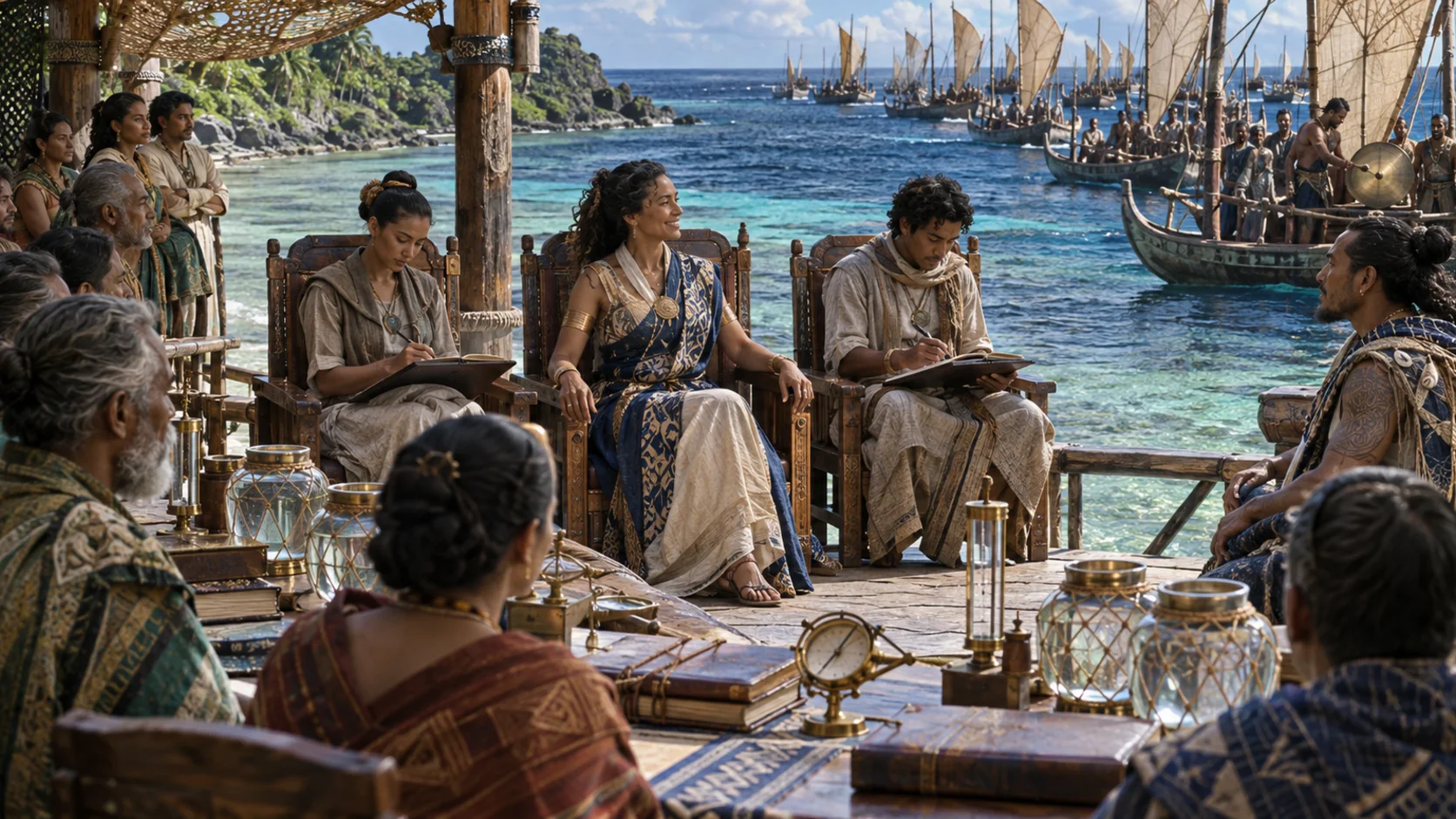
Three chairs stood empty between the delegations.
Councilor Mara Vey thought the chairs were an omission. The sea people had travelled six days; leaving guests to stand looked like an insult. She asked two clerks to sit and took the third chair herself, smiling toward Navigator Sefa Koro.
The lagoon went silent. On the nearest vessel, a brass disk struck the deck once.
Sefa did not sit. She untied the blue cord at her wrist and laid it across the table. Behind her, forty masts lowered their rescue pennants.
MaraWhat have I done?
The interpreter, Nilo Esen, answered too quickly.
NiloYou accepted the open duties.
MaraAccepted what duties?
Sefa pointed beyond the platform to the pale crescents under the water.
SefaStewardship of the north wells. Passage through the coral gates. Emergency draw from the three sweet reefs.
The water delegates rose. Those reefs supplied eleven thousand people; one bad channel could turn five settlements brackish.
Mara stood from the chair as if it had burned her.
MaraWe accepted nothing. We filled seats for guests.
SefaAn empty seat is a duty kept open until someone takes it.
Sefa said through Nilo.
SefaYou took all three.
MaraAn empty seat means welcome here.
SefaThen your welcome claims our unanswered burdens.
Above the table, the storm buoy began its hourly pulse. A tropical wall was forming two days east. At eighteen hundred, when the sun touched the outer shoal, the old rescue compact expired. Without renewal, the island councils could not command the ocean nation's deep-draft vessels, and the ocean nation could not shelter in the island harbours without separate permission from every settlement.
The first nursery boats—families travelling between flotillas with the season—had entered the storm corridor at midnight. Eight were due by eighteen hundred; three more were expected by eighteen thirty, when an expired compact could leave them without coordinated harbour protection.
Governor Tal Orri pushed the island claim book away.
TalNo agreement made by a chair will bind us.
Sefa's deputy, Navigator Pol Reka, answered.
PolThen no agreement made by your signatures will bind us. Your marks do not speak aboard our vessels.
Illuminara had watched from the edge of the platform, beside the freshwater cooperative's mechanic, Iri Vale. She touched neither chair nor ledger.
IlluminaraBefore anyone explains what the other side meant, name what cannot be decided by explanation.
Iri held up a jar of clear reef water.
IriNo protocol may make silence, absence or courtesy count as consent to a water claim.
Sefa laid a hand on the blue cord.
SefaNo protocol may erase an obligation merely because the person who carries it is not in the room.
Mara looked at the lowered rescue pennants and the dark line of weather.
MaraAnd no one loses the right to refuse because the clock is cruel.
02 · What an Empty Place Holds
Old sail loft · time unstated
They moved the council into the old sail loft, where the floor could be marked without the tide washing the marks away. Each side drew its political language before trying to translate it.
Mara drew the island rule first: a filled chair meant presence and welcome; a signature bound only its signer; an empty chair could not vote; every affected water cooperative kept its own seal.
Sefa drew the maritime rule beside it. An empty chair kept a burden visible. Sitting there meant carrying its question until refusal or plan—not agreeing to perform the duty, as Nilo's translation had implied.
MaraSo we did not grant the reefs?
Pol's expression did not soften.
PolYou accepted the duty to answer our claim. Then your clerks entered the chairs in your ledger as votes in favour.
Tal turned on the clerks. They showed him the council rule: any visiting delegation seated at the central table counted toward quorum. The island system had transformed a maritime question into a local vote.
IlluminaraTwo systems made the mistake together.
IriA convenient mistake. Their cisterns are low. Their fleet needs water.
Pol stepped forward.
PolYes. We need water. Do not hide that fact inside your accusation, as if need makes every word a trick.
The storm buoy pulsed again. Eleven hours and forty minutes remained before the compact expired.
Illuminara asked for the explanation each side least wanted. Iri named strategic ambiguity; Pol named the islands' habit of calling unfamiliar limits misunderstandings.
IlluminaraBoth mechanisms can be real. Different meanings can cause an error, and strategic pressure can decide who benefits from leaving it uncorrected.
On sailcloth she sealed two predictions before a test was chosen: translation alone would yield agreement without concession; pressure alone would survive clearer words; both together would stabilise meaning but leave the resource dispute visible.
Sefa studied the predictions.
SefaHow do we test without letting the test bind the reefs?
IlluminaraWith something small enough to reverse and real enough to disappoint someone.
Mara pointed to a drifting rescue marker. Island pilots wanted it inside the eastern channel; ocean navigators needed turning room outside. It was reversible, but its position decided which boats waited in the storm.
MaraA live dispute. Not a lesson.
IlluminaraBefore anything binds, each side restates the other's meaning within three minutes. One objection, and nothing binds.
Pol glanced at the empty chairs.
PolWho measures the three minutes?
Iri set her mechanical kitchen timer on the floor.
IriSomeone whose wells are at stake and whose clock cannot be persuaded.
03 · The First Vocabulary Fails
Council in the sail loft · before the marker test
Both peoples used bowls in public decisions: island green meant assent, red refusal, white a question. The ocean nation placed answers beside filled chairs and questions before empty ones.
Mara set the rescue marker on a chart. Sefa put a white bowl before an empty chair. Mara placed green beside her own.
MaraWe agree to discuss it.
The navigators began rolling up the chart.
Nilo closed his eyes.
NiloThey think you accepted their position.
MaraI accepted the question.
SefaA question belongs before the empty chair. Green beside you is an answer.
Their first protocol had failed before the timer turned. Pol laughed without pleasure.
PolWe invented a clearer way to make the same mistake.
Tal demanded written clauses. Sefa refused to make crews who read wind knots and water marks depend on shore-trained lawyers.
Illuminara removed the bowls.
IlluminaraOne colour is carrying both the type of speech and its force.
She asked Nilo to translate three statements separately: I heard you; I can predict what you will do; I agree that you may do it.
The island language separated them. In the ocean council register, the last two shared a verb whose image was to set one's weight behind a mast. Nilo had translated it as agree in nine treaties. He also admitted that ocean readers treated at least four island attendance signatures as promises.
Mara put the chairs against the wall.
MaraNo more compressed meanings.
They kept white for questions, blue for restatement and red for refusal, then proposed pouring water together for consent.
Iri rejected it.
IriWater as the sign of consent in a water dispute is coercive theatre.
Pol agreed: a crew with an empty cistern should not pour away what it needed to say yes. The second design failed.
Sefa offered her vessel's brass disk. Mara threaded blue sailcloth through its centre so consent would be both sounded and seen, but only after mutual restatement.
They had built no agreement. They had made two bad agreements impossible.
04 · Three Minutes at the Red Marker
Harbour mouth · from 11:41
At eleven forty-one they carried the protocol to the harbour mouth, where the marker rolled between a paired route for island boats and a turn wide enough for rescue vessels but across a fishing lane. The storm warning changed to approach; nursery boats in the corridor reported squalls.
Sefa made the first proposal: move the marker one hundred and twenty metres east until the last nursery vessel entered harbour, then restore it before the evening fishing return.
Mara placed white before the empty chair, Sefa placed blue beside Mara, and Iri turned the timer.
MaraYou are asking us to close half the island channel for six hours so your deep vessels can turn. Our small boats may still enter one at a time under pilot control. At eighteen hundred the marker returns, whether or not every rescue vessel has arrived.
Sefa answered before the third minute.
SefaAlmost. The return condition is the last nursery vessel, not the clock. If one is late, we keep the channel.
The timer rang. No consent.
Tal exhaled sharply.
TalThen the test proves your proposal is unacceptable.
IlluminaraIt proves the proposal was not yet understood. Refusal comes after understanding, not in place of it.
Mara opened a second round.
MaraThen I refuse an unlimited delay. My counterproposal: the marker moves for six hours. A late nursery vessel takes the northern entrance with two island pilots. You may refuse that risk.
Sefa placed the blue bowl. Pol turned the timer.
SefaYou will move the marker east now. At eighteen hundred it returns. If a nursery vessel remains outside, two pilots from your harbour—not ours—board it beyond the reef and bring it through the northern entrance. The island council accepts the pilot risk; the vessel's master keeps the right to refuse the northern route.
Mara nodded once.
Mara placed blue for the return restatement, and the timer began.
MaraYou accept the six-hour move, but you do not surrender command of a late vessel. Its master may wait outside or choose the northern route after the island pilots report conditions. Refusing the route does not cancel rescue cooperation.
Sefa pulled the blue bowl nearer.
Neither struck the disk.
IriYou both understood.
Mara and SefaUnderstanding is not consent.
Sefa asked the nearest nursery master by radio whether the northern entrance was acceptable. The answer came through static: acceptable only if the outer wave sensor stayed below two point four metres.
The island pilots agreed to that threshold. Iri wrote it beside the timer. Only then did Mara and Sefa pull the blue cloth through the brass disk together. It rang once, and the marker crew started its engine.
The test had taken nineteen minutes. At exactly noon the six-hour move began. Island skiffs queued but did not stop; two deep rescue vessels turned without crossing the fishing lane. Every participant could say what would end the arrangement.
Pol watched the marker settle into its new position.
PolThe words worked.
Iri shook her head.
IriThe limits worked.
IlluminaraBoth. Now ask whether they still work when the answer costs water.
05 · The Need Inside the Misunderstanding
Council negotiations · time unstated
Sefa opened the sealed cistern records. Hail had destroyed three flotillas' roof catchments. The driest held one hundred and eight thousand litres—nine days at twelve thousand daily—and needed another one hundred and forty-four thousand to reach twenty-one days.
Pol's log showed he had asked about reef water twelve days before the chairs were filled.
PolEven with perfect understanding, we would still need an answer.
The marker test proved translation mattered; the dated request proved pressure predated the mistake. Both sealed predictions survived.
Iri spread maps of the sweet reefs. A single emergency draw would not poison them. A permanent channel might. The claim recorded by the island ledger granted seasonal access without a volume limit.
MaraSo the misunderstanding was real, and the advantage was real.
SefaYes. Do not make us choose which truth lets you respect us.
Tal proposed water from the main island reservoirs in exchange for abandoning every reef claim. The freshwater cooperatives refused; their reservoirs were already rationed. Pol proposed a temporary channel at the northern reef. Iri refused; the first cut would create a salt path no treaty could close.
The compact had five hours and six minutes left.
Illuminara asked what each side could lose without losing itself. The question angered everyone, which was why she kept it.
The ocean nation could share one eastern-shoal fishing season; the islands could lend six drought condensers if the flotillas supplied crews and sailcloth. Fishing paid for risk, not water.
Illuminara found two entries everyone else had read separately: the flotillas expected to discard ninety-six thousand litres of salt-dusted first rain at the storm's lowest forecast, and their mast inventory listed forty-three spare resin seals. She first suggested sealing the collection mouths; Iri refused because trapped salt would foul them. Illuminara then asked whether the island cooperatives' charcoal-and-fibre first-flush gates could take the mast resin instead: replaceable fibre would hold the salt while water passed through. Iri cut a test groove; Sefa surrendered one seal from her own vessel. Under brine pressure it held.
The children counted forty gates while Iri and Pol checked the ledger aloud. Six condensers guaranteed thirty-six thousand litres in forty-eight hours; the gated first rain supplied at least ninety-six thousand; a separately sealed surface reserve was capped at thirty thousand. One hundred and sixty-two thousand against a one-hundred-and-forty-four-thousand shortfall: twelve and a half percent spare. The shared fishing season paid for equipment and risk; it was not entered in the water column.
Pol objected.
PolWe surrender a season on a forecast.
IriWe lend drought equipment on your records. Risk is not disrespect merely because it is mutual.
Pol looked toward Sefa. She did not rescue him from the choice.
The low-stakes marker test had separated meaning from assent. Now the strategic dispute stood bare: who would carry the uncertainty of rain.
Illuminara marked her design's weakest line: swollen resin could jam the gates. Iri required a six-hour soak of three seals; Sefa accepted the delay but capped the contribution at forty. Illuminara revised the plan. Need became measurable enough to negotiate.
Mara placed the white bowl before an empty chair.
MaraQuestion open: will you accept the equipment plan, the shared fishing season and the sealed surface reserve instead of any reef claim?
Sefa placed the blue bowl.
SefaFirst, each side predicts the other's obligations. Three minutes.
06 · No Silence Is a Yes
Council negotiations · from 17:31 in the third round
They needed four rounds. The first added safe lanes to the fishing access; the second put two cooperative seals between a failed storm and any reserve release.
At seventeen thirty-one, in the third round, Mara said.
MaraThe reef claim is withdrawn.
Pol placed the red bowl between them.
PolNo. A withdrawal says we possessed a right that you later took away. Your courts could call us violators for returning; ours could demand compensation for losing it. I will not bind rescue to a false history.
Iri turned the timer. Mara answered.
MaraYou say no reef right ever formed because the chairs could not consent. We record the ledger entry as void, not revoked. You may return to the water question, but returning creates no answer.
Pol reached for the blue cloth, then stopped.
PolAnd the duty held by the empty chair?
The timer rang before Mara could answer. Nothing bound. They had spent three minutes and lost the round.
On the restart, Nilo restated the chair itself.
NiloIt keeps a question visible. It grants no right and no answer. No person may fill it for another. Removing it records only that the question has been answered, refused or explicitly deferred.
Iri added.
IriAnd absence never counts as any of those.
SefaCorrect.
At seventeen forty-one, the freshwater cooperatives approved the equipment plan one by one, each keeping a red bowl within reach. The fifth marked assent only after reducing the surface reserve assigned to its settlement. The ocean delegation accepted the change and increased the fishing share; an unanswered bowl or a vessel master's refusal would still bind no one and would not end rescue cooperation.
At seventeen forty-seven, the navigators approved. At seventeen fifty-two, eight minutes before expiry, Pol was last. He put his hand on the blue cloth, then stopped.
PolIf the rain fails and the reserve fails, we return to the water question.
MaraYou may always return to the question. Returning does not create an answer.
Pol looked at the empty chair.
PolCorrect.
He pulled.
The disk rang. Five cooperative bells answered from the harbour offices. On the vessels, the rescue pennants rose again.
No one sat in the empty chair.
07 · The Seats That Remained
Lagoon and council platform · evening, then before the next rescue season
One nursery vessel reached the roadstead at seventeen forty-six. Its master refused the northern entrance at a two-point-six-metre wave reading. Pilot Deva Orr moved her skiff from its unloading berth into the escort position; her crew would unload by hand after dark. At eighteen hundred the marker returned and the vessel entered the reopened eastern channel. Three later vessels followed under the renewed pact by eighteen thirty.
No one treated the refusal as a betrayal.
Rain came at dawn, hard enough to flatten the harbour flags. The new gates ran brown for nine minutes as their replaceable fibre loaded with salt, then clear. Children held lamps behind the filters and called the change. They recovered one hundred and one thousand four hundred litres; the six condensers supplied thirty-five thousand six hundred more over forty-eight hours.
The reefs remained uncut. With seven thousand litres still missing, Iri's cooperative chose to release eight thousand from the sealed reserve. Rain, condensers and reserve therefore supplied one hundred and forty-five thousand litres, leaving a one-thousand-litre margin. The driest flotilla held two hundred and fifty-three thousand litres: twenty-one days at its recorded draw, plus that margin.
In the eastern shoals, nets snagged and arguments multiplied. Red bowls appeared seven times; after six refusals, fishing continued elsewhere.
Nilo revised nine treaties, expanding compressed verbs into heard, predicted and consented. Attendance signatures moved to a different page from promises.
Mara kept the chairs in the sail loft. When visitors tried to fill them, a clerk placed a white bowl and explained that the seats held unanswered duties. Courtesy carried no legal force.
Sefa returned before the next rescue season. She brought the brass disk, its centre polished by many hands. At the council platform she found Illuminara examining a crack in one of the old green bowls.
SefaYou did not give us a common language.
IlluminaraNo. You built a way to discover when you did not have one.
Across the lagoon, Iri and Pol were arguing over the placement of a new rain gauge. The timer stood between them. Neither looked pleased.
Sefa listened until the timer rang and both began again.
SefaAnd if the method fails?
Illuminara set the cracked bowl aside rather than mending it.
IlluminaraThen the failure must be allowed to say no.
The three chairs remained empty in the morning light. They no longer looked abandoned. Between them stood a white bowl, a strip of blue cloth and a red bowl no one had hidden.
Beyond the platform, rescue pennants and fishing markers moved on the same wind without becoming the same thing.